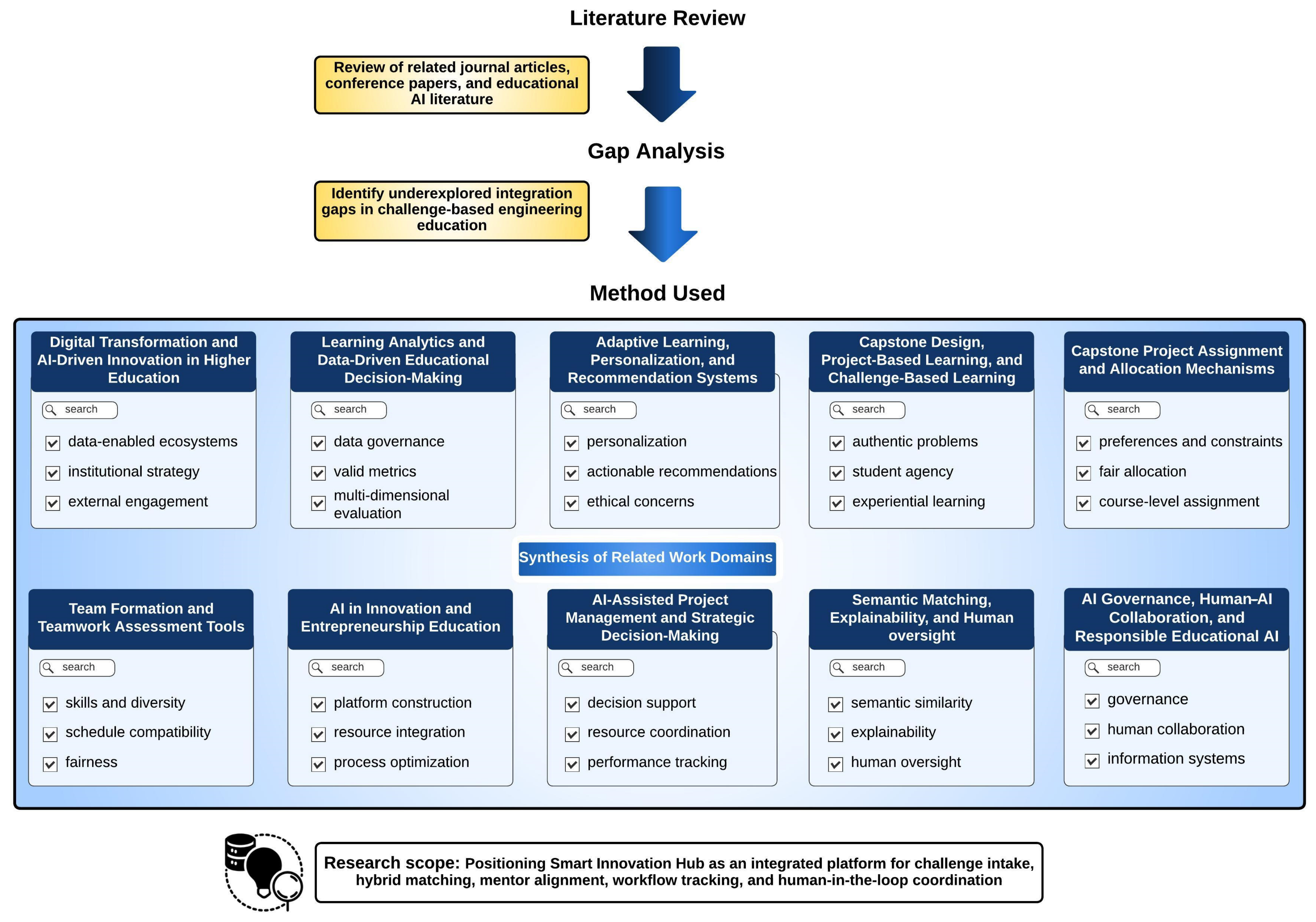
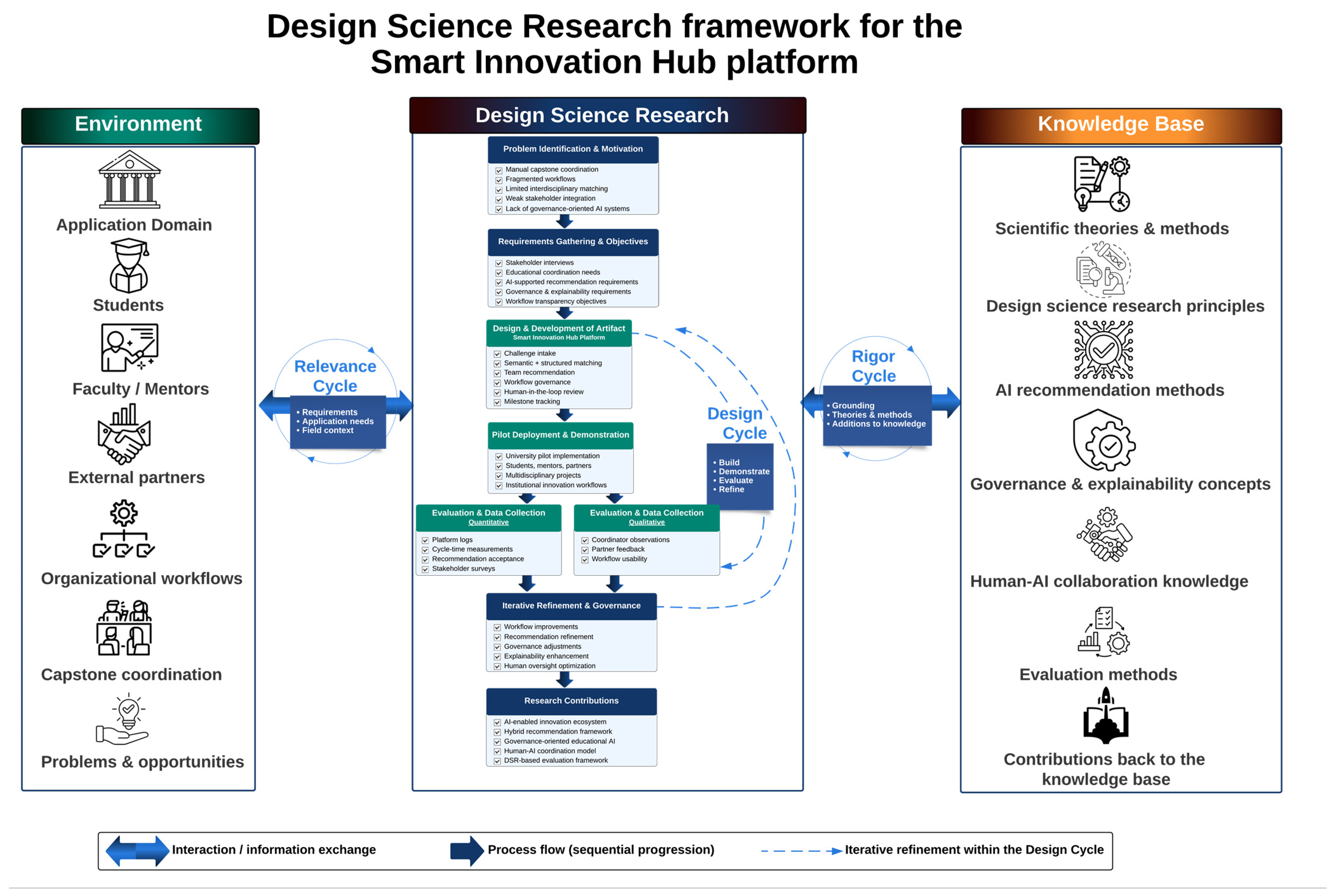
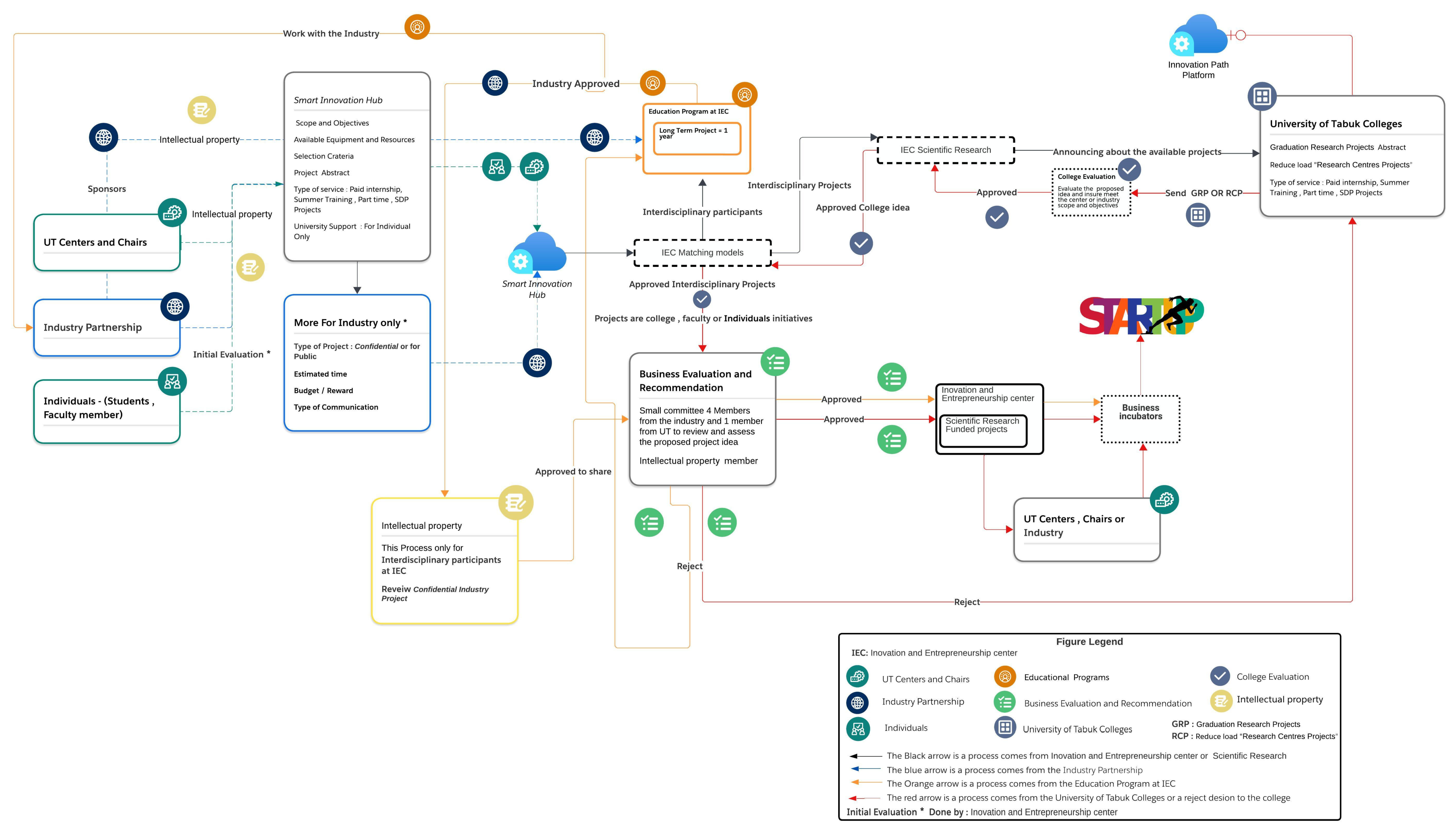
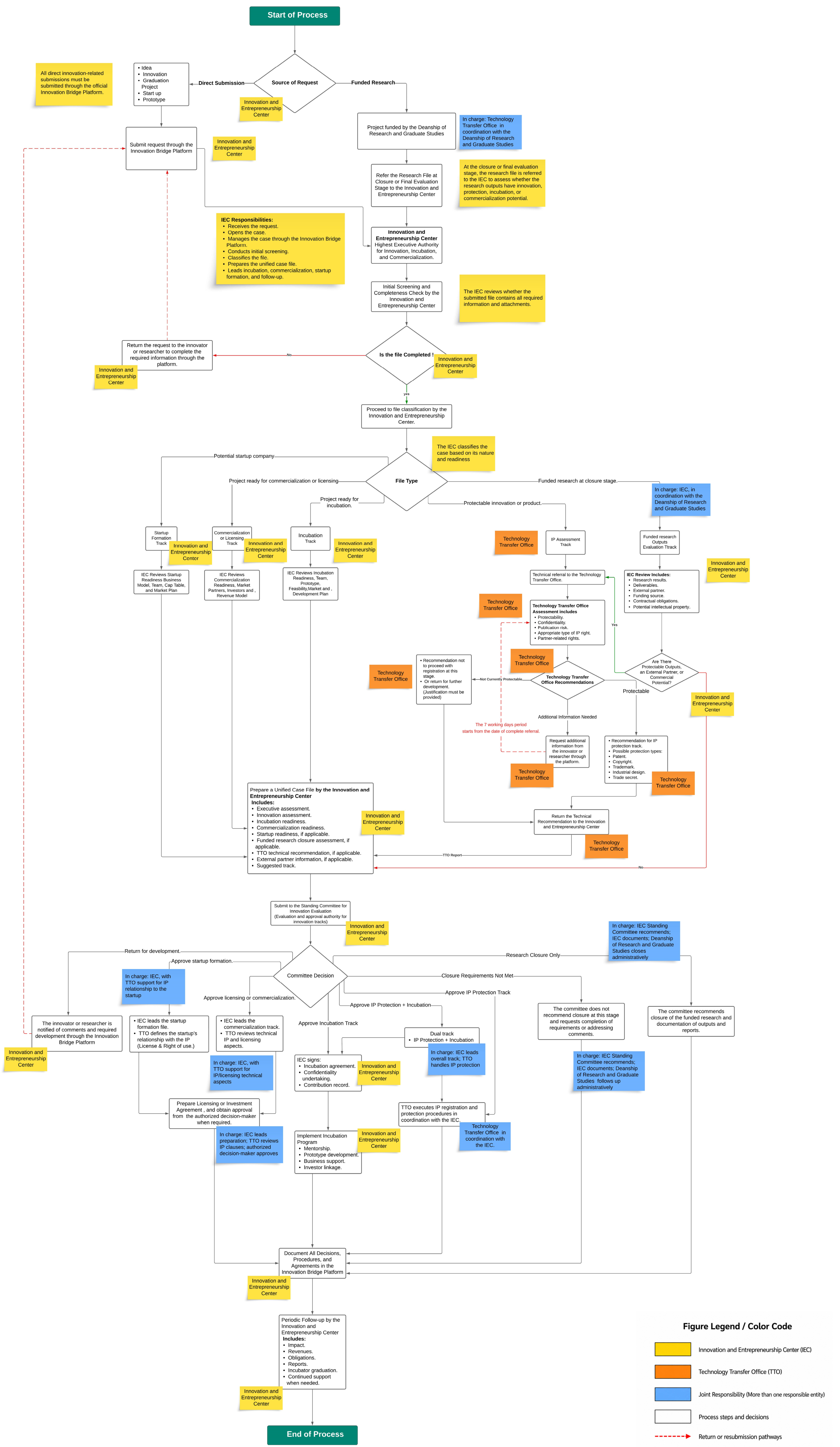
The core operational capability of the Smart Innovation Hub lies in its AI-supported recommendation and coordination framework, which was designed to support transparent, interdisciplinary, and governance-oriented matching among challenges, students, mentors, research entities, and institutional resources. Unlike conventional capstone-assignment systems that rely primarily on manual coordination or isolated optimization rules, the proposed framework integrates semantic similarity analysis, structured eligibility filtering, interdisciplinary balancing, workflow governance, and human-in-the-loop review within an integrated recommendation architecture.
The recommendation architecture combines structured participant attributes with semantic representations extracted from unstructured textual information such as challenge descriptions, project abstracts, participant interests, mentor expertise statements, prior project summaries, and innovation narratives. This hybrid approach enables the platform to capture both explicit eligibility constraints and implicit semantic relationships that may not be represented through structured fields alone.
4.6.1. Inputs and Representations
The Smart Innovation Hub recommendation framework was designed to support multidisciplinary, governance-oriented, and challenge-driven educational coordination workflows. Unlike conventional capstone-assignment systems that rely primarily on manual coordination or isolated optimization rules, the proposed framework integrates semantic similarity analysis, structured eligibility filtering, interdisciplinary balancing, workflow governance, and human-supervised review mechanisms within a unified recommendation architecture. For each challenge or initiative, the platform aims to generate a ranked list of feasible and governance-compatible project configurations. A configuration may include a multidisciplinary student team, one or more faculty mentors, and, when appropriate, associated research centers, laboratories, or institutional resources. The recommendation process is designed to satisfy operational constraints while maximizing semantic alignment, interdisciplinary compatibility, workflow feasibility, and stakeholder relevance.
The recommendation problem is therefore treated as a constrained hybrid recommendation and coordination problem rather than a simple classification or allocation task. The framework simultaneously processes structured institutional data, unstructured textual information, multiple stakeholder requirements, structured workflow constraints, and human-supervised review activities. Consequently, the platform was intentionally designed as a decision-support system in which AI-generated recommendations remain transparent, explainable, reviewable, and auditable rather than fully autonomous.
The matching engine consumes two primary categories of information:
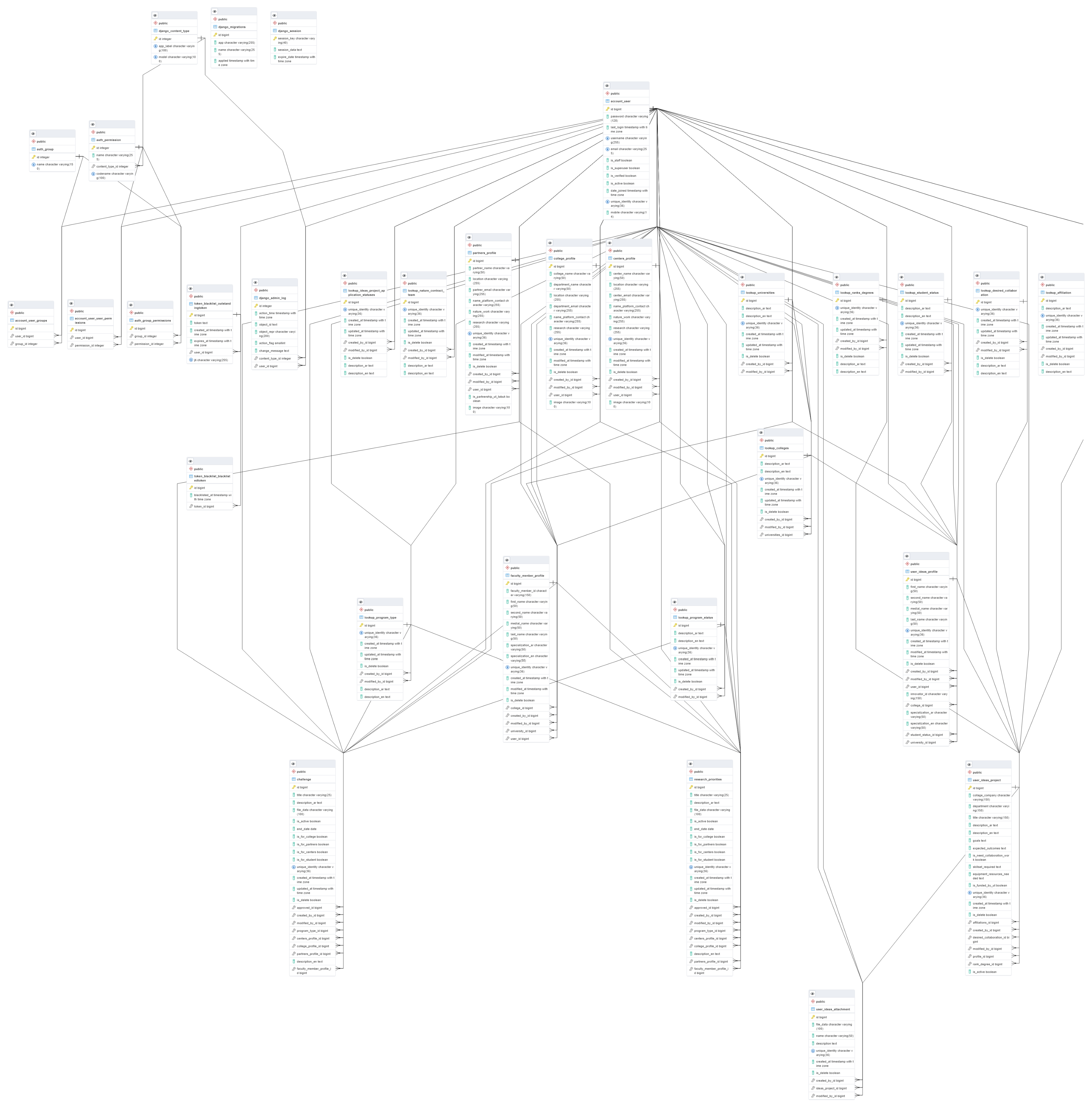
Table 3 summarizes representative entities, attributes, and operational roles within the Smart Innovation Hub recommendation framework.
Structured attributes are normalized and encoded into feature vectors to support compatibility evaluation and eligibility filtering. During the pilot implementation, semantic similarity analysis was conducted using transformer-based multilingual sentence-embedding techniques to represent challenge descriptions, participant profiles, mentor expertise, and project metadata as vector representations. The implementation supported both Arabic and English textual content commonly used within the university environment. Cosine similarity was used as the primary semantic similarity metric during recommendation ranking. Structured constraints such as discipline eligibility, mentor capacity, availability, project preferences, and interdisciplinary composition requirements were integrated alongside semantic similarity scores within the recommendation workflow. The implementation was intended to support workflow coordination and pilot deployment activities rather than optimization-focused benchmark evaluation. The pilot emphasized practical workflow coordination and explainable recommendation support rather than comparative benchmarking across multiple embedding architectures.
The hybrid semantic-structured strategy improves recommendation quality because challenge-based educational innovation environments contain both explicit institutional constraints and ambiguous contextual information that cannot be adequately represented using rule-based allocation alone. The semantic layer enables the platform to identify hidden conceptual relationships among participants and projects, while the structured layer preserves operational feasibility, governance requirements, fairness considerations, and institutional policies [
5,
6,
9,
22,
23].
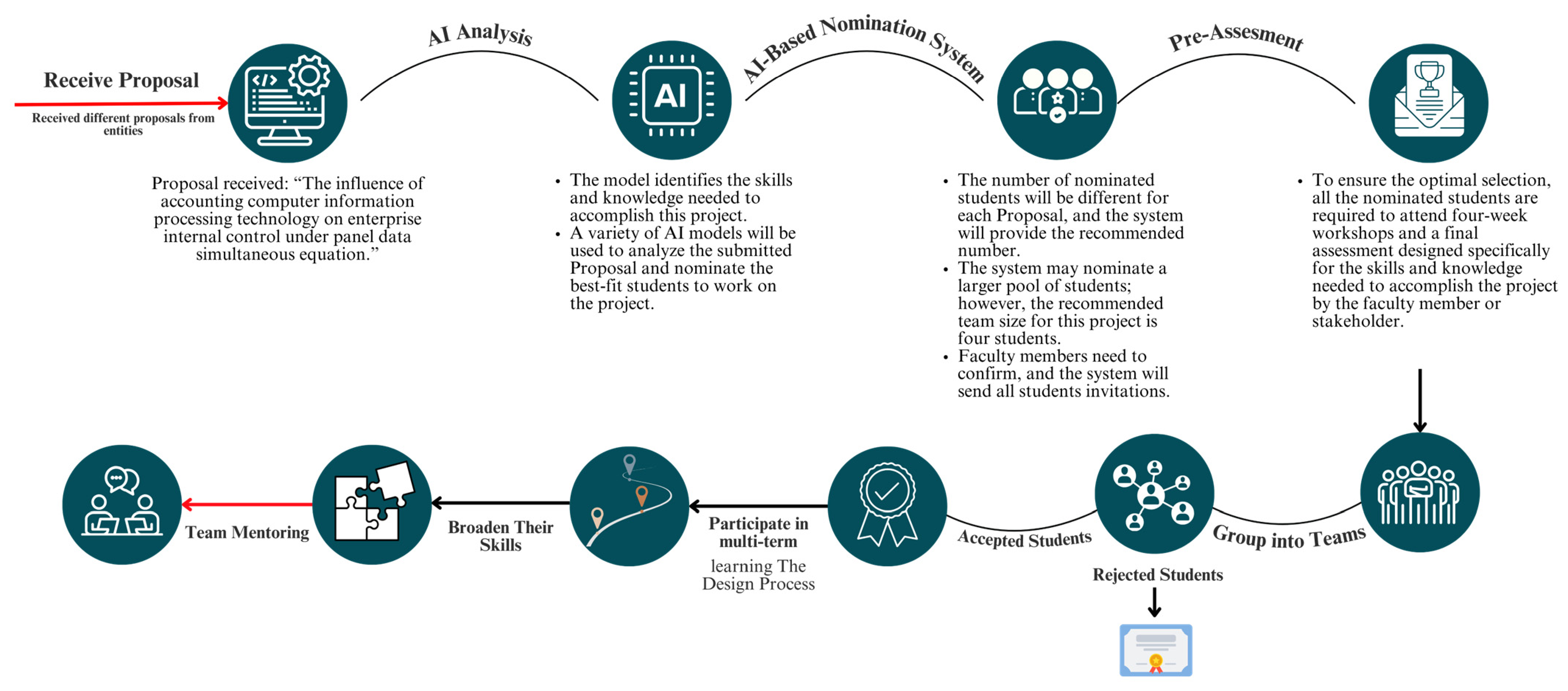
The recommendation workflow begins with challenge intake and participant-profile enrichment. Structured challenge attributes include disciplinary requirements, technical skills, timelines, confidentiality conditions, commercialization potential, and partner expectations. Participant profiles include academic discipline, technical competencies, completed coursework, certifications, innovation interests, research experience, and textual portfolio descriptions. These data are processed through a hybrid recommendation pipeline integrating semantic similarity analysis, structured compatibility evaluation, interdisciplinary balancing, mentor alignment, and governance-oriented filtering mechanisms.
The overall recommendation score was calculated as a weighted hybrid compatibility function integrating semantic similarity, structured compatibility, interdisciplinary balance, mentor alignment, and governance-related constraints:
where
Represents the final composite matching score assigned to a candidate project–team–mentor configuration. It combines semantic similarity, skill alignment, preference alignment, team diversity, and mentor workload balance into a single score used to rank feasible recommendations.
: Represents the semantic similarity between the challenge description and the participant-profile text.
Represents the weighted overlap between required and available skills.
Captures the alignment between declared student, mentor, and partner preferences.
Reflects disciplinary diversity and complementarity within the candidate team.
Represents the mentor workload-balance term.
The weights , , , , and define the relative contribution of each component to the final score. These weights were adjusted iteratively during pilot deployment based on coordinator feedback, workflow observations, and operational feasibility considerations. Because the pilot represented an exploratory institutional implementation, the scoring framework should be interpreted as an adaptive governance-oriented recommendation mechanism rather than a fixed optimization model.
The staged recommendation workflow provides several operational and governance-oriented benefits. It reduces ambiguity during challenge intake, improves transparency in recommendation generation, preserves auditability of workflow decisions, and enables longitudinal evaluation of project outcomes and coordination effectiveness. The workflow also enables the platform to support multiple categories of initiatives, including capstone projects, research-center projects, industry challenges, entrepreneurship opportunities, innovation competitions, and commercialization-oriented activities.
Figure 6 illustrates the AI-supported hybrid semantic-structured recommendation workflow implemented within the Smart Innovation Hub. The workflow integrates challenge intake, participant-profile enrichment, structured filtering, semantic similarity analysis, interdisciplinary balancing, governance-oriented evaluation, recommendation ranking, and human-supervised review activities within a unified recommendation pipeline.
To further demonstrate the operational implementation of the Smart Innovation Hub,
Figure 7,
Figure 8,
Figure 9,
Figure 10,
Figure 11,
Figure 12 and
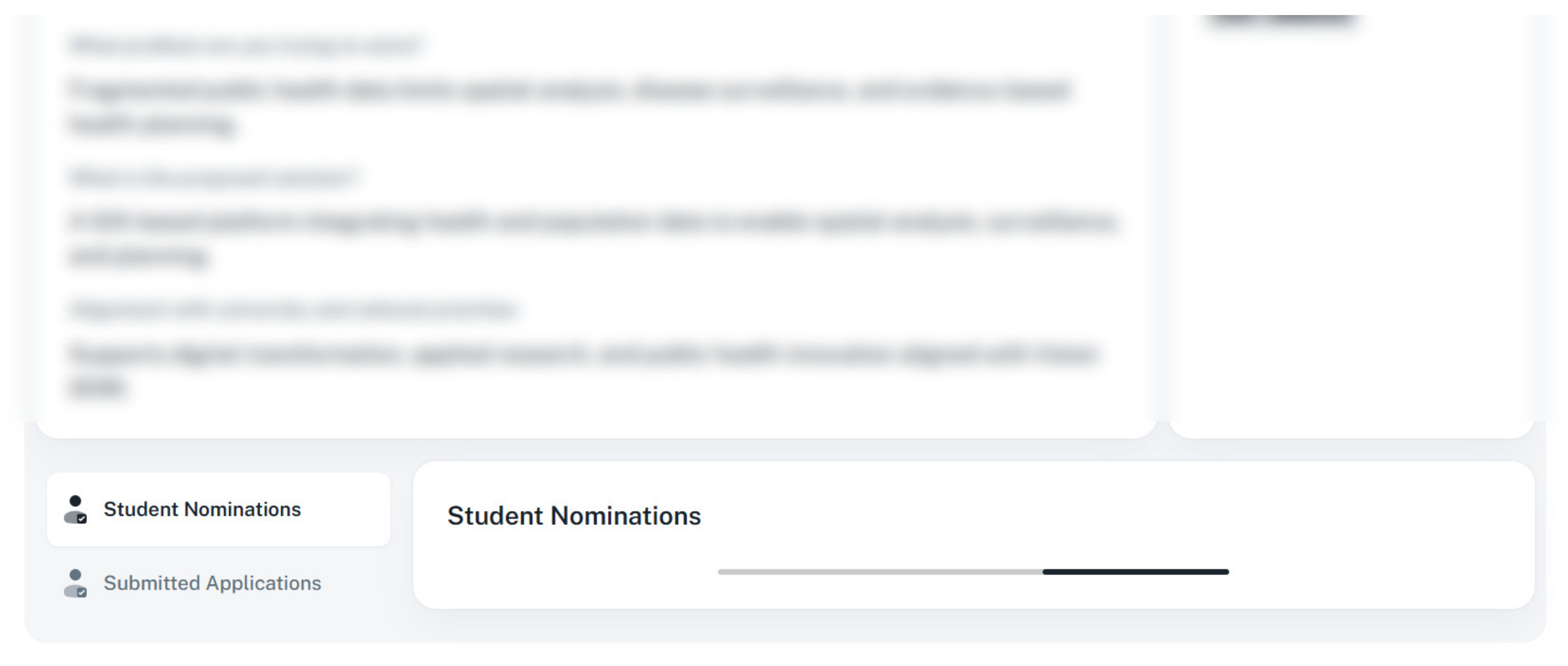
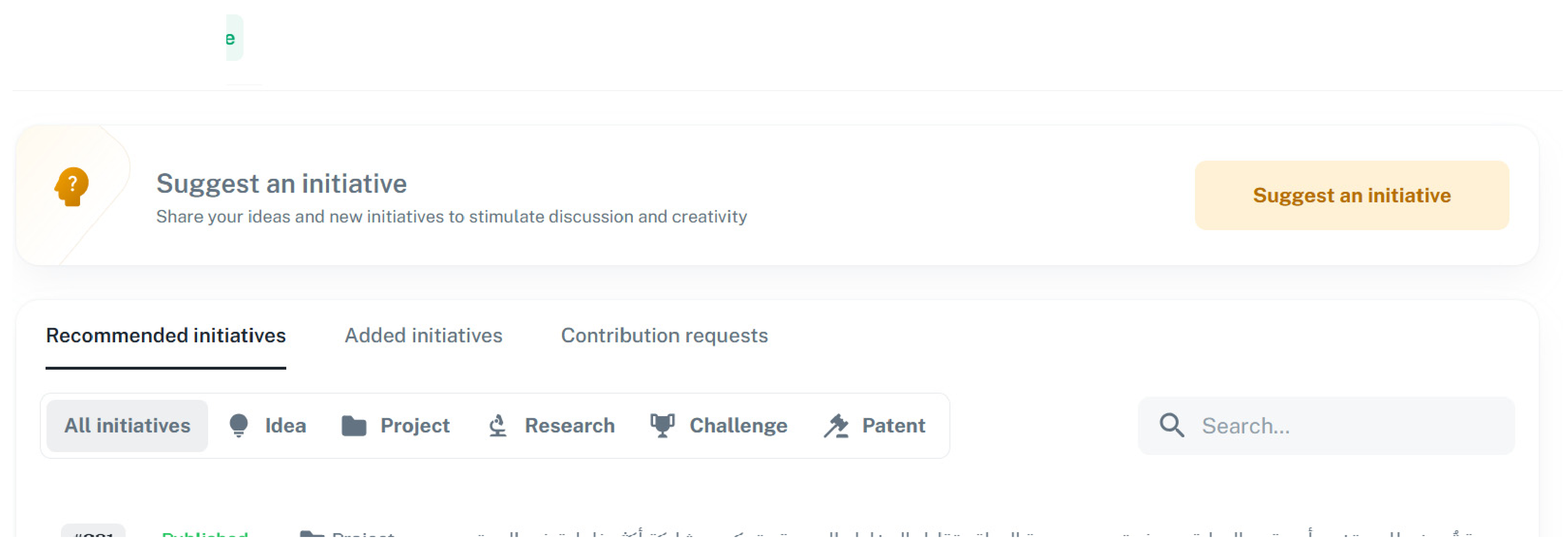
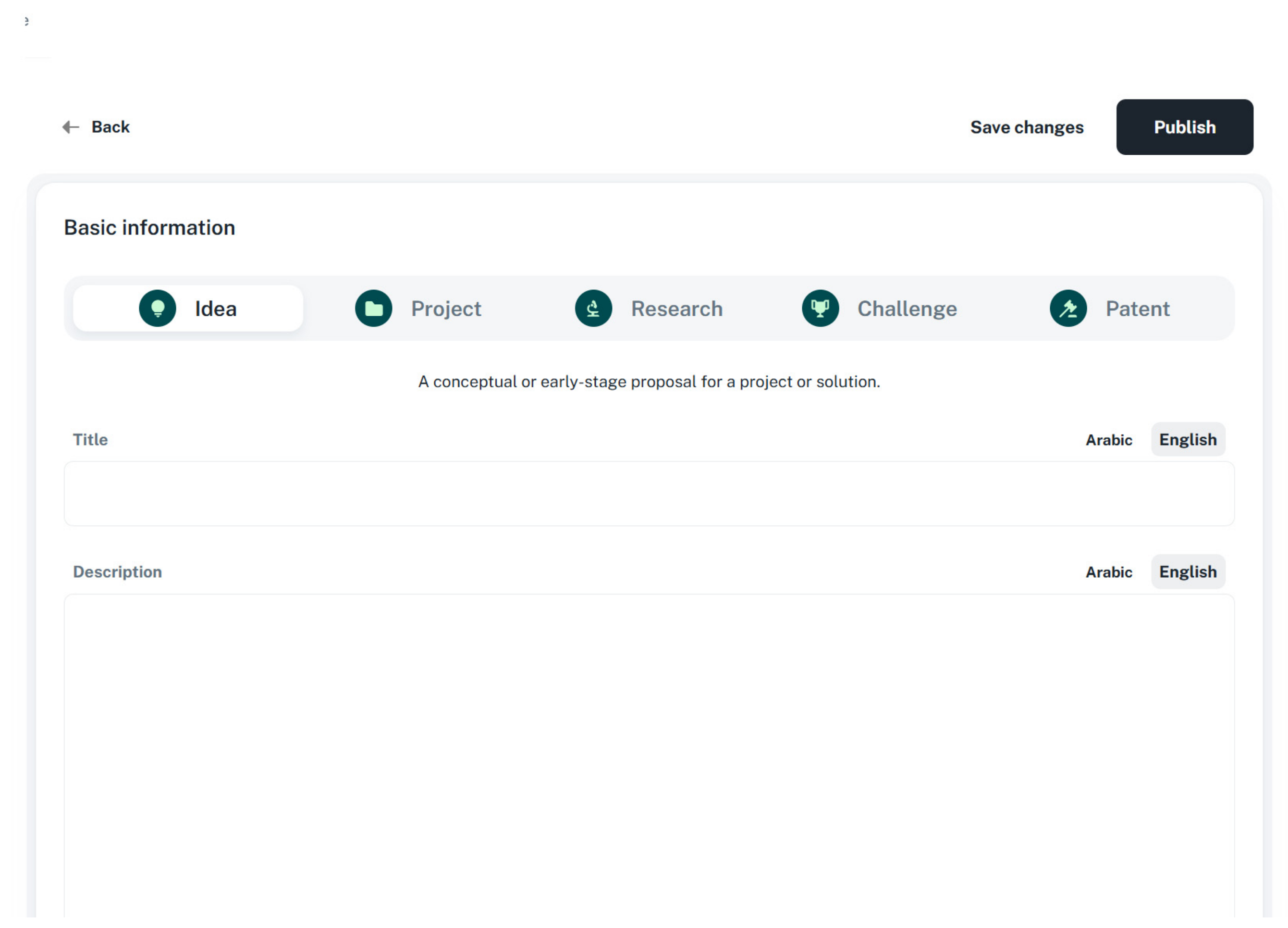
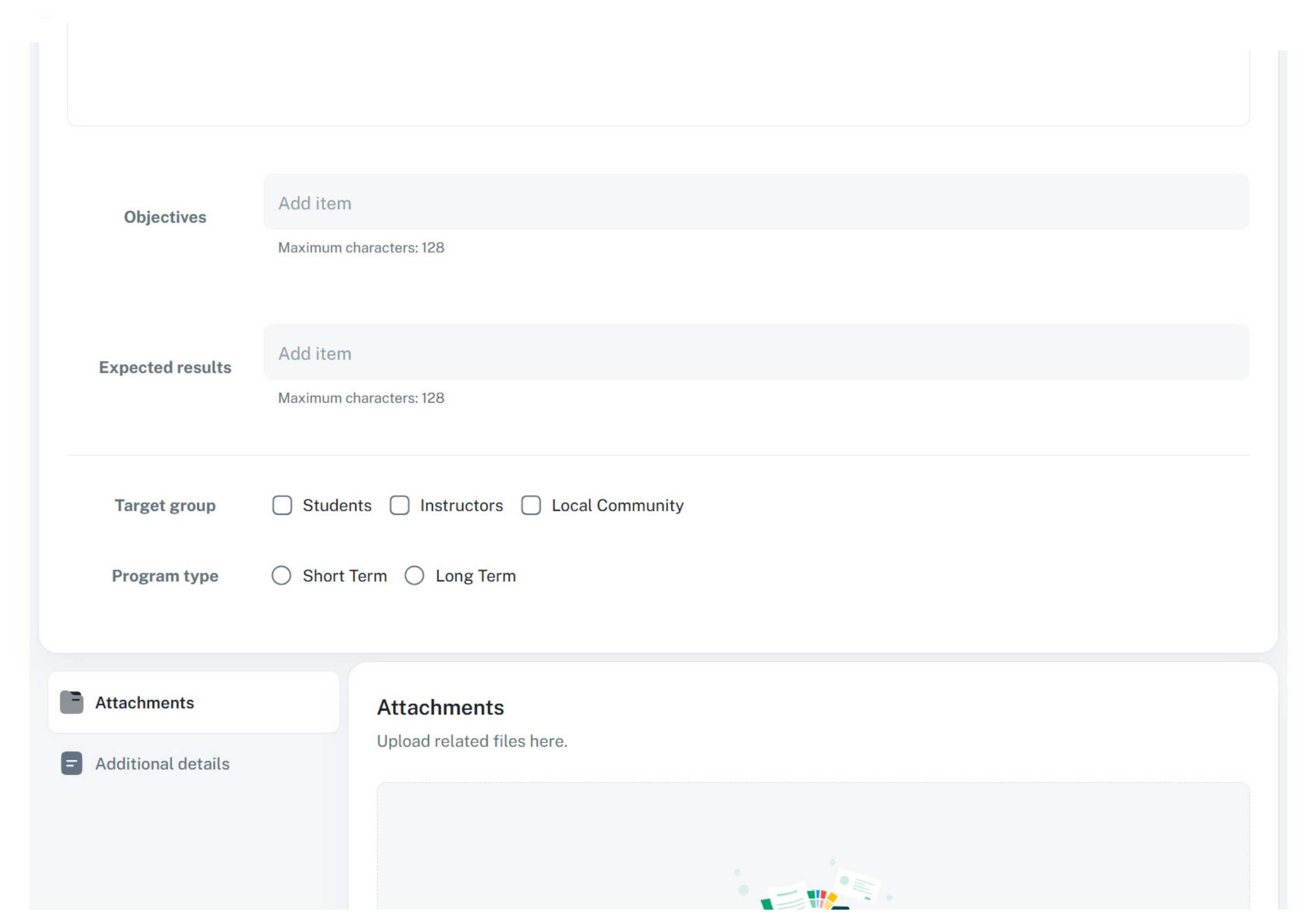
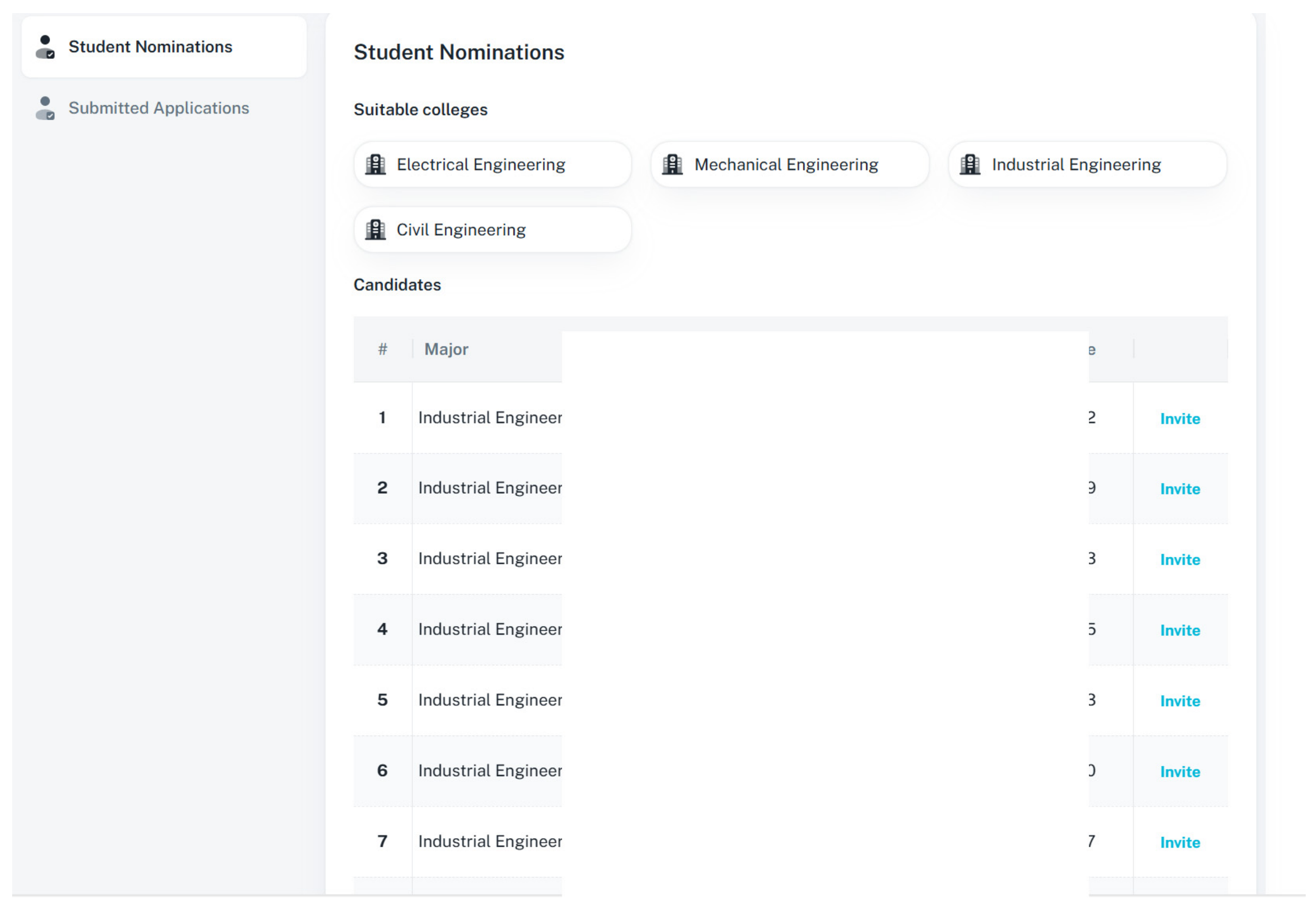
Figure 13 present anonymized screenshots from the deployed pilot environment. These figures illustrate how the platform supports initiative discovery, challenge submission, metadata structuring, workflow coordination, bilingual initiative management, contribution requests, and AI-supported nomination processes within the broader innovation ecosystem.
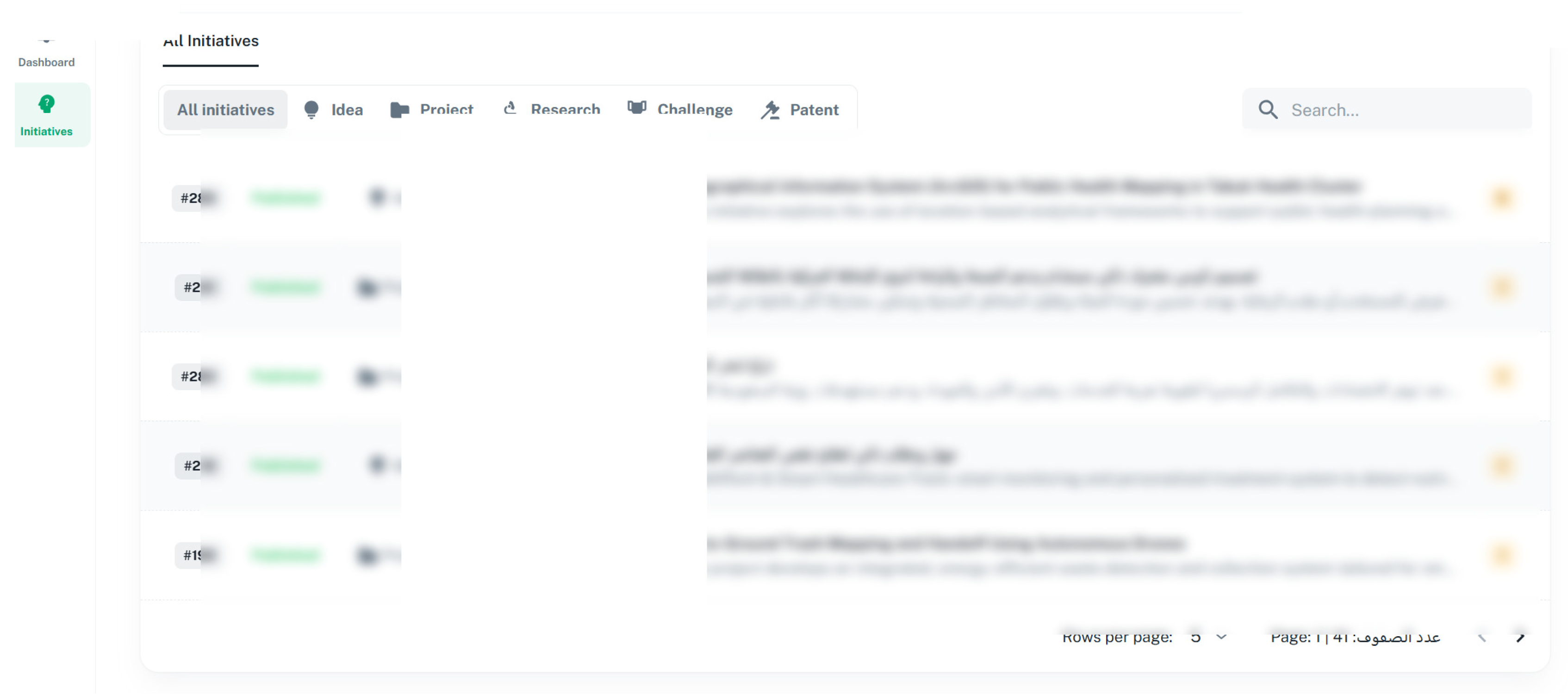
The initiatives dashboard serves as the central discovery and coordination interface within the Smart Innovation Hub ecosystem. Users can browse and filter initiatives across multiple categories, including ideas, projects, research initiatives, patents, challenges, and commercialization-oriented activities. Type-based filtering and keyword-search functionalities improve accessibility, initiative discovery, and workflow visibility while reducing administrative overhead for coordinators managing large numbers of submissions.
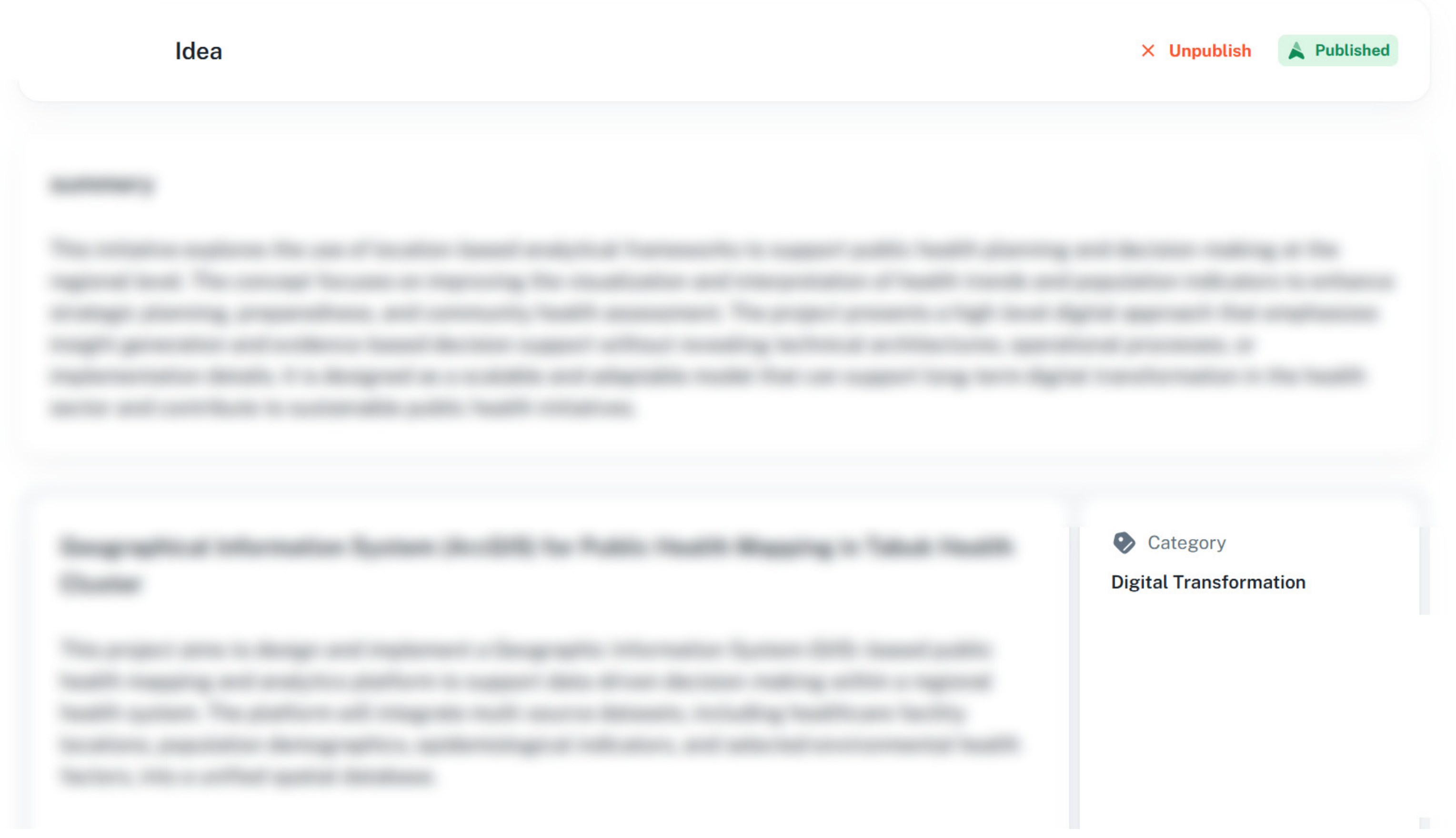
The initiative-detail interface standardizes how submissions are represented for downstream recommendation, governance review, and evaluation activities. Narrative summaries capture contextual information, while structured metadata fields support filtering, reporting, feature extraction, and interoperability within the AI-supported recommendation pipeline. Publication-control mechanisms further support structured workflow management and quality-assurance activities.
For challenge-driven educational workflows, the platform guides coordinators and partners to structure challenge statements, expected outcomes, solution directions, and institutional-priority alignment within standardized templates. This improves the quality and consistency of textual information used during semantic matching and recommendation generation while supporting later evaluation of challenge outcomes, workflow alignment, and project feasibility.
The platform home interface supports initiative discovery, engagement visibility, and multidisciplinary collaboration across the broader innovation ecosystem. Recommended initiatives and contribution-request mechanisms enable students, mentors, and external stakeholders to identify suitable collaboration opportunities while reducing the coordination cost associated with interdisciplinary participation and partner engagement.
Initiatives can be submitted through a structured wizard that begins with selecting the initiative type (idea, project, research, challenge, or patent) and entering core metadata such as title and description. The bilingual input option (Arabic/English) supports inclusive participation and enables higher-quality text matching when the platform is used in multilingual contexts. Moreover, initiatives are submitted through a structured multi-stage workflow beginning with initiative-type selection and entry of foundational metadata such as title, description, category, and participation details. The bilingual input capability (Arabic and English) supports multilingual educational environments while improving semantic matching quality across diverse stakeholder groups.
Additional submission stages capture execution-oriented information required for recommendation, governance review, workflow tracking, and outcome evaluation. Objectives, expected results, target groups, program classifications, and supporting attachments improve scope alignment, recommendation quality, traceability, and institutional documentation throughout the project lifecycle.
Together,
Figure 7,
Figure 8,
Figure 9,
Figure 10,
Figure 11 and
Figure 12 provide operational implementation evidence for the Smart Innovation Hub ecosystem. The screenshots demonstrate how initiatives are discovered, submitted, structured, enriched with metadata, linked to structured workflows, and routed toward AI-supported nomination and coordination activities. This implementation evidence complements the conceptual architecture and demonstrates that the proposed framework has been translated into an operational institutional platform rather than remaining a purely theoretical model.
4.6.2. Human-in-the-Loop Recommendation Governance
Although AI-supported recommendation mechanisms were used to generate candidate project–team–mentor configurations, the Smart Innovation Hub was intentionally designed as a human-supervised educational coordination system rather than a fully autonomous allocation platform. Human coordinators retained authority for reviewing recommendation outputs, adjusting constraints, validating interdisciplinary balance, approving final decisions, and documenting override actions when necessary. This governance-oriented recommendation strategy was implemented because challenge-based educational innovation workflows involve contextual judgment, institutional priorities, fairness considerations, stakeholder expectations, confidentiality constraints, commercialization requirements, and educational objectives that cannot be fully represented through automated optimization alone [
7,
8,
9,
22,
23,
24,
25,
26]. Consequently, AI recommendation outputs were treated as decision-support artifacts rather than deterministic assignment decisions. To improve explainability and transparency, the platform records:
Recommendation scores;
Contributing recommendation factors;
Semantic similarity indicators;
Structured eligibility conditions;
Governance-related constraints;
Override actions;
Workflow decisions;
Approval histories, and recommendation-review activities.
These audit and traceability mechanisms support governance-oriented educational coordination while preserving institutional accountability and human oversight. The governance framework also incorporates role-based access controls and workflow permissions to ensure that sensitive challenge information, partner requirements, commercialization-related records, and participant data remain visible only to authorized stakeholders. Structured workflow logs are preserved throughout recommendation, evaluation, incubation, and commercialization stages to support traceability, transparency, institutional auditability, and post-project evaluation.
Recent AI-governance research emphasizes that explainability, transparency, accountability, fairness, and human oversight are essential components of responsible AI-enabled organizational systems [
22,
23,
24,
25,
26].
The Smart Innovation Hub operationalizes these principles by integrating recommendation explainability, human-supervised coordination, structured workflow management, and institutional review mechanisms directly within the recommendation lifecycle. The recommendation-review process therefore combines AI-supported coordination with institutional review validation. Coordinators and governance entities may approve, modify, defer, or reject recommendation outputs depending on workflow feasibility, interdisciplinary balance, resource availability, confidentiality considerations, or institutional priorities. This governance-oriented approach improves trust in AI-supported educational coordination while preserving flexibility for complex multidisciplinary innovation environments.
Recommendation explainability mechanisms were incorporated into the platform to improve transparency, recommendation interpretability, and stakeholder trust. Each recommendation includes an explanation identifying major contributing factors such as matched technical skills, relevant prior experiences, disciplinary alignment, semantic similarity indicators, preference compatibility, and mentor-capacity considerations. These explanations improve coordinator visibility into recommendation logic and support governance-oriented review activities.
The platform also supports human-in-the-loop control mechanisms that allow coordinators to adjust recommendation weights, lock pre-assigned participants, remove unsuitable candidates, rerun recommendation processes, and document override reasons when modifications are required. This governance-oriented review process is particularly important because educational innovation workflows often involve contextual considerations that cannot be fully represented through structured data or automated optimization alone.
Human oversight may improve recommendation quality by correcting incomplete profiles, contextual mismatches, workflow anomalies, or institutional constraints not fully captured within recommendation models. However, governance-oriented oversight may also introduce risks associated with implicit bias or inconsistent coordinator preferences if override activities are not properly documented and audited. To address these concerns, Smart Innovation Hub records override reasons, recommendation-review activities, invitation outcomes, and workflow decisions to support later auditing, transparency evaluation, and governance review.
The recommendation framework also faces cold-start challenges when new students, mentors, or external partners possess incomplete profiles or limited historical activity records. To reduce this limitation, the platform encourages profile enrichment and combines semantic recommendation with structured challenge attributes, institutional constraints, and workflow-oriented filtering mechanisms. This hybrid strategy improves operational feasibility while reducing dependence on historical interaction data alone.
Data privacy, governance, and fairness considerations were integrated throughout the recommendation lifecycle. Profile fields were limited to information necessary for recommendation generation, workflow coordination, and evaluation activities. Sensitive attributes were excluded from recommendation scoring unless explicitly required for approved institutional equity objectives. The platform additionally records recommendation decisions, invitation outcomes, coordinator overrides, and workflow histories to support governance-oriented auditing and traceability.
Fairness-oriented governance activities should evaluate whether specific disciplines, student groups, mentors, or stakeholder categories become systematically underrepresented within high-visibility innovation opportunities or commercialization-oriented projects. Governance policies should further define authorization boundaries regarding access to participant profiles, partner challenge records, recommendation histories, and outcome-related information to preserve institutional accountability and participant privacy.
Figure 13 illustrates the governance-oriented recommendation validation and review process implemented within the Smart Innovation Hub. The workflow demonstrates how AI-generated recommendation outputs progress through coordinator review, governance validation, audit logging, and final approval activities before assignment confirmation and workflow activation.