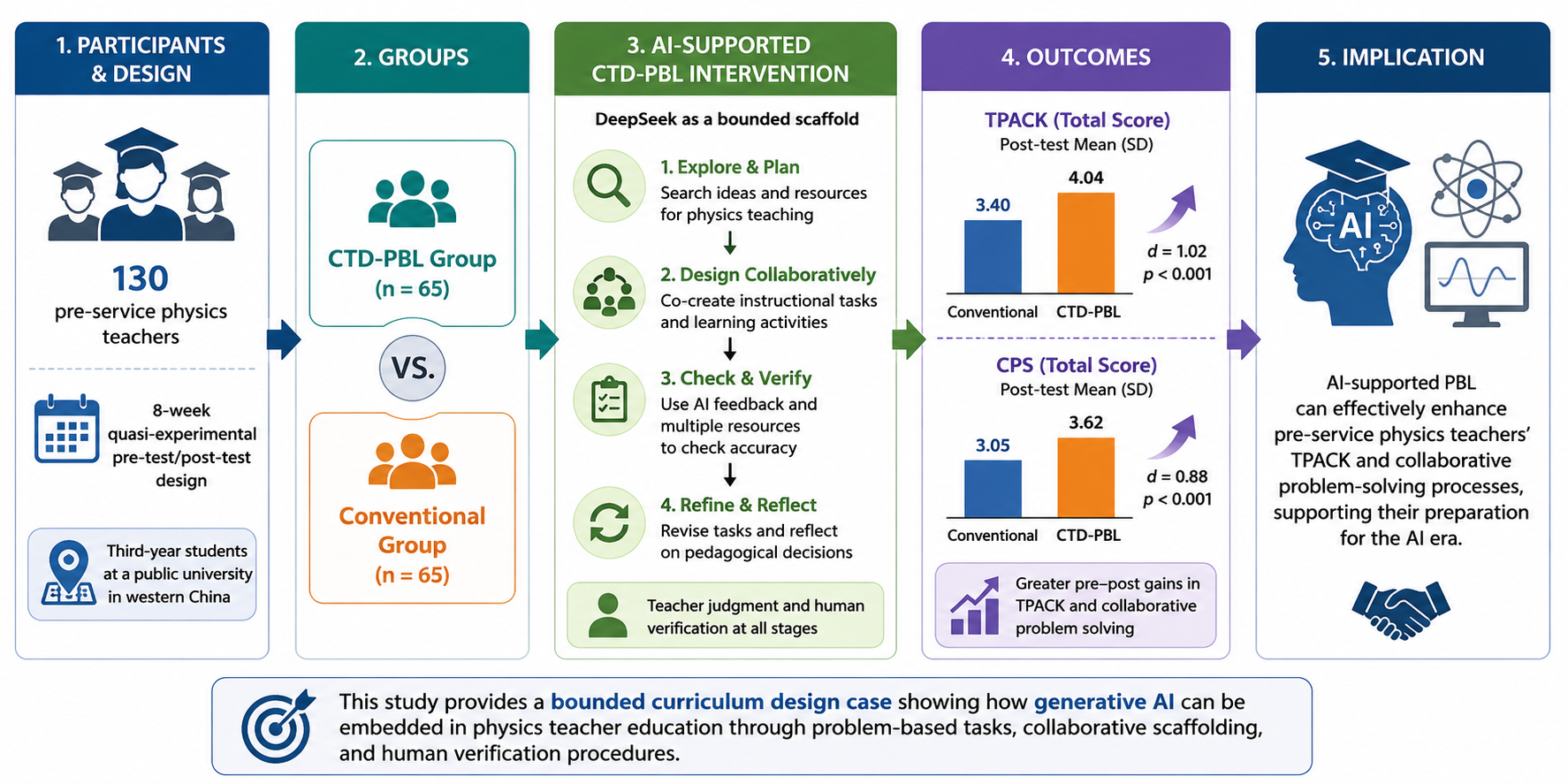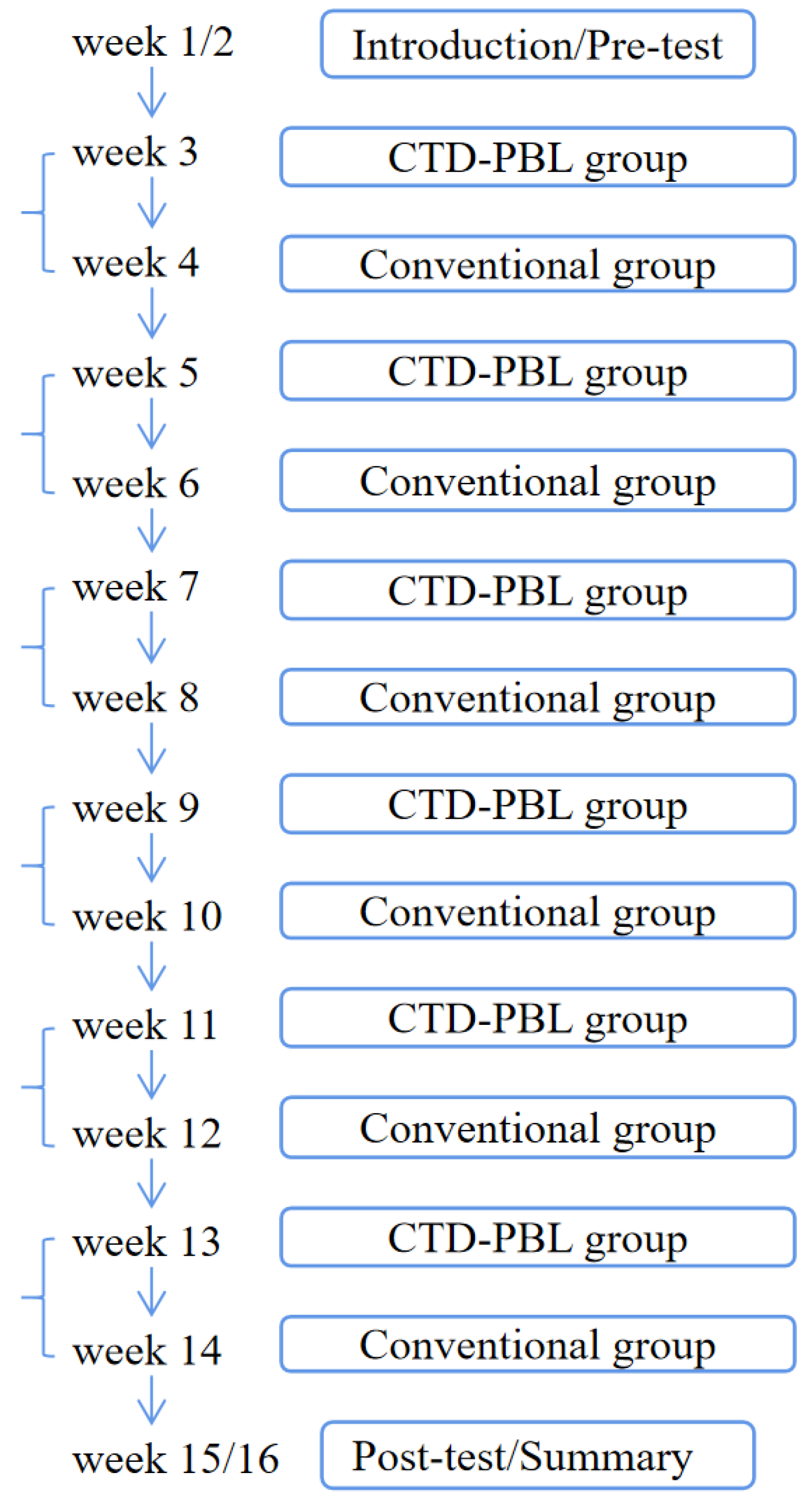

Changes in Pre-Service Physics Teachers’ TPACK and Collaborative Problem Solving Associated with an AI-Supported CTD-PBL Module: A Quasi-Experimental Study

Abstract
1. Introduction
2. Materials and Methods
2.1. Design and Participants
2.2. Intervention
2.3. AI Support Operationalisation
2.4. Instruments
2.5. Validity, Reliability, and Module Refinement
2.6. Data Collection Procedure
2.7. Data Analysis
2.8. Ethical Considerations
3. Results
3.1. Data Screening and Baseline Comparability
3.2. Primary Mixed Repeated-Measures Model Results for TPACK and CPS
3.3. Group Differences and Pre–Post Changes in TPACK Competencies
3.4. Group Differences and Pre–Post Changes in Collaborative Problem Solving
3.5. Summary of Empirical Findings
4. Discussion
4.1. Main Findings
4.2. Mechanism Interpretation
4.3. Relationship to Previous Literature
4.4. Limitations
4.5. Practical Implications
5. Conclusions
Author Contributions
Funding
Institutional Review Board Statement
Informed Consent Statement
Data Availability Statement
Conflicts of Interest
Abbreviations
| AI | Artificial Intelligence |
| ADDIE | Analysis, Design, Development, Implementation, and Evaluation |
| CPS | Collaborative Problem Solving |
| CTD-PBL | The Collaborative TPACK Competency Development Module Based on Problem-Based Learning |
| PBL | Problem-Based Learning |
| TPACK | Technological Pedagogical Content Knowledge |
| PK | Pedagogical Knowledge |
| CK | Content Knowledge |
| TK | Technological Knowledge |
| PCK | Pedagogical Content Knowledge |
| TPK | Technological Pedagogical Knowledge |
| TCK | Technological Content Knowledge |
| TPCK | Technological Pedagogical Content Knowledge |
| OECD | Organisation for Economic Co-operation and Development |
| PISA | Programme for International Student Assessment |
| SPSS | Statistical Package for the Social Sciences |
| EG | Experimental Group (The CTD-PBL group) |
| CG | Control Group/Conventional Group |
| The CTD-PBL group | The Collaborative TPACK Competency Development Module Based on Problem Based Learning group |
Appendix A
Sources, Basis for Use, Number of Items, Subscales, and Scoring Anchors of the TPACK and CPS Scales
| Item | 5-Point Likert Scale |
| PK.xs | |
| pk1. I can adapt my teaching based upon what students currently understand or do not understand. | ☐1 ☐2 ☐3 ☐4 ☐5 |
| pk2. I can adapt my teaching style to different learners. | ☐1 ☐2 ☐3 ☐4 ☐5 |
| pk3. I can use a wide range of teaching approaches in a classroom setting. | ☐1 ☐2 ☐3 ☐4 ☐5 |
| pk4. I can assess student learning in multiple ways. | ☐1 ☐2 ☐3 ☐4 ☐5 |
| CK.xs | |
| ck1. I have sufficient knowledge about my teaching subject. | ☐1 ☐2 ☐3 ☐4 ☐5 |
| ck2. I can use a subject-specific way of thinking in my teaching subject. | ☐1 ☐2 ☐3 ☐4 ☐5 |
| ck3. I know the basic theories and concepts of my teaching subject. | ☐1 ☐2 ☐3 ☐4 ☐5 |
| ck4. I know the history and development of important theories in my teaching subject. | ☐1 ☐2 ☐3 ☐4 ☐5 |
| TK.xs | |
| tk1. I keep up with important new technologies. | ☐1 ☐2 ☐3 ☐4 ☐5 |
| tk2. I frequently play around with the technology. | ☐1 ☐2 ☐3 ☐4 ☐5 |
| tk3. I know about a lot of different technologies. | ☐1 ☐2 ☐3 ☐4 ☐5 |
| tk4. I have the technical skills I need to use technology. | ☐1 ☐2 ☐3 ☐4 ☐5 |
| PCK.xs | |
| pck1. I know how to select effective teaching approaches to guide student thinking and learning in my teaching subject. | ☐1 ☐2 ☐3 ☐4 ☐5 |
| pck2. I know how to develop appropriate tasks to promote students’ complex thinking of my teaching subject. | ☐1 ☐2 ☐3 ☐4 ☐5 |
| pck3. I know how to develop exercises with which students can consolidate their knowledge of my teaching subject. | ☐1 ☐2 ☐3 ☐4 ☐5 |
| pck4. I know how to evaluate students’ performance in my teaching subject. | ☐1 ☐2 ☐3 ☐4 ☐5 |
| TPK.xs | |
| tpk1. I can choose technologies that enhance the teaching approaches for a lesson. | ☐1 ☐2 ☐3 ☐4 ☐5 |
| tpk2. I can choose technologies that enhance students’ learning for a lesson. | ☐1 ☐2 ☐3 ☐4 ☐5 |
| tpk3. I can adapt the use of the technologies that I am learning about to different teaching activities. | ☐1 ☐2 ☐3 ☐4 ☐5 |
| tpk4. I am thinking critically about how to use technology in my classroom. | ☐1 ☐2 ☐3 ☐4 ☐5 |
| TCK.xs | |
| tck1. I know how technological developments have changed the field of my subject. | ☐1 ☐2 ☐3 ☐4 ☐5 |
| tck2. I can explain which technologies have been used in research in my field. | ☐1 ☐2 ☐3 ☐4 ☐5 |
| tck3. I know which new technologies are currently being developed in the field of my subject. | ☐1 ☐2 ☐3 ☐4 ☐5 |
| tck4. I know how to use technologies to participate in scientific discourse in my field. | ☐1 ☐2 ☐3 ☐4 ☐5 |
| TPCK.xs | |
| tpck1. I can use strategies that combine content, technologies, and teaching approaches that I learned about in my coursework in my classroom. | ☐1 ☐2 ☐3 ☐4 ☐5 |
| tpck2. I can choose technologies that enhance the content for a lesson. | ☐1 ☐2 ☐3 ☐4 ☐5 |
| tpck3. I can select technologies to use in my classroom that enhance what I teach, how I teach, and what students learn. | ☐1 ☐2 ☐3 ☐4 ☐5 |
| tpck4. I can teach lessons that appropriately combine my teaching subject, technologies, and teaching approaches. | ☐1 ☐2 ☐3 ☐4 ☐5 |
| Sub-Dimension | Item | Rating (1–5) |
| Participation | Q1: I was actively participating in the science lesson. | ☐1 ☐2 ☐3 ☐4 ☐5 |
| Q2: I was listening carefully when other students were speaking or making presentations. | ☐1 ☐2 ☐3 ☐4 ☐5 | |
| Q3: I asked others for help when I met difficulty. | ☐1 ☐2 ☐3 ☐4 ☐5 | |
| Perspective taking | Q4: Collaborating with others is more effective in finding solutions than working by oneself. | ☐1 ☐2 ☐3 ☐4 ☐5 |
| Q5: It is important to receive help from others in problem solving. | ☐1 ☐2 ☐3 ☐4 ☐5 | |
| Q6: When facing unfamiliar problems, it is helpful to solve the problems by collaborating with others. | ☐1 ☐2 ☐3 ☐4 ☐5 | |
| Social regulation | Q7: During the science lesson, I can recognise my advantages and disadvantages in learning. | ☐1 ☐2 ☐3 ☐4 ☐5 |
| Q8: If my classmates have any problems, I have the duty to help them. | ☐1 ☐2 ☐3 ☐4 ☐5 | |
| Q9: It is necessary to negotiate with other members to reach an agreement on a problem solution. | ☐1 ☐2 ☐3 ☐4 ☐5 | |
| Task regulation | Q10: I knew the objectives of the lesson clearly. | ☐1 ☐2 ☐3 ☐4 ☐5 |
| Q11: It is important to analyse problems before solving them. | ☐1 ☐2 ☐3 ☐4 ☐5 | |
| Q12: I will investigate the information in order to solve the problems. | ☐1 ☐2 ☐3 ☐4 ☐5 | |
| Q13: It is not necessary to find multiple solutions for one problem. | ☐1 ☐2 ☐3 ☐4 ☐5 | |
| Learning and knowledge building | Q14: In science lessons, it is often necessary to use knowledge from other subjects. | ☐1 ☐2 ☐3 ☐4 ☐5 |
| Q15: If I am provided enough information, I can acquire new knowledge by myself. | ☐1 ☐2 ☐3 ☐4 ☐5 | |
| Q16: I can organise what I have learned after the lesson. | ☐1 ☐2 ☐3 ☐4 ☐5 | |
| Q17: When I cannot solve the problems, I will reflect on the learning. | ☐1 ☐2 ☐3 ☐4 ☐5 |
Appendix B
Prompt Framework for Bounded AI Use Across the Six CTD-PBL Modules
| Module | Task Focus | AI Use Stage | Sample Prompt Template | Expected AI-Supported Output | Required Human Verification | Evidence Recorded |
| Module 1. Safe DC Power Supply Box | Low-voltage 3–6 V DC power supply design for secondary physics laboratory use | Lesson idea generation and safety review | We are designing a 3–6 V low-voltage DC power supply box for a secondary physics demonstration. Suggest possible classroom demonstration ideas that connect voltage stability, current limitation, and student safety. Do not give final answers. List the physics principles, possible misconceptions, and safety checks that students should verify. | Initial teaching ideas; possible misconceptions; safety-check prompts; links among voltage, current, load, and classroom explanation | Check whether the proposed circuit reasoning is consistent with Ohm’s law, component ratings, current-limiting requirements, and classroom safety standards. Reject any unsafe wiring, unsupported component advice, or explanation that treats AI output as authoritative. | Planning sheet; prototype notes; safety checklist; three-load stability test record; peer-feedback form; revised demonstration script |
| Module 2. RC Transient and Sensing | RC circuit and low-cost sensor logging task using timing, calibration, and fitting | Resource organisation, modelling support, and task refinement | For a pre-service physics teacher task on RC transient sensing, help organise the key concepts students need: τ = RC, charging and discharging curves, calibration using at least three data points, sensor linear range, and uncertainty. Suggest how these ideas can be turned into a student-friendly data-logging task. | Concept outline; possible calibration sequence; explanation alternatives for exponential change; task-sequencing suggestions | Verify the RC formula, polarity, discharge path, measurement repeats, fitting logic, residual interpretation, and whether the explanation is appropriate for secondary physics learners. AI suggestions must be checked against measured data and course materials. | Calibration plan; data table; fitted curve or plot; uncertainty notes; model limitation notes; peer review; revised task design |
| Module 3. Magnetic Field and Force Mapping | Magnetic field mapping using smartphone magnetometer or Hall sensor | Representation comparison and misconception diagnosis | We are preparing a micro-lesson called “Making the Invisible Field Visible” using a smartphone magnetometer or Hall sensor. Suggest ways to represent magnetic field strength, direction, distance effects, and right-hand rule reasoning. Identify possible student misconceptions and propose prompts for peer review. | Representation options; heat-map or contour-map explanation ideas; misconception prompts; peer-review questions | Verify the right-hand rule, Biot–Savart-related explanation, F = ILB applicability, background field correction, sampling interval, and device limitations. AI suggestions must not replace repeated measurements or student-generated visualisation. | Measurement plan; repeated readings; field map or heat map; background correction notes; micro-lesson script; peer-feedback record; reflection note |
| Module 4. Electromagnetic Induction and Energy Conversion | Hand-crank generator optimisation involving coil turns, rotation speed, load, and LED stability | Explanation comparison, design evaluation, and revision planning | For a hand-crank generator optimisation task, compare two ways of explaining Faraday’s law, Lenz’s law, coil turns, rotation speed, load resistance, and LED stability to secondary students. Suggest how groups can evaluate two design alternatives using evidence from repeated measurements. | Alternative explanation structures; evaluation criteria; revision prompts for optimisation plan; possible visual reasoning tools | Verify induced EMF reasoning, energy conversion pathway, load matching explanation, measurement repeats, power curves, uncertainty table, and safety of the demonstration. Reject responses that overstate efficiency or ignore losses. | Trial records; power versus load/speed curves; uncertainty table; optimisation memo; peer-feedback form; revised demonstration plan |
| Module 5. AC to DC Transformation for Sensors | Rectification and filtering for classroom sensor power supply | Tool–content alignment and instructional product refinement | We are designing a classroom-oriented task on AC to DC transformation for sensors. Suggest how students can compare rectifier and filter effects, ripple, load change, and sensor stability. Provide questions that help them connect waveform evidence with teaching explanations. | Comparison prompts for rectification and filtering; waveform explanation ideas; revision questions for instructional product | Verify waveform interpretation, ripple-load relationship, polarity, filtering explanation, classroom feasibility, and whether the technology choice supports the intended teaching goal. AI output must be checked against observed or simulated waveforms. | Product rubric; annotated waveform; load comparison notes; instructional product; reflection record; peer review |
| Module 6. EM Waves, Shielding, and Interference Detection | Mini electromagnetic compatibility survey for classroom environments | Inquiry planning, resource organisation, and final report review | We are designing a mini inquiry on electromagnetic waves, shielding, and interference detection in a classroom environment. Suggest an inquiry plan that includes possible interference sources, shielding materials, evidence to collect, and how students can report findings responsibly. | Inquiry plan; list of possible interference sources; shielding comparison prompts; report-structure suggestions | Verify whether suggested sources and shielding explanations are physically plausible, measurable in the available classroom context, safe, and supported by evidence. Reject unsupported causal claims or speculative explanations. | EMC survey plan; observation or measurement notes; shielding comparison record; final mini-report; peer-review form; reflection note |
| Cross-module verification checklist | Applies to all six modules | Before incorporating AI output into group artefacts | Check the AI-generated suggestion against physics accuracy, pedagogical suitability, classroom feasibility, safety, and evidence availability. Identify which parts should be accepted, revised, verified, or rejected. | Verification decisions; revised AI-supported suggestions; prompts for group discussion | Four required checks: (1) physics principle check; (2) evidence or measurement check; (3) pedagogical alignment check; (4) safety and ethical-use check. Instructor or peer review was required before final artefact submission. | Planning sheet; revision notes; peer-feedback record; instructor monitoring notes; final artefact; reflection document |
References
- UNESCO. AI and Education: Guidance for Policy-Makers; UNESCO: Paris, France, 2021. [Google Scholar]
- OECD. OECD Digital Education Outlook 2021: Pushing the Frontiers with Artificial Intelligence, Blockchain and Robots; OECD Publishing: Paris, France, 2021. [Google Scholar]
- Zhang, D.; Mishra, S.; Brynjolfsson, E.; Etchemendy, J.; Ganguli, D.; Grosz, B.; Lyons, T.; Manyika, J.; Niebles, J.C.; Sellitto, M.; et al. The AI Index 2021 Annual Report; AI Index Steering Committee, Stanford Institute for Human-Centered Artificial Intelligence, Stanford University: Stanford, CA, USA, 2021. [Google Scholar]
- Tan, X.; Cheng, G.; Ling, M.H.A. Artificial intelligence in teaching and teacher professional development: A systematic review. Comput. Educ. Artif. Intell. 2025, 8, 100355. [Google Scholar] [CrossRef] [Scilit]
- Ajani, O.A. Enhancing pre-service teacher education: Crafting a technology-responsive curriculum for modern classrooms and adaptive learners. Res. Educ. Policy Manag. 2024, 6, 209–229. [Google Scholar] [CrossRef] [Scilit]
- U.S. Department of Education, Office of Educational Technology. Artificial Intelligence and the Future of Teaching and Learning: Insights and Recommendations; U.S. Department of Education: Washington, DC, USA, 2023.
- Miao, F.; Holmes, W. Guidance for Generative AI in Education and Research; UNESCO: Paris, France, 2023. [Google Scholar]
- Guan, L.; Zhang, Y.; Gu, M. Pre-service teachers’ preparation for artificial intelligence in education. Comput. Educ. Artif. Intell. 2024, 8, 100341. [Google Scholar] [CrossRef] [Scilit]
- Al-Abdullatif, A. Modeling teachers’ acceptance of generative artificial intelligence use in higher education: The role of AI literacy, intelligent TPACK, and perceived trust. Educ. Sci. 2024, 14, 1209. [Google Scholar] [CrossRef] [Scilit]
- Runge, I.; Hebibi, F.; Lazarides, R. Acceptance of pre-service teachers towards artificial intelligence (AI): The role of AI-related teacher training courses and AI-TPACK within the technology acceptance model. Educ. Sci. 2025, 15, 167. [Google Scholar] [CrossRef] [Scilit]
- Aperstein, Y.; Cohen, Y.; Apartsin, A. Generative AI-based platform for deliberate teaching practice: A review and a suggested framework. Educ. Sci. 2025, 15, 405. [Google Scholar] [CrossRef] [Scilit]
- Wen, W.; Wen, H. Bridging generative AI technology and teacher education: Understanding preservice teachers’ processes of unit design with ChatGPT. Contemp. Issues Technol. Teach. Educ. 2024, 24, 582–611. [Google Scholar]
- Mishra, P.; Warr, M.; Islam, R. TPACK in the age of ChatGPT and generative AI. J. Digit. Learn. Teach. Educ. 2023, 39, 235–251. [Google Scholar] [CrossRef] [Scilit]
- Bearman, M.; Tai, J.; Dawson, P.; Boud, D.; Ajjawi, R. Developing evaluative judgement for a time of generative artificial intelligence. Assess. Eval. High. Educ. 2024, 49, 893–905. [Google Scholar] [CrossRef] [Scilit]
- Weidlich, J.; Gotsch, F.; Schudel, K.; Marusic-Würscher, C.; Mazzarella, J.; Bolten, H.; Bütler, D.; Luger, S.; Wohlfender, B.; Maag Merki, K. Teacher, peer, or AI? Comparing effects of feedback sources in higher education. Comput. Educ. Open 2025, 9, 100300. [Google Scholar] [CrossRef] [Scilit]
- Farmer, S. A knowledge framework for teachers of physics and physics teacher educators: The genesis of a knowledge framework based on the knowledge quartet. Educ. Sci. 2024, 14, 687. [Google Scholar] [CrossRef] [Scilit]
- Dragić-Cindrić, D.; Anderson, J. Developing pre-service teachers’ pedagogical content knowledge: Lessons from a science methods class. Educ. Sci. 2025, 15, 860. [Google Scholar] [CrossRef] [Scilit]
- Mapulanga, T.; Jita, L. A systematic review of studies using the topic-specific pedagogical content knowledge framework in science education. Educ. Sci. 2025, 15, 1417. [Google Scholar] [CrossRef] [Scilit]
- Mishra, P.; Koehler, M.J. Technological pedagogical content knowledge: A framework for teacher knowledge. Teach. Coll. Rec. 2006, 108, 1017–1054. [Google Scholar] [CrossRef] [Scilit]
- Chai, C.S.; Koh, J.H.L.; Tsai, C.-C. A review of technological pedagogical content knowledge. J. Educ. Technol. Soc. 2013, 16, 31–51. [Google Scholar]
- Voogt, J.; Fisser, P.; Roblin, N.P.; Tondeur, J.; van Braak, J. Technological pedagogical content knowledge: A review of the literature. J. Comput. Assist. Learn. 2013, 29, 109–121. [Google Scholar] [CrossRef] [Scilit]
- Willermark, S. Technological pedagogical and content knowledge: A review of empirical studies published from 2011 to 2016. J. Educ. Comput. Res. 2018, 56, 315–343. [Google Scholar] [CrossRef] [Scilit]
- Schmid, M.; Brianza, E.; Mok, S.; Petko, D. Running in circles: A systematic review of reviews on technological pedagogical content knowledge (TPACK). Comput. Educ. 2024, 214, 105024. [Google Scholar] [CrossRef] [Scilit]
- Gatete, O. Revisiting TPACK: A critical review and contextual extension for the digital age. J. Educ. Technol. Syst. 2025, 54, 561–612. [Google Scholar] [CrossRef] [Scilit]
- Petko, D.; Mishra, P.; Koehler, M.J. TPACK in context: An updated model. Comput. Educ. Open 2025, 9, 100244. [Google Scholar] [CrossRef] [Scilit]
- Hughes, J.; Cheah, Y.; Shi, Y.; Hsiao, K. Preservice and inservice teachers’ pedagogical reasoning underlying their most-valued technology-supported instructional activities. J. Comput. Assist. Learn. 2020, 36, 549–568. [Google Scholar] [CrossRef] [Scilit]
- Sofwan, M.; Habibi, A.; Yaakob, M. TPACK’s roles in predicting technology integration during teaching practicum: Structural equation modeling. Educ. Sci. 2023, 13, 448. [Google Scholar] [CrossRef] [Scilit]
- Hesse, F.; Care, E.; Buder, J.; Sassenberg, K.; Griffin, P. A framework for teachable collaborative problem solving skills. In Assessment and Teaching of 21st Century Skills: Methods and Approach; Griffin, P., Care, E., Eds.; Springer: Dordrecht, The Netherlands, 2015; pp. 37–56. [Google Scholar] [CrossRef] [Scilit]
- OECD. PISA 2015 Results, Volume V: Collaborative Problem Solving; OECD Publishing: Paris, France, 2017. [Google Scholar] [CrossRef] [Scilit]
- Ying, Y.; Tiemann, R. A comparative analysis of collaborative problem solving skills between German and Chinese high school students in chemistry. Educ. Sci. 2024, 14, 1198. [Google Scholar] [CrossRef] [Scilit]
- Barrows, H.S. Problem-based learning in medicine and beyond: A brief overview. New Dir. Teach. Learn. 1996, 1996, 3–12. [Google Scholar] [CrossRef] [Scilit]
- Magaji, A.; Adjani, M.; Coombes, S. A systematic review of preservice science teachers’ experience of problem-based learning and implementing it in the classroom. Educ. Sci. 2024, 14, 301. [Google Scholar] [CrossRef] [Scilit]
- Tanjung, S.; Baharuddin, B.; Ampera, D.; Farihah, F.; Jahidin, I. Problem based learning (PBL) model with technological, pedagogical, and content knowledge (TPACK) approach. Int. J. Educ. Math. Sci. Technol. 2022, 10, 799–817. [Google Scholar] [CrossRef] [Scilit]
- Karwasz, G.; Wyborska, K. How constructivist environment changes perception of learning: Physics is fun. Educ. Sci. 2023, 13, 195. [Google Scholar] [CrossRef] [Scilit]
- Csanadi, A.; Kollar, I.; Fischer, F. Pre-service teachers’ evidence-based reasoning during pedagogical problem solving: Better together? Eur. J. Psychol. Educ. 2021, 36, 147–168. [Google Scholar] [CrossRef] [Scilit]
- Alvianto, A.; Handoyono, N. The effect of problem-based learning using simulators on CPS skills and learning outcomes of lighting systems. J. Vocat. Educ. Stud. 2024, 7, 197–210. [Google Scholar] [CrossRef] [Scilit]
- Stinken-Rösner, L.; Hofer, E.; Rodenhauser, A.; Abels, S. Technology implementation in pre-service science teacher education based on the transformative view of TPACK. Educ. Sci. 2023, 13, 732. [Google Scholar] [CrossRef] [Scilit]
- Xu, E.; Wang, W.; Wang, Q. The effectiveness of collaborative problem solving in promoting students’ critical thinking: A meta-analysis based on empirical literature. Humanit. Soc. Sci. Commun. 2023, 10, 16. [Google Scholar] [CrossRef] [Scilit]
- Chai, C.S.; Rahmawati, Y.; Jong, M. Indonesian science, mathematics, and engineering preservice teachers’ experiences in STEM-TPACK design-based learning. Sustainability 2020, 12, 9050. [Google Scholar] [CrossRef] [Scilit]
- Aktaş, İ.; Özmen, H. Investigating the impact of TPACK development course on pre-service science teachers’ performances. Asia Pac. Educ. Rev. 2020, 21, 667–682. [Google Scholar] [CrossRef] [Scilit]
- Irdalisa; Paidi; Djukri. Implementation of technology-based guided inquiry to improve TPACK among prospective biology teachers. Int. J. Instr. 2020, 13, 33–44. [Google Scholar] [CrossRef] [Scilit]
- Jin, Y.; Harp, C. Examining preservice teachers’ TPACK, attitudes, self-efficacy, and perceptions of teamwork in a stand-alone educational technology course using flipped classroom or flipped team-based learning pedagogies. J. Digit. Learn. Teach. Educ. 2020, 36, 166–184. [Google Scholar] [CrossRef] [Scilit]
- Rets, I.; Rienties, B.; Lewis, T. Transforming pre-service teacher education through virtual exchange. Interact. Learn. Environ. 2023, 31, 1229–1241. [Google Scholar] [CrossRef] [Scilit]
- Ning, Y.; Zhang, C.; Xu, B.; Zhou, Y.; Wijaya, T. Teachers’ AI-TPACK: Exploring the relationship between knowledge elements. Sustainability 2024, 16, 978. [Google Scholar] [CrossRef] [Scilit]
- Setiyawan, A.; Soeharto, S.; Wijaya, T.; Korenova, L.; Lavicza, Z. Measuring teachers’ competencies for AI integration. Comput. Educ. Open 2025, 9, 100319. [Google Scholar] [CrossRef] [Scilit]
- Ling, Y.; Jan, J. Voices from the flip: Teacher perspectives on integrating AI chatbots in flipped English classrooms. Educ. Sci. 2025, 15, 1219. [Google Scholar] [CrossRef] [Scilit]
- Deng, F.; Lan, W.; Sun, D.; Zheng, Z. Examining Pre-Service Chemistry Teachers’ Technological Pedagogical Content Knowledge (TPACK) of Using Data-Logging in the Chemistry Classroom. Sustainability 2023, 15, 15441. [Google Scholar] [CrossRef] [Scilit]
- Purwaningsih, E.; Sari, A.; Yuliati, L.; Masjkur, K.; Kurniawan, B.; Zahiri, M. Improving the problem-solving skills through the development of teaching materials with STEM-PjBL (science, technology, engineering, and mathematics-project based learning) model integrated with TPACK (technological pedagogical content knowledge). J. Phys. Conf. Ser. 2020, 1481, 012133. [Google Scholar] [CrossRef] [Scilit]
- Chai, C.S.; Koh, J.H.L.; Tsai, C.-C. Facilitating preservice teachers’ development of technological, pedagogical, and content knowledge. J. Educ. Technol. Soc. 2010, 13, 63–73. [Google Scholar]
- Haug, B.S.; Mork, S.M. Taking 21st century skills from vision to classroom. Teach. Teach. Educ. 2021, 100, 103286. [Google Scholar] [CrossRef] [Scilit]
- Cao, J.; Yu, C.; Wu, Y. Policy instrument preferences and optimization strategies: Based text analysis of provincial-level education digitalization policy from China. Educ. Sci. 2024, 14, 539. [Google Scholar] [CrossRef] [Scilit]
- Shi, R.; Wan, X. A bibliometric analysis of knowledge mapping in Chinese education digitalization research from 2012 to 2022. Humanit. Soc. Sci. Commun. 2024, 11, 576. [Google Scholar] [CrossRef] [Scilit]
- Doğan, M.; Arslan, H. Graduate student engagement and digital governance in higher education. Educ. Sci. 2025, 15, 682. [Google Scholar] [CrossRef] [Scilit]
- Jing, M.; Guo, Z.; Wu, X.; Yang, Z.; Wang, X. Higher education digital academic leadership: Perceptions and practices from Chinese university leaders. Educ. Sci. 2025, 15, 606. [Google Scholar] [CrossRef] [Scilit]
- Schmid, M.; Brianza, E.; Petko, D. Developing a short assessment instrument for Technological Pedagogical Content Knowledge (TPACK.xs) and comparing the factor structure of an integrative and a transformative model. Comput. Educ. 2020, 157, 103967. [Google Scholar] [CrossRef] [Scilit]
- Chen, L.; Yoshimatsu, N.; Goda, Y.; Okubo, F.; Taniguchi, Y.; Oi, M.; Konomi, S.; Shimada, A.; Ogata, H.; Yamada, M. Direction of collaborative problem solving-based STEM learning by learning analytics approach. Res. Pract. Technol. Enhanc. Learn. 2019, 14, 24. [Google Scholar] [CrossRef] [Scilit]
- Nguyen, H.; Mouw, J.; Mali, A.; Strijbos, J.; Korpershoek, H. Developing a technological pedagogical and content knowledge survey for university teachers. Comput. Educ. Open 2024, 6, 100202. [Google Scholar] [CrossRef] [Scilit]



| Group | N | Female | Male | Pre-Test TPACK M (SD) | Pre-Test CPS M (SD) |
|---|---|---|---|---|---|
| Conventional | 65 | 41(63.1%) | 24 (36.9%) | 3.16 (0.59) | 2.99 (0.65) |
| CTD-PBL | 65 | 44 (67.6%) | 21 (32.3%) | 3.01(0.64) | 3.12 (0.66) |
| Aspect | CTD-PBL Group | Conventional Group |
|---|---|---|
| Instructional approach | Structured CTD-PBL instructional approach | Regular conventional teaching approach |
| Teaching orientation | Problem-based, collaborative, technology-supported, and inquiry-oriented | Lecture-based, demonstration-oriented, and discipline-centred |
| Classroom process | Students worked through problem situations, inquiry tasks, collaborative planning, peer feedback, and reflective revision | The instructor explained physics content, demonstrated experimental procedures, and guided students during task completion |
| Student task organisation | Small-group work with structured collaboration, role allocation, shared responsibility, and collective outputs | Small-group task completion with ordinary peer discussion |
| Learning resources | Physics learning resources, simulation or digital tools, online materials, collaborative platforms, and AI prompt support provided as part of the CTD-PBL tasks | Ordinary non-AI resources, such as online searching, short instructional videos, peer discussion, and teacher consultation |
| AI support | AI support was embedded within the CTD-PBL learning process, including the provision of AI prompts to support inquiry, planning, and refinement | AI tools were not permitted |
| Teacher role | The instructor provided staged scaffolding, task guidance, feedback, and support for collaborative inquiry | The instructor provided explanation, demonstration, procedural guidance, and help when students requested support |
| Main instructional distinction | Learning was organised through the CTD-PBL structure, where AI was one embedded support component | Learning followed the regular teaching plan, with ordinary non-AI support used according to students’ needs |
| Teaching Technique | Description |
|---|---|
| Active Learning | Emphasises student-centered learning through group discussions, case studies, and problem-solving tasks to promote engagement and deeper understanding. |
| Collaborative Learning | Students work in small groups, with roles assigned to ensure contribution and foster communication, teamwork, and leadership skills. |
| Inquiry-Based Learning | Encourages students to approach problems with inquiry, ask questions, investigate solutions, and critically evaluate different approaches. |
| Technological Integration | Students use digital tools like simulation software, online databases, and collaborative platforms to enhance learning and visualise physics phenomena. |
| Formative Assessment | Continuous assessment through quizzes, peer evaluations, reflective journals, and instructor observations to provide ongoing feedback. |
| Scaffolded Support | Provides gradual support through guided instructions, learning resources, and timely feedback to help students build confidence in tackling challenges. |
| Module | Core Physics Focus | Required Output | Evidence Type | Dominant TPACK/CPS Targets |
|---|---|---|---|---|
| Safe DC Power Supply Box | Low-voltage power design | Group design plan + instructional explanation | Planning sheet, prototype notes | TCK, TPCK, task regulation |
| RC Transient and Sensing | RC circuit and sensor logging | Data-logging task design | Data sheet, design rationale | TK, TPK, learning, and knowledge building |
| Magnetic Field and Force Mapping | Field representation | Mapping activity + learner explanation | Measurement record, concept explanation | TCK, TPCK, perspective taking |
| Electromagnetic Induction and Energy Conversion | Generator optimisation | Demonstration plan + refinement | Trial records, peer feedback | PCK, TPCK, social regulation |
| AC to DC Transformation for Sensors | Transformation for classroom sensors | Instructional product | Product rubric, reflection | TCK, task regulation |
| EM Waves, Shielding, and Interference Detection | EMC survey | Mini inquiry/report | Final product, peer review | CPS participation, shared knowledge construction |
| Stage | Scaffold/Support | Human Verification Mechanism | Revision Evidence |
|---|---|---|---|
| Problem launch | Facilitation prompts; role setup | Instructor clarification | Initial plan sheet |
| Problem analysis | Planning templates; misconception prompts | Peer/instructor review | Brainstorm notes; misconception list |
| Investigation | Tool-use guidance; evidence templates | Content/feasibility check | Datasheets; setup photos |
| Solution construction | Prototype/testing scaffold | Rubric-based check | Prototype; trial records |
| Presentation and reflection | Peer feedback form; reflection questions | Peer review + self-check | Final product; reflection |
| Theory | Design Principle | CTD-PBL Design Choice | Module Anchor Task | Evidence | Outcome Dimension |
|---|---|---|---|---|---|
| TPACK | Tool–content–pedagogy alignment; explicit rationale | Tool bound to content rep. + teaching script | M5 ripple vs. load with rectifier + filter; M3 field heatmap + micro-lesson | Objectives–instrument mapping; DQ/MQ/EQ rubric; micro-lesson script | TPACK.xs subscales (TK, TPK, TCK, PCK, TPACK) |
| Constructivism | ERC scaffolds; public artefacts; iteration | Launch → investigate → ERC memo → demo | M2 calibration → model selection ERC; M4 optimisation memo | ERC memos; peer-review forms; iteration logs | Higher-order Bloom evidence (A/E/C artefacts) |
| CLT | Reduce extraneous; manage intrinsic; increase germane | Pre-training; segmented worksheets; templates; safety/fidelity | M1 stability test with pre-trained meters; M5 annotated waveforms | Fidelity checklist; error/redo logs; time-on-task | MQ gains (repeatability, uncertainty) |
| Collaborative learning | Interdependence + accountability + social skills | Role rotation; peer-review; CPS prompts | All CTD weeks: team roles and review cycles | CPS questionnaire; peer-review means; collab notes | CPS facets (coordination, monitoring, decision) |
| Situated learning | Authentic tasks; teacher-ready packs; transfer | Deliver teacher packs; demo plans; constraints-aware design | M6 EMC survey for real classrooms; M1 safety demo | Teacher-pack checklist; classroom-fit rating | Transfer; enacted TPACK |
| Problem Identified | Evidence | Revision Made |
|---|---|---|
| Ambiguity in data sheet instructions | Student confusion during setup; repeated questions observed | Reworded instruction; added example entries; updated worksheet version to 1 |
| Misalignment between product rubric and expected student outputs | Expert noted scoring mismatch; inconsistent marking in trial run | Revised rubric descriptors; aligned with typical student products; added scoring notes |
| Confusion in tool selection process during sensor experiment | Trial logs showed delays; students used incorrect instruments | Added visual tool guide; relocated tool list to pre-lab checklist |
| Terminology inconsistency across modules | Language checklist flagged variation; 50% of experts suggested correction | Standardised key terms; applied across all modules; changes tracked in version 1.3 |
| Low engagement in peer review activity | Student feedback showed unclear purpose; peer form underused | Simplified peer form layout; clarified role in task sheet; added oral prompt |
| Outcome | Group | N | Pre-Test M (SD) | Post-Test M (SD) | Gain [95% CI] | Difference in Gain [95% CI] | Group × Time F (df) | p | Partial η2 |
|---|---|---|---|---|---|---|---|---|---|
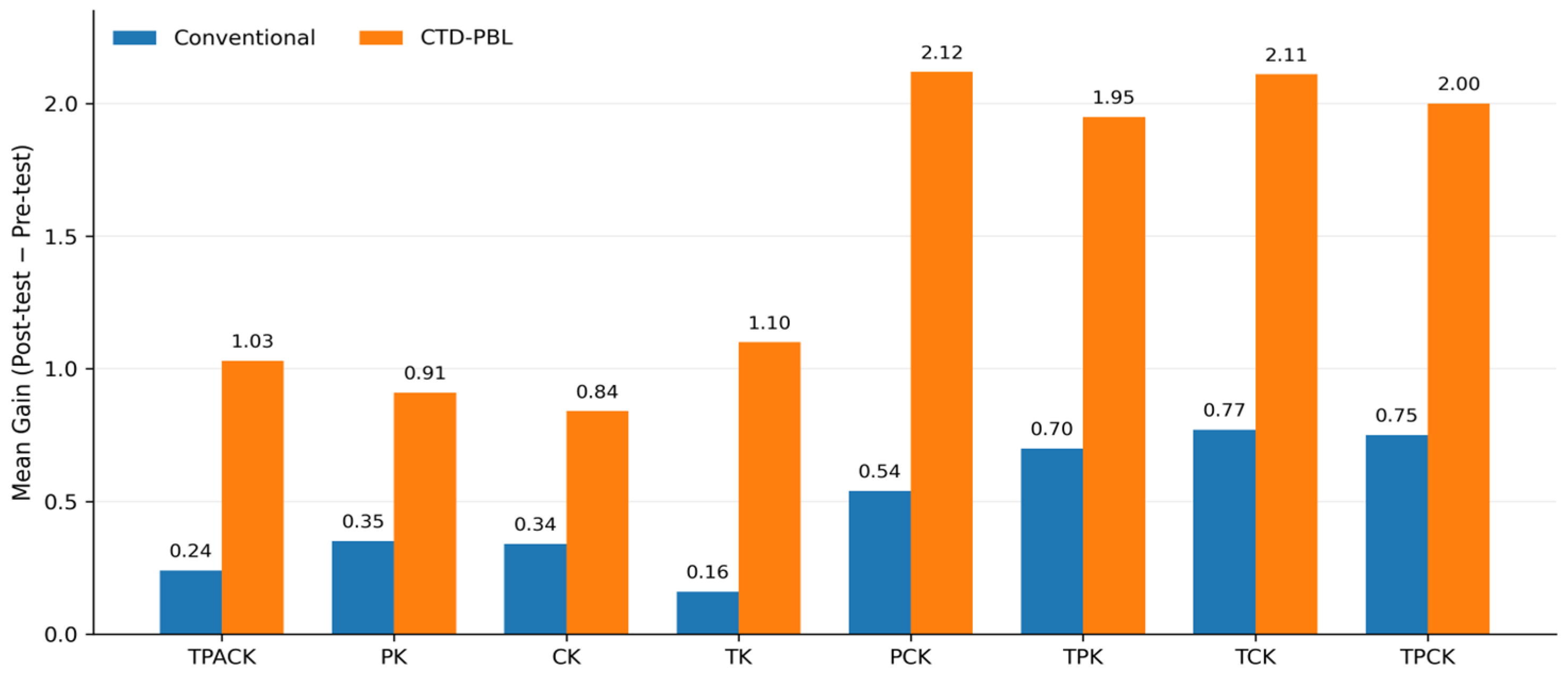
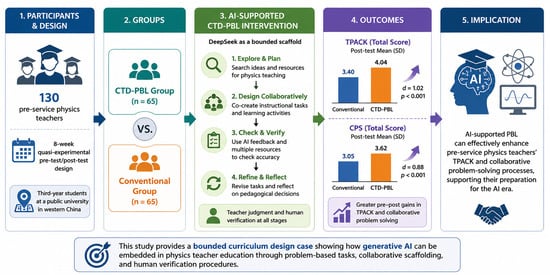
| TPACK | Conventional | 65 | 3.16 (0.59) | 3.40 (0.61) | 0.24 [0.08, 0.40] | 0.79 [0.55, 1.03] | F(1, 128) = 41.787 | <0.001 | 0.139 |
| TPACK | CTD-PBL | 65 | 3.01 (0.64) | 4.04 (0.75) | 1.03 [0.82, 1.24] | ||||
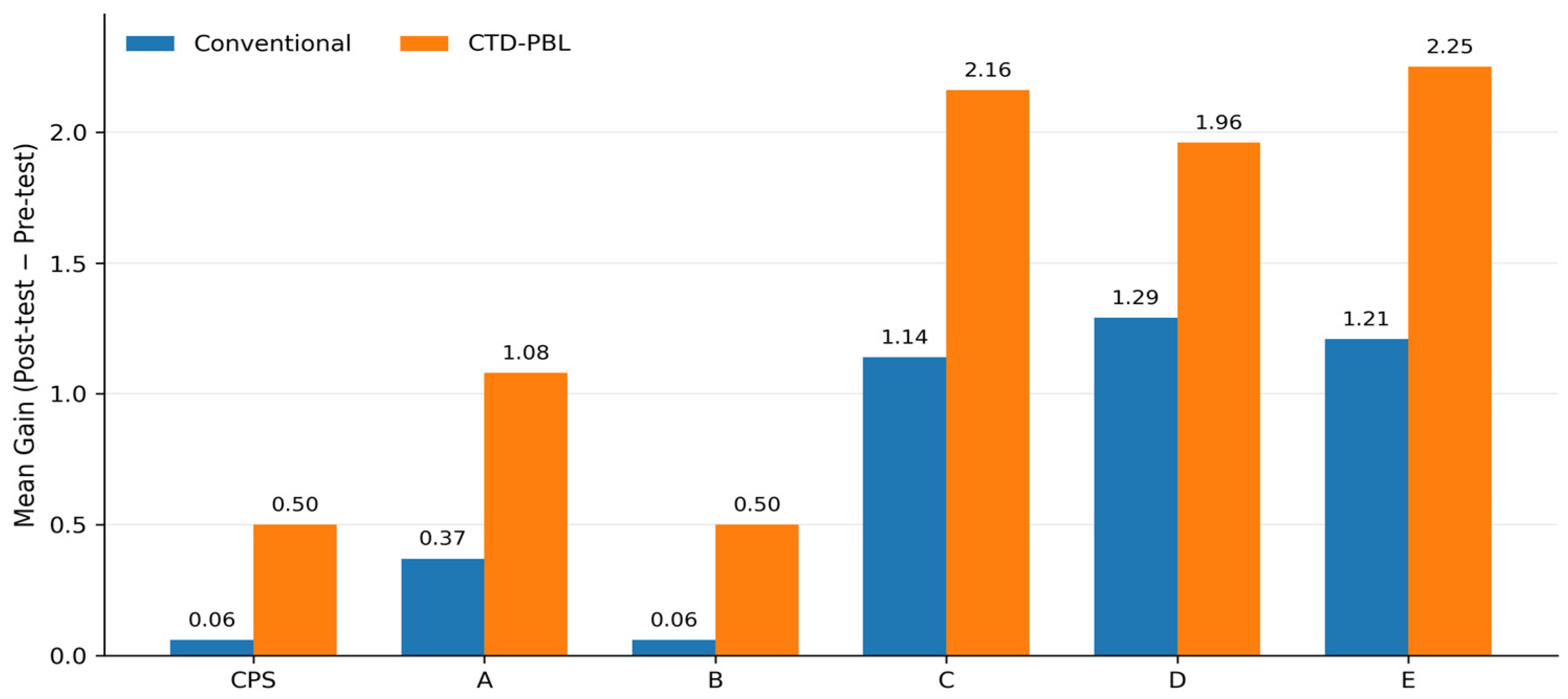
| CPS | Conventional | 65 | 2.99 (0.65) | 3.05 (0.66) | 0.06 [0.00, 0.12] | 0.44 [0.31, 0.57] | F(1,128) = 46.882 | <0.001 | 0.152 |
| CPS | CTD-PBL | 65 | 3.12 (0.66) | 3.62 (0.65) | 0.50 [0.34, 0.66] |
| Variable | Conventional M (SD) | CTD-PBL M (SD) | Mean Difference [95% CI] | t (df) | p | Cohen’s d |
|---|---|---|---|---|---|---|
| TPACK | 3.40 (0.61) | 4.04 (0.75) | 0.64 [0.42, 0.86] | −5.842 (128) | <0.001 | 1.02 |
| PK | 3.45 (0.60) | 4.00 (0.81) | 0.55 [0.31, 0.79] | −4.612 (128) | <0.001 | 0.81 |
| CK | 3.47 (0.69) | 4.05 (0.76) | 0.58 [0.36, 0.80] | −5.233 (128) | <0.001 | 0.92 |
| TK | 3.35 (0.65) | 4.13 (0.70) | 0.78 [0.47, 1.09] | −4.981 (128) | <0.001 | 0.87 |
| PCK | 3.42 (0.61) | 4.44 (0.58) | 1.02 [0.68, 1.36] | −6.021 (128) | <0.001 | 1.06 |
| TPK | 3.40 (0.59) | 4.49 (0.54) | 1.09 [0.69, 1.49] | −5.442 (128) | <0.001 | 0.95 |
| TCK | 3.20 (0.65) | 4.47 (0.54) | 1.27 [0.78, 1.76] | −5.118 (128) | <0.001 | 0.90 |
| TPCK | 3.37 (0.54) | 4.48 (0.50) | 1.11 [0.79, 1.43] | −6.884 (128) | <0.001 | 1.21 |
| Variable | Conventional M (SD) | CTD-PBL M (SD) | Mean Difference [95% CI] | t (df) | p | Cohen’s d |
|---|---|---|---|---|---|---|
| CPS | 3.05 (0.66) | 3.62 (0.65) | 0.57 [0.35, 0.79] | −5.024 (128) | <0.001 | 0.88 |
| Participation | 3.58 (0.62) | 4.10 (0.80) | 0.52 [0.27, 0.77] | −4.115 (128) | <0.001 | 0.72 |
| Perspective Taking | 3.05 (1.07) | 3.62 (1.41) | 0.57 [0.31, 0.83] | −4.332 (128) | <0.001 | 0.76 |
| Social Regulation | 3.69 (0.61) | 4.66 (0.49) | 0.97 [0.55, 1.39] | −4.554 (128) | <0.001 | 0.80 |
| Task Regulation | 3.57 (0.57) | 4.49 (0.59) | 0.92 [0.54, 1.30] | −4.772 (128) | <0.001 | 0.84 |
| Learning and Knowledge Building | 3.63 (0.62) | 4.73 (0.43) | 1.10 [0.65, 1.55] | −4.889 (128) | <0.001 | 0.86 |
Disclaimer/Publisher’s Note: The statements, opinions and data contained in all publications are solely those of the individual author(s) and contributor(s) and not of MDPI and/or the editor(s). MDPI and/or the editor(s) disclaim responsibility for any injury to people or property resulting from any ideas, methods, instructions or products referred to in the content. |
© 2026 by the authors. Licensee MDPI, Basel, Switzerland. This article is an open access article distributed under the terms and conditions of the Creative Commons Attribution (CC BY) license.
Share and Cite
Chen, Q.; Osman, K. Changes in Pre-Service Physics Teachers’ TPACK and Collaborative Problem Solving Associated with an AI-Supported CTD-PBL Module: A Quasi-Experimental Study. Information 2026, 17, 688. https://doi.org/10.3390/info17070688
Chen Q, Osman K. Changes in Pre-Service Physics Teachers’ TPACK and Collaborative Problem Solving Associated with an AI-Supported CTD-PBL Module: A Quasi-Experimental Study. Information. 2026; 17(7):688. https://doi.org/10.3390/info17070688
Chicago/Turabian StyleChen, Qirui, and Kamisah Osman. 2026. "Changes in Pre-Service Physics Teachers’ TPACK and Collaborative Problem Solving Associated with an AI-Supported CTD-PBL Module: A Quasi-Experimental Study" Information 17, no. 7: 688. https://doi.org/10.3390/info17070688
APA StyleChen, Q., & Osman, K. (2026). Changes in Pre-Service Physics Teachers’ TPACK and Collaborative Problem Solving Associated with an AI-Supported CTD-PBL Module: A Quasi-Experimental Study. Information, 17(7), 688. https://doi.org/10.3390/info17070688