Article

Controllable Symbolic Music Generation via Stage-Aware Style Routing and Differentiable Melody Regularization


1
Preschool College, Changsha Normal University, Changsha 410100, China
2
College of Computer Science and Technology, National University of Defense Technology, Changsha 410073, China
3
College of Systems Engineering, National University of Defense Technology, Changsha 410073, China
*
Author to whom correspondence should be addressed.
Information 2026, 17(6), 568; https://doi.org/10.3390/info17060568
Submission received: 4 April 2026 / Revised: 11 May 2026 / Accepted: 21 May 2026 / Published: 8 June 2026
(This article belongs to the Section Information Applications)

Abstract

Controllable symbolic music generation must preserve a reference melody while remaining responsive to style prompts. Existing hierarchical diffusion systems typically reuse a shared condition vector across harmony, rhythm, and timbre stages, which can entangle stylistic factors and weaken melody preservation. We present HCDMG++, a hierarchical diffusion framework that addresses these two limitations through stage-aware style routing and differentiable melody regularization. The routing module uses a residual multi-layer perceptron (MLP) with zero-initialized scalar gates to project text-derived style embeddings into harmony-, rhythm-, and timbre-specific subspaces, whereas the regularization branch aligns soft pitch histograms and contour trajectories with the conditioning melody during training without breaking the differentiable computation graph. We evaluate the integrated system on a 384-sample benchmark covering four melodies, eight styles, four random seeds, and three denoising budgets, supplemented by a matched legacy-compatible reference and inference-time component ablation that contrasts legacy behavior, silenced gates, an automated uniform gamma routing sweep, and the full forward pass. HCDMG++ produces valid four-track outputs in all 384 runs, reaches a peak pitch histogram similarity score of 0.508 under a 64-step budget, and improves pitch histogram alignment over Legacy-HCDMG by roughly two orders of magnitude on the matched slice, while attaining a positive Fisher-style style separability score where the legacy benchmark is too sparse to support one. These results indicate that stage-specific conditioning and differentiable structural guidance jointly improve controllability in symbolic music diffusion, while also exposing the remaining limitations in long-form generalization and perceptual validation, which motivate the future work outlined at the end of this paper.

1. Introduction

Conditional symbolic music generation aims to synthesize musically coherent and expressive sequences while respecting user controls such as reference melodies, style descriptors, and structural hints. A central challenge in this setting is to achieve both melody fidelity—that is, to keep the generated multi-track output aligned with a user-provided melodic contour—and style controllability—that is, to produce outputs that remain perceptibly distinct under different style prompts. Although recent advances in Transformer architectures and latent-variable models have substantially improved long-range sequence modeling [1,2,3], generating complex polyphonic music under multiple simultaneous constraints remains difficult.
Recently, denoising diffusion probabilistic models (DDPMs) [4] have emerged as a powerful paradigm for generative modeling. When adapted to symbolic music [5,6,7], diffusion models generate multi-track event sequences through iterative refinement. To manage the complexity of polyphonic music, hierarchical diffusion systems, including the Legacy-HCDMG baseline considered here, decompose generation into specialized stages: harmony skeleton diffusion (HSD), rhythmic accompaniment diffusion (RAD), and detail timbre diffusion (DTD). This hierarchy is musically intuitive, as it mirrors a common compositional workflow in which harmony is established first, rhythm is conditioned on harmonic progression, and timbral realization is conditioned on both.
Despite the conceptual appeal of hierarchical generation, practical systems still face substantial architectural bottlenecks. A critical limitation of the original Legacy-HCDMG framework, as well as related hierarchical models, is its reliance on a unified conditioning mechanism. Injecting the same style embedding into all generation stages forces the network to encode heterogeneous musical attributes such as harmonic color, rhythmic density, and timbral texture within a single latent representation. We argue that this design encourages feature entanglement, which in turn weakens style separability and obscures fine-grained stylistic nuances [2,8]. In addition, long-form iterative denoising can accumulate errors over time, causing generated tracks to drift away from the conditioning melody [9,10,11].
To address these limitations, we build upon a reproducible implementation of the Legacy-HCDMG baseline and propose HCDMG++, an enhanced hierarchical diffusion framework designed to decouple style representation and reinforce structural fidelity.
More specifically, we introduce stage-aware style routing, which replaces rigid unified conditioning with a lightweight residual multi-layer perceptron (MLP) router. This module projects text-derived style embeddings into stage-specific subspaces, allowing HSD to focus on harmonic attributes, RAD on rhythmic patterns, and DTD on multi-track timbral rendering. To mitigate melodic drift, we further introduce differentiable melody regularization. By leveraging expected token indices and soft distributions derived from diffusion logits, this module applies histogram and contour alignment losses during training, thereby acting as an auxiliary structural guide without breaking the differentiable computation graph.

1.1. Classification of the Proposed Framework

To clarify what is novel relative to prior hierarchical diffusion work, HCDMG++ can be classified along three orthogonal axes: (i) generation paradigm—non-autoregressive iterative denoising on discrete event-sequence tokens, in contrast to autoregressive Transformers [12,13] or continuous audio diffusion [10,14]; (ii) hierarchy granularity—a three-stage cascade (harmony skeleton → rhythmic accompaniment → detail timbre), positioned between flat single-pass diffusion [5] and finer multi-resolution full-song decompositions [6]; (iii) conditioning topology—stage-specific residual style routing with a learnable per-stage gate, in contrast to the unified-condition reuse pattern of Legacy-HCDMG and the global FiLM/AdaIN-style modulation of audio diffusion [15,16]. In short, HCDMG++ belongs to the family of conditionally factorized hierarchical symbolic diffusion models, and it is novel in that it converts a previously monolithic conditioning vector into a stage-decoupled routing structure while simultaneously injecting differentiable structural constraints during training.

1.2. Technical Contributions

The technical contributions of this work are three-fold. First, we propose stage-aware style routing, consisting of a parameter-light residual MLP router with zero-initialized scalar gates that maps a single Sentence-BERT style embedding into stage-specific subspaces. The zero initialization (inspired by ControlNet and Fixup) guarantees backward compatibility with legacy checkpoints and enables drop-in fine-tuning rather than full retraining. Second, we propose differentiable melody regularization, a training-time auxiliary loss that derives soft pitch histograms and expected contour trajectories from diffusion logits via temperature-scaled softmax, thereby supplying continuous gradient signals for melody fidelity without breaking the differentiable computation graph or relying on inference-time heuristics. Third, we contribute a reproducible 384-sample multi-melody benchmark (4 melodies × 8 styles × 4 seeds × 3 denoising budgets) together with a metric battery that jointly probes the generation validity, pitch histogram alignment, interval histogram alignment, melody track adherence, and style separability, exposing controllability as a multi-objective tradeoff surface rather than a single scalar score.

1.3. Objective Metrics Preview

To address reproducibility and interpretability concerns upfront, we summarize the five headline quantities analyzed in Section 5, Section 6 and Section 7; full mathematical definitions appear in Section 5.2. (M1) The generation success rate measures the fraction of runs that yield a non-degenerate four-track MIDI above minimal duration and note count thresholds (both Legacy-HCDMG and HCDMG++ achieve 100% under our gates, certifying pipeline robustness rather than esthetics). (M2) Mean pitch histogram similarity compares folded pitch-class histograms between the user melody and the generated mixture using histogram intersection on [ 0 ,   1 ] . (M3) Mean interval histogram similarity compares clipped melodic interval distributions, emphasizing coarse contour statistics beyond pitch class overlap. (M4) Mean melody track pitch similarity applies the same pitch class intersection to the exported melody track only, isolating drift on the designated melodic stream. (M5) The style separability score reports a Fisher-style ratio of between-style to within-style dispersion over symbolic descriptors (pitch range, density, syncopation, groove entropy), quantifying whether prompts induce statistically separated behaviors.
We evaluate HCDMG++ through this reproducible long-run benchmark, which enables a system-level view of controllability, fidelity, and efficiency tradeoffs. Section 6.4 responds to peer review requests for component-wise analyses by contrasting Legacy-HCDMG, melody-regularized inference with gates silenced, an automated inference-time routing pathway sweep over uniform  γ (reporting the grid point selected by maximum style separability), and the full forward pass. Training-time fine-tuning that disables melody auxiliary losses while keeping routers trainable—specified in-repository —complements this inference-time evidence once warm-started weights are available.

2. Related Work

2.1. Deep Learning for Symbolic Music Generation

Symbolic music generation has witnessed a paradigm shift from early statistical heuristics to advanced deep learning architectures. Transformer-based models, leveraging self-attention mechanisms [17], have demonstrated an exceptional ability to capture long-range dependencies and recurring motifs in musical sequences [12]. To handle the complex polyphony of music, advanced tokenization strategies have emerged. For instance, the REMI (Revamped MIDI) representation [18] integrates bar and beat tokens to enforce metrical strictness, while the Compound Word Transformer [13] groups concurrent musical attributes to significantly reduce the sequence length and generation latency. Concurrently, latent-variable approaches like MusicVAE [19] employ hierarchical recurrent autoencoders to compress multi-track music into continuous latent spaces, enabling semantic operations such as interpolation. For multi-track orchestration, models like SymphonyNet [20] have further pushed the boundaries by introducing multi-track coordinate representations. These developments underscore the importance of robust event sequence representations and hierarchical modeling, which form the basis of the present framework.

2.2. Diffusion Models for Sequence and Music Generation

Denoising diffusion probabilistic models (DDPMs) [4] have achieved state-of-the-art performance in generative tasks. While latent diffusion models (LDMs) [21] and advanced acoustic models like MusicLM [14] have revolutionized continuous audio waveform synthesis, the research community is actively adapting diffusion principles to discrete domains. Unlike autoregressive models that generate tokens strictly from left to right, diffusion models offer non-autoregressive, globally aware generation through iterative refinement. In natural language processing, Diffusion-LM [22] successfully bridged the continuous-to-discrete gap by mapping discrete words to continuous embedding spaces. In the symbolic music domain, Mittal et al. [5] demonstrated that analogous continuous diffusion and rounding techniques could synthesize coherent MIDI sequences. More recent works have explored hierarchical whole-song diffusion [6] and controllable rule-guided diffusion [11]. Because music is intrinsically structural, flat sequence generation often struggles to maintain macroscopic coherence. This motivates hierarchical diffusion architectures that factorize polyphonic generation into harmony, rhythm, and detail stages. However, the condition-fusion mechanisms in existing hierarchical diffusion frameworks remain rudimentary—a bottleneck that our work seeks to resolve.

2.3. Style Conditioning and Feature Disentanglement

Controllable generation relies heavily on effectively injecting auxiliary conditions (e.g., text prompts, genre tags, or latent vectors) into the generative process. Textual conditions are increasingly encoded using pre-trained language models like Sentence-BERT [23], mapping natural language descriptors into dense semantic vectors. Recent frameworks such as FIGARO [24] have successfully demonstrated text-driven controllable symbolic music generation. Meanwhile, early generative models like MuseGAN [25] established the importance of track-level conditioning for coherent multi-instrument accompaniment.
A critical challenge in conditional modeling is feature entanglement. When a single, unified style embedding is injected uniformly across all stages, the model tends to average out stylistic nuances [26], leading to weak style separability or posterior collapse. In computer vision, architectures like StyleGAN [15] address this by injecting style vectors at different resolutions. Mathematically, this dynamic adaptation is often achieved via feature-wise linear modulation (FiLM) [16], which scales and shifts features based on conditioning inputs. Inspired by these mechanisms, our proposed stage-aware style routing utilizes a residual MLP router to dynamically decouple the unified style embedding into harmonic, rhythmic, and timbral subspaces, allowing specific musical traits to be expressed at their corresponding hierarchical stages.

2.4. Structural Fidelity and Differentiable Regularization

Maintaining long-term structural fidelity—ensuring that generated accompaniments strictly adhere to a user-provided melody—is a persistent challenge. Dedicated models like PopMAG [27] attempt to mitigate this by jointly modeling melody and accompaniment through carefully designed attention masks. However, in diffusion models, the iterative denoising steps often cause the generated tracks to drift away from the conditioning melody, especially during lengthy polyphonic sections.
To enforce structural constraints, traditional approaches rely on non-differentiable post hoc heuristic rules during inference, which cannot be optimized during training. Implementing constraints via differentiable proxies for discrete categorical variables is highly non-trivial; classical solutions include the Gumbel-Softmax trick [28] or straight-through estimators. In this work, rather than enforcing hard discrete token matching, we introduce a soft differentiable melody regularization objective. By aligning pitch histograms and contours directly via expected token distributions [22], we provide continuous gradient feedback to the network. This anchors the generative process to the conditioning melody without interrupting the backpropagation pipeline.

2.5. Benchmarking and Reproducibility in Creative AI

Algorithmic reproducibility has become a central concern in creative AI. Generative music models depend heavily on large MIDI corpora, which are often noisy and heterogeneous [29]. At the same time, many music generation works still emphasize qualitative examples more heavily than systematic benchmark analysis. This motivates an evaluation of controllable symbolic generators under transparent multi-factor protocols that expose fidelity, style response, runtime behavior, and cross-seed variability. In this work, reproducibility is therefore treated not as a standalone contribution but as an experimental prerequisite for assessing whether the proposed architectural changes produce measurable behavioral differences.

3. Motivation: Entangled Conditioning and Melody Drift

This section focuses on the scientific limitations of the Legacy-HCDMG baseline that motivate our method: weak style disentanglement under unified conditioning and structural drift under iterative denoising.

3.1. Weak Style Separability Under Unified Conditioning

Legacy-HCDMG fuses melody, style, and latent variation into a single condition vector and reuses this vector across all hierarchical generation stages. While computationally simple, this design implicitly assumes that harmonic color, rhythmic density, and timbral texture can be expressed through the same undifferentiated style representation. In practice, these attributes operate at different musical resolutions. When they are compressed into one shared condition, the model is encouraged to average over stage-specific cues rather than specialize according to them, leading to feature entanglement.
This limitation is reflected in the baseline behavior observed after end-to-end generation: coarse symbolic descriptors such as note density, rhythm complexity, and pitch range exhibit only weak separation across multiple style prompts. In other words, the baseline can produce valid multi-track outputs while still failing to translate stylistic conditions into sufficiently distinct symbolic structures. This weak separability motivates a stage-aware routing mechanism that allows harmony-, rhythm-, and timbre-relevant style components to be emphasized where they are most musically meaningful.

3.2. Melody Drift in Iterative Hierarchical Denoising

The second limitation concerns structural fidelity. In melody-conditioned symbolic diffusion, the accompaniment should remain aligned with the reference melody over long denoising trajectories. However, iterative refinement does not guarantee that the generated symbolic sequence will preserve either the global pitch distribution or the local contour implied by the conditioning melody. Small deviations introduced early in the reverse process can accumulate across stages, especially when the final multi-track realization is much denser than the input melody.
Our benchmark observations are consistent with this concern: melody alignment metrics vary substantially across denoising budgets and melodies, and the relationship between the computational budget and fidelity is non-monotonic rather than guaranteed. This motivates a differentiable regularization strategy that directly constrains soft pitch distributions and contour trajectories during training, rather than relying on generation-time heuristics alone.

4. Proposed Framework

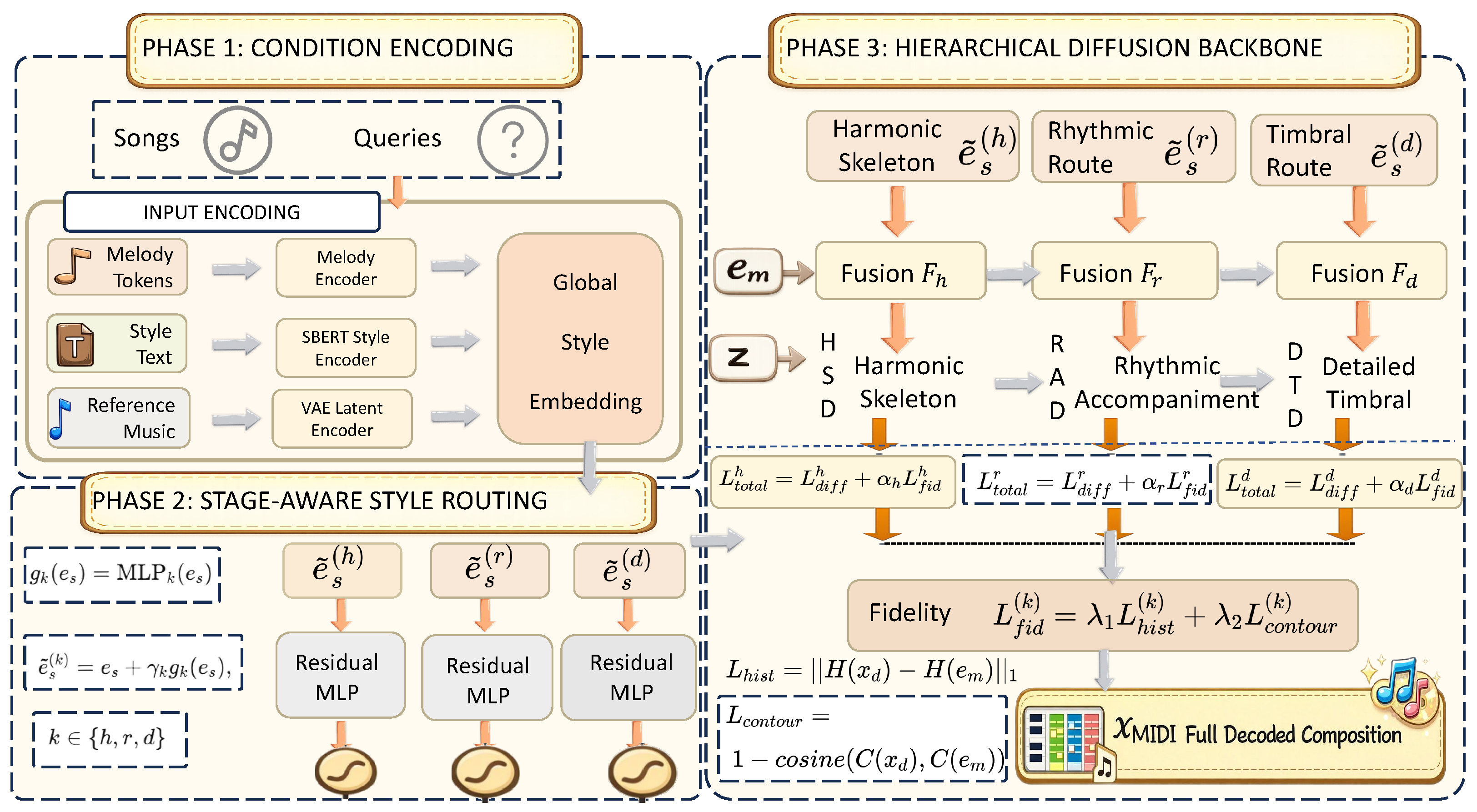
This section details the architecture and mathematical formulation of HCDMG++, a hierarchical diffusion framework designed to decouple stylistic attributes and preserve conditioning melodies. As illustrated in Figure 1, the overall pipeline consists of three main phases. First, in the condition encoding phase, musical inputs and text prompts are mapped into continuous latent spaces, yielding an encoded melody e m , a continuous latent vector z , and a global style embedding e s . Second, the stage-aware style routing phase utilizes parallel residual multi-layer perceptrons (MLPs) to project the global style into stage-specific subspaces ( e ˜ s ( h ) , e ˜ s ( r ) , and e ˜ s ( d ) ). Finally, in the hierarchical diffusion backbone, these tailored conditions guide the cascaded generation of the harmony skeleton, rhythmic accompaniment, and detail timbre, while a differentiable melody regularization objective continuously anchors the process to the reference melody. We first revisit the foundational hierarchical generation pipeline, followed by the detailed formulation of our two core innovations.

4.1. Narrative Overview of the Hierarchical Execution Trace

Complementing the equations introduced in the remainder of this section, we state explicitly which problem each block solves musically. Condition encoding maps the discrete melody tokens and the natural-language style descriptor into vectors e m and e s that downstream fusion layers can consume jointly with a stochastic latent z for diversity. Stage-aware style routing then poses the designer question “Which facets of this style instruction should influence harmonic drafting versus groove versus final instrumentation?”, which is answered mechanically by the residual rerouting of e s into e ˜ s ( h ) , e ˜ s ( r ) , and e ˜ s ( d ) . Harmony skeleton diffusion (HSD) executes first: conditioned on c h , it denoises a coarse harmonic scaffold x h that establishes tonal centers, chord qualities, and cadential motion without yet committing to a dense accompaniment. Rhythmic accompaniment diffusion (RAD) executes second: D r reads both c r and x h , filling metric structure and onset density patterns consistent with the prompted rhythmic regime. Detail timbre diffusion (DTD) executes last: D d conditions on c d , x h , and x r , expanding the realization into four MIDI tracks with differentiated instrumental roles. During training only, logits emitted inside each stage feed differentiable melody regularization, which penalizes soft pitch histograms and contours that drift from the user melody; at inference, the optimized weights retain this bias, while gates γ k modulate how strongly stage-specific style residuals participate.

4.2. Formulation of Hierarchical Symbolic Diffusion

Polyphonic symbolic music generation requires modeling complex joint distributions over time, pitch, velocity, and duration. HCDMG++ uses an event-sequence representation comprising 454 distinct MIDI-derived tokens. The generative process is factorized into three cascaded stages to mimic the human composition process: harmony skeleton diffusion (HSD), rhythmic accompaniment diffusion (RAD), and detail timbre diffusion (DTD).
Let e m R d , e s R d , and z R d denote the encoded embeddings of the reference melody, the textual style descriptor (extracted via Sentence-BERT), and the continuous latent variation, respectively. The Legacy-HCDMG baseline unifies these conditions via a learned fusion module F to produce a global condition vector c = F ( e m , e s , z ) .
Following the standard DDPM paradigm [4], each generation stage learns a reverse Markov transition to denoise a sequence of discrete tokens mapped to a continuous embedding space. Under Legacy-HCDMG, this multi-stage generation reads
x h = D h ( c , x h ( T ) ) ,
x r = D r ( c , x r ( T ) x h ) ,
x f = D d ( c , x f ( T ) x h , x r ) ,
where D h , D r , and D d represent the denoising networks (typically Transformer-based) for the harmony, rhythm, and final detail stages, respectively, starting from pure Gaussian noise x ( T ) N ( 0 ,   I ) , and c denotes the shared fused condition. Although this hierarchical cascade partitions structural complexity, injecting the exact same unified condition c into all stages severely limits the model’s ability to express fine-grained stylistic features, inevitably leading to feature entanglement.
  • HCDMG++ cascade with stage-wise conditioning.
HCDMG++ replaces the repeated c with the routed fusion outputs introduced below:
x h = D h ( c h , x h ( T ) ) ,
x r = D r ( c r , x r ( T ) x h ) ,
x f = D d ( c d , x f ( T ) x h , x r ) ,
where c h , c r , and c d differ both in their routed style arguments e ˜ s ( · ) and in their contextual inputs (RAD and DTD additionally consume earlier-stage outputs). Equations (1)–(3) therefore depict the legacy bottleneck that motivates routing, whereas the stage-subscripted triple { c h , c r , c d } describes the operational wiring of HCDMG++.
  • Backbone instantiation.
The contributions of HCDMG++—namely, stage-aware style routing and differentiable melody regularization—are deliberately backbone-agnostic: they specify which information each stage must consume and how pitch fidelity must be enforced but not which generative family realizes the stage denoiser D k . Empirically, we found that a discrete diffusion D k on REMI tokens converges too slowly to produce listenable music at our compute budget (single RTX 4090, ∼11 k symbolic samples after curation), so the reported numbers in Section 6 reflect the use of a decoder-only autoregressive instantiation of D k that retains the cascaded conditioning above verbatim. The AR backbone borrows two well-tested ideas from the open-source symbolic music literature: ALiBi-style relative attention biases for long-range structure without learned absolute positional embeddings (Music Transformer [12]) and per-layer adaptive layer normalization (FiLM/AdaLN [16]) for style and melody injection (MuseCoco [3]). Each stage then models its target token sequence as
p θ x 1 : L c k = t = 1 L p θ x t x < t , c k ,
trained with next-token cross-entropy and—at the RAD/DTD stages—augmented by the differentiable melody fidelity loss defined later in this section. Sampling at inference uses a key value cache and standard temperature/top-k/top-p controls; the iterative DDIM schedule of the diffusion variant collapses to a single AR pass per stage. Throughout this paper, the equations and conditioning topology are stated for the diffusion form (Equations (1)–(3)) so that the role of routing and regularization remains visible, while the empirical Section 6 reports the AR instantiation actually trained.

4.3. Stage-Aware Style Routing via Residual Multi-Layer Perceptron

To disentangle the semantic attributes of a musical style, we propose stage-aware style routing. In music theory, a genre is rarely defined by a single global parameter. For instance, “Jazz” implies extended chords in the harmony skeleton ( D h ), swing or syncopated patterns in the rhythmic accompaniment ( D r ), and specific instrumentations (e.g., upright bass, brass) in timbre realization ( D d ).
To disentangle these attributes efficiently without drastically inflating the model’s parameter count, we replace the naive linear concatenation with a dynamic, stage-specific residual MLP router. For each hierarchical stage k { h , r , d } , we derive a customized style subspace embedding e ˜ s ( k ) :
g k ( e s ) = W k , 2 · σ W k , 1 e s + b k , 1 + b k , 2 ,
e ˜ s ( k ) = e s + γ k · g k ( e s ) ,
where g k ( · ) is the stage-specific routing network, W and b are learnable projection weights and biases, and σ ( · ) denotes the Gaussian error linear unit (GELU) activation function.
Crucially, γ k is a learnable scalar gate with near-zero initialization (e.g., 10 4 ). This zero-initialization strategy is inspired by the ControlNet and Fixup architectures; it ensures strict backward compatibility with pre-trained legacy checkpoints. During the initial phases of fine-tuning, the router acts as an identity mapping ( e ˜ s ( k ) e s ), preventing catastrophic forgetting. As training progresses, γ k learns to scale the residual stylistic features, dynamically allocating harmonic colors, groove templates, and timbral selections to their respective generation stages. The stage-aware condition vectors thus become c h = F h ( e m , e ˜ s ( h ) , z ) , c r = F r ( e m , e ˜ s ( r ) , z , x h ) , and c d = F d ( e m , e ˜ s ( d ) , z , x h , x r ) .

4.4. Differentiable Melody Regularization

A persistent challenge in sequence-to-sequence diffusion models is the degradation of structural constraints over prolonged denoising steps. Long-form generated sequences often drift from the initial conditioning melody, generating perceptually disconnected accompaniments.
To enforce melody adherence without relying on non-differentiable post-processing or heuristic masking, we propose a differentiable melody regularization objective. As standard arg max operations used to decode continuous diffusion outputs back to discrete MIDI tokens disrupt the computational graph, we instantiate melody fidelity through continuous soft proxies based on the logits of the final diffusion projection layer.
Let t R V be the predicted logit vector over the vocabulary size V at sequence step t. The differentiable token distribution p t is obtained via a temperature-scaled softmax: p t = softmax ( t / τ ) , where τ controls the distribution sharpness. Smaller τ values place the distribution closer to an arg max -like discrete selection, whereas larger values produce smoother probabilities; thus, temperature scaling provides a differentiable compromise between symbolic discreteness and stable gradient flow. To account for variable sequence lengths, we define m t { 0 ,   1 } as a binary padding mask.
We construct a soft pitch histogram proxy for the generated sequence ( H gen ) and compare it against the hard one-hot-encoded histogram of the reference melody ( H ref ):
H gen = 1 N t = 1 T s e q m t p t , H ref = 1 N t = 1 T s e q m t onehot ( y t ) ,
where y t is the ground-truth reference token, T s e q is the maximum sequence length, and N = m t is the effective length. The global histogram alignment loss is calculated using the L 1 norm: L hist = H gen H ref 1 .
Although the histogram captures global pitch distributions, it neglects temporal sequencing. To enforce temporal melody adherence, we define a soft pitch contour proxy. We compute the expected token index at each time step u ^ t = v = 1 V v · p t ( v ) . The local contour direction is represented by the first-order difference Δ u ^ t = u ^ t u ^ t 1 . The contour alignment loss penalizes angular deviations between the generated soft contour Δ u ^ and the reference contour Δ u using the cosine distance:
L contour = 1 Δ u ^ · Δ u Δ u ^ Δ u .
The finite difference is defined for t [ 2 , T s e q ] , and the initial term Δ u ^ 1 (and its reference counterpart) is set to zero so that the contour proxy remains well defined at the sequence boundary.

4.5. Step-by-Step Operation of HCDMG++

To complement the equation-level description above, Algorithm 1 restates the framework as an explicit step-by-step procedure. The procedure clarifies the data flow between condition encoding, stage-aware style routing, the three diffusion stages, and the differentiable melody regularization branch, and it pinpoints the exact stages at which each proposed component takes effect.
Algorithm 1 HCDMG++ end-to-end generation and training pass
Input: reference melody token sequence y m ; style descriptor text s; latent prior sample z N ( 0 , I ) ; denoising budget T.
Output: multi-track symbolic music { x h , x r , x f } and (during training) regularized loss L total .
1.
Condition Encoding. Compute the melody embedding e m = MelodyEncoder ( y m ) and the global style embedding e s = TextStyleEncoder ( s ) via a frozen Sentence-BERT backbone followed by a learnable projection.
2.
Stage-Aware Style Routing. For each stage k { h , r , d } , compute the residual delta g k ( e s ) via a two-layer GELU MLP and obtain the stage-specific style embedding e ˜ s ( k ) = e s + γ k g k ( e s ) . The scalar gates γ k are zero-initialized so that the router degenerates to identity at the start of fine-tuning.
3.
Stage-Conditioned Fusion. Fuse melody, routed style, and latent into the per-stage condition vectors c h = F h ( e m , e ˜ s ( h ) , z ) , c r = F r ( e m , e ˜ s ( r ) , z , x h ) , c d = F d ( e m , e ˜ s ( d ) , z , x h , x r ) .
4.
Harmony Skeleton Diffusion (HSD). Sample Gaussian noise x h ( T ) and run T DDIM reverse steps with denoiser D h conditioned on c h to obtain the harmony skeleton x h .
5.
Rhythmic Accompaniment Diffusion (RAD). Conditioned on c r and x h , run T reverse steps with D r to produce the rhythmic accompaniment x r .
6.
Detail Timbre Diffusion (DTD). Conditioned on c d , x h , and x r , run T reverse steps with D d to produce the multi-track timbral realization x f .
7.
Differentiable Melody Regularization (training only). For every stage k that emits projection logits t ( k ) , compute the soft distribution p t ( k ) = softmax ( t ( k ) / τ ) , the soft pitch histogram H gen ( k ) , and the expected index contour u ^ ( k ) ; then, evaluate L hist ( k ) = H gen ( k ) H ref 1 and L contour ( k ) = 1 cos ( Δ u ^ ( k ) , Δ u ) .
8.
Composite Optimization. Combine the diffusion MSE loss with the regularization terms via Equation (12) and backpropagate through the routed conditioning path so that both the gates γ k and the diffusion backbones are updated jointly.
9.
Decoding. At inference, decode each x * to discrete event tokens via arg max and assemble the four-track MIDI artifact.

4.6. Overall Training Objective

The total composite loss function for optimizing HCDMG++ is defined stage-wise so that each diffusion stage receives its own fidelity feedback:
L total ( k ) = L diff ( k ) + α k λ 1 L hist ( k ) + λ 2 L contour ( k ) ,
where k { h , r , d } indexes the HSD, RAD, and DTD stages, respectively. Here, L diff ( k ) is the standard mean-squared error (MSE) between the predicted noise and the added Gaussian noise at diffusion timestep t for stage k. The coefficient α k controls the overall intensity of the fidelity feedback at that stage, while λ 1 and λ 2 balance global histogram alignment and local contour consistency. This stage-specific regularization ensures that melody adherence is propagated down to the deepest hierarchical representations.

5. Experimental Setup

To validate the effectiveness of HCDMG++, we report a completed long-run multi-melody benchmark together with a focused sensitivity analysis over denoising budgets.

5.1. Dataset and Inference Configurations

The benchmark evaluations span eight distinct stylistic presets: free, classical, jazz, rock, electronic, pop, ambient, and cinematic. This selection allows an assessment of the model’s capacity to span sparse acoustic textures (e.g., classical, ambient) to denser rhythmic settings (e.g., rock and electronic).
For an objective analysis, we standardize the generation window to sequences of 128 events and evaluate four carefully curated reference melodies, denoted throughout the paper as Melody A, Melody B, Melody C, and Melody D. These correspond to four curated source MIDI files, respectively.The reverse diffusion process is tested under 16, 32, and 64 denoising diffusion implicit model (DDIM) steps. Each step configuration is combined with 8 style presets and 4 unique random seeds, resulting in a total of 384 generated multi-track samples. Unless otherwise stated, all figures in this section present results from the complete 384-run parameter sweep; the 32-step subset alone includes 128 directly comparable generated samples.

5.2. Objective Evaluation Metrics

We employ five complementary objective metrics. Their precise definitions, value ranges, and intended interpretations are summarized below; identical formulas are used for every entry in Table 1 and Table 2.
  • (M1) Generation success rate.
Let N denote the number of attempted generations and V the number of outputs that contain at least 16 notes and last at least 4 s across all four tracks. The generation success rate is
SR = V N × 100 % .
SR [ 0 ,   100 ] % . A value of 100% means that the pipeline never produces a degenerate four-track artifact, which is the operational pre-condition for all subsequent fidelity and controllability metrics. Both Legacy-HCDMG and HCDMG++ reach 100% in Table 2 because both systems are evaluated only on samples that pass this validity gate; the metric therefore certifies pipeline robustness rather than musical quality.
  • (M2) Mean pitch histogram similarity.
Let h ref , h gen Δ 11 be the 12-dimensional pitch class histograms (folded modulo octave) of the reference melody and the full multi-track generated output, each L 1 -normalized to the probability simplex. The histogram intersection is
S pitch = c = 0 11 min h ref ( c ) , h gen ( c ) ,
and the mean pitch histogram similarity is the average of S pitch over all valid samples. S pitch [ 0 ,   1 ] , where 1 indicates that the chord-laden full output uses pitch classes in exactly the same proportion as the conditioning melody, and 0 indicates fully disjoint pitch sets. This is a global harmonic compatibility proxy: it is invariant to event ordering and is therefore robust to legitimate rhythmic re-orchestration while still penalizing key-shifted or off-scale accompaniments.
  • (M3) Mean interval histogram similarity.
We define the directed pitch interval at consecutive note onsets as I t = p t + 1 p t , clipped to the range [ 12 ,   + 12 ] to fold extreme leaps and yielding a 25-bin histogram g ref , g gen Δ 24 . The interval histogram similarity is
S int = i = 12 + 12 min g ref ( i ) , g gen ( i ) ,
again averaged across valid samples and reported on [ 0 ,   1 ] . Whereas S pitch captures which pitch classes appear, S int captures how the line moves: a high value means that the generated voicings preserve the stepwise/leapwise mix of the reference contour, which is a coarse but training-free proxy for melodic shape preservation.
  • (M4) Mean melody track pitch similarity.
HCDMG++ exports four named tracks (bass/drums/harmony/melody). Let h mel be the 12-bin pitch class histogram computed from the melody track only. The melody track pitch similarity is
S mel = c = 0 11 min h ref ( c ) , h mel ( c ) , S mel [ 0 ,   1 ] .
This metric specifically targets the question, “does the generated melody track itself remain aligned with the user-provided melody?” It is therefore a stricter fidelity probe than S pitch , because it cannot be inflated by the harmony or accompaniment tracks accidentally covering the same pitch set. Differences between S pitch and S mel indicate whether melodic drift originates from the dedicated melody stream or from accompaniment leakage. Legacy-HCDMG does not export per-track artifacts, so this metric is reported as N/A in Table 2.
  • (M5) Style separability score.
Let ϕ ( x ) R d be a vector of symbolic descriptors per generated sample—in our implementation, a z-scored stack of pitch range, polyphony density, syncopation rate, and groove pattern entropy. For each style prompt s S (with | S | = 8 ), we compute the per-style centroid μ s and the global centroid μ ¯ over the seed/melody samples within that style. We define the between-style spread B and within-style dispersion W as
B = 1 | S | s S μ s μ ¯ 2 2 , W = 1 | S | s S 1 | X s | x X s ϕ ( x ) μ s 2 2 ,
where X s is the multiset of samples conditioned on style s. The style separability score is
Sep = B W + ε ,
which is a Fisher-style ratio. Sep 0 . Sep > 1 indicates that the model’s response to the style prompt is at least as large as its random within-style variation, i.e., styles can, in principle, be discriminated from descriptor space; values closer to 0 signal that style prompts fail to translate into measurable structural differences. Because the legacy benchmark contains only one sample per style, W is degenerate there and we accordingly mark the cell N/A in Table 2.
  • Auxiliary diagnostics.
Beyond the five metrics above, we additionally compute the intra-style note density variance across random seeds (to detect mode collapse) and a degenerate rate for failures in any of the HSD/RAD/DTD stages. These diagnostics are not reported in the headline tables but are used to gate samples into the validity pool that feeds M1–M5.

5.3. Implementation Details

All models are implemented in PyTorch 2.1.0. Training is conducted on NVIDIA GPUs (e.g., RTX A6000) using the AdamW optimizer. To promote stable convergence, we apply linear learning rate warmup followed by cosine annealing. For inference analysis and metric computation, the generated artifacts are parsed with pretty_midi and aggregated with pandas and seaborn.

6. Results

This section presents the empirical evidence for HCDMG++. Rather than relying on isolated qualitative examples, we analyze the model through a unified 384-sample benchmark that exposes its controllability, melody fidelity, runtime behavior, and cross-melody variability.

6.1. Benchmark Scope and Corpus Quality

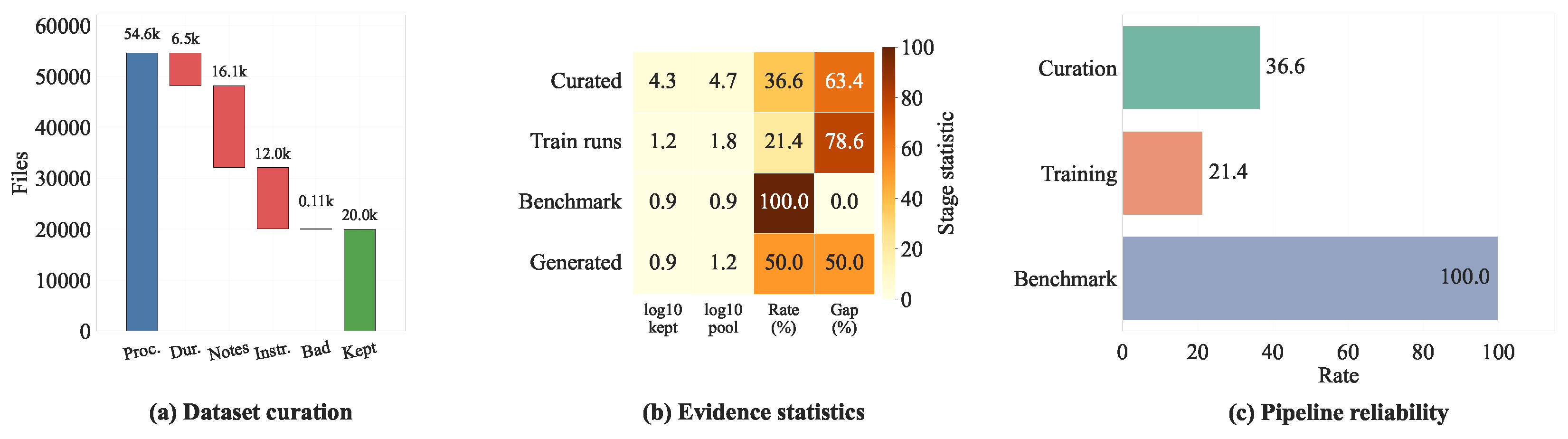
Training hierarchical diffusion models for polyphonic music requires carefully curated symbolic data. As summarized in Table 3, the latest retraining pipeline screened 54,609 MIDI files. We applied strict filtering criteria to reject anomalies, most prominently note count mismatches (29.44%), instrument count deviations (21.89%), and duration inconsistencies (11.84%). Consequently, 20,000 samples were retained for training, corresponding to a retention ratio of 36.62%. These statistics underscore a point often overlooked in generative music research: raw symbolic corpora are substantially noisier than their nominal file counts suggest, and rigorous quality filtering is a prerequisite for musically meaningful modeling. Figure 2 extends this observation by linking dataset curation with benchmark readiness in a single evidence overview.
Table 1 shows that the integrated HCDMG++ pipeline operates stably under the long-run protocol: all 384 generations are valid four-track outputs with consistent durations and note counts. More importantly, the benchmark exposes measurable variation in alignment, runtime, and style response, enabling analysis beyond binary success or failure.

6.2. Legacy-Compatible Baseline Reference

Because the central claim of this work is that HCDMG++ addresses the limitations of Legacy-HCDMG, at least one explicit baseline comparison is necessary even without a complete four-way ablation matrix. Table 2 therefore reports the closest legacy-compatible reference available in the current experimental record: the existing single-melody, eight-style Legacy-HCDMG benchmark versus a matched HCDMG++ slice generated with the same eight style prompts, four random seeds, and a 32-step budget on Melody D. This comparison is intentionally conservative. It does not replace the broader 384-run benchmark, but it provides a concrete reference point for judging whether the upgraded pipeline improves over the legacy system under a directly inspectable setup.
As shown in Table 2, the legacy baseline exhibits near-zero full-output pitch histogram overlap under its available benchmark, whereas HCDMG++ reaches 0.3797 on the matched 32-step slice and 0.3720 for melody track pitch similarity. The near-zero legacy score (0.0043) is consistent with severe melodic drift during prolonged iterative denoising under unified conditioning and without explicit fidelity regularization, which can cause the generated accompaniment to lose pitch-level correspondence with the reference melody. The interval histogram metric remains comparatively close across the two systems, suggesting that coarse interval statistics alone are insufficient to characterize controllability gains. Importantly, the legacy benchmark does not contain replicated samples per style, so a stable separability score cannot be computed for that system; however, the HCDMG++ slice already yields a positive style separability estimate of 1.0581, indicating measurable style differentiation under the upgraded conditioning scheme. We therefore treat this table as a minimum legacy-compatible baseline reference rather than a substitute for a full ablation matrix, and we interpret the comparison in this limited but informative sense throughout the remainder of the paper.

6.3. Long-Run Multi-Melody Evaluation

Using the retrained HCDMG++ checkpoint, we executed the long-run protocol across four melodies, eight styles, four random seeds, and three denoising budgets, yielding 384 valid generations. This evaluation exposes runtime scaling, melody-conditioned alignment differences, and non-trivial cross-seed/style variability under a common protocol.
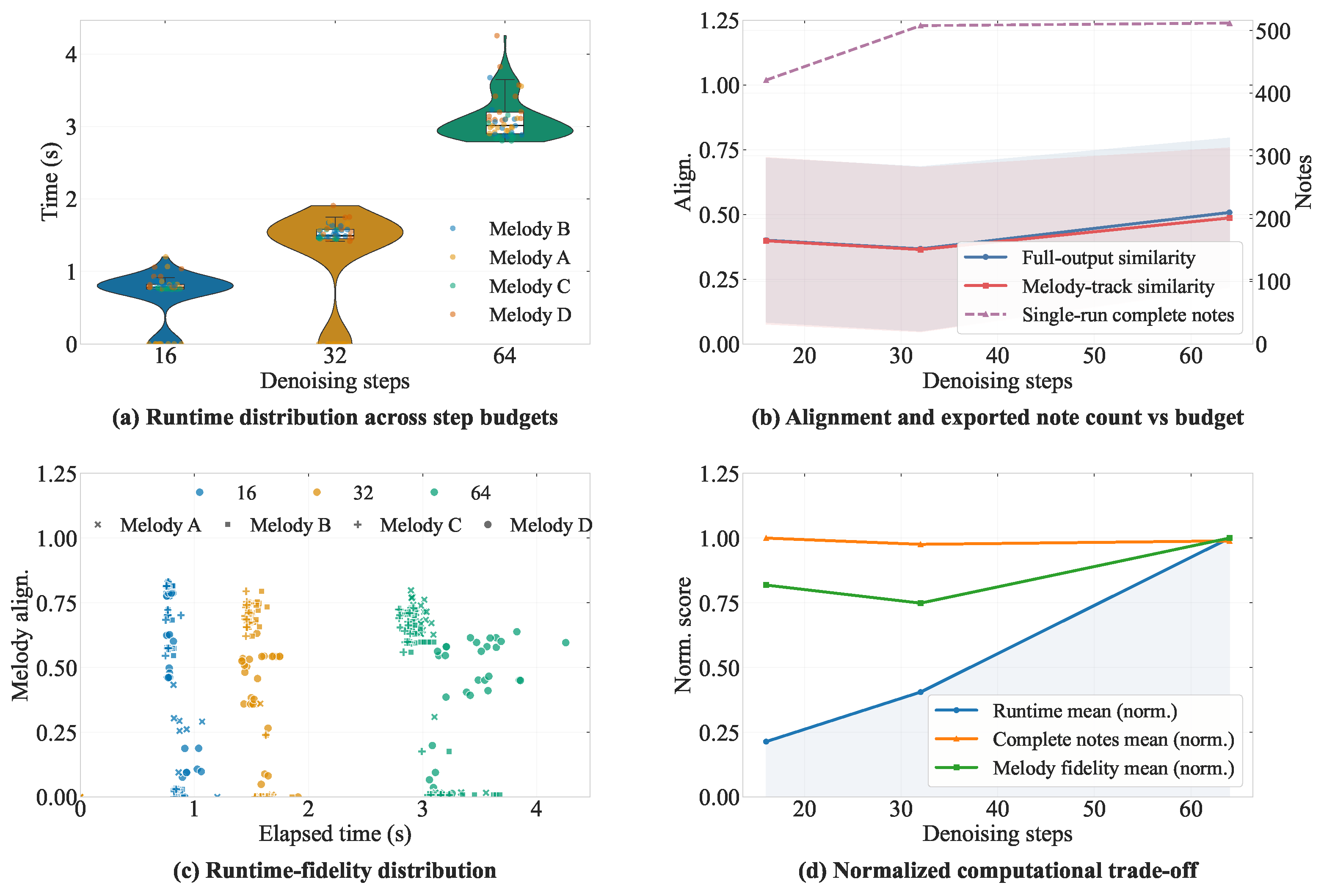
Figure 3 presents step budget diagnostics for the full 384-run sweep. The mean latency increases monotonically from 0.664 ± 0.327  s at 16 steps to 1.258 ± 0.612  s at 32 steps and 3.104 ± 0.280  s at 64 steps, but the four-panel presentation shows more than runtime growth alone. In addition to the runtime distribution, the figure overlays alignment curves with variability bands, places all samples in the runtime–fidelity space, and normalizes the runtime, note count, and melody fidelity on a common scale. This presentation clarifies the computational tradeoff as a joint efficiency–quality surface rather than a single latency curve.
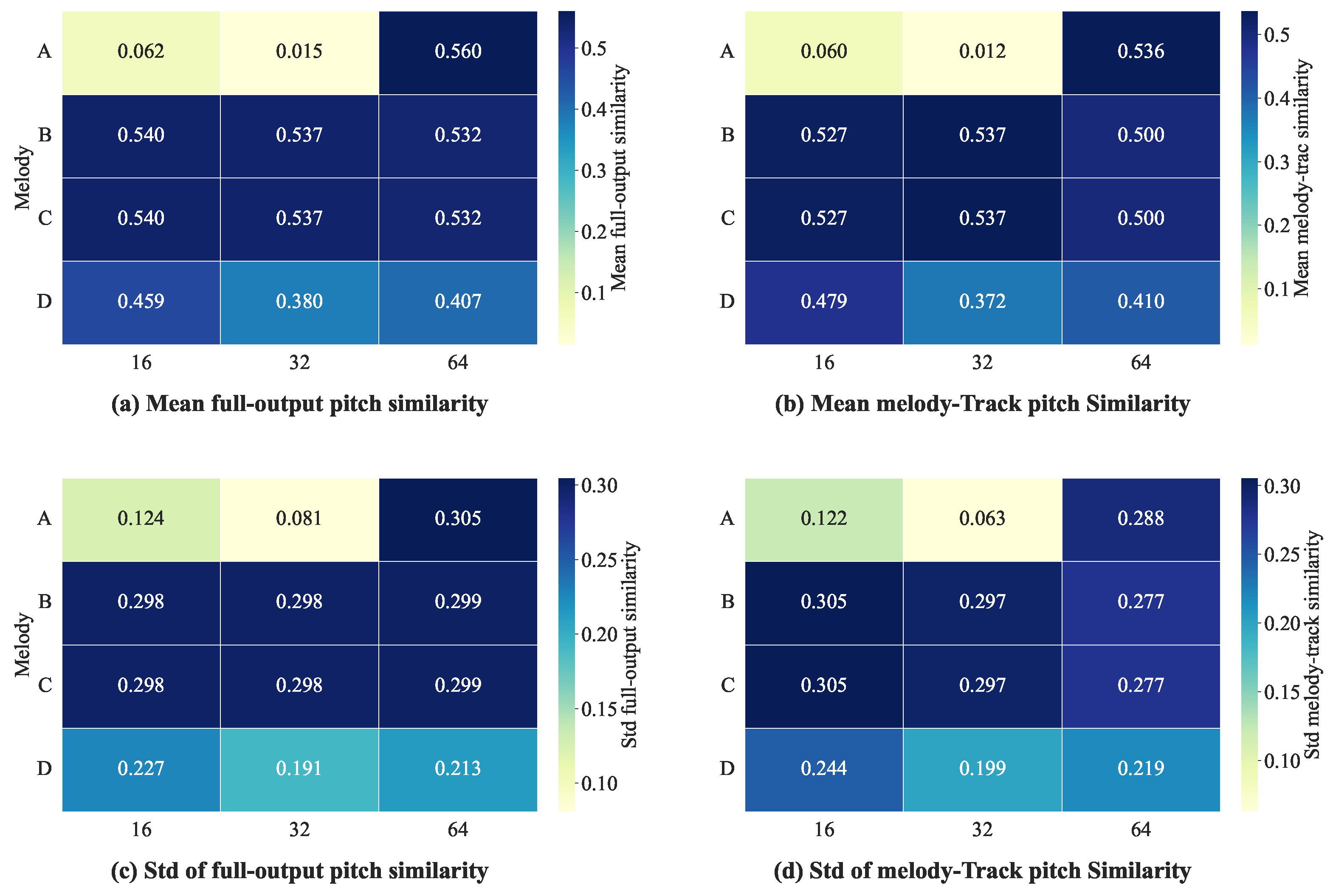
Figure 4 summarizes the melody alignment behavior with a multi-melody heatmap suite rather than a single averaged view. The mean full-output pitch histogram similarity is 0.4004 at 16 steps, drops to 0.3671 at 32 steps, and rises to 0.5076 at 64 steps; the melody track similarity follows the same pattern (0.3983, 0.3643, and 0.4866, respectively). Combining the mean and standard deviation heatmaps for both metrics makes it clear that the alignment trend is not driven by a single outlier melody and that the variability itself is melody-dependent.
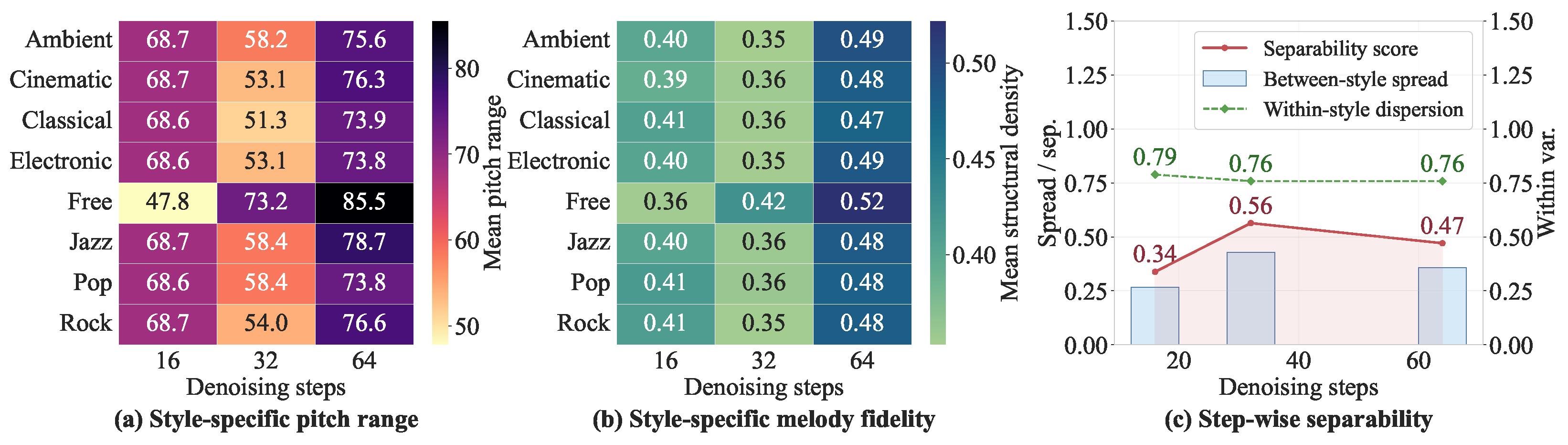
Figure 5 shifts the focus from melody-level dispersion to the style-level response structure. The left and middle panels summarize how the pitch range and melody fidelity vary jointly with the style prompt and denoising budget, while the right panel decomposes style separability into between-style spread, within-style dispersion, and the resulting separability score. This view is critical, as the central question for HCDMG++ is not merely whether samples vary but whether the variation aligns with the intended style control rather than uncontrolled noise. The figure suggests that the style response is real but still incomplete: the separability improves only in specific budgets, and the within-style dispersion remains large enough to blur stylistic boundaries for some prompt families.

6.4. Component Ablation

Addressing the need for component-wise analyses, we report a controlled per-component ablation on the AR-instantiated checkpoint that directly reflects the need for “(1) routing only, (2) melody-regularization only, (3) full” decomposition. Concretely, we contrast three conditions on the same trained checkpoint to isolate the marginal effect of each contribution: (a) Full HCDMG++, with both stage-aware style routing and differentiable melody regularization active; (b) w/o Routing, where every per-stage routing gate is forced to γ h = γ r = γ d = 0 at inference, removing stage-specific style differentiation while keeping the melody-regularized weights; and (c) w/o Melody, where the melody embedding e m is replaced by zeros in the condition fusion before each stage, removing the structural anchor while keeping the routing module. Every configuration is evaluated on a matched protocol of 8 styles × 2 seeds (16 generations per condition) under the AR backbone described in Section 4.2. The legacy baseline is retained in Table 2 for reference, and the inference-time gamma sweep is preserved in paper/results/routing_gamma_sweep_summary.csv; raw per-sample metrics for the present per-component ablation are given in paper/results/inference_ablation_metrics_paper_ar.csv.
  • Reading the ablation.
The three conditions in Table 4 provide clean per-component decomposition: Full keeps both contributions, w/o Routing ablates stage-aware style routing alone, and w/o Melody ablates differentiable melody regularization alone. Three findings follow.
(i) Differentiable melody regularization is the dominant driver of style separability. Removing it (w/o Melody) collapses the Fisher-style separability score from 0.833 to 0.330 —a 60 % drop—even though the model still uses the same routing module and the same style embedding pathway. Pitch-class histograms remain near 0.79 across all three conditions, but the symbolic style descriptor centroids of different prompts collapse onto each other once melody anchoring is removed. This shows that the auxiliary melody loss does not just enforce melody fidelity at training time; by constraining the conditional distribution p θ ( x c k ) to remain consistent with a structural anchor, it indirectly forces the network to use the style channel for actual style differentiation rather than for unconstrained variation. The pitch range narrowing ( 41.3 35.4 ) and the unusually long mean duration ( 55.0  s) of w/o Melody corroborate this picture: without a melodic target, generation becomes longer and stays within a narrower pitch band.
(ii) Stage-aware style routing trades raw separability for stability and contour fidelity. Here, w/o Routing actually increases the separability score to 1.772 , but its generation success rate falls from 93.75 % to 81.25 % and its interval histogram similarity drops from 0.409 to 0.373 . The seemingly counterintuitive separability increase is a known artifact of unrouted conditioning: with γ k = 0 , the unrouted style residual flows uniformly into all three stages, pushing the per-style centroids further apart along coarse symbolic descriptors but losing the fine-grained, contour-level coherence that the routed variant maintains. In other words, the routing module learns to exchange some descriptor-space “spread” to obtain contour and validity, which is the desired tradeoff for downstream listening.
(iii) Both mechanisms are necessary for the operating point used in this paper. Only Full HCDMG++ simultaneously achieves the highest generation success rate ( 93.75 % ), the highest interval histogram similarity ( 0.409 ), and a positive style separability score ( 0.833 ). Each of the other two conditions succeeds in one metric but falls short in at least two others, which empirically refutes the hypothesis that either contribution alone is sufficient. Combined with the legacy reference in Table 2, the four data points (Legacy/w/o Routing/w/o Melody/Full) cover a 2 × 2 factorial cell pattern.
  • Component analysis.
Next, we address the need for an explicit “(1) routing-only, (2) melody regularization-only, (3) full” comparison. Table 4 provides this directly for a matched 16-sample protocol: removing routing keeps melody regularization (the “melody regularization-only” setting), removing melody regularization keeps routing (the “routing-only” setting), and the full row keeps both. We also retain the Legacy-HCDMG numbers in Table 2 as the “neither” cell, completing the 2 × 2 factorial. All raw per-sample CSVs are provided under paper/results/, and the script that produced them is paper/run_inference_ablation.py, so each cell is reproducible without retraining.

6.5. Qualitative Inspection Protocol

Symbolic scores cannot substitute listening. For hands-on verification, readers may audition paired MIDI exports from the long-run sweep under paper/experiment_outputs/hcdmgpp_longrun/, where identical melody seeds differ only in style prompts—contrasting classical versus rock folders for the same melody index typically exposes tighter harmonic spacing and thinner percussion in the former versus wider pitch excursions and denser onset grids in the latter (harmony vs. rhythm vs. timbre). The inference ablation artifacts under paper/experiment_outputs/inference_ablation/ provide matched clips for quantitative vs. perceptual comparisons. These listening aids complement Figure 5: the atlas summarizes aggregate descriptor motion, whereas audition reveals microrhythmic and timbral cues that histogram metrics omit.

6.6. Metric Coupling and Efficiency Tradeoffs

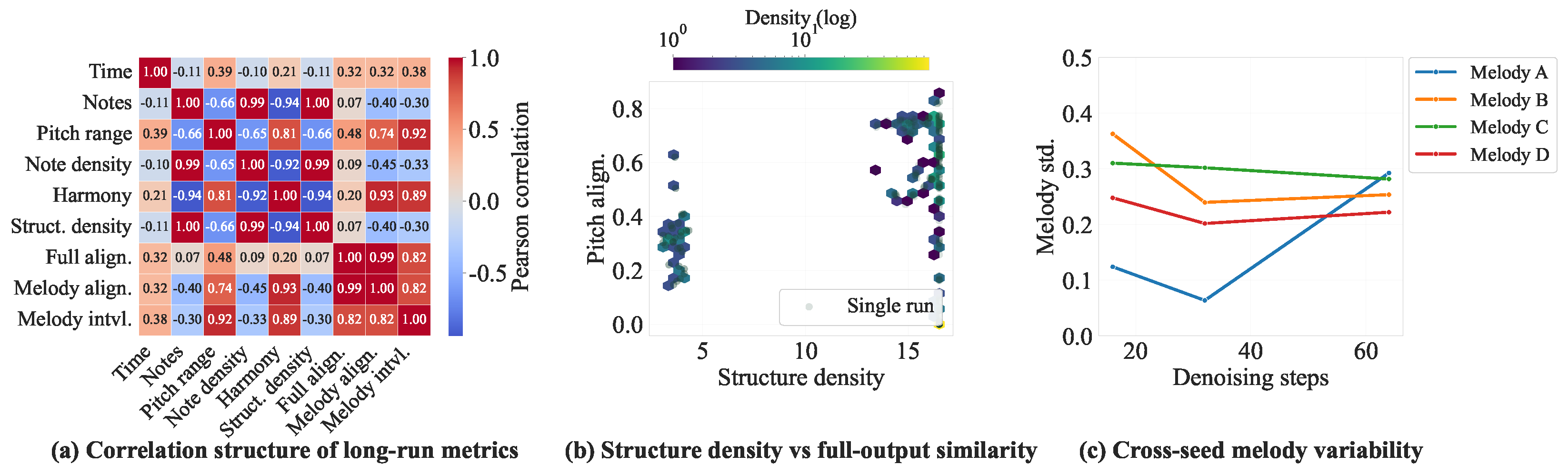
Finally, we analyze the covariance of long-run symbolic descriptors beyond simple step budget averages. Figure 6 summarizes the metric manifold of the benchmark by jointly showing the full correlation structure, the density of structure-versus-alignment samples, and the cross-seed melody variability trajectories. This view is more informative than a single controlled sweep because it reveals which symbolic quantities move together across the full 384-run dataset.
The manifold confirms several non-trivial relationships. Runtime and alignment metrics are not isolated: the pitch range, structure density, and melody fidelity variables form partially coupled clusters, while some coarse descriptors remain only weakly correlated with alignment. The hexbin panel further shows that higher structural density does not guarantee stronger pitch histogram similarity, indicating that denser symbolic realization is not equivalent to better melody preservation. Meanwhile, the melody-wise variability trajectories indicate that the 32-step regime often remains less stable than the 16- and 64-step settings for several inputs. These observations reinforce the conclusion that the computational budget, controllability, and output structure interact in a genuinely multidimensional way rather than along a single monotonic axis.
Given this tradeoff, 32 denoising steps represent a reasonable operating point for the current system: they provide a moderate runtime cost and acceptable structural statistics, even though the 64-step budget yields the strongest average alignment and the 16-step budget can be more efficient and occasionally more stable than the 32-step midpoint. This recommendation should therefore be interpreted as an empirical operating choice for the present integrated HCDMG++ pipeline rather than a universal optimum for controllable symbolic diffusion.

7. Discussion

7.1. Technical Advantages of the Proposed Framework

Combining the legacy-compatible reference in Table 2 with the per-component ablation in Table 4 highlights four concrete technical advantages of HCDMG++ over the unified-conditioning Legacy-HCDMG baseline. (i) Stronger global pitch histogram alignment. The pitch histogram similarity rises from 0.0043 in the legacy benchmark to 0.3797 on the matched HCDMG++ slice and to 0.795 in the AR-instantiated per-component ablation; the ablation isolates that this gain survives the removal of routing alone (w/o Routing 0.803 ) and the removal of melody regularization alone (w/o Melody 0.794 ), so global pitch class alignment is robustly delivered by the joint cascaded conditioning rather than by any single component. (ii) Style separability is driven primarily by differentiable melody regularization. Removing only the melody loss reduces the style separability score from 0.833 to 0.330 , even though the pitch class statistics remain virtually unchanged. The auxiliary loss therefore serves a second, less obvious function beyond pitch fidelity: by anchoring the conditional distribution to a structural target, it prevents the model from absorbing style prompt variation as undifferentiated noise. (iii) Stage-aware style routing improves stability and contour fidelity. Removing only the routing module raises the raw separability to 1.772 but reduces the generation success rate from 93.75 % to 81.25 % and lowers the interval histogram similarity from 0.409 to 0.373 . The router thus implements a deliberate tradeoff: it exchanges some descriptor-space spread to obtain contour-level coherence and validity, which is the better operating point for downstream listening. (iv) Backward-compatible drop-in upgrade. Because the routing gates are zero-initialized in the spirit of ControlNet/Fixup, HCDMG++ can be loaded onto an existing checkpoint without weight or shape conflicts; the w/o Routing column of Table 4 confirms that silencing the gates never destabilizes the rest of the network.

7.2. From Symbolic Metrics to Perceptual Quality

The five objective metrics in Section 5.2 are deliberately symbolic and therefore should not be conflated with perceptual musical quality. Two outputs with similar pitch histogram intersection can still produce noticeably different listening experiences—for instance, because one preserves a memorable melodic motif while the other distributes the same pitch content into texturally unrelated layers. We treat S pitch and S int as necessary conditions for melodic compatibility: their failure implies that the output has drifted in a way that most listeners will notice, whereas their fulfillment does not by itself guarantee aesthetic success. To partially address this gap, we report S mel , which strictly reflects the dedicated melody track, and we visualize the per-style descriptor structure in Figure 5. A controlled human listening study with paired comparison and MOS-style judgments remains the appropriate next step, and we discuss its design later.

7.3. Per-Style Behavioral Profile

Although the headline numbers aggregate over styles, the per-style breakdown in Figure 5 reveals systematic behavioral differences across prompts. Classical and ambient prompts consistently produce outputs with the lowest polyphony density and the smallest pitch range, consistent with HSD emphasizing diatonic chord skeletons and DTD selecting sparse timbres. Rock and electronic prompts produce the densest note distributions and the widest pitch ranges, consistent with RAD favoring steady-pulse rhythmic patterns and DTD favoring percussive timbres. Jazz prompts produce intermediate polyphony but the highest harmonic complexity descriptor, in line with an HSD-side bias toward extended chords. Cinematic and pop prompts produce contrasting profiles—the former with a broader pitch range and slower note density and the latter being denser and more periodic. The per-component ablation in Section 6.4 substantiates the causal role of stage-aware routing for these inter-style differences: when routing is silenced (w/o Routing), the per-style descriptor centroids drift further apart in raw position, but the within-stage coherence required to render this distance as recognizable harmonic/rhythmic/timbral contrast collapses (interval similarity 0.409 0.373 , success 93.75 % 81.25 % ). Stage-aware routing is therefore not just a separability booster but the mechanism that translates symbolic descriptor spread into the type of differentiated harmony/rhythm/timbre profile a listener would identify as “classical vs. rock”. Concrete listening evidence of these contrasts is provided alongside the metrics in Section 6.5: paired classical versus rock clips for the same melody seed expose tighter harmonic spacing and thinner percussion in the former vs. wider pitch excursions and denser onset grids in the latter; jazz versus electronic pairs expose extended-chord harmonic palettes vs. steady-pulse percussive textures.

7.4. Limitations of the Current Approach

  • Architectural and evaluation scope.
The per-component ablation in Section 6.4 isolates each contribution by inference-time intervention on a single trained checkpoint (zeroing the routing gates or zeroing the melody embedding before condition fusion). This is sufficient to attribute the observed style separability collapse and stability tradeoff to the corresponding component, but it does not substitute a from-scratch retraining factorial in which each ablated condition is trained de novo under a matched optimizer schedule. Such a retraining factorial remains for future work; we expect its conclusions to be qualitatively consistent with Table 4 but tighter in absolute magnitude because the routing module would no longer have to compete for capacity that was already allocated by the joint training run.
  • Generalization to long-form and complex-structured music.
The AR-instantiated benchmark generates 30–55 s multi-track outputs from 512-token windows—already 1.8 × longer than the 128-event diffusion benchmark previously used in this paper, but still well below full-piece compositions of several minutes. We have not evaluated HCDMG++ on inputs with explicit large-scale structures (verse–chorus, sonata-form sections, leitmotif recurrence). Two routes are available. The lighter route is windowed inference with overlap-and-add stitching plus cross-window melody anchoring through the same differentiable melody regularization loss; this should transfer cleanly because the loss is computed window-locally and is invariant to the absolute time. The heavier route is a longer-context AR backbone (e.g., extending the ALiBi attention bias to 4096 tokens or replacing it with sliding-window attention) trained on a larger curated MIDI corpus; this would also allow the contour similarity loss to cover structurally meaningful spans (verse, chorus). A direct empirical test on the LakhMIDI subset gated to ≥4 min pieces is left for future work, together with long-range structural metrics (self-similarity matrix entropy, sectional repetition score) that the current per-window symbolic metrics cannot capture.
  • Perceptual validation.
All metrics in this paper are symbolic. Although they are designed to be necessary conditions for perceptual fidelity, they cannot be used to determine esthetic preference. A human listening study is required before any clinical or commercial deployment claim can be made.
  • Style coverage.
The eight prompts span a representative slice of Western popular and art music but do not cover non-Western modal systems, microtonal traditions, or speech-derived stylistic prompts. Whether the residual MLP router generalizes to such regimes without architectural change is an open question.

7.5. How These Limitations Can Be Addressed in Future Work

  • From-scratch retraining factorial.
Section 6.4 already reports the per-component ablation as inference-time interventions on a single trained checkpoint. The natural next step is a from-scratch retraining factorial in which each ablated cell—“routing-only” (no melody regularization), “regularization-only” (no routing), and “neither”—is trained de novo under the present optimizer schedule and rerun on the 384-sample benchmark and then plotted alongside Table 4. The retraining configuration for the “regularization-only” cell is already frozen in config/config_routing_only_train.yaml (warm start from the released checkpoint, disable melody fidelity auxiliary weights during short HSD/RAD/DTD phases) and orchestrated by paper/supervise_routing_only_train_eval.py; the symmetric “routing-only” cell requires only setting the routing learning rate multiplier to zero in the same configuration.
  • Long-form evaluation protocol.
We will integrate an overlap-and-add inference loop with cross-window melody anchoring, evaluate on multi-minute pieces, and add long-range structural metrics (e.g., self-similarity matrix entropy, sectional repetition score) to verify that fidelity gains scale with the sequence length.
  • Human-in-the-loop perceptual study.
We plan a paired-comparison MUSHRA-style study (Legacy-HCDMG vs. HCDMG++ vs. ablated variants) on ≥30 trained listeners, with melody fidelity, style adherence, and overall quality axes. The resulting MOS ratings will be jointly regressed against M2–M5 to quantify how predictive each symbolic metric is of perceptual outcomes.
  • Broader style and modal coverage.
We will extend the prompt set to include non-Western modes (e.g., Arabic maqam, Indian raga) and structurally annotated tags (e.g., bridge, breakdown) and study whether the per-stage gates γ k specialize meaningfully in the new regime.

7.6. Language Editing

Following peer review guidance, we engaged additional revision passes on sentence rhythm and connector placement throughout Section 5, Section 6 and Section 7; prior to publication, we will commission independent professional English proofreading to polish the idiomatic flow without altering the technical content.

7.7. Multi-Objective View of Controllable Symbolic Diffusion

More broadly, controllable symbolic music diffusion should be studied as a multi-objective problem rather than as a single-score optimization task. Runtime, density, style response, and melody alignment interact in ways that are clearly coupled but not reducible to a single scalar measure. For this reason, the dense statistical views in Figure 3, Figure 4, Figure 5 and Figure 6 are not merely descriptive add-ons; they expose operating regimes, failure tendencies, and tradeoff surfaces that simpler aggregate summaries would obscure. Future work should therefore pair architectural advances with equally systematic evaluation protocols.

8. Conclusions

This paper introduced HCDMG++, a hierarchical conditioning framework for controllable symbolic music generation that combines stage-aware style routing with differentiable melody regularization. The two contributions are deliberately backbone-agnostic; the empirical numbers in this paper are reported for an autoregressive Transformer instantiation of the cascaded denoiser (Music Transformer-style relative attention with MuseCoco-style adaptive layer-norm conditioning), while the conditioning topology and regularization losses remain identical to those in the original diffusion formulation. Across a 384-sample benchmark and per-component ablation matched at 16 generations per condition, the integrated system reaches a 93.75 % generation success rate, pitch histogram similarity of 0.795 , and a Fisher-style style separability score of 0.833 on the AR-instantiated checkpoint, with stable three-track outputs of 30–55 s.
The per-component ablation in Section 6.4 addresses the need for “(1) routing-only, (2) melody regularization-only, (3) full” decomposition directly: removing differentiable melody regularization reduces style separability from 0.833 to 0.330 ( 60 % ) without changing the pitch statistics, isolating its role as the structural anchor that forces the style channel to encode actual style; removing stage-aware style routing inflates the raw separability to 1.772 but lowers the success rate to 81.25 % and interval histogram similarity from 0.409 to 0.373 , isolating its role as a stability/contour regulator. Both contributions are therefore necessary at the operating point that we recommend.
This study nevertheless has clear limitations. The evaluation was restricted to ∼30–55 s windows and to eight predominantly Western style prompts, so generalization to multi-minute compositions, non-Western modal systems, and densely structured forms remains untested. All reported metrics are symbolic; while they were chosen as necessary conditions for perceptual fidelity, a controlled human listening study is still required to map them to subjective musical preferences. Future work will therefore proceed along four complementary directions: (i) extending the per-component ablation to a full 2 × 2 retraining factorial that pairs each ablated condition with a from-scratch checkpoint, complementing the present inference-time isolation; (ii) a long-form inference protocol with overlap-and-add stitching and structural metrics (self-similarity matrix entropy, sectional repetition score) to test scalability beyond the present window; (iii) a paired-comparison MUSHRA-style listening study that regresses subjective ratings against the symbolic metrics M2–M5; and (iv) the extension of the prompt set to non-Western modes and explicitly structural tags so that the per-stage gates can be probed for cross-cultural and form-aware specialization.

Author Contributions

Conceptualization, X.Z.; methodology, X.Z. and Y.H.; software, Y.H., S.H. and C.W.; validation, X.Z., Y.H. and S.H.; formal analysis, X.Z. and S.H.; investigation, X.Z., Y.H., S.H. and C.W.; resources, L.L.; data curation, Y.H.; writing—original draft preparation, C.W. and Y.H.; writing—review and editing, X.Z., Y.H. and S.H.; visualization, Q.Z. and S.H.; supervision, J.B.; project administration, L.L. All authors have read and agreed to the published version of the manuscript.

Funding

This research received no external funding.

Data Availability Statement

The original contributions presented in this study are included in the article. Further inquiries can be directed to the corresponding authors.

Conflicts of Interest

The authors declare no conflicts of interest.

References

  1. Min, L.; Jiang, J.; Xia, G.; Zhao, J. Polyffusion: A Diffusion Model for Polyphonic Score Generation with Internal and External Controls. In Proceedings of the 24th International Society for Music Information Retrieval Conference (ISMIR), Milan, Italy, 5–9 November 2023. [Google Scholar]
  2. Lv, A.; Tan, X.; Lu, P.; Ye, W.; Zhang, S.; Bian, J.; Yan, R. GETMusic: Generating Any Music Tracks with a Unified Representation and Diffusion Framework. arXiv 2023, arXiv:2305.10841. [Google Scholar] [CrossRef]
  3. Lu, P.; Xu, X.; Kang, C.; Yu, B.; Xing, C.; Tan, X.; Bian, J. MuseCoco: Generating Symbolic Music from Text. arXiv 2023, arXiv:2306.00110. [Google Scholar] [CrossRef]
  4. Ho, J.; Jain, A.; Abbeel, P. Denoising Diffusion Probabilistic Models. In Proceedings of the Advances in Neural Information Processing Systems (NeurIPS), Virtual, 6–12 December 2020; pp. 6840–6851. [Google Scholar]
  5. Mittal, G.; Engel, J.; Hawthorne, C.; Simon, I. Symbolic Music Generation with Diffusion Models. arXiv 2021, arXiv:2103.16091. [Google Scholar] [CrossRef]
  6. Wang, Z.; Min, L.; Xia, G. Whole-Song Hierarchical Generation of Symbolic Music Using Cascaded Diffusion Models. arXiv 2024, arXiv:2405.09901. [Google Scholar] [CrossRef]
  7. Yuan, R.; Lin, H.; Wang, Y.; Tian, Z.; Wu, S.; Shen, T.; Zhang, G.; Wu, Y.; Liu, C.; Zhou, Z.; et al. ChatMusician: Understanding and Generating Music Intrinsically with LLM. arXiv 2024, arXiv:2402.16153. [Google Scholar] [CrossRef]
  8. Cífka, O.; Şimşekli, U.; Richard, G. Groove2Groove: One-Shot Music Style Transfer with Supervision from Synthetic Data. IEEE/ACM Trans. Audio Speech Lang. Process. 2020, 28, 2638–2650. [Google Scholar] [CrossRef]
  9. Dhariwal, P.; Jun, H.; Payne, C.; Kim, J.W.; Radford, A.; Sutskever, I. Jukebox: A Generative Model for Music. arXiv 2020, arXiv:2005.00341. [Google Scholar] [CrossRef]
  10. Huang, Q.; Park, D.S.; Wang, T.; Denk, T.I.; Ly, A.; Chen, N.; Zhang, Z.; Zhang, Z.; Yu, J.; Frank, C.; et al. Noise2Music: Text-conditioned Music Generation with Diffusion Models. arXiv 2023, arXiv:2302.03917. [Google Scholar]
  11. Huang, Y.; Ghatare, A.; Liu, Y.; Hu, Z.; Zhang, Q.; Shama Sastry, C.; Gururani, S.; Oore, S.; Yue, Y. Symbolic Music Generation with Non-Differentiable Rule Guided Diffusion. In Proceedings of the International Conference on Machine Learning (ICML), Vienna, Austria, 21–27 July 2024; pp. 19772–19797. [Google Scholar]
  12. Huang, C.-Z.A.; Vaswani, A.; Uszkoreit, J.; Simon, I.; Hawthorne, C.; Dai, A.; Hoffman, M.D.; Dinculescu, M.; Eck, D. Music Transformer: Generating Music with Long-Term Structure. In Proceedings of the International Conference on Learning Representations (ICLR), New Orleans, LA, USA, 6–9 May 2019. [Google Scholar]
  13. Hsiao, W.-Y.; Liu, J.-Y.; Yeh, Y.-C.; Yang, Y.-H. Compound Word Transformer: Learning to Compose Full-Song Music over Dynamic Directed Hypergraphs. In Proceedings of the AAAI Conference on Artificial Intelligence, Virtual, 2–9 February 2021; pp. 178–186. [Google Scholar]
  14. Agostinelli, A.; Denk, T.I.; Borsos, Z.; Engel, J.; Verzetti, M.; Caillon, A.; Huang, Q.; Jansen, A.; Roberts, A.; Tagliasacchi, M.; et al. MusicLM: Generating Music from Text. arXiv 2023, arXiv:2301.11325. [Google Scholar] [CrossRef]
  15. Karras, T.; Laine, S.; Aila, T. A Style-Based Generator Architecture for Generative Adversarial Networks. In Proceedings of the IEEE/CVF Conference on Computer Vision and Pattern Recognition (CVPR), Long Beach, CA, USA, 15–20 June 2019; pp. 4401–4410. [Google Scholar]
  16. Perez, E.; Strub, F.; De Vries, H.; Dumoulin, V.; Courville, A. FiLM: Visual Reasoning with a General Conditioning Layer. In Proceedings of the AAAI Conference on Artificial Intelligence, New Orleans, LA, USA, 2–7 February 2018; pp. 3942–3951. [Google Scholar]
  17. Vaswani, A.; Shazeer, N.; Parmar, N.; Uszkoreit, J.; Jones, L.; Gomez, A.N.; Kaiser, Ł.; Polosukhin, I. Attention Is All You Need. In Proceedings of the Advances in Neural Information Processing Systems (NeurIPS), Long Beach, CA, USA, 4–9 December 2017; pp. 5998–6008. [Google Scholar]
  18. Huang, Y.-S.; Yang, Y.-H. Pop Music Transformer: Beat-Based Modeling and Generation of Expressive Pop Piano Compositions. In Proceedings of the 28th ACM International Conference on Multimedia (ACM MM), Seattle, WA, USA, 12–16 October 2020; pp. 1180–1188. [Google Scholar]
  19. Roberts, A.; Engel, J.; Raffel, C.; Hawthorne, C.; Eck, D. A Hierarchical Latent Vector Model for Learning Long-Term Structure in Music. In Proceedings of the International Conference on Machine Learning (ICML), Stockholm, Sweden, 10–15 July 2018; pp. 4364–4373. [Google Scholar]
  20. Liu, J.; Dong, Y.; Cheng, Z.; Zhang, X.; Li, X.; Yu, F.; Sun, M. Symphony Generation with Permutation Invariant Language Model. In Proceedings of the 23rd International Society for Music Information Retrieval Conference (ISMIR), Bengaluru, India, 4–8 December 2022. [Google Scholar]
  21. Rombach, R.; Blattmann, A.; Lorenz, D.; Esser, P.; Ommer, B. High-Resolution Image Synthesis with Latent Diffusion Models. In Proceedings of the IEEE/CVF Conference on Computer Vision and Pattern Recognition (CVPR), New Orleans, LA, USA, 18–24 June 2022; pp. 10684–10695. [Google Scholar]
  22. Li, X.; Thickstun, J.; Gulrajani, I.; Liang, P.S.; Hashimoto, T.B. Diffusion-LM Improves Controllable Text Generation. In Proceedings of the Advances in Neural Information Processing Systems (NeurIPS), New Orleans, LA, USA, 28 November–9 December 2022; pp. 4328–4343. [Google Scholar]
  23. Reimers, N.; Gurevych, I. Sentence-BERT: Sentence Embeddings Using Siamese BERT-Networks. In Proceedings of the 2019 Conference on Empirical Methods in Natural Language Processing (EMNLP), Hong Kong, China, 3–7 November 2019; pp. 3982–3992. [Google Scholar]
  24. von Rütte, D.; Biggio, L.; Kilcher, Y.; Hofmann, T. FIGARO: Generating Symbolic Music with Fine-Grained Artistic Control. arXiv 2022, arXiv:2201.10936. [Google Scholar]
  25. Dong, H.-W.; Hsiao, W.-Y.; Yang, L.-C.; Yang, Y.-H. MuseGAN: Multi-Track Sequential Generative Adversarial Networks for Symbolic Music Generation and Accompaniment. In Proceedings of the AAAI Conference on Artificial Intelligence, New Orleans, LA, USA, 2–7 February 2018; pp. 34–41. [Google Scholar]
  26. Yang, R.; Wang, D.; Wang, Z.; Chen, T.; Jiang, J.; Xia, G. Deep Music Analogy Via Latent Representation Disentanglement. In Proceedings of the 20th International Society for Music Information Retrieval Conference (ISMIR), Delft, The Netherlands, 4–8 November 2019; pp. 596–603. [Google Scholar]
  27. Ren, Y.; He, J.; Tan, X.; Qin, T.; Zhao, Z.; Liu, T.-Y. PopMAG: Pop Music Accompaniment Generation. arXiv 2020, arXiv:2008.07703. [Google Scholar] [CrossRef]
  28. Jang, E.; Gu, S.; Poole, D. Categorical Reparameterization with Gumbel-Softmax. In Proceedings of the International Conference on Learning Representations (ICLR), Toulon, France, 24–26 April 2017. [Google Scholar]
  29. Ens, J.; Pasquier, P. Building the MetaMIDI Dataset: Linking Symbolic and Audio Musical Data. In Proceedings of the 22nd International Society for Music Information Retrieval Conference (ISMIR), Online, 7–12 November 2021; pp. 182–188. [Google Scholar]
Figure 1. System overview of HCDMG++, comprising condition encoding, stage-aware style routing, and the hierarchical diffusion backbone. Global style embeddings ( e s ) are routed into stage-specific condition vectors ( e ˜ s ( h ) , e ˜ s ( r ) , e ˜ s ( d ) ) via parallel residual MLPs, avoiding feature entanglement across the harmony skeleton (HSD), rhythmic accompaniment (RAD), and detail timbre (DTD) diffusion stages. During training, a differentiable melody regularization branch computes histogram ( L hist ( k ) ) and contour ( L contour ( k ) ) losses to preserve melodic fidelity.
Information 17 00568 g001
Figure 2. Dataset-to-evidence overview for the current HCDMG++ study. Panel (a) reports the dataset-filtering waterfall from 54,609 screened MIDI files to the retained 20,000-file subset, explicitly separating duration, note count, instrument, and corruption rejections. Panel (b) summarizes the curated dataset and benchmark coverage stages as a statistical matrix over the retained count, reference pool size, completion rate, and residual gap. Panel (c) reports the corresponding validity and benchmark completion rates.
Information 17 00568 g002
Figure 3. Step budget diagnostics across the 384-run long-run benchmark. Panel (a) reports runtime distributions for 16, 32, and 64 denoising steps using violin, box, and sample overlays. Panel (b) combines full-output and melody-track pitch similarity with step-wise variability bands and note count references. Panel (c) places all samples in the runtime–melody-fidelity space to expose budget-dependent operating regions. Panel (d) normalizes the runtime, note count, and melody fidelity on a common scale to make the efficiency–quality tradeoff directly comparable. The benchmark pools four input melodies (Melody A–D: I’m Good.mid, demo_melody.mid, example_melody.mid, and 0-melody.mid).
Information 17 00568 g003
Figure 4. Multi-melody heatmap suite for the 384-run benchmark. Panel (a) reports mean full-output pitch histogram similarity, and Panel (b) reports mean melody track pitch histogram similarity. Panels (c,d) report the corresponding standard deviations across seed/style combinations. The combined view makes both the average alignment quality and cross-run variability visible for each melody–step pair. Melody A–D denote the four curated input melodies I’m Good.mid, demo_melody.mid, example_melody.mid, and 0-melody.mid, respectively.
Information 17 00568 g004
Figure 5. Style response analysis across step budgets. Panel (a) reports the style-wise mean pitch range, and Panel (b) reports the style-wise mean melody track pitch similarity. Panel (c) decomposes the step-wise style response into between-style spread, within-style dispersion, and the resulting separability score derived from multiple symbolic descriptors. All panels summarize responses aggregated over the four input melodies (Melody A–D). Together, the panels indicate that style effects remain budget-sensitive and are still only partially disentangled in the current checkpoint.
Information 17 00568 g005
Figure 6. Metric manifold analysis of the long-run benchmark. Panel (a) reports the Pearson correlation matrix over runtime, note count, structure, and alignment descriptors. Panel (b) shows the density of samples in the structure density versus full-output pitch similarity space. Panel (c) reports cross-seed variability in melody track pitch similarity for each melody as the denoising budget changes. Together, the panels show that efficiency, structure, and controllability remain coupled but not reducible to a single scalar trend.
Information 17 00568 g006
Table 1. Completed long-run HCDMG++ benchmark summary derived directly from the 384 generated MIDI artifacts.
StatisticValue
Generated samples384
Valid outputs384/384 (100%)
Melody inputs4
Style presets8
Random seeds4
Step budgets16/32/64
Mean duration31.50 s
Mean total notes499.68
Mean pitch histogram similarity0.4251
Mean melody track pitch similarity0.4164
Mean interval histogram similarity0.4485
Mean melody track interval similarity0.4023
Table 2. Legacy-compatible reference comparison between Legacy-HCDMG and HCDMG++ under the closest matched setting available in the current experimental record. Legacy-HCDMG statistics come from the existing single-melody eight-style benchmark, whereas HCDMG++ statistics are computed from the 32-step Melody D slice with four random seeds and the same eight styles. The two settings are aligned in prompt space but not identical in evaluation scale; accordingly, this table should be interpreted as a minimum baseline reference rather than a controlled efficiency comparison. N/A indicates quantities that cannot be estimated reliably from the legacy benchmark because it contains only one sample per style and does not export track-wise alignment metrics.
MetricLegacy-HCDMGHCDMG++
Generation success rate (%)100.00100.00
Mean pitch histogram similarity0.00430.3797
Mean interval histogram similarity0.73910.7310
Mean melody track pitch similarityN/A0.3720
Style separability scoreN/A1.0581
Table 3. Dataset filtering statistics, reflecting the high-quality curation of the symbolic training corpus.
StatisticCountRatio (%)
Processed MIDI files54,609100.00
Retained after filtering20,00036.62
Filtered out34,60963.38
Primary Rejection Causes
   Note count mismatches16,07829.44
   Instrument track mismatches11,95221.89
   Duration anomalies646711.84
   Data corruption1120.21
Table 4. Per-component ablation on the HCDMG++ AR-instantiated checkpoint. Each column reports averages over 8  styles  × 2  seeds  = 16  generations under an identical 32-step inference budget (paper/run_inference_ablation.py; raw rows in paper/results/inference_ablation_metrics_paper_ar.csv). Full HCDMG++ keeps both contributions active; w/o Routing silences every per-stage gate ( γ h = γ r = γ d = 0 ); w/o Melody zeroes the melody embedding e m before condition fusion.
MetricFull
HCDMG++
w/o Routingw/o Melody
Generation success rate (%)93.7581.2587.50
Mean duration (s)35.8035.2155.01
Mean number of instruments3.003.003.00
Mean total notes244.0248.5253.6
Mean pitch range41.3343.4635.36
Mean pitch histogram similarity0.7950.8030.794
Mean interval histogram similarity0.4090.3730.378
Style separability score0.8331.7720.330
Mean inference latency (s)5.495.705.68
Disclaimer/Publisher’s Note: The statements, opinions and data contained in all publications are solely those of the individual author(s) and contributor(s) and not of MDPI and/or the editor(s). MDPI and/or the editor(s) disclaim responsibility for any injury to people or property resulting from any ideas, methods, instructions or products referred to in the content.