
Article

Deep Learning for Age and Gender Recognition from Facial Images: A Comparative Study of EfficientNet Variants with Explainability †
by
George Sigalos
,
Ioannis Hatzilygeroudis
* and
Isidoros Perikos
Computer Engineering and Informatics Department, University of Patras, 26504 Patras, Greece
*
Author to whom correspondence should be addressed.
The paper is an extension of the following conference paper: Sigalos, G.; Hatzilygeroudis, I.; Perikos, I. Age and Gender Recognition from Images Using EfficientNet Models. In 2025 16th International Conference on Information, Intelligence, Systems & Applications (IISA); IEEE: Mytilene, Island of Lesvos, Greece, 2025; pp. 1–5. https://doi.org/10.1109/IISA66859.2025.11311189.
Information 2026, 17(6), 567; https://doi.org/10.3390/info17060567
Submission received: 27 April 2026 / Revised: 24 May 2026 / Accepted: 5 June 2026 / Published: 8 June 2026
(This article belongs to the Section Artificial Intelligence)

Abstract

Age and gender estimation from facial images is a critical task in computer vision with wide-ranging applications in human–computer interaction, marketing, surveillance, and social media personalization. While deep learning models have achieved high accuracy, two key challenges persist: (a) finding an optimal balance between computational efficiency and performance across different model scales, and (b) understanding the internal decision-making process of these models. This study presents a comprehensive investigation addressing both challenges through a comparative evaluation of two members of the EfficientNet family, EfficientNet B4 and EfficientNetV2-S, for age and gender classification. We leveraged the Adience and UTKFace benchmarks, employing preprocessing techniques including face detection, alignment, normalization, oversampling, and augmentation to combat overfitting. EfficientNet B4 achieved notable results, including 95.11% accuracy for age classification on UTKFace, establishing a new state of the art for that benchmark. Subsequently, EfficientNetV2-S was evaluated for its improved training speed and parameter efficiency, achieving competitive performance across all tasks. Distinct from standard classification studies, this work further emphasizes model interpretability by integrating Gradient-weighted Class Activation Mapping (Grad-CAM) to visualize and benchmark the specific facial regions influencing the EfficientNetV2-S network’s predictions. The Grad-CAM analysis reveals that the trained model effectively prioritizes relevant facial features rather than relying on background noise, validating that the network learns meaningful representations for age and gender recognition. These findings highlight the efficacy of the EfficientNet family not only as accurate classifiers but also as interpretable models suitable for real-world deployment.

1. Introduction

Nowadays, a variety of industries place a high value on machine vision for tasks like identification of gender and age from human images because of its extensive benefits. For example, it benefits marketing and advertising by helping to target the right audience and modify content to maximize earnings. Person identification aids monitoring in security and surveillance tasks. Additionally, it is essential to social media and online platforms, as it helps customize content recommendations to relevant user groups in order to improve the user experience.
Convolutional Neural Networks (CNNs), one of the most prominent developments in Deep Learning (DL), have demonstrated promising results in tackling human face recognition [1,2]. While the application of learning algorithms has given good results, issues persist due to the complexity and variety of human facial features. The efficiency and accuracy of age and gender identification models can still be greatly enhanced, regardless of the advancements already made [3]. Finding a balance between computational efficiency and performance remains a challenge for many current models.
EfficientNet is a model family known for its balance between accuracy and computational efficiency [4]. However, its successor, EfficientNetV2, introduces significant improvements, utilizing Fused-MBConv layers to accelerate training speed while maintaining parameter efficiency [5]. Although many CNN-based models have been used for age and gender identification, the literature exploring the specific advantages of EfficientNet variants, both from the original family (V1) and the newer V2 architecture, remains limited. Previous works, such as [6,7], have primarily focused on narrow sub-problems like limited age estimation or masked face recognition. Therefore, a more comprehensive experimental evaluation of EfficientNet variants is required to fully assess their potential for age and gender recognition from unmasked facial images. This evaluation should compare the performance of V1 and V2 architectures and also examine explainability aspects, including the visual regions that influence model predictions.
This paper aims to fill this gap through a two-phase investigation. In the first phase, we designed and evaluated architectures based on EfficientNet B4 (and explored B1 and B5) for gender and age recognition, achieving results comparable to or surpassing the state-of-the-art. In the second phase, we extended the study to the EfficientNetV2-S (Small) architecture, selected for its improved training speed and parameter efficiency, while simultaneously integrating Gradient-weighted Class Activation Mapping (Grad-CAM) to provide visual explanations of the model’s predictions. Unlike previous approaches, we emphasize model interpretability alongside performance. For training and evaluation, we use two well-known datasets: Adience and UTKFace. The results achieved validate the models’ robustness without sacrificing efficiency. To the best of our knowledge, this is one of the first efforts to systematically evaluate and compare EfficientNet V1 and V2 variants for age and gender identification with a specific focus on visual explainability.
This work is an extension of the conference paper in [8]. It expands the original work in multiple dimensions. First, the literature survey has been substantially extended to provide a comprehensive review of the current approaches and methods. Second, a dedicated section on materials and methods has been introduced. Third, the Phase 1 experiments are presented in greater detail. Moreover, additional experiment that employ EfficientNet B5 is introduced, and further examine the effect of model. Fourth, an entirely new experimental phase has been added and systematically evaluates the EfficientNetV2 architecture across all tasks. This phase additionally incorporates a visual explainability analysis via Grad-CAM. Finally, the comparative evaluation has been updated and includes an expanded set of state-of-the-art methods that provide a thorough benchmark of the proposed models.
The structure of the paper is as follows. Initially, we review related work that addresses the problem of determining age and gender using machine learning techniques. The datasets used for training are then described, along with the preprocessing methods applied. Afterwards, we present the design and hyperparameters of our models across both phases, and evaluate their performance by analyzing the outcomes of our trials and comparing them with other research utilizing the same datasets. We then present the Grad-CAM explainability analysis. Finally, we conclude the paper and discuss future directions.

2. Related Work

The domain of facial analysis for age and gender estimation has evolved significantly, progressing from hand-crafted feature extraction to sophisticated deep learning architectures.

2.1. Traditional Approaches

Early techniques relied heavily on extracting specific features from facial images using algorithms such as Local Binary Patterns (LBP) and Gabor filters [9,10]. While LBP offers the advantage of not requiring prior training, its reliance on a broad range of facial analysis points often resulted in lower accuracy. Conversely, Gabor image descriptors yielded better accuracy but incurred high computational costs, particularly when processing large datasets. For classification, Support Vector Machines (SVMs) were commonly employed for categorical age groups [11], while Support Vector Regressors (SVRs) were used for exact age estimation [12]. Other traditional methods included Fuzzy Linear Discriminant Analysis (LDA) [13] and k-neighbor regression [10]. For gender determination, Weber’s Local Descriptor showed promise [14], though often on controlled datasets like FERET. Hybrid traditional approaches, such as combining LBP with AdaBoost, were later applied to more challenging “in-the-wild” datasets like LFW [15].

2.2. Deep Learning and CNNs

The advent of Convolutional Neural Networks (CNNs) marked a paradigm shift, offering superior adaptability to varying lighting and pose conditions. Early deep learning approaches focused on optimizing specific layers. For instance, the Merged Multi-CNN (MM-CNN) utilized 40 distinct facial features processed by parallel small-scale CNNs, combined via a specific merging layer to enhance accuracy [16]. Further optimizations included Global Average Pooling (GAP) and Convolutionalization for Parameter Reduction (CPR) to reduce model size without sacrificing performance [16].
Standard architectures like GoogleLeNet [17] and VGG16/ResNet50 [18] have been widely adapted for this domain. Some studies used single CNN models to categorize age and gender, employing the HAAR algorithm for image processing before input into the CNN [19], while discrete age classes covering the entire age range were also explored [20]. Other studies implemented separate CNN models for age (classification) and gender (binary classification) [21], while separable convolution networks were employed to simultaneously estimate age, gender, and ethnicity [22]. Simpler architectures with fewer convolutional layers have also been explored for resource-constrained scenarios [23,24], often utilizing pretrained weights from massive datasets like IMDb-WIKI [25] or VGGFace2 [26]. A CNN with five convolutional levels, after extensive preprocessing, was used in [27].
More recently, additional works have explored CNN-based and multi-task strategies for facial attribute recognition. The work in [28] used CNN-based models and achieved a gender classification accuracy above 90% on UTKFace. Their findings further confirm that gender recognition is usually easier than age estimation, especially because age prediction is affected by dataset imbalance and visual ambiguity across age groups. In addition, the authors of [29] compared Single-Task Learning (STL) and Multi-Task Learning (MTL) models based on VGG16, VGG19, ResNet50, and DenseNet121 with transfer learning. The best VGG16-based MTL model achieved 92.5% accuracy for age group classification, 98.2% for gender, and 95.0% for race, showing the effectiveness of shared representations for facial attribute recognition.

2.3. Efficient Architectures and Hybrid Models

As the focus shifted toward balancing accuracy with computational speed, efficient architectures gained prominence. A pretrained EfficientNetB0 was used as a base model in [26], while [30] combined EfficientNetB7 with an Active Shape Model (ASMNet) for feature extraction. However, these implementations often relied on the original EfficientNet (V1) family. While EfficientNetB0 is lightweight, it lacks the training speed optimizations of V2, and B7 is computationally heavy, making it less ideal for real-time deployment.
Hybrid architectures have also been proposed to leverage multiple classifiers. For example, the authors of [31] combined CNNs for feature extraction with Extreme Learning Machines (ELM) for classification. Similarly, the authors of [32] integrated Multi-Class Face Parsing (MCFP) with Deep CNNs to segment facial parts for race, age, and gender detection. Ensemble methods, such as combining EfficientNetB0, DenseNet121, and InceptionV3 [33], have shown that aggregating features can improve performance, though at the cost of increased model complexity.

2.4. The Interpretability Gap

A major limitation in current research is that these models often work like a “black box” and it is difficult to know what is happening inside these vast neural networks. Most studies focus only on performance metrics such as accuracy or Mean Absolute Error (MAE), without exploring why the model makes certain predictions. Few researchers have used Explainable AI (XAI) methods like Grad-CAM for age and gender recognition to check if the model is learning meaningful facial features. Grad-CAM does not solve the “black box” problem but offers some kind of interpretability. This lack of interpretability in other similar efforts is a key gap that this work aims to address.

3. Materials and Methods

3.1. The EfficientNet Architecture Family

3.1.1. EfficientNet V1

The central innovation of the original EfficientNet lies in its method of model scaling, which significantly diverges from traditional practices of increasing a model’s depth, width, or input image resolution indiscriminately. Instead, EfficientNet employs a compound scaling method, utilizing a compound coefficient to scale these dimensions in a more balanced and effective manner. This scaling is guided by a fixed set of scaling coefficients determined through a search process, ensuring that each aspect of the model’s depth, width, and resolution, is scaled uniformly [4].
The MBConv block, a foundational element of EfficientNet’s architecture, represents an evolution of the inverted residual block, incorporating several innovative features. These include residual connections that address the vanishing gradient problem, a bottleneck design that efficiently reduces computational cost, depth-wise separable convolution that reduces computational complexity, and the squeeze-and-excitation (SE) technique that dynamically adjusts channel importance [4,34].
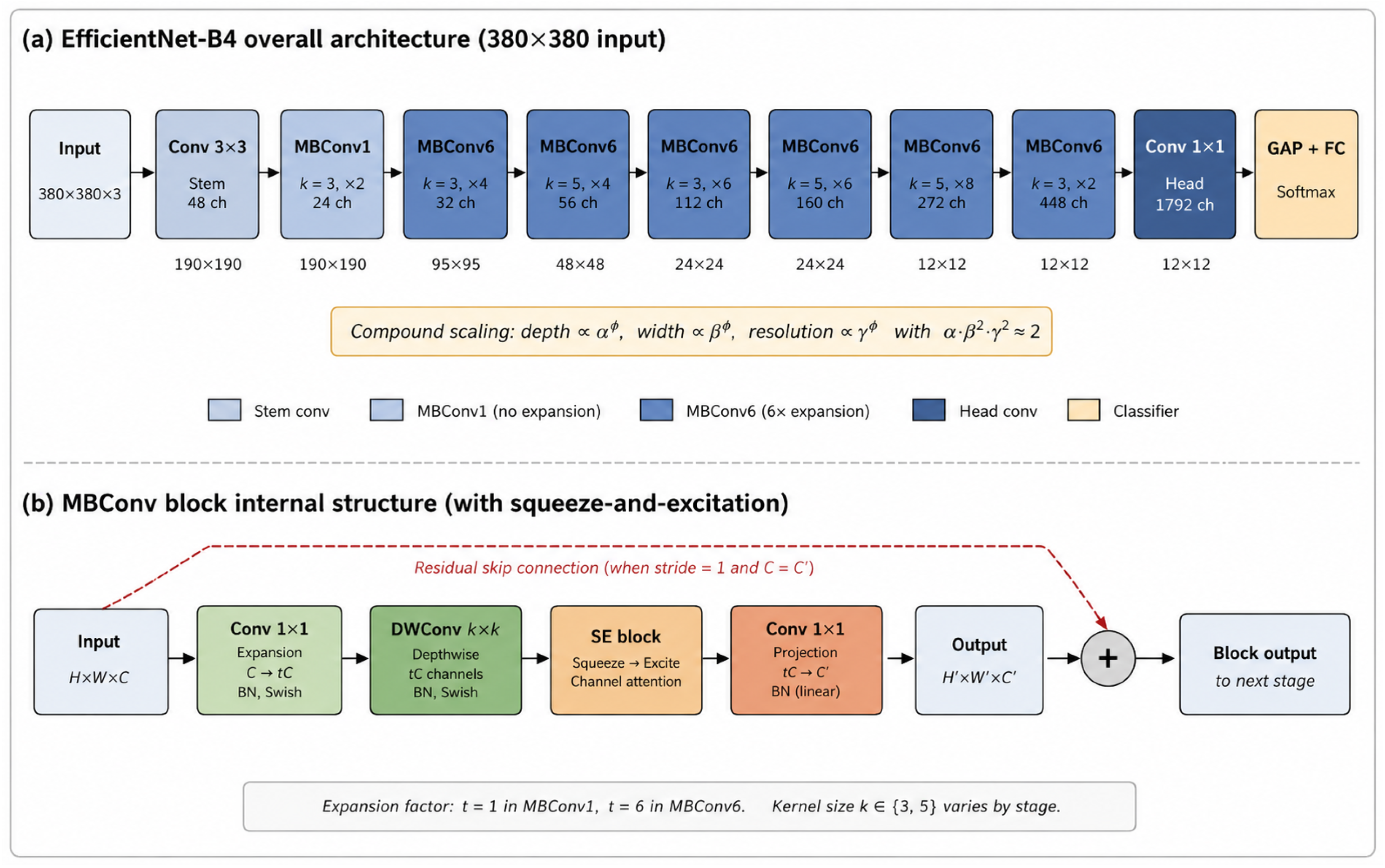
Building on the compound-scaling principle, EfficientNet offers eight sibling models, B0 through B7, obtained by uniformly scaling the baseline network in depth, width, and input resolution. Each successive model applies fixed coefficients ( α 1.2 for depth, β 1.1 for width, γ 1.15 for resolution). The baseline B0 ( 224 × 224 input) contains 5.3 M parameters and 0.39 GFLOPs, achieving 77 % top-1 accuracy on ImageNet. At the other extreme, B7 ( 600 × 600 input) expands to 66 M parameters and 37 GFLOPs while reaching 84 % top-1 accuracy. The intermediate variant B4 ( 380 × 380 input) uses 19  M parameters and 4.2 GFLOPs to obtain 83 % accuracy, illustrating the near-linear accuracy gains attainable with balanced scaling [4]. Figure 1 summarizes the overall EfficientNet-B4 pipeline together with the internal structure of the MBConv block.

3.1.2. EfficientNetV2-S

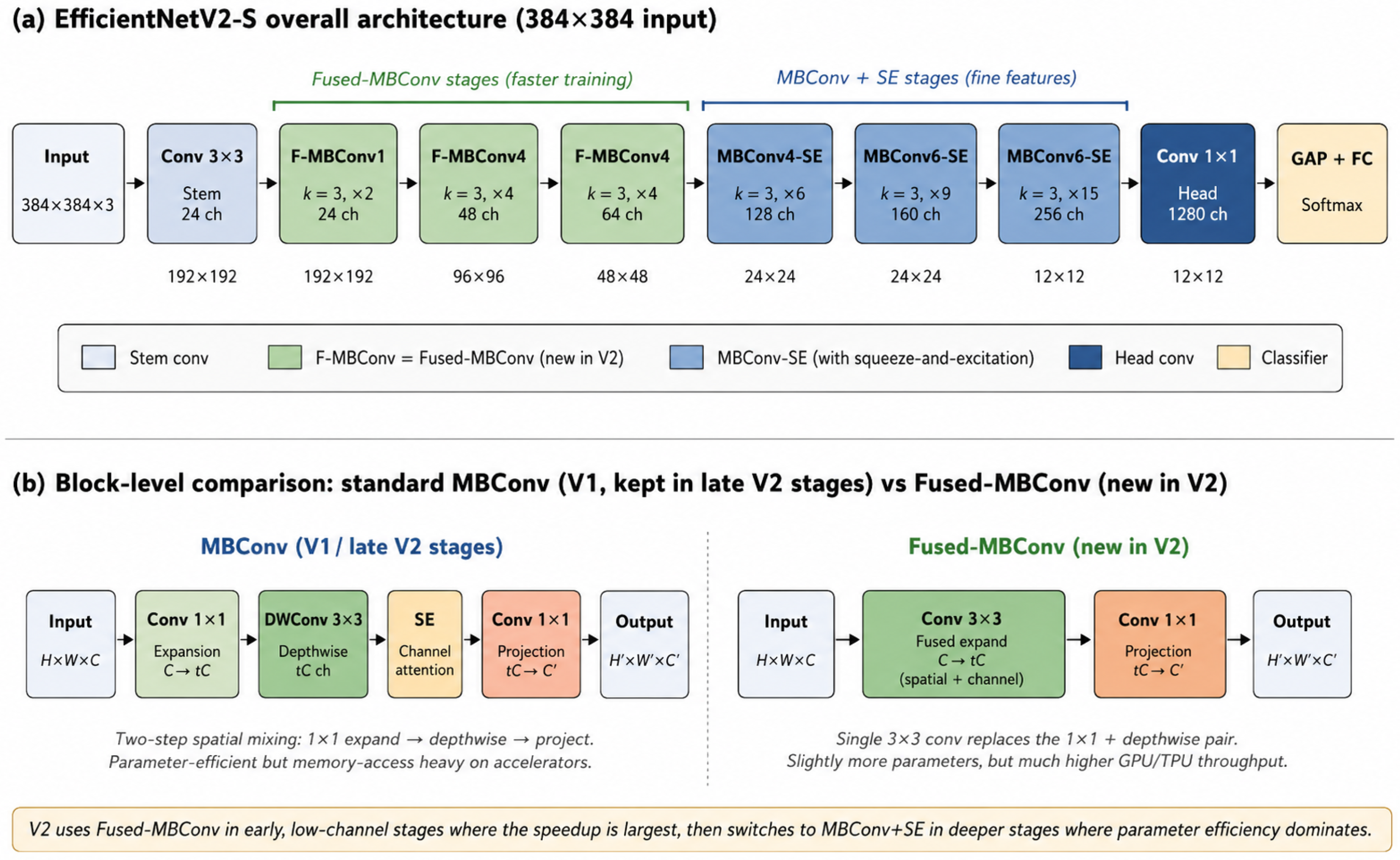
EfficientNetV2 represents a significant evolution over the original family. While the original models relied heavily on Depthwise Separable Convolutions to reduce parameters, this often resulted in memory access bottlenecks that slowed down training on modern accelerators. EfficientNetV2 addresses this by introducing Fused-MBConv blocks in the early layers, where standard 3 × 3 convolutions and expansion phases are fused into a single operation. This modification significantly improves training speed and memory efficiency without sacrificing accuracy [5].
The EfficientNetV2-S (Small) variant offers an optimal trade-off between computational cost and performance. Unlike the compound scaling of V1, V2 utilizes a non-uniform scaling strategy labeled “progressive learning” where the network adaptively adjusts regularization strength (such as dropout and data augmentation) based on image size. This allows the model to learn features from the facial variations present in age and gender recognition tasks without the massive parameter overhead of larger models. Figure 2 illustrates the EfficientNetV2-S pipeline and contrasts the Fused-MBConv block with the standard MBConv block retained in the deeper stages.

3.2. Datasets

To ensure the models are effective to “in-the-wild” conditions, we utilized two distinct benchmarks:
  • Adience Benchmark: This dataset is specifically designed for age and gender classification under real-world conditions. It comprises over 26,000 images of approximately 2200 subjects. The images are characterized by significant variations in pose, lighting, noise, and resolution, making it a challenging benchmark. Unlike constrained datasets, Adience images are not pre-aligned, requiring preprocessing [35].
  • UTKFace Dataset: A large-scale face dataset consisting of over 20,000 images with annotations for age, gender, and ethnicity. The images cover a wide range of ages (from 0 to 116 years) and variations in facial expression and illumination. This diversity is critical for preventing bias and ensuring the model learns broadly applicable features [36]. We chose to formulate age estimation on UTKFace as an 8-class classification problem rather than as integer-valued regression in order to maintain consistency with the Adience benchmark, in which age labels are not integers but discrete groups 0–2, 4–6, 8–13, 15–20, 25–32, 38–43, 48–53, and 60+. By binning the UTKFace ages similarly into groups, we are able to use a single architecture, a single classification head, a single loss function (categorical cross-entropy), and a single primary evaluation metric (accuracy/F1) across both datasets, which is essential for the cross-dataset comparison that is the main contribution of the paper.

3.3. Data Preprocessing

Effective preprocessing is vital for deep learning performance. The pipeline, common to both phases of our study, consists of the following stages:
  • Face Detection and Alignment: For the Adience dataset, which contains uncropped images, we employed the Dlib library utilizing its CNN-based face detector to isolate facial regions. Images containing multiple faces or no detectable faces were filtered out to maintain label consistency. The UTKFace dataset was used in its aligned version.
  • Data Splitting: The datasets were split into 80% for training and 20% for validation. This strict separation ensures that the model’s hyperparameters are tuned on unseen data.
  • Normalization: Pixel intensity values were normalized from the standard [ 0 , 255 ] range to [ 0 , 1 ] using min-max normalization. This prevents large gradients that can destabilize training.
  • Class Balancing (Oversampling): Age datasets often suffer from class imbalance, with the majority of subjects falling between 25 and 40 years. To mitigate bias toward these dominant classes, we applied random oversampling to the minority age groups in the training set, duplicating samples until a balanced distribution was achieved.
  • Augmentation: To further prevent overfitting, we applied real-time data augmentation including horizontal flipping and random rotations (up to ± 20 ). We avoided extreme distortions to preserve the semantic integrity of age-related features like wrinkles and skin texture.

3.4. Explainability via Grad-CAM

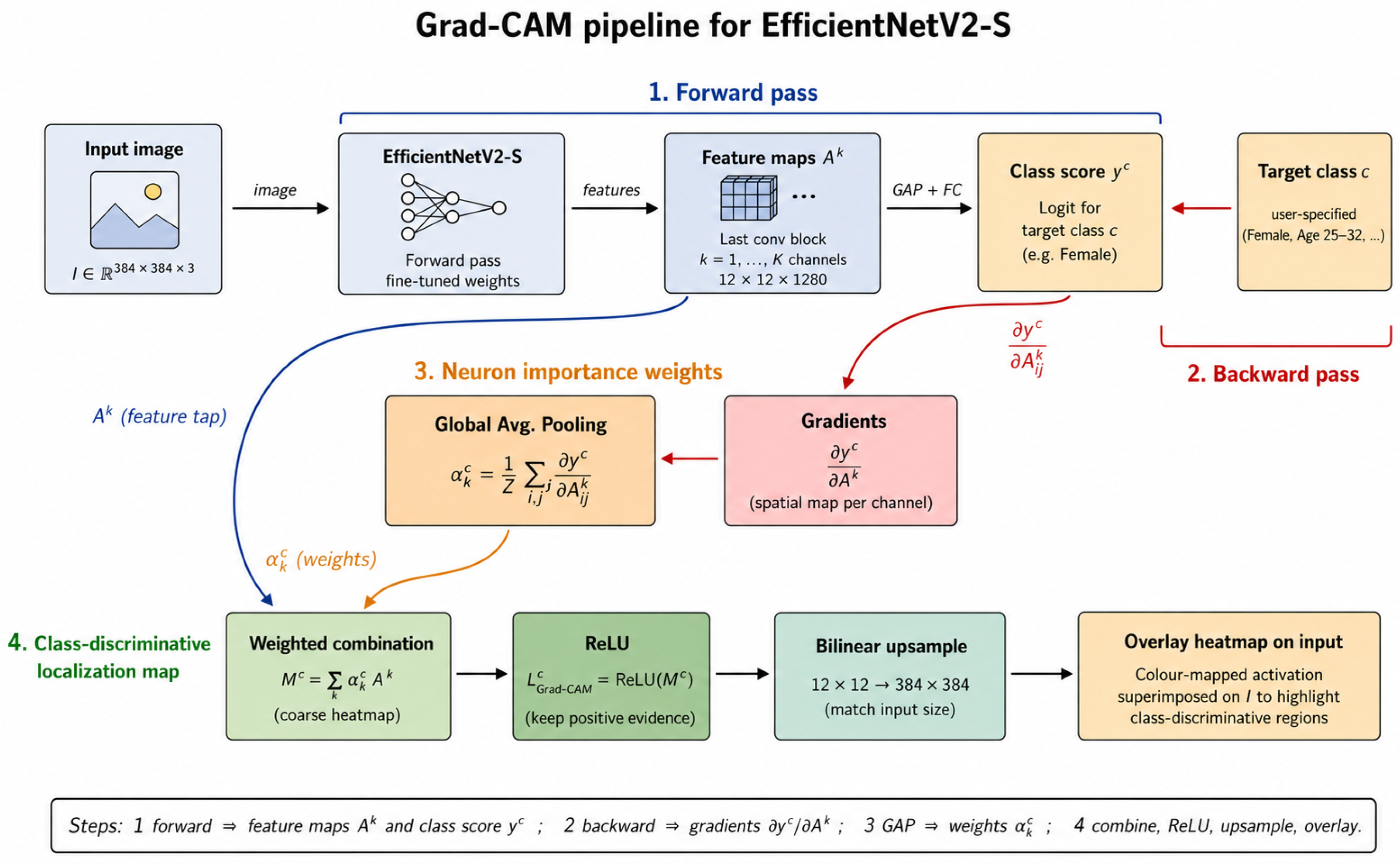
A critical limitation of many deep learning approaches is their “black-box” nature. To address this in our second experimental phase, we integrated Gradient-weighted Class Activation Mapping (Grad-CAM) [37] into the evaluation pipeline of the EfficientNetV2-S model. Grad-CAM utilizes the gradients of the specific target concept (e.g., “Female” or “Age 25–32”) flowing into the final convolutional layer to produce a localization map.
Mathematically, we compute the neuron importance weights α k c for a class c and feature map A k as
α k c = 1 Z i j 𝜕 y c 𝜕 A i j k
where y c is the score for class c and Z is the number of pixels in the feature map. These weights are then combined to generate a heatmap:
L Grad - CAM c = ReLU k α k c A k
This heatmap highlights the regions of the image that arguably led the model to its prediction. By overlaying this map onto the original input image, we can verify whether the model is focusing on relevant facial features or relying on non-important information, like the background, to make its decisions. The complete pipeline is summarized in Figure 3.

4. Experimental Setup

4.1. Experimental Tools and Environment

The implementation of the proposed frameworks relied on the TensorFlow libraries and the Keras API. Data preprocessing and initial analysis were conducted using the OpenCV library.
For Phase 1 (EfficientNet B4), model training was conducted in cloud environments such as Kaggle and Google Colaboratory, utilizing GPUs including NVIDIA A100, P100, V100, and T4, as well as TPUs.
For Phase 2 (EfficientNetV2-S), training was executed on a high-performance computing server hosted by the Department of Computer Engineering and Informatics at the University of Patras, equipped with 8 NVIDIA A100 GPUs.

4.2. Network Training Strategies

To overcome the limitations of dataset size and improve generalization, both phases employed Transfer Learning. The models were initialized with weights pretrained on ImageNet, leveraging millions of learned feature representations. To adapt these models to the specific tasks of age and gender recognition, we implemented several key strategies:
  • Data Augmentation: Dynamic augmentation was applied during training. In Phase 1, this included horizontal flipping and random rotation up to ± 20 . In Phase 2, additional augmentation was employed including zoom ( ± 15 % ), width/height shifts ( 10 % ), brightness adjustment ( 0.85 1.15 ).
  • Regularization: Both phases used L2 regularization and dropout to prevent overfitting. Phase 1 additionally employed DropConnect. Phase 2 used a Dropout layer with rate 0.3 and L2 regularization with coefficient λ = 10 4 .
  • Optimization and Callbacks: Phase 1 used early stopping with a patience of 10 epochs and gradual learning rate reduction with a decay rate of 0.9. Phase 2 used the Adam optimizer with an initial learning rate of 10 4 , a ReduceLROnPlateau callback to reduce the learning rate by a factor of 0.5 if validation loss stagnated for 6 epochs, and EarlyStopping with a patience of 20 epochs.

4.3. Phase 1: EfficientNet B4 Models

We designed four models for the four experimental cases: UTKF-Gender, UTKF-Age, Adience-Gender, and Adience-Age. All models used EfficientNet B4 as the backbone, with transfer learning from ImageNet. The specific configurations varied per task, as shown in Table 1 and Table 2.
For the UTKFace-Gender model (UTKF-G-B4), early stopping with patience of 10 epochs and a learning rate decay of 0.9 were used. Images were resized to 224 × 224 . For the UTKFace-Age model (UTKF-A-B4), an additional dense layer of 1024 neurons was inserted after global average pooling, with images resized to 220 × 220 . For both Adience models, images were resized to 200 × 200 ; the gender model (ADI-G-B4) used a dense layer of 256 neurons, while the age model (ADI-A-B4) used a dense layer of 1024 neurons. We also investigated EfficientNet B1 (for Adience-Age) and B5 (for UTKFace-Gender) to explore the effect of model scaling.

4.4. Phase 2: EfficientNetV2-S Models

In Phase 2, we used the EfficientNetV2-S backbone for all four experimental cases, ensuring consistency in the evaluation of the architecture’s capabilities. All input images were resized to 384 × 384 pixels to match the optimal resolution for EfficientNetV2-S. The classification head consisted of a Global Average Pooling 2D layer, a Dense layer with 512 neurons (ReLU activation), a Dropout layer (rate 0.3), and a final Dense output layer with Softmax activation ( N = 2 for gender, N = 8 for age). The hyperparameters for Phase 2 are summarized in Table 3.

4.5. Explainability Setup

To validate the EfficientNetV2-S model’s focus, we implemented a custom Grad-CAM module. Analysis was performed at two distinct stages: Before Training (using raw ImageNet weights) and After Training (using the fine-tuned weights). We extracted gradients from the last convolutional block (specifically block7a_expand_conv) to generate heatmaps for 20 randomly sampled validation images. This comparative analysis allows us to visually confirm that the model transitions from generic object detection to learning face-specific semantic features.

5. Results

5.1. Phase 1: EfficientNet B4 Classification Performance

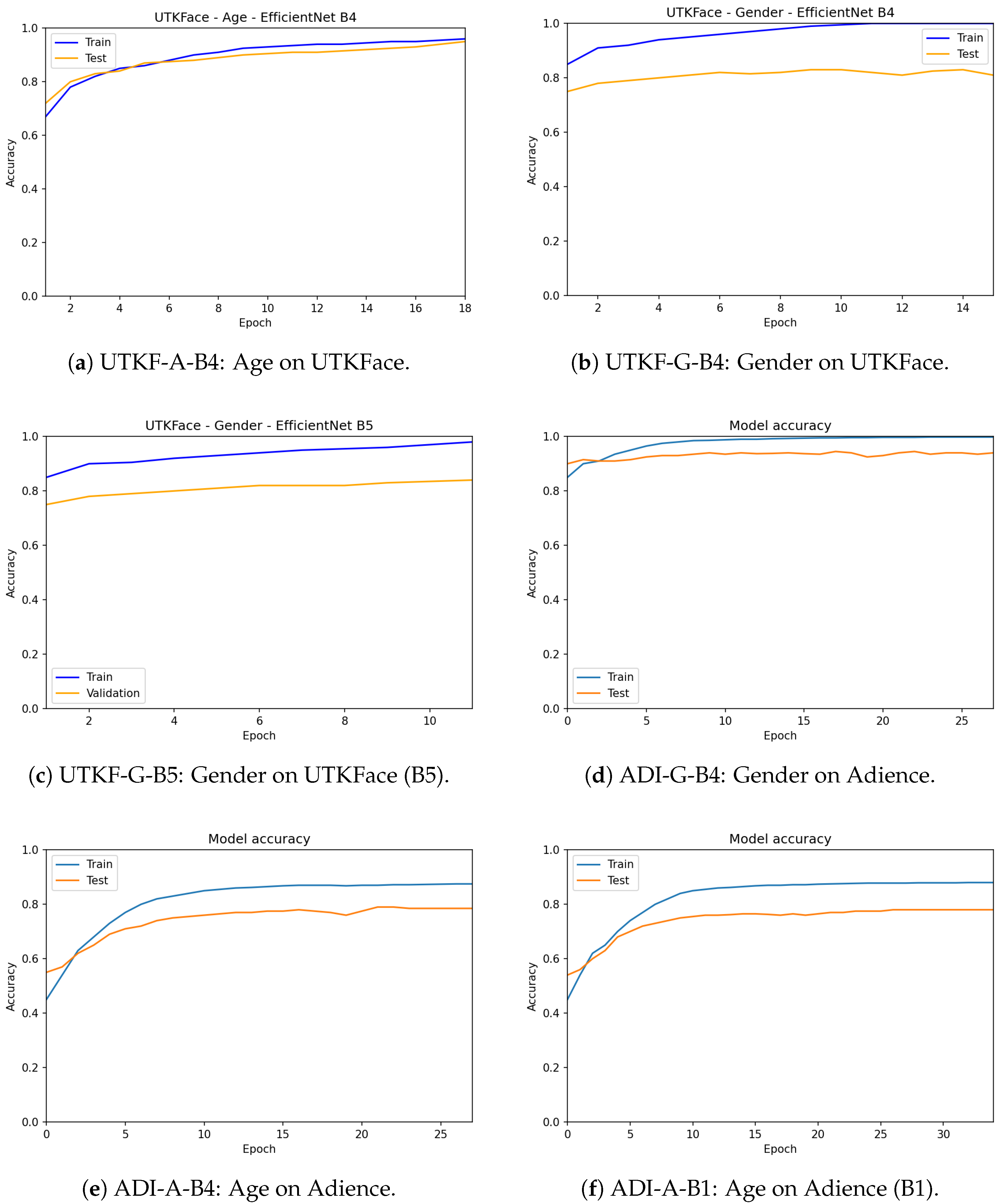
Table 4 summarizes the results achieved by the EfficientNet B4 (and B1/B5) models. The UTKF-A-B4 model achieved 95.11% accuracy on the UTKFace age classification task, which is particularly noteworthy. For comparison, the EfficientNet B1 model achieved 77.69% on Adience age classification, while B4 achieved 80%, confirming that model scaling improves accuracy, though the gains are moderate given that B1 utilizes 6.5 million parameters versus B4’s 17.6 million. Additionally, we investigated EfficientNet B5 on the UTKFace-Gender dataset, where it achieved 83% accuracy. Despite its larger parameter size, B5 demonstrated better generalization by reducing the gap between training and validation accuracy compared to B4.
The training and validation accuracy curves for all Phase 1 models are presented in Figure 4. These curves illustrate the convergence behavior and the degree of overfitting observed for each model configuration.

5.2. Phase 2: EfficientNetV2-S Classification Performance

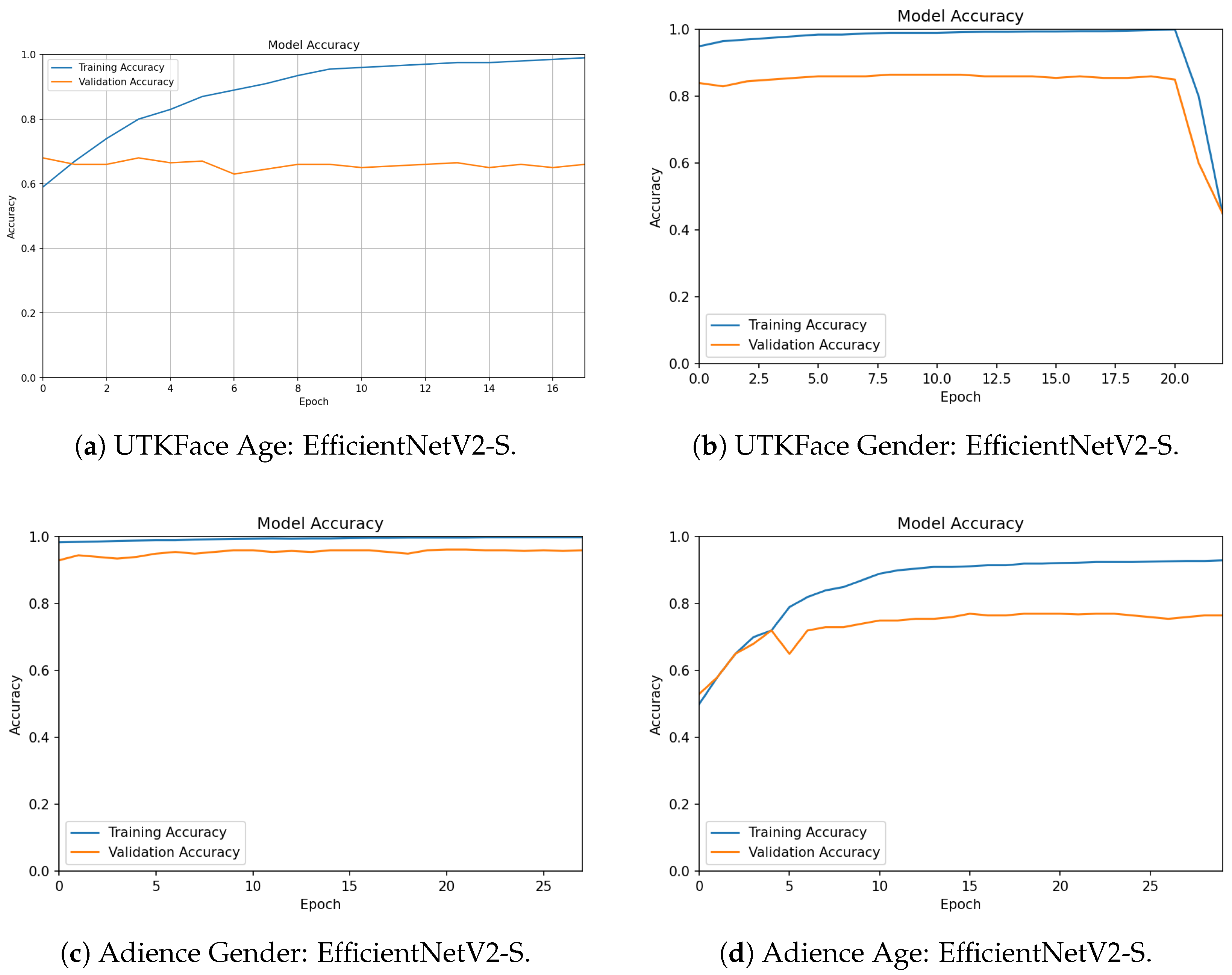
Table 5 presents the detailed performance of the EfficientNetV2-S models. The model achieved 95.68% accuracy on Adience gender classification, the highest across all Phase 2 tasks. For age estimation, the model achieved 76.21% on the Adience dataset and 77% on UTKFace.
The training and validation accuracy curves for all Phase 2 models are shown in Figure 5. These curves demonstrate the convergence characteristics and generalization behavior of the EfficientNetV2-S architecture across the different tasks.

5.3. Cross-Phase Comparison

A comparison between the two phases reveals complementary strengths. EfficientNet B4 achieved the highest age classification accuracy on UTKFace (95.11%), significantly outperforming the V2-S model (77%) on that specific task. In contrast, EfficientNetV2-S excelled on Adience gender classification (95.68% vs. 94.55% for B4) and UTKFace gender classification (85.16% vs. 81.45% for B4). For Adience age, B4 (80%) slightly outperformed V2-S (76.21%). These differences can be attributed to variations in the classification head design and input resolution between the two phases. Importantly, V2-S offers faster training convergence due to its Fused-MBConv architecture and its standardized pipeline.

5.4. Comparison with State of the Art

In Table 6, a comparison of our best models from both phases with state-of-the-art methods on the same datasets is presented. Our UTKF-A-B4 model significantly surpasses other CNN implementations for age classification on UTKFace ( + 7.02 % above the second best). For Adience gender classification, the V2-S model (95.68%) surpasses several existing methods and is competitive with the best. Although gender classification accuracy is impressive, the age estimation accuracy on Adience benchmark (76.21% for V2-S, 80% for B4) is far less than what was achieved by the SOTA models (89.5%). This can be explained as follows. Adience age classification relies on face-specific pretraining. For example, the pretrained CNN in [25] uses IMDb-WIKI, while the EfficientNetB0-based method in [26] uses VGGFace2. These datasets contain large-scale facial images and provide models with prior knowledge that is directly related to facial attribute recognition. In contrast, our EfficientNet models are initialized with ImageNet weights. ImageNet is a general object recognition dataset and is not specifically designed for facial analysis. So, models pretrained on face-specific datasets may learn more relevant facial patterns, such as facial structure, local facial regions, and appearance-related cues. Therefore, it is reasonable that models pretrained on face-specific datasets may perform better on age estimation tasks.

5.5. Visual Explainability Analysis (Phase 2)

To validate that the EfficientNetV2-S model is learning meaningful facial features, we performed a Grad-CAM analysis before and after the training process. This visual check is important for ensuring the model’s reliability in real-world applications. The percentages mentioned below are the average Grad-CAM accuracy calculated across the validation subset.

5.5.1. Pretraining Focus

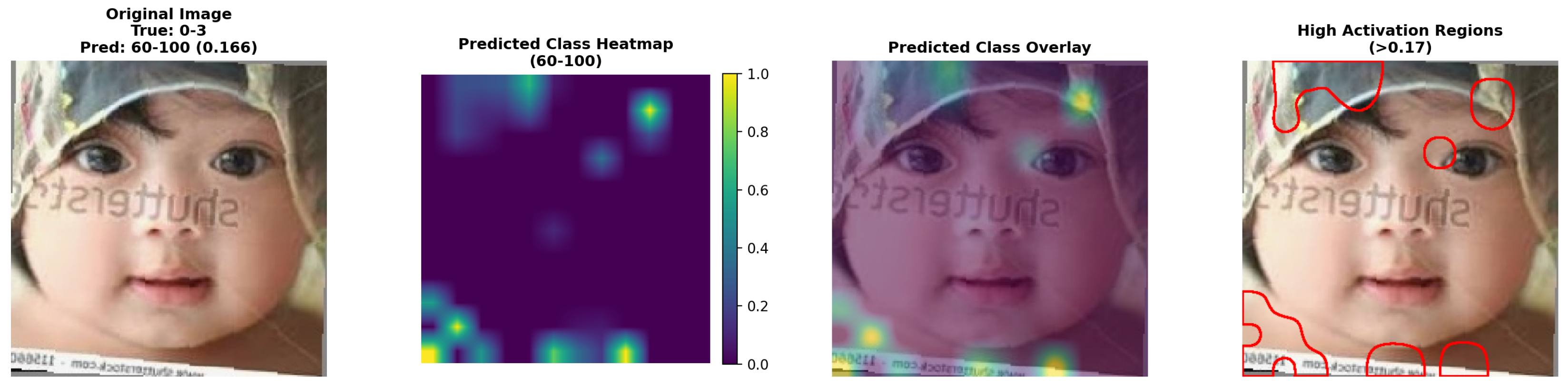
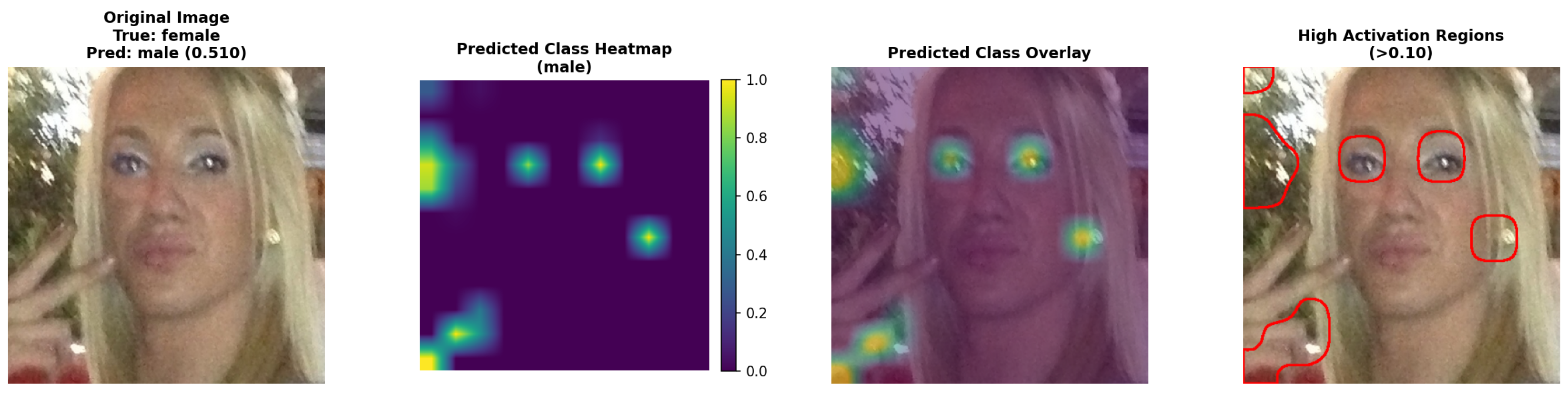
In the initial “Before” phase, the network initialized with ImageNet weights lacked understanding of facial attributes (see Figure 6, Figure 7, Figure 8 and Figure 9):
  • UTKFace Age (Before): Average Grad-CAM accuracy of 15%.
  • UTKFace Gender (Before): Average Grad-CAM accuracy of 80%.
  • Adience Age (Before): Average Grad-CAM accuracy of 5%.
  • Adience Gender (Before): Average Grad-CAM accuracy of 5%.
The pretraining Grad-CAM results reveal a clear lack of facial understanding. The network activations are quite unfocused. They focus on irrelevant regions such as backgrounds and image borders. This behavior is expected, as the model carries only generic ImageNet feature representations at this stage. For the UTKFace Age task, the heatmap activations reach only 15% accuracy. The UTKFace Gender task performs better at 80%, mainly due to the fact that ImageNet contains some gender-distinguishable instances. The Adience Age and Adience Gender tasks both score just 5%. Overall, the pretraining results confirm that task-specific fine-tuning is essential. Without it, the model cannot reliably identify the facial regions relevant to age and gender prediction.

5.5.2. Post-Training Focus

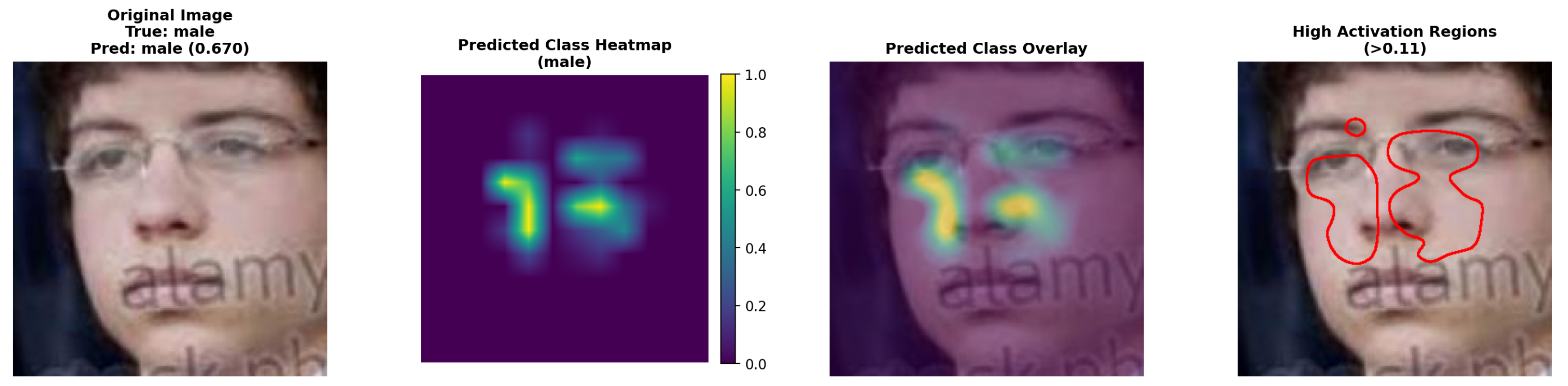
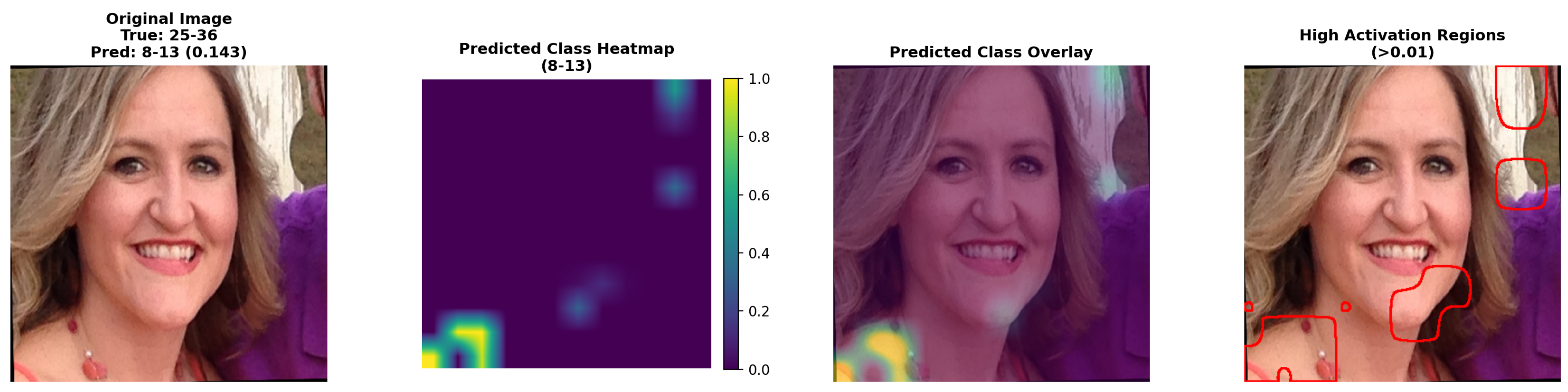
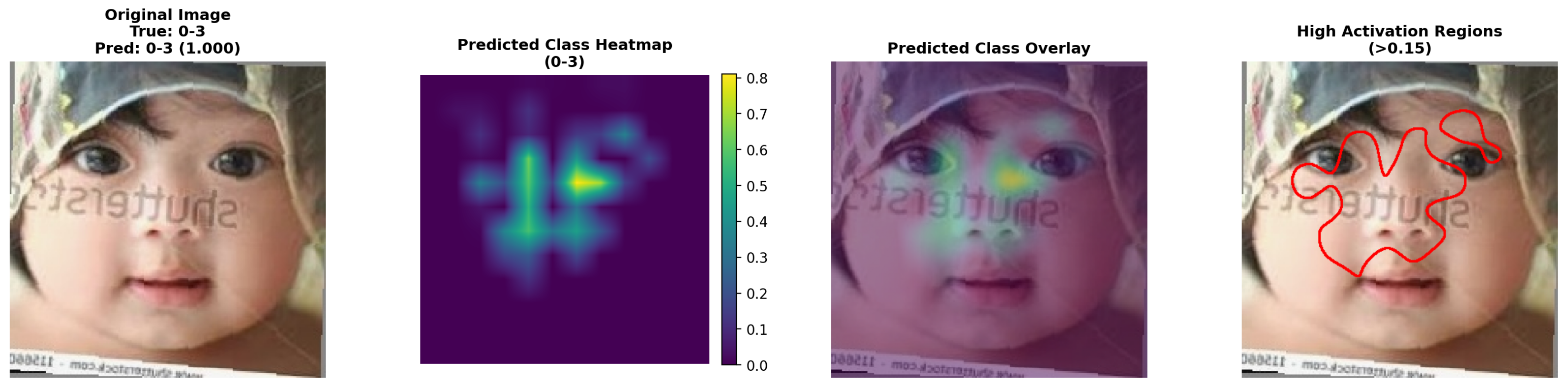
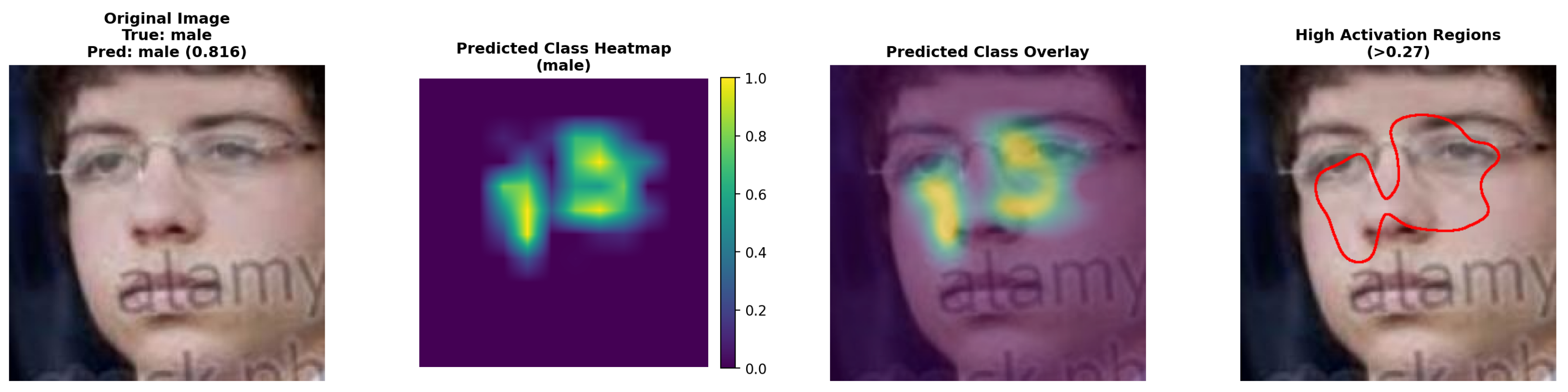
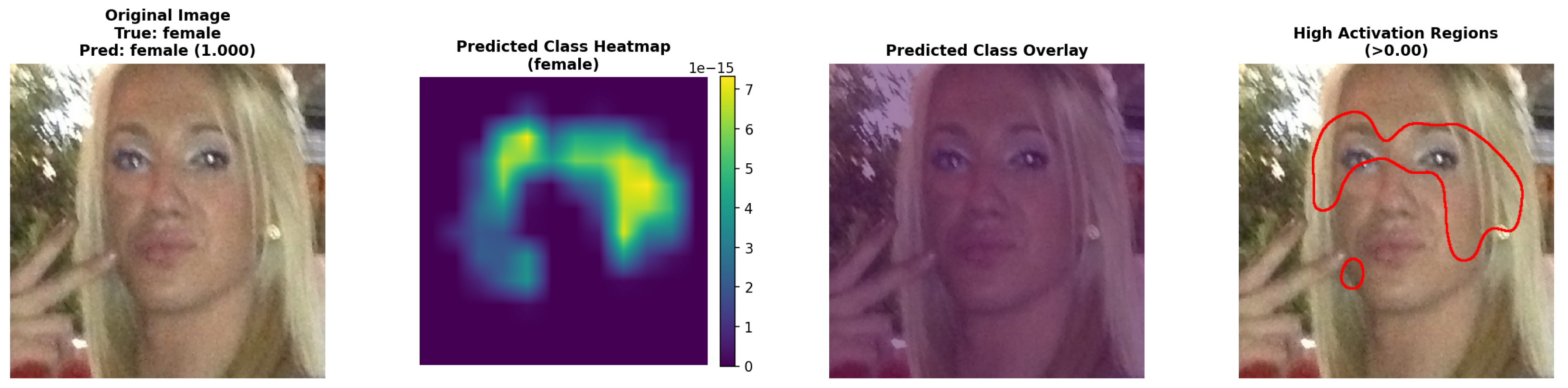
Following the training process, the “After” analysis demonstrated significant better results (see Figure 10, Figure 11, Figure 12 and Figure 13):
  • UTKFace Age (After): Average Grad-CAM accuracy of 100%.
  • UTKFace Gender (After): Average Grad-CAM accuracy of 100%.
  • Adience Gender (After): Average Grad-CAM accuracy of 100%.
  • Adience Age (After): Average Grad-CAM accuracy of 75%.
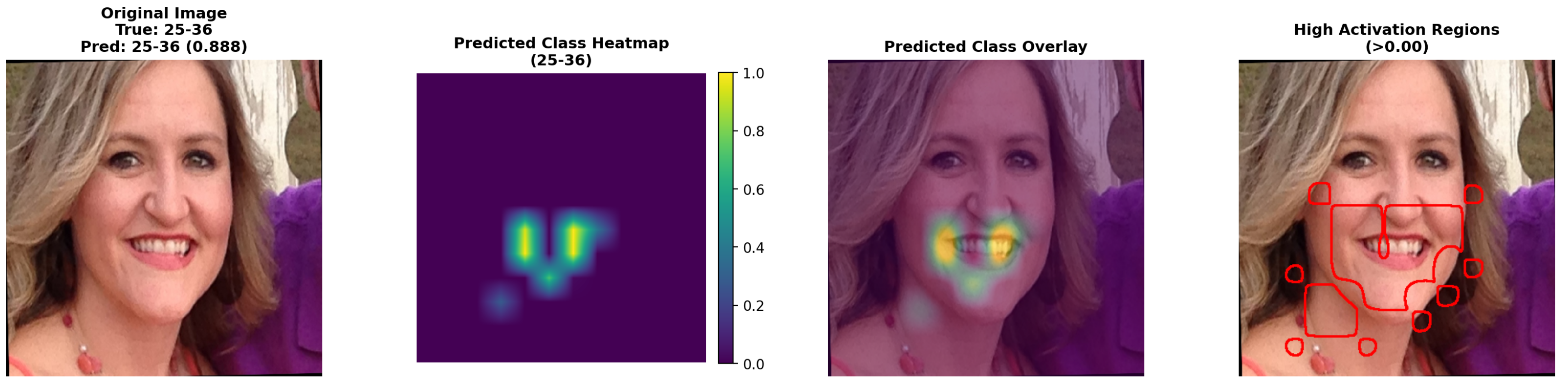
The post-training Grad-CAM results show substantial improvements. The network now focuses clearly on proper facial regions. Activations are concentrated on semantically meaningful areas such as the eyes, nose, mouth, and skin texture. For the UTKFace Age task the Grad-CAM accuracy reaches 100%. The heatmaps focus on central facial features that are greatly associated with aging. For the UTKFace Gender task, the accuracy also reaches 100% and the model focuses on facial areas that provide meaningful information for distinguishing gender. The Adience Gender task similarly achieves 100% accuracy and the activations are concentrated on the proper face areas. The Adience Age task is the only exception, reaching 75% accuracy. This also suggests that age estimation on the Adience dataset remains inherently difficult, even for a well-trained model. The transition from unproper-focused pretraining activations to proper-focused post-training heatmaps validates the effectiveness of the learning process. It also greatly indicates that the model’s predictions are based on appropriate and meaningful facial patterns.
The dramatic improvement in Grad-CAM accuracy, from as low as 5% to 100% in three out of four cases, which confirms that the fine-tuned EfficientNetV2-S model successfully transitions from generic feature detection to face-specific feature detection. The Adience-Age case, which showed the lowest post-training Grad-CAM accuracy at 75%, also corresponds to the most challenging classification task, suggesting that some predictions in this category may still rely partially on contextual features rather than purely facial features.

6. Conclusions and Future Work

In this paper, we presented a comprehensive study on the use of EfficientNet architectures for age and gender recognition from facial images. Our investigation spanned two phases: (a) experiments with EfficientNet B4 (and variants B1, B5) from the original V1 family, and (b) a systematic evaluation of EfficientNetV2-S with an emphasis on visual explainability via Grad-CAM.
The Phase 1 results demonstrated that EfficientNet B4 achieves highly competitive performance, with the UTKF-A-B4 model setting a new state of the art on UTKFace age classification at 95.11%. Model scaling from B1 to B4 gave moderate improvements, confirming that EfficientNet is efficient even at lower scales. In Phase 2, EfficientNetV2-S demonstrated competitive results across all tasks while offering faster training convergence. It did best particularly on Adience gender classification (95.68%) and UTKFace gender classification (85.16%), outperforming the B4 models on these tasks.
A consistent observation across both phases is that all proposed models achieve higher accuracy on gender classification than on age classification. Part of this gap is structural, as gender recognition is a binary problem whereas age recognition is a more complex multi-class task affected by class imbalance and visual ambiguity between adjacent age groups. Beyond this, the higher performance on gender classification compared with age classification is also consistent with human perception, where gender is easier to be distinguished than age, except for very broad categories such as child, adult, and elderly. In this sense, the observed performance may be considered human-like, although this does not imply that the models follow the same reasoning process as humans.
The Grad-CAM analysis provided critical insights into the EfficientNetV2-S model’s internal decision-making. The shift from irrelevant attention (pretraining) to focused, face specific activation (post-training) validates that the network learns meaningful facial representations. This interpretability analysis goes beyond traditional accuracy metrics and provides confidence that the model’s predictions are based on appropriate facial patterns. However, due to the relatively small number (20) of involved images, reliability of our results is not secured, but they give a preliminary and qualitative insight towards the interpretability of our approach.
Future work will focus on several directions: (a) expanding to more complex architectures such as B6 and B7 to explore the accuracy–complexity trade-off further, (b) applying Grad-CAM analysis to the B4 models for a direct explainability comparison across architectures, (c) investigating ensemble methods such as cascading techniques [38] to combine the complementary strengths of V1 and V2 models, and (d) extending the explainability framework to include additional XAI methods like SHAP or LIME for a more comprehensive understanding of model behavior.

Author Contributions

Conceptualization, G.S., I.P. and I.H.; methodology, G.S., I.P. and I.H.; software, G.S.; validation, G.S., I.P. and I.H.; formal analysis, G.S.; visualization, G.S.; writing—original draft preparation, G.S.; writing—review and editing, I.H. and I.P.; supervision, I.P. and I.H. All authors have read and agreed to the published version of the manuscript.

Funding

This research received no external funding.

Informed Consent Statement

Not applicable.

Data Availability Statement

The data presented in this study are openly available in OUI-Adience Face Image Project and UTKFace at https://talhassner.github.io/home/projects/Adience/Adience-data.html and https://susanqq.github.io/UTKFace/, reference number [31,33].

Conflicts of Interest

The authors declare no conflicts of interest.

References

  1. Punyani, P.; Gupta, R.; Kumar, A. Neural networks for facial age estimation: A survey on recent advances. Artif. Intell. Rev. 2020, 53, 3299–3347. [Google Scholar] [CrossRef]
  2. Agbo-Ajala, O.; Viriri, S. Deep learning approach for facial age classification: A survey of the state-of-the-art. Artif. Intell. Rev. 2021, 54, 179–213. [Google Scholar] [CrossRef]
  3. Chen, L.; Li, S.; Bai, Q.; Yang, J.; Jiang, S.; Miao, Y. Review of Image Classification Algorithms Based on Convolutional Neural Networks. Remote Sens. 2021, 13, 4712. [Google Scholar] [CrossRef]
  4. Tan, M.; Le, Q.V. EfficientNet: Rethinking Model Scaling for Convolutional Neural Networks. In Proceedings of the 36th International Conference on Machine Learning (ICML), Long Beach, CA, USA, 9–15 June 2019; Volume 97, pp. 6105–6114. [Google Scholar]
  5. Tan, M.; Le, Q.V. EfficientNetV2: Smaller Models and Faster Training. In Proceedings of the International Conference on Machine Learning (ICML), Virtual Event, 18–24 July 2021; pp. 10096–10106. [Google Scholar]
  6. Aruleba, I.; Viriri, S. Deep Learning for Age Estimation Using EfficientNet. In Distributed Computing and Artificial Intelligence, Special Sessions, 17th International Conference; Rojas, I., Joya, G., Català, A., Eds.; LNCS 12861; Springer: Cham, Switzerland, 2021; pp. 407–419. [Google Scholar]
  7. Mosayyebi, F.; Seyedarabi, H.; Afrouzian, R. Gender recognition in masked facial images using EfficientNet and Transfer Learning Approach. Int. J. Inf. Technol. 2024, 16, 2693–2703. [Google Scholar] [CrossRef]
  8. Sigalos, G.; Hatzilygeroudis, I.; Perikos, I. Age and Gender Recognition from Images Using EfficientNet Models. In 2025 16th International Conference on Information, Intelligence, Systems & Applications (IISA); IEEE: Mytilene, Island of Lesvos, Greece, 2025; pp. 1–5. [Google Scholar] [CrossRef]
  9. Wang, J.G.; Yau, W.Y.; Wang, H.L. Age categorization via ECOC with fused Gabor and LBP Features. In Proceedings of the 2009 Workshop on Applications of Computer Vision (WACV), Snowbird, UT, USA, 7–8 December 2009; pp. 1–6. [Google Scholar]
  10. Selim, M.; Stricker, D. Real-time human age estimation based on Facial images using uniform Local Binary Patterns. In Proceedings of the International Conference on Computer Vision Theory and Applications (VISAPP), Berlin, Germany, 11–14 March 2015; pp. 233–426. [Google Scholar]
  11. Choi, S.E.; Lee, Y.J.; Lee, S.J.; Park, K.R.; Kim, J. Age estimation using a hierarchical classifier based on global and local facial features. Pattern Recognit. 2011, 44, 1262–1281. [Google Scholar] [CrossRef]
  12. Fu, Y.; Huang, T. Human Age Estimation with Regression on Discriminative Aging Manifold. IEEE Trans. Multimed. 2008, 10, 578–584. [Google Scholar] [CrossRef]
  13. Gao, F.; Ai, H. Face age classification on consumer images with gabor feature and fuzzy LDA method. In Advances in Biometrics; Springer: Berlin/Heidelberg, Germany, 2009; pp. 132–141. [Google Scholar]
  14. Ullah, I.; Hussain, M.; Al-Haidari, F.; Mirza, A.M. Gender recognition from face images with local WLD descriptor. In Proceedings of the 19th International Conference on Systems, Signals and Image Processing (IWSSIP), Vienna, Austria, 11–13 April 2012; pp. 417–420. [Google Scholar]
  15. Shan, C. Learning local binary patterns for gender classification on real-world face images. Pattern Recognit. Lett. 2012, 33, 431–437. [Google Scholar] [CrossRef]
  16. Kawai, H.; Ito, K.; Aoki, T. Face Attribute Estimation Using Multi-Task Convolutional Neural Network. J. Imaging 2022, 8, 105. [Google Scholar] [CrossRef] [PubMed]
  17. Liu, X.; Li, J.; Hu, C.; Pan, J.S. Deep Convolutional Neural Networks-Based Age and Gender Classification with Facial Images. In Proceedings of the First International Conference on Electronics Instrumentation Information Systems (EIIS), Harbin, China, 3–5 June 2017; pp. 1–4. [Google Scholar]
  18. Uddin, S.M.S.; Morshed, M.S.; Rahman, M.I. Age Estimation from Facial Images using Transfer Learning and k-fold Cross-Validation. In Proceedings of the 2021 International Conference on Pattern Recognition and Intelligent Systems (PRI), Bangkok, Thailand, 23–25 July 2021; pp. 33–36. [Google Scholar]
  19. Rafique, I.; Hamid, A.; Al-Mogren, A.S.; Yasir, T. Age and Gender Prediction using Deep Convolutional Neural Networks. In Proceedings of the International Conference on Innovative Computing (ICIC), Lahore, Pakistan, 1–2 November 2019. [Google Scholar]
  20. Kjærran, A.; Barbakadze, E.S.; Vennerød, C.B. Facial Age Estimation Using Convolutional Neural Networks. arXiv 2021, arXiv:2105.06746. [Google Scholar] [CrossRef]
  21. Sharma, N.; Singh, R.; Jindal, N. Face-Based Age and Gender Estimation Using Improved Convolutional Neural Network Approach. Wirel. Pers. Commun. 2022, 124, 3035–3054. [Google Scholar] [CrossRef]
  22. Nyaupane, B.K.; Shakya, S. Age, Gender, and Ethnicity Prediction using Deep Separable Convolutional Neural Networks. In Proceedings of the International Multidisciplinary Conference, Dubai, United Arab Emirates, 3–4 March 2022. [Google Scholar]
  23. Levi, G.; Hassner, T. Age and Gender Classification using Convolutional Neural Networks. In Proceedings of the IEEE Conference on Computer Vision and Pattern Recognition (CVPR) Workshops, Boston, MA, USA, 7–12 June 2015; pp. 34–42. [Google Scholar]
  24. Liu, W.; Chen, L.; Chen, Y. Age Classification Using Convolutional Neural Networks with the Multi-class Focal Loss. IOP Conf. Ser. Mater. Sci. Eng. 2018, 428, 012043. [Google Scholar] [CrossRef]
  25. Agbo-Ajala, O.; Viriri, S. Deeply Learned Classifiers for Age and Gender Predictions of Unfiltered Faces. Sci. World J. 2020, 2020, 1289408. [Google Scholar] [CrossRef]
  26. Saggu, G.S.; Gupta, K.; Mann, P.S. Efficient Classification for Age and Gender of Unconstrained Face Images. In Algorithms for Intelligent Systems; Springer: Singapore, 2022; pp. 13–24. [Google Scholar]
  27. Dey, P.; Mahmud, T.; Hossain, M.S.; Andersson, K. Human Age and Gender Prediction from Facial Images Using Deep Learning Methods. Procedia Comput. Sci. 2024, 238, 314–321. [Google Scholar] [CrossRef]
  28. Kocoń, M.; Pawlukiewicz, S. Age estimation and gender classification from facial images. Appl. Sci. 2025, 15, 10212. [Google Scholar] [CrossRef]
  29. Jayamanne, D.J. Classification of Age Group, Gender, and Race from Facial Images Using Multi-Task Based Deep CNNs with Transfer Learning. In Proceedings of the 2025 International Conference on Artificial Intelligence, Computer, Data Sciences and Applications (ACDSA), Antalya, Turkiye, 7–9 August 2025; pp. 1–8. [Google Scholar]
  30. Meenakshi, J.; Thailambal, G. Gender and age classification using ASMNet based facial fiducial detection and Jordan neural network. Prog. Artif. Intell. 2024, 13, 293–306. [Google Scholar] [CrossRef]
  31. Duan, M.; Li, K.; Yang, C.; Li, K. A hybrid deep learning CNN–ELM for age and gender classification. Neurocomputing 2018, 275, 448–461. [Google Scholar] [CrossRef]
  32. Khan, K.; Attique, M.; Khan, R.U.; Syed, I. Multi-Task Framework for Facial Attributes Classification through End-to-End Face Parsing and Deep Convolutional Neural Networks. Sensors 2020, 20, 328. [Google Scholar] [CrossRef]
  33. Khan, K.; Attique, M.; Khan, R.U.; Syed, I. Age Estimation from Facial Photos: A CNN-Based Approach with Multi-Model Feature Fusion. Highlights Sci. Eng. Technol. 2024, 85, 363–375. [Google Scholar]
  34. Alhichri, H.; Alswayed, A.S.; Bazi, Y.; Ammour, N.; Alajlan, N.A. Classification of Remote Sensing Images Using EfficientNet-B3 CNN Model with Attention. IEEE Access 2020, 9, 14090–14112. [Google Scholar] [CrossRef]
  35. Eidinger, E.; Enbar, R.; Hassner, T. Age and gender estimation of unfiltered faces. IEEE Trans. Inf. Forensics Secur. 2014, 9, 2170–2179. [Google Scholar] [CrossRef]
  36. UTKFace Dataset. Available online: https://susanqq.github.io/UTKFace/ (accessed on 1 December 2024).
  37. Selvaraju, R.R.; Cogswell, M.; Das, A.; Vedantam, R.; Parikh, D.; Batra, D. Grad-CAM: Visual Explanations from Deep Networks via Gradient-Based Localization. Int. J. Comput. Vis. 2020, 128, 336–359. [Google Scholar] [CrossRef]
  38. de Zarzà, I.; de Curtò, J.; Hernández-Orallo, E.; Calafate, C.T. Cascading and Ensemble Techniques in Deep Learning. Electronics 2023, 12, 3354. [Google Scholar] [CrossRef]
Figure 1. Architecture of the EfficientNet-B4 model used in Phase 1 of this study [4]. The model has approximately 19 M parameters and 4.2 GFLOPs, with a native input resolution of 380 × 380. (a) Stage-level pipeline. The input image first passes through a 3 × 3 stem convolution, then through a sequence of MBConv stages, and finally through a 1 × 1 head convolution, global average pooling and a fully connected softmax classifier. Each MBConv stage repeats the same block several times; the repetition count is shown above each block (e.g., × 4 means the block is stacked four times). Two block variants are used: MBConv1 (no expansion of the channel dimension) and MBConv6 (channels are expanded by a factor of 6 inside the block). (b) Internal structure of a single MBConv block. The block first expands the channel dimension via a 1 × 1 pointwise convolution, then applies a k × k depthwise convolution ( k { 3 , 5 } depending on the stage), then a squeeze-and-excitation (SE) module that reweights the channels by their global importance, and finally a 1 × 1 projection convolution back to the target output width. A residual skip connection is added when the input and output have matching shape (stride = 1 and equal channel count); otherwise the block is purely feed-forward. The compound scaling rule used by the B0–B7 family is depth α ϕ , width β ϕ , resolution γ ϕ with α · β 2 · γ 2 2 [4].
Information 17 00567 g001
Figure 2. Architecture of the EfficientNetV2-S model used in Phase 2 of this study [5]. EfficientNetV2-S was designed to address the slow training speed of the original EfficientNet family on modern accelerators, which was caused by the memory-access pattern of depthwise convolutions in the early, high-resolution stages. The native input resolution is 384 × 384 . (a) Stage-level pipeline. After a 3 × 3 stem convolution, the network alternates between two block families: Fused-MBConv blocks (green), used in the early stages where feature maps are large and channel counts are small, and standard MBConv blocks with squeeze-and-excitation (blue), used in the later stages where channel counts are large and parameter efficiency dominates. The repetition count for each stage is shown above the block (e.g., × 15 ). The pipeline ends with a 1 × 1 head convolution, global average pooling, and a fully connected softmax classifier. (b) Block-level contrast. The standard MBConv block (left) performs spatial mixing in two steps: a 1 × 1 expansion convolution followed by a depthwise 3 × 3 convolution, with SE channel attention and a 1 × 1 projection. The Fused-MBConv block (right) replaces the expansion-plus-depthwise pair with a single 3 × 3 standard convolution that mixes channels and space at once. This costs slightly more parameters per block but delivers substantially higher throughput on GPU and TPU hardware, which is the source of EfficientNetV2’s faster training time relative to V1 [5].
Information 17 00567 g002
Figure 3. Grad-CAM pipeline applied to the EfficientNetV2-S model for visual explanation of age and gender predictions [37]. The goal of Grad-CAM is to produce a class-discriminative spatial heatmap that shows which regions of the input image most influenced the model’s score for a chosen target class (e.g., “Female”, or “Age 25–32”). The pipeline has four numbered steps. (1) Forward pass: the input image I R 384 × 384 × 3 is propagated through the network. The activations A k of the last convolutional block (which has K = 1280 channels at 12 × 12 spatial resolution) are stored, and the class score y c for the target class is read from the logits. (2) Backward pass: a single backward pass produces the gradients 𝜕 y c / 𝜕 A i j k , which quantify how much each unit of each feature map contributes to the target score. (3) Neuron importance weights: the gradients are spatially averaged with global average pooling to give one scalar weight α k c per feature-map channel. (4) Heatmap construction: the feature maps are combined as k α k c A k , passed through ReLU to keep only positive evidence for the target class, bilinearly upsampled from 12 × 12 back to 384 × 384 , and finally overlaid on the original image. In this study the resulting heatmap is used to check, qualitatively and quantitatively, whether the trained network is attending to facial regions (eyes, mouth, skin) rather than to background or border artifacts.
Information 17 00567 g003
Figure 4. Training and validation accuracy curves for the six Phase 1 models, all based on the EfficientNet family. Each panel plots accuracy (vertical axis) against epoch number (horizontal axis) for one model, with the training-set curve and the validation-set curve shown separately. Panels (a,b) correspond to the UTKFace age and gender tasks with B4; panel (c) shows the UTKFace gender task with the larger B5 model, included to study the effect of scaling up the model; panels (d,e) show the Adience gender and age tasks with B4; and panel (f) shows the Adience age task with the smaller B1 model, included to study the effect of scaling down. Together the panels illustrate how convergence speed, plateau accuracy and the gap between training and validation curves vary across tasks and across the B1/B4/B5 models.
Information 17 00567 g004
Figure 5. Training and validation accuracy curves for the four Phase 2 models, all built on the same EfficientNetV2-S model and trained under an identical pipeline ( 384 × 384 input, Adam optimizer with initial learning rate 10 4 , dropout 0.3, L2 regularization with λ = 10 4 , ReduceLROnPlateau and EarlyStopping callbacks). Each panel plots accuracy (vertical axis) against epoch number (horizontal axis) for one task, with the training-set curve and the validation-set curve shown separately: (a) UTKFace age, (b) UTKFace gender, (c) Adience gender, and (d) Adience age. Compared with the corresponding Phase 1 curves in Figure 4, the V2-S models reach their final plateau in noticeably fewer epochs, reflecting the faster training behavior of the Fused-MBConv blocks introduced in V2.
Information 17 00567 g005
Figure 6. Representative Grad-CAM example for the UTKFace age classification task before training, i.e., with the EfficientNetV2-S model still carrying its initial ImageNet weights. Each example shows the original input face alongside the Grad-CAM heatmap produced by the pipeline of Figure 3, with warm colors (red, yellow) marking image regions that contribute strongly to the predicted class and cool colors (blue) marking regions that contribute little. At this pretraining stage, the activations are spread over irrelevant regions such as the background and the image borders, reflecting that the ImageNet-pretrained features are not yet specialized for age cues. The corresponding average Grad-CAM accuracy across the validation subset is 15%.
Information 17 00567 g006
Figure 7. Representative Grad-CAM example for the UTKFace gender classification task before training (raw ImageNet weights), using the same heatmap convention as in Figure 6. Unlike the other pretraining cases, the activations already overlap with the face to a meaningful extent, consistent with the fact that ImageNet contains many human-image categories whose features partially transfer to gender recognition. The corresponding average Grad-CAM accuracy across the validation subset is 80%, which is the highest of the four pretraining cases and indicates that the ImageNet-pretrained features already provide a reasonable starting point for this particular task.
Information 17 00567 g007
Figure 8. Representative Grad-CAM example for the Adience age classification task before training (raw ImageNet weights), shown with the same heatmap convention as in Figure 6. Because Adience images are unaligned and contain substantial pose, lighting and resolution variation, the pretrained features struggle even more than on UTKFace: the heatmap focuses on background regions and image borders rather than on the face. The corresponding average Grad-CAM accuracy across the validation subset is only 5%.
Information 17 00567 g008
Figure 9. Representative Grad-CAM example for the Adience gender classification task before training (raw ImageNet weights), shown with the same heatmap convention as in Figure 6. As with the Adience age case in Figure 8, the network attends primarily to non-facial regions (background, hair edges, clothing) rather than to face-specific cues. The corresponding average Grad-CAM accuracy across the validation subset is 5%, indicating that the pretrained features are essentially unsuited to the task without further training.
Information 17 00567 g009
Figure 10. Representative Grad-CAM example for the UTKFace age classification task after training the EfficientNetV2-S model on the task data. The heatmap convention is the same as in Figure 6. In contrast with the pretraining case, the activations now concentrate on central facial regions associated with aging cues, such as the eyes, cheeks and forehead. The corresponding average Grad-CAM accuracy across the validation subset rises from 15% before training to 100% after training, confirming that the network has learned to localize task-relevant facial features.
Information 17 00567 g010
Figure 11. Representative Grad-CAM example for the UTKFace gender classification task after training. Compared with the pretraining example in Figure 7, the heatmap is now slightly more focused on facial regions; the visual change is less pronounced than in the other tasks because the pretraining attention was already largely aligned with the face. The corresponding average Grad-CAM accuracy across the validation subset rises from 80% before training to 100% after training.
Information 17 00567 g011
Figure 12. Representative Grad-CAM example for the Adience gender classification task after training. Although Adience images contain substantial pose, lighting and resolution variation, the trained model now focuses cleanly on the face rather than on the cluttered background that dominated the pretraining example in Figure 9. The corresponding average Grad-CAM accuracy across the validation subset rises from 5% before training to 100% after training.
Information 17 00567 g012
Figure 13. Representative Grad-CAM example for the Adience age classification task after training. The heatmap is now concentrated on the face, confirming that the trained model attends to facial regions rather than to the background that dominated the pretraining example in Figure 8. The corresponding average Grad-CAM accuracy across the validation subset rises from 5% before training to 75%, a clear improvement over the pretraining case.
Information 17 00567 g013
Table 1. Hyperparameter values for the EfficientNet B4 models on UTKFace.
ParameterUTKF-G-B4UTKF-A-B4
Classes28
Batch Size1618
Max Epochs3535
Epoch Completion1818
Input Resolution224 × 224220 × 220
Initial Learning Rate 10 4 10 4
Final Learning Rate 10 4 9 × 10 5
Dropout RateN/A0.45
DropConnect Rate0.450.45
L2 ( λ )N/A0.03
LR Decay Rate0.90.9
Early Stopping Patience10 epochs10 epochs
Table 2. Hyperparameter values for the EfficientNet B4 models on Adience.
ParameterADI-G-B4ADI-A-B4
Classes28
Batch Size1616
Max Epochs3535
Epoch Completion2828
Input Resolution200 × 200200 × 200
Initial Learning Rate 10 4 10 4
Final Learning Rate 9 × 10 5 9 × 10 5
Dropout Rate0.50.5
DropConnect Rate0.50.5
L2 ( λ )0.030.03
LR Decay Rate0.90.9
Early Stopping Patience10 epochs10 epochs
Table 3. Hyperparameters and training configuration for the EfficientNetV2-S models (Phase 2).
ParameterUTK-GenderUTK-AgeAdience-GenderAdience-Age
Classes2828
Batch Size16161616
Max Epochs60606060
Input Resolution384 × 384384 × 384384 × 384384 × 384
Initial Learning Rate 10 4 10 4 10 4 10 4
OptimizerAdamAdamAdamAdam
Dropout Rate0.30.30.30.3
L2 ( λ ) 10 4 10 4 10 4 10 4
LR Reduction Patience6 epochs6 epochs6 epochs6 epochs
Early Stopping Patience20 epochs20 epochs20 epochs20 epochs
Table 4. F1-scores and accuracy of the EfficientNet B4/B1/B5 models (Phase 1).
TaskModel—DatasetF1 (%)Accuracy (%)
AgeEfficientNet B4—UTKFace95.0895.11
GenderEfficientNet B4—UTKFace80.8281.45
GenderEfficientNet B5—UTKFace81.0083.00
AgeEfficientNet B1—Adience77.8177.69
AgeEfficientNet B4—Adience79.0080.00
GenderEfficientNet B4—Adience94.1894.55
Table 5. Detailed performance of the EfficientNetV2-S model across different tasks and datasets (Phase 2).
TaskDatasetAcc. (%)Prec.Rec.F1MCCKappa
GenderAdience95.68%0.95680.95680.95680.91320.9132
UTKFace85.16%0.85200.85160.85170.70270.7025
AgeAdience76.21%0.76330.76210.76140.7281
UTKFace77%0.790.780.780.7026
Table 6. Comparison of our best models with state-of-the-art methods. Bold indicates the best value; underline indicates the second best.
Paper/ModelDataset (Task)Accuracy (%)
[32] Hybrid (RAG-MCFP-DCNN)Adience (Age)69.4
[25] Pretrained CNN (IMDb-WIKI) 83.1
[6] EfficientNetB4 81.1
[26] Pretrained EfficientNetB0 (VGGFace2) 89.5
[27] CNN (5Conv) 86.42
ADI-A-B4 (Ours, Phase 1) 80.0
V2-S (Ours, Phase 2) 76.21
[32] Hybrid (RAG-MCFP-DCNN)Adience (Gender)93.6
[25] Pretrained CNN (IMDb-WIKI) 96.2
[26] Pretrained EfficientNetB0 (VGGFace2) 94.2
[27] CNN (5Conv) 97.65
ADI-G-B4 (Ours, Phase 1) 94.55
V2-S (Ours, Phase 2) 95.68
[6] EfficientNetB4UTKFace (Age)73.5
[18] ResNet50 (5 extra layers) 88.03
[33] Hybrid (EfficientNetB0+DenseNet121+InceptionV3) 65.0
[27] CNN (5Conv) 81.96
UTKF-A-B4 (Ours, Phase 1) 95.11
V2-S (Ours, Phase 2) 77.0
[27] CNN (5Conv)UTKFace (Gender)96.32
UTKF-G-B5 (Ours, Phase 1) 83.0
V2-S (Ours, Phase 2) 85.16
Disclaimer/Publisher’s Note: The statements, opinions and data contained in all publications are solely those of the individual author(s) and contributor(s) and not of MDPI and/or the editor(s). MDPI and/or the editor(s) disclaim responsibility for any injury to people or property resulting from any ideas, methods, instructions or products referred to in the content.