A New Lossless Compression Paradigm for Federated Learning: A Quantile-Based Framework for Bandwidth Efficiency Without Accuracy Degradation



Abstract
1. Introduction
- 1.
- Applies the open-source quantile-based lossless compression framework (Pcodec) to compress deep network updates in the context of FL.
- 2.
- Demonstrates through comprehensive experiments that the Pcodec algorithm can be efficiently employed with various convolutional deep networks and achieves a high compression ratio while maintaining competitive model accuracy under a unified evaluation setup.
2. Related Work
2.1. Model Compression Techniques
2.2. Quantile Methods in Other Domains
2.3. Gap Analysis
3. Quantile-Based Compression Method
3.1. Proposed Method Overview
3.2. Mathematical Formulation
3.2.1. Federated Learning
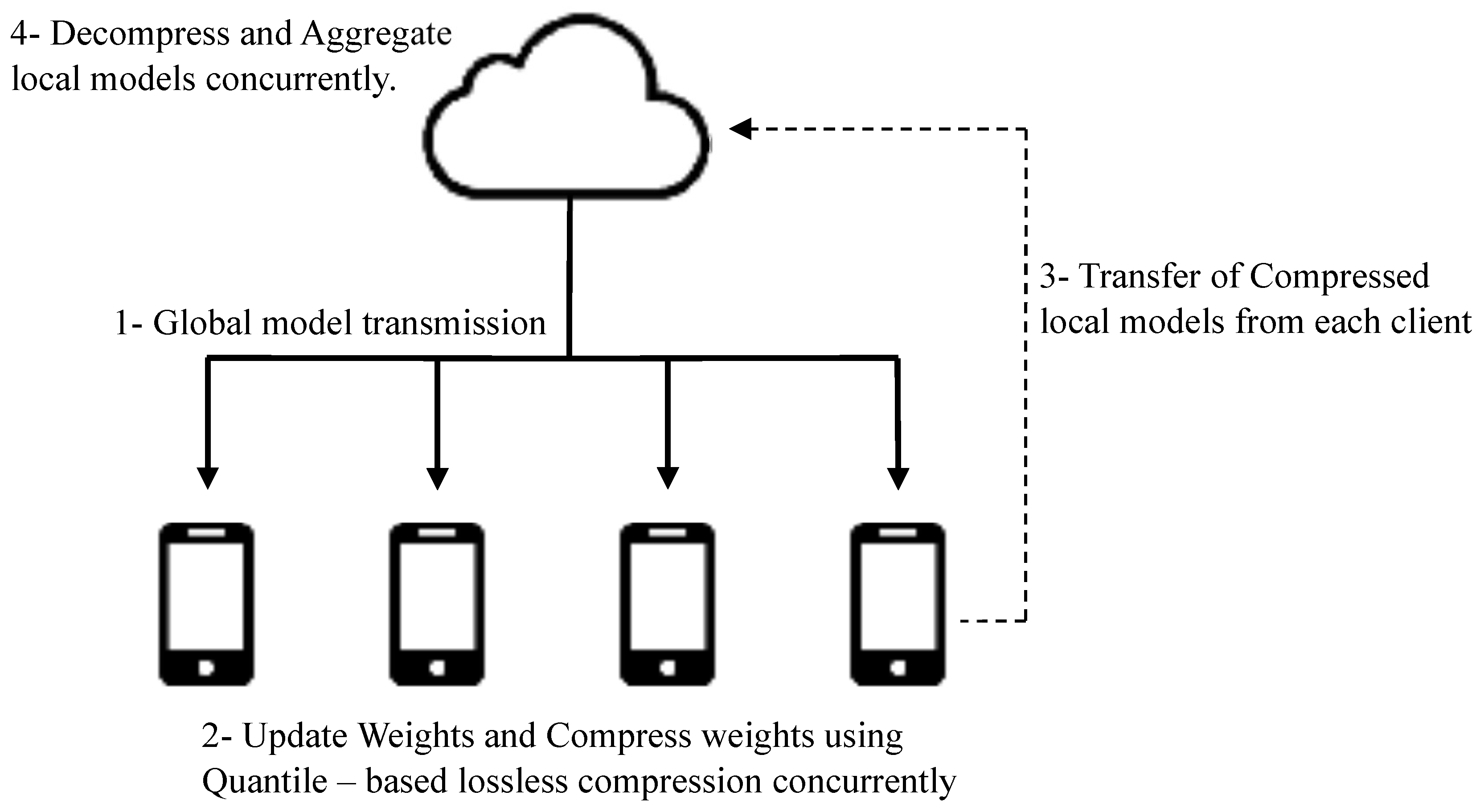
3.2.2. Quantile Lossless Compression-Based Method
- 1.
- Compute deltas and use them as the values instead of the original values if delta encoding is configured.
- 2.
- Determine unoptimized prefixes by selecting roughly evenly spaced quantiles from the distribution, each is a range with related metadata. It determines the GCD for each range if enabled.
- 3.
- Merge neighboring prefixes to maximize their effectiveness where appropriate.
- 4.
- Each prefix is given a Huffman code according to its respective weights in the data.
- 5.
- Use prefixes to encode deltas.
3.2.3. The Proposed Algorithm
| Algorithm 1: The FL algorithm with compressing weights using the quantile lossless compression method. |
 |
4. Results and Discussion
4.1. Experimental Setup
4.1.1. Baseline Methods
4.1.2. Evaluation Metrics
4.1.3. Implementation Details
- 1.
- The first experiment is conducted using the MNIST and CIFAR-10 datasets in an Independent and Identically Distributed (iid) environment. It is supposed that all data is kept on the user’s devices rather than on the central server. In the PyTorch version 2.10.0 simulation, the cross-entropy function is utilized as the loss function with 0.9 momentum. The fraction of participation of the overall 100 clients is 0.1 with 5 local epochs, 100 batch size, 0.01 local learning rate.Two models are used in this experiment, VGG16 [54] and ResNet18 [55] for deep convolutional neural networks. These two architectures were selected because they present contrast architectural characteristics. VGG16 is a deep network with many parameters and a simple sequential design and ResNet18 has a compact structure with residual connections and fewer parameters. Finally, both models are commonly used in FL studies, which allows us to compare the study results with previous work, and they are also practical to train repeatedly within our experimental setup. All networks are compressed using a quantile-based compression method with full precision. Compared to the original full-precision network, the compressed network infers substantially faster. Therefore, the compressed networks by quantile-based lossless compression will work more smoothly on local devices with limited computing power. Finally, both neural networks have the same result that the approach maintains the accuracy of the model.
- 2.
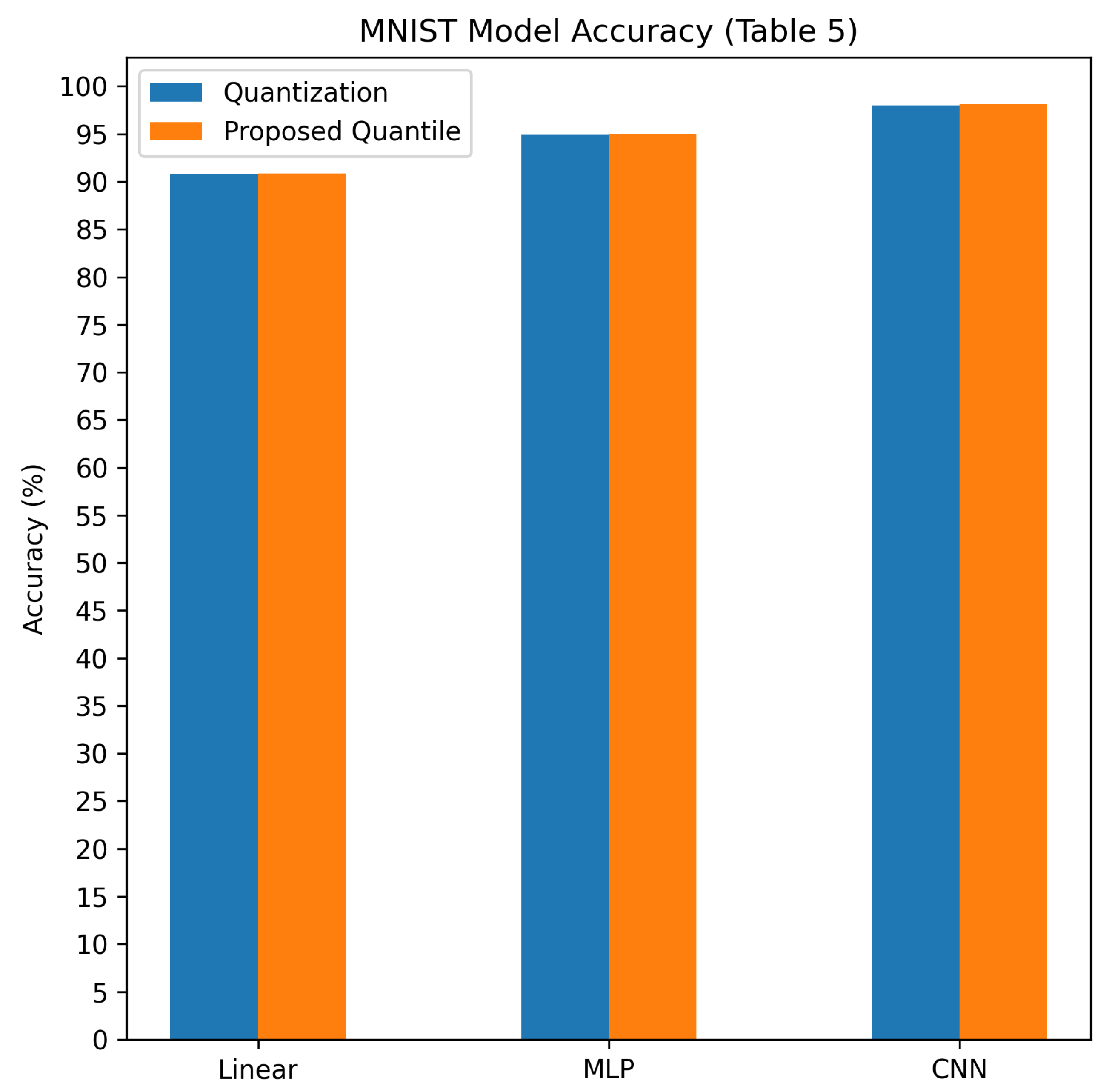
- In the second experiment, two different datasets are used to implement the FL frameworks: the MNIST and CIFAR-10 datasets. For the MNIST dataset, the number of participating users in this simulation, presented as (K), is 30 users, each performing local training using SGD with a 0.01 learning rate. All networks are compressed using a quantile-based compression method, and the experiment was evaluated by employing three model architectures: a linear regression model, a multi-layer perceptron (MLP), and a convolutional neural network (CNN). The proposed framework is compared with the baseline [35]. For the baseline method, the lattice dimension is with the compression ratio and privacy budget . Subsequently, the FL is applied to the CIFAR-10 dataset, which contains 32 × 32 RGB images, similarly divided into 50,000 training and 10,000 test samples, but distributed among K = 30 users. Each user utilizes local SGD with a learning rate of 0.1. The architecture in this case is a more complex CNN with three convolutional layers followed by four fully-connected layers, integrating ReLU activations, max pooling, and dropout layers before the softmax output layer. While the MNIST experiments validate the scalar encoders, CIFAR-10 focuses on implementing multivariate approaches as baselines, allowing the exploration of how model complexity and data diversity affect FL performance. For the baseline method, two configurations are evaluated, both with and , but differing in the compression ratio: the first with and the second with .
4.2. Results
4.3. Study Limitation
5. Conclusions
Author Contributions
Funding
Data Availability Statement
Acknowledgments
Conflicts of Interest
References
- Kairouz, P.; McMahan, H.B. Advances and Open Problems in Federated Learning. Found. Trends Mach. Learn. 2021, 14, 1–210. [Google Scholar] [CrossRef]
- Li, T.; Sahu, A.K.; Talwalkar, A.; Smith, V. Federated Learning: Challenges, Methods, and Future Directions. IEEE Signal Process. Mag. 2020, 37, 50–60. [Google Scholar] [CrossRef]
- Li, Y.; Chen, C.; Liu, N.; Huang, H.; Zheng, Z.; Yan, Q. A Blockchain-Based Decentralized Federated Learning Framework with Committee Consensus. IEEE Netw. 2020, 35, 234–241. [Google Scholar] [CrossRef]
- McMahan, B.; Moore, E.; Ramage, D.; Hampson, S.; y Arcas, B.A. Communication-efficient learning of deep networks from decentralized data. In Artificial Intelligence and Statistics; PMLR: New York, NY, USA, 2017; pp. 1273–1282. [Google Scholar]
- Oh, Y.; Jeon, Y.S.; Chen, M.; Saad, W. FedVQCS: Federated Learning via Vector Quantized Compressed Sensing. IEEE Trans. Wirel. Commun. 2024, 23, 1755–1770. [Google Scholar] [CrossRef]
- Kaushal, V.; Sharma, S. Weighted FedCOM: A Communication Efficient Approach to Federated Learning. Evol. Syst. 2025, 16, 27. [Google Scholar] [CrossRef]
- Wu, D.; Ullah, R.; Rodgers, P.; Kilpatrick, P.; Spence, I.; Varghese, B. EcoFed: Efficient Communication for DNN Partitioning-Based Federated Learning. IEEE Trans. Parallel Distrib. Syst. 2024, 35, 377–390. [Google Scholar] [CrossRef]
- Kim, M.; Saad, W.; Mozaffari, M.; Debbah, M. Green, Quantized Federated Learning Over Wireless Networks: An Energy-Efficient Design. IEEE Trans. Wirel. Commun. 2024, 23, 1386–1402. [Google Scholar] [CrossRef]
- Xu, J.; Du, W.; Jin, Y.; He, W.; Cheng, R. Ternary Compression for Communication-Efficient Federated Learning. IEEE Trans. Neural Netw. Learn. Syst. 2022, 33, 1162–1176. [Google Scholar] [CrossRef]
- Alistarh, D.; Grubic, D.; Li, J.; Tomioka, R.; Vojnovic, M. QSGD: Communication-efficient SGD via gradient quantization and encoding. In Advances in Neural Information Processing Systems; Curran Associates, Inc.: Red Hook, NY, USA, 2017; pp. 1709–1720. [Google Scholar]
- Gholami, A.; Kim, S.; Dong, Z.; Yao, Z.; Mahoney, M.W.; Keutzer, K. A Survey of Quantization Methods for Efficient Neural Network Inference. arXiv 2021, arXiv:2106.08295. [Google Scholar] [CrossRef]
- Reisizadeh, A.; Mokhtari, A.; Hassani, H.; Jadbabaie, A.; Pedarsani, R. FedPAQ: A communication-efficient federated learning method with periodic averaging and quantization. In International Conference on Artificial Intelligence and Statistics; PMLR: New York, NY, USA, 2020; pp. 2021–2031. [Google Scholar]
- Liu, Y.; Zhang, W.; Wang, J. Zero-shot Adversarial Quantization. In Proceedings of the 2021 IEEE/CVF Conference on Computer Vision and Pattern Recognition (CVPR); IEEE: New York, NY, USA, 2021; pp. 1512–1521. [Google Scholar]
- Cai, Y.; Yao, Z.; Dong, Z.; Gholami, A.; Mahoney, M.W.; Keutzer, K. ZeroQ: A Novel Zero Shot Quantization Framework. In Proceedings of the IEEE/CVF Conference on Computer Vision and Pattern Recognition (CVPR); IEEE: New York, NY, USA, 2020; pp. 13169–13178. [Google Scholar]
- Shlezinger, N.; Chen, M.; Eldar, Y.C.; Poor, H.V.; Cui, S. UVeQFed: Universal vector quantization for federated learning. IEEE Trans. Signal Process. 2021, 69, 500–514. [Google Scholar] [CrossRef]
- Horvath, S.; Ho, C.Y.; Horvath, L.; Sahu, A.N.; Canini, M.; Richtárik, P. Natural compression for distributed deep learning. In Proceedings of the Mathematical and Scientific Machine Learning; PMLR: New York, NY, USA, 2022; pp. 129–141. [Google Scholar]
- Gou, J.; Yu, B.; Maybank, S.J.; Tao, D. Knowledge Distillation: A Survey. Int. J. Comput. Vis. 2021, 129, 1789–1819. [Google Scholar] [CrossRef]
- Polino, A.; Pascanu, R.; Alistarh, D. Model Compression via Distillation and Quantization. arXiv 2018, arXiv:1802.05668. [Google Scholar] [CrossRef]
- Isik, B.; No, A.; Weissman, T. Rate-distortion theoretic model compression: Successive refinement for pruning. arXiv 2021, arXiv:2102.08329. [Google Scholar]
- Ma, X.; Qin, M.; Sun, F.; Hou, Z.; Yuan, K.; Xu, Y.; Wang, Y.; Chen, Y.K.; Jin, R.; Xie, Y. Effective Model Sparsification by Scheduled Grow-and-Prune Methods. arXiv 2021, arXiv:2106.09857. [Google Scholar]
- Zhang, M.; Yu, X.; Rong, J.; Ou, L. Graph pruning for model compression. Appl. Intell. 2022, 52, 11244–11256. [Google Scholar] [CrossRef]
- Liu, H.; Shi, Y.; Su, Z.; Zhang, K.; Wang, X.; Yan, Z.; Kong, F. FedADP: Communication-Efficient by Model Pruning for Federated Learning. In Proceedings of the GLOBECOM 2023—2023 IEEE Global Communications Conference; IEEE: New York, NY, USA, 2023; pp. 3093–3098. [Google Scholar] [CrossRef]
- Fan, W.; Yang, K.; Wang, Y.; Chen, C.; Li, J. Data-free Adaptive Structured Pruning for Federated Learning. J. Supercomput. 2024, 80, 18600–18626. [Google Scholar] [CrossRef]
- Aji, A.F.; Heafield, K. Sparse communication for distributed gradient descent. In Proceedings of the 2017 Conference on Empirical Methods in Natural Language Processing; Association for Computational Linguistics: Stroudsburg, PA, USA, 2017; pp. 440–445. [Google Scholar] [CrossRef]
- Han, P.; Wang, S.; Leung, K.K. Adaptive gradient sparsification for efficient federated learning: An online learning approach. In Proceedings of the 2020 IEEE 40th International Conference on Distributed Computing Systems (ICDCS); IEEE: New York, NY, USA, 2020; pp. 300–310. [Google Scholar] [CrossRef]
- Liu, B.; Wan, M.; Foroosh, H.; Tappen, M.; Pensky, M. Sparse Convolutional Neural Networks. In Proceedings of the 2015 IEEE Computer Society Conference on Computer Vision and Pattern Recognition (CVPR’15); IEEE: New York, NY, USA, 2015; pp. 806–814. [Google Scholar]
- Alistarh, D.; Hoefler, T.; Johansson, M.; Konstantinov, N.; Khirirat, S.; Renggli, C. The convergence of sparsified gradient methods. In Proceedings of the Advances in Neural Information Processing Systems; Curran Associates, Inc.: Red Hook, NY, USA, 2018. [Google Scholar]
- Lin, Y.; Han, S.; Mao, H.; Wang, Y.; Dally, W.J. Deep gradient compression: Reducing the communication bandwidth for distributed training. arXiv 2017, arXiv:1712.01887. [Google Scholar] [CrossRef]
- Wen, J.; Zhang, Z.; Lan, Y.; Cui, Z.; Cai, J.; Zhang, W. A survey on federated learning: Challenges and applications. Int. J. Mach. Learn. Cybern. 2023, 14, 513–535. [Google Scholar] [CrossRef] [PubMed]
- Le, D.D.; Tran, A.K.; Pham, T.B.; Huynh, T.N. A Survey of Model Compression and Its Feedback Mechanism in Federated Learning. In Proceedings of the International Conference on Document Analysis and Recognition (ICDAR ’24), Phuket, Thailand, 10–14 June 2024. [Google Scholar] [CrossRef]
- Ding, Y.; Shikh-Bahaei, M.; Huang, C.; Yuan, W. Secure Federated Learning with Model Compression. In Proceedings of the 2023 IEEE International Conference on Communications Workshops (ICC Workshops); IEEE: New York, NY, USA, 2023; pp. 843–848. [Google Scholar] [CrossRef]
- Martin, L.; Niels, J.; Ben, Z. Pcodec: Lossless Compression of Numerical Data. Available online: https://github.com/Pcodec/Pcodec (accessed on 18 May 2026).
- Loncaric, M.; Jeppesen, N.; Zinberg, B. Pcodec: Better Compression for Numerical Sequences. arXiv 2025, arXiv:2502.06112. [Google Scholar] [CrossRef]
- Shalabi, E.; Khedr, W.; Rushdy, E.; Salah, A. A Comparative Study of Privacy-Preserving Techniques in Federated Learning: A Performance and Security Analysis. Information 2025, 16, 244. [Google Scholar] [CrossRef]
- Lang, N.; Sofer, E.; Shaked, T.; Shlezinger, N. Joint Privacy Enhancement and Quantization in Federated Learning. IEEE Trans. Signal Process. 2023, 71, 295–310. [Google Scholar] [CrossRef]
- Kim, Y.J.; Hong, C.S. Optimized Quantization for Convolutional Deep Neural Networks in Federated Learning. In Proceedings of the 2020 21st Asia-Pacific Network Operations and Management Symposium (APNOMS); IEEE: New York, NY, USA, 2020; pp. 150–154. [Google Scholar] [CrossRef]
- Wang, C.; Wang, J.; Lou, Z.; Kong, L.; Tao, W.; Wang, Y. SparseBatch: Communication-efficient Federated Learning With Partially Homomorphic Encryption. J. Appl. Sci. Eng. 2025, 28, 1645–1656. [Google Scholar] [CrossRef]
- Zheng, J.; Tang, J. Communication-efficient Federated Learning Based on Compressed Sensing and Ternary Quantization. Appl. Intell. 2025, 55, 100. [Google Scholar] [CrossRef]
- Hu, B.; Huang, X.; Zhang, K.; Wu, F.; Sun, C.; Cui, T.; Zhang, Y. Enhanced Federated Reinforcement Learning for Mobility-Aware Node Selection and Model Compression. In Proceedings of the IEEE Conference on Global Communications (GLOBECOM), IEEE Global Communications Conference, Kuala Lumpur, Malaysia, 4–8 December 2023; pp. 158–163. [Google Scholar] [CrossRef]
- Li, C.; Zhang, Y.; Yu, L.; Yang, M. Efficient Vehicle Selection and Resource Allocation for Knowledge Distillation-Based Federated Learning in UAV-Assisted VEC. IEEE Trans. Intell. Transp. Syst. 2025; early access. [CrossRef]
- Phiri, A.; Doku, I. Is Climate Finance Aiding Food Security in Developing Countries? A Focus on Sub-Saharan Africa. Cogent Econ. Financ. 2024, 12, 2312777. [Google Scholar] [CrossRef]
- Tufail, M.; Song, L.; Khan, Z. Green Finance and Green Growth Nexus: Evaluating the Role of Globalization and Human Capital. J. Appl. Econ. 2024, 27, 2309437. [Google Scholar] [CrossRef]
- Pan, F.; Deng, H.; Chen, M.; Zhao, L.; Qian, W.; Wan, X. Spatial-Temporal Evolution and Driving Factors of Agricultural Green Development in China: Evidence from Panel Quantile Approaches. Sustainability 2024, 16, 6345. [Google Scholar] [CrossRef]
- Aprea, I.L.; Scognamiglio, S.; Zanetti, P. Systemic Risk Measurement: A Quantile Long Short-Term Memory Network Approach. Appl. Soft Comput. 2024, 152, 111224. [Google Scholar] [CrossRef]
- Yoo, G.; Park, J.; Woo, H. Risk-Conditioned Reinforcement Learning: A Generalized Approach for Adapting to Varying Risk Measures. In Proceedings of the Thirty-Eighth AAAI Conference on Artificial Intelligence; Wooldridge, M., Dy, J., Natarajan, S., Eds.; AAAI Conference on Artificial Intelligence; AAAI Press: Menlo Park, CA, USA, 2024; Volume 38, pp. 16513–16521. [Google Scholar]
- Banerjee, A.K.; Boubaker, S.; Al-Nassar, N.S. Climate Policy Initiatives, Green Finance, and Carbon Risk Interconnectedness. Financ. Res. Lett. 2024, 67, 105776. [Google Scholar] [CrossRef]
- Papacharalampous, G.; Tyralis, H.; Doulamis, N.; Doulamis, A. Uncertainty Estimation of Machine Learning Spatial Precipitation Predictions from Satellite Data. Mach. Learn. Sci. Technol. 2024, 5, 035044. [Google Scholar] [CrossRef]
- Arbor, A.; Schmidt, M.; Zhang, J.; Bulmer, C.; Filatow, D.; Kasraei, B.; Smukler, S.; Heung, B. Filling the Gaps in Soil Data: A Multi-Model Framework for Addressing Data Gaps Using Pedotransfer Functions and Machine-Learning with Uncertainty Estimates to Estimate Bulk Density. Catena 2024, 245, 108310. [Google Scholar] [CrossRef]
- Penga, J.; Fua, X.; Wua, C.; Daib, Q.; Yang, H. Comparative Analysis of Nonlinear Impacts on the Built Environment within Station Areas with Different Metro Ridership Segments. Travel Behav. Soc. 2025, 38, 100898. [Google Scholar] [CrossRef]
- Wu, G.; Liu, F.; Li, S.; Song, Q.; Tang, Z. AC-DNN: An Adaptive Compact DNNs Architecture for Collaborative Learning Among Heterogeneous Smart Devices. IEEE Internet Things J. 2024, 11, 21072–21082. [Google Scholar] [CrossRef]
- Hachem, H.; Abboud, C. Bayesian Estimation of Simultaneous Regression Quantiles Using Hamiltonian Monte Carlo. Algorithms 2024, 17, 224. [Google Scholar] [CrossRef]
- Deng, L. The MNIST database of handwritten digit images for machine learning research. IEEE Signal Process. Mag. 2012, 29, 141–142. [Google Scholar] [CrossRef]
- Krizhevsky, A.; Nair, V.; Hinton, G. CIFAR-10 (Canadian Institute for Advanced Research). Online. 2010. Available online: https://academictorrents.com/details/463ba7ec7f37ed414c12fbb71ebf6431eada2d7a (accessed on 18 May 2026).
- Simonyan, K.; Zisserman, A. Very Deep Convolutional Networks for Large-Scale Image Recognition. arXiv 2014, arXiv:1409.1556. [Google Scholar]
- He, K.; Zhang, X.; Ren, S.; Sun, J. Deep Residual Learning for Image Recognition. In Proceedings of the IEEE Conference on Computer Vision and Pattern Recognition; IEEE: New York, NY, USA, 2016; pp. 770–778. [Google Scholar] [CrossRef]



| Dataset | Compression Method | Model | ||
|---|---|---|---|---|
| Linear | MLP | CNN | ||
| MNIST | Quantization [35] | 3.6% | −2.3% | 0.4% |
| Proposed Quantile | 68% | 55% | 53% | |
| CIFAR-10 | Quantization [35] | −3.4% | 1.8% | 1.7% |
| Proposed Quantile | 63% | 86% | 86% | |
| Dataset | Compression Method | VGG16 Model Layers | ||
|---|---|---|---|---|
| Linear | Activation | Convolution | ||
| MNIST | Quantization [36] | 4.2% | 3.9% | 4.1% |
| Proposed Quantile | 49% | 58% | 50% | |
| CIFAR-10 | Quantization [36] | 3.3% | 3.1% | 3.7% |
| Proposed Quantile | 49% | 58% | 50% | |
| Dataset | Compression Method | ResNet18 Model Layers | |
|---|---|---|---|
| Activation | Convolution | ||
| MNIST | Quantization [36] | 4.6% | 4.6% |
| Proposed Quantile | 54% | 49% | |
| CIFAR-10 | Quantization [36] | 3.9% | 4.6% |
| Proposed Quantile | 54% | 49% | |
| Dataset | Compression Method | Accuracy | |
|---|---|---|---|
| Train | Test | ||
| MNIST | Quantization [36] | 99.99% | 99.36% |
| Proposed Quantile | 100% | 99.2% | |
| CIFAR-10 | Quantization [36] | 85.29% | 83.35% |
| Proposed Quantile | 88.08% | 85.63% | |
| Model | Accuracy (%) | (%) | p-Value | Effect Size (r) | Practical Impact | |
|---|---|---|---|---|---|---|
| Quantization [35] Mean ± Std | Proposed Quantile Mean ± Std | |||||
| CNN | <0.001 *** | (large) | Negligible | |||
| MLP | <0.001 *** | (large) | Negligible | |||
| Linear | 0.014 * | (medium) | Negligible | |||
| Config | Method | Final Val Acc (%) | Best Val Acc (%) | Test | p-Value |
|---|---|---|---|---|---|
| Quantization [35] | Mann–Whitney U | *** | |||
| Proposed Quantile | |||||
| Quantization [35] | Mann–Whitney | *** | |||
| Proposed Quantile |
Disclaimer/Publisher’s Note: The statements, opinions and data contained in all publications are solely those of the individual author(s) and contributor(s) and not of MDPI and/or the editor(s). MDPI and/or the editor(s) disclaim responsibility for any injury to people or property resulting from any ideas, methods, instructions or products referred to in the content. |
© 2026 by the authors. Licensee MDPI, Basel, Switzerland. This article is an open access article distributed under the terms and conditions of the Creative Commons Attribution (CC BY) license.
Share and Cite
Abdellah, M.; Hesham, A.; Salah, A.; Behery, G.M. A New Lossless Compression Paradigm for Federated Learning: A Quantile-Based Framework for Bandwidth Efficiency Without Accuracy Degradation. Information 2026, 17, 528. https://doi.org/10.3390/info17060528
Abdellah M, Hesham A, Salah A, Behery GM. A New Lossless Compression Paradigm for Federated Learning: A Quantile-Based Framework for Bandwidth Efficiency Without Accuracy Degradation. Information. 2026; 17(6):528. https://doi.org/10.3390/info17060528
Chicago/Turabian StyleAbdellah, Marwa, Aya Hesham, Ahmad Salah, and Gamal M. Behery. 2026. "A New Lossless Compression Paradigm for Federated Learning: A Quantile-Based Framework for Bandwidth Efficiency Without Accuracy Degradation" Information 17, no. 6: 528. https://doi.org/10.3390/info17060528
APA StyleAbdellah, M., Hesham, A., Salah, A., & Behery, G. M. (2026). A New Lossless Compression Paradigm for Federated Learning: A Quantile-Based Framework for Bandwidth Efficiency Without Accuracy Degradation. Information, 17(6), 528. https://doi.org/10.3390/info17060528