DGAM: Dual-Guided Anomaly Mining for Semi-Supervised Graph Anomaly Detection



Abstract
1. Introduction
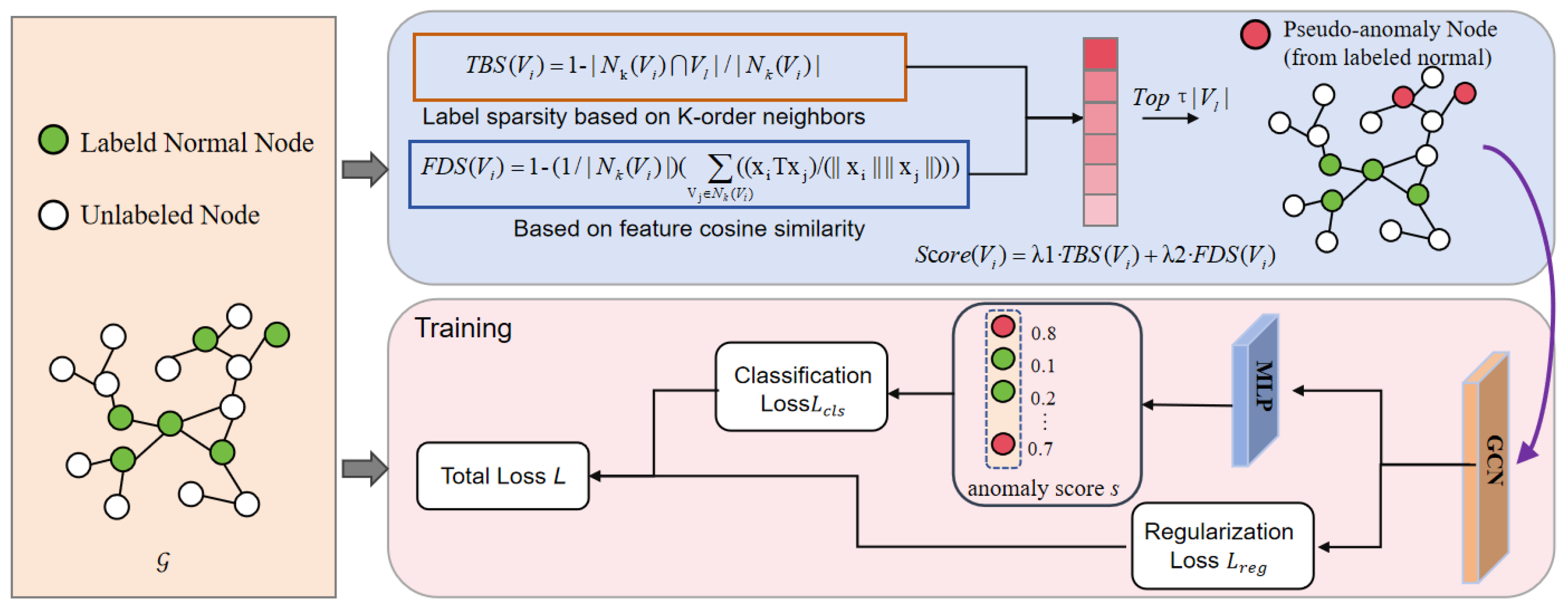
- We propose DGAM, a semi-supervised graph anomaly detection framework based on topological isolation and feature deviation. It uses TBS and FDS metrics to select pseudo-anomalies from labeled normal nodes as hard negative proxies, providing an effective basis for semi-supervised anomaly detection with only normal labels.
- A dual-index screening strategy is proposed by combining TBS and FDS. TBS identifies structurally isolated nodes, while FDS captures nodes with deviating local features. Their weighted fusion enables more effective pseudo-anomaly selection, contributing to improved anomaly detection performance in experiments.
- A joint training objective is designed to optimize pseudo-label classification while introducing embedding norm regularization to enhance the discriminative power and generalization of node representations.
- Experimental results on multiple real-world graph datasets show that DGAM outperforms existing state-of-the-art baselines, verifying the effectiveness of the proposed method.
2. Related Work
2.1. Graph Anomaly Detection
2.2. Generative Graph Anomaly Detection
3. Preliminaries
3.1. Problem Definition
3.2. Graph Neural Networks
4. Our Method
4.1. Topological and Feature Anomaly Measurement Module
4.1.1. Topological Boundary Score (TBS)
4.1.2. Feature Deviation Score (FDS)
4.1.3. Pseudo-Anomaly Screening
4.2. Training
4.2.1. Model Architecture
4.2.2. Training Objective
| Algorithm 1: DGAM: dual-guided anomaly mining for semi-supervised GAD |
| Require: Graph ; Labeled normal node set ; Hyperparameters: K, , , , , Ensure: Anomaly scores
|
5. Experiments
5.1. Experimental Setup
- Amazon [19]: User-product review network (Musical Instruments). Anomaly: users with <20% helpful votes. Undirected, unweighted. 25 handcrafted features (user activity, review helpfulness).
- Reddit [20]: User-subreddit interaction graph. Anomaly: banned users (spam/harassment). Undirected, unweighted. 64 features (text embeddings from user posts).
- Elliptic [21]: Bitcoin transaction network. Anomaly: illicit transactions. Directed weighted, converted to undirected unweighted. 93 transaction metadata features.
- Photo [22]: Amazon co-purchase network (Photo category). Anomaly: products with abnormal purchasing patterns. Undirected, unweighted. 745 bag-of-words features from product reviews.

| Dataset | Type | Nodes | Edges | Attributes | Anomalies (%) |
|---|---|---|---|---|---|
| Amazon | Co-review | 11,944 | 4,398,392 | 25 | 6.9 |
| Social Media | 10,984 | 168,016 | 64 | 3.3 | |
| Elliptic | Bitcoin Transaction | 46,564 | 73,248 | 93 | 9.8 |
| Photo | Co-purchase | 7535 | 119,043 | 745 | 9.2 |
- DOMINANT [9]: Autoencoder-based method reconstructing both node features and graph structure; anomaly score combines reconstruction errors.
- AnomalyDAE [10]: Dual autoencoder with attention mechanism, jointly learning structural and attribute embeddings.
- OCGNN [11]: One-class graph neural network integrating SVM objective with GNN representation learning.
- AEGIS [23]: Generative adversarial network that synthesizes pseudo-anomalies to train a discriminative detector.
- GAAN [24]: GAN-based method generating fake graph nodes; discriminator distinguishes real vs. fake node pairs.
- TAM [25]: Local affinity maximization with heterophily edge pruning; anomaly score based on affinity deficiency.
- CHRN [26]: Heterophily-aware method bridging spatial and spectral domains; uses label-aware edge indicator to prune heterophilous edges.
- GGAD [4]: Generative semi-supervised method, closest to our setting, generating pseudo-anomaly nodes for one-class classification.
- TAQ-GAD [27]: Generative semi-supervised method that selects pseudo-anomalies via topological anomaly quantification and augments training with virtual anomaly centers.
5.2. Implementation Details
5.3. Main Experiment Results
- Amazon. On Amazon, TAQ-GAD achieves the best AUROC (0.9474) and AUPRC (0.7973), followed by GGAD (0.9443 and 0.7922). DGAM obtains 0.9215 ± 0.0512 and 0.7762 ± 0.0702, respectively. DGAM is slightly lower than the top baselines on this dataset. Amazon has a very high edge density (over four million edges) and a moderate anomaly ratio (6.9%); generative methods like GGAD and TAQ-GAD may better cover the anomaly distribution in this setting by synthesizing diverse pseudo-anomalies. DGAM selects pseudo-anomalies exclusively from labeled normal nodes, which may be less diverse when normal nodes do not fully capture all anomaly patterns.
- Elliptic. On Elliptic, DGAM achieves the best AUPRC of 0.4124 ± 0.0061, a substantial improvement over the best baseline (GGAD, 0.2425). The AUROC (0.7463 ± 0.0087) is competitive, ranking among the top methods alongside TAQ-GAD (0.7453) and CHRN (0.7315). This indicates that DGAM is particularly effective at ranking anomalies higher on this dataset, where illicit transactions tend to be structurally peripheral and feature-distinctive, making them well-suited for detection by the dual TBS and FDS metrics. The notably small standard deviation (0.0061 for AUPRC) further demonstrates DGAM’s stable performance on this dataset.
- Reddit and Photo. On Reddit, TAQ-GAD achieves the best AUROC (0.6682) and AUPRC (0.0780), while DGAM obtains 0.6599 ± 0.0396 and 0.0590 ± 0.0123, respectively, remaining competitive with the top methods. On Photo, DGAM gives the best AUROC (0.7175 ± 0.0772) and a competitive AUPRC (0.2440 ± 0.1197). These two datasets are sparser and exhibit more complex anomaly patterns. In such settings, DGAM’s dual metrics (TBS and FDS) provide effective signals for selecting pseudo-anomalies, contributing to its relative advantage. The moderate standard deviations on Photo reflect sensitivity to the random sampling of labeled normal nodes on this smaller dataset.
| Setting | Method | Dataset | |||||||
|---|---|---|---|---|---|---|---|---|---|
| AUROC | AUPRC | ||||||||
| Amazon | Elliptic | Photo | Amazon | Elliptic | Photo | ||||
| Unsupervised | DOMINANT | 0.7025 | 0.5105 | 0.2960 | 0.5136 | 0.1315 | 0.0380 | 0.0454 | 0.1039 |
| AnomalyDAE | 0.7783 | 0.5091 | 0.4963 | 0.5069 | 0.1429 | 0.0319 | 0.0872 | 0.0987 | |
| OCGNN | 0.7165 | 0.5246 | 0.2581 | 0.5307 | 0.1352 | 0.0375 | 0.0616 | 0.0965 | |
| AEGIS | 0.6059 | 0.5349 | 0.4553 | 0.5516 | 0.1200 | 0.0413 | 0.0827 | 0.0972 | |
| GAAN | 0.6513 | 0.5216 | 0.2590 | 0.4296 | 0.0852 | 0.0348 | 0.0436 | 0.0768 | |
| TAM | 0.8303 | 0.6062 | 0.4039 | 0.5675 | 0.4024 | 0.0437 | 0.0502 | 0.1013 | |
| Semi-supervised | DOMINANT | 0.8867 | 0.5194 | 0.3256 | 0.5314 | 0.7289 | 0.0414 | 0.0652 | 0.1283 |
| AnomalyDAE | 0.9171 | 0.5280 | 0.5409 | 0.5272 | 0.7748 | 0.0362 | 0.0949 | 0.1177 | |
| OCGNN | 0.8810 | 0.5622 | 0.2881 | 0.6461 | 0.7538 | 0.0400 | 0.0640 | 0.1501 | |
| AEGIS | 0.7593 | 0.5605 | 0.5132 | 0.5936 | 0.2616 | 0.0441 | 0.0912 | 0.1110 | |
| GAAN | 0.6531 | 0.5349 | 0.2724 | 0.4355 | 0.0856 | 0.0362 | 0.0611 | 0.0768 | |
| TAM | 0.8405 | 0.5829 | 0.4150 | 0.6013 | 0.5183 | 0.0446 | 0.0552 | 0.1087 | |
| CHRN | 0.9346 | 0.5731 | 0.7315 | 0.6223 | 0.7865 | 0.0500 | 0.2101 | 0.1420 | |
| GGAD | 0.9443 | 0.6354 | 0.7290 | 0.6476 | 0.7922 | 0.0610 | 0.2425 | 0.1420 | |
| TAQ-GAD | 0.9474 | 0.6682 | 0.7453 | 0.7107 | 0.7973 | 0.0780 | 0.3573 | 0.2073 | |
| DGAM | 0.9215 ± 0.0512 | 0.6599 ± 0.0396 | 0.7463 ± 0.0087 | 0.7175 ± 0.0772 | 0.7762 ± 0.0702 | 0.0590 ± 0.0123 | 0.4124 ± 0.0061 | 0.2440 ± 0.1197 | |
5.4. Ablation Study
5.5. Computational Complexity and Runtime
5.6. Parameter Analysis
5.6.1. Effect of the Proportion of Pseudo-Anomalies
5.6.2. Effect of Loss Weights and
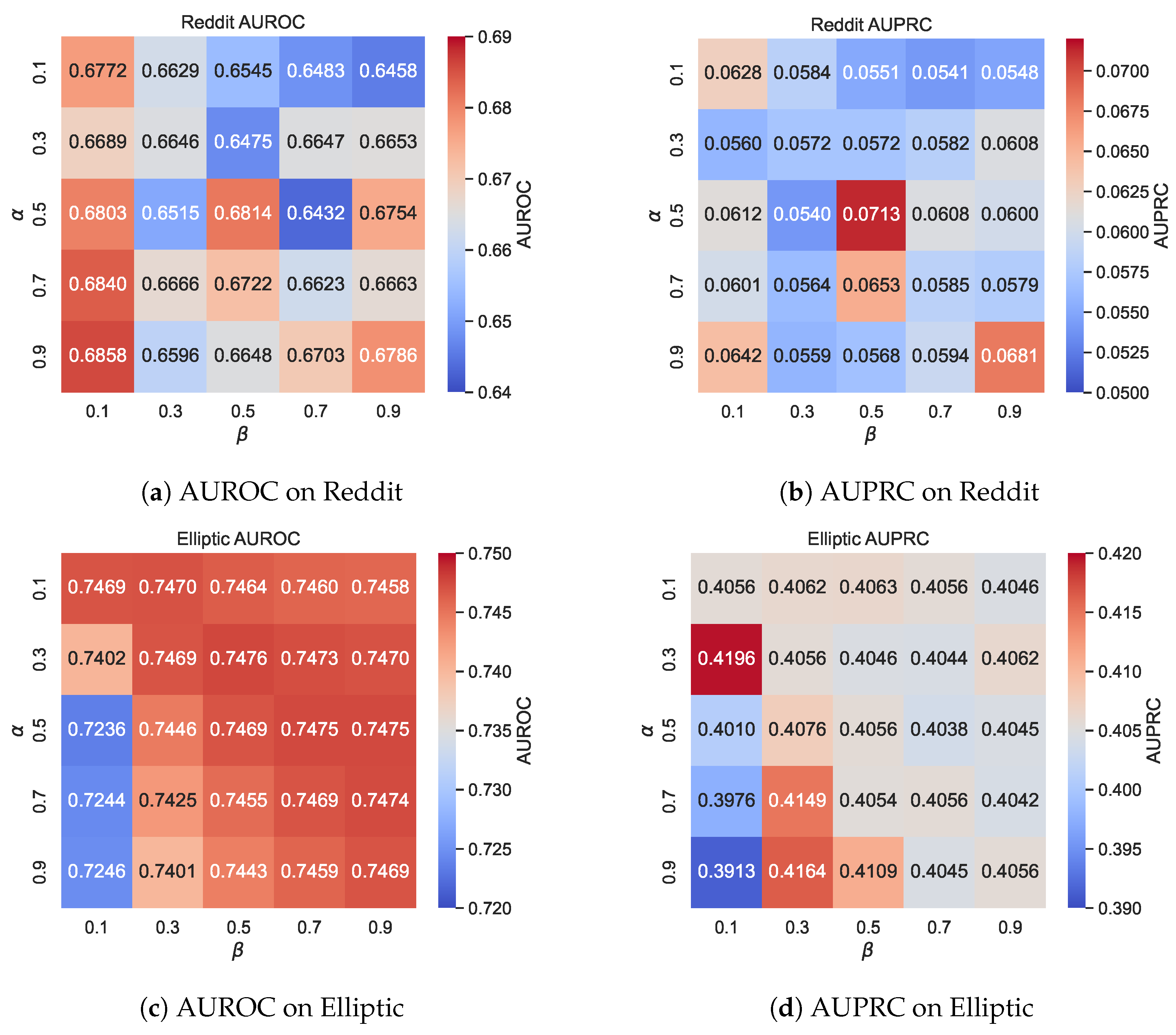
5.6.3. Effect of Fusion Weights and
6. Limitations
7. Conclusions
Author Contributions
Funding
Data Availability Statement
Conflicts of Interest
References
- Ma, X.; Wu, J.; Xue, S.; Yang, J.; Zhou, C.; Sheng, Q.Z.; Xiong, H.; Akoglu, L. A comprehensive survey on graph anomaly detection with deep learning. IEEE Trans. Knowl. Data Eng. 2021, 35, 12012–12038. [Google Scholar] [CrossRef]
- Tang, J.; Hua, F.; Gao, Z.; Zhao, P.; Li, J. Gadbench: Revisiting and benchmarking supervised graph anomaly detection. Adv. Neural Inf. Process. Syst. 2023, 36, 29628–29653. [Google Scholar]
- Chunawala, H.; Kumbhar, S.; Pandey, A.; Rajput, B.J.; Sahu, G.; Guru, A. A Survey of Anomaly Detection in Graphs: Algorithms and Applications. In Graph Mining: Practical Uses and Instruments for Exploring Complex Networks; Springer Nature: Cham, Switzerland, 2025; pp. 21–31. [Google Scholar]
- Qiao, H.; Wen, Q.; Li, X.; Lim, E.; Pang, G. Generative semi-supervised graph anomaly detection. Adv. Neural Inf. Process. Syst. 2024, 37, 4660–4688. [Google Scholar]
- Fernández, A.; Garcia, S.; Herrera, F.; Chawla, N.V. SMOTE for learning from imbalanced data: Progress and challenges, marking the 15-year anniversary. J. Artif. Intell. Res. 2018, 61, 863–905. [Google Scholar] [CrossRef]
- Zhou, Q.; Chen, Y.; Xu, Z.; Wu, Y.; Pan, M.; Das, M.; Yang, H.; Tong, H. Graph anomaly detection with adaptive node mixup. In Proceedings of the 33rd ACM International Conference on Information and Knowledge Management; Association for Computing Machinery: New York, NY, USA, 2024; pp. 3494–3504. [Google Scholar]
- Chen, N.; Liu, Z.; Hooi, B.; He, B.; Fathony, R.; Hu, J.; Chen, J. Consistency training with learnable data augmentation for graph anomaly detection with limited supervision. In Proceedings of the Twelfth International Conference on Learning Representations, Vienna, Austria, 7–11 May 2024. [Google Scholar]
- Liu, F.; Ma, X.; Wu, J.; Yang, J.; Xue, S.; Beheshti, A.; Zhou, C.; Peng, H.; Sheng, Q.Z.; Aggarwal, C.C. Dagad: Data augmentation for graph anomaly detection. In 2022 IEEE International Conference on Data Mining (ICDM); IEEE: Piscataway, NJ, USA, 2022; pp. 259–268. [Google Scholar]
- Ding, K.; Li, J.; Bhanushali, R.; Liu, H. Deep anomaly detection on attributed networks. In Proceedings of the 2019 SIAM International Conference on Data Mining; Society for Industrial and Applied Mathematics: Philadelphia, PA, USA, 2019; pp. 594–602. [Google Scholar]
- Fan, H.; Zhang, F.; Li, Z. Anomalydae: Dual autoencoder for anomaly detection on attributed networks. In ICASSP 2020–2020 IEEE International Conference on Acoustics, Speech and Signal Processing (ICASSP); IEEE: Piscataway, NJ, USA, 2020; pp. 5685–5689. [Google Scholar]
- Wang, X.; Jin, B.; Du, Y.; Cui, P.; Tan, Y.; Yang, Y. One-class graph neural networks for anomaly detection in attributed networks. Neural Comput. Appl. 2021, 33, 12073–12085. [Google Scholar] [CrossRef]
- Liu, Y.; Li, Z.; Pan, S.; Gong, C.; Zhou, C.; Karypis, G. Anomaly detection on attributed networks via contrastive self-supervised learning. IEEE Trans. Neural Netw. Learn. Syst. 2021, 33, 2378–2392. [Google Scholar] [CrossRef] [PubMed]
- Jin, M.; Liu, Y.; Zheng, Y.; Chi, L.; Li, Y.; Pan, S. Anemone: Graph anomaly detection with multi-scale contrastive learning. In Proceedings of the 30th ACM International Conference on Information & Knowledge Management; Association for Computing Machinery: New York, NY, USA, 2021; pp. 3122–3126. [Google Scholar]
- Xu, Y.; Peng, Z.; Shi, B.; Hua, X.; Dong, B.; Wang, S.; Chen, C. Revisiting graph contrastive learning on anomaly detection: A structural imbalance perspective. Proc. Aaai Conf. Artif. Intell. 2025, 39, 12972–12980. [Google Scholar] [CrossRef]
- Jin, D.; Cao, J.; Wang, X.; Feng, B.; He, D.; Wang, L.; Dang, J. Rethinking Contrastive Learning in Graph Anomaly Detection: A Clean-View Perspective. arXiv 2025, arXiv:2505.18002. [Google Scholar] [CrossRef]
- Berahmand, K.; Forouzandeh, S.; Mohammadi, M.; Moradi, P.; Jalili, M. AC2L-GAD: Active Counterfactual Contrastive Learning for Graph Anomaly Detection. arXiv 2026, arXiv:2601.21171. [Google Scholar]
- Tang, J.; Li, J.; Gao, Z.; Li, J. Rethinking graph neural networks for anomaly detection. In Proceedings of the International Conference on Machine Learning, PMLR, Baltimore, MD, USA, 17–23 July 2022; pp. 21076–21089. [Google Scholar]
- Zhou, S.; Huang, X.; Liu, N.; Zhou, H.; Chung, F.; Huang, L. Improving generalizability of graph anomaly detection models via data augmentation. IEEE Trans. Knowl. Data Eng. 2023, 35, 12721–12735. [Google Scholar] [CrossRef]
- Dou, Y.; Liu, Z.; Sun, L.; Deng, Y.; Peng, H.; Yu, P.S. Enhancing graph neural network-based fraud detectors against camouflaged fraudsters. In Proceedings of the 29th ACM International Conference on Information & Knowledge Management; Association for Computing Machinery: New York, NY, USA, 2020; pp. 315–324. [Google Scholar]
- Kumar, S.; Zhang, X.; Leskovec, J. Predicting dynamic embedding trajectory in temporal interaction networks. In Proceedings of the 25th ACM SIGKDD International Conference on Knowledge Discovery & Data Mining; Association for Computing Machinery: New York, NY, USA, 2019; pp. 1269–1278. [Google Scholar]
- Weber, M.; Domeniconi, G.; Chen, J.; Weidele, D.K.I.; Bellei, C.; Robinson, T.; Leiserson, C. Anti-Money Laundering in Bitcoin: Experimenting with Graph Convolutional Networks for Financial Forensics. In Proceedings of the ACM SIGKDD International Conference on Knowledge Discovery and Data Mining, Anchorage, Alaska, 4–8 August 2019. [Google Scholar]
- McAuley, J.; Targett, C.; Shi, Q.; Hengel, A.V.D. Image-based recommendations on styles and substitutes. In Proceedings of the 38th International ACM SIGIR Conference on Research and Development in Information Retrieval; Association for Computing Machinery: New York, NY, USA, 2015; pp. 43–52. [Google Scholar]
- Ding, K.; Li, J.; Agarwal, N.; Liu, H. Inductive anomaly detection on attributed networks. In Proceedings of the Twenty-Ninth International Joint Conference on Artificial Intelligence, Yokohama Yokohama, Japan, 7–15 January 2021; pp. 1288–1294. [Google Scholar]
- Chen, Z.; Liu, B.; Wang, M.; Dai, P.; Lv, J.; Bo, L. Generative adversarial attributed network anomaly detection. In Proceedings of the 29th ACM International Conference on Information & Knowledge Management; Association for Computing Machinery: New York, NY, USA, 2020; pp. 1989–1992. [Google Scholar]
- Qiao, H.; Pang, G. Truncated affinity maximization: One-class homophily modeling for graph anomaly detection. Adv. Neural Inf. Process. Syst. 2023, 36, 49490–49512. [Google Scholar]
- Gao, Y.; Wang, X.; He, X.; Liu, Z.; Feng, H.; Zhang, Y. Addressing heterophily in graph anomaly detection: A perspective of graph spectrum. In Proceedings of the ACM Web Conference; Association for Computing Machinery: New York, NY, USA, 2023; pp. 1528–1538. [Google Scholar]
- Guo, T.; Fan, Y.; Cui, C.; Liang, J.; Zhao, J.; Wang, D. Topological Anomaly Quantification for Semi-supervised Graph Anomaly Detection. In Proceedings of the Fourteenth International Conference on Learning Representations (ICLR), Rio de Janeiro, Brazil, 23–27 April 2026. [Google Scholar]




| Variant | AUROC | AUPRC | ||||
|---|---|---|---|---|---|---|
| Elliptic | Photo | Elliptic | Photo | |||
| Baseline | 0.5913 | 0.3879 | 0.6427 | 0.0478 | 0.0731 | 0.1360 |
| +TBS | 0.6617 | 0.7475 | 0.7226 | 0.0576 | 0.4017 | 0.3169 |
| +FDS | 0.5865 | 0.7467 | 0.6504 | 0.0580 | 0.4132 | 0.1397 |
| +TBS+FDS | 0.6814 | 0.7469 | 0.7718 | 0.0713 | 0.4056 | 0.3647 |
| Variant | AUROC | AUPRC | ||||
|---|---|---|---|---|---|---|
| Elliptic | Photo | Elliptic | Photo | |||
| 0.6804 | 0.7337 | 0.7805 | 0.0661 | 0.3591 | 0.3335 | |
| 0.6814 | 0.7469 | 0.7718 | 0.0713 | 0.4056 | 0.3647 | |
| Method | Amazon | Elliptic | Photo | |
|---|---|---|---|---|
| DOMINANT | 1592 | 125 | 1119 | 437 |
| AnomalyDAE | 1656 | 161 | 8296 | 445 |
| OCGNN | 765 | 162 | 3517 | 125 |
| AEGIS | 1121 | 166 | 5638 | 417 |
| GAAN | 1678 | 94 | 1866 | 307 |
| TAM | 4516 | 432 | 13,200 | 165 |
| GGAD | 658 | 368 | 5146 | 106 |
| TAQ-GAD | 534 | 134 | 2400 | 480 |
| DGAM (Ours) | 523 | 76 | 2160 | 122 |
| Photo | ||||
|---|---|---|---|---|
| AUROC | AUPRC | AUROC | AUPRC | |
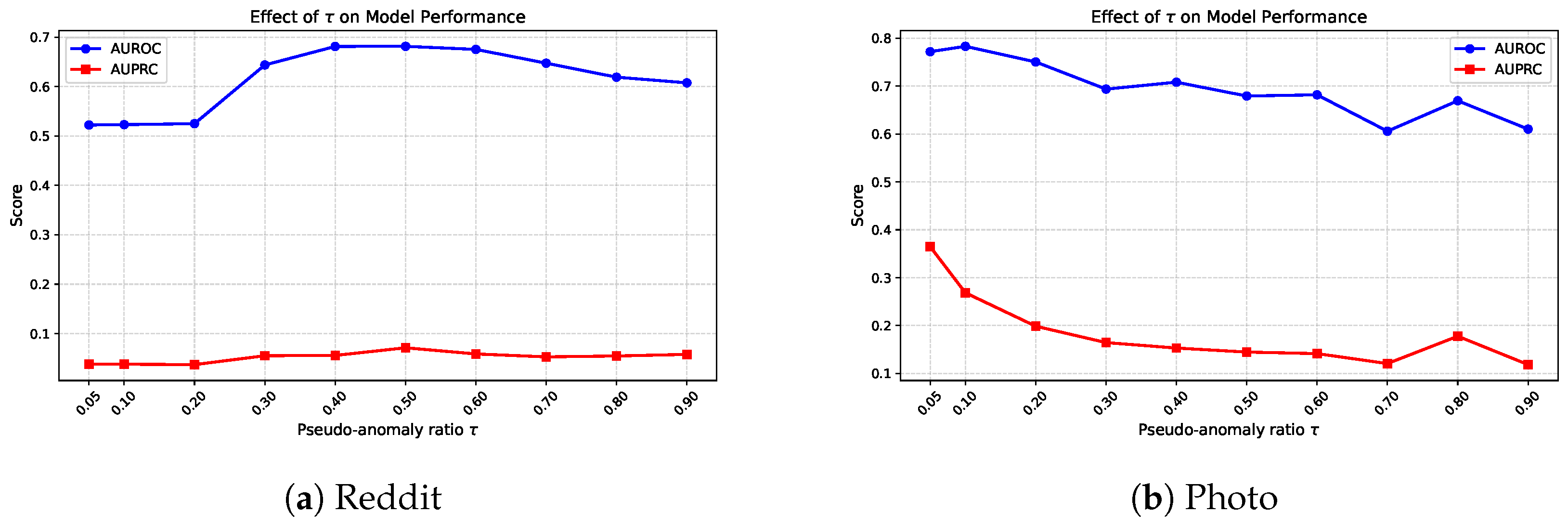
| 0.05 | 0.5222 | 0.0382 | 0.7718 | 0.3647 |
| 0.10 | 0.5229 | 0.0380 | 0.7829 | 0.2685 |
| 0.20 | 0.5249 | 0.0372 | 0.7503 | 0.1987 |
| 0.30 | 0.6437 | 0.0552 | 0.6936 | 0.1645 |
| 0.40 | 0.6812 | 0.0558 | 0.7081 | 0.1531 |
| 0.50 | 0.6814 | 0.0713 | 0.6792 | 0.1447 |
| 0.60 | 0.6752 | 0.0588 | 0.6817 | 0.1415 |
| 0.70 | 0.6473 | 0.0529 | 0.6058 | 0.1207 |
| 0.80 | 0.6190 | 0.0547 | 0.6693 | 0.1778 |
| 0.90 | 0.6075 | 0.0579 | 0.6101 | 0.1185 |
Disclaimer/Publisher’s Note: The statements, opinions and data contained in all publications are solely those of the individual author(s) and contributor(s) and not of MDPI and/or the editor(s). MDPI and/or the editor(s) disclaim responsibility for any injury to people or property resulting from any ideas, methods, instructions or products referred to in the content. |
© 2026 by the authors. Licensee MDPI, Basel, Switzerland. This article is an open access article distributed under the terms and conditions of the Creative Commons Attribution (CC BY) license.
Share and Cite
Li, X.; Guo, T.; Tian, Z. DGAM: Dual-Guided Anomaly Mining for Semi-Supervised Graph Anomaly Detection. Information 2026, 17, 521. https://doi.org/10.3390/info17060521
Li X, Guo T, Tian Z. DGAM: Dual-Guided Anomaly Mining for Semi-Supervised Graph Anomaly Detection. Information. 2026; 17(6):521. https://doi.org/10.3390/info17060521
Chicago/Turabian StyleLi, Xingxuan, Ting Guo, and Zhen Tian. 2026. "DGAM: Dual-Guided Anomaly Mining for Semi-Supervised Graph Anomaly Detection" Information 17, no. 6: 521. https://doi.org/10.3390/info17060521
APA StyleLi, X., Guo, T., & Tian, Z. (2026). DGAM: Dual-Guided Anomaly Mining for Semi-Supervised Graph Anomaly Detection. Information, 17(6), 521. https://doi.org/10.3390/info17060521