Integrating Risk Factors and Symptoms for Urinary Tract Infection Diagnosis Using an Explainable AI Approach in Low-Resource Regions

 ,
, 
Abstract
1. Introduction
- (i)
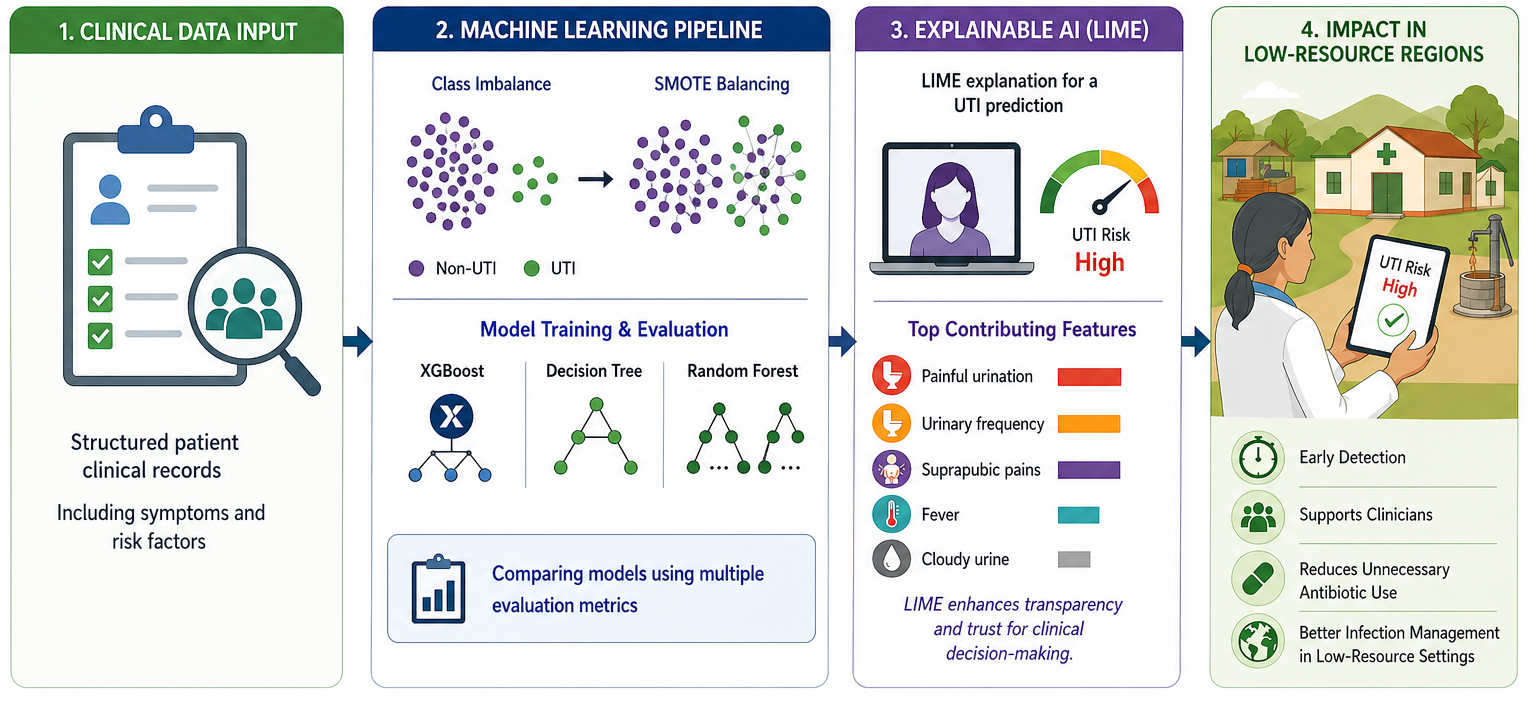
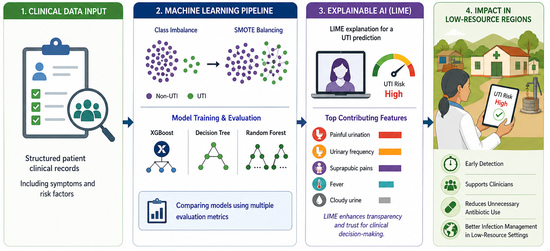
- The development and evaluation of interpretable machine learning models for urinary tract infection (UTI) diagnosis using patient symptoms and risk factors in a low-resource context;
- (ii)
- The application of the Synthetic Minority Over-sampling Technique (SMOTE) to address class imbalance in the dataset, thereby improving model learning and robustness;
- (iii)
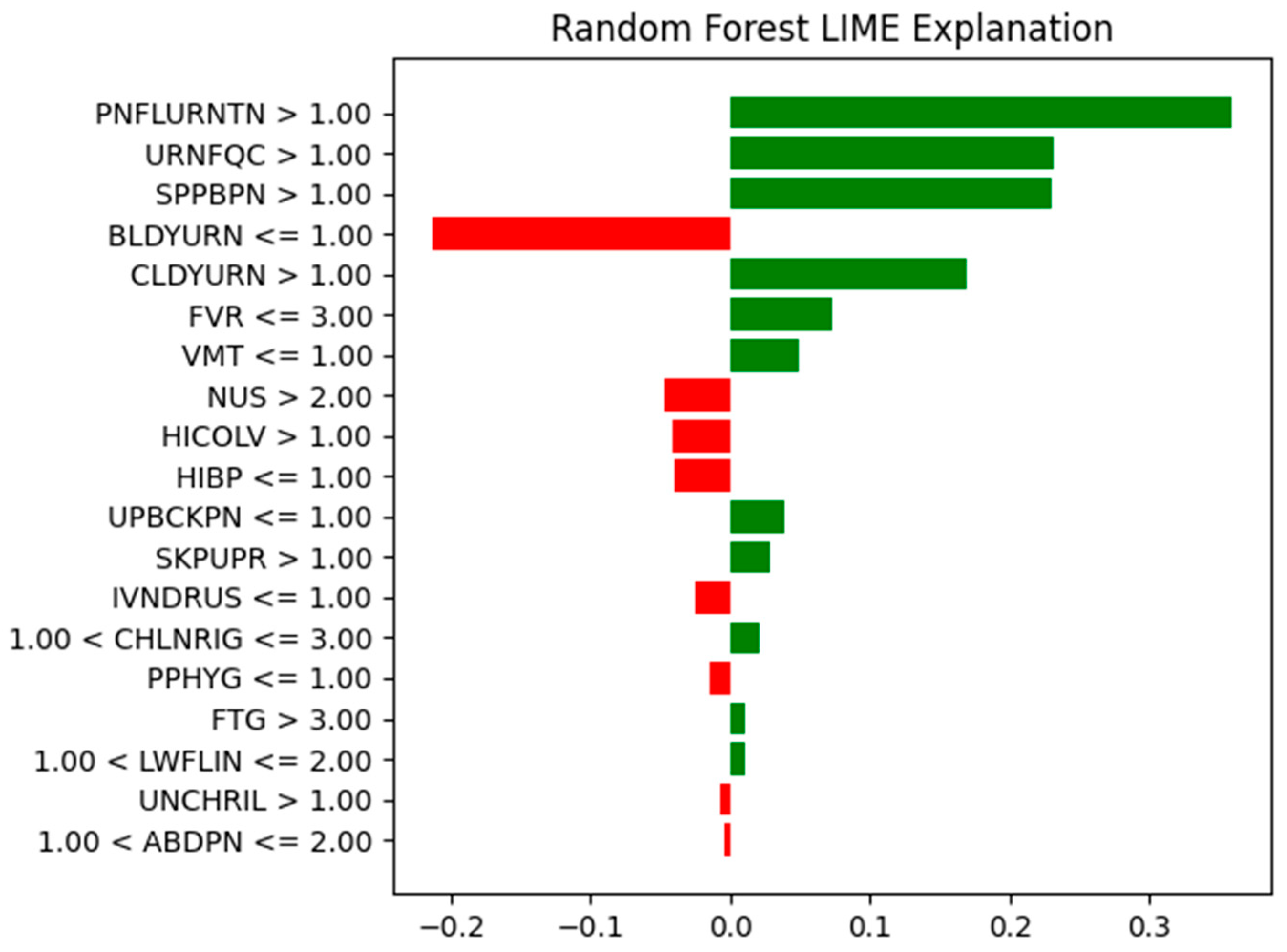
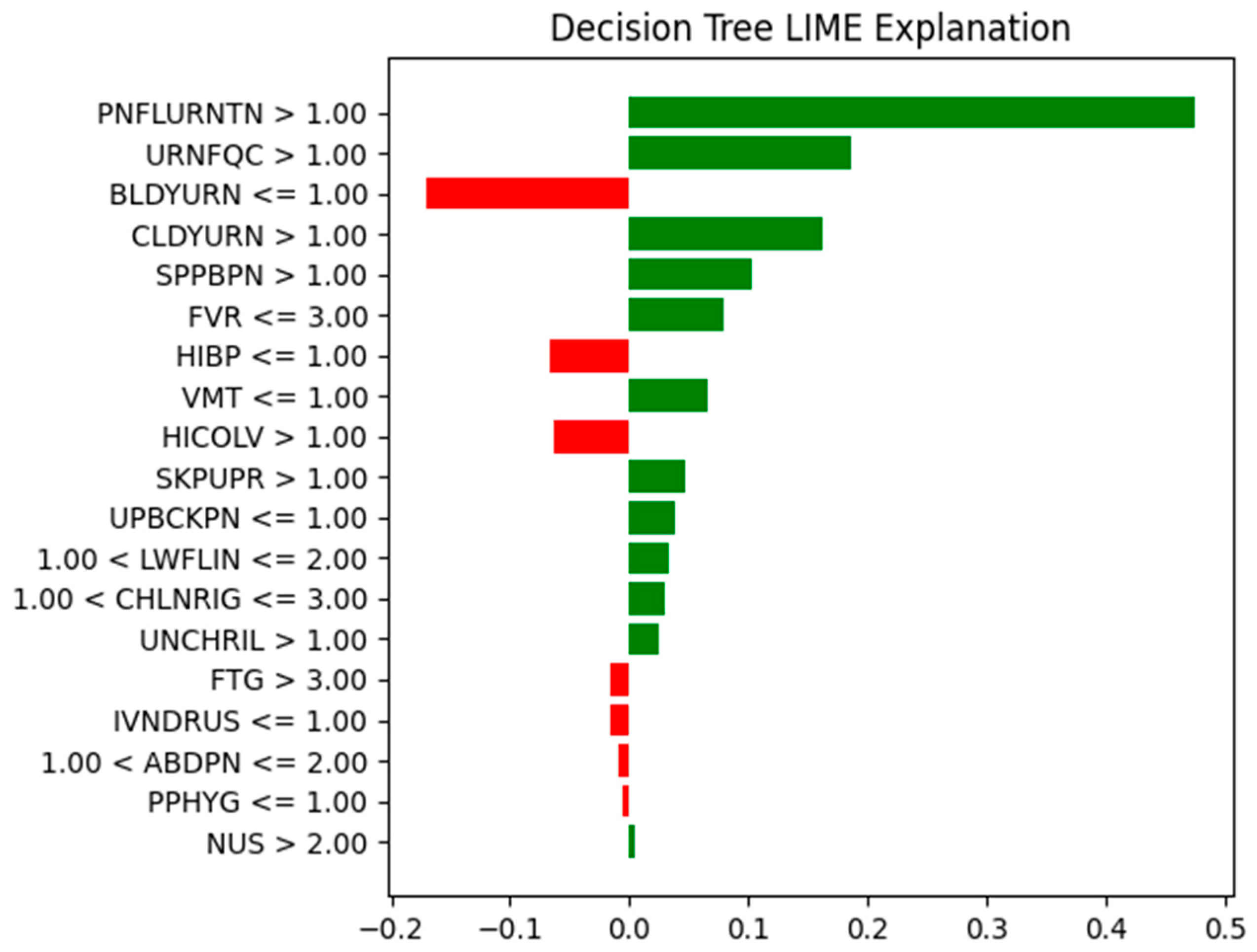
- The integration of explainable artificial intelligence (XAI) techniques, specifically LIME, to provide feature-level explanations of model predictions and enhance interpretability for clinical use;
- (iv)
- A comparative evaluation of multiple machine learning models using appropriate performance metrics to identify a suitable candidate for potential deployment in clinical decision support;
- (v)
- A discussion of the potential applicability of the proposed framework in low-resource settings, highlighting its ability to support early UTI detection and assist clinical decision-making while promoting responsible antibiotic use.
2. Materials and Methods
2.1. Dataset and Preprocessing
2.2. Model Development, Performance Evaluation, and Explainability with LIME
3. Results and Discussion
4. Conclusions
Author Contributions
Funding
Institutional Review Board Statement
Informed Consent Statement
Data Availability Statement
Conflicts of Interest
References
- Flores, E.; Martínez-Racaj, L.; Blasco, A.; Diaz, E.; Esteban, P.; Lopez-Garrigos, M.; Salinas, M. A step forward in the diagnosis of urinary tract infections: From machine learning to clinical practice. Comput. Struct. Biotechnol. J. 2024, 24, 533–541. [Google Scholar] [CrossRef]
- Karas, D.R.; Upadhyayula, S.; Love, A.; Bigham, M.T. Utilising clinical decision support in the treatment of urinary tract infection across a large pediatric primary care network. Pediatr. Qual. Saf. 2023, 8, e655. [Google Scholar] [CrossRef]
- Asuquo, D.; Attai, K.; Obot, O.; Ekpenyong, M.; Akwaowo, C.; Arnold, K.; Uzoka, F.-M. Febrile disease modeling and diagnosis system for optimizing medical decisions in resource-scarce settings. Clin. eHealth 2024, 7, 52–76. [Google Scholar] [CrossRef]
- Ramsay, J.A.; Mascaro, S.; Campbell, A.J.; Foley, D.A.; Mace, A.O.; Ingram, P.; Borland, M.L.; Blyth, C.C.; Larkins, N.G.; Robertson, T.; et al. Urinary tract infections in children: Building a causal model-based decision support tool for diagnosis with domain knowledge and prospective data. BMC Med. Res. Methodol. 2022, 22, 218. [Google Scholar] [CrossRef]
- Flores-Mireles, A.L.; Walker, J.N.; Caparon, M.; Hultgren, S.J. Urinary tract infections: Epidemiology, mechanisms of infection and treatment options. Nat. Rev. Microbiol. 2015, 13, 269–284. [Google Scholar] [CrossRef] [PubMed]
- Delory, T.; Le Bel, J.; Lariven, S.; Peiffer-Smadja, N.; Lescure, F.-X.; Bouvet, E.; Jeanmougin, P.; Tubach, F.; Boelle, P.-Y. Computerized decision support system use for surveillance of antimicrobial resistance in urinary tract infections in primary care. J. Antimicrob. Chemother. 2022, 77, 524–530. [Google Scholar] [CrossRef]
- Von Vietinghoff, S.; Shevchuk, O.; Dobrindt, U.; Engel, D.R.; Jorch, S.K.; Kurts, C.; Wagenlehner, F. The global burden of antimicrobial resistance—Urinary tract infections. Nephrol. Dial. Transplant. 2024, 39, 581–588. [Google Scholar] [CrossRef] [PubMed]
- Neugebauer, M.; Ebert, M.; Vogelmann, R. Clinical decision support system improves antibiotic therapy for upper urinary tract infection in a randomized single-blinded study. BMC Health Serv. Res. 2020, 20, 185. [Google Scholar] [CrossRef]
- Rawson, T.M.; Moore, L.S.P.; Hernandez, B.; Charani, E.; Castro-Sanchez, E.; Herrero, P.; Hayhoe, B.; Hope, W.; Georgiou, P.; Holmes, A.H. A systematic review of clinical decision support systems for antimicrobial management: Are we failing to investigate these interventions appropriately? Clin. Microbiol. Infect. 2017, 23, 524–532. [Google Scholar] [CrossRef] [PubMed]
- Asuquo, D.; Umoren, I.; Osang, F.; Attai, K. A machine learning framework for length of stay minimization in healthcare emergency department studies. Stud. Eng. Technol. 2023, 10, 1–17. [Google Scholar] [CrossRef]
- Puli, S.K.; Usha, P. Transforming healthcare: Advancements, applications, and future directions of machine learning. In Proceedings of the 2024 10th International Conference on Smart Computing and Communication (ICSCC); IEEE: New York, NY, USA, 2024; pp. 502–506. [Google Scholar] [CrossRef]
- Devi, A.; Raj, T.N. Enhanced heart disease prediction through optimized ensemble random forest model. In Proceedings of the 2024 4th International Conference on Sustainable Expert Systems (ICSES); IEEE: New York, NY, USA, 2024; pp. 1702–1707. [Google Scholar] [CrossRef]
- Naik, N.; Talyshinskii, A.; Shetty, D.K.; Hameed, B.M.Z.; Zhankina, R.; Somani, B.K. Smart diagnosis of urinary tract infections: Is artificial intelligence the fast-lane solution? Curr. Urol. Rep. 2024, 25, 37–47. [Google Scholar] [CrossRef]
- Jeng, S.L.; Huang, Z.J.; Yang, D.C.; Teng, C.H.; Wang, M.C. Machine learning to predict the development of recurrent urinary tract infection related to single uropathogen, Escherichia coli. Sci. Rep. 2022, 12, 17216. [Google Scholar] [CrossRef]
- de-Vries, S.; Ten Doesschate, T.; Totté, J.E.; Heutz, J.W.; Loeffen, Y.G.; Oosterheert, J.J.; Boel, E. A semi-supervised decision support system to facilitate antibiotic stewardship for urinary tract infections. Comput. Biol. Med. 2022, 146, 105621. [Google Scholar] [CrossRef] [PubMed]
- Attai, K.; Ekpenyong, M.; Amannah, C.; Asuquo, D.; Ajuga, P.; Obot, O.; Johnson, E.; John, A.; Maduka, O.; Akwaowo, C.; et al. Enhancing the interpretability of malaria and typhoid diagnosis with explainable AI and large language models. Trop. Med. Infect. Dis. 2024, 9, 216. [Google Scholar] [CrossRef] [PubMed]
- Attai, K.F.; Amannah, C.; Ekpenyong, M.E.; Asuquo, D.E.; Akputu, O.K.; Obot, O.U.; Ajuga, P.C.; Obi, J.C.; Maduka, O.; Akwaowo, C.; et al. Developing an explainable artificial intelligence system for the mobile-based diagnosis of febrile diseases using random forest, LIME, and GPT. Healthc. Inform. Res. 2025, 31, 125–135. [Google Scholar] [CrossRef]
- Farashi, S.; Momtaz, H.E. Prediction of urinary tract infection using machine learning methods: A study for finding the most-informative variables. BMC Med. Inform. Decis. Mak. 2025, 25, 13. [Google Scholar] [CrossRef] [PubMed]
- Yen, C.-C.; Ma, C.-Y.; Tsai, Y.-C. Interpretable Machine Learning Models for Predicting Critical Outcomes in Patients with Suspected Urinary Tract Infection with Positive Urine Culture. Diagnostics 2024, 14, 1974. [Google Scholar] [CrossRef]
- Amannah, C.; Attai, K.F.; Uzoka, F.-M. A Data-Driven Intelligent Methodology for Developing Explainable Diagnostic Model for Febrile Diseases. Algorithms 2025, 18, 190. [Google Scholar] [CrossRef]
- Attai, K.; Akwaowo, C.; Asuquo, D.; Esubok, N.E.; Nelson, U.A.; Dan, E.; Obot, O.; Amannah, C.; Uzoka, F.M. Explainable AI modelling of comorbidity in pregnant women and children with tropical febrile conditions. In Proceedings of the International Conference on Artificial Intelligence and Its Applications; OJS/PKP: Burnaby, BC, Canada, 2023; pp. 152–159. [Google Scholar]
- Markus, A.F.; Kors, J.A.; Rijnbeek, P.R. The role of explainability in creating trustworthy artificial intelligence for healthcare: A comprehensive survey of the terminology, design choices, and evaluation strategies. J. Biomed. Inform. 2021, 113, 103655. [Google Scholar] [CrossRef]
- Adekoya, A.; Okezue, M.A.; Menon, K. Medical Laboratories in Healthcare Delivery: A Systematic Review of Their Roles and Impact. Laboratories 2025, 2, 8. [Google Scholar] [CrossRef]
- Han, G.R.; Goncharov, A.; Eryilmaz, M.; Ye, S.; Palanisamy, B.; Ghosh, R.; Lisi, F.; Rogers, E.; Guzman, D.; Yigci, D.; et al. Machine learning in point-of-care testing: Innovations, challenges, and opportunities. Nat. Commun. 2025, 16, 3165. [Google Scholar] [CrossRef]
- Rasheed, K.; Qayyum, A.; Ghaly, M.; Al-Fuqaha, A.; Razi, A.; Qadir, J. Explainable, trustworthy, and ethical machine learning for healthcare: A survey. Comput. Biol. Med. 2022, 149, 106043. [Google Scholar] [CrossRef]
- Tan, L.; Huang, C.; Yao, X. A concept-based local interpretable model-agnostic explanation approach for deep neural networks in image classification. In Proceedings of the International Conference on Intelligent Information Processing; Springer Nature: Cham, Switzerland, 2024; pp. 119–133. [Google Scholar]
- Das, N.; Topalovic, M.; Raskin, J.; Aerts, J.M.; Troosters, T.; Janssens, W. Explaining predictions of an automated pulmonary function test interpretation algorithm. Eur. Respir. J. 2019, 54, PA2227. [Google Scholar] [CrossRef]
- Kumar-Akulasinghe, N.B.; Blomberg, T.; Liu, J.; Leao, A.S.; Papapetrou, P. Evaluating local interpretable model-agnostic explanations on clinical machine learning classification models. In Proceedings of the 2020 IEEE 33rd International Symposium on Computer-Based Medical Systems (CBMS); IEEE: New York, NY, USA, 2020; pp. 7–12. [Google Scholar] [CrossRef]
- NFRF; University of Uyo Teaching Hospital; Mount Royal University. NFRF Project Patient Dataset with Febrile Diseases [Data Set]. Zenodo 2024. [Google Scholar] [CrossRef]
- Favresse, J.; Cabo, J.; Bosse, M.; Lardinois, B.; Cadrobbi, J.; Laffineur, K.; Elsen, M.; Douxfils, J.; Roelandts, L.; De Bruyne, S. Machine learning algorithms for predicting urinary tract infections: Integration of demographic data and dipstick reflectance results. Clin. Chem. 2025, 71, 1083–1094. [Google Scholar] [CrossRef] [PubMed]
- Hang, C.-N.; Tsai, Y.-Z.; Yu, P.-D.; Chen, J.; Tan, C.-W. Privacy-Enhancing Digital Contact Tracing with Machine Learning for Pandemic Response: A Comprehensive Review. Big Data Cogn. Comput. 2023, 7, 108. [Google Scholar] [CrossRef]
- Aklah, Z.; Al-Safi, A.; Abdali, M.H.; Al-jabery, K. A Machine Learning Model for Automated Contact Tracing during Disease Outbreaks. Healthc. Anal. 2025, 7, 100389. [Google Scholar] [CrossRef]




| Patient Age (Years) | Male | Female | Total |
|---|---|---|---|
| <5 | 534 | 419 | 953 |
| 5–12 | 346 | 323 | 669 |
| 13–19 | 150 | 213 | 363 |
| 20–64 | 1012 | 1605 | 2617 |
| ≥65 | 133 | 135 | 268 |
| Total | 2175 | 2695 | 4870 |
| SN | Symptom/Risk Factor | SN | Symptom/Risk Factor |
|---|---|---|---|
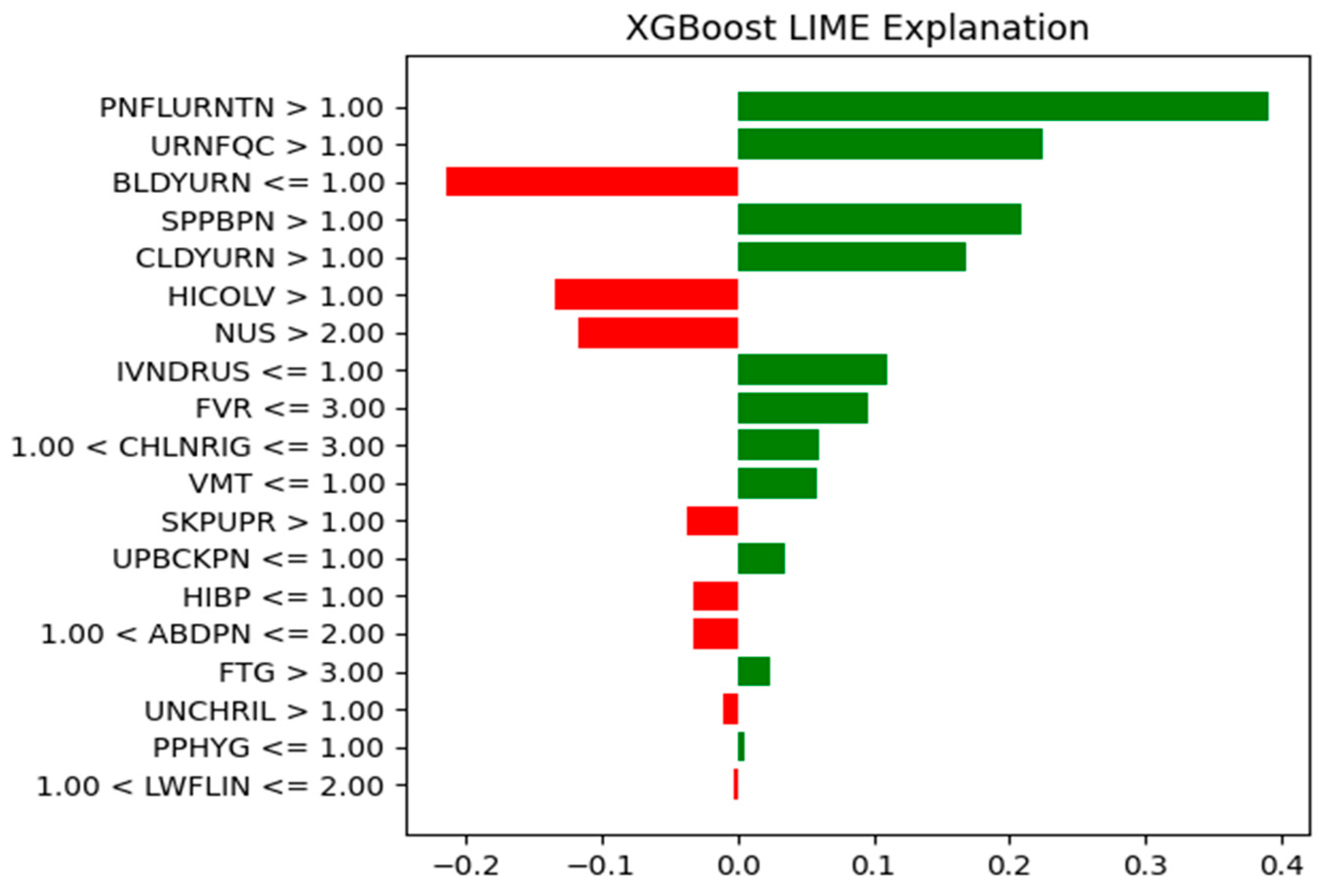
| 1 | Abdominal pains (ABDPN) | 11 | Urinary frequency (URNFQC) |
| 2 | Bloody urine (BLDYURN) | 12 | Vomiting (VMT) |
| 3 | Chills and rigors (CHLNRIG) | 13 | High Blood Pressure (HIBP) |
| 4 | Cloudy urine (CLDYURN) | 14 | High Cholesterol Level (HICOLV) |
| 5 | Fatigue (FTG) | 15 | Poor Personal Hygiene (PPHYG) |
| 6 | Fever (FVR) | 16 | Intravenous Drug Use (IVNDRUS) |
| 7 | Nausea (NUS) | 17 | Skin Puncture (SKPUPR) |
| 8 | Upper back pain (UPBCKPN) | 18 | Low Fluid Intake (LWFLIN) |
| 9 | Painful urination (PNFLURNTN) | 19 | Underlying Chronic Illness (UNCHRIL) |
| 10 | Suprapubic pains (SPPBPN) |
| SMOTE Models | ||||||
| Accuracy | Precision | Recall | F1 Score | Log Loss | AUC-ROC | |
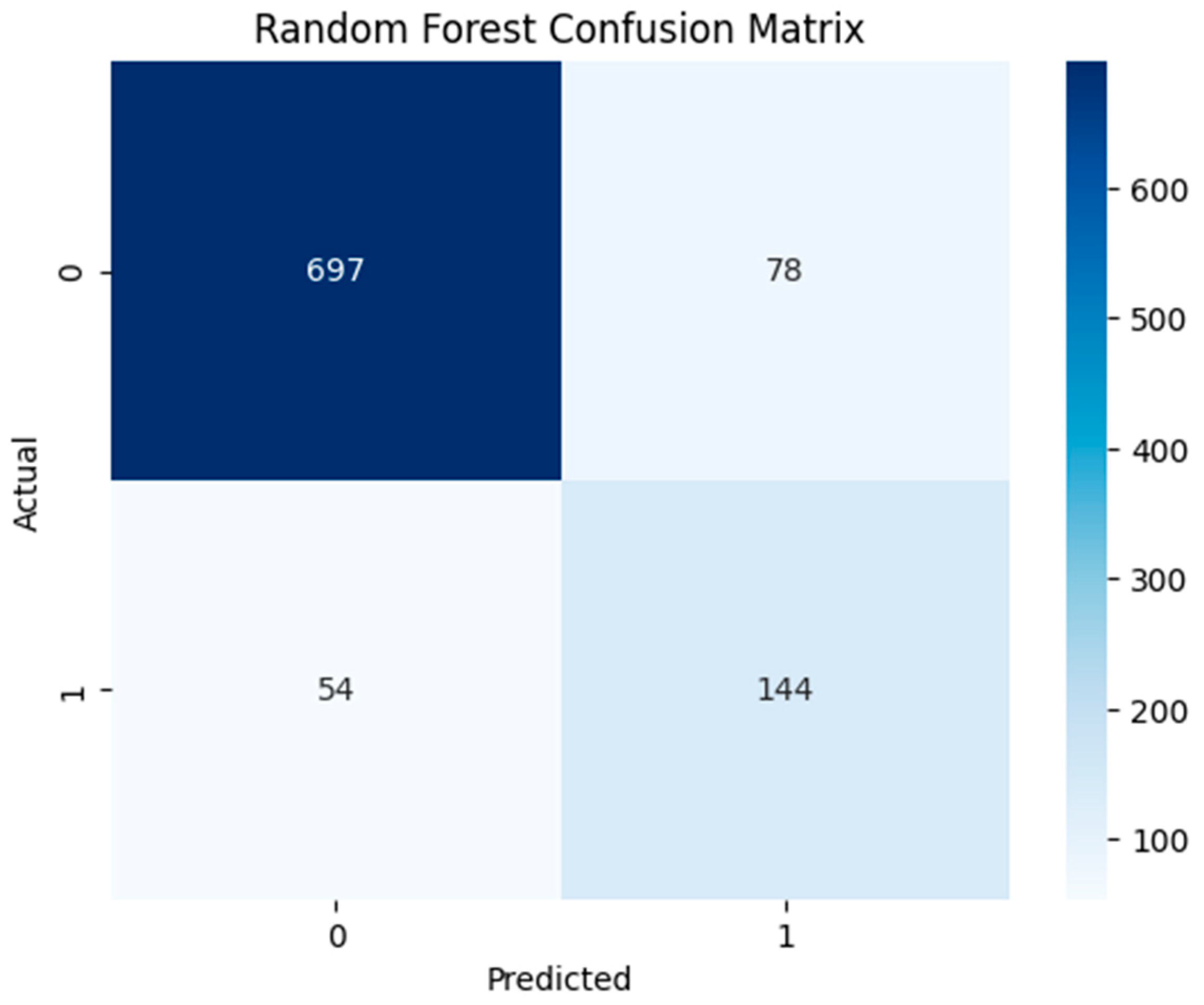
| Random Forest | 0.8643 | 0.8712 | 0.8643 | 0.8671 | 0.6057 | 0.8695 |
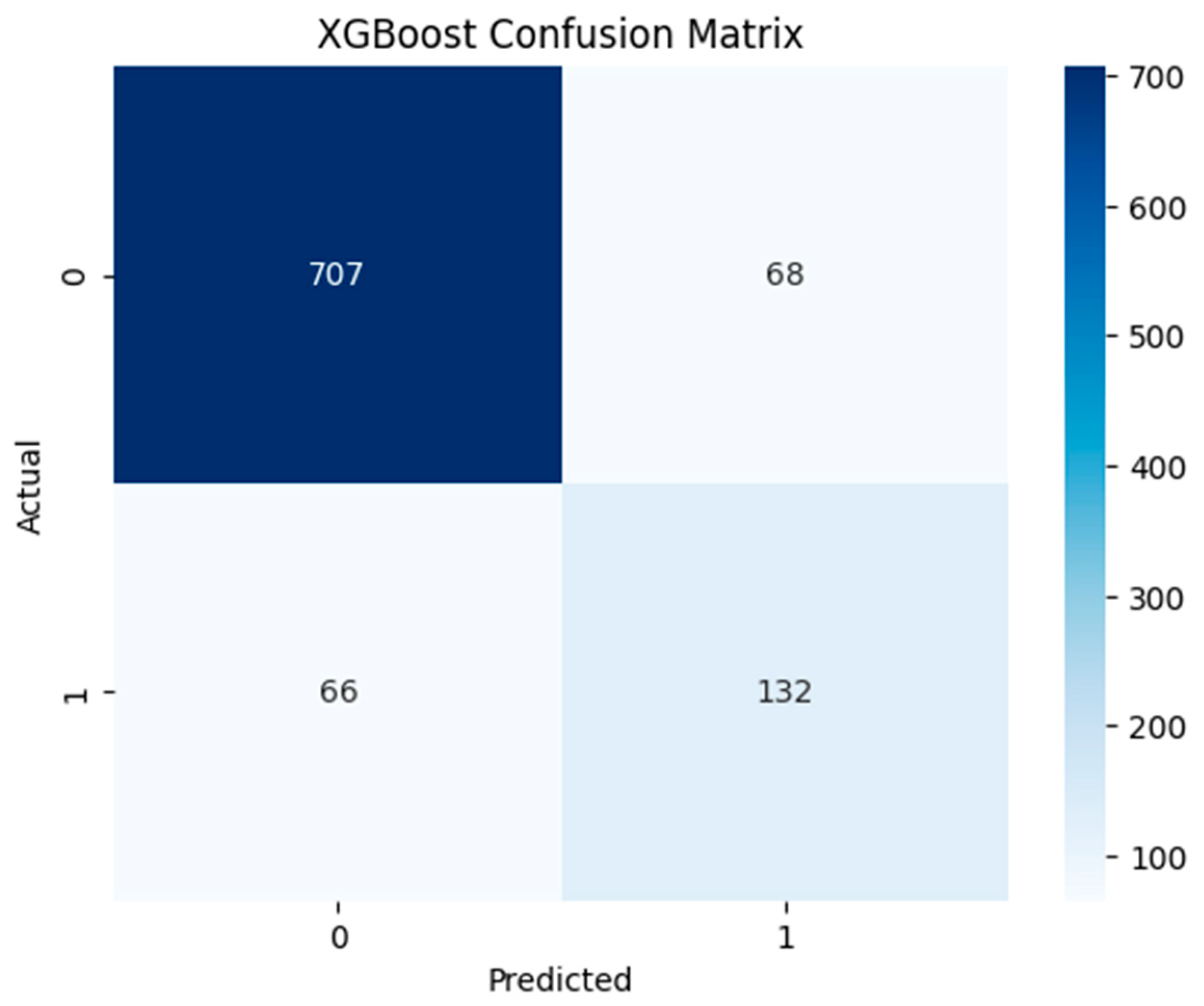
| XGBOOST | 0.8623 | 0.8628 | 0.8623 | 0.8625 | 0.4566 | 0.8307 |
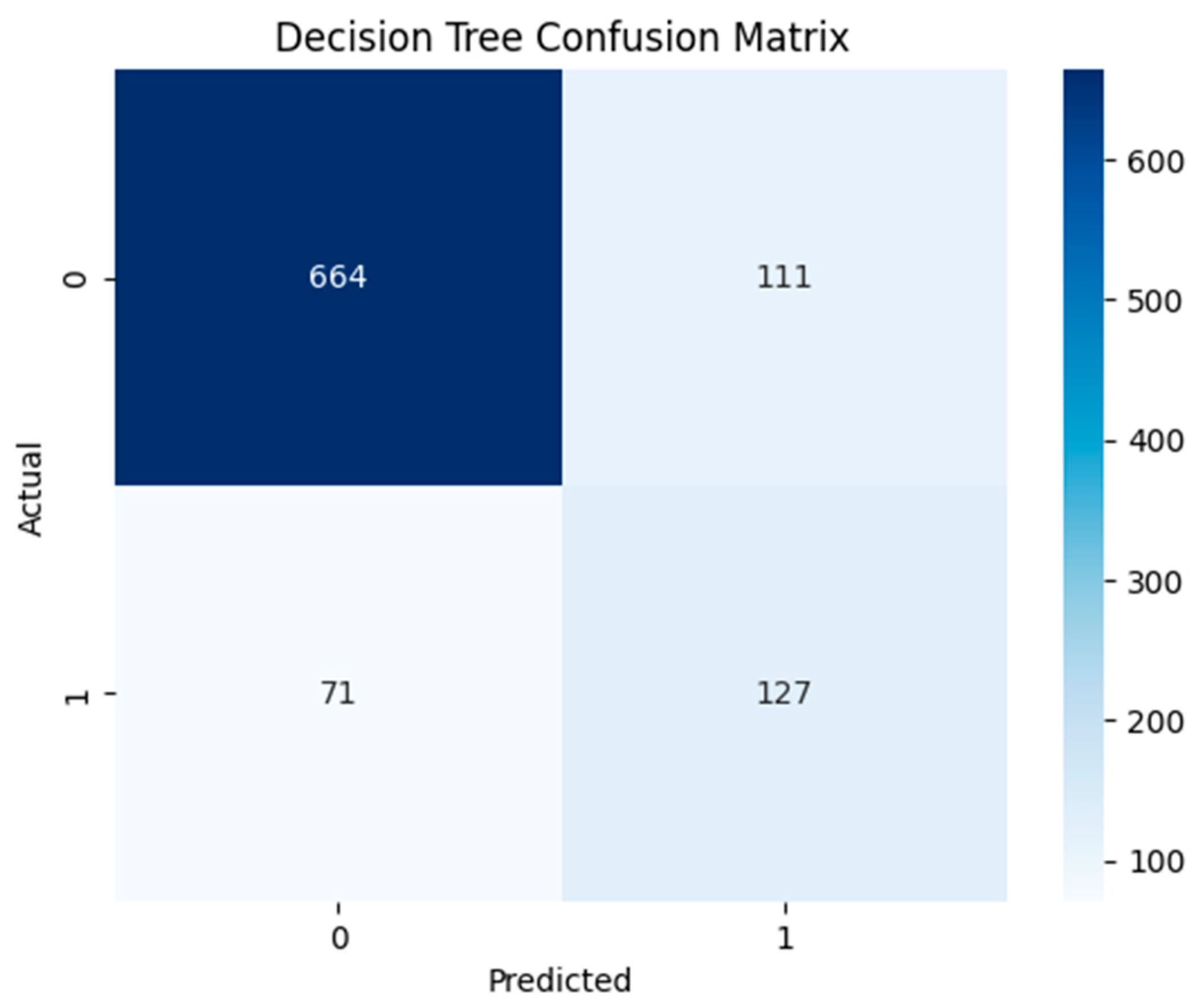
| Decision Tree | 0.8129 | 0.8282 | 0.8129 | 0.8191 | 5.5892 | 0.7263 |
| Non-SMOTE Models | ||||||
| Random Forest | 0.8849 | 0.8808 | 0.8849 | 0.8750 | 0.3117 | 0.8833 |
| XGBOOST | 0.8869 | 0.8816 | 0.8869 | 0.8802 | 0.3223 | 0.8835 |
| Decision Tree | 0.8674 | 0.8594 | 0.8674 | 0.8558 | 2.3150 | 0.7124 |
Disclaimer/Publisher’s Note: The statements, opinions and data contained in all publications are solely those of the individual author(s) and contributor(s) and not of MDPI and/or the editor(s). MDPI and/or the editor(s) disclaim responsibility for any injury to people or property resulting from any ideas, methods, instructions or products referred to in the content. |
© 2026 by the authors. Licensee MDPI, Basel, Switzerland. This article is an open access article distributed under the terms and conditions of the Creative Commons Attribution (CC BY) license.
Share and Cite
Attai, K.; Asuquo, D.; Akputu, K.; Obot, O.; Thomas, C.; Uzoka, F.-V.; Attai, E.; Akwaowo, C.; Uzoka, F.-M. Integrating Risk Factors and Symptoms for Urinary Tract Infection Diagnosis Using an Explainable AI Approach in Low-Resource Regions. Information 2026, 17, 435. https://doi.org/10.3390/info17050435
Attai K, Asuquo D, Akputu K, Obot O, Thomas C, Uzoka F-V, Attai E, Akwaowo C, Uzoka F-M. Integrating Risk Factors and Symptoms for Urinary Tract Infection Diagnosis Using an Explainable AI Approach in Low-Resource Regions. Information. 2026; 17(5):435. https://doi.org/10.3390/info17050435
Chicago/Turabian StyleAttai, Kingsley, Daniel Asuquo, Kingsley Akputu, Okure Obot, Cornelia Thomas, Faith-Valentine Uzoka, Ekerette Attai, Christie Akwaowo, and Faith-Michael Uzoka. 2026. "Integrating Risk Factors and Symptoms for Urinary Tract Infection Diagnosis Using an Explainable AI Approach in Low-Resource Regions" Information 17, no. 5: 435. https://doi.org/10.3390/info17050435
APA StyleAttai, K., Asuquo, D., Akputu, K., Obot, O., Thomas, C., Uzoka, F.-V., Attai, E., Akwaowo, C., & Uzoka, F.-M. (2026). Integrating Risk Factors and Symptoms for Urinary Tract Infection Diagnosis Using an Explainable AI Approach in Low-Resource Regions. Information, 17(5), 435. https://doi.org/10.3390/info17050435