A Hybrid Recommendation Approach for Adaptive Worksheet Generation Using Pedagogically Structured Learning Objects


Abstract
1. Introduction
Related Work
2. Materials and Methods
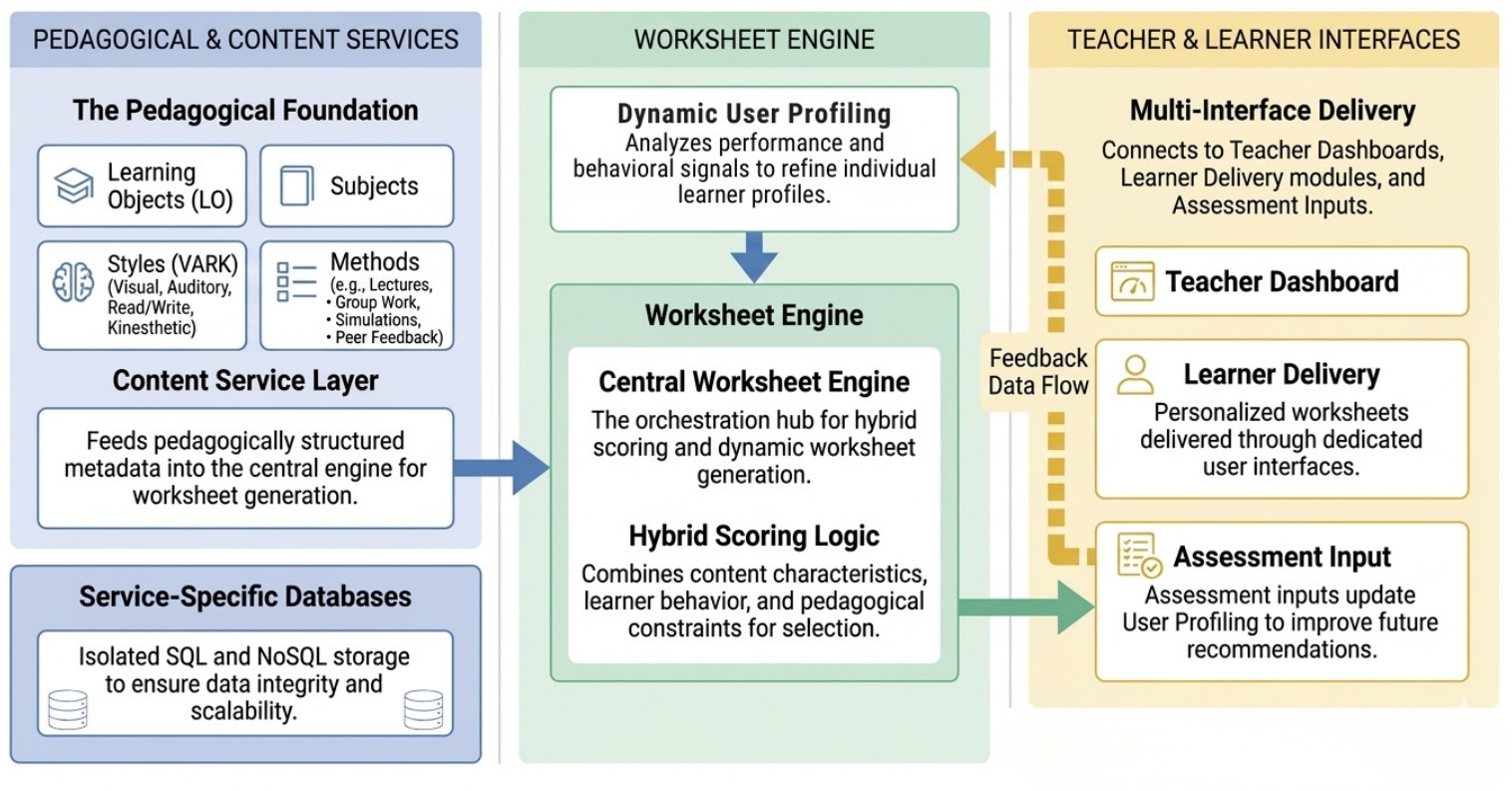
2.1. Architectural Design
2.2. Microservices Intercommunication and Data Flow
2.3. Data Storage
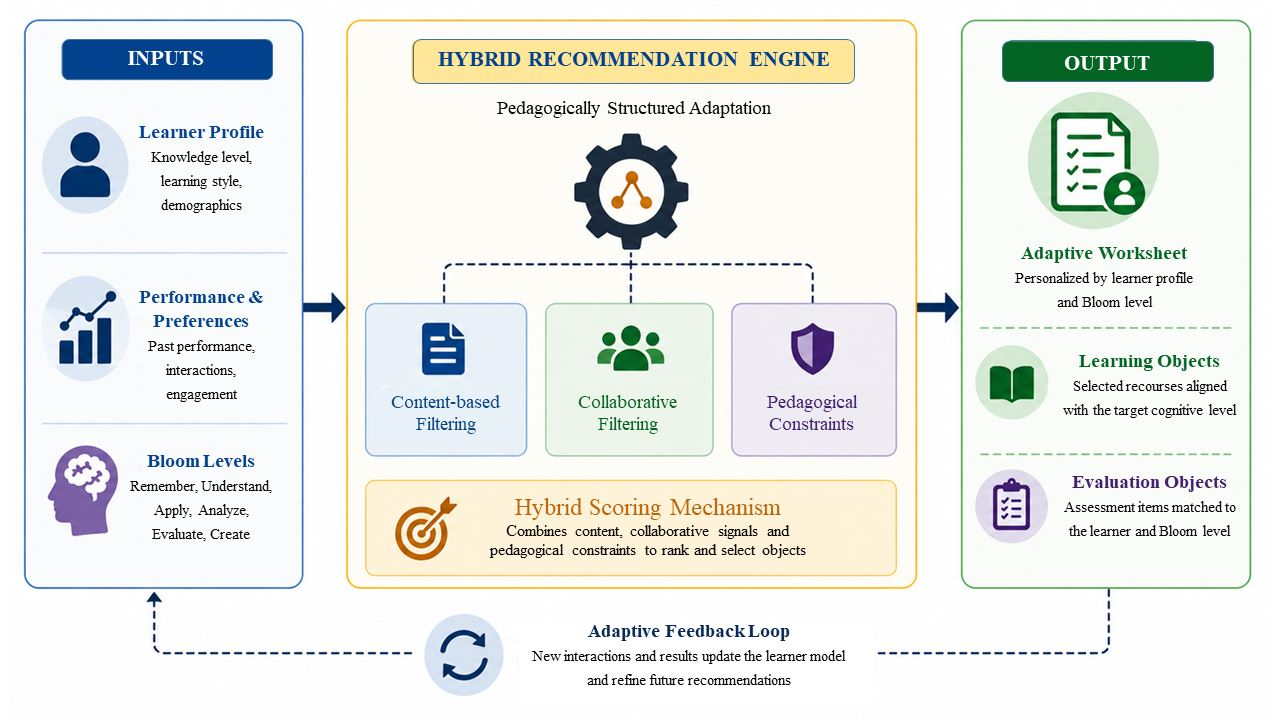
2.4. Recommendation Engine
2.4.1. Learning Object Score
2.4.2. Evaluation Object Score
2.4.3. Similar Students
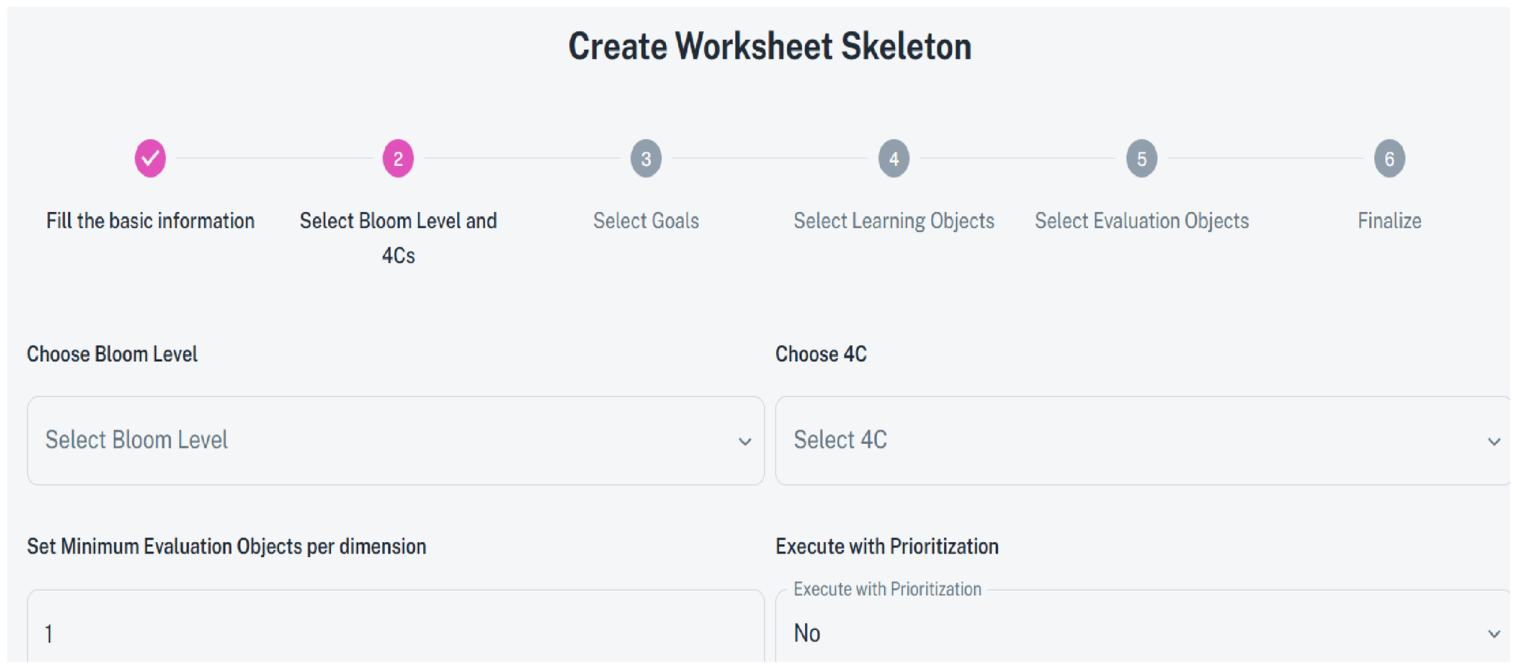
2.5. Study Design
3. Results
3.1. Accuracy of Learning Object (LO) and Evaluation Object (EO) Recommendations
3.2. LO Overlap Accuracy Across Bloom Levels
3.3. Accuracy Across Worksheets
3.4. Simulation-Based Adaptivity Validation
3.5. Performance
4. Discussion
Limitations and Future Work
5. Conclusions
Author Contributions
Funding
Institutional Review Board Statement
Informed Consent Statement
Data Availability Statement
Acknowledgments
Conflicts of Interest
Abbreviations
| LO | Learning Object |
| EO | Evaluation Object |
| LS | Learning Style |
| SS | Similar Students |
| VARK | Visual, Auditory, Read/Write, Kinesthetic |
References
- Katsaris, I.; Vidakis, N. Adaptive e-learning systems through learning styles: A review of the literature. Adv. Mob. Learn. Educ. Res. 2021, 1, 124–145. [Google Scholar] [CrossRef] [Scilit]
- Pelanek, R. A Classification Framework for Practice Exercises in Adaptive Learning Systems. IEEE Trans. Learn. Technol. 2020, 13, 734–747. [Google Scholar] [CrossRef] [Scilit]
- Bhaskaran, S.; Marappan, R. Design and analysis of an efficient machine learning based hybrid recommendation system with enhanced density-based spatial clustering for digital e-learning applications. Complex Intell. Syst. 2023, 9, 3517–3533. [Google Scholar] [CrossRef] [Scilit]
- Valtolina, S.; Matamoros, R.A.; Epifania, F. Design of a conversational recommender system in education. User Model. User-Adapt. Interact. 2024, 34, 1613–1641. [Google Scholar] [CrossRef] [Scilit]
- Butmeh, H.; Abu-Issa, A. Hybrid attribute-based recommender system for personalized e-learning with emphasis on cold start problem. Front. Comput. Sci. 2024, 6, 1404391. [Google Scholar] [CrossRef] [Scilit]
- Amin, S.; Uddin, M.I.; Mashwani, W.K.; Alarood, A.A.; Alzahrani, A.; Alzahrani, A.O. Developing a Personalized E-Learning and MOOC Recommender System in IoT-Enabled Smart Education. IEEE Access 2023, 11, 136437–136455. [Google Scholar] [CrossRef] [Scilit]
- Divjak, B.; Svetec, B.; Horvat, D.; Kadoić, N. Assessment validity and learning analytics as prerequisites for ensuring student-centred learning design. Br. J. Educ. Technol. 2023, 54, 313–334. [Google Scholar] [CrossRef] [Scilit]
- Krathwohl, D.R. A Revision of Bloom’s Taxonomy of Educational Objectives. Theory Pract. 2002, 41, 302. [Google Scholar] [CrossRef] [Scilit]
- Hmoud, M.; Shaqour, A. AIEd Bloom’s Taxonomy: A Proposed Model for Enhancing Educational Efficiency and Effectiveness in the Artificial Intelligence Era. Int. J. Technol. Learn. 2024, 31, 111–128. [Google Scholar] [CrossRef] [Scilit]
- da Silva, F.L.; Slodkowski, B.K.; da Silva, K.K.A.; Cazella, S.C. A systematic literature review on educational recommender systems for teaching and learning: Research trends, limitations and opportunities. Educ. Inf. Technol. 2023, 28, 3289–3328. [Google Scholar] [CrossRef] [Scilit] [PubMed]
- Zhang, Q.; Lu, J.; Zhang, G. Recommender Systems in E-learning. J. Smart Environ. Green Comput. 2022, 1, 76–89. [Google Scholar] [CrossRef] [Scilit]
- Rahdari, B.; Brusilovsky, P. Simulation-Based Evaluation of Interactive Recommender Systems. In IntRS@ RecSys; ACM: New York, NY, USA, 2022; Volume 3222, pp. 122–136. [Google Scholar]
- Raj, N.S.; Renumol, V.G. An improved adaptive learning path recommendation model driven by real-time learning analytics. J. Comput. Educ. 2024, 11, 121–148. [Google Scholar] [CrossRef] [Scilit]
- Gligorea, I.; Cioca, M.; Oancea, R.; Gorski, A.T.; Gorski, H.; Tudorache, P. Adaptive Learning Using Artificial Intelligence in e-Learning: A Literature Review. Educ. Sci. 2023, 13, 1216. [Google Scholar] [CrossRef] [Scilit]
- Fariani, R.I.; Junus, K.; Santoso, H.B. A Systematic Literature Review on Personalised Learning in the Higher Education Context. Technol. Knowl. Learn. 2023, 28, 449–476. [Google Scholar] [CrossRef] [Scilit]
- Guo, S.; Zheng, Y.; Zhai, X. Educational recommender systems: A review based on bibliometric analysis. Educ. Inf. Technol. 2024, 29, 16387–16409. [Google Scholar] [CrossRef] [Scilit]
- Li, K.C.; Wong, B.T.M. Artificial intelligence in personalised learning: A bibliometric analysis. Interact. Technol. Smart Educ. 2023, 20, 422–445. [Google Scholar] [CrossRef] [Scilit]
- Aljunid, M.F.; Manjaiah, D.H.; Hooshmand, M.K.; Ali, W.A.; Shetty, A.M.; Alzoubah, S.Q. A collaborative filtering recommender systems: Survey. Neurocomputing 2025, 617, 128718. [Google Scholar] [CrossRef] [Scilit]
- Ayemowa, M.O.; Ibrahim, R.; Bena, Y.A. A systematic review of the literature on deep learning approaches for cross-domain recommender systems. Decis. Anal. J. 2024, 13, 100518. [Google Scholar] [CrossRef] [Scilit]
- Demertzi, V.; Demertzis, K. A Hybrid Adaptive Educational eLearning Project based on Ontologies Matching and Recommendation System. arXiv 2020. [Google Scholar] [CrossRef] [Scilit]
- Wan, H.; Yu, S. A recommendation system based on an adaptive learning cognitive map model and its effects. Interact. Learn. Environ. 2020, 31, 1821–1839. [Google Scholar] [CrossRef] [Scilit]
- Subha, S.; Sankaralingam, B.P.; Gurusamy, A.; Sehar, S.; Bavirisetti, D.P. Personalization-based deep hybrid E-learning model for online course recommendation system. PeerJ Comput. Sci. 2023, 9, e1670. [Google Scholar] [CrossRef] [Scilit]
- Lin, Y.; Wu, J.; Lin, M. Online learning platform based on AI adaptive learning and collaborative filtering algorithm. J. Comput. Methods Sci. Eng. 2025, 14727978251361823. [Google Scholar] [CrossRef] [Scilit]
- Dhananjaya, G.M.; Goudar, R.H.; Kulkarni, A.A.; Rathod, V.N.; Hukkeri, G.S. A Digital Recommendation System for Personalized Learning to Enhance Online Education: A Review. IEEE Access 2024, 12, 34019–34041. [Google Scholar] [CrossRef] [Scilit]
- Dai, J.; Gu, X.; Zhu, J. Personalized Recommendation in the Adaptive Learning System: The Role of Adaptive Testing Technology. J. Educ. Comput. Res. 2023, 61, 523–545. [Google Scholar] [CrossRef] [Scilit]
- Thomas, B.; Chandra, J. The Effect of Bloom’s Taxonomy on Random Forest Classifier for cognitive level identification of E-content. In Proceedings of the 2020 International Conference on Emerging Trends in Information Technology and Engineering (ic-ETITE), Beijing, China, 23–25 October 2020; IEEE: Piscataway, NJ, USA, 2020; Volume 2020, pp. 3–8. [Google Scholar] [CrossRef] [Scilit]
- Shaikh, S.; Daudpotta, S.M.; Imran, A.S. Bloom’s Learning Outcomes’ Automatic Classification Using LSTM and Pretrained Word Embeddings. IEEE Access 2021, 9, 117887–117909. [Google Scholar] [CrossRef] [Scilit]
- Patil, P.M.; Bhavsar, R.P.; Pawar, B.V. Bloom’s Taxonomy based automatic Marathi question generation. Int. J. Adv. Technol. Eng. Explor. 2024, 11, 575–603. [Google Scholar] [CrossRef] [Scilit]
- Shen, D. Recommendation of Online Educational Resources Based on Neural Network. In Proceedings of the 2020 International Conference on Artificial Intelligence and Computer Engineering (ICAICE), Beijing, China, 23–25 October 2020; IEEE: Piscataway, NJ, USA, 2020; Volume 2020, pp. 32–36. [Google Scholar] [CrossRef] [Scilit]
- Elmachtoub, A.N.; Grigas, P. Smart “Predict, then Optimize”. Manag. Sci. 2022, 68, 9–26. [Google Scholar] [CrossRef] [Scilit]
- Mandi, J.; Guns, T. Interior point solving for LP-based prediction+optimisation. Adv. Neural Inf. Process. Syst. 2020, 33, 7272–7282. [Google Scholar]
- Bengio, Y.; Lodi, A.; Prouvost, A. Machine learning for combinatorial optimization: A methodological tour d’horizon. Eur. J. Oper. Res. 2021, 290, 405–421. [Google Scholar] [CrossRef] [Scilit]
- Chen, X.; Yang, Y.; Liu, Y.; Wu, L. Feature-Driven Economic Improvement for Network-Constrained Unit Commitment: A Closed-Loop Predict-and-Optimize Framework. IEEE Trans. Power Syst. 2022, 37, 3104–3118. [Google Scholar] [CrossRef] [Scilit]
- Katsaris, I.; Logothetis, I.; Katsios, K.; Vidakis, N. Adaptive Blended Learning Platform based on the 4Cs Architecture. In Proceedings of the 14th International Conference on Computer Supported Education, Virtual, 22–24 April 2022; SCITEPRESS—Science and Technology Publications: Setúbal, Portugal, 2022; pp. 251–259. [Google Scholar] [CrossRef] [Scilit]
- Zhang, Y.; Chen, X. Explainable Recommendation: A Survey and New Perspectives. Found. Trends Inf. Retr. 2020, 14, 1–101. [Google Scholar] [CrossRef] [Scilit]
- Khosravi, H.; Shum, S.B.; Chen, G.; Conati, C.; Tsai, Y.S.; Kay, J.; Knight, S.; Martinez-Maldonado, R.; Sadiq, S.; Gašević, D. Explainable Artificial Intelligence in education. Comput. Educ. Artif. Intell. 2022, 3, 100074. [Google Scholar] [CrossRef] [Scilit]
- Kem, D.D. Personalised and Adaptive Learning: Emerging Learning Platforms in the Era of Digital and Smart Learning. Int. J. Soc. Sci. Hum. Res. 2022, 5, 385–391. [Google Scholar] [CrossRef] [Scilit]
- Stray, J.; Halevy, A.; Assar, P.; Hadfield-Menell, D.; Boutilier, C.; Ashar, A.; Bakalar, C.; Beattie, L.; Ekstrand, M.; Leibowicz, C.; et al. Building Human Values into Recommender Systems: An Interdisciplinary Synthesis. ACM Trans. Recomm. Syst. 2024, 2, 1–57. [Google Scholar] [CrossRef] [Scilit]
- Yang, C.C.Y.; Ogata, H. Personalized learning analytics intervention approach for enhancing student learning achievement and behavioral engagement in blended learning. Educ. Inf. Technol. 2023, 28, 2509–2528. [Google Scholar] [CrossRef] [Scilit]



| Study | Recommendation Approach/Core Method | Pedagogical Structuring | Target Output | Evaluation Method |
|---|---|---|---|---|
| Demertzi & Demertzis [20] | Hybrid: Ontology-matching and Rule-based | No explicit pedagogical constraint | General e-learning pathways | Empirical observation |
| Wan & Yu [21] | Hybrid: Cognitive Maps and CF | Cognitive Maps | General learning sequences | Empirical testing |
| Dai et al. [25] | Hybrid: Adaptive Testing and CF | Item Response Theory (IRT) | Adaptive test items | Empirical testing |
| Lin et al. [23] | Hybrid: Deep Neural CF | No explicit pedagogical constraint | Online course recommendations | Simulation-based testing |
| Thomas & Chandra [26] | Machine Learning: Random Forest | Bloom tagging (descriptive use) | Tagged e-content | Model Accuracy |
| Shaikh et al. [27] | Machine Learning: LSTM | Bloom tagging (descriptive use) | Tagged learning outcomes | Model Accuracy/F1 Score |
| Patil et al. [28] | NLP Pipeline and Rule-based | Bloom tagging (descriptive use) | Static question generation | System functional testing |
| Shen [29] | Deep Learning: Neural Networks | Bloom and Learning Styles (descriptive use) | General educational resources | System Accuracy Metrics |
| This study | Hybrid: Content-based, CF and Rules | Explicit structural enforcement (Bloom + VARK) | Adaptive, multi-level Worksheets | Simulation-based testing |
| Hybrid Recommender—Our Proposed System | ||||||
| Bloom Level | Mean LO Overlap (0–3) | Normalized LO Accuracy | % 3/3 Overlap | % 2/3 Overlap | % 1/3 Overlap | % 0/3 Overlap |
| Remember | 3.00 | 100% | 100% | 0% | 0% | 0% |
| Understand | 3.00 | 100% | 100% | 0% | 0% | 0% |
| Apply | 3.00 | 100% | 100% | 0% | 0% | 0% |
| Analyze | 2.11 | 70.3% | 26.7% | 57.8% | 15.6% | 0% |
| Evaluate | 2.13 | 71.1% | 24.4% | 64.4% | 11.1% | 0% |
| Create | 2.16 | 72.0% | 28.9% | 57.8% | 13.3% | 0% |
| Content-Based Recommender | ||||||
| Bloom Level | Mean LO Overlap (0–3) | Normalized LO Accuracy | % 3/3 Overlap | % 2/3 Overlap | % 1/3 Overlap | % 0/3 Overlap |
| Remember | 3.00 | 100% | 100% | 0% | 0% | 0% |
| Understand | 3.00 | 100% | 100% | 0% | 0% | 0% |
| Apply | 3.00 | 100% | 100% | 0% | 0% | 0% |
| Analyze | 2.06 | 68.67% | 25.6% | 54.4% | 20.0% | 0% |
| Evaluate | 2.07 | 69% | 24.4% | 57.8% | 17.8% | 0% |
| Create | 2.08 | 69.33% | 26.7% | 55.6% | 16.7% | 1% |
| Hybrid Recommender—Our Proposed System | |||
| Worksheet | Mean LO Overlap (0–3) | Normalized LO Accuracy | EO Accuracy |
| W1 | 2.82 | 94.0% | 100% |
| W2 | 2.48 | 82.7% | 96.7% |
| W3 | 2.51 | 83.7% | 95.6% |
| W4 | 2.52 | 84.0% | 95.6% |
| W5 | 2.61 | 86.9% | 96.7% |
| W6 | 2.84 | 94.7% | 98.9% |
| Content-Based Recommender | |||
| Worksheet | Mean LO Overlap (0–3) | Normalized LO Accuracy | EO Accuracy |
| W1 | 2.44 | 81.5% | 86.7% |
| W2 | 2.50 | 83.3% | 94.4% |
| W3 | 2.60 | 86.7% | 90.0% |
| W4 | 2.46 | 81.9% | 90.0% |
| W5 | 2.63 | 87.8% | 90.0% |
| W6 | 2.57 | 85.6% | 96.7% |
Disclaimer/Publisher’s Note: The statements, opinions and data contained in all publications are solely those of the individual author(s) and contributor(s) and not of MDPI and/or the editor(s). MDPI and/or the editor(s) disclaim responsibility for any injury to people or property resulting from any ideas, methods, instructions or products referred to in the content. |
© 2026 by the authors. Licensee MDPI, Basel, Switzerland. This article is an open access article distributed under the terms and conditions of the Creative Commons Attribution (CC BY) license.
Share and Cite
Katsaris, I.; Sfakiotakis, S.; Logothetis, I.; Vidakis, N. A Hybrid Recommendation Approach for Adaptive Worksheet Generation Using Pedagogically Structured Learning Objects. Information 2026, 17, 437. https://doi.org/10.3390/info17050437
Katsaris I, Sfakiotakis S, Logothetis I, Vidakis N. A Hybrid Recommendation Approach for Adaptive Worksheet Generation Using Pedagogically Structured Learning Objects. Information. 2026; 17(5):437. https://doi.org/10.3390/info17050437
Chicago/Turabian StyleKatsaris, Iraklis, Sakellaris Sfakiotakis, Ilias Logothetis, and Nikolas Vidakis. 2026. "A Hybrid Recommendation Approach for Adaptive Worksheet Generation Using Pedagogically Structured Learning Objects" Information 17, no. 5: 437. https://doi.org/10.3390/info17050437
APA StyleKatsaris, I., Sfakiotakis, S., Logothetis, I., & Vidakis, N. (2026). A Hybrid Recommendation Approach for Adaptive Worksheet Generation Using Pedagogically Structured Learning Objects. Information, 17(5), 437. https://doi.org/10.3390/info17050437