Article

Global Virtual Prosumer Framework for Secure Cross-Border Energy Transactions Using IoT, Multi-Agent Intelligence, and Blockchain Smart Contracts


by
Nikolaos Sifakis
Department of Production Engineering and Management, Technical University of Crete, 73100 Chania, Greece
Information 2026, 17(4), 396; https://doi.org/10.3390/info17040396
Submission received: 22 February 2026 / Revised: 5 April 2026 / Accepted: 17 April 2026 / Published: 21 April 2026
(This article belongs to the Special Issue IoT, AI, and Blockchain: Applications, Security, and Perspectives)

Abstract

Global decarbonization and the rapid growth of distributed energy resources increase the need for information-centric mechanisms that can support secure, scalable, cross-border coordination under heterogeneous technical and regulatory conditions. This paper proposes a Global Virtual Prosumer (GVP) framework that integrates IoT sensing, multi-agent coordination, and permissioned blockchain smart contracts to operationalize cross-border energy services as auditable service commitments rather than physical power exchange. Building on prior work that validated MAS-based power management and blockchain-secured operation within individual Virtual Prosumers, the present contribution lies in the cross-border coordination layer and its associated contractual and evaluation mechanisms, not in the constituent technologies themselves. A layered IoT–AI–blockchain architecture is introduced, where off-chain optimization produces allocations and admissibility indicators and on-chain contracts enforce identity, feasibility guards, delegation and partner-assignment rules, oracle verification, and settlement time compliance outcomes. The contractual lifecycle is formalized through four smart-contract algorithms covering trade registration, conditional delegation, cooperative fulfillment, and cross-border settlement with explicit failure semantics and event-based audit trails. The framework is evaluated on a global case study with seven Virtual Prosumers and quantified using contract-centric KPIs that capture registration time rejections, settlement success versus non-compliance, oracle-driven failure attribution, and full lifecycle traceability. The results demonstrate internal consistency of the proposed lifecycle and the practical value of KPI-driven accountability for cross-border energy service coordination. At the same time, the evaluation is based on synthetic parameterization and an emulated contract environment; realistic deployment constraints—including consensus latency, cross-region communication reliability, and regulatory overlap—are discussed as explicit limitations and directions for future empirical validation.

1. Introduction

The global energy sector is undergoing a profound transformation driven by the large-scale deployment of renewable energy sources, the electrification of transportation, and the increasing participation of consumers as active market entities [1]. Traditional centralized energy systems, designed around predictable generation and unidirectional power flows, are progressively being replaced by decentralized, data-intensive, and highly dynamic energy ecosystems. This transition amplifies coordination, scalability, security, and trust challenges because cross-border energy-service commitments span multiple stakeholders and jurisdictions with limited shared governance, requiring verifiable information flows and auditable settlement [2].
At the core of this transformation lies the emergence of prosumers, entities that can simultaneously consume, generate, and flexibly manage energy [3,4]. Enabled by advances in Internet of Things (IoT) technologies, smart metering infrastructures, and real-time communication networks, prosumers continuously generate large volumes of heterogeneous data describing energy production, consumption, flexibility, and system constraints. Secure, interoperable, and scalable handling of this information is essential because it becomes the basis for verifiable service commitments, not merely monitoring.
While significant research efforts have focused on peer-to-peer (P2P) energy trading and local energy communities, most existing approaches remain geographically constrained and heavily dependent on centralized intermediaries for coordination, market clearing, or regulatory enforcement [3,5]. Such solutions struggle to scale across regions with heterogeneous regulatory frameworks, diverse grid characteristics, and varying levels of infrastructure maturity. Moreover, centralized coordination mechanisms introduce single points of failure and trust assumptions that are increasingly incompatible with the decentralized nature of future energy markets.
Blockchain technology has been widely proposed as a means to address trust, transparency, and auditability in decentralized energy systems [5,6]. By enabling immutable transaction records and automated execution through smart contracts, blockchain infrastructures offer a promising foundation for decentralized energy trading without reliance on centralized authorities. However, conventional blockchain-based energy market implementations typically focus on small-scale deployments or localized microgrids, where transaction volumes, latency constraints, and governance complexity remain manageable [5,6]. Extending these approaches to global-scale energy transactions introduces additional challenges related to scalability, interoperability, regulatory compliance, and cyber–physical security.
In parallel, artificial intelligence (AI) and multi-agent systems (MASs) have emerged as effective paradigms for managing distributed energy resources under uncertainty [7]. Agent-based architectures enable autonomous decision-making, distributed optimization, and adaptive coordination among heterogeneous actors, making them well-suited for complex energy environments characterized by real-time variability and decentralized control. Nevertheless, most existing MAS-based energy management frameworks are designed for local or regional operation and do not explicitly address cross-border interaction, global coordination, or blockchain-enabled settlement mechanisms [5].
Against this backdrop, there is a clear need for information-centric architectures that treat energy trading not merely as a physical power exchange problem but as a global cyber–physical information system. Such architectures must integrate IoT-based data acquisition, AI-driven decision-making, and blockchain-based trust mechanisms in a unified framework designed to support secure, automated, and scalable energy transactions across geographically distributed regions, subject to empirical validation of deployment-level constraints such as consensus latency, cross-region communication reliability, and jurisdictional regulatory heterogeneity.
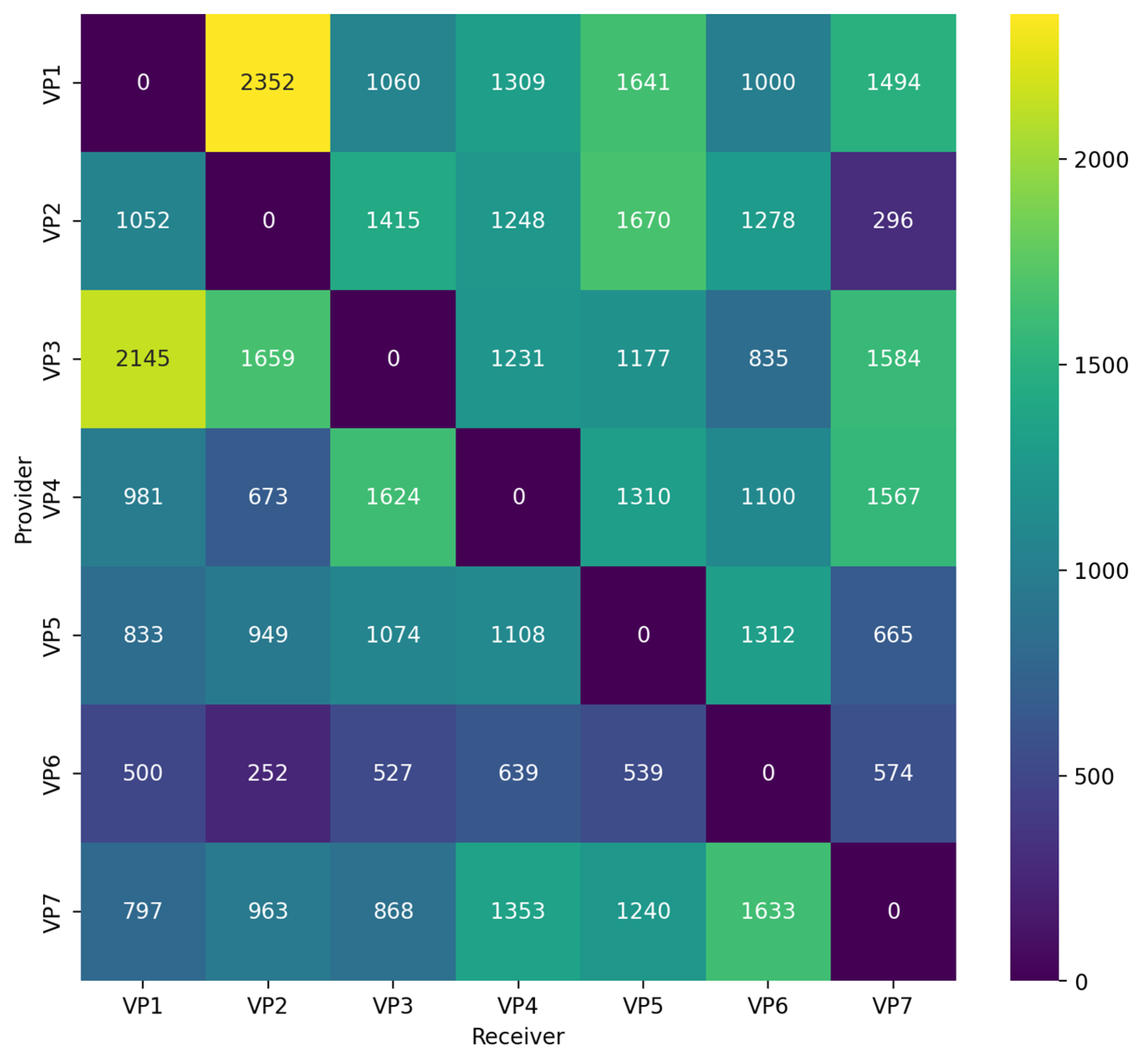
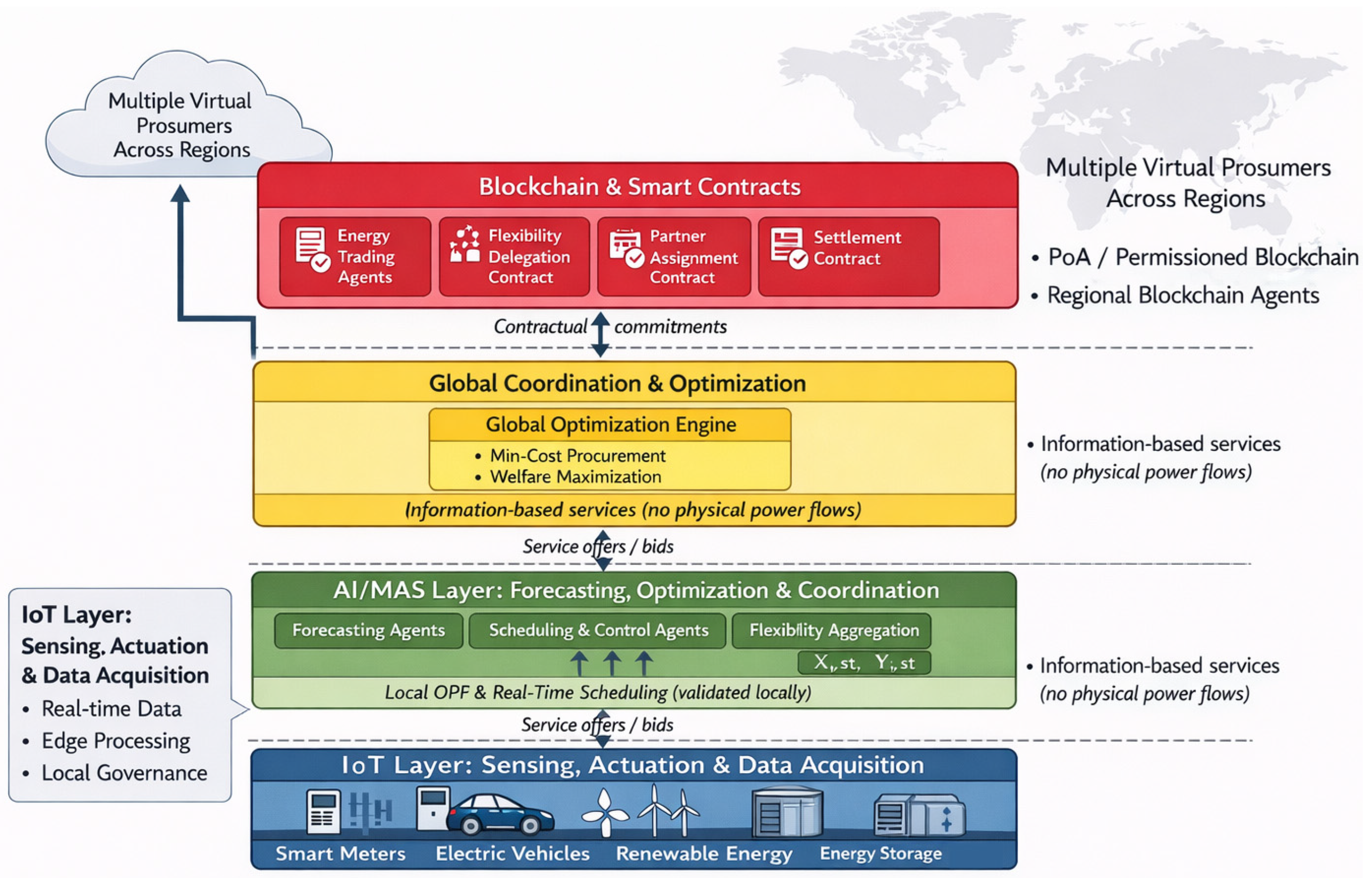
This paper addresses this gap by proposing a Global Virtual Prosumer (GVP) framework that combines established technological pillars—IoT-based sensing, multi-agent coordination, and blockchain-enabled energy trading—into a unified cross-border architecture. The contribution does not lie in advancing these technologies individually but in integrating them into an information-centric coordination layer that supports an explicit on-chain contractual lifecycle, structured failure semantics, and contract-centric KPI instrumentation. In this way, the framework enables auditable, non-repudiable, and compliance-aware coordination of multi-jurisdictional energy services. Rather than focusing on direct physical power transfer, the proposed approach targets information-driven services such as flexibility provision, balancing support, certificate-based trading, and cross-border settlement, thereby promoting global interoperability while respecting local operational and regulatory constraints. The global network of seven Virtual Prosumers (VPs) used as a case study is depicted in Figure 1, and the three-layer IoT–AI–blockchain architecture that underpins each VP is illustrated in Figure 2.
The main contributions of this paper are as follows:
(C1) An information-centric global service abstraction in which geographically distributed energy clusters are modeled as Virtual Prosumers that interact through three tradeable services—balancing, flexibility, and certificates—subject to feasibility envelopes and cross-border admissibility constraints rather than physical power exchange.
(C2) A complete on-chain contractual lifecycle (Algorithms 1–4) covering trade registration, flexibility delegation, cooperative partner assignment, and cross-border settlement, together with explicit failure-event semantics that support end-to-end auditability and non-repudiation.
(C3) A scenario-based evaluation methodology based on ten contract-centric KPIs (K1–K10), capturing not only service-level coverage but also settlement success, oracle verification performance, rejection and non-compliance decomposition, and lifecycle traceability.
(C4) An integrated security and governance architecture embedding oracle-based delivery verification, regulatory compliance hooks, and permissioned identity management into the smart-contract layer, illustrating how cross-border coordination can remain compliance-aware without relying on centralized control.
Algorithm 1: Energy Trading Contract
Input: Provider i , consumer j , service s , time slot t , allocated quantity  z i j , s , t ,  price  p s , t (optional), signatures σ i , σ j , regional identifiers
Output: On-chain trade record and events
1:Require Verify Identities and Signatures ( i ,   j ,   σ i , σ j )
2:Require Time Window Open ( t T )
3:Require Regulatory Admissibility for both parties at registration time: B i , s , t = 1  and  A j , s , t = 1 (see Section 4.5.4, C5)
4:Require Quantity Feasible ( 0 z i j , s , t x i , s , t   and  0 z i j , s , t y j , s , t )
5:Generate trade identifier I D Hash i , j , s , t , z i j , s , t
6:Store trade commitment on-chain Trade I D i , j , s , t , z i j , s , t , p s , t , PENDING
7:Lock the committed quantity z i j , s , t for provider i until settlement/cancellation/expiry to prevent commitment across concurrent trades
8:Emit event T r a d e A c c e p t e d ( I D , i , j , s , t , z i j , s , t ) (only after successful validation and state update)
9:Return ID
Failure semantics (applies to Steps 1–4): Any violated Require condition reverts the transaction and no on-chain state is written (atomic execution).
Algorithm 2: Flexibility Delegation Contract
Input: Delegator  i , partner k , time slot t , delegated flexibility d k i , t , delegation bound D ¯ k i , t , signatures
Output: On-chain delegation record and events
1:Require Verify Identities and Signatures ( i , k ,   σ i ,   σ k )
2:Require Time Window Open ( t T and delegation window open)
3:Require Regulatory admissible: B k , f l e x , t = 1
4:Require Delegation bounds 0 d k i , t D ¯ k i , t
5:Generate delegation identifier I D Hash i , k , t , d k i , t
6:Store delegation record on-chain Delegation I D i , k , t , d k i , t , A C T I V E
7:Update delegated flexibility pool Pool i , t Pool i , t + d k i , t
8:Lock delegated quantity d k i , t for partner k until settlement or cancellation/expiry (to prevent re-delegation)
9:Emit event D e l e g a t i o n A p p r o v e d ( I D , i , k , t , d k i , t ) only after successful validation and state update
10:Return ID
Failure semantics (applies to Steps 1–4): Any violated Require condition reverts the transaction and no on-chain state is written (atomic execution).
Algorithm 3: Partner Assignment Contract
Input: Virtual Prosumer i , candidate partner set P i , time slot t , binary selection a k i , t , maximum partners K i
Output: On-chain active partner set for i , t and events; returns success flag
1:Require Verify Authorization of Virtual Prosumer i
2:Require Time Validity t T
3:Require Candidate Set Non Empty ( P i > 0 )
4:Compute   c o u n t k ϵ P i a k i , t
5:Require  count K i (otherwise revert: exceeds maximum partners)
6:Initialize   A c t i v e P a r t n e r s i , t
7:For each   k P i   do
8: Require Verify Identity and Authorization of k
9: If  a k i , t = 1  then
10:    Require Regulatory Admissibility for ( k , i , t ) (service/region constraints)
11:     Activate partner k  for  i  at  t
12:     A c t i v e P a r t n e r s i , t A c t i v e P a r t n e r s i , t k
13:    Emit event PartnerActivated(i,k,t) (only after successful activation)
14: Else
15:     Deactivate  partner  k  for   i  at  t
16:    Emit event PartnerDeactivated(i,k,t)
17: End if
18:End for
19:Store  ActivePartners i , t on-chain
20:Return   T R U E
Failure semantics: Any violated Require condition reverts the transaction and no on-chain state is written (atomic execution).
Algorithm 4: Cross-Border Settlement and Compliance Contract
Input: Trade identifier I D , seller i , buyer j , service s , time slot t , committed quantity z i j , s , t , price/term p s , t , oracle delivery proof Proof I D , qty , oracle , timestamp , σ oracle , admissibility flags A j , s , t  and  B i , s , t
Output: On-chain settlement record, balance or certificate updates, and events
1:Retrieve trade record Trade I D = i , j , s , t , z i j , s , t , p s , t , status
2:Require  Trade I D . status = PENDING
3:Require Verify Oracle Identity And Signature σ oracle
4:Require   O r a c l e A u t h o r i z e ( o r a c l e ,   r e g i o n i ,   s e r v i c e s )
5:Determine delivered quantity q m i n Proof . qty , z i j , s , t
6:Require  q 0
7:Check regulatory admissibility at settlement time: a d m ( B i , s , t = 1  and  A j , s , t = 1 )
8: v e r V e r i f y P r o o f F r e s h n e s s A n d B i n d i n g ( P r o o f ,   I D ,   t )
9:/* Determine reason code (priority order) */
10: If a d m = F A L S E   then  r c A D M I S S I B I L I T Y _ F A I L
11: Else if a u t h = F A L S E  then  r c   O R A C L E _ U N A U T H O R I Z E D
12: Else if v e r = F A L S E  then    r c   O R A C L E _ S T A L E   O R   M I S M A T C H
13: Else r c   O K
14:End if
15:If  r c = O K  then
16: Compute settlement obligation Pay j i , s , t p s , t q
17: If settlement is monetary then
18: If  Balance j < Pay j i , s , t  then
19: r c S E T T L E M E N T _ F U N D S _ I N S U F F I C I E N T
20: Else
21: Update   Balance j Balance j Pay j i , s , t ,   Balance i Balance i + Pay j i , s , t
22: End if
23: Else if settlement is certificate—or token-based then
24: Transfer certificate or credit amount proportional to q  from  j  to  i
25: End if
26:End if
27:If   r c = O K  then
28: Update trade status Trade I D . status SETTLED _COMPLIANT
29: Store settlement record Settlement I D i , j , s , t , q , Pay j i , s , t , COMPLIANT
30: Release locked quantities for I D (from Algorithms 1 and 2)
31: Emit events DeliveryVerified(ID,q), SettlementCompleted(ID, Pay j i , s , t )
32:Else /* NONCOMPLIANT path */
33: Update trade status Trade I D . status SETTLED _NONCOMPLIANT
34: Store settlement record Settlement I D i , j , s , t , 0 , 0 , NONCOMPLIANT
35: Release locked quantities for I D (expiry/penalty logic handled by policy)
36: Emit event ComplianceViolation(ID,rc,details)
37:End if
38:Return Trade(ID).status
Failure semantics: Step 2 and Step 3 are enforced as Require; if violated, the transaction reverts and no on-chain state is written. All business-rule failures are captured via rc ≠ OK and recorded as NONCOMPLIANT (Steps 32–36) to preserve auditability and support KPI K8 root-cause decomposition.
The proposed framework builds directly on two prior studies by the authors. Reference [6] introduced a blockchain-enabled Virtual Prosumer architecture with real-time MAS-based power management for locally integrated microgrids comprising plug-in electric vehicles and renewable energy sources, validating local coordination and scheduling within a single Virtual Prosumer. Reference [8] extended this architecture to Virtual Prosumer networks with integrated physical- and network-layer security using Proof-of-Authority blockchain consensus. Together, these studies established the intra-VP foundation: local MAS intelligence, device-level scheduling, and blockchain-supported secure operation within a single jurisdiction.
Table 1. Illustrative example: one time slot, one service (flex), two providers, two receivers.
(a) Feasibility envelopes and economic parameters
VPRoleEnvelopeValue (MW)Cost/UtilityAdmissibility
VP1ProviderX1,flex,150c1 = 2.5 EUR/MWB1 = 1 (eligible)
VP3ProviderX3,flex,130c3 = 3.1 EUR/MWB3 = 1 (eligible)
VP2ReceiverY2,flex,140u2 = 4.0 EUR/MWA2 = 1 (admissible)
VP5ReceiverY5,flex,125u5 = 3.8 EUR/MWA5 = 1 (admissible)
(b) Optimization outcome (min-cost) and allocation matrix z
z (MW)VP2VP5x (committed)X (envelope)
VP13515x1 = 5050
VP3510x3 = 1530
y (received)y2 = 40y5 = 25
Y (envelope)4025
Building on that foundation, the present study introduces several elements not addressed in [6] or [8]. First, it extends the Virtual Prosumer concept from local operation to a cross-border GVP coordination layer based on tradeable energy services rather than physical interconnection. Second, it formalizes a four-stage on-chain contractual lifecycle (Algorithms 1–4), moving beyond simple transaction recording toward contract-level registration, delegation, partner assignment, and settlement. Third, it incorporates oracle-based verification and structured failure attribution, enabling explicit decomposition of rejection and non-compliance events. Fourth, it introduces actor-role accountability and lifecycle traceability across jurisdictions. Finally, it proposes a contract-centric KPI framework (K1–K10) specifically designed to evaluate cross-border contractual coordination rather than only operational energy metrics.
Appendix A Table A1 provides an element-by-element comparison between the capabilities inherited from [6,8] and those newly introduced in the present work. Appendix A Table A2 further positions the proposed framework against representative studies from local blockchain-based P2P trading, MAS-based virtual power plant coordination, and centralized cross-border energy management.

2. Related Work

2.1. Peer-to-Peer Energy Trading

Peer-to-peer (P2P) energy trading has emerged as a promising paradigm for enabling decentralized energy exchange among prosumers, primarily within local energy communities and microgrids. Early studies demonstrated that P2P mechanisms can improve economic efficiency, increase renewable energy utilization, and enhance user engagement by allowing direct energy transactions without traditional intermediaries [3,4]. Various market-clearing mechanisms, pricing schemes, and incentive structures have been proposed to support such localized energy exchanges [8].
Despite these advances, most P2P energy trading frameworks remain inherently local in scope, constrained by geographical proximity, shared distribution infrastructure, and homogeneous regulatory environments. As highlighted in recent surveys, scaling P2P markets beyond neighborhood or community-level deployments introduces significant challenges related to coordination complexity, trust management, and regulatory heterogeneity [6,9]. Consequently, existing P2P approaches are not directly applicable to global energy interaction scenarios, where physical power exchange is infeasible and information-driven coordination becomes essential.

2.2. Blockchain-Based Energy Markets

Blockchain technology has been widely investigated as an enabling infrastructure for decentralized energy markets due to its ability to provide immutable records, transparent transaction histories, and automated execution via smart contracts [5]. Several blockchain-based platforms have been proposed for energy trading in microgrids, transactive energy systems, and community-level markets, often leveraging public blockchains such as Ethereum or hybrid architectures combining blockchain with off-chain components [5,10,11].
While these approaches successfully address trust and transparency at small scales, their applicability to large-scale or cross-border energy markets remains limited. Public blockchain solutions frequently suffer from scalability constraints, high transaction latency, and excessive energy consumption, whereas permissioned blockchains often assume predefined governance structures that are difficult to generalize globally [6,12]. Moreover, most blockchain-based energy market studies focus on transaction recording and settlement, without integrating intelligent coordination mechanisms capable of managing distributed resources dynamically and autonomously across heterogeneous regions.

2.3. Virtual Power Plants and Agent-Based Energy Management

Virtual Power Plants (VPPs) aggregate geographically distributed energy resources—such as renewable generators, storage systems, and flexible loads—into a single, controllable entity capable of participating in energy markets [13]. To manage the inherent complexity of such systems, multi-agent systems (MASs) and distributed optimization techniques have been extensively employed, enabling autonomous decision-making, scalability, and adaptability under uncertainty [7,14].
Agent-based VPP frameworks have demonstrated strong performance in real-time scheduling, demand response, and grid support services at local and regional levels [7,13]. However, these approaches typically rely on centralized aggregators or trusted coordinators for market interaction and settlement, limiting their suitability for decentralized, trustless environments. Furthermore, existing VPP and MAS-based solutions generally assume operation within a single regulatory domain and do not address global interoperability, cross-border coordination, or blockchain-enabled smart contract execution as first-class design objectives.

2.4. Cross-Border/Multi-Jurisdiction Blockchain Energy Markets

Early blockchain-enabled energy pilots and much of the local P2P trading literature focus on intra-community exchange inside a single distribution context: one DSO, one retail market design, one data protection regime. In contrast, cross-border coordination is primarily a governance, interoperability, and settlement problem: actors must align heterogeneous market rules (licensing, consumer protection, balancing responsibilities), data/privacy obligations (e.g., GDPR-style constraints), and financial compliance (KYC/AML) while enabling automated clearing via smart contracts. The recent review literature emphasizes that regulatory alignment and market design are now first-order constraints because jurisdictional differences directly shape what can be tokenized, which entities can validate, and how disputes are enforced [15].
From a systems standpoint, cross-border markets require (i) interoperability across heterogeneous ledgers and legacy energy IT and (ii) settlement mechanisms that remain legally meaningful across jurisdictions. On interoperability, the post-2021 trajectory moves beyond single-chain P2P towards multi-platform ecosystems, pushing the design space toward cross-chain bridges and standardized asset semantics. On settlement, multi-jurisdiction settings impose requirements that go well beyond the balance-update model of local P2P: settlement must simultaneously satisfy energy-market coupling rules, data governance and identity constraints, and auditability requirements that evidence non-compliance and dispute resolution across jurisdictions. Recent frameworks accordingly emphasize governance models for validator participation that respect financial compliance, and privacy-preserving verification where smart contracts enforce obligations while cryptographic tools limit disclosure of sensitive data [15].
The resulting design perspective treats cross-border energy trading as an information-centric coordination layer that supports multiple transactive services—certified attributes, flexibility commitments, balancing coordination—while physical power remains locally constrained. Under this view, blockchain’s value lies in trusted commitments, standardized data exchange, and verifiable settlement across institutions, rather than in physically moving energy across borders.
These considerations translate into four concrete design requirements for the proposed framework: (i) an interoperability layer with standardized data models connecting heterogeneous systems; (ii) compliance-aware governance with validator/role design satisfying jurisdiction-specific licensing, data sovereignty, and KYC/AML constraints; (iii) privacy-preserving oracle/attestation patterns to prove delivery and compliance without exposing sensitive profiles; and (iv) settlement semantics that map on-chain events to jurisdiction-specific contractual obligations, rather than assuming that on-chain finality equals legal settlement.
These four requirements directly motivate specific design choices in the proposed GVP framework: requirement (i) is addressed by the layered IoT–AI–blockchain stack with standardized service interfaces (Section 4); requirement (ii) by the permissioned PoA governance model with regional validator roles (Section 4.3.2); requirement (iii) by the oracle verification mechanism embedded in Algorithm 4 and measured by KPI K8 (Section 6.7); and requirement (iv) by the four-stage contractual lifecycle (Algorithms 1–4) whose on-chain events carry explicit failure semantics mapped to settlement time compliance outcomes (Section 5, KPIs K6–K8).

2.5. Oracle Design and Trust Models in Blockchain Energy Systems

Blockchain-based energy applications (e.g., local flexibility delivery, metering-based settlement, carbon/REC certification, or market-clearing with off-chain optimization) inevitably depend on off-chain facts that smart contracts cannot observe natively. This dependency is widely referred to as the blockchain oracle problem: even if on-chain execution is deterministic and auditable, the truthfulness of contract outcomes hinges on whether the external data injected on-chain is correct, timely, and non-manipulated. In practice, oracles can reintroduce centralization and single points of failure, and they also expand the attack surface to data sources, communication channels, and oracle governance/incentives [16].
A useful way to structure the design space is through oracle trust models, which formalize how external data becomes acceptable for on-chain use. Recent surveys identify three essential components [16]:
Data validation (energy semantics): verification must cover not only message authenticity but also physical/operational plausibility, e.g., meter readings consistent with device limits, flexibility activation consistent with declared envelopes, and certification claims consistent with provenance and timestamps.
Transmission and integrity (chain of custody): the trust model must describe how readings, prices, forecasts, or optimization outputs are protected against tampering in transit, through signed messages, authenticated feeds, and explicit on-chain verification steps.
Incentives, governance, and failure modes: common oracle designs (voting/staking-based, reputation-based) carry known weaknesses, including collusion risks and governance centralization, which, for energy settlement, directly affect crediting, penalties, and dispute resolution.
This three-dimensional trust model lens directly motivates how we operationalize oracle quality in our evaluation. Rather than treating oracle verification as a binary pass/fail, we introduce KPI K8 as an oracle performance metric with root-cause decomposition, designed to answer why credited delivery or verification fails. K8 separates three practically distinct failure categories—source/data-feed issues, oracle-layer faults (aggregation/consensus failures or compromised nodes), and on-chain verification/settlement issues (late submissions, mismatched commitments, or rule violations)—that map one-to-one onto the validation, transmission, and governance dimensions above. The settlement contract (Algorithm 4) operationalizes this decomposition by generating typed ComplianceViolation events with reason codes, enabling post-hoc root-cause analysis across scenarios and services (Section 6.8.4).
Finally, verifiable compute is an emerging complementary mechanism: zero-knowledge proofs can make off-chain computation verifiable with cheap on-chain checks, explicitly modeling untrusted provers and punishing invalid proofs [17]; while not yet deployed in the current framework, this direction is identified as a future extension in Section 8.

2.6. Hierarchical VPP/VPP-like Architectures with MAS and Blockchain Integration

Recent work increasingly converges on hierarchical architectures to cope with the scale, heterogeneity, and real-time constraints of VPP and VPP-like systems, while using multi-agent coordination and blockchain to strengthen decentralization, automation, and auditability. Systematic reviews of hierarchical and multi-agent optimization for P2P energy management confirm that layered control (device/DER level → local aggregators → market/grid coordination) is a recurring design pattern that balances computational tractability with operational fidelity, with blockchain and smart contracts introduced as complementary mechanisms for secure coordination and automated settlement [17,18].
Within this line, conceptual VPP frameworks built around multi-layer stacks explicitly separate sensing/measurement, forecasting/analytics, market interfaces, and settlement functions, placing blockchain at the upper layers for tamper-evident records and automated execution of trading logic [19,20]. Complementarily, hierarchical blockchain architectures for V2G market trading modularize responsibilities across data storage, contract operation, and transaction execution layers, improving maintainability and security through simulation-validated intelligent contracts [21].
Overall, these studies motivate the view that hierarchical decomposition is not only a control/optimization convenience but also a systems-engineering principle that cleanly separates (i) local physical feasibility and device constraints, (ii) aggregation and coordination policies, and (iii) market/settlement processes. This separation is especially relevant when blockchain is employed because smart contracts can naturally implement the upper-layer coordination and settlement rules, while MAS mechanisms manage distributed decision-making at lower layers under uncertainty and heterogeneous objectives.
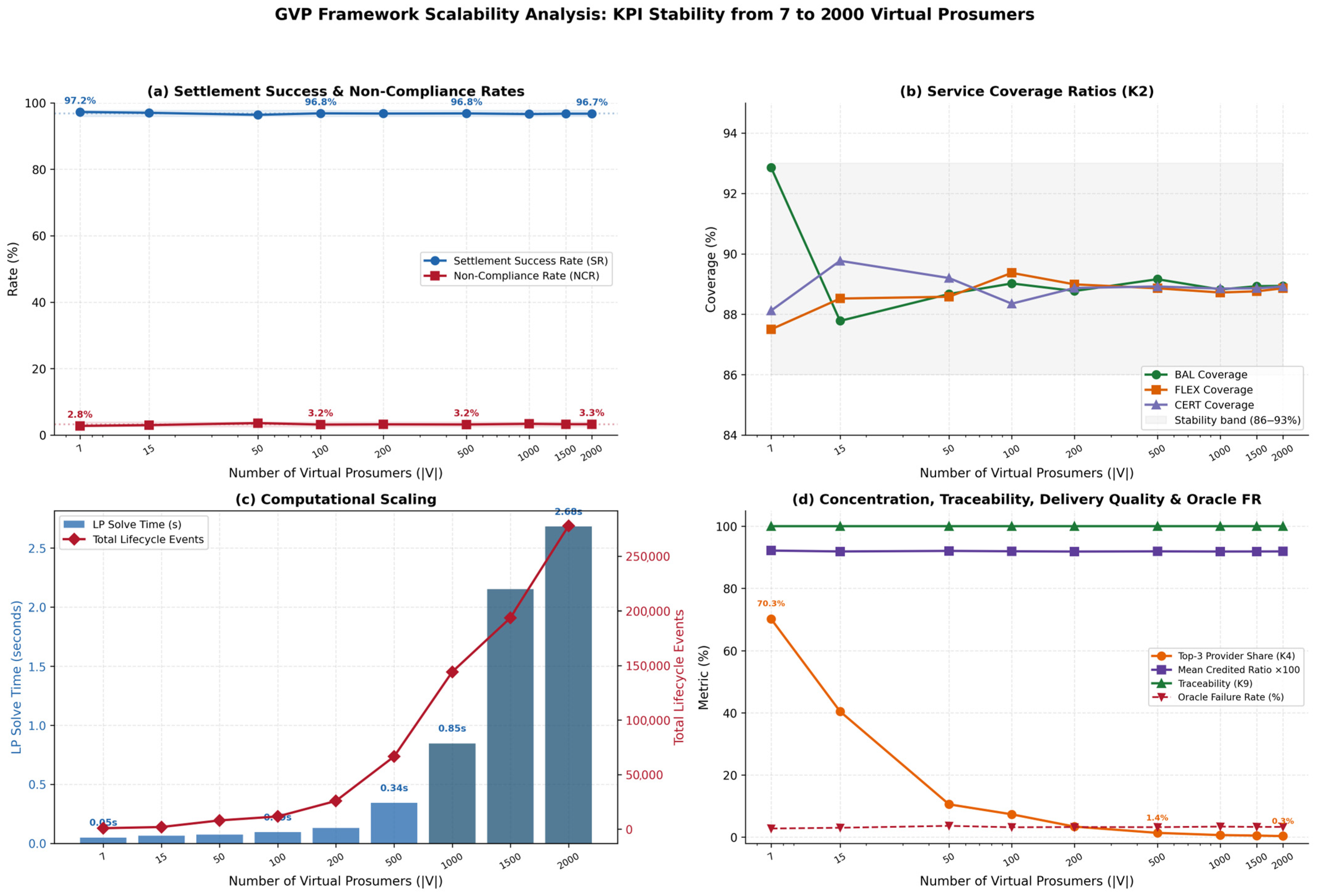
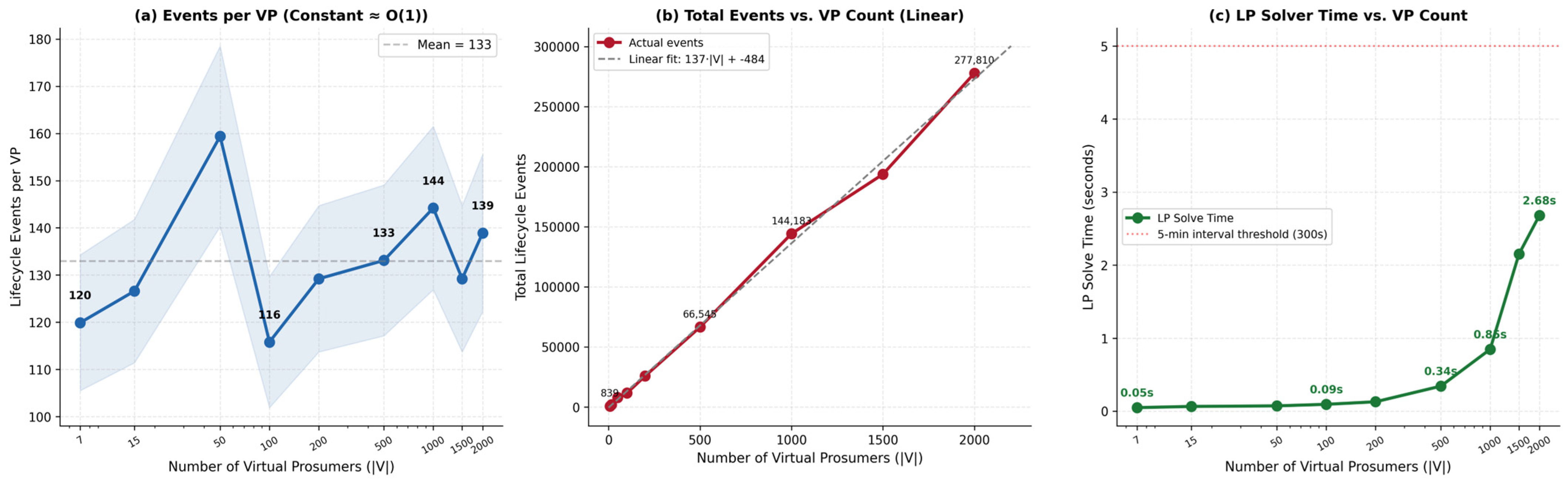
The GVP framework inherits this hierarchical principle: the IoT and AI/MAS layers (Section 4.1 and Section 4.2) handle local physical feasibility and device-level scheduling within each Virtual Prosumer, while the blockchain layer (Section 4.3) implements the upper-layer coordination and settlement rules through Algorithms 1–4. The global optimization models (Section 4.5) operate exclusively on aggregated feasibility envelopes exported by the lower layers, ensuring that on-chain complexity scales with inter-VP commitments rather than with the internal device population—a design choice whose scalability is validated in Section 6.8.6.

2.7. Research Gap and Motivation

From the above review, it is evident that existing research streams—P2P energy trading, blockchain-based energy markets, and agent-based Virtual Power Plants—have matured substantially, with increasing convergence in recent years. In particular, several works have combined MAS-based coordination with blockchain-enabled settlement within integrated architectures: hierarchical MAS + blockchain designs for VPP operation and P2P trading have been proposed, with layered control separating device-level scheduling from market-level settlement [18,20,21]; blockchain-integrated V2G frameworks have demonstrated smart-contract-based automation of vehicle-to-grid market procedures [20]; and multi-agent blockchain platforms for community-level energy trading have addressed local trust and transaction transparency [6,8,22,23]. These works provide valuable foundations for decentralized energy coordination. However, they typically operate within a single regulatory jurisdiction and do not address cross-border service coordination as a first-class design objective. Against this backdrop, the specific combination proposed in this work—namely, (i) a Global Virtual Prosumer abstraction that decouples information-based service coordination from physical power exchange across jurisdictions; (ii) a four-stage smart-contract lifecycle with explicit delegation, partner assignment, oracle verification, and settlement time compliance enforcement with structured failure attribution (Algorithms 1–4); and (iii) a contract-centric KPI suite that separates optimization-layer coverage from on-chain verification and compliance root causes (K1–K10)—has not, to our knowledge, been presented as a unified framework in the existing literature. This claim pertains specifically to the integrated lifecycle and evaluation methodology, not to the individual constituent technologies, and Appendix A Table A1 and Table A2 provide a detailed element-by-element comparison against the closest antecedents to substantiate this positioning.
Specifically, while existing approaches address subsets of these requirements, they do not jointly provide:
  • Abstraction of heterogeneous regions into interoperable market-facing entities for cross-border service coordination.
  • Separation of local physical feasibility from global coordination in a programmable, on-chain contractual layer.
  • Recording of settlement time compliance outcomes as tamper-evident lifecycle events with structured failure attribution.
A detailed element-by-element comparison supporting this assessment is provided in Appendix A Table A1 and Table A2.
This gap motivates the Global Virtual Prosumer framework proposed in this work, which builds on individually mature technological pillars—IoT-based data acquisition, AI-driven multi-agent coordination, and blockchain-enabled smart contracts— and integrates them into a unified cross-border contractual lifecycle designed to support secure, scalable, and automated energy service coordination at a worldwide scale, while acknowledging that full empirical validation under real-world deployment constraints remains a necessary next step (see Section 8.8). The claim of novelty therefore pertains to this integrated lifecycle and evaluation methodology, not to the individual constituent technologies. In contrast to existing P2P energy trading frameworks [3,4,8], which remain confined to local physical grids and homogeneous regulatory environments, and unlike conventional blockchain-based energy platforms [5,10,12] that primarily address transaction recording and settlement at small scales, the proposed GVP framework operates at the global coordination level through information-based service abstractions. Similarly, while VPP and MAS-based approaches [7,13,14] have demonstrated effective local resource management, they typically rely on centralized aggregators and do not natively integrate cross-border smart contract execution or regulatory compliance enforcement. The GVP framework addresses these limitations jointly by embedding global interoperability, multi-agent intelligence, and blockchain-based trust mechanisms into a single, unified architecture.
To sharpen positioning against the closest antecedents, Appendix A Table A1 maps carry-over versus novelty across scope, lifecycle (Algorithms 1–4), oracle verification, and auditability KPIs relative to [6,8], while Appendix A Table A2 provides a dimension-by-dimension qualitative comparison of the GVP framework against representative local P2P blockchain platforms [3,10,12], MAS-based VPP frameworks [7,13,14], and centralized cross-border coordination mechanisms [16,24]. The comparison confirms that the identified gap is not addressable by extending any single existing stream: local P2P platforms provide on-chain transaction records but assume single-jurisdiction, physically coupled grids; MAS-based VPPs enable distributed real-time control but lack on-chain lifecycle management and cross-border settlement; and centralized cross-border mechanisms achieve multi-jurisdictional coordination but depend on institutional trust without transparent, non-repudiable audit trails. Importantly, these approaches are not superseded by the GVP but rather operate at complementary scales: local P2P and MAS-VPP mechanisms can serve as the physical-layer and coordination-layer components within each Virtual Prosumer (as realized by the IoT and AI/MAS layers in Section 4), while the GVP’s blockchain-backed contractual lifecycle operates at the global information coordination layer above them. This architectural complementarity is a deliberate design feature, not an accidental overlap.

3. Global Virtual Prosumer Concept

3.1. Virtual Prosumers Beyond Local Energy Systems

The concept of the Virtual Prosumer originates from the aggregation of distributed energy resources—such as renewable generation units, energy storage systems, and flexible loads—into a unified operational and market-facing entity. In local or regional settings, Virtual Prosumers enable coordinated participation in energy markets, demand response programs, and grid support services, often acting as intermediaries between individual prosumers and system operators [13,14]. The local VP concept—including MAS-based coordination and blockchain-secured operation—has been validated in prior work [6,8]. The present section extends this concept to a global scale, introducing the Global Virtual Prosumer (GVP) as a cross-border abstraction that is architecturally distinct from the local VP foundation that it builds upon.
Extending this concept to a global scale requires a fundamental abstraction shift. A Global Virtual Prosumer (GVP) is not defined by physical proximity or shared grid infrastructure but by its ability to represent, coordinate, and monetize energy-related capabilities across geographically distributed and heterogeneous energy ecosystems. Each GVP encapsulates local operational complexity—including grid constraints, regulatory rules, and resource availability—while exposing standardized information interfaces to global energy markets. Figure 1 provides a concrete illustration of this concept, showing the seven geographically distributed Virtual Prosumers (VPs) used in the global case study (Section 6) and their participation in blockchain-enabled cross-border energy services.
In this sense, Global Virtual Prosumers function as information-driven cyber–physical entities, enabling participation in global energy coordination mechanisms without necessitating direct physical interconnection between distant power systems. As shown in Figure 1, the seven VPs span diverse regional contexts—from PEV-dominated flexibility hubs to solar certificate exporters and regulatory sandboxes—yet interact through a common information coordination layer.

3.2. From Physical Power Exchange to Information-Based Energy Services

Unlike conventional electricity markets, where energy transactions are closely coupled to physical power flows, global energy interaction cannot rely on the direct transfer of electrical energy across continents. Instead, coordination at the global level is achieved through the exchange of energy-related services and information artifacts, which can be securely quantified, validated, and settled digitally [5,6].
The proposed Global Virtual Prosumer framework explicitly avoids the notion of long-distance physical power transfer and focuses on four complementary categories of information-based energy services.

3.2.1. Balancing and Ancillary Services

Balancing services represent the capability of a Virtual Prosumer to adjust its aggregated generation or consumption in response to external signals, contributing to frequency regulation, reserve provision, and system stability at the local or regional level. In the global context, these services are traded as contractual commitments, rather than instantaneous power flows, enabling system operators or market platforms to procure flexibility across geographically diverse regions [13,16].
By abstracting balancing capabilities as tradable digital services, Global Virtual Prosumers can participate in coordinated balancing schemes while respecting local grid constraints and operational autonomy.

3.2.2. Energy and Environmental Certificates

Energy certificates—such as guarantees of origin, renewable energy certificates, or carbon-related instruments—constitute a critical mechanism for linking energy production to sustainability objectives without requiring physical energy delivery [5]. Blockchain-based certification schemes have been shown to enhance transparency, traceability, and trust in such markets by providing immutable records of certificate issuance and ownership transfer [10].
Within the Global Virtual Prosumer framework, certificates are treated as first-class tradable assets, enabling cross-border exchange of environmental value independently of physical electricity flows. This approach aligns with emerging regulatory practices and supports global decarbonization goals.

3.2.3. Flexibility Provision

Flexibility refers to the ability of energy resources to modify their operational profiles over time, including load shifting, storage dispatch, and controllable generation. At a global scale, flexibility is increasingly recognized as a valuable commodity that can be aggregated, priced, and exchanged independently of energy volume [6,18].
Global Virtual Prosumers aggregate local flexibility potential and expose it through standardized interfaces, allowing flexibility services to be procured, delegated, or reallocated via smart contracts. This enables global coordination of demand-side and supply-side flexibility while preserving decentralized control.

3.2.4. Financial Settlement and Market Clearing

Financial settlement constitutes the final layer of global energy interaction, linking contractual commitments, delivered services, and economic compensation. Blockchain-enabled smart contracts provide a robust mechanism for automating settlement processes, enforcing contractual terms, and ensuring non-repudiation without centralized clearinghouses [5,12].
In the proposed framework, smart contracts govern the lifecycle of global energy transactions, from service commitment and validation to settlement and auditing. This design supports transparent, trustless financial interaction among geographically distributed actors while accommodating heterogeneous regulatory and market conditions.
It is important to note that financial settlement constitutes an operational mechanism that supports the execution and clearing of tradable service transactions (balancing, flexibility, and certificates), rather than a tradable service category in its own right. Accordingly, it is not included in the set S = { b a l , f l e x , c e r t } defined in Section 4.5.

3.3. Enabling Global Coordination Through Abstraction

By decoupling energy services from physical power transfer, the Global Virtual Prosumer concept enables scalable global coordination without violating the fundamental constraints of power system operation. Local grids retain full authority over physical control and safety, while global interaction occurs exclusively through secure information exchange and contractual mechanisms.
This abstraction layer allows heterogeneous energy systems to interoperate within a unified digital marketplace, positioning Global Virtual Prosumers as foundational building blocks for next-generation energy information systems that integrate IoT sensing, AI-driven coordination, and blockchain-based trust infrastructures.

4. Architecture: IoT–AI–Blockchain Stack

The proposed Global Virtual Prosumer framework is realized through a layered architecture that integrates IoT-based sensing and actuation, AI-driven multi-agent intelligence, and a blockchain-based trust and settlement layer. This stack-oriented design explicitly separates physical energy systems from global coordination and market interaction, enabling scalability, security, and interoperability across heterogeneous regions. Figure 2 illustrates the layered architecture, highlighting the separation between local physical control, global optimization, and blockchain-based contract enforcement, as well as the direction of information and contractual commitment flows across layers.
Figure 1 (introduced in Section 1) provides a global view of the Virtual Prosumers participating in the framework, while the architecture described in this section details the internal operation and interaction of the three layers within each Virtual Prosumer and across the global network.

4.1. IoT Layer: Sensing, Actuation, and Data Acquisition

The IoT layer constitutes the physical interface between energy resources and the digital coordination framework. It encompasses smart meters, renewable energy sources (RESs), energy storage systems, and electric vehicles (EVs), all of which continuously generate real-time data describing power production, consumption, state of charge, and operational constraints [25,26].
Advanced metering infrastructures and edge devices enable fine-grained monitoring and bidirectional communication, transforming traditionally passive grid elements into active participants of the energy ecosystem. Through standardized communication protocols and heterogeneous networking technologies (e.g., cellular, broadband, and low-power IoT networks), the IoT layer supports reliable data acquisition across diverse deployment environments [25].
From an architectural perspective, the IoT layer is intentionally designed to remain locally governed. Physical control actions, safety constraints, and grid protection mechanisms are enforced at the local level, ensuring compliance with regional regulations and operational limits. Only abstracted and validated information, such as aggregated power profiles, flexibility envelopes, and service availability indicators, is propagated upward to the intelligence layer. This design choice preserves grid stability while enabling global coordination. This data flow—from physical assets through IoT sensing to validated information abstractions—is depicted in the lowest tier of Figure 2 (IoT Layer), with upward arrows indicating the propagation of aggregated and validated data toward the AI/MAS and blockchain layers.

4.2. AI and Multi-Agent System Layer: Virtual Prosumer Intelligence

The AI/MAS layer forms the decision-making core of the Global Virtual Prosumer framework. Each Virtual Prosumer is coordinated by a collection of intelligent agents responsible for forecasting, optimization, and real-time control of local energy resources. Multi-agent systems are particularly well suited for this role due to their ability to operate autonomously, adapt to uncertainty, and scale across distributed environments [27,28,29].
At this layer, agents perform several key functions:
Forecasting agents estimate short-term and medium-term energy production, consumption, and flexibility availability using historical data and real-time IoT inputs.
Control and scheduling agents compute optimal operational setpoints for local resources while respecting grid constraints and contractual obligations.
Coordination agents aggregate local capabilities into standardized service descriptions that can be exposed to global markets.
The abstraction of local resources into a Virtual Prosumer enables heterogeneous systems—ranging from urban EV fleets to renewable-dominated rural grids—to participate uniformly in global coordination mechanisms. Importantly, the MAS layer acts as a buffer between physical systems and global interaction, ensuring that global commitments do not violate local feasibility or safety constraints.
Existing studies have demonstrated that MAS-based energy management frameworks outperform centralized approaches in terms of scalability, resilience, and adaptability, particularly under high uncertainty and dynamic operating conditions [27,28,30,31]. However, unlike existing MAS-based energy management frameworks that—while employing decentralized agent architectures for local decision-making—typically rely on a centralized aggregator or trusted coordinator for market interaction and settlement (e.g., a single VPP operator interfacing with the system operator), the proposed architecture tightly integrates the MAS layer with blockchain-based trust mechanisms, enabling fully decentralized coordination, commitment enforcement, and settlement without a single trusted intermediary.
As depicted in Figure 2, the AI/MAS layer serves as the abstraction boundary between physical energy assets and global coordination, exporting only validated capability envelopes and service descriptors to the upper layers.

4.3. Blockchain Layer: Trust, Automation, and Global Interoperability

The blockchain layer provides the foundation for secure, transparent, and automated interaction among geographically distributed Virtual Prosumers. Rather than serving as a control mechanism for physical assets, blockchain functions as a global coordination and settlement infrastructure, recording commitments, validating service delivery, and enforcing contractual agreements through smart contracts [5,6].

4.3.1. Smart Contracts for Energy Services

Smart contracts encode the rules governing global energy services, including balancing commitments, flexibility delegation, certificate exchange, and financial settlement. Once deployed, these contracts execute autonomously, eliminating the need for centralized clearinghouses and reducing counterparty risk [5,12,32].
Within the proposed framework, smart contracts interact exclusively with the MAS layer through verified digital inputs, ensuring that only feasible and validated service commitments are recorded on-chain. This separation minimizes blockchain overhead while preserving strong guarantees of non-repudiation and auditability.

4.3.2. Permissioned Blockchain and Proof-of-Authority Consensus

To address scalability, latency, and energy consumption concerns associated with public blockchains, the architecture adopts a permissioned blockchain model governed by Proof-of-Authority (PoA) consensus [12,33]. In this setting, transaction validation is performed by pre-authorized regional blockchain agents, each representing a trusted institutional or regulatory entity within a specific geographic domain.
PoA consensus enables high transaction throughput and low validation latency, making it suitable for near-real-time coordination and frequent service settlement. Moreover, regional blockchain agents facilitate regulatory alignment, allowing local compliance requirements to be enforced without compromising global interoperability.

4.3.3. Interoperability Across Regions and Markets

A critical requirement for global energy coordination is interoperability across heterogeneous blockchain networks, market structures, and regulatory environments. The proposed architecture supports interoperability through standardized data models, contract templates, and cross-chain communication mechanisms that allow Virtual Prosumers to participate in multiple markets without duplicating infrastructure [6].
By abstracting energy services as information assets and managing them through interoperable smart contracts, the framework enables seamless interaction among regional energy ecosystems while avoiding tight coupling between physical systems. Figure 2 emphasizes that blockchain components do not participate in real-time control but operate exclusively on validated commitments and settlement information.

4.3.4. Limitations and Open Challenges of the Blockchain Layer

While the permissioned blockchain with PoA consensus offers clear advantages in throughput, latency, and energy efficiency relative to public alternatives (Section 4.3.2), several inherent limitations must be explicitly acknowledged to avoid overstating the guarantees provided by the blockchain layer alone.
Governance centralization: In a PoA-based permissioned network, the integrity of on-chain records depends entirely on the trustworthiness and independence of the pre-authorized validator set, which, in this framework, is the regional blockchain agents representing institutional or regulatory entities. This constitutes a fundamentally different trust model from public blockchains with open validator participation: if a sufficient subset of regional validators is captured, colluded, or coerced, the immutability and non-repudiation guarantees of the ledger are compromised. The framework partially mitigates this risk by anchoring validator roles to entities with independent regulatory accountability (e.g., regional system operators, energy regulators, or certified market operators), thereby leveraging institutional separation of interests as an external check on validator behavior. Nevertheless, the validator governance model—including onboarding, rotation, and revocation procedures, as well as mechanisms for detecting and responding to validator collusion—remains an open design challenge. Transparent validator governance protocols, periodic rotation schedules, and cryptographic audit mechanisms (e.g., verifiable random validator shuffling or commit–reveal schemes for block production) are identified as important extensions for strengthening the trust model in deployment scenarios.
Cross-chain interoperability: As discussed in Section 2.4, the broader cross-border energy landscape is evolving toward multi-platform ecosystems where different jurisdictions may operate on heterogeneous blockchain infrastructures. The current framework assumes a single shared permissioned network among all participating Virtual Prosumers—a simplifying assumption that avoids the complexities of cross-chain interaction but limits applicability to scenarios where all participants can be onboarded onto a common ledger. Extending the framework to support genuinely heterogeneous blockchain environments would require cross-chain interoperability mechanisms such as Inter-Blockchain Communication (IBC) protocols, relay chains, or hash-time-locked contracts (HTLCs). As noted in the literature review (Section 2.4), pilot implementations of such bridges (e.g., Cacti-IBC connectors) are emerging in regulatory sandbox environments, but they introduce additional attack surfaces (bridge contract exploits, relay node compromise), non-trivial latency overhead (cross-chain finality requires multiple confirmation rounds), and compounded trust assumptions (each chain’s consensus must be trusted by the bridge). The settlement semantics of Algorithms 1–4 are designed around single-ledger atomic state transitions; adapting them to cross-chain settlement with eventual consistency guarantees and dispute resolution across heterogeneous ledgers is a substantial research challenge identified as future work.
Blockchain as an enforcement substrate, not a compliance authority: A critical conceptual distinction that must be made explicit is that blockchain provides a programmable enforcement substrate for compliance rules, but does not autonomously determine, interpret, or resolve regulatory requirements. The compliance hooks embedded in smart contracts (Section 5.6) enforce pre-configured admissibility parameters and validation logic, but the correctness and completeness of these rules depend entirely on the external processes through which they are defined: legal agreements between jurisdictions, regulatory sandbox negotiations, bilateral or multilateral institutional coordination, and ongoing rule maintenance as regulations evolve. In particular, blockchain-based enforcement cannot resolve genuine regulatory conflicts between jurisdictions (e.g., mutually exclusive data residency requirements or conflicting definitions of eligible flexibility products)—such conflicts require institutional resolution mechanisms that operate outside the technical scope of the framework. This distinction is important for correctly interpreting the framework’s compliance-related claims: smart contracts guarantee that configured rules are enforced consistently and auditably, not that the rules themselves are complete or conflict-free.

4.4. Architectural Summary

By integrating IoT-based sensing, AI-driven multi-agent intelligence, and blockchain-enabled trust mechanisms into a unified stack, the proposed architecture transforms global energy trading into an information-centric cyber–physical system. Each layer addresses a distinct set of challenges—physical observability, intelligent coordination, and secure settlement—while collectively enabling scalable, decentralized, and automated global energy interaction.

4.5. Mathematical Model for Global Coordination and Service Trading

This section formalizes the global coordination layer of the proposed Global Virtual Prosumer (GVP) framework. The purpose of this layer is not to compute physical power flows between continents (which is infeasible), but to optimally allocate and settle information-based energy services (e.g., flexibility, balancing capacity, certificates) among geographically distributed Virtual Prosumers (VPs) under feasibility and compliance constraints [1,4,16,34]. This global layer sits above the local real-time control/scheduling mechanisms (MAS-based), which remain responsible for physical feasibility and safety at each VP.
We present two complementary optimization formulations that can be used depending on the viewpoint of the global market operator [16,18,24]:
  • Cost minimization (min-cost procurement): a global coordinator procures required services at minimum cost.
  • Social welfare maximization (max-welfare clearing): a global market clears offers and bids to maximize total welfare (benefit minus cost).
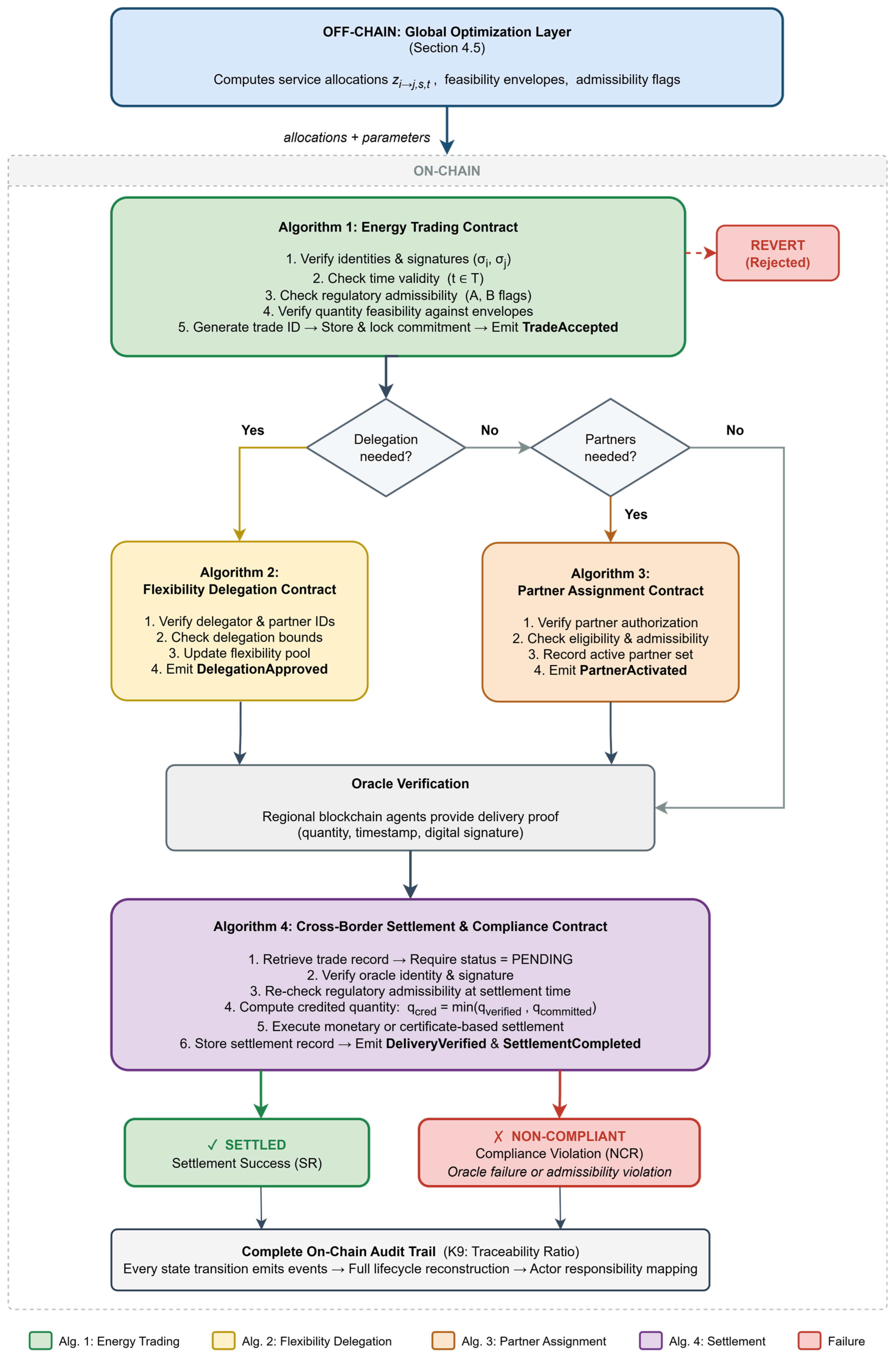
Both models share the same sets, variables, and feasibility constraints; they differ primarily in the objective. The outcomes of the proposed optimization models define the contractual commitments exchanged among Virtual Prosumers. Specifically, the optimized service allocations and commitments are translated into smart contract instances governing energy service trading, flexibility delegation, partner assignment, and cross-border settlement, as detailed in Section 5. These optimization results are further instantiated in the global case study presented in Section 6, ensuring a consistent link between analytical modeling, contract execution, and system-level evaluation [5,6,12,29].
For the reader’s convenience, a condensed table of all mathematical notation used in this section is provided in Appendix A Table A3.

4.5.1. Sets, Indices, and Time Structure

Let V denote the set of Virtual Prosumers (VPs), indexed by i on the supply side and j on the demand side. In the global case study presented in Section 6, the set V consists of seven Virtual Prosumers, i.e., V = { V P 1 , , V P 7 } .
The set T represents the discrete time horizon of the global coordination problem, indexed by t . Each time slot corresponds to a predefined market interval (e.g., 5 min, 15 min, or 1 h), depending on the temporal resolution required by the application and the underlying market mechanisms.
The set S denotes the collection of globally tradable energy-related services, indexed by s . In this work, the following service categories are considered:
s = bal : balancing and ancillary capacity commitments;
s = flex : flexibility provision, including load shifting, reserve allocation, and controllable charging/discharging;
s = cert : energy and environmental certificates, such as guarantees of origin, treated as tradable digital assets.
This abstraction reflects the fundamental design choice of the proposed Global Virtual Prosumer framework: the global coordination layer operates on information-based services and contractual commitments, rather than on direct physical power exchange. Such an approach is consistent with the Virtual Prosumer concept introduced in Section 3, enabling scalable cross-border coordination while preserving local operational autonomy [4,13,33].
Illustrative example: Before introducing the full notation, a minimal example informally illustrates how the key quantities relate. Consider a single time slot (t = 1), a single service (s = flex, flexibility), two providers (VP1, VP3), and two receivers (VP2, VP5). Table 1a summarizes the parameters, decision variables, and allocation matrix for this instance.
Reading the table: VP1 can supply up to X1 = 50 MW of flexibility, but VP3 can supply only up to X3 = 30 MW. VP2 needs up to Y2 = 40 MW and VP5 needs up to Y5 = 25 MW. The min-cost optimizer allocates z1 → 2 = 35, z1 → 5 = 15, z3 → 2 = 5, and z3 → 5 = 10 (the cheapest provider VP1 is used first). The row sums give the committed supply xᵢ and the column sums give the received quantity yⱼ. Notice that VP1 uses its full envelope (x1 = X1 = 50), while VP3 retains 15 MW of unused capacity (x3 = 15 < X3 = 30). Each non-zero z entry becomes an input to the Energy Trading Contract (Algorithm 1) in Section 5.

4.5.2. Parameters

The global coordination problem relies on a set of parameters that capture the feasible capabilities, economic characteristics, and regulatory constraints of each Virtual Prosumer. These parameters are designed to be quantifiable, verifiable, and directly contractable, enabling their use in both optimization and smart contract execution.
Feasibility envelopes from local intelligence layers.
For each Virtual Prosumer, feasibility envelopes are computed locally by the forecasting and control agents operating at the IoT and multi-agent system layers. These envelopes summarize the locally feasible service capabilities while preserving privacy and operational autonomy [4,20,35].
Let X ¯ i , s , t 0 denote the maximum quantity of service s that Virtual Prosumer i can supply at time t . This parameter represents an aggregated supply capacity envelope that respects all local physical, operational, and safety constraints. For instance, in the case of flexibility services, X ¯ i , flex , t captures the volume of flexibility that can be committed without violating charging, storage, or load constraints, while, for balancing services, it reflects the available reserve capacity. For certificate-related services, it represents the quantity of certificates that can be issued or transferred.
Similarly, let Y ¯ j , s , t 0 denote the maximum quantity of service s that Virtual Prosumer j can request at time t . This demand envelope reflects the local need or admissible uptake of services, such as balancing support to hedge forecast uncertainty or certificates required to satisfy compliance obligations.
By operating on such envelopes, the global coordination layer avoids the exchange of raw asset-level data and instead relies on validated capability bounds, ensuring scalability and privacy preservation.
Economic parameters.
The economic behavior of Virtual Prosumers is modeled through cost and utility functions. Let C i , s , t denote the cost incurred by Virtual Prosumer i when supplying service s at time t . This function may capture opportunity costs, degradation effects (e.g., battery wear in flexibility provision), reserve commitment costs, or administrative overhead associated with certificate issuance and verification.
Conversely, let U j , s , t denote the utility or benefit obtained by Virtual Prosumer j when receiving service s at time t . This utility may reflect avoided imbalance penalties, improved reliability or resilience, or the compliance value associated with certificates.
Cost and utility are modeled as functions rather than constants to accommodate varying marginal effects with respect to service volume, enabling realistic market-clearing behavior. In the numerical case studies, these functions may be instantiated in linear or convex forms for tractability [16,18,36].
Regulatory and policy parameters.
To account for heterogeneous regulatory environments, the model incorporates region-specific admissibility parameters. Let A j , s , t { 0 , 1 } denote whether Virtual Prosumer j is permitted to receive service s at time t under the applicable regulatory framework. Analogous parameters may be defined for service provision.
These parameters allow regulatory requirements to be enforced directly within the optimization problem and subsequently validated through smart contract compliance hooks, as discussed in Section 5. By embedding regulatory admissibility into the decision-making process, the framework achieves global interoperability while respecting local legal and policy constraints [31,33].
Key modeling assumptions: The following assumptions underlie the global coordination formulations presented in Section 4.5.5 and Section 4.5.6 and should be stated explicitly:
(A1) Convexity: Cost functions C i , s , t ( · ) are assumed to be convex and non-decreasing in the supplied quantity; utility functions U i , s , t ( · ) are assumed to be concave and non-decreasing in the received quantity. These properties guarantee that both the min-cost (Section 4.5.5) and max-welfare (Section 4.5.6) formulations are convex programs with unique global optima. In the numerical case study (Section 6), both C and U are instantiated as linear functions C ( x )   =   c   ·   x ,   U ( y )   =   u   ·   y , which is the simplest convex specification; the implications of this linearity assumption—including the absence of increasing marginal costs and decreasing marginal utility—are discussed in Section 8.7.
(A2) Information availability: The global coordination layer is assumed to have access to the feasibility envelopes X i , s , t ,   Y j , s , t , cost/utility coefficients c i , s , t ,   u j , s , t , admissibility indicators (Aⱼ,s,t, Bᵢ,s,t), and system-level requirements D s , t at the time the optimization is solved. These parameters are communicated by the local AI/MAS layers through the standardized service interfaces described in Section 4.2. In practice, forecast uncertainty may affect envelope accuracy; this limitation is discussed in Section 4.5.7.
(A3) Price variables: The clearing prices πs,t mentioned in Section 4.5.3 are optional dual outputs of the optimization (shadow prices of the flow conservation or system-requirement constraints), not externally provided market prices. They are not required for computing the optimal allocation but can be extracted post-hoc for settlement valuation. The framework is therefore compatible with both price-taking and price-making market designs.
(A4) Single-period independence: The two formulations treat each time slot t independently (no inter-temporal coupling such as storage dynamics or ramp constraints). Inter-temporal dependencies are handled locally within each VP by the MAS scheduling layer, which internalizes them into the feasibility envelopes X and Y before they are communicated to the global layer.

4.5.3. Decision Variables

The global optimization problem determines the allocation of energy-related services among Virtual Prosumers by explicitly distinguishing between service provision, service reception, and inter-prosumer allocation.
Let x i , s , t 0 denote the quantity of service s that Virtual Prosumer i commits to provide at time t . This variable represents a global contractual commitment and is bounded by the locally feasible supply envelope derived from the intelligence layer.
Let y j , s , t 0 denote the quantity of service s that Virtual Prosumer j receives, or is allocated, at time t . This variable captures the effective uptake of services by each Virtual Prosumer within the global coordination framework.
To explicitly model the matching between service providers and recipients, let z i j , s , t 0 denote the allocation of service s from Virtual Prosumer i to Virtual Prosumer j at time t . These allocation variables define the contractual service flows that underpin settlement, auditing, and accountability mechanisms.
Collectively, the variables x i , s , t , y j , s , t , and z i j , s , t specify who provides which service, to whom, and in what quantity, forming the basis for both global optimization and subsequent smart contract execution.
Optionally, an explicit clearing price π s , t may be associated with each service s at time t to support financial settlement and economic interpretation of the allocation results. While such price variables are not required to compute the optimal allocation itself, they facilitate transparent valuation and accounting in cross-border service transactions.

4.5.4. Core Constraints

The global optimization problem is subject to a set of constraints that ensure feasibility, consistency of service allocation, and regulatory compliance across all participating Virtual Prosumers [16,18].
(C1) Supply capacity constraints: First, service provision by each Virtual Prosumer is limited by its locally feasible supply envelope. For every Virtual Prosumer i , service s , and time slot t , the committed service quantity must satisfy
0 x i , s , t X ¯ i , s , t , i V , s S , t T .
This constraint guarantees that global service commitments remain consistent with local physical, operational, and safety constraints enforced by the underlying control and intelligence layers.
(C2) Demand bounds: Similarly, the amount of service allocated to each Virtual Prosumer is bounded by its locally admissible demand envelope. For every Virtual Prosumer j , service s , and time slot t , the allocated service quantity satisfies
0 y j , s , t Y ¯ j , s , t , j V , s S , t T .
This constraint prevents unrealistic over-procurement and ensures that allocated services can be effectively utilized at the local level.
(C3) Flow conservation/allocation consistency: To guarantee consistency between service provision and reception, flow conservation constraints are imposed. The total amount of service s received by Virtual Prosumer j at time t must equal the sum of allocations from all providing Virtual Prosumers:
i V z i j , s , t = y j , s , t , j V , s S , t T .
At the same time, the total service allocated by a providing Virtual Prosumer cannot exceed its committed supply:
j V z i j , s , t x i , s , t , i V , s S , t T .
Together, these constraints define a valid global matching between service providers and recipients and form the basis for subsequent settlement and auditing. The asymmetry between the two sides of C3 is intentional: demand must be exactly met (ensuring that every recipient receives precisely the allocated quantity), while providers retain the flexibility to commit less than their full envelope—any gap between x i , s , t and j V z i j , s , t represents unused supply capacity that carries no economic penalty under the min-cost formulation.
(C4) Market-level requirement: In procurement-oriented scenarios, the global coordination layer may be required to satisfy minimum system-level service requirements. Let D s , t denote the minimum required quantity of service s at time t . This requirement is enforced through
j V y j , s , t D s , t , s S , t T .
Such constraints are particularly relevant for balancing or reserve procurement at the global level.
(C5) Regulatory admissibility/compliance hooks: Finally, regulatory and policy constraints are incorporated through admissibility parameters. Let A j , s , t { 0 , 1 } indicate whether Virtual Prosumer j is permitted to receive service s at time t under the applicable regional regulatory framework. The following constraint enforces regulatory compliance:
y j , s , t A j , s , t Y ¯ j , s , t , j V , s S , t T .
Analogously, admissibility constraints may be imposed on service provision through parameters B i , s , t that bound x i , s , t .
These constraints provide the optimization-level representation of the regulatory compliance hooks later enforced during smart contract execution [31,33].

4.5.5. Optimization Model I: Min-Cost Global Procurement

In the first formulation, the global coordination problem is modeled as a minimum-cost procurement problem, where a global coordination entity seeks to satisfy predefined system-level service requirements at the lowest possible total cost. This formulation is particularly relevant in scenarios where minimum quantities of balancing capacity, flexibility, or other energy-related services must be secured to ensure adequacy and reliability at the global level [15,17].
Objective:
The objective function minimizes the total cost incurred by all Virtual Prosumers in providing energy-related services over the considered time horizon:
m i n t T s S i V C i , s , t x i , s , t .
The optimization problem is subject to the following constraints.
Supply capacity constraints
0 x i , s , t X ¯ i , s , t , i V , s S , t T
Demand bounds
0 y j , s , t Y ¯ j , s , t , j V , s S , t T
Allocation consistency constraints
i V z i j , s , t = y j , s , t , j V , s S , t T
j V z i j , s , t x i , s , t , i V , s S , t T
System-level minimum service requirements
j V y j , s , t D s , t , s S , t T
Regulatory admissibility constraints
y j , s , t A j , s , t Y ¯ j , s , t j V , s S , t T
Under this formulation, Virtual Prosumers act as service providers that submit cost-based supply offers, while the global coordination layer selects the least-cost combination of service commitments that satisfies all technical, operational, and regulatory constraints. The resulting optimal solution defines the global procurement plan, which is subsequently translated into contractual commitments and enforced through smart contracts, as described in Section 5. This model is well suited for applications where cost efficiency and guaranteed service adequacy are the primary coordination objectives.

4.5.6. Optimization Model II: Max-Welfare Global Market Clearing

In the second formulation, the global coordination problem is expressed as a social welfare maximization problem, in which the global platform clears a market for energy-related services by balancing the benefits of service reception against the costs of service provision across all participating Virtual Prosumers. This formulation is particularly suitable for cross-border coordination scenarios where services are allocated based on heterogeneous valuations and cost structures rather than strict procurement targets [16,18,33].
The objective is to maximize the total social welfare over the considered time horizon.
Objective:
m a x t T s S j V U j , s , t y j , s , t i V C i , s , t x i , s , t λ s , t δ s , t
where δ s , t 0 denotes a slack variable representing unmet system-level service requirements and λ s , t > 0 is a penalty coefficient that quantifies the cost of such shortfalls. In the numerical case study (Section 8), λ s , t is held constant across the time horizon ( λ s , t λ s for all t ∈ T) and set to 10   ×   m a x ( c i , s , t ) per service; the time subscript is retained in the general formulation to accommodate non-stationary penalty specifications in future instantiations.
The optimization is subject to the following constraints.
Supply capacity constraints
0 x i , s , t X ¯ i , s , t , i V , s S , t T
Demand bounds
0 y j , s , t Y ¯ j , s , t , j V , s S , t T
Allocation consistency (flow conservation)
i V z i j , s , t = y j , s , t , j V , s S , t T
j V z i j , s , t x i , s , t , i V , s S , t T
Relaxed system-level service requirements
j V y j , s , t + δ s , t D s , t , s S , t T
δ s , t 0 , s S , t T
Regulatory admissibility constraints
y j , s , t A j , s , t Y ¯ j , s , t , j V , s S , t T
x i , s , t B i , s , t X ¯ i , s , t , i V , s S , t T
By relaxing the strict system-level requirement through the introduction of slack variables, this formulation preserves incentives for baseline service adequacy while allowing the allocation to be primarily driven by heterogeneous utilities and costs [34,35]. Shortfalls are explicitly penalized in the objective function, ensuring that unmet requirements occur only when they are economically justified.
From optimization outputs to smart contract inputs: The optimal solution of either formulation produces three categories of outputs that are passed directly to the smart contract layer (Section 5):
Allocation matrix z i i , s , t : Each non-zero entry represents a bilateral service commitment between a provider V P and a receiver V P ⱼ. These entries are the primary inputs to the Energy Trading Contract (Algorithm 1): for every z i i , s , t > 0 , Algorithm 1 is invoked with the provider identity, receiver identity, service type, time slot, committed quantity, and the associated cost/utility terms. The algorithm then performs identity verification, feasibility-envelope validation (checking z     X and z     Y ), and regulatory admissibility checks (A, B flags) before accepting or reverting the trade on-chain.
Committed supply and received quantities x i , s , t , y i , s , t : These aggregated quantities serve as on-chain reference values for the Flexibility Delegation Contract (Algorithm 2) and the Partner Assignment Contract (Algorithm 3). When a VP delegates part of its committed supply x to another VP, the delegation quantity is validated against the original commitment; similarly, partner assignment redistributes portions of z entries among cooperating VPs.
Clearing prices π s , t (when computed): If dual prices are extracted from the optimization, they are passed to the Cross-Border Settlement Contract (Algorithm 4) to support automated financial settlement. The settlement algorithm uses these prices, together with oracle-verified delivery quantities, to compute credited payments and trigger ComplianceViolation events when delivered quantities deviate from committed quantities.
This explicit handoff ensures traceability from optimization-layer decisions to contract-layer enforcement: every on-chain commitment can be traced back to a specific allocation z , and every settlement outcome (KPIs K6–K8) can be attributed to a specific optimization-layer decision. The full instantiation of this pipeline is demonstrated in the case study (Section 6).

4.5.7. Scope and Limitations of the Global Optimization Layer

The optimization models introduced in Section 4.5 are deliberately formulated at the global coordination level, operating on information-based energy services (e.g., flexibility, balancing capacity, certificates) rather than on detailed physical power flows. Accordingly, the proposed formulations are not intended to replace local power system optimization tasks, such as network-constrained scheduling or Optimal Power Flow (OPF). Instead, these functions are executed locally within each Virtual Prosumer, as established in prior work on Virtual Prosumer networks and real-time multi-agent energy management [6,8].
In particular, each Virtual Prosumer employs local forecasting, scheduling, and control mechanisms—incorporating OPF-based constraints, state-of-charge dynamics, and grid security limits—to compute locally feasible capability envelopes (e.g., X ¯ i , s , t and Y ¯ j , s , t ). These envelopes summarize the outcomes of detailed real-time optimization and are subsequently communicated to the global coordination layer. This hierarchical separation ensures that all globally traded commitments remain physically feasible, secure, and compliant at the local level, while enabling scalable cross-border coordination [6,8,15].
This architectural choice enables scalability and interoperability across heterogeneous regions, but it also introduces limitations. First, network-level constraints such as line congestion, voltage profiles, and losses are not explicitly represented in the global optimization model; these effects are instead internalized within the local scheduling and OPF formulations of each Virtual Prosumer [7,35]. Second, the effectiveness of the global allocation depends on the accuracy and integrity of the feasibility envelopes provided by the local intelligence layers. Forecast uncertainty or cyber–physical disturbances may affect efficiency, although such risks are mitigated through blockchain-based data integrity guarantees and multi-agent resilience mechanisms, as discussed in Section 7 [5,12,30,31].
Finally, cross-border interaction is intentionally abstracted as the exchange of verified service commitments and settlement information, rather than real-time physical power transfers. This abstraction avoids infeasible assumptions regarding intercontinental power exchange while remaining fully compatible with the real-time, network-aware energy management frameworks validated in previous studies [6,8].
While the hierarchical separation described above is architecturally sound and has been validated in prior work at the local level [6,8], the current study does not empirically validate the interface between local envelope computation and global coordination outcomes. Specifically, the case study (Section 6) uses synthetically generated feasibility envelopes X i , s , t ,   Y j , s , t drawn from uniform distributions rather than envelopes derived from operational OPF solvers or empirical grid data. This means that the sensitivity of global coordination outcomes to envelope accuracy—including the effects of forecast errors, delayed envelope updates, or local OPF approximation fidelity—is not quantified in the present evaluation.
The framework’s contractual lifecycle does, however, provide a built-in mechanism for detecting downstream consequences of envelope inaccuracy: if a Virtual Prosumer commits to a service quantity at registration time (Algorithm 1) based on an overestimated envelope, and the actual delivered quantity falls short at execution time, this discrepancy is captured at settlement (Algorithm 4) through oracle verification and recorded as a ComplianceViolation event with root-cause attribution (KPIs K7–K8). In this sense, the on-chain settlement layer acts as a safety net that converts envelope-induced infeasibility into auditable non-compliance rather than silent failure. Nevertheless, the current evaluation does not exercise this mechanism with realistically degraded envelopes—all synthetic envelopes are internally consistent by construction.
Empirically validating this hierarchical trust model is an important direction for future work. Specifically, three lines of investigation are identified: (i) coupling the global coordination layer with validated local OPF models (e.g., from [6,8]) to derive envelopes under realistic network conditions and quantify the impact of envelope approximation errors on settlement success rates (K6–K7) and coverage KPIs (K2–K3); (ii) stress-testing the framework under deliberately degraded envelope quality (e.g., introducing systematic overestimation biases or stale envelopes with configurable update latency) to characterize the resilience of the contractual lifecycle; and (iii) validating the end-to-end pipeline—from local OPF through envelope export to global allocation and on-chain settlement—using empirical data from regional flexibility pilots or balancing market records.

5. Smart Contracts for Global Energy Transactions

Smart contracts constitute the operational backbone of the proposed Global Virtual Prosumer (GVP) framework, enabling secure, automated, and trustless coordination among geographically distributed actors. In contrast to conventional energy market platforms that rely on centralized clearing entities, the proposed approach employs smart contracts as autonomous coordination mechanisms that govern service commitments, validation, and settlement across heterogeneous regions [5,6].
Importantly, smart contracts in this framework do not directly control physical energy assets. Instead, they operate on information abstractions produced by the AI/MAS layer, ensuring that all contractual commitments remain locally feasible and globally verifiable. This design choice preserves operational safety while enabling scalable global interaction.

5.1. Role of Smart Contracts in Global Virtual Prosumer Framework

In the proposed Global Virtual Prosumer (GVP) framework, smart contracts serve as the execution and enforcement layer that operationalizes the outcomes of global coordination and optimization processes. Their primary role is to translate the service allocations and commitments determined by the mathematical models in Section 4.5 into verifiable, enforceable, and auditable contractual agreements among geographically distributed Virtual Prosumers [5,6,12].
Smart contracts govern the lifecycle of global energy-related services, including offer registration, commitment validation, flexibility delegation, partner coordination, and financial settlement. By encoding these processes in an immutable and transparent manner, the framework enables trustless interaction among participants that may operate under different institutional, regulatory, or market regimes, without relying on centralized clearing authorities [5,6]. This approach aligns with recent findings on blockchain-based energy markets, which emphasize automation, transparency, and reduced counterparty risk as key enablers of decentralized coordination [12].
Importantly, smart contracts in the proposed architecture do not participate in real-time physical control or local optimization of energy assets. Tasks such as forecasting, network-constrained scheduling, and Optimal Power Flow (OPF) are executed locally within each Virtual Prosumer by the AI/MAS layer, as established in prior work on real-time multi-agent energy management and virtually integrated microgrids [6]. Instead, smart contracts operate exclusively on information-level abstractions, such as validated service envelopes, allocation decisions, and settlement data. This separation of concerns preserves operational safety and ensures that all on-chain commitments remain consistent with locally enforced feasibility constraints.
The interaction between smart contracts and the global optimization layer is therefore strictly hierarchical. The optimization models presented in Section 4.5 determine what services are allocated, in what quantities, and between which Virtual Prosumers, while smart contracts enforce how these allocations are committed, monitored, and settled. Regulatory admissibility and compliance requirements are incorporated through dedicated compliance hooks embedded within the contract logic, allowing region-specific rules to be enforced without fragmenting the global coordination mechanism [30].
Overall, smart contracts act as the bridge between global decision-making and decentralized execution, enabling secure, transparent, and interoperable cross-border energy service trading while respecting the autonomy and technical constraints of local energy systems [5,6].

5.2. Energy Trading Contract

The Energy Trading Contract formalizes the exchange of energy-related services between Virtual Prosumers or between Virtual Prosumers and external market entities. Rather than representing physical power delivery, the contract encapsulates service-level commitments, such as availability windows, capacity bounds, and performance metrics, as determined by the global optimization models presented in Section 4.5.
Workflow overview:
  • A Virtual Prosumer advertises available services (e.g., balancing capacity, flexibility) through standardized service descriptors generated by its AI/MAS layer.
  • Counterparties submit service requests specifying quantity, duration, and compensation terms.
  • The smart contract validates compatibility between offers and requests, including regulatory admissibility and capacity constraints, and records the agreed commitment on-chain.
  • Service delivery is verified ex post through trusted data feeds provided by regional blockchain agents or authorized oracles.
This mechanism enables automated, transparent, and auditable energy service trading without centralized intermediaries, aligning with emerging transactive energy market paradigms and blockchain-based energy trading frameworks [6,33].

5.3. Flexibility Delegation Contract

Flexibility is a critical enabler of modern energy systems, allowing resources to adapt to variability in demand and renewable generation. The Flexibility Delegation Contract allows a Virtual Prosumer to temporarily delegate flexibility-related service obligations, rather than direct physical control, to another authorized entity within the global coordination framework.
Unlike traditional bilateral agreements, delegation is explicitly constrained by time windows, service scope, and operational limits, all of which are encoded within the smart contract and derived from the locally feasible envelopes introduced in Section 4.5. The AI/MAS layer ensures that delegated flexibility remains within locally feasible bounds, while the contract enforces accountability, revocation conditions, and traceability of delegated commitments.
Such delegation mechanisms are particularly relevant in global coordination scenarios, where flexibility may be procured across regions to support market balancing or contingency management without violating local autonomy or physical grid constraints [18,37].

5.4. Partner Assignment Contract

In global energy coordination scenarios, service provision may involve multiple cooperating Virtual Prosumers rather than a single provider. The Partner Assignment Contract governs the selection, authorization, and coordination of partner Virtual Prosumers that jointly fulfill a service commitment determined at the global optimization level.
This contract specifies:
Eligibility criteria for participation, derived from locally validated capability envelopes and regulatory admissibility.
Allocation rules based on proximity, available capacity, reliability, or performance indicators.
Revenue-sharing and settlement rules among cooperating partners.
The partner selection itself is driven by the global coordination and optimization processes, while the smart contract enforces the resulting assignment, commitments, and accountability conditions. By encoding partner assignment logic within smart contracts, the framework ensures transparent, auditable, and non-discriminatory collaboration, while allowing the MAS layer to dynamically adapt local operation to fulfill the assigned commitments. This approach mitigates coordination complexity and reduces negotiation overhead in large-scale distributed energy markets [7,13].

5.5. Cross-Border Settlement Contract

Financial settlement across jurisdictions represents one of the most complex aspects of global energy markets. The Cross-Border Settlement Contract automates the reconciliation of service commitments, delivery verification, and financial compensation across heterogeneous regulatory and monetary environments.
Settlement contracts operate on verified service outcomes rather than raw operational data, ensuring privacy preservation and regulatory compliance. Compensation mechanisms may be linked to regional pricing schemes, digital energy certificates, or tokenized representations of value, depending on local market structures [5,12].
By automating settlement through smart contracts, the framework reduces counterparty risk, accelerates clearing processes, and enhances transparency in cross-border energy interaction.

5.6. Regulatory Compliance Hooks

A key challenge in global energy trading is ensuring compliance with diverse and evolving regulatory frameworks. The proposed smart contract architecture incorporates regulatory compliance hooks, enabling region-specific constraints to be enforced without fragmenting the global system.
These hooks allow:
Validation of service eligibility against regional rules.
Enforcement of reporting and auditing requirements.
Integration with trusted regulatory or institutional blockchain agents.
By decoupling global coordination logic from local compliance enforcement, the framework achieves a balance between interoperability and regulatory sovereignty. Similar modular compliance approaches have been identified as essential for scalable blockchain-based energy systems [6,26].

5.7. Smart Contract Algorithms

To ensure clarity, reproducibility, and alignment between analytical modeling and contract execution, this section presents the core smart contract algorithms that operationalize the Global Virtual Prosumer framework. The algorithms are expressed in structured pseudocode form and represent the on-chain logic responsible for validating, registering, enforcing, and settling the service commitments determined by the global optimization models introduced in Section 4.5.
Importantly, the algorithms presented here do not perform optimization or physical control. All decisions regarding service quantities, partner selection, and allocation are assumed to be computed off-chain by the global coordination and optimization layer (Section 4.5) and the local AI/MAS intelligence within each Virtual Prosumer (Section 4.2). The role of the smart contract algorithms is to verify feasibility and compliance, register commitments, manage contractual state transitions, and execute settlement in a transparent and auditable manner.
Each algorithm explicitly defines:
Required inputs (e.g., service offers and requests, time windows, regional identifiers, cryptographic signatures).
Validation and compliance checks (e.g., admissibility rules, capacity limits, oracle verification).
On-chain state updates (e.g., commitment locking, delegation activation, partner registration).
Emitted events supporting monitoring, auditing, and dispute resolution.
The algorithms collectively implement the contractual lifecycle of global energy services, spanning energy trading, flexibility delegation, partner assignment, and cross-border settlement. By formalizing these processes as modular and interoperable smart contract algorithms, the proposed framework bridges the gap between global optimization-based coordination and decentralized, trustless execution, while preserving the autonomy and technical constraints of local energy systems.

5.7.1. Algorithm 1: Energy Trading Contract

Algorithm 1 describes the on-chain procedure used to register, validate, and enforce global energy service trades between Virtual Prosumers based on the allocations determined by the global optimization layer.
Algorithm 1 implements the on-chain logic for registering global energy service trades between Virtual Prosumers (as provider i and consumer j ) by converting off-chain allocation decisions into immutable contractual commitments. Its primary role is to anchor, on-chain, the service allocation produced by the global optimization layer (Section 4.5) as a verifiable trade record with a well-defined lifecycle state. The inputs—allocated quantity z i j , s , t , service s , and time slot t (and optionally p s , t )—are assumed to be computed off-chain by the global coordination/optimization mechanism. The contract first verifies identities/authorization via signatures (Step 1) and checks time validity (Step 2). It then enforces settlement-time eligibility prerequisites already at registration time by requiring regulatory admissibility for both parties (Step 3) and operational feasibility of the committed quantity against locally validated envelopes x i , s , t and y j , s , t (Step 4). Upon successful validation, the trade is stored on-chain with status PENDING (Step 6), and the committed quantity is explicitly locked for provider i to prevent double allocation until settlement or cancellation/expiry (Step 7). Finally, the contract emits a TradeAccepted event after the state update (Step 8), ensuring transparency, non-repudiation, and auditability of registered commitments, while leaving price formation, market clearing, and physical realization to the off-chain optimization and local control layers.

5.7.2. Algorithm 2: Flexibility Delegation Contract

Algorithm 2 specifies the on-chain procedure for delegating flexibility-related service commitments between Virtual Prosumers within predefined temporal, regulatory, and feasibility bounds.
Algorithm 2 implements the on-chain logic for flexibility delegation between Virtual Prosumers in the Global Virtual Prosumer (GVP) framework. Its purpose is to allow a delegator i to temporarily augment its available flexibility at time t by accepting a delegated commitment from an authorized partner k , without transferring direct physical control of underlying assets. The delegated quantity d k i , t and its upper bound D ¯ k i , t are assumed to be computed off-chain by the local AI/MAS layer (and, when applicable, coordinated with the global optimization layer in Section 4.5), reflecting locally feasible flexibility envelopes and contractual limits. The contract first validates identities and authorization through signature verification for both parties (Step 1) and enforces that the delegation occurs within the admissible time window (Step 2). It then checks regulatory admissibility for the partner’s flexibility provision at t via B k , flex , t = 1 (Step 3) and guarantees feasibility by requiring 0 d k i , t D ¯ k i , t (Step 4). Upon successful validation, the delegation is recorded on-chain as an active commitment, and the receiving prosumer’s delegated flexibility pool is updated accordingly (Steps 6–7). To prevent double-use of the same flexibility capacity, the delegated quantity is explicitly locked for partner k until settlement or cancellation/expiry (Step 8), and an approval event is emitted after the state update (Step 9). Overall, Algorithm 2 provides a reasoned, auditable mechanism to record delegated flexibility obligations with non-repudiation and explicit role attribution (initiator vs. executor) while leaving physical realization and scheduling to local MAS control under feasibility envelopes. Delegation does not change the agreed price/terms; it only reassigns execution responsibility under the same contractual conditions.

5.7.3. Algorithm 3. Partner Assignment Contract

Algorithm 3 operationalizes the on-chain partner assignment state for cooperative service provision by recording—per Virtual Prosumer i and time slot t —which candidates in P i are activated as partners. The contract does not search or rank partners; it verifies and records the off-chain partner selection decision to make cooperative fulfillment auditable. The contract first validates that the caller is authorized and that t is within the admissible time horizon. To avoid partial updates, it checks c o u n t K i before any state change, ensuring atomic execution under the maximum-partners constraint. It then iterates over the candidate set and, for each candidate k , verifies identity/authorization and (when selected) checks regulatory admissibility for the service/region constraints at i , t . Selected partners are activated and appended to A c t i v e P a r t n e r s i , t , while non-selected candidates are explicitly deactivated, with corresponding events emitted for traceability. Finally, the computed A c t i v e P a r t n e r s i , t set is stored on-chain as an immutable assignment record. This record provides a verifiable mapping of which entities are authorized to cooperate with i at time t , enabling subsequent contract stages (e.g., settlement/compliance logic) to attribute responsibilities and support auditability via event logs, without exposing off-chain optimization internals or requiring on-chain optimization.

5.7.4. Algorithm 4: Cross-Border Settlement and Compliance Contract

Algorithm 4 operationalizes the final on-chain stage of the Global Virtual Prosumer (GVP) transaction lifecycle: cross-border settlement with explicit compliance outcomes. Its purpose is to reconcile an oracle-attested delivery signal with the contractual commitment recorded on-chain and execute the corresponding monetary or certificate-based settlement under multi-jurisdiction admissibility constraints. Given a pending trade record T r a d e I D = i , j , s , t , z i j , s , t , p s , t , P E N D I N G , the contract first enforces hard guards: the trade must be in PENDING state and the submitted proof must originate from an authenticated oracle (identity and signature verification) authorized for the specific region/service scope. The algorithm then computes the credited quantity as q c r e d = m i n q v e r , z i j , s , t , | | with | | q v e r = P r o o f . q t y , ensuring that settlement never exceeds the originally committed quantity. Compliance is evaluated at settlement time through two checks: (i) regulatory admissibility of both parties for s , t and (ii) proof freshness/binding (timestamp and trade-ID binding) to prevent replay or mismatched submissions. Instead of leaving failure handling implicit, Algorithm 4 assigns a reason code in priority order (e.g., ADMISSIBILITY_FAIL, ORACLE_UNAUTHORIZED, ORACLE_STALE_OR_MISMATCH). If all compliance conditions hold, it computes the settlement obligation P a y j i , s , t = p s , t q c r e d and executes settlement either as a monetary balance transfer or as a certificate/token credit proportional to q c r e d . If monetary settlement is selected, insufficient funds are captured explicitly via SETTLEMENT_FUNDS_INSUFFICIENT, yielding a non-compliant outcome without ambiguity. On success, the trade status is updated to SETTLED_COMPLIANT, an immutable settlement record is stored on-chain, locked quantities reserved by the earlier contract stages are released, and events are emitted to support auditability and dispute handling (e.g., DeliveryVerified, SettlementCompleted). On failure, the contract records SETTLED_NONCOMPLIANT, stores a non-compliant settlement record, releases locks according to policy, and emits a ComplianceViolation(ID, rc, details) event. This design provides a transparent, reason-coded audit trail that directly supports KPI K8’s root-cause decomposition of oracle/compliance/settlement failures. Importantly, Algorithm 4 does not perform market clearing, price formation, or physical grid control. Allocation and pricing inputs originate from the off-chain optimization layer, while physical realization and network-constrained scheduling remain the responsibility of local control/MAS components. The smart contract’s role is to ensure settlement finality, accountability, and cross-border compliance signaling at the information coordination layer.

5.8. Contract Interactions and Lifecycle

Collectively, these contracts transform global energy information exchange into a programmable, auditable workflow: the off-chain optimizer outputs allocations, feasibility envelopes, and admissibility flags, while the on-chain layer enforces identity, admissibility, delegation/partner rules, oracle verification, and settlement. Figure 3 makes explicit the two failure classes recorded on-chain—registration time reverts (RR) and settlement time non-compliance (NCR)—and shows how emitted events at each transition enable full lifecycle reconstruction and actor responsibility mapping (K9). Specifically, Algorithm 1 produces either a TradeAccepted event (with an immutable commitment lock) or a Revert, enabling separation of registration time rejections from downstream failures; this distinction directly feeds KPI K6 (rejection rate at registration). Algorithm 4 produces either SettlementCompleted (with credited quantity q c r e d and monetary/certificate transfer) or ComplianceViolation (with root-cause attribution to oracle failure or admissibility violation), providing the structured event stream from which KPIs K7 (settlement non-compliance decomposition) and K8 (oracle verification performance) are computed.

6. Global Case Study: Seven Virtual Prosumers

To demonstrate the applicability and coherence of the proposed Global Virtual Prosumer (GVP) framework, a global case study involving seven geographically distributed Virtual Prosumers is considered. The spatial distribution and high-level roles of the Virtual Prosumers are illustrated in Figure 1, highlighting the diversity of energy resources, grid characteristics, and operational contexts encompassed by the framework.
Rather than focusing on detailed physical power flows, the case study emphasizes information-driven coordination, smart contract interaction, and cross-border service provision among heterogeneous energy ecosystems.

6.1. Case Study Overview

Each Virtual Prosumer represents a regional aggregation of local energy assets coordinated by a multi-agent system and exposed to the global framework through standardized information interfaces. The roles assigned to the Virtual Prosumers reflect typical regional characteristics observed in contemporary energy systems, enabling the evaluation of interoperability, scalability, and flexibility across diverse contexts. It should be noted that each of the seven Virtual Prosumers in this case study is not an individual agent but a hierarchical macro-entity that internally comprises thousands of agents and physical assets, as validated in [6,8]. The global coordination layer operates on aggregated feasibility envelopes, ensuring that on-chain complexity scales with the number of inter-VP commitments O ( | V | 2   | S |   | T | ) rather than with the total internal device population. The scalability of the global coordination layer to larger VP populations is assessed in Section 6.8.6.
Table 2 summarizes the participating Virtual Prosumers, their regions, and their primary roles within the global framework.
To facilitate orientation across the case study, Table 3 consolidates the key structural and numerical parameters governing the four scenarios; detailed per-VP profiles are provided in Table 4 and Section 6.5.
Scope of validation: To set clear expectations for the results that follow, we distinguish three categories of claims made in this paper and their respective validation status:
Numerically validated (Section 6.8 and Section 6.9). The end-to-end smart-contract lifecycle logic (Algorithms 1–4), the internal consistency and decomposition properties of KPIs K1–K10 across four scenarios, and the scalability of the global coordination layer up to 2000 VPs (Section 6.8.6) are all quantitatively evaluated using a deterministic contract-lifecycle emulator. Within the synthetic parameterization of Table 3, these results are reproducible (seed = 42) and demonstrate that the proposed lifecycle produces structurally stable, auditable, and fully traceable outcomes.
Analytically projected (Section 6.8.7). Blockchain-layer performance characteristics (throughput, latency, storage, gas overhead) are assessed through semi-quantitative projections derived from emulator event volumes and published platform benchmarks. These are first-order feasibility estimates, not empirical measurements.
Conceptual/future work. Regulatory adoption across real jurisdictions, integration with live electricity markets and grid operators, empirical calibration of feasibility envelopes from operational OPF solvers, adversarial robustness under coordinated attacks, and cross-chain interoperability with heterogeneous blockchain platforms are discussed as architectural capabilities and future research directions (Section 4.3.4, Section 8.7 and Section 8.8) but are not empirically validated in this study. This three-tier distinction applies throughout the remainder of Section 6 and is revisited in Section 8.7 (Threats to Validity).

6.2. Regional Virtual Prosumer Roles

VP1 (North America) aggregates plug-in electric vehicles (PEVs) and renewable generation, representing regions with high electrification of transport and advanced smart charging infrastructures. Its primary contribution lies in flexibility provision and demand-side balancing services.
VP2 (Africa) models large-scale solar hubs coordinated at the regional level. This Virtual Prosumer emphasizes certificate-based trading and long-term service commitments, reflecting regions with abundant renewable potential but limited grid interconnection.
VP3 (Europe) focuses on balancing and ancillary services, leveraging mature electricity markets and advanced regulatory frameworks. VP3 plays a key role in validating cross-border service coordination mechanisms.
VP4 (South America) represents regions with significant hydroelectric and wind resources. Its role highlights the integration of dispatchable renewables and variability management through coordinated service offerings.
VP5 (Asia) captures dense urban energy systems characterized by high demand concentration, complex load profiles, and limited flexibility at the individual asset level. Aggregation through the Virtual Prosumer abstraction enables meaningful participation in global coordination.
VP6 (Australia) models isolated or weakly interconnected grids, emphasizing resilience, autonomy, and contingency-oriented flexibility services. This Virtual Prosumer illustrates the framework’s applicability to remote and islanded systems.
VP7 (Europe) operates as a regulatory sandbox, enabling experimentation with novel smart contract structures, compliance mechanisms, and market rules before broader deployment.

6.3. Interaction and Coordination Mechanisms

All Virtual Prosumers interact through the blockchain-enabled coordination layer described in Section 4, using the smart contract types introduced in Section 5. Energy Trading Contracts facilitate service exchange, Flexibility Delegation Contracts support dynamic reassignment of capabilities, Partner Assignment Contracts enable cooperative service provision, and Cross-Border Settlement Contracts automate financial reconciliation.
Crucially, no physical power transfer occurs between regions. Instead, coordination is achieved through validated information exchange, contractual commitments, and automated settlement, allowing each Virtual Prosumer to remain fully compliant with local operational and regulatory constraints.

6.4. Discussion

This global case study demonstrates that the proposed framework can accommodate a wide range of regional energy profiles within a unified architecture. By abstracting heterogeneous systems into interoperable Virtual Prosumers, the framework enables scalable global coordination while preserving local autonomy and system integrity.
The diversity of the seven Virtual Prosumers highlights the flexibility of the approach and provides a realistic foundation for evaluating security, governance, and interoperability aspects in global decentralized energy markets.
Real-world mapping. While the seven VPs are not calibrated to specific national systems, their role assignments are informed by recognizable energy-system archetypes. VP1 (North America, PEV flexibility) and VP3 (Europe, balancing services) resemble the profile of mature electricity markets with large-scale EV integration and organized ancillary-service procurement, analogous to PJM, ERCOT, or the Central European frequency-containment markets. VP2 (Africa, solar/certificate hub) and VP4 (South America, hydro/wind) represent high-renewable regions where certificate issuance and inter-regional flexibility coordination are emerging priorities, comparable to the Southern African Power Pool or Brazil’s interconnected system. VP5 (Asia, dense urban demand) captures the demand-concentration and limited local flexibility profile of megacity clusters such as those in East and Southeast Asia. VP6 (Australia, isolated grids) approximates the weak-grid and island-system context where resilience-oriented flexibility services are critical, analogous to South Australia or Pacific island microgrids. VP7 (Europe, regulatory sandbox) models the experimental governance environments actively promoted by EU member states through regulatory sandboxes for blockchain-based energy innovation. These mappings are illustrative rather than calibrative: the parameterization (Table 4) reflects plausible heterogeneity in service profiles and cost structures, but does not claim to reproduce the quantitative characteristics of any specific real-world balancing area or market zone.
Sensitivity to key assumptions. Among the case study parameters, two categories have the strongest influence on KPI outcomes. First, feasibility envelope magnitudes (X, Y) directly determine service coverage ratios (K2–K3) and allocation structure (K4): if envelopes are systematically overestimated, the optimization may commit quantities that cannot be delivered, leading to higher non-compliance rates (K7) at settlement time. The framework’s built-in detection mechanism for this failure mode is Algorithm 4, which records overcommitment as a ComplianceViolation event with root-cause attribution (K7–K8). Second, the oracle failure rate directly governs the gap between committed and credited delivery: increasing the oracle failure probability from the baseline 3.27% to 10% would proportionally increase non-compliance rates and reduce settlement success (K6), as demonstrated by the sensitivity analysis in Section 8.7. Importantly, the qualitative structure of the KPI decomposition—separating oracle-related failures from admissibility-related failures—is invariant to parameter values; only the magnitudes of the individual KPI components change.

6.5. Parameterization for the Seven VPs

This section instantiates the global case study of seven geographically distributed Virtual Prosumers (VP1–VP7) by specifying the numerical parameters required by the global coordination model (Section 4.5) and the smart contract lifecycle (Section 5). Consistent with the design objective of the Global Virtual Prosumer (GVP) framework, the parameterization focuses on contractable, verifiable information abstractions (service envelopes, admissibility, and settlement inputs), rather than detailed physical power flows.

6.5.1. Sets and Time Structure

Let V = V P 1 , , V P 7 denote the set of Virtual Prosumers in the case study. Each VP represents an aggregated regional energy ecosystem coordinated locally by a MAS layer and exposed globally via standardized information interfaces. Table 2 summarizes the regions and primary roles of the seven VPs (e.g., VP1: PEVs and renewables; VP3: balancing services; VP7: regulatory sandbox).
The global coordination horizon is discretized into a finite set of time slots T , where each slot corresponds to a market interval (e.g., 5 min, 15 min, or 1 h) depending on the desired evaluation resolution. The globally tradable service set is S = s 1 , s 2 , s 3 , where:
s 1 : balancing and ancillary capacity commitments,
s 2 : flexibility provision (load shifting, reserve allocation, controllable charging/discharging),
s 3 : energy/environmental certificates as tradable digital assets.

6.5.2. Feasibility Envelopes (Locally Computed, Globally Contractable)

For each v V , s S , and t T , the local AI/MAS layer computes privacy-preserving feasibility envelopes that summarize the maximum contractable capabilities without exposing asset-level telemetry.
X ¯ v , s , t : maximum quantity of service s that VP v can supply at time t (supply envelope).
Y ¯ v , s , t : maximum quantity of service s that VP v can request/receive at time t (demand envelope).
These envelopes directly parameterize the optimization constraints (Section 4.5) and are also referenced by the smart contracts to validate that on-chain commitments remain within locally feasible bounds.
To reflect the heterogeneous roles of the seven regions, the envelope profiles are shaped to be consistent with the high-level characterization of each VP. For example, VP1 (PEVs/renewables) is parameterized with higher flexibility potential, VP3 with higher balancing capability, VP2 with stronger certificate issuance capacity, VP5 with higher flexibility demand, and VP6 with tighter supply envelopes consistent with weak/islanded grid constraints. Table 4 summarizes the numerical envelope profiles and associated parameter ranges used for each VP, service, and time slot (e.g., X ¯ v , s , t , Y ¯ v , s , t ), providing the concrete instantiation of the heterogeneous roles described above.

6.5.3. Economic Parameters (Cost and Utility Functions)

Economic behavior is captured through time- and service-dependent functions:
C v , s , t x : cost incurred when VP v supplies quantity x of service s at time t .
U v , s , t y : utility/benefit obtained when VP v receives quantity y of service s at time t .
These functions represent opportunity costs (e.g., battery degradation for flexibility), reserve commitment costs, administrative/verification overhead for certificates, avoided imbalance penalties, resilience benefits, or compliance value. In the simulations, linear cost and utility functions are employed: C ( x )   =   c   ·   x and U ( y )   =   u   ·   y , with per-service, per-VP coefficients sampled from the ranges specified in Table 4. This linear instantiation ensures tractability while preserving heterogeneity across services and regions. The implications of this linear assumption—including the absence of increasing marginal costs and decreasing marginal utility effects—on allocation structures and KPI outcomes are discussed in Section 8.7.

6.5.4. Regulatory Admissibility (Optimization Constraints and Compliance Hooks)

To model heterogeneous policy environments and enable contract-level compliance enforcement, we assign admissibility indicators per VP, service, and time window. At the optimization level, admissibility appears as parameters that bound feasible participation, and at the blockchain level, the same rules are enforced via compliance hooks and settlement checks.
Let A v , s , t 0 , 1 denote whether VP v is permitted to receive service s at time t under its applicable regulatory framework; analogously, B v , s , t 0 , 1 may restrict provision. These indicators are evaluated both during trade registration (Algorithm 1) and again at settlement time (Algorithm 4), ensuring that regulatory constraints remain enforced across the full contract lifecycle.

6.5.5. Delegation and Partner Assignment Parameters

Because the framework supports re-allocation of obligations and cooperative fulfillment, we also parameterize the structures needed by the Flexibility Delegation and Partner Assignment contracts:
Delegation bounds (per v , t ): a delegation quantity ϕ v , t and an upper bound ϕ ¯ v , t computed off-chain from local envelopes, ensuring delegated flexibility remains safe and feasible.
Candidate partner sets P v V and a maximum number of active partners K v m a x used by Algorithm 3 to activate/deactivate cooperating VPs for a given time window.
(Optional) partner attributes used by the off-chain selection logic (e.g., proximity score, reliability score, available capacity margin), while the smart contract enforces the resulting assignments transparently and immutably.
This parameterization enables results that explicitly identify which VP triggered delegation, which partners were activated, and which VPs ultimately executed the commitment.

6.5.6. Settlement and Oracle Verification Parameters

Cross-border settlement operates on verified service outcomes, not raw operational data. Therefore, the case study parameterizes the verification and settlement inputs required by Algorithm 4:
Authorized oracle set (per region/service) and oracle authentication requirements.
Delivery proof model (e.g., probability of oracle verification success/failure, verified delivered quantity signal).
Settlement terms (monetary or certificate/token-based) and the rule that the credited delivered quantity is the minimum of verified delivery and committed quantity, preventing over-crediting.
If oracle verification or admissibility checks fail, the contract records a non-compliant outcome and emits a ComplianceViolation event, supporting auditing and dispute escalation.
It should be noted that the current case study employed synthetically generated parameters (feasibility envelopes, cost/utility coefficients, admissibility flags, and oracle verification outcomes) rather than empirical data from operational energy systems. This choice enabled controlled evaluation of the contractual lifecycle logic and KPI instrumentation independently of data-quality artifacts. Accordingly, the quantitative results (e.g., coverage ratios, settlement success rates, oracle failure rates) should be interpreted as proof-of-concept demonstrations of the framework’s coordination logic, rather than as empirical performance benchmarks. Future work will seek to calibrate the simulation pipeline using publicly available data from regional energy markets, balancing authorities, and certificate registries in order to strengthen the external validity of the evaluation.

6.6. Scenarios

To evaluate the contract-centric operation of the proposed Global Virtual Prosumer (GVP) framework, four scenarios were defined. The scenarios were constructed to activate the smart contract algorithms (Algorithms 1–4) under progressively richer coordination conditions while keeping the evaluation aligned with the key design choice of the framework: no physical power transfer occurred across regions; only information-based service commitments were exchanged, verified, and settled.
Across all scenarios, the global coordination layer determined service allocations among Virtual Prosumers using the optimization formulations of Section 4.5, which operated on feasibility envelopes, economic parameters, and admissibility constraints. The resulting non-zero allocations z i j , s , t were then mapped to on-chain commitments and state transitions via the smart contract lifecycle defined in Section 5.

6.6.1. Scenario S1: Baseline (Local-Only, No Cross-Border Commitments)

Objective: Establish a benchmark representing purely local operation, where each VP satisfies its needs using its own locally available envelopes and internal coordination, without forming cross-border service commitments.
Activation: No smart contract was instantiated for cross-border interaction. The scenario was used only as a baseline reference for comparing the impact of contract-enabled global coordination on service coverage, settlement outcomes, and compliance behavior in the subsequent scenarios.

6.6.2. Scenario S2: Global Trading (Energy Trading Contract: Algorithm 1)

Objective: Evaluate the on-chain enforcement of cross-border service commitments based on the global coordination outcome. In this scenario, the optimization layer determined the service allocation matrix z i j , s , t subject to feasibility envelopes and admissibility constraints, and each non-zero allocation was recorded as an on-chain trade commitment.
Activation: For each i , j , s , t such that z i j , s , t > 0 , an Energy Trading Contract instance was executed using Algorithm 1, which verified identities/signatures, checked time validity, enforced regulatory admissibility, and ensured feasibility against the locally computed envelopes before committing and locking the allocated quantity on-chain.
Outcome focus: This scenario produced a transparent trade ledger and event stream (e.g., accepted/reverted trades) that allowed direct evaluation of: (i) how optimization outputs translate into immutable commitments and (ii) how feasibility/admissibility checks prevent invalid allocations from being committed.

6.6.3. Scenario S3: Delegation and Cooperative Provision (Algorithms 2 and 3 on Top of S2)

Objective: Test the framework’s ability to handle cases where (a) a VP cannot fulfill part of its contracted flexibility commitments using local capability alone and (b) a global service commitment is more efficiently or reliably fulfilled through a coalition of cooperating VPs.
Activation (Delegation): When flexibility support needed to be reassigned within allowable bounds (e.g., due to local limitations or reconfiguration needs), a Flexibility Delegation Contract was triggered via Algorithm 2. The delegated flexibility quantity and bound were computed off-chain by the local AI/MAS and/or global optimization layers and then validated on-chain (authorization, admissibility, and delegation bound checks), recorded immutably, and incorporated into the receiving VP’s delegated flexibility pool.
Activation (Partners): When cooperative fulfillment was required, a Partner Assignment Contract was executed via Algorithm 3, which enforced on-chain the partner selection outcomes computed off-chain. The contract validated partner eligibility/authorization, enforced regulatory admissibility for the specific service and time window, and recorded the active partner set through explicit events (PartnerActivated/PartnerDeactivated), thereby linking partner obligations to the global commitment in an auditable manner.
Outcome focus: This scenario enabled explicit tracing of (i) which VP initiated delegation, (ii) which VP(s) executed the delegated or partnered commitment, and (iii) how partner coalitions were formed and recorded, without requiring any cross-border physical power exchange.

6.6.4. Scenario S4: Cross-Border Settlement and Compliance (Algorithm 4 on Top of S2–S3)

Objective: Evaluate the final stage of the contractual lifecycle: verification of service delivery through trusted oracles and automated settlement under heterogeneous regulatory constraints.
Activation: For each pending on-chain commitment produced in S2 (and optionally modified via S3), the Cross-Border Settlement and Compliance Contract was executed using Algorithm 4. The contract retrieved the trade record, verified oracle identity and signatures, checked region- and service-level oracle authorization, re-evaluated regulatory admissibility at settlement time, computed the effectively delivered quantity as the minimum of verified delivery and committed quantity (i.e., q c r e d = m i n ( q v e r , q c o m ) ), and performed settlement (monetary or certificate/token-based) while emitting auditable events. If oracle verification or admissibility failed, the contract stored a non-compliant outcome and emitted a ComplianceViolation event to support governance escalation and dispute resolution.
Outcome focus: This scenario generated settlement-centric performance indicators (e.g., settlement success vs. non-compliance, oracle-driven failures, admissibility-driven rejections), directly reflecting the framework’s compliance hooks and its emphasis on verified information abstractions rather than raw operational data.

6.7. Key Performance Indicators (KPIs)

The evaluation was structured around Key Performance Indicators that directly reflected the framework’s dual nature: (i) global information-based coordination (optimization outcomes over service envelopes) and (ii) on-chain enforceability, auditability, and compliance (smart contract lifecycle events). KPIs were computed per scenario (S1–S4) and aggregated across time slots and services where appropriate, enabling a consistent comparison as additional contract mechanisms were activated.
Positioning against existing evaluation metrics. Most existing blockchain-based energy market evaluations report aggregate economic outcomes (total cost, welfare, energy traded) and basic transaction counts [5,10,12,32]. Some recent works additionally include settlement latency or throughput metrics in the context of specific blockchain platforms [6,12]. However, these metrics treat the contract layer as a pass/fail mechanism and do not decompose why settlements succeed or fail, who is responsible for each lifecycle step, or whether the full commitment history is reconstructable from on-chain events. More architecturally sophisticated proposals—such as the tokenized electricity market of [38], which specifies a Matcher contract, an oracle-mediated DSO policy interface, and deterministic intra-slot settlement logic—advance the design space considerably, yet remain conceptual studies that do not empirically evaluate contract lifecycle outcomes, oracle failure rates, or lifecycle traceability. The proposed KPI suite (K1–K10) is therefore complementary to—not a replacement for—standard economic metrics. Its specific added value lies in four capabilities absent from prior evaluations: (i) registration time rejection decomposition (K6–K7) that separates feasibility from admissibility causes; (ii) oracle verification performance with root-cause attribution distinguishing data-feed, oracle-layer, and verification-rule failures (K8); (iii) full lifecycle traceability ratios (K9) quantifying the fraction of commitments for which end-to-end audit reconstruction is possible; and (iv) actor responsibility mapping that attributes initiator/executor/settler roles across jurisdictions (K9). These metrics are essential for cross-border coordination under heterogeneous regulatory constraints, where aggregate ‘energy traded’ figures provide no visibility into compliance accountability.

6.7.1. Coordination and Allocation KPIs (Optimization-Level)

These KPIs summarize the effectiveness of global coordination in meeting service needs under feasibility envelopes and regulatory admissibility constraints (Section 4.5).
(K1) Total procurement cost/total welfare: Depending on the selected objective (min-cost or max-welfare), we report the following system-level aggregates over all Virtual Prosumers, services, and time steps. Let V denote the set of Virtual Prosumers (VPs), S the set of traded services (e.g., FLEX, BAL, CERT), and T the set of time slots. Let x i , s , t 0 denote the allocated (procured) quantity of service s S from provider VP i V at time t T and let y j , s , t 0 denote the served/consumed quantity of service s by receiver VP j V at time t . Let C i , s , t x i , s , t be the cost function of providing quantity x i , s , t and let U j , s , t y j , s , t be the utility function of receiving quantity y j , s , t .
Total procurement cost is
C t o t = i V s S t T C i , s , t x i , s , t .
Total welfare is
W t o t = j V s S t T U j , s , t y j , s , t i V s S t T C i , s , t x i , s , t .
(K2) System service coverage ratio: For each service s S and time slot t T , let D s , t denote the target/required quantity (scenario-defined). Let y j , s , t 0 denote the effectively delivered quantity of service s to receiver VP j V at time t . The service coverage ratio is defined as
C o v s , t = j V y j , s , t D s , t , for   D s , t > 0 .
Its time-aggregated form for each service s is
Cov ¯ s = 1 T t T Cov s , t
This KPI captures how well the coordinated allocation satisfies system requirements under the envelope constraints.
(K3) Shortfall and unmet demand (when relaxation is allowed): If shortfall (relaxation) variables δ s , t 0 are introduced to relax service coverage constraints for service s S at time t T , where δ s , t denotes the unmet required quantity (in the same units as D s , t ), we report the total shortfall per service:
Δ s = t T δ s , t
We also report an optional normalized shortfall:
Δ ¯ s = t T δ s , t t T D s , t ,         for   t T D s , t > 0 .
These metrics quantify residual gaps that could not be covered even after global coordination, reflecting envelope scarcity or admissibility restrictions.
(K4) Allocation structure and concentration: To summarize the structure of cross-VP commitments, we aggregate the allocation matrix over time. Let z i j , s , t 0 denote the quantity of service s S committed from provider VP i V to receiver VP j V at time t T . The time-aggregated allocation is
Z i j , s = t T z i j , s , t .
For each service s , we quantify concentration using the top- k provider share. Let F i , s = j V Z i j , s be the total outgoing flow of service s from provider i and let F t o t , s = i V F i , s be the total flow of service s . Sorting F i , s i V in descending order as F 1 , s F V , s , the top- k share is
T o p K s k = r = 1 k F r , s F t o t , s , for   F t o t , s > 0 .
Higher values of T o p K s k indicate that the solution relies on a few dominant providers, whereas lower values indicate a more distributed allocation across multiple VPs.

6.7.2. Smart Contract and Settlement KPIs (Blockchain-Level)

These KPIs map directly to the on-chain event stream produced by Algorithms 1–4, enabling scenario comparisons in terms of how many contracts are triggered, how many executions succeed, and where failures occur.
(K5) Contract event counts per type: For each scenario, we report the following on-chain event counts:
N t r a d e   (Trades): number of accepted trades (Algorithm 1)
N d e l (Delegations): number of delegation activations (Algorithm 2)
N p a r t (Partners): number of partner activations/deactivations (Algorithm 3)
N a t t e m p t (Settlements): number of settlement attempts (Algorithm 4)
Each count is computed as the total number of corresponding events emitted on-chain during the scenario execution.
(K6) Settlement success rate: Let N a t t e m p t denote the total number of settlement verification/settlement attempts executed by the settlement procedure (Algorithm 4) and let N s e t t l e d denote the number of attempts that complete successfully, i.e., the oracle proof is verified and the settlement record is finalized. We report the settlement success rate as
S R = N s e t t l e d N a t t e m p t .
This KPI measures the end-to-end enforceability of commitments under oracle verification and compliance checks.
(K7) Non-compliance and rejection rates (compliance hooks): We distinguish between (i) registration-time rejections (Algorithm 1), caused by invalid parameters or service inadmissibility at submission time, and (ii) settlement time non-compliant outcomes (Algorithm 4), caused by oracle verification failures or inadmissibility at settlement time. Let N s u b m i t denote the total number of submitted trade-registration requests (Algorithm 1) and let N r e j denote the number of registrations rejected during registration time checks. Similarly, let N a t t e m p t denote the total number of settlement verification/settlement attempts (Algorithm 4) and let N n o n c denote the number of attempts resulting in a non-compliant outcome (e.g., missing/invalid proofs or settlement time inadmissibility). We report the rejection rate and non-compliance rate as
R R = N r e j N s u b m i t , N C R = N n o n c N a t t e m p t .
(K8) Oracle verification performance: Let q c o m denote the committed (contracted) quantity for a settlement attempt (i.e., the quantity specified in the smart contract) and let q v e r denote the quantity verified as delivered by the oracle (i.e., supported by a valid proof). To prevent over-crediting, the effectively credited delivery is defined as
q c r e d = m i n ( q v e r , q c o m ) ,
where q c r e d is the credited (settled) quantity. Based on q c r e d , we quantify oracle verification performance using (i) the oracle verification failure rate and (ii) the distribution of the credited delivery ratio. The oracle verification failure rate is computed as
F R = N f a i l N a t t ,
where N a t t is the total number of oracle verification (settlement) attempts and N f a i l is the number of attempts that fail verification (e.g., missing, invalid, or inconsistent proofs). For successful verifications, the credited delivery ratio is
r s u c c = q c r e d q c o m , q c o m > 0 ,
and its distribution over all successful attempts captures how closely verified delivery matches contractual commitments while enforcing an anti-over-crediting settlement rule.
(K9) Auditability and traceability metrics: Since every contractual state transition emits on-chain events, we quantify traceability using two metrics.
Traceability ratio. Let N c o m denote the total number of commitments (accepted trade registrations) created in a scenario. Let N t r a c e denote the number of commitments for which a complete lifecycle can be reconstructed from on-chain logs, i.e., the commitment has a registration event, optionally one or more delegation/partner events (if triggered), and a terminal settlement outcome event (settled or non-compliant). The traceability ratio is
T R = N t r a c e N c o m .
Actor responsibility mapping. For each event category k (e.g., registration, delegation, partner activation, settlement), we report the counts of events grouped by (i) initiator VP (the VP that triggers the contract call), (ii) executor VP (the VP that performs the delegated/partnered action, if applicable), and (iii) settling VP (the VP that finalizes the settlement). These counts explicitly answer “which VP executed which contract step” and enable post-hoc accountability analysis.
(K10) Verified flexibility coverage: For the flexibility service s f l e x S , we report the fraction of requested flexibility that is ultimately verified by the oracle and credited at settlement. Let D s f l e x , t denote the requested (target) flexibility demand at time slot t T . Let q s f l e x , t c o m denote the total committed flexibility quantity for time t (i.e., the sum of flexibility quantities contractually agreed in accepted trades) and let q s f l e x , t v e r denote the total oracle-verified delivered flexibility quantity for time t . To prevent over-crediting, the credited flexibility at time t is defined as
q s f l e x , t c r e d = m i n ( q s f l e x , t v e r , q s f l e x , t c o m ) .
Verified flexibility coverage is then computed as
C o v f l e x = t T q s f l e x , t c r e d t T D s f l e x , t , for   t T D s f l e x , t > 0 .
This KPI quantifies how much of the system’s flexibility demand is ultimately delivered under oracle verification and compliance constraints, complementing S R , R R , and N C R by focusing on service-level delivery quality rather than only event success.

6.8. Results and Discussion

This section discusses the outcomes of the four scenarios (S1–S4) using the KPIs defined in Section 6.7, with emphasis on smart contract interaction and traceability rather than detailed physical power flow trajectories. As established in Section 3, Section 4.5 and Section 5, cross-border coordination was realized through information-based service commitments and an on-chain contractual lifecycle that validated feasibility/admissibility, recorded commitments, supported delegation/partner cooperation, and executed settlement based on verified outcomes. Table 5 provides a consolidated KPI summary across scenarios S1–S4 (e.g., SR, RR, NCR, and C o v f l e x , which we use below to interpret how each added contractual mechanism (trading, delegation/partners, and settlement) affected performance and accountability. Table 6 reports optimization-level coordination outcomes (K1–K3). Notably, flexibility exhibited persistent scarcity C o v F L E X < 1 , which motivated an examination of how much of the planned coverage survived the contractual lifecycle and became verified delivery (Table 5, C o v f l e x ). Differences between Table 6 and Table 7 highlight that when a shortfall was economically permissible (lower penalties), the welfare objective could rationally leave residual gaps, shifting emphasis to service-level verification and accountability in S4.

6.8.1. Scenario-Wise Service Coverage Under Alternative Optimization Objectives

Figure 4 compares flexibility and certificate coverage across scenarios S1–S4 under the two alternative global coordination objectives (min-cost vs. max-welfare). The figure summarizes KPI (K2) at the optimization layer, i.e., how well the global allocations satisfy the scenario-defined service requirements under feasibility envelopes and regulatory admissibility constraints.
A consistent pattern emerges across Table 6 and Table 7: min-cost procurement yielded strictly higher coverage than max-welfare clearing in every scenario–service combination, with differences ranging from 0.06 to 0.09 (Figure 4). This reflects the structural difference between the two formulations. Under the min-cost objective, service requirements were enforced as hard constraints (Equation (12)), driving the optimizer to procure at least the required quantity whenever feasible. By contrast, in the max-welfare formulation, the relaxed requirement mechanism (via shortfall/slack variables with finite penalties, Equations (19) and (20) allowed the optimizer to rationally accept residual gaps when the marginal cost of full coverage exceeded the penalty value λ s , t . Because the penalty coefficients were finite λ s , t =   10   ×   m a x ( c i , s , t ) , the welfare optimizer consistently accepted small shortfalls rather than incurring disproportionate procurement costs, producing systematically lower coverage. This effect was visible across all services and scenarios in Figure 4, and was most pronounced for FLEX in S1 ( Δ   =   0.09 ) and CERT in S4 ( Δ   =   0.07 ), where settlement-time admissibility restrictions reduced feasible exchanges and the welfare objective absorbed the shortfall
Across scenarios, S1 (local-only) exhibited the lowest coverage since no cross-VP coordination was activated and local envelopes alone needed to meet demand. When global trading was activated (S2), coverage improved markedly for both FLEX and CERT, and this improvement remained essentially unchanged in S3 because delegation/partner mechanisms primarily affected contract-level execution and accountability rather than changing the underlying optimization targets. The most notable deviation appeared in S4, where additional compliance/admissibility conditions tightened feasible exchanges: while min-cost maintained relatively high FLEX coverage, CERT coverage dropped compared to S2/S3, indicating that compliance-sensitive restrictions could selectively reduce certificate satisfaction even when the system was cost-driven. The same effect was amplified under max-welfare (Table 7), where CERT coverage in S4 declined further because the model could trade off certificate shortfalls against welfare gains.
Importantly, Figure 4 should be interpreted as an upper-bound “planned coverage” at the coordination layer. In later subsections (S4), the contractual lifecycle—oracle verification, settlement time admissibility checks, and “credited delivery” rules—determined how much of this planned coverage survived as verified and credited delivery. This explains why subsequent settlement-centric KPIs (e.g., SR/RR/NCR and oracle-related non-compliance) were necessary complements: they quantified the gap between optimized intent (Figure 4; Table 5 and Table 6) and contract-enforced reality (Table 5), which is central to this study’s claim of compliance-aware, auditable cross-border coordination.

6.8.2. From Global Allocations to On-Chain Commitments (S2 vs. S1)

Scenario S1 served as the local-only benchmark where no cross-VP contractual commitments were formed. In contrast, Scenario S2 activated the Energy Trading Contract (Algorithm 1), meaning that every non-zero allocation z i j , s , t produced by the global coordination layer was transformed into an on-chain trade record after passing identity, feasibility, and regulatory admissibility checks.
The first class of results therefore concerns the allocation structure (K4) and the corresponding trade event volume (K5). The aggregated allocation matrices Z i j , s = t z i j , s , t provided a compact representation of “who provides what service to whom” at the information layer (e.g., flexibility, balancing, certificates). Figure 5 visualizes these allocations as a provider–recipient structure across VPs and services, highlighting the dominant corridors and the relative intensity of commitments. These matrices also map directly to the contract event stream: each accepted trade yielded immutable records and emitted events (e.g., commitment locking) that enabled auditing and non-repudiation. Figure 6 places this mapping in operational terms by summarizing the resulting trade-related event volume and its breakdown across the contract lifecycle, making the contrast between S1 (no cross-VP events) and S2 (systematic event generation per accepted trade) explicit.
Interpretation: The key insight in S2 is not the presence of hourly trading curves but the fact that a global optimizer can produce allocations that are (i) bounded by locally computed envelopes and (ii) enforced on-chain with explicit lifecycle events, establishing a transparent interface between global decision-making and decentralized execution.

6.8.3. Delegation and Cooperative Fulfillment as Contract-Level Mechanisms (S3)

Scenario S3 activates the Flexibility Delegation Contract (Algorithm 2) and the Partner Assignment Contract (Algorithm 3) on top of S2. In this scenario, results focus on which VPs trigger reconfiguration and which VPs ultimately execute commitments, measured by (K5) contract event counts and (K9) responsibility mapping. Accordingly, Figure 6 also serves as a direct proxy for the added contractual activity introduced by S3 since delegation and partner assignment introduce additional event types beyond baseline trading.
For delegation, Algorithm 2 records the delegation identifier, locks delegated quantities, and updates the delegated flexibility pool, while enforcing time validity, admissibility, and delegation bounds derived from locally feasible envelopes. For partner assignment, Algorithm 3 records the active partner set on-chain and emits PartnerActivated/PartnerDeactivated events, making coalition formation auditable and explicitly linking partner obligations to a global commitment.
Interpretation: S3 demonstrates that global coordination is not limited to single-provider commitments: when local limitations or reliability considerations arise, the framework can re-express feasibility at the contractual layer through (i) delegation within envelope-constrained bounds and (ii) cooperative fulfillment with explicit partner accountability. Importantly, these mechanisms preserve the architectural separation: selection and optimization occur off-chain (global coordination + local AI/MAS), while smart contracts enforce validation, accountability, and immutable records.
Notably, verified flexibility coverage decreased slightly from S2 (65.0%) to S3 (57.4%), as reported in Table 5. This reduction is consistent with the fact that S3 introduced additional contract-level lifecycle gates on top of the same off-chain optimization targets: delegation and partner activation expanded the set of settlement time checks (e.g., delegation bounds, partner eligibility/admissibility windows, and role-consistent execution) and exposed more commitments to oracle verification and settlement time admissibility constraints. As a result, a non-negligible fraction of quantities that were feasible at the planning stage could fail to be ultimately credited on-chain, even though the optimization intent (and the input parameterization) remained unchanged relative to S2. In this sense, S3 illustrates the framework’s core tradeoff: stronger reconfiguration capability and auditable accountability come with tighter contractual integrity enforcement that can reduce the credited throughput under verification and compliance constraints.

6.8.4. Settlement, Oracle Verification, and Compliance Outcomes (S4)

Scenario S4 activated cross-border settlement and compliance enforcement via Algorithm 4. Here, the central reported outcomes were: settlement success rate (K6), rejection/non-compliance rates (K7), and oracle verification performance (K8). Algorithm 4 verified oracle identity and authorization, re-checked admissibility at settlement time, computed credited delivery as q cred = m i n q ver , q com to prevent over-crediting, stored an immutable settlement record, and emitted D e l i v e r y V e r i f i e d S e t t l e m e n t C o m p l e t e d events; if verification or admissibility failed, it emitted ComplianceViolation.
While Table 6 reports planned (optimization-layer) service satisfaction under feasibility and admissibility constraints, the S4 settlement stage determined what was actually credited once oracle verification and compliance checks were enforced. In particular, Table 8 summarizes KPI K8 for S4 and shows that the overall oracle verification failure rate was 3.27% over 703 attempts, with clear service-dependent differences: FLEX exhibited the lowest failure rate (0.42%), whereas BAL and CERT were more failure-prone (4.90% and 4.44%, respectively).
Beyond binary verification, Table 8 also reports the credited delivery ratio, i.e., the mean ratio q cred q com conditional on settlement time crediting; the overall credited delivery remained high (mean 0.9212, median 0.9231), with a very similar central tendency across BAL/CERT/FLEX. This distributional behavior is visualized in Figure 7, which shows a concentration at around ~0.92, supporting the interpretation that the settlement rule q cred = m i n q ver , q com produces consistent, non-over-crediting outcomes across services.
When oracle failures were included, credited delivery decreased at the portfolio level because failed verifications contributed zero credited quantity, thereby widening the gap between optimized intent (Table 6) and contract-enforced delivery in S4. Figure 8 corroborates Table 8, showing that oracle risk was highest for BAL and CERT (4.90% and 4.44%, respectively), while FLEX remained markedly more reliable (0.42%). This service-level risk stratification contributed to the deterioration of settlement-centric KPIs in S4 (e.g., SR/NCR), together with settlement time admissibility and compliance enforcement, despite strong optimization-layer coverage.
Interpretation: S4 operationalizes this study’s key claim that global-scale interaction can be enabled without physical interconnection by relying on verified information abstractions. Settlement does not require raw telemetry exchange across jurisdictions; instead, it relies on trusted verification signals (regional blockchain agents/oracles) and compliance hooks that encode heterogeneous regulatory constraints while maintaining interoperability.
In practice, the most informative results are (i) the breakdown of failed settlements into oracle-related vs. admissibility-related causes (K7–K8) and (ii) the extent to which the event logs provide complete lifecycle traceability across jurisdictions (K9).
Figure 9 summarizes this decomposition by attributing settlement failures to oracle verification issues versus admissibility/non-compliance outcomes, thereby making the dominant rejection drivers in S4 explicit.
Figure 10 complements these KPI-level outcomes by visualizing the S4 overlay network as a directed, service-based flow graph (VP-to-VP edges), showing how cross-border commitments propagate across jurisdictions and how the contractual lifecycle yields end-to-end traceability along each corridor. These results directly quantify auditability and governance readiness, complementing the optimization-layer KPIs.

6.8.5. Linking Optimization Outcomes to Contract-Level Accountability

Across scenarios, the results should be interpreted through the framework’s strict hierarchy: the global optimization layer determined x i , s , t , y j , s , t , z i j , s , t under feasibility and admissibility constraints, while smart contracts enforced how these allocations became auditable commitments and how they were monitored and settled.
Figure 11 and Figure 12 make this linkage explicit by mapping contract-level actions and settlement outcomes to the involved actors (VPs) and their roles, i.e., “who applied which step” across the lifecycle (registration, delegation, partner activation, and settlement).
This linkage enables a distinctive evaluation angle: rather than reporting “energy traded per hour”, the case study reports contractual accountability, such as (i) which VP most frequently initiated delegation (Algorithm 2 events), (ii) which VP appeared most often as a cooperative executor (Algorithm 3 partner activations), (iii) which service categories exhibited the highest compliance-violation incidence at settlement (Algorithm 4 ComplianceViolation events), and (iv) how often trades were rejected at registration due to envelope/admissibility inconsistencies (Algorithm 1 reversions), noting that, in our case study, the registration-stage rejection rate was zero ( R R = 0 , Table 5); hence, registration-time reversions were not observed.
Specifically, Figure 11 summarizes VP-wise event responsibility by role (initiator vs. executor vs. settlement counterparty), highlighting how delegation and cooperative fulfillment redistribute execution responsibility beyond the initiating VP.
Figure 12 complements this view by attributing settlement time outcomes (verification success, settlement completion, and compliance violations) to the corresponding parties, thereby closing the loop between optimization intent and on-chain accountability. Collectively, these results substantiate the central contribution: smart contracts act as a programmable coordination layer that increases transparency and reduces counterparty risk by enforcing verifiable commitments, role-attributable actions, and settlement finality, while local AI/MAS retains responsibility for real-time feasibility, control, and operational decision-making.

6.8.6. Scalability Analysis: Global Coordination of Virtual Prosumers

To assess whether the contractual lifecycle and KPI behavior established in Section 6.8.1, Section 6.8.2, Section 6.8.3, Section 6.8.4 and Section 6.8.5 generalize beyond the seven-VP case study, we extended the contract lifecycle emulator to VP populations of |V| ∈ {7, 15, 50, 100, 200, 500, 1000, 1500, 2000} under the same parameterization scheme and random seed (seed = 42), exercising the full S4 scenario (Algorithms 1–4: trading, delegation, partner assignment, and settlement with oracle verification and compliance enforcement) at each scale.
As established in [6,8], each Virtual Prosumer at the global coordination layer is not a single agent but a hierarchical macro-entity that internally comprises thousands of individual agents (EV/As, CEV/As, DF/As) coordinated in real time. The global coordination layer operates on aggregated feasibility envelopes exported by each VP, ensuring that on-chain complexity scales with the number of inter-VP commitments O V 2 · S · T , rather than with the total internal device population. This evaluation therefore assessed the scalability of the global information coordination layer specifically. The emulator code, parameter generation scripts, and complete event-log schema for reproducing Table 9 and Figure 13, Figure 14 and Figure 15 are available from the corresponding author upon request.
Settlement-Centric KPI Stability
Table 9 and Figure 13a demonstrate that settlement-centric KPIs remained stable across a 285× increase in VP population. Settlement success rate (SR) varied within a ±0.62 percentage-point band (97.24% at |V| = 7 vs. 96.73% at |V| = 2000), while non-compliance rate (NCR) remained within 2.76–3.38%. The oracle failure rate tracked NCR closely at ≈3.2%, confirming that the stochastic verification model (Bernoulli with p = 0.0327) behaved consistently regardless of population size. The mean credited delivery ratio (qcred/qcom) was invariant at ≈0.919 (±0.003) across all configurations, and traceability (K9) remained at 100% for all VP counts, meaning every commitment received a terminal settlement outcome event (SETTLED_COMPLIANT or SETTLED_NONCOMPLIANT) without exception. These results confirm that the contractual lifecycle logic—including identity verification, feasibility checks, oracle verification, and compliance enforcement—exhibited no degradation as the number of interacting VPs increased.
Service Coverage Stability
Figure 13b shows that all three service coverage ratios converged to a stable band from |V| ≥ 50 onwards: CovBAL ≈ 88.8–89.2%, CovFLEX ≈ 88.7–89.4%, CovCERT ≈ 88.4–88.9%. The slightly higher CovBAL at |V| = 7 (92.9%) was a small-sample effect: with only seven VPs, the optimization concentrated supply on a few dominant providers, which inflated coverage for the most abundant service. As the population grew and the allocation diversified (cf. declining Top-3 share in Figure 13d), coverage ratios converged to their population-independent equilibrium values. This convergence confirms that the optimization layer and the contractual lifecycle produced structurally stable outcomes irrespective of VP count.
Computational Scaling
A critical question for practical deployment is whether the global coordination problem remains computationally tractable at scale. Figure 15 provides three complementary views of computational scaling. Figure 15a shows that the number of lifecycle events per VP remained approximately constant (≈133, mean across all configurations), confirming O(|V|) scaling of the total event volume rather than combinatorial growth. Figure 15b demonstrates that total lifecycle events scaled linearly with |V| (linear fit: ≈137·|V|, R2 ≈ 0.99). Figure 15c shows that the LP solver (HiGHS) converged in 0.05 s for |V| = 7, 0.85 s for |V| = 1000, and 2.68 s for |V| = 2000, remaining three orders of magnitude below the 5 min market interval (300 s), even at the largest configuration. This sub-linear scaling of solve time relative to the quadratic growth of decision variables (O(|V|2 · |S| · |T|)) reflects the sparsity-exploiting capabilities of modern LP solvers and the structural properties of the aggregated coordination formulation.
Structural Diversification and Allocation Concentration
Figure 13d shows that Top-3 provider concentration (K4) decreased monotonically from 70.3% at |V| = 7 to 10.5% at |V| = 50, 1.4% at |V| = 500, and 0.32% at |V| = 2000. This monotonic decline was a structural consequence of the min-cost allocation: as more providers became available, the optimizer distributed service commitments across a larger set, reducing systemic dependency on individual providers. This diversification property is particularly desirable for cross-border coordination, where concentration on a small number of regional providers would create single points of failure and governance concerns. The fact that K4 declined smoothly without discontinuities also confirms that the optimization and contract lifecycle did not produce degenerate allocation patterns at any scale.
Permissioned Blockchain Compatibility
At |V| = 2000, the emulator generated 131,712 accepted trades, 12,013 delegation events, 2373 partner activations, and 131,712 settlement attempts over a 24 h horizon, totaling 277,810 lifecycle events. Permissioned blockchain platforms such as Hyperledger Fabric routinely sustain 2000–3000 transactions per second with sub-second finality under Raft or BFT ordering. The full daily event volume of 2000 VPs could therefore be processed on-chain in approximately 90–140 s, well within real-time settlement requirements and compatible with the 5 min market interval assumed in the coordination model. This compatibility analysis was based on published platform-level throughput benchmarks and provides a necessary-condition argument (the event volume was within the nominal capacity of existing platforms), but it does not constitute empirical validation of execution overhead. Factors such as smart-contract computational complexity per transaction (which depends on the number of state reads/writes, cryptographic verifications, and event emissions in Algorithms 1–4), concurrent transaction contention, cross-region network latency between validator nodes, and state database growth over extended horizons are not captured by this estimate. Empirical deployment benchmarking on a live permissioned platform is therefore identified as a priority for future work (Section 8.7).
Discussion and Implications
The scalability analysis yielded three principal conclusions. First, all settlement-centric and coverage KPIs (K1–K10) were population-invariant within narrow bands, confirming that the contractual lifecycle logic introduced in Algorithms 1–4 did not degrade as the coordination problem scaled. Second, the computational cost of global coordination remained negligible relative to the market interval, with sub-3-s LP solve times at |V| = 2000 and linear event scaling (≈137 events per VP). Third, the progressive diversification of the allocation structure (K4: 70% → 0.3%) demonstrates that larger VP populations produce more resilient coordination outcomes, an emergent benefit of scale rather than a challenge.
These findings confirm that the GVP contractual lifecycle and KPI instrumentation are structurally robust with respect to VP population size: the seven-VP evaluation in Section 6.8.1, Section 6.8.2, Section 6.8.3, Section 6.8.4 and Section 6.8.5 establishes the lifecycle logic and auditability mechanisms in detail, while the scalability analysis from |V| = 7 to |V| = 2000 demonstrates that the same mechanisms produce numerically equivalent outcomes within narrow bands across a 285× population increase, with sub-3-s computational overhead and monotonically improving allocation diversification. Live-chain deployment benchmarking—including throughput, consensus latency, gas costs, and adversarial robustness on representative permissioned platforms—is identified in Section 8.7 as a primary direction for future work.

6.8.7. Blockchain-Layer Performance Considerations

The KPI results presented in Section 6.8.1, Section 6.8.2, Section 6.8.3, Section 6.8.4, Section 6.8.5 and Section 6.8.6 are produced by a contract-lifecycle emulator that faithfully replicates the state transition logic and event emissions of Algorithms 1–4, but abstracts away the execution environment of a live blockchain platform. This subsection complements the lifecycle-level scalability analysis of Section 6.8.6 with a qualitative-to-semi-quantitative assessment of the blockchain-specific performance dimensions that a deployment-ready implementation would face: transaction throughput, confirmation latency, on-chain storage growth, and gas/fee overhead. All estimates below are derived from the emulator’s event logs (Table 9) combined with published benchmarks of representative permissioned platforms; they should be read as first-order feasibility projections, not empirical measurements. Table 10 provides a summary of the key projections.
Transaction throughput: Table 9 reports total lifecycle events per coordination cycle (|T| = 24 slots, |S| = 3 services). At |V| = 2000, the emulator produced 131,712 trade registrations, 12,013 delegations, and 2373 partner assignments, plus the corresponding settlement events, approximately 277,810 lifecycle events per day under a single-cycle-per-day assumption. Under a 24-cycle-per-day (hourly clearing) regime, this would scale to approximately 6.7 million events per day, or roughly 77 transactions per second (TPS) sustained. Published benchmarks for permissioned platforms report: Hyperledger Fabric 2.x with Raft ordering achieves 2000–3000 TPS for simple state transitions; PoA-configured Ethereum clients (e.g., Hyperledger Besu, OpenEthereum) sustain 200–500 TPS depending on contract complexity; and Quorum with IBFT consensus reports 400–1000 TPS. The projected 77 TPS for 2000 VPs is therefore well within the capacity of current permissioned platforms, even when accounting for the multi-step logic of Algorithms 1–4, which is more complex than a simple token transfer. A safety margin of at least 3–40× remains available before throughput becomes a binding constraint.
Confirmation latency: PoA and IBFT/Raft consensus mechanisms provide deterministic finality, meaning that a transaction is final once the block containing it is appended—there is no probabilistic confirmation delay as in Proof-of-Work chains. Reported block times for PoA-configured Besu and Fabric range from 0.5 to 2 s under normal load, yielding end-to-end confirmation latencies (submission → block inclusion → finality) of 1–5 s for a single-region validator set. For the GVP framework, which features geographically distributed regional blockchain agents (Section 4.3.2), cross-region network propagation adds a latency component that depends on the physical distance between validators and the number of consensus rounds required. Conservatively assuming 100–300 ms inter-continental RTT and a two-round IBFT pre-commit/commit protocol, per-transaction finality in a globally distributed validator set would be approximately 2–8 s. This is compatible with the framework’s coordination granularity: even at 5 min market intervals (the finest resolution described in Section 6.5.1), a 2–8-s confirmation latency consumes less than 3% of the slot duration, leaving ample time for the full four-stage lifecycle to execute sequentially within a single slot.
On-chain storage growth: Each lifecycle event emitted by Algorithms 1–4 consists of a structured record containing identifiers (provider, receiver, service, time slot), quantities (committed, delegated, delivered, credited), role attributions (initiator, executor, settler), and a reason code for non-compliant outcomes. A representative encoding of such an event requires approximately 250–400 bytes of on-chain storage (including indexed event fields for efficient querying). At |V| = 2000 and 277,810 events per day, daily storage growth is approximately 70–110 MB. Over a year of continuous operation, this accumulates to 25–40 GB, a volume that is manageable with standard enterprise storage but non-trivial for long-term retention. Mitigation strategies include: (i) off-chain event archiving with on-chain Merkle root anchoring, which preserves auditability while reducing ledger bloat; (ii) state pruning, where historical state data is archived off-chain and only the latest state snapshot is retained on-chain; and (iii) tiered storage, where infrequently accessed settlement records are migrated to cost-effective storage layers while recent records remain on the active ledger.
Gas and fee overhead: In permissioned PoA networks, the concept of gas serves as a computational metering mechanism rather than an economic fee market. Unlike public Ethereum, where gas prices fluctuate with demand and impose per-transaction costs, permissioned networks typically operate with zero or fixed gas prices set by network governance. The relevant cost metric is therefore computational resource consumption per transaction rather than monetary fee expenditure. Algorithms 1–4 involve multi-step logic (identity verification, feasibility checks, admissibility enforcement, oracle verification, compliance evaluation, and event emission) that is more gas-intensive than simple token transfers. Based on the complexity profile of similar multi-step smart contracts reported in the literature, each lifecycle event is estimated to consume 100,000–500,000 gas units, with Algorithm 4 (settlement with oracle verification and compliance evaluation) at the upper end. In a PoA network with a 30-million gas block limit and 1 s block times, this translates to 60–300 transactions per block, consistent with the throughput projections above. The primary cost implication for operators is therefore validator infrastructure (compute, storage, network bandwidth) rather than per-transaction fees.
Bottlenecks and mitigation strategies: Based on the above analysis (summarized in Table 10), we identify three potential bottlenecks and corresponding mitigation strategies:
(B1) Settlement-event bursts. Under hourly clearing with 2000 VPs, the settlement phase (Algorithm 4) generates a burst of events when all trades in a slot are settled simultaneously. This burst concentration may temporarily exceed single-block capacity. Mitigation: staggered settlement windows that distribute settlement events across multiple blocks within the slot, or batched settlement transactions that aggregate multiple trade settlements into a single multi-call transaction.
(B2) Oracle attestation latency. If oracle attestations (delivery confirmations, verification proofs) arrive asynchronously and with variable delay, they may create a pipeline stall where settlement cannot proceed until all required attestations are available. Mitigation: the event-based design of Algorithm 4 already supports deferred settlement with explicit timeout policies; extending this with configurable grace periods and partial-settlement logic (settling trades with available attestations while queuing others) would reduce sensitivity to oracle latency.
(B3) Cross-region validator synchronization. Geographically distributed PoA validators may experience transient network partitions or elevated latency during inter-continental consensus rounds. Mitigation: hierarchical consensus architectures where intra-region transactions are finalized by regional validators with low latency, and only inter-region settlements require global consensus; this aligns naturally with the regional blockchain agent model described in Section 4.3.2.
In summary, the projected transaction volumes from the scalability analysis (Section 6.8.6) are well within the demonstrated capacity of current permissioned blockchain platforms, and no fundamental throughput or storage constraint prevents deployment at the 2000-VP scale evaluated in this study. However, these projections remain analytical estimates derived from emulator event logs and published platform benchmarks; empirical validation through live-chain deployment with geographically distributed validators is identified as a primary direction for future work (Section 8.7).

6.9. Simulation Pipeline and Reproducibility

Our evaluation is based on a reproducible, Python-based, contract lifecycle emulator that mirrored the state transitions, event emissions, and failure-path branching defined in Algorithms 1–4. Although the present study did not deploy these algorithms on a live or testnet blockchain, the emulator explicitly modeled transaction-stage outcomes across registration, delegation, partner assignment, and settlement, together with oracle verification and compliance enforcement. As a result, it produced the same observable contractual artifacts—namely, events and state transitions—that would be subject to audit in an on-chain implementation.
This design allowed the analysis to focus on contractual logic, KPI consistency, and coordination-layer behavior, without conflating these aspects with blockchain-dependent execution effects. In particular, the emulator did not capture deployment-specific overheads such as per-transaction gas consumption, confirmation latency from submission to block inclusion, consensus propagation delays across geographically distributed validator nodes, or throughput degradation under concurrent trade registration by multiple Virtual Prosumers. The only execution time quantity reported in this study is the LP solver wall-clock time (Table 9, column LP(s)), which refers exclusively to the off-chain optimization stage and is therefore independent of any blockchain platform.
Accordingly, the KPI results reported in Section 6.8 should be interpreted as lifecycle logic and coordination-layer metrics rather than as empirical measures of smart-contract runtime efficiency or blockchain performance. No claims are made regarding on-chain execution efficiency in the present work. Instead, Section 6.8.7 provides an analytical discussion of expected blockchain-layer behavior based on the emulator’s event volumes and published benchmark evidence from representative platforms. A natural next step is the implementation of Algorithms 1–4 as executable smart contracts on a permissioned blockchain platform, such as Hyperledger Fabric with Raft ordering or a PoA-configured Ethereum sidechain, followed by empirical measurement of gas, latency, throughput, and consensus-related performance under realistic transaction loads.
First, a scenario-specific parameter generator instantiates the seven VPs by producing time-indexed feasibility envelopes X ¯ v , s , t , Y ¯ v , s , t , economic coefficients for C v , s , t and U v , s , t , and admissibility flags A v , s , t , B v , s , t , including compliance restrictions for S4. Second, the global coordination stage solves the corresponding allocation problem (Section 4.5) and outputs non-zero cross-VP allocations z i j , s , t . Third, allocations are transformed into an event log by executing the smart-contract lifecycle logic: every non-zero z i j , s , t triggers Energy Trading Contract registration (Algorithm 1); scenario-specific conditions trigger Delegation (Algorithm 2) and Partner Assignment (Algorithm 3); and verified settlement is simulated via oracle proofs and compliance hooks (Algorithm 4), producing outcomes such as SETTLED, REJECTED, or NON-COMPLIANT. Finally, KPIs defined in Section 6.7 are computed from both the optimization outputs and the event log.
This approach ensures end-to-end traceability from optimization decisions to contractual enforcement outcomes, allowing the evaluation to focus on where smart contracts apply and which VPs initiate/execute/settle each contractual step.
Table 11 summarizes the core simulation settings used across all scenarios. All stochastic elements are seeded for reproducibility.
The contract event log was generated deterministically from the optimization output as follows. For each non-zero allocation zij,s,t > 0, one trade registration attempt was created (Algorithm 1). If the trade passed all admissibility and feasibility checks, it was accepted (TradeAccepted event); otherwise, it was reverted and a rejection record (RR) was stored. For scenarios S3–S4, accepted FLEX trades were selected for delegation with probability 0.30 (Algorithm 2), and a subset of delegated trades triggered partner activation with probability 0.20 (Algorithm 3). At settlement (Algorithm 4), each accepted trade underwent oracle verification (Bernoulli failure with p = 0.0327), followed by re-verification of admissibility at settlement time. Trades that passed both checks were credited; those that failed produced ComplianceViolation events with root-cause attribution (oracle failure vs. admissibility violation). The complete event log and simulation code are available from the author upon request.
It should be noted that the current case study employed synthetically generated parameters (feasibility envelopes, cost/utility coefficients, admissibility flags, and oracle verification outcomes) rather than empirical data from operational energy systems. Accordingly, the quantitative results (e.g., coverage ratios, settlement success rates, oracle failure rates) should be interpreted as proof-of-concept demonstrations of the framework’s contractual lifecycle and coordination logic, rather than as empirical performance benchmarks. Future work will seek to calibrate the simulation pipeline using publicly available data from regional energy markets, balancing authorities, and certificate registries in order to strengthen the external validity of the evaluation. The global coordination model was solved using the SciPy linear programming solver (linprog, HiGHS backend), which was appropriate given the linear instantiation of cost and utility functions adopted in this study.

7. Security, Trust, and Governance

The transition from centralized energy infrastructures to globally distributed, information-driven energy coordination introduces fundamental challenges related to security, trust, and governance. In the proposed Global Virtual Prosumer (GVP) framework, these challenges are addressed through the joint use of blockchain technology and multi-agent intelligence, enabling decentralized operation without reliance on a single trusted authority.
Rather than assuming trust a priori, the framework enforces trust by design, combining cryptographic mechanisms, autonomous verification, and regulatory-aware governance structures.

7.1. Trust Without Central Authority

Traditional energy markets rely on centralized operators—such as system operators, market operators, or clearinghouses—to establish trust, validate transactions, and resolve disputes. While effective at local or national scales, such centralized trust models become increasingly fragile and opaque in global coordination scenarios.
In the proposed framework, trust is established through:
Cryptographic identity and authentication of Virtual Prosumers and blockchain agents.
Immutable transaction records maintained by the blockchain layer.
Autonomous validation of service commitments and delivery through smart contracts.
This decentralized trust model eliminates single points of failure and reduces dependency on institutional intermediaries, aligning with broader trends in trustless distributed systems [5,6,26]. Importantly, trust is not transferred to the blockchain itself but emerges from the combined operation of MAS-based verification and blockchain-backed accountability.

7.2. Attack Surface Analysis

The global and multi-layered nature of the GVP framework introduces a diverse attack surface spanning physical, cyber, and organizational domains. Key threat vectors include:
False data injection attacks targeting IoT devices and metering infrastructure.
Impersonation and Sybil attacks against Virtual Prosumers or blockchain agents.
Replay and message manipulation attacks within inter-agent communication.
Denial-of-service attacks affecting coordination or settlement processes.
Unlike monolithic systems, the proposed architecture localizes the impact of such attacks. Compromised IoT devices affect only local observability, while global coordination remains protected through aggregated data validation and contract-based verification [30,38].

7.3. Blockchain and Multi-Agent Mitigation Mechanisms

Security mitigation in the proposed framework is achieved through the synergistic integration of blockchain and multi-agent systems, rather than reliance on either technology in isolation.
The MAS layer contributes:
Redundant validation through distributed agent consensus.
Behavioral anomaly detection based on historical performance.
Local feasibility enforcement prior to global commitment.
The blockchain layer contributes:
Immutable recording of commitments and settlements.
Cryptographic non-repudiation of actions.
Deterministic enforcement of smart contract rules.
This layered mitigation strategy significantly reduces the effectiveness of common attack vectors and enhances system resilience under partial compromise or network disruption [7,12].
A key trust-critical component in this architecture is the oracle verification layer, which bridges off-chain physical delivery and on-chain contractual settlement. Oracle roles in the GVP framework are assigned to regional blockchain agents, permissioned entities associated with each Virtual Prosumer’s local regulatory jurisdiction. Each oracle proof consists of a signed attestation containing: (i) the verified delivered quantity, (ii) a delivery timestamp, and (iii) a digital signature under the oracle’s registered public key. The trust model assumes a permissioned identity scheme in which oracle agents are pre-registered through administrative onboarding and their public keys are stored on-chain; the smart contracts verify oracle signatures against these registered identities at settlement time (Algorithm 4, step 2). An oracle “failure” is defined as any of the following conditions: the oracle proof is missing (no attestation submitted within the settlement window), the signature is invalid or cannot be verified against a registered key, or the reported quantity is inconsistent with the committed trade record. Each such failure triggers a ComplianceViolation event and is recorded on-chain with its root cause, enabling decomposition into oracle-related versus admissibility-related non-compliance (KPIs K7–K8). This design does not assume oracle honesty; rather, it constrains the damage of a compromised oracle to the trades for which it provides attestation, while the permissioned identity layer and event-level traceability (K9) enable post-hoc audit and accountability. Specifically, if a regional agent is compromised, only the settlements submitted with its attestation are affected; the permissioned onboarding mechanism allows its identity to be revoked on-chain, and the immutable event log enables retroactive identification of all trades verified by the compromised agent for remediation. Future extensions may incorporate multi-oracle consensus, reputation scoring, or challenge-response mechanisms to further harden the trust model [31].

7.4. Data Integrity and Non-Repudiation

Ensuring data integrity and non-repudiation is essential for global energy coordination, where contractual commitments may span multiple jurisdictions and stakeholders. In the proposed framework, integrity is enforced through cryptographic hashing and digital signatures, while non-repudiation is achieved via immutable blockchain records.
Only validated and aggregated information—such as service commitments and delivery confirmations—is recorded on-chain. Raw operational data remain under local control, reducing exposure and preserving privacy. This design balances transparency with confidentiality and aligns with best practices in secure cyber–physical system design [5,31].

7.5. Governance and Regulatory Compliance

Global energy coordination must coexist with heterogeneous regulatory frameworks governing data protection, market operation, and energy system safety. The proposed architecture incorporates governance mechanisms that respect regulatory sovereignty while enabling interoperability.
Regulatory compliance is enforced through:
Regional blockchain agents operating under local institutional authority.
Compliance hooks embedded in smart contracts to enforce jurisdiction-specific rules.
Auditability mechanisms supporting regulatory oversight without centralized control.
From a data protection perspective, the framework aligns with principles of the General Data Protection Regulation (GDPR) by minimizing personal data exposure, supporting data minimization, and avoiding unnecessary cross-border data transfer [39]. Energy law considerations—such as market licensing, service eligibility, and reporting obligations—are addressed through modular contract design and region-specific validation logic [31]. It should be noted, however, that the correctness and completeness of on-chain compliance enforcement are conditioned on the accuracy of the externally configured admissibility parameters and validation rules. The blockchain layer guarantees consistent and auditable enforcement of configured rules, but does not autonomously detect or resolve conflicts between heterogeneous regulatory frameworks, a limitation discussed in detail in Section 4.3.4.

7.6. Systematic Threat-Vector Mapping

Section 7.1, Section 7.2, Section 7.3, Section 7.4 and Section 7.5 discuss the framework’s security posture at a conceptual level. To provide a practitioner-oriented reference, this subsection systematically maps eight concrete threat vectors—drawn from the attack categories identified in Section 7.2 and Section 2.5, the blockchain-layer limitations discussed in Section 4.3.4, and the oracle trust model analysis of Section 2.5—to the specific architectural mechanisms and KPIs that detect or mitigate each. Table 12 presents this mapping in a structured form.
Several structural observations emerge from this mapping. First, the framework’s defense-in-depth architecture means that most threat vectors are addressed at multiple layers: envelope misreporting (T3), for instance, is checked at registration time (Algorithm 1, feasibility guard) and settlement time (Algorithm 4, oracle verification) and is detectable post-hoc through KPI decomposition (K7–K8). This redundancy ensures that no single-point bypass can silently corrupt settlement outcomes. Second, the KPI suite K1–K10 serves a dual purpose: beyond its primary role as a performance and accountability instrument, it functions as a passive intrusion detection mechanism. Anomalous patterns in K5 (event volume), K7 (non-compliance decomposition), K8 (oracle failure root cause), and K9 (actor traceability) can signal the presence of threats T1–T8 even when the architectural countermeasures do not prevent the attack outright. For example, a sudden spike in oracle-related non-compliance (K8) concentrated on a single regional agent may indicate oracle compromise (T1) or attestation withholding (T5), triggering administrative investigation and potential identity revocation.
Third, the residual-risk column in Table 12 makes explicit what the current framework does not mitigate. The most significant residual risks are: (i) the single-oracle trust assumption for each trade (T1), which can be addressed by multi-oracle consensus or challenge-response mechanisms in future implementations; (ii) the absence of on-chain collusion detection for validators (T2), which relies entirely on governance-level controls; and (iii) the dependence on externally configured admissibility parameters (T8), whose correctness is not verifiable on-chain. These residual risks are consistent with the limitations discussed in Section 4.3.4 and Section 8.7, and their mitigation is identified as a direction for future work.

7.7. Discussion

By integrating decentralized trust mechanisms, layered security controls, and regulatory-aware governance, the proposed GVP framework demonstrates that global energy coordination can be achieved without centralized authority while maintaining high levels of security and compliance. This approach positions blockchain and multi-agent systems not merely as enabling technologies but as foundational components of next-generation energy information systems.
A systematic mapping of eight concrete threat vectors to the framework’s architectural countermeasures and detection KPIs is provided in Table 12 (Section 7.6), demonstrating that the KPI suite K1–K10 serves as both a performance accountability instrument and a passive anomaly detection layer for security-relevant events.

8. Discussion and Perspectives

The proposed Global Virtual Prosumer (GVP) framework positions global energy coordination as an information-centric cyber–physical system. Beyond the architectural and conceptual contributions presented in previous sections, this section discusses key implications, limitations, and future research directions related to scalability, interoperability, artificial intelligence evolution, digital energy identity, and value representation.

8.1. Scalability

Scalability is a critical requirement for global energy coordination, where the number of participating entities, transactions, and data streams may grow by several orders of magnitude. The proposed framework addresses scalability through architectural decoupling, separating physical system control from global coordination and settlement.
By aggregating local resources into Virtual Prosumers and operating on information abstractions rather than raw operational data, the framework significantly reduces coordination complexity and blockchain load. Permissioned blockchain infrastructures with Proof-of-Authority consensus further enhance scalability by enabling high-throughput transaction processing without the computational overhead associated with public blockchains [12,33].
Future research should explore adaptive aggregation strategies and hierarchical coordination schemes that dynamically adjust abstraction levels based on system size, transaction density, and operational criticality.

8.2. Interoperability

Interoperability across heterogeneous energy systems, markets, and regulatory domains remains a fundamental challenge for global coordination. The GVP framework addresses this challenge by defining standardized interfaces for energy-related services, enabling Virtual Prosumers to interact without requiring uniform physical infrastructures or market rules.
Blockchain interoperability mechanisms—such as cross-chain communication, standardized smart contract templates, and shared data schemas—play a central role in enabling participation across multiple regional platforms [6]. Importantly, interoperability in this context is not limited to technical compatibility but extends to semantic and regulatory alignment, ensuring that service definitions and contractual obligations retain consistent meaning across jurisdictions.
However, the current evaluation operates under the simplifying assumption that all Virtual Prosumers share a single permissioned blockchain network (Section 4.3.4). In practice, cross-border energy coordination may involve participants operating on heterogeneous ledger infrastructures due to regional technology choices, regulatory mandates, or legacy system constraints. Achieving interoperability in such multi-chain environments requires not only standardized data models and contract templates but also cross-chain bridge mechanisms that can relay proofs, synchronize states, and settle obligations across ledgers with different consensus protocols and finality semantics. As discussed in Section 4.3.4, current bridge technologies (IBC, relay chains, HTLCs) remain an active area of development with known security and latency trade-offs. Furthermore, semantic interoperability—ensuring that a “flexibility commitment” or “balancing service” carries the same contractual meaning across jurisdictions with different market definitions—requires institutional harmonization efforts that extend beyond technical protocol design. Future work should therefore address both the technical dimension (cross-chain settlement protocols compatible with the four-algorithm lifecycle) and the institutional dimension (standardized energy service ontologies and cross-jurisdictional regulatory alignment) of blockchain interoperability for global energy coordination.

8.3. Evolution of Artificial Intelligence in Global Energy Systems

While the current framework employs AI primarily through multi-agent coordination, forecasting, and optimization, future iterations are expected to incorporate more advanced learning-based techniques. Federated learning, reinforcement learning, and hybrid model-based/data-driven approaches offer promising avenues for improving adaptability and performance without compromising data sovereignty [37,40].
A key research direction lies in the co-evolution of AI and governance, where learning-based agents operate within clearly defined contractual and regulatory boundaries. In such settings, smart contracts may serve not only as enforcement mechanisms but also as guardrails that constrain AI behavior, ensuring safety, fairness, and accountability.

8.4. Digital Energy Passports

As energy systems become increasingly digital, the notion of digital energy passports emerges as a powerful abstraction for representing the identity, attributes, and history of energy-related services and assets. A digital energy passport may encapsulate information such as resource type, carbon intensity, certification status, and historical performance, enabling transparent and auditable participation in global markets [31].
Within the GVP framework, digital energy passports can be implemented as blockchain-backed metadata structures linked to Virtual Prosumers or specific service offerings. This approach supports traceability and trust while avoiding the direct exposure of sensitive operational data. Digital passports may also facilitate compliance reporting and consumer-facing transparency initiatives.

8.5. Tokenization of Energy Value

Tokenization has attracted significant attention in the context of energy markets, often accompanied by speculative narratives and unrealistic assumptions. In contrast, the proposed framework adopts a conservative and purpose-driven view of tokenization, focusing on energy credits, certificates, and service entitlements rather than volatile cryptocurrencies.
Tokenized representations of energy-related value—such as flexibility credits, balancing entitlements, or environmental certificates—can enhance liquidity, traceability, and automation when tightly coupled to verified service delivery and regulatory frameworks [5,26]. Crucially, tokenization in this context serves as an accounting and settlement mechanism, not as an end in itself.
Future work should investigate standardized token models aligned with energy regulation and accounting practices, ensuring that tokenization enhances market efficiency without introducing systemic risk.

8.6. Parameterization and Stochastic Assumptions

Stochastic components in the emulator represented exogenous uncertainties that affected contract execution (e.g., oracle availability, voluntary delegation, partner activation). We modeled these as Bernoulli trials to obtain controlled, interpretable failure/activation processes and enable systematic sensitivity analysis. The baseline probabilities were chosen to (a) reflect low-but-nonzero oracle failure consistent with the observed aggregate verification failure rate in Table 8 (K8) and (b) generate non-degenerate volumes of delegation and partner activation events, ensuring that Algorithms 2 and 3 are exercised sufficiently to make KPI estimation statistically meaningful. To address concerns about ad-hoc settings, Section 8.7 now reports a structured sensitivity analysis over these parameters and quantifies KPI robustness under perturbations.

8.7. Threats to Validity, Limitations, and Outlook

Threats to Validity: To delineate the scope of the present evaluation, it is important to state explicitly what was and what was not validated. The case study validated: (i) the end-to-end smart-contract lifecycle logic (Algorithms 1–4), including event emission, failure-path branching, role attribution, and settlement finality; (ii) the internal consistency of KPIs K1–K10 under four progressively complex scenarios; (iii) the ability of the framework to decompose unsuccessful settlement outcomes into oracle-related versus settlement-time admissibility/compliance root causes (K7–K8), while producing full lifecycle traceability and actor responsibility mapping (K9); and (iv) scalability of the global coordination layer up to 2000 VPs (Section 6.8.6), confirming KPI stability across a 285× population increase. It did not validate: (a) live-chain throughput/latency/gas, although Section 6.8.7 provides an analytical assessment of expected blockchain-layer performance based on emulator event volumes and published platform benchmarks, confirming that the projected transaction rates are within the demonstrated capacity of current permissioned platforms; (b) empirical market/grid data beyond synthetic envelopes, including the sensitivity of global coordination outcomes to envelope accuracy and update latency (see Section 4.5.7); or (c) adversarial robustness under coordinated attacks. Therefore, quantitative outcomes should be interpreted as proof-of-concept evidence for lifecycle logic and auditability, not as empirical performance benchmarks. Section 8.8 further elaborates on three specific categories of realistic deployment constraints—consensus latency, regulatory overlap and conflict, and communication failures—that must be addressed through future empirical validation. In particular, this work makes no empirical claims about smart-contract execution overhead, gas costs, or on-chain transaction latency. The reported computational times (Table 9, LP(s) column) measure the off-chain optimization solver only and should not be interpreted as indicative of end-to-end blockchain execution performance.
Despite its conceptual strengths, the proposed framework faces practical challenges related to deployment complexity, institutional adoption, and regulatory harmonization. Real-world implementation will require close collaboration among system operators, regulators, and technology providers, as well as incremental deployment strategies that respect existing market structures and jurisdictional constraints.
From a methodological standpoint, we quantified the sensitivity of settlement-level indicators to key emulator parameters via a one-at-a-time (OAT) analysis. Using S4 as baseline (overall oracle failure 3.27%; BAL 4.90%; CERT 4.44%; FLEX 0.42%), we conducted OAT sensitivity on oracle/delegation/partner probabilities to quantify KPI robustness. Table 13 summarizes the induced shifts in SR/NCR, K8, and event volumes (delegations, partner activations). The results indicate that oracle reliability primarily affected settlement-centric KPIs (SR and NCR), whereas optimization-layer coverage (K2) was primarily driven by feasibility envelope tightness. Network size affected audit activity and allocation concentration, with preliminary runs for 10–15 VPs suggesting approximately linear growth in lifecycle event counts and reduced top-k provider concentration. Overall, the qualitative conclusions remained stable under the tested perturbations; a broader global sensitivity study on envelope tightness, penalty coefficients, and multi-oracle designs remains future work.
Impact of modeling assumptions on system performance: Beyond sensitivity to stochastic parameters (Table 13), three structural modeling assumptions merit explicit discussion regarding their potential impact on system performance conclusions.
Scalar feasibility envelopes as convex relaxation: The global coordination model treated feasibility envelopes X i , s , t ,   Y j , s , t as scalar upper bounds that implicitly encoded all local physical constraints into a single maximum contractable quantity per VP, service, and time slot. This representation amounted to a convex relaxation of the true locally feasible set, which may be non-convex in practice due to discrete unit commitment decisions (e.g., minimum run times, startup costs), non-convex storage dynamics (e.g., state-of-charge-dependent efficiency), or combinatorial constraints on simultaneous service provision. If the true feasible region is substantially non-convex, scalar envelopes may overestimate the jointly achievable service combinations, leading to globally optimal allocations that prove locally infeasible at execution time. The framework’s settlement layer (Algorithm 4) provides a partial safeguard: such discrepancies would manifest as oracle-verified delivery shortfalls and be recorded as ComplianceViolation events with root-cause attribution (KPIs K7–K8). However, the current evaluation used synthetically generated envelopes that were internally consistent by construction (Table 13) and therefore did not quantify the frequency or severity of convexity-induced infeasibility. Future work should investigate conservative envelope computation strategies (e.g., inner approximations of the non-convex feasible set) and quantify the resulting trade-off between envelope tightness and global coordination efficiency.
Independence assumption in oracle failure modeling: Oracle verification failures were modeled as independent, identically distributed (i.i.d.) Bernoulli trials (p = 0.0327; Table 13), and the OAT sensitivity analysis (Table 13) confirmed that the settlement success rate responded monotonically to changes in the failure probability. However, the i.i.d. assumption did not capture failure correlation structures that were plausible in operational deployments: regional communication outages could simultaneously affect all oracle attestations within a geographic domain; shared infrastructure dependencies (e.g., a common metering data pipeline) could induce service-correlated failures; and adversarial attacks could target specific oracle agents, producing concentrated rather than uniformly distributed verification failures. Such correlated failures could produce substantially lower settlement success rates than predicted by the i.i.d. model, particularly in scenarios where multiple VPs depend on the same regional oracle infrastructure. Section 8.8 discusses correlated communication failures at the architectural level; at the modeling level, future work should investigate scenario-based failure injection (e.g., regional blackout scenarios disabling all oracles in a jurisdiction simultaneously) and copula-based dependence models to characterize the sensitivity of settlement KPIs (K6–K8) to realistic failure correlation structures.
Linear cost and utility functions: The optimization models were instantiated with linear cost C ( x )   =   c · x and utility U ( y )   =   u · y functions (Section 6.5.3), ensuring LP tractability and enabling the use of efficient solvers (HiGHS). While the mathematical formulation (Section 4.5) accommodated general convex cost and utility specifications, the linear instantiation did not capture realistic marginal effects: flexibility provision typically exhibited increasing marginal costs due to battery degradation, thermal stress, or opportunity costs that escalated with depth of discharge; certificate procurement could exhibit decreasing marginal utility as compliance targets were progressively satisfied. Nonlinear (e.g., quadratic or piecewise-linear) instantiations would produce different marginal pricing signals and potentially different allocation structures. In particular, provider concentration (K4) could increase if marginal cost curves diverge significantly across VPs, and service coverage patterns (K2–K3) could shift if the optimizer becomes more selective at the margin. The sensitivity of KPI outcomes to nonlinear cost/utility specifications, and the computational implications of moving from LP to convex QP or piecewise-linear formulations, are identified as open questions for future investigation.
To contextualize the framework’s value proposition, two simplified baseline architectures were compared against the GVP on-chain approach. These baselines are not intended as exhaustive benchmarks across fundamentally different coordination paradigms, which would require defining equivalent allocation and settlement tasks under incommensurable architectures. Rather, they serve to isolate the specific value added by (i) the on-chain lifecycle (auditability, non-repudiation, structured failure attribution) and (ii) the delegation mechanism (cooperative fulfillment, responsibility mapping), under controlled parameterizations.
Baseline A (Centralized Clearing Authority): The same optimization outputs were used, but settlement verification and decision logging were handled by a single trusted centralized entity rather than on-chain smart contracts. Under this model, the settlement success rate (SR) was analytically equivalent to the GVP in S4 (93.0%, Table 5): because the centralized authority applied identical verification gates—the same oracle failure model (Bernoulli, p = 0.0327) and the same settlement time admissibility re-checks—any difference in SR would require a difference in verification logic, not merely in delivery mechanism. The blockchain was the delivery mechanism, not the verification authority; consequently, replacing on-chain contracts with a centralized entity left SR unchanged by construction. However, the centralized authority provided no immutable audit trail: the traceability ratio (K9) was 0.00 in Baseline A, compared to 1.00 in the GVP (Table 9), because lifecycle reconstruction could not be independently verified from tamper-evident events. Furthermore, structured rejection/non-compliance decomposition (K7–K8) became unavailable: root-cause attribution of unsuccessful settlements required manual forensic analysis rather than transparent event queries. This comparison highlights that the GVP’s primary advantage over centralized clearing is not allocation efficiency but transparency, non-repudiation, and auditable compliance, properties that are essential for cross-border commitments involving multiple jurisdictions and regulatory authorities.
Baseline B (No-Delegation Policy): Scenario S2 served as the “delegation disabled” baseline, against which S3 (with delegation and partner assignment) was compared. The optimization-layer allocations remained unchanged by design, confirming that delegation did not alter the optimization objective but instead re-expressed feasibility at the contractual layer when local constraints or reliability considerations arose. As shown in Table 5, verified flexibility coverage decreased from 65.03% (S2) to 57.36% (S3), reflecting the additional lifecycle gates introduced by delegation and cooperative fulfillment (delegation bounds, partner eligibility/admissibility windows, and settlement time verification/compliance enforcement). In exchange, S3 provided richer lifecycle traceability (additional delegation and partner-activation events), explicit responsibility attribution across cooperating VPs, and a contractual mechanism for redistributing fulfillment obligations when a single VP could not reliably execute the commitment within its local envelope. This tradeoff indicates that delegation is most beneficial when cooperative execution across jurisdictions is required, even though stricter contractual integrity enforcement can reduce the fraction of flexibility that is ultimately credited on-chain.
Scalability analysis: To assess whether the contractual lifecycle and KPI behavior generalize beyond the seven-VP case study, Section 6.8.6 reports emulator runs for VP populations of |V| ∈ {7, 15, 50, 100, 200, 500, 1000, 1500, 2000} under the same parameterization scheme (Table 11). The results confirm KPI stability across the full range: settlement success rate (SR) remained within 96.6–97.2% (±0.62 pp), non-compliance rate (NCR) within 2.8–3.4%, and all three service coverage ratios stabilized within a ±1.5% band from |V| ≥ 50 onwards. The mean credited delivery ratio q c r e d / q c o m was invariant at ≈0.919, and traceability (K9) remained at 100% for all VP counts. Computationally, the LP solver (HiGHS) converged in under 2.68 s for |V| = 2000, and total lifecycle events scaled linearly with |V| (≈137 events per VP, R2 ≈ 0.99). Top-3 provider concentration (K4) decreased monotonically from 70.3% (|V| = 7) to 0.32% (|V| = 2000), indicating progressive allocation diversification. At |V| = 2000, the emulator produced 277,810 lifecycle events per day, a volume readily accommodated by permissioned blockchain platforms operating at thousands of transactions per second. These results confirm that the contractual lifecycle logic and KPI instrumentation generalize to operationally realistic VP populations without degradation. However, systematic benchmarking on live permissioned blockchain platforms—including throughput, consensus latency, gas costs, and adversarial robustness—remains an important direction for future work, targeting platforms such as Hyperledger Fabric and investigating hierarchical aggregation strategies (e.g., regional VP federations) for deployments beyond 2000 VPs.
Qualitative positioning: Beyond the quantitative baselines above, Table A2 (Appendix A) provides a dimension-by-dimension qualitative comparison of the GVP framework against local P2P blockchain platforms [3,10,12], MAS-based VPP frameworks [7,13,14], and centralized cross-border coordination mechanisms [16,24], confirming that the framework’s distinguishing contribution lies in the specific combination of decentralized cross-border coordination, a four-stage on-chain contractual lifecycle with formal delegation, structured settlement time failure attribution, and full lifecycle auditability, features that are not jointly present in any single existing approach.
KPI evaluation comparison: To further substantiate the evaluation methodology (Contribution C3), Table 14 compares the evaluation dimensions covered by the GVP KPI suite (K1–K10) against those reported in representative prior works from the three related streams identified in Section 2.7.
The comparison confirms that standard economic metrics (K1) are shared across all approaches, but the contract lifecycle metrics (K5–K10)—which capture why settlements fail, who executed which step, and whether the full commitment history is auditable—are unique to the proposed framework. This distinction is particularly relevant for cross-border coordination, where aggregate economic indicators provide no visibility into compliance accountability or jurisdictional responsibility attribution.
Outlook: By framing global energy coordination as an information system problem, the GVP framework offers a scalable and adaptable foundation for future digital energy markets. Continued research at the intersection of IoT, AI, and blockchain is required to (i) deploy and benchmark the smart-contract layer on representative permissioned infrastructures, (ii) incorporate richer empirical market and grid constraints, (iii) evaluate adversarial robustness under explicit threat models, and (iv) systematically quantify scalability and sensitivity under larger VP populations and multi-oracle verification designs.
Data calibration: The synthetic parameterization used in the current evaluation demonstrates the internal consistency and lifecycle enforceability of the proposed framework but does not establish external validity against real-world market outcomes. Future work will seek to calibrate the simulation pipeline using publicly available datasets from regional energy markets (e.g., ENTSO-E Transparency Platform data for European balancing markets), flexibility pilot programs, and certificate registries (e.g., AIB hub data for Guarantees of Origin) in order to validate the reported KPI ranges against empirical settlement outcomes and identify parameter sensitivities that may emerge under realistic market conditions.

8.8. Realistic Deployment Constraints

While the preceding sections demonstrate the internal consistency and scalability of the proposed contractual lifecycle under synthetic parameterization, the reviewer process has correctly highlighted the importance of examining the framework’s behavior under realistic deployment constraints. This section explicitly addresses three such constraint categories—consensus and communication latency, regulatory overlap and conflict, and communication failures—and positions them as concrete directions for future empirical work.
Consensus and communication latency: The framework adopts a permissioned blockchain model with Proof-of-Authority (PoA) consensus (Section 4.3.2), which is architecturally designed for low validation latency—sub-second block finality has been demonstrated on representative platforms such as Hyperledger Fabric and Besu in enterprise deployments. However, the current evaluation does not empirically measure end-to-end latency, including the time from off-chain optimization output to on-chain commitment finality, cross-region network propagation delays between geographically distributed blockchain agents, and the round-trip time for oracle attestation submission and verification. These latency components are particularly relevant for services with near-real-time delivery semantics (e.g., balancing and ancillary services), where settlement windows may be as short as minutes. The emulated contract environment abstracts away these timing effects by assuming instantaneous message delivery between layers. Future work should benchmark the full smart-contract lifecycle (Algorithms 1–4) on a live permissioned blockchain deployment with geographically distributed validator nodes, measuring per-step latency distributions and identifying bottlenecks under realistic network conditions. In addition, the interaction between consensus latency and settlement-window duration should be systematically studied: if the time required for oracle proof submission and verification approaches or exceeds the settlement deadline, the framework must implement explicit timeout policies and grace period mechanisms, features that are architecturally supported by the event-based design (ComplianceViolation events with root-cause attribution) but not yet empirically characterized.
Regulatory overlap and conflict: The framework models regulatory constraints through binary admissibility parameters A ( v , s , t ) and B ( v , s , t ) , which indicate whether a Virtual Prosumer is permitted to receive or provide a given service at a given time under its applicable regulatory framework (Section 6.5.4). While this design cleanly separates feasibility from admissibility and enables both registration time and settlement time compliance enforcement (Algorithms 1 and 4), the binary representation constitutes a deliberate simplification. In practice, regulatory constraints exhibit several forms of complexity not fully captured by the current model. First, jurisdictional overlap: a cross-border transaction may be simultaneously subject to the regulatory frameworks of both the provider’s and the receiver’s jurisdictions, and these frameworks may impose conflicting requirements (e.g., differing data residency rules, licensing prerequisites, or settlement currency restrictions). The current admissibility model evaluates each VP’s constraints independently and does not model pairwise or multi-lateral regulatory conflicts. Second, temporal evolution: energy regulations and market rules evolve over time—sometimes on shorter timescales than the coordination horizon—raising the question of how admissibility parameters should be updated dynamically and how in-flight contracts should be handled when regulatory changes occur mid-lifecycle. Third, interpretive ambiguity: real-world regulatory compliance often involves qualitative judgments (e.g., whether a particular flexibility product qualifies under a specific national ancillary service definition), which cannot be reduced to binary flags without institutional agreements. Extending the admissibility model to incorporate pairwise conflict detection (e.g., through a compatibility matrix C ( v i ,   v j ,   s ) that flags known regulatory conflicts between jurisdiction pairs), dynamic regulatory feeds that update on-chain parameters through governance-authorized oracle channels, and graduated compliance indicators (rather than binary pass/fail) represents an important direction for increasing the framework’s regulatory realism.
Communication failures and fault tolerance: The current evaluation assumes reliable communication between the layers of the IoT–AI–blockchain architecture: local agents successfully transmit feasibility envelopes to the global coordination layer, oracle agents deliver attestations to the blockchain within the expected settlement window, and blockchain agents propagate events across regional nodes without loss. In operational deployments, several failure modes may arise. Network partitions between regional blockchain agents could prevent the timely propagation of commitment or settlement events, potentially leading to inconsistent ledger states across regions until the partition resolves. Oracle unavailability—whether due to communication failures, agent crashes, or denial-of-service conditions—is partially addressed by the framework’s existing oracle failure model: Algorithm 4 already records missing or invalid oracle proofs as ComplianceViolation events with root-cause attribution (K8), and the permissioned identity layer enables revocation of compromised oracle agents (Section 7.3). However, the current evaluation treats oracle failures as stochastic (Bernoulli-distributed) rather than correlated or adversarial and does not model cascading failures where a regional communication outage simultaneously affects multiple oracle attestations and blockchain agent synchronization. Additionally, the framework does not currently implement explicit retry, fallback, or graceful degradation mechanisms at the smart-contract level: if an oracle proof is missing at settlement time, the trade is recorded as non-compliant without distinction between transient communication failures and genuine verification failures. Future work should introduce timeout-and-retry semantics in the settlement contract (e.g., a configurable grace period during which late oracle submissions are still accepted), implement multi-oracle consensus for critical services to tolerate individual oracle failures, and evaluate the framework under correlated failure scenarios (e.g., regional network outages affecting a subset of VPs simultaneously) to quantify the impact on settlement success rates and KPI stability.
The three constraint categories discussed above—latency, regulatory complexity, and communication failures—represent the primary gap between the current proof-of-concept evaluation and a deployment-ready system. Importantly, the framework’s architectural choices (event-based audit trails, root-cause attribution in settlement failures, modular oracle design, and compliance hooks) provide structural affordances for addressing these constraints incrementally. However, translating these affordances into validated mechanisms requires empirical benchmarking on live permissioned blockchain platforms, collaboration with regulatory authorities to develop realistic admissibility models, and fault-injection testing under adversarial and correlated failure conditions.

9. Conclusions

This paper presented a Global Virtual Prosumer (GVP) framework that combines IoT sensing/actuation, multi-agent coordination, and blockchain-based smart contracts for supporting secure and auditable cross-border energy service transactions at the global scale. The core design choice is to treat global coordination as an information-centric cyber–physical problem—focused on verifiable service commitments and settlement—rather than as direct physical power exchange across jurisdictions. This shift enables interoperable interaction among heterogeneous energy ecosystems while preserving local autonomy and regulatory constraints.
The proposed GVP abstraction represents geographically distributed energy domains as standardized, interoperable actors capable of participating in global coordination through information-based services, including balancing, flexibility provision, and certification, with settlement executed through an explicit on-chain lifecycle. The layered IoT–AI–blockchain architecture separates responsibilities by design: local agents and control systems maintain real-time feasibility, operational safety, and jurisdiction-specific rules, while smart contracts enforce commitment formation, validation gates, event-based accountability, and settlement finality.
A global case study with seven Virtual Prosumers across multiple continents demonstrated—under synthetically parameterized scenarios—the feasibility and internal consistency of the end-to-end contractual lifecycle (Algorithms 1–4). The results showed how the framework supports contract-centric evaluation beyond aggregate “energy traded” metrics, including settlement success and failure decomposition (oracle verification versus admissibility/compliance causes), service-dependent verification reliability, and actor responsibility mapping (“who applied which step”) across registration, delegation, partner activation, and settlement. These outcomes substantiate the framework’s primary value proposition: increased transparency, non-repudiation, and governance readiness through structured event logs and verifiable settlement decisions, without reliance on a centralized clearing authority.
At the same time, the reported quantitative values should be interpreted as proof-of-concept evidence of lifecycle enforceability and auditability logic rather than empirical performance benchmarks, since the evaluation is based on synthetic parameterization and an emulated contract environment. Moreover, realistic deployment constraints—including consensus latency under geographically distributed validators, regulatory overlap and conflict between jurisdictions, and correlated communication failures—have been identified as explicit limitations (Section 8.8) that must be addressed through live-platform benchmarking and institutional collaboration before the framework can claim operational readiness. Future work will therefore focus on (i) deploying and benchmarking the smart-contract layer on representative permissioned infrastructures, with explicit measurement of end-to-end latency across geographically distributed validators; (ii) incorporating richer empirical market and grid constraints, including dynamic regulatory feeds and pairwise jurisdictional conflict detection; (iii) extending verification to multi-oracle designs, explicit threat models, and correlated communication failure scenarios; (iv) scaling the evaluation to larger VP populations and longer horizons; and (v) conducting fault-injection experiments to characterize the framework’s resilience under realistic operational disruptions (see Section 8.8 for detailed discussion). Overall, by framing global energy coordination as a secure information system with programmable contracts, the GVP framework provides a practical foundation for the next generation of interoperable, regulation-aware digital energy markets.

Funding

This research received no external funding.

Institutional Review Board Statement

Not applicable.

Informed Consent Statement

Not applicable.

Data Availability Statement

Synthetic datasets were generated using a Python-based simulation pipeline described in Section 6.9. The simulation code, parameter generation scripts (including ranges, distributions, and random seeds), event-log schema, and the complete pipeline for regenerating all Tables and Figures are available from the corresponding author upon reasonable request. A public repository release is planned alongside the final version of this manuscript.

Conflicts of Interest

The author declares no conflicts of interest.

Abbreviations

The following abbreviations are used in this manuscript:
GVPGlobal Virtual Prosumer
VPVirtual Prosumer
IoTInternet of Things
AIArtificial Intelligence
MASMulti-Agent System
DERDistributed Energy Resource
P2PPeer-to-Peer
RESRenewable Energy Source
EVElectric Vehicle
KPIKey Performance Indicator
APIApplication Programming Interface
GDPRGeneral Data Protection Regulation

Appendix A

Table A1. Comparison of the proposed GVP framework against Refs. [6,8], highlighting what is carried over versus what is new in this work.
ElementRef. [6]Ref. [8]This Work (GVP)What Is New Here
ScopeLocal/regional Virtual Prosumer (VP) coordinationVP-oriented coordination (local context)Global multi-VP coordination across regions (GVP abstraction)Explicit globalization of the VP concept into interoperable GVP entities spanning multiple jurisdictions
System architectureBlockchain-enabled MAS for real-time power managementMAS/blockchain elements for VP coordinationLayered IoT–AI–blockchain stack enabling cross-border information-centric energy servicesCross-border interoperability layer and clear separation between optimization (off-chain) and contract lifecycle (on-chain)
Coordination paradigmPrimarily local scheduling/management within VP contextLocal VP coordinationInformation-centric coordination (services: flexibility/balancing/certification) rather than direct physical energy exchangeReframing as global service coordination with standardized interfaces and settlement logic
Smart-contract designCore blockchain usage for secure coordination/loggingSmart-contract support at VP levelFour-stage contractual lifecycle (Algorithms 1–4): registration, delegation, partner assignment, settlement/complianceEnd-to-end lifecycle with delegation/partners and explicit settlement enforcement (not just logging)
Delegation and cooperative fulfillmentNot modeled as a formal on-chain mechanismLimited/absentFormal delegation (Algorithm 2) + partner assignment (Algorithm 3)Contract-level reallocation of execution responsibility while preserving original commitment terms
Oracle verificationNot instrumented as a dedicated evaluation axisNot explicitOracle verification modeled and measured (K8), linked to settlement outcomesOracle-aware evaluation and explicit distinction between oracle-driven failures and settlement time failures
Compliance/admissibility enforcementNot emphasized as settlement-time gatesLimitedExplicit admissibility and settlement time compliance checks (Algorithm 4)Formal settlement time compliance enforcement under cross-border constraints
Accountability and actor rolesNot explicitly tracked across lifecycle stagesNot explicitActor responsibility mapping and traceability KPI (K9) across initiator/executor/settler rolesExplicit actor role accountability and audit-ready attribution across cooperating GVPs
KPI instrumentationPerformance/management metrics in local VP settingBasic KPI reportingKPI suite K1–K10, including coverage, concentration, settlement success, rejection/non-compliance, oracle performance, and auditabilityAuditability/traceability metrics + root-cause decomposition (K7–K8) added to conventional KPIs
Scenario designLocal operational scenariosLocal scenariosFour progressively complex scenarios (S1–S4) exercising the full contract lifecycle across 7 GVPsStructured lifecycle stress-testing (baseline → global trading → delegation → settlement/compliance)
Interoperability and regulatory framingLimited cross-jurisdiction emphasisLimitedCross-jurisdiction framing with outlook on regulatory harmonization and deployment complexityExplicit multi-jurisdiction lens and discussion of regulatory constraints and adoption pathways
Ref. [6] is treated as the primary antecedent for the VP + MAS + blockchain foundation, while this work’s novelty centers on the global GVP abstraction, the Algorithms 1–4 contractual lifecycles (delegation/partners/settlement enforcement), and the auditability-focused KPI layer (K7–K10).
Table A2. Qualitative comparison of the GVP framework with related approaches.
DimensionLocal P2P Blockchain [3,10,12]MAS-Based VPP [7,13,14]Centralized Cross-Border [15,23]GVP (This Work)
Geographic scopeSingle community/microgridRegional (single jurisdiction)Multi-region (centralized operator)Multi-region (decentralized)
Cross-border coordinationNoNoYes (via central operator/market coupling)Yes (via permissioned blockchain smart contracts)
Trust modelBlockchain (often public, PoW/PoS)Centralized aggregator/trusted coordinatorInstitutional trust (regulated entities)Permissioned blockchain (PoA) + MAS verification
On-chain contractual lifecycleTransaction recording (single-stage)Not applicableNot applicableFour-stage lifecycle (Algorithms 1–4): registration, delegation, partner assignment, settlement
Delegation mechanismNot modeledImplicit (aggregator reassigns internally)Bilateral agreements (off-platform)Formal on-chain delegation and partner assignment (Algorithms 2 and 3)
Settlement complianceBasic (payment finality, on-chain transfer)Off-chain (aggregator-managed)Centralized clearing (institutional enforcement)On-chain with oracle verification, compliance hooks, and reason-coded failure attribution
Regulatory heterogeneitySingle jurisdiction assumedSingle jurisdiction assumedHandled by central operator/bilateral agreementsEmbedded in contract logic: admissibility flags enforced at registration and settlement time (C5, Algorithms 1 and 4)
Failure attributionNot structuredNot structuredManual/forensic (auditor-dependent)Structured root-cause decomposition (K7–K8: oracle vs. admissibility)
AuditabilityTransaction-level (on-chain records)Limited (aggregator logs)Auditor-dependent (institutional records)Full lifecycle traceability with actor responsibility mapping (K9)
Physical power transferYes (local grid)Yes (local/regional grid)Yes (interconnectors/market coupling)No (information-centric service commitments)
References in column headers denote representative works from each stream. The comparison is qualitative; quantitative benchmarking would require equivalent deployment conditions across fundamentally different architectures.
Table A3. Condensed notation for the global coordination model (Section 4.5).
SymbolDescriptionIntroduced inType
Sets and indices
V Set of Virtual Prosumers (VPs); | V | = 7 in the case studySection 4.5.1Set
i ,   j VP indices: i = provider (supply side), j = receiver (demand side)Section 4.5.1Index
S Set of globally tradable services S = { b a l , f l e x , c e r t } Section 4.5.1Set
s Service index ( s     S )Section 4.5.1Index
T Discrete time horizon (set of time slots)Section 4.5.1Set
t Time-slot index ( t     T )Section 4.5.1Index
Parameters (inputs)
X ¯ i , s , t Supply envelope: max quantity of service s that VP i can provide at time tSection 4.5.2Parameter
Y ¯ j , s , t Demand envelope: max quantity of service s that VP j can receive at time tSection 4.5.2Parameter
C i , s , t Cost function: cost incurred by VP i supplying service s at time tSection 4.5.2Function
U j , s , t Utility function: benefit obtained by VP j receiving service s at time tSection 4.5.2Function
c i , s , t Linear cost coefficient (when C is linear: C ( x )   =   c   ·   x )Section 6.5Scalar
u i , s , t Linear utility coefficient (when U is linear: U ( y )   =   u   ·   y )Section 6.5Scalar
A j , s , t Receiver admissibility flag: 1 if VP j may receive service s at time t; 0 otherwiseSection 4.5.2Binary
B i , s , t Provider admissibility flag: 1 if VP i may supply service s at time t; 0 otherwiseSection 4.5.2Binary
D s , t System-level minimum service requirement for service s at time tSection 4.5.4Scalar
λ s , t Penalty coefficient for unmet service requirements (max-welfare model)Section 4.5.6Scalar
Decision variables (outputs)
x i , s , t Committed supply: quantity of service s that VP i commits to provide at time tSection 4.5.3Continuous
y j , s , t Allocated reception: quantity of service s that VP j receives at time tSection 4.5.3Continuous
z i j , s , t Bilateral allocation: quantity of service s allocated from VP i to VP j at time tSection 4.5.3Continuous
π s , t Clearing price for service s at time t (optional dual variable/shadow price)Section 4.5.3Dual
δ s , t Slack variable: unmet system-level requirement for service s at time t (max-welfare)Section 4.5.6Continuous
Constraints
C1Supply capacity: 0 x i , s , t X ¯ i , s , t Equation (1)Constraint
C2Demand bounds: 0 y j , s , t Y ¯ j , s , t Equation (2)Constraint
C3Flow conservation: i V z i j , s , t = y j , s , t , j V z i j , s , t x i , s , t Equations (3) and (4)Constraint
C4System-level requirement: j V y j , s , t D s , t Equation (5)Constraint
C5Regulatory admissibility: y j , s , t A j , s , t Y ¯ j , s , t , x i , s , t B i , s , t X ¯ i , s , t Equation (6)Constraint
Smart-contract interface (Section 5)
z i j , s , t Optimal allocation → input to Algorithm 1 (Energy Trading Contract)Section 4.5, Section 4.5.1, Section 4.5.2, Section 4.5.3, Section 4.5.4, Section 4.5.5, Section 4.5.6, Section 4.5.7 and Section 5 Handoff
x i , s , t , y j , s , t Committed supply/reception → reference for Algorithms 2 and 3 (delegation, partner)Section 4.5, Section 4.5.1, Section 4.5.2, Section 4.5.3, Section 4.5.4, Section 4.5.5, Section 4.5.6, Section 4.5.7 and Section 5 Handoff
π s , t Clearing price → input to Algorithm 4 (settlement) for financial reconciliationSection 4.5, Section 4.5.1, Section 4.5.2, Section 4.5.3, Section 4.5.4, Section 4.5.5, Section 4.5.6, Section 4.5.7 and Section 5Handoff
q c o m , q v e r , q c r e d Committed, verified (oracle), and credited delivery quantities at settlementAlgorithm 4Settlement
Subscript notation: i = provider VP, j = receiver VP, s = service, t = time slot. Superscript * denotes optimal (solved) values. The “Handoff” type indicates quantities passed from the optimization layer to the smart-contract layer (Section 5).

References

  1. International Energy Agency. World Energy Outlook 2023; IEA: Paris, France, 2023. [Google Scholar]
  2. IEA Digitalization & Energy. Digit & Energy; IEA: Paris, France, 2017. [Google Scholar] [CrossRef]
  3. Mengelkamp, E.; Gärttner, J.; Rock, K.; Kessler, S.; Orsini, L. Designing microgrid energy markets A case study: The Brooklyn Microgrid. Appl. Energy 2018, 210, 870–880. [Google Scholar] [CrossRef]
  4. Parag, Y.; Sovacool, B. Electricity market design for the prosumer era. Nat. Energy 2016, 1, 16032. [Google Scholar] [CrossRef]
  5. Andoni, M.; Robu, V.; Flynn, D.; Abram, S.; Geach, D.; Jenkins, D.; Mccallum, P.; Peacock, A. Blockchain technology in the energy sector: A systematic review of challenges and opportunities. Renew. Sustain. Energy Rev. 2019, 100, 143–174. [Google Scholar] [CrossRef]
  6. Sifakis, N.K.; Kanellos, F.D. Real-Time Multi-Agent Based Power Management of Virtually Integrated Microgrids Comprising Prosumers of Plug-in Electric Vehicles and Renewable Energy Sources. IEEE Access 2024, 12, 161842–161865. [Google Scholar] [CrossRef]
  7. Zhang, C.; Wu, J.; Zhou, Y.; Cheng, M.; Long, C. Peer-to-Peer energy trading in a Microgrid. Appl. Energy 2018, 220, 1–12. [Google Scholar] [CrossRef]
  8. Sifakis, N.; Armyras, K.; Kanellos, F. Real-Time Power Management of Plug-In Electric Vehicles and Renewable Energy Sources in Virtual Prosumer Networks with Integrated Physical and Network Security Using Blockchain. Energies 2025, 18, 613. [Google Scholar] [CrossRef]
  9. Islam, S.N. A Review of Peer-to-Peer Energy Trading Markets: Enabling Models and Technologies. Energies 2024, 17, 1702. [Google Scholar] [CrossRef]
  10. Tushar, W.; Yuen, C.; Saha, T.K.; Morstyn, T.; Chapman, A.C.; Alam, M.J.E.; Hanif, S.; Poor, H.V. Peer-to-peer energy systems for connected communities: A review of recent advances and emerging challenges. Appl. Energy 2021, 282, 116131. [Google Scholar] [CrossRef]
  11. Huang, Q.; Amin, W.; Umer, K.; Gooi, H.B.; Eddy, F.Y.S.; Afzal, M.; Shahzadi, M.; Khan, A.A.; Ahmad, S.A. A review of transactive energy systems: Concept and implementation. Energy Rep. 2021, 7, 7804–7824. [Google Scholar] [CrossRef]
  12. Mengelkamp, E.; Notheisen, B.; Beer, C.; Dauer, D.; Weinhardt, C. A blockchain-based smart grid: Towards sustainable local energy markets. Comput. Sci. Res. Dev. 2018, 33, 207–214. [Google Scholar] [CrossRef]
  13. Li, Z.; Kang, J.; Yu, R.; Ye, D.; Deng, Q.; Zhang, Y. Consortium Blockchain for Secure Energy Trading in Industrial Internet of Things. IEEE Trans. Ind. Inform. 2018, 14, 3690–3700. [Google Scholar] [CrossRef]
  14. Pudjianto, D.; Ramsay, C.; Strbac, G. Virtual power plant and system integration of distributed energy resources. IET Renew. Power Gener. 2007, 1, 10–16. [Google Scholar] [CrossRef]
  15. Khanjari, A.; Naderian, H.; Reza, H.; Sheikh-el-eslami, M.K.; Karimi, M. Transactive energy and peer-to-peer energy trading based on blockchain: A comprehensive review and a generalized cyber-physical framework. Energy Strategy Rev. 2025, 62, 101949. [Google Scholar] [CrossRef]
  16. Hassan, A.; Makhdoom, I.; Iqbal, W.; Ahmad, A.; Raza, A. From trust to truth: Advancements in mitigating the Blockchain Oracle problem. J. Netw. Comput. Appl. 2023, 217, 103672. [Google Scholar] [CrossRef]
  17. Arévalo, P.; Ochoa-Correa, D.; Villa-Ávila, E.; Iñiguez-Morán, V.; Astudillo-Salinas, P. Systematic Review of Hierarchical and Multi-Agent Optimization Strategies for P2P Energy Management and Electric Machines in Microgrids. Appl. Sci. 2025, 15, 4817. [Google Scholar] [CrossRef]
  18. Luo, Q.; Zhou, Y.; Hou, W.; Peng, L. A hierarchical blockchain architecture based V2G market trading system. Appl. Energy 2022, 307, 118167. [Google Scholar] [CrossRef]
  19. Kaif, A.D.; Alam, K.S.; Das, S.K. Blockchain based sustainable energy transition of a Virtual Power Plant: Conceptual framework design & experimental implementation. Energy Rep. 2024, 11, 261–275. [Google Scholar] [CrossRef]
  20. Syamala, M.; Gowri, U.; Babu, D.V.; Anselin, A.S.; Altaf, M.; Muniyandy, E. Sustainable Computing: Informatics and Systems Transactive energy management system for smart grids using Multi-Agent Modeling and Blockchain. Sustain. Comput. Inform. Syst. 2024, 43, 101001. [Google Scholar] [CrossRef]
  21. Gu, B.; Nawab, F. zk-Oracle: Trusted off-chain compute and storage for decentralized applications. Distrib. Parallel Databases 2024, 42, 525–548. [Google Scholar] [CrossRef]
  22. Luan, W.; Tian, L.; Zhao, B.; Ai, Q. A multi-timescale blockchain-based virtual power plant trading framework for building integrated photovoltaic prosumers. Appl. Energy 2025, 398, 126422. [Google Scholar] [CrossRef]
  23. Tredinnick, L. Cryptocurrencies and the blockchain. Bus. Inf. Rev. 2019, 36, 39–44. [Google Scholar] [CrossRef]
  24. McArthur, S.D.J.; Davidson, E.M.; Catterson, V.M.; Dimeas, A.L.; Hatziargyriou, N.D.; Ponci, F.; Funabashi, T. Multi-agent systems for power engineering applications—Part I: Concepts, approaches, and technical challenges. IEEE Trans. Power Syst. 2007, 22, 1743–1752. [Google Scholar] [CrossRef]
  25. Gungor, V.C.; Sahin, D.; Kocak, T.; Ergut, S.; Buccella, C.; Cecati, C.; Hancke, G.P. Smart Grid Technologies: Communication Technologies and Standards. IEEE Trans. Ind. Inform. 2011, 7, 529–539. [Google Scholar] [CrossRef]
  26. Zanella, A.; Bui, N.; Castellani, A.; Vangelista, L.; Zorzi, M. Internet of Things for Smart Cities. IEEE Internet Things J. 2014, 1, 22–32. [Google Scholar] [CrossRef]
  27. McArthur, S.D.J.; Davidson, E.M.; Catterson, V.M.; Dimeas, A.L.; Hatziargyriou, N.D.; Ponci, F.; Funabashi, T. Multi-agent systems for power engineering applications—Part II: Technologies, standards, and tools for building multi-agent systems. IEEE Trans. Power Syst. 2007, 22, 1753–1759. [Google Scholar] [CrossRef]
  28. Kantamneni, A.; Brown, L.E.; Parker, G.; Weaver, W.W. Survey of multi-agent systems for microgrid control. Eng. Appl. Artif. Intell. 2015, 45, 192–203. [Google Scholar] [CrossRef]
  29. Wooldridge, M. An Introduction to MultiAgent Systems, 2nd ed.; Wiley: Hoboken, NJ, USA, 2009. [Google Scholar]
  30. Pipattanasomporn, M.; Feroze, H.; Rahman, S. Multi-agent systems in a distributed smart grid: Design and implementation. In Proceedings of the 2009 IEEE/PES Power Systems Conference and Exposition, Seattle, WA, USA, 15–18 March 2009; pp. 1–8. [Google Scholar] [CrossRef]
  31. De Filippi, P.; Wright, A. Blockchain and the Law: The Rule of Code; Harvard University Press: Cambridge, MA, USA, 2018. [Google Scholar] [CrossRef]
  32. Din, J.; Su, H. Blockchain-Enabled Smart Grids for Optimized Electrical Billing and Peer-to-Peer Energy Trading. Energies 2024, 17, 5744. [Google Scholar] [CrossRef]
  33. De Angelis, S.; Aniello, L.; Baldoni, R.; Lombardi, F.; Margheri, A.; Sassone, V. PBFT vs proof-of-authority: Applying the CAP theorem to permissioned blockchain. CEUR Workshop Proc. 2018, 2058, 1–11. [Google Scholar]
  34. Boyd, S.; Vandenberghe, L. Convex Optimization; Cambridge University Press: Cambridge, MA, USA, 2004. [Google Scholar]
  35. Bertsekas, D. Nonlinear Programming; Athena Scientific: Nashua, NH, USA, 1999. [Google Scholar]
  36. Yapa, C.; de Alwis, C.; Liyanage, M.; Ekanayake, J. Survey on blockchain for future smart grids: Technical aspects, applications, integration challenges and future research. Energy Rep. 2021, 7, 6530–6564. [Google Scholar] [CrossRef]
  37. Sutton, R.S.; Barto, A.G. Reinforcement Learning: An Introduction; MIT Press: Cambridge, MA, USA, 2018. [Google Scholar]
  38. Evdokimov, V.; Kudin, A.; Chikhladze, V.; Artemchuk, V. A Blockchain Architecture for Hourly Electricity Rights and Yield Derivatives. FinTech 2026, 5, 2. [Google Scholar] [CrossRef]
  39. European Parliament. General Data Protection Regulation (GDPR); Regulation (EU) 2016/679; European Parliament: Strasbourg, France, 2016.
  40. Yang, Q.; Liu, Y.; Chen, T.; Tong, Y. Federated machine learning: Concept and applications. ACM Trans. Intell. Syst. Technol. 2019, 10, 1–19. [Google Scholar] [CrossRef]
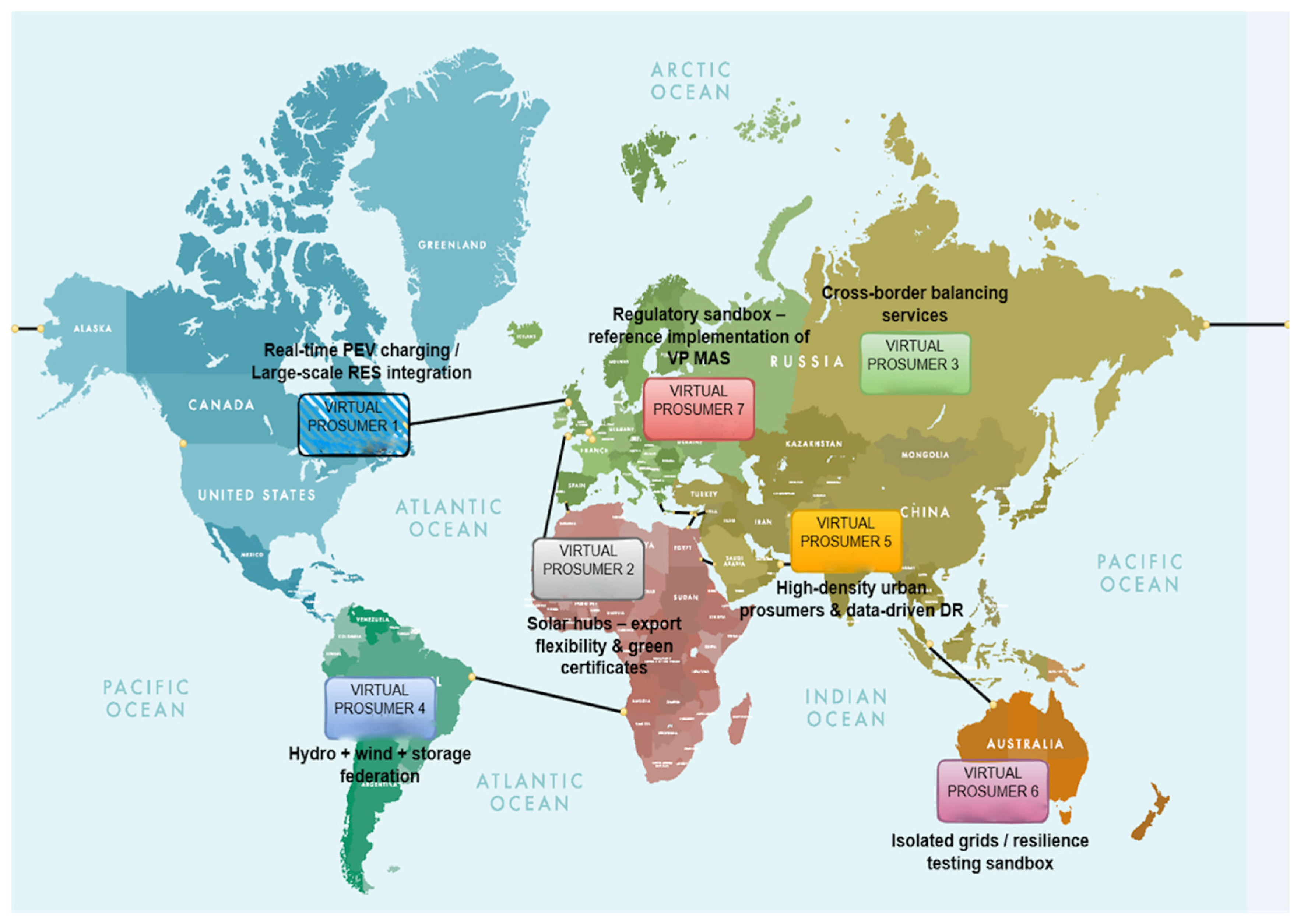
Figure 1. Global Virtual Prosumer (GVP) network used in the case study, illustrating seven geographically distributed Virtual Prosumers (VPs)—each representing a hierarchical macro-entity comprising thousands of local agents and physical assets—and their participation in blockchain-enabled cross-border energy service transactions. VP roles and regional assignments are detailed in Table 1.
Information 17 00396 g001
Figure 2. Layered IoT–AI–blockchain architecture of the Global Virtual Prosumer (GVP) framework. The lowest layer—the Internet of Things (IoT) layer—handles sensing, actuation, and data acquisition from physical energy assets (smart meters, renewable energy sources (RESs), energy storage systems, and electric vehicles (EVs)). The middle layer—the artificial intelligence/multi-agent system (AI/MAS) layer—provides forecasting, optimization, and coordination intelligence through autonomous software agents. The top layer—the blockchain layer—enforces trust, settlement, and global interoperability through smart contracts executed on a permissioned network with Proof-of-Authority (PoA) consensus, where pre-authorized regional blockchain agents serve as validators (Section 4.3.2). Arrows indicate the direction of information and contractual commitment flows across layers: validated and aggregated data flows upward from the IoT layer to the AI/MAS layer, and service commitments and settlement outcomes flow between the AI/MAS and blockchain layers.
Information 17 00396 g002
Figure 3. Smart contract lifecycle flowchart showing the end-to-end progression from off-chain optimization outputs through on-chain trade registration (Algorithm 1), conditional delegation (Algorithm 2) and partner assignment (Algorithm 3), oracle verification, and cross-border settlement with compliance enforcement (Algorithm 4). Decision points, failure modes, and audit trail generation are indicated.
Information 17 00396 g003
Figure 4. Scenario-wise comparison of flexibility and certificate coverage under alternative optimization objectives. Numerical annotations on each bar and Δ labels between pairs confirm that min-cost coverage (blue) is strictly higher than max-welfare coverage (red) in every scenario–service combination (Table 6 and Table 7).
Information 17 00396 g004
Figure 5. Aggregated VP-to-VP commitment matrix across the seven Virtual Prosumers. Each cell reports the total contracted quantity t z i j , s , t (or the number of accepted trades), highlighting who provides which services to whom at the information layer.
Information 17 00396 g005
Figure 6. Smart contract lifecycle event distribution across scenarios S1–S4. The figure shows the number of events per contract stage observed in each scenario, including registration, delegation, partner activation, settlement, and other recorded outcomes where present.
Information 17 00396 g006
Figure 7. Oracle verification performance (K8): credited delivery ratio distribution.
Information 17 00396 g007
Figure 8. Oracle verification failure rate in S4.
Information 17 00396 g008
Figure 9. Settlement performance decomposition under Algorithm 4. Successful settlements are contrasted against non-compliant outcomes and decomposed by root cause (oracle verification failure vs. regulatory inadmissibility), illustrating the role of oracles and compliance hooks in cross-border settlement.
Information 17 00396 g009
Figure 10. Overlay of VP-to-VP contract flow network under Scenario S4. Directed edges show registered commitments (initiator → counterparty), aggregated over time. Colors denote service (BAL/FLEX/CERT) and edge width is proportional to total committed quantity.
Information 17 00396 g010
Figure 11. Contract-level accountability mapping in S4: VP-wise event counts by role (initiator, executor, settlement counterparty).
Information 17 00396 g011
Figure 12. Contract responsibility mapping per VP, scenario (S2–S4), and service (BAL/FLEX/CERT), showing event counts where each VP acted as initiator (blue), executor (orange), or settlement (green) counterparty across the smart-contract lifecycle.
Information 17 00396 g012
Figure 13. Scalability analysis of the GVP framework from |V| = 7 to |V| = 2000 Virtual Prosumers under Scenario S4. (a) Settlement success rate and non-compliance rate remained flat across the entire range. (b) Service coverage ratios (BAL, FLEX, CERT) stabilized within a narrow band from |V| ≥ 50. (c) LP solver time remained sub-3-s, even at |V| = 2000, while total lifecycle events scaled linearly. (d) Top-3 provider concentration decreased monotonically, traceability remained at 100%, and mean credited delivery ratio was invariant.
Information 17 00396 g013
Figure 14. Zoomed convergence bands for key KPIs across |V| = 7 to 2000. Left: SR converged to ≈96.75%, with a tight ±0.62 pp band; the solid blue line shows the SR value at each VP population size, and the shaded blue region represents the ±0.62 pp stability envelope around the grand mean (dashed line), illustrating that SR never leaves this narrow band across the full 285× population increase. Center: BAL, FLEX, and CERT coverage converged from |V| ≥ 50 onwards. Right: mean credited delivery ratio remained invariant at ≈0.919.
Information 17 00396 g014
Figure 15. Computational scaling of the GVP framework. (a) Lifecycle events per VP remained approximately constant (≈133), confirming O(|V|) total scaling; the solid blue line shows the events-per-VP value at each population size, and the shaded blue region represents the variability band around the grand mean (dashed line at 133), illustrating that per-VP event generation is population-invariant. (b) Total lifecycle events vs. VP count with linear fit (137·|V| − 484, R2 ≈ 0.99); the red markers show the actual total event counts at each |V|, and the dashed grey line is the least-squares linear regression, confirming that aggregate on-chain activity scales as O(|V|) rather than combinatorially. (c) LP solver time vs. VP count; the solid green line traces the HiGHS wall-clock solve time at each population size, and the dashed red horizontal line marks the 5 min (300 s) market interval threshold—solver time at |V| = 2000 (2.68 s) was <1% of this threshold, confirming that global coordination remains computationally tractable across the full range evaluated.
Information 17 00396 g015
Table 2. Overview of Virtual Prosumers, regions, and functional roles in the Global Virtual Prosumer framework.
Virtual ProsumerRegionPrimary Role
VP1North AmericaPEVs and Renewable Energy
VP2AfricaSolar Energy Hubs
VP3EuropeBalancing Services
VP4South AmericaHydro and Wind Resources
VP5AsiaDense Urban Energy Systems
VP6AustraliaIsolated and Weak Grids
VP7EuropeRegulatory Sandbox
Table 3. Summary of case study parameters across scenarios S1–S4.
ParameterS1 (Baseline)S2 (Trading)S3 (+Deleg.)S4 (+Settlement)
Virtual Prosumers |V|7777
Services |S|3 (BAL, FLEX, CERT)333
Time slots |T|24242424
Algorithms activatedNoneAlg. 1Alg. 1–3Alg. 1–4
Supply envelopes XU[50,200] MWU[50,200] MWU[50,200] MWU[50,200] MW
Demand envelopes YU[50,200] MWU[50,200] MWU[50,200] MWU[50,200] MW
Cost range c (EUR/MW)1.29–4.511.29–4.511.29–4.511.29–4.51
Utility range u (EUR/MW)2.04–6.482.04–6.482.04–6.482.04–6.48
Admissibility A, BAll = 1All = 1All = 1Partial restrictions
Delegation probabilityp = 0.10p = 0.10
Partner activation prob.p = 0.05p = 0.05
Oracle failure ratep = 0.0327
Optimization objectiveBoth (mc/mw)BothBothBoth
Random seed42424242
U[a,b] = uniform distribution over [a,b]; mc = min-cost, mw = max-welfare. Detailed per-VP envelope profiles, cost/utility coefficients, and admissibility flags are provided in Table 2. Stochastic parameters (delegation, partner activation, oracle failure) are modeled as Bernoulli trials; sensitivity analysis is reported in Section 8.7.
Table 4. Parameterization Summary for the Seven Virtual Prosumers (VPs).
VPRegion/Role (Illustrative)Dominant ServiceEnvelope Scaling (High-Level)Cost Range (per Unit)Utility Range (per Unit)Admissibility Notes (High-Level)
VP1Flexibility hub/exporterFLEXSupply: FLEX High, BAL Med, CERT MedBAL: 2.26–3.06; FLEX: 1.78–2.40; CERT: 1.29–1.75BAL: 2.89–4.08; FLEX: 3.40–4.80; CERT: 2.04–2.88Baseline: admissible for all services (scenario-dependent restrictions may apply).
VP2Solar/certificate hubCERTSupply: BAL Med, FLEX Med, CERT HighBAL: 2.38–3.22; FLEX: 1.87–2.53; CERT: 1.36–1.84BAL: 2.89–4.08; FLEX: 3.40–4.80; CERT: 2.04–2.88Example S4: temporary CERT supply restriction during selected hours (provider-side).
VP3Balancing hub/ancillary providerBALSupply: BAL High, FLEX Med, CERT MedBAL: 2.26–3.06; FLEX: 1.78–2.40; CERT: 1.29–1.75BAL: 2.89–4.08; FLEX: 3.40–4.80; CERT: 2.04–2.88Baseline: admissible for all services.
VP4Interconnector/neutral hubMixedSupply: BAL Med, FLEX Med, CERT MedBAL: 2.38–3.22; FLEX: 1.87–2.53; CERT: 1.36–1.84BAL: 2.89–4.08; FLEX: 3.40–4.80; CERT: 2.04–2.88Baseline: admissible for all services.
VP5Dense-urban demand hubFLEX (demand)Demand: FLEX High; Supply: FLEX Low–MedBAL: 2.62–3.54; FLEX: 2.06–2.78; CERT: 1.50–2.02BAL: 2.89–4.08; FLEX: 4.59–6.48; CERT: 2.04–2.88Baseline: admissible for all services.
VP6Constrained/compliance-sensitive VPMixed (BAL/FLEX)Supply: Overall Low; Demand: MedBAL: 3.33–4.51; FLEX: 2.62–3.54; CERT: 1.90–2.58BAL: 3.32–4.69; FLEX: 3.91–5.52; CERT: 2.04–2.88Example S4: CERT receiving restricted in specified night windows (receiver-side).
VP7Global partner/backup hubMixedSupply: BAL Med, FLEX Med, CERT MedBAL: 2.38–3.22; FLEX: 1.87–2.53; CERT: 1.36–1.84BAL: 2.89–4.08; FLEX: 3.40–4.80; CERT: 2.04–2.88Typically fully admissible; often used as partner/executor in delegation scenarios.
Cost and utility ranges correspond to the synthetic coefficients used in the Python 3.14 pipeline (per-service base values with VP-specific multipliers and bounded variability), while admissibility notes summarize scenario-dependent regulatory hooks (receiver-/provider-side flags) applied in S4.
Table 5. KPI summary per scenario.
ScenarioTradesDelegationsPartner ActivationsSRRRNCRCov_flex
S10000.0%0.0%0.0%0.0%
S27070099.6%0.0%0.4%65.0%
S36907614998.0%0.0%2.0%57.4%
S47036113493.0%0.0%7.0%55.6%
SR = Settled/(Settled + Non-compliant), RR = Rejected/(Registered + Rejected), NCR = Non-compliant/(Settled + Non-compliant), Cov_flex = (Σ verified/credited FLEX settled)/(Σ total FLEX demand).
Table 6. Optimization-level KPI summary for scenarios S1–S4 under the min-cost objective.
Scenario C t o t (K1) C o v B A L (K2) C o v F L E X (K2) C o v C E R T (K2) Δ B A L (K3) Δ F L E X (K3) Δ C E R T (K3)
S1214,8800.880.830.900.120.170.10
S2226,9400.960.900.980.040.100.02
S3226,9400.960.900.980.040.100.02
S4226,1200.960.900.920.040.100.08
Table 7. Optimization-level KPI summary for scenarios S1–S4 under the max-welfare objective.
Scenario W t o t (K1) C o v B A L (K2) C o v F L E X (K2) C o v C E R T (K2) Δ B A L (K3) Δ F L E X (K3) Δ C E R T (K3)
S1118,4600.810.740.830.190.260.17
S2144,5200.910.820.920.090.180.08
S3144,5200.910.820.920.090.180.08
S4142,8800.910.820.850.090.180.15
Table 8. Oracle verification performance summary (K8) for S4.
ServiceN
Attempts
Oracle
failure_rate
Mean   ( q c r e d / q c o m ) [All] Median   ( q c r e d / q c o m ) [All]Under_Delivery
Share [Success]
ALL7030.03270.92120.92311
BAL2450.04890.92020.92011
CERT2250.04440.91910.92041
FLEX2330.00420.92390.93021
Note: The ‘ALL’ failure rate is the attempt-weighted average across services.
Table 9. Scalability KPI summary for Scenario S4 across VP populations |V| = 7 to 2000.
|V|TradesDeleg.Part.SR (%)NCR (%)Cov_BALCov_FLEXCov_CERTTop3 (%)Trace (%)Oracle FRμ(q/q_com)LP (s)
739935697.22.892.987.588.170.31002.760.92170.049
15901791897.03.087.888.589.840.51003.000.91880.065
5037723557396.43.688.788.689.210.51003.610.92060.073
10055364337996.83.289.089.488.37.31003.160.91940.094
20011,942166728496.83.288.889.088.93.41003.230.91850.129
50031,363319162896.83.289.288.988.91.41003.190.91910.343
100068,0836696132196.63.488.888.788.80.61003.380.91860.847
150091,1769452193096.73.388.988.888.90.51003.270.91872.152
2000131,71212,013237396.73.388.988.988.90.31003.270.91892.682
SR = settlement success rate; NCR = non-compliance rate; Cov = service coverage ratio; Top3 = top-3 provider share (K4); Trace = traceability ratio (K9); Oracle FR = oracle verification failure rate; μ(q/qcom) = mean credited delivery ratio; LP(s) = LP solver time in seconds. Rows with |V| ≥ 1000 are highlighted. All runs used seed = 42, |T| = 24, |S| = 3.
Table 10. Blockchain-layer performance projections at |V| = 2000 VPs under Scenario S4.
MetricProjected ValuePlatform CapacityMarginBottleneck?
Throughput (sustained)≈77 TPS200–3000 TPS3–40×No
Confirmation latency2–8 s (global)0.5–2 s (regional)<3% slotNo
Storage growth25–40 GB/yearEnterprise-gradeMitigableMonitor
Gas per event100K–500K units30M/block (PoA)60–300 tx/blkNo
Settlement bursts (B1)Peak > sustainedStaggerPotential
Oracle latency (B2)VariableGrace periodPotential
Cross-region sync (B3)100–300 ms RTTHierarchicalPotential
TPS = transactions per second; gas units refer to EVM-equivalent computational metering. “Margin” denotes the ratio between platform capacity and projected demand or the mitigation strategy for bottleneck rows. Green = comfortable margin; yellow = manageable; orange = requires mitigation.
Table 11. Simulation settings and parameter generation rules.
ParameterValue/Rule
Random seed42 (NumPy default_rng)
Number of Virtual Prosumers |V|7 (VP1–VP7, as defined in Table 2)
Time horizon |T|24 time steps (hourly granularity, 1 day)
Services |S|3 (BAL, FLEX, CERT)
Cost coefficients ci,s,tU(range) per service from Table 4; drawn once per VP
Utility coefficients uj,s,tU(range) per service from Table 4; drawn once per VP
Supply/demand envelopesU[50, 200] MW per VP-service pair; constant over T
Admissibility flags (Aij,s)Bernoulli(0.85); drawn per directed VP pair × service
Oracle failure modelBernoulli(0.0327) per trade at settlement; i.i.d.
Delegation probability (S3, S4)0.30 of accepted FLEX trades trigger delegation
Partner activation (S3, S4)0.20 of delegated trades activate partner VPs
Penalty coefficient λs,t10× max(ci,s,t) per service (max-welfare only)
SolverSciPy linprog (HiGHS backend), Python 3.11
Table 12. Systematic threat-vector mapping: threat description, affected layer, architectural mitigation, detection KPI, and residual risk.
ID/ThreatDescriptionArchitectural MitigationDetection KPI(s)LayerResidual Risk
T1. Oracle manipulationCompromised oracle submits falsified delivery attestation to inflate credited quantityPermissioned oracle identity (Section 7.3); signature verification in Alg. 4 step 2; quantity bounded by min(q_ver, q_com); single-oracle blast radius (only affected trades impacted); revocable identity with on-chain audit trailK8 (oracle failure decomposition); K7 (non-compliance root cause); K9 (actor traceability)Oracle/BlockchainSingle-oracle trust assumption; multi-oracle consensus not yet implemented
T2. Validator collusionSubset of PoA validators collude to censor, reorder, or forge transactionsValidators anchored to independent regulatory entities (Section 4.3.2); institutional separation of interests; periodic rotation and revocation procedures (Section 4.3.4)K9 (lifecycle traceability detects gaps in event sequence); K5 (event volume anomalies)Blockchain (consensus)No on-chain collusion detection; governance-level mitigation only (Section 4.3.4)
T3. Envelope misreportingVP reports inflated supply envelope X to secure larger allocations, then cannot deliverFeasibility check in Alg. 1 (z ≤ X); settlement time delivery verification in Alg. 4; overcommitment recorded as ComplianceViolation with root-cause attributionK7 (non-compliance decomposition: admissibility vs. oracle); K8 (delivery shortfall); K6 (SR decline)AI/MAS → BlockchainSynthetic envelopes in current study; real OPF-derived envelopes not yet validated (Section 4.5.7)
T4. Replay attack on measurement dataAttacker replays old meter readings to satisfy oracle verification with stale dataTimestamped and signed oracle attestations (Section 7.3); Alg. 4 checks time validity of oracle proof against trade record; nonce/sequence number enforcement in oracle protocolK8 (on-chain verification failure: timestamp mismatch flagged as verification-rule violation)IoT → OracleClock synchronization across regions assumed; fine-grained replay detection depends on oracle implementation
T5. Delay/withholding of attestationsOracle deliberately delays submission of delivery proof beyond settlement windowSettlement window timeout in Alg. 4; missing attestation triggers ComplianceViolation with “oracle proof missing” reason code; deferred settlement with grace period (Section 6.8.7, B2)K8 (source/data-feed failure category); K7 (oracle-related non-compliance count)Oracle → BlockchainTimeout duration is configurable but not empirically optimized; no penalty mechanism for oracle delay
T6. Sybil/impersonation attackAttacker creates fake VP identities to manipulate allocation or settlementPermissioned identity scheme with administrative onboarding (Section 7.1); Alg. 1 step 1 verifies registered identity and signature; no open registrationK5 (anomalous trade volume from unknown identities); K9 (unregistered actor flagged)Blockchain (identity)Depends on integrity of administrative onboarding process; no on-chain identity proofing
T7. False data injection at IoT layerCompromised sensor/meter injects fabricated readings into local MAS, corrupting envelopesLocal MAS anomaly detection and multi-source corroboration (Section 7.3); aggregated envelopes mask individual sensor faults; global layer operates on validated bounds onlyK7–K8 (downstream effect detected as delivery shortfall at settlement); K2–K3 (coverage anomaly)IoT → AI/MASDetection is probabilistic; sophisticated injection consistent with plausible ranges may evade local checks
T8. Regulatory admissibility bypassVP circumvents admissibility flags to participate in restricted service/time windowDual enforcement: admissibility checked at registration (Alg. 1, C5) AND at settlement (Alg. 4); flags stored on-chain and immutable within coordination cycleK7 (admissibility-related rejection/non-compliance count); K1 (registration-time rejection rate)Blockchain (smart contract)Correctness depends on externally configured A/B parameters; regulatory conflicts not auto-resolved (Section 4.3.4)
Alg. = algorithm; SR = settlement success rate. KPI numbers refer to the contract-centric KPI suite defined in Section 6.7.
Table 13. One-at-a-time (OAT) sensitivity analysis of stochastic emulator parameters under Scenario S4.
Run IDParameter ValueSR (%)NCR (%)K8: FR (Oracle)DelegationsPartner_Active C o v F L E X C o v C E R T
R1 p o r a c l e 0.010095.164.840.009962.6137.80.55690.5355
R2 p o r a c l e 0.032793.216.790.030862.6137.80.55610.5203
R3 p o r a c l e 0.070089.5810.420.068662.6137.80.55370.4920
R4 p d e l 0.050093.346.660.031434.275.10.55620.5200
R5 p d e l 0.086893.216.790.030862.6137.80.55610.5203
R6 p d e l 0.150093.406.600.0316108.1239.80.55740.5201
R7 p a r t n e r s c a l e   0.700093.296.710.030762.696.00.55670.5214
R8 p a r t n e r s c a l e   1.000093.216.790.030862.6137.80.55610.5203
R9 p a r t n e r s c a l e   1.300093.096.910.030562.6179.50.55450.5197
  • N C R = N o n - c o m p l i a n t S e t t l e d + N o n - c o m p l i a n t , where Non-compliant aggregates oracle verification failures and settlement time admissibility/compliance failures; for Scenario S4, the rejection rate was zero; hence, S R + N C R 1 .
  • K8 reported the oracle-only failure rate F R = f a i l u r e s a t t e m p t s (Table 8), whereas NCR captured the overall fraction of unsuccessful settlements (oracle and settlement time combined).
  • Baseline values corresponded to p o r a c l e 0.0327 (attempt-weighted), p d e l 0.0868 (expected 61 delegations over 703 trades), and partner_scale = 1.0 (expected 134 partner activations).
  • C o v F L E X and C o v C E R T denote mean credited coverage ratios at settlement (Scenario S4), reported here as emulator outputs under the same trade volumes and parameterization.
Table 14. Evaluation dimension comparison: GVP KPI suite vs. representative prior approaches.
Evaluation DimensionLocal P2P
[3,10,12,32]
MAS-VPP
[7,13,14]
Centralized XB
[15,23]
Tokenized/DeFi energy
[38]
GVP (K1–K10)
This Work
Economic aggregates (cost/welfare)YesYesYesPartial
(stylized UAH examples)
Yes (K1)
Service coverage per typePartialPartialNoNoYes (K2, per service)
Shortfall decompositionNoNoNoNoYes (K3)
Allocation concentrationNoNoNoNoYes (K4)
Contract event counts by stageNoNoNoPartial
(Matcher events defined, not measured)
Yes (K5)
Registration rejection rateNoNoNoNoYes (K6)
Settlement success vs. non-complianceNoNoManual auditPartial
(deterministic buyback logic, no empirical settlement KPI)
Yes (K7, with root-cause)
Oracle verification with failure attributionNoNoNoPartial
(oracle interface specified for DSO policy; no failure decomposition)
Yes (K8)
Lifecycle traceability ratioNoNoAuditor-dependentNoYes (K9, 100%)
Verified flexibility coverageNoNoNoNoYes (K10)
Notes: [32] Din & Su (2024)—blockchain billing and P2P trading in a single-jurisdiction smart grid (MATLAB R2023b simulation); evaluation covers economic billing accuracy but no lifecycle KPIs. Folded into the Local P2P column. [38] Evdokimov et al. (2026)—blockchain architecture for hourly electricity rights and yield derivatives (PT/YT/IndexYT tokenization, ERC-1155 order book, oracle-mediated DSO layer); conceptual/architectural study with stylized numerical examples but no empirical settlement KPIs, oracle failure attribution, or lifecycle traceability metrics. “Partial” entries reflect cases where the mechanism is architecturally specified but not empirically evaluated. GVP column highlighted in green denotes dimensions uniquely covered by the proposed framework’s KPI suite (K1–K10).
Disclaimer/Publisher’s Note: The statements, opinions and data contained in all publications are solely those of the individual author(s) and contributor(s) and not of MDPI and/or the editor(s). MDPI and/or the editor(s) disclaim responsibility for any injury to people or property resulting from any ideas, methods, instructions or products referred to in the content.