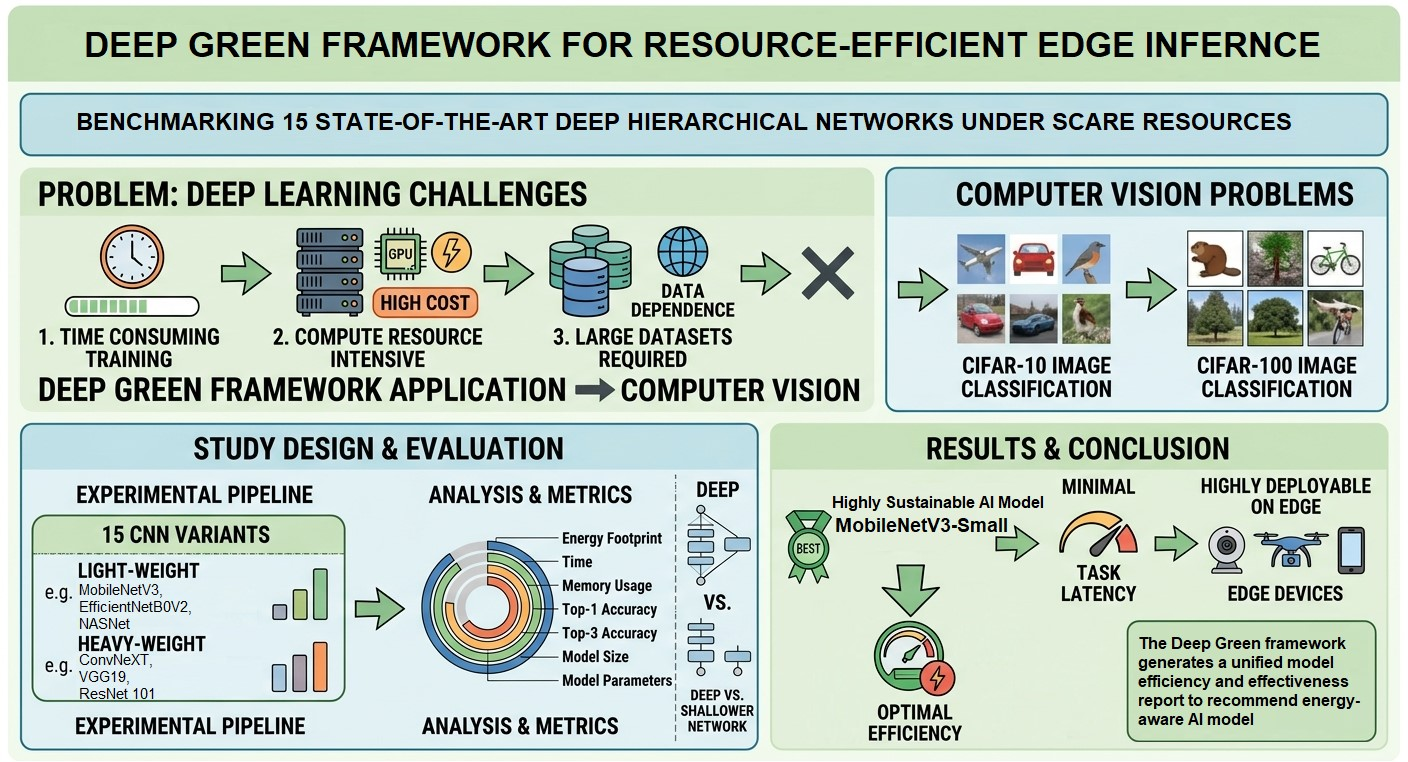
Towards Sustainable AI: Benchmarking Energy Efficiency of Deep Neural Networks for Resource-Constrained Edge Devices



Abstract
1. Introduction
1.1. Motivation and Challenges
1.2. Novelty
2. Measuring Energy in Deep Hierarchical Network
- RQ1:
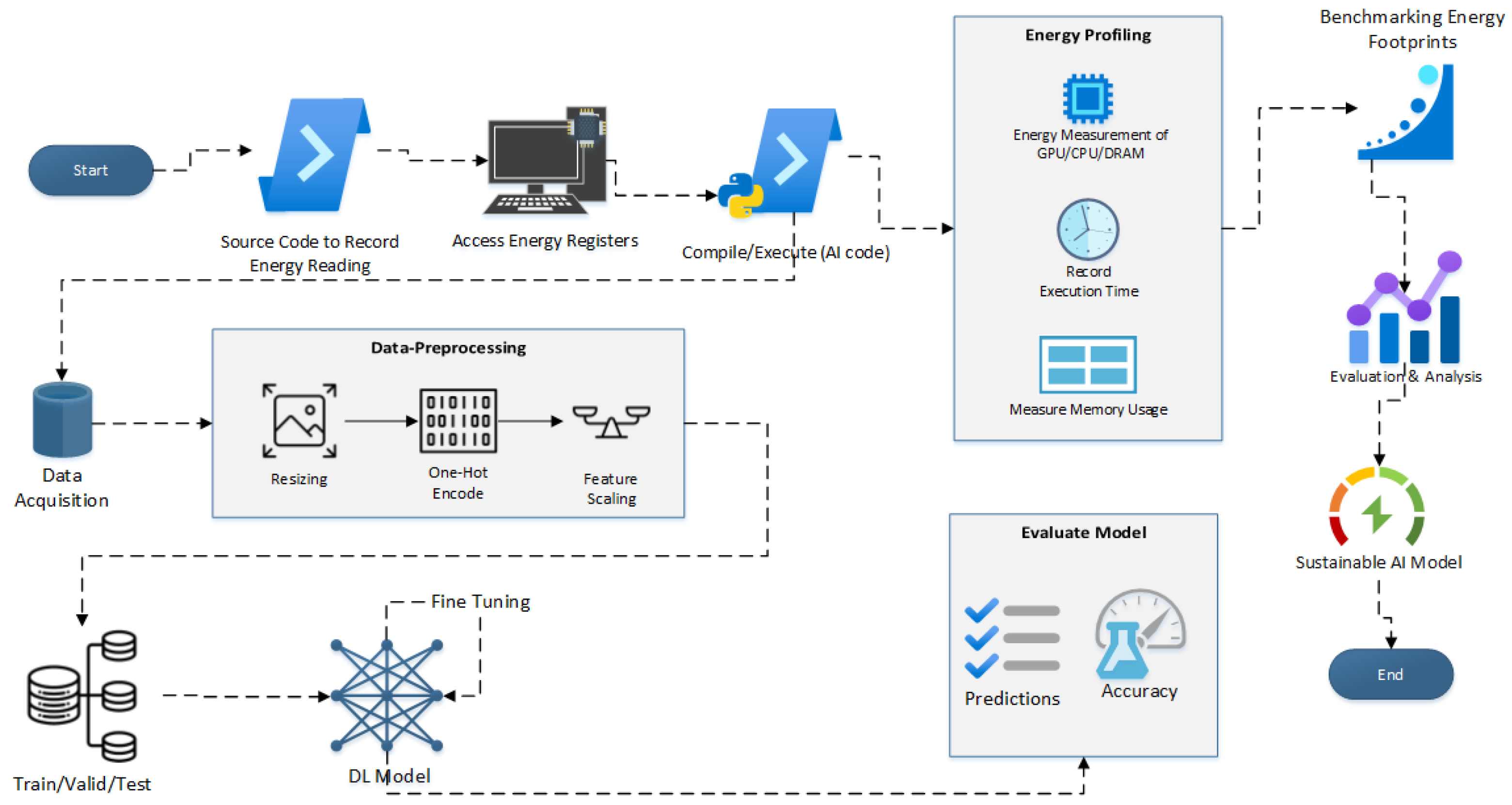
- Can we compare the energy efficiency of deep learning while training and inference? The study found that CNNs are famous for their exceptional ability to process and analyze visual data, which makes it possible to obtain a large, comparable, representative, and diverse set of computer vision datasets. This allows data scientists and researchers to measure, analyze, and compare the energy consumption and energy efficiency of different DL models (Energy = Power × Time).
- RQ2:
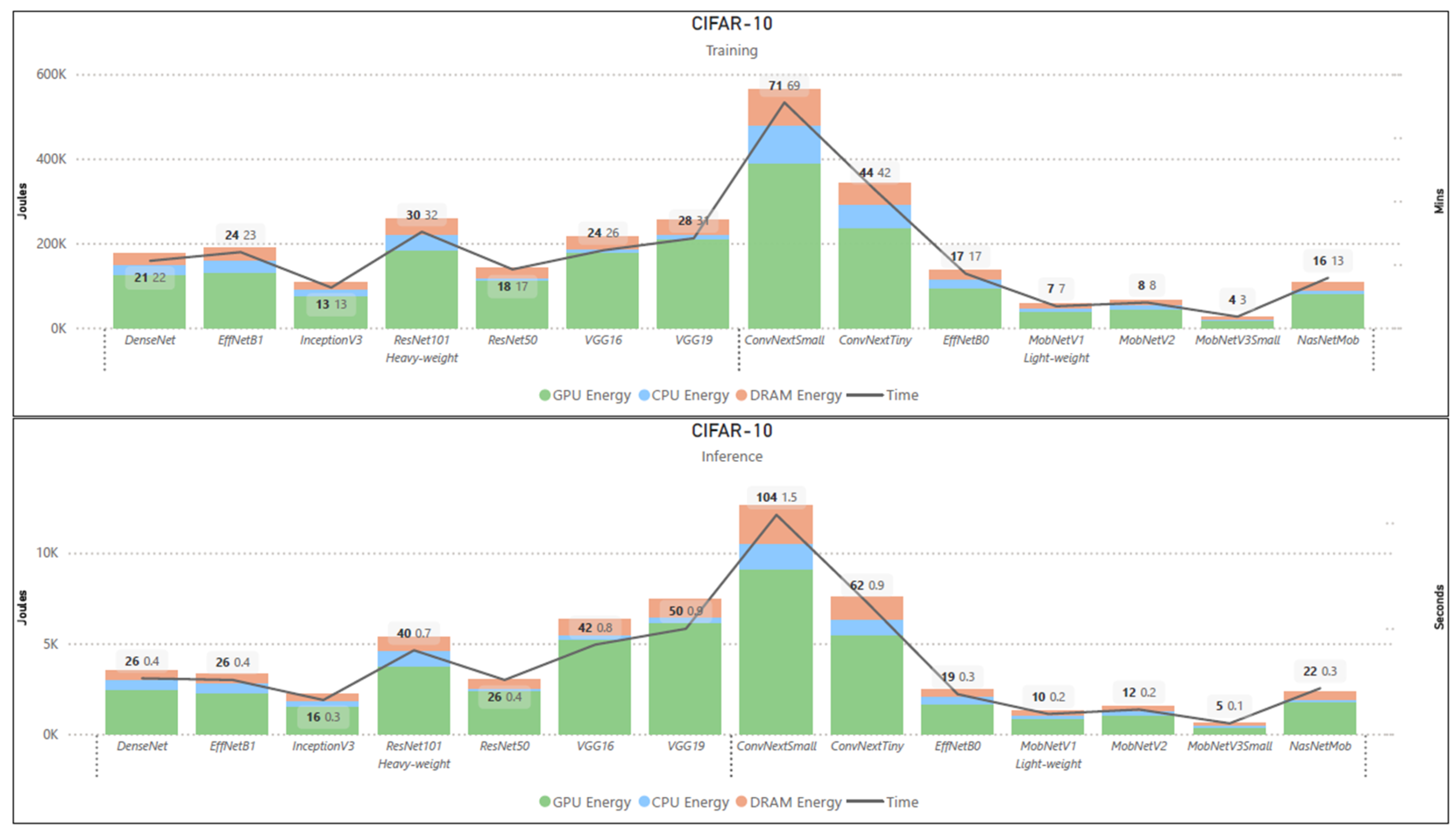
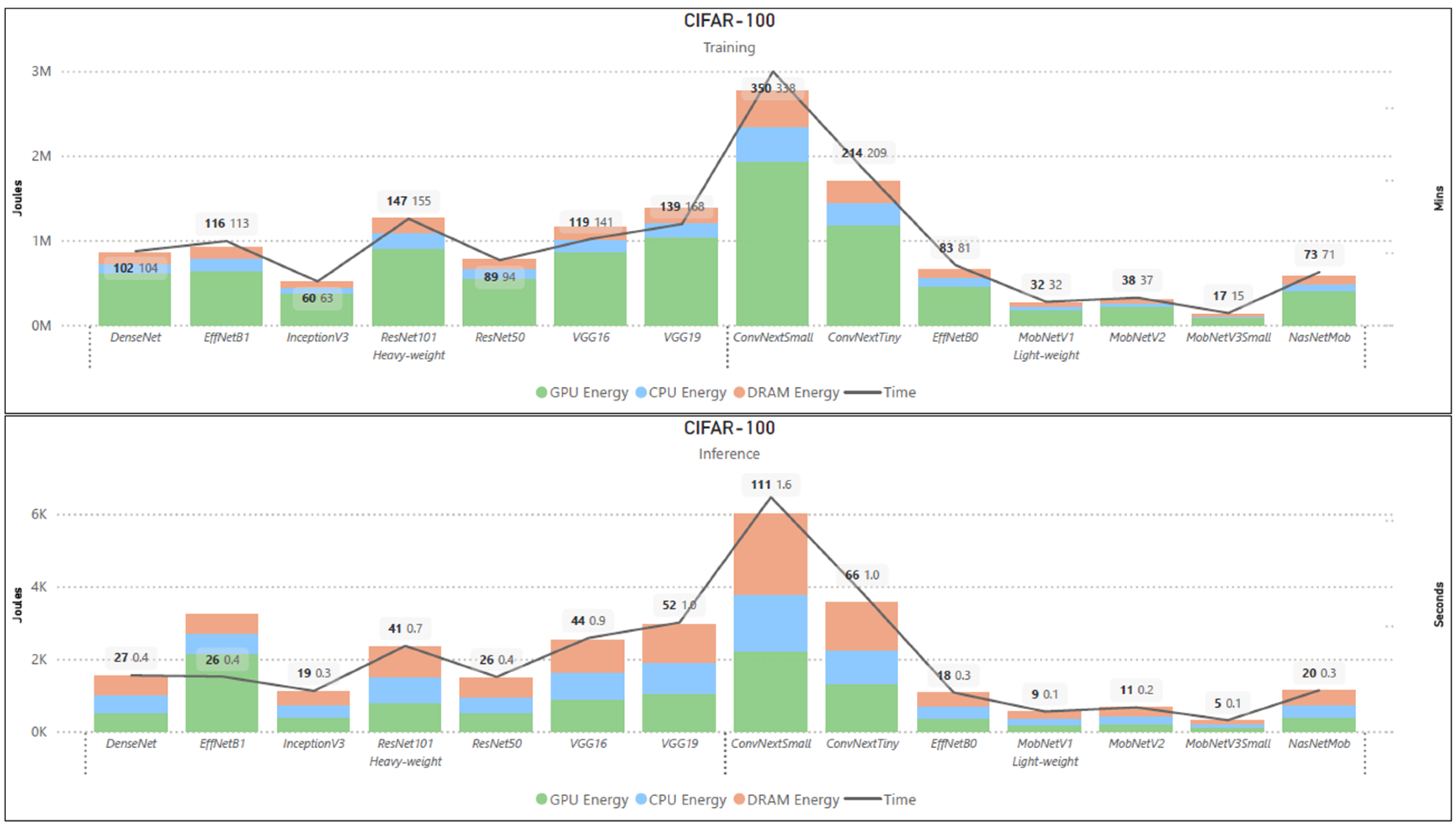
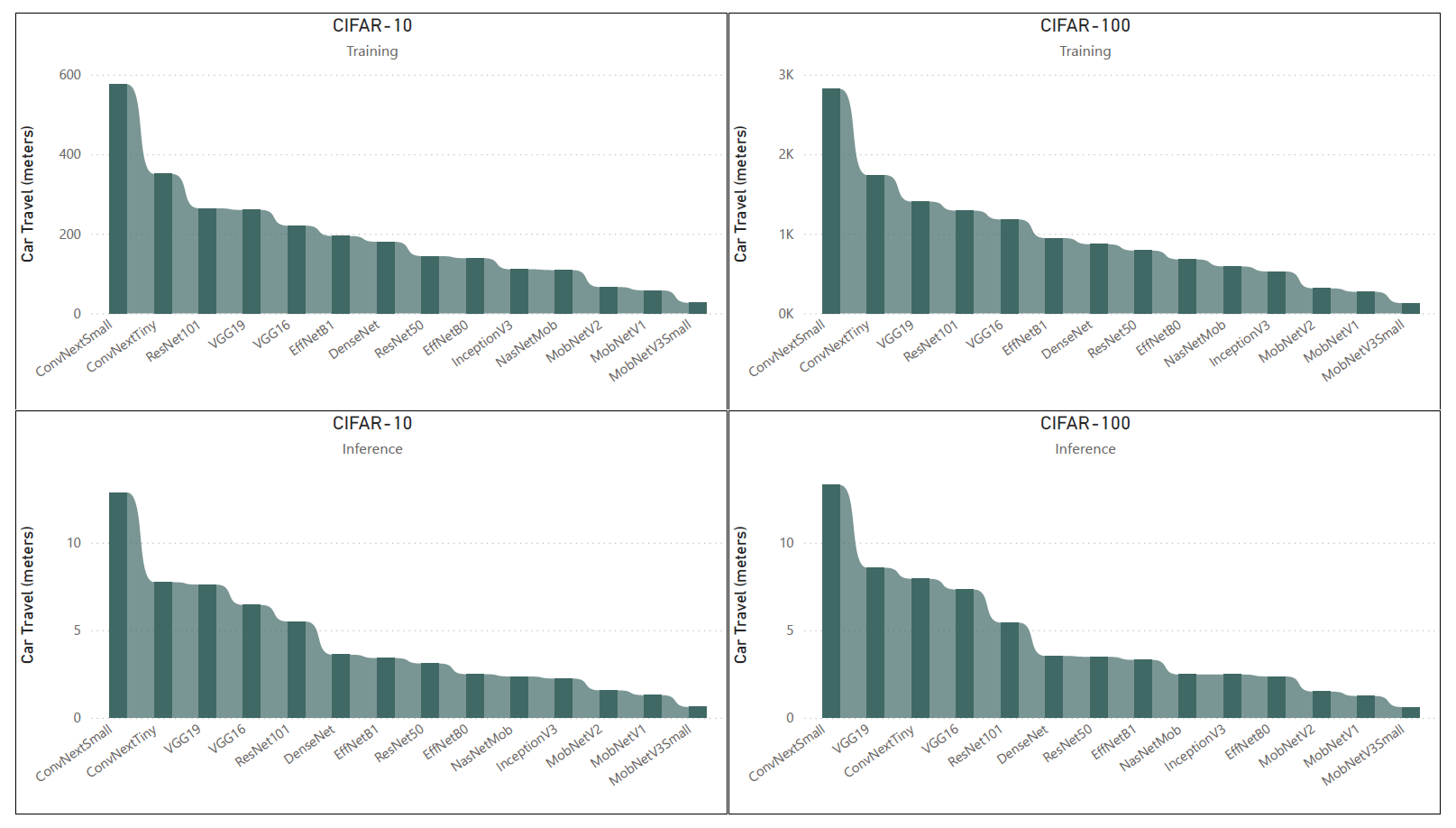
- Is the faster model in terms of training and inference always the greenest (energy-efficient) and computationally efficient model? The study examines whether faster models are inherently more energy-efficient and computationally efficient. The proposed framework provides data scientists with the ability to analyze the relationship between CNN model execution speed and both energy consumption and architectural design complexity.
- RQ3:
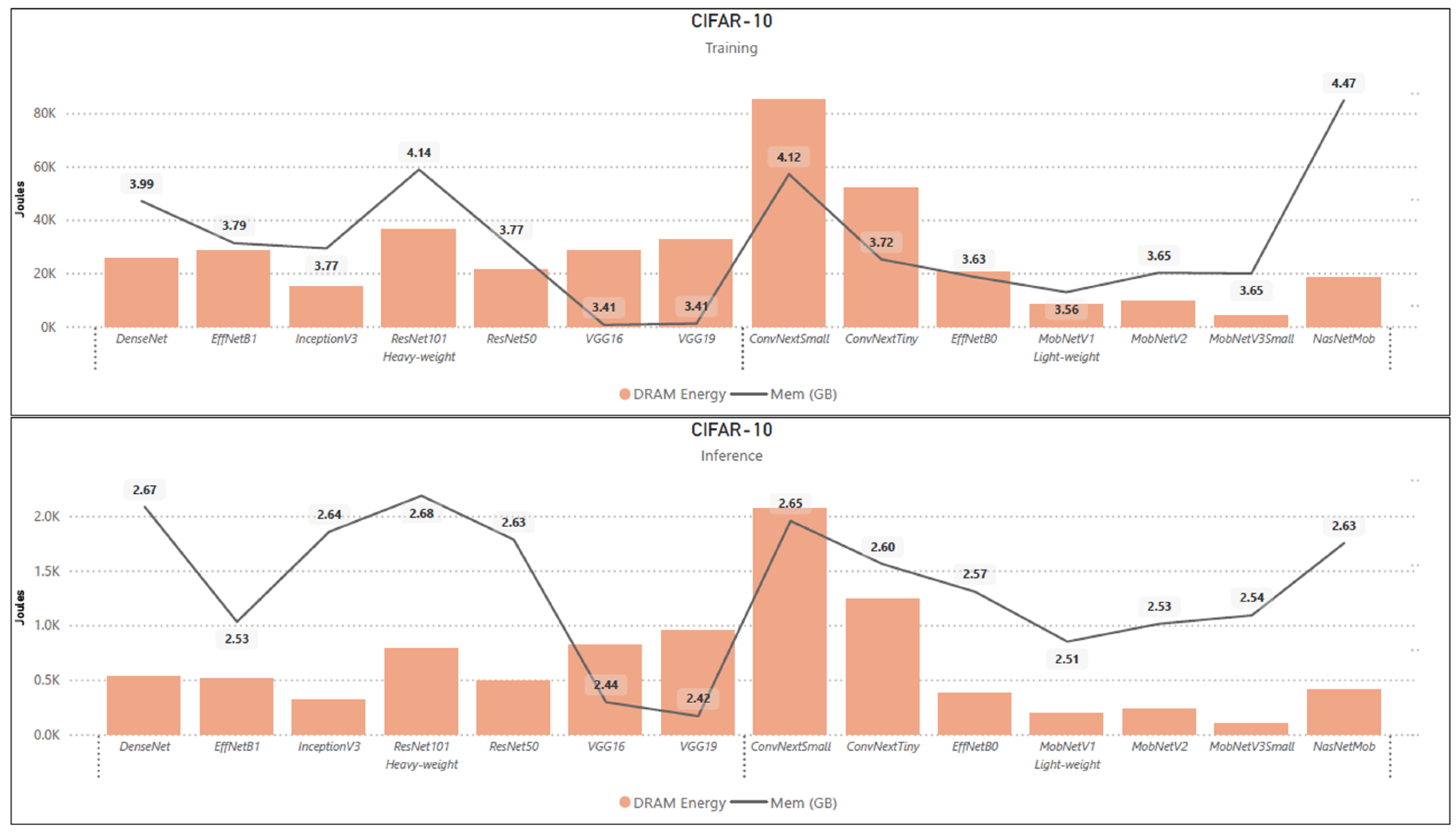
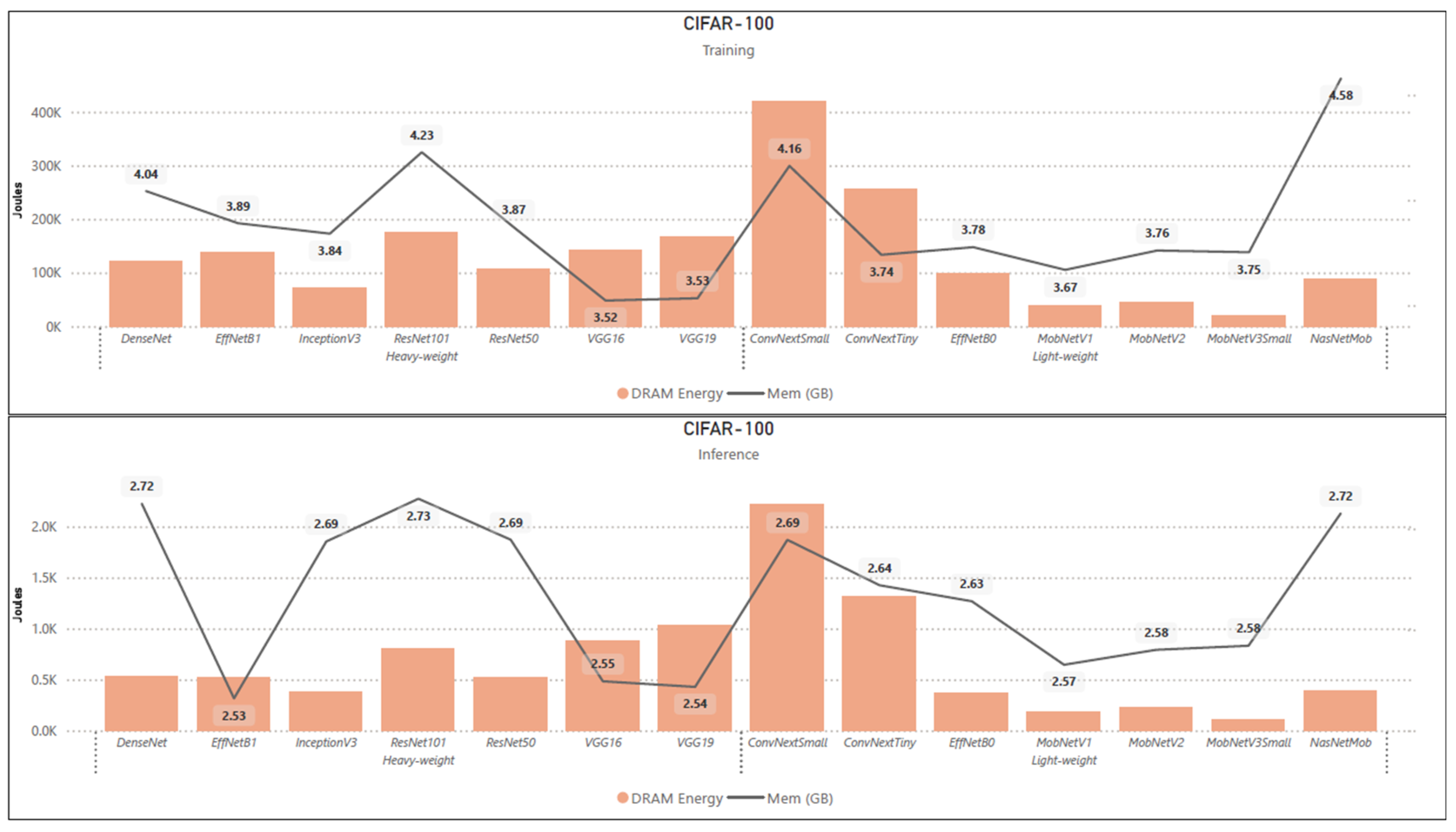
- How does memory usage relate to energy consumption? Understanding how memory usage impacts efficiency. It facilitates effective memory management where computational efficiency is a concern, especially under resource-constrained environments.
- RQ4:
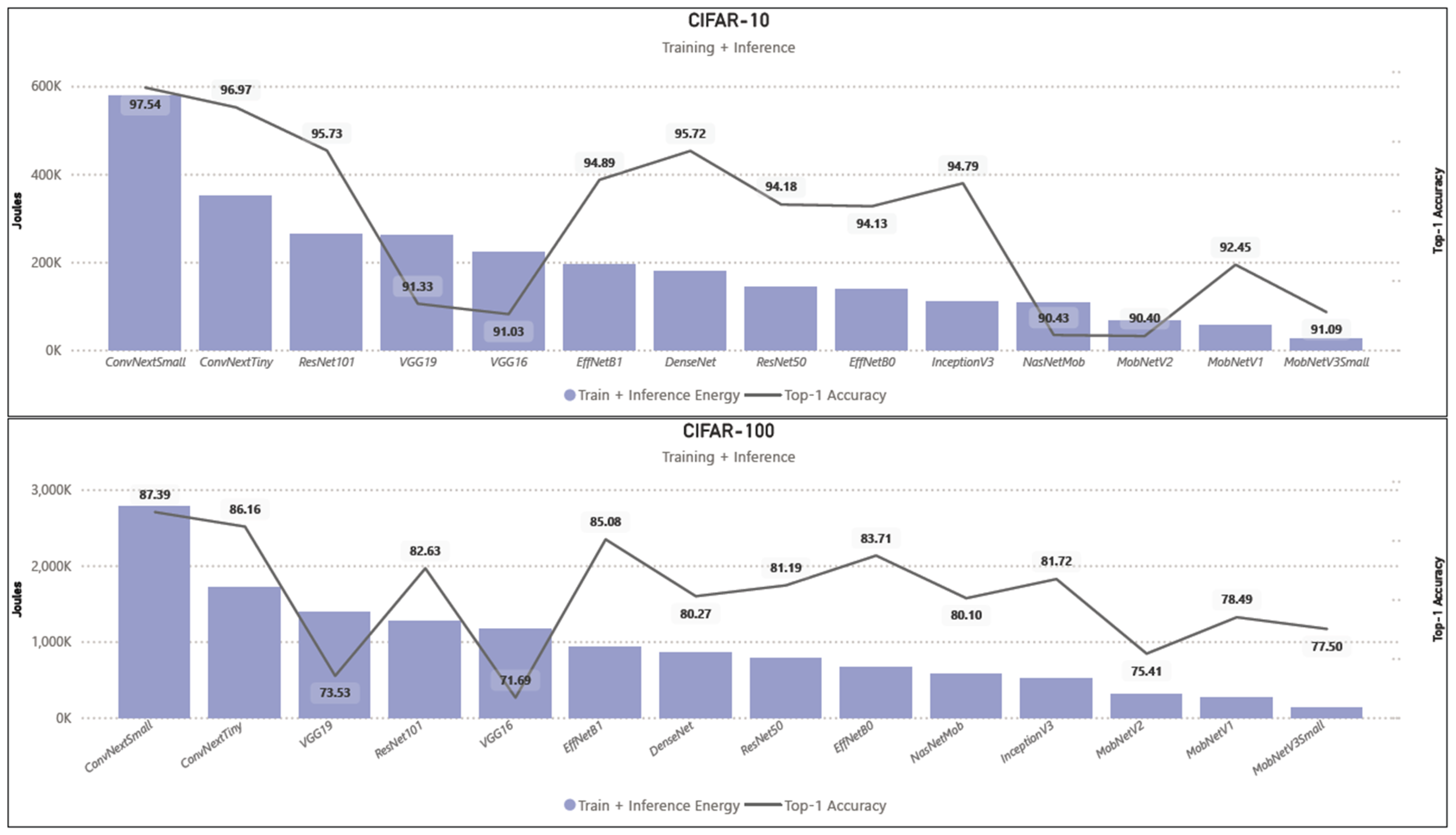
- How does overall energy consumption relate to the resulting accuracy of the model? The study reveals a weak relationship between training and inference energy with the effectiveness of the model.
- RQ5:
- Can a CNN model be automatically identified for an edge environment by considering carbon footprints and energy efficiency, accuracy, task latency, and memory usage? The study analyzed trade-offs between carbon and energy consumption, task latency, and memory usage of different CNN architectures and found notable differences in how these models utilize computational resources. The study provides information on which CNN models are best suited for specific scenarios like resource-constrained environment.
3. Related Work
4. Methodology
4.1. Experimental Setup
4.2. Dataset Description and Key Training Hyperparameters
5. Analysis and Discussion
5.1. Resource-Efficient Edge Inference
5.2. Strategies for Resource-Efficient Edge Inference
5.2.1. Model-Level Optimization
5.2.2. Hardware-Level Optimization
5.2.3. Training-Level Optimization
6. Conclusions
Author Contributions
Funding
Institutional Review Board Statement
Informed Consent Statement
Data Availability Statement
Acknowledgments
Conflicts of Interest
Appendix A

| Classifier | Model Size (MB) | Model Complexity (Parameters in Millions) | CIFAR-10 | CIFAR-100 | ||||
|---|---|---|---|---|---|---|---|---|
| Epoch | Batch Size | Optimizer | Epoch | Batch Size | Optimizer | |||
| MobNetV3SmallLW | 17 | 2.1 | 3 | 32 | SGD | 15 | 32 | SGD |
| MobNetV2LW | 33 | 4.1 | 3 | 32 | SGD | 15 | 32 | SGD |
| MobNetV1LW | 39 | 4.9 | 3 | 32 | SGD | 15 | 32 | SGD |
| EffNetB0LW | 48 | 5.9 | 3 | 32 | SGD | 15 | 32 | SGD |
| NASNetMobLW | 50 | 5.9 | 3 | 32 | SGD | 15 | 32 | SGD |
| EffNetB0V2LW | 63 | 7.8 | 3 | 32 | SGD | 15 | 32 | SGD |
| EffNetB1HW | 68 | 8.5 | 3 | 32 | SGD | 15 | 32 | SGD |
| DenseNetHW | 70 | 8.7 | 3 | 32 | SGD | 15 | 32 | SGD |
| VGG16HW | 126 | 15.8 | 3 | 32 | SGD | 15 | 32 | SGD |
| VGG19HW | 169 | 21.1 | 3 | 32 | SGD | 15 | 32 | SGD |
| InceptionV3HW | 196 | 24.5 | 3 | 32 | SGD | 15 | 32 | SGD |
| ResNet50HW | 210 | 26.3 | 3 | 32 | SGD | 15 | 32 | SGD |
| ConvNeXtTinyLW | 234 | 29.2 | 3 | 16 | SGD | 15 | 16 | SGD |
| ResNet101HW | 363 | 45.3 | 3 | 32 | SGD | 15 | 32 | SGD |
| ConvNeXtSmallLW | 407 | 50.8 | 3 | 16 | SGD | 15 | 16 | SGD |
References
- Malmodin, J. Greenhouse Gas Emissions in the ICT Sector. 2020. Available online: https://c2e2.unepccc.org/wp-content/uploads/sites/3/2020/03/greenhouse-gas-emissions-in-the-ict-sector.pdf (accessed on 10 October 2025).
- Jones, N. How to stop data centres from gobbling up the world’s electricity. Nature 2018, 561, 163–166. [Google Scholar] [CrossRef]
- Liu, Y.; Wei, X.; Xiao, J.; Liu, Z.; Xu, Y.; Tian, Y. Energy consumption and emission mitigation prediction based on data center traffic and PUE for global data centers. Glob. Energy Interconnect. 2020, 3, 272–282. [Google Scholar] [CrossRef]
- Andrae, A.S.G. New perspectives on internet electricity use in 2030. Eng. Appl. Sci. Lett. 2020, 3, 19–31. [Google Scholar] [CrossRef]
- Cambridge Blockchain Network Sustainability Index: CBECI. Available online: https://ccaf.io/cbnsi/cbeci (accessed on 14 October 2025).
- Hao, K. Training a single AI model can emit as much carbon as five cars in their lifetimes. MIT Technol. Rev. 2020, 75, 103. [Google Scholar]
- Su, Z.; Li, Q.; Kaneko, H.; Li, H.; Meng, L. Optimization and Deployment of DNNs for RISC-V-based Edge AI. In 2024 IEEE International Conference on Real-Time Computing and Robotics (RCAR), Alesund, Norway; IEEE: New York, NY, USA, 2024; pp. 200–205. [Google Scholar] [CrossRef]
- Wu, Y.; Wu, C.; Yuan, G.; Li, Y.; Guo, W.; Rao, J.; Shen, X.; Ren, B.; Wang, Y. DACO: Pursuing Ultra-low Power Consumption via DNN-Adaptive CPU-GPU CO-optimization on Mobile Devices. In 2024 Design, Automation & Test in Europe Conference & Exhibition (DATE), Valencia, Spain; IEEE: New York, NY, USA, 2024; pp. 1–2. [Google Scholar] [CrossRef]
- Dhiman, R.; Miteff, S.; Wang, Y.; Ma, S.-C.; Amirikas, R.; Fabian, B. Artificial Intelligence and Sustainability—A review. Analytics 2024, 3, 140–164. [Google Scholar] [CrossRef]
- Li, W.; Hacid, H.; Almazrouei, E.; Debbah, M. A comprehensive review and a taxonomy of edge machine learning: Requirements, paradigms, and techniques. AI 2023, 4, 729–786. [Google Scholar] [CrossRef]
- Pinto, G.; Castor, F.; Liu, Y.D. Mining questions about software energy consumption. In Proceedings of the 11th Working Conference on Mining Software Repositories; Association for Computing Machinery: New York, NY, USA, 2014; pp. 22–31. [Google Scholar] [CrossRef]
- Pang, C.; Hindle, A.; Adams, B.; Hassan, A.E. What Do Programmers Know about Software Energy Consumption? IEEE Softw. 2016, 33, 83–89. [Google Scholar] [CrossRef]
- Ardito, L.; Morisio, M. Green IT—Available data and guidelines for reducing energy consumption in IT systems. Sustain. Comput. Inform. Syst. 2013, 4, 24–32. [Google Scholar] [CrossRef]
- Verdecchia, R.; Lago, P.; Ebert, C.; De Vries, C. Green IT and green software. IEEE Softw. 2021, 38, 7–15. [Google Scholar] [CrossRef]
- Pereira, R.; Couto, M.; Ribeiro, F.; Rua, R.; Cunha, J.; Fernandes, J.P.; Saraiva, J. Ranking programming languages by energy efficiency. Sci. Comput. Program. 2021, 205, 102609. [Google Scholar] [CrossRef]
- Georgiou, S.; Kechagia, M.; Louridas, P.; Spinellis, D. What are Your Programming Language’s Energy-Delay Implications? In 2018 IEEE/ACM 15th International Conference on Mining Software Repositories (MSR), Gothenburg, Sweden; Association for Computing Machinery: New York, NY, USA, 2018; pp. 303–313. [Google Scholar] [CrossRef]
- Liu, K.; Pinto, G.; Liu, Y.D. Data-Oriented characterization of Application-Level energy optimization. In Lecture Notes in Computer Science; Springer: Berlin/Heidelberg, Germany, 2015; pp. 316–331. [Google Scholar] [CrossRef]
- Noureddine, A.; Bourdon, A.; Rouvoy, R.; Seinturier, L. A preliminary study of the impact of software engineering on GreenIT. In 2012 First International Workshop on Green and Sustainable Software (GREENS), Zurich, Switzerland; IEEE: New York, NY, USA, 2012; pp. 21–27. [Google Scholar] [CrossRef]
- Johann, T.; Dick, M.; Naumann, S.; Kern, E. How to measure energy-efficiency of software: Metrics and measurement results. In 2012 First International Workshop on Green and Sustainable Software (GREENS), Zurich, Switzerland; IEEE: New York, NY, USA, 2012; pp. 51–54. [Google Scholar] [CrossRef]
- Henderson, P.; Hu, J.; Romoff, J.; Brunskill, E.; Jurafsky, D.; Pineau, J. Towards the systematic reporting of the energy and carbon footprints of machine learning. arXiv 2020. [Google Scholar] [CrossRef]
- Anthony, L.F.W.; Kanding, B.; Selvan, R. CarbonTracker: Tracking and Predicting the carbon footprint of training deep learning models. arXiv 2020. [Google Scholar] [CrossRef]
- Hähnel, M.; Döbel, B.; Völp, M.; Härtig, H. Measuring energy consumption for short code paths using RAPL. ACM SIGMETRICS Perform. Eval. Rev. 2012, 40, 13–17. [Google Scholar] [CrossRef]
- Khan, K.N.; Hirki, M.; Niemi, T.; Nurminen, J.K.; Ou, Z. RAPL in action. ACM Trans. Model. Perform. Eval. Comput. Syst. 2018, 3, 9. [Google Scholar] [CrossRef]
- Noureddine, A. PowerJoular and JoularJX: Multi-Platform Software Power Monitoring Tools. In 2022 18th International Conference on Intelligent Environments (IE), Biarritz, France; IEEE: New York, NY, USA, 2022; pp. 1–4. [Google Scholar] [CrossRef]
- Patterson, D.; Gonzalez, J.; Holzle, U.; Le, Q.; Liang, C.; Munguia, L.-M.; Rothchild, D.; So, D.R.; Texier, M.; Dean, J. The carbon footprint of machine learning training will plateau, then shrink. Computer 2022, 55, 18–28. [Google Scholar] [CrossRef]
- Wu, C.J.; Raghavendra, R.; Gupta, U.; Acun, B.; Ardalani, N.; Maeng, K.; Chang, G.; Aga, F.; Huang, J.; Bai, C.; et al. Sustainable AI: Environmental implications, challenges and opportunities. arXiv 2021. [Google Scholar] [CrossRef]
- Lannelongue, L. Carbon Footprint, the (Not So) Hidden Cost of High Performance Computing. BCS, 11 October 2023. Available online: https://www.bcs.org/articles-opinion-and-research/carbon-footprint-the-not-so-hidden-cost-of-high-performance-computing/ (accessed on 14 October 2025).
- Kleinman, Z.; Vallance, C. Warning AI Industry Could Use as much Energy as the Netherlands. BBC News, 10 October 2023. Available online: https://www.bbc.com/news/technology-67053139 (accessed on 10 October 2025).
- Dhar, P. The carbon impact of artificial intelligence. Nat. Mach. Intell. 2020, 2, 423–425. [Google Scholar] [CrossRef]
- Zhao, H.; Cui, W.; Chen, Q.; Zhang, S.; Li, Z.; Leng, J.; Li, C.; Zeng, D.; Guo, M. Towards fast setup and high throughput of GPU serverless computing. arXiv 2024. [Google Scholar] [CrossRef]
- Verdecchia, R.; Sallou, J.; Cruz, L. A systematic review of Green AI. Wiley Interdiscip. Rev. Data Min. Knowl. Discov. 2023, 13, e1507. [Google Scholar] [CrossRef]
- Tabbakh, A.; Amin, L.A.; Islam, M.; Mahmud, G.M.I.; Chowdhury, I.K.; Mukta, M.S.H. Towards sustainable AI: A comprehensive framework for Green AI. Discov. Sustain. 2024, 5, 408. [Google Scholar] [CrossRef]
- Wang, Q.; Li, Y.; Li, R. Ecological footprints, carbon emissions, and energy transitions: The impact of artificial intelligence (AI). Humanit. Soc. Sci. Commun. 2024, 11, 1043. [Google Scholar] [CrossRef]
- You, J.; Chung, J.-W.; Chowdhury, M. ZEUS: Understanding and Optimizing {GPU} Energy Consumption of {DNN} Training. 2023. Available online: https://www.usenix.org/conference/nsdi23/presentation/you (accessed on 20 October 2025).
- Santos, S.O.S.; Skiarski, A.; García-Núñez, D.; Lazzarini, V.; Moral, R.D.A.; Galvan, E.; Ottoni, A.L.C.; Nepomuceno, E. Green Machine Learning: Analysing the Energy Efficiency of Machine Learning Models. In Irish Signals and Systems Conference; IEEE: New York, NY, USA, 2024. [Google Scholar] [CrossRef]
- Yenikaya, M.A.; Oktaysoy, O. Machine learning in energy efficiency: Comparison of energy estimation models. EKEV Akad. Derg. 2025, 103, 196–210. [Google Scholar] [CrossRef]
- Aldoseri, A.; Al-Khalifa, K.N.; Hamouda, A.M. Methodological approach to assessing the current state of organizations for AI-Based Digital Transformation. Appl. Syst. Innov. 2024, 7, 14. [Google Scholar] [CrossRef]
- Jean-Quartier, C.; Bein, K.; Hejny, L.; Hofer, E.; Holzinger, A.; Jeanquartier, F. The Cost of Understanding—XAI Algorithms towards Sustainable ML in the View of Computational Cost. Computation 2023, 11, 92. [Google Scholar] [CrossRef]
- PyRAPL. PyPI, 19 December 2019. Available online: https://pypi.org/project/pyRAPL/ (accessed on 14 October 2025).
- Client Challenge. Available online: https://pypi.org/project/pyJoules/ (accessed on 14 October 2025).
- Kliu. GitHub-kliu20/jRAPL. GitHub. Available online: https://github.com/kliu20/jRAPL/ (accessed on 14 October 2025).
- Liao, S.; Xie, Y.; Lin, X.; Wang, Y.; Zhang, M.; Yuan, B. Reduced-Complexity deep neural networks design using Multi-Level compression. IEEE Trans. Sustain. Comput. 2017, 4, 245–251. [Google Scholar] [CrossRef]
- Menghani, G. Efficient Deep Learning: A survey on making deep learning models smaller, faster, and better. ACM Comput. Surv. 2023, 55, 259. [Google Scholar] [CrossRef]
- Russakovsky, O.; Deng, J.; Su, H.; Krause, J.; Satheesh, S.; Ma, S.; Huang, Z.; Karpathy, A.; Khosla, A.; Bernstein, M.; et al. ImageNet Large Scale Visual Recognition Challenge. Int. J. Comput. Vis. 2015, 115, 211–252. [Google Scholar] [CrossRef]
- Monitoring of CO2 Emissions from Passenger Cars. Available online: https://co2cars.apps.eea.europa.eu/ (accessed on 12 September 2025).
- Electricity: Which Appliances Consume the Most in Your Home? Act for the Ecological Transition, 11 November 2025. Available online: https://agirpourlatransition.ademe.fr/particuliers/economiser/energie/consommation-appareils-menagers (accessed on 15 September 2025).
- Cheng, Y.; Wang, D.; Zhou, P.; Zhang, T. A survey of model compression and acceleration for deep neural networks. arXiv 2017. [Google Scholar] [CrossRef]
- Zhuang, F.; Qi, Z.; Duan, K.; Xi, D.; Zhu, Y.; Zhu, H.; Xiong, H.; He, Q. A comprehensive survey on transfer learning. Proc. IEEE 2020, 109, 43–76. [Google Scholar] [CrossRef]
- Xu, Y.; Khan, T.M.; Song, Y.; Meijering, E. Edge deep learning in computer vision and medical diagnostics: A comprehensive survey. Artif. Intell. Rev. 2025, 58, 3. [Google Scholar] [CrossRef]


| Specification | Requirements |
|---|---|
| Deep Learning Specification |
|
| Edge Computing Specifications |
|
| Overall Specifications |
|
| Measure Name | Notion |
|---|---|
| Energy | where
|
| Energy Efficiency |
|
| Relative Energy Efficiency |
|
| Carbon Dioxide Emission |
|
| Equivalent Usage Emission |
|
| Classifier | CIFAR-10 | CIFAR-100 | Relative Efficiency (%) | ||||||||
|---|---|---|---|---|---|---|---|---|---|---|---|
| Energy (J) | Time (s) | Mem (GB) | Top-1 Accuracy | Top-3 Accuracy | Energy (J) | Time (s) | Mem (GB) | Top-1 Accuracy | Top-3 Accuracy | ||
| MobNetV3SmallLW | 25,992 | 216 | 6.19 | 91.09 | 99.04 | 124,356 | 1001 | 6.34 | 77.5 | 92.65 | 100 |
| MobNetV1LW | 57,380 | 418 | 6.07 | 92.45 | 99.21 | 264,159 | 1925 | 6.23 | 78.49 | 92.58 | 47.41 |
| MobNetV2LW | 65,899 | 491 | 6.18 | 90.4 | 98.82 | 307,491 | 2272 | 6.34 | 75.41 | 90.77 | 39.60 |
| EffNetB0V2LW | 95,285 | 724 | 5.06 | 94.01 | 99.45 | 462,996 | 3526 | 6.22 | 84.76 | 96.11 | 28.56 |
| InceptionV3HW | 110,369 | 778 | 6.41 | 94.79 | 99.56 | 516,232 | 3629 | 6.53 | 81.72 | 94.25 | 25.12 |
| NASNetMobLW | 108,534 | 968 | 7.09 | 90.43 | 98.63 | 578,874 | 4406 | 7.29 | 80.1 | 93.52 | 22.12 |
| EffNetB0LW | 137,995 | 1045 | 6.2 | 94.13 | 99.36 | 664,902 | 4990 | 6.4 | 83.71 | 95.88 | 19.75 |
| ResNet50HW | 143,695 | 1132 | 6.4 | 94.18 | 99.58 | 774,934 | 5394 | 6.56 | 81.19 | 94.15 | 17.02 |
| DenseNetHW | 179,481 | 1295 | 6.66 | 95.72 | 99.69 | 853,042 | 6144 | 6.77 | 80.27 | 94.17 | 15.20 |
| EffNetB1HW | 193,568 | 1459 | 6.33 | 94.89 | 99.68 | 928,808 | 6970 | 6.42 | 85.08 | 96.31 | 14.30 |
| VGG16HW | 222,019 | 1509 | 5.85 | 91.03 | 99.1 | 1162,817 | 7166 | 6.07 | 71.69 | 89.01 | 10.48 |
| ResNet101HW | 264,034 | 1857 | 6.82 | 95.73 | 99.63 | 1269,484 | 8833 | 6.96 | 82.63 | 94.7 | 10.37 |
| VGG19HW | 262,008 | 1745 | 5.84 | 91.33 | 98.91 | 1384,247 | 8410 | 6.08 | 73.53 | 89.65 | 8.93 |
| ConvNeXtTinyLW | 350,932 | 2673 | 6.32 | 96.97 | 99.77 | 1711,460 | 12,911 | 6.38 | 86.16 | 96.41 | 7.92 |
| ConvNeXtSmallLW | 576,910 | 4370 | 6.77 | 97.54 | 99.88 | 2,777,480 | 21,096 | 6.85 | 87.39 | 96.71 | 4.92 |
| Relationship | Spearman ρ | Correlation |
|---|---|---|
| Energy and Time | 0.99 | Very Strong |
| Energy and Memory | 0.71 | Strong |
| Memory and Time | 0.68 | Strong |
| Energy and Accuracy | 0.45 | Weak |
| ||
| Classifier | CIFAR-10 Inference | CIFAR-100 Inference | ||||||
|---|---|---|---|---|---|---|---|---|
| Inference Latency (s) | Per-Sample Latency (ms) | Throughput (inf/s) | Infernce Backend | Inference Latency (s) | Per-Sample Latency (ms) | Throughput (inf/s) | Inference Backend | |
| MobNetV3 Small | 4.85 | 0.48 | 2063 | GPU | 4.85 | 0.49 | 2060 | GPU |
| 21.64 | 2.16 | 462 | CPU | 30.05 | 3.01 | 333 | CPU | |
| 16.79 | 1.68 | 596 | XNNPACK | 16.76 | 1.68 | 597 | XNNPACK | |
| MobNetV1 | 8.99 | 0.90 | 1112 | GPU | 9.01 | 0.90 | 1110 | GPU |
| 69.22 | 6.92 | 144 | CPU | 87.26 | 8.73 | 115 | CPU | |
| 112.55 | 11.26 | 89 | XNNPACK | 112.37 | 11.24 | 89 | XNNPACK | |
| NASNetMob | 19.13 | 1.91 | 523 | GPU | 19.17 | 1.92 | 522 | GPU |
| 98.53 | 9.85 | 101 | CPU | 127.18 | 12.72 | 79 | CPU | |
| 164.86 | 16.49 | 61 | XNNPACK | 164.13 | 16.41 | 61 | XNNPACK | |
| EffNetB0V2 | 13.11 | 1.31 | 763 | GPU | 13.13 | 1.31 | 761 | GPU |
| 80.30 | 8.03 | 125 | CPU | 103.64 | 10.36 | 96 | CPU | |
| 169.06 | 16.91 | 59 | XNNPACK | 169.88 | 16.99 | 59 | XNNPACK | |
| InceptionV3 | 15.37 | 1.54 | 651 | GPU | 15.20 | 1.52 | 658 | GPU |
| 118.14 | 11.81 | 85 | CPU | 132.99 | 13.30 | 75 | CPU | |
| 524.20 | 52.42 | 19 | XNNPACK | 526.39 | 52.64 | 19 | XNNPACK | |
Disclaimer/Publisher’s Note: The statements, opinions and data contained in all publications are solely those of the individual author(s) and contributor(s) and not of MDPI and/or the editor(s). MDPI and/or the editor(s) disclaim responsibility for any injury to people or property resulting from any ideas, methods, instructions or products referred to in the content. |
© 2026 by the authors. Licensee MDPI, Basel, Switzerland. This article is an open access article distributed under the terms and conditions of the Creative Commons Attribution (CC BY) license.
Share and Cite
Qamar, R.; Asif, R.; Jameel, S.M. Towards Sustainable AI: Benchmarking Energy Efficiency of Deep Neural Networks for Resource-Constrained Edge Devices. Information 2026, 17, 380. https://doi.org/10.3390/info17040380
Qamar R, Asif R, Jameel SM. Towards Sustainable AI: Benchmarking Energy Efficiency of Deep Neural Networks for Resource-Constrained Edge Devices. Information. 2026; 17(4):380. https://doi.org/10.3390/info17040380
Chicago/Turabian StyleQamar, Rohail, Raheela Asif, and Syed Muslim Jameel. 2026. "Towards Sustainable AI: Benchmarking Energy Efficiency of Deep Neural Networks for Resource-Constrained Edge Devices" Information 17, no. 4: 380. https://doi.org/10.3390/info17040380
APA StyleQamar, R., Asif, R., & Jameel, S. M. (2026). Towards Sustainable AI: Benchmarking Energy Efficiency of Deep Neural Networks for Resource-Constrained Edge Devices. Information, 17(4), 380. https://doi.org/10.3390/info17040380