1. Introduction
With the accelerating global transition to low-carbon energy systems, wind power has emerged as a pivotal clean and renewable energy source, progressively increasing its share in the power system [
1]. Yet, wind power generation exhibits obvious intermittency and volatility due to dynamic coupling of meteorological conditions, geographical distribution, and equipment operational states, posing substantial challenges to grid operations, electricity market participation, and wind farm maintenance [
2,
3]. Statistics show that high-precision wind power prediction can reduce the wind abandonment rate by 15–20%, yielding annual operational cost savings exceeding millions of dollars for grid operators [
4]. Thus, developing high-precision and robust wind power prediction models has become a focus in both academia and industry [
5].
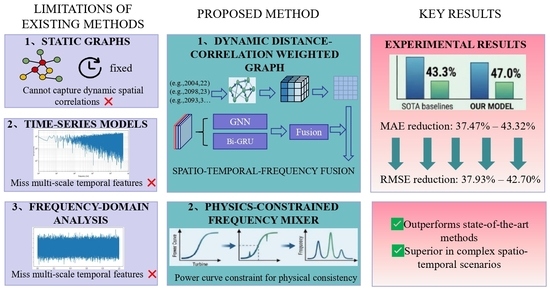
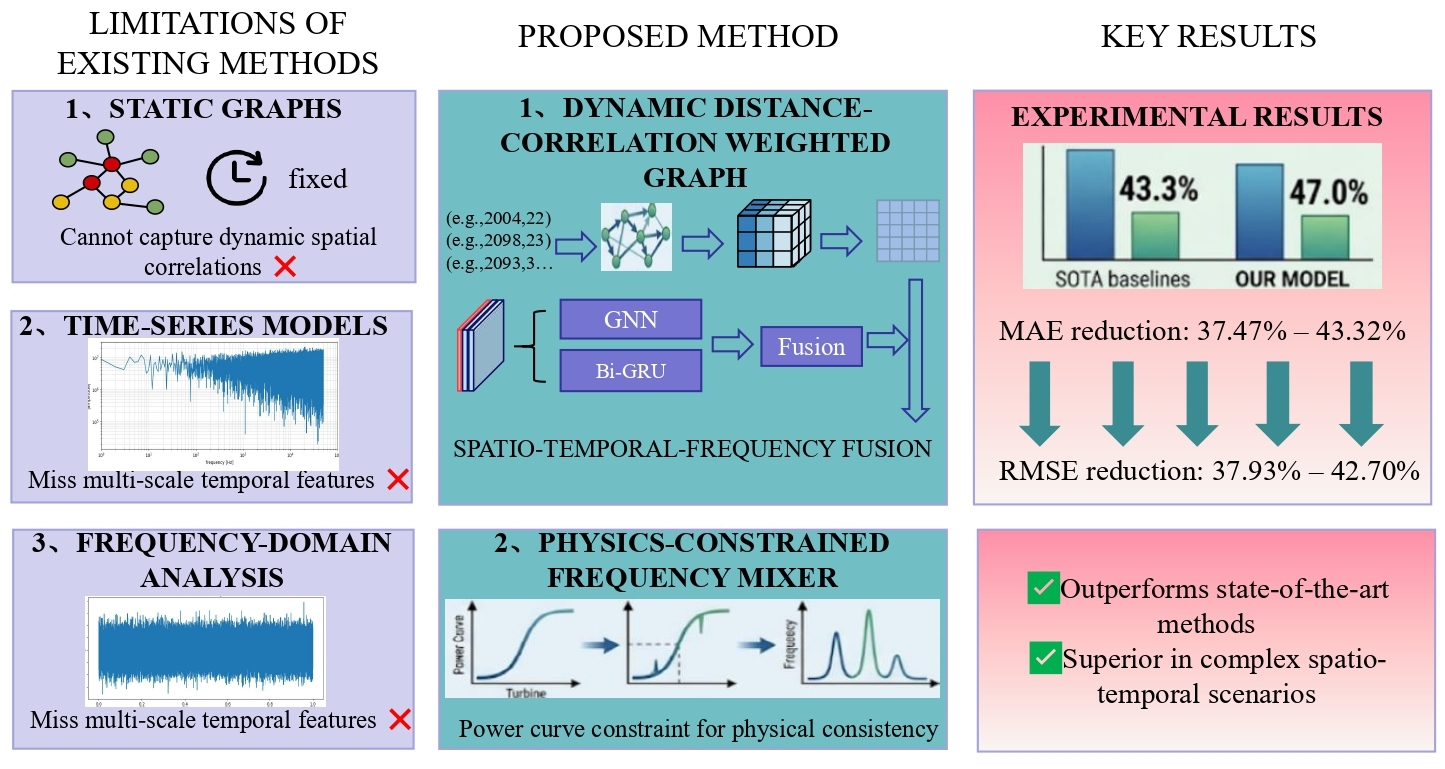
Over the past few years, remarkable advancements have been made in wind power forecasting research, covering a wide spectrum of methodologies including physical models, statistical approaches, conventional machine learning techniques, and deep learning-based frameworks. Each category of methods has demonstrated unique merits in addressing partial forecasting demands, yet persistent bottlenecks remain unresolved in practical engineering scenarios. Existing methods are plagued by prominent defects: static graph construction strategies fail to perceive dynamic spatial dependencies driven by variable meteorological conditions and wake effects; traditional time series modeling architectures lack the capability to extract multi-scale temporal and frequency-domain features; and most data-driven models neglect the integration of physical constraints, resulting in insufficient interpretability and unstable prediction performance. These inherent limitations severely restrict the improvement of forecasting accuracy and the industrial application potential of current models.
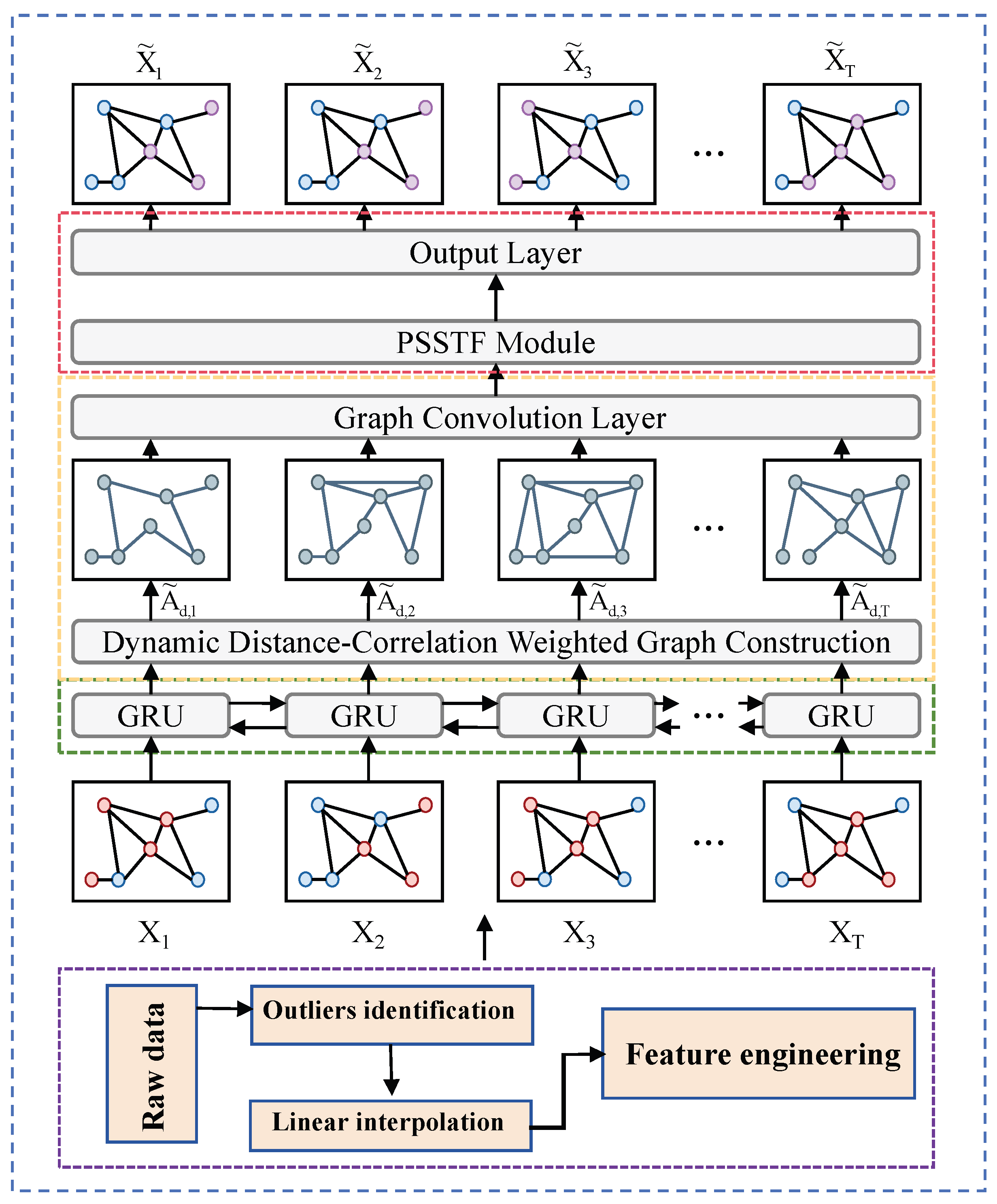
Targeting the above-mentioned core challenges, this study develops an innovative graph-guided deep learning framework named DBFP-Net (dynamic graph-bidirectional frequency-physics integrated network), which fuses dynamic spatial modeling, bidirectional temporal analysis and constrained time–frequency processing to enhance the precision and robustness of short-to-medium term wind power prediction. The framework breaks through the bottlenecks of traditional methods by optimizing spatial correlation modeling, time–frequency feature extraction and physical constraint integration, providing a feasible solution for efficient and accurate wind power forecasting.
The principal contributions of this work are summarized as follows:
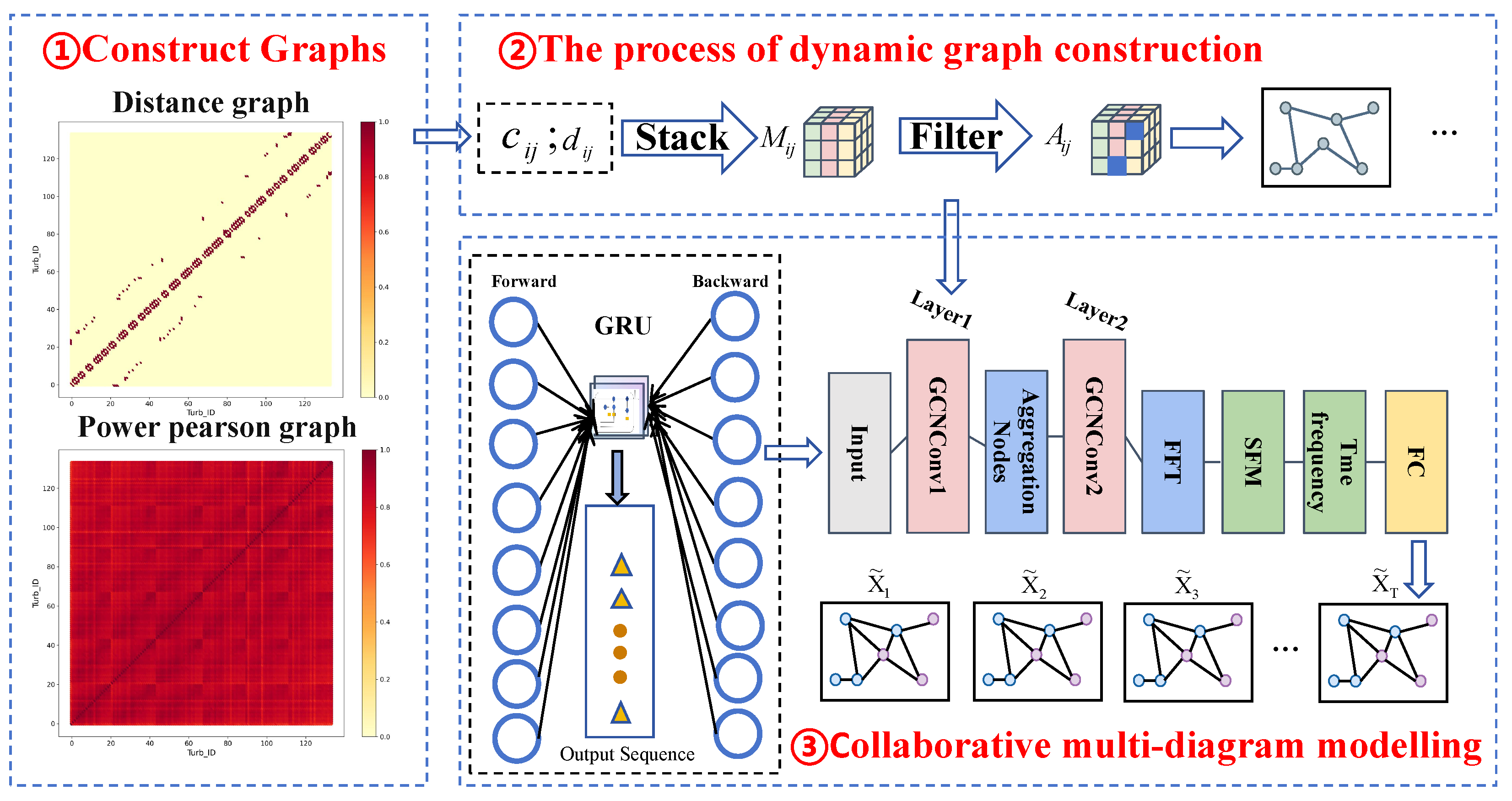
Contribution 1: A novel dynamic weighted graph construction method (DCWGC) is proposed to adaptively model meteorology–terrain coupling and wake effects. By dynamically fusing turbine geographic distance and historical power correlation weights via learnable parameters, it breaks the limitations of static graphs and significantly improves spatial modeling accuracy.
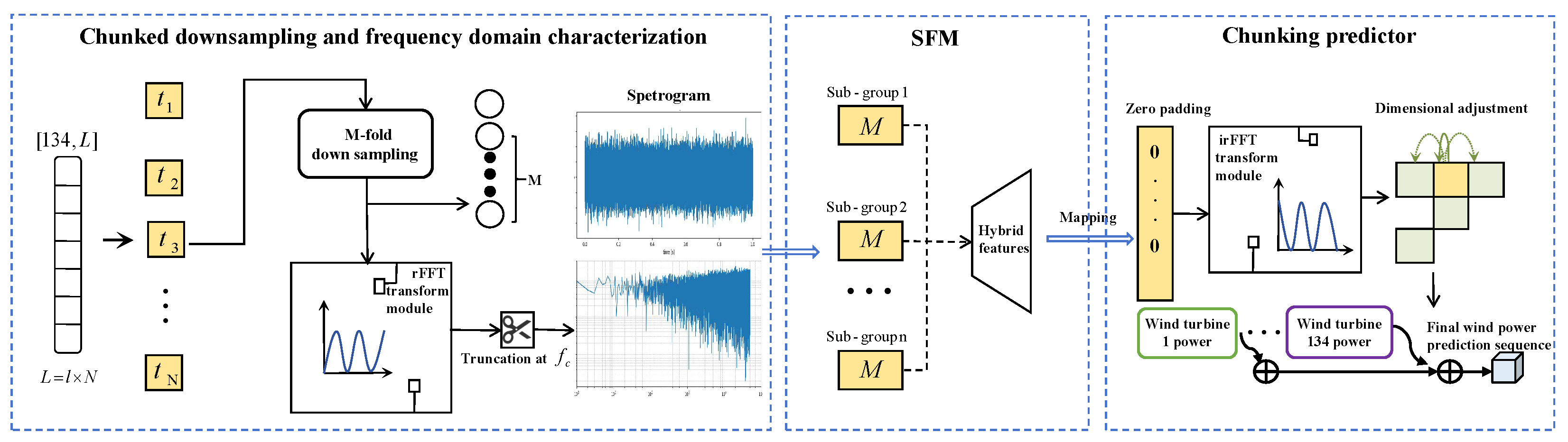
Contribution 2: An innovative time-space-frequency multimodal prediction framework is constructed, integrating DCWGC-based GCN for spatial dependence, BiGRU for temporal feature extraction, and the original PSSTF module for rFFT-based noise separation and frequency feature mining, which markedly boosts forecast accuracy over 10 min to 2 h prediction horizons.
Contribution 3: A physics-constrained frequency-domain noise suppression strategy is designed via the PSSTF module. The novel power curve-constrained frequency mixer ensures aerodynamic compliance while retaining dominant frequency components, unifying physical realism and high-precision prediction.
The rest of the paper is organized as follows:
Section 2 systematically reviews the related work in wind power forecasting.
Section 3 elaborates the problem formulation of spatio-temporal multi-step wind power prediction and the detailed design of the proposed DBFP-Net model.
Section 4 presents the experimental configurations, comparative results and in-depth analysis.
Section 5 discusses the critical limitations and future research directions of the proposed method. concludes this paper.
2. Literature Review
In recent years, remarkable progress has been witnessed in the field of wind power prediction, and mainstream research methodologies can be categorized into physical approaches, statistical models, traditional machine learning algorithms and deep learning frameworks [
4]. Physical models construct atmospheric dynamic equations relying on numerical weather prediction (NWP) data, but they are plagued by excessively high modeling complexity and prohibitive computational costs [
6]. Statistical models, typified by ARIMA and VAR, improve operational efficiency by fitting the inherent relationships in historical data [
7], yet their capability to capture nonlinear and multi-scale features embedded in wind power series is severely limited [
8]. Traditional machine learning methods including support vector machines (SVMs) and random forest (RFs) are heavily reliant on manual feature engineering, making it difficult to adapt to the dynamic fluctuations of high-dimensional spatio-temporal data [
9]. Although the aforementioned methods have improved prediction accuracy to varying degrees, most models are constrained by insufficient ability to characterize the spatio-temporal dynamic coupling relationship, presenting prominent defects especially in modeling the complex spatial correlations of wind turbine clusters. To address the challenges of high volatility, nonlinearity and multi-scale data characteristics, Liu et al. [
10] proposed a collaborative multi-resolution ensemble model integrating real-time decomposition and binary kernel density estimation to enhance prediction performance. Nevertheless, statistical models suffer from inherent drawbacks including excessive dependence on historical data, limited generalization ability and slow convergence speed.
Subsequently, various traditional machine learning algorithms have been widely applied to wind power forecasting, such as SVM, Random Forest and BP neural networks [
11,
12,
13]. Yang et al. developed a data-driven finite-state Markov chain model using actual wind farm operation data, which integrates diurnal and seasonal fluctuations of wind power generation and incorporates SVM prediction results to boost performance. Zhang et al. [
14] adopted an optimized particle swarm optimization algorithm to refine BP neural network for short-term wind power prediction, effectively elevating prediction accuracy with superior performance in RMSE and MAE compared to the standard PSO-BP method. However, these traditional machine learning approaches invariably involve cumbersome feature engineering, which not only increases computational complexity but also leads to excessively time-consuming prediction procedures.
To overcome the shortcomings of traditional machine learning, deep learning methods have been increasingly introduced into wind power prediction. Zhu et al. [
15] proposed a short-term wind power prediction method based on temporal convolutional networks, which excels in capturing temporal dependence but exhibits unsatisfactory performance in handling complex nonlinear features. Shahid et al. [
16] developed an LSTM model integrated with genetic algorithm for parameter optimization, which achieves optimal hyperparameter configuration but entails lengthy iterative computation.
Traditional single neural network models are prone to local minima and overfitting; thus, hybrid models have been widely adopted in wind power forecasting. Chen et al. [
17] proposed the EnsemLSTM model, which fuses a long short-term memory network, support vector regression, and an extremal optimization algorithm. By employing an LSTM cluster with diverse hidden layers and neuron configurations, EnsemLSTM effectively mines latent information in wind speed time series, yet its performance is highly restricted by complex feature engineering and heavy reliance on feature extraction quality. Zhao et al. [
18] put forward a novel nonlinear hybrid model combining singular spectrum analysis and temporal convolutional network, which decomposes raw sequence data and extracts key temporal features via TCN, significantly improving prediction accuracy but consuming massive computational resources.
Meanwhile, graph convolutional networks (GCNs) have provided a novel solution for spatio-temporal prediction of wind turbine clusters owing to their superior capability in modeling non-Euclidean spatial relations and have been extensively employed in such prediction tasks [
19,
20]. Most existing studies establish inter-turbine connections based on single topological indicators such as geographical distance or linear correlation metrics. For instance, Geng et al. [
21] constructed a static graph using geographical distance information and combined it with LSTM to extract temporal dependencies, but such methods fail to capture the dynamic physical and meteorological interactions among turbines. Furthermore, Bentsen et al. [
22] extracted spatial dependencies and fused temporal update functions through a GNN architecture. Additionally, Yu et al. [
23] proposed a superposition graph neural network (SGNN) that captures spatio-temporal features by constructing and superimposing graphs over sequential time steps. While this superposition mechanism incorporates temporal evolution, the underlying graph at each time step typically relies on fixed spatial relationships (e.g., geographical proximity), which may not adaptively reflect the complex, weather-driven dynamic coupling (e.g., varying wake effects) between turbine power outputs and their spatial distribution in real time. This limitation hinders the full representation of dynamic interactions in operational environments [
24].
Despite the advances in spatio-temporal feature capture, existing methods are still limited by single-dimension static correlation modeling, which cannot characterize the dynamic spatial correlations under the coupling of meteorology, terrain and equipment multi-physics fields. This further verifies the necessity and innovation of the proposed DBFP-Net framework for addressing the above research gaps.
The core implementation process of the DBFP-Net for wind power prediction is summarized in Algorithm 1, which covers the entire workflow from input data preprocessing to multi-step wind power prediction, including dynamic graph construction, spatio-temporal-frequency feature extraction, and physics-constrained multimodal fusion.
| Algorithm 1 DBFP-Net for wind power prediction with dynamic graph and bidirectional temporal-frequency fusion. |
| Require: Meteorological-turbine data (time steps T, turbine number N, feature dimension D: wind speed, direction, temperature, geographic coordinates, historical power, etc.); Historical power sequence ; Forecast horizon H; Sparsity threshold ; Dynamic balance coefficient ; PSSTF hyperparameters () |
| Ensure: Multi-step wind power prediction (MW) |
- 1:
Initialization: GCN, Bi-GRU, PSSTF, and fusion layer parameters ; Min-Max normalization function ; Power curve constraint function - 2:
{Normalize all features to [0,1]} - 3:
{Normalize historical power sequence} - 4:
for each turbine pair do - 5:
{Equation (3)} - 6:
{Power correlation coefficient} - 7:
{Dynamic weight calculation (Equation (2))} - 8:
end for - 9:
{Remove self-connections (Equation (3))} - 10:
{Construct dynamic graph } - 11:
{Initial node features} - 12:
for do - 13:
{Degree matrix of } - 14:
{Equation (4)} - 15:
end for - 16:
{Spatial features, : GCN output dimension} - 17:
{Forward GRU (t=1→T)} - 18:
{Reverse GRU (t=T→1)} - 19:
{Bidirectional temporal features (Equation (9))} - 20:
{Normalize temporal features} - 21:
- 22:
{Chunked downsampling (Equation (10))} - 23:
{M-fold downsampling} - 24:
{rFFT + dominant frequency truncation} - 25:
- 26:
for K do - 27:
{Divide into K orthogonal subgroups} - 28:
{Complex linear transformation (Equation (11))} - 29:
end for - 30:
{Residual connection} - 31:
{Future H-step frequency features} - 32:
{Apply turbine power curve constraint} - 33:
{Inverse rFFT (Equation (12))} - 34:
{Frequency features, : PSSTF output dimension} - 35:
{Align spatial features to forecast horizon H} - 36:
{Align temporal features to forecast horizon H} - 37:
{Feature concatenation (Equation (13))} - 38:
{Fusion prediction (Equation (14))} - 39:
{Denormalize to original MW scale} - 40:
return
|
Author Contributions
Conceptualization, Y.M., Y.S., Z.W., W.Z. and M.X.; methodology, Y.M., Y.S., Z.W., W.Z. and M.X.; software, Y.M.; validation, Y.M. and Y.S.; formal analysis, Y.M. and Z.W.; investigation, Y.M. and W.Z.; resources, W.Z.; data curation, Y.M. and W.Z.; writing—original draft, Y.M.; writing—review and editing, M.X.; visualization, Y.M.; supervision, M.X.; project administration, M.X.; funding acquisition, M.X. All authors have read and agreed to the published version of the manuscript.
Funding
This work was supported by the Science and Technology Project of SGCC (52170025002A-380-ZN).
Institutional Review Board Statement
Not applicable.
Informed Consent Statement
Not applicable.
Data Availability Statement
The datasets generated during and/or analyzed during the current study are available in the lulu3939/lulucoderepository on GitHub,
https://github.com/lulu3939/lulucode, accessed on 3 March 2026.
Conflicts of Interest
The authors declare no conflicts of interest. The design, implementation, data analysis, and manuscript preparation of this study were not influenced by any commercial, financial, or personal relationships that could compromise the objectivity and impartiality of the research outcomes. All authors confirm the absence of any known competing financial interests or personal relationships that might be perceived as inappropriately affecting the results reported in this work. Furthermore, all funders of this study (if applicable) were not involved in the research design, data collection and analysis, interpretation of results, manuscript writing, or decisions regarding publication. The research process maintained full academic independence to ensure the objectivity and scientific rigor of the conclusions.
Abbreviations
The following abbreviations are used in this manuscript:
| DBFP-Net | Dynamic Graph and Bidirectional Temporal-Frequency Fusion Network |
| SDWPF | Spatial Dynamic Wind Power Forecasting |
| DCWGC | Dynamic Distance Correlation Weighted Graph Construction |
| PSSTF | Patchwise Sparse Space-Time–Frequency Module |
| GCN | Graph Convolutional Network |
| Bi-GRU | Bidirectional Gated Recurrent Unit |
| rFFT | real-valued Fast Fourier Transform |
| MAE | Mean Absolute Error |
| RMSE | Root Mean Square Error |
| SCADA | Supervisory Control and Data Acquisition |
| ARIMA | Autoregressive Integrated Moving Average |
| VAR | Vector Autoregression |
| SVM | Support Vector Machine |
| TCN | Temporal Convolutional Network |
| MLP | Multilayer Perceptron |
References
- Zou, C.; Li, S.; Liu, H.; Ma, F. Revolution and significance of ‘Green Energy Transition’ in the context of new quality productive forces: A discussion on theoretical understanding of ‘Energy Triangle’. Pet. Explor. Dev. 2024, 51, 1611–1627. [Google Scholar] [CrossRef]
- Yang, M.; Huang, Y.; Xu, C.; Liu, C.; Dai, B. Review of several key processes in wind power forecasting: Mathematical formulations, scientific problems, and logical relations. Appl. Energy 2025, 377, 124631. [Google Scholar] [CrossRef]
- Sireesha, P.V.; Thotakura, S. Wind power prediction using optimized MLP-NN machine learning forecasting model. Electr. Eng. 2024, 106, 7643–7666. [Google Scholar] [CrossRef]
- Hanifi, S.; Liu, X.; Lin, Z.; Lotfian, S. A critical review of wind power forecasting methods—Past, present and future. Energies 2020, 13, 3764. [Google Scholar] [CrossRef]
- Li, F.; Wang, H.; Wang, D.; Liu, D.; Sun, K. A Review of Wind Power Prediction Methods Based on Multi-Time Scales. Energies 2025, 18, 1713. [Google Scholar] [CrossRef]
- Liu, Z.; Guo, H.; Zhang, Y.; Zuo, Z. A Comprehensive Review of Wind Power Prediction Based on Machine Learning: Models, Applications, and Challenges. Energies 2025, 18, 350. [Google Scholar] [CrossRef]
- Tsai, W.C.; Hong, C.M.; Tu, C.S.; Lin, W.M.; Chen, C.H. A review of modern wind power generation forecasting technologies. Sustainability 2023, 15, 10757. [Google Scholar] [CrossRef]
- Arrieta-Prieto, M.; Schell, K.R. Spatially transferable machine learning wind power prediction models: V-logit random forests. Renew. Energy 2024, 223, 120066. [Google Scholar] [CrossRef]
- Qiao, Y.; Chen, H.; Fu, B. Multi-Wind Turbine Wind Speed Prediction Based on Weighted Diffusion Graph Convolution and Gated Attention Network. Energies 2024, 17, 1658. [Google Scholar] [CrossRef]
- Liu, H.; Duan, Z. Corrected multi-resolution ensemble model for wind power forecasting with real-time decomposition and bivariate kernel density estimation. Energy Convers. Manag. 2020, 203, 112265. [Google Scholar] [CrossRef]
- Li, L.L.; Zhao, X.; Tseng, M.L.; Tan, R.R. Short-term wind power forecasting based on support vector machine with improved dragonfly algorithm. J. Clean. Prod. 2020, 242, 118447. [Google Scholar] [CrossRef]
- Natarajan, V.A.; Kumari, N.S. Wind power forecasting using parallel random forest algorithm. In Soft Computing for Problem Solving (SocProS 2018); Springer: Singapore, 2020; pp. 209–224. [Google Scholar]
- Wang, T.; Li, S.; Yu, W.; Neng, F.; Li, X.; Yang, J.; Xiong, L. Wind power prediction based on BP neural network combined with ERA5 data. Energy Storage Sci. Technol. 2025, 14, 183. [Google Scholar]
- Zhang, Y.; Chen, B.; Zhao, Y.; Pan, G. Wind speed prediction of IPSO-BP neural network based on Lorenz disturbance. IEEE Access 2018, 6, 53168–53179. [Google Scholar] [CrossRef]
- Zhu, R.; Liao, W.; Wang, Y. Short-term prediction for wind power based on temporal convolutional network. Energy Rep. 2020, 6, 424–429. [Google Scholar] [CrossRef]
- Shahid, F.; Zameer, A.; Muneeb, M. A novel genetic LSTM model for wind power forecast. Energy 2021, 223, 120069. [Google Scholar] [CrossRef]
- Chen, J.; Zeng, G.Q.; Zhou, W.; Du, W.; Lu, K.D. Wind speed forecasting using nonlinear-learning ensemble of deep learning time series prediction and extremal optimization. Energy Convers. Manag. 2018, 165, 681–695. [Google Scholar] [CrossRef]
- Zhao, Y.; Jia, L. A short-term hybrid wind power prediction model based on singular spectrum analysis and temporal convolutional networks. J. Renew. Sustain. Energy 2020, 12, 056101. [Google Scholar] [CrossRef]
- Zhao, Y.; Liao, H.; Pan, S.; Zhao, Y. Interpretable multi-graph convolution network integrating spatio-temporal attention and dynamic combination for wind power forecasting. Expert Syst. Appl. 2024, 255, 124766. [Google Scholar] [CrossRef]
- Wang, D.; Yang, M.; Zhang, W. Wind power group prediction model based on multi-task learning. Electronics 2023, 12, 3683. [Google Scholar] [CrossRef]
- Geng, X.; Xu, L.; He, X.; Yu, J. Graph optimization neural network with spatio-temporal correlation learning for multi-node offshore wind speed forecasting. Renew. Energy 2021, 180, 1014–1025. [Google Scholar] [CrossRef]
- Bentsen, L.; Warakagoda, N.D.; Stenbro, R.; Engelstad, P. Spatio-temporal wind speed forecasting using graph networks and novel Transformer architectures. Appl. Energy 2023, 333, 120565. [Google Scholar] [CrossRef]
- Yu, M.; Zhang, Z.; Li, X.; Yu, J.; Gao, J.; Liu, Z.; You, B.; Zheng, X.; Yu, R. Superposition graph neural network for offshore wind power prediction. Future Gener. Comput. Syst. 2020, 113, 145–157. [Google Scholar] [CrossRef]
- Wang, Q.; Hu, J.; Yang, S.; Dong, Z.; Deng, X.; Xu, Y. Towards machine learning applications for structural load and power assessment of wind turbine: An engineering perspective. Energy Convers. Manag. 2025, 324, 119275. [Google Scholar] [CrossRef]
- Li, S.; Li, X.; Jiang, Y.; Yang, Q.; Lin, M.; Peng, L.; Yu, J. A novel frequency-domain physics-informed neural network for accurate prediction of 3D spatio-temporal wind fields in wind turbine applications. Appl. Energy 2025, 386, 125526. [Google Scholar] [CrossRef]
- Pouta, E.; Rajala, T.; Mäntymaa, E.; Kangas, K.; Hiedanpää, J. Does multidimensional distance matter? Perceptions and acceptance of wind power. J. Environ. Policy Plan. 2024, 26, 47–59. [Google Scholar] [CrossRef]
- Hu, Y.; Hu, X.; Yao, X.; Li, Q.; Fang, F.; Liu, J. Ultra-short-term prediction for wind power via intelligent reductional reconfiguration of wind conditions and upgraded stepwise modelling with embedded feature engineering. Renew. Energy 2025, 240, 122155. [Google Scholar] [CrossRef]
- Xin, Z.; Liu, X.; Zhang, H.; Wang, Q.; An, Z.; Liu, H. An enhanced feature extraction based long short-term memory neural network for wind power forecasting via considering the missing data reconstruction. Energy Rep. 2024, 11, 97–114. [Google Scholar] [CrossRef]
- Qiao, Y.; Han, S.; Zhang, Y.; Liu, Y.; Yan, J. A multivariable wind turbine power curve modeling method considering segment control differences and short-time self-dependence. Renew. Energy 2024, 222, 119894. [Google Scholar] [CrossRef]
- Zhou, J.; Lu, X.; Xiao, Y.; Tang, J.; Su, J.; Li, Y.; Liu, J.; Lyu, J.; Ma, Y.; Dou, D.; et al. SDWPF: A dataset for spatial dynamic wind power forecasting over a large turbine array. Sci. Data 2024, 11, 649. [Google Scholar] [CrossRef]
- Dolatabadi, A.; Abdeltawab, H.; Mohamed, Y.A.R.I. Deep spatial-temporal 2D CNN-BLSTM model for ultrashort-term LiDAR-assisted wind turbine’s power and fatigue load forecasting. IEEE Trans. Ind. Inform. 2021, 18, 2342–2353. [Google Scholar] [CrossRef]
- Yu, C.; Wang, F.; Shao, Z.; Sun, T.; Wu, L.; Xu, Y. Dsformer: A double sampling transformer for multivariate time series long-term prediction. In Proceedings of the 32nd ACM International Conference on Information and Knowledge Management, New York, NY, USA, 21–25 October 2023; pp. 3062–3072. [Google Scholar]
- Hong, J.T.; Han, S.; Yan, J.; Liu, Y.Q. Dual-path frequency Mamba-Transformer model for wind power forecasting. Energy 2025, 332, 137225. [Google Scholar] [CrossRef]
- Jiang, Z.; Tan, Q.; Li, N.; Che, J.; Tan, X. A novel BiGRU multi-step wind power forecasting approach based on multi-label integration random forest feature selection and neural network clustering. Energy Convers. Manag. 2024, 319, 118904. [Google Scholar] [CrossRef]
- Kong, Y.; Wang, Z.; Nie, Y.; Zhou, T.; Zohren, S.; Liang, Y.; Sun, P.; Wen, Q. Unlocking the power of LSTM for long term time series forecasting. AAAI 2025, 39, 11968–11976. [Google Scholar] [CrossRef]
- Jiang, W.; Ning, P.; Yang, J.; Zhai, Y.; Gao, F.; Wang, R. LLIC: Large receptive field transform coding with adaptive weights for learned image compression. In IEEE Transactions on Multimedia; IEEE: New York, NY, USA, 2024; pp. 10937–10951. [Google Scholar]
| Disclaimer/Publisher’s Note: The statements, opinions and data contained in all publications are solely those of the individual author(s) and contributor(s) and not of MDPI and/or the editor(s). MDPI and/or the editor(s) disclaim responsibility for any injury to people or property resulting from any ideas, methods, instructions or products referred to in the content. |