Article

Biometric Identification Under Different Emotions via EEG: A Deep Learning Approach

by
Zhyar Abdalla Jamal
* and
Azhin Tahir Sabir
Department of Software Engineering, Koya University, Koya 44001, Kurdistan Region, Iraq
*
Author to whom correspondence should be addressed.
Information 2026, 17(3), 305; https://doi.org/10.3390/info17030305
Submission received: 23 February 2026 / Revised: 10 March 2026 / Accepted: 20 March 2026 / Published: 22 March 2026
(This article belongs to the Section Biomedical Information and Health)

Abstract

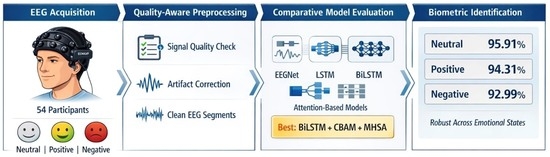
Electroencephalography (EEG) has attracted growing interest as a biometric modality because it reflects ongoing brain activity and is inherently difficult to counterfeit. At the same time, EEG signals are influenced by internal conditions such as emotions, which may affect identification stability, particularly when recordings are obtained using portable consumer-grade systems. This study examines how emotional states influence EEG-based biometric performance and evaluates deep learning architectures to determine an effective modeling approach for cross-emotion robustness. EEG data were collected from 65 participants using a 14-channel Emotiv EPOC X headset, with 54 subjects retained after self-reported emotional validation. Recordings were acquired under neutral, positive, and negative visual stimuli. To address variability associated with portable acquisition, preprocessing made use of the device’s internal signal quality metrics to select reliable segments, compensate for degraded regions, and reduce noise. Among the evaluated models, a Bidirectional Long Short-Term Memory (BiLSTM) network enhanced with Convolutional Block Attention Module (CBAM) and Multi-Head Self-Attention (MHSA) achieved highest performance in our experiments. The model was trained on neutral-state data and subsequently evaluated under emotional conditions. It reached 95.91% accuracy in the neutral condition and maintained high performance under positive (94.31%) and negative (92.99%) states. Despite a modest decline under negative stimuli, identification performance remained stable. These findings support the feasibility of robust EEG-based biometric authentication using consumer-grade devices in realistic settings.

Graphical Abstract

1. Introduction

As digital systems become more integrated into everyday life, establishing trust in user identity has become increasingly important. Reliable verification mechanisms are therefore essential. Traditional biometric methods, such as fingerprint and facial recognition, are widely used because they are convenient and easy to deploy at scale. However, these approaches are not without limitations. They can be vulnerable to spoofing attacks, template leakage, and various privacy concerns [1,2]. For this reason, growing attention has shifted toward biometric systems that inherently provide liveness detection and are significantly more difficult to imitate or forge.
Electroencephalography (EEG) which records the electrical activity from the scalp, has been investigated as a biometric trait since it contains subject-specific patterns that are hard to mimic. This property provides EEG with a natural advantage in liveness detection compared with classical traits including fingerprints or face images [3,4]. With the rise of portable headsets (e.g., Emotiv EPOC X), EEG collection is now feasible outside controlled laboratories, enabling more practical authentication research [5]. At the same time, consumer-grade devices typically offer fewer channels and are more sensitive to motion, electrode drift, and contact variability, which can complicate preprocessing and classification [6].
A key challenge in EEG-based biometrics is the natural variability of brain activity. EEG signals are non-stationary and can shift over time due to factors like fatigue, mental effort, environmental conditions, and emotional state [7]. Emotional states have been shown to influence EEG spectral power and spatial activation patterns, particularly in the frontal and temporal regions of the brain [8,9]. Consequently, a biometric model developed based on neutral emotional states may not work well when tested using affective states. This variation challenges the robustness and generalization capability in EEG-based identification system under realistic scenarios.
While prior work has investigated EEG-based biometric identification and emotion recognition individually, little attention has been paid to the way in which emotional variation affects bio-potential based biometric performance, especially by using low-cost hardware and systems. Closing this gap is important to understanding whether EEG based authentication systems work as reliably outside the laboratory.
This study investigates the influence of emotional states on EEG-based biometric identification within a deep learning framework. Multiple neural architectures were evaluated to determine a suitable modeling approach for maintaining identification performance under emotional variability. Among the examined models, the Bidirectional Long Short-Term Memory (BiLSTM) model augmented with Convolutional Block Attention Module (CBAM) and Multi-Head Self-Attention (MHSA) showed the most robust and highest performance under varying emotional conditions. The model was trained exclusively on neutral-state data to simulate a realistic enrollment scenario and was subsequently evaluated on neutral, positive, and negative emotional conditions to assess cross-emotion generalization. EEG recordings were collected from 65 participants using a portable Emotiv EPOC X device, with 54 emotion-validated participants included in the final analysis.
Despite the emotional variability, portable EEG recording is subject to practical constraints concerning signal stability. Consumer headsets are found to have increased noise due to electrode drift, small amounts of sensor slip and movement-related artefacts when compared with lab-grade hardware. Because the sensors are lightweight and easy to move, small shifts in electrode contact can lead to fluctuations in channel reliability over time. In this study, the signal quality indicators provided by the device were incorporated directly into the preprocessing stage. These metrics were used to detect low-quality segments, apply artifact correction only where necessary, and restore portions of the signal that had been degraded. By considering channel-level reliability before model training, the proposed pipeline helps maintain cleaner and more consistent EEG recordings. This approach reduces the impact of noise that is commonly present in portable EEG systems and ultimately enhances the robustness and reliability of the biometric identification framework. The main contributions of this work are as follows:
  • Systematic evaluation of EEG-based biometric identification under neutral, positive, and negative conditions, demonstrating that negative emotion is associated with the largest observed reduction in accuracy.
  • Integration of device-reported signal quality metrics into the preprocessing pipeline to guide selective artifact mitigation and segment correction, improving robustness of portable EEG recordings.
  • Evaluation of an attention-enhanced BiLSTM architecture that combines CBAM and Multi-Head Self-Attention, demonstrating improved stability of identification performance under varying emotional states.
  • Collection and utilization of a custom 65-participant EEG dataset recorded with a consumer-grade device under controlled emotional induction for cross-emotion biometric evaluation.
The remainder of this paper is organized as follows. Section 2 summarizes related work in EEG biometrics and affective computing. Section 3 describes the materials and methods. Section 4 presents the experimental results, followed by discussion in Section 5. Section 6 concludes the paper.

2. Related Work

2.1. EEG-Based Biometric Systems

Electroencephalography (EEG) has been increasingly investigated as a biometric modality due to its intrinsic liveness properties and resistance to spoofing. Unlike conventional biometric traits, EEG signals originate from underlying neural processes and are therefore consequently challenging to replicate. Early approaches to EEG-based identification typically relied on handcrafted features derived from resting-state recordings, task-based experiments, or event-related potentials (ERPs), which were then classified using traditional machine learning methods [10,11].
Recently, researchers have begun using deep learning models to learn subject-specific patterns directly from raw or minimally preprocessed EEG recordings, reducing the need for manual feature engineering [12,13]. The growing availability of portable and consumer-grade EEG headsets has encouraged research into practical authentication systems [14]. Studies using devices like the Emotiv EPOC X show promising identification performance, even with fewer channels and more noise compared to lab-grade systems [15].
Despite these advances, some challenges still remain. Over time, identification stability may be weakened by the session-to-session variability and sensitivity of EEG signals to electrode placement and device characteristics [16,17]. Developing robust models capable of generalizing across such variability remains an active area of research.

2.2. Emotional Modulation of EEG Signals

EEG signals are inherently non-stationary and influenced by internal physiological and psychological states. Emotional processes are known to influence neural oscillatory activity across multiple cortical regions and frequency bands [18]. Emotional states are often associated with changes in EEG spectral power and with asymmetry between the left and right hemispheres, particularly in frontal regions. For instance, frontal alpha asymmetry has been widely reported as a neural marker of affective valence, with different patterns observed under positive and negative emotional conditions [19].
These neural modulations form the basis of EEG-based emotion recognition systems, where deep learning architectures have achieved high classification performance in affective state detection tasks [20]. However, the same emotional sensitivity that makes EEG suitable for affective computing may also reduce stability in biometric identification systems. Changes in emotional state can modify spectral and spatial EEG patterns, which may increase the risk of mismatch between enrollment data and subsequent verification samples.
Performance degradation under emotional variability has been reported in prior work, with reductions exceeding 10% in certain settings [9]. Multiple studies have pointed out that emotional changes should be taken into account when designing EEG-based authentication approaches [21,22]. Despite this awareness, systematic evaluation across different emotional conditions remains limited, especially in studies that use consumer-grade EEG devices.

2.3. Deep Learning Approaches for EEG Identification

The high dimensionality and temporal dynamics of EEG signals have encouraged the use of deep learning methods for automatic feature extraction and classification [23]. Convolutional Neural Networks (CNNs) are widely used to capture spatial relationships across electrode channels, while Recurrent Neural Networks (RNNs), particularly Long Short-Term Memory (LSTM) networks, are effective for modeling temporal dependencies in sequential neural data [24,25].
Bidirectional LSTM (BiLSTM) models further enhance this capability by analyzing temporal information in both forward and backward directions, allowing the network to capture richer contextual information [26]. Attention mechanisms have further enhanced model performance by allowing selective focus on informative signal components. The Convolutional Block Attention Module (CBAM) refines channel-wise and spatial features, while Multi-Head Self-Attention (MHSA) captures long-range temporal dependencies within EEG sequences [27,28]. Hybrid architectures combining recurrent processing with attention mechanisms have demonstrated improved performance in several EEG-based applications, including emotion recognition and clinical analysis [29,30]. A major concern is whether deep learning models can keep identification stable when emotions change, particularly with portable EEG setups. Although EEG biometrics and emotion recognition have progressed, research rarely explores how they connect. Controlled experiments of cross-emotion identification are still rare, especially in the case of consumer devices. This link is crucial when it comes to assessing the EEG-based authentication robustness outside the lab.
In this work, we address this problem by evaluating a deep learning-based EEG biometric model that trained using neutral state data only and gets evaluated among neutral, positive and negative emotions.

3. Materials and Methods

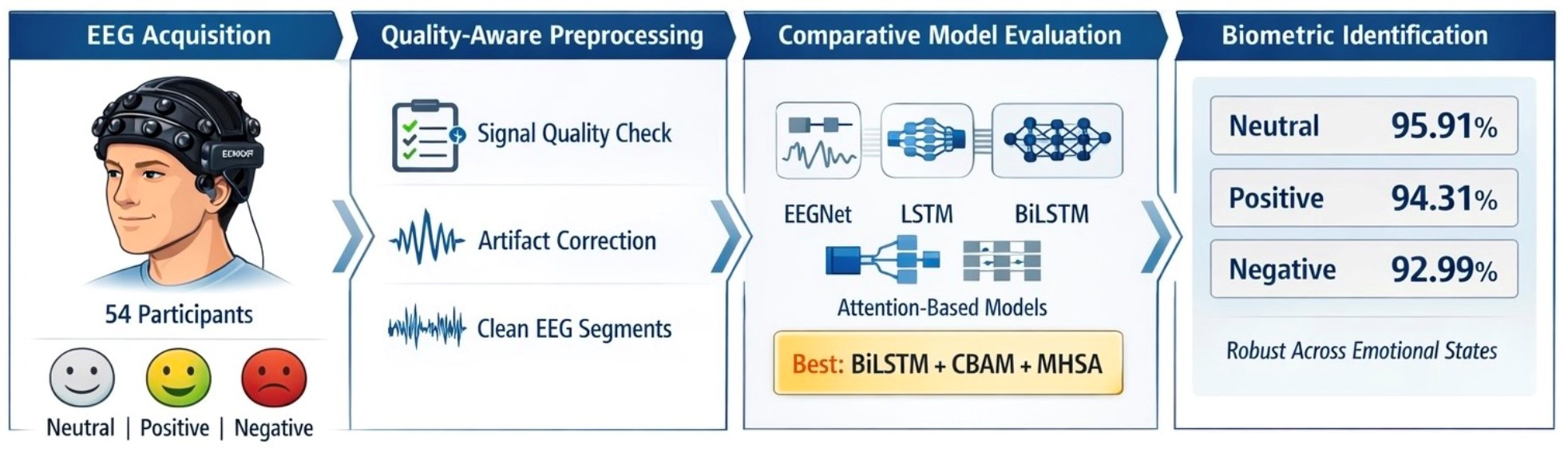
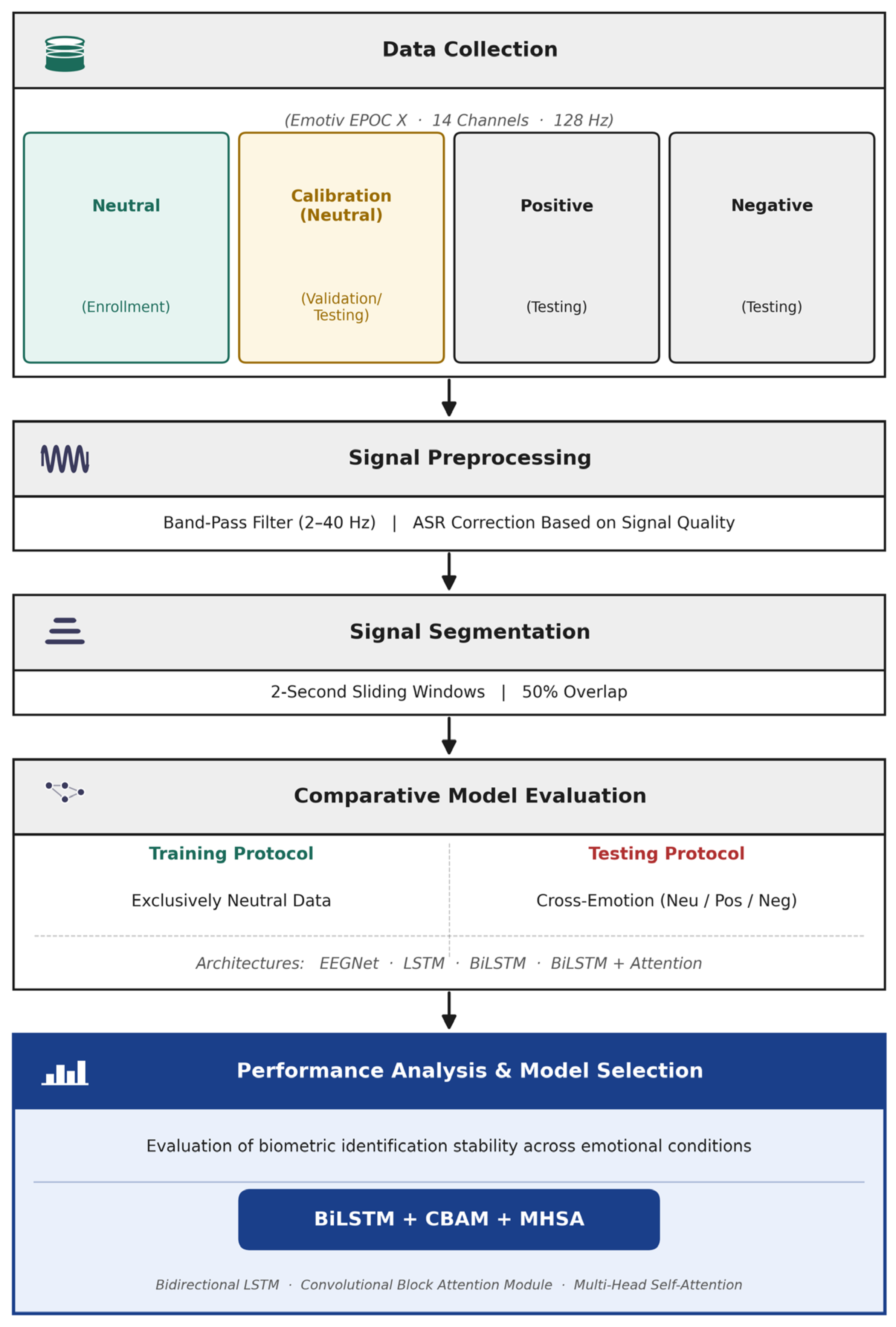
This section describes the participants, experimental protocol, acquisition setup, preprocessing pipeline, model configurations, and evaluation procedure. The overall workflow of the study is illustrated in Figure 1.

3.1. Participants and Experimental Protocol

A total of 65 healthy adult volunteers participated in this study. Participants ranged in age from 18 to 65 years, with a mean age of 34 years. The initial sample included 44 male and 21 female participants. Before the recordings began, all participants were informed about the purpose and procedures of the study and provided written consent to take part.
After completing the recording sessions, participants were asked to complete a short self-assessment survey to confirm the emotions they experienced during the experiment. Based on these responses, data from 54 participants were retained for the final analysis. The emotion-validated group consisted of 35 male and 19 female participants. This step helped ensure that the EEG recordings used in the experiments reflected the intended emotional conditions.
Only minimal and non-identifiable information was collected for ethical purposes, including anonymized participant codes, gender, and responses from the emotion validation survey. No names, photographs, or personally identifiable information were recorded. Table 1 summarizes the demographic characteristics and recording parameters of the participants.

Emotion Induction and Validation

Emotion elicitation was accomplished by the presentation of culturally adapted visual stimuli designed to represent neutral, positive and negative emotional categories. The images were gathered from publicly available online sources and carefully selected to reflect positive, negative, and neutral content that would be clearly recognizable within the local cultural context. To strengthen the cultural validity, three independent evaluators reviewed the chosen images. The final categorization into neutral, positive, and negative groups was decided by consensus.
In this study positive pictures were chosen to elicit relatively pleasant feelings of happiness, enjoyment or relaxation, and negative pictures were designed to evoke unpleasant feelings such as fear or sadness. Neutral images illustrated every day, emotionally neutral scenes that were unlikely to elicit any strong feelings in particular.
For every participant, the recording sessions followed the same fixed order: Neutral, Calibration (Neutral), Positive, and Negative. Each emotional condition featured five images, displayed for 10 s each, totaling 50 s per condition. The calibration session included three neutral images, lasting 30 s. After finishing all recordings, participants completed a single self-report survey indicating whether the intended emotional states were successfully evoked. Participants who did not report successful emotion induction were excluded from the final sample. short breaks, lasting 5 ± 2 min, were provided between sessions to help maintain a stable physiological state and reduce the influence of unrelated factors like hunger, sleepiness, or general fatigue that may be introduced by longer breaks. Table 2 presents the total recording structure for each participant.

3.2. Data Acquisition

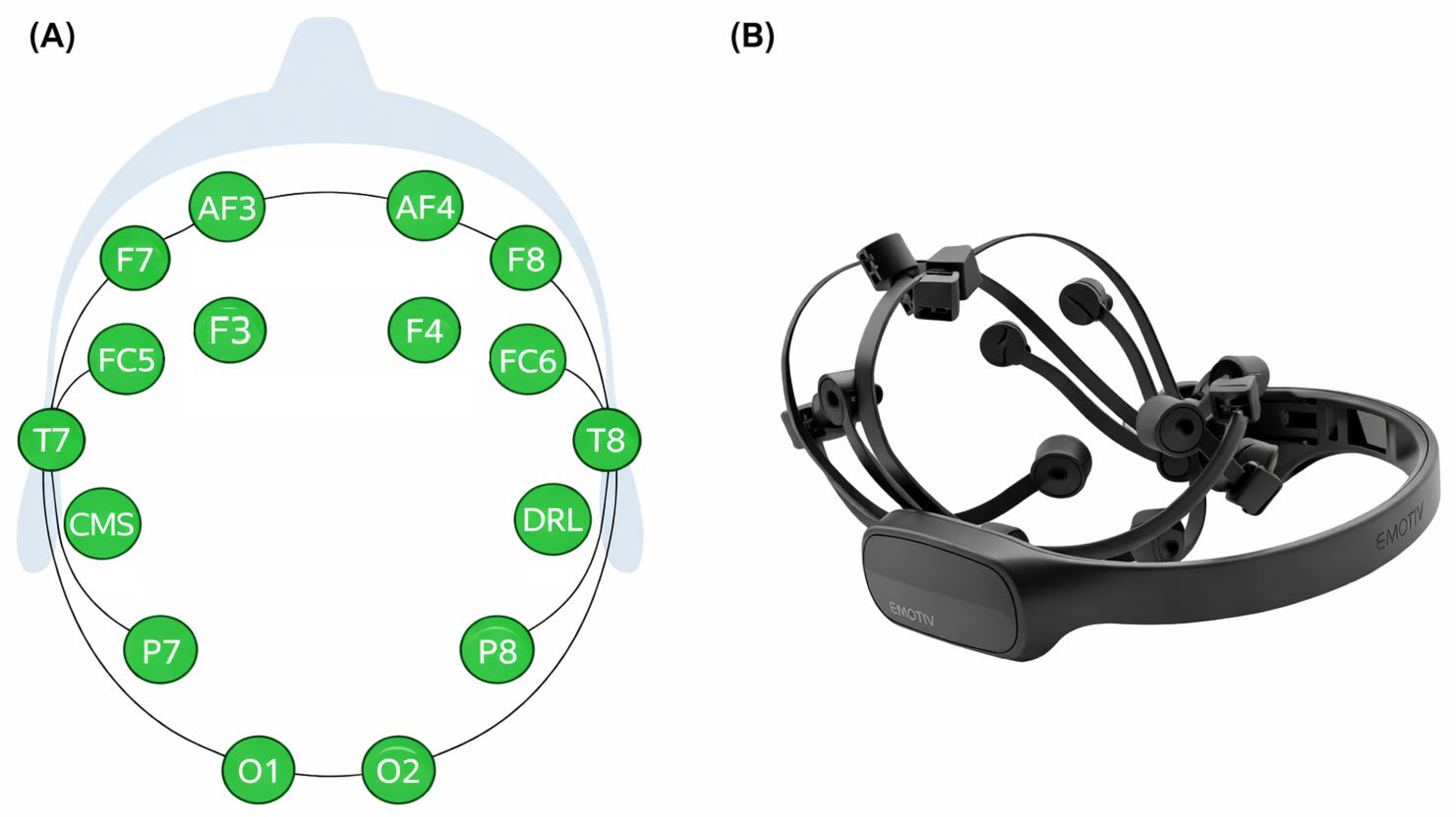
EEG signals were recorded using the Emotiv EPOC X wireless headset which provides 14 active channels positioned according to the international 10–20 system. The channel montage includes:
  • Frontal: AF3, AF4, F3, F4, F7, F8.
  • Frontocentral: FC5, FC6.
  • Temporal: T7, T8.
  • Parietal: P3, P4.
  • Occipital: O1, O2.
EEG signals were recorded at a sampling rate of 128 Hz. The device samples internally at 2048 Hz before downsampling to 128 Hz for output. On-device preprocessing includes AC coupling, a 5th-order sinc filter, and digital notch filtering at 50 Hz and 60 Hz to minimize power-line interference. The reference electrodes (CMS/DRL) were placed according to the manufacturer’s standard configuration [31]. Signal quality was monitored with EmotivPRO software (version 4.8), and participants were requested to reposition if a channel’s quality degraded. The Emotiv EPOC X headset and the sensor position in accordance with the 10–20 system is presented in Figure 2.

3.3. Preprocessing Pipeline

Preprocessing is a very important step in EEG analysis, as the signals are highly susceptible to various types of noise and artifacts. This challenge becomes bolder when using consumer-grade devices, where sensor drift and minor movements can introduce substantial signal distortions.
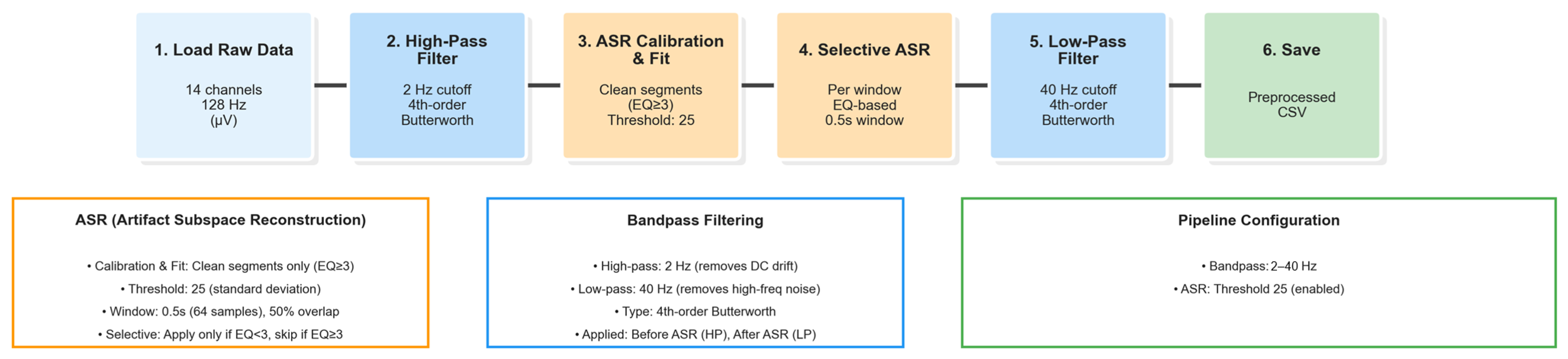
To address these issues, a preprocessing pipeline was developed to mitigate noise and artifacts commonly associated with portable, low-density EEG systems. The processing steps are illustrated in Figure 3.

3.3.1. Band-Pass Filtering

The EEG data were band-pass filtered between 2 Hz and 40 Hz. This range was chosen to address slow drift noise, eye-movement artifacts, and baseline instability often found in portable EEG recordings. Frequencies below 2 Hz were removed to reduce slow electrode drift and contamination from eye movements, while frequencies above 40 Hz were cut off to limit high-frequency noise common in consumer-grade systems. This 2–40 Hz range retains the key cognitive frequency bands important for biometric identification, such as theta, alpha, beta, and low-gamma activity [32,33]. When compared empirically to other filter ranges including 0.5–40 Hz, 1–40 Hz, and 5–40 Hz—the 2–40 Hz setting provided stable validation results while preserving discriminative information in the frequency spectrum.

3.3.2. Artifact Subspace Reconstruction (ASR)

Artifact Subspace Reconstruction (ASR) was used to reduce brief, high-amplitude artifacts that frequently appear in consumer-grade EEG recordings. ASR works by examining the EEG signal in small, overlapping time windows and comparing the statistical patterns within each window to a reference model built from clean data. If a window shows unusually high variability compared to this reference, it is considered likely to contain artifacts. Instead of simply discarding the affected portion, ASR reduces the influence of the abnormal components and reconstructs the signal based on the characteristics of clean EEG activity. This approach allows noisy segments to be corrected while preserving as much meaningful neural information as possible. cutoff value of 25 was chosen as a practical compromise, providing effective noise reduction while limiting the risk of removing meaningful neural information [34,35]. Instead of simply discarding noisy segments, ASR reconstructs them, which helps maintain the temporal continuity of the signal and avoids unnecessary data loss [36].
During calibration, only stable and high-quality EEG segments were used to compute the reference covariance matrix. These clean segments were identified using the device’s built-in signal quality metric, which assigns a quality label every 64 samples (approximately 0.5 s). According to the Emotiv EPOC manufacturer’s documentation, this metric is generated through an AI-based evaluation of signal characteristics [37]. By relying only on reliable segments for calibration, the reference model was based on genuine neural activity rather than artifact-contaminated data.
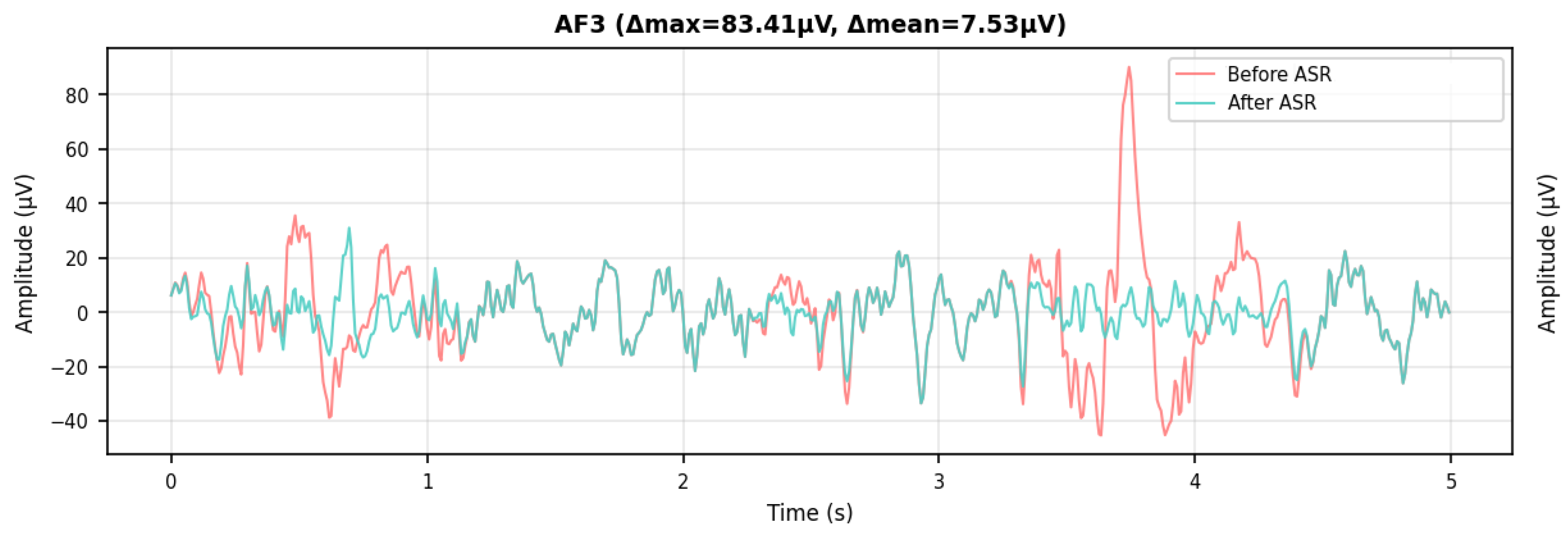
To prevent excessive signal modification, artifact correction was applied selectively rather than uniformly across the entire recording. Segments with quality values below 80% were processed using ASR, while segments with higher quality were left unchanged. This targeted approach minimizes unnecessary alterations to already stable data and reduces the risk of overcorrection. By focusing only on degraded portions of the signal, the preprocessing step preserves individual neural patterns that are essential for robust and reliable biometric identification. Figure 4 presents an example of how ASR corrects a transient spike in a representative EEG channel.

3.3.3. Segmentation

After preprocessing, the EEG signals were segmented into 2-s windows with 50% overlap. This window length provides a practical balance between temporal resolution and signal stability in EEG-based analysis, and previous studies have also reported that slightly longer windows can improve classification performance by capturing more stable temporal patterns. The 50% overlap expands the training samples while holding temporal continuity, which helps to model the sequential EEG dynamics [38]. Based on preliminary observations during model development, the 2-s window was found to provide stable cross-emotion identification performance without increasing model complexity.

3.4. Model Architecture

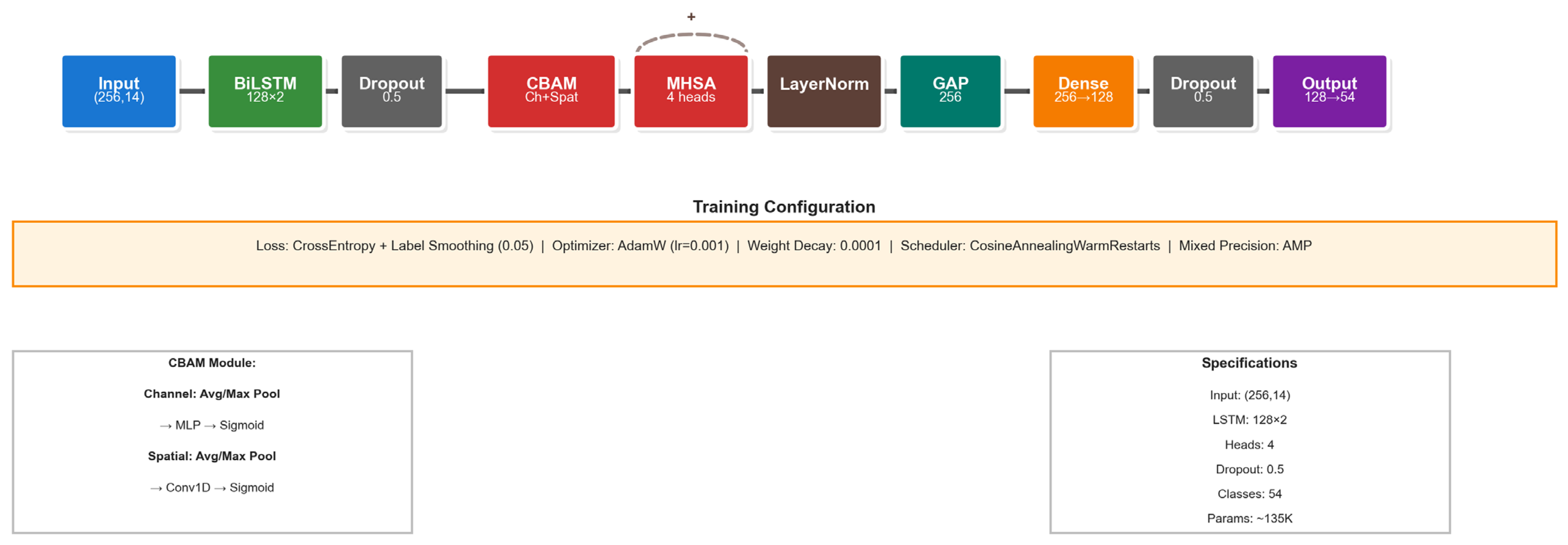
To determine an effective modeling strategy for portable EEG biometrics under emotional variation, multiple architectures were evaluated, including EEGNet, LSTM, BiLSTM, and attention-augmented recurrent frameworks. To ensure a fair comparison between models, all architectures were trained using the same preprocessed EEG data and segmentation strategy described in Section 3.3. Specifically, identical preprocessing steps were applied, including band-pass filtering, artifact correction using ASR, and segmentation into 2-s windows with 50% overlap. The same training data derived from the neutral condition and the same evaluation protocol were used across all models. Common training settings, such as optimizer, learning rate, and evaluation metrics, were kept consistent where applicable. Recurrent architectures (LSTM and BiLSTM variants) operated directly on the segmented EEG signals, while EEGNet used feature representations extracted from the same preprocessed segments. Among evaluated models, a Bidirectional Long Short-Term Memory (BiLSTM) architecture enhanced with Convolutional Block Attention Module (CBAM) and Multi-Head Self-Attention (MHSA) demonstrated the strongest and most stable performance and was therefore selected for detailed analysis. This configuration was assessed specifically for its ability to maintain identification accuracy under the spatial and signal constraints of a portable 14-channel EEG system. The input to the network consists of the segmented EEG windows described in Section 3.3.3. Specifically, each sample corresponds to a 2-s window of preprocessed EEG data, resulting in 14-channel sequences with 256-time steps (2 s at 128 Hz). No handcrafted feature extraction was applied. the model operates directly on the band-pass filtered and ASR-corrected signals, allowing the network to learn discriminative spatiotemporal representations in an end-to-end manner.
The architecture comprises:
  • Bidirectional LSTM layer: 128 units per direction, producing 256-dimensional temporal representations.
  • CBAM: Channel and spatial attention mechanisms to emphasize informative EEG channels and temporal positions.
  • Multi-Head Self-Attention: Four attention heads (key dimension = 64) to model long-range temporal dependencies.
  • Residual connection with Layer Normalization: Stabilizes training and preserves information flow.
  • Classification head: Global average pooling, fully connected layer (128 units, ReLU), dropout (p = 0.5), L2 regularization (λ = 0.0001), and softmax output.
The total number of learnable parameters is approximately 135 K.
The model architecture is illustrated in Figure 5.

3.5. Training and Evaluation Strategy

To simulate a realistic deployment scenario, the model was trained exclusively on neutral-state EEG data. Evaluation was performed on unseen neutral, positive, and negative sessions to assess cross-emotion generalization. To ensure that the induced emotional response had sufficient time to develop, the first 10 s of positive and negative recording sessions were excluded from analysis. This step was applied consistently across all participants to minimize the influence of transition effects at the onset of stimulus presentation. Each participant contributed equal recording duration per emotional condition, resulting in an approximately balanced number of segmented windows per subject. This ensured uniform class representation during training and evaluation.

3.5.1. Optimization

The model was trained end-to-end using:
  • AdamW optimizer;
  • Initial learning rate: 0.001;
  • Cosine annealing with warm restarts (T0 = 5 epochs, η_min = 1 × 10⁻⁶);
  • Weight decay: 0.0001;
  • Label smoothing: α = 0.05;
  • Early stopping (patience = 50 epochs).

3.5.2. Data Partitioning and Leakage Prevention

The 30-s calibration session was divided into validation (30%) and held-out test subsets to prevent data leakage. All windows derived from a single raw recording were strictly confined to a single partition (train, validation, or test). Overlapping or adjacent windows were not allowed to cross partition boundaries.
Calibration and emotional sessions were never used for training. This protocol ensures unbiased evaluation and prevents contamination between enrollment and verification data.

4. Results

This section presents the identification performance across emotional conditions, followed by a comparative evaluation of the examined architectures. The results aim to assess performance stability under emotional variation using portable EEG recordings.

4.1. Identification Performance Across Emotional Conditions

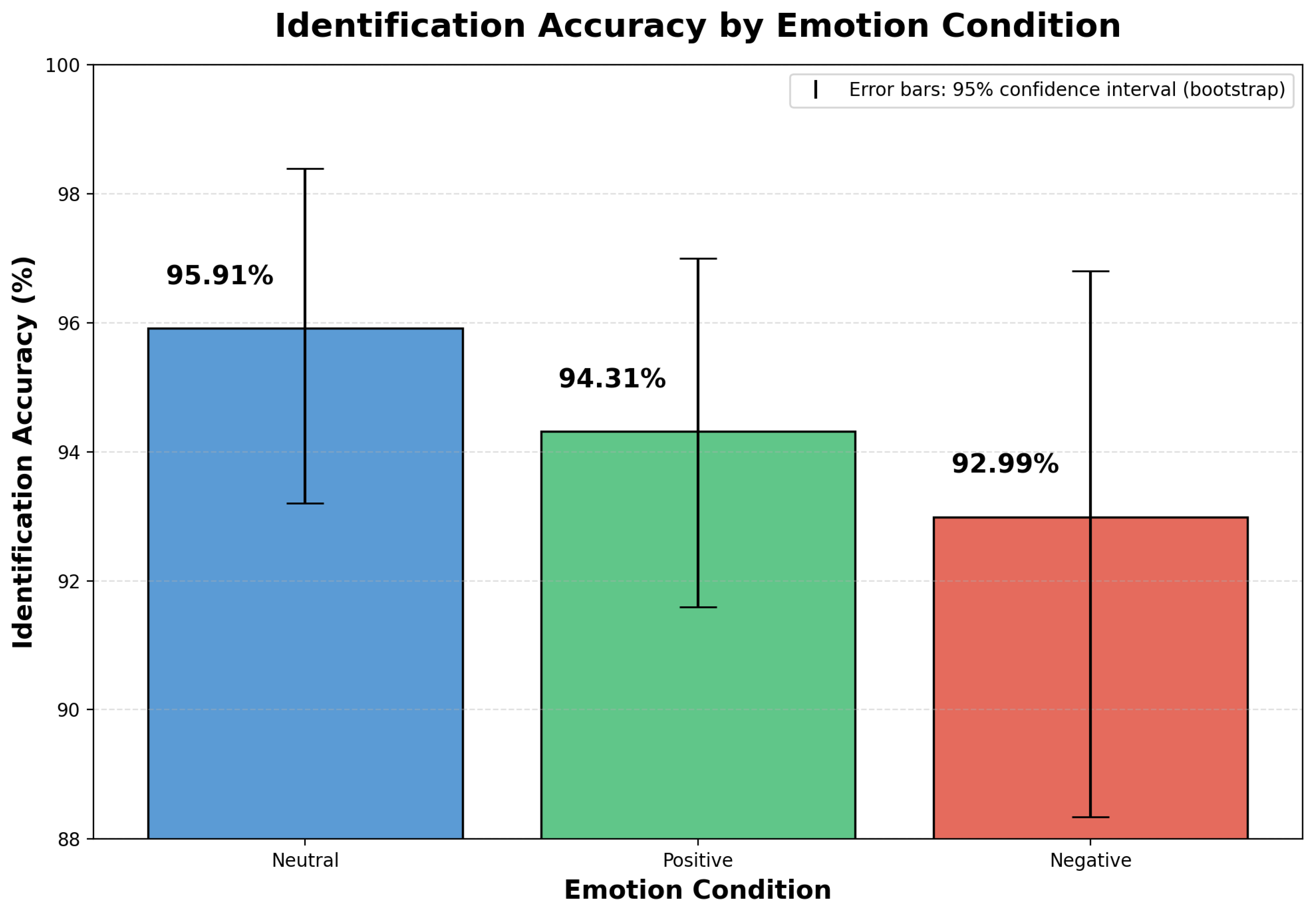
The attention-augmented BiLSTM architecture demonstrated consistently high identification accuracy across all emotional states. In the neutral condition, accuracy reached 95.91% (SD = 1.45, 95% CI: 93.20–98.39). Under positive emotion, performance slightly decreased to 94.31% (SD = 1.59, 95% CI: 91.59–97.00), while under negative emotion, accuracy was 92.99% (SD = 2.38, 95% CI: 88.34–96.80).
Compared with the neutral baseline, performance declined by 1.60 percentage points in the positive condition and 2.92 percentage points in the negative condition. The largest decrease was measured for negative stimulation effect implying a higher performance drop due to negative stimulation. Confidence interval was calculated with participant-level bootstrap resampling (100 samples, 95% confidence level). Confidence intervals were estimated using participant-level bootstrap resampling (100 samples, 95% confidence level). Detailed metrics are summarized in Table 3, and the overall trend is illustrated in Figure 6.

4.2. Comparative Model Evaluation

To explore which modeling approach is most suitable for portable EEG-based biometric identification under changing emotional conditions, several architectures were examined. All models were trained and evaluated under the same experimental protocol to ensure a fair comparison between architectures. These included EEGNet, LSTM, BiLSTM, BiLSTM combined with CBAM attention, and an extended version integrating both CBAM and multi-head self-attention (MHSA). The performance comparison of these models across neutral, positive, and negative emotional states is presented in Table 4. By comparing their performance across neutral, positive, and negative emotional states, we aimed to better understand how different temporal and attention mechanisms influence robustness.
The comparative results indicate that recurrent architectures consistently outperformed EEGNet, underscoring the importance of temporal modeling in capturing identity-related EEG dynamics. Because EEG signals are inherently time-dependent, models capable of learning sequential dependencies appear better suited for biometric identification tasks. In particular, the Bidirectional LSTM demonstrated superior performance compared to its unidirectional counterpart, suggesting that incorporating both past and future contextual information enhances stability, especially under varying emotional conditions.
The integration of CBAM further improved performance consistency across emotional states. This finding suggests that adaptive attention over channels and spatial features can partially compensate for variability introduced by portable, low-channel EEG acquisition. By allowing the model to emphasize more informative signal components, attention mechanisms appear to mitigate some of the instability associated with wearable devices. The results indicate that CBAM improves feature emphasis across EEG channels, while the addition of MHSA further enhances the modeling of long-range temporal dependencies, resulting in improved robustness across emotional conditions.
The best overall performance was achieved when Multi-Head Self-Attention was incorporated into the architecture. The improvement was most pronounced under negative emotional conditions, where performance degradation was otherwise more evident. These results suggest that combining bidirectional temporal modeling with complementary attention mechanisms enhances robustness to emotion-induced variability and supports stable identification accuracy, even within the practical constraints of a 14-channel portable EEG system.

4.3. Statistical Analysis of Emotional Effects

A repeated-measures analysis was performed to evaluate the influence of emotional state on identification accuracy. Because the analysis involved participant-level accuracy values across multiple conditions, the non-parametric Friedman test was applied, as it does not require the assumption of normally distributed data. The results indicated no statistically significant effect of emotion on model performance (χ2 (2) = 1.95, p = 0.377).
Pairwise participant-level comparisons were also non-significant (Neutral vs. Positive: p = 0.610; Neutral vs. Negative: p = 0.381; Positive vs. Negative: p = 0.557). After Bonferroni correction, all adjusted p-values remained non-significant (all Bonferroni-adjusted p ≥ 1.000). Effect sizes were small (Cohen’s d = 0.093–0.160).
Although this pattern suggests that negative emotional states may introduce slightly greater variability in EEG signals, the differences did not reach statistical significance. However, this trend highlights that emotional variability should still be considered when designing robust EEG-based biometric systems.

5. Discussion

The present study investigated whether EEG-based biometric identification remains stable under short-term emotional variability when trained exclusively on neutral-state data. The results demonstrate that identification accuracy remained high across emotional conditions. However, a consistent numerical reduction was observed under emotional modulation, with the largest decrease occurring under negative emotion. Although these differences did not reach statistical significance, the pattern suggests that emotional state, particularly negative affect, introduces measurable variability in identity-related EEG representations.
This observation is consistent with prior findings indicating that emotional states can alter oscillatory EEG dynamics and degrade biometric performance [9]. Emotional states affect brain activity, especially in frontal and temporal regions that also contain identity-related information. This overlap could partly explain why performance drops under some emotional conditions. Specifically, the greater decline seen with negative emotions might be tied to higher neural variability, often associated with stress or high-arousal states. Even though the attention-enhanced BiLSTM model improved stability across emotions, the findings indicate that emotional changes still have a noticeable effect on EEG-based authentication.
In signal processing, applying a 2–40 Hz band-pass filter removed slow drifts and reduced eye-related interference, while preserving oscillatory components crucial for identification. Selectively using ASR further cut short-lived artifacts without altering clean signal segments unnecessarily. These preprocessing steps are particularly important for portable EEG devices, which are more prone to electrode shifts, motion artifacts, and signal variability compared to lab-grade systems. Despite these challenges, the results show that with careful preprocessing and attention-based modeling, consumer-grade EEG hardware can still support reliable biometric identification.
At the modeling stage, bidirectional temporal processing allowed the network to learn patterns from both past and future signal context. The integration of CBAM and multi-head self-attention mechanisms enabled the model to dynamically emphasize informative channels and time segments. The comparative analysis suggests that these attention mechanisms contributed to improved robustness, particularly when emotional conditions varied.
The performance reduction seen under some emotional states highlights the importance of explicitly considering affective variability in EEG-based authentication systems. One promising direction for future research is the use of generative modeling approaches, such as Generative Adversarial Networks (GANs) [39], to model emotion-related variations in EEG signals. Previous studies have shown that GAN-based approaches can be used to synthesize or augment EEG data [40], suggesting that such methods may help increase training diversity and improve robustness across emotional states. In addition, transfer learning strategies [41,42] may provide a practical mechanism for adapting neutral-trained models to emotion-shifted domains with limited additional data. Such approaches could enhance cross-emotion generalization while maintaining feasibility for portable EEG systems.
Several limitations should be considered when interpreting the findings. Emotional states were induced under controlled laboratory conditions, and the recordings for different emotional conditions were collected on the same day with short intervals between sessions (approximately 5 ± 2 min). This design was chosen to isolate the effect of emotional variability while minimizing other factors such as fatigue, hunger, circadian changes, and variations in EEG sensor placement. As a result, the findings primarily reflect the impact of short-term emotional variability rather than long-term biometric stability across days or devices. Emotional states were confirmed through participant self-report rather than physiological ground-truth measures such as galvanic skin response or heart rate variability. Although self-report validation is widely used in affective research, incorporating multimodal physiological measures in future studies could further strengthen emotion verification. Future research should investigate identification robustness across recordings collected on different days and over extended time spans. Examining longitudinal stability and exploring adaptive learning strategies capable of updating identity representations under varying affective conditions may further improve real-world applicability.

6. Conclusions

This study evaluated EEG-based biometric identification under emotional variability using a consumer-grade portable device. Cross-emotion testing showed that identification accuracy remained high across neutral, positive, and negative conditions, with negative emotion exhibiting the largest observed reduction in performance. However, these differences were not statistically significant.
The results indicate that a combination of structured preprocessing and attention-enhanced temporal modeling can maintain stable identification under short-term affective modulation, even when using portable EEG hardware. These findings support the feasibility of emotion-aware EEG biometrics in practical settings. Future work should investigate long-term stability and adaptive strategies to further improve cross-emotion robustness.

Author Contributions

Conceptualization, Z.A.J. and A.T.S.; methodology, Z.A.J. and A.T.S.; software, Z.A.J.; validation, Z.A.J.; formal analysis, Z.A.J.; investigation, Z.A.J.; data curation, Z.A.J.; resources, A.T.S.; writing—original draft preparation, Z.A.J.; writing—review and editing, Z.A.J. and A.T.S.; supervision, A.T.S.; project administration, A.T.S. All authors have read and agreed to the published version of the manuscript.

Funding

This research received no external funding.

Institutional Review Board Statement

The study was conducted in accordance with the Declaration of Helsinki and approved by the Ethics Committee of the Research Center, Koya University (protocol code KUEN25002, approved on 17 February 2025).

Informed Consent Statement

Informed consent was obtained from all subjects involved in the study.

Data Availability Statement

The data presented in this study are available on request from the corresponding author due to containing biometric information from human participants.

Conflicts of Interest

The authors declare no conflicts of interest.

Abbreviations

The following abbreviations are used in this manuscript:
EEGElectroencephalography
LSTMLong Short-Term Memory
CNNConvolutional Neural Network
BiLSTMBidirectional Long Short-Term Memory
CBAMConvolutional Block Attention Module
MHSAMulti-Head Self-Attention
ASRArtifact Subspace Reconstruction
CMS/DRLCommon Mode Sense/Driven Right Leg
GANGenerative Adversarial Network

References

  1. Jain, A.K.; Ross, A.A.; Nandakumar, K. Introduction to Biometrics; Springer: Boston, MA, USA, 2011. [Google Scholar]
  2. Galbally, J.; Marcel, S.; Fierrez, J. Biometric Antispoofing Methods: A Survey in Face Recognition. IEEE Access 2014, 2, 1530–1552. [Google Scholar] [CrossRef]
  3. Rehman, T.U.; Alruwaili, M.; Siddiqi, M.H.; Alhwaiti, Y.; Anwar, S.; Halim, Z.; Alam, M. Advancing EEG-Based Biometric Identification through Multi-Modal Data Fusion and Deep Learning Techniques. Complex Intell. Syst. 2025, 11, 398. [Google Scholar] [CrossRef]
  4. Aldayel, M.; Alsedairy, N.; Al-Nafjan, A. Brainwave Biometrics: A Secure and Scalable Brain–Computer Interface-Based Authentication System. AI 2025, 6, 205. [Google Scholar] [CrossRef]
  5. Sabio, J.; Williams, N.S.; McArthur, G.M.; Badcock, N.A. A Scoping Review on the Use of Consumer-Grade EEG Devices for Research. PLoS ONE 2024, 19, e0291186. [Google Scholar] [CrossRef]
  6. Lee, S.; Kim, M.; Ahn, M. Evaluation of Consumer-Grade Wireless EEG Systems for Brain-Computer Interface Applications. Biomed. Eng. Lett. 2024, 14, 1433–1443. [Google Scholar] [CrossRef]
  7. Baraku, T.; Stergiadis, C.; Veloudis, S.; Klados, M.A. Personalized User Authentication System Using Wireless EEG Headset and Machine Learning. Brain Organoid Syst. Neurosci. J. 2024, 2, 17–22. [Google Scholar] [CrossRef]
  8. Beyrouthy, T.; Mostafa, N.; Roshdy, A.; Karar, A.; Alkork, S. Review of EEG-Based Biometrics in 5G-IoT: Current Trends and Future Prospects. Appl. Sci. 2024, 14, 534. [Google Scholar] [CrossRef]
  9. Arnau-Gonzalez, P.; Arevalillo-Herraez, M.; Katsigiannis, S.; Ramzan, N. On the Influence of Affect in EEG-Based Subject Identification. IEEE Trans. Affect. Comput. 2021, 12, 391–401. [Google Scholar] [CrossRef]
  10. Albaiati, A.E.; Akbar, M.F.; Hssayeni, M.D.; Khalil, A.; Wahab, M.N.A.; Weli, S.S.; Raheem, E.A. Deep Learning Approaches for EEG-Based Biometrics: A Systematic Review. IEEE Access 2025, 13, 171025–171047. [Google Scholar] [CrossRef]
  11. Al-Nafjan, A.; Alahaideb, L.; Aldayel, M.; Aljumah, H. EEG-Based Authentication Across Various Event-Related Potentials (ERPs). Sensors 2025, 25, 4962. [Google Scholar] [CrossRef] [PubMed]
  12. Alsumari, W.; Hussain, M.; Alshehri, L.; Aboalsamh, H.A. EEG-Based Person Identification and Authentication Using Deep Convolutional Neural Network. Axioms 2023, 12, 74. [Google Scholar] [CrossRef]
  13. Nisar, H.; Cheong, J.Y.; Yap, V.V. EEG-Based Biometrics for User Identification Using Deep Learning Method. In Proceedings of the 2024 IEEE 8th International Conference on Signal and Image Processing Applications (ICSIPA), Kuala Lumpur, Malaysia, 3–5 September 2024; IEEE: New York, NY, USA, 2024; pp. 1–6. [Google Scholar]
  14. Alahaideb, L.; Al-Nafjan, A.; Aljumah, H.; Aldayel, M. Brain–Computer Interface for EEG-Based Authentication: Advancements and Practical Implications. Sensors 2025, 25, 4946. [Google Scholar] [CrossRef] [PubMed]
  15. Benomar, M.; Cao, S.; Vishwanath, M.; Vo, K.; Cao, H. Investigation of EEG-Based Biometric Identification Using State-of-the-Art Neural Architectures on a Real-Time Raspberry Pi-Based System. Sensors 2022, 22, 9547. [Google Scholar] [CrossRef] [PubMed]
  16. Melnik, A.; Legkov, P.; Izdebski, K.; Kärcher, S.M.; Hairston, W.D.; Ferris, D.P.; König, P. Systems, Subjects, Sessions: To What Extent Do These Factors Influence EEG Data? Front. Hum. Neurosci. 2017, 11, 150. [Google Scholar] [CrossRef]
  17. Radüntz, T. Signal Quality Evaluation of Emerging EEG Devices. Front. Physiol. 2018, 9, 98. [Google Scholar] [CrossRef]
  18. Pei, G.; Li, H.; Lu, Y.; Wang, Y.; Hua, S.; Li, T. Affective Computing: Recent Advances, Challenges, and Future Trends. Intell. Comput. 2024, 3, 0076. [Google Scholar] [CrossRef]
  19. Reznik, S.J.; Allen, J.J.B. Frontal Asymmetry as a Mediator and Moderator of Emotion: An Updated Review. Psychophysiology 2018, 55, e12965. [Google Scholar] [CrossRef]
  20. Karthiga, M.; Suganya, E.; Sountharrajan, S.; Balusamy, B.; Selvarajan, S. Eeg Based Smart Emotion Recognition Using Meta Heuristic Optimization and Hybrid Deep Learning Techniques. Sci. Rep. 2024, 14, 30251. [Google Scholar] [CrossRef]
  21. Becerra, M.A.; Duque-Mejia, C.; Castro-Ospina, A.; Serna-Guarín, L.; Mejía, C.; Duque-Grisales, E. EEG-Based Biometric Identification and Emotion Recognition: An Overview. Computers 2025, 14, 299. [Google Scholar] [CrossRef]
  22. Rakshe, C.; Bobby Thomas, C.; Kalathe, M.; Sreeraj, V.S.; Venkatasubramanian, G.; Kumar, D.; Prince, A.A.; Fredo Agastinose Ronickom, J. Fine-Tuning EEG Channel Utilization for Emotionally Stimulated Biometric Authentication. IEEE Access 2025, 13, 27537–27549. [Google Scholar] [CrossRef]
  23. Al-Hadithy, S.S.; Abdalkafor, A.S.; Al-Khateeb, B. Emotion Recognition in EEG Signals: Deep and Machine Learning Approaches, Challenges, and Future Directions. Comput. Biol. Med. 2025, 196, 110713. [Google Scholar] [CrossRef]
  24. Ma, Y.; Huang, Z.; Yang, Y.; Zhang, S.; Dong, Q.; Wang, R.; Hu, L. Emotion Recognition Model of EEG Signals Based on Double Attention Mechanism. Brain Sci. 2024, 14, 1289. [Google Scholar] [CrossRef]
  25. Postepski, F.; Wojcik, G.M.; Wrobel, K.; Kawiak, A.; Zemla, K.; Sedek, G. Recurrent and Convolutional Neural Networks in Classification of EEG Signal for Guided Imagery and Mental Workload Detection. Sci. Rep. 2025, 15, 10521. [Google Scholar] [CrossRef]
  26. Kumar, A.; Kumar, A. BiLSTM-Based Human Emotion Classification Using EEG Signal. Clin. EEG Neurosci. 2025, 15500594251364017. [Google Scholar] [CrossRef]
  27. Hu, Z.; Chen, L.; Luo, Y.; Zhou, J. EEG-Based Emotion Recognition Using Convolutional Recurrent Neural Network with Multi-Head Self-Attention. Appl. Sci. 2022, 12, 11255. [Google Scholar] [CrossRef]
  28. Woo, S.; Park, J.; Lee, J.-Y.; Kweon, I.S. CBAM: Convolutional Block Attention Module. In Proceedings of the European Conference on Computer Vision (ECCV); Ferrari, V., Hebert, M., Sminchisescu, C., Weiss, Y., Eds.; Springer: Berlin/Heidelberg, Germany, 2018; Volume 11211, pp. 3–19. [Google Scholar]
  29. Huang, Z.; Ma, Y.; Wang, R.; Li, W.; Dai, Y. A Model for EEG-Based Emotion Recognition: CNN-Bi-LSTM with Attention Mechanism. Electronics 2023, 12, 3188. [Google Scholar] [CrossRef]
  30. Wang, J.; Ye, W.; He, J.; Zhang, L.; Huang, G.; Yu, Z.; Liang, Z. Integrating Biological and Machine Intelligence: Attention Mechanisms in Brain-Computer Interfaces. arXiv 2025, arXiv:2502.19281. [Google Scholar] [CrossRef]
  31. Emotiv Epoc X. Available online: https://www.emotiv.com/products/epoc-x (accessed on 25 November 2025).
  32. Luo, H.; Li, H.; Tao, W.; Yang, Y.; Ieong, C.-I.; Wan, F. A Portable and Affordable Four-Channel EEG System for Emotion Recognition with Self-Supervised Feature Learning. Mathematics 2025, 13, 1608. [Google Scholar] [CrossRef]
  33. Yedukondalu, J.; Sunkara, K.; Rejeti, V.K.K.; Krishna, Y.M.; Chaitanya, M.K. Single-Channel EOG Artifact Removal Using Fixed Frequency EWT and GMETV Filter. Sci. Rep. 2025, 15, 38671. [Google Scholar] [CrossRef]
  34. Chang, C.-Y.; Hsu, S.-H.; Pion-Tonachini, L.; Jung, T.-P. Evaluation of Artifact Subspace Reconstruction for Automatic Artifact Components Removal in Multi-Channel EEG Recordings. IEEE Trans. Biomed. Eng. 2020, 67, 1114–1121. [Google Scholar] [CrossRef]
  35. Plechawska-Wojcik, M.; Kaczorowska, M.; Zapala, D. The Artifact Subspace Reconstruction (ASR) for EEG Signal Correction. A Comparative Study. In Information Systems Architecture and Technology: Proceedings of 39th International Conference on Information Systems Architecture and Technology—ISAT 2018; Springer: Cham, Switzerland, 2019; Volume 853, pp. 125–135. [Google Scholar] [CrossRef]
  36. Kim, H.; Chang, C.-Y.; Kothe, C.; Iversen, J.R.; Miyakoshi, M. Juggler’s ASR: Unpacking the Principles of Artifact Subspace Reconstruction for Revision toward Extreme MoBI. J. Neurosci. Methods 2025, 420, 110465. [Google Scholar] [CrossRef]
  37. Performance Metrics. Available online: https://www.emotiv.com/pages/performance-metrics (accessed on 18 December 2025).
  38. Martín-Chinea, K.; Ortega, J.; Gómez-González, J.F.; Pereda, E.; Toledo, J.; Acosta, L. Effect of Time Windows in LSTM Networks for EEG-Based BCIs. Cogn. Neurodynamics 2023, 17, 385–398. [Google Scholar] [CrossRef]
  39. Goodfellow, I.; Pouget-Abadie, J.; Mirza, M.; Xu, B.; Warde-Farley, D.; Ozair, S.; Courville, A.; Bengio, Y. Generative Adversarial Networks. Commun. ACM 2020, 63, 139–144. [Google Scholar] [CrossRef]
  40. Fahimi, F.; Dosen, S.; Ang, K.K.; Mrachacz-Kersting, N.; Guan, C. Generative Adversarial Networks-Based Data Augmentation for Brain–Computer Interface. IEEE Trans. Neural Netw. Learn. Syst. 2021, 32, 4039–4051. [Google Scholar] [CrossRef] [PubMed]
  41. Nemade, B.; Kulkarni, V.; Shah, D.; Patel, K.; Patel, S.; Goradiya, U.B. An Adaptive Transformer-Based Framework for Advanced Brain Activity Mapping and Intelligent Neurotherapeutic Decision Support. Front. Hum. Neurosci. 2025, 19, 1551168. [Google Scholar] [CrossRef] [PubMed]
  42. Esmi, N.; Shahbahrami, A.; Gaydadjiev, G.; De Jonge, P. TEREE: Transformer-Based Emotion Recognition Using EEG and Eye Movement Data. Intell.-Based Med. 2025, 12, 100305. [Google Scholar] [CrossRef]
Figure 1. Overview of the proposed EEG-based biometric identification pipeline.
Information 17 00305 g001
Figure 2. (A) Electrode placement of the Emotiv EPOC X headset based on the international 10–20 system. (B) Emotiv EPOC X wireless EEG headset.
Information 17 00305 g002
Figure 3. Pre-Processing Steps.
Information 17 00305 g003
Figure 4. ASR Before–After.
Information 17 00305 g004
Figure 5. BiLSTM Model Architecture.
Information 17 00305 g005
Figure 6. BiLSTM-CBAM + MHSA Model Identification accuracy across emotional conditions. Bars represent the mean identification accuracy for the neutral, positive, and negative conditions. Error bars indicate the 95% confidence interval.
Information 17 00305 g006
Table 1. Participant Demographic.
Participants54 emotion-validated participants (from a total of 65 recruited)
Gender distribution35 male (64.8%), 19 female (35.2%)
Age Range18–65 years
Mean Age34 years
Sampling rate128 Hz
Channels14
Collected DataParticipant code + Gender + Emotion Survey
EEG DeviceEmotiv EPOC X wireless headset (Emotiv Inc., San Francisco, CA, USA)
Table 2. Total Recording Structure (Per Participant).
Session TypeDurationDetails
Neutral50 s5 neutral images × 10 s
Calibration Set (Neutral)30 s3 neutral images × 10 s
Positive50 s5 positive images × 10 s
Negative50 s5 negative images × 10 s
Rest Between Sessions5 ± 2 minPrevents fatigue/hunger/drowsiness
Table 3. BiLSTM-CBAM + MHSA Performance Across Emotional Conditions.
EmotionAccuracy (%)F1-Score (Macro) (%)
Neutral95.91 ± 1.45 (95% CI: 93.20–98.39)95.90 ± 1.30 (95% CI: 94.02–98.77)
Positive94.31 ± 1.59 (95% CI: 91.59–97.00)94.06 ± 1.24 (95% CI: 93.17–97.77)
Negative92.99 ± 2.38 (95% CI: 88.34–96.80)91.92 ± 2.16 (95% CI: 89.90–96.47)
Table 4. Model Comparison.
ModelNeutral Acc. (%)Positive Acc. (%)Negative Acc. (%)
EEGNet88.15 ± 1.2380.16 ± 1.8770.91 ± 2.01
LSTM88.74 ± 1.0179.88 ± 1.5567.40 ± 1.67
BiLSTM90.35 ± 1.9489.74 ± 1.6983.78 ± 2.45
BiLSTM + CBAM91.12 ± 0.8890.56 ± 1.1186.88 ± 1.21
BiLSTM-CBAM + MHSA95.91 ± 1.4594.31 ± 1.5992.99 ± 2.38
Disclaimer/Publisher’s Note: The statements, opinions and data contained in all publications are solely those of the individual author(s) and contributor(s) and not of MDPI and/or the editor(s). MDPI and/or the editor(s) disclaim responsibility for any injury to people or property resulting from any ideas, methods, instructions or products referred to in the content.