Profiling Decision-Making Styles Under Healthcare Resource Scarcity: An Interdisciplinary Clustering Approach

Abstract
1. Introduction
2. Related Work
3. Proposed Method
3.1. Data Collection and Variable Description
3.2. Data Pre-Processing
3.3. Profiling
3.3.1. Descriptive Analysis of Decision-Style Characteristics
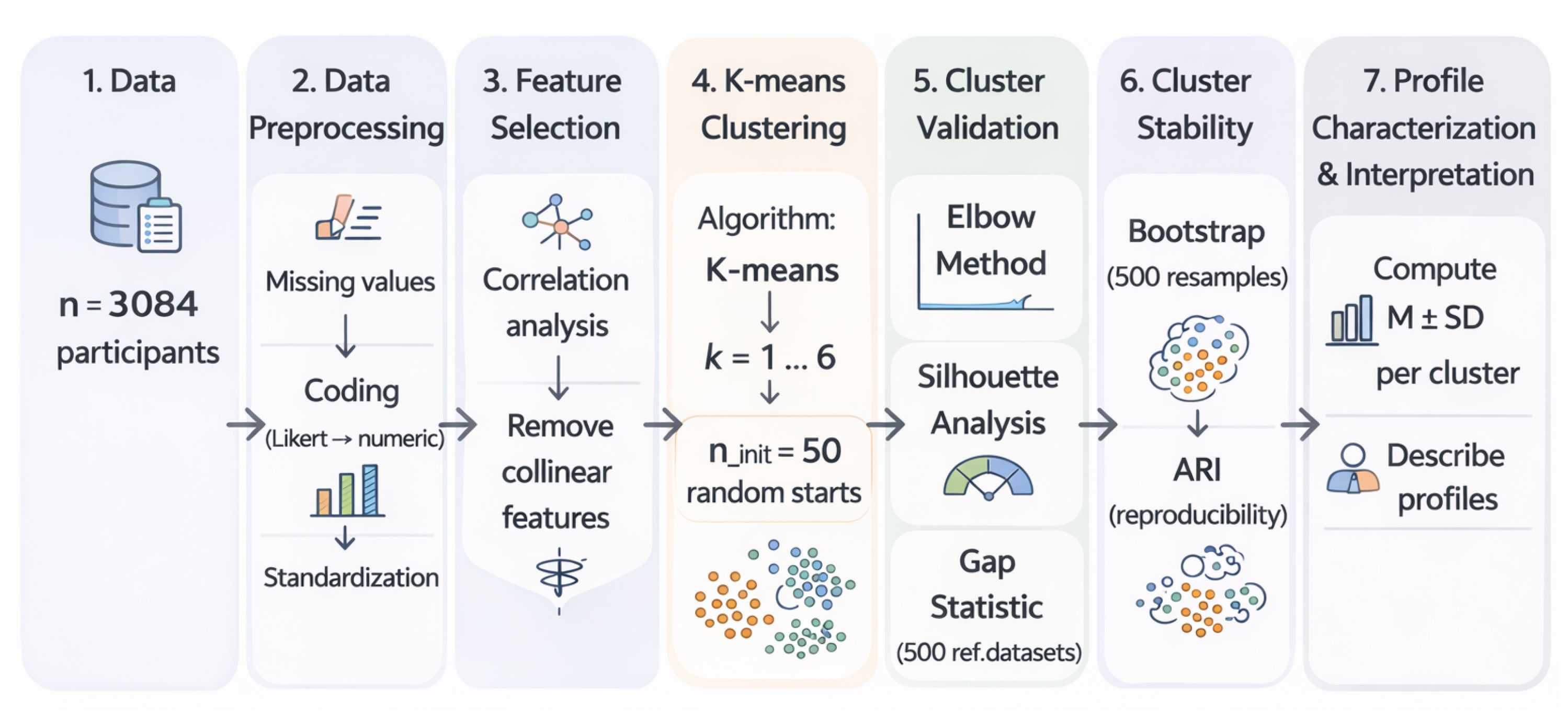
3.3.2. Clustering-Based Profile Identification
- is the set of participants assigned to cluster r;
- is the centroid of cluster r;
- is the vector of criterion scores for participant i.
- Suitability to the Data Structure: The variables used for clustering consist of continuous Likert-scale measurements treated as approximately interval-level variables, a common and accepted practice in behavioural and decision-science research. K-means is well-suited for partitioning continuous multivariate data into compact, spherical clusters by minimizing WCSS. Because our objective was to identify internally cohesive and externally distinct decision-making profiles, variance minimization was theoretically aligned with the research aim.
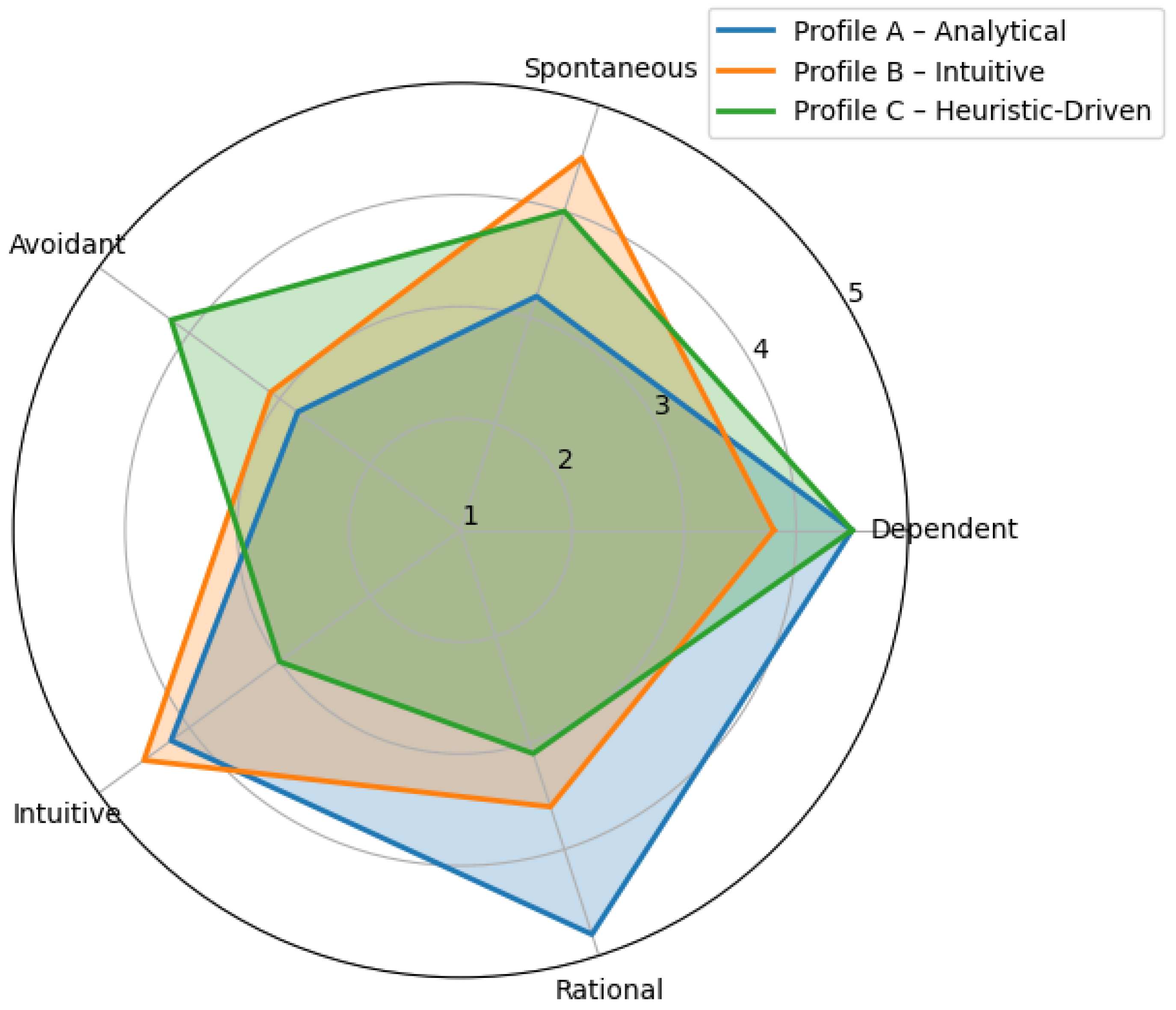
- Interpretability and Theoretical Alignment: Our study aims to derive interpretable behavioural profiles. K-means produces centroid-based clusters, which allow straightforward interpretation in terms of mean score patterns across decision criteria. This centroid representation facilitates theoretical mapping between statistical clusters and substantive decision-making styles. More complex model-based approaches (e.g., Gaussian Mixture Models) would introduce additional distributional assumptions without substantially improving interpretability in this context.
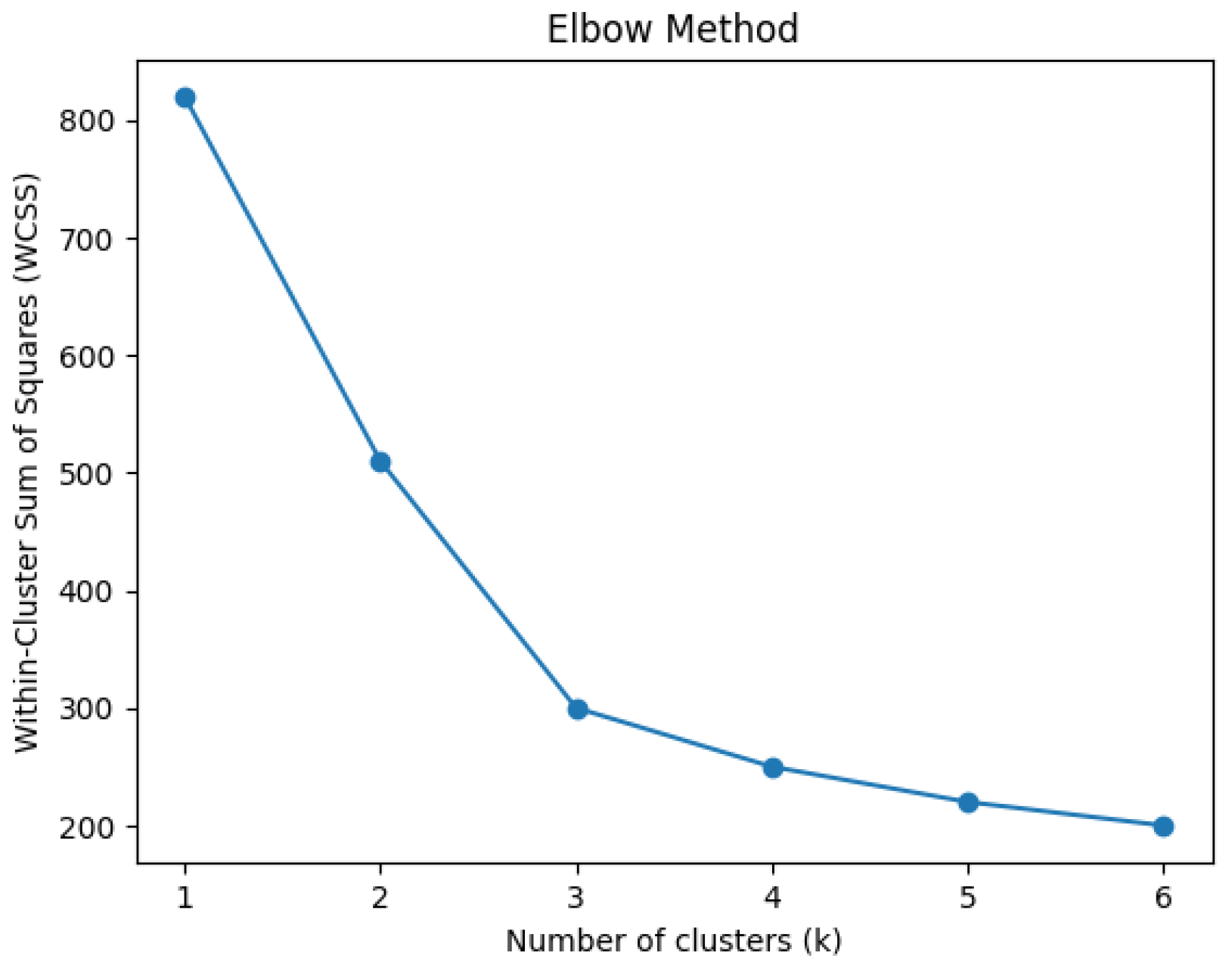
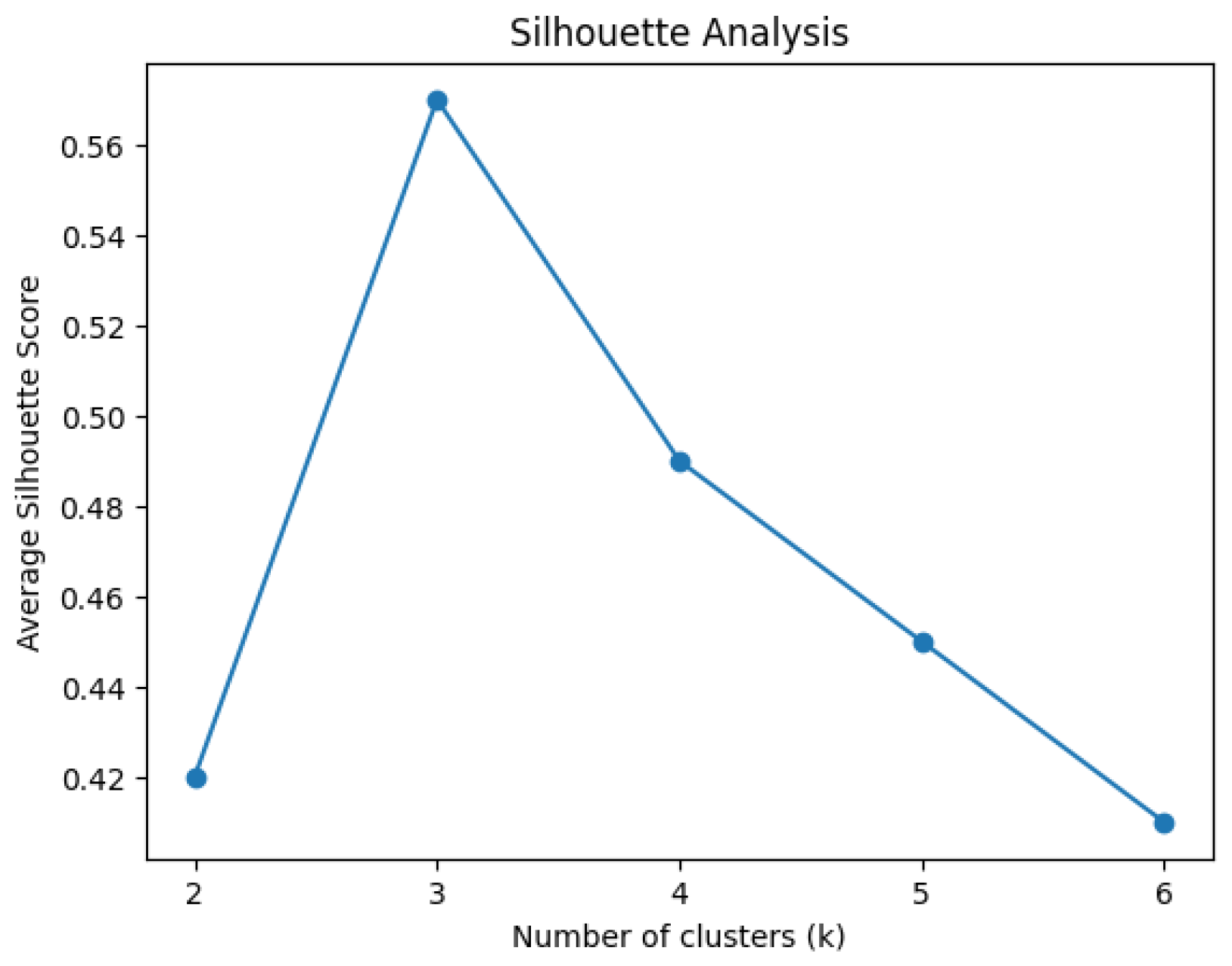
- Empirical Robustness Checks: To ensure that the choice of K-means did not bias results, we evaluated cluster validity using a triangulated approach (Elbow, Silhouette, and Gap Statistic). All criteria converged on a three-cluster solution, suggesting structural stability independent of any single diagnostic metric.
3.3.3. Association Between Profiles and Rationing Criteria
- is the score of participant i on criterion j;
- is the weight assigned to participant i (for unweighted mean, );
- is the weighted mean of criterion j.
4. Results
4.1. Descriptive Analysis of Decision-Style Characteristics
4.2. Determination of the Optimal Number of Clusters
4.3. Clustering Analysis of Decision Styles and Healthcare Prioritisation Criteria
5. Discussion
5.1. Interpretation of Findings
5.2. Theoretical and Methodological Contributions
5.3. Practical and Policy Implications
5.4. Limitations and Future Research
6. Conclusions
Author Contributions
Funding
Institutional Review Board Statement
Informed Consent Statement
Data Availability Statement
Conflicts of Interest
Abbreviations
| QALYs | Quality-adjusted Life Years |
| GDMS | General Decision-Making Style |
| IQR | Interquartile Range |
| WCSS | Within-Cluster Sum of Squares |
| ARI | Adjusted Rand Index |
References
- Arrow, K.J. Uncertainty and the welfare economics of medical care. In Uncertainty in Economics; Elsevier: Amsterdam, The Netherlands, 1963; pp. 345–375. [Google Scholar]
- Williams, A. Intergenerational equity: An exploration of the ‘fair innings’ argument. Health Econ. 1997, 6, 117–132. [Google Scholar] [CrossRef]
- Culyer, A.J.; Wagstaff, A. Equity and equality in health and health care. J. Health Econ. 1993, 12, 431–457. [Google Scholar] [CrossRef]
- Dolan, P. Utilitarianism and the measurement and aggregation of quality–adjusted life years. Health Care Anal. 2001, 9, 65–76. [Google Scholar] [CrossRef]
- Dolan, P.; Shaw, R.; Tsuchiya, A.; Williams, A. QALY maximisation and people’s preferences: A methodological review of the literature. Health Econ. 2005, 14, 197–208. [Google Scholar] [CrossRef] [PubMed]
- Culyer, A.J. Equity-some theory and its policy implications. J. Med. Ethics 2001, 27, 275–283. [Google Scholar] [CrossRef] [PubMed]
- Daniels, N.; Sabin, J.E. Setting Limits Fairly: Learning to Share Resources for Health; Oxford University Press: Oxford, UK, 2008. [Google Scholar]
- Glover, C.M.; Stewart, C.C.; Yu, L.; Wilson, R.S.; Lamar, M.; Bennett, D.A.; Boyle, P.A. Psychological well-being relates to Healthcare and Financial decision making in a study of predominantly white older adults. J. Appl. Gerontol. 2023, 42, 1770–1780. [Google Scholar] [CrossRef]
- Sedlár, M.; Gurňáková, J. Decision-making styles in medical students and healthcare professionals: The roles of personality traits and socio-emotional intelligence factors. J. Psychol. 2025, 159, 71–91. [Google Scholar] [CrossRef]
- Kahneman, D. Thinking, Fast and Slow; Farrar, Straus and Giroux: New York, NY, USA, 2011. [Google Scholar]
- Leonard, T.C.; Thaler, R.H.; Sunstein, C.R. Nudge: Improving Decisions About Health, Wealth, and Happiness; Yale University Press: New Haven, CT, USA, 2008; p. 293. [Google Scholar]
- Ubel, P.A.; DeKay, M.L.; Baron, J.; Asch, D.A. Cost-effectiveness analysis in a setting of budget constraints—Is it equitable? N. Engl. J. Med. 1996, 334, 1174–1177. [Google Scholar] [CrossRef] [PubMed]
- Baltussen, R.; Marsh, K.; Thokala, P.; Diaby, V.; Castro, H.; Cleemput, I.; Garau, M.; Iskrov, G.; Olyaeemanesh, A.; Mirelman, A.; et al. Multicriteria decision analysis to support health technology assessment agencies: Benefits, limitations, and the way forward. Value Health 2019, 22, 1283–1288. [Google Scholar] [CrossRef]
- Dowling, A.; Lane, H.; Haines, T. Community preferences for the allocation of scarce healthcare resources during the COVID-19 pandemic: A review of the literature. Public Health 2022, 209, 75–81. [Google Scholar] [CrossRef]
- Madeira, F.; Do Bú, E.A.; Freitas, G.; Pereira, C.R. Distributive justice criteria and social categorization processes predict healthcare allocation bias. Br. J. Health Psychol. 2023, 28, 552–566. [Google Scholar] [CrossRef]
- Pinho, M.; Veiga, P. Attitudes of health professionals concerning bedside rationing criteria: A survey from Portugal. Health Econ. Policy Law 2020, 15, 113–127. [Google Scholar] [CrossRef]
- Pinho, M. The challenge posed by the COVID-19 pandemic: How to decide who deserves life-saving medical devices? Int. J. Health Gov. 2021, 26, 28–41. [Google Scholar] [CrossRef]
- de Fine Licht, J.; Naurin, D. Open decision-making procedures and public legitimacy. In Secrecy and Publicity in Votes and Debates; Cambridge University Press: Cambridge, UK, 2015; Volume 131. [Google Scholar]
- Erman, E.; Möller, N. Political legitimacy in the real normative world: The priority of morality and the autonomy of the political. Br. J. Political Sci. 2015, 45, 215–233. [Google Scholar] [CrossRef]
- Hamilton, K.; Shih, S.I.; Mohammed, S. The development and validation of the rational and intuitive decision styles scale. J. Personal. Assess. 2016, 98, 523–535. [Google Scholar] [CrossRef] [PubMed]
- Moyano-Díaz, E.; Mendoza-Llanos, R. Yes! Maximizers maximize almost everything: The decision-making style is consistent in different decision domains. Front. Psychol. 2021, 12, 663064. [Google Scholar] [CrossRef]
- Hastie, T.; Tibshirani, R.; Friedman, J. The Elements of Statistical Learning; Springer: Berlin/Heidelberg, Germany, 2009. [Google Scholar]
- Jain, A.K. Data clustering: 50 years beyond K-means. Pattern Recognit. Lett. 2010, 31, 651–666. [Google Scholar] [CrossRef]
- Loftus, T.J.; Shickel, B.; Balch, J.A.; Tighe, P.J.; Abbott, K.L.; Fazzone, B.; Anderson, E.M.; Rozowsky, J.; Ozrazgat-Baslanti, T.; Ren, Y.; et al. Phenotype clustering in health care: A narrative review for clinicians. Front. Artif. Intell. 2022, 5, 842306. [Google Scholar] [CrossRef]
- Orchard, C.; Lin, E.; Rosella, L.; Smith, P.M. Using unsupervised clustering approaches to identify common mental health profiles and associated mental health-care service-use patterns in Ontario, Canada. Am. J. Epidemiol. 2024, 193, 976–986. [Google Scholar] [CrossRef]
- Aljohani, A. Optimizing patient stratification in healthcare: A comparative analysis of clustering algorithms for ehr data. Int. J. Comput. Intell. Syst. 2024, 17, 173. [Google Scholar] [CrossRef]
- Rouco, A.; Silva, F.; Soares, B.; Albuquerque, D.; Gouveia, C.; Brás, S.; Pinho, P. Detection of random body movements using clustering-based methods in bioradar systems. Information 2024, 15, 584. [Google Scholar] [CrossRef]
- Yang, W.C.; Lai, J.P.; Liu, Y.H.; Lin, Y.L.; Hou, H.P.; Pai, P.F. Using medical data and clustering techniques for a smart healthcare system. Electronics 2023, 13, 140. [Google Scholar] [CrossRef]
- Chen, C.; Lu, Y.; Qiu, J.; Xiong, H.; Zhou, L.; Wu, T. Data-driven cluster analysis identifies three clinical phenotypes in hemodialysis patients. Ren. Fail. 2025, 47, 2588961. [Google Scholar] [CrossRef] [PubMed]
- Nalinthasnai, N.; Thammasudjarit, R.; Tassaneyasin, T.; Eksombatchai, D.; Sungkanuparph, S.; Boonsarngsuk, V.; Sutherasan, Y.; Junhasavasdikul, D.; Theerawit, P.; Petnak, T. Unsupervised machine learning clustering approach for hospitalized COVID-19 pneumonia patients. Bmc Pulm. Med. 2025, 25, 70. [Google Scholar] [CrossRef] [PubMed]
- Sun, L.; Chen, G.; Xiong, H.; Guo, C. Cluster Analysis in Data-Driven Management and Decisions. J. Manag. Sci. Eng. 2017, 2, 227–251. [Google Scholar] [CrossRef]
- Nayak, S.; Khilar, P.M. Handling Missing Data in Healthcare with Fuzzy Clustering Imputation; CRC Press: Boca Raton, FL, USA, 2025; pp. 161–185. [Google Scholar] [CrossRef]
- Liu, Y.; Zhang, J.; Chan, F.T.S. AI-enhanced robust method for integrated healthcare resource pre-positioning and patient scheduling. Int. J. Prod. Res. 2025, 63, 729–757. [Google Scholar] [CrossRef]
- Tiwari, V.; Gowthami, C.; Bhavani, R.; Kayalvizhi, S.; Selvakanmani, S.; Chowdary Edara, D. Strategic Improved K-Means Clustering in Mining Blood Donor Data Analysis and IoT-based Allocation. J. Intell. Syst. Internet Things 2024, 13, 122–134. [Google Scholar] [CrossRef]
- Anandan, K.; Ismail, S. AI-Powered Data-Driven Resource Allocation and Scenario Planning for Healthcare Systems. In Lecture Notes in Electrical Engineering; Springer: Berlin/Heidelberg, Germany, 2026; Volume 1466, pp. 1725–1734. [Google Scholar] [CrossRef]
- Cheng, Y.; Zang, C.; Ma, J.; Zhang, Z.; Zuo, Q. Revealing the heterogeneity of socio-economic impacts on resource-environmental pressure: A novel three-dimensional framework applied to the Yellow River Basin. Ecol. Indic. 2024, 166, 112419. [Google Scholar] [CrossRef]
- Scott, S.G.; Bruce, R.A. Decision-making style: The development and assessment of a new measure. Educ. Psychol. Meas. 1995, 55, 818–831. [Google Scholar] [CrossRef]
- Guerreiro, C.; Leal, F.; Pinho, M. Synthetic Data Generation for Binary and Multi-Class Classification in the Health Domain. Information 2025, 16, 986. [Google Scholar] [CrossRef]
- Fischer, S.; Soyez, K.; Gurtner, S. Adapting Scott and Bruce’s general decision-making style inventory to patient decision making in provider choice. Med. Decis. Mak. 2015, 35, 525–532. [Google Scholar] [CrossRef]
- Douma, L.N.; Uiters, E.; Timmermans, D.R. Decision-making styles in the context of colorectal cancer screening. BMC Psychol. 2020, 8, 11. [Google Scholar] [CrossRef] [PubMed]
- Whitty, J.A.; Lancsar, E.; Rixon, K.; Golenko, X.; Ratcliffe, J. A systematic review of stated preference studies reporting public preferences for healthcare priority setting. Patient-Patient-Centered Outcomes Res. 2014, 7, 365–386. [Google Scholar] [CrossRef] [PubMed]
- Pinho, M.; Leal, F. An intelligent community-based system for healthcare prioritisation. Sci. Rep. 2025, 15, 34066. [Google Scholar] [CrossRef] [PubMed]
- Miguel, I.; Pinho, M. The relationship between human values and support for distributive approaches in healthcare rationing: An exploratory study. Mind Soc. 2025, 24, 1025–1046. [Google Scholar] [CrossRef]



| Dependent | Spontaneous | Avoidant | Intuitive | Rational | |
|---|---|---|---|---|---|
| Gender | |||||
| M | 6.56 | 17.12 | 4.17 | 29.98 | 42.16 |
| F | 7.32 | 10.60 | 6.26 | 28.42 | 47.40 |
| Marital Status | |||||
| Married/Common-law marriage | 6.48 | 10.18 | 4.16 | 30.8 | 48.38 |
| Divorced/Separated | 4.95 | 16.83 | 3.96 | 24.75 | 49.5 |
| Single | 7.3 | 14.26 | 7.13 | 26.85 | 44.46 |
| Widowed | 12.24 | 19.39 | 7.14 | 24.49 | 36.73 |
| Other | 7.63 | 14.48 | 4.31 | 32.88 | 40.7 |
| Level of Education | |||||
| 1st Cycle (4th grade) | 7.75 | 21.71 | 8.53 | 37.98 | 24.03 |
| 2nd Cycle (6th grade) | 7.46 | 32.84 | 4.48 | 32.84 | 22.39 |
| 3rd Cycle (9th grade) | 4.55 | 21.59 | 8.52 | 29.55 | 35.80 |
| Bachelor’s Degree | 6.45 | 6.45 | 8.06 | 35.48 | 43.55 |
| Doctorate | 2.27 | 15.91 | 2.27 | 29.55 | 50.00 |
| Secondary Education | 6.88 | 13.77 | 5.14 | 31. 67 | 42.54 |
| Licentiate Degree | 8.16 | 9.83 | 5.25 | 24.25 | 52.51 |
| Master’s Degree | 6.98 | 6.59 | 4.26 | 22.87 | 59.3 |
| Other | 5.48 | 17.81 | 4.11 | 32.88 | 39.73 |
| Professional Situation | |||||
| Employed | 6.1 | 10.77 | 3.73 | 29.61 | 49.8 |
| Student | 7.95 | 13.28 | 6.84 | 27.87 | 44.06 |
| Retired | 8.37 | 20.92 | 7.11 | 30.54 | 33.05 |
| Working Student | 7.48 | 18.37 | 9.52 | 23.81 | 40.82 |
| Unemployed | 7.79 | 17.53 | 5.84 | 32.47 | 36.36 |
| Other | 8.11 | 16.22 | 5.41 | 31.08 | 39.19 |
| Age | |||||
| Generation BB | 7.8 | 16.59 | 6.59 | 28.78 | 40 |
| Generation X | 6.67 | 6.68 | 3.11 | 30.43 | 53.11 |
| Generation Y | 4.93 | 14.04 | 3.98 | 31.31 | 45.73 |
| Generation Z | 7.78 | 14.7 | 6.59 | 27.68 | 43.25 |
| Political Orientation | |||||
| Center | 7.83 | 12.54 | 4.8 | 27.85 | 46.98 |
| Right | 6.02 | 15.32 | 4.65 | 28.18 | 45.83 |
| Left | 6.24 | 10.88 | 8.16 | 28.64 | 46.08 |
| No Political Option | 7.78 | 14.24 | 4.64 | 32.62 | 40.73 |
| k | WCSS | Average Silhouette | Gap Statistic |
|---|---|---|---|
| 1 | 820 | – | 0.12 |
| 2 | 510 | 0.42 | 0.31 |
| 3 | 300 | 0.57 | 0.48 |
| 4 | 250 | 0.49 | 0.44 |
| 5 | 220 | 0.45 | 0.39 |
| 6 | 200 | 0.41 | 0.35 |
Disclaimer/Publisher’s Note: The statements, opinions and data contained in all publications are solely those of the individual author(s) and contributor(s) and not of MDPI and/or the editor(s). MDPI and/or the editor(s) disclaim responsibility for any injury to people or property resulting from any ideas, methods, instructions or products referred to in the content. |
© 2026 by the authors. Licensee MDPI, Basel, Switzerland. This article is an open access article distributed under the terms and conditions of the Creative Commons Attribution (CC BY) license.
Share and Cite
Pinho, M.; Leal, F.; Miguel, I. Profiling Decision-Making Styles Under Healthcare Resource Scarcity: An Interdisciplinary Clustering Approach. Information 2026, 17, 287. https://doi.org/10.3390/info17030287
Pinho M, Leal F, Miguel I. Profiling Decision-Making Styles Under Healthcare Resource Scarcity: An Interdisciplinary Clustering Approach. Information. 2026; 17(3):287. https://doi.org/10.3390/info17030287
Chicago/Turabian StylePinho, Micaela, Fátima Leal, and Isabel Miguel. 2026. "Profiling Decision-Making Styles Under Healthcare Resource Scarcity: An Interdisciplinary Clustering Approach" Information 17, no. 3: 287. https://doi.org/10.3390/info17030287
APA StylePinho, M., Leal, F., & Miguel, I. (2026). Profiling Decision-Making Styles Under Healthcare Resource Scarcity: An Interdisciplinary Clustering Approach. Information, 17(3), 287. https://doi.org/10.3390/info17030287