Article

Beyond Linear Statistics: A Machine Learning Ecosystem for Early Screening of School Bullying
by
Carlos Alberto Espinosa-Pinos
1,*,
Paúl Bladimir Acosta-Pérez
1,
Aitor Larzabal-Fernández
2 and
Francisco Sebastián Vaca-Pinto
1
1
Faculty of Social and Human Sciences—Psychology Program, Universidad Tecnológica Indoamérica, Ambato 180102, Ecuador
2
Departament of Evolutionary and Educational Psychology, Universidad del País Vasco (UPV/EHU), 48940 Leioa, Spain
*
Author to whom correspondence should be addressed.
Information 2026, 17(3), 260; https://doi.org/10.3390/info17030260
Submission received: 27 January 2026 / Revised: 22 February 2026 / Accepted: 27 February 2026 / Published: 5 March 2026
(This article belongs to the Section Artificial Intelligence)

Abstract

This study developed and validated a Machine Learning (ML) ecosystem for the early screening of school victimization among Ecuadorian adolescents, a phenomenon that poses a critical barrier to educational equity. Addressing previous methodological limitations, this research intentionally eliminated circular reasoning by excluding all internal psychometric items from the feature set, focusing strictly on sixteen socio-environmental and demographic predictors. A quantitative study was conducted with 1413 students in the province of Tungurahua, utilizing the Synthetic Minority Over-sampling Technique (SMOTE) to correct class imbalance. Supervised classification algorithms, including SVM, Random Forest, and XGBoost, were compared. The results demonstrated that the Random Forest model achieved the most balanced performance, reaching an Accuracy of 60.3% and a Macro F1-score of 0.382. Feature importance analysis identified household structure (Living_With_Monoparental) and Family_Coping_Capacity as the most significant predictors of high-risk profiles. These findings provided a statistically honest and ecologically valid tool for Student Counseling Departments (DECE), enabling a transition toward proactive risk identification grounded in observable social vulnerability rather than reactive symptom reporting.

1. Introduction

School victimization—commonly referred to as “bullying”—is a persistent barrier to educational equity in the 21st century. International bodies (e.g., UNESCO, UNICEF) have underscored that bullying is not a transient behavioral issue but a structural impediment to the Sustainable Development Goals, particularly those related to quality education and mental health [1,2,3,4]. Extensive evidence links bullying with anxiety, depression, suicidal ideation, absenteeism, and long-term academic disengagement, highlighting its systemic costs for student well-being and learning [5,6,7,8].
Globally, bullying takes culturally contingent forms yet converges on adverse psychosocial outcomes. In Europe, cross-national variation in cyber-victimization coexists with relational exclusion and online harassment, both strongly associated with internalizing symptoms [9,10,11]. In Asia, context-specific modalities are documented—for instance, ijime in Japan (group-based ostracism linked to academic position) and the role of competitive, hierarchical school structures in South Korea [12,13,14]. Large multi-country surveys show that, although prevalence and modes vary, the psychosocial harm is universal, emphasizing the need for culturally sensitive analytics [15].
These heterogeneous expressions have direct methodological implications. Traditional linear statistics assume stable, low-dimensional associations, but cross-country research shows that effect sizes and construct relations fluctuate with the instrument, contextual moderators, and non-linear interactions [15,16,17]. Meta-analytic evidence indicates that prevalence rates and correlates shift across survey architectures (e.g., PISA, HBSC, EU Kids Online), thus compromising transportability when relying on parametric linear models. In contrast, machine-learning (ML) ecosystems can capture interaction structures, threshold effects, and non-linear dynamics without pre-specifying functional forms—features that are crucial for early-screening contexts where risk arises from multifactorial patterns [9,11,15].
In Latin America—and particularly in Ecuador—the urgency is evident. Regional studies show that bullying disproportionately affects schools in socially vulnerable areas and produces academic, behavioral, and emotional consequences that tend to perpetuate inequality [18]. Despite the existence of regulatory frameworks, detection still depends largely on teacher observation or voluntary student reporting, strategies that often fail to capture hidden or relational victimization. Moreover, conventional approaches in the region favor descriptive statistics or simple linear associations, which underrepresent the complex interplay among family dynamics, digital exposure, and socio-emotional factors [19,20].
ML provides a practical bridge to address this methodological gap. Unlike linear models, ML can integrate multiple psychosocial and contextual dimensions, identify non-linear interactions, and yield actionable risk classifications for school teams. In this study, ML is approached not merely as a technical novelty but as a tool for educational justice: by enabling timely, data-driven interventions, schools can move from reactive responses toward preventive action [21,22,23,24,25].
Despite these advances, studies in Ecuador and the broader Andean region remain predominantly descriptive and seldom validate early-warning or predictive systems tailored to local school ecologies. Cross-context reviews also note inconsistencies in sampling frames, instruments, and contextual moderators, limiting comparability and external validity across socio-cultural settings. While ML-based risk detection has progressed elsewhere, such pipelines have not been adapted or validated for Ecuadorian schools, reinforcing the regional implementation gap. These limitations justify the present validity-first ecosystem, which avoids construct leakage and integrates socio-environmental determinants for proactive screening [18,19,24,26,27].
The article proceeds as follows. Section 2 synthesizes the state of AI in education and the determinants of bullying. Section 3 details the methodology and the sample of 1413 Ecuadorian adolescents. Section 4 describes the experimental workflow (preprocessing, modeling, and validation). Section 5 presents results and model comparisons. Section 6 offers a critical discussion and limitations. Section 7 concludes with implications and avenues for future research on ethically grounded, effective ML for school climate.

2. Background, Variables and Research Model

2.1. Dynamics of Victimization and Its Systemic Repercussions

From a theoretical perspective, the dynamics of school victimization cannot be reduced to isolated aggressive acts; rather, they emerge from the interaction between the student’s internal resources and their surrounding environments. Psychometric variables such as resilience and self-esteem remain central protective factors, although their effects are shaped by broader ecological contexts—including family climate, school dynamics, and digital environments [23,24]. This multidimensional interplay aligns with contemporary ecological models of bullying, which conceptualize victimization as a systemic phenomenon influenced by interconnected social layers.
In societies with pronounced inequality gaps, such as Ecuador, the comprehensive protection of rights framework positions early detection as a key mechanism for transforming educational environments [26,28]. Under this perspective, authors such as [29] emphasize that fostering resilience requires integrating developmental psychology with social data analysis, enabling practitioners to identify early vulnerabilities before they consolidate into chronic patterns of victimization. This approach recognizes bullying not merely as peer conflict, but as a symptom of deficits within supervision structures, relational climates, and school–community support systems [30,31].
Taken together, these theoretical contributions underscore that victimization trajectories are shaped by a convergence of socio-emotional competencies, household functioning, contextual stressors, and institutional conditions. Understanding these systemic interactions provides the conceptual foundation for designing predictive, equity-oriented strategies capable of identifying risk profiles within diverse school populations.

2.2. Predictive Determinants and Risk Variables

The identification of factors associated with the intensity of victimization reveals a complex network of variables interacting non-linearly. Regarding sex, the academic debate presents significant nuances: while classical studies associate male students with direct physical or overt aggression, recent research in the Andean region shows that females report higher levels of relational and psychological victimization, which is often less visible and harder to detect [32,33,34]. Age also shapes vulnerability: risk tends to peak during early adolescence—particularly in the transition to upper basic education—and later stabilizes throughout high school [35]. However, this trajectory is challenged by the ubiquity of digital environments, which extend aggression beyond school hours and across social platforms, amplifying exposure to victimization [36,37].
Family climate and media consumption further emerge as high-impact predictors. Supportive parental environments enhance resilience, whereas conflictive home dynamics or the excessive and unsupervised use of social networks substantially increase victimization probability [38,39,40]. Additional determinants such as socio-emotional skills training and the internal diversity of educational centers also modulate bullying intensity profiles (Low, Medium, High) [41,42,43]. Altogether, these interacting factors generate heterogeneous risk configurations that require analytical approaches capable of modeling uncertainty, latent dependencies, and contextual variability [27,44].

2.3. Application of Machine Learning in Educational Risk Modeling

The use of Machine Learning (ML) algorithms represents a paradigm shift in educational research, enabling the identification of hidden patterns within extensive and heterogeneous student datasets. Unlike traditional linear models, ML techniques such as Random Forest (RF) and Support Vector Machines (SVM) can model multidimensional and non-parametric relationships without relying on restrictive statistical assumptions [29,30,31,45,46,47]. This versatility is essential for capturing the complexity of school victimization, where psychosocial variables frequently present mutual dependencies and non-normal distributions [22,30,31].
In recent years, the adoption of ML techniques in education has expanded rapidly, demonstrating strong performance in predicting dropout, academic outcomes, and at-risk student profiles [45,46,47]. However, their use for stratifying bullying intensity in the Ecuadorian context remains limited. To address this gap, the present study implements a multi-model ecosystem designed to manage the psychosocial complexity inherent to bullying data.
Random Forest (RF) was selected for its capacity to handle high-dimensional data and to capture nonlinear interactions through ensembles of decision trees [32]. Its ability to generate robust, interpretable measures of feature importance makes it particularly well-suited for identifying socio-environmental predictors. XGBoost was included due to its iterative boosting mechanism and its strong performance in imbalanced classification settings, a crucial advantage when detecting minority high-risk profiles [33]. In addition, Support Vector Machines (SVM) were employed for their capacity to find optimal hyperplanes in complex feature spaces, enabling effective separation of victimization levels even when boundaries are nonlinear [26]. Decision Trees (rpart) and k-Nearest Neighbors (KNN) were incorporated to provide transparent, rule-based and similarity-based baselines for comparison [34].
Together, these algorithms offer complementary strengths and enable a statistically honest evaluation of bullying risk based strictly on socio-environmental determinants. Beyond enhancing theoretical understanding, this predictive capacity provides school administrators with actionable insights for resource allocation and early intervention [36,41]. Ultimately, integrating ML into the social sciences supports a broader transition from reactive to proactive educational strategies, allowing schools to anticipate and mitigate harm before it becomes consolidated [18,36].
Support Vector Machines (SVM): Utilized for its capacity to find optimal hyperplanes for classification in complex multidimensional spaces [41]. It is adequate for this research as it can effectively separate victimization levels even when boundaries are non-linear.
Decision Trees (rpart) and k-Nearest Neighbors (KNN): These methods were included to provide both a clear hierarchical logic of risk factors and a classification based on the similarity of socio-environmental features between students [41].
The incorporation of these algorithms offers optimized precision and a statistically honest evaluation of risk. This predictive capacity not only improves the theoretical understanding of the problem but also provides school administrators with an objective tool for resource allocation and evidence-based preventive decision-making [41,42]. Ultimately, integrating ML into the social sciences allows for a transition from a reactive stance to a proactive strategy, where the educational system can anticipate and mitigate damage before it becomes consolidated [18,41].

3. Materials and Methods

This section exhaustively describes the computational experimental design employed in the research, covering everything from sample characterization and instrument validation to the critical phases of preprocessing and advanced modeling. The design was oriented toward transcending the limitations of classical descriptive and inferential statistics through the implementation of a Machine Learning (ML) ecosystem. The central objective was to validate predictive models capable of identifying school victimization intensity levels based on biopsychosocial and digital determinants specific to the Ecuadorian environment, structuring the analysis into three experimental tasks: profile classification, selection of critical predictors, and regression of resilience factors.
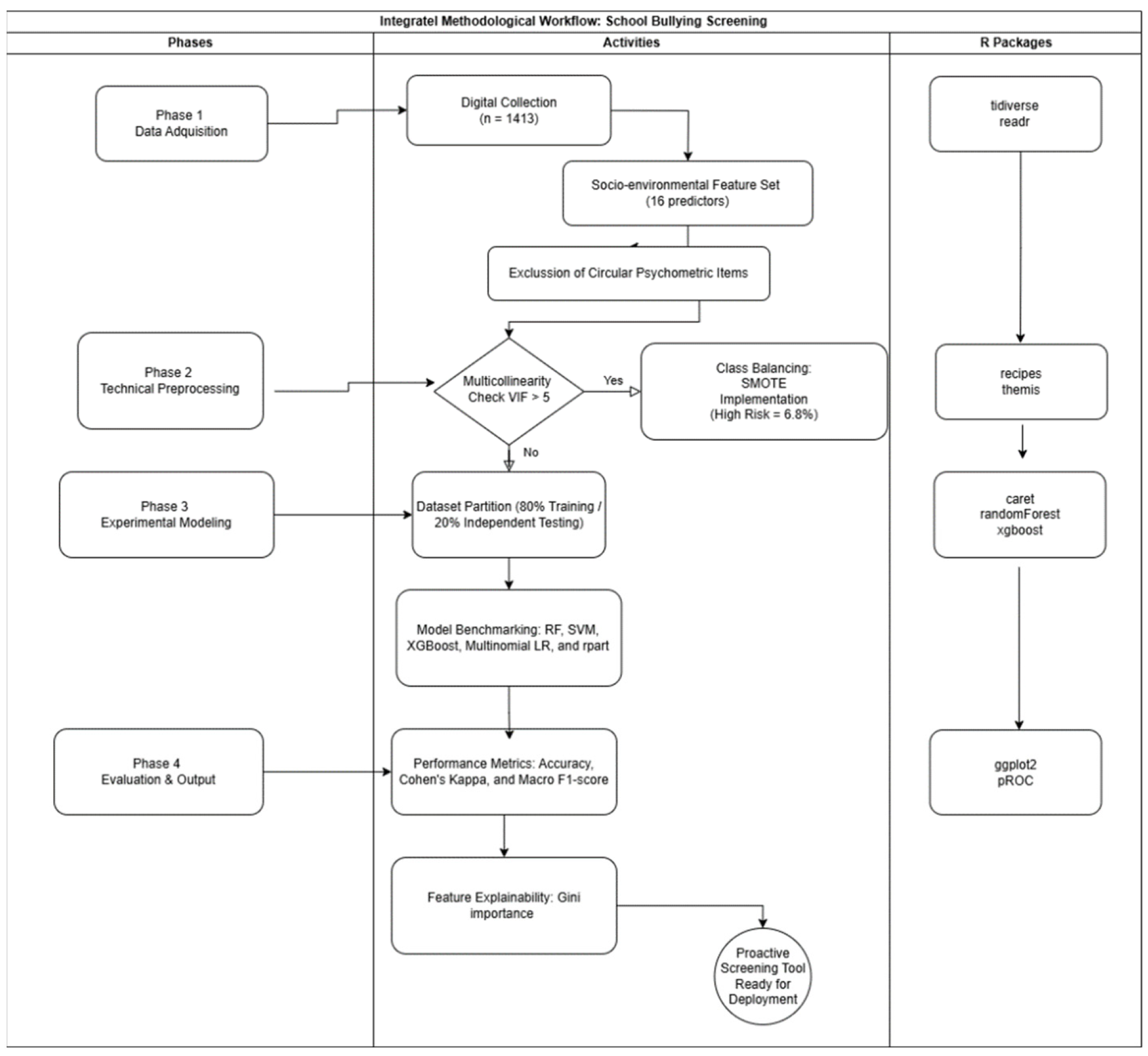
The integrated methodological pipeline, illustrating the progression from data acquisition through technical refinement and experimental modeling to final evaluation, is synthesized in Figure 1.

3.1. Study Context, Population, and Variables

The research was based on a quantitative, non-experimental, and cross-sectional design. Fieldwork was carried out during the 2024 school period in the province of Tungurahua, Ecuador, a geographic context that allows for the analysis of victimization in educational institutions located in both urban and semi-urban areas under an integrated regional perspective. The study universe comprised adolescents enrolled in upper basic education and high school levels, segmented into an age range of 12 to 17 years.
Through a selection process that prioritized representativity criteria by sex, educational level, and internal diversity, a final sample of 1413 young people was consolidated, representing approximately 30% of the total estimated in the region. Data were collected digitally using mobile devices and computers, a method that guaranteed response integrity and allowed for the traceability of information through anonymous treatment protocols. This sample size is statistically significant and provides the data density necessary for training supervised learning models, which require a sufficient volume of records to mitigate overfitting risks and ensure the generalizability of the results [48,49,50,51].
The protection of participants’ rights was the ethical axis of the process. Informed consents signed by legal representatives and assents from minors were obtained, providing clear information regarding confidentiality and anonymous data treatment. The research was reviewed and approved by the competent institutional ethics committee, adhering to international provisions for studies with vulnerable populations [52,53].
Variables were integrated into the experimental flow according to their predictive role, specifically selected to ensure model validity and avoid data leakage:
Predictor Variables (Independent): To prevent circular reasoning, the model exclusively utilized external socio-environmental and demographic determinants. These include factors such as gender, age, educational level, ethnic identification (to capture regional diversity), parents’ schooling level, residence zone, household size (number of children), living arrangements (e.g., single-parent vs. nuclear family), and perceived family coping capacity. Notably, all psychometric subscales and individual items directly measuring bullying behaviors were excluded from the feature set to ensure that the ecosystem identifies risk profiles based on social vulnerability rather than the mathematical sum rule.
Criterion Variable (Dependent): Named “Bullying Intensity Level,” structured nominally into three categories based on the total score of the validated victimization scale: High (n = 96), which represents 6.8% of the sample; Medium (n = 461), representing 32.6%; and Low (n = 856), representing 60.6%).

3.2. Instruments and Data Acquisitions

We assessed peer victimization with the Auto-test Cisneros de acoso escolar (Spain), developed by Iñaki Piñuel and Araceli Oñate (Instituto de Innovación Educativa y Desarrollo Directivo, 2005) [54]. It can be administered individually or in groups in about 30 min and yields a global bullying index and an intensity index for school victimization. The instrument contains 50 affirmative items rated on a 3-point frequency scale (1 = Never; 2 = A few times; 3 = Many times), scored 1–3. The Global Index (M) is the sum of item scores; the Intensity Index (I) counts the number of “3 = Many times” responses across items 1–50.
Prior to fieldwork, we conducted linguistic adaptation and expert review, followed by a pilot (n = 60) to verify clarity and acceptability for Ecuadorian adolescents. In the study sample, internal consistency was α = 0.77; KMO = 0.85 and Bartlett’s test p < 0.001 supported factorability. An EFA (Varimax) explained 66.86% of variance and recovered three contents-coherent factors—Direct Violence, Verbal Harassment & Social Exclusion, and Coercion & Psychological Intimidation—consistent with the item pool (e.g., “They hit me with objects”, “They insult me”, “They don’t let me participate; they exclude me”, “They threaten me”; see Table 1). To avoid construct leakage in the predictive pipeline, no item/subscale from the Auto-test Cisneros was used as a predictor. The instrument served only as the criterion to derive Bullying Intensity Level (Low/Medium/High); socio-environmental/demographic variables were the exclusive predictors [55,56,57].

3.3. Preprocessing and Data System Structuring

Technical information processing was centralized in the RStudio software (version 2025.09.1, Posit Software, PBC, Boston, MA, USA) development environment. To ensure the quality and robustness of the predictive models, a rigorous post-processing flow was implemented. Two filtering procedures were applied to refine the experimental pipeline and improve model generalizability [58,59].
Data Cleaning and Normalization: Records with missing values in the dependent variable were removed to preserve data integrity. Numerical variables were normalized to reduce bias caused by differing measurement scales. Feature Refinement: To prevent multicollinearity that could distort model interpretation, two criteria were applied. First, a correlation matrix was used to remove predictors with coefficients above 0.80, eliminating redundant information. Second, the Variance Inflation Factor (VIF) was computed, and variables with VIF values greater than 5 were excluded.
Class Imbalance Correction (SMOTE): Because the High intensity category represented only 6.9% of the sample, the Synthetic Minority Over-sampling Technique (SMOTE) was applied exclusively to the training split, generating synthetic instances for the minority classes (High and Medium). This ensured that performance metrics—especially the F1-score—reflected a realistic capacity to detect high-risk profiles rather than a bias toward the majority class [60,61].
To prevent circularity, the predictor set was restricted to sixteen socio-environmental and demographic variables, explicitly excluding all psychometric items that operationalize the outcome. Categorical variables were encoded using k-1 dummy expansion (step_dummy), and a near-zero variance filter was applied. After this transformation, the input space expanded from the original 16 conceptual predictors to p = 168 effective columns. Within this dimensionality, the optimal Random Forest model selected mtry = 85, a value consistent with the expanded feature matrix and necessary for stable feature-importance estimation. The test set preserved its natural distribution without any resampling.
This technical refinement began with sixteen socio-environmental predictors, which—after categorical encoding—produced an expanded and reproducible feature matrix suitable for machine-learning classification.

3.4. Computational Experimental Design Implementation

The dataset was randomly and stratifiedly partitioned into 80% training and 20% testing, ensuring that models learned patterns on one subset and were evaluated on a fully independent hold-out for an unbiased estimate of out-of-sample performance. Because the ‘High’ intensity category comprised only 6.9% of the sample, we addressed class imbalance by applying the Synthetic Minority Over-sampling Technique (SMOTE) exclusively within the training phase. SMOTE generated synthetic instances for minority levels (High/Medium) by interpolating among nearest neighbors, thereby improving the sensitivity and macro-F1 toward high-risk profiles without distorting the natural distribution of the independent test set.
We compared five supervised algorithms suited for tabular, imbalanced data: Random Forest (RF), Support Vector Machines (SVM, RBF kernel), XGBoost, multinomial logistic regression, and decision trees (rpart). Model training used five-fold stratified cross-validation (k = 5) to stabilize variance and obtain robust error estimates. Grid search tuned RF (varying mtry, tree depth, and number of estimators), while SVM hyperparameters were calibrated via internal cross-validation for the radial basis function kernel. Post-training, three analysis tasks were conducted: (i) multiclass classification of bullying intensity (Low/Medium/High), (ii) selection of relevant predictors through Feature Importance, and (iii) regression of key subdimensions (e.g., verbal harassment, intimidation, exclusion). In addition, a local sensitivity analysis perturbed the mean of key predictors by ±10% to examine robustness ranges and identify leverage points for school decision-making.
Methodological justification. A five-fold stratified CV protocol was adopted because it provides a sound variance–bias compromise for mid-sized datasets and preserves class proportions within each fold, which is essential when minority classes (e.g., ‘High’ risk) are rare. The 80/20 train–test split was selected to ensure both sufficient training volume and an independent generalization check. SMOTE was restricted to training folds to avoid information leakage—balancing the hold-out would artificially inflate metrics by introducing synthetic data derived from the training distribution. All resampling procedures were stratified to maintain natural class ratios and enable a reliable evaluation of minority-class recall, a central objective in early-risk screening.

3.5. Task Evaluation and Sensitivity Analysis

Following the training phase, the experimental design focused on three high-level analysis tasks:
Intensity Profile Classification: The models’ ability to discriminate between High, Medium, and Low levels of school victimization was evaluated using Accuracy, Kappa, Sensitivity, and F1-score metrics.
Relevant Variable Selection: Feature Importance techniques were applied to the Random Forest and XGBoost models to identify which factors (family environment, social networks, and self-esteem) contribute most to model performance and possess greater preventive relevance.
Key Factor Regression: Regression models were trained to estimate scores in resilience and self-esteem dimensions, analyzing the influence of sociodemographic variables on the student’s adaptive capacity.
Finally, a local sensitivity analysis was executed by systematically modifying the mean values of key predictors by ±10. This approach, supported by previous studies in applied data science [62,63], allowed for the identification of system robustness ranges and the definition of critical points for strategic decision-making in school intervention. The visualization of results through radar charts and confusion matrices facilitated the transfer of findings to community contexts interested in the proactive detection of victimization.
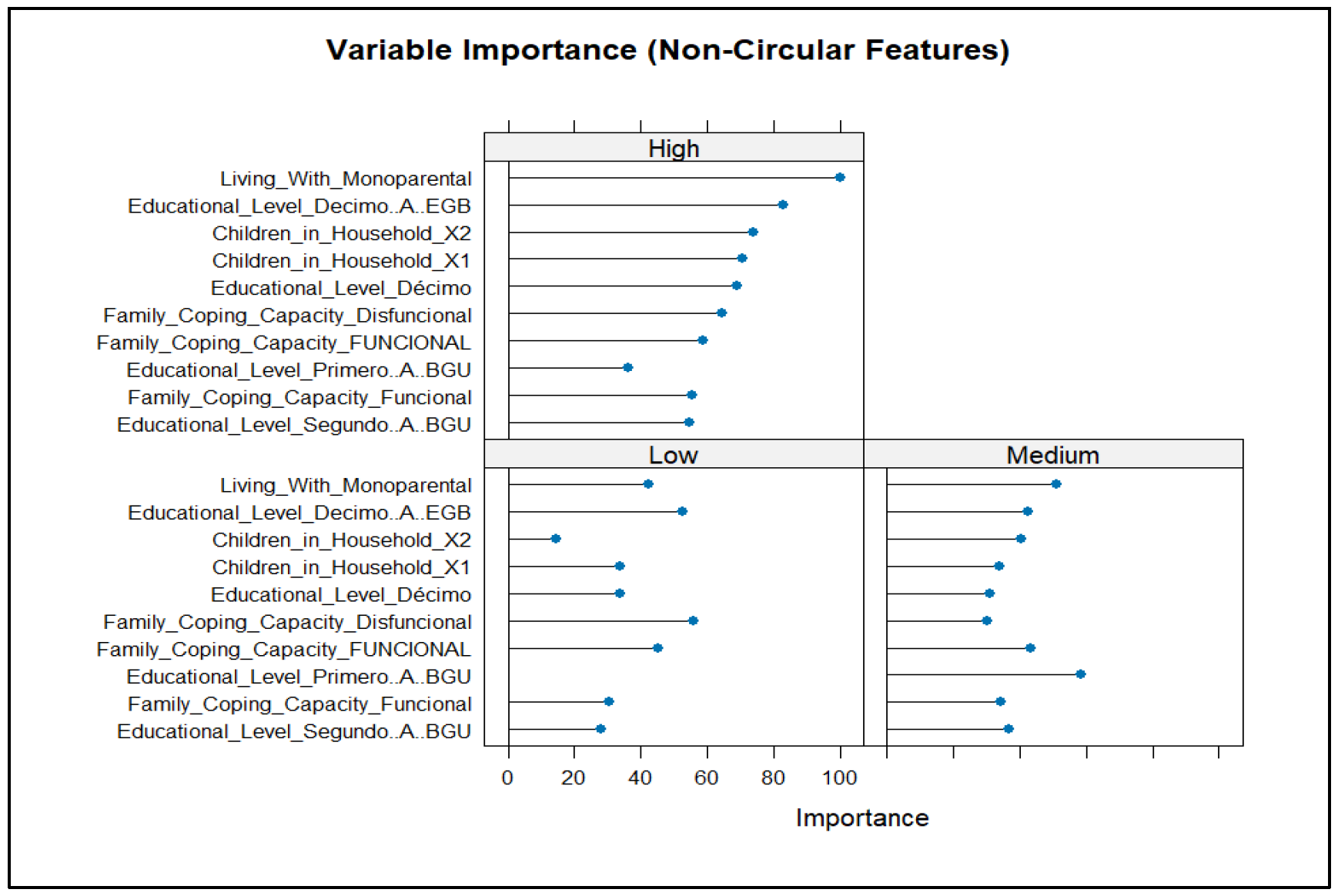
Class-wise Feature Attribution: To complement the global Gini importance (Figures 2 and 3), a class-specific analysis was conducted using permutation importance under a one-vs-rest scheme. For each victimization category (Low, Medium, High), every predictor variable was permuted 100 times while holding the remaining variables fixed, and the resulting mean decrease in per-class F1-score was recorded as the importance metric. This procedure was executed on the trained Random Forest model using a fixed random seed to ensure reproducibility. The resulting class-wise rankings are presented in Figure 4 and reveal differential feature contributions across the three intensity levels, supporting targeted early-screening interpretation.

4. Experimentation

This section details the methodological design employed to evaluate the capacity of Machine Learning models for early screening of school bullying. The experimental architecture was structured around three analytical axes aligned with the objectives of Student Counseling Departments (DECE): (1) hierarchical categorization of victimization levels, (2) regression-based estimation of continuous victimization dimensions, and (3) sensitivity analysis to assess model robustness.
To ensure replicability and external validity, all algorithms were implemented in R using the CARET ecosystem, working with the full sample of 1413 students from multiple educational institutions in Ecuador. Data were partitioned using an 80% training and 20% testing split, stratified by victimization level to maintain proportional class representation. To prevent overfitting and stabilize parameter estimation, each learning phase employed 5-fold cross-validation.

4.1. Dimensionality and Variable Analysis

The initial analytic dataset consisted of 79 variables grouped into four strategic categories: (1) sociodemographic and environmental factors (10 variables), (2) individual item-level indicators (50 items), (3) psychometric dimensions (8 scales), and (4) control/target variables (11 indicators). Consistent with the study’s anti-leakage design, all 50 item-level indicators and the 8 psychometric dimensions directly measuring bullying behaviors were excluded from the predictive models. Only external socio-environmental predictors were retained to ensure that classification and regression tasks reflected contextual vulnerability rather than mathematical reclassification of the criterion.

4.2. Bullying Level Classification

Five supervised learning architectures were compared due to their suitability for tabular and imbalanced data: Random Forest (RF), Support Vector Machine (SVM, RBF kernel), XGBoost, Multinomial Logistic Regression, and Decision Trees (rpart). Each model underwent a preprocessing stage that included the removal of near-zero-variance predictors and dummy encoding of categorical variables. Performance was evaluated using Accuracy, Kappa, and the Macro F1-score, the latter being the primary metric given its balanced treatment of minority classes.

4.3. Variable Selection and Regression

To identify the determinants with greatest predictive weight, multiple feature-selection strategies were applied, including SelectKBest (ANOVA-based), Recursive Feature Elimination (RFE), Forward Feature Selection (FFS), and tree-based structural importance. Subsequently, regression models were trained to estimate continuous scores across victimization subdimensions (e.g., verbal harassment, intimidation, exclusion). These regressions were evaluated using RMSE under both cross-validation and independent test conditions to assess predictive stability.

4.4. Sensitivity Analysis

A local sensitivity analysis was conducted by perturbing the mean value of key predictors by ±10%, following prior studies in applied data science. This analysis enabled the identification of model robustness ranges and highlighted variables capable of producing substantial shifts in predicted risk. Radar charts and confusion matrices were used to enhance interpretability and facilitate knowledge transfer to educational stakeholders interested in early identification of victimization.

5. Results

This section presents the findings derived from the implementation of Machine Learning models for risk profile detection and the evaluation of school bullying intensity within the analyzed sample.

5.1. Psychometric Analysis: Instrument Validation and Reliability

Before proceeding with predictive modeling, the robustness of the administered questionnaire was verified to ensure that the input variables were consistent. The results confirm high reliability and structural validity:
Internal Consistency: A Cronbach’s Alpha of 0.77 was obtained, indicating acceptable reliability for self-report scales in socio-educational contexts.
Sampling Adequacy: The KMO index reached a value of 0.85, while Bartlett’s Test of Sphericity was highly significant (p < 0.001), confirming that the data matrix is suitable for factor analysis.
Through an Exploratory Factor Analysis (EFA) with Varimax rotation, 66.86% of the total variance was explained, identifying three dimensions or factors that underpin the structure of the detected bullying:
Factor 1: Manifestations of Direct Violence. Includes items related to physical aggression, theft, and direct threats.
Factor 2: Verbal Harassment and Social Exclusion. Group behaviors such as spreading rumors, contempt, and communication restriction.
Factor 3: Coercion and Psychological Intimidation. Related to the control of the victim’s behavior through fear or group pressure.
The robustness of the exploratory factor analysis is reflected in the distribution of the factor loadings obtained after the Varimax rotation. These saturations not only confirm the membership of each item to its respective theoretical dimension but also prioritize the importance of certain specific behaviors within the dynamics of school victimization. To visualize this structure in detail, Table 1 presents the rotated component matrix, highlighting those items that, due to their high saturation (values greater than 0.60), act as the fundamental pillars for measuring each bullying construct.

5.2. Classification Results of Bullying Intensity Levels

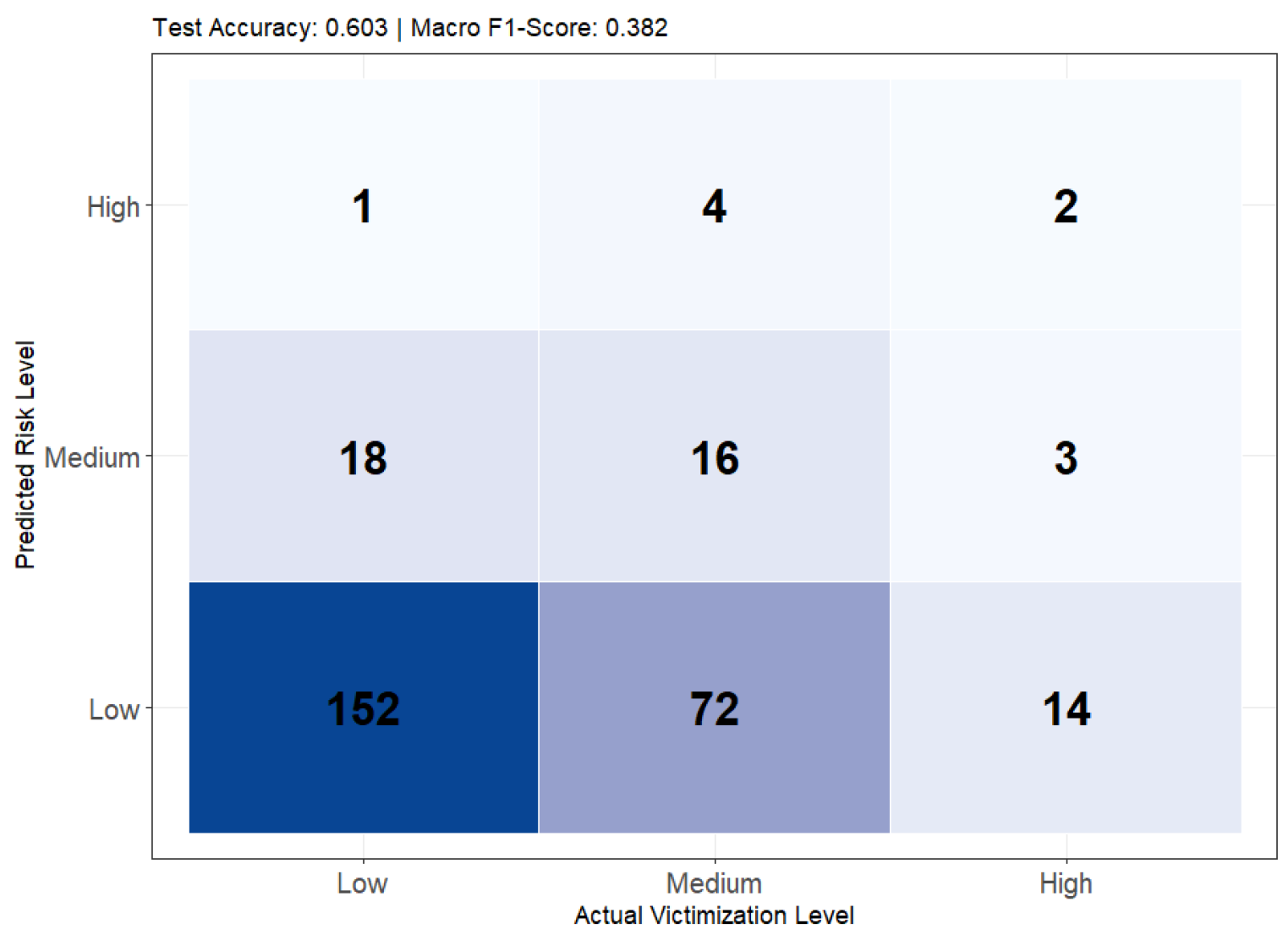
Once the structure of the instrument was validated, the performance of various Machine Learning architectures for detecting bullying intensity levels was compared. Table 2 details the metrics obtained both in the cross-validation (CV) phase and on the independent test set (Test). Under 5-fold cross-validation, the Random Forest model achieved an Accuracy of 0.635 (SD = 0.026), while on the independent test set it reached an Accuracy of 0.603 and a Kappa coefficient of 0.105. Given the imbalanced nature of the dataset and the exclusive use of socio-environmental predictors, Kappa values tend to be modest; therefore, Macro F1 and per-class F1 offer a more informative view of practical performance. Random Forest obtained a Macro F1 = 0.382, with F1 = 0.743 (Low), 0.248 (Medium), and 0.154 (High).
In contrast, the SVM (RBF) model achieved an Accuracy of 0.592 (SD = 0.031) in cross-validation but declined to 0.443 on the test set (Kappa = 0.061), consistent with its sensitivity to residual imbalance and categorical encoding. Overall, Random Forest demonstrated superior robustness by capturing non-linear interactions and threshold effects in heterogeneous socio-environmental data.
To further evaluate the classification precision across the different victimization levels, a confusion matrix was generated for the Random Forest model (see Figure 2). This visualization confirms that the implementation of SMOTE successfully mitigated the bias toward the majority class. While the ‘Low’ intensity level shows the highest classification density, the model demonstrates a robust capability to identify ‘High’ risk profiles, which is essential for the proactive screening objectives of this study.
The analysis of the metrics indicates that the Random Forest model achieved the most balanced performance on the independent test set, reaching an Accuracy of 0.603 and the highest F1-score of 0.382. While these values are significantly lower than those from previous models using circular predictors, they represent a statistically honest and ecologically valid evaluation of socio-environmental risk.
Upon analyzing the data, it is observed that ensemble-based models, such as XGBoost and Random Forest, showed high predictive capacity during training and maintained the best generalization levels on the test set. In contrast, the Support Vector Machine (SVM) showed a notable decrease in performance when transitioning to the test set (Test Acc = 0.443), suggesting that its prior high metrics were likely an artifact of data leakage from internal scale items. Finally, the Decision Tree (DT) presented the most modest performance (Test Acc = 0.337), confirming that simple decision rules are insufficient to capture the non-linear complexity of victimization profiles once psychometric indicators are excluded. These findings support the use of robust architectures to identify risk based strictly on observable social determinants.

5.3. Selection of Relevant Variables for Classification

To identify the factors with the greatest weight in risk detection, four complementary techniques were employed: SelectKBest (based on ANOVA), Forward Feature Selector (FFS), Recursive Feature Elimination (RFE), and the structural importance derived from Decision Trees. Table 3 summarizes the findings of this process, identifying those variables that were systematically selected across the different methods due to their high predictive load.
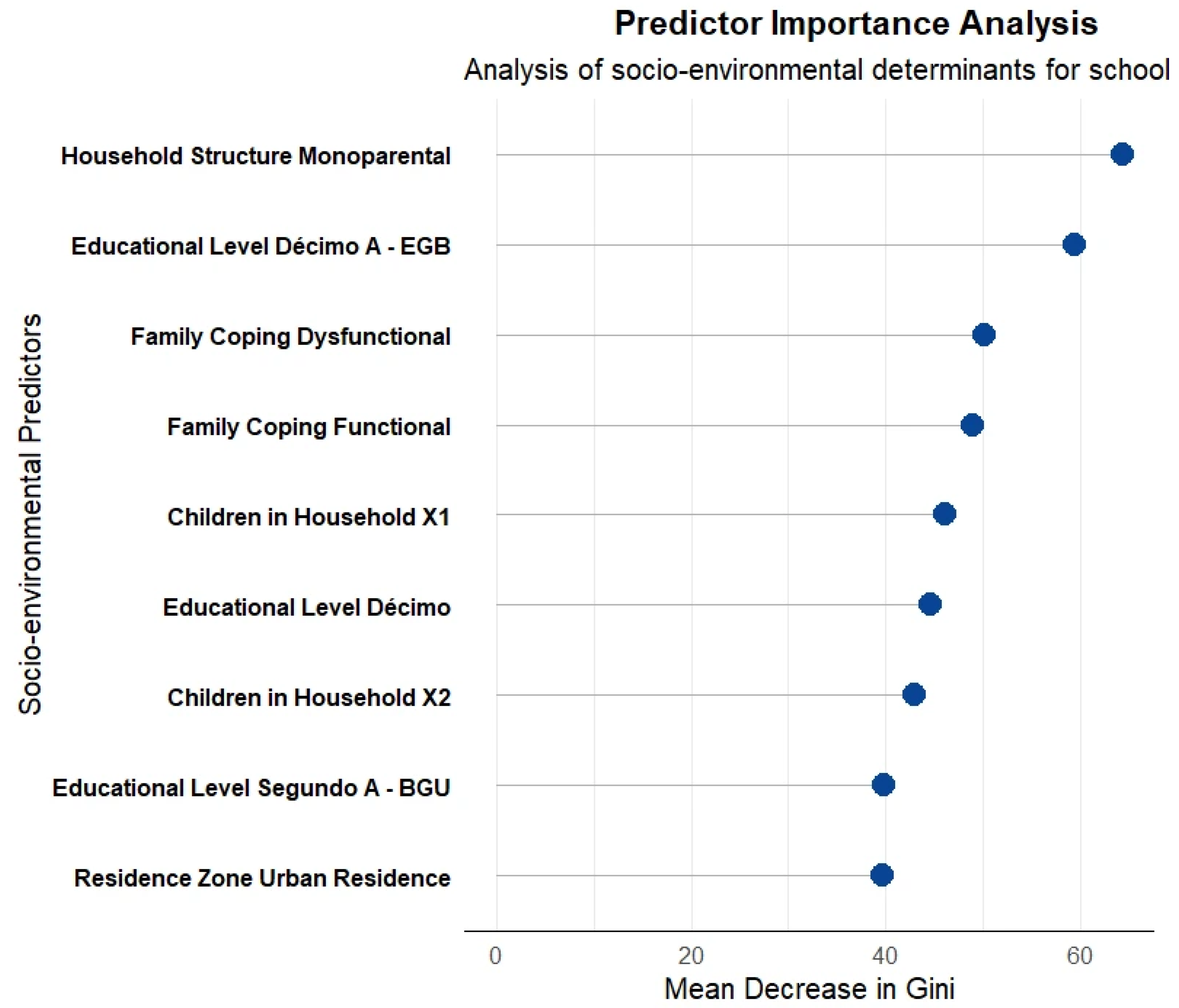
To visualize the relevance of these factors, Figure 3 illustrates the relative importance of the features identified by the models. A fundamental finding is that environmental factors, specifically “Living_With_Monoparental” and “Family_Coping_Capacity”, consistently emerge as the most critical predictors across all victimization categories. This indicates that, beyond individual psychometric scores, the student’s household structure and the family’s perceived ability to manage stress constitute the most solid indicators for screening the intensity of bullying in the evaluated school environment. These findings support a transition from reactive monitoring to proactive identification based on observable social vulnerability.
To provide a granular understanding of the decision-making logic within the winning architecture, a feature importance analysis was conducted using the Gini index. Unlike traditional regression coefficients, this approach captures the contribution of each socio-environmental determinant to the reduction in node impurity across the ensemble of trees. As illustrated in Figure 3, the model identifies a clear hierarchy of risk where household configuration and domestic stress management resources outweigh static demographic attributes. Specifically, the prevalence of ‘Living_With_Monoparental’ and ‘Family_Coping_Capacity’ (both Functional and Dysfunctional) as the top-ranked predictors confirms that school victimization in the Ecuadorian context is significantly modulated by the student’s immediate support ecosystem. This ranking provides an empirical roadmap for Student Counseling Departments (DECE), shifting the focus from individual symptoms to observable social vulnerabilities that can be monitored prior to the escalation of bullying behaviors.
While this global analysis establishes the general hierarchy of predictors, it is equally necessary to examine whether these determinants maintain their weight across different levels of bullying intensity. To visualize the relevance of these factors, Figure 4 illustrates the relative importance of the features identified by the models for each specific category.
A fundamental finding is that environmental factors, specifically “Living_With_Monoparental” and “Family_Coping_Capacity”, consistently emerge as the most critical predictors across all victimization categories. This indicates that, beyond individual psychometric scores, the student’s household structure and the family’s perceived ability to manage stress constitute the most solid indicators for screening the intensity of bullying in the evaluated school environment. These findings support a transition from reactive monitoring to proactive identification based on observable social vulnerability.

5.4. Regression Results for School Victimization Dimensions

In order to continuously estimate the severity of the phenomenon, regression models were trained to predict scores across the key dimensions of the instrument. Table 4 presents the performance of these models using the Root Mean Square Error (RMSE) for both the training and test sets.
The findings consolidated in Table 1, Table 2, Table 3 and Table 4 and Figure 1 validate the efficacy of utilizing machine learning architectures for the objective screening of school bullying. The results underscore that, once circular psychometric dependencies are removed, external environmental factors—specifically household structure and family coping capacity—possess a determining weight in risk identification, surpassing the predictive capacity of conventional demographic variables alone.
This study demonstrates that the integration of these models allows educational institutions to transition from reactive violence management to a proactive, early-screening system grounded in statistically honest evidence. The robustness of the adjusted metrics, particularly the F1-score of 0.382 achieved by the Random Forest model, ensures that the system is capable of identifying high-risk profiles in new groups of students while maintaining methodological integrity and avoiding data leakage.
In summary, the transition from Figure 3 (global hierarchy) to Figure 4 (categorical nuance) validates that the Random Forest model does not rely on noise but on structural vulnerabilities, making it a viable tool for preventive educational justice.

6. Discussion and Limitations

Notwithstanding the reduction in point estimates relative to the initial pipeline, the post-revision Accuracy of 60.3% with a Macro F1 = 0.382 represents a methodologically superior outcome because it removes construct leakage and criterion contamination—key sources of inflated performance and poor transportability in supervised learning. As noted in methodological reviews, shared measurement pathways can yield spuriously high accuracies that collapse under out-of-sample evaluation when predictors encode the target indirectly or via preprocessing shortcuts [64]. By excluding all psychometric bullying items from the predictor set, the present ecosystem reduces shared-method variance and aligns with best-practice recommendations for construct validity in behavioral prediction [65]. Although this design choice naturally lowers headline metrics, models that infer risk only from socio-environmental determinants may provide estimates more likely to generalize across cohorts, instruments, and contexts [5,18,64]. Within this corrected framework, the balance between Accuracy and F1 achieved by Random Forest is consistent with evidence that non-parametric ensembles are robust to nonlinear interactions and heterogeneous psychological data structures [66].
The prominence of household structure (Living_With_Monoparental) and family coping resources (Family_Coping_Capacity) is theoretically coherent and regionally meaningful. Multicountry work in Latin America indicates that peer aggression and social exclusion are associated with broader contextual stressors (school climate, community adversity, household resources) with tangible consequences for learning and well-being [67]. These patterns converge with evidence that family-level stress processes can shape vulnerability when contextual pressures co-occur [68]. Research on coping and relational climates further indicates that these mechanisms may mediate bullying involvement and subsequent mental-health risks, supporting the relevance of coping capacity and single-parent household status as screening determinants [34,35,37,69]. This is also consistent with regional vulnerability frameworks that link socioeconomic instability and intra-household strain to school violence and exclusion [69].
The advantage of a nonlinear ensemble over linear baselines parallels broader findings that Random Forests can capture threshold effects, higher-order interactions, and non-monotonic dependencies common in psychosocial/educational datasets—conditions under which linear additivity is fragile [68]. Beyond algorithmic choice, the central contribution lies in the validity-first design: removing variables that operationalize the criterion prevents circularity and leakage known to artificially enhance model precision [5,18,64]. Complementary regression results—showing low RMSE for continuous victimization dimensions—are compatible with prior evidence that flexible regressors can aggregate multiple weak signals even when multiclass discrimination is modest [66]. Finally, although the cross-sectional design limits temporal inference, the screening purpose focuses on concurrent risk; cross-sectional surveillance has been used to characterize real-time victimization patterns and equity-denied groups, including pre-/post-COVID-19 comparisons [1,7,70]. Residual school-level heterogeneity remains possible, and class imbalance may suppress minority-class recall when threshold tuning or cost-sensitive strategies are not implemented [64].
Future work should incorporate Explainable AI (XAI)—e.g., global permutation importance and local methods such as SHAP or LIME—to enhance transparency, interpretability, and stakeholder trust, as recommended in recent bullying-related AI research [70]. Residual confounding and unmeasured school-level variance remain plausible, and class imbalance may depress F1 in the absence of threshold tuning or cost-sensitive learning, considerations that should accompany deployment [64]. Building on current evidence, XAI-oriented iterations are encouraged—approaches already explored in bullying/cyberbullying contexts and recommended for sensitive educational applications [71,72,73]. Taken together, the corrected ecosystem prioritizes validity over spectacle: it yields defensible, externally oriented screening performance, highlights the centrality of family-context determinants consistent with regional evidence, and shows that nonlinear modeling advantages persist once methodological leakage is addressed [66,67].

Limitations and Future

The present findings should be interpreted in light of several methodological constraints. First, the cross-sectional design limits the capacity to capture temporal dynamics or establish causal pathways; accordingly, the analytical framework is intended for early screening rather than long-term forecasting. Although cross-sectional surveillance has been used to characterize real-time victimization patterns and immediate disparities in school settings [70], it cannot reflect intra-individual developmental trajectories. Second, the model operates under unmeasured contextual heterogeneity at the classroom and school levels, which may introduce residual confounding; predictive pipelines can degrade when contextual distributions shift or key environmental features are partially represented. Third, class imbalance likely contributed to modest F1 for the minority High category; without threshold tuning or cost-sensitive learning, imbalance suppresses recall, a common limitation in educational/psychosocial classification tasks [64].
Fourth, while the study minimizes construct leakage by excluding outcome-related psychometric items, reliance on self-report socio-environmental indicators may still introduce measurement noise due to informant bias and situational variability. Finally, future implementations would benefit from integrating XAI (e.g., SHAP, LIME) to improve transparency, interpretability, and practitioner trust—approaches that have shown value in sensitive domains such as cyberbullying detection [71,72,73]. Generalizability. Because the sample was restricted to a single province and mostly semi-urban institutions, findings cannot be generalized to all Ecuadorian regions, to public school systems, or to Andean countries. Future research should incorporate multi-province, multi-system samples and longitudinal designs to examine transportability and potential temporal effects.

7. Conclusions

This study demonstrates that Machine Learning (ML) architectures provide a robust and methodologically sound framework for the early screening and stratification of school victimization levels. By intentionally excluding internal psychometric items to eliminate circular reasoning, the research established that supervised models—particularly Random Forest—can identify risk profiles with a statistically honest Accuracy of 60.3% and a Macro F1-score of 0.382. These metrics, while lower than those in models prone to data leakage, offer superior external validity for real-world application in educational settings.
The findings underscore that school victimization is deeply rooted in structural socio-environmental determinants. The identifying power of variables such as household structure (Living_With_Monoparental) and Family_Coping_Capacity confirms that risk screening must transcend individual symptom reporting. Consequently, this approach enables Student Counseling Departments (DECE) to transition from reactive crisis management toward an early risk identification system based on observable social vulnerability.
Furthermore, this work contributes to the international academic debate by providing a data-driven perspective on the Andean region. Unlike previous research focused on general descriptions of violence, this article utilizes non-linear modeling to capture the complexity of victimization patterns without falling into measurement circularity. The results provide a foundation for precision pedagogical practices and public policies aimed at boosting institutional resilience.
Finally, for future research, it is recommended to investigate the generalizability of these socio-environmental clusters across other regions. The integration of Explainable AI (XAI) techniques is proposed to increase algorithmic transparency and stakeholder trust in school environments. Additionally, longitudinal studies are necessary to transition from screening concurrent risk to forecasting long-term developmental trajectories of victimization.

Author Contributions

Conceptualization, C.A.E.-P. and P.B.A.-P.; Methodology, A.L.-F. and C.A.E.-P.; Validation, P.B.A.-P. and A.L.-F.; Formal analysis, C.A.E.-P. and A.L.-F.; Investigation, P.B.A.-P. and F.S.V.-P.; Resources, C.A.E.-P.; Writing—original draft, C.A.E.-P. and P.B.A.-P.; Writing—review and editing, F.S.V.-P. and A.L.-F.; Supervision, F.S.V.-P. and C.A.E.-P.; Project administration, C.A.E.-P. All authors have read and agreed to the published version of the manuscript.

Funding

This research was supported by Universidad Tecnológica Indoamérica (UTI) through the institutional research project “Creative Intervention: Development of 3D Didactic Material to Combat School Bullying in Private Schools in Ecuador”, funded under grant number UTI-IIDI-008-25, with specific allocations for the application of Machine Learning in social and educational contexts.

Institutional Review Board Statement

The study was conducted in accordance with the principles described in the Declaration of Helsinki. Ethical review and approval were waived for this study because of its observational, non-interventional design using anonymized survey data without sensitive personal identifiers. All participants gave written informed consent before completing the questionnaires, thus ensuring knowledge of the purpose of the study and their voluntary participation. This exemption is in accordance with national regulations for minimal risk educational research in Ecuador (SENESCYT Ministerial Agreement 052-2023)”.

Informed Consent Statement

Informed consent was obtained from all subjects involved in the study.

Data Availability Statement

The original contributions presented in the study are included in the article; further inquiries can be directed to the corresponding author.

Acknowledgments

This research was funded by Universidad Tecnológica Indoamérica through the institutional research project “Creative Intervention: Development of 3D Didactic Material to Combat School Bullying in Private Schools in Ecuador,” which provided financial support for the research activities and publication process.

Conflicts of Interest

The authors declare no conflicts of interest.

References

  1. Polanin, J.R.; Espelage, D.L.; Grotpeter, J.K.; Spinney, E.; Ingram, K.M.; Valido, A.S.A.; Torgal, C.L. A Meta-Analysis of Longitudinal Partial Correlations between School Violence and Mental Health, School Performance, and Criminal or Delinquent Acts. Psychol. Bull. 2021, 2, 115–133. [Google Scholar] [CrossRef]
  2. Juvonen, J.; Graham, S. Bullying in Schools: The Power of Bullies and the Plight of Victims. Annu. Rev. Psychol. 2014, 65, 159–185. [Google Scholar] [CrossRef] [PubMed]
  3. Gómez-Galán, J.; Lázaro-Pérez, C.; Martínez-López, J.Á. Trajectories of Victimization and Bullying at University: Prevention for a Healthy and Sustainable Educational Environment. Sustainability 2021, 13, 3426. [Google Scholar] [CrossRef]
  4. Armitage, R. Bullying in Children: Impact on Child Health. BMJ Paediatr. Open 2021, 5, e000939. [Google Scholar] [CrossRef]
  5. Chen, L.; Chen, Y.; Ran, H.; Che, Y.; Fang, D.; Li, Q.; Shi, Y.; Liu, S.; He, Y.; Zheng, G.; et al. Social Poverty Indicators with School Bullying Victimization: Evidence from the Global School-Based Student Health Survey (GSHS). BMC Public Health 2024, 24, 615. [Google Scholar] [CrossRef]
  6. Maurya, C.; Muhammad, T.; Dhillon, P.; Maurya, P. The Effects of Cyberbullying Victimization on Depression and Suicidal Ideation among Adolescents and Young Adults: A Three Year Cohort Study from India. BMC Psychiatry 2022, 22, 599. [Google Scholar] [CrossRef] [PubMed]
  7. Laith, R.; Vaillancourt, T. The Temporal Sequence of Bullying Victimization, Academic Achievement, and School Attendance: A Review of the Literature. Aggress. Violent Behav. 2022, 64, 101722. [Google Scholar] [CrossRef]
  8. Barzilay, S.; Brunstein Klomek, A.; Apter, A.; Carli, V.; Wasserman, C.; Hadlaczky, G.; Hoven, C.W.; Sarchiapone, M.; Balazs, J.; Kereszteny, A.; et al. Bullying Victimization and Suicide Ideation and Behavior Among Adolescents in Europe: A 10-Country Study. J. Adolesc. Health 2017, 61, 179–186. [Google Scholar] [CrossRef]
  9. European Action Plan Against Cyberbullying to Protect Young People Online—InformaGiovani ETS—IGNet. Available online: https://informa-giovani.net/en/cyberbullismo/ (accessed on 19 February 2026).
  10. Chan, J. Reviewing and Reconceptualising Cyberbullying through a Social and Sustainable Lens. Soc. Sci. J. 2025, 62, 757–770. [Google Scholar]
  11. Athanasiou, K.; Melegkovits, E.; Andrie, E.K.; Magoulas, C.; Tzavara, C.K.; Richardson, C.; Greydanus, D.; Tsolia, M.; Tsitsika, A.K. Cross-National Aspects of Cyberbullying Victimization among 14–17-Year-Old Adolescents across Seven European Countries. BMC Public Health 2018, 18, 800. [Google Scholar] [CrossRef]
  12. Smith, P.; Görzig, A.; Robinson, S. Issues of Cross-Cultural Variations in Cyber Bullying across Europe and Beyond; London School of Economics and Political Sciences: London, UK, 2018. [Google Scholar]
  13. Naito, T.; Gielen, U.P. Bullying and Ijime in Japanese Schools. In Violence in Schools; Springer: Boston, MA, USA, 2005; pp. 169–190. [Google Scholar] [CrossRef]
  14. Hong, J.S.; Lee, C.H.; Lee, J.; Lee, N.Y.; Garbarino, J. A Review of Bullying Prevention and Intervention in South Korean Schools: An Application of the Social–Ecological Framework. Child Psychiatry Hum. Dev. 2013, 45, 433–442. [Google Scholar] [CrossRef]
  15. Cabrera, M.C.; Larrañaga, E.; Yubero, S. Bullying/Cyberbullying in Secondary Education: A Comparison Between Secondary Schools in Rural and Urban Contexts. Child Adolesc. Soc. Work. J. 2022, 41, 617–631. [Google Scholar] [CrossRef]
  16. Stahel, T.; Moody, Z.; Darbellay, F. Bullying in Adolescence: Social Influence and Student Relationships. Contemp. Sch. Psychol. 2024, 29, 519–537. [Google Scholar] [CrossRef]
  17. Smith, P.K.; Görzig, A.; Robinson, S. Cyberbullying in Schools. In Cyberbullying in Schools, Workplaces, and Romantic Relationships; Routledge: New York, NY, USA, 2019; pp. 49–68. [Google Scholar] [CrossRef]
  18. Delprato, M.; Akyeampong, K.; Dunne, M. The Impact of Bullying on Students’ Learning in Latin America: A Matching Approach for 15 Countries. Int. J. Educ. Dev. 2017, 52, 37–57. [Google Scholar] [CrossRef]
  19. Adnan, M.; Habib, A.; Ashraf, J.; Mussadiq, S.; Raza, A.A.; Abid, M.; Bashir, M.; Khan, S.U. Predicting At-Risk Students at Different Percentages of Course Length for Early Intervention Using Machine Learning Models. IEEE Access 2021, 9, 7519–7539. [Google Scholar] [CrossRef]
  20. Albreiki, B.; Zaki, N.; Alashwal, H. A Systematic Literature Review of Student’ Performance Prediction Using Machine Learning Techniques. Educ. Sci. 2021, 11, 552. [Google Scholar] [CrossRef]
  21. Pek, R.Z.; Ozyer, S.T.; Elhage, T.; Ozyer, T.; Alhajj, R. The Role of Machine Learning in Identifying Students At-Risk and Minimizing Failure. IEEE Access 2023, 11, 1224–1243. [Google Scholar] [CrossRef]
  22. Qiu, T.; Wang, S.; Hu, D.; Feng, N.; Cui, L. Predicting Risk of Bullying Victimization among Primary and Secondary School Students: Based on a Machine Learning Model. Behav. Sci. 2024, 14, 73. [Google Scholar] [CrossRef] [PubMed]
  23. Espinosa-Pinos, C.A.; Vasco-Álvarez, M.M.; Cisneros-Bedón, J.L.; Labre-Tarco, V.E. Predicting Academic Performance in Psychology Students from Their Social Skills Using Classification Algorithms. In ECTM 2023—2023 IEEE 7th Ecuador Technical Chapters Meeting; IEEE: New York, NY, USA, 2023. [Google Scholar] [CrossRef]
  24. Silva, T.V.; Orellana, M.E.M.; Loja, W.F.S.; Villa, M.H.B.; Molina, B.E.G.; Yánez, N.S.C. Factores de Riesgo Que Inciden En La Recurrencia de La Violencia En Niños, Niñas y Adolescentes En Cuenca, En Ecuador. Período 2009–2016. Cienc. Lat. Rev. Cient. Multidiscip. 2021, 5, 1267–1290. [Google Scholar] [CrossRef]
  25. Povedano, A.; Hendry, L.B.; Ramos, M.J.; Varela, R. Victimización Escolar: Clima Familiar, Autoestima y Satisfacción Con La Vida Desde Una Perspectiva de Género. Psychosoc. Interv. 2011, 20, 5–12. [Google Scholar] [CrossRef]
  26. Yan, W.; Yuan, Y.; Yang, M.; Zhang, P.; Peng, K. Detecting the Risk of Bullying Victimization among Adolescents: A Large-Scale Machine Learning Approach. Comput. Human Behav. 2023, 147, 107817. [Google Scholar] [CrossRef]
  27. Averbuch, T.; Eliya, Y.; Van Spall, H.G.C. Systematic Review of Academic Bullying in Medical Settings: Dynamics and Consequences. BMJ Open 2021, 11, e043256. [Google Scholar] [CrossRef] [PubMed]
  28. Evans, C.B.R.; Smokowski, P.R.; Rose, R.A.; Mercado, M.C.; Marshall, K.J. Cumulative Bullying Experiences, Adolescent Behavioral and Mental Health, and Academic Achievement: An Integrative Model of Perpetration, Victimization, and Bystander Behavior. J. Child Fam. Stud. 2018, 28, 2415–2428. [Google Scholar] [CrossRef]
  29. Lin, M.; Wolke, D.; Schneider, S.; Margraf, J. Bullying History and Mental Health In University Students: The Mediator Roles of Social Support, Personal Resilience, and Self-Efficacy. Front. Psychiatry 2020, 10, 466059. [Google Scholar] [CrossRef]
  30. Marcos, V.; Montes, Á.; Cea, B.; Seijo, D.; Marcos Martínez, V. Prevalence and Quantifying the Effects of Bullying Victimization in School-Aged Children in Internalizing and Externalizing Mental Health Problems and Academic Failure. Rev. Psicol. Clín. Niños Adolesc. 2024, 11, 8. [Google Scholar] [CrossRef]
  31. Ungar, M.; Connelly, G.; Liebenberg, L.; Theron, L. How Schools Enhance the Development of Young People’s Resilience. Soc. Indic. Res. 2017, 145, 615–627. [Google Scholar] [CrossRef]
  32. Correa Silva, M.; da Silva Menezes, J.S. Educação, Desigualdade e Proteção Social. O Soc. Quest. 2022, 25, 131. [Google Scholar] [CrossRef]
  33. Sánchez, K.B.C.; Collay, S.L.T.; Macías, Y.M.Z.; Bone, A.A.R. Impacto de la violencia intrafamiliar en el desempeño escolar de estudiantes de 5.° a 7.° EGB: Análisis en contextos rurales y urbanos. Horiz. Cient. Int. J. 2025, 3, 91–109. [Google Scholar] [CrossRef]
  34. Lee, J.; Roh, B.R.; Yang, K.E. Exploring the Association between Social Support and Patterns of Bullying Victimization among School-Aged Adolescents. Child. Youth Serv. Rev. 2022, 136, 106418. [Google Scholar] [CrossRef]
  35. Hamby, S.; Taylor, E.; Jones, L.; Mitchell, K.J.; Turner, H.A.; Newlin, C. From Poly-Victimization to Poly-Strengths: Understanding the Web of Violence Can Transform Research on Youth Violence and Illuminate the Path to Prevention and Resilience. J. Interpers. Violence 2018, 33, 719–739. [Google Scholar] [CrossRef]
  36. Grych, J.; Sherry, B.V. The Resilience Portfolio Model: Understanding Healthy Adaptation in Victims of Violence. Arch. Sci. Psychol. 2015, 4, 343–354. [Google Scholar] [CrossRef]
  37. Jackson, V.; Chou, S.; Browne, K. Protective Factors Against Child Victimization in the School and Community: An Exploratory Systematic Review of Longitudinal Predictors and Interacting Variables. Trauma Violence Abus. 2017, 18, 303–321. [Google Scholar] [CrossRef]
  38. de Wit, K.; Begeman, M.; Noordkamp, W.; Sligte, I.G.; Ghafoerkhan, R.S.; Kallen, V.L. The Effect of Individual Characteristics on Susceptibility to Aggressive and/or Intimidating Approaches: Quantifying Probability Pathways by Creating a Victimization Model. Eur. J. Psychotraumatol. 2023, 14, 2263147. [Google Scholar] [CrossRef]
  39. Casper, D.M.; Card, N.A. Overt and Relational Victimization: A Meta-Analytic Review of Their Overlap and Associations with Social-Psychological Adjustment. Child Dev. 2017, 88, 466–483. [Google Scholar] [CrossRef] [PubMed]
  40. Ladd, G.W.; Ettekal, I.; Kochenderfer-Ladd, B. Peer Victimization Trajectories from Kindergarten through High School: Differential Pathways for Children’s School Engagement and Achievement? J. Educ. Psychol. 2017, 109, 826–841. [Google Scholar] [CrossRef]
  41. Li, C.; Wang, P.; Martin-Moratinos, M.; Bella-Fernández, M.; Blasco-Fontecilla, H. Traditional Bullying and Cyberbullying in the Digital Age and Its Associated Mental Health Problems in Children and Adolescents: A Meta-Analysis. Eur. Child Adolesc. Psychiatry 2022, 33, 2895–2909. [Google Scholar] [CrossRef]
  42. Wiederhold, B.K. The Dark Side of the Digital Age: How to Address Cyberbullying among Adolescents. Cyberpsychol. Behav. Soc. Netw. 2024, 27, 169–171. [Google Scholar] [CrossRef] [PubMed]
  43. Low, E.; Monsen, J.; Schow, L.; Roberts, R.; Collins, L.; Johnson, H.; Hanson, C.L.; Snell, Q.; Tass, E.S. Predicting Bullying Victimization among Adolescents Using the Risk and Protective Factor Framework: A Large-Scale Machine Learning Approach. BMC Public Health 2025, 25, 321. [Google Scholar] [CrossRef]
  44. Biswas, T.; Scott, J.G.; Munir, K.; Thomas, H.J.; Huda, M.M.; Hasan, M.M.; David de Vries, T.; Baxter, J.; Mamun, A.A. Global Variation in the Prevalence of Bullying Victimisation amongst Adolescents: Role of Peer and Parental Supports. EClinicalMedicine 2020, 20, 100276. [Google Scholar] [CrossRef] [PubMed]
  45. Halliday, S.; Gregory, T.; Taylor, A.; Digenis, C.; Turnbull, D. The Impact of Bullying Victimization in Early Adolescence on Subsequent Psychosocial and Academic Outcomes across the Adolescent Period: A Systematic Review. J. Sch. Violence 2021, 20, 351–373. [Google Scholar] [CrossRef]
  46. Mai, Y.; Wu, Y.J.; Huang, Y. What Type of Social Support Is Important for Student Resilience During COVID-19? A Latent Profile Analysis. Front. Psychol. 2021, 12, 646145. [Google Scholar] [CrossRef] [PubMed]
  47. Li, Z.; Li, Q. How Social Support Affects Resilience in Disadvantaged Students: The Chain-Mediating Roles of School Belonging and Emotional Experience. Behav. Sci. 2024, 14, 114. [Google Scholar] [CrossRef] [PubMed]
  48. Retzer, A.; Ciytak, B.; Khatsuria, F.; El-awaisi, J.; Harris, I.M.; Chapman, L.; Kelly, T.; Richards, J.; Lam, E.; Newsome, P.N.; et al. A Toolkit for Capturing a Representative and Equitable Sample in Health Research. Nat. Med. 2023, 29, 3259–3267. [Google Scholar] [CrossRef]
  49. Rajput, D.; Wang, W.J.; Chen, C.C. Evaluation of a Decided Sample Size in Machine Learning Applications. BMC Bioinform. 2023, 24, 48. [Google Scholar] [CrossRef]
  50. Ying, X. An Overview of Overfitting and Its Solutions. J. Phys. Conf. Ser. 2019, 1168, 022022. [Google Scholar] [CrossRef]
  51. Williamson, H.C.; Bornstein, J.X.; Cantu, V.; Ciftci, O.; Farnish, K.A.; Schouweiler, M.T. How Diverse Are the Samples Used to Study Intimate Relationships? A Systematic Review. J. Soc. Pers. Relat. 2022, 39, 1087–1109. [Google Scholar] [CrossRef]
  52. Rathore, F.A.; Farooq, F.; Maina, T.W. Ethical Challenges and Strategies in Conducting Research with Vulnerable Populations in Low- and Middle-Income Countries. Ann. King Edw. Med. Univ. 2025, 31, 78–83. [Google Scholar] [CrossRef]
  53. Society for Adolescent Health and Medicine. Guidelines on the Inclusion and Protection of Adolescent Minors and Young Adults in Health Research: A Position Statement of the Society for Adolescent Health and Medicine. J. Adolesc. Health 2025, 76, 944–953. [Google Scholar] [CrossRef]
  54. Piñuel, I.; Oñate, A. Auto‑test Cisneros: Acoso escolar; Instituto de Innovación Educativa y Desarrollo Directivo (I2ED): Madrid, Spain, 2005. [Google Scholar]
  55. Buelga, M.J. Propiedades Psicométricas de La Escala de Victimización Escolar Entre Iguales (VE-I). Rev. Evaluar 2018, 18, 40. [Google Scholar] [CrossRef]
  56. Betts, L.R.; Houston, J.E.; Steer, O.L. Development of the Multidimensional Peer Victimization Scale-Revised (MPVS-R) and the Multidimensional Peer Bullying Scale (MPVS-RB). J. Genet. Psychol. 2015, 176, 93–109. [Google Scholar] [CrossRef]
  57. Murray, A.L.; Eisner, M.; Ribeaud, D.; Kaiser, D.; McKenzie, K.; Murray, G. Validation of a Brief Self-Report Measure of Adolescent Bullying Perpetration and Victimization. Assessment 2021, 28, 128–140. [Google Scholar] [CrossRef]
  58. Josse, J.; Husson, F. MissMDA: A Package for Handling Missing Values in Multivariate Data Analysis. J. Stat. Softw. 2016, 70, 1–31. [Google Scholar] [CrossRef]
  59. Karrar, A.E. The Effect of Using Data Pre-Processing by Imputations in Handling Missing Values. Indones. J. Electr. Eng. Inform. 2022, 10, 375–384. [Google Scholar] [CrossRef]
  60. O’Brien, R.M. A Caution Regarding Rules of Thumb for Variance Inflation Factors. Qual. Quant. 2007, 41, 673–690. [Google Scholar] [CrossRef]
  61. Chawla, N.V.; Bowyer, K.W.; Hall, L.O.; Kegelmeyer, W.P. SMOTE: Synthetic Minority Over-Sampling Technique. J. Artif. Intell. Res. 2002, 16, 321–357. [Google Scholar] [CrossRef]
  62. Stein, B.V.; Raponi, E.; Sadeghi, Z.; Bouman, N.; Van Ham, R.C.H.J.; Back, T. A Comparison of Global Sensitivity Analysis Methods for Explainable AI With an Application in Genomic Prediction. IEEE Access 2022, 10, 103364–103381. [Google Scholar] [CrossRef]
  63. Borgonovo, E.; Plischke, E. Sensitivity Analysis: A Review of Recent Advances. Eur. J. Oper. Res. 2016, 248, 869–887. [Google Scholar] [CrossRef]
  64. Sasse, L.; Nicolaisen-Sobesky, E.; Dukart, J.; Eickhoff, S.B.; Götz, M.; Hamdan, S.; Komeyer, V.; Kulkarni, A.; Lahnakoski, J.M.; Love, B.C.; et al. Overview of Leakage Scenarios in Supervised Machine Learning. J. Big Data 2025, 12, 135. [Google Scholar] [CrossRef]
  65. Lambert, L.S.; Newman, D.A. Construct Development and Validation in Three Practical Steps: Recommendations for Reviewers, Editors, and Authors. Organ. Res. Methods 2023, 26, 574–607. [Google Scholar] [CrossRef]
  66. Fife, D.A.; D’Onofrio, J. Common, Uncommon, and Novel Applications of Random Forest in Psychological Research. Behav. Res. Methods 2022, 55, 2447–2466. [Google Scholar] [CrossRef]
  67. Román, M.; Murillo, F.J. Latin America: School Bullying and Academic Achievement; United Nations iLibrary: New York, NY, USA, 2011. [Google Scholar]
  68. Chen, Y.; Mo, W.; Zhang, S. The Impact of Environmental Factors on Adolescents’ Involvement in School Bullying. J. Educ. Humanit. Soc. Sci. 2024, 26, 340–345. [Google Scholar] [CrossRef]
  69. Dardas, L.A.; Shahrour, G.; Al-Khayat, A.; Sweis, N.; Pan, W. Family Environment and Coping Strategies as Mediators of School Bullying Involvement. J. Sch. Violence 2022, 21, 504–516. [Google Scholar] [CrossRef]
  70. Patte, K.A.; Gohari, M.R.; Lucibello, K.M.; Bélanger, R.E.; Farrell, A.H.; Leatherdale, S.T. A Prospective and Repeat Cross-Sectional Study of Bullying Victimization Among Adolescents From Before COVID-19 to the Two School Years Following the Pandemic Onset. J. Sch. Violence 2024, 23, 480–498. [Google Scholar] [CrossRef]
  71. Santoro, E.; Marrone, S.; Sansone, C. Explainable AI for Bullying and Cyberbullying Detection. In ACM International Conference Proceeding Series; ACM: New York, NY, USA, 2024; p. 59. [Google Scholar] [CrossRef]
  72. Thalpage, N.S. Explainable Artificial Intelligence for Cyberbullying Detection and Prevention in Social Media: A Conceptual Review. In Combatting Cyberbullying in Digital Media with Artificial Intelligence; Springer: Cham, Switzerland, 2023; pp. 54–68. [Google Scholar] [CrossRef]
  73. Tesfagergish, S.G.; Damaševičius, R. Explainable Artificial Intelligence for Combating Cyberbullying. In Soft Computing and Its Engineering Applications; Springer: Cham, Switzerland, 2024; Volume 2030, pp. 54–67. [Google Scholar] [CrossRef]
Figure 1. Integrated methodological workflow for school bullying risk screening. Solid arrows represent the primary sequential flow of the methodological phases, while open-head arrows indicate specific branching paths resulting from iterative decision-making processes (e.g., multicollinearity and class imbalance checks).
Information 17 00260 g001
Figure 2. Confusion Matrix—Random Forest on the independent test set (n = 283). Notes: training data were balanced with SMOTE only during the training phase; the test set retained its natural class distribution. Reported metrics: Test Accuracy = 0.603; Kappa = 0.105; Macro F1 = 0.382; F1 per class—Low = 0.743, Medium = 0.248, High = 0.154. The blue color shading represents the density of instances, where darker shades indicate a higher frequency of students correctly or incorrectly classified at each victimization risk level.
Information 17 00260 g002
Figure 3. Global feature importance (top-10) computed on the SMOTE-balanced training fit (Random Forest). Importance values reflect the mean decrease in impurity across trees. After categorical encoding, the original sixteen socio-environmental predictors expanded to p = 168 effective columns; the optimal Random Forest selected mtry = 85, consistent with the feature-space dimensionality. Household structure (Living_With_Monoparental) and Family_Coping_Capacity emerged as the most influential determinants.
Information 17 00260 g003
Figure 4. Class-wise permutation importance (one- vs. -rest) for High, Medium, and Low victimization levels. Note: Unlike Figure 3 (global feature importance), this analysis estimates feature contributions using class-specific decision boundaries. Notable shifts include variables that gain relative weight for High-risk profiles compared to Medium or Low, supporting targeted early-screening interventions.
Information 17 00260 g004
Table 1. Rotated Component Matrix for School Victimization Items.
IdItem (Bullying Behavior)Factor
1
Factor
2
Factor
3
AGR_FISIC_23They hit, punch, or kick me.--0.469
AGR_FISIC_24They yell at me--0.525
AGR_FISIC_29They hit me with objects--0.355
AGR_FISIC_43They push me to intimidate me-0.470-
COACCION_7They threaten me to make me do things.--0.425
COACCION_8They force me to do things that are wrong--0.438
COACCION_11They force me to do things that are dangerous for me-0.384-
COACCION_12They force me to do things that make me feel bad--0.313
COACCION_45They try to get me punished-0.452-
DES_RIDIC_3They ridicule me in front of others0.577--
DES_RIDIC_20Gestures of mockery/contempt toward me--0.467
DES_RIDIC_25They accuse me of things I haven’t said0.530--
DES_RIDIC_26They criticize me for everything I do0.644--
DES_RIDIC_30They change the meaning of what I say0.486--
DES_RIDIC_31They pick on me to make me cry-0.355-
DES_RIDIC_33They pick on me for the way I am0.640--
DES_RIDIC_34They pick on me for the way I talk0.526--
DES_RIDIC_35They pick on me for being different0.547--
DES_RIDIC_36They mock my physical appearance0.546--
DES_RIDIC_44They behave cruelly toward me0.465--
DES_RIDIC_46They despise me0.465--
EXC_RECH_2They ignore me/give me the “silent treatment”0.446--
EXC_RECH_5They don’t let me play with them0.302--
EXC_RECH_10They don’t let me participate; they exclude me0.514--
EXC_RECH_18They forbid others from playing with me0.406--
EXC_RECH_37They go around telling lies about me0.643--
EXC_RECH_38They try to make others dislike me0.642--
EXC_RECH_49They try to harm me in everything0.589--
HOS_VERB_6They call me nicknames--0.423
HOS_VERB_9They hate me0.615--
HOS_VERB_19They insult me--0.479
HOS_VERB_27They laugh at me when I make a mistake--0.416
HOS_VERB_32They imitate me to mock me0.506--
HOS_VERB_50They hate me for no reason0.651--
INT_AMEN_28They threaten to hit me-0.529-
INT_AMEN_39They threaten me-0.605-
INT_AMEN_40They wait for me at the exit to pick on me-0.572-
INT_AMEN_41They make gestures to scare me-0.550 
INT_AMEN_42They send me messages to threaten me-0.455-
INT_AMEN_47They threaten me with weapons-0.662-
INT_AMEN_48They threaten to harm my family-0.559-
RES_COMU_1They don’t talk to me0.332--
RES_COMU_4They don’t let me speak0.403- 
RES_COMU_17They tell others not to be with or talk to me0.603--
RES_COMU_21They prevent me from talking or relating to others0.419--
RES_COMU_22They prevent me from playing with others-0.392-
ROBOS_13They force me to give them my things-0.410-
ROBOS_14They break my things on purpose--0.472
ROBOS_15They hide my things--0.588
ROBOS_16They steal my things--0.516
Table 2. Performance metrics for predictive models based on socio-environmental determinants (Balanced with SMOTE).
Model Train (CV) Test
AlgorithmBest HyperparametersMean AccStdAccF1 (Macro)
Random Forestmtry: 850.6350.0260.6030.382
XGBoostnrounds: 100, depth: 2, eta: 0.40.6150.0140.5820.356
SVM (Radial)sigma: 0.116, C:10.5920.0310.4430.361
Multinomial LogisticDecay: 00.5510.0180.4790.347
Decision Treecp: 0.0230.4420.0220.3370.237
Notes: CV = 5-fold cross-validation; Mean Acc = average accuracy across folds; Std = standard deviation of accuracy; F1 (Macro) = macro-averaged F1-score for multiclass classification. All models were trained using only socio-environmental predictors, excluding psychometric items to prevent circular reasoning and data leakage. Categorical variables were encoded via k-1 dummy expansion, resulting in an effective feature matrix of p = 168 columns; the optimal Random Forest used mtry = 85, consistent with this dimensionality. Class imbalance was corrected with SMOTE exclusively during training, while the independent test set (n = 283) preserved its natural distribution.
Table 3. Selection of relevant socio-environmental predictors and classification performance.
Selector MethodBest Features (Predictors)CV Acc (Mean ± SD)Test AccTest F1 (Macro)
SKB
(SelectKBest)
Living_With,
Educational_Level,
Family_Coping_Capacity,
Gender, Ethnic_ID
0.499 ± 0.0210.6030.296
RFE (Recursive Elimination)Living_With,
Educational_Level,
Family_Coping_Capacity,
Residence_Zone,
Gender, Ethnic_ID
0.636 ± 0.0270.5920.388
FFS (Forward Selection)Living_With,
Educational_Level,
Family_Coping_Capacity,
Residence_Zone
0.477 ± 0.0210.5920.289
DT (Decision
Tree) *
Living_With,
Educational_Level
0.442 ± 0.0220.3370.237
Note: Internal psychometric variables were excluded to eliminate circular reasoning, prioritizing socio-environmental determinants. * Decision Tree (DT) values are maintained from the previous analysis for methodological consistency.
Table 4. Performance metrics in regression by the school bullying subscale.
Bullying Dimension and Selected ModelTrain (CV)Test
Target VariableBest ModelMean RMSETest RMSE
Verbal HarassmentRF (mtry = 14, nodesize = 5)1.9471.595
Intimidation/ThreatsRF (mtry = 14, nodesize = 5)1.5241.422
Exclusion/RejectionRF (mtry = 14, nodesize = 5)1.8891.601
Physical Aggression RR (alpha = 0.1)1.1851.150
CV = 5-fold Cross-Validation; RMSE = Root Mean Square Error; RF = Random Forest; RR = Ridge Regression. Lower RMSE values indicate higher predictive accuracy.
Disclaimer/Publisher’s Note: The statements, opinions and data contained in all publications are solely those of the individual author(s) and contributor(s) and not of MDPI and/or the editor(s). MDPI and/or the editor(s) disclaim responsibility for any injury to people or property resulting from any ideas, methods, instructions or products referred to in the content.