Cost Risk Factors in Construction Projects: A Contractor’s Perspective

 , , , and
Abstract
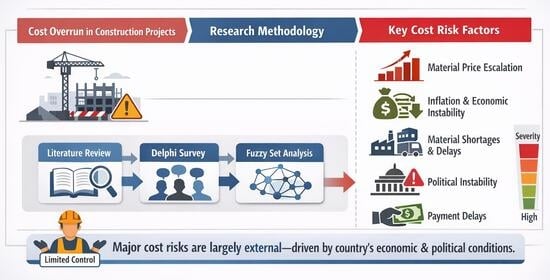
1. Introduction
- •
- RQ1. What are the main risk factors that cause cost overruns to construction projects in developing countries?
- •
- RQ2. What are the main risk factors causing cost overruns in the Ethiopian building construction projects from the contractors’ perspective?
2. Materials and Methods
2.1. The Systematic Literature Review Procedure
2.2. The Delphi Technique
2.3. Fuzzy Technique
2.3.1. Step 1: Fuzzification
2.3.2. Step 2: Aggregation
2.3.3. Step 3: Determination of Fuzzy Risk Magnitude
2.3.4. Step 4: Defuzzification
2.3.5. Step 5: Risk Factors Analysis
3. Results
4. Discussion
4.1. Cost Risk Factors in the Developing Countries
4.2. Cost Risk Factors in the Ethiopian Context
4.2.1. Escalation and Fluctuation in Material Prices
4.2.2. Inflation
4.2.3. Shortage of Materials
4.2.4. County’s Political Instability
4.2.5. Country’s Economic Instability
4.2.6. Delay in Payment to the Contractor
4.2.7. Delay in Procurement and Delivery of Materials
4.3. Implication and Limitation
5. Conclusions and Recommendations
Supplementary Materials
Author Contributions
Funding
Institutional Review Board Statement
Informed Consent Statement
Data Availability Statement
Conflicts of Interest
Abbreviations
| CI | Construction Industry |
| ECI | Ethiopian construction industry |
| SLR | Systematic literature review |
References
- Alaloul, W.S.; Musarat, M.A.; Rabbani, M.B.A.; Iqbal, Q.; Maqsoom, A.; Farooq, W. Construction Sector Contribution to Economic Stability: Malaysian GDP Distribution. Sustainability 2021, 13, 5012. [Google Scholar] [CrossRef]
- Giang, D.T.H.; Pheng, L.S. Role of Construction in Economic Development: Review of Key Concepts in the Past 40 Years. Habitat Int. 2011, 35, 118–125. [Google Scholar] [CrossRef]
- Abate, H.H.; Mengistu, D.G.; Abera, T.A. Failure Factors of Building Construction Projects in Ethiopia. Afr. J. Sci. Technol. Innov. Dev. 2024, 16, 860–880. [Google Scholar] [CrossRef]
- Pollack, J.; Helm, J.; Adler, D. What is the Iron Triangle, and How Has it Changed? Int. J. Manag. Proj. Bus. 2018, 11, 527–547. [Google Scholar] [CrossRef]
- Olatunji, O.A. A comparative analysis of tender sums and final costs of public construction and supply projects in Nigeria. J. Financ. Manag. Prop. Constr. 2008, 13, 60–79. [Google Scholar] [CrossRef]
- Belay, S.M.; Tilahun, S.; Yehualaw, M.; Matos, J.; Sousa, H.; Workneh, E.T. Analysis of Cost Overrun and Schedule Delays of Infrastructure Projects in Low Income Economies: Case Studies in Ethiopia. Adv. Civ. Eng. 2021, 2021, 4991204. [Google Scholar] [CrossRef]
- Belachew, A.S.; Mengesha, W.J.; Mohammed, M. Causes of Cost Overrun in Federal Road Projects of Ethiopia in Cases of Southern District. Am. J. Civ. Eng. 2017, 5, 27–40. [Google Scholar] [CrossRef]
- Welde, M.; Klakegg, O.J. Avoiding Cost Overrun Through Stochastic Cost Estimation and External Quality Assurance. IEEE Trans. Eng. Manag. 2024, 71, 1984–1997. [Google Scholar] [CrossRef]
- Kerzner, H. Project Management: A Systems Approach to Planning, Scheduling, and Controlling, 12th ed.; Wiley: Hoboken, NJ, USA, 2017; p. 814. [Google Scholar]
- Pinto, J.K. Project Management: Achieving Competitive Advantage, 5th ed.; Pearson: New York, NY, USA, 2019; p. 564. [Google Scholar]
- Sudarsana, D.K. Development of an Integrated Cost, Time, Quality and Safety Risk Analysis Tool in a Construction Project. Int. J. Cond. Monit. Diagn. Eng. Manag. 2023, 26, 3–8. [Google Scholar]
- Kivrak, S.; Udan, O.H. Risk Management Practices in Ethiopian Somali Regional State Construction Projects. Buildings 2023, 13, 3130. [Google Scholar] [CrossRef]
- Ayalew, T.; Dakhli, Z.; Lafhaj, Z. Assessment on Performance and Challenges of Ethiopian Construction Industry. Quest J. J. Archit. Civ. Eng. 2016, 2, 1–11. [Google Scholar]
- Yadeta, A.E. Critical Risks in Construction Projects in Ethiopia. J. Adv. Res. Civ. Eng. Archit. 2019, 1, 1–9. [Google Scholar]
- PMI. A Guide to the Project Management Body of Knowledge, 6th ed.; PMI: Newtown Square, PA, USA, 2017. [Google Scholar]
- Hillson, D.; Simon, P. Practical Project Risk Management: The ATOM Methodology, 3rd ed.; Berrett-Koehler Publishers, Inc.: San Francisco, CA, USA, 2020. [Google Scholar]
- Ismail, M.Z.; Ramly, Z.M.; Hamid, R.A. Systematic Review of Cost Overrun Research in the Developed and Developing Countries. Int. J. Sustain. Constr. Eng. Technol. 2021, 12, 196–211. [Google Scholar] [CrossRef]
- Mitikie, B.B.; Lee, J.; Lee, T.S. The Impact of Risk in Ethiopian Construction Project Performance. Open Access Libr. J. 2017, 4, e4233. [Google Scholar] [CrossRef]
- Park, Y.I.; Papadopoulou, T.C. Causes of Cost Overruns in Transport Infrastructure Projects in Asia: Their Significance and Relationship with Project Size. Built Environ. Proj. Asset Manag. 2012, 2, 195–216. [Google Scholar] [CrossRef]
- Hillson, D. Managing Risk in Projects, 2nd ed.; Routledge: London, UK, 2025. [Google Scholar]
- Zewdu, Z.T.; Aregaw, G.T. Causes of Contractor Cost Overrun in Construction Projects: The Case of Ethiopian Construction Sector. Int. J. Bus. Econ. Res. 2015, 4, 180–191. [Google Scholar] [CrossRef]
- Okoli, C.; Schabram, K. A Guide to Conducting a Systematic Literature Review of Information Systems Research. Sprouts Work. Pap. Inf. Syst. 2010, 10. [Google Scholar] [CrossRef]
- Fink, A. Conducting Research Literature Reviews, 4th ed.; SAGE Publications, Inc.: New York, NY, USA, 2014. [Google Scholar]
- Azarian, M.; Yu, H.; Shiferaw, A.T.; Stevik, T.K. Do We Perform Literature Review Right? A Scientific Mapping and Methodological Assessment. Logistics 2023, 7, 89. [Google Scholar] [CrossRef]
- Mongeon, P.; Paul-Hus, A. The Journal Coverage of Web of Science and Scopus: A Comparative Analysis. Scientometrics 2016, 106, 213–228. [Google Scholar] [CrossRef]
- Vieira, E.S.; Gomes, J.A.N.F. A Comparison of Scopus and Web of Science for a Typical University. Scientometrics 2009, 81, 587–600. [Google Scholar] [CrossRef]
- DESA. World Economic Situation and Prospects; United Nations Publication: New York, NY, USA, 2024. [Google Scholar]
- Othman, S.A.; Jaff, D.K.I.; Oztas, A. Development of a Risk Breakdown Structure in Mega Projects based on Different Case Studies. Eng. Technol. Appl. Sci. Res. 2024, 14, 15625–15630. [Google Scholar] [CrossRef]
- Ebrahimnejad, S.; Mousavi, S.M.; Seyrafianpour, H. Risk Identification and Assessment for Build-Operate-Transfer Projects: A Fuzzy Multi Attribute Decision Making Model. Expert Syst. Appl. 2010, 37, 575–586. [Google Scholar] [CrossRef]
- Al-Bahar, J.F.; Crandall, K.C. Systematic Risk Management Approach for Construction Projects. J. Constr. Eng. Manag. 1990, 116, 533–546. [Google Scholar] [CrossRef]
- Tessema, A.T.; Alene, G.A.; Wolelaw, N.M. Assessment of Risk Factors on Construction Projects in Gondar City, Ethiopia. Heliyon 2022, 8, e11726. [Google Scholar] [CrossRef] [PubMed]
- Choudhry, R.M.; Aslam, M.A.; Hinze, J.W.; Arain, F.M. Cost and Schedule Risk Analysis of Bridge Construction in Pakistan: Establishing Risk Guidelines. J. Constr. Eng. Manag. 2014, 140, 04014020. [Google Scholar] [CrossRef]
- Siraj, N.B.; Fayek, A.R. Risk Identification and Common Risks in Construction: Literature Review and Content Analysis. J. Constr. Eng. Manag. 2019, 145, 03119004. [Google Scholar] [CrossRef]
- Fernández-Valderrama, P.; Ureña-Estrella, C.; Moyano, J.; Bienvenido-Huertas, D. Cost and time risk factors in construction projects in the Dominican Republic. Front. Built Environ. 2024, 10, 1307572. [Google Scholar] [CrossRef]
- Mehdizadeh, R.; Breysse, D.; Taillandier, F.; Niandou, H. Dynamic and multi perspective risk management in construction with a special view to temporary structures. Civ. Eng. Environ. Syst. 2013, 30, 115–129. [Google Scholar] [CrossRef]
- Devi, A.C.; Ananthanarayanan, K. Factors Influencing Cost Over-Run in Indian Construction Projects. In MATEC Web of Conferences; EDP Sciences: Hulls, France, 2017; Volume 120. [Google Scholar] [CrossRef]
- Wang, J.-Y.; Yuan, H.-P. Major Cost-Overrun Risks in Construction Projects in China. Int. J. Proj. Organ. Manag. 2011, 3, 227–242. [Google Scholar] [CrossRef]
- Franc, J.M.; Hung, K.K.C.; Pirisi, A.; Weinstein, E.S. Analysis of Delphi Study 7-Point Linear Scale Data by Parametric Methods: Use of the Mean and Standard Deviation. Methodol. Innov. 2023, 16, 226–233. [Google Scholar] [CrossRef]
- Sumsion, T. The Delphi Technique: An Adaptive Research Tool. Br. J. Occup. Ther. 1998, 61, 153–156. [Google Scholar] [CrossRef]
- Keeney, S.; Hasson, F.; McKenna, H.P. The Delphi Technique in Nursing and Health Research; Wiley-Blackwell: Chichester, UK, 2011. [Google Scholar]
- Ameyaw, E.E.; Hu, Y.; Shan, M.; Chan, A.P.C.; Le, Y. Application of Delphi Method in Construction Engineering and Management Research: A Quantitative Perspective. J. Civ. Eng. Manag. 2016, 22, 991–1000. [Google Scholar] [CrossRef]
- Junger, S.; Payne, S.A.; Brine, J.; Radbruch, L.; Brearley, S.G. Guidance on Conducting and REporting DElphi Studies (CREDES) in palliative care: Recommendations based on a methodological systematic review. Palliat. Med. 2017, 31, 684–706. [Google Scholar] [CrossRef]
- Perera, B.A.K.S.; Rameezdeen, R.; Chileshe, N.; Hosseini, M.R. Enhancing the Effectiveness of Risk Management Practices in Sri Lanka Road Construction Projects: A Delphi Approach. Int. J. Constr. Manag. 2014, 14, 1–14. [Google Scholar] [CrossRef]
- Hallowell, M.R.; Gambatese, J.A. Qualitative Research: Application of the Delphi Method to CEM Research. J. Constr. Eng. Manag. 2010, 136, 99–107. [Google Scholar] [CrossRef]
- Perrenoud, A.; Short, E.; Cowan, D. Development and Validation of Elements for the Construction Risk Maturity Assessment (CRMA). Int. J. Constr. Educ. Res. 2023, 19, 42–60. [Google Scholar] [CrossRef]
- Gracht, H.A.v.d. Consensus measurement in Delphi studies. Technol. Forecast. Soc. Change 2012, 79, 1525–1536. [Google Scholar] [CrossRef]
- Perera, H.P.; Perera, B.A.K.S.; Palihakkara, D.A. Financial and Economic Risk Management in Coastal Land Reclamation Projects. Constr. Innov. 2023, 23, 878–897. [Google Scholar] [CrossRef]
- Xu, Y.; Yeung, J.F.Y.; Chan, A.P.C.; Chan, D.W.M.; Wang, S.Q.; Ke, Y. Developing a Risk Assessment Model for PPP Projects in China—A Fuzzy Synthetic Evaluation Approach. Autom. Constr. 2010, 19, 929–943. [Google Scholar] [CrossRef]
- Syaifullah; Ariffin, S.A.; Nordin, N.M. Fuzzy Delphi Method: A Step-by-Step Guide to Obtaining Expert Consensus on Mobile Tourism Acceptance Culture. Int. J. Adv. Comput. Sci. Appl. 2025, 16, 564–577. [Google Scholar]
- Hasson, F.; Keeney, S.; McKenna, H. Research Guidelines for the Delphi Survey Technique. J. Adv. Nurs. 2000, 32, 1008–1015. [Google Scholar] [CrossRef]
- McKenna, H.P. The Delphi Technique: A Worthwhile Research Approach for Nursing? J. Adv. Nurs. 1994, 19, 1221–1225. [Google Scholar] [CrossRef]
- Zadeh, L.A. Fuzzy Sets. Inf. Control. 1965, 8, 338–353. [Google Scholar] [CrossRef]
- Fayek, A.R. Fuzzy Logic and Fuzzy Hybrid Techniques for Construction Engineering and Management. J. Constr. Eng. Manag. 2020, 146, 04020064. [Google Scholar] [CrossRef]
- Klir, G.J.; Yuan, B. Fuzzy Sets and Fuzzy Logic: Theory and Applications; Prentice Hall PTR: Upper Saddle River, NJ, USA, 1995; p. 574. [Google Scholar]
- Sotoudeh-Anvari, A. The Applications of MCDM Methods In COVID-19 Pandemic: A State of the Art Review. Appl. Soft Comput. 2022, 126, 109238. [Google Scholar] [CrossRef]
- Sharma, S.; Goyal, P.K. Applying “Fuzzy Techniques” in Construction Project Management. Int. J. Emerg. Technol. 2019, 10, 384–391. [Google Scholar]
- Chain, A.P.C.; Chain, D.W.M.; ASCE, M.; Yeung, J.F.Y. Overview of the Application of “Fuzzy Techniques” in Construction Management Research. J. Constr. Eng. Manag. 2009, 135, 1241–1252. [Google Scholar] [CrossRef]
- Ameyaw, E.E.; Chain, A.P.C. Fuzzy Hybrid Computing in Construction Engineering and Management: Theory and Applications; Robinson Fayek, A., Ed.; Emerald Publishing Limited: Bingley, UK, 2018; p. 1. [Google Scholar]
- Andrić, J.M.; Lu, D.-G. Risk Assessment of Bridges Under Multiple Hazards in Operation Period. Saf. Sci. 2016, 83, 80–92. [Google Scholar] [CrossRef]
- Cheng, J.; Xu, M.-S.; Chen, Z.-R. A Fuzzy Logic-Based Method for Risk Assessment of Bridges During Construction. J. Haebin Inst. Technol. 2019, 26, 1–10. [Google Scholar] [CrossRef]
- Zadeh, L.A. The Concept of a Linguistic Variable and Its Application to Approximate Reasoning—I. Inf. Sci. 1975, 8, 199–249. [Google Scholar] [CrossRef]
- Chen, G.; Pham, T.T. Introduction to Fuzzy Sets, Fuzzy Logic, and Fuzzy Control Systems; CRC Press: Boca Raton, FL, USA, 2001; p. 316. [Google Scholar]
- Hedaoo, N.; Pawar, A. Risk Assessment Model Based on Fuzzy Logic for Residential Buildings. Slovak J. Civ. Eng. 2021, 29, 37–48. [Google Scholar] [CrossRef]
- Saatchi, R. Fuzzy Logic Concepts, Developments and Implementation. Information 2024, 15, 656. [Google Scholar] [CrossRef]
- Chang, D.-Y. Applications of the Extent Analysis Method on Fuzzy AHP. Eur. J. Oper. Res. 1996, 95, 649–655. [Google Scholar] [CrossRef]
- Rahmani, A.; Hosseinzadeh Lotfi, F.; Rostamy-Malkhalifeh, M.; Allahviranloo, T. A New Method for Defuzzification and Ranking of Fuzzy Numbers Based on the Statistical Beta Distribution. Adv. Fuzzy Syst. 2016, 2016, 6945184. [Google Scholar] [CrossRef]
- Shume, H.A.; Mitikie, B.B. An Integrated Delphi And Fuzzy AHP Model for Contractor Selection: A Case of Addis Ababa Design and Construction Works Bureau. Cogent Eng. 2024, 11, 2357724. [Google Scholar] [CrossRef]
- Syed, A.; Beg, I.; Khalid, A. Aggregation Methods for Fuzzy Judgments. Fuzzy Econ. Rev. 2016, 21, 3–21. [Google Scholar] [CrossRef]
- Fodor, J. Aggregation Functions in Fuzzy Systems. In Aspects of Soft Computing, Intelligent Robotics and Control; Fodor, J., Kacprzyk, J., Eds.; Springer: Berlin/Heidelberg, Germany, 2009; Volume 241, pp. 25–50. [Google Scholar]
- Rondeau, L.; Ruelas, R.; Levrat, L.; Lamotte, M. A Defuzzification Method Respecting the Fuzzification. Fuzzy Sets Syst. 1997, 86, 311–320. [Google Scholar] [CrossRef]
- Hellendoorn, H.; Thomas, C. Defuzzification in Fuzzy Controllers. J. Intell. Fuzzy Syst. 1993, 1, 109–123. [Google Scholar] [CrossRef]
- Maheswari, S.; Shalini, M.; Yookesh, T.L. Defuzzification Formula for Modelling and Scheduling A Furniture Fuzzy Project Network. Int. J. Eng. Adv. Technol. 2019, 9, 279–283. [Google Scholar] [CrossRef]
- Acebes, F.; Gonzalez-Varona, J.M.; Lopez-Paredes, A.; Pajares, J. Beyond Probability-Impact Matrices in Project Risk Management: A Qualitative Methodology for Risk Prioritisation. Humanit. Soc. Sci. Commun. 2024, 11, 1–13. [Google Scholar] [CrossRef]
- Levine, E.S. Improving Risk Matrices: The Advantages of Logarithmically Scaled Axes. J. Risk Res. 2012, 15, 209–222. [Google Scholar] [CrossRef]
- Ahmed Marey Alhammadi, A.S.; Memon, A.H. Ranking of the Factors Causing Cost Overrun in Infrastructural Projects of UAE. Int. J. Sustain. Constr. Eng. Technol. 2020, 11, 204–211. [Google Scholar] [CrossRef]
- Ahmed Marey Alhammadi, A.S.; Memon, A.H. Inhibiting Factors of Cost Performance in UAE Construction Projects. Int. J. Sustain. Constr. Eng. Technol. 2020, 11, 126–132. [Google Scholar] [CrossRef]
- Derakhshanalavijeh, R.; Teixeira, J.M.C. Cost Overrun in Construction Projects in Developing Countries, Gas-Oil Industry of Iran as a Case Study. J. Civ. Eng. Manag. 2016, 23, 125–136. [Google Scholar] [CrossRef]
- Raju, M.V.; Asadi, S.S.; Kumar, M.S.; Palivela, H. Evaluation of Cost and Time Impacts to Overruns in Construction Industry. Int. J. Civ. Eng. Technol. 2017, 8, 1416–1424. [Google Scholar]
- Sinesilassie, E.G.; Tabish, S.Z.S.; Jha, K.N. Critical factors affecting cost performance: A case of Ethiopian public construction projects. Int. J. Constr. Manag. 2018, 18, 108–119. [Google Scholar] [CrossRef]
- Ashtari, M.A.; Ansari, R.; Hassannayebi, E.; Jeong, J. Cost Overrun Risk Assessment and Prediction in Construction Projects: A Bayesian Network Classifier Approach. Buildings 2022, 12, 1660. [Google Scholar] [CrossRef]
- Asiedu, E.M.; Mkansi, M. Critical Factors Contributing to Budget Overruns in Ghana’s Telecommunication Industry Construction Projects. J. Constr. Dev. Ctries. 2023, 28, 265–293. [Google Scholar] [CrossRef]
- B, C.S.; Asadi, S.S. An Experimental Study for Evaluation of Time and Cost Driven Factors Analysis of a Commercial Complex. Int. J. Civ. Eng. Technol. 2017, 8, 139–146. [Google Scholar]
- Wang, Y.; Ghazali, F.E.M. Effective control measures to minimize cost overrun during construction phase of high-rise residential building projects in Chongqing, China. Arch. Civ. Eng. 2023, 69, 79–94. [Google Scholar] [CrossRef]
- Akram, M.; Ali, T.; Memon, N.A.; Khahro, S.H. Causal Attributes of Cost Overrun in Construction Projects of Pakistan. Int. J. Civ. Eng. Technol. 2017, 8, 477–483. [Google Scholar]
- Alghonamy, A. Cost Overrun in Construction Projects in Saudi Arabia: Contractors‘ Perspective. Int. J. Eng. Technol. 2015, 15, 35–42. [Google Scholar]
- Alhammadi, Y.; Al-Mohammad, M.S.; Rahman, R.A. Modeling the Causes and Mitigation Measures for Cost Overruns in Building Construction: The Case of Higher Education Projects. Buildings 2024, 14, 487. [Google Scholar] [CrossRef]
- Alshihri, S.; Al-Gahtani, K.; Almohsen, A. Risk Factors That Lead to Time and Cost Overruns of Building Projects in Saudi Arabia. Buildings 2022, 12, 902. [Google Scholar] [CrossRef]
- Amini, S.; Rezvani, A.; Tabassi, M.; Malek Sadati, S.S. Causes of cost overruns in building construction projects in Asian countries; Iran as a case study. Eng. Constr. Archit. Manag. 2023, 30, 2739–2766. [Google Scholar] [CrossRef]
- Johnson, R.M.; Babu, R.I.I. Time and cost overruns in the UAE construction industry: A critical analysis. Int. J. Constr. Manag. 2020, 20, 402–411. [Google Scholar] [CrossRef]
- Memon, A.Q.; Memon, A.H.; Soomro, M.A. Contractor’s Perception on Factors Causing Cost Overrun in Construction Works of Pakistan. Int. J. Sustain. Constr. Eng. Technol. 2020, 11, 84–92. [Google Scholar] [CrossRef]
- Renuka, S.M.; Umarani, C. Effect of Critical Risk Factors Causing Cost Deviation in Medium Sized Construction Projects. J. Constr. Dev. Ctries. 2018, 23, 63–85. [Google Scholar] [CrossRef]
- Sohu, S.; Abdullah, A.H.; Nagapan, S.; Rind, T.A.; Jhatial, A.A. Controlling Measures for Cost Overrun Causes in Highway Projects of Sindh Province. Eng. Technol. Appl. Sci. Res. 2019, 9, 4276–4280. [Google Scholar] [CrossRef]
- Alzebdeh, K.; Bashir, H.A.; Al Siyabi, S.K. Applying Interpretive Structural Modeling to Cost Overruns in Construction Projects in the Sultanate of Oman. J. Eng. Res. 2015, 12, 53. [Google Scholar] [CrossRef]
- Berihu, L.G.; Grum, B.; Tariku, Z.; Abebe, B.A. Causes, Effects, and Mitigation Measures of Time and Cost Overruns in Water Supply Projects: Case of Tigrai Region, Northern Ethiopia. Adv. Civ. Eng. 2023, 2023, 7113730. [Google Scholar] [CrossRef]
- Famiyeh, S.; Amoatey, C.T.; Adaku, E.; Agbenohevi, C.S. Major Causes of Construction Time and Cost Overruns: A Case of Selected Educational Sector Projects in Ghana. J. Eng. Des. Technol. 2017, 15, 181–198. [Google Scholar] [CrossRef]
- Obianyo, J.I.; Okey, O.E.; Alaneme, G.U. Assessment of cost overrun factors in construction projects in Nigeria using fuzzy logic. Innov. Infrastruct. Solut. 2022, 7, 304. [Google Scholar] [CrossRef]
- Sohu, S.; Abdullah, A.H.; Nagapan, S.; Memon, N.A.; Yunus, R.; Hasmori, M.F. Causative Factors of Cost Overrun in Building Projects of Pakistan. Int. J. Integr. Eng. 2018, 10, 122–126. [Google Scholar] [CrossRef]
- Sohu, S.; Ansari, A.A.; Jhatial, A.A. Most Common Factors Causing Cost Overrun with its Mitigation Measure for Pakistan Construction Industry. Int. J. Sustain. Constr. Eng. Technol. 2020, 11, 256–261. [Google Scholar] [CrossRef]
- Alinaitwe, H.; Apolot, R.; Tindiwensi, D. Investigation into the Causes of Delays and Cost Overruns in Uganda’s Public Sector Construction Projects. J. Constr. Dev. Ctries. 2013, 18, 33–47. [Google Scholar]
- Annamalaisami, C.D.; Kuppuswamy, A. Managing Cost Risks: Toward a Taxonomy of Cost Overrun Factors in Building Construction Projects. ASCE-ASME J. Risk Uncertain. Eng. Syst. Part A Civ. Eng. 2021, 7, 04021021. [Google Scholar] [CrossRef]
- Daoud, A.O.; El Hefnawy, M.; Wefki, H. Investigation of critical factors affecting cost overruns and delays in Egyptian mega construction projects. Alex. Eng. J. 2023, 83, 326–334. [Google Scholar] [CrossRef]
- Kamal, A.; Abas, M.; Khan, D.; Azfar, R.W. Risk factors influencing the building projects in Pakistan: From perspective of contractors, clients and consultants. Int. J. Constr. Manag. 2022, 22, 1141–1157. [Google Scholar] [CrossRef]
- Shaikh, F.A. Financial Mismanagement: A Leading Cause of Time and Cost Overrun in Mega Construction Projects in Pakistan. Eng. Technol. Appl. Sci. Res. 2020, 10, 5247–5250. [Google Scholar] [CrossRef]
- Kamaruddeen, A.M.; Sung, C.F.; Wahi, W. A Study on Factors Causing Cost Overrun of Construction Projects in Sarawak, Malaysia. Civ. Eng. Archit. 2020, 8, 191–199. [Google Scholar] [CrossRef]
- Kim, S.-Y.; Tuan, K.N.; Lee, J.D.; Pham, H.; Luu, V.T. Cost overrun factor analysis for hospital projects in Vietnam. KSCE J. Civ. Eng. 2018, 22, 1–11. [Google Scholar] [CrossRef]
- Xie, W.; Deng, B.; Yin, Y.; Lv, X.; Deng, Z. Critical Factors Influencing Cost Overrun in Construction Projects: A Fuzzy Synthetic Evaluation. Buildings 2022, 12, 2028. [Google Scholar] [CrossRef]
- Judson, L.; Paul, V.K. Critical Uncertainty Factors Impacting Building Construction Projects in India. Civ. Eng. Archit. 2022, 10, 1854–1863. [Google Scholar] [CrossRef]
- Mahamid, I. Contractors’ perception of risk factors affecting cost overrun in building projects in Palestine. IES J. Part A Civ. Struct. Eng. 2014, 7, 38–50. [Google Scholar] [CrossRef]
- Yang, J.-B.; Chen, C.-C. Causes of Budget Changes in Building Construction Projects: An Empirical Study in Taiwan. Eng. Econ. 2015, 60, 1–21. [Google Scholar] [CrossRef]
- Ammar, T.; Abdel-Monem, M.; El-Dash, K. Risk factors causing cost overruns in road networks. Ain Shams Eng. J. 2022, 13, 101720. [Google Scholar] [CrossRef]
- Rashed, E.F.; Shaqour, E.N. Factors Causing Cost Overrun in Administrative Construction Projects of Egypt. J. Eng. Appl. Sci. 2014, 61, 199–215. [Google Scholar]
- Bakri, A.S.; Razak, M.A.A.; Abd Shukor, A.S. Identification of Factors Influencing Time and Cost Risks in Highway Construction Projects. Int. J. Sustain. Constr. Eng. Technol. 2021, 12, 280–288. [Google Scholar] [CrossRef]
- França, A.; Haddad, A.N. Causes of construction projects cost overrun in Brazil. Int. J. Sustain. Constr. Eng. Technol. 2018, 9, 69–83. [Google Scholar] [CrossRef]
- Balali, A.; Moehler, R.C.; Valipour, A. Ranking cost overrun factors in the mega hospital construction projects using Delphi-SWARA method: An Iranian case study. Int. J. Constr. Manag. 2022, 22, 2577–2585. [Google Scholar] [CrossRef]
- Seddeeq, A.B.; Assaf, S.; Abdallah, A.; Hassanain, M.A. Time and Cost Overrun in the Saudi Arabian Oil and Gas Construction Industry. Buildings 2019, 9, 41. [Google Scholar] [CrossRef]
- Esmaeili, I.; Kashani, H. Managing Cost Risks in Oil and Gas Construction Projects: Root Causes of Cost Overruns. ASCE-ASME J. Risk Uncertain. Eng. Syst. Part A Civ. Eng. 2022, 8, 04021072. [Google Scholar] [CrossRef]
- Qalbin, R.A.; Rabayah, H.; Darwish, M.; Abendeh, R. Assessment of Construction Risks in Projects Funded by External Sources in Jordan during the COVID-19 Pandemic. Buildings 2023, 13, 1885. [Google Scholar] [CrossRef]
- Draleti, G.; Sengonzi, R.; Kakitahi, J. Improvement of Risk Management in Cost Estimation in the Building Construction Industry in Uganda. J. Constr. Dev. Ctries. 2024, 29, 111–138. [Google Scholar] [CrossRef]
- Taha, G.; Sherif, A.; Badawy, M. Overall Cost Overrun Estimate in Residential Projects: A Hybrid Dynamics Approach. Appl. Comput. Intell. Soft Comput. 2022, 2022, 2285971. [Google Scholar] [CrossRef]
- Akinradewo, O.; Aigbavboa, C.; Oke, A.; Coffie, H.; Ogunbayo, B. Unearthing Causative Factors of Cost Overrun on Ghanaian Road Projects. Balt. J. Road Bridge Eng. 2022, 17, 171–188. [Google Scholar] [CrossRef]
- Enshassi, A.; Kumaraswamy, M.; Al-Najjar, J. Significant Factors Causing Time and Cost Overruns in Construction Projects in the Gaza Strip: Contractors’ Perspective. Int. J. Constr. Manag. 2010, 10, 35–60. [Google Scholar] [CrossRef]
- Mahmud, A.T.; Ogunlana, S.O.; Hong, W.T. Key Driving Factors of Cost Overrun in Highway Infrastructure Projects in Nigeria: A Context-Based Perspective. J. Eng. Des. Technol. 2021, 19, 1530–1555. [Google Scholar] [CrossRef]
- Ikediashi, D.I.; Okolie, K.C. An Assessment of Risks Associated With Contractor’s Cash Flow Projections in South-South, Nigeria. Int. J. Constr. Manag. 2022, 22, 2051–2058. [Google Scholar] [CrossRef]
- Sha, K.; Jiang, Z. Improving Rural Labourers’ Status in China’s Construction Industry. Build. Res. Inf. 2003, 31, 464–473. [Google Scholar] [CrossRef]
- Caldas, C.H.; Menches, C.L.; Reyes, P.M.; Navarro, L.; Vargas, D.M. Materials Management Practices in the Construction Industry. Pract. Period. Struct. Des. Constr. 2015, 20, 04014039. [Google Scholar] [CrossRef]
- Anireddy, A.R. Material Cost Fluctuations: Analyzing the Effects of Market Volatility on Civil Project Budgets. Int. J. Sci. Res. 2024, 13, 1606–1610. [Google Scholar] [CrossRef]
- Herrera, R.F.; Sánchez, O.; Castañeda, K.; Porras, H. Cost Overrun Causative Factors in Road Infrastructure Projects: A Frequency and Importance Analysis. Appl. Sci. 2020, 10, 5506. [Google Scholar] [CrossRef]
- Musarat, M.A.; Alaloul, W.S.; Liew, M.S. Impact of Inflation Rate on Construction Projects Budget: A Review. Ain Shams Eng. J. 2021, 12, 407–414. [Google Scholar] [CrossRef]
- Guhhan, S.; Arditi, D. Factors Affecting International Construction. J. Constr. Eng. Manag. 2005, 131, 273–282. [Google Scholar] [CrossRef]
- Musarat, M.A.; Alaloul, W.S.; Liew, M.S. Incorporating Inflation Rate in Construction Projects Cost: Forecasting Model. Heliyon 2024, 10, e26037. [Google Scholar] [CrossRef]
- Ebekozien, A.; Aigbavboa, C.O.; Thwala, W.D.; Hafez, M.A.; Samsurijan, M.S. Sustainable Development Goals Under Threat: The Impact of Inflation on Construction Projects. Eng. Constr. Archit. Manag. 2024, 31, 323–341. [Google Scholar] [CrossRef]
- Abeyrathne, A.H.M.C.P.; Pavithra, G.; Gowsiga, M. The Mitigation Measures for Material Shortage Issues in Construction Industry. IQSSL Tech. Res. Proc. 2020. Available online: https://www.researchgate.net/publication/358565687_THE_MITIGATION_MEASURES_FOR_MATERIAL_SHORTAGE_ISSUES_IN_CONSTRUCTION_INDUSTRY (accessed on 31 July 2025).
- Yildiz, S.; Gunes, S.; Kivrak, S. Examining the Impact of Material Management Practices on Project Performance in the Construction Industry. Buildings 2024, 14, 2076. [Google Scholar] [CrossRef]
- Erfan, M.U. The Political Stability and Development Linkages in Bangladesh: A Study of Two Villages. J. Community Posit. Pract. 2024, 27, 60–88. [Google Scholar] [CrossRef]
- Bekr, G.A. Factors Affecting Performance of Construction Projects in Unstable Political and Economic Situations. ARPN J. Eng. Appl. Sci. 2017, 12, 5384–5395. [Google Scholar]
- Khan, W.A. The Impact of Economic Fluctuations on Project Management Practices in Large-Scale Construction Projects. iRASD J. Manag. 2024, 6, 152–163. [Google Scholar] [CrossRef]
- Weerakoon, T.G.; Wimalasena, S.; Fedotova, K. Economic Crisis Adaptation in Sri Lankan Construction Industry: Pathway to Prosperity. Balt. J. Real Estate Econ. Constr. Manag. 2023, 11, 240–256. [Google Scholar] [CrossRef]
- Sohu, S.; Halid, A.; Nagapan, S.; Fattah, A.; Latif, I.; Ullah, K. Causative Factors of Cost Overrun in Highway Projects of Sindh Province of Pakistan. IOP Conf. Ser. Mater. Sci. Eng. 2017, 271, 012036. [Google Scholar] [CrossRef]
- Bedada, A.T. An Analysis of How the Construction Business in Ethiopia is Affected by the Rising Cost of Building Materials. Am. J. Constr. Build. Mater. 2023, 7, 1–6. [Google Scholar] [CrossRef]
- Adisu Ayal, B.; Bamelak Bishaw, E.; Molla Aynalem, M.; Yirga Bekalu, K. Political Instability and Its Consequences for Economic Growth in Ethiopia: A Time Series Analysis. J. Econ. Adm. Sci. 2024, 30, 459–472. [Google Scholar] [CrossRef]
- Donka, D.T.; Mengistu, D.G. Business Failure and Organizational Capacity of Contractors in Ethiopia. Ethiop. J. Eng. Technol. 2023, 3, 129–148. [Google Scholar]
- Makoye, M.; Mlinga, R.S.; Ndanshau, M.O.A. Impact of macroeconomic factors on performance of construction industry in Tanzania. Int. J. Constr. Manag. 2022, 23, 2625–2636. [Google Scholar] [CrossRef]
- Coleman, C.E.; Muya, M.; Brobbey, D.A.; Mwanaumo, E.M. Impact of Political Factors on Construction Contract Termination: Empirical Evidence From Ghana. Afr. J. Appl. Res. 2025, 11, 129–153. [Google Scholar] [CrossRef]
- Eliasson, J. Cost overruns of infrastructure projects—Distributions, causes and remedies. Transp. Res. Part A Policy Pract. 2025, 198, 104532. [Google Scholar] [CrossRef]
- Steininger, B.I.; Groth, M.; Weber, B.L. Cost overruns and delays in infrastructure projects: The case of Stuttgart 21. J. Prop. Invest. Financ. 2020, 39, 256–282. [Google Scholar] [CrossRef]
- Chammout, B.; El-adaway, I.H.; Abdul Nabi, M.; Assaad, R.H. Price Escalation in Construction Projects: Examining National and International Contracts. J. Constr. Eng. Manag. 2024, 150, 04024109. [Google Scholar] [CrossRef]
- Moynihan, G.P.; Al-Zarrad, M.A. Application of Hedging Principles to Materials Price Risk Mitigation in Construction Projects. Int. J. Constr. Eng. Manag. 2015, 4, 180–190. [Google Scholar] [CrossRef]



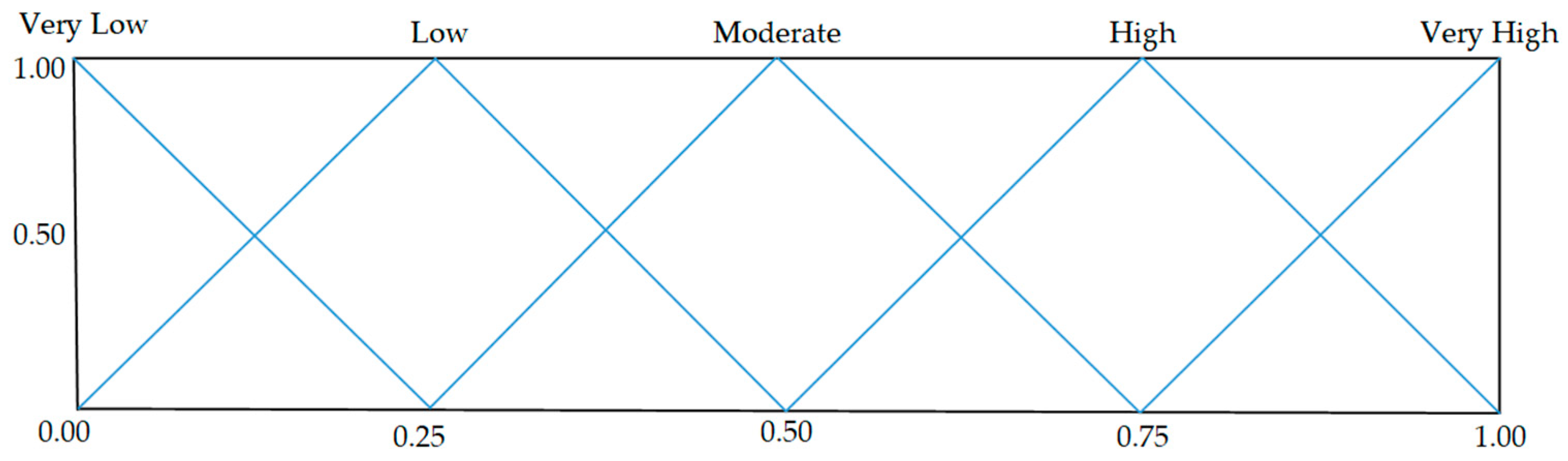
| Linguistic Evaluation | Linguistic Scale | Triangular Fuzzy Number |
|---|---|---|
| Very Low (VL) | 1 | (0,0,0.25) |
| Low (L) | 2 | (0,0.25,0.5) |
| Medium (M) | 3 | (0.25,0.5,0.75) |
| High (H) | 4 | (0.5,0.75,1) |
| Very High (VH) | 5 | (0.75,1,1) |
| Expert’s ID | Linguistic Evaluation | Likert Scale Response | Fuzzification | |||
|---|---|---|---|---|---|---|
| Likelihood (L) | Impact (I) | Likelihood (L) | Impact (I) | Likelihood (L) | Impact (I) | |
| EXP1 | High | Very High | 4 | 5 | (0.5,0.75,1) | (0.75,1,1) |
| EXP2 | Very High | Very high | 5 | 5 | (0.75,1,1) | (0.75,1,1) |
| … | … | … | … | … | … | … |
| EXP26 | Very High | High | 5 | 4 | (0.75,1,1) | (0.5,0.75,1) |
| Average | (0.577,0.827,0.942) | (0.654,0.904,0.981) | ||||
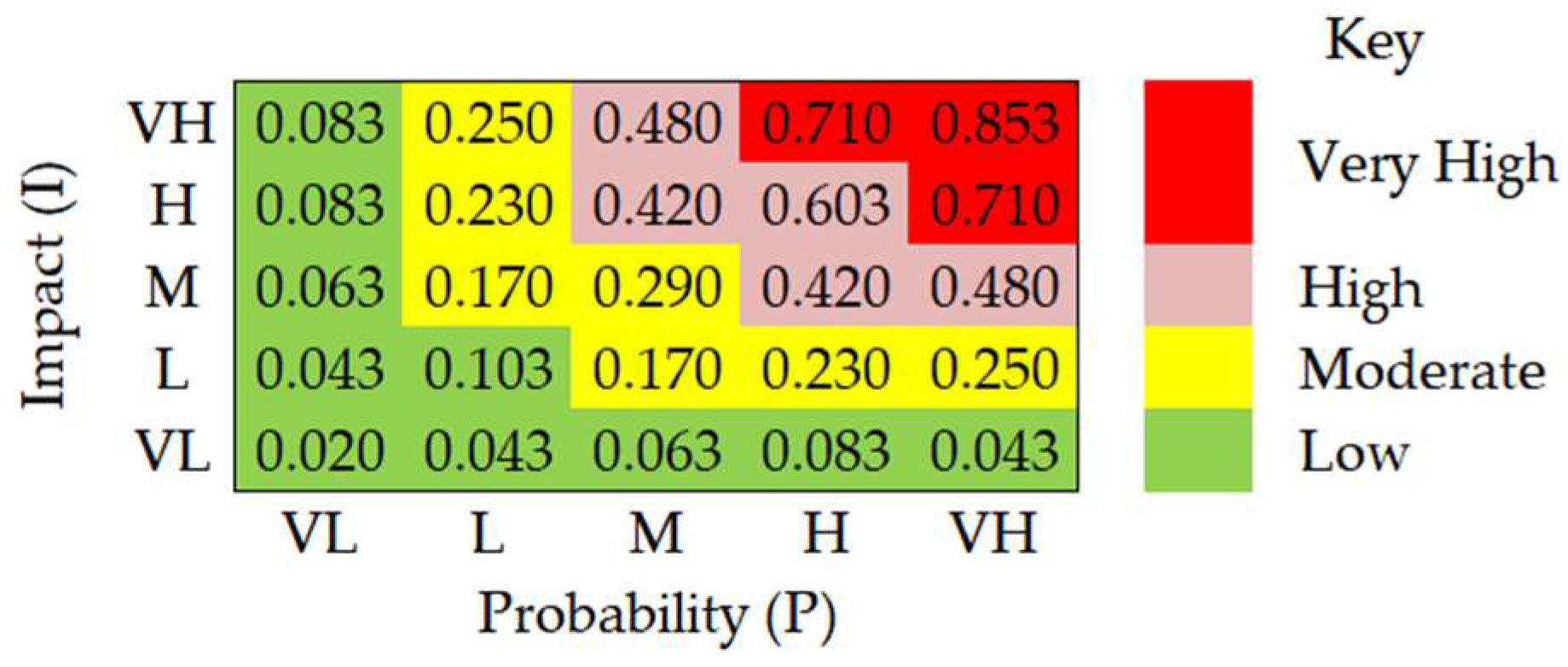
| Risk Category | CRISP Value Range |
|---|---|
| Low | (0.02—0.103) |
| Moderate | (0.104—0.29) |
| High | (0.30—0.603) |
| Very High | (0.604—0.853) |
| Risk Factors | References | Frequency | % | Rank |
|---|---|---|---|---|
| Management Risk Factors | ||||
| 1. Poor coordination among parties involved in the project | [75,76,77,78,79] | 5 | 10% | 31 |
| 2. Lack of project management experience and skills of the project team | [76,79,80,81,82,83] | 6 | 12% | 26 |
| 3. Inadequate project planning and scheduling | [76,77,81,84,85,86,87,88,89,90,91,92] | 12 | 24% | 9 |
| 4. Poor communication among parties involved in the project | [81,86,88,93,94,95,96,97,98] | 9 | 18% | 14 |
| 5. Poor site management and supervision by the contractor | [19,75,76,81,86,87,88,97,99,100,101,102,103] | 13 | 25% | 6 |
| 6. Poor experience of the owner in project management | [79,89,98] | 3 | 6% | 43 |
| 7. Poor project management such as cost, resource, and risk | [78,82,84,86,89,95,104,105,106] | 9 | 18% | 14 |
| 8. Delayed decision making by the client | [76,79,84,89,90,92,94,97,98,103,107] | 11 | 22% | 10 |
| 9. Poor contract management | [81,86,92,106,108] | 5 | 10% | 31 |
| 10. Unstable organizational environment | [81] | 1 | 2% | 64 |
| Technical Risk Factor | ||||
| 11. Design error | [76,77,86,92,94,98,100,103,106,109] | 10 | 20% | 11 |
| 12. Design change | [75,76,77,78,82,83,84,85,86,88,89,92,93,94,95,106,107,110,111,112] | 20 | 39% | 2 |
| 13. Lack of consistency between design and specification | [78,94] | 2 | 4% | 56 |
| 14. Insufficient feasibility study before design | [19,77,95] | 3 | 6% | 43 |
| 15. Design delay | [85,97,101,113] | 4 | 8% | 38 |
| 16. Design and project scope complexity | [78,80,89] | 3 | 6% | 43 |
| 17. Consultant and design team incompetency | [76,86,94,98,101,114] | 6 | 12% | 26 |
| 18. Poor quantity and cost estimation | [6,19,76,77,81,84,86,88,89,90,93,98,102,109,110,115,116] | 17 | 33% | 3 |
| 19. Poor estimation of activity durations | [19,76,78,81,102,115,116] | 7 | 14% | 21 |
| 20. Poor project scope definition | [117,118] | 2 | 4% | 56 |
| 21. Negligence of site visit during bidding | [115] | 1 | 2% | 64 |
| 22. Lack of proper professional software | [78] | 1 | 2% | 64 |
| 23. Incomplete design and specification | [75,76,116,118] | 4 | 8% | 38 |
| Construction Risk Factors | ||||
| 24. Rework due to poor workmanship and poor quality of work | [80,86,91,100,107,114] | 6 | 12% | 26 |
| 25. Rework due to construction mistake or error | [77,88,100,102,104,105,119] | 7 | 14% | 21 |
| 26. Temporary delays and interruptions causing cost overrun | [92,101,103] | 3 | 6% | 43 |
| 27. Adoption of improper or unaccepted construction methods | [77,103,120] | 3 | 6% | 43 |
| 28. Contractor’s incompetency and lack of experience in similar projects | [76,82,86,87,88,89,98,103,120] | 9 | 18% | 14 |
| 29. Pressure to deliver project on accelerated schedule | [104,115,119] | 3 | 6% | 43 |
| 30. Making tough decisions by engineers during project implementation | [117] | 1 | 2% | 64 |
| 31. Delay in execution of planned activity | [86,88,93,100,121,122] | 6 | 12% | 26 |
| 32. High level of quality requirement by client | [91] | 1 | 2% | 64 |
| Resource Related Risk Factors | ||||
| 33. Shortage of skilled labor in the project area | [6,75,76,77,78,81,87,92,103,104,107,117,123] | 13 | 25% | 6 |
| 34. Shortage of materials | [6,75,82,83,94,104,123] | 7 | 14% | 21 |
| 35. Shortage of equipment | [6,75,80,82,83,94,104,119,123] | 9 | 18% | 14 |
| 36. Suppliers’ monopoly | [121] | 1 | 2% | 64 |
| 37. Poor labor productivity | [75,76,86,113] | 4 | 8% | 38 |
| 38. Sub-contractors’ failure; default of sub-contractors | [19,76,87,90,120] | 5 | 10% | 31 |
| 39. Delay in procurement and delivery of materials | [78,80,90,93,94,121,123] | 7 | 14% | 21 |
| 40. High staff turnover | [87] | 1 | 2% | 64 |
| Site Condition Risk Factors | ||||
| 41. Unforeseen subsurface conditions | [80] | 1 | 2% | 64 |
| 42. Unforeseen and differing site conditions | [19,83,116] | 3 | 6% | 43 |
| 43. Poor site investigations such as geological site survey and soil test | [19,83,90,100,103] | 5 | 10% | 31 |
| 44. Delay in site possession | [80,91,111,112] | 4 | 8% | 38 |
| 45. Improper project site or location | [106] | 1 | 2% | 64 |
| Contractual and Legal Risk Factors | ||||
| 46. Contradictions in documents and ambiguity in contract terms | [77,78,83] | 3 | 6% | 43 |
| 47. Deficient contracts with discrepancies and errors | [90,99] | 2 | 4% | 56 |
| 48. Project scope change | [76,99,100,104,110,113,116,120,122] | 9 | 18% | 14 |
| 49. Variation or change order (addition/omission) | [6,19,84,86,87,94,101,105,109,110,111,112,117,119,120] | 15 | 29% | 4 |
| 50. Contractual claims and disputes | [75,76,86,90,111,116] | 6 | 12% | 26 |
| 51. The lowest bid price award system | [19,83,85,87,100,104,108,115,121] | 9 | 18% | 14 |
| 52. Inappropriate procurement system and contract type | [19,89,120] | 3 | 6% | 43 |
| 53. Issuing strict instructions and regulations during crisis | [117] | 1 | 2% | 64 |
| 54. Resistance to follow regulations | [117] | 1 | 2% | 64 |
| 55. Bureaucracy in tendering method | [90] | 1 | 2% | 64 |
| Economic and Financial Risk Factors | ||||
| 56. Inflation | [6,77,80,82,99,110,115,116,118,123] | 10 | 20% | 11 |
| 57. Funding problems (financial difficulty of client) | [76,82,84,89,90,92,95,97,98,103,108,114,116] | 13 | 25% | 6 |
| 58. Fluctuations in currency exchange rate | [78,93,106,108,116,121,123] | 7 | 14% | 21 |
| 59. Increase banks loan interest rates | [78,83,99] | 3 | 6% | 43 |
| 60. Escalation and fluctuation in material prices | [6,76,77,78,80,83,84,86,88,92,93,94,95,97,100,102,104,106,107,108,111,112,118,119,121] | 25 | 49% | 1 |
| 61. Delay in payments to the contractor | [76,78,84,85,86,87,90,94,95,98,99,120,122,123] | 14 | 27% | 5 |
| 62. Country’s economic instability | [79,88,90] | 3 | 6% | 43 |
| 63. High transportation costs | [77] | 1 | 2% | 64 |
| 64. High bond and insurance rates | [90,120] | 2 | 4% | 56 |
| 65. Increase in equipment and machinery cost | [77,83,90,93,115] | 5 | 10% | 31 |
| 66. Increase in labor costs or wages | [6,77,83,93,100] | 5 | 10% | 31 |
| 67. Contractor’s financial difficulty | [75,76,84,87,90,96,97,107,116,123] | 10 | 20% | 11 |
| 68. Rebates | [106,115] | 2 | 4% | 56 |
| 69. Tax liability | [78] | 1 | 2% | 64 |
| Social and Cultural Risk Factors | ||||
| 70. Time and cost required for land acquisition and compensation | [80,91] | 2 | 4% | 56 |
| 71. Differences in culture, language, and religious backgrounds | [122] | 1 | 2% | 64 |
| 72. Insecurity and crime (theft, vandalism, kickbacks, and fraudulent practices) | [79,118] | 2 | 4% | 56 |
| Governmental and Political Risk Factors | ||||
| 73. Changes in government laws, regulations, and policies affecting the project | [77,78,93,106] | 4 | 8% | 38 |
| 74. County’s Political Instability | [103,121,122] | 3 | 6% | 43 |
| 75. Political interferences | [110] | 1 | 2% | 64 |
| 76. Delay or refusal of the government bodies in project approval and permit | [90,107,117] | 3 | 6% | 43 |
| 77. Corruption and bribery | [78,117] | 2 | 4% | 56 |
| Environmental and Safety Risk Factors | ||||
| 78. Adverse weather conditions (continuous rainfall, snow, temperature, wind) | [19,78,79,83,103,105,112,122] | 8 | 16% | 20 |
| 79. Force majeure (natural and man-made disasters which are beyond the firm’s control, e.g., fire, floods, thunder and lightning, landslide, earthquake, hurricane) | [97,98,106,110,117] | 5 | 10% | 31 |
| 80. Epidemic illness or disease | [106] | 1 | 2% | 64 |
| 81. Difficulty of applying new health and safety standards | [117] | 1 | 2% | 64 |
| Cost Risk Factors | Delphi Round-1 | Delphi Round-2 | Delphi Round-3 | Fuzzy Analysis | ||||||||
|---|---|---|---|---|---|---|---|---|---|---|---|---|
| Agreement% | Consensus | Agreement % | Consensus | Probability | Impact | Overall Consensus | Crisp Value | Category | Rank | |||
| d Value | Consensus | d Value | Consensus | |||||||||
| Management Risk Factors | ||||||||||||
| 1. Poor coordination among parties involved in the project | 90% | Yes | 85% | Yes | 0.173 | Yes | 0.171 | Yes | Yes | 0.517 | HI | 26 |
| 2. Lack of project management experience and skills of the project team | 67% | Yes | 67% | Yes | 0.165 | Yes | 0.176 | Yes | Yes | 0.457 | HI | 39 |
| 3. Inadequate project planning and scheduling | 87% | Yes | 78% | Yes | 0.130 | Yes | 0.146 | Yes | Yes | 0.535 | HI | 22 |
| 4. Poor communication among parties involved in the project | 70% | Yes | 70% | Yes | 0.149 | Yes | 0.154 | Yes | Yes | 0.505 | HI | 29 |
| 5. Poor site management and supervision by the contractor | 70% | Yes | 52% | Yes | 0.170 | Yes | 0.136 | Yes | Yes | 0.484 | HI | 32 |
| 6. Poor experience of the owner in project management | 70% | Yes | 52% | Yes | 0.179 | Yes | 0.157 | Yes | Yes | 0.404 | HI | 49 |
| 7. Poor project management such as cost, resource, and risk | 93% | Yes | 70% | Yes | 0.098 | Yes | 0.122 | Yes | Yes | 0.592 | HI | 9 |
| 8. Delayed decision making by the client | 93% | Yes | 85% | Yes | 0.194 | Yes | 0.150 | Yes | Yes | 0.582 | HI | 13 |
| 9. Poor contract management | 80% | Yes | 85% | Yes | 0.142 | Yes | 0.141 | Yes | Yes | 0.58 | HI | 14 |
| 10. Unstable organizational environment | 70% | Yes | 44% | No | - | - | - | - | - | - | - | - |
| Technical Risk Factors | ||||||||||||
| 11. Design error | 67% | Yes | 63% | Yes | 0.169 | Yes | 0.211 | No | No | - | - | - |
| 12. Design change | 93% | Yes | 93% | Yes | 0.161 | Yes | 0.161 | Yes | Yes | 0.533 | HI | 23 |
| 13. Lack of consistency between design and specification | 60% | Yes | 59% | Yes | 0.164 | Yes | 0.192 | Yes | Yes | 0.388 | HI | 52 |
| 14. Insufficient feasibility study before design | 87% | Yes | 85% | Yes | 0.136 | Yes | 0.142 | Yes | Yes | 0.531 | HI | 25 |
| 15. Design delay | 73% | Yes | 59% | Yes | 0.179 | Yes | 0.178 | Yes | Yes | 0.469 | HI | 37 |
| 16. Design and project scope complexity | 50% | No | - | - | - | - | - | - | - | - | - | - |
| 17. Consultant and design team incompetency | 60% | Yes | 56% | Yes | 0.186 | Yes | 0.157 | Yes | Yes | 0.404 | HI | 49 |
| 18. Poor quantity and cost estimation | 80% | Yes | 81% | Yes | 0.151 | Yes | 0.150 | Yes | Yes | 0.562 | HI | 17 |
| 19. Poor estimation of activity durations | 73% | Yes | 63% | Yes | 0.166 | Yes | 0.170 | Yes | Yes | 0.509 | HI | 28 |
| 20. Poor project scope definition | 70% | Yes | 70% | Yes | 0.204 | No | 0.172 | Yes | No | - | - | - |
| 21. Negligence of site visit during bidding | 53% | Yes | 52% | Yes | 0.220 | No | 0.189 | Yes | No | - | - | - |
| 22. Lack of proper professional software | 37% | No | - | - | - | - | - | - | - | - | - | - |
| 23. Incomplete design and specification | 70% | Yes | 78% | Yes | 0.194 | Yes | 0.137 | Yes | Yes | 0.532 | HI | 24 |
| Construction Risk Factors | ||||||||||||
| 24. Rework due to poor workmanship and poor quality of work | 70% | Yes | 63% | Yes | 0.177 | Yes | 0.183 | Yes | Yes | 0.374 | HI | 53 |
| 25. Rework due to construction mistake or error | 50% | No | - | - | - | - | - | - | - | - | - | - |
| 26. Temporary delays and interruptions causing cost overrun | 73% | Yes | 81% | Yes | 0.174 | Yes | 0.211 | No | No | - | - | - |
| 27. Adoption of improper or unaccepted construction methods | 40% | No | - | - | - | - | - | - | - | - | - | - |
| 28. Contractor’s incompetency and lack of experience in similar projects | 60% | Yes | 56% | Yes | 0.196 | Yes | 0.183 | Yes | Yes | 0.396 | HI | 51 |
| 29. Pressure to deliver project on accelerated schedule | 70% | Yes | 48% | No | - | - | - | - | - | - | - | - |
| 30. Making tough decisions by engineers during project implementation | 40% | No | - | - | - | - | - | - | - | - | - | - |
| 31. Delay in execution of planned activity | 80% | Yes | 81% | Yes | 0.130 | Yes | 0.171 | Yes | Yes | 0.54 | HI | 21 |
| 32. High level of quality requirement by client | 43% | No | - | - | - | - | - | - | - | - | - | - |
| Resource Related Risk Factors | ||||||||||||
| 33. Shortage of skilled labor in the project area | 67% | Yes | 44% | No | - | - | - | - | - | - | - | - |
| 34. Shortage of materials | 97% | Yes | 89% | Yes | 0.151 | Yes | 0.143 | Yes | Yes | 0.653 | VH | 3 |
| 35. Shortage of equipment | 90% | Yes | 81% | Yes | 0.160 | Yes | 0.152 | Yes | Yes | 0.585 | HI | 12 |
| 36. Suppliers’ monopoly | 43% | No | - | - | - | - | - | - | - | - | - | - |
| 37. Poor labor productivity | 60% | Yes | 52% | Yes | 0.198 | Yes | 0.159 | Yes | Yes | 0.472 | HI | 35 |
| 38. Sub-contractors’ failure; default of sub-contractors | 70% | Yes | 78% | Yes | 0.185 | Yes | 0.172 | Yes | Yes | 0.439 | HI | 43 |
| 39. Delay in procurement and delivery of materials | 83% | Yes | 89% | Yes | 0.147 | Yes | 0.133 | Yes | Yes | 0.619 | VH | 7 |
| 40. High staff turnover | 63% | Yes | 30% | No | - | - | - | - | - | - | - | - |
| Site Condition Risk Factors | ||||||||||||
| 41. Unforeseen subsurface conditions | 83% | Yes | 70% | Yes | 0.203 | Yes | 0.166 | Yes | Yes | 0.446 | HI | 42 |
| 42. Unforeseen and differing site conditions | 90% | Yes | 63% | Yes | 0.189 | Yes | 0.135 | Yes | Yes | 0.474 | HI | 34 |
| 43. Poor site investigations such as geological site survey and soil test | 77% | Yes | 81% | Yes | 0.164 | Yes | 0.174 | Yes | Yes | 0.516 | HI | 27 |
| 44. Delay in site possession | 87% | Yes | 74% | Yes | 0.018 | Yes | 0.152 | Yes | Yes | 0.57 | HI | 15 |
| 45. Improper project site or location | 50% | No | - | - | - | - | - | - | - | - | - | - |
| Contractual and Legal Risk Factors | ||||||||||||
| 46. Contradictions in documents and ambiguity in contract terms | 50% | No | - | - | - | - | - | - | - | - | - | - |
| 47. Deficient contracts with discrepancies and errors | 43% | No | - | - | - | - | - | - | - | - | - | - |
| 48. Project scope change | 80% | Yes | 81% | Yes | 0.192 | Yes | 0.145 | Yes | Yes | 0.471 | HI | 36 |
| 49. Variation or change order (addition/omission) | 93% | Yes | 85% | Yes | 0.142 | Yes | 0.186 | Yes | Yes | 0.544 | HI | 18 |
| 50. Contractual claims and disputes | 83% | Yes | 74% | Yes | 0.172 | Yes | 0.172 | Yes | Yes | 0.479 | HI | 33 |
| 51. The lowest bid price award system | 87% | Yes | 67% | Yes | 0.226 | No | 0.219 | Yes | No | - | - | - |
| 52. Inappropriate procurement system and contract type | 57% | Yes | 70% | Yes | 0.209 | No | 0.210 | No | No | - | - | - |
| 53. Issuing strict instructions and regulations during crisis | 40% | No | - | - | - | - | - | - | - | - | - | - |
| 54. Resistance to follow regulations | 33% | No | - | - | - | - | - | - | - | - | - | - |
| 55. Bureaucracy in tendering method | 50% | No | - | - | - | - | - | - | - | - | - | - |
| Economic and Financial Risk Factors | ||||||||||||
| 56. Inflation | 97% | Yes | 96% | Yes | 0.142 | Yes | 0.142 | Yes | Yes | 0.679 | VH | 2 |
| 57. Funding problems (financial difficulty of client) | 90% | Yes | 74% | Yes | 0.186 | Yes | 0.194 | Yes | Yes | 0.568 | HI | 16 |
| 58. Fluctuations in currency exchange rate | 97% | Yes | 85% | Yes | 0.145 | Yes | 0.176 | Yes | Yes | 0.597 | HI | 8 |
| 59. Increase banks loan interest rates | 57% | Yes | 33% | No | - | - | - | - | - | - | - | - |
| 60. Escalation and fluctuation in material prices | 97% | Yes | 85% | Yes | 0.164 | Yes | 0.112 | Yes | Yes | 0.683 | VH | 1 |
| 61. Delay in payments to the contractor | 97% | Yes | 96% | Yes | 0.143 | Yes | 0.156 | Yes | Yes | 0.62 | VH | 6 |
| 62. Country’s economic instability | 90% | Yes | 81% | Yes | 0.168 | Yes | 0.161 | Yes | Yes | 0.627 | VH | 5 |
| 63. High transportation costs | 70% | Yes | 37% | No | - | - | - | - | - | - | - | - |
| 64. High bond and insurance rates | 47% | No | - | - | - | - | - | - | - | - | - | - |
| 65. Increase in equipment and machinery cost | 97% | Yes | 81% | Yes | 0.156 | Yes | 0.170 | Yes | Yes | 0.588 | HI | 10 |
| 66. Increase in labor costs or wages | 63% | Yes | 44% | No | - | - | - | - | - | - | - | - |
| 67. Contractor’s financial difficulty | 80% | Yes | 74% | Yes | 0.161 | Yes | 0.166 | Yes | Yes | 0.586 | HI | 11 |
| 68. Rebates | 20% | No | - | - | - | - | - | - | - | - | - | - |
| 69. Tax liability | 27% | No | - | - | - | - | - | - | - | - | - | - |
| Social and Cultural Risk Factors | ||||||||||||
| 70. Time and cost required for land acquisition and compensation | 87% | Yes | 85% | Yes | 0.189 | Yes | 0.164 | Yes | Yes | 0.543 | HI | 19 |
| 71. Differences in culture, language, and religious backgrounds | 37% | No | - | - | - | - | - | - | - | - | - | - |
| 72. Insecurity and crime (theft, vandalism, kickbacks, and fraudulent practices) | 70% | Yes | 63% | Yes | 0.188 | Yes | 0.223 | Yes | Yes | 0.416 | HI | 47 |
| Government and Political Risk Factors | ||||||||||||
| 73. Changes in government laws, regulations, and policies affecting the project | 67% | Yes | 63% | Yes | 0.238 | Yes | 0.215 | Yes | Yes | 0.414 | HI | 48 |
| 74. County’s Political Instability | 90% | Yes | 96% | Yes | 0.174 | Yes | 0.143 | Yes | Yes | 0.642 | VH | 4 |
| 75. Political interferences | 63% | Yes | 74% | Yes | 0.229 | No | 0.169 | Yes | No | |||
| 76. Delay or refusal of the government bodies in project approval and permit | 60% | Yes | 44% | No | - | - | - | - | - | - | - | - |
| 77. Corruption and bribery | 70% | Yes | 74% | Yes | 0.156 | Yes | 0.183 | Yes | Yes | 0.541 | HI | 20 |
| Environmental and Safety Risk Factors | ||||||||||||
| 78. Adverse weather conditions (continuous rainfall, snow, temperature, wind) | 77% | Yes | 81% | Yes | 0.190 | Yes | 0.195 | Yes | Yes | 0.431 | HI | 45 |
| 79. Force majeure (natural and man-made disasters which are beyond the firm’s control, e.g., fire, floods, thunder and lightning, landslide, earthquake, hurricane) | 63% | Yes | 74% | Yes | 0.216 | No | 0.204 | No | No | - | - | - |
| 80. Epidemic illness or disease | 23% | No | - | - | - | - | - | - | - | - | - | - |
| 81. Difficulty of applying new health and safety standards | 33% | No | - | - | - | - | - | - | - | - | - | - |
Disclaimer/Publisher’s Note: The statements, opinions and data contained in all publications are solely those of the individual author(s) and contributor(s) and not of MDPI and/or the editor(s). MDPI and/or the editor(s) disclaim responsibility for any injury to people or property resulting from any ideas, methods, instructions or products referred to in the content. |
© 2026 by the authors. Licensee MDPI, Basel, Switzerland. This article is an open access article distributed under the terms and conditions of the Creative Commons Attribution (CC BY) license.
Share and Cite
Belihu, K.T.; Woldesenbet, A.K.; Shiferaw, A.T.; Wubet, W.A.; Yehualaw, M.D.; Taffese, W.Z. Cost Risk Factors in Construction Projects: A Contractor’s Perspective. Information 2026, 17, 226. https://doi.org/10.3390/info17030226
Belihu KT, Woldesenbet AK, Shiferaw AT, Wubet WA, Yehualaw MD, Taffese WZ. Cost Risk Factors in Construction Projects: A Contractor’s Perspective. Information. 2026; 17(3):226. https://doi.org/10.3390/info17030226
Chicago/Turabian StyleBelihu, Kaleab Tsegaye, Asregidew Kassa Woldesenbet, Asmamaw Tadege Shiferaw, Worku Asratie Wubet, Mitiku Damtie Yehualaw, and Woubishet Zewdu Taffese. 2026. "Cost Risk Factors in Construction Projects: A Contractor’s Perspective" Information 17, no. 3: 226. https://doi.org/10.3390/info17030226
APA StyleBelihu, K. T., Woldesenbet, A. K., Shiferaw, A. T., Wubet, W. A., Yehualaw, M. D., & Taffese, W. Z. (2026). Cost Risk Factors in Construction Projects: A Contractor’s Perspective. Information, 17(3), 226. https://doi.org/10.3390/info17030226