Article

Toward a Sustainable Digital Footprint in Industry 4.0: Predicting Green AI Adoption Among Gen Z Manufacturing Technicians

by
Mostafa Aboulnour Salem
Deanship of Development and Quality Assurance, King Faisal University, Al-Ahsa 31982, Saudi Arabia
Information 2026, 17(2), 217; https://doi.org/10.3390/info17020217
Submission received: 7 January 2026 / Revised: 16 February 2026 / Accepted: 18 February 2026 / Published: 20 February 2026

Abstract

The digital carbon footprint denotes the environmental impact generated by digital technologies throughout their lifecycle. Industry 4.0 manufacturing environments rely extensively on data processing, information storage, and artificial intelligence, thereby increasing energy demand and associated carbon emissions. These conditions have intensified interest in Green AI, particularly in applications such as predictive maintenance and collaborative human–machine systems. This research investigates determinants of behavioural intention to adopt Green AI through an extended Unified Theory of Acceptance and Use of Technology (UTAUT) model tailored to Industry 4.0 and sustainability contexts. The framework incorporates performance expectancy, Industry 4.0 eligibility, technology influence, digital manufacturing competence, sustainability conditions, Green AI recognition, and green manufacturing concern. Data were obtained from an anonymous survey of 1003 Generation Z students enrolled in technical disciplines and preparing for manufacturing-oriented careers. Relationships among constructs were analysed using partial least squares structural equation modelling (PLS-SEM). The model demonstrates strong explanatory and predictive capability. Adoption intention is primarily associated with performance expectancy, Industry 4.0 eligibility, and digital manufacturing competence, while sustainability-oriented perceptions play a contextual rather than direct behavioural role. The study offers a domain-specific empirical extension of UTAUT within pre-workforce technical education rather than proposing a new acceptance theory. The findings reflect intention formation prior to labour-market entry and require validation in operational manufacturing settings before broader generalisation.

1. Introduction

Industry 4.0 marks a structural shift in manufacturing systems and industrial economies driven by advanced digitalisation [1]. The integration of data analytics, machine learning, cloud computing, the Internet of Things, and artificial intelligence has reshaped production and organisational processes. These technologies enhance efficiency and productivity but also increase energy demand and digital carbon emissions [2,3].
Industry 4.0 is frequently associated with the Sustainable Development Goals (SDGs), particularly SDG 9 (industry, innovation, and infrastructure), SDG 12 (responsible consumption and production), and SDG 13 (climate action). Greater resource efficiency, waste reduction, and optimised energy use can support sustainable industrial development and competitiveness [4,5]. Nevertheless, the rapid expansion of digital infrastructure introduces additional environmental pressures that complicate sustainability ambitions [6].
Green AI has emerged as a response to these tensions, emphasising computational efficiency and environmentally responsible design and deployment of artificial intelligence. Its relevance is pronounced in Industry 4.0 applications—such as predictive maintenance and collaborative human–machine manufacturing—where large-scale data processing and continuous computation are required [7,8,9].
This study examines Generation Z students enrolled in technical majors and preparing for manufacturing-oriented careers. The analysis is situated in a pre-workforce educational context and therefore addresses intention formation rather than actual workplace adoption. The findings should be interpreted as indicators of readiness prior to labour-market entry, not as evidence of behaviour among practising technicians [10].
Early understanding of students’ orientation toward sustainable digital technologies, including Green AI, is important for shaping future industrial practices and mitigating the long-term digital carbon footprint [6]. Prior research highlights the need to examine Gen Z’s readiness to engage with sustainability-oriented AI tools in technologically intensive domains [11,12]. The expansion of Industry 4.0 technologies reinforces this need by linking digital transformation with rising computational energy consumption and environmental impact [13,14,15].
Gen Z represents a cohort socialised in pervasive digital environments characterised by continuous connectivity, mobile technologies, and platform-based interaction [16]. Technical education is consequently undergoing rapid transformation, with AI-enabled tools influencing knowledge acquisition, skills development, and professional preparation for industrial roles [17].
Gen Z students’ readiness to adopt sustainability-oriented AI tools is critical to the implementation of AI-driven sustainability strategies within Industry 4.0 institutions. This readiness includes developing AI literacy, supporting self-directed learning, and promoting responsible technology use. Together, these factors contribute to long-term educational and industrial resilience [18].
Technology acceptance frameworks, most notably the Unified Theory of Acceptance and Use of Technology (UTAUT), have been widely applied to examine AI adoption. However, the original model does not fully address domain-specific conditions such as Industry 4.0 eligibility, digital manufacturing competence, or sustainability-oriented AI practices, limiting its explanatory precision in performance-intensive industrial contexts [19].
Empirical evidence linking Green AI adoption to a sustainable digital footprint remains sparse. Existing studies tend to emphasise technological capability and efficiency, while paying less attention to educational preparation and the development of sustainability-oriented behavioural norms. This gap is increasingly consequential as AI-enabled industrial ecosystems expand.
The present study investigates how Gen Z students in technical disciplines perceive technological, readiness-related, competence-based, and sustainability-related factors that shape their behavioural intention to adopt Green AI within Industry 4.0 environments. Rather than proposing a new acceptance model, the study develops a contextualised extension of UTAUT aligned with sustainability-driven industrial transformation.
The study addresses the following research questions:
RQ1: What technological and performance-related factors influence Gen Z students’ behavioural intentions to adopt Green AI in Industry 4.0-oriented technical education?
RQ2: How do Industry 4.0 eligibility and digital manufacturing competence shape performance expectancy and adoption intentions toward Green AI?
RQ3: To what extent do sustainability-related perceptions—namely, sustainability conditions, Green AI recognition, and green manufacturing concern—contribute to Green AI adoption intentions among Gen Z students in technical majors?
A structured research design was implemented to ensure conceptual clarity and methodological transparency. Data collection and analytical procedures were explicitly aligned with the proposed framework, enabling careful interpretation of both significant and non-significant relationships. This approach supports a focused contribution to understanding Green AI adoption within sustainability-oriented Industry 4.0 education.
The current article is organised as follows: Section 1, the Introduction, highlights the study background, motivates the research problem, and states the research questions. Section 2 presents the literature review and develops the hypotheses based on a contextualised extension of UTAUT for Industry 4.0 and Green AI adoption. Section 3 describes the research design, including sample, instrument development, data collection procedures, and the PLS-SEM analytical approach. Section 4 reports the results for the measurement and structural models, including MICOM-based invariance assessment and hypothesis testing. Section 5 discusses the findings by linking the interpretations to the reported results and tables. Section 6 concludes with the main theoretical and practical implications, and Section 7 outlines the study limitations and directions for future research.

2. Research Hypothesis and Literature Review

2.1. Green AI Adoption Intentions Among Gen Z Students

Generation Z (Gen Z), generally defined as individuals born between 1997 and 2012, is widely recognised as a digital native cohort. They grew up with continuous access to the internet, smartphones, and digital technologies, which shaped their familiarity with technology [20]. In Industry 4.0 contexts, Gen Z’s adoption of emerging technologies is influenced by several key technological, organisational, and individual factors [21].
Performance Expectancy (PE) refers to the extent to which an individual believes that using a technology will improve learning outcomes or task performance [22]. Green AI tools are more likely to gain acceptance when students perceive them as strengthening technical competence, academic outcomes, and preparedness for sustainable industrial practice [7,23].
H1. 
Performance expectancy positively influences students’ (future technicians’) behavioural intention to adopt Green AI in collaborative manufacturing systems.
Industry 4.0 Eligibility (I4E) reflects individuals’ perceptions of organisational readiness, infrastructural maturity, system compatibility, and the availability of technical support required to use Green AI effectively in Industry 4.0 environments. This construct extends the facilitating conditions component of the UTAUT model by addressing the specific infrastructural and technological demands of advanced manufacturing contexts [24]. Even among digitally fluent learners, usability and institutional preparedness remain critical during early training stages [25]. Technologies that require lower cognitive and operational effort are more likely to be accepted in educational settings [16].
H2. 
Industry 4.0 eligibility positively influences students’ behavioural intention to adopt Green AI in collaborative manufacturing systems.
Technology Influence (TI) refers to the extent to which individuals perceive that important others—such as peers, instructors, or educational institutions—support or encourage the use of a technology. Normative support within academic environments can legitimise the relevance of Green AI and shape students’ willingness to engage with it [26].
H3. 
Technology positively influences students’ behavioural intention to adopt Green AI in collaborative manufacturing systems.
Sustainability Conditions (SC) represent the availability of supporting infrastructure, training, and organisational resources that facilitate effective technology use [27]. Adequate support for sustainability can reduce adoption barriers and increase student confidence, particularly when engaging with complex AI systems in Industry 4.0 learning environments [28]. Thus, the following hypothesis is proposed:
H4. 
Sustainability conditions positively influence students’ behavioural intention to adopt Green AI in collaborative manufacturing systems.

2.2. Industry 4.0, Green AI, and the Green Digital Footprint

The original Unified Theory of Acceptance and Use of Technology (UTAUT) provides a general explanation of technology adoption. Still, it does not fully account for the operational and sustainability demands of Industry 4.0 environments. This study, therefore, applies a contextualised extension of UTAUT in which Green AI adoption is conceptualised as both performance-driven and capability-dependent within sustainability-oriented technical education. Value-oriented elements—such as AI awareness and environmental concern—are treated as contextual antecedents, while digital competence reflects the ability to apply AI responsibly in practice.
The green digital footprint is operationalised here as a perceptual indicator of sustainability. It reflects students’ awareness of computational efficiency and their intention to minimise unnecessary processing, redundant use of AI, or resource-intensive digital behaviour. The construct does not directly measure energy consumption or emissions; rather, it links Green AI adoption to responsible technology engagement in educational settings [29].
Industry 4.0 technologies are often energy-intensive, which highlights the importance of adopting a sustainability-oriented perspective when examining AI adoption decisions [30]. To address this issue, the present study extends the UTAUT model by incorporating digital manufacturing competence, Green AI recognition, and green manufacturing concern as additional predictors [31].
Digital Manufacturing Competence (DMC) refers to students’ ability to use advanced digital and AI-based technologies in technical and manufacturing-related contexts [32]. Higher competence is expected to increase self-efficacy and reduce uncertainty when engaging with Green AI tools, leading to stronger adoption intentions among Gen Z students [33].
H5. 
Digital manufacturing competence positively influences students’ behavioural intention to adopt Green AI in collaborative manufacturing systems.
Green AI Recognition (GAR) reflects individuals’ awareness and understanding of AI concepts, including ethical considerations, computational efficiency, and environmental implications [34]. Greater awareness may increase appreciation of Green AI’s role in reducing energy consumption and supporting sustainable industrial practices [8,15].
H6. 
Green AI recognition positively influences students’ behavioural intention to adopt Green AI in collaborative manufacturing systems.
Green Manufacturing Concern (GMC) represents individuals’ concern for environmentally responsible manufacturing and sustainable industrial behaviour [35]. Since Green AI aims to reduce the environmental impact of digital technologies, students with stronger sustainability concerns are expected to show higher adoption intentions. This behaviour contributes to a greener digital footprint in Industry 4.0 ecosystems [8,15].
H7. 
Green manufacturing concern positively influences students’ behavioural intention to adopt Green AI in collaborative manufacturing systems.
H8. 
Industry 4.0 eligibility positively influences the performance expectancy of Green AI in collaborative manufacturing systems.

3. Materials and Methods

3.1. Sample and Research Population

Participants were recruited from colleges that offer Industry 4.0-relevant technical programs, including computing and data sciences, engineering-related disciplines, energy and sustainability, and applied sciences. These programs were selected because they develop the digital and analytical skills required for Industry 4.0 and commonly serve as pathways to industrial and manufacturing-related careers [36].
The sample consisted of Generation Z students aged 18–23 years enrolled in technical majors at higher-education institutions in the Kingdom of Saudi Arabia. International enrolment within these programs produced a cohort representing multiple national backgrounds. For analytical purposes, participants were conceptualised as future manufacturing technicians, reflecting the occupational orientation of their academic training; none were employed as practising technicians at the time of data collection.
A total of 1003 students participated in the study, including 473 males and 530 females, from nine developing countries: Saudi Arabia, Egypt, Jordan, Yemen, Syria, India, the Philippines, Pakistan, and Bangladesh (see Table 1a,b).
Universities were selected to ensure variation in geographic location, institutional size, and sector, including large public universities, medium-sized institutions, and private universities. Data was collected over eight months from April to November 2025. Each participant completed the questionnaire once, resulting in a cross-sectional dataset. This design is suitable for examining associations among latent constructs but does not allow causal inference.
A non-probability, voluntary-response sampling strategy was employed due to institutional access constraints. The survey was disseminated through official academic communication channels within participating colleges. The findings, therefore, represent pre-workforce technical learners rather than the wider population of employed manufacturing technicians.

3.2. Instrument and Data Collection

Data was collected using an anonymous structured questionnaire designed to measure factors influencing students’ behavioural intentions to adopt Green AI tools. The study followed a cross-sectional design, with each participant responding once during the collection period. Participation was voluntary, and confidentiality and anonymity were assured.
Distribution occurred through institutional communication channels, accompanied by a brief description emphasising the relevance of Green AI to Industry 4.0 skills and sustainable digital transformation.
The questionnaire consisted of three sections: The first collected demographic information, including gender, academic specialisation, and educational context. The second section presented an informed consent statement describing the study objectives and ethical safeguards. The third section included Likert-scale items measuring the constructs of the proposed theoretical model.
Measurement items were adapted from established and validated scales to ensure conceptual accuracy and reliability. Minor wording modifications were made to align the items with the Industry 4.0 and Green AI context without altering their theoretical meaning. Performance expectancy was measured using five items (PE1–PE5) adapted from prior technology acceptance research [37,38].
Industry 4.0 eligibility was assessed using five items (I4E1–I4E5) capturing perceptions of organisational readiness, infrastructural maturity, and technological compatibility [14,24]. The influence of technology was measured using five items (TI1–TI5) reflecting organisational guidance and technological leadership. Sustainability conditions were measured using four items (SC1–SC4), capturing perceptions of institutional support [37,39].
Digital manufacturing competence was measured using four items (DMC1–DMC4) reflecting students’ digital and technical skills [39,40]. Green AI recognition was assessed using four items that measured respondents’ awareness of computational efficiency, energy consumption, and responsible AI training and inference practices. Green manufacturing concern was measured using four items capturing general concern for environmentally responsible manufacturing practices [41]. Behavioural intention was assessed using four items (BI1–BI4) adapted from previous studies [42].
To ensure cultural and linguistic validity, the instrument was reviewed by 15 bilingual experts in higher education, engineering, and information technology. These experts evaluated the items for content validity, cultural relevance, and conceptual clarity. In addition, ten students reviewed both the Arabic and English versions of the questionnaire to assess readability and contextual appropriateness.
A forward–backward translation procedure, verified by a bilingual review committee, was applied to ensure semantic equivalence between language versions. Minor wording refinements were made to improve clarity. A pilot study with 17 participants confirmed satisfactory internal consistency and reliability across all constructs [43].
All constructs were modelled as reflective latent variables and analysed using Partial Least Squares Structural Equation Modelling (PLS-SEM). This method is suitable for predictive research involving complex models, multiple latent constructs, and large samples. It is also robust to non-normal data distributions. Measurement statistics—including outer loadings, composite reliability, average variance extracted (AVE), cross-loadings, and the heterotrait–monotrait (HTMT) ratio—were exported directly from the PLS-SEM output to minimise transcription errors.
Indicators exhibiting potential redundancy or excessively high loadings or composite reliability (above 0.95) were carefully examined for semantic overlap. Redundant items were removed when necessary to preserve construct validity, reliability, and conceptual distinctiveness. The analysis assumes reflective measurement, independence of observations, and accurate self-reporting by participants [44,45].
Measurement invariance was assessed prior to pooling the multi-country sample using the Measurement Invariance of Composite Models (MICOM) procedure. Configural and compositional invariance were established across country and college subgroups, indicating equivalence of construct measurement. The pooled dataset was therefore used to estimate the structural model, and interpretations were made cautiously across contexts.

3.3. Software, Versions, and Reproducibility Details

All analyses were conducted using the following software and settings to support reproducibility. SmartPLS 4.0 (SmartPLS GmbH, Bönningstedt, Germany) was used for the primary PLS-SEM analysis, moderation modelling, bootstrapping with 5000 subsamples, MICOM measurement invariance testing, and simple slope visualisation. IBM SPSS Statistics 29 was used for data screening, descriptive statistics, missing-data diagnostics, and preliminary robustness checks.
AMOS 29 was used to run a confirmatory factor analysis (CFA) with maximum likelihood estimation to assess standard method variance. Key analytical settings included the path weighting scheme, mean-centring of indicators for interaction terms, bias-corrected bootstrap confidence intervals, and two-tailed significance testing at α = 0.05. These details are reported to enable independent replication of the whole analytical workflow.

4. Results

Measurement invariance was assessed prior to pooling the multi-country and multi-college sample using the Measurement Invariance of Composite Models (MICOM) procedure in PLS-SEM. MICOM was evaluated following the standard three-step approach: (Step 1) configural invariance, ensuring identical indicators, data treatment, and estimation settings across groups; (Step 2) compositional invariance, examined through a permutation test of the correlations between composite scores; and (Step 3) equality of composite means and variances across groups. Permutation testing was conducted using 5000 permutations with two-tailed testing at α = 0.05. The results supported partial measurement invariance (configural and compositional invariance) across countries and college subgroups, which justifies pooling the data for structural model estimation while interpreting cross-context generalisations with appropriate caution.
As shown in Table 2, configural and compositional invariance were established across both country and college groupings, indicating partial measurement invariance. This level of invariance is sufficient to justify pooling the data for subsequent structural model estimation while interpreting general cross-group differences with appropriate caution.
Table 3 presents the assessment of the measurement model. The results confirm that all constructs meet the recommended criteria for indicator reliability, convergent validity, and internal consistency within the PLS-SEM framework.
Indicator reliability is well established. All outer loadings exceed the recommended threshold of 0.70, ranging from 0.73 to 0.88. These values indicate strong relationships between indicators and their respective constructs. No indicators were removed.
Convergent validity is supported, as average variance extracted (AVE) values range from 0.57 to 0.74, exceeding the minimum threshold of 0.50. Each construct accounts for more than half of the variance in its indicators, indicating adequate construct coherence.
Internal consistency is also satisfactory. Composite reliability (CR) values range from 0.84 to 0.93, and Cronbach’s alpha values range from 0.80 to 0.90. All values exceed the accepted threshold of 0.70, with no evidence of redundancy.
Constructs that later showed significant structural effects—namely performance expectancy, Industry 4.0 eligibility, technology influence, digital manufacturing competence, and behavioural intention—exhibit stronger measurement properties, reflected in higher AVE and reliability values.
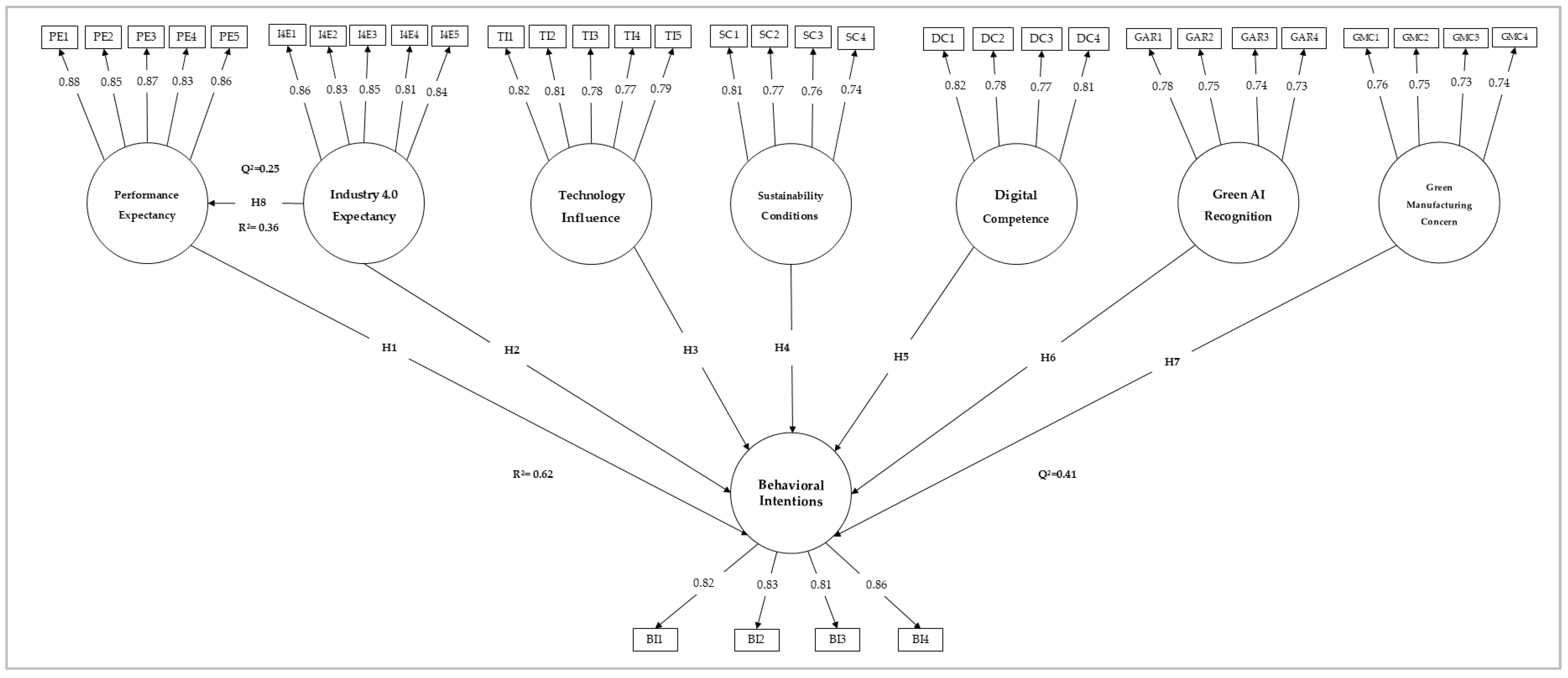
In contrast, sustainability conditions, Green AI recognition, and green manufacturing concern show acceptable but comparatively moderate convergent validity. This pattern supports their role as contextual or value-oriented factors rather than primary behavioural drivers [46]. Overall, the measurement model is statistically sound and theoretically coherent, providing a solid foundation for structural model analysis and hypothesis testing (see Figure 1).
Table 4 presents the factor cross-loading analysis conducted to assess discriminant validity within the PLS-SEM framework. Likewise, discriminant validity is established when each indicator loads more highly on its theoretically assigned latent construct than on any other construct in the model.
As shown, all indicators demonstrate their highest loadings on their respective constructs, confirming that the constructs are empirically distinct. In addition, the result aligns with established methodological standards [43], and validates the discriminant validity of the measurement model.
Table 4 reports on the cross-loading analysis. Discriminant validity is established when each indicator loads more strongly on its intended construct than on any other construct. All indicators exhibit the highest loadings on their respective constructs. Performance expectancy items load between 0.83 and 0.88, with substantially lower cross-loadings on other constructs. This confirms a clear separation between performance expectancy and other adoption-related dimensions.
Industry 4.0 eligibility indicators load strongly on their construct (0.81–0.86), with weaker cross-loadings on technology influence and sustainability conditions. This result confirms that perceived infrastructural readiness is empirically distinct from individual competence and perceptions of sustainability.
Technology influence indicators load between 0.77 and 0.82, while cross-loading remains consistently lower—sustainability condition indicators load between 0.74 and 0.80. Although moderate cross-loadings are observed for Industry 4.0 eligibility and technology influence, each indicator loads highest on its own construct, confirming empirical distinctiveness.
Digital manufacturing competence indicators load between 0.77 and 0.82, with lower cross-loadings than those for all other constructs. Green AI recognition and green manufacturing concern also load most strongly on their respective constructs, with no problematic cross-loadings. Behavioural intention indicators show high loadings (0.81–0.86) and remain clearly distinct from other constructs. These results provide strong evidence of discriminant validity. No indicator loads more highly on a non-target construct than on its intended construct.
Table 5 presents the Fornell–Larcker criterion results. Discriminant validity is confirmed when the square root of AVE for each construct exceeds its correlations with other constructs. For all constructs, diagonal values exceed the corresponding off-diagonal correlations. Although moderate correlations exist between related constructs—such as performance expectancy and behavioural intention (r = 0.71)—they remain below the square root of AVE values. Sustainability-related constructs show weaker correlations with behavioural intention, which aligns with the structural model results.
Table 6 reports the heterotrait–monotrait (HTMT) ratio. All HTMT values range from 0.41 to 0.83, remaining below the conservative threshold of 0.85. The highest HTMT values are observed for the relationships between performance expectancy and behavioural intention (0.83), Industry 4.0 eligibility and behavioural intention (0.74), and digital manufacturing competence and behavioural intention (0.71). These values indicate strong but non-redundant relationships.
Sustainability conditions, Green AI recognition, and green manufacturing concern consistently show lower HTMT values for behavioural intention. This pattern further supports their contextual role rather than direct behavioural influence. Together, the cross-loadings, Fornell–Larcker criterion, and HTMT results confirm strong discriminant validity and robustness of the measurement model.
Table 7 presents the structural model results based on a non-parametric bootstrapping procedure with 5000 resamples, two-tailed testing, and a 95% confidence interval.
The model accounts for a substantial proportion of the variance in behavioural intention (R2 = 0.62), indicating strong explanatory power. Performance expectancy shows the strongest direct effect on behavioural intention (β = 0.36, p < 0.001), supporting H1. This result indicates that perceived performance and productivity gains are the primary drivers of Green AI adoption intentions.
Industry 4.0 eligibility has a significant positive effect on behavioural intention, supporting H2. It also strongly predicts performance expectancy (β = 0.55, p < 0.001), supporting H8. These findings highlight the importance of infrastructural readiness and system compatibility in shaping both adoption intentions and performance expectations.
Technology influence has a positive but modest effect on behavioural intention (β = 0.12, p < 0.01), supporting H3. Digital manufacturing competence also significantly influences behavioural intention (β = 0.20, p < 0.001), supporting H5. These results emphasise the role of organisational guidance and individual capability in Green AI adoption.
In contrast, sustainability conditions, Green AI recognition, and green manufacturing concern do not show significant direct effects on behavioural intention. As a result, H4, H6, and H7 are rejected. These constructions appear to function as contextual or value-based factors rather than immediate behavioural drivers.
Table 8 reports the structural model quality metrics. Behavioural intention shows strong explanatory power (R2 = 0.62) and high predictive relevance (Q2 = 0.41). Performance expectancy also demonstrates moderate explanatory power (R2 = 0.36).
Effect size analysis reveals that performance expectancy has a significant effect on behavioural intention (f2 = 0.29). Industry 4.0 eligibility (f2 = 0.14) and digital manufacturing competence (f2 = 0.11) show medium effects. Technology’s influence has a small effect (f2 = 0.05), whereas sustainability-related constructs exhibit negligible to minor impacts.
The results indicate a clear hierarchy of predictors. Green AI adoption intentions are primarily driven by performance expectancy, Industry 4.0 eligibility, and digital manufacturing competence. Sustainability-oriented constructs play an enabling or contextual role rather than acting as primary behavioural drivers.

5. Discussion

Performance expectancy is the strongest direct predictor of behavioural intention to adopt Green AI in Industry 4.0-oriented learning contexts (PE → BI: β = 0.36, p < 0.001; Table 7). The model explains a substantial proportion of variance in behavioural intention (R2 = 0.62; Table 7) and demonstrates strong predictive relevance (Q2 = 0.41; Table 8). Together, these results indicate that adoption intention in this pre-workforce cohort is primarily instrumental; students report higher intention when they expect tangible performance gains from Green AI.
Extending the Unified Theory of Acceptance and Use of Technology (UTAUT) with Industry 4.0 eligibility and digital manufacturing competence enhances its explanatory relevance for technologically intensive and sustainability-sensitive settings. Traditional UTAUT variables explain general acceptance behaviour, but they insufficiently represent the infrastructural and capability conditions that characterise Industry 4.0 ecosystems. The present results indicate that readiness-related and competence-based factors exert greater influence than normative or value-oriented motivations [4].
Industry 4.0 eligibility plays a central enabling role. It has a significant direct effect on behavioural intention (I4E → BI: β = 0.24, p < 0.001; Table 7) and a strong effect on performance expectancy (I4E → PE: β = 0.55, p < 0.001; Table 7), explaining over one-third of PE variance (R2 = 0.36; Table 7). The effect size for I4E on PE is large (f2 = 0.56; Table 8), indicating that perceptions of infrastructural readiness, compatibility, and support meaningfully shape expected performance benefits, which in turn relate to intention. This finding is consistent with prior Industry 4.0 research [1,37,47].
Technology influence has a smaller but significant effect (TI → BI: β = 0.12, p = 0.004; Table 7) and a minor effect size (f2 = 0.05; Table 8). This indicates that perceived encouragement from instructors, peers, or institutional leadership can reinforce intention, but it does not outweigh performance- and readiness-related drivers. In technically mature contexts, social and organisational influence appears supportive rather than decisive [15,19,26,48].
Digital manufacturing competence also significantly predicts behavioural intention. Students with stronger digital and technical skills are more confident in using Green AI tools and integrating them into manufacturing workflows. This result confirms that adoption in Industry 4.0 contexts is capability-driven, where individual readiness enables the translation of technological potential into practical use [8,19,49].
In contrast, sustainability-oriented constructs do not directly predict behavioural intention in the structural model (SC → BI: β = 0.05, p = 0.193; GAR → BI: β = 0.04, p = 0.271; GMC → BI: β = 0.06, p = 0.162; Table 7). Their effect sizes are negligible to minor (SC f2 = 0.01; GAR f2 = 0.01; GMC f2 = 0.02; Table 8). Importantly, this is not a measurement artefact: the constructs demonstrate acceptable reliability and convergent validity (Table 3), and discriminant validity is supported via cross-loadings, Fornell–Larcker, and HTMT (Table 4, Table 5 and Table 6). Therefore, the more plausible interpretation is substantive: for pre-workforce learners, sustainability awareness and concern may function as contextual orientations rather than immediate behavioural drivers, particularly when students have limited direct exposure to operational energy costs, carbon accounting, or industrial AI trade-offs [12,47,50].
The results collectively indicate a layered structure of influence. Performance expectancy, Industry 4.0 eligibility, and digital manufacturing competence form the primary behavioural pathway, while technology influence and sustainability-related constructs provide contextual reinforcement rather than direct motivation [51,52].
For educational institutions seeking to encourage Green AI adoption, emphasis should be placed on demonstrating tangible performance value, strengthening Industry 4.0 eligibility, and embedding applied digital manufacturing skills within curricula. Awareness-based sustainability messaging alone is unlikely to drive engagement without accompanying technical capability and perceived utility.
Interpretation must remain bound by the study design. The cross-sectional, self-reported data capture intention formation among students rather than observable workplace behaviour. Pre-workforce learners operate outside the organisational constraints, production pressures, and cost structures that shape technology adoption in manufacturing settings. Empirical validation in industrial environments is required to determine whether these intention patterns translate into operational practice.


6. Conclusions

This study investigated determinants of technical college students’ behavioural intention to adopt Green AI within Industry 4.0-oriented collaborative manufacturing contexts. The proposed model extends the Unified Theory of Acceptance and Use of Technology (UTAUT) by integrating Industry 4.0 eligibility, technology influence, digital manufacturing competence, Green AI recognition, sustainability conditions, and green manufacturing concern to reflect emerging digital sustainability demands.
The results identify performance expectancy as the primary driver of adoption intention. Industry 4.0 eligibility exerts both direct and indirect effects on intention, mediated by performance expectations. Digital manufacturing competence further strengthens adoption by enabling confident and effective engagement with Green AI tools.
Sustainability conditions, Green AI recognition, and green manufacturing concerns do not demonstrate significant direct behavioural effects. Their role appears contextual, shaping awareness rather than motivating action in performance-oriented Industry 4.0 learning environments.
The findings reaffirm UTAUT as a useful baseline for explaining technology acceptance while demonstrating that its explanatory precision improves when readiness- and competence-oriented constructs are incorporated. This contextual extension more accurately reflects the conditions under which the adoption of sustainability-oriented AI is shaped in technical education and pre-industrial preparation.

7. Future Research Opportunities and Limitations

Despite its theoretical and empirical contributions, several limitations should be considered when interpreting the findings and identifying directions for further investigation. The cross-sectional design relied on self-reported data, which may introduce common-method bias and limit causal interpretation. The analysis captures behavioural intention rather than observable adoption of Green AI. Longitudinal, experimental, or mixed-methods approaches would allow examination of how intention evolves into actual usage as Industry 4.0 eligibility and digital manufacturing competence develop over time.
The participant group comprised students enrolled in technical majors rather than practising manufacturing technicians. Generalisation of operational industrial environments should therefore be made cautiously. Organisational pressures, production constraints, and direct exposure to AI deployment costs may shape adoption behaviour differently in workplace settings. Replication within vocational training centres, manufacturing firms, and professional contexts would strengthen external validity.
The operationalisation of Green AI recognition reflected perceptual awareness and did not include direct measurement of energy consumption, computational load, or carbon emissions. The green digital footprint was therefore assessed at the attitudinal level rather than through objective efficiency indicators. Future research could incorporate measurable sustainability metrics alongside behavioural constructs. Variables such as trust in AI systems, ethical risk perception, algorithmic transparency, and organisational sustainability culture may further enhance explanatory depth.
The sample integrates multiple national and institutional contexts. Measurement invariance was established in this study using the MICOM procedure, enabling pooled estimation of the structural model. Nevertheless, future research should extend this work by conducting multi-group analysis (MGA) under established invariance (and/or by testing additional group definitions, such as public vs. private institutions, vocational vs. university pathways, and—critically—workplace technicians vs. students) before advancing stronger cross-context claims.

Funding

This work was funded by the Deanship of Scientific Research, Vice Presidency for Graduate Studies and Scientific Research, King Faisal University, Saudi Arabia (Grant number KFU260766).

Institutional Review Board Statement

Before data collection commenced, formal ethical approval was obtained from the Institutional Review Board of King Faisal University (KFU-REC-2025-APR-ETHICS3283). This approval confirms that all research procedures complied with institutional ethical standards and adhered to the principles outlined in the Declaration of Helsinki [53]. (The approval documentation is available at: https://2u.pw/pwBuiQ) (accessed on 15 October 2025).

Informed Consent Statement

Several measures were implemented to safeguard participants’ rights. Participation was entirely voluntary and free from coercion, and written informed consent was obtained from all respondents. Participants were informed of their right to withdraw from the study at any time without providing a reason. All data were anonymised to ensure confidentiality. Respondents were assured that their responses would remain anonymous, be securely stored on encrypted institutional servers, and be used exclusively for academic research purposes. No personally identifiable information was collected. (The informed consent form is available at: https://2u.pw/uT216A). Informed consent was obtained from all subjects involved in the study.

Data Availability Statement

The original contributions presented in this study are included in the article. Further inquiries can be directed to the corresponding author.

Conflicts of Interest

The author declares no conflicts of interest.

References

  1. Kumar, S.; Verma, A.K.; Mirza, A. Digitalisation, Artificial Intelligence, IoT, and Industry 4.0 and Digital Society, in Digital Transformation, Artificial Intelligence and Society: Opportunities and Challenges; Springer: Singapore, 2024; pp. 35–57. [Google Scholar]
  2. Attaran, S.; Attaran, M.; Celik, B.G. Digital Twins and Industrial Internet of Things: Uncovering operational intelligence in industry 4.0. Decis. Anal. J. 2024, 10, 100398. [Google Scholar] [CrossRef]
  3. Paramesha, M.; Rane, N.; Rane, J. Big data analytics, artificial intelligence, machine learning, internet of things, and blockchain for enhanced business intelligence. Partn. Univers. Multidiscip. Res. J. 2024, 1, 110–133. [Google Scholar] [CrossRef]
  4. Agarwal, A.; Ojha, R. Prioritizing implications of Industry-4.0 on the sustainable development goals: A perspective from the analytic hierarchy process in manufacturing operations. J. Clean. Prod. 2024, 444, 141189. [Google Scholar] [CrossRef]
  5. Abubakar, A.K.; Gillam, L.; Sastry, N. The Role of the Internet of Things (IoT) in Achieving the United Nations (UN) Sustainable Development Goals (SDGs)—A Systematic Review. ACM Comput. Surv. 2025, 58, 81. [Google Scholar] [CrossRef]
  6. Palsodkar, M.; Yadav, G.; Nagare, M.R. Integrating Industry 4.0 and agile new product development practices to evaluate the penetration of sustainable development goals in manufacturing industries. J. Eng. Des. Technol. 2024, 22, 1351–1392. [Google Scholar] [CrossRef]
  7. Subrahmanyam, S. Developing Green Skills for Sustainable Careers. In Integrating AI and Sustainability in Technical and Vocational Education and Training (TVET); IGI Global Scientific Publishing: Hershey, PA, USA, 2025; pp. 101–126. [Google Scholar]
  8. Verdecchia, R.; Sallou, J.; Cruz, L. A systematic review of Green AI. WIREs Data Min. Knowl. Discov. 2023, 13, e1507. [Google Scholar] [CrossRef]
  9. Mahajan, P. What is Ethical: AIHED Driving Humans or Human-Driven AIHED? A Conceptual Framework enabling the Ethos of AI-driven Higher education. arXiv 2025, arXiv:2503.04751. [Google Scholar]
  10. Zong, Z.; Guan, Y. AI-driven intelligent data analytics and predictive analysis in Industry 4.0: Transforming knowledge, innovation, and efficiency. J. Knowl. Econ. 2024, 16, 864–903. [Google Scholar] [CrossRef]
  11. Pang, Y.; Huang, T.; Wang, Q. AI and Data-Driven Advancements in Industry 4.0. Sensors 2025, 25, 2249. [Google Scholar] [CrossRef] [PubMed]
  12. Chowdhury, R.H. AI-powered Industry 4.0: Pathways to economic development and innovation. Int. J. Creat. Res. Thoughts 2024, 12, h650–h657. [Google Scholar]
  13. Huang, F.; Sun, L. Examining the Roles of Technology in Sustaining Language Teaching and Learning. Sustainability 2023, 15, 16664. [Google Scholar] [CrossRef]
  14. Akinyelu, S.I. Sustainable development goals and persons with disabilities in education and employment. Transnat’l Hum. Rts. Rev. 2024, 10, 1. [Google Scholar] [CrossRef]
  15. Bolón-Canedo, V.; Morán-Fernández, L.; Cancela, B.; Alonso-Betanzos, A. A review of green artificial intelligence: Towards a more sustainable future. Neurocomputing 2024, 599, 128096. [Google Scholar] [CrossRef]
  16. Salem, M.A. A Digital Sustainability Lens: Investigating Medical Students’ Adoption Intentions for AI-Powered NLP Tools in Learning Environments. Sustainability 2025, 17, 6379. [Google Scholar] [CrossRef]
  17. Huang, F.; Derakhshan, A. Learning motivation and digital literacy in AI adoption for self-regulated English learning. Eur. J. Educ. 2025, 60, e70254. [Google Scholar] [CrossRef]
  18. Yang, W.; Lu, Y.; Yeom, S.; Herbert, D. Adapting GenAI Strategies: Understanding Models. Aims, and Challenges in Different Targeted Data and Domains. IEEE Access 2025, 13, 185181–185217. [Google Scholar] [CrossRef]
  19. Ghouse, S.M.; Shekhar, R.; Chaudhary, M. Sustainable choices of Gen Y and Gen Z: Exploring green horizons. Manag. Sustain. Arab. Rev. 2025, 4, 533–559. [Google Scholar] [CrossRef]
  20. Hananel, R.; Menahem, B.; Chen, S.-B.P. Who in the World Is Generation Z? The Rise of Mobile Natives and Their Socio-Technological Identity. Societies 2025, 15, 314. [Google Scholar] [CrossRef]
  21. Reid, L.; Button, D.; Brommeyer, M. Challenging the myth of the digital native: A narrative review. Nurs. Rep. 2023, 13, 573–600. [Google Scholar] [CrossRef] [PubMed]
  22. Elshaer, I.A.; AlNajdi, S.M.; Salem, M.A. Sustainable AI Solutions for Empowering Visually Impaired Students: The Role of Assistive Technologies in Academic Success. Sustainability 2025, 17, 5609. [Google Scholar] [CrossRef]
  23. Nair, R. Incorporation of Deep Learning-Based AI Tools in Education: A Statistical Evaluation of the Perceptions of Gen-Z and Millennials. In Global Higher Education Practices in Times of Crisis: Questions for Sustainability and Digitalization; Emerald Publishing Limited: Bingley, UK, 2024; pp. 199–227. [Google Scholar]
  24. Alshebami, A.S.; Seraj, A.H.A.; Elshaer, I.A.; Al Shammre, A.S.; Al Marri, S.H.; Lutfi, A.; Salem, M.A.; Zaher, A.M.N. Improving Social Performance through Innovative Small Green Businesses: Knowledge Sharing and Green Entrepreneurial Intention as Antecedents. Sustainability 2023, 15, 8232. [Google Scholar] [CrossRef]
  25. Theocharis, D.; Tsekouropoulos, G. Sustainable consumption and branding for Gen Z: How brand dimensions influence consumer behavior and adoption of newly launched technological products. Sustainability 2025, 17, 4124. [Google Scholar] [CrossRef]
  26. Elshaer, I.A.; Alnajdi, S.M.; Salem, M.A. AI-Assistive Technology Adoption and Mental Health Disorders in Visually Impaired University Students. Electronics 2025, 14, 4036. [Google Scholar] [CrossRef]
  27. Salem, M.A.; Khalil, Z.A. An Interpretable Hybrid RF–ANN Early-Warning Model for Real-World Prediction of Academic Confidence and Problem-Solving Skills. Math. Comput. Appl. 2025, 30, 140. [Google Scholar] [CrossRef]
  28. Alyoussef, I.Y.; Drwish, A.M.; Albakheet, F.A.; Alhajhoj, R.H.; Al-Mousa, A.A. AI Adoption for Collaboration: Factors Influencing Inclusive Learning Adoption in Higher Education. IEEE Access 2025, 13, 81690–81713. [Google Scholar] [CrossRef]
  29. Bhambri, P.; Rana, R.; Kautish, S. Sustainable Digital Transformation: Reducing Carbon Footprint in the Metaverse. In Metaverse and Sustainability: Business Resilience Towards Sustainable Development Goals; Springer: Cham, Switzerland, 2025; pp. 105–127. [Google Scholar]
  30. Paalosmaa, T. Energy optimization and industry 4.0 readiness in manufacturing SMEs—Insights from Ostrobothnia, Finland. Energy Effic. 2025, 18, 60. [Google Scholar] [CrossRef]
  31. Park, I.; Kim, D.; Moon, J.; Kim, S.; Kang, Y.; Bae, S. Searching for new technology acceptance model under social context: Analyzing the determinants of acceptance of intelligent information technology in digital transformation and implications for the requisites of digital sustainability. Sustainability 2022, 14, 579. [Google Scholar] [CrossRef]
  32. Ahmed, R. Artificial Intelligence-Based Assessment and Student Performance: The Mediating Role of Digital Competence in the University Context. J. Res. Innov. Strateg. Educ. 2025, 2, 18–35. [Google Scholar] [CrossRef]
  33. Falebita, O.S.; Kok, P.J. Artificial intelligence tools usage: A structural equation modeling of undergraduates’ technological readiness, self-efficacy and attitudes. J. STEM Educ. Res. 2025, 8, 257–282. [Google Scholar] [CrossRef]
  34. Oncioiu, I.; Bularca, A.R. Artificial Intelligence Governance in Higher Education: The Role of Knowledge-Based Strategies in Fostering Legal Awareness and Ethical Artificial Intelligence Literacy. Societies 2025, 15, 144. [Google Scholar] [CrossRef]
  35. Zeng, Z.; Zhong, W.; Naz, S. Can environmental knowledge and risk perception make a difference? The role of environmental concern and pro-environmental behavior in fostering sustainable consumption behavior. Sustainability 2023, 15, 4791. [Google Scholar] [CrossRef]
  36. Ministry of Education, Saudi Arabia. KSA International Statistics. Available online: https://moe.gov.sa/ar/aboutus/sectors/intl-cooperation/Pages/ksa-intl-stats.aspx (accessed on 19 December 2025).
  37. Alasmari, T.; Alzahrani, A. Saudi Arabia’s shifts towards green and sustainable Logistics: Bibliometric and machine learning-based insights and forecasts. J. Clean. Prod. 2025, 509, 145577. [Google Scholar] [CrossRef]
  38. Gidage, M.; Bhide, S. Corporate reputation as the nexus: Linking moral and social responsibility, green practices, and organizational performance. Corp. Reput. Rev. 2024, 1–23. [Google Scholar] [CrossRef]
  39. Alotaibi, N.S. The impact of AI and LMS integration on the future of higher education: Opportunities, challenges, and strategies for transformation. Sustainability 2024, 16, 10357. [Google Scholar] [CrossRef]
  40. AlSagri, H.S.; Sohail, S.S. Evaluating the role of Artificial Intelligence in sustainable development goals with an emphasis on “quality education”. Discov. Sustain. 2024, 5, 458. [Google Scholar] [CrossRef]
  41. Rachmad, Y.E. Personalized Digital Influence Theory; United Nations Economic and Social Council: New York, NY, USA, 2025. [Google Scholar]
  42. Salem, M.A.; Khalil, Z.A. Unlocking GAI in Universities: Leadership-Driven Corporate Social Responsibility for Digital Sustainability. Adm. Sci. 2026, 16, 58. [Google Scholar] [CrossRef]
  43. Leguina, A. A Primer on Partial Least Squares Structural Equation Modeling (PLS-SEM); Taylor & Francis: Abingdon, UK, 2015. [Google Scholar]
  44. Venkatesh, V.; Morris, M.G.; Davis, G.B.; Davis, F.D. User acceptance of information technology: Toward a unified view. MIS Q. 2003, 27, 425–478. [Google Scholar] [CrossRef]
  45. Kaur, P.; Stoltzfus, J.; Yellapu, V. Descriptive statistics. Int. J. Acad. Med. 2018, 4, 60–63. [Google Scholar] [CrossRef]
  46. Hair, J.F., Jr.; Hult, G.T.M.; Ringle, C.M.; Sarstedt, M.; Danks, N.P.; Ray, S. Partial Least Squares Structural Equation Modeling (PLS-SEM) Using R: A Workbook; Springer Nature: New York, NY, USA, 2021. [Google Scholar]
  47. Hammad, M.Y.; Rahamaddulla, S.R.; Tamyez, P.F.M.; Fauzi, M.A. From Industry 4.0 to 5.0: Leveraging AI and IoT for sustainable and human-centric operations. Int. J. Ind. Eng. Oper. Manag. 2025, 1–19. [Google Scholar] [CrossRef]
  48. Alexander, S. Issues and Ideas. Deepfake Cyberbullying: The Psychological Toll on Students and Institutional Challenges of AI-Driven Harassment. Clear. House: A J. Educ. Strateg. Issues Ideas 2025, 98, 36–50. [Google Scholar] [CrossRef]
  49. Zhang, Y.; Jiang, S. Pro-Environmental Personal Norms and Subjective Norms Related to AI-Driven Green Entrepreneurship Intention: A Qualitative Insight to Explore Students in Higher Education Institutions. Afr. Educ. Res. J. 2025, 13, 83–99. [Google Scholar]
  50. Sunny, S.R. AI-Driven Defect Prediction for Aerospace Composites Using Industry 4.0 Technologies. (Preprint-v1.0, July 2025). Zenodo. Available online: https://zenodo.org/records/16044460 (accessed on 19 December 2025).
  51. Elshaer, I.A.; AlNajdi, S.M.; Salem, M.A. Measuring the Impact of Large Language Models on Academic Success and Quality of Life Among Students with Visual Disability: An Assistive Technology Perspective. Bioengineering 2025, 12, 1056. [Google Scholar] [CrossRef] [PubMed]
  52. Yakubu, M.N.; David, N.; Abubakar, N.H. Students’ behavioural intention to use content generative AI for learning and research: A UTAUT theoretical perspective. Educ. Inf. Technol. 2025, 30, 17969–17994. [Google Scholar] [CrossRef]
  53. World Medical Association. Declaration of Helsinki: World Medical Association. Ethical principles for medical research on human beings. In Proceedings of the 64th WMA General Assembly, Fortaleza, Brazil, 27 October 2013. [Google Scholar]
Figure 1. Statistical model.
Information 17 00217 g001
Table 1. (a,b) Sample demographic characteristics (n = 1003; M = male; F = female).
(a)
DemographicKSAEGYJORYEMSYRINDPHLPAKBGDSum
F1531516351332919229530
M1491285047252618237473
Total3022791139858553745161003
%30.1127.8211.279.775.785.483.694.491.60100
(b)
CollegesFOSCAFSFVMCESSUM
F16914715262530
M16314910160473
Total3322962531221003
%33.1029.5125.2212.16100
Table 2. MICOM Assessment of Measurement Invariance Across Country and College Groups.
ConstructCICOEMVINV
CtryCollCtryCollCtryCollCtryColl
PEYesYesYesYesNoNoPartialPartial
I4EYesYesYesYesNoNoPartialPartial
TIYesYesYesYesNoNoPartialPartial
SCYesYesYesYesNoNoPartialPartial
DMCYesYesYesYesNoNoPartialPartial
GARYesYesYesYesNoNoPartialPartial
GMCYesYesYesYesNoNoPartialPartial
BIYesYesYesYesNoNoPartialPartial
Note. CI = Configural Invariance; CO = Compositional Invariance (permutation test with 5000 permutations); EMV = Equality of Means and Variances (MICOM Step 3); INV = Level of Measurement Invariance; Ctry = Country groups; Coll = College groups. Construct abbreviations: Performance Expectancy (PE); Industry 4.0 Eligibility (I4E); Technology Influence (TI); Sustainability Conditions (SC); Digital Manufacturing Competence (DMC); Green AI Recognition (GAR); Green Manufacturing Concern (GMC); Behavioural Intention (BI).
Table 3. Quality Criteria for the Conceptual Model.
ConstructsLoadingsMeanAVECRα
Performance Expectancy (PE) 0.860.740.930.9
PE10.88
PE20.85
PE30.87
PE40.83
PE50.86
Industry 4.0 Eligibility (I4E) 0.840.710.920.89
I4E10.86
I4E20.83
I4E30.85
I4E40.81
I4E50.84
Technology Influence (TI) 0.790.630.890.85
TI10.82
TI20.81
TI30.78
TI40.77
TI50.79
Sustainability Conditions (SC) 0.780.590.850.81
SC10.81
SC20.77
SC30.76
SC40.74
Digital Manufacturing Competence (DMC) 0.80.640.880.84
DMC10.82
DMC20.78
DMC30.77
DMC40.81
Green AI Recognition (GAR) 0.760.580.840.8
GAR10.78
GAR20.75
GAR30.74
GAR40.73
Green Manufacturing Concern (GMC) 0.770.570.840.8
GMC10.76
GMC20.75
GMC30.73
GMC40.74
Behavioural Intentions (BI) 0.840.710.910.88
BI10.82
BI20.83
BI30.81
BI40.86
Table 4. Factor cross-loading analysis.
ItemPEI4ETISCDMCGARGMCBI
PE10.880.580.410.360.440.40.330.62
PE20.850.560.40.350.420.390.320.6
PE30.870.570.410.360.430.40.330.61
PE40.830.540.390.340.410.380.310.58
PE50.860.560.40.350.420.390.320.6
I4E10.570.860.430.410.480.390.340.52
I4E20.550.830.410.390.460.380.330.5
I4E30.560.850.420.40.470.390.340.51
I4E40.530.810.40.380.450.370.320.48
I4E50.550.840.410.390.460.380.330.5
TI10.410.430.820.450.390.360.340.4
TI20.40.420.80.440.380.350.330.39
TI30.390.410.780.430.370.340.320.38
TI40.380.40.770.420.360.330.310.37
TI50.390.410.790.430.370.340.320.38
SC10.360.410.450.80.420.330.380.34
SC20.350.390.440.770.410.320.370.33
SC30.340.40.430.760.40.310.360.32
SC40.330.380.420.740.390.30.350.31
DMC10.440.480.390.420.820.460.30.46
DMC20.420.460.380.410.780.440.290.44
DMC30.410.450.370.40.770.430.280.43
DMC40.430.470.380.410.810.450.290.45
GAR10.40.390.360.330.460.780.310.36
GAR20.390.380.350.320.440.750.30.35
GAR30.380.370.340.310.430.740.290.34
GAR40.370.360.330.30.420.730.290.33
GMC10.330.340.340.380.30.310.760.32
GMC20.320.330.330.370.290.30.750.31
GMC30.310.320.320.360.280.290.730.3
GMC40.320.330.330.350.290.290.740.31
BI10.620.520.40.340.460.360.320.82
BI20.60.50.390.330.440.350.310.83
BI30.610.510.380.320.430.340.30.81
BI40.640.530.410.350.470.370.330.86
Table 5. Fornell–Larcker Discriminant Validity Assessment.
PEI4ETISCDMCGARGMCBI
PE0.86
I4E0.60.843
TI0.440.460.794
SC0.380.420.480.768
DMC0.490.540.40.450.8
GAR0.430.410.370.340.520.762
GMC0.340.350.360.440.310.320.755
BI0.710.560.450.360.520.380.340.843
Table 6. Results of the Heterotrait–Monotrait (HTMT).
Construct PairHTMT
PE—I4E0.72
PE—TI0.52
PE—SC0.46
PE—DMC0.6
PE—GAR0.57
PE—GMC0.41
PE—BI0.83
I4E—TI0.55
I4E—SC0.57
I4E—DMC0.69
I4E—GAR0.55
I4E—GMC0.43
I4E—BI0.74
TI—SC0.62
TI—DMC0.5
TI—GAR0.48
TI—GMC0.49
TI—BI0.58
SC—DMC0.6
SC—GAR0.46
SC—GMC0.66
SC—BI0.49
DMC—GAR0.74
DMC—GMC0.42
DMC—BI0.71
GAR—GMC0.44
GAR—BI0.52
GMC—BI0.45
Table 7. Structural Model Estimates and Fit Statistics.
RHsPathβtpR2Supported
H1PE—BI0.3611.2<0.0010.62Yes
H2I4E—BI0.246.5<0.001Yes
H3TI—BI0.122.90.004Yes
H4SC—BI0.051.30.193No
H5DMC—BI0.25.7<0.001Yes
H6GAR—BI0.041.10.271No
H7GMC—BI0.061.40.162No
H8I4E—PE0.5516.1<0.0010.36Yes
Table 8. Structural Model Quality Metrics.
Endogenous ConstructPredictorR2f2Q2Effect Level
BIPE0.620.290.41High
I4E0.14Medium
TI0.05Minor
SC0.01Negligible
DMC0.11Medium
GAR0.01Negligible
GMC0.02Minor
PEI4E0.360.560.25High
Disclaimer/Publisher’s Note: The statements, opinions and data contained in all publications are solely those of the individual author(s) and contributor(s) and not of MDPI and/or the editor(s). MDPI and/or the editor(s) disclaim responsibility for any injury to people or property resulting from any ideas, methods, instructions or products referred to in the content.