1. Introduction
Industry 4.0 marks a structural shift in manufacturing systems and industrial economies driven by advanced digitalisation [
1]. The integration of data analytics, machine learning, cloud computing, the Internet of Things, and artificial intelligence has reshaped production and organisational processes. These technologies enhance efficiency and productivity but also increase energy demand and digital carbon emissions [
2,
3].
Industry 4.0 is frequently associated with the Sustainable Development Goals (SDGs), particularly SDG 9 (industry, innovation, and infrastructure), SDG 12 (responsible consumption and production), and SDG 13 (climate action). Greater resource efficiency, waste reduction, and optimised energy use can support sustainable industrial development and competitiveness [
4,
5]. Nevertheless, the rapid expansion of digital infrastructure introduces additional environmental pressures that complicate sustainability ambitions [
6].
Green AI has emerged as a response to these tensions, emphasising computational efficiency and environmentally responsible design and deployment of artificial intelligence. Its relevance is pronounced in Industry 4.0 applications—such as predictive maintenance and collaborative human–machine manufacturing—where large-scale data processing and continuous computation are required [
7,
8,
9].
This study examines Generation Z students enrolled in technical majors and preparing for manufacturing-oriented careers. The analysis is situated in a pre-workforce educational context and therefore addresses intention formation rather than actual workplace adoption. The findings should be interpreted as indicators of readiness prior to labour-market entry, not as evidence of behaviour among practising technicians [
10].
Early understanding of students’ orientation toward sustainable digital technologies, including Green AI, is important for shaping future industrial practices and mitigating the long-term digital carbon footprint [
6]. Prior research highlights the need to examine Gen Z’s readiness to engage with sustainability-oriented AI tools in technologically intensive domains [
11,
12]. The expansion of Industry 4.0 technologies reinforces this need by linking digital transformation with rising computational energy consumption and environmental impact [
13,
14,
15].
Gen Z represents a cohort socialised in pervasive digital environments characterised by continuous connectivity, mobile technologies, and platform-based interaction [
16]. Technical education is consequently undergoing rapid transformation, with AI-enabled tools influencing knowledge acquisition, skills development, and professional preparation for industrial roles [
17].
Gen Z students’ readiness to adopt sustainability-oriented AI tools is critical to the implementation of AI-driven sustainability strategies within Industry 4.0 institutions. This readiness includes developing AI literacy, supporting self-directed learning, and promoting responsible technology use. Together, these factors contribute to long-term educational and industrial resilience [
18].
Technology acceptance frameworks, most notably the Unified Theory of Acceptance and Use of Technology (UTAUT), have been widely applied to examine AI adoption. However, the original model does not fully address domain-specific conditions such as Industry 4.0 eligibility, digital manufacturing competence, or sustainability-oriented AI practices, limiting its explanatory precision in performance-intensive industrial contexts [
19].
Empirical evidence linking Green AI adoption to a sustainable digital footprint remains sparse. Existing studies tend to emphasise technological capability and efficiency, while paying less attention to educational preparation and the development of sustainability-oriented behavioural norms. This gap is increasingly consequential as AI-enabled industrial ecosystems expand.
The present study investigates how Gen Z students in technical disciplines perceive technological, readiness-related, competence-based, and sustainability-related factors that shape their behavioural intention to adopt Green AI within Industry 4.0 environments. Rather than proposing a new acceptance model, the study develops a contextualised extension of UTAUT aligned with sustainability-driven industrial transformation.
The study addresses the following research questions:
RQ1: What technological and performance-related factors influence Gen Z students’ behavioural intentions to adopt Green AI in Industry 4.0-oriented technical education?
RQ2: How do Industry 4.0 eligibility and digital manufacturing competence shape performance expectancy and adoption intentions toward Green AI?
RQ3: To what extent do sustainability-related perceptions—namely, sustainability conditions, Green AI recognition, and green manufacturing concern—contribute to Green AI adoption intentions among Gen Z students in technical majors?
A structured research design was implemented to ensure conceptual clarity and methodological transparency. Data collection and analytical procedures were explicitly aligned with the proposed framework, enabling careful interpretation of both significant and non-significant relationships. This approach supports a focused contribution to understanding Green AI adoption within sustainability-oriented Industry 4.0 education.
The current article is organised as follows:
Section 1, the Introduction, highlights the study background, motivates the research problem, and states the research questions.
Section 2 presents the literature review and develops the hypotheses based on a contextualised extension of UTAUT for Industry 4.0 and Green AI adoption.
Section 3 describes the research design, including sample, instrument development, data collection procedures, and the PLS-SEM analytical approach.
Section 4 reports the results for the measurement and structural models, including MICOM-based invariance assessment and hypothesis testing.
Section 5 discusses the findings by linking the interpretations to the reported results and tables.
Section 6 concludes with the main theoretical and practical implications, and
Section 7 outlines the study limitations and directions for future research.
4. Results
Measurement invariance was assessed prior to pooling the multi-country and multi-college sample using the Measurement Invariance of Composite Models (MICOM) procedure in PLS-SEM. MICOM was evaluated following the standard three-step approach: (Step 1) configural invariance, ensuring identical indicators, data treatment, and estimation settings across groups; (Step 2) compositional invariance, examined through a permutation test of the correlations between composite scores; and (Step 3) equality of composite means and variances across groups. Permutation testing was conducted using 5000 permutations with two-tailed testing at α = 0.05. The results supported partial measurement invariance (configural and compositional invariance) across countries and college subgroups, which justifies pooling the data for structural model estimation while interpreting cross-context generalisations with appropriate caution.
As shown in
Table 2, configural and compositional invariance were established across both country and college groupings, indicating partial measurement invariance. This level of invariance is sufficient to justify pooling the data for subsequent structural model estimation while interpreting general cross-group differences with appropriate caution.
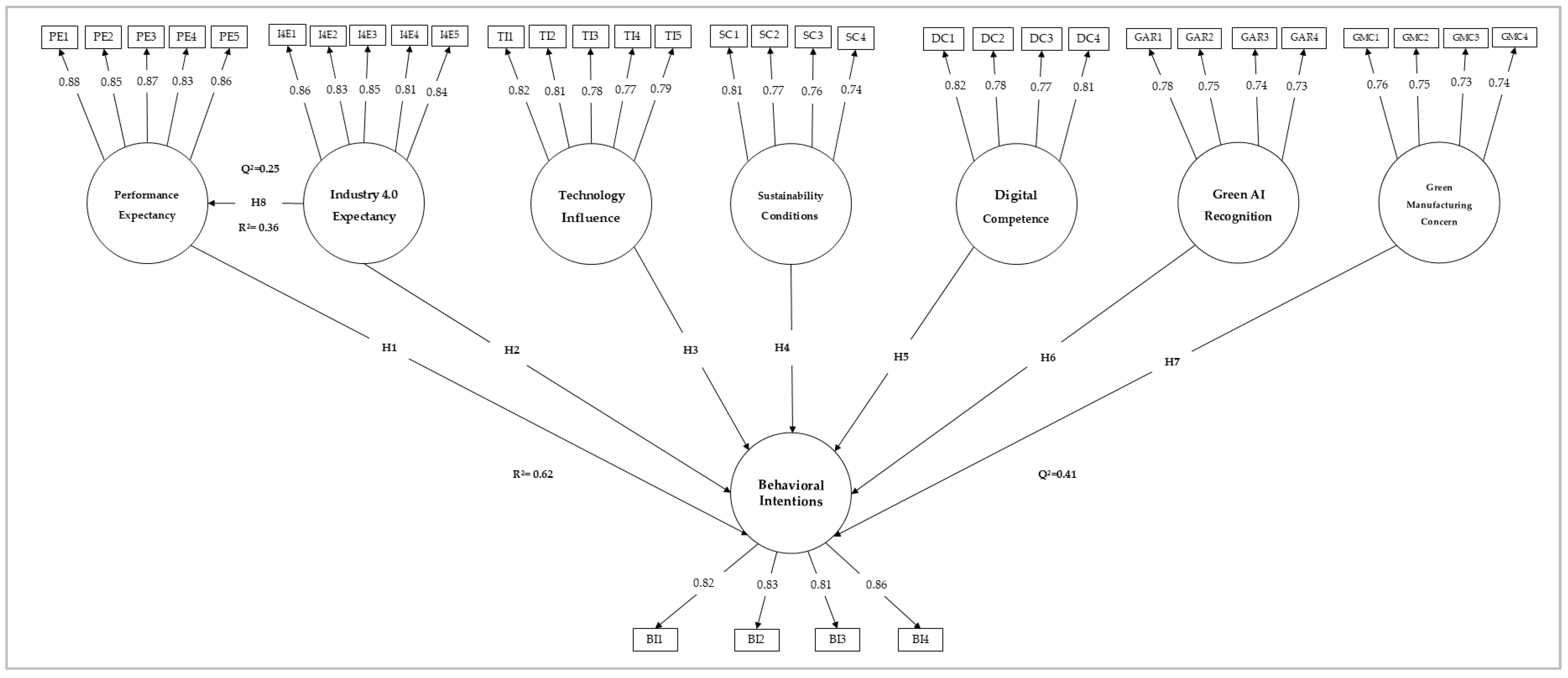
Table 3 presents the assessment of the measurement model. The results confirm that all constructs meet the recommended criteria for indicator reliability, convergent validity, and internal consistency within the PLS-SEM framework.
Indicator reliability is well established. All outer loadings exceed the recommended threshold of 0.70, ranging from 0.73 to 0.88. These values indicate strong relationships between indicators and their respective constructs. No indicators were removed.
Convergent validity is supported, as average variance extracted (AVE) values range from 0.57 to 0.74, exceeding the minimum threshold of 0.50. Each construct accounts for more than half of the variance in its indicators, indicating adequate construct coherence.
Internal consistency is also satisfactory. Composite reliability (CR) values range from 0.84 to 0.93, and Cronbach’s alpha values range from 0.80 to 0.90. All values exceed the accepted threshold of 0.70, with no evidence of redundancy.
Constructs that later showed significant structural effects—namely performance expectancy, Industry 4.0 eligibility, technology influence, digital manufacturing competence, and behavioural intention—exhibit stronger measurement properties, reflected in higher AVE and reliability values.
In contrast, sustainability conditions, Green AI recognition, and green manufacturing concern show acceptable but comparatively moderate convergent validity. This pattern supports their role as contextual or value-oriented factors rather than primary behavioural drivers [
46]. Overall, the measurement model is statistically sound and theoretically coherent, providing a solid foundation for structural model analysis and hypothesis testing (see
Figure 1).
Table 4 presents the factor cross-loading analysis conducted to assess discriminant validity within the PLS-SEM framework. Likewise, discriminant validity is established when each indicator loads more highly on its theoretically assigned latent construct than on any other construct in the model.
As shown, all indicators demonstrate their highest loadings on their respective constructs, confirming that the constructs are empirically distinct. In addition, the result aligns with established methodological standards [
43], and validates the discriminant validity of the measurement model.
Table 4 reports on the cross-loading analysis. Discriminant validity is established when each indicator loads more strongly on its intended construct than on any other construct. All indicators exhibit the highest loadings on their respective constructs. Performance expectancy items load between 0.83 and 0.88, with substantially lower cross-loadings on other constructs. This confirms a clear separation between performance expectancy and other adoption-related dimensions.
Industry 4.0 eligibility indicators load strongly on their construct (0.81–0.86), with weaker cross-loadings on technology influence and sustainability conditions. This result confirms that perceived infrastructural readiness is empirically distinct from individual competence and perceptions of sustainability.
Technology influence indicators load between 0.77 and 0.82, while cross-loading remains consistently lower—sustainability condition indicators load between 0.74 and 0.80. Although moderate cross-loadings are observed for Industry 4.0 eligibility and technology influence, each indicator loads highest on its own construct, confirming empirical distinctiveness.
Digital manufacturing competence indicators load between 0.77 and 0.82, with lower cross-loadings than those for all other constructs. Green AI recognition and green manufacturing concern also load most strongly on their respective constructs, with no problematic cross-loadings. Behavioural intention indicators show high loadings (0.81–0.86) and remain clearly distinct from other constructs. These results provide strong evidence of discriminant validity. No indicator loads more highly on a non-target construct than on its intended construct.
Table 5 presents the Fornell–Larcker criterion results. Discriminant validity is confirmed when the square root of AVE for each construct exceeds its correlations with other constructs. For all constructs, diagonal values exceed the corresponding off-diagonal correlations. Although moderate correlations exist between related constructs—such as performance expectancy and behavioural intention (r = 0.71)—they remain below the square root of AVE values. Sustainability-related constructs show weaker correlations with behavioural intention, which aligns with the structural model results.
Table 6 reports the heterotrait–monotrait (HTMT) ratio. All HTMT values range from 0.41 to 0.83, remaining below the conservative threshold of 0.85. The highest HTMT values are observed for the relationships between performance expectancy and behavioural intention (0.83), Industry 4.0 eligibility and behavioural intention (0.74), and digital manufacturing competence and behavioural intention (0.71). These values indicate strong but non-redundant relationships.
Sustainability conditions, Green AI recognition, and green manufacturing concern consistently show lower HTMT values for behavioural intention. This pattern further supports their contextual role rather than direct behavioural influence. Together, the cross-loadings, Fornell–Larcker criterion, and HTMT results confirm strong discriminant validity and robustness of the measurement model.
Table 7 presents the structural model results based on a non-parametric bootstrapping procedure with 5000 resamples, two-tailed testing, and a 95% confidence interval.
The model accounts for a substantial proportion of the variance in behavioural intention (R2 = 0.62), indicating strong explanatory power. Performance expectancy shows the strongest direct effect on behavioural intention (β = 0.36, p < 0.001), supporting H1. This result indicates that perceived performance and productivity gains are the primary drivers of Green AI adoption intentions.
Industry 4.0 eligibility has a significant positive effect on behavioural intention, supporting H2. It also strongly predicts performance expectancy (β = 0.55, p < 0.001), supporting H8. These findings highlight the importance of infrastructural readiness and system compatibility in shaping both adoption intentions and performance expectations.
Technology influence has a positive but modest effect on behavioural intention (β = 0.12, p < 0.01), supporting H3. Digital manufacturing competence also significantly influences behavioural intention (β = 0.20, p < 0.001), supporting H5. These results emphasise the role of organisational guidance and individual capability in Green AI adoption.
In contrast, sustainability conditions, Green AI recognition, and green manufacturing concern do not show significant direct effects on behavioural intention. As a result, H4, H6, and H7 are rejected. These constructions appear to function as contextual or value-based factors rather than immediate behavioural drivers.
Table 8 reports the structural model quality metrics. Behavioural intention shows strong explanatory power (R
2 = 0.62) and high predictive relevance (Q
2 = 0.41). Performance expectancy also demonstrates moderate explanatory power (R
2 = 0.36).
Effect size analysis reveals that performance expectancy has a significant effect on behavioural intention (f2 = 0.29). Industry 4.0 eligibility (f2 = 0.14) and digital manufacturing competence (f2 = 0.11) show medium effects. Technology’s influence has a small effect (f2 = 0.05), whereas sustainability-related constructs exhibit negligible to minor impacts.
The results indicate a clear hierarchy of predictors. Green AI adoption intentions are primarily driven by performance expectancy, Industry 4.0 eligibility, and digital manufacturing competence. Sustainability-oriented constructs play an enabling or contextual role rather than acting as primary behavioural drivers.
5. Discussion
Performance expectancy is the strongest direct predictor of behavioural intention to adopt Green AI in Industry 4.0-oriented learning contexts (PE → BI:
β = 0.36,
p < 0.001;
Table 7). The model explains a substantial proportion of variance in behavioural intention (R
2 = 0.62;
Table 7) and demonstrates strong predictive relevance (Q
2 = 0.41;
Table 8). Together, these results indicate that adoption intention in this pre-workforce cohort is primarily instrumental; students report higher intention when they expect tangible performance gains from Green AI.
Extending the Unified Theory of Acceptance and Use of Technology (UTAUT) with Industry 4.0 eligibility and digital manufacturing competence enhances its explanatory relevance for technologically intensive and sustainability-sensitive settings. Traditional UTAUT variables explain general acceptance behaviour, but they insufficiently represent the infrastructural and capability conditions that characterise Industry 4.0 ecosystems. The present results indicate that readiness-related and competence-based factors exert greater influence than normative or value-oriented motivations [
4].
Industry 4.0 eligibility plays a central enabling role. It has a significant direct effect on behavioural intention (I4E → BI:
β = 0.24,
p < 0.001;
Table 7) and a strong effect on performance expectancy (I4E → PE:
β = 0.55,
p < 0.001;
Table 7), explaining over one-third of PE variance (R
2 = 0.36;
Table 7). The effect size for I4E on PE is large (f
2 = 0.56;
Table 8), indicating that perceptions of infrastructural readiness, compatibility, and support meaningfully shape expected performance benefits, which in turn relate to intention. This finding is consistent with prior Industry 4.0 research [
1,
37,
47].
Technology influence has a smaller but significant effect (TI → BI:
β = 0.12,
p = 0.004;
Table 7) and a minor effect size (f
2 = 0.05;
Table 8). This indicates that perceived encouragement from instructors, peers, or institutional leadership can reinforce intention, but it does not outweigh performance- and readiness-related drivers. In technically mature contexts, social and organisational influence appears supportive rather than decisive [
15,
19,
26,
48].
Digital manufacturing competence also significantly predicts behavioural intention. Students with stronger digital and technical skills are more confident in using Green AI tools and integrating them into manufacturing workflows. This result confirms that adoption in Industry 4.0 contexts is capability-driven, where individual readiness enables the translation of technological potential into practical use [
8,
19,
49].
In contrast, sustainability-oriented constructs do not directly predict behavioural intention in the structural model (SC → BI:
β = 0.05,
p = 0.193; GAR → BI:
β = 0.04,
p = 0.271; GMC → BI:
β = 0.06,
p = 0.162;
Table 7). Their effect sizes are negligible to minor (SC f
2 = 0.01; GAR f
2 = 0.01; GMC f
2 = 0.02;
Table 8). Importantly, this is not a measurement artefact: the constructs demonstrate acceptable reliability and convergent validity (
Table 3), and discriminant validity is supported via cross-loadings, Fornell–Larcker, and HTMT (
Table 4,
Table 5 and
Table 6). Therefore, the more plausible interpretation is substantive: for pre-workforce learners, sustainability awareness and concern may function as contextual orientations rather than immediate behavioural drivers, particularly when students have limited direct exposure to operational energy costs, carbon accounting, or industrial AI trade-offs [
12,
47,
50].
The results collectively indicate a layered structure of influence. Performance expectancy, Industry 4.0 eligibility, and digital manufacturing competence form the primary behavioural pathway, while technology influence and sustainability-related constructs provide contextual reinforcement rather than direct motivation [
51,
52].
For educational institutions seeking to encourage Green AI adoption, emphasis should be placed on demonstrating tangible performance value, strengthening Industry 4.0 eligibility, and embedding applied digital manufacturing skills within curricula. Awareness-based sustainability messaging alone is unlikely to drive engagement without accompanying technical capability and perceived utility.
Interpretation must remain bound by the study design. The cross-sectional, self-reported data capture intention formation among students rather than observable workplace behaviour. Pre-workforce learners operate outside the organisational constraints, production pressures, and cost structures that shape technology adoption in manufacturing settings. Empirical validation in industrial environments is required to determine whether these intention patterns translate into operational practice.