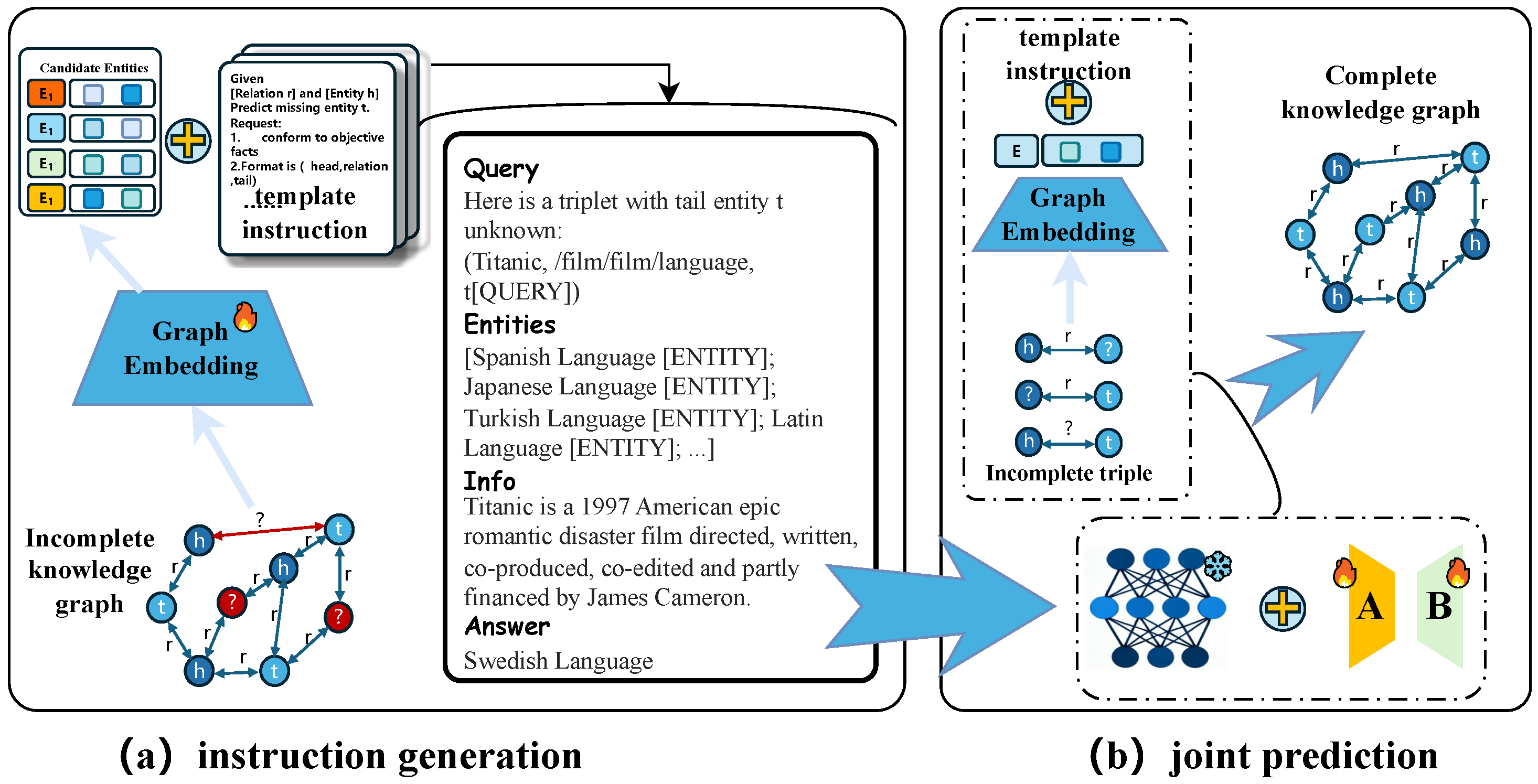
Mitigating Hallucinations in Knowledge Graph Completion via Embedding-Guided Instruction Tuning
 , , , , and
Abstract
1. Introduction
- We propose a novel instruction generation strategy that utilizes pre-trained KGE models to automatically synthesize high-quality, structure-aware fine-tuning data, effectively eliminating the need for manual annotation.
- We develop a specialized instruction-tuning protocol that adapts LLMs to the structural constraints of KGC tasks, significantly enhancing their discriminative capabilities while mitigating generative hallucinations.
- We introduce a joint prediction pipeline that synergizes the high-recall retrieval of KGE models with the high-precision reasoning of fine-tuned LLMs to ensure robust and accurate link prediction.
- We demonstrate through empirical validation on standard benchmarks that our approach outperforms state-of-the-art baselines, achieving absolute Hits@1 improvements of 7.0% on FB15k-237 and 2.5% on WN18RR compared to the baseline.
2. Related Work
2.1. Geometric and Factorization-Based KGE
2.2. Neural and Graph-Based Architectures
2.3. Pre-Trained Language Models
2.4. Generative LLMs and Hallucination Mitigation
3. Preliminaries
3.1. Notation Definitions
3.2. Definition of Knowledge Graph Completion Task
- 1.
- Prediction of tail entity: Given the head entity h and the relation r, predict the tail entity that satisfies . Its mathematical expression is as follows:where is the set of parameters of the embedding model, and is the probability that the entity t is the correct tail entity.
- 2.
- Prediction of the head entity: Given the relation r and the tail entity t, predict the head entity that satisfies . The expression is as follows:
- 3.
- Prediction of relationships: Given the head entity h and the tail entity t, predict the relation that satisfies . The expression is as follows:
3.3. Knowledge Graph Embedding
3.4. Instruction Tuning of Large Language Models
4. Method
4.1. Overview
4.2. Embedding-Guided Instruction Generation
4.2.1. Instruction Template Design
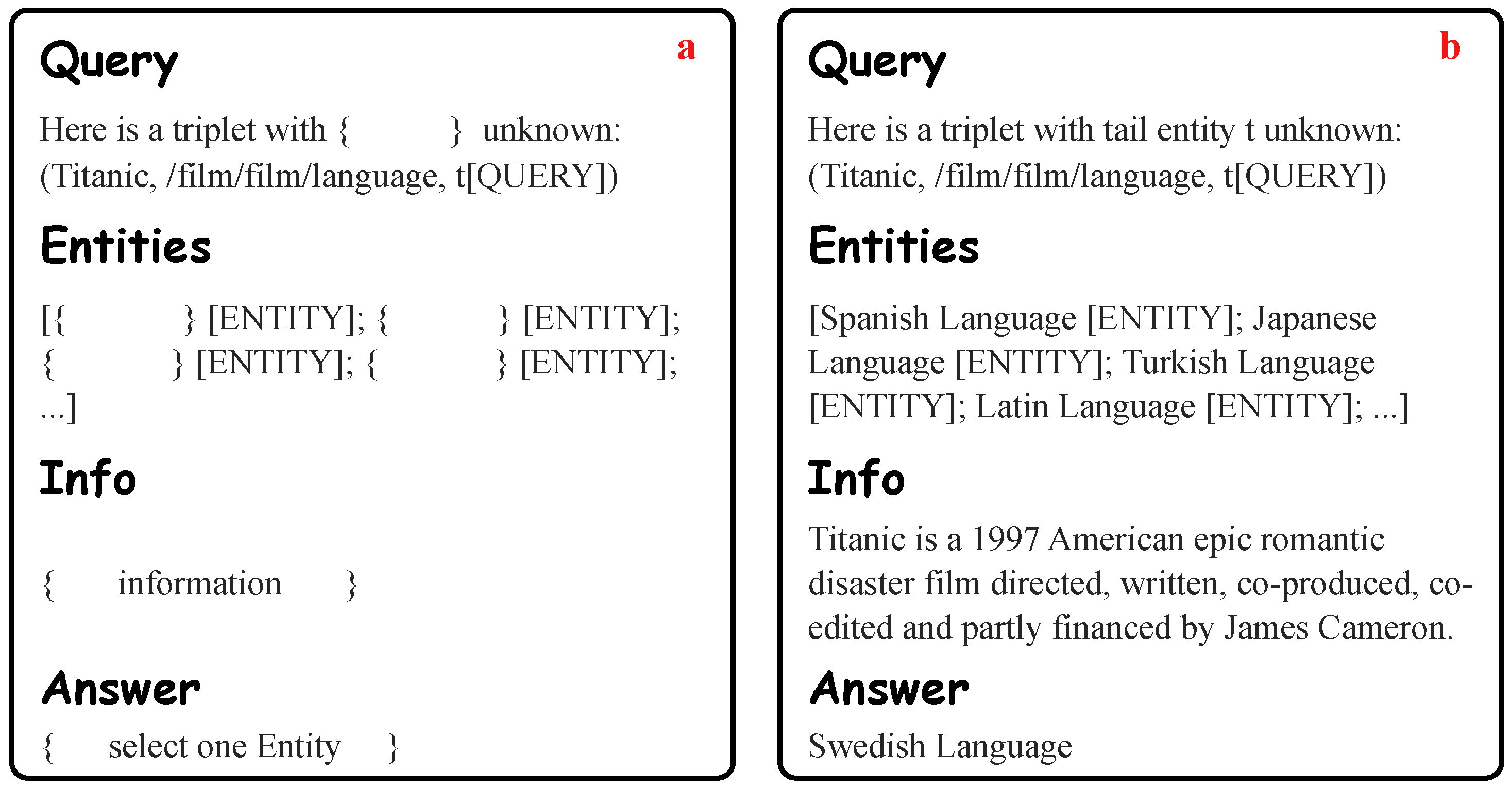
- Query: Describes the task (e.g., tail entity prediction) and provides the incomplete triple with a natural language prompt.
- Entities: A candidate entity list retrieved by the KGE model using similarity-based ranking, which is a well-established technique. This list serves as the “options” for the LLM, transforming the open-ended generation into a multiple-choice-like discrimination task.
- Info: Contextual information to aid reasoning. In this work, we utilize the textual descriptions of entities provided by the dataset. To filter out irrelevant noise, we select descriptions based on TF-IDF similarity with the query.
- Answer: The ground truth entity, used as the supervision signal for fine-tuning.
4.2.2. Automated Data Synthesis
| Algorithm 1: Fine-tuning Instruction Generation Algorithm Based on Knowledge Graph Embedding Model |
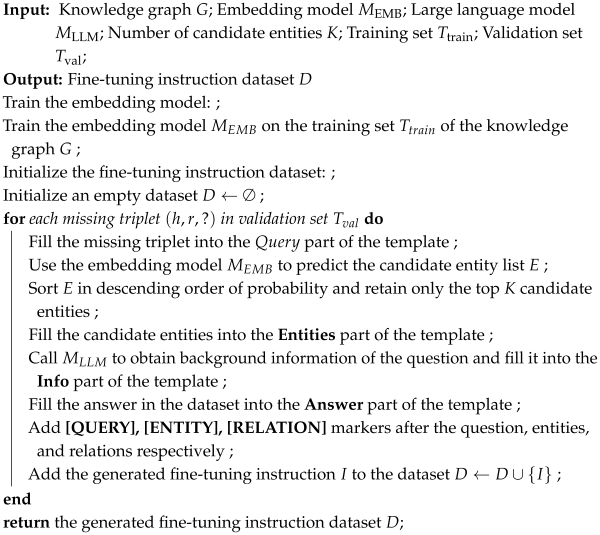 |
4.3. Structure-Aware Instruction Tuning
4.3.1. Structural Token Initialization
4.3.2. Attention-Enhanced QLoRA
4.3.3. Optimization Objective
4.4. Joint Inference Mechanism
| Algorithm 2: Link Prediction Algorithm Combining Embedding Model and Large Language Model |
 |
5. Experiments
5.1. Datasets
5.2. Evaluation Metrics
5.3. Experimental Setup
5.4. Main Results

| Method | LLM Backbone | MRR | Hits@1 | Hits@3 | Hits@10 |
|---|---|---|---|---|---|
| Triple-based methods | |||||
| TransE [18] | - | 0.279 | 0.198 | 0.376 | 0.441 |
| ConvE [27] | - | 0.320 | 0.240 | 0.350 | 0.490 |
| SimKGC [37] | - | 0.338 | 0.252 | 0.364 | 0.390 |
| RESCAL [46] | - | 0.356 | 0.266 | 0.390 | 0.535 |
| GenKGC [39] | - | - | 0.192 | 0.355 | 0.439 |
| ComplEx [24] | - | 0.366 | 0.271 | 0.401 | 0.557 |
| KGTuner [47] | - | 0.345 | 0.252 | 0.381 | 0.534 |
| KG-Mixup [48] | - | 0.359 | 0.265 | 0.395 | 0.547 |
| UniGE [49] | - | 0.343 | 0.257 | 0.375 | 0.523 |
| GNN-based methods | |||||
| CompGCN [30] | - | 0.355 | 0.264 | 0.390 | 0.535 |
| NBFNet [31] | - | 0.415 | 0.321 | 0.454 | 0.599 |
| CSProm-KG [50] | - | 0.355 | 0.261 | 0.389 | 0.531 |
| LLM-based methods | |||||
| KICGPT [13] | - | 0.412 | 0.327 | 0.448 | 0.581 |
| EGIT | |||||
| + TransE | Llama-3-8B | 0.372 | 0.317 | 0.398 | 0.514 |
| + SimKGC | Llama-3-8B | 0.398 | 0.329 | 0.446 | 0.539 |
| + ComplEx | Llama-3-8B | 0.418 | 0.339 | 0.461 | 0.577 |
| + TransE | Llama-3.1-8B | 0.368 | 0.313 | 0.394 | 0.512 |
| + SimKGC | Llama-3.1-8B | 0.384 | 0.327 | 0.413 | 0.523 |
| + ComplEx | Llama-3.1-8B | 0.416 | 0.341 | 0.454 | 0.562 |
| Method | LLM Backbone | MRR | Hits@1 | Hits@3 | Hits@10 |
|---|---|---|---|---|---|
| Triple-based methods | |||||
| TransE [18] | - | 0.243 | 0.043 | 0.441 | 0.532 |
| ConvE [27] | - | 0.430 | 0.390 | 0.440 | 0.510 |
| SimKGC [37] | - | 0.671 | 0.595 | 0.719 | 0.802 |
| RESCAL [46] | - | 0.467 | 0.439 | 0.478 | 0.516 |
| GenKGC [39] | - | - | 0.287 | 0.403 | 0.535 |
| ComplEx [24] | - | 0.487 | 0.441 | 0.501 | 0.580 |
| KGTuner [47] | - | 0.481 | 0.438 | 0.499 | 0.556 |
| KG-Mixup [48] | - | 0.488 | 0.443 | 0.505 | 0.541 |
| UniGE [49] | - | 0.491 | 0.447 | 0.512 | 0.563 |
| GNN-based methods | |||||
| CompGCN [30] | - | 0.479 | 0.443 | 0.494 | 0.546 |
| NBFNet [31] | - | 0.551 | 0.497 | 0.573 | 0.666 |
| CSProm-KG [50] | - | 0.569 | 0.520 | 0.590 | 0.675 |
| LLM-based methods | |||||
| KICGPT [13] | - | 0.564 | 0.478 | 0.612 | 0.677 |
| EGIT | |||||
| + TransE | Llama-3-8B | 0.508 | 0.496 | 0.517 | 0.571 |
| + SimKGC | Llama-3-8B | 0.674 | 0.620 | 0.723 | 0.796 |
| + ComplEx | Llama-3-8B | 0.610 | 0.569 | 0.626 | 0.692 |
| + TransE | Llama-3.1-8B | 0.494 | 0.479 | 0.506 | 0.564 |
| + SimKGC | Llama-3.1-8B | 0.654 | 0.580 | 0.725 | 0.797 |
| + ComplEx | Llama-3.1-8B | 0.604 | 0.568 | 0.625 | 0.689 |
5.5. Ablation Study
5.6. Training Cost and Efficiency
6. Conclusions
Author Contributions
Funding
Data Availability Statement
Acknowledgments
Conflicts of Interest
References
- Yani, M.; Krisnadhi, A.A. Challenges, techniques, and trends of simple knowledge graph question answering: A survey. Information 2021, 12, 271. [Google Scholar] [CrossRef]
- Guo, Q.; Zhuang, F.; Qin, C.; Zhu, H.; Xie, X.; Xiong, H.; He, Q. A survey on knowledge graph-based recommender systems. IEEE Trans. Knowl. Data Eng. 2020, 34, 3549–3568. [Google Scholar] [CrossRef]
- Zhang, O.; Lin, H.; Zhang, X.; Wang, X.; Wu, Z.; Ye, Q.; Zhao, W.; Wang, J.; Ying, K.; Kang, Y.; et al. Graph Neural Networks in Modern AI-Aided Drug Discovery. Chem. Rev. 2025, 125, 10001–10103. [Google Scholar] [CrossRef] [PubMed]
- Bongini, P.; Bianchini, M.; Scarselli, F. Molecular generative graph neural networks for drug discovery. Neurocomputing 2021, 450, 242–252. [Google Scholar] [CrossRef]
- Bollacker, K.; Evans, C.; Paritosh, P.; Sturge, T.; Taylor, J. Freebase: A collaboratively created graph database for structuring human knowledge. In Proceedings of the 2008 ACM SIGMOD International Conference on Management of Data, Vancouver, BC, Canada, 9–12 June 2008; pp. 1247–1250. [Google Scholar]
- Bian, H. LLM-empowered knowledge graph construction: A survey. arXiv 2025, arXiv:2510.20345. [Google Scholar] [CrossRef]
- Ji, S.; Pan, S.; Cambria, E.; Marttinen, P.; Yu, P.S. A survey on knowledge graphs: Representation, acquisition, and applications. IEEE Trans. Neural Networks Learn. Syst. 2021, 33, 494–514. [Google Scholar] [CrossRef] [PubMed]
- Ali, M.; Berrendorf, M.; Hoyt, C.T.; Vermue, L.; Sharifzadeh, S.; Tresp, V.; Lehmann, J. PyKEEN 1.0: A python library for training and evaluating knowledge graph embeddings. J. Mach. Learn. Res. 2021, 22, 1–6. [Google Scholar]
- Yao, L.; Peng, J.; Mao, C.; Luo, Y. Exploring large language models for knowledge graph completion. In Proceedings of the ICASSP 2025—2025 IEEE International Conference on Acoustics, Speech and Signal Processing (ICASSP), Hyderabad, India, 6–11 April 2025; IEEE: Piscataway, NJ, USA, 2025; pp. 1–5. [Google Scholar]
- Ji, Z.; Lee, N.; Frieske, R.; Yu, T.; Su, D.; Xu, Y.; Ishii, E.; Bang, Y.J.; Madotto, A.; Fung, P. Survey of hallucination in natural language generation. ACM Comput. Surv. 2023, 55, 1–38. [Google Scholar] [CrossRef]
- Zhang, Y.; Li, Y.; Cui, L.; Cai, D.; Liu, L.; Fu, T.; Huang, X.; Zhao, E.; Zhang, Y.; Chen, Y.; et al. Siren’s Song in the AI Ocean: A Survey on Hallucination in Large Language Models. Comput. Linguist. 2025, 51, 1373–1418. [Google Scholar] [CrossRef]
- Wagner, R.; Kitzelmann, E.; Boersch, I. Mitigating hallucination by integrating knowledge graphs into LLM inference–a systematic literature review. In Proceedings of the 63rd Annual Meeting of the Association for Computational Linguistics, Vienna, Austria, 27 July–1 August 2025; Volume 4: Student Research Workshop, pp. 795–805. [Google Scholar]
- Wei, Y.; Huang, Q.; Zhang, Y.; Kwok, J. Kicgpt: Large language model with knowledge in context for knowledge graph completion. In Proceedings of the Findings of the Association for Computational Linguistics: EMNLP 2023, Singapore, 6–10 December 2023; pp. 8667–8683. [Google Scholar]
- Dong, Q.; Li, L.; Dai, D.; Zheng, C.; Ma, J.; Li, R.; Xia, H.; Xu, J.; Wu, Z.; Chang, B.; et al. A survey on in-context learning. In Proceedings of the 2024 Conference on Empirical Methods in Natural Language Processing, Miami, FL, USA, 12–16 November 2024; pp. 1107–1128. [Google Scholar]
- Zhang, Y.; Chen, Z.; Guo, L.; Xu, Y.; Zhang, W.; Chen, H. Making large language models perform better in knowledge graph completion. In Proceedings of the 32nd ACM International Conference on Multimedia, Melbourne, Australia, 28 October–1 November 2024; pp. 233–242. [Google Scholar]
- Hu, E.J.; Shen, Y.; Wallis, P.; Allen-Zhu, Z.; Li, Y.; Wang, S.; Wang, L.; Chen, W. Lora: Low-rank adaptation of large language models. ICLR 2022, 1, 3. [Google Scholar]
- Liu, Y.; Cao, Y.; Lin, X.; Shang, Y.; Wang, S.; Pan, S. Enhancing Large Language Model for Knowledge Graph Completion via Structure-Aware Alignment-Tuning. In Proceedings of the 2025 Conference on Empirical Methods in Natural Language Processing, Suzhou, China, 4–9 November 2025; pp. 20981–20995. [Google Scholar]
- Bordes, A.; Usunier, N.; Garcia-Duran, A.; Weston, J.; Yakhnenko, O. Translating embeddings for modeling multi-relational data. Adv. Neural Inf. Process. Syst. 2013, 26, 2787–2795. [Google Scholar]
- Wang, Z.; Zhang, J.; Feng, J.; Chen, Z. Knowledge graph embedding by translating on hyperplanes. In Proceedings of the AAAI Conference on Artificial Intelligence, Québec, QC, Canada, 27–31 July 2014; Volume 28. [Google Scholar]
- Lin, Y.; Liu, Z.; Sun, M.; Liu, Y.; Zhu, X. Learning entity and relation embeddings for knowledge graph completion. In Proceedings of the AAAI Conference on Artificial Intelligence, Austin, TX, USA, 25–30 January 2015. [Google Scholar]
- Sun, Z.; Deng, Z.H.; Nie, J.Y.; Tang, J. Rotate: Knowledge graph embedding by relational rotation in complex space. In Proceedings of the International Conference on Learning Representations (ICLR), New Orleans, LA, USA, 6–9 May 2019. [Google Scholar]
- Zhang, Z.; Cai, J.; Zhang, Y.; Wang, J. Learning hierarchy-aware knowledge graph embeddings for link prediction. In Proceedings of the AAAI conference on Artificial Intelligence, New York, NY, USA, 7–12 February 2020; Volume 34, pp. 3065–3072. [Google Scholar]
- Yang, B.; Yih, W.T.; He, X.; Gao, J.; Deng, L. Embedding entities and relations for learning and inference in knowledge bases. In Proceedings of the International Conference on Learning Representations (ICLR), San Diego, CA, USA, 7–9 May 2015. [Google Scholar]
- Trouillon, T.; Welbl, J.; Riedel, S.; Gaussier, É.; Bouchard, G. Complex embeddings for simple link prediction. In Proceedings of the International Conference on Machine Learning. PMLR, New York, NY, USA, 20–22 June 2016; pp. 2071–2080. [Google Scholar]
- Balažević, I.; Allen, C.; Hospedales, T. Tucker: Tensor factorization for knowledge graph completion. In Proceedings of the 2019 Conference on Empirical Methods in Natural Language Processing and the 9th International Joint Conference on Natural Language Processing (EMNLP-IJCNLP), Hong Kong, China, 3–7 November 2019; pp. 5185–5194. [Google Scholar]
- Kazemi, S.M.; Poole, D. SimplE Embedding for Link Prediction in Knowledge Graphs. In Proceedings of the Advances in Neural Information Processing Systems, Montréal, QC, Canada, 3–8 December 2018; Volume 31. [Google Scholar]
- Dettmers, T.; Minervini, P.; Stenetorp, P.; Riedel, S. Convolutional 2d knowledge graph embeddings. In Proceedings of the AAAI Conference on Artificial Intelligence, New Orleans, LA, USA, 2–7 February 2018; Volume 32. [Google Scholar]
- Nguyen, T.D.; Nguyen, D.Q.; Phung, D. A novel embedding model for knowledge base completion based on convolutional neural network. In Proceedings of the 2018 Conference of the North American Chapter of the Association for Computational Linguistics: Human Language Technologies, New Orleans, LA, USA, 1–6 June 2018; Volume 2 (Short Papers), pp. 327–333. [Google Scholar]
- Schlichtkrull, M.; Kipf, T.N.; Bloem, P.; Van Den Berg, R.; Titov, I.; Welling, M. Modeling relational data with graph convolutional networks. In Proceedings of the European Semantic Web Conference; Springer: Berlin/Heidelberg, Germany, 2018; pp. 593–607. [Google Scholar]
- Vashishth, S.; Sanyal, S.; Nitin, V.; Talukdar, P. Composition-based multi-relational graph convolutional networks. In Proceedings of the International Conference on Learning Representations (ICLR), Addis Ababa, Ethiopia, 26–30 April 2020. [Google Scholar]
- Zhu, Z.; Zhang, Z.; Xhonneux, L.P.; Tang, J. Neural bellman-ford networks: A general graph neural network framework for link prediction. In Proceedings of the Advances in Neural Information Processing Systems (NeurIPS), Online, 6–14 December 2021. [Google Scholar]
- Zhang, Y.; Yao, Q. Knowledge graph reasoning with relational digraph. In Proceedings of the Web Conference (WWW), Austin, TX, USA, 30 April 30–4 May 2022. [Google Scholar]
- Xiao, H.; Huang, M.; Meng, L.; Zhu, X. SSP: Semantic space projection for knowledge graph embedding with text descriptions. In Proceedings of the AAAI Conference on Artificial Intelligence, San Francisco, CA, USA, 4–9 February 2017; Volume 31. [Google Scholar]
- Yao, L.; Mao, C.; Luo, Y. KG-BERT: BERT for knowledge graph completion. arXiv 2019, arXiv:1909.03193. [Google Scholar] [CrossRef]
- Wang, B.; Shen, T.; Long, G.; Zhou, T.; Wang, Y.; Chang, Y. Structure-augmented text representation learning for efficient knowledge graph completion. In Proceedings of the Web Conference 2021, Ljubljana, Slovenia, 19–23 April 2021; pp. 1737–1748. [Google Scholar]
- Wang, W.; Bi, B.; Yan, M.; Wu, C.; Bao, Z.; Xia, J.; Peng, L.; Si, L. Structbert: Incorporating language structures into pre-training for deep language understanding. In Proceedings of the International Conference on Learning Representations (ICLR), New Orleans, LA, USA, 6–9 May 2019. [Google Scholar]
- Wang, L.; Zhao, W.; Wei, Z.; Liu, J. SimKGC: Simple Contrastive Knowledge Graph Completion with Pre-trained Language Models. In Proceedings of the 60th Annual Meeting of the Association for Computational Linguistics (Volume 1: Long Papers), Dublin, Ireland, 22–27 May 2022; Association for Computational Linguistics: Stroudsburg, PA, USA, 2022. [Google Scholar]
- Saxena, A.; Kochsiek, A.; Gemulla, R. Sequence-to-Sequence Knowledge Graph Completion and Question Answering. In Proceedings of the 60th Annual Meeting of the Association for Computational Linguistics (Volume 1: Long Papers), Dublin, Ireland, 22–27 May 2022; Association for Computational Linguistics: Stroudsburg, PA, USA, 2022; pp. 2814–2828. [Google Scholar]
- Xie, X.; Zhang, N.; Li, Z.; Deng, S.; Chen, H.; Xiong, F.; Chen, M.; Chen, H. From discrimination to generation: Knowledge graph completion with generative transformer. In Proceedings of the Companion Proceedings of the Web Conference 2022, Lyon, France, 25–29 April 2022; pp. 162–165. [Google Scholar]
- Chen, B.; Bertozzi, A.L. AutoKG: Efficient automated knowledge graph generation for language models. In Proceedings of the 2023 IEEE International Conference on Big Data (BigData), Sorrento, Italy, 15–18 December 2023; IEEE: Piscataway, NJ, USA, 2023; pp. 3117–3126. [Google Scholar]
- Chen, J.; Ma, L.; Li, X.; Thakurdesai, N.; Xu, J.; Cho, J.H.; Nag, K.; Korpeoglu, E.; Kumar, S.; Achan, K. Knowledge graph completion models are few-shot learners: An empirical study of relation labeling in e-commerce with llms. arXiv 2023, arXiv:2305.09858. [Google Scholar]
- Lewis, P.; Perez, E.; Piktus, A.; Petroni, F.; Karpukhin, V.; Goyal, N.; Küttler, H.; Lewis, M.; Yih, W.t.; Rocktäschel, T.; et al. Retrieval-augmented generation for knowledge-intensive nlp tasks. Adv. Neural Inf. Process. Syst. 2020, 33, 9459–9474. [Google Scholar]
- Galkin, M.; Yuan, X.; Mostafa, H.; Tang, J.; Zhu, Z. Towards Foundation Models for Knowledge Graph Reasoning. In Proceedings of the NeurIPS 2023 Workshop: New Frontiers in Graph Learning, New Orleans, LA, USA, 15 December 2023. [Google Scholar]
- Guan, X.; Liu, Y.; Lin, H.; Lu, Y.; He, B.; Han, X.; Sun, L. Mitigating large language model hallucinations via autonomous knowledge graph-based retrofitting. In Proceedings of the AAAI Conference on Artificial Intelligence, Vancouver, BC, Canada, 20–27 February 2024; Volume 38, pp. 18126–18134. [Google Scholar]
- Dettmers, T.; Pagnoni, A.; Holtzman, A.; Zettlemoyer, L. Qlora: Efficient finetuning of quantized llms. Adv. Neural Inf. Process. Syst. 2023, 36, 10088–10115. [Google Scholar]
- Nickel, M.; Tresp, V.; Kriegel, H.P. A three-way model for collective learning on multi-relational data. In Proceedings of the International Conference on Machine Learning, Bellevue, WA, USA, 28 June–2 July 2011; Volume 11, pp. 3104482–3104584. [Google Scholar]
- Zhang, Y.; Zhou, Z.; Yao, Q.; Li, Y. KGTuner: Efficient Hyper-parameter Search for Knowledge Graph Learning. arXiv 2022, arXiv:2205.02460. [Google Scholar] [CrossRef]
- Shomer, H.; Jin, W.; Wang, W.; Tang, J. Toward Degree Bias in Embedding-Based Knowledge Graph Completion. In Proceedings of the ACM Web Conference 2023, New York, NY, USA, 30 April–4 May 2023; pp. 705–715. [Google Scholar] [CrossRef]
- Liu, Y.; Cao, Z.; Gao, X.; Zhang, J.; Yan, R. Bridging the Space Gap: Unifying Geometry Knowledge Graph Embedding with Optimal Transport. In Proceedings of the ACM Web Conference 2024, New York, NY, USA, 13–17 May 2024; pp. 2128–2137. [Google Scholar] [CrossRef]
- Chen, C.; Wang, Y.; Sun, A.; Li, B.; Lam, K.Y. Dipping PLMs Sauce: Bridging Structure and Text for Effective Knowledge Graph Completion via Conditional Soft Prompting. In Proceedings of the Findings of the Association for Computational Linguistics: ACL 2023; Rogers, A., Boyd-Graber, J., Okazaki, N., Eds.; Association for Computational Linguistics: Toronto, ON, Canada, 2023; pp. 11489–11503. [Google Scholar] [CrossRef]

| Dataset | #Entities | #Relations | #Triplets | #Train | #Valid | #Test |
|---|---|---|---|---|---|---|
| FB15k-237 | 14,541 | 237 | 310,116 | 272,115 | 17,535 | 20,466 |
| WN18RR | 40,943 | 11 | 93,003 | 86,835 | 3034 | 3134 |
| Hyperparameter | Value |
|---|---|
| rank | 64 |
| alpha | 16 |
| dropout | 0.1 |
| precision | bf16 |
| quantization precision | INT4 |
| Variant | MRR | Hits@1 | Hits@3 | Hits@10 |
|---|---|---|---|---|
| EGIT (Full Model) | 0.418 | 0.339 | 0.461 | 0.577 |
| w/o Fine-tuning | 0.381 | 0.302 | 0.423 | 0.541 |
| w/o Candidate List | 0.342 | 0.265 | 0.381 | 0.498 |
| Direct LLM Prediction | 0.287 | 0.210 | 0.325 | 0.443 |
Disclaimer/Publisher’s Note: The statements, opinions and data contained in all publications are solely those of the individual author(s) and contributor(s) and not of MDPI and/or the editor(s). MDPI and/or the editor(s) disclaim responsibility for any injury to people or property resulting from any ideas, methods, instructions or products referred to in the content. |
© 2026 by the authors. Licensee MDPI, Basel, Switzerland. This article is an open access article distributed under the terms and conditions of the Creative Commons Attribution (CC BY) license.
Share and Cite
Zhang, P.; Xu, X.; Wu, J.; Lu, X.; Shi, J.; Zhang, X.; Cui, D.; Peng, X.; He, S.; Zong, P.; et al. Mitigating Hallucinations in Knowledge Graph Completion via Embedding-Guided Instruction Tuning. Information 2026, 17, 207. https://doi.org/10.3390/info17020207
Zhang P, Xu X, Wu J, Lu X, Shi J, Zhang X, Cui D, Peng X, He S, Zong P, et al. Mitigating Hallucinations in Knowledge Graph Completion via Embedding-Guided Instruction Tuning. Information. 2026; 17(2):207. https://doi.org/10.3390/info17020207
Chicago/Turabian StyleZhang, Pengfei, Xing Xu, Junying Wu, Xin Lu, Jiahao Shi, Xiaodong Zhang, Dezhi Cui, Xiuxian Peng, Sihao He, Ping Zong, and et al. 2026. "Mitigating Hallucinations in Knowledge Graph Completion via Embedding-Guided Instruction Tuning" Information 17, no. 2: 207. https://doi.org/10.3390/info17020207
APA StyleZhang, P., Xu, X., Wu, J., Lu, X., Shi, J., Zhang, X., Cui, D., Peng, X., He, S., Zong, P., Zhang, G., Ou, Z., Song, M., & Zhu, Y. (2026). Mitigating Hallucinations in Knowledge Graph Completion via Embedding-Guided Instruction Tuning. Information, 17(2), 207. https://doi.org/10.3390/info17020207