1. Introduction
An estimated 5 million adolescents in the United States (U.S.) aged 12 to 17 encountered at least one major depressive episode during the last year [
1]. Research indicates that many adolescents diagnosed with Major Depressive Disorder (MDD) remain untreated, with 37.9% receiving no treatment and only 36.9% obtaining care from mental health specialists [
2]. Moreover, only 39% of adolescents and children had a positive response to treatment for depression, and this positive response tends to diminish gradually over time [
3].
There is a need for effective interventions and support systems to address the mental health challenges faced by adolescents. Traditional therapy may be costly and hard to scale. The use of digital therapeutics, including mobile apps, teletherapy, video games, and conversational agents, can be beneficial in addressing mental health issues, especially among the youth population, due to their accessibility and scalability. Conversational Agents (CAs) are automated software that provides interactive dialogue to users [
4]. CAs offer greater accessibility than traditional therapy services, as they are not constrained by time or location, and they are low-cost and scalable. Thus, CAs may represent a potential solution to address global mental health needs. However, there is limited research on their efficacy with adolescents. CAs can be programmed to respond with text, spoken language, live videos, or emojis. Regarding text-based CAs, there are two primary categories: rule-based and AI-based. Rule-based CAs use decision trees that determine the message to send based on the user’s response pattern. A systematic review and meta-analysis of CAs have shown significant improvements in adults with depression in the short term, but not in the long term [
5]. However, there is limited literature available for CAs targeted towards adolescent mental health issues.
Only a few studies were conducted with adolescents using CA: Tess for adolescents with diabetes [
6]; “Layla’s Got You” about contraception, sexually transmitted infections (STIs), and sexual health for Black and Hispanic young women [
7]; and KIT, a positive-body-image CA developed to provide psychoeducation and coping strategies [
8]. To date, only two studies have focused on CAs tailored for depression in adolescents. BethBot is a text-based CA delivered through Facebook messenger that provides psychoeducation and teaches coping strategies for adolescents with depression [
9]. Users recommended incorporating more emojis and slang into the conversation as well as creating a CA that was more personal and allowed for preference adjustment. A total of 54.5% of the users had a positive view of BethBot, and they believed that the CA could improve symptoms as well as offering someone to talk to. The study highlighted a limitation due to the small sample size of 23 participants, of which only 13 completed the full experience. The second study focuses on Woebot, a CBT-based CA developed to deliver support for various psychological challenges for emerging adults aged 16 to 21 [
10]. This study found that users generally acquired social support from the CA. Users stated that the CA can readily offer access to social support and that many users viewed fewer barriers to communicating with a CA than with a human. Furthermore, numerous users stated that it was easier to self-disclose to a CA than a person because CAs offer anonymity and privacy.
Due to the limited number of CAs available for adolescents, there is uncertainty in the methods of interactions preferred by the users. In addition, the longer-term outcomes of these interactions are unknown. Communication preferences in adolescents for CAs, such as Emojis, GIFs or Memes, require further research. Mariamo et al. [
11] found that questions with GIFs were viewed favorably by adolescent users but did not significantly affect the probability of replies. Mostafavi and Porter [
12] showed that using emojis in online messaging can aid emotional expression in response to the absence of body language and vocal cues. Adolescents’ perception of the features of the CA can be better understood through the Technology Acceptance Model (TAM) and the Unified Theory of Acceptance and Use of Technology (UTAUT) [
13]. Understanding the factors that influence adolescents’ initial adoption of and engagement with a CA is key to influencing continued use. It is possible that adolescents are more likely to use a CA when it is perceived as useful and easy to use, and when others use it. Additionally, adolescents may be a good fit for interventions delivered through CA due to their familiarity with text-based communications. Within this framework, the design features of the CA are expected to promote engagement in a personalized format, which, in turn, may influence adolescents’ perceived confidence in the agent’s ability to support mood-related outcomes.
2. Materials and Methods
This study used a single-group pretest–posttest design to examine changes in outcomes following interaction with the chatbot intervention.
Athena Bot is a text-based CA designed for this study delivered via Chatfuel. Scripts were modified from a CBT behavioral activation perspective CA [
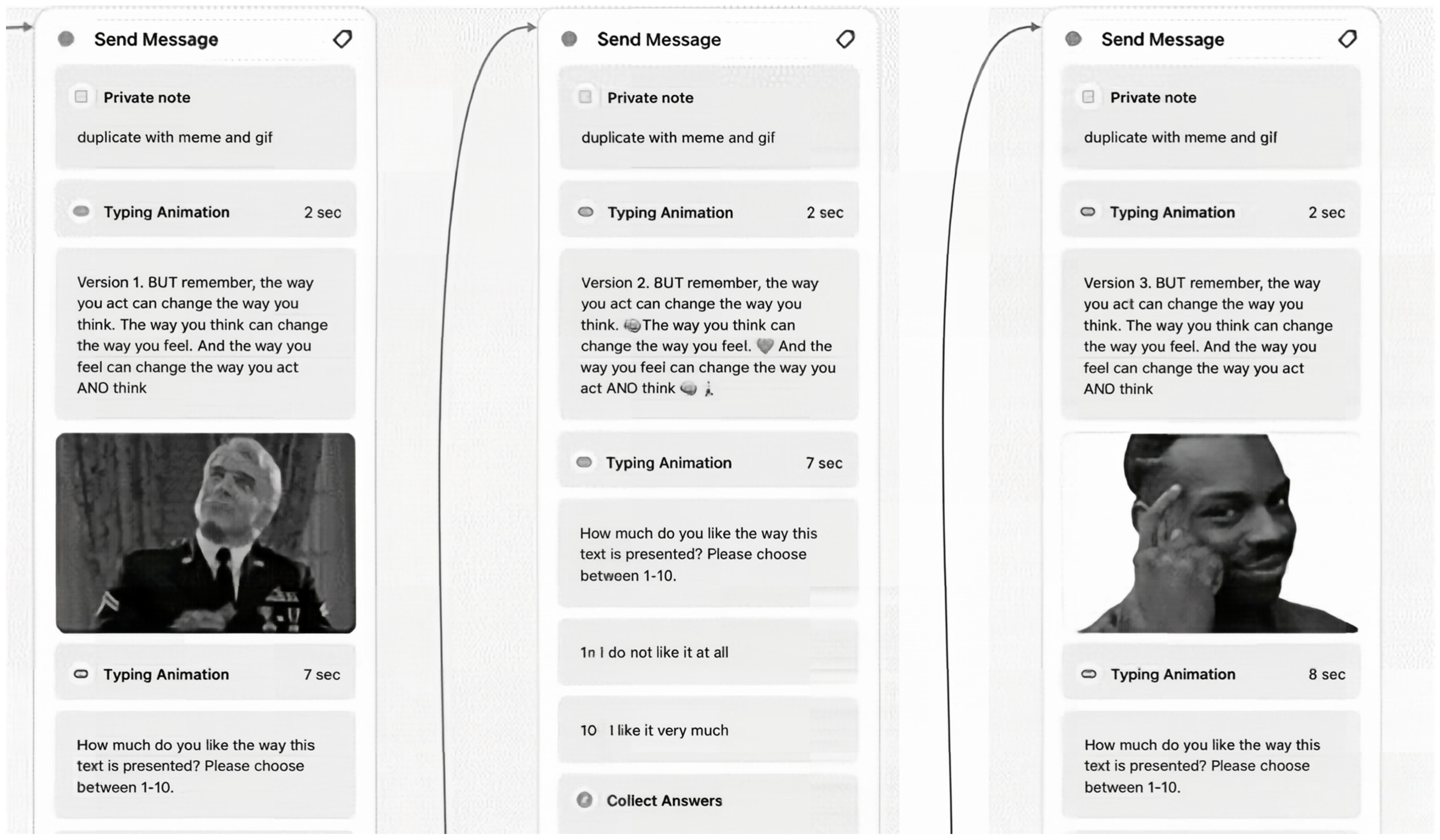
9]. Athena is rule-based, so the order of messages and the CA’s responses were not dependent on the users’ comments. The Athena CA was designed before the advent of AI, and as a result, the design used a rule-based system that proceeded based on pre-chosen paths. The CA script also included open-ended, multiple choice, Likert scale, and net promoter score (NPS) questions to assess user experience. The scripts were modified to include three questions to ascertain the user’s preference for questions that include a meme, GIF, or emoji. Athena’s messages included emojis, internet memes, and GIFs related to concepts from Behavioral Activation. Each message had three versions with a meme, GIF, or emoji (See
Figure 1).
Emojis, which means “picture words” in Japanese, are graphic symbols representing facial expressions, common objects, and actions among others [
14]. Internet memes, coined by Mike Godwin in 1993, are images with text overlaid that incorporate elements from popular culture that are remixed by numerous participants to serve as a form of public commentary [
15]. The Graphics Interchange Format (GIF) is a bitmap image design issued in 1987 by computer scientist Steve Wilhite at CompuServe. GIFs are animated images that have become culturally relevant in social media [
16].
Confidence measure: The users’ Confidence score was calculated based on their answer to “On a scale from 1–10, how confident are you that a bot can teach you something to improve your mood?” before and after interacting with Athena.
Net Promoter Score: The users’ net promoter score (NPS) was calculated based on their answer to “On a scale of 1 to 10, with 1 being not at all and 10 being definitely, would you recommend the CA you used today to a friend?”
Preferences for question formatting: The question for open-ended versus multiple choice answer options was “How much do you like the way this question was presented to you?” Preference for question formatting was ascertained using Likert scales with 1 = I did not like it at all and 10 = I liked it very much after each of the six formatting questions.
Preferences for emojis, GIFs or memes in responses: The question for different emoji, GIF, and meme information presentations was, “How much do you like the way this text is presented to you?” Preference for emojis, GIFs, or memes was ascertained using Likert scales with 1 = I did not like it at all and 10 = I liked it very much after each type of question. See
Figure 1.
Recruitment was conducted through Instagram and Facebook with a link to the CA and snowball sampling. Participants were recruited in the Bay Area Region of California, USA. Participants needed to have a device that was able to access Chatfuel to participate in the study. The assent form was included at the beginning of the conversation. Upon obtaining participant assent, adolescents began messaging with the CA through Chatfuel. The CA text consisted of six modules, followed by a series of questions on user experience. The study was intended to be completed in a single session. Given the exploratory nature of the study, the potential for dropout, and the limitations of snowball sampling, a target sample size of 66 participants was selected. As part of ethical consideration for minors, the data was deidentified and participants were given permission to withdraw at any point during the study. Furthermore, support in the form of crisis lines was provided.
Descriptive statistics were provided on all measures for quantitative data. For confidence, a paired samples
t-test was used for a pre-and post-analysis of the confidence question. The distribution of NPSs was calculated by determining the frequency of each potential score [
1,
2,
3,
4,
5,
6,
7,
8,
9,
10]. A thematic analysis using Braun and Clarke’s [
17] method was used to identify themes of adolescents’ perceptions and user experience. The themes were identified by the first author, who created a codebook. A second blind coder received the definitions of each theme and was asked to code the responses. Inter-rater reliability between the coders was assessed using Cohen’s kappa, which is frequently used to assess agreement between coders on categorical variables. A paired samples
t-test determined adolescents’ preference for multiple-choice versus open-ended questions. A factorial ANOVA was conducted to determine preferences for emojis, memes, or GIFs descriptive statistics were used.
4. Discussion
There is scant research on CAs designed explicitly for adolescents [
6,
9,
18]. This study aimed to investigate various aspects of adolescents’ interactions with the behavioral activation CA Athenabot. The most relevant finding was that adolescents reported a significant increase in their confidence in the utility of the bot to improve their mood baseline to post-intervention. This finding highlights the potential of a CA for adolescents with mood-related problems, and that they found the information useful.
Interestingly, adolescents reported a Net Promoter Score (NPS) of 6.73 (mode = 10), indicating acceptable support. This score was similar to the one reported in the previous version of this CA (i.e., 6.04; [
9]). Two factors may explain the acceptable NPS of both studies. On one hand, some users perceived the CA as very useful. The fact that a rating of 10 was the mode supports this hypothesis. On the other hand, adolescents are constantly exposed to the latest technologies, especially through video games and immersive environments. In contrast, many studies, including the current one, often rely on rudimentary tools and methodologies such as survey instruments. Adolescents who are accustomed to those immersive experiences may find the methods used in this study less relevant or engaging. As a result, there may be challenges in capturing their attention and interest in participating in studies conducted with less advanced tools. These findings underscore the importance of considering target users’ unique characteristics and preferences when designing and evaluating CA interventions, as well as the need for further research to understand factors influencing user satisfaction and engagement across diverse populations.
Regarding the comments supporting the adolescents’ NPS, the most frequent theme reported was that Athena needed to adjust better to the audience, highlighting the need for a more personalized CA. Additionally, there were several comments about Athena being helpful; adolescents found that it provided useful information, guidance or emotional support. Adolescents also reported a favorable view of Athena’s functionality, usability and quality of interactions. On the other hand, some users felt Athena was impersonal and lacked warmth and empathy, which may have contributed to adolescents’ feelings of frustration, disengagement or dissatisfaction. The lack of warmth and empathy may be due to Athena being scripted instead of generative AI; scripted bots do not respond in as empathic a manner as the newer versions of CA utilizing large language models. The quantitative findings showed an increase in the adolescents’ confidence in the capability of the CA to improve their mood, which is supported by the qualitative themes that describe Athena as helpful. This highlights the capability of a more primitive CA that is rule based in helping with building rapport and confidence in the user’s regarding the CA.
Regarding preference for type of questions, adolescents rated multiple-choice button questions significantly higher than typed response questions. This is consistent with a previous study where adolescents responded positively to the presence of buttons in conversational interfaces and appreciated the guidance in conversational topic flow provided by button-directed conversations [
8]. Similarly, Inkster et al. [
19] found that adult users generally prefer responding through preformatted options. The preference for multiple-choice buttons aligns with cognitive load theory [
20], which posits that reducing cognitive load by offering structured formats can enhance engagement and comprehension. This may be particularly true for adolescents navigating various cognitive and emotional challenges.
GIFs had the highest scores when asked about their preferences for GIFs, emojis or memes, but there were no significant differences. This finding is consistent with Mariamo et al. [
11], who reported favorable views toward GIFs in CAs by adolescent users but which did not affect engagement. While there were no differences in terms of preferences, emojis, GIFs and memes may play a role in contributing to perceiving the CA as more human. According to Rapp et al. [
21], giving a CA a human name and using emojis might make users perceive it as human. Furthermore, Rapp et al. [
21] suggest that giving CAs human names can foster a perception of the CA as more personable and approachable, thus increasing users’ willingness to engage with it. Interestingly, studies have indicated that users prefer female CAs [
22]. Finally, Mostafavi and Porter [
12] also highlighted the role of emojis and other multimedia content in online messaging as aids for emotional expression, especially in the absence of nonverbal cues like body language and vocal tone. Future studies can explore preferences for conversation style in terms of media usage across different CA platforms and the effectiveness of these styles in building rapport with users.
The sample is selected with a limited age group in the US and as such the generalizability of the findings may be limited. Future research can explore these topics across different geographical regions and age groups. This study was designed as a preliminary study on the effects of conversational agents and conducted as a single session, which poses a limitation in finding the long-term effects of an intervention using conversation agents. Future direction for studies can explore the more continuous and long term effects of conversational agents on adolescents with depression. Given that there were no significant differences between the different media types, future research can explore different determinants of engagement to see if there are differences in preferences for adolescents.
Author Contributions
Conceptualization, A.T. and E.B.; methodology, A.T.; writing—original draft preparation, A.T. and A.R.B.; writing—review and editing, T.P.; supervision, E.B. All authors have read and agreed to the published version of the manuscript.
Funding
This research received no external funding.
Institutional Review Board Statement
The study was conducted in accordance with the Declaration of Helsinki, and approved by the Institutional Review Board of Palo Alto University (Study 2023-051-ONLINE on 18 November 2023).
Informed Consent Statement
Patient consent was waived by the Palo Alto University as they deemed it a minimal risk study. The participants were not receiving an intervention, but providing feedback on their experience with the conversational agent. Additionally, no identifiable information was recorded or stored so the participants’ identities were protected.
Data Availability Statement
The raw data supporting the conclusions of this article will be made available by the authors on request.
Conflicts of Interest
The authors declare no conflicts of interest.
References
- Major Depression—National Institute of Mental Health (NIMH). Available online: https://www.nimh.nih.gov/health/statistics/major-depression (accessed on 18 July 2024).
- Costello, E.J.; He, J.P.; Sampson, N.A.; Kessler, R.C.; Merikangas, K.R. Services for Adolescents With Psychiatric Disorders: 12-Month Data From the National Comorbidity Survey–Adolescent. Psychiatr. Serv. 2014, 65, 359–366. [Google Scholar] [CrossRef] [PubMed]
- Cuijpers, P.; Karyotaki, E.; Ciharova, M.; Miguel, C.; Noma, H.; Stikkelbroek, Y.; Weisz, J.R.; Furukawa, T.A. The effects of psychological treatments of depression in children and adolescents on response, reliable change, and deterioration: A systematic review and meta-analysis. Eur. Child Adolesc. Psychiatry 2023, 32, 177–192. [Google Scholar] [CrossRef] [PubMed]
- Lim, S.M.; Shiau, C.W.C.; Cheng, L.J.; Lau, Y. Chatbot-Delivered Psychotherapy for Adults With Depressive and Anxiety Symptoms: A Systematic Review and Meta-Regression. Behav. Ther. 2022, 53, 334–347. [Google Scholar] [CrossRef] [PubMed]
- He, Y.; Yang, L.; Qian, C.; Li, T.; Su, Z.; Zhang, Q.; Hou, X. Conversational Agent Interventions for Mental Health Problems: Systematic Review and Meta-analysis of Randomized Controlled Trials. J. Med. Internet Res. 2023, 25, e43862. [Google Scholar] [CrossRef] [PubMed]
- Stephens, T.N.; Joerin, A.; Rauws, M.; Werk, L.N. Feasibility of pediatric obesity and prediabetes treatment support through Tess, the AI behavioral coaching chatbot. Transl. Behav. Med. 2019, 9, 440–447. [Google Scholar] [CrossRef] [PubMed]
- Bonnevie, E.; Lloyd, T.D.; Rosenberg, S.D.; Williams, K.; Goldbarg, J.; Smyser, J. Layla’s Got You: Developing a tailored contraception chatbot for Black and Hispanic young women. Health Educ. J. 2021, 80, 413–424. [Google Scholar] [CrossRef]
- Beilharz, F.; Sukunesan, S.; Rossell, S.L.; Kulkarni, J.; Sharp, G. Development of a Positive Body Image Chatbot (KIT) With Young People and Parents/Carers: Qualitative Focus Group Study. J. Med. Internet Res. 2021, 23, e27807. [Google Scholar] [CrossRef] [PubMed]
- Dosovitsky, G.; Bunge, E. Development of a chatbot for depression: Adolescent perceptions and recommendations. Child Adolesc. Ment. Health 2023, 28, 124–127. [Google Scholar] [CrossRef] [PubMed]
- Bae Brandtzæg, P.B.; Skjuve, M.; Kristoffer Dysthe, K.K.; Følstad, A. When the Social Becomes Non-Human: Young People’s Perception of Social Support in Chatbots. In Proceedings of the 2021 CHI Conference on Human Factors in Computing Systems; ACM: Yokohama, Japan, 2021; pp. 1–13. Available online: https://dl.acm.org/doi/10.1145/3411764.3445318 (accessed on 18 July 2024).
- Mariamo, A.; Temcheff, C.E.; Léger, P.M.; Senecal, S.; Lau, M.A. Emotional Reactions and Likelihood of Response to Questions Designed for a Mental Health Chatbot Among Adolescents: Experimental Study. JMIR Hum. Factors 2021, 8, e24343. [Google Scholar] [CrossRef] [PubMed]
- Mostafavi, M.; Porter, M.D. How emoji and word embedding helps to unveil emotional transitions during online messaging. In 2021 IEEE International Systems Conference (SysCon); IEEE: Vancouver, BC, Canada, 2021; pp. 1–8. Available online: https://ieeexplore.ieee.org/document/9447137/ (accessed on 18 July 2024).
- Naji, G.M.A.; Yuan, F.; Azzura, N.; Danish, F.; Ateeq, A.; Ibrahim, S.B.; Hakimi, H.; Abdollah, A.B.; Iskandar, Y.H.P. Factors influencing perceived benefits and behavioral intention to use mental health chatbots among professional employees: An empirical study. Front. Digit. Health 2025, 7, 1606273. [Google Scholar] [CrossRef] [PubMed]
- Da Quinta, N.; Santa Cruz, E.; Rios, Y.; Alfaro, B.; Martinez De Marañón, I. What is behind a facial emoji? The effects of context, age, and gender on children’s understanding of emoji. Food Qual. Prefer. 2023, 105, 104761. [Google Scholar] [CrossRef]
- Way, L.C. The importance of memes. Eur. J. Commun. 2019, 34, 552–556. [Google Scholar] [CrossRef]
- Rúa-Hidalgo, I.; Galmes-Cerezo, M.; Cristofol-Rodríguez, C.; Aliagas, I. Understanding the Emotional Impact of GIFs on Instagram through Consumer Neuroscience. Behav. Sci. 2021, 11, 108. [Google Scholar] [CrossRef] [PubMed]
- Braun, V.; Clarke, V. Using thematic analysis in psychology. Qual. Res. Psychol. 2006, 3, 77–101. [Google Scholar] [CrossRef]
- Holt-Quick, C.; Warren, J.; Stasiak, K.; Williams, R.; Christie, G.; Hetrick, S.; Hopkins, S.; Cargo, T.; Merry, S. A Chatbot Architecture for Promoting Youth Resilience. In Studies in Health Technology and Informatics; Merolli, M., Bain, C., Schaper, L.K., Eds.; IOS Press: Amsterdam, The Netherlands, 2021; Available online: https://ebooks.iospress.nl/doi/10.3233/SHTI210017 (accessed on 18 July 2024).
- Inkster, B.; Sarda, S.; Subramanian, V. An Empathy-Driven, Conversational Artificial Intelligence Agent (Wysa) for Digital Mental Well-Being: Real-World Data Evaluation Mixed-Methods Study. JMIR mHealth uHealth 2018, 6, e12106. [Google Scholar] [CrossRef] [PubMed]
- Orru, G.; Longo, L. The Evolution of Cognitive Load Theory and the Measurement of Its Intrinsic, Extraneous and Germane Loads: A Review. In Human Mental Workload: Models and Applications; Longo, L., Leva, M.C., Eds.; Communications in Computer and Information Science; Springer International Publishing: Cham, Switzerland, 2019; Volume 1012, pp. 23–48. Available online: http://link.springer.com/10.1007/978-3-030-14273-5_3 (accessed on 18 July 2024).
- Rapp, A.; Curti, L.; Boldi, A. The human side of human-chatbot interaction: A systematic literature review of ten years of research on text-based chatbots. Int. J. Hum.-Comput. Stud. 2021, 151, 102630. [Google Scholar] [CrossRef]
- Borau, S.; Otterbring, T.; Laporte, S.; Fosso Wamba, S. The most human bot: Female gendering increases humanness perceptions of bots and acceptance of AI. Psychol. Mark. 2021, 38, 1052–1068. [Google Scholar] [CrossRef]
| Disclaimer/Publisher’s Note: The statements, opinions and data contained in all publications are solely those of the individual author(s) and contributor(s) and not of MDPI and/or the editor(s). MDPI and/or the editor(s) disclaim responsibility for any injury to people or property resulting from any ideas, methods, instructions or products referred to in the content. |