1. Introduction
Artificial Intelligence (AI) has been increasingly adopted across various sectors, with healthcare emerging as one of the fastest-growing domains. Recent AI advancements have demonstrated significant potential to improve diagnostic accuracy, clinical decision-making, and overall healthcare efficiency. However, the adoption of AI in healthcare introduces critical challenges, particularly related to data privacy, data security, and model robustness [
1,
2].
Federated Learning (FL) is an evolving approach in decentralized Machine Learning (ML), enabling simultaneous model training across numerous devices or clients without necessitating data sharing. FL has gained recognition as an effective solution for mitigating data privacy concerns [
3].
Ensuring the integrity and trustworthiness of shared information is a fundamental challenge in distributed learning systems, particularly in collaborative healthcare environments where unreliable updates can directly degrade decision quality and patient safety.
Although FL improves data privacy by keeping data local, it does not inherently prevent poisoning attacks, where participants manipulate local data or model updates to degrade the global model’s performance. While blockchain can reduce risks associated with a centralized coordinator, it does not guarantee that client-submitted updates are trustworthy; therefore, blockchain-based FL remains vulnerable to client-side attacks [
4,
5].
FL produces and aggregates a global model from multiple participants or clients. The poisoning attacks can compromise the accuracy and reliability of healthcare models, leading to misdiagnosis in clinical and scientific settings [
6]. To address poisoning attacks, it is crucial to integrate additional techniques into FL training to filter out poisoned models and ensure global model aggregation against malicious manipulation.
This paper presents an advanced AI framework that integrates FL, blockchain technology, and consensus mechanisms to prevent malicious attacks in healthcare scenarios. The integration of blockchain and consensus technologies can enhance data privacy preservation, support performance-based client participation control, and improve robustness against poisoning attacks, thereby enhancing the performance and accuracy of AI systems. By utilizing datasets from the MedMNIST collection (medmnist Python package, version 3.0.2), including OCTMNIST and TissueMNIST, the experiments were conducted to simulate real-world healthcare scenarios [
7].
Blockchain’s inherent features, such as transparency, immutability, and decentralized control, enhance the security and reliability of FL models [
8]. Furthermore, consensus mechanisms such as Proof-of-Work (PoW) and Proof-of-Stake (PoS) provide an effective solution for securing model aggregation by supporting secure, verifiable aggregation while enhancing integrity and trust in the federated learning process [
9,
10].
The methodology in this study used an FL approach and compared it with centralized learning across three scenarios. In the first scenario, data was divided among ten clients, and the global model was updated through several rounds. In the second scenario, 10% and 50% poisoning attacks were simulated to see how they would affect the global model’s performance. A Secure Multiparty Computing (SMPC) technique was employed to preserve the confidentiality of client model updates during the aggregation process [
11]. The third scenario integrates FL with blockchain technology and consensus mechanisms to ensure robust and reliable model aggregation among participating clients.
In the proposed framework, the aggregated global model is recorded on the blockchain using a PoS consensus mechanism [
12,
13]. PoS enables performance-aware participation by allowing clients with higher accuracy-based stakes to have greater influence during aggregation. This performance-aware aggregation process suppresses unstable or low-quality updates, thereby reducing the influence of malicious or unreliable clients on the global model.
Despite recent advances in blockchain-enabled federated learning, most existing solutions primarily emphasize security guarantees without adequately addressing the trade-off between robustness and computational efficiency, particularly at high poisoning ratios. In healthcare environments, where scalability and timely model updates are critical, excessive cryptographic overhead can limit practical deployment. To address this gap, this work introduces a performance-weighted PoS aggregation strategy, while SMPC is employed to protect local model updates, enabling robust mitigation of poisoning attacks while significantly reducing training and aggregation time. The proposed framework is evaluated under severe attack scenarios (up to 50% malicious clients) using real medical datasets, highlighting its practical applicability.
Unlike existing blockchain-based federated learning approaches that primarily emphasize security guarantees, this work explicitly investigates the trade-off between robustness and computational efficiency under high poisoning ratios. By incorporating performance-weighted Proof-of-Stake directly into the aggregation process rather than treating PoS as an auxiliary incentive or reputation layer, and by reporting a detailed time-complexity analysis, the proposed framework demonstrates that robustness against adversarial clients can be achieved without incurring excessive computational overhead, which is critical for practical healthcare deployments.
The main contributions of this work are summarized as follows:
- 1.
Design of a blockchain-enabled federated learning architecture tailored for healthcare systems, integrating SMPC-based privacy preservation with consensus-based global aggregation.
- 2.
Proposal of a performance-weighted Proof-of-Stake (PoS) mechanism that prioritizes reliable client updates based on historical accuracy.
- 3.
Comprehensive evaluation of robustness against poisoning attacks under both moderate (10%) and severe (50%) malicious client scenarios using medical imaging datasets.
- 4.
Comparative analysis of accuracy, robustness, and computational efficiency, highlighting the practical feasibility of PoS-based aggregation compared to PoW baseline under high poisoning ratios.
The remainder of this paper is structured as follows:
Section 2 analyzes relevant previous studies.
Section 3 discusses the proposed methodology.
Section 4 presents and discusses the findings. Finally,
Section 5 provides a conclusion.
2. Related Work
This section discusses the need to improve the quality of medical environments, including data privacy, time-to-processing, and client training in AI. For instance, Mohammed et al. [
14] introduced a model called EDFOS to enhance data privacy and blockchain-based networks through simulations. The EDFOS system reduced power consumption by 39% compared to existing healthcare systems and cut training and testing time by 29%. In addition, as the ratio of malicious clients increases, the performance of FL models significantly drops.
Kalapaaking et al. [
15] proposed a blockchain-based FL model that incorporates SMPC to enhance against poisoning attacks. Using the OCTMNIST and TissueMNIST datasets with a ResNet-18 CNN model enables secure model verification via SMPC, eliminating compromised local models. Once local models are verified, they are sent to blockchain nodes for secure aggregation, and the global model is stored in a tamper-proof storage system. The average poisoned-client accuracy declined to 30% on the OCTMNIST datasets when 10% of clients were malicious, while the global evaluation accuracy dropped by 7%. Global model accuracy could decline 22% with 50% malicious clients. 10% malicious clients reduced global model accuracy by 9% for TissueMNIST, whereas 50% reduced it by 26%.
N. Dong et al. [
16] suggested a way to protect FL from poisoning attacks by combining blockchain technology with a stake-based aggregation mechanism. The suggested FedAVG with blockchain worked just as well as FedAVG without malicious attacks, and it worked better than FedAVG with malicious attacks all the time when using the ChestX-ray14 dataset. The results showed that the proposed stake-based aggregation mechanism effectively identifies and stops bad behavior in FL settings.
C. Gan et al. [
17] proposed a dual-blockchain strategy to eliminate low-quality nodes and reduce poisoning attacks. It used the MedMNIST dataset on two blockchains, MQchain and RIchain. The proof-of-quality consensus algorithm in MQchain keeps out low-quality nodes, while the reputation evaluation mechanism in RIchain does the same. Compared to three other methods, the model made it harder for attacks to work.
In addition, another study [
18] proposed an approach named PBSL to resist poisoning attacks while safeguarding data privacy with incorporated threshold fully homomorphic encryption and the MNIST and FashionMNIST datasets. It was developed by integrating deep learning techniques with blockchain-based smart contract platforms. PBSl showed consistent accuracy, with only a slight drop from 98.0% at 10% malicious MCs to 96.0% at 50%. The limitation of this study is the diagnostic accuracy challenges caused by insufficient data sharing.
L. Tian et al. [
19] proposed an AI model named PEFL, which leverages blockchain to facilitate privacy protection and coordination among customers. PEFL incorporated an aggregation-aspect detection set of rules to counter poisoning attacks and proposed the MFF consensus mechanism, which was evaluated on the MNIST and CIFAR-10 datasets. Their model executed better training efficiency while ensuring privacy and security. The proposed framework nonetheless confronted challenges in real-world applications, despite its upgrades.
C. Wan et al. proposed a decentralized FL that combined blockchain technology with distillation protection [
20]. A rotation mechanism randomly assigned clients to roles so that awful clients could not be assigned to the same roles. This feature makes it easier for the local purchaser to counter attacks with adversarial samples, reduces communication overhead, accelerates training, and improves the model’s generalization. Even as the number of adversarial samples increased, the proposed model trained with an accuracy of over 0.880. The limitation emphasized is that it functions solely within a simulated environment.
Bharath et al. [
21] proposed a blockchain-based federated learning model named ATB-FL. This recent preprint integrates behavior-based trust evaluation with blockchain authentication and incentive–penalty mechanisms, and was evaluated on the CIC-IoMT 2024 dataset.The ATB-FL framework reported a diagnostic accuracy of 95.1% and reduced the misclassification rate to below 5%. However, the evaluation was limited to a single dataset, raising concerns regarding scalability and generalizability.
M. Xu and X. Li [
22] employed a model named FedG2L to address poisoning attacks and single-point failures in centralized FL using the Gradient-Similarity-Based Secure Consensus Algorithm. The model is based on gradient similarity, enabling the identification and removal of gradients that deviate, using an improved auxiliary classifier generative adversarial network for data generation. Accuracy improved by at least 55% compared with schemes that did not incorporate any defense mechanisms. The attack success rate was reduced by more than 60% in mitigating poisoning attacks. The strategy assumed that some groups were equally limited rather than completely malicious and possessed unlimited power. This restricts how strong the attacker model may be.
W. Liu, et al. [
23] developed the BFG model based on blockchain and FL using the interplanetary file system, differential privacy, and generative adversarial networks with a consensus protocol of PoS. BFG reduces the success rate of poisoning attacks. For 10% poisoning, attackers achieved approximately a 26% attack success rate on the MNIST and 23% on the CIFAR-10 dataset. The limitations were due to the use of partial and limited images.
R. Myrzashova et al. [
24] developed a framework based on blockchain and FL to identify 15 distinct lung diseases and the NIH Chest X-Ray dataset. The model evaluated on a test accuracy of 92.86% and a latency of 43.518 ms. It demonstrated robustness, with resilience metrics consistently approaching 87% across three evaluated cyberattacks.
G. Sun et al. [
25] proposed an attack on federated learning (AT2FL) to address high communication costs and stragglers using computing gradients for the target nodes. Endoscopic images, human activity recognition, and the Parkinson’s dataset were used in this study. The EndAD and Human Activity datasets showed performance deterioration of 21.707% and 26.836% in classifying direct attacks, respectively.
Z. Ma et al. [
26] proposed SFPA (Secure Federated Learning against Poisoning Attacks), a secure federated learning framework designed to provide privacy-preserving random forest-based FL across multiple data islands and a multi-key decryption scheme. SFPA utilizes RF as the ensemble learner for medical diagnosis. RF models are chosen for their interpretability and transparency, consisting of a series of decision trees. Experiments showed that the accuracy of SFPA with secure defense ranged from 84.3–97.4% even with increased poisoning. However, the key generation center assumption could be a point of vulnerability if the KGC were compromised.
Previous studies have employed various methodologies to address poisoning attacks in FL. Some studies focused on FL without addressing filtering poisoning attacks, whereas others proposed filtering techniques to enhance the security of the global model, as demonstrated in
Table 1. A comprehensive comparison of federated learning (FL) and attack-related studies in healthcare is provided in
Supplementary Table S1. However, filtering methods usually increase training time, especially in the cloud. Small datasets limited some studies, making it challenging to generalize their results to larger contexts.
In this study, we aim to contribute by utilizing FL and assessing various learning strategies, including centralized and federated settings under label-flipping attacks at 10% and 50%. The framework incorporates SMPC-based privacy preservation and blockchain consensus mechanisms to improve robustness and efficiency. We expect improved performance and reduced training time, addressing limitations in prior work and supporting practical healthcare applications.
3. Methodology
This paper proposes a FL architecture based on blockchain technology and a consensus mechanism, and evaluates it alongside SMPC-based secure aggregation for privacy preservation. This methodology aims to develop healthcare environments in which shared machine learning models are trained for multiple clients or hospitals while preserving data privacy and model integrity across different medical facilities.
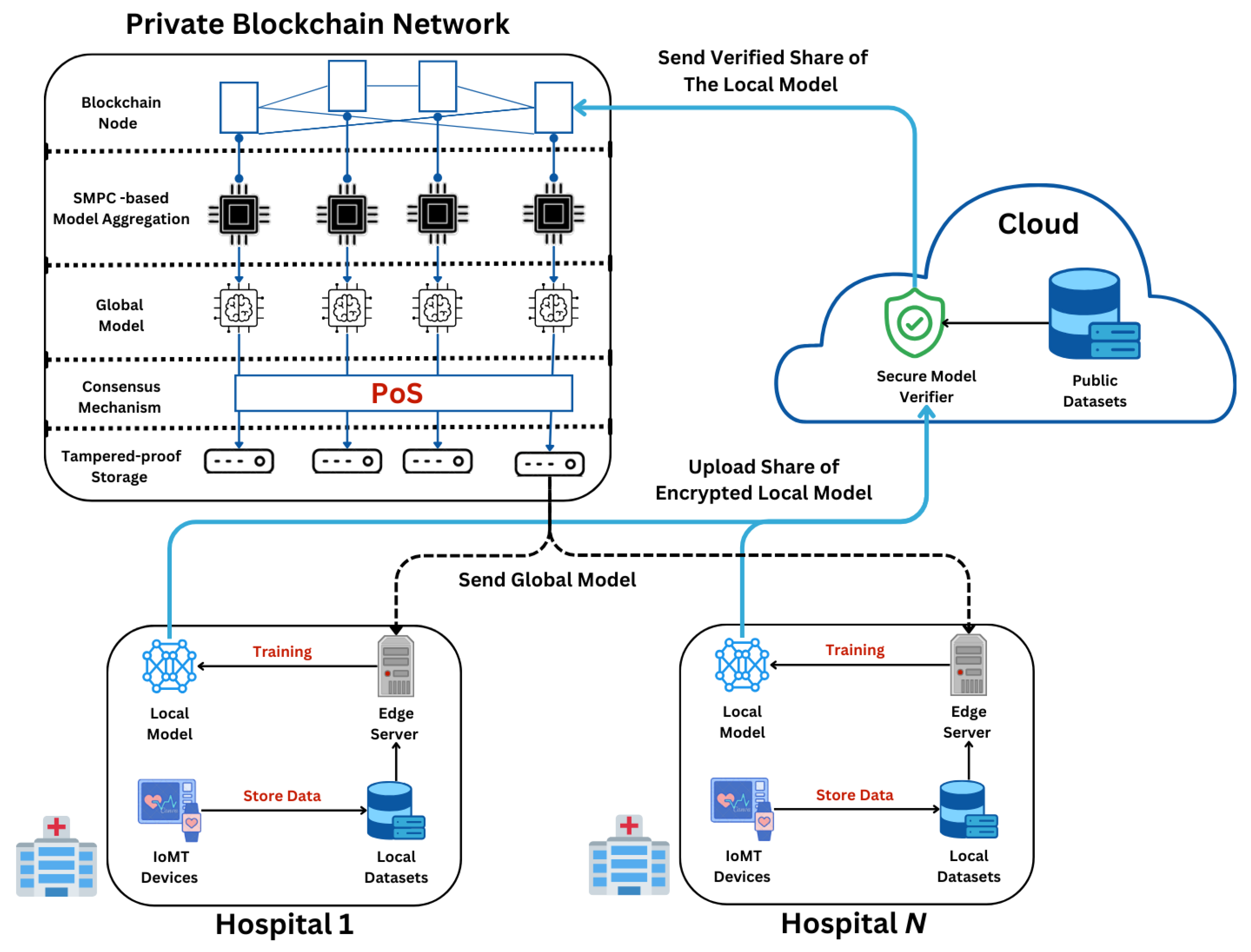
Figure 1 illustrates the proposed methodology, in which each hospital’s local model is trained independently on its own data without sharing it with other clients. Secure verification is then performed between hospital clients and the cloud. SMPC-based secure aggregation is then performed to preserve the confidentiality of client updates, while poisoning attacks are mitigated during the aggregation process. Blockchain technology based on consensus mechanisms is applied to provide tamper-resistant storage and coordinated model dissemination, supporting the evaluation of system efficiency and robustness.
4. Results and Discussion
This section presents and discusses the performance results of several FL approaches for the OCTMNIST and TissueMNIST datasets. The analysis evaluates each method’s performance in terms of accuracy, robustness against malicious attacks, and efficiency, particularly in the context of blockchain-based and secure model aggregation. Additionally, the section provides a detailed comparison of the time complexity of each approach, offering insights into the computational cost and scalability of the proposed methods. To account for stochastic effects during training, the reported results reflect average performance trends observed across repeated experimental runs.
4.3. Scenario C: Blockchain-Based Global Aggregation Using PoW and PoS
Scenario C examines the impact of blockchain-based aggregation techniques using PoW and PoS on FL across both datasets. The research evaluates the effect of the consensus mechanism on 10% and 50% of labeling attacks.
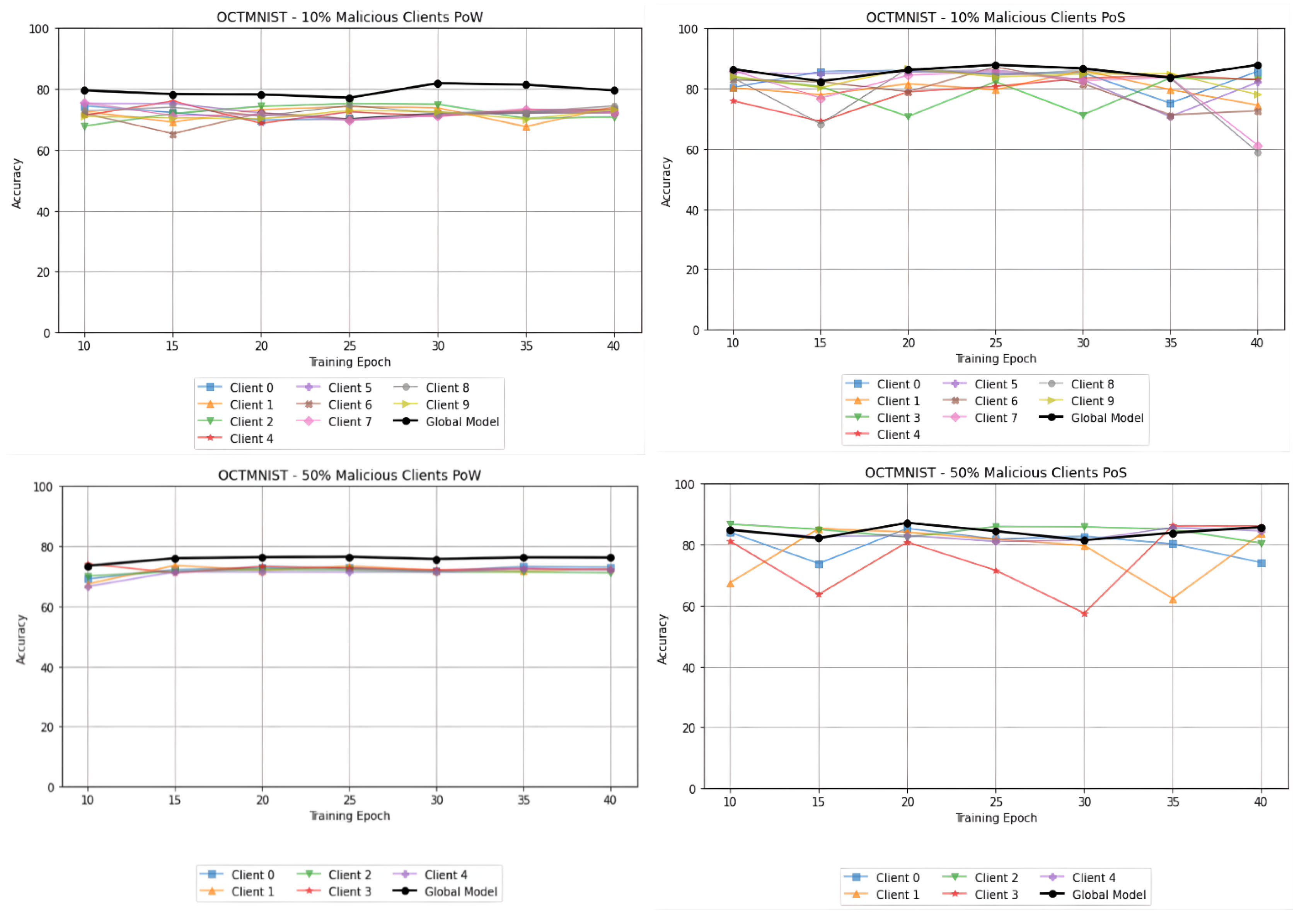
Figure 5 illustrates that evaluating the global model, under the two consensus techniques, facilitates coordinated and robust global aggregation under poisoning scenarios.
To ensure a fair comparison across consensus mechanisms, execution times were normalized by the total number of model parameters. Communication overhead was quantified based on the average size of model updates transmitted per client per round and the number of participating clients.
In our experimental setup, this corresponds to a communication cost of approximately per training round for 10 participating clients.
In the OCTMNIST dataset, as shown in
Figure 5, PoW may introduce higher instability due to its computational overhead and the inherent randomness of the consensus process. The fluctuations observed in client model performance, particularly in the individual plots under the 10% malicious client scenario, reflect this behavior. In contrast, PoS demonstrates improved client alignment and stability under the 50% malicious client scenario, where client models exhibit more consistent behavior. The global model consistently outperforms individual local models, highlighting the effectiveness of global aggregation under blockchain-based coordination. Overall, PoS shows a greater ability to integrate heterogeneous client updates into a stable global model under poisoning conditions.
The results indicate that both PoW and PoS mechanisms provide viable solutions for global aggregation in federated learning. However, PoS demonstrates more stable and consistent performance across clients, particularly when data is evenly distributed. In comparison, PoW may introduce additional variability due to its dependence on computational resources and stochastic consensus behavior.
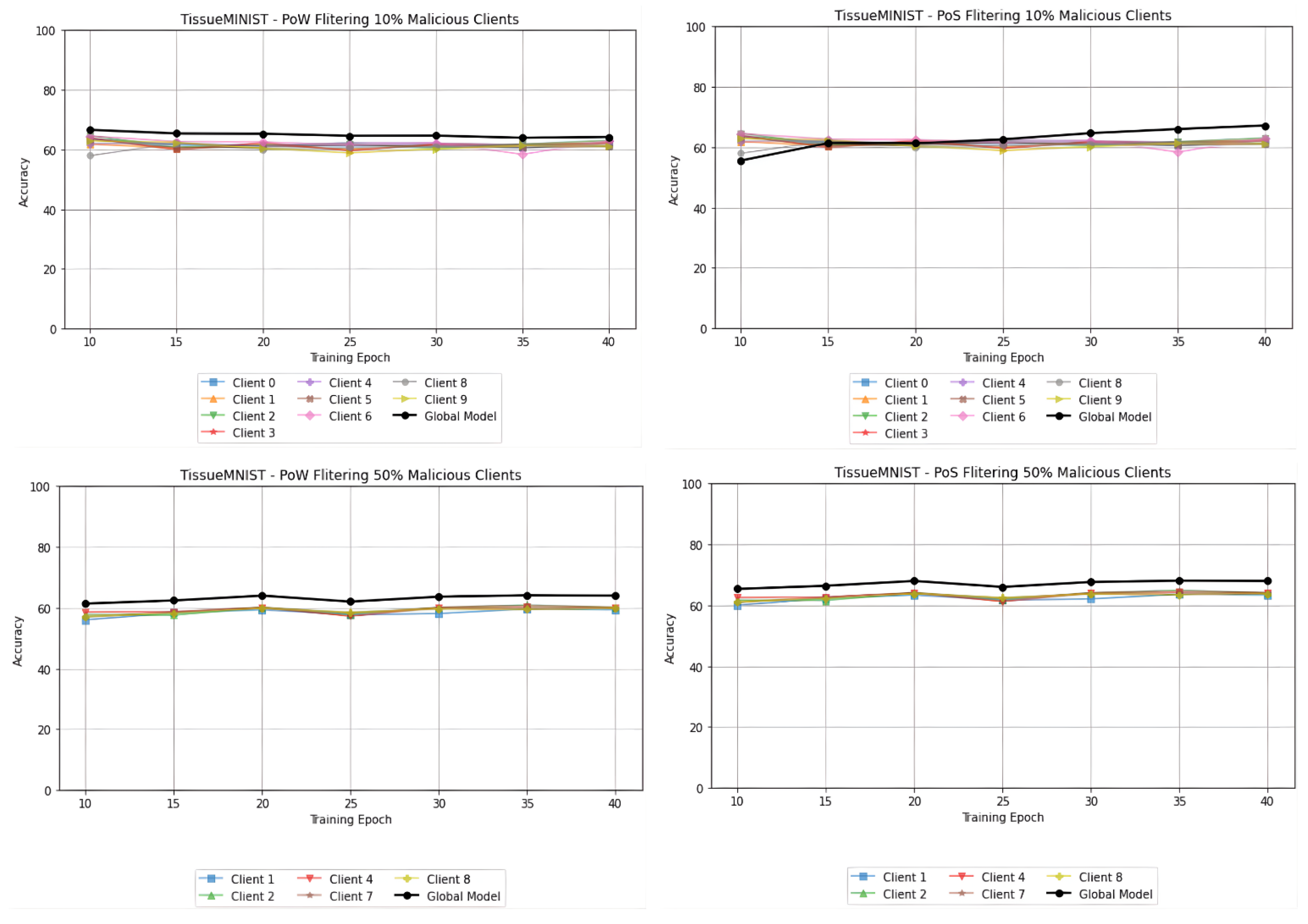
For the TissueMNIST dataset, the performance of the proposed framework is illustrated in
Figure 6. The figure presents the behavior of both local client models and the aggregated global model under different blockchain-based aggregation strategies. Under PoW, additional randomness is introduced into the aggregation process, resulting in noticeable variability in client model performance under the 10% malicious client scenario. In contrast, PoS demonstrates improved alignment and stability among client models under the 50% malicious client scenario, where client updates exhibit more consistent behavior due to performance-aware aggregation.
Across all scenarios, the global model consistently outperforms individual local models, highlighting the effectiveness of blockchain-based global aggregation under adversarial conditions. The aggregated global model benefits from the coordinated contributions of participating clients, leading to improved accuracy and more stable convergence behavior. Compared to PoW, PoS exhibits reduced performance fluctuations across clients, making it a more suitable aggregation strategy for federated learning in the TissueMNIST setting. This improved stability may be attributed to weighting client contributions by historical performance, which reduces the influence of less reliable updates.
To further contextualize robustness, we compared the proposed approach with Krum, a widely used Byzantine-robust aggregation method, under identical poisoning settings. Krum improves robustness compared to standard FedAvg; however, it incurs higher aggregation overhead and shows reduced performance at high poisoning ratios than the proposed consensus-aware approach. The quantitative comparison under 50% poisoning is presented in
Table 8.
4.4. Discussion and Analysis of Performance
The results presented in
Table 9 summarize the performance of the proposed approaches, including centralized learning, FL, and evaluations under label-flipping attacks using SMPC, PoW, and PoS for both the OCTMNIST and TissueMNIST datasets.
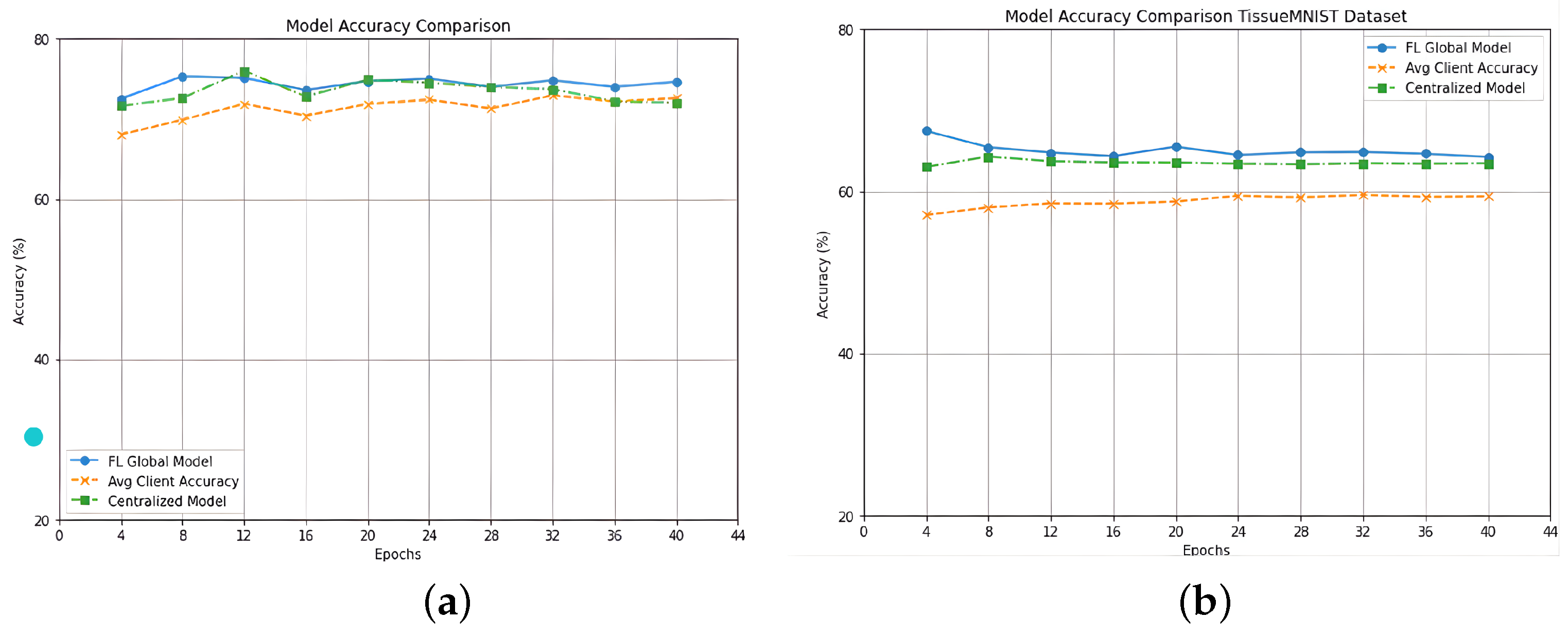
The centralized learning method in the OCTMNIST dataset attains 72.60% accuracy. The TissueMNIST dataset has a lower rate of 63.92% for centralized learning because the data in this dataset is more complicated. The FL approach yields a slight improvement over the centralized approach in both datasets: 74.60% for OCTMNIST and 64.23% for TissueMNIST.
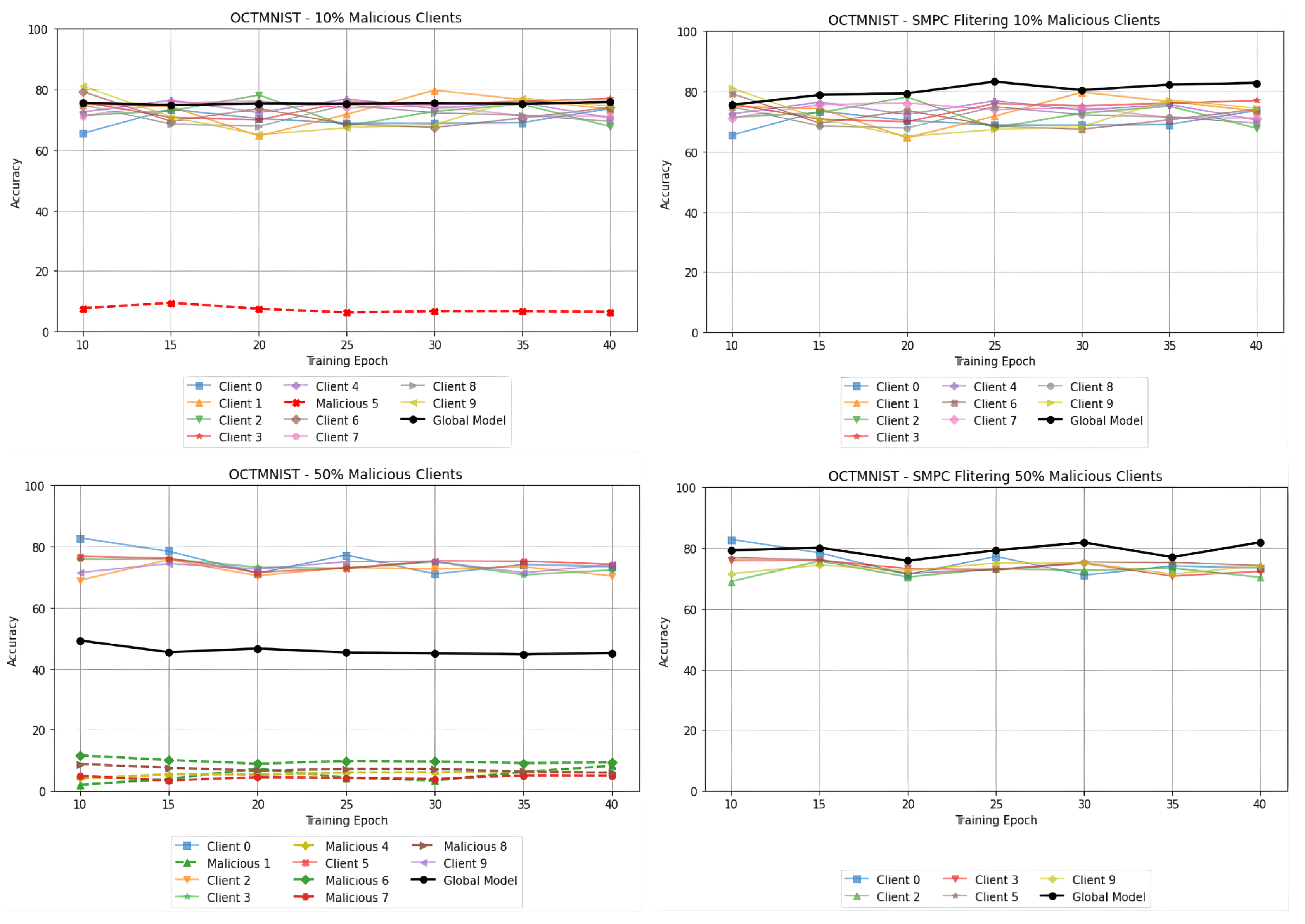
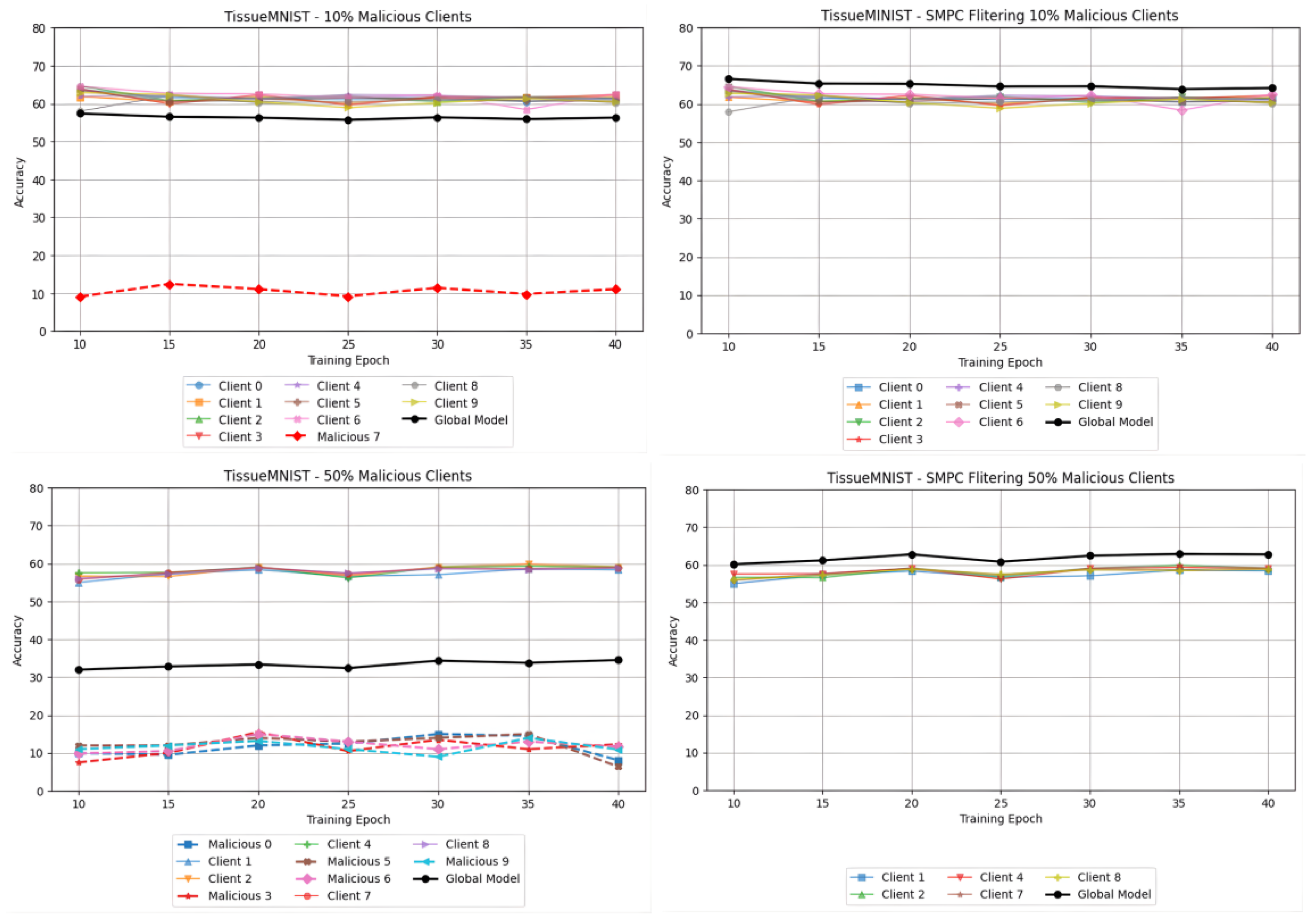
When simulated label flipping is introduced, the performance of FL systems is degraded. In the OCTMNIST dataset, 10% label flipping out of ten clients resulted in similar accuracy to FL training, but 50% label flipping reduced the accuracy to 46.34%. While the 10% label flipping reduced the performance to 57.12, and 35.21% for 50% label flipping in the TissueMNIST dataset.
SMPC effectively preserves the confidentiality of the aggregation process, and the results for OCTMNIST and TissueMNIST show significant enhancements in performance. As expected, SMPC achieves an accuracy of 83.20% for OCTMNIST under 10% label flipping, and 81.86% under 50% label flipping.
For the TissueMNIST dataset, SMPC helps maintain stable aggregation behavior under adversarial training conditions. It shows improvements of 66.86% and 63.94% for the two label-flipping cases.
For the PoW, the results show that it achieves a performance of 83.89% with 10% label flipping for OCTMNIST, which is slightly better than SMPC, despite the 50% label flipping recorded of 76.62% accuracy. For TissueMNIST, PoW achieves 67.16% with 10% label flipping and 64.14% with 50% label flipping.
PoS provides the best performance on both datasets; this improvement is attributed to reliability-aware client weighting, which reduces the influence of consistently low-performing updates during aggregation. In the OCTMNIST dataset, PoS 10% and PoS 50% get 87.85% and 88.66%, respectively. This is much better than both SMPC and PoW methods.
In TissueMNIST, PoS outperforms alternative approaches, achieving scores of 69.8% and 68.14% for 10% and 50% label flipping, respectively. The effective execution of PoS with both datasets demonstrates its capability to stabilize and safeguard the FL process.
These results indicate that consensus-aware aggregation plays a critical role in stabilizing federated learning under adversarial conditions. In particular, the PoS-based strategy demonstrates that reliability-aware client weighting can enhance robustness while reducing computational overhead, making it more suitable for large-scale healthcare deployments than PoW and cryptography-heavy defenses.
Author Contributions
Conceptualization, R.H.A.; Methodology, R.H.A.; Software, R.H.A.; Validation, R.H.A.; Investigation, R.H.A.; Resources, R.H.A.; Data curation, R.H.A.; Writing—original draft preparation, R.H.A.; Writing—review and editing, R.H.A.; Visualization, R.H.A.; Supervision, F.O.B. and E.F.K.; Project administration, F.O.B. and E.F.K. All authors have read and agreed to the published version of the manuscript.
Funding
This research was funded by the General Authority for Defense Development (GADD), Saudi Arabia, Grant No. GADD_2024_01_0401.
Data Availability Statement
The data presented in this study are openly available in MedMNIST at
https://medmnist.com/ (accessed on 1 January 2026).
Acknowledgments
The authors would like to acknowledge the General Authority for Defense Development (GADD), Saudi Arabia, for their support of this research.
Conflicts of Interest
The authors declare no conflicts of interest.
References
- Chikhaoui, E.; Alajmi, A.; Larabi-Marie-Sainte, S. Artificial intelligence applications in healthcare sector: Ethical and legal challenges. Emerg. Sci. J. 2022, 6, 717–738. [Google Scholar] [CrossRef]
- Kumar, K.; Kumar, P.; Deb, D.; Unguresan, M.L.; Muresan, V. Artificial intelligence and machine learning based intervention in medical infrastructure: A review and future trends. Healthcare 2023, 11, 207. [Google Scholar] [CrossRef]
- Zhang, C.; Xie, Y.; Bai, H.; Yu, B.; Li, W.; Gao, Y. A survey on federated learning. Knowl.-Based Syst. 2021, 216, 106775. [Google Scholar] [CrossRef]
- Ren, Y.; Hu, M.; Yang, Z.; Feng, G.; Zhang, X. BPFL: Blockchain-based privacy-preserving federated learning against poisoning attack. Inf. Sci. 2024, 665, 120377. [Google Scholar] [CrossRef]
- Bagdasaryan, E.; Veit, A.; Hua, Y.; Estrin, D.; Shmatikov, V. How to backdoor federated learning. In Proceedings of the International Conference on Artificial Intelligence and Statistics, PMLR, Virtual, 26–28 August 2020; pp. 2938–2948. [Google Scholar]
- Yazdinejad, A.; Dehghantanha, A.; Karimipour, H.; Srivastava, G.; Parizi, R.M. A robust privacy-preserving federated learning model against model poisoning attacks. IEEE Trans. Inf. Forensics Secur. 2024, 19, 6693–6708. [Google Scholar] [CrossRef]
- Yang, J.; Shi, R.; Ni, B. Medmnist classification decathlon: A lightweight automl benchmark for medical image analysis. In Proceedings of the 2021 IEEE 18th International Symposium on Biomedical Imaging (ISBI), Nice, France, 13–16 April 2021; pp. 191–195. [Google Scholar]
- He, Z.; Xu, R.; Wang, B.; Meng, Q.; Tang, Q.; Shen, L.; Tian, Z.; Duan, J. Integrated blockchain and federated learning for robust security in internet of vehicles networks. Symmetry 2025, 17, 1168. [Google Scholar] [CrossRef]
- Xiong, H.; Zhao, Y.; Xia, Y.; Zhang, M.; Yeh, K.H. Da-fl: Blockchain empowered secure and private federated learning with anonymous authentication. IEEE Trans. Reliab. 2025, 74, 5133–5146. [Google Scholar] [CrossRef]
- Ahmed, A.A.; Alabi, O.O. Secure and scalable blockchain-based federated learning for cryptocurrency fraud detection: A systematic review. IEEE Access 2024, 12, 102219–102241. [Google Scholar] [CrossRef]
- Zhao, C.; Zhao, S.; Zhao, M.; Chen, Z.; Gao, C.Z.; Li, H.; Tan, Y.A. Secure multi-party computation: Theory, practice and applications. Inf. Sci. 2019, 476, 357–372. [Google Scholar] [CrossRef]
- Cao, B.; Zhang, Z.; Feng, D.; Zhang, S.; Zhang, L.; Peng, M.; Li, Y. Performance analysis and comparison of PoW, PoS and DAG based blockchains. Digit. Commun. Netw. 2020, 6, 480–485. [Google Scholar] [CrossRef]
- Sarhan, M.; Lo, W.W.; Layeghy, S.; Portmann, M. HBFL: A hierarchical blockchain-based federated learning framework for collaborative IoT intrusion detection. Comput. Electr. Eng. 2022, 103, 108379. [Google Scholar] [CrossRef]
- Mohammed, M.A.; Lakhan, A.; Abdulkareem, K.H.; Zebari, D.A.; Nedoma, J.; Martinek, R.; Kadry, S.; Garcia-Zapirain, B. Energy-efficient distributed federated learning offloading and scheduling healthcare system in blockchain based networks. Internet Things 2023, 22, 100815. [Google Scholar] [CrossRef]
- Kalapaaking, A.P.; Khalil, I.; Yi, X. Blockchain-based federated learning with SMPC model verification against poisoning attack for healthcare systems. IEEE Trans. Emerg. Top. Comput. 2023, 12, 269–280. [Google Scholar] [CrossRef]
- Dong, N.; Wang, Z.; Sun, J.; Kampffmeyer, M.; Knottenbelt, W.; Xing, E. Defending against poisoning attacks in federated learning with blockchain. IEEE Trans. Artif. Intell. 2024, 5, 3743–3756. [Google Scholar] [CrossRef]
- Gan, C.; Xiao, X.; Zhu, Q.; Jain, D.K.; Saini, A.; Hussain, A. Federated learning-driven dual blockchain for data sharing and reputation management in Internet of medical things. Expert Syst. 2025, 42, e13714. [Google Scholar] [CrossRef]
- Zhu, X.; Lai, T.; Li, H. Privacy-Preserving Byzantine-Resilient Swarm Learning for E-Healthcare. Appl. Sci. 2024, 14, 5247. [Google Scholar] [CrossRef]
- Tian, L.; Lin, F.; Gan, J.; Jia, R.; Zheng, Z.; Li, M. Pefl: Privacy-preserved and efficient federated learning with blockchain. IEEE Internet Things J. 2025, 12, 3305–3317. [Google Scholar] [CrossRef]
- Wan, C.; Wang, Y.; Xu, J.; Wu, J.; Zhang, T.; Wang, Y. Research on privacy protection in federated learning combining distillation defense and blockchain. Electronics 2024, 13, 679. [Google Scholar] [CrossRef]
- Bharath, B.; Shree, R.P.; Tadkal, S.; Mala, B.; Chandrkala, L.; Ashwini, S. Adaptive Trust-Driven Federated Learning with Blockchain for Secure AI Healthcare Diagnostics. Authorea Prepr. 2025. [Google Scholar] [CrossRef]
- Xu, M.; Li, X. FedG2L: A privacy-preserving federated learning scheme base on “G2L” against poisoning attack. Connect. Sci. 2023, 35, 2197173. [Google Scholar] [CrossRef]
- Liu, W.; He, Y.; Wang, X.; Duan, Z.; Liang, W.; Liu, Y. BFG: Privacy protection framework for internet of medical things based on blockchain and federated learning. Connect. Sci. 2023, 35, 2199951. [Google Scholar] [CrossRef]
- Myrzashova, R.; Alsamhi, S.H.; Hawbani, A.; Curry, E.; Guizani, M.; Wei, X. Safeguarding patient data-sharing: Blockchain-enabled federated learning in medical diagnostics. IEEE Trans. Sustain. Comput. 2024, 10, 176–189. [Google Scholar] [CrossRef]
- Sun, G.; Cong, Y.; Dong, J.; Wang, Q.; Lyu, L.; Liu, J. Data poisoning attacks on federated machine learning. IEEE Internet Things J. 2021, 9, 11365–11375. [Google Scholar] [CrossRef]
- Ma, Z.; Ma, J.; Miao, Y.; Liu, X.; Choo, K.K.R.; Deng, R.H. Pocket diagnosis: Secure federated learning against poisoning attack in the cloud. IEEE Trans. Serv. Comput. 2021, 15, 3429–3442. [Google Scholar] [CrossRef]
- Targ, S.; Almeida, D.; Lyman, K. Resnet in resnet: Generalizing residual architectures. arXiv 2016, arXiv:1603.08029. [Google Scholar] [CrossRef]
- Al-Hejri, A.M.; Sable, A.H.; Al-Tam, R.M.; Al-Antari, M.A.; Alshamrani, S.S.; Alshmrany, K.M.; Alatebi, W. A hybrid explainable federated-based vision transformer framework for breast cancer prediction via risk factors. Sci. Rep. 2025, 15, 18453. [Google Scholar] [CrossRef]
- Almutairi, S.; Barnawi, A. A comprehensive analysis of model poisoning attacks in federated learning for autonomous vehicles: A benchmark study. Results Eng. 2024, 24, 103295. [Google Scholar] [CrossRef]
- Dib, O.; Li, S.; Li, Z.; Abdallah, R.; Diallo, E.H. FL-SMPC++: A Robust Framework for Privacy-Preserving Federated Learning. Results Eng. 2025, 28, 107380. [Google Scholar] [CrossRef]
- Latif, S.; Ahmad, J.; Al Malwi, W.; Asiri, F.; Alnazzawi, N.; Yang, J.; Gadekallu, T.R. Mitigating Model Poisoning and Tampering in Consumer IoT With HMAC in Split Federated Learning. IEEE Trans. Consum. Electron. 2025, 71, 12312–12322. [Google Scholar] [CrossRef]
- Benaissa, A.; Retiat, B.; Cebere, B.; Belfedhal, A.E. Tenseal: A library for encrypted tensor operations using homomorphic encryption. arXiv 2021, arXiv:2104.03152. [Google Scholar] [CrossRef]
- Aggarwal, S.; Kumar, N. Cryptographic consensus mechanisms. In Advances in Computers; Elsevier: Amsterdam, The Netherlands, 2021; Volume 121, pp. 211–226. [Google Scholar]
- Nguyen, C.T.; Hoang, D.T.; Nguyen, D.N.; Niyato, D.; Nguyen, H.T.; Dutkiewicz, E. Proof-of-stake consensus mechanisms for future blockchain networks: Fundamentals, applications and opportunities. IEEE Access 2019, 7, 85727–85745. [Google Scholar] [CrossRef]
- King, S.; Nadal, S. PPCoin: Peer-to-Peer Crypto-Currency with Proof-of-Stake. White Paper, 2012. Available online: https://peercoin.net/assets/paper/peercoin-paper.pdf (accessed on 9 February 2026).
- Al-Maamari, M.R.; Ramteke, R.; Al-Hejri, A.M.; Alshamrani, S.S. Integrating CNN and transformer architectures for superior Arabic printed and handwriting characters classification. Sci. Rep. 2025, 15, 29936. [Google Scholar] [CrossRef] [PubMed]
- Al-Hejri, A.M.; Al-Tam, R.M.; Fazea, M.; Sable, A.H.; Lee, S.; Al-Antari, M.A. ETECADx: Ensemble self-attention transformer encoder for breast cancer diagnosis using full-field digital X-ray breast images. Diagnostics 2022, 13, 89. [Google Scholar] [CrossRef] [PubMed]
- Al-Tam, R.M.; Al-Hejri, A.M.; Narangale, S.M.; Samee, N.A.; Mahmoud, N.F.; Al-Masni, M.A.; Al-Antari, M.A. A hybrid workflow of residual convolutional transformer encoder for breast cancer classification using digital X-ray mammograms. Biomedicines 2022, 10, 2971. [Google Scholar] [CrossRef]
- Al-Hejri, A.M.; Al-Tam, R.M.; Sable, A.H.; Almuhaya, B.; Alshamrani, S.S.; Alshmrany, K.M. A hybrid vision transformer with ensemble CNN framework for cervical cancer diagnosis. BMC Med. Inform. Decis. Mak. 2025, 25, 411. [Google Scholar] [CrossRef] [PubMed]
- Al-Tam, R.M.; Al-Hejri, A.M.; Alshamrani, S.S.; Al-antari, M.A.; Narangale, S.M. Multimodal breast cancer hybrid explainable computer-aided diagnosis using medical mammograms and ultrasound Images. Biocybern. Biomed. Eng. 2024, 44, 731–758. [Google Scholar] [CrossRef]
- Yang, F.; Zhou, W.; Wu, Q.; Long, R.; Xiong, N.N.; Zhou, M. Delegated proof of stake with downgrade: A secure and efficient blockchain consensus algorithm with downgrade mechanism. IEEE Access 2019, 7, 118541–118555. [Google Scholar] [CrossRef]
Figure 1.
The proposed PoS-based blockchain federated learning workflow.
Figure 2.
Accuracy performance comparison between centralized learning, FL global model, and average client accuracy: (a) OCTMNIST. (b) TissueMNIST. Reported results represent average performance trends observed across repeated experimental runs.
Figure 3.
Performance of the OCTMNIST dataset under poisoning attack scenarios and SMPC-based secure aggregation. Reported results represent average performance trends observed across repeated experimental runs.
Figure 4.
Performance of the TissueMNIST dataset under poisoning attack scenarios and SMPC-based secure aggregation. Reported results represent average performance trends observed across repeated experimental runs.
Figure 5.
Performance of the FL framework under PoW and PoS consensus mechanisms on the OCTMNIST dataset. Reported results represent average performance trends observed across repeated experimental runs.
Figure 6.
Performance of the FL framework under PoW and PoS consensus mechanisms on the TissueMNIST dataset. Reported results represent average performance trends observed across repeated experimental runs.
Table 1.
Blockchain-based federated learning defense and attack-resilient methods in healthcare.
| Reference | Method | Key Results | Remarks |
|---|
| Mohammed et al. (2023) [14] | EDFOS (Blockchain FL) | 39% power reduction; 29% faster training | Energy efficient; simulation only |
| Dong et al. (2024) [16] | Stake-based blockchain FL | Outperforms FedAvg under poisoning | Single-dataset validation |
| Gan et al. (2025) [17] | Dual-blockchain FL | Improved poisoning resilience | High system complexity |
| Zhu et al. (2024) [18] | PBSL (Blockchain + FHE) | Accuracy drop: 98% to 96% (50% attackers) | Strong privacy; scalability issues |
| Tian et al. (2025) [19] | PEFL | Improved efficiency and security | Deployment challenges |
| Kalapaaking et al. (2024) [15] | Blockchain FL + SMPC | 30% acc. loss (10% attackers); 50% (50%) | Secure but accuracy-sensitive |
| Wan et al. (2024) [20] | Blockchain + distillation | Higher accuracy; adversarial robustness | Simulation only |
| B. M. B. et al. (2025) [21] | ATB-FL | 95.1% diagnostic accuracy | Scalability limits |
| Xu and Li (2023) [22] | FedG2L | 55% acc. gain; 60% attack reduction | Limited threat model |
Table 2.
Dataset sampling splitting for training, validation, and testing.
| Dataset | Total Samples | Training Set | Validation Set | Testing Set |
|---|
| TissueMNIST | 236,386 | 165,466 | 23,640 | 47,280 |
| OCTMNIST | 109,309 | 97,477 | 10,832 | 1000 |
Table 3.
The hyperparameter of the proposed FL approaches.
| Variables | Description |
|---|
| Number of Clients | 10 |
| Data Splitting per Client | 80%, 10% and 10% |
| Number of Labels | 4 in OCTMNIST, and 8 in TissueMINIST |
| Learning Rate | 0.001 |
| Batch Size | 32 |
| Epochs | 10 |
| Rounds | 40 |
Table 4.
Sensitivity analysis of stake threshold values.
| Stake Threshold () | Accuracy (%) |
|---|
| 0.4 | 89.6 ± 1.2 |
| 0.5 | 93.4 ± 0.8 |
| 0.6 | 92.9 ± 1.0 |
Table 5.
Performance results of centralized learning for both datasets. Reported values correspond to average performance obtained across repeated experimental runs.
| Symbol | Description |
|---|
| n | Number of participating clients |
| The i-th client, where |
| r | Federated learning round index |
| Total number of federated learning rounds |
| Local model trained by client |
| Global model |
| Local validation accuracy of client |
| Collection of local model weights selected for aggregation |
| Accuracy values used for aggregation-related decisions |
| Reputation-based stake assigned to client |
| Length of the model parameter vector |
Table 6.
Performance results of the FL architecture on both datasets. Reported values correspond to the average performance obtained across repeated experimental runs.
| Dataset | ACC | PRE | REC | F1 Score |
|---|
| OCTMNIST | 72.60 | 78.41 | 72.12 | 70.36 |
| TissueMNIST | 63.92 | 64.12 | 64.00 | 64.28 |
Table 7.
Performance results of the FL architecture on both datasets.
| Dataset | Global Model Accuracy (%) | Average Client Accuracy (%) |
|---|
| 1st Round | Last Round | 1st Round | Last Round |
|---|
| OCTMNIST | 25.90 | 74.60 | 70.33 | 72.58 |
| TissueMNIST | 43.09 | 64.23 | 54.66 | 59.37 |
Table 8.
Comparison with the Byzantine robust Krum aggregation method under 50% poisoning.
| Method | Accuracy (%) | Aggregation Time (s) |
|---|
| FedAvg | 72.1 | 1.00 |
| Krum | 81.3 | 1.45 |
| Proposed (PoS) | 89.4 | 1.12 |
Table 9.
The discussion of the performance results for all the proposed FL approaches for both datasets.
| Dataset | Centralized Learning | Federated Learning | Flipping Label | SMPC | PoW | PoS |
|---|
| OCTMNIST | 72.60% | 74.60% | 10% (73.93) | 83.20% | 83.89% | 87.85% |
| 50% (46.34) | 81.86% | 76.62% | 88.66% |
| TissueMNIST | 63.92% | 64.23% | 10% (57.12) | 66.86% | 67.16% | 69.80% |
| 50% (35.21) | 63.94% | 64.14% | 68.14% |
Table 10.
The complexity time in seconds per round of training for all the proposed FL approaches for both datasets.
| Dataset | Centralized | Fed | SMPC | PoW | PoS |
|---|
| s/Epoch | s/Round | s/Round | s/Round | s/Round |
|---|
| OCTMNIST | 88.50 | 512.78 | 3511 | 877.85 | 123.56 |
| TissueMNIST | 107.65 | 872.70 | 5972 | 1491.80 | 210.17 |
Table 11.
The comparison of the proposed approaches to the related previous studies.
| Study | Year | Dataset | Methodology | Performance Accuracy |
|---|
| A. P. Kalapaaking et al. [15] | 2024 | OCTMNIST, TissueMNIST | Blockchain + SMPC, Model verification | Reduced accuracy by 30% for 10% malicious clients, 50% drop for 50% malicious clients |
| X. Zhu, et al. [18] | 2024 | MNIST, FashionMNIST | Blockchain + fully homomorphic encryption | Accuracy dropped by 2% from 98% to 96% with 50% malicious clients |
| B. M. B. et al. [21] | 2025 | CIC-IoMT 2024 | Behavior-based blockchain authentication | 95.1% diagnostic accuracy, reduced misclassification |
| M. Xu and X. Li [22] | 2023 | Not specified | Gradient-similarity-based secure consensus algorithm | 55% improvement in accuracy, 60% reduction in poisoning attacks |
| W. Liu, et al. [23] | 2023 | MNIST, CIFAR-10 | Blockchain + federated learning + GANs | Reduced attack success rates (26% on MNIST, 23% on CIFAR-10) |
| Z. Ma, et al. [26] | 2022 | Multiple datasets | Random forest-based federated learning | Accuracy range 84.3, even with increased poisoning. |
| Proposed Work | 2025 | OCTMNIST, TissueMNIST datasets | ResNet18, SMPC-based secure aggregation, Blockchain consensus mechanisms (PoW and PoS) | 88.66% for OCTMNIST, and 69.8% for TissueMNIST |
| Disclaimer/Publisher’s Note: The statements, opinions and data contained in all publications are solely those of the individual author(s) and contributor(s) and not of MDPI and/or the editor(s). MDPI and/or the editor(s) disclaim responsibility for any injury to people or property resulting from any ideas, methods, instructions or products referred to in the content. |