Article

Adoption of Generative AI in Higher Education: Perceptions of Journalism Students
by
Laura Alonso-Muñoz
* and
Andreu Casero-Ripollés
Department of Communication Sciences, Faculty of Social Sciences and Humanities, Jaume I University of Castelló, 12071 Castelló de la Plana, Castelló, Spain
*
Author to whom correspondence should be addressed.
Information 2026, 17(2), 189; https://doi.org/10.3390/info17020189
Submission received: 31 December 2025 / Revised: 8 February 2026 / Accepted: 10 February 2026 / Published: 13 February 2026
(This article belongs to the Special Issue Digital Technologies for Communication in the Age of AI)

Abstract

Higher education has undergone a profound transformation since the release of ChatGPT in November 2022. The introduction of this tool generated immediate interest among students while simultaneously provoking concern among faculty, who perceived it as an unparalleled pedagogical challenge. This study aims to analyze how university students use generative Artificial Intelligence (Gen AI). To this end, an online survey (n = 281) was administered to journalism students at the Universitat Jaume I de Castelló (Spain). Specifically, the study examined the frequency of use, academic applications, interaction patterns, evaluation of outcomes, and ethical perspectives regarding GenAI tools. The results indicate that 93% of students report using Gen AI, with significantly higher usage among advanced students (i.e., 3rd and 4rth academic year Journalism degree students) [F(1, 279) = 11.09, p < 0.001, n2 = 0.038]. Moreover, 77.2% of respondents use it for learning or studying, while 44.2% use it to complete class assignments. Regarding motivation, the data show that students primarily turn to artificial intelligence to perform tasks more efficiently and effectively and to achieve better results. Although students acknowledge certain risks in the academic use of Gen AI, they perceive its benefits more clearly than its limitations. Additionally, they are aware that they need more AI literacy. These findings provide valuable insights for reorienting undergraduate curricula to address the challenges of generative AI and to educate students on its ethical and appropriate use.

1. Introduction

The emergence of Chat GPT in November 2022 represented a turning point in the field of higher education. The appearance of this free, easily accessible, and intuitive software generated curiosity and enthusiasm among students, while provoking concern among some faculty members [1]. Regarded as the fourth revolution of technology in education [2], Artificial Intelligence (henceforth AI) brings with it a range of possibilities that can assist educators in innovating and facilitating parts of their workload. However, it also entails a series of challenges related, among other issues, to the authenticity of content and potential academic misconduct.
AI is not a new technology. Its existence dates to the 1950s, specifically to 1956, when Professor John McCarthy of Stanford University used the term to describe the science and engineering of making intelligent machines [3,4]. We can define AI systems as “the capacity of a machine to imitate human and intelligent behaviour” [5]. One branch of this technology is Generative Artificial Intelligence (henceforth Gen AI), whose purpose is the creation of original content from a collection of pre-existing data. These AI systems employ advanced techniques, such as deep learning and generative neural networks, to autonomously create data, text, images, sound, or other types of content [6]. Nevertheless, Gen AI creates an illusion of rational thought; yet it neither reasons nor possesses entirely reliable knowledge [7].
Gen AI tools have the potential to revolutionize teaching and learning [8,9], and their impact can be observed from the perspectives of both educators and students. Thus, for instance, students can enhance their learning by employing AI to contrast or critique their writing, explore concepts, and personalize their learning experience [10]. From the educators’ perspective, Gen AI can facilitate the performance of minor or administrative tasks, allowing them to increase their dedication to pedagogical tasks or those involving a higher intellectual load [11]. It is not merely a matter of Gen AI functioning as a content creator, but rather it enhancing their intelligence and creativity [12], thereby improving their teaching practice.
However, there are no opportunities without risks. Among the primary concerns of educators regarding Gen AI is the possibility of students using it dishonestly, for example, for cheating [10,13] or plagiarism [14,15]. There is also concern that students may be unaware of the biassed and ideologically charged responses offered by these technologies [10], as well as the lack of privacy involved in sharing personal data with these systems [16]. Nevertheless, what concerns educators most is that Gen AI may hinder students’ critical thinking [17]. In other words, educators believe that the regular use of Gen AI can diminish students’ ability to analyze and evaluate information objectively, logically, and impartially to form their own opinion, a basic and fundamental competence in higher education.
In the face of the challenges posed by Gen AI to higher education, the response from educators has been diverse. Some have introduced this technology into their teaching and integrated it smoothly and naturally, while others have been opposed to its use and have banned it in their classrooms [18]. What is clear, however, is that beyond this dichotomy, the focus must be placed on the need for responsible and transparent use of Gen AI by both teachers and students. To this end, this technology must be employed by addressing both ethics and the promotion of critical thinking [19]. In other words, educators must explain how Gen AI can be used responsibly [20], as well as reflect upon and verify the coherence of each proposal. In this context, AI literacy is essential [21], and “higher education educators have the responsibility to prepare students to interact with generative AI technology in an ethical and responsible manner” [11]. In this regard, Long and Magerko [22] argue that the ability to use AI to solve problems both inside and outside the classroom is an essential component of AI literacy. By acquiring these skills, students can understand the real impact of AI on individuals and society and gain a deeper understanding of what this technology entails.
The widespread adoption of Gen AI in education has highlighted the need to establish a joint institutional response [23]. Thus, the European Union (EU) has committed to regulating AI to protect individuals’ rights and promote AI literacy, consistently ensuring ethics and equity [24]. In relation to the field of education, the EU has developed multiple initiatives such as, for example, the Digital Education Action Plan (2021–2027) [25], which highlights the need to establish clear guidelines on the use of AI in education, the promotion of training in digital competences, and the protection of personal data; or the White Paper on Artificial Intelligence [26], which offers a regulatory framework for AI in Europe, always from an ethical perspective.
Supranational organizations such as the United Nations Educational, Scientific and Cultural Organization (UNESCO) have published a series of guides aimed at guiding the ethical and safe use of the technology. On the one hand, in its “Guidance for generative AI in education and research” [27], it offers an ethical framework for researchers and educators for the implementation of these tools following a humanistic approach that prioritizes values such as inclusion, equity, and data protection, assessing both AI’s risks and benefits and suggesting the need to establish pedagogical validations for its responsible development. On the other hand, UNESCO has developed an AI competency framework for teachers aimed at empowering educators to integrate these technological tools into their teaching practices “in a safe, effective, and ethical manner” [28]. These guidelines emphasize that the acquisition of AI-related competencies should be progressive and tailored to educators’ level of knowledge and professional experience.
At an empirical level, the study by Chen et al. [29] explores AI literacy among university students across various disciplines by analyzing four dimensions: adoption, interaction, evaluation, and ethical perception. The results obtained demonstrate that university students primarily use AI as an assistant for idea generation to complete their academic tasks. However, although the students surveyed in Chen et al.’s study demonstrate critical capacity and verify the results obtained with the help of AI, they show questionable ethics, given that the majority do not consider the use of AI as a breach of academic integrity. These data demonstrate the need to integrate AI literacy into university studies, as well as the creation of explicit policies that guide students toward the ethical and responsible use of these technologies.

Gen AI in Journalism Education

GenAI has become an indispensable tool for developing a career in journalism [30] and an essential requirement for becoming a journalist [31]. Nevertheless, this type of technological tool, based on large language models (LLMs), is a disruptive innovation that forces us to rethink the role of journalists, as it has a significant impact on information production processes [32,33].
Despite this, there has been a time lag between the media and academic sectors in the adoption of GenAI [34]. Specifically, the former has been employing this technology more rapidly than journalism faculties [35]. In the latter, there is tension between traditionalist professors, who see GenAI as a threat and react with restrictions and prohibitions, and innovative professors who integrate it into the classroom [36] because they perceive it as a cognitive partner that can improve productivity and creativity in the field of journalism [37]. Some studies advocate enhancing academia–industry collaboration [38] to avoid the risk of graduates entering the labour market with obsolete technical skills [34] and being ill-prepared for their careers [39].
The spread of GenAI in both the professional and academic fields of journalism is now an established fact. Various studies identify the frequent use of these technologies among journalism students [40,41], with ChatGPT being one of the most widely used. However, regional differences have been detected in the use of these tools among students, creating a territorial divide between North America and Europe on the one hand, and Latin America on the other [31]. Although the use of GenAI is common, journalism students have a superficial understanding of how these tools actually work and have misconceptions about their biases, risks, and ‘hallucinations’ [30,32,41].
Previous research has identified several key beliefs of journalism students regarding the use of GenAI. One of these is the advantages this technology brings to productivity, as it acts as an effective assistant in repetitive non-editorial tasks, such as grammatical correction, allowing more time to be devoted to complex and creative research [42]. Additionally, students use these tools to generate new ideas [39]. Although GenAI is a good starting point for improving journalistic productivity, it can easily become a crutch [39]. Further, the prevailing view among students is that these tools are assistants but not substitutes for journalists [31]. However, from the educators’ point of view, GenAI has the potential to produce simple and brief news items but loses quality in more complex and hybrid journalistic articles [40]. This technology also offers interesting opportunities to generate more personalized content, according to students [42,43]. In contrast, these tools can lead to a risk of homogenization of journalistic content [44], to technological blindness, as students accept the results offered by GenAI as if they were objective without questioning their veracity or biases [45], and, finally, to cognitive laziness, since if students delegate the entire thought process to this technology, they lose the ability to develop their own original journalistic voice and lose contact with information sources and social reality [37].
Another key aspect of journalism students’ views on GenAI is the ethical dimension. Here, an ambivalent perception prevails [30], whereby they admit that this technology can produce errors when it lacks information (hallucinations) and lead to an increase in disinformation, but they trust that human supervision will correct these risks. This concern is shared by professional journalists who consider ethics to be important in the use of these tools, as they can lead to a lack of fact-checking, bias and an absence of transparency about how the algorithms work [44]. For their part, journalism students believe that these tools lack a moral compass and, therefore, human journalists need to guide them and retain full control of editorial processes [42]. In this sense, journalists must enhance their human skills (intuition, creativity, and critical thinking) to supervise the content generated by Gen AI [35]. In this context, educators emphasize the importance of critical thinking and ethical judgement [46].
A third issue that shapes journalism students’ perceptions of GenAI is related to concerns about academic dishonesty arising from its use [40,43]. Some research reveals that this is a grey area, as students show great confusion about what constitutes plagiarism when using these technologies and believe that reviewing or slightly modifying content produced with GenAI gives it legitimacy [41]. However, students criticize the lack of clear regulations and fear being accused of AI misuse. They therefore emphasize transparency: educators should be clear about their expectations and students should disclose when and how they have used AI in their work [39].
Finally, another important element in student perceptions is the impact of GenAI on the future of their journalistic careers. Some studies have highlighted that this technology will increase job insecurity, especially in the Latin American context [36], or lead to mass layoffs [42]. On the contrary, other research suggests that GenAI generates a perception of self-efficacy among journalism students that helps reduce their job anxiety [45].
The consolidation of GenAI is having a major impact on journalism education. These technologies are forcing a change in the assessment model, which must shift from focusing on the final product to addressing the process of creation, research and critical thinking behind that product [37]. Several studies agree that in this new scenario, journalism studies should not treat AI as an isolated subject in course programmes but rather integrate it, systemically, into all phases and processes of journalism [45]. Additionally, it is essential not only to teach how to use GenAI operationally and instrumentally, through ‘prompt engineering’ [37], but also to incorporate training in deep technological literacy [30] based on critical pragmatism that enables students to supervise these tools by applying ethical standards and critical thinking [32]. This means moving towards a techno-humanist, pyramid-shaped educational model that prioritizes practical training, critical thinking, and ethics [38]. There is widespread consensus in previous research that it is necessary to promote AI literacy in journalism studies [30,31,32,36]. Finally, these new skills pose a challenge for educators. In this regard, some studies report that while universities are focusing their efforts on equipping students with new skills and knowledge about GenAI, there is a lack of institutional initiatives and programmes for training faculty members in this field, which may lead to an educational gap [46].
In this context, Journalism Studies educators cannot ignore the rise of Gen AI in this discipline, nor can they ignore the fact that students use Gen AI regularly. Building on the framework established by Chen et al. [29], this research addresses a significant empirical gap in the current literature. While prior studies have explored AI literacy in broad, multi-disciplinary contexts, there is a regional paucity of data specifically focusing on Spanish journalism students. This population is particularly informative given the transformative impact of generative AI on the media industry and the urgent need for future communicators to master critical verification skills. Furthermore, unlike previous exploratory works, this study provides fine-grained measures across five specific domains (i.e., frequency, academic application, interaction, evaluation, and ethics) to offer a more nuanced understanding of how Spanish journalism students are integrating these tools into their professional preparation.
Therefore, considering all the above, this work poses the following research questions:
  • RQ1. How frequently do Journalism Studies students use Gen AI?
  • RQ2. How do Journalism Studies students use Gen AI to perform their academic tasks?
  • RQ3. How do Journalism Studies students evaluate the responses they obtain when interacting with Gen AI?
  • RQ4. What is the ethical view that Journalism Studies students have regarding the use of Gen AI at an academic level?
  • RQ5. How do Journalism Studies students wish to be trained in Gen AI?

2. Materials and Methods

To address these research questions, this exploratory study is based on the online survey technique. The questionnaire was launched in October 2025 via the Qualtrics platform to all Journalism Studies students at the Universitat Jaume I de Castelló (Spain). Out of a total of 360 students, 281 responded to the questionnaire, representing 78.05% of the total population. In this sense, according to the mathematical calculation of the sampling error, with a confidence level of 95%, the sample of 281 students presents an approximate sampling error of ±2.7%, which allows it to be considered statistically representative of the population under study.
Double stratification has been applied to the study sample: by gender and by educational level. Regarding gender, 58% (n = 163) of those surveyed are women, while 42% (n = 118) are men. This imbalance responds to the fact that, in recent decades, women have comprised the majority in university Journalism Studies in Spain [47]. Regarding the educational level, 49.8% (n = 140) of those surveyed are Starter Students (i.e., in the first and second years of their journalism studies), while 50.2% (n = 141) are Advanced Students (third and fourth year).
To understand the use of Gen AI by Journalism Studies students and its implications at various levels, the methodology proposed by Chen et al. [29] has been adapted. To this end, 30 questions are posed, divided into five domains: frequency, academic use, evaluation, ethics, and AI Literacy. Table 1 shows a summary of the domains, the description, and the type of questions included in each (for more information see Appendix A).
Data processing was carried out using the statistical software SPSS (v. 31). The study is descriptive in nature. However, to determine whether there were statistically significant differences between groups based on educational level and gender, an ANOVA test was performed. The survey complies with the ethical requirements established by the Universitat Jaume I de Castelló and has the approval of the Ethics Committee for Research Involving Human Beings (code CEISH/64/2025) on 23 September 2025.

3. Results

3.1. Frequency of Use and Type of Gen AI Tools Employed by Journalism Students

Of the students surveyed, 93.24% acknowledged using Gen AI, compared to 6.76% who stated that they did not. Specifically, 92.14% of Starter Students (95% CI [87.6%, 96.6%]) and 94.33% of the Advanced Students (95% CI [90.5%, 98.2%]) confirmed its use. When analyzed by gender, the prevalence remains high in both groups, with 91.53% of male students (95% CI [86.4%, 96.6%]) and 94.48% of female students (95% CI [90.9%, 98.0%]) reporting usage. The narrow range of these confidence intervals, coupled with low standard errors (ranging from 0.017 to 0.025), confirms the high precision of the percentage estimates across the different academic and demographic segments.
When respondents were asked about the frequency of using these tools, more than 60% of students admitted to using Gen AI very regularly, either daily or several times a week (Table 2). This demonstrates that the student body has highly internalized the use of these tools and has integrated them into their daily lives.
If the data are analyzed according to the educational level of the students, the ANOVA test results reveal statistically significant differences between both groups [F(1, 279) = 11.09, p < 0.001, n2 = 0.038]. In this sense, although the effect is medium (n2 = 0.038), it can be observed that Advanced Students (70.22%) make much more frequent use of these tools than Starter Students (52.14%) (Table 2). These data could be due to two factors. Firstly, students in the early years of Journalism Studies appear more cautious when using Gen AI in their tasks for fear that faculty may detect it and grade it as plagiarism or academic misconduct, as indicated by academic regulations regarding Gen AI use. Secondly, during the first two years of the degree, subjects are more theoretical, whereas in the third and fourth years, subjects are much more practical and professionalizing; therefore, these students manage a significantly higher workload than in previous years. In this context, Gen AI can be a powerful ally for saving time. Regarding gender (Table 2), the analysis of variance (ANOVA) indicates that statistically significant differences also exist between males and females [F(1, 279) = 4.15, p = 0.043, n2 = 0.015]. Thus, although a small effect is observed between groups (n2 = 0.015), the data show that females (64.42%) employ Gen AI more frequently in their daily lives than males (56.78%).
When respondents are asked about the type of Gen AI tools they habitually use (Table 3), we observe that 33.18% acknowledge opting for those of a generalist nature, such as Chat GPT or Gemini (an application to which they have access through via the university’s corporate account). Among specialized tools, those related to image and video stand out (9.56%), such as Canva or CapCut. However, they very infrequently use specialized audio tools like Moises or ElevenLabs, specialized text tools such as Grammarly or DeepL, or social media-related applications like Llama from Meta or Grok, owned by X. These data denote a lack of knowledge of more specialized artificial intelligence tools that could be more useful for performing more specific and complex tasks inherent to the field of journalism.
If the data are analyzed according to the educational level and gender of the respondents, it is observed that there are no major differences (Table 3). However, it is interesting to see how Advanced Students employ specialized text tools (7.10%) more frequently than Starter Students (2.37%). The same occurs with specialized image and video tools (15.10% vs. 11.40%). This may be because the types of tasks required of them are not the same, as the degree of difficulty and specialization increases as their training progresses. On the other hand, regarding gender, two points are observed. Firstly, females (14.08%) employ specialized image and video tools with a much greater frequency than males (8.60%). Secondly, males (11%) show significantly higher knowledge and use of AI tools inherent to social networks, especially Grok, compared to females (0.60%), who make very residual use of them.

3.2. Educational Uses of Gen AI by Journalism Students

When the students are asked what they typically use Gen AI for at an academic level, the results suggest that they employ it to perform most of the tasks habitually required in class (Table 4). In this sense, its use for learning/studying (77.22%) is particularly prominent, which indicates a use of AI similar to that of the Google search engine. In other words, students employ this technology to quickly and easily access information and content when they wish to clarify a concept or have doubts regarding issues explained in class. Furthermore, 44.13% of those surveyed acknowledge using it to complete class assignments, such as practical exercises. Given that a large proportion of the tasks required of students are related to the creation of journalistic products, we can infer that they employ assistants such as Chat GPT or Gemini to perform tasks inherent to the various phases of the journalistic production process, for instance, designing interview questionnaires, writing news stories, or adapting information for different media platforms.
It is noteworthy that 24.56% of those surveyed acknowledge employing Gen AI to perform communication-related tasks, such as writing an email (Table 4). Performing these types of tasks, considered minor, using Gen AI may lead to a reduction in the students’ cognitive capacity, thereby reducing critical thinking. Further, 22.06% use it to prepare class presentations. This datum is in line with the high percentage of students claiming to use Canva frequently.
If the data are analyzed according to educational level and gender, some interesting points are observed (Table 4). Firstly, statistically significant differences are observed regarding educational level, but not regarding gender. Thus, the data show that Advanced Students (50.35%) report having used Gen AI more frequently to perform their academic tasks [F(1, 279) = 4.49, p = 0.035, n2 = 0.016] than Starter Students (37.86%), as well as for learning and studying (83.69% vs. 70.71%) [F(1, 279) = 6.84, p = 0.009, n2 = 0.024] and performing communicative tasks (29.79% vs. 19.29%) [F(1, 279) = 4.21, p = 0.041, n2 = 0.015]. However, the magnitude of the differences between the groups is small (values ranging 0.15 to 0.24). These data are relevant given that, although we might presuppose that Advanced Students have more knowledge and skills than Starter Students and, consequently, a greater mastery of the field of journalism, they employ artificial intelligence much more than those students just beginning their studies who, therefore, possess less knowledge. In this context, it is concerning that students make abusive use of Gen AI to perform journalistic tasks, given that the paradox may arise of generating a new generation of professionals who have a high dependency on Gen AI to carry out their work and feel lost without this technology. For their part, Starter Students (25%) employ Gen AI more frequently to create presentations of their work.
When asked about the motivations that drive them to use these technologies, two stand out (Table 5). On the one hand, students sometimes felt that they had some original ideas but were stuck and needed help (81.85%) and, on the other, they did not understand the material or content provided by the faculty (59.07%). These data reflect a use of artificial intelligence related to the need to improve and develop tasks in a more efficient and effective manner to obtain better results.
At a lower level, 20.28% of those surveyed stated they employ Gen AI because it generates curiosity (Table 5). This datum reflects the need to adapt study plans and introduce Gen AI into the classroom so that students learn to use artificial intelligence in an effective and, above all, ethical manner.
The data also indicate negative motivations on the part of the students (Table 5). Some point out that they are afraid of doing the work poorly without the help of these technologies (16.73%) and, consequently, failing the subject. This denotes a lack of confidence in their own capacities, given that they believe they cannot perform the task on their own. Along these same lines, 17.79% acknowledge using it because little time remained to submit a particular task and they had not done it. This reveals that Gen AI is also employed as a resource to compensate for students’ poor planning and time management. In this sense, they prefer to opt for doing it with Gen AI, even if they deliver an exercise of inferior quality, rather than not submitting it.
Regarding motivations, the data show no statistically significant differences exist regarding educational level and gender of the Journalism Studies students. However, it can be observed that Advanced Students more frequently acknowledge that they employ Gen AI to give a push to their work when they find themselves stuck (86.52%) or to perform exercises to meet the deadline due to poor time planning (21.28%). It is also significant that 26.95% of Advanced Students acknowledge using this technology because they have been encouraged to do so by the faculty, compared to 4.29% of Starter Students. These data may reflect incipient educational improvements implemented in Journalism Studies, where faculty, especially those teaching third and fourth-year subjects, have decided to introduce the guided use of Gen AI in their subjects to improve training.

3.3. Journalism Students’ Evaluation Outcomes of Gen AI Tools

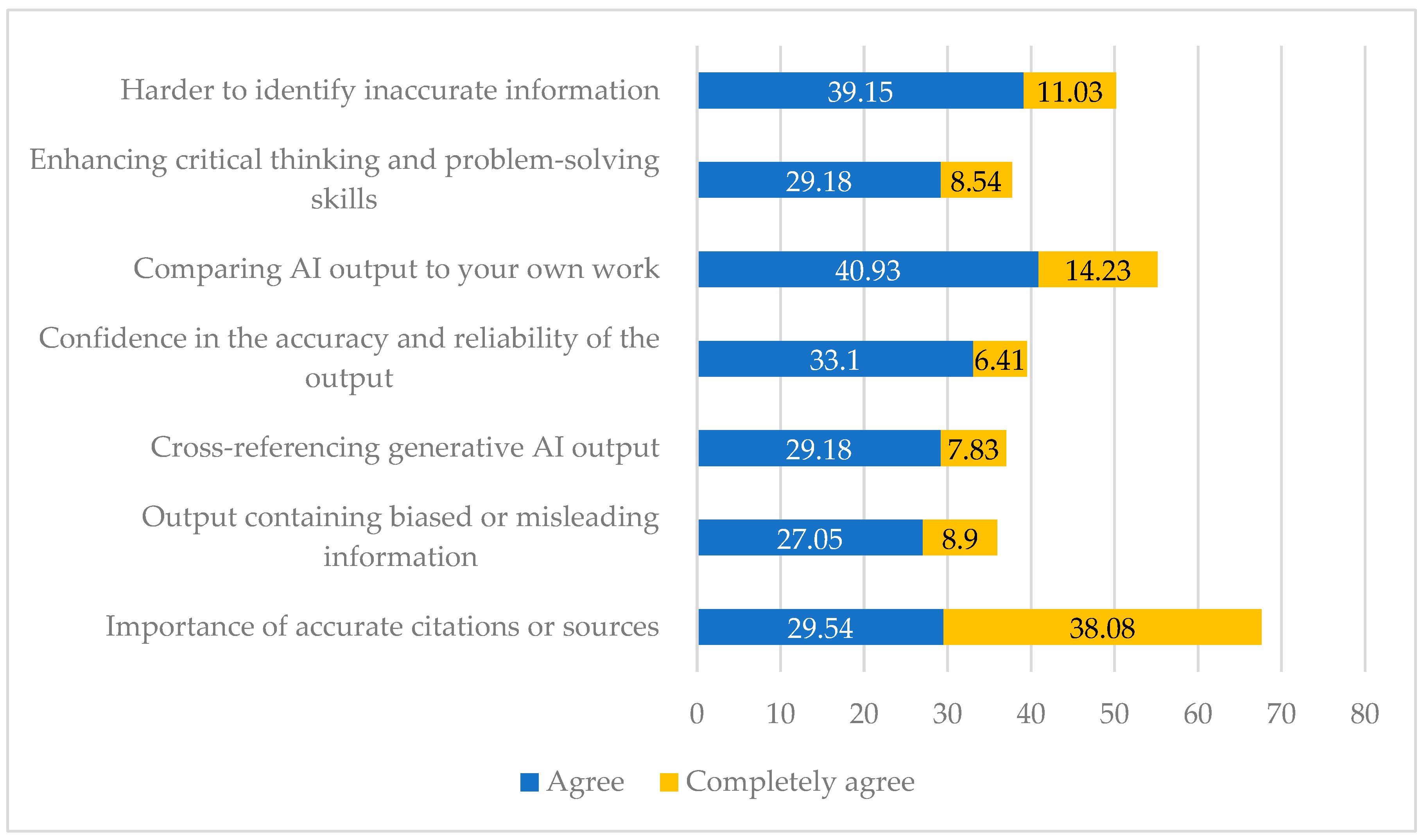
To determine whether students understand the limitations and capabilities of Gen AI tools, they were asked to evaluate the outcomes they received after interacting with them through seven questions (Figure 1). Thus, 67.62% consider it very important for the result obtained to include citations to the sources from which the information was derived. Furthermore, 55.16% acknowledge that it is extremely important to compare the results presented by Gen AI with those of one’s own production. This comparison can be useful for improving the quality of one’s own work.
Regarding concerns, half of those surveyed (50.18%) agree or strongly agree with the fact that they find it very complicated to identify inaccurate information in the outcomes they obtain from Gen AI (Figure 1). This leads to students frequently using AI to prepare their practical assignments and making fundamental errors due to an inability to discern correct information from incorrect data. A further 35.94% of respondents agree or strongly agree that the outcomes returned by these platforms are biassed or misleading, while approximately 60% distrust the outputs they receive. Furthermore, a vast majority (over 60%) do not consider that this technology will help them improve their critical thinking, but rather the opposite (Figure 1).
We observe, therefore, that in general terms, the student body recognizes the potential benefits of these tools for, for example, improving their own work. However, they also maintain a tentative critical posture regarding reliability, biases, and the need to verify the outcomes received. The results of the ANOVA test indicate that no statistically significant differences exist regarding the educational level or the gender of the respondents.

3.4. Ethical Perception of Journalism Students Regarding Gen AI Use in Academic Sphere

To understand the ethical perception of journalism students, they were asked three questions related to academic integrity and Gen AI (Table 6). Each answer has been evaluated on a five-level Likert scale, ranging from “completely disagree” (1) to “completely agree” (5). In the first instance, the results indicate that the student body has moderate knowledge of the academic regulations that govern the use of artificial intelligence in the university environment (M = 3.25; SD = 1.100). Nevertheless, students acknowledge being in considerable agreement (M = 3.57; SD = 1.120) with the fact that most of their peers employ artificial intelligence to cheat in their work. This suggests, on the one hand, a highly distrustful view towards other students and, on the other, that they assume and naturalize the idea that students do not always exhibit ethical behaviour when performing tasks required by faculty.
However, they are mostly in disagreement (M = 2.67; SD = 1.121) with the notion that the use of AI should be considered a violation of academic integrity at the university. These data indicate that the student body is not aware of the ethical implications that employing Gen AI can have, nor of the contradictions it may generate regarding areas such as intellectual property or creativity and how it can affect the decline in critical thinking, an essential aspect for a journalist.
Regarding ethical perceptions, the ANOVA test reveals no statistically significant differences with respect to either educational level or the gender of the respondents. In this sense, no major differences are observed between students in their first and final years, or between males and females.

3.5. AI Literacy and Training Preferences by Journalism Students

Students were asked how they would like to learn more about the use of Gen AI tools (Table 7). A total of 72.24% of students would like this type of knowledge to be included in the various subjects that comprise Journalism Studies, while 71.89% indicated they would like to learn more about these tools from the faculty. These data indicate that students are aware of the need for AI Literacy; despite knowing and using general Gen AI tools such as Chat GPT, Gemini, or Copilot, they do not know how to utilize them appropriately and do not take advantage of more specific tools that could be useful for journalistic tasks. On the other hand, 52.67% of those surveyed prefer to learn to use these tools by themselves autonomously, without supervision or help from the faculty.
A comparative analysis of the data reveals several significant findings (Table 7). Firstly, the ANOVA test results indicate statistically significant differences regarding educational level in two areas: the preference for learning about AI tools autonomously [F(1, 279) = 9.658, p = 0.002, n2 = 0.039] and the desire for more Gen AI content to be included in the Journalism Studies curriculum [F(1, 279) = 8.107, p = 0.005, n2 = 0.028]. In both cases, the scale of the effect is small. While these two points may appear contradictory, Advanced Students (58.87%) show both a greater predisposition toward self-directed learning and the strongest desire for formal Gen AI integration across their various subjects.
Secondly, regarding gender, the ANOVA test shows statistically significant differences only in the preference for being taught by faculty members F(1, 279) = 12.094, p < 0.001, n2 = 0.045]. In this case, we observe a medium-sized effect. In this regard, females (76.07%) show much higher values than males (66.10%), who lean more toward learning by themselves without the need for faculty guidance.

4. Discussion

The use of Gen AI in students’ daily life is a current reality. This is reflected in the results obtained in this research, which indicate that over 93% of respondents, that is, virtually all Journalism Studies students at the Universitat Jaume I, employ Gen AI. These data sit well above the average for the Spanish population [48], the European population [49] and the American population [47], which stand at 89%, 86% and 47.2%, respectively. Furthermore, more than 60% of journalism students use this technology daily or several times a week (RQ1).
The data also indicate that females who are currently in the final years of the degree programme are those who have most internalized its use in their daily lives. This might be because advanced courses contain much more practical content and subjects, and the workload is higher than that for Starter Students; therefore, employing Gen AI can help them manage and reduce that load.
Among the types of tools they claim to know and utilize, those of a generalist nature such as Chat GPT or Gemini stand out. These data are consistent with findings in other contexts, which highlighted that general-purpose Gen AI tools were the most frequently used by students [29,40,41]. Furthermore, it is important to note that the surveyed students have access to Gemini because Universitat Jaume I de Castelló has its corporate account linked to Google and this might be one of the main reasons for the students’ choice. In this respect, its ease of access and features, which are superior to the free version, may be an incentive.
On the other hand, we observe a notable lack of knowledge regarding specialized tools that are useful for performing journalistic work. In this sense, regarding these Gen AI tools, the use they make of those focused on audio or video formats is noteworthy, such as Canva, intended for creating presentations, or CapCut, which is used for video editing. These data are in line with the trends observed in other contexts [49,50]. In both cases, Advanced Students make more pronounced use of these types of tools. This might be explained by the type of tasks these students must develop, which are highly focused on the audiovisual component. This finding demonstrates the need to introduce these types of Gen AI tools in more specialized journalism subjects, drawing students’ attention to the existence of tools such as, for example, Notta.ai or Sonix.ai, which can mitigate some of the most tedious tasks for journalism students, such as the transcription of interviews.
Regarding the academic uses that Journalism students make of Gen AI (RQ2), we observe that they are highly varied. Nevertheless, nearly eight out of every 10 students acknowledge using it primarily for studying or learning. In other words, they employ Gen AI as a kind of search engine to clarify doubts and expand or complement the information explained in class by the teacher. In this sense, many students have replaced the traditional Google search, which on occasion was slower and more tedious, with the posing of questions to Chat GPT which, in a few seconds, offers a wide amount of information. The danger in this case, as teachers point out [10], is that they may accept the responses offered by Gen AI systems as valid without verifying or contrasting the information, and without being aware of the biases and ideologization of these tools. The data also indicate that almost half of those surveyed acknowledge employing Gen AI to perform evaluable tasks and practical exercises required by teachers. These findings are in line with those observed in previous studies: although they have detected frequent use of Gen AI by journalism students [40,41], they have also seen that they have superficial knowledge of the biases and risks of this technology [30,32,41].
The results also show that 9% of respondents acknowledge using Gen AI for taking exams, an aspect contrary to university academic regulations, which consider this fraudulent use of the technology. In this sense, although there are university guidelines that regulate the use of Gen AI, they are unclear, and students rely on this lack of regulation regarding the dishonesty involved in using these tools to carry out certain tasks [40,41,43]. This is an ever-increasing concern among teachers [10,13] that is leading some faculty members to rethink assessment tests with the objective of verifying that the student body has truly acquired basic competences to perform professional journalistic tasks without the need for Gen AI.
There are two key motivations that drive the student body to employ Gen AI to perform their assignments: on the one hand, the need to receive help to perform a task they have started to work on but do not know how to continue and, on the other, the lack of understanding of the materials or the task assigned by the teacher. In these cases, the use that students make of Gen AI stems from the need to improve their tasks in a more efficient way and thus achieve optimal results. A notable percentage of students claim that their use is due to curiosity. This datum reflects the need to adapt study plans and introduce Gen AI into the classroom so that students learn to use artificial intelligence in a safe, effective, and ethical manner [11,28]. Thus, as some studies maintain, we should not isolate Gen AI in a single subject but rather introduce it transversally into our curricula [45]. In this sense, we must not only teach students to perform ‘prompt engineering’ [37], but also teach them to use this technology critically [32] applying the principles of techno-humanism [38].
However, the results also reflect negative motivations in the use of Gen AI. On the one hand, the data indicate that some students feel insecure when performing a task alone, without the help of Gen AI. On the other, almost 20% acknowledge that they utilize it because the deadline is approaching and they have not completed the task. In this vein, they prefer to do the exercise using Gen AI, even if that implies cheating or making errors, rather than submitting nothing at all. Both dynamics can generate a long-term dependency on Gen AI and a reduction in student autonomy within learning processes.
Thirdly, regarding the evaluation that students perform of the outputs obtained after employing Gen AI (RQ3), half of those surveyed are concerned about the outputs because they do not know how to distinguish correct from incorrect information. Related to this, a third of respondents acknowledge that the outputs are biassed or contain misleading information, while 60% distrust the results obtained by employing Gen AI. From these data, it can be inferred that the student body maintains a critical attitude and is aware of the limitations of this technology. Nevertheless, despite this distrust, many students employ Gen AI regularly to perform their academic tasks. Thus, students perceive the benefits more clearly than the limitations in the use of Gen AI. This could lead to an underdevelopment of critical thinking on the part of the students, an issue that notably concerns teachers [17,46].
When ethical questions related to the use of Gen AI are analyzed (RQ4), the results indicate that the students have moderate knowledge of the university’s academic regulations governing its use. The majority considers that employing Gen AI to perform tasks required by faculty is not a violation of academic integrity in the university. This would explain the widespread use of this technology to perform assignments and, on the other hand, that they do not use it thinking that they are engaging in malpractice, but rather perceive this technology as an assistant to generate ideas, foster creativity, and improve their own contributions. However, these data contradict the fact that they acknowledge agreeing that most of their peers employ Gen AI to cheat in their work, which demonstrates a distrustful view regarding their peers and the assumption that many students’ behaviour is unethical. These data demonstrate the need to emphasize the ethical part of Gen AI use by the student body [17,38], preventing them from making an unintentional and erroneous use of these platforms [10,13,14,15,39].
Finally, regarding how Journalism students wish to be trained on Gen AI (RQ5), the data indicate that the majority would like this type of knowledge to be included in the different subjects of the training programme, as well as to learn more about them from the faculty. These data indicate, on the one hand, that students are aware that they need AI literacy because, despite knowing and using the most generalist tools, they are unaware of more specific tools that could best suit them for performing journalistic tasks. And, on the other hand, they underline the need for faculty to be trained in these matters to convey updated and rigorous knowledge of these tools, always from an ethical perspective that responds to values such as equity [24,25,26,27,28]. Thus, as previous research maintains, it is necessary to promote AI literacy among students [30,31,32,36].
Our findings allow for a radiographical analysis of the knowledge and use of Gem AI among Journalism students from various perspectives. This analysis offers educators a transversal vision to make improvements and adaptations in the different subjects of the training programme with the aim of introducing the use of Gen AI in the different phases of the journalistic production process. Thus, the findings of this research serve as an essential diagnostic tool for institutional decision-making. Specifically, the data provide the empirical basis required to redesign the journalism curriculum, ensuring that future pedagogical interventions and assessment frameworks are directly tailored to the specific gaps identified in students’ AI literacy and ethical awareness. This offers key insights to adapt content and knowledge to the requirements of the current labour market, strongly influenced by the emergence of Gen AI, and to continue training updated and versatile journalism professionals.

5. Conclusions

The emergence of Generative Artificial Intelligence (Gen AI) represents one of the most significant technological advances of the past decade, transforming a wide range of fields and disciplines. Its impact is also notable in the labour market, where its rapid development and consolidation have led to the redefinition of certain professions, including journalism.
This study provides valuable insights into how journalism students use Gen AI in the academic context, highlighting the need to strengthen ethical training and AI literacy. The data obtained allow us to analyze the use of this technology across five dimensions: frequency of use, academic use, evaluation of the results obtained, ethics, and AI literacy. At a time when democracies are increasingly threatened by phenomena such as disinformation, the role of journalism has become more vital than ever. In this context, technologies like Generative AI can serve as a powerful ally; however, it is essential to redesign academic curricula to ensure students learn to use these tools ethically and responsibly. This approach not only enhances their skills for a highly technological labour market but also allows for a comprehensive update of journalism training. The findings obtained in this research will allow us to redesign the journalism curriculum and adapt specific subjects to introduce GenAI in a transversal and ethical manner.
This research has three limitations. First, it is based on data from a survey conducted among journalism students at Universitat Jaume I; therefore, it would be necessary to administer the questionnaire to students from other degree programmes to determine whether the observed trends persist or whether differences emerge. Nevertheless, the findings may be extrapolated to other disciplines and academic contexts. Second, it is exploratory in nature, which results in a largely descriptive approach to the data. Consequently, while the study provides a valuable baseline, further research using longitudinal designs or advanced inferential tests is needed to establish causal mechanisms and validate the patterns observed in this initial phase. Finally, this study is limited by its lack of qualitative data. Future research should adopt qualitative methodologies to explore in greater depth the students’ perspectives on AI motivations and ethical considerations. Future studies could employ focus groups or semi-structured interviews to address these qualitative nuances.
Overall, these findings are useful for reorienting certain content taught in journalism training programmes, enabling them to adapt to the challenges posed by Gen AI and to educate students in the ethical and efficient use of this technology.

Author Contributions

Conceptualization, L.A.-M.; methodology, L.A.-M.; software, L.A.-M.; validation, L.A.-M. and A.C.-R.; formal analysis, L.A.-M.; investigation, L.A.-M.; resources, L.A.-M.; data curation, L.A.-M.; writing—original draft preparation, L.A.-M. and A.C.-R.; writing—review and editing, L.A.-M. and A.C.-R.; visualization, L.A.-M.; supervision, A.C.-R.; project administration, L.A.-M. and A.C.-R.; funding acquisition, L.A.-M. and A.C.-R. All authors have read and agreed to the published version of the manuscript.

Funding

This research is part of the educational innovation project under grant number 61265/26, funded by Universitat Jaume I of Castelló.

Institutional Review Board Statement

The study was conducted in accordance with the Declaration of Helsinki and approved by the Ethics Committee for Research Involving Human Beings of Universitat Jaume I de Castelló (protocol code CEISH/64/2025 and date of approval 23 September 2025).

Informed Consent Statement

Informed consent was obtained from all subjects involved in the study.

Data Availability Statement

Data will be made available on reasonable request by the corresponding author.

Conflicts of Interest

The authors declare no conflicts of interest.

Appendix A. Questionnaire Survey, Based on Chen et al. [29]

Sociodemographic variables
CourseFirst
Second
Third
Fourth
GenderMale
Female
Age
Frequency of use of gen AI tools
Do you use generative AI?No
Yes
How often do you use generative AI?I never use it.
I use it once every six months or less.
I use it once a month.
I use it once a week
I use it several times a month.
I use it several times a week
I use it daily.
Which generative AI tools do you use most often? Please select all options that apply.GeneralistsChat GPT
Gemini
Copilot
Bard AI
Claude
Perplexity
Specialized in audioEstudyfetch
Moises
WriteOut
ElevenLabs
Specialized in textDeepL
Humata
Compose
Grammarly
TinyWow
Noty.AI
Penélope.AI
PaperPal
WriteSonic
Quill
Smodin
Specialized in image and videoLeonardo
Canva
Dall-E
Firefly
Unprompt.AI
Lensgo
PromeAI
CapCut
PlayGround
Midjourney
Dall-E
Pictory
Fimora
ClipChamp
Runway
Heygen
SlideGo
Slides.AI
Tome
Specialized in social mediaGrok
Llama
Educational Use of Gen AI: academic work they use generative AI for and their reasons for such use
What do you use generative AI for in academia? Please select all options that apply.To do class assignments
To learn or study
To perform communication-related tasks such as, for example, writing an email
To make presentations
To conduct exams or tests
Others
For what reasons do you use generative AI in your class assignments? Please select all options that apply.I had some original ideas, but I was stuck and needed help.
I was curious to see what the result would be.
I didn’t understand the material/content that the teacher had given me.
I had little time left to hand in my assignment.
I was afraid of doing it wrong without help.
I thought the task the teacher had assigned me was irrelevant or unfair.
My teacher encouraged me to use it
Others
Evaluation: to assess the quality of the AI-generated content
Based on the responses obtained when using generative AI, express the degree of agreement or disagreement with the following statements (1 = completely disagree and 5 = completely agree)Importance of including citations or sources.
Results that contain biased or misleading information.
Cross-referencing of Gen AI results
Confidence in the accuracy and reliability of the results.
Comparing the Gen AI results with my own work.
Improvement of critical thinking and problem-solving skills.
Greater difficulty in identifying inaccurate information.
Ethics: ethical concerns about AI use, particularly regarding academic integrity
Indicate your level of agreement or disagreement with the following statements (1 = completely disagree and 5 = completely agree)I am very familiar with the Universitat Jaume I de Castelló academic integrity policy.
I believe that the use of generative AI in academic assignment should be considered a breach of academic integrity at the Universitat Jaume I de Castelló.
I believe that most university students use generative AI to cheat on their assignment.
AI Literacy: how they would like to find out more information about generative AI tools
By what means would you prefer to learn more about generative AI (1 = strongly disagree and 5 = strongly agree)I’ll investigate generative AI tools on my own.
I would like my degree to include content on the use of generative AI tools.
I would like to learn more from my teachers.
I’m not interested in knowing more.
Others.

References

  1. García-Peñalvo, F.J. La percepción de la Inteligencia Artificial en contextos educativos tras el lanzamiento de Chat GPT: Disrupción o pánico. Educ. Knowl. Soc. 2023, 24, e31279. [Google Scholar] [CrossRef] [Scilit]
  2. Prendes-Espinosa, M.P. La revolución de la Inteligencia Artificial en tiempos de negacionismo tecnológico. RiiTe Rev. Interuniv. Investig. Tecnol. Educ. 2023, 15, 1–15. [Google Scholar] [CrossRef] [Scilit]
  3. McCarthy, J. What is artificial intelligence? Eng. Mater. Des. 2004, 32, 1–14. [Google Scholar]
  4. Moor, J. The Dartmouth College Artificial Intelligence Conference: The Next Fifty Years. AI Mag. 2006, 27, 87. [Google Scholar] [CrossRef]
  5. Aghion, P.; Jones, B.F.; Jones, C. Artificial Intelligence and Economic Growth. In The Economics of Artificial Intelligence; Agrawal, A., Gans, J., Goldfarb, A., Eds.; University of Chicago Press: Chicago, IL, USA, 2019; pp. 237–290. [Google Scholar]
  6. Cano-Orón, L.; López-Meri, A. Introducción al Uso de la IA en Periodismo. Guía de Referencias y Modos de Uso; Universitat de València: Valencia, Spain, 2024. [Google Scholar] [CrossRef] [Scilit]
  7. Bender, E.; Gebru, T.; McMillan-Major, A.; Shmitchell, S. On the dangers of stochastic parrots: Can language models be too big? In Proceedings of the 2021 ACM Conference on Fairness, Accountability, and Transparency, Online, 3–10 March 2021. [Google Scholar] [CrossRef] [Scilit]
  8. Sabzalieva, E.; Valentini, A. ChatGPT and Artificial Intelligence in Higher Education: Quick Start Guide; UNESCO: Paris, France, 2023; Available online: https://unesdoc.unesco.org/ark:/48223/pf0000385146_spa (accessed on 10 December 2025).
  9. Rudolph, J.; Tan, S.; Tan, S. ChatGPT: Bullshit spewer or the end of traditional assessments in higher education? J. Appl. Learn. Teach. 2023, 6, 342–363. [Google Scholar] [CrossRef] [Scilit]
  10. Bailey, J. AI in education. Educ. Next 2023, 23, 28–35. [Google Scholar]
  11. Pelletier, K.; Robert, J.; Muscanell, N.; McCormack, M.H.; Reeves, J.; Arbino, N.; Grajek, S. 2023 EDUCAUSE Horizon Report, Teaching and Learning Edition; EDUCAUSE: Louisville, CO, USA, 2023; Available online: https://library.educause.edu/-/media/files/library/2023/4/2023hrteachinglearning.pdf (accessed on 10 December 2025).
  12. Keppler, S.; Sinchaisri, W.P.; Snyder, C. Backwards Planning with Generative AI: Case Study Evidence from US K12 Teachers; SSRN: Rochester, NY, USA, 2025. [Google Scholar] [CrossRef] [Scilit]
  13. Greitemeyer, T.; Kastenmüller, A. HEXACO, the dark triad, and chat GPT: Who is willing to commit academic cheating? Heliyon 2023, 9, e19909. [Google Scholar] [CrossRef] [Scilit] [PubMed]
  14. Malinka, K.; Peresíni, M.; Firc, A.; Hujn ak, O.; Janus, F. On the educational impact of ChatGPT: Is artificial intelligence ready to obtain a university degree? In Proceedings of the 2023 Conference on Innovation and Technology in Computer Science Education, Turku, Finland, 10–12 July 2023. [Google Scholar] [CrossRef] [Scilit]
  15. Meyer, J.G.; Urbanowicz, R.J.; Martin, P.C.N.; O’Connor, K.; Li, R.; Peng, P.-C.; Bright, T.J.; Tatonetti, N.; Won, K.J.; González-Hernández, G.; et al. ChatGPT and large language models in academia: Opportunities and challenges. BioData Min. 2023, 16, 20. [Google Scholar] [CrossRef] [Scilit]
  16. Giannini, S. Generative AI and the Future of Education; UNESCO: Paris, France, 2023; Available online: https://unesdoc.unesco.org/ark:/48223/pf0000385877 (accessed on 10 December 2025).
  17. Kasneci, E.; Sessler, K.; Küchemann, S.; Bannert, M.; Dementieva, D.; Fischer, F.; Gasser, U.; Groh, G.; Günnemann, S.; Hüllermeier, E.; et al. ChatGPT for good? On opportunities and challenges of large language models for education. Learn. Individ. Differ. 2023, 103, 102274. [Google Scholar] [CrossRef] [Scilit]
  18. McMurtrie, B. What Will Determine AI’s Impact on College Teaching? 5 Signs to Watch; The Chronicle of Higher Education: Washington, DC, USA, 2023; Available online: https://www.chronicle.com/article/what-will-determine-ais-impact-on-college-teaching-5-signs-to-watch (accessed on 10 December 2025).
  19. Lopezosa, C.; Codina, L. ChatGPT y Software CAQDAS Para el Análisis Cualitativo de Entrevistas: Pasos Para Combinar la Inteligencia Artificial de OpenAI con ATLAS.ti, NVivo y MAXQDA; Universitat Pompeu Fabra: Barcelona, Spain, 2023; Available online: http://hdl.handle.net/10230/55477 (accessed on 10 December 2025).
  20. Rahimi, F.; Abadi, A.T.B. ChatGPT and publication ethics. Arch. Med. Res. 2023, 54, 272–274. [Google Scholar] [CrossRef] [Scilit]
  21. Kong, S.C.; Cheung, W.M.Y.; Zhang, G. Evaluation of an artificial intelligence literacy course for university students with diverse study backgrounds. Comput. Educ. Artif. Intell. 2021, 2, 100026. [Google Scholar] [CrossRef] [Scilit]
  22. Long, D.; Magerko, B. What is AI literacy? Competencies and design considerations. In Proceedings of the 2020 CHI Conference on Human Factors in Computing Systems, Honolulu, HI, USA, 25–30 April 2020; pp. 1–16. [Google Scholar] [CrossRef] [Scilit]
  23. Adamakis, M.; Rachiotis, T. Artificial Intelligence in Higher Education: A State-of-the-Art Overview of Pedagogical Integrity, Artificial Intelligence Literacy, and Policy Integration. Encyclopedia 2025, 5, 180. [Google Scholar] [CrossRef] [Scilit]
  24. Comisión Europea. DigComp 2.2, The Digital Competence Framework for Citizens: With New Examples of Knowledge, Skills and Attitudes; Oficina de Publicaciones de la Unión Europea: Luxembourg, Germany, 2022; Available online: https://op.europa.eu/en/publication-detail/-/publication/50c53c01-abeb-11ec-83e1-01aa75ed71a1/language-en (accessed on 10 December 2025).
  25. Comisión Europea. Digital Education Action Plan (2021–2027); Oficina de Publicaciones de la Unión Europea: Brussels, Belgium, 2020; Available online: https://ec.europa.eu/education/education-in-the-eu/digital-education-action-plan_en (accessed on 10 December 2025).
  26. Comisión Europea. Libro Blanco Sobre la Inteligencia Artificial—Un Enfoque Europeo Orientado a la Excelencia y la Confianza; Oficina de Publicaciones de la Unión Europea: Brussels, Belgium, 2020; Available online: https://eur-lex.europa.eu/legal-content/ES/TXT/PDF/?uri=CELEX:52020DC0065 (accessed on 10 December 2025).
  27. Miao, F.; Homes, W. Guía Para el Uso de IA Generativa en Educación e Investigación; UNESCO: Paris, France, 2024; Available online: https://unesdoc.unesco.org/ark:/48223/pf0000389227 (accessed on 10 December 2025).
  28. Miao, F.; Cukurova, M. Marco de Competencias Para Docentes en Materia de IA; UNESCO: Paris, France, 2025. [Google Scholar] [CrossRef] [Scilit]
  29. Chen, K.; Tallant, A.C.; Selig, I. Exploring generative AI literacy in higher education: Student adoption, interaction, evaluation and ethical perceptions. Inf. Learn. Sci. 2024, 126, 132–148. [Google Scholar] [CrossRef] [Scilit]
  30. Veenstra, A.S.; Wilder, M.; Shimu, F.; Schlauder, L.; Dousdebés, F. Journalism Students’ Use, Expectations, and Understanding of Generative AI Tools. Journal. Mass Commun. Educ. 2025, 80, 115–128. [Google Scholar] [CrossRef] [Scilit]
  31. Apablaza-Campos, A.; Wilches Tinjacá, J.A.; Salaverría, R. Generative Artificial Intelligence for Journalistic Content in Ibero-America: Perceptions, Challenges and Regional Projections. BiD 2024, 6, 52. [Google Scholar] [CrossRef] [Scilit]
  32. Wenger, D.; Hossain, M.S.; Senseman, J.R. AI and the Impact on Journalism Education. Journal. Mass Commun. Educ. 2025, 80, 97–114. [Google Scholar] [CrossRef] [Scilit]
  33. Silva-Rodríguez, A.; Rodríguez-Vázquez, A.I.; López-García, X. The impact of artificial intelligence and digitalization on journalistic roles. Anàlisi 2025, 73, 41–59. [Google Scholar] [CrossRef] [Scilit]
  34. Husnain, M.; Imran, A.; Tareen, H.K. Artificial intelligence in journalism: Examining prospectus and obstacles for students in the domain of media. J. Asian Dev. Stud. 2024, 13, 614–625. [Google Scholar] [CrossRef] [Scilit]
  35. Shi, Y.; Sun, L. How generative AI is transforming journalism: Development, application and ethics. Journal. Media 2024, 5, 582–594. [Google Scholar] [CrossRef] [Scilit]
  36. Pereyra, M.M.; Cane, J. “¿Es o no es mentira?”: Testimonios de estudiantes de Comunicación y Periodismo acerca de la Inteligencia Artificial Generativa y el consumo de noticias. Questión 2024, 79, 1–14. [Google Scholar] [CrossRef] [Scilit]
  37. Ncube, L.; Mofokeng, R.W.; Chibuwe, A.; Munoriyarwa, A.; Murangi, A.K. ‘Mind the gap’: Artificial intelligence and journalism training in Southern African journalism schools. Media Pract. Educ. 2025, 19, 2177–2188. [Google Scholar] [CrossRef] [Scilit]
  38. Mayo-Cubero, M. Exploring Journalism Education in the AI Era: A Mixed Analysis of University Training in Spain. Journal. Mass Commun. Educ. 2025, 1–18. [Google Scholar] [CrossRef] [Scilit]
  39. Powers, E.; Arif, R.; Fedner, M.; Conahan, E.; Ezechukwu, A. “A Starting Point and a Crutch”: Student and Faculty Perceptions of Generative AI. Teach. Journal. Mass Commun. 2025, 15, 2–12. [Google Scholar]
  40. Fernández-Barrero, Á.; López-Redondo, I.; Aramburú-Moncada, L.G. Possibilities and challenges of Artificial Intelligence in the teaching and learning process of Journalism Writing. The experience in Spanish universities. Commun. Soc. 2024, 37, 241–256. [Google Scholar] [CrossRef] [Scilit]
  41. Gómez-Diago, G. Perspectives to address artificial intelligence in journalism teaching. A review of research and teaching experiences. Rev. Lat. Comun. Soc. 2022, 80, 29–46. [Google Scholar] [CrossRef] [Scilit]
  42. Aitamurto, T.; Boyles, J.L. Next Generation Journalistic Norms: Journalism Students’ Social Imaginary of AI-Infused Journalism. Journal. Pract. 2025, 19, 2230–2248. [Google Scholar] [CrossRef] [Scilit]
  43. Matos-Mejías, C.; Carrasco-Polaino, R. Implementación de la Inteligencia Artificial en los estudios de Periodismo de la Facultad de Ciencias de la Información de la Universidad Complutense de Madrid. Eur. Public Soc. Innov. Rev. 2025, 10, 1–18. [Google Scholar] [CrossRef] [Scilit]
  44. Chaparro-Domínguez, M.Á.; Parratt-Fernández, S.; Mayoral-Sánchez, J. GenAI in journalism: An ethical analysis of implications, best practices, and challenges. Online J. Commun. Media Technol. 2025, 15, e202530. [Google Scholar] [CrossRef] [Scilit]
  45. Biswas, M.; Bland, D. AI in journalism and communication teaching: Use, challenges and opportunities. Teach. J. Mass Commun. 2024, 14, 11–20. [Google Scholar]
  46. Jiang, S.; Rafeeq, A. Journalism Education in the Age of AI: Asia’s Academic Shift. Journal. Mass Commun. Educ. 2025, 10776958251379563. [Google Scholar] [CrossRef] [Scilit]
  47. Rivero-Santamarina, D.; Meso-Ayerdi, K.; Peña-Fernández, S. La feminización de los estudios de Periodismo: Análisis del caso español. Rev. Lat. De Comun. Soc. 2015, 70, 566–583. [Google Scholar] [CrossRef] [Scilit]
  48. Fundación CYD. Inteligencia Artificial y Universidad: Uso y Percepción de la IA en el Entorno Universitario; Fundación CYD: Valladolid, Spain, 2025; Available online: https://www.fundacioncyd.org/wp-content/uploads/2025/05/PUBLICACION-Inteligencia-Artificial-y-universidad-8MAI.pdf (accessed on 10 December 2025).
  49. Freeman, J. Student Generative AI Survey 2025; Higher Education Policy Institute: Oxford, UK, 2025; Available online: https://www.hepi.ac.uk/2025/02/26/student-generative-ai-survey-2025/ (accessed on 10 December 2025).
  50. Digital Education Council. Global AI Student Survey. AI or Not AI: What Students Want; Digital Education Council: Brussels, Belgium, 2024; Available online: https://www.digitaleducationcouncil.com/form/global-ai-student-survey-2024 (accessed on 10 December 2025).
Figure 1. Evaluation Outcomes of Gen AI tools. Proportion of students that agree or completely agree (%). Source: authors own elaboration.
Information 17 00189 g001
Table 1. Summary of the. Source: authors own elaboration based on [29].
DomainDescriptionNumber of QuestionsType of Questions
FrequencyParticipants were asked about the use of Gen AI and their frequency3Dichotomous (yes/no); single response; multiple choice.
Educational UseParticipants were asked about the academic work they had used generative AI for and their reasons for such use.14Multiple choice.
EvaluationParticipants were asked to assess the quality of the AI-generated content.7Five-point Likert scale questions (1 = strongly disagree to 5 = strongly agree).
EthicsParticipants were asked about their ethical concerns about AI use, particularly regarding academic integrity.3Five-point Likert scale questions (1 = strongly disagree to 5 = strongly agree).
AI LiteracyParticipants were asked about how they would like to find out more information about generative AI tools.3Five-point Likert scale questions (1 = strongly disagree to 5 = strongly agree).
Table 2. Frequency of Gen AI Use Among Students: % (n). Source: authors own elaboration.
Educational LevelGender
GeneralStarter
Students
Advanced StudentsMaleFemale
I never use Gen AI2.14 (6)2.86 (4)1.42 (2)2.54 (3)1.84 (3)
I use Gen AI once every six months or less2.49 (7)2.89 (4)2.13 (3)5.08 (6)0.61 (1)
I use Gen AI once a month3.20 (9)5.00 (7)1.42 (2)4.24 (5)2.45 (4)
I use Gen AI once a week9.61 (27)8.57 (12)10.64 (15)11.02 (13)8.59 (14)
I use Gen AI several times a month21.35 (60)28.57 (40)14.18 (20)20.34 (24)22.09 (36)
I use Gen AI several times a week42.70 (120)37.14 (52)48.23 (68)43.22 (51)42.33 (69)
I use Gen AI daily18.51 (52)15.00 (21)21.99 (31)13.56 (16)22.09 (69)
Total100 (281)100 (140)100 (141)100 (118)100 (163)
Note: n = 281/Starter Student (first- and second-year students)—Advanced Students (third- and fourth-year students).
Table 3. Types of AI Tools Used by Students (%). Source: authors own elaboration.
Educational LevelGender
GeneralStarter
Students
Advanced
Students
MaleFemale
Generalists33.1830.5035.8333.4833.00
Specialized in audio0.400.70-0.80-
Specialized in text2.402.377.103.352.43
Specialized in image and video10.2611.4015.108.6014.08
Specialized in social media2.503.203.5011.000.60
Note: n = 281/Starter Student (first- and second-year students)—Advanced Students (third- and fourth-year students). Multiple choice.
Table 4. Type of Tasks Undertaken by the Students Using Gen AI: % (n). Source: authors own elaboration.
Educational LevelGender
GeneralStarter
Students
Advanced
Students
MaleFemale
In class assignments44.13 (124)37.86 (53)50.35 (71)46.61 (55)42.33 (69)
In learning/studying77.22 (217)70.71 (99)83.69 (118)74.58 (88)79.14 (129)
In communication24.56 (69)19.29 (27)29.79 (42)22.88 (27)25.77 (42)
In presentations22.06 (62)25.00 (35)19.15 (27)22.88 (27)21.47 (35)
In exams or tests8.90 (25)8.57 (12)9.22 (13)11.02 (13)7.36 (12)
Others25.62 (72)33.57 (47)17.73 (25)27.12 (32)24.54 (40)
Note: n = 281/Starter Student (first- and second-year students)—Advanced Students (third- and fourth-year students). Multiple choice.
Table 5. Students Reasons for Gen AI Usage in Assignments: % (n). Source: authors own elaboration.
Educational LevelGender
GeneralStarter
Students
Advanced
Students
MaleFemale
I had some original ideas, but I was stuck and needed some assistance.81.85 (230)77.14 (108)86.52 (122)79.66 (94)83.44 (136)
I was curious to see what the output would be like.20.28 (57)20.71 (29)19.86 (28)25.42 (30)16.56 (27)
I did not understand the material/content.59.07 (166)57.14 (80)60.99 (86)51.69 (61)64.42 (105)
I was running short on time to turn in my assignment.17.79 (50)14.29 (20)21.28 (30)20.34 (24)15.95 (26)
I was afraid I might do poorly on it without help.16.73 (47)16.43 (23)17.02 (24)14.41 (17)18.40 (30)
I thought the assignment was irrelevant or unfair.3.20 (9)2.14 (3)4.26 (6)4.24 (5)2.45 (4)
My professor encouraged me to use it.15.66 (4)4.29 (6)26.95 (38)15.25 (18)15.95 (26)
Others17.08 (48)20.71 (29)13.48 (19)20.34 (24)14.72 (24)
Note: n = 281/Starter Student (first- and second-year students)—Advanced Students (third- and fourth-year students). Multiple choice.
Table 6. Academic Integrity Awareness and Attitudes Toward Gen AI Usage: M (SD). Source: authors own elaboration.
Educational LevelGender
GeneralStarter StudentsAdvanced StudentsMaleFemale
I have a great awareness of the academic integrity policy at Universitat Jaume I de Castelló3.25 (1.100)3.26 (1.059)3.24 (1.143)3.22 (1.095)3.27 (1.107)
I believe using generative AI in academic coursework should be considered a breach of academic integrity at Universitat Jaume I de Castelló2.67 (1.121)2.79 (1.066)2.56 (1.165)2.78 (1.087)2.60 (1.142)
I think most students at Universitat Jaume I de Castelló use generative AI to cheat in academic work.3.57 (1.120)3.53 (1.017)3.61 (1.216)3.53 (1.035)3.60 (1.180)
Note: n = 281/Starter Student (first- and second-year students)—Advanced Students (third- and fourth-year students).
Table 7. Preferred Way of Learning More About Gen AI: % (n). Source: authors own elaboration.
Educational LevelGender
GeneralStarter
Students
Advanced
Students
MaleFemale
I am not interested in knowing more12.10 (34)12.14 (17)12.06 (17)11.02 (13)12.88 (21)
I will find out more about generative AI tools on my own52.67 (148)46.43 (65))58.87 (83)55.93 (66)50.31 (82)
I would like my degree program to include content on using generative AI tools72.24 (203)66.43 (93)78.01 (110)73.73 (87)71.17 (116)
I would like to learn more from my instructors71.89 (202)72.14 (101)71.67 (101)66.10 (78)76.07 (124)
Other18.15 (51)15.00 (21)21.28 (30)20.34 (24)16.56 (27)
Note: n = 281/Starter Student (first- and second-year students)—Advanced Students (third- and fourth-year students). Multiple choice.
Disclaimer/Publisher’s Note: The statements, opinions and data contained in all publications are solely those of the individual author(s) and contributor(s) and not of MDPI and/or the editor(s). MDPI and/or the editor(s) disclaim responsibility for any injury to people or property resulting from any ideas, methods, instructions or products referred to in the content.