Article

DC-CSAP: An Edge-UAV-End Collaborative Data Collection Framework for UAV-Assisted IoT

1
The School of Computer and Information Technology, Xinyang Normal University, Xinyang 464000, China
2
Henan Key Laboratory of Education Big Data Analysis and Application, Xinyang 464000, China
3
Tsinghua Shenzhen International Graduate School, Tsinghua University, Shenzhen 518055, China
4
The School of Computer and Electronics Information, Guangxi University, Nanning 530004, China
*
Authors to whom correspondence should be addressed.
Information 2026, 17(2), 190; https://doi.org/10.3390/info17020190
Submission received: 29 December 2025 / Revised: 6 February 2026 / Accepted: 8 February 2026 / Published: 13 February 2026

Abstract

The integration of Unmanned Aerial Vehicles (UAVs) with the Internet of Things (IoT) is revolutionizing a wide range of applications. However, collecting massive sensing data from large-scale fields efficiently remains challenging, constrained by the limited energy of UAVs and sensing nodes. Existing schemes lack the computational intelligence of an Edge Server (ES) for deep coordination. To address this, we propose DC-CSAP, a novel “Edge-UAV-End” collaborative data collection framework. DC-CSAP introduces a systematic workflow orchestrated by the ES, which is operationalized through four dedicated collaboration mechanisms: (1) In our ES–UAV collaboration, we devise a two-phase path optimization algorithm that hybridizes Simulated Annealing (SA) with a convex-hull-inspired greedy method. (2) The ES–ISN collaboration features a prediction-based binary vector mechanism, transmitting only inaccurate data to slash communication overheads. (3) The UAV–ISN and (4) Inter-ISN protocols ensure efficient data exchange and aggregation. Extensive simulations validate that DC-CSAP outperforms benchmarks in terms of Correct Prediction Rate (CPR), energy efficiency, and UAV path length.

1. Introduction

The vision of large-scale sensing and intelligent monitoring of the physical world, empowered by the Internet of Things (IoT), promises a new era of data-driven decision-making [1] through continuous observation of distributed critical parameters [2]. However, the large-scale realization of this vision is hindered by a critical bottleneck. That is, reliable data collection is immensely energy intensive, yet each sensor node carries strictly limited power. This problem is magnified by the massive number of nodes deployed across farms. Conventional multi-hop wireless sensor networks (WSNs) struggle with coverage holes and rapid battery depletion, especially in vast and heterogeneous agricultural fields, making them economically unsustainable for long-term operations.
The integration of Unmanned Aerial Vehicles (UAVs) as mobile data collectors presents a compelling solution to this impasse [3]. Their high mobility allows them to bypass the multi-hop communication bottleneck by flying close to IoT sensing nodes (ISNs), thereby significantly reducing the transmission power required by each ISN. This UAV-assisted paradigm has gained considerable research traction. Recent studies have focused on improving the efficiency of UAV data collection through different methods. These methods mainly include: optimizing UAV flight trajectories [4]; enhancing clustering mechanisms of ISNs [5,6,7]; and optimizing resource allocation strategies for data collection in UAV–LEO (low earth orbit) 6G IoT networks [8]. By using different optimization methods, these schemes have improved data collection efficiency to some extent. Nevertheless, there is still significant room for improving the energy efficiency of sensing data collection in large-scale agricultural fields.
By analyzing existing UAV data collection methods, we identify at least two fundamental limitations that persist among them:
  • The prevailing research landscape is predominantly occupied by a two-party interaction model between the UAV and the sensor nodes. This UAV–sensor-centric paradigm, while beneficial, ignores the powerful computational and orchestration capabilities of an Edge Server (ES), thereby preventing the data collection schemes from breaking through the efficiency bottleneck.
  • They struggle to handle scenarios where large volumes of sensing data need to be uploaded simultaneously. For example, in cases where ISNs are densely clustered and the generation rates of sensing data are high, communication congestion between the UAV and ISNs becomes likely, leading to increased time costs and packet loss rates.
To break this performance ceiling, we advocate for a fundamental shift in the collaborative architecture at the network edge, achieved by transitioning from a two-party to a three-party paradigm. This paper introduces DC-CSAP (Data Collection based on Convex-hull Simulated Annealing and Prediction), a novel “Edge-UAV-End” framework designed to orchestrate the synergistic cooperation of three distinct entities: the intelligent ES, the mobile UAV, and the distributed ISNs. In this framework, the ES acts as the central nervous system, training data prediction models and formulating global strategies. ISNs, as the sensory organs, execute lightweight data acquisition under model guidance. The UAV, functioning as the mobile actuator, executes energy-efficient data collection flights based on trajectories computed by the ES.
It is important to clarify the positioning of this work’s novelty. The goal of DC-CSAP is not to propose a brand new prediction algorithm or a foundational optimization paradigm. Instead, our key innovation is architectural and systemic: we introduce a novel three-party collaborative paradigm that intelligently orchestrates an Edge Server, a mobile UAV, and distributed sensor nodes. Within this overarching framework, we make specific design contributions at the interface layers: (1) a protocol that effectively leverages a standard prediction model (ARIMA) for communication reduction, and (2) a tailored path optimizer that enhances a classic metaheuristic (SA) for reliable performance within our system’s constraints. The superior performance demonstrated in Section 5 stems from this synergistic integration and orchestration, which represents a significant step beyond the prevalent UAV-sensor-centric approaches.
The primary contributions of this work are summarized as follows:
  • A Novel System-Level Collaborative Framework: The core contribution of this work is the proposal of DC-CSAP, a novel “Edge-UAV-End” system architecture and orchestration framework for the UAV-assisted IoT. Its novelty lies not in inventing new prediction or path-finding algorithms from scratch, but in integrating and coordinating established components (edge intelligence, UAV mobility, and predictive sampling) into a cohesive workflow that overcomes the limitations of existing two-party (UAV-node) models. We formally define and implement four dedicated collaboration mechanisms (ES-UAV, ES-ISN, UAV-ISN, and Inter-ISN) that enable this synergy.
  • A Lightweight, Prediction-Driven Communication Protocol (ES–ISN Collaboration): While we employ the well-established ARIMA model for time-series prediction, our contribution to this layer is the design of a lightweight protocol centered around a novel binary index vector mechanism. This protocol, governed by the ES, allows ISNs to transmit only inaccurate data, shifting the computational burden of model training and maintenance to the resource-rich ES and fundamentally reducing communication overheads.
  • An Enhanced Path Optimization Strategy (ES–UAV Collaboration): For UAV trajectory planning, we build upon the classic Simulated Annealing (SA) metaheuristic [9]. Our specific contribution here is a purpose-built, two-phase enhancement (TSP-CSA) that introduces a convex-hull-inspired [10] geometric initialization phase. This enhancement is designed to provide a high-quality starting point for SA, accelerating convergence and improving the reliability of obtaining a near-optimal flight path within the collaborative framework.
  • Comprehensive System Evaluation: Through extensive simulations on a real-world dataset, we demonstrate that the integrated DC-CSAP framework outperforms established baselines in terms of Correct Prediction Rate (CPR), network energy efficiency, and operational effectiveness (UAV path length).
The remainder of this paper is organized as follows. Section 2 reviews the related work. Section 3 introduces the system model and problem formulation. Section 4 elaborates on the DC-CSAP framework and its core algorithms. Section 5 presents and analyzes the experimental results, and Section 6 discusses the findings, limitations, and future research directions. Finally, Section 7 concludes the paper.

2. Related Work

The burgeoning field of UAV-assisted data collection for the IoT has been explored through various methodological lenses. Existing research can be broadly categorized by its core optimization focus. This section reviews these strategies, highlighting their strengths and limitations in addressing the challenges of scalable and efficient data collection in the UAV-assisted IoT.
A substantial body of work has focused on optimizing UAV flight trajectory and deployment. Much of this research formulates path planning as a combinatorial optimization problem. For instance, ref. [11] planned paths with the aim of minimizing energy consumption and flight time using an improved ant colony algorithm; ref. [12] optimized trajectory to achieve AoS (Age of Synchronization) and energy consumption minimization; and ref. [13] achieved UAV energy minimization through altitude and speed scheduling. Others have modeled the problem within a Markov Decision Process (MDP) framework and employed deep reinforcement learning (DRL) algorithms like pointer network-A* (Ptr-A*) [14] and twin delayed deep deterministic policy gradient (TD3) [15] to generate adaptive and efficient trajectories. Further studies have focused on optimizing UAV deployment in conjunction with path planning. Ref. [16] proposed a heuristic for multi-UAV deployment in Wireless Powered IoT Networks (WPINs) to maximize throughput, while ref. [17] used a DRL-based method to solve the MDP of joint deployment and collection. A key limitation of these approaches, however, is their inherent reliance on proactive, UAV-to-node collection models. By design, they seek to efficiently gather all available data, thus overlooking the fundamental strategy of reducing the total data volume through predictive sampling.
Another critical research direction involves the optimization of communication, clusters and resource management. Techniques such as Successive Convex Approximation (SCA) are widely used to jointly optimize UAV trajectory and sensor transmission power [18,19]. The integration of new communication paradigms like Non-Orthogonal Multiple Access (NOMA) has also been explored to enhance spectral efficiency and data rates [19,20,21]. Furthermore, clustering algorithms are a common strategy for reducing direct transmission distances; studies like [5,6,7] have employed sophisticated clustering methods to group sensor nodes, with UAVs collecting data from cluster heads. A key limitation of these approaches is their treatment of data as a given, inelastic commodity, rather than leveraging its temporal characteristics to minimize transmissions.
Recognizing the complex trade-offs in real-world systems, recent research has begun to integrate multiple performance metrics. A prominent metric is the Age of Information (AoI), which quantifies data freshness. Studies such as [11,22] design trajectories specifically to minimize AoI. Other studies have attempted to balance AoI with energy consumption [23,24]. Similarly, fairness in data collection across sensor nodes has been addressed using max–min fairness models [25]. Although these studies considered more complex utility functions, they still largely operated within conventional “collect-all-data” frameworks and lacked higher-level orchestrators to intelligently manage their entire processes.
A nascent but promising research thread involves using data characteristics to improve collection efficiency. Ref. [26] introduced a prediction-based scheme for blockchain-enabled UAV-assisted IoT systems. Therein, an Adaptive Linear Prediction (ALP) model is used to predict sensing data, enabling ISNs to upload model parameters instead of raw data. While this approach reduces network traffic, it necessitates that ISNs retrain the prediction model whenever new data is generated. This requirement imposes significant computational and energy overheads on the resource-constrained ISNs. The core idea of predicting data to avoid transmission of redundant information remains underexplored in the context of UAV–IoT systems. While prediction models like Auto-Regressive Integrated Moving Average (ARIMA) are well-established for time-series forecasting [27,28], their integration into a holistic, Edge Server-orchestrated data collection framework, where predictions actively control communication schedules, represents a significant gap in the literature.
Our review identifies two critical gaps. First, the existing schemes are designed to efficiently collect all data that sensors generate, and there is a lack of proactive, data-centric strategies that exploit the predictability of sensing data (e.g., temperature and humidity) to fundamentally reduce communication overheads. The reactive and undifferentiated collection paradigm becomes increasingly inefficient and unscalable as network density and data generation rates grow. Second, the architectural paradigm is predominantly limited to two-party (UAV–ISN) interactions, missing the opportunity for an intelligent ES to act as a central coordinator that trains prediction models, guides data uploading, and optimizes UAV paths in a unified manner.
Our proposed DC-CSAP framework is designed to address these gaps. It introduces a novel “Edge-UAV-End” collaborative architecture that moves beyond the conventional two-party model. Within this architecture, we integrate a data prediction model with a binary indexing mechanism to enable ISNs to transmit only non-predictable data, thereby tackling the problem at its source. Furthermore, we develop a hybrid trajectory optimization algorithm that synergistically combines the geometric guidance of convex-hull theory with the global search prowess of SA. This holistic approach ensures superior performance in terms of energy efficiency, scalability, and operational effectiveness for data collection in the UAV-assisted IoT.
A comprehensive comparison of the related studies is summarized in Table 1, where the significance of our work is highlighted.

3. System Model and Problem Formulation

3.1. System Model

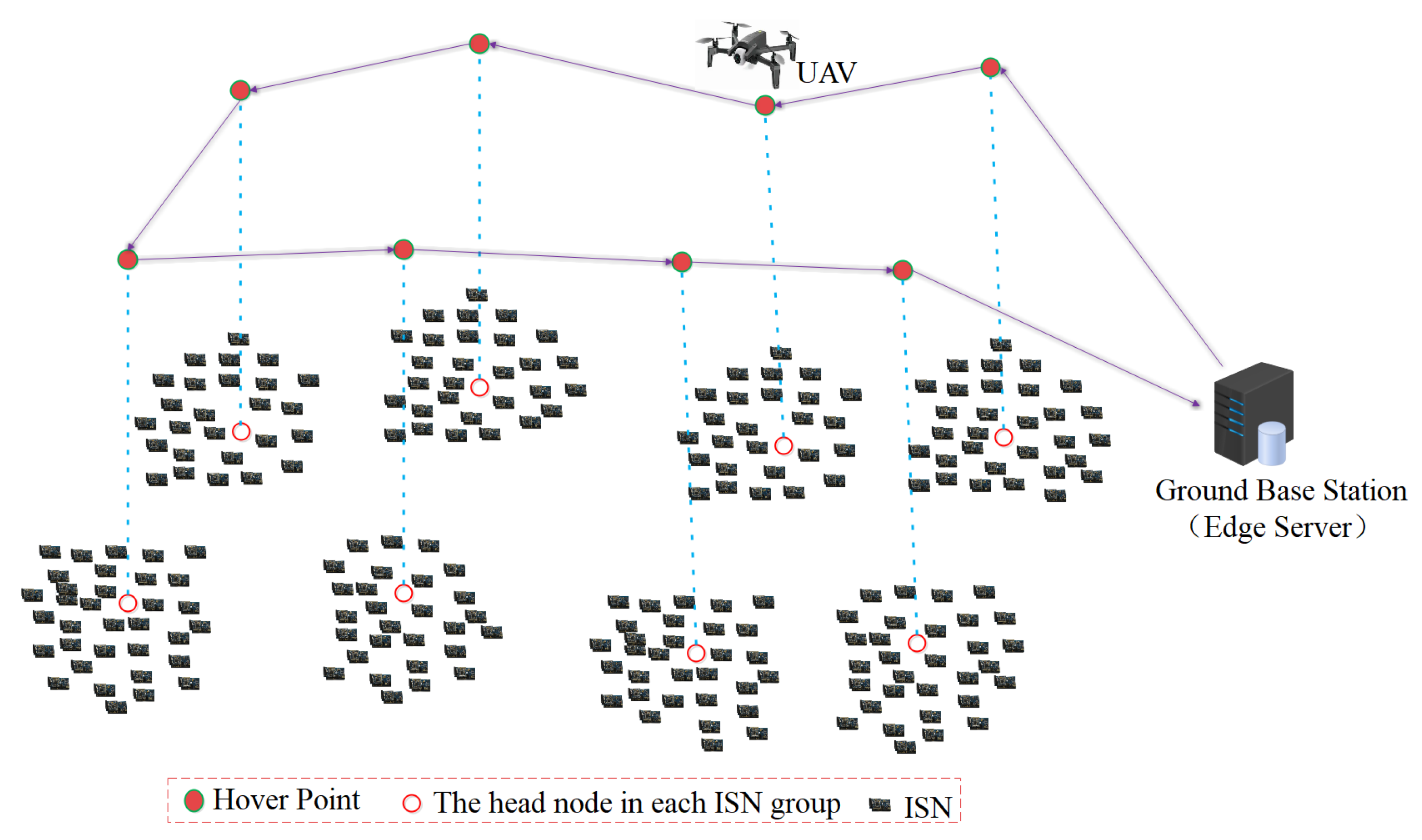
The system model of UAV-assisted IoT, as shown in Figure 1, comprises three components: (1) a ground base station (GBS) equipped with an ES, (2) a UAV, and (3) multiple ground ISNs, denoted by the set S 1 , S 2 , , S n . The ES serves as a local AI (Artificial Intelligence) data center, which can store and process the sensing data collected by the UAV; the UAV is responsible for collecting the sensing data during the flight over the ISNs; and the ISNs are used to perceive the physical environment and upload the sensing data to the UAV when the UAV is close to them. We assume that n ISNs are clustered into m groups using some ISN clustering methods [29] and each group is composed of ISNs which are close to each other in position. Let G i ( 1 i m ) denote the ith group of ISNs. Then, we have (1)
{ G 1 } { G 2 } . . . { G m } = { S 1 , S 2 , . . . , S n } .
In each group G i ( 1 i m ) , the ISN nearest to the geographical center of G i is selected as the Cluster Head (CH) and the location at a height of H meters directly above the head node is determined as the hover point of the UAV over G i , which is denoted as h p i ( 1 i m ) . We use H P S = { h p i | 1 i m } to denote the set of all the UAV hover points above all the clusters. During data collection, each ISN first prepares and sends its data to its corresponding head node. Then the UAV will access each head node along a determined flight path and each head node will upload the data to the UAV when the UAV is hovering above it. For ease of presentation, we define the concept of data collection round as follows.
Data collection round: The data collection round refers to the complete process of a single data-gathering mission, which includes the following sequential operations: (1) taking off from the GBS; (2) flying along a predefined path; (3) hovering at designated waypoints to collect data; and (4) returning to the GBS. The duration of this process is termed the round time.
We assume that the GBS can recharge the UAV, ensuring that its on-board energy is fully replenished at the start of each new data collection round. Moreover, we explicitly consider the asymmetry in energy constraints between the UAV and the ISNs. The ISNs are assumed to be battery-powered, static devices with limited initial energy, for which battery replacement or recharging is impractical on a frequent basis. In contrast, the UAV’s energy can be conveniently replenished at the GBS. This fundamental disparity motivates our primary optimization focus on minimizing the total energy consumption of the ISNs, which is the most critical factor for extending the operational lifetime of the entire sensing network. While UAV energy consumption is also considered, with particular attention to propulsion energy correlated with path length, it is treated as a secondary objective given the relative ease of its replenishment.
For ease of reference, we list the key notations and their definitions in Table 2.

3.1.1. Air-to-Ground Communication Model

LoS (Line of Sight) link is assumed to determine the communication channel between the UAV and the ISNs. This assumption is reasonable because the UAV mainly communicates with the head node, which is almost directly below the hovering point above each cluster. Specifically, suppose that S j ( S j G i ( 1 i m ) ) is the cluster head of G i ( 1 i m ) . We derive the data transmission rate from S j to the UAV hovering at h p i ( 1 i m ) as follows.
Let g s j _ h p i denote the channel power gain from S j to the UAV hovering at point h p i , and g 0 represent the reference channel power gain at a reference distance of 1 m from S j . Since the UAV only collects sensing data while hovering above each cluster’s centroid, the Doppler effect induced by UAV mobility can be neglected. Thus, g s j _ h p i can be modeled as
g s j _ h p i = g 0 ( d i s ( S j , h p i ) ) 2 ,
where d i s ( S j , h p i ) represents the distance between S j and h p i .
Let r s j , h p i denote the data transmission rate from S j to the UAV hovering at h p i ( 1 i m ) , Then it can be worked out through
r s j _ h p i = B l o g 2 ( 1 + P s j g s j _ h p i δ 2 ) ,
where δ 2 is the nose power at the receiver of the UAV and P S j is the antenna transmission power of S j .

3.1.2. Energy Model of the ISNs

ISNs are assumed to dedicate their energy primarily to communication tasks. Non-cluster head nodes engage only in intra-cluster messaging, whereas cluster heads undertake dual roles: (1) aggregating sensing data from cluster members and (2) forwarding the compiled data to the UAV via single-hop/multi-hop links.
Let E S i ( i = 1 , , n ) , E s e n d S i and E r e c e i v e S i denote the total energy consumed by S i ( i = 1 , , n ) , the energy consumed by S i to send sensing data and the energy consumption of S i to receive the sensing data in a data collection round, respectively. Clearly this gives
E S i = E s e n d S i + E r e c e i v e S i .
To model E s e n d S i more specifically, we suppose that S i ( i = 1 , , n ) and S j ( j = 1 , , n ; j i ) are two neighboring ISNs. Let E s e n d i , j denote the energy consumed by S i to send l bits to S j . Then, referring to [14], E s e n d i , j can be expressed as follows:
E s e n d i , j = l E e l e c + ( 1 χ ) ξ f s D 2 + χ ξ m p D 4
where
D = d i s ( S i , S j ) ,
and
χ = 1 , if D > ξ f s ξ m p 0 , if D ξ f s ξ m p .
In Equations (5) and (7), E e l e c is the circuitry-dissipated energy for one bit and ξ f s and ξ m p are two energy parameters of the radio amplifier in free space and non-free space where multi-path effects exist, respectively.
Then we model E r e c e i v e S i as follows. Suppose S i has received l bits of sensing data from its neighboring nodes in a data collection round. E r e c e i v e S i can be expressed as follows [14]:
E r e c e i v e S i = l E e l e c .
If an ISN is a cluster head, its energy consumption model on receiving data is the same as each common member ISN in its cluster. However, its energy consumption model on transmitting the data to the UAV is a little different, since the communication should follow the air-to-ground model. Suppose S k ( ( 1 k n ) ) is a head node. Let E u p l o a d S k denote the energy consumed by S k to upload D k bits of sensing data to the UAV hovering above it. Then E u p l o a d S k can be worked out according to
E u p l o a d S k = P S k D k r s k _ h p k ,
where P S k is the antenna transmission power of S k and r s k _ h p k is the data transmission rate from S k to the UAV hovering at h p k .

3.2. Problem Formulation

Based on the above-mentioned models and the identified asymmetry in energy constraints, we formulate the data collection problem in UAV-assisted IoT as a multi-objective collaborative optimization problem. The primary system-level goal is to maximize the operational lifetime of the energy-constrained ISN network. A secondary but important goal is to improve the operational efficiency of the UAV, which is directly tied to its mission completion time and energy cost. These are captured by the following two objectives:
(1)
Minimize the total energy consumption of all ISNs by i = 1 n E S i , which is the critical determinant of network lifetime.
(2)
Minimize the total UAV path length per data collection round by L uav _ path , which is the dominant factor determining the UAV’s propulsion energy consumption and the mission duration.
Formally, let A EUI denote the set of collaborative optimization strategies among the ES, the UAV, and the ISNs. The problem is expressed as the multi-objective optimization in (10), aiming to find strategies that best trade off these two objectives.
P : min A EUI i = 1 n E S i , L uav _ path s . t . ( 1 ) ( 9 )
L 1 , L 2 R ISN
1 | G ( i ) | ( 1 i m )
D collected D generated r threshold
i = 1 m VST i = m
The constraint (10b) ensures that the ISN deployment field is sufficiently large; otherwise UAV path optimization would be meaningless. Here, L 1 and L 2 denote the length and width of the rectangular deployment field and R ISN represents the maximum communication radius of each ISN.
The constraint (10c) guarantees that each cluster contains at least one ISN, where | G ( i ) | denotes the total number of ISNs in cluster G ( i ) .
The constraint (10d) limits the minimum quantity of sensing data collected by the UAV in one data collection round. Here, D collected and D generated denote the quantities of sensing data successfully collected by the UAV and generated by all ISNs in the system, respectively, while r threshold [ 1 2 , 1 ] is the ratio threshold determined by system users. Note that in our proposed DC-CSAP scheme, a sensing data item that is correctly predicted by the model is not transmitted to the UAV; hence it is still considered to be collected data and is nevertheless included in D collected .
In Equation (10e), the variable V S T i ( 1 i m ) keeps track of the total number of times the UAV visits the hovering point h p i in a single data collection round. The initial value of V S T i is zero, and it is incrementally increased by one each time the UAV visits h p i . The constraint (10e) ensures that the UAV must visit all m clusters and that each cluster is visited exactly once.
Based on the network model described in this paper, once the ISN clustering method is determined, the UAV’s hovering positions above each cluster are fixed. Furthermore, according to the problem formulation, each hovering position must be visited exactly once by the UAV. It can be concluded that the aforementioned multi-objective optimization problem is a non-coupled multi-objective optimization problem, where each objective can be optimized independently.
Moreover, we assume that the UAV can return to the GBS solely using its onboard energy after completing a full data collection round. Should this assumption fail (e.g., in extremely large-scale scenarios), the deployment field could be partitioned into smaller sub-regions with multiple UAVs assigned for cooperative data collection. Such an extension lies beyond the scope of this study.

4. Methods

In this section, we propose the DC-CSAP framework, which is a dynamically adaptive data collection framework for the UAV-assisted IoT to solve the optimization problem formulated previously. Our description begins with the overall workflow, followed by the collaboration mechanisms within the framework.

4.1. Overall Data Collection Workflow

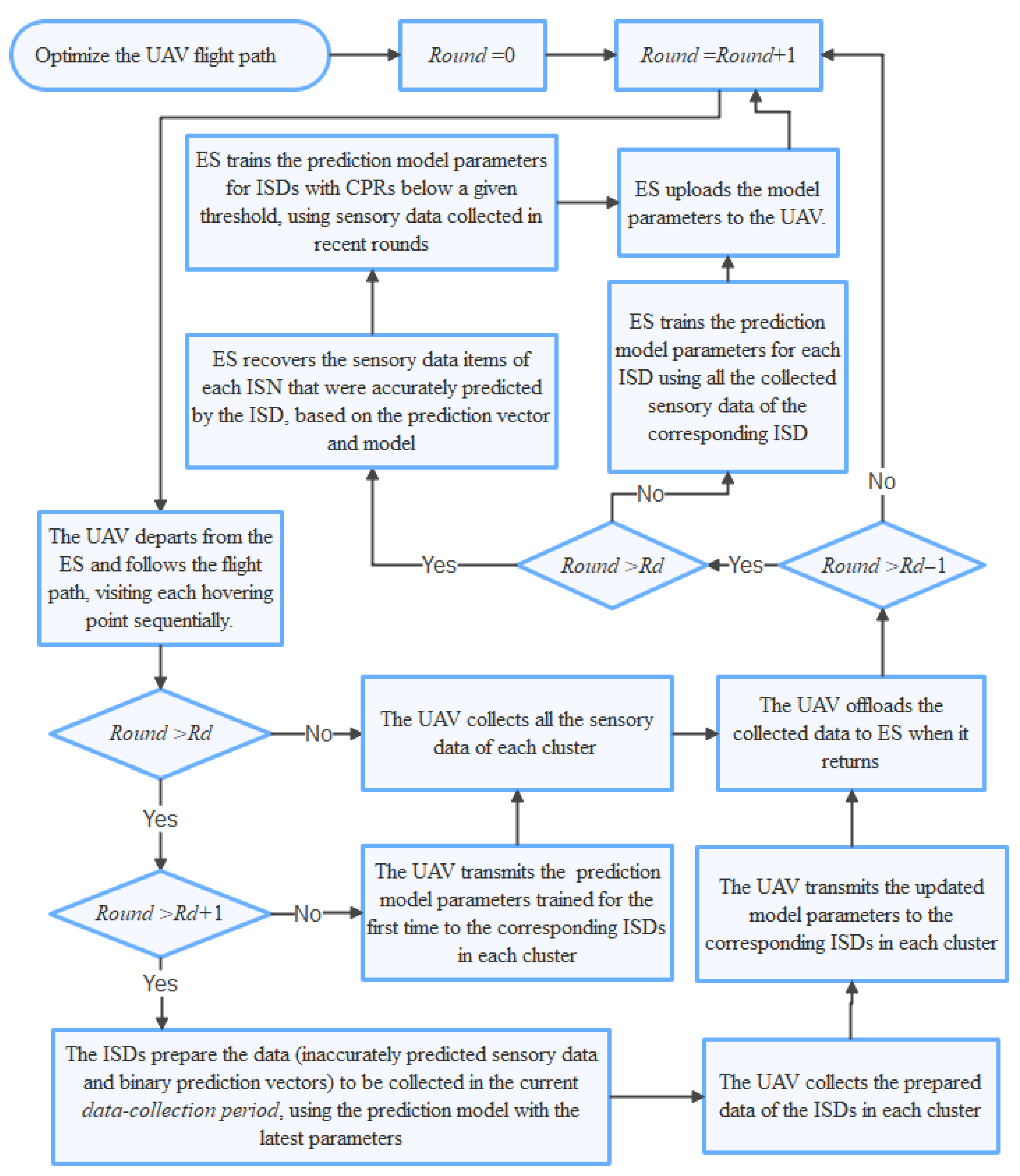
The workflow is structured to operate in rounds. In the first few data collection rounds, the UAV collects all sensing data from each ISN, which are then used by the ES to train the data prediction model. Once the model is well trained, it is broadcast to the ISNs by the UAV in the next data collection round. Afterward, the prediction-based in-cluster data collection mechanism can be employed by both the UAV and the ISNs in subsequent rounds. At this stage, each ISN predicts its sensing data using the prediction model and compares the predicted values with the actual measurements. Only data that deviate significantly from the predictions are transmitted to the UAV. The overall data collection workflow of the DC-CSAP Framework is illustrated in Figure 2.
In Figure 2, the variable R o u n d tracks the total number of completed data collection rounds, while R d serves as a threshold for R o u n d , determining DC-CSAP’s control flow. Specifically, if R o u n d < R d , the UAV collects all sensing data from every ISN; if R o u n d is equal to R d , the ES trains prediction parameters for each ISN using nodes’ historical data; and if R o u n d > R d , two cases should be considered: Case 1 ( R o u n d = R d + 1 ) and Case 2 ( R o u n d > R d + 1 ). In Case 1, the UAV collects all sensory data without utilizing any prediction models (as the ISNs lack the necessary parameters) and then broadcasts the model parameters to the respective ISNs. In Case 2, each ISN uses the received prediction model parameters to predict its sensing data prior to the UAV’s arrival. Upon the UAV’s arrival and data collection, each ISN then generates a binary prediction vector by comparing its predictions with the actual measured values. The UAV collects only inaccurately predicted data items and the vectors, enabling the ES to reconstruct correctly predicted values. This approach dramatically reduces the volume of transmitted data per round, thereby lowering communication costs for both UAVs and ISNs.
In DC-CSAP, we adopt the well-established ARIMA (Autoregressive Integrated Moving Average) model [28] as the predictive engine for time-series data. We select the ARIMA model as the foundational predictor in DC-CSAP based on three primary considerations: (1) our target application (e.g., environmental monitoring) often generates data with strong temporal regularity (seasonality, trend), which ARIMA is exceptionally well-suited to capture; (2) the model structure is inherently lightweight, with minimal parameters to store and compute, making it ideal for dissemination to and execution on resource-constrained ISNs; and (3) as a classical statistical model, ARIMA offers clear interpretability of parameters and stable performance, providing a reliable baseline for our novel collaborative framework. Future integration of more complex models (e.g., lightweight neural networks) can be built upon this verified architecture.
Fundamentally, ARIMA combines the Autoregressive (AR) and Moving Average (MA) components, augmented with differencing. Its key parameters are the number of autoregressive terms, moving average terms, and differencing order. Our contribution at this layer is not the modification of ARIMA itself, but its novel integration into a collaborative workflow: the ES trains and manages the ARIMA model for each ISN, and the model’s predictions are used to generate the binary index vector that actively controls data transmission. This shifts the computational burden of sophisticated time-series forecasting from the resource-constrained ISNs to the ES, which is a key enabler of the framework’s efficiency. As ARIMA is a standard model, we omit further implementation details and focus on its role within DC-CSAP.
It is noteworthy that the parameters of the prediction model are not updated in every data collection round. Instead, an update is triggered only when the prediction accuracy falls below a preset threshold, which makes the associated cost relatively low.

4.2. Collaboration Mechanisms

This subsection details the collaborative interactions for data collection within the DC-CSAP framework. For clarity, the overall ES–UAV–ISN collaboration is broken down into four components: (1) ES–UAV Collaboration, (2) ES–ISN Collaboration, (3) UAV–ISN Collaboration, and (4) Inter-ISN Collaboration. Each component is elaborated in detail subsequently.

4.2.1. ES–UAV Collaboration

The collaboration between the ES and the UAV in DC-CSAP establishes a symbiotic workflow: the ES computes an efficient flight path, which the UAV then executes. To fulfill this requirement within our framework, we design the TSP–CSA algorithm (where TSP indicates it solves the Traveling Salesman Problem, and CSA denotes Convex-hull-inspired Simulated Annealing). TSP–CSA is a tailored enhancement of the classic Simulated Annealing (SA) metaheuristic, specifically developed for reliable and efficient path planning in our collaborative scenario.
Given the requirement to visit all hovering points exactly once (constraint (10e)), the path planning problem is formulated as a TSP aimed at minimizing the total flight distance (Equation (10a)). Our TSP–CSA algorithm builds upon the SA metaheuristic [9] but introduces a key enhancement to address SA’s known sensitivity to the initial solution: a dedicated geometric initialization phase. This results in a two-phase strategy (Algorithm 1).
In the first phase, we construct a high-quality initial path by drawing inspiration from convex-hull algorithms—specifically, the strategy of first identifying extreme points. A greedy method then iteratively incorporates the remaining points to form a reasonable, albeit often non-convex, initial tour. This purpose-built starting point provides stability and accelerates convergence. The second phase employs the standard SA mechanism to refine this initial path, probabilistically accepting suboptimal states to escape local minima and yield a near-optimal final flight path.
In Algorithm 1, the initial and optimized UAV paths are represented as graph structures P a t h uav _ initial and P a t h uav _ optimized , respectively. The set HPS includes the four extreme points h p x max , h p x min , h p y max , and h p y min , which are the points with the maximum x-coordinate, minimum x-coordinate, maximum y-coordinate, and minimum y-coordinate, respectively. The algorithm consists of two phases. The first phase begins by constructing P a t h uav _ initial as a closed polygon connecting these four points. Subsequently, the remaining points in HPS are iteratively incorporated into the path. Each iteration involves selecting the point in HPS with the smallest minimum distance to any edge in the current P a t h uav _ initial , removing that point from HPS , replacing its closest edge with two new edges connected to the selected point, and updating the path to form a new closed polygon.
Algorithm 1 The UAV Path Optimization Algorithm TSP-CSA
Input:  HPS = { h p 0 , h p 1 , , h p m } , T initial , φ , ϱ
Output:  P a t h uav _ optimized
  1:
Step 1: Initial Path Construction via Convex Hull
  2:
Find four extreme points h p x max , h p x min , h p y max , h p y min in HPS
  3:
Construct initial path P a t h uav _ initial as polygon connecting extreme points
  4:
Update HPS HPS { h p x max , h p x min , h p y max , h p y min }
  5:
while  ( HPS )   do
  6:
    Select h p selected HPS with minimal distance to P a t h uav _ initial
  7:
    Find edge v 1 , v 2 P a t h uav _ initial closest to h p selected
  8:
    Update HPS HPS { h p selected }
  9:
    Remove v 1 , v 2 from P a t h uav _ initial
10:
    Add edges v 1 , h p selected and h p selected , v 2 to P a t h uav _ initial
11:
end while
12:
Step 2: Path Refinement via SA
13:
P a t h uav _ old P a t h uav _ initial
14:
T current T initial , i t e r 0
15:
while  ( i t e r ϱ )  do
16:
    Generate P a t h uav _ new by perturbing P a t h uav _ old
17:
    if  f ( P a t h uav _ new ) f ( P a t h uav _ old )  then
18:
         P a t h uav _ old P a t h uav _ new
19:
    else
20:
         Γ f ( P a t h uav _ new ) f ( P a t h uav _ old ) f ( P a t h uav _ old )
21:
         P accept exp Γ T current
22:
        Generate random r Uniform [ 0 , 1 ]
23:
        if  P accept > r  then
24:
             P a t h uav _ old P a t h uav _ new
25:
        end if
26:
    end if
27:
     T current T current × φ
28:
     i t e r i t e r + 1
29:
end while
30:
P a t h uav _ optimized = P a t h uav _ old ;
31:
return  P a t h uav _ optimized
In the second phase, the final optimized path is generated through multiple rounds of SA iterations. In each iteration, a new path P a t h new is generated from the previously accepted path P a t h old . The acceptance of P a t h new is determined by a probability P accept that depends on both the path lengths, computed by a function f ( · ) , and the current temperature T current , which is initialized as T initial . Specifically, P accept follows the Metropolis criterion [9] and is defined as
P accept = 1 if Γ 0 , e Γ T current if Γ > 0 .
where Γ represents the normalized change in path length and is calculated as
Γ = f ( P a t h new ) f ( P a t h old ) f ( P a t h old ) .
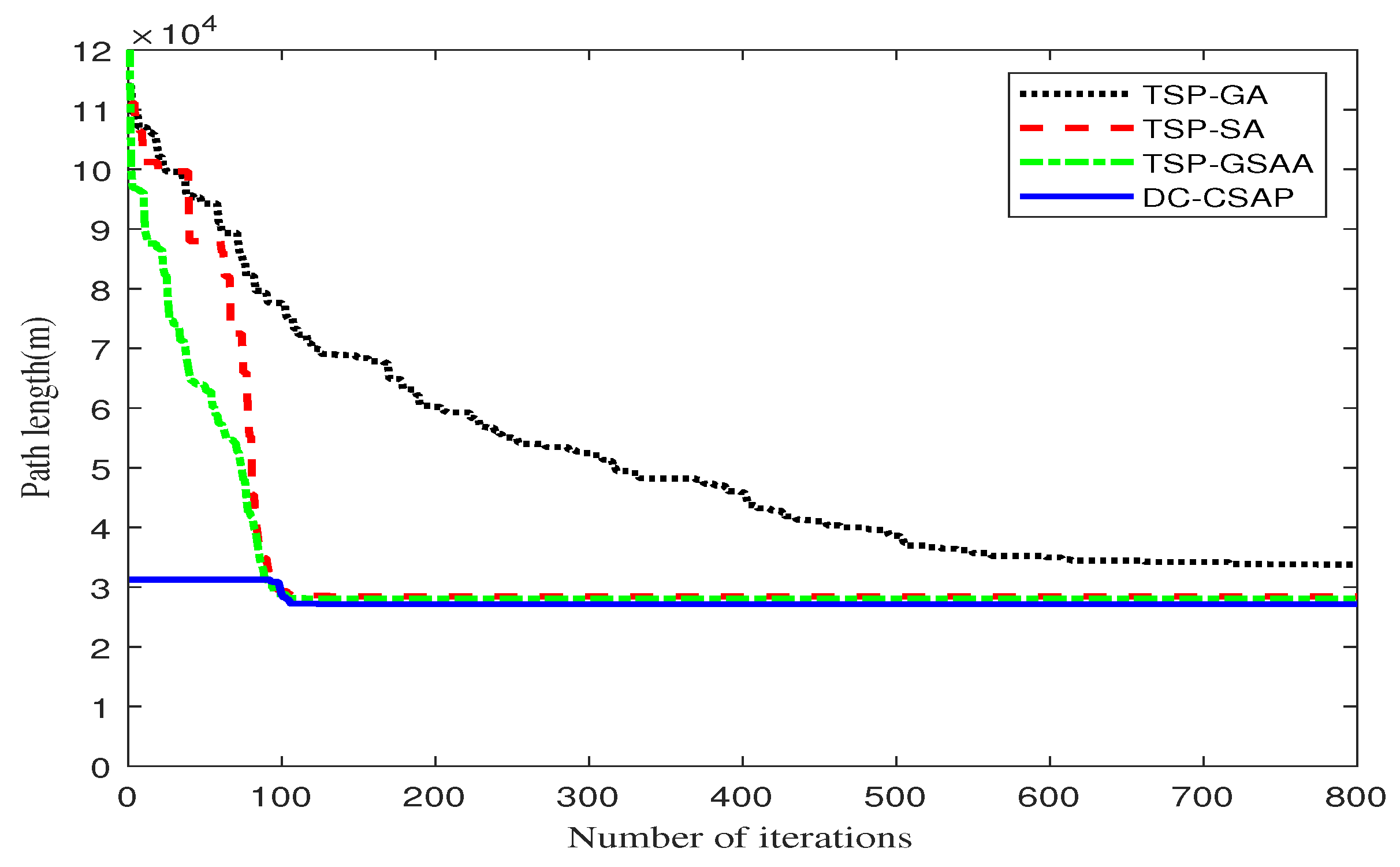
The time complexity of the TSP–CSA algorithm is dominated by the Simulated Annealing phase. For m hover points, each SA iteration involves evaluating a neighbor solution with O ( m ) distance calculations. The iteration budget ϱ is a preset parameter. With a fixed number of iterations ϱ , the overall complexity is O ( ϱ · m ) . Empirical convergence analysis (see Figure 5) shows that a constant ϱ (e.g., 800) suffices for the problem scales considered, as the algorithm plateaus rapidly. The convex-hull-inspired initialization has complexity O ( m log m ) . Thus, TSP–CSA scales linearly with the number of clusters in its main loop, making it practical for the scale of problems considered (tens to hundreds of clusters). For extremely large-scale deployments, partitioning strategies coupled with TSP–CSA would be applicable.

4.2.2. ES–ISN Collaboration

Within the ES–ISN collaboration framework, ISNs supply raw sensing data for ES processing, whereas the ES trains prediction models for the ISNs to alleviate their transmission burden. The following paragraphs detail how these trained models help ISNs reduce communication costs.
Once an ISN ( S j ) has received the prediction model parameters, it leverages the latest model to forecast its sensing data for the current round. The predicted values are then compared against the actual measurements. To minimize communication overheads, only data items with significant prediction errors are marked for physical collection. Accurately predicted data can be reconstructed at the ES using the model (e.g., ARIMA), eliminating the need for their transmission.
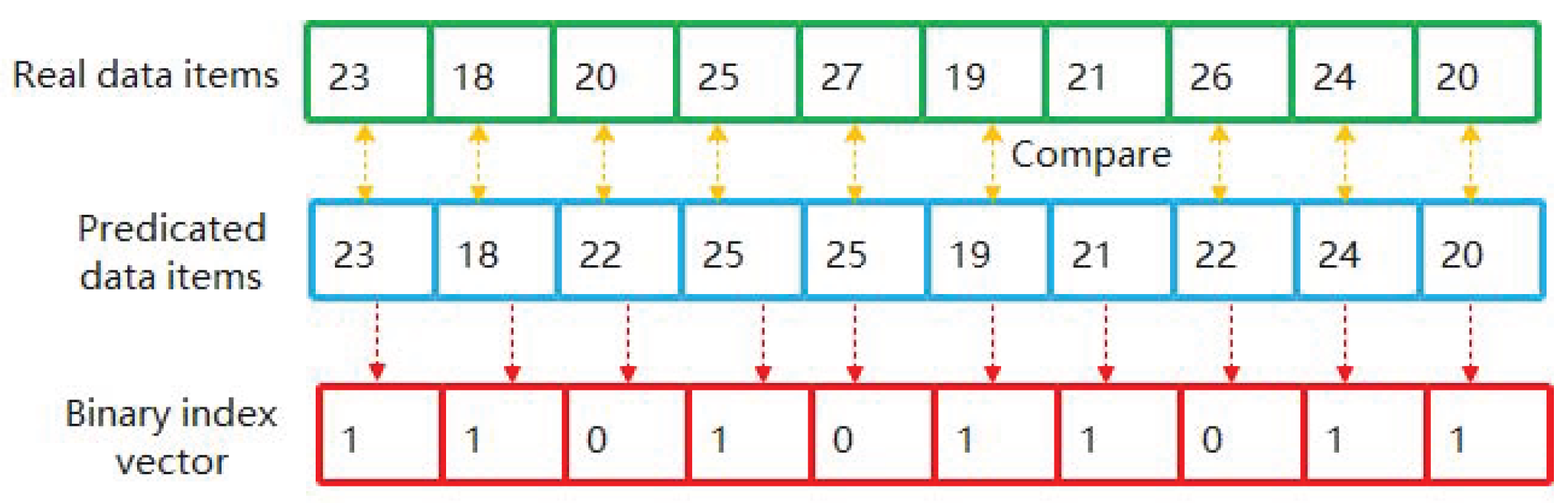
To efficiently communicate the prediction accuracy to the ES, S j generates a binary prediction vector (a term adopted throughout this paper). In this vector, a 1 denotes a correctly predicted data item (within an acceptable error bound), while a 0 flags an item that requires collection due to prediction inaccuracy. An example of this vector’s construction is illustrated in Figure 3.
To evaluate the prediction model’s performance, we define the Correct Prediction Rate (CPR) metric. For an ISN S j that generates w sensing data items d 1 , d 2 , , d w in a data collection round, with corresponding predictions d ^ 1 , d ^ 2 , , d ^ w , its CPR is calculated as
C P R = 1 w j = 1 w I ( | d j d ^ j | ϵ )
where I ( · ) is the indicator function that returns 1 if the condition is true and 0 otherwise, and ϵ is a small, configurable tolerance threshold. The tolerance threshold ϵ is a key system parameter that directly controls the trade-off between CPR and communication energy consumption. It should be configured according to the precision requirements of the target application.
In DC-CSAP, the ES computes the CPR for each ISN. Should the CPR fall below a predefined threshold, the ES retrains the ARIMA model using the ISN’s most recent historical data. The UAV then delivers these updated parameters to the corresponding ISN in the subsequent data collection round.

4.2.3. UAV–ISN Collaboration

The UAV, functioning as the mobile data collector, primarily interacts with the head node of each ISN cluster. The collaboration protocol between the UAV and a cluster G p (where 1 p m ) with head node S h is detailed in Algorithm 2.
The rationale for using the head node as a relay between common ISNs and the UAV is twofold. First, since the UAV hovers directly above the head node, it establishes a line-of-sight link with the highest quality and stability within the cluster, minimizing packet loss and transmission latency. Second, this role centralizes the communication burden on the head node, which entails higher energy expenditure. To ensure fairness and balance the energy consumption across the cluster, the head node role can be rotated among eligible ISNs. It is important to note that a change in head node necessitates an update to the corresponding UAV hovering point and a recalculation of the overall flight path.
Algorithm 2 The UAV–ISN Collaboration Protocol in DC-CSAP
1:
Upon the UAV’s arrival at a head node S h of cluster G p :
2:
// Phase 1: Parameter Delivery
3:
if The UAV carries updated parameters for any ISN in G p  then
4:
    The UAV delivers the parameter set(s) to S h .
5:
end if
6:
// Phase 2: Data Collection
7:
S h waits until it has aggregated all data packets from its member nodes.
8:
S h uploads the aggregated data packet to the UAV.

4.2.4. Inter-ISN Collaboration

In DC-CSAP, the head node of each cluster collaborates with its member nodes to enhance data collection efficiency. This collaboration follows a two-stage protocol: full data collection and prediction-based collection, as implemented in the three-step process of Algorithm 3.
Specifically, in the first stage, member nodes in each cluster must transmit all previously uncollected sensing data to the head node. Prediction technology is not leveraged at this stage because the ISNs have either not received the ARIMA model parameters or have only just received them in the current data collection round. The protocol transitions to the second stage once every ISN has received the model parameters.
In the second stage, each ISN (including the head node) first generates an index vector using the prediction models and raw sensing data. As the method for generating the index vector has been introduced in the preceding ES–ISN Collaboration subsection, it is not redescribed here. Subsequently, each I S N i prepares a data packet P K T i with the following contents:
P K T i = { T begin , T end , I D X i , r i , R A W i }
In (14), T begin and T end denote the start and end generation times, respectively, of the sensing data in this packet. r i represents the data generation rate of I S N i during the interval [ T begin , T end ] ; I D X i is the index vector computed using the prediction model and all sensing data generated by I S N i during [ T begin , T end ] ; and R A W i is the set of raw sensing data generated by I S N i during [ T begin , T end ] that were not predicted correctly.
All prepared data packets from the member ISNs in each cluster are sent to their head node. The head node then aggregates these packets and uploads the complete set to the UAV upon its arrival.
Algorithm 3 Inter-ISN Collaboration Protocol
  1:
// Step 1: Data Preparation at Each ISN S i
  2:
for each ISN S i ( 1 i n ) (including the head nodes) do
  3:
    if  S i has not received the ARIMA parameters then
  4:
        P K T i all sensing data generated in the current round.
  5:
    else
  6:
       Predict current-round sensing data using the latest-updated model.
  7:
        I D X i generate binary prediction vector.
  8:
        P K T i pack( T b e g i n , T e n d , I D X i , r i , R A W i ) as in Equation (14).
  9:
    end if
10:
end for
11:
// Step 2: Intra-Cluster Data Transmission
12:
for each common member ISN S j ( 1 j n )  do
13:
    if  S j has prepared a data packet P K T j  then
14:
        S j sends P K T j to its corresponding head node.
15:
    end if
16:
end for
17:
if A cluster head node S h receives some updated parameter set/sets from the UAV then
18:
   for each parameter set p a r a m k  do
19:
       if  p a r a m k is for S h  then
20:
           S h updates its own parameters with p a r a m k .
21:
       else
22:
           S h forwards p a r a m k to the corresponding common ISN.
23:
       end if
24:
    end for
25:
end if
26:
// Step 3: Data Aggregation and UAV Upload by Each Head Node S h
27:
for each head node S h  do
28:
     S h waits until receiving P K T j from all common nodes in its cluster.
29:
     S h aggregates all P K T j (including its own P K T h ) into C l u s t e r P K T .
30:
    Upon UAV arrival, S h transmits C l u s t e r P K T to the UAV.
31:
end for

5. Results

In this section, we present a comprehensive performance evaluation of the proposed DC-CSAP scheme. The key metrics used are listed in Table 3. Among the metrics, the Convergence Rate measures the speed at which an optimization method approaches the final solution (or a stable state); CPR indirectly reflects the data collection efficiency, since a higher prediction accuracy leads to a lower volume of data requiring transmission, reduced communication overheads, and consequently, higher data collection efficiency; the UAV Path Length is a key indicator of the performance of the proposed UAV path optimization method; the Per-ISN Energy is defined as the total energy consumed by a node over one complete operational cycle, and is a metric of the energy efficiency of the ISNs in DC-CSAP.
Moreover, since the proposed framework involves both path optimization and prediction components, we compare it with baseline algorithms from both domains, as summarized in Table 4.

5.1. Experimental Environment and Parameter Settings

In our experiments, the n ISNs are partitioned into m clusters using the standard K-means algorithm applied to their geographical coordinates. The objective of K-means is to minimize the total intra-cluster squared Euclidean distance, ensuring that ISNs within the same cluster are geographically proximate. This method provides a well-established and reproducible baseline for generating the clustered topology required by the DC-CSAP framework. The influence of clustering strategies based on system performance and their co-optimization with UAV trajectory planning is discussed as a promising future direction in Section 6.6.
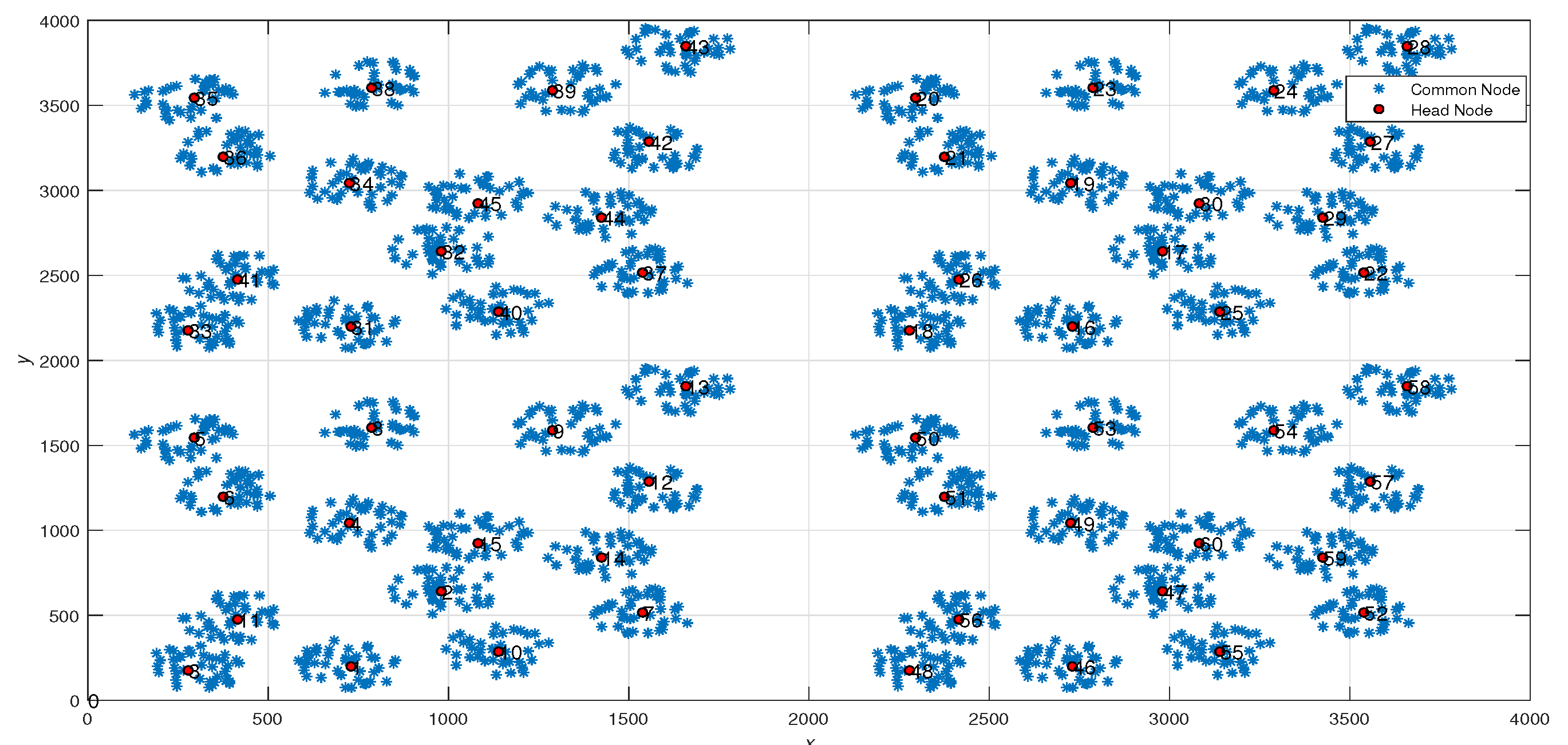
We used MATLAB R2018b as the simulation platform, and the default parameter settings are listed in Table 5. Figure 4 shows the deployment of the ISNs in the field. In this figure, the whole field can be divided into four sub-areas, and the ISNs are deployed in a similar manner in each sub-area. The sensing data used in the simulation were taken from the temperature observation dataset of the Qinghai–Tibet Plateau, which exhibits periodicity and regularity, from 2008 to 2016 [32]. Each ISN is set to generate one sensing data item every hour, and the size of each data item is 64 bits.

5.2. Convergence Rate and UAV Path Length

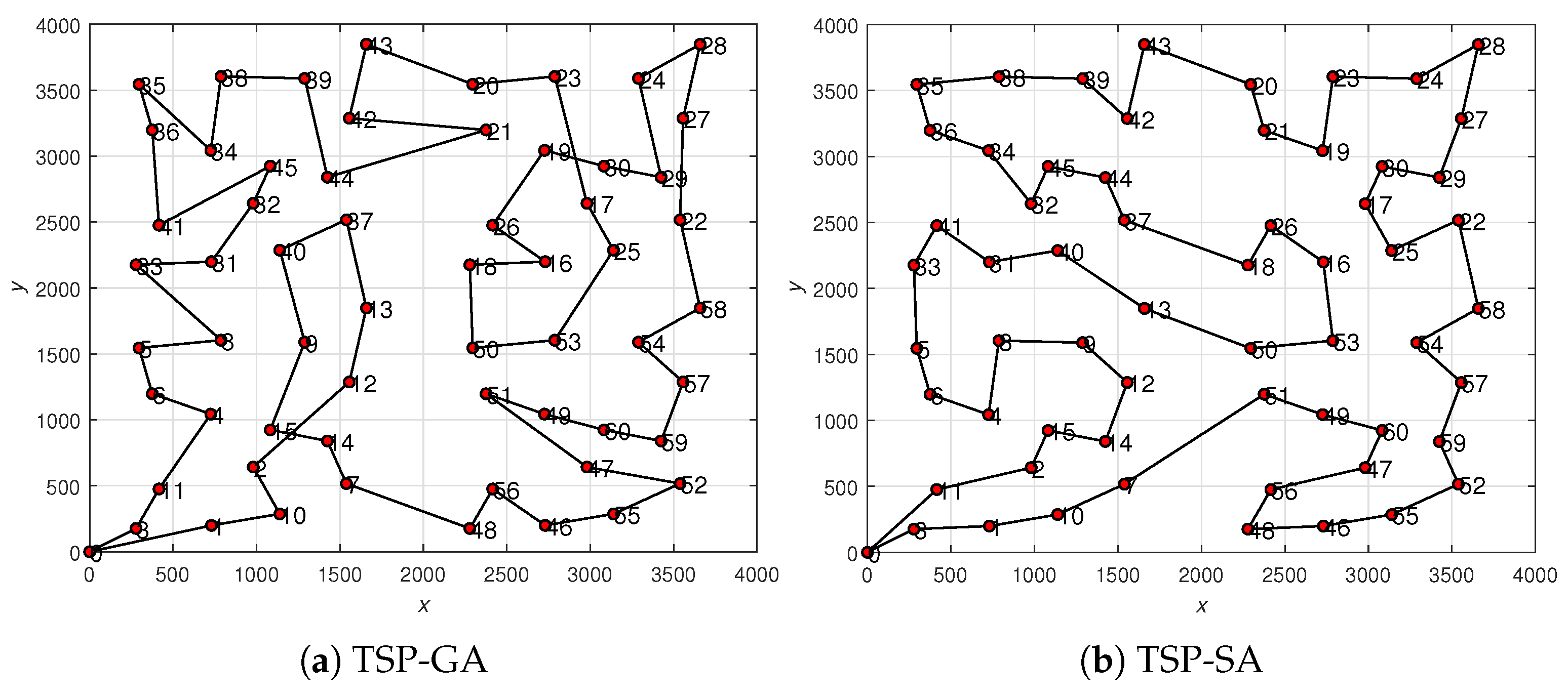
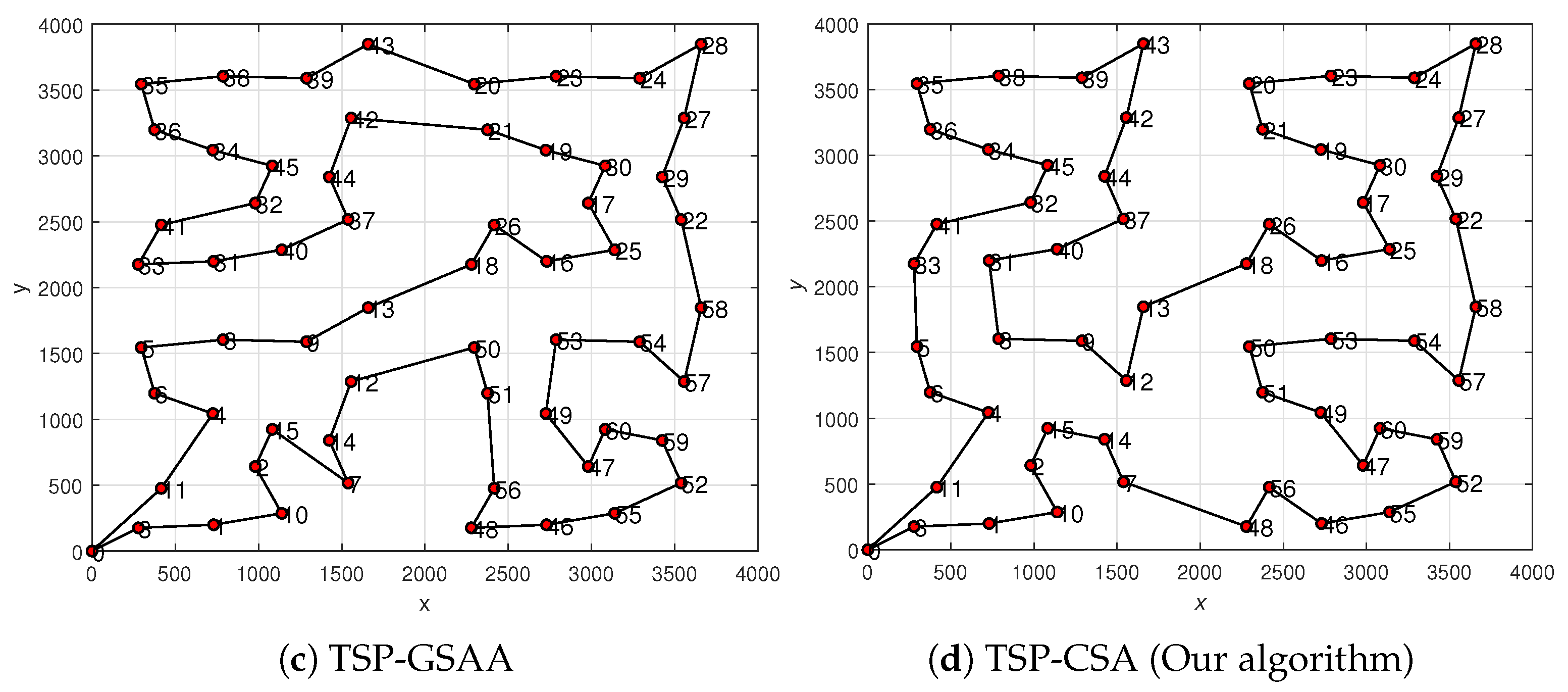
Figure 5 shows the convergence behaviors and the corresponding UAV path lengths across iterations for all path optimization methods, including our proposed DC-CSAP. The results clearly demonstrate that our method achieves a significantly faster convergence rate than the benchmarks. Specifically, DC-CSAP attains the shortest UAV path in the fewest iterations. Notably, it produces a path length very close to the final solution after only a few iterations, a capability the other methods lack. The final optimized paths for all methods are visually compared in Figure 6.

5.3. Prediction Accuracy

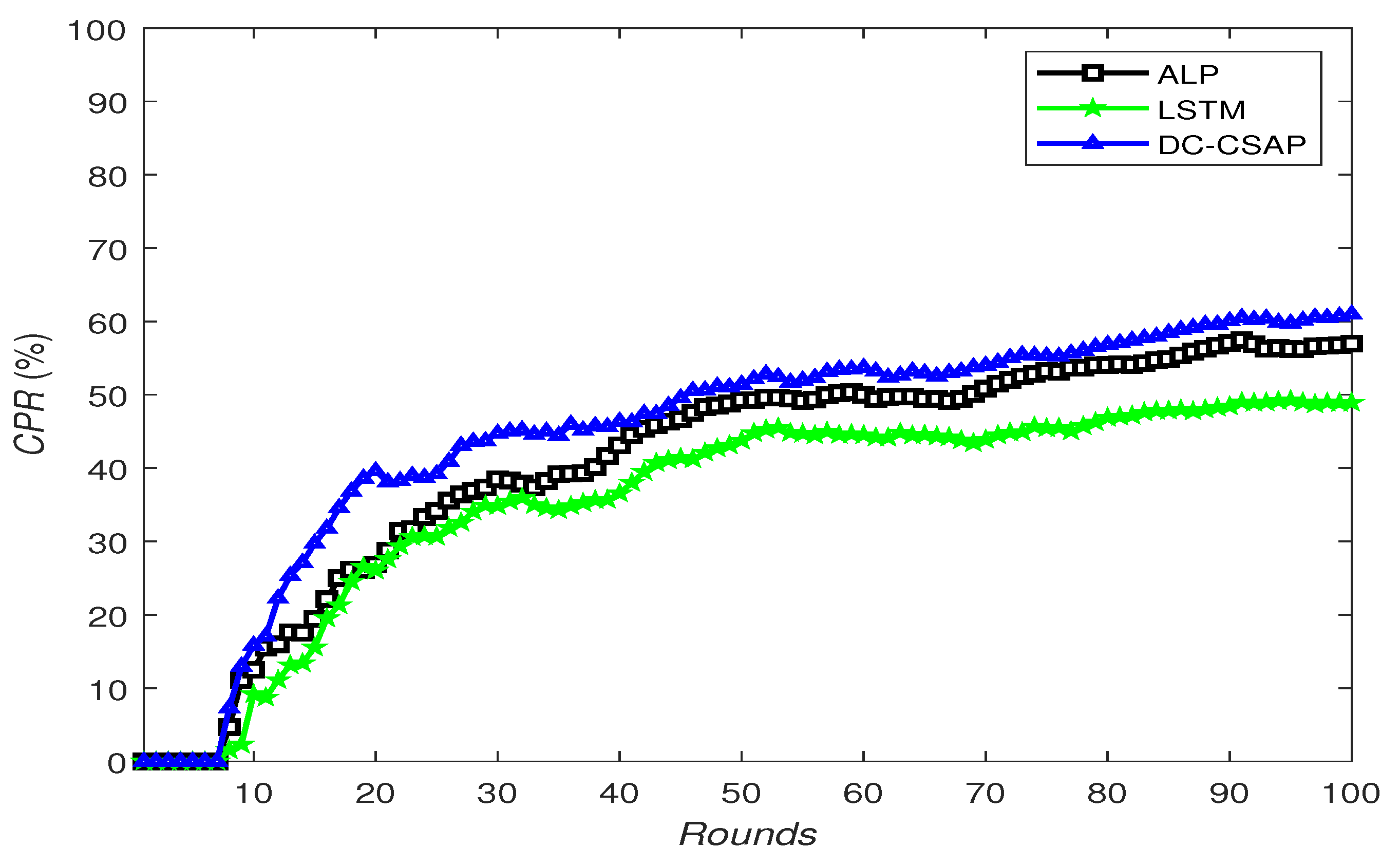
In this subsection, we evaluate the CPR of the ARIMA prediction model employed in DC-CSAP, comparing its performance with two alternative prediction models (ALP and LSTM). For our simulations, we define the acceptable error range for sensing data prediction as [0, 2]. Specifically, a prediction is considered correct if the absolute difference between real and predicted values satisfies | S D r e a l S D p r e d i c t e d | 2 , where S D r e a l represents an actual sensing data item and S D p r e d i c t e d denotes its corresponding predicted value.
Figure 7 shows the simulation results of the average CPR over multiple data collection rounds. The results demonstrate that ARIMA consistently outperforms LSTM and ALP in terms of CPR. The results demonstrate that for the targeted periodic sensing data, the classical ARIMA model achieves a higher CPR than both the lightweight ALP predictor and the computationally intensive LSTM network, providing quantitative justification for its selection as the predictive engine within the DC-CSAP framework for this class of applications.

5.4. ISN Energy Consumption

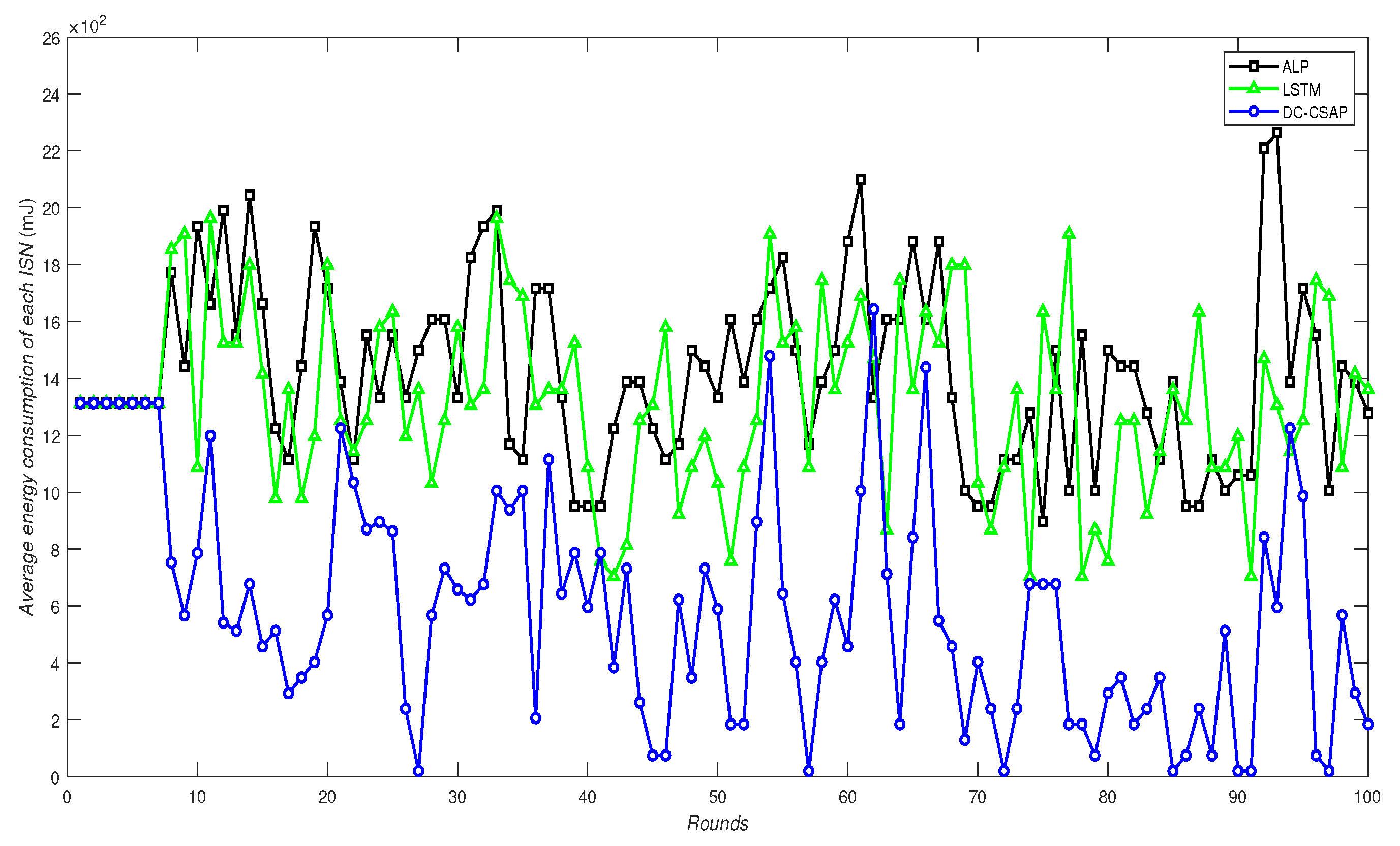
Figure 8 shows the average energy consumption per ISN per data collection round under different schemes. The results demonstrate that all three compared schemes initially show identical energy consumption for the first several rounds, since they collect raw sensing data without using prediction methods during this phase. As the rounds progress, while the average energy consumption fluctuates, our DC-CSAP scheme consistently outperforms both the ALP and LSTM schemes as well as the no-prediction baseline. This superiority stems from three key factors: First, unlike ALP and LSTM which require local model retraining whenever new data is generated (as shown in [26,31]), DC-CSAP avoids this recurrent computational overhead. Second, ALP’s multi-linear model structure forces ISNs to transmit both unpredicted data and numerous model parameters, while DC-CSAP minimizes such transmissions. Third, DC-CSAP achieves a higher CPR, meaning fewer sensing data items need uploading (only those that cannot be correctly predicted). Notably, DC-CSAP exhibits near-zero communication cost in certain rounds when its CPR approaches 100%, eliminating the need for data transmission entirely.

6. Discussion

6.1. Performance Advantages and Synergistic Design

The simulation results confirm that the DC-CSAP framework outperforms existing benchmarks, primarily due to its fundamental shift from a passive “collect-all-data” model to an active “predict-and-plan” paradigm orchestrated by the ES. This new paradigm explicitly decouples the data collection problem into two synergistic layers: a data plane for intelligent reduction and a motion plane for efficient planning. The key advantage of DC-CSAP stems from its synergistic two-layer optimization. At the data layer, the ES–ISN collaboration using the ARIMA model achieves a higher CPR than ALP and LSTM baselines. This high CPR enables the binary index vector mechanism to drastically reduce the volume of data requiring physical transmission, which is the direct cause of the significantly lower Per-ISN Energy consumption. Unlike ALP, this approach avoids forcing ISNs to retrain models locally, saving computational energy. At the motion layer, the ES–UAV collaboration employs a hybrid path optimizer that combines a convex-hull-inspired initialization with Simulated Annealing. This design yields a faster convergence rate and a shorter final flight path compared to TSP–GA, TSP–SA, and TSP–GSAA benchmarks.
Critically, these two layers are not independent. The reduction in data volume simplifies the communication burden, while the optimized flight path ensures efficient collection. This synergy, coordinated by the ES, is the main reason for DC-CSAP’s superior overall efficiency.

6.2. Practical Challenge: State Desynchronization

A critical consideration for practical deployment is ensuring robust operation despite potential state desynchronization between the ES and ISNs. The framework’s efficiency relies on the assumption that all parties maintain perfectly synchronized ARIMA model parameters. In reality, this synchronization can be compromised by packet loss during parameter updates, temporal mismatches between retraining triggers and UAV delivery schedules, or differential update reception times across ISNs. An ISN operating with an obsolete model while the ES attempts reconstruction with a newer version leads to catastrophic decoding errors.
To address this, we propose a lightweight version-control mechanism. Each ARIMA parameter set generated by the ES is assigned a monotonically increasing version number (e.g., a short integer). Crucially, the ES maintains a versioned parameter history for each ISN, retaining recent model versions and their corresponding parameters. When an ISN prepares its data packet, it binds the binary index vector with its currently active model version. The UAV collects both the data and its version tag. Upon receipt, the ES first checks the version against the ISN’s history. If a match is found, the ES retrieves the corresponding parameters for reconstruction. If the version is outdated or missing, the ES flags a desynchronization event. ISNs with outdated versions are then prioritized for parameter updates in subsequent UAV collection rounds.
The version-control protocol naturally extends to coordinate the event-driven model retraining with the periodic UAV data collection schedule. When the ES triggers a retrain for an ISN (due to low CPR), the new model is trained asynchronously. This process does not disrupt the UAV’s ongoing flight or data collection—all ISNs continue using their current models. Once training completes, the updated parameters are queued for delivery during the UAV’s next regular collection round, avoiding the need for urgent rescheduling. This design ensures temporal consistency by tolerating a one-round delay in update propagation, which is acceptable for applications like environmental monitoring. The storage overheads for maintaining multiple versions per ISN are negligible given the compact size of ARIMA parameter sets.

6.3. System Design Trade-Off

A fundamental design consideration in dynamic UAV-assisted data collection systems is the inherent tension between energy-balancing strategies (e.g., CH rotation) and the stability of the global flight plan. In our framework, the UAV’s hovering point ( h p i ) for a cluster G i is defined relative to the current CH’s location. Therefore, rotating the CH role changes the coordinates of h p i , which could invalidate the previously optimized global TSP path computed by the ES. If such rotation occurred frequently, it would force the ES to re-execute the computationally intensive TSP–CSA algorithm in every affected round, potentially introducing significant latency and undermining system stability.
To mitigate this issue and ensure operational efficiency, our design incorporates two key mechanisms to drastically reduce the frequency of ES-side path re-computation:
(1)
Energy Threshold-Based Rotation Trigger: CH rotation is not a per-round operation. It is triggered only when the energy level of the incumbent CH falls below a predefined threshold (e.g., 30% of its initial energy). Given the substantial reduction in transmission load afforded by our predictive data collection mechanism, the energy depletion rate for a CH is slow. Consequently, CH rotation is a low-frequency, long-term maintenance event rather than a routine procedure.
(2)
Event-Driven Path Re-Planning: The UAV does not merely collect data; it also gathers network-state information, including any CH changes that occurred since its last visit. Path re-optimization on the ES is triggered only if the UAV reports a change in the set of hovering points HPS . In rounds where the network topology is static, the ES can simply dispatch the pre-computed optimal path, eliminating recurrent computational overheads. Moreover, even when a global path re-computation is triggered, the computational cost on the ES remains manageable. As shown in Figure 5, our TSP–CSA algorithm exhibits a significantly faster convergence rate than the benchmark methods. This efficiency ensures that the path optimization process itself imposes only a modest and acceptable computational burden on the ES.
It is important to note that the impact of a single CH change on the overall flight path is often bounded. In typical large-scale deployments where clusters are geographically dispersed, the Euclidean distance between the old and new hovering points for a given cluster is usually small compared to the inter-cluster distances. In such scenarios, the primary challenge for the TSP solver remains the optimization of the visiting order among clusters, not the precise location of the access point within a cluster. A minor positional adjustment of one h p i may necessitate only a local path refinement rather than a full global re-optimization, a potential direction for future algorithm enhancement.
Another fundamental design consideration is the Role of the Prediction Tolerance ϵ . The parameter ϵ intrinsically defines a trade-off curve between CPR and the Per-ISN Energy consumption. A smaller ϵ enforces stricter accuracy, decreasing CPR and increasing the volume of data transmitted. Conversely, a larger ϵ improves CPR and reduces energy use but accepts greater prediction error. The value ϵ = 2 used in our experiments was selected to reflect common accuracy tolerances in environmental monitoring (e.g., for temperature data). Optimizing this parameter dynamically in response to data volatility or application needs is an integral part of the configuration analysis planned for future work.

6.4. Consideration of UAV Energy Consumption and System Efficiency

This section discusses the UAV energy consumption within the DC-CSAP framework. It is important to note that our current system model prioritizes the validation of the core collaborative paradigm and therefore adopts a focused approach: the optimization objective in Problem P (Equation (10a)) explicitly minimizes ISN energy and UAV flight distance, while treating UAV hovering energy and logistics (e.g., battery swapping and mission scheduling) as secondary factors. This simplification is justified for the following reasons and within the defined scope of this study.
First, the framework’s data reduction mechanism inherently minimizes the primary contributor to hovering energy: transmission time. As evidenced in Figure 7, the high and growing Correct Prediction Rate (CPR) drastically reduces the volume of raw data for transmission. Consequently, the required hovering duration at each cluster is short, rendering its energy cost manageable within the mission budget.
Second, the dominant component of UAV energy consumption, which is the propulsion energy for flight, is directly and effectively minimized by the TSP–CSA path optimizer. The significant reduction in total flight path length (Figure 5 and Figure 6) translates into lower overall propulsion energy, which is the largest share of the UAV’s energy expenditure per mission.
Finally, this modeling focus aligns with a critical system-level priority: the asymmetry in energy constraints. ISNs are static, battery-constrained devices where battery replacement is logistically challenging, making their lifetime duration the paramount concern. In contrast, the UAV is a mobile agent capable of convenient recharging at the GBS. Therefore, the primary objective of minimizing i = 1 n E S i directly addresses the most important sustainability challenge, as demonstrated by the results in Figure 8.
In summary, within the current model’s scope, DC-CSAP effectively balances system-wide energy efficiency by synergistically reducing ISN communication energy and UAV flight energy. We acknowledge that for real-world, large-scale, or multi-UAV deployments, a more comprehensive model jointly optimizing hovering energy, battery logistics, and mission scheduling would be essential. These important aspects are formally noted as limitations in Section 6.6 and are incorporated into our future work on scalable multi-UAV systems.

6.5. Generalization to Challenging and Heterogeneous Sensing Environments

The performance evaluation presented in this study utilizes a historical temperature dataset characterized by strong periodicity and smooth temporal variation. We acknowledge that this constitutes a specific, albeit common, class of IoT sensing data. Consequently, the quantitative results on CPR and energy savings reported in Section 5 are explicitly validated for scenarios with similar predictable data patterns.
However, the design of the DC-CSAP framework incorporates key features that provide a clear pathway for operation in more challenging environments, such as during bursty events or with heterogeneous sensor data. These features are:
(1)
A Closed-Loop Feedback Mechanism for Adaptation. The framework is not static. A sustained drop in an ISN’s CPR, potentially caused by a shift to non-stationary data, is monitored by the ES. This can trigger an automatic retraining of the prediction model for that node using recent data, allowing the system to re-converge to an efficient state after the pattern change. This built-in feedback loop is a foundational element for handling dynamic data.
(2)
Modular and Model-Agnostic Architecture. The core collaboration workflow, where the ES trains a model and disseminates it for local prediction, is deliberately decoupled from any specific prediction algorithm. This design means that the ARIMA model used in our evaluation can be replaced or supplemented by other specialized models (e.g., more robust models for volatile data) without altering the fundamental “predict-and-compare” protocol. The ES can maintain a portfolio of models suitable for diverse data characteristics.
Therefore, while the current experimental validation is focused on periodic data, the framework’s design principles inherently support extension to more complex scenarios. The proposed investigation of an automated meta-layer for dynamic model selection (Section 6.6) aims to fully automate this inherent capability, thereby enhancing the framework’s robustness and autonomy in open-world sensing environments.

6.6. Limitations and Future Work

While the simulation results demonstrate the potential of the DC-CSAP framework, this study has several limitations, which are listed as follows.
(1)
The performance evaluation was conducted entirely in a MATLAB simulation using models for communication channels, UAV dynamics, and energy consumption. Although we used a real-world environmental dataset (soil temperature), the system interactions are simulated. Real-world deployments face unpredictable challenges, such as variable wireless channel conditions (multi-path fading and intermittent LOS), dynamic wind affecting UAV flight stability and energy consumption, hardware imperfections, and clock synchronization issues among distributed ISNs. These factors could impact the performance of the prediction-based protocol and the accuracy of the energy models.
(2)
The framework is evaluated in a single-UAV, static-cluster scenario. The performance in highly dynamic networks—where ISNs may fail, join, or move, or where the field topology changes—requires further investigation. Similarly, the coordination mechanisms for multi-UAV systems, which are necessary for covering very large areas, are not addressed in this work.
(3)
The efficacy of the predictive layer is contingent on the temporal regularity of the sensing data, as demonstrated with the quasi-periodic temperature dataset. Its performance on highly non-stationary or volatile data streams (e.g., sudden event detection) requires further evaluation and may necessitate the integration of more adaptive or hybrid prediction models.
(4)
Our current system model employs several necessary simplifications in order to focus on validating the core collaborative paradigm. First, we assume a highly reliable and low-latency ES. In practice, ES failures or delays would necessitate mechanisms like a local cache at the UAV or predictive pre-fetching. Second, the UAV operation model incorporates key simplifications: (a) the energy model prioritizes propulsion energy (path length) for mission-scale analysis, while hovering and communication energy are considered secondary; and (b) logistical factors such as battery swap/charge time, battery degradation, and scheduling of missions are abstracted. In dense networks or long-duration operations, these factors would become dominant and require joint optimization within the planning framework. Third, the communication model assumes reliable Line-of-Sight (LoS) links between the UAV and ground ISNs. This is a reasonable simplification for open-field scenarios where the UAV hovers above clusters. However, it may not hold in environments with thick vegetation or urban structures, where signal blockage and multi-path fading could impact link reliability and data transmission efficiency. Fourth, our model assumes homogeneous initial energy for all ISNs. In practice, energy heterogeneity due to manufacturing variances, uneven discharge rates, or different distances to the cluster head would affect the fairness and efficiency of cluster head rotation and overall network lifetime. Finally, the overheads of model retraining (communication for data collection and ES computation) are acknowledged but not quantified; its impact on short-term network stability and optimal retraining scheduling remains an open question. Addressing these aspects constitutes vital future work for transitioning DC-CSAP from a robust framework to a deployable system.
(5)
The performance evaluation and validation of the DC-CSAP framework in this study are based on simulation. While this allows for controlled and reproducible analysis of the core collaborative paradigm, it inherently cannot fully capture all the practical complexities of real-world deployments. Critical challenges such as unpredictable UAV dynamics under varying wind conditions, GNSS signal interference or loss, non-ideal battery discharge curves, physical obstacles in complex terrain (e.g., dense crops, forests, or urban structures), and the full variability of wireless channels in such environments are abstracted. Consequently, the quantitative results presented demonstrate the framework‘s potential and efficacy under idealized conditions, and its absolute performance in physical settings requires future empirical testing.
Furthermore, other critical system-level challenges for future deployment, such as the computational burden on the Edge Server when scaling to thousands of ISNs, the latency in the “Edge-UAV-End” coordination loop, and potential security vulnerabilities in the wireless links, are acknowledged but require dedicated investigation beyond the scope of this foundational study.
These limitations outline the boundaries of our current validation and point directly to avenues for future research:
  • Prototype Development and Field Testing. The most critical next step is to transition from simulation to a real-world prototype. We plan to develop a small-scale testbed comprising a commercial UAV, multiple low-power sensor nodes, and an edge computing unit. This will allow us to validate the core collaboration protocols, measure real energy consumption, and refine the models under actual environmental conditions.
  • Joint Optimization of Clustering and UAV Trajectory. The current framework decouples the ISN clustering stage from the UAV path planning stage. A compelling direction is to investigate their joint optimization, where the clustering algorithm (e.g., cluster head selection and cluster boundaries) is co-designed with the UAV’s flight path to minimize a global system cost function that combines ISN communication energy and UAV propulsion energy. This holistic approach could unlock further efficiency gains, especially in large-scale or non-uniformly distributed networks.
  • Scalable Multi-UAV Cooperation and Swarm Intelligence. To address large-scale deployment scenarios, we will extend the DC-CSAP architecture to support a cooperative UAV fleet. This research will focus on: (1) distributed task allocation and scheduling mechanisms that account for UAV energy constraints and battery logistics; (2) advanced collaborative trajectory planning, potentially leveraging reinforcement learning (RL) and swarm intelligence algorithms for efficient, adaptive, and collision-free coverage; and (3) UAV-to-UAV communication protocols for robust coordination. This direction aims to transform DC-CSAP into a scalable and autonomous multi-agent data collection system.
  • Lightweight and Self-Adaptive Prediction Model. To handle diverse and non-stationary data patterns directly at the resource-constrained ISNs, we will investigate the design of a novel, lightweight prediction model. This model will inherently support dynamic self-adaptation to various data characteristics, eliminating the need for complex model-switching orchestration from the ES and further enhancing the framework’s autonomy and robustness.
  • Analysis and Configuration for Robustness in Dynamic Environments. While the adaptive framework enables model switching, ensuring its long-term robustness under diverse and evolving conditions requires deeper study. This work will involve: (1) a comprehensive sensitivity analysis to investigate the interplay between the prediction tolerance threshold ( ϵ ), data characteristics (volatility and periodicity), and model selection; and (2) the development of advanced adaptation mechanisms to address sustained challenges such as model drift and non-stationary data streams. This will include research into lightweight concept drift detection at ES and incremental learning techniques for efficient model updates. The overarching goal is to derive intelligent strategies for dynamically configuring the system (e.g., tuning ϵ and triggering model switches or updates) to autonomously maintain the optimal trade-off between communication efficiency and data fidelity across time-varying and multi-modal sensing scenarios.
  • Towards a Deployable System: Refining System Models and Protocols. To transition DC-CSAP from a robust framework to a deployable system, future work will address the practical system aspects currently simplified in our model. This includes: (a) enhancing robustness against Edge Server latency or failures through mechanisms like UAV-local caching and predictive task scheduling; (b) refining the UAV energy and logistics model to jointly optimize propulsion, hovering, communication energy, and battery-aware mission scheduling for single- and multi-UAV scenarios; (c) quantifying and minimizing the overheads of model retraining, including their impact on network stability and the development of optimal retraining policies; and (d) incorporating more realistic communication channel models (e.g., probabilistic LoS/NLoS) and designing robust transmission strategies to ensure reliable operation in environments with obstacles, such as dense vegetation or urban areas; and (e) integrating advanced energy-aware clustering strategies, such as the energy level-based dynamic cluster head selection mechanism [33], to balance load and maximize network lifetime in large-scale deployments.
  • Real-world Prototyping and Field Deployment. The highest-priority future work is the transition of DC-CSAP from a simulation model to a physically deployed system. This involves the development of a hardware testbed comprising commercial UAV platforms, low-power sensor networks deployed in actual agricultural or industrial plots, and edge computing hardware. The key objectives will be to validate the core collaboration protocols, measure true energy consumption and communication reliability, and evaluate the framework’s robustness against real-world challenges such as adverse weather, terrain obstacles, and unpredictable link quality.
By pursuing these directions, we aim to advance DC-CSAP from a validated conceptual framework to a deployable system solution for large-scale IoT data collection.

7. Conclusions

This paper proposes DC-CSAP, a novel “Edge-UAV-End” collaborative framework for the UAV-assisted IoT. Its core innovation lies in the Edge Server-orchestrated synergy between predictive data reduction and optimized path planning. Comprehensive simulations demonstrate that this approach simultaneously achieves a higher CPR, lower Per-ISN Energy, and shorter UAV Path Length than benchmarks.
The study also identifies key limitations that define the scope of the current work and direct future research. Most importantly, the framework’s performance in its current form has been validated under scenarios with predictable data patterns and static network topologies. Therefore, the most immediate and critical extensions are to develop adaptive mechanisms for non-stationary data streams and to scale the coordination algorithms for dynamic environments with multiple cooperative UAVs, which are essential steps toward practical deployment.

Author Contributions

Conceptualization, X.M. and Y.X.; methodology, X.M.; software, M.H.; validation, Y.W. and X.M.; formal analysis, X.M.; investigation, Y.X.; resources, Y.X.; data curation, M.H.; writing—original draft preparation, X.M.; writing—review and editing, Y.X.; visualization, M.H.; supervision, X.M.; project administration, X.M.; funding acquisition, Y.X. All authors have read and agreed to the published version of the manuscript.

Funding

This work was supported by the Key Scientific Research Project Plan of Henan Higher Education Institutions under Grant No. 23A520021.

Data Availability Statement

Restrictions apply to the availability of these data. Data were obtained from the National Tibetan Plateau Data Center and are available from https://doi.org/10.11888/Soil.tpdc.270110 with the permission of the National Tibetan Plateau Data Center.

Acknowledgments

During the preparation of this manuscript, the authors used deepseek for the purposes of refining language, checking LaTeX code, and improving the clarity of technical tables. The authors have reviewed and edited the output and take full responsibility for the content of this publication.

Conflicts of Interest

The authors declare no conflicts of interest. The funders had no role in the design of the study; in the collection, analyses, or interpretation of data; in the writing of the manuscript; or in the decision to publish the results.

References

  1. Li, X.; Gong, Z.; Zheng, J.; Liu, Y.; Cao, H. A survey of data collaborative sensing methods for smart agriculture. Internet Things 2024, 28, 101354. [Google Scholar] [CrossRef]
  2. Lin, Y.-C.; Wu, T.-Y.; Wang, C.-F.; Ou, J.-Y.; Hsu, T.-C.; Lyu, S.; Cheng, L.; Lin, Y.-X.; Taniar, D. An intelligent plant watering decision support system for drought monitoring & analysis based on AIoT and an LSTM time-series framework. Internet Things 2025, 32, 101617. [Google Scholar] [CrossRef]
  3. Tekin, N. Age of Information minimization for secure data collection in multi UAV-assisted IoT applications. Internet Things 2025, 33, 101672. [Google Scholar] [CrossRef]
  4. Wang, R.; Meng, K.; Li, D. Multi-UAV Collaborative Trajectory Planning for Seamless Data Collection and Transmission. In Proceedings of the 2025 IEEE Wireless Communications and Networking Conference (WCNC), Milan, Italy, 24–27 March 2025; pp. 1–7. [Google Scholar] [CrossRef]
  5. Nguyen, K.-V.; Nguyen, C.-H.; Do, T.V.; Rotter, C. Efficient Multi-UAV Assisted Data Gathering Schemes for Maximizing the Operation Time of Wireless Sensor Networks in Precision Farming. IEEE Trans. Ind. Inform. 2023, 19, 11664–11674. [Google Scholar] [CrossRef]
  6. Ma, X.; Huang, M.; Ni, W.; Yin, M.; Min, J.; Jamalipour, A. Balancing Time and Energy Efficiency by Sizing Clusters: A New Data Collection Scheme in UAV-Aided Large-Scale Internet of Things. IEEE Internet Things J. 2024, 11, 9355–9367. [Google Scholar] [CrossRef]
  7. Shen, L.; Wang, N.; Zhu, Z.; Xu, W.; Li, Y.; Mu, X.; Cai, L. UAV-Enabled Data Collection over Clustered Machine-Type Communication Networks: AEM Modeling and Trajectory Planning. IEEE Trans. Veh. Technol. 2022, 71, 10016–10032. [Google Scholar] [CrossRef]
  8. Prathyusha, Y.; Sheu, T.-L. A Data Collection Scheme for IoT Using NOMA Techniques in UAV-LEO 6G Networks. In Proceedings of the 2023 2nd International Conference on 6G Networking (6GNet), Paris, France, 18–20 October 2023; pp. 1–4. [Google Scholar] [CrossRef]
  9. Kirkpatrick, S.; Gelatt, C.D., Jr.; Vecchi, M.P. Optimization by simulated annealing. Science 1983, 220, 671–680. [Google Scholar] [CrossRef]
  10. Kirkpatrick, D.G.; Seidel, R. The Ultimate Planar Convex Hull Algorithm? Siam J. Comput. 1986, 15, 287–299. [Google Scholar] [CrossRef]
  11. Li, T.; Leng, S.; Xiong, K.; Zhang, H.; Zhang, K. AoI-Sensitive Collaborative Data Generation and Collection for Multi-UAV-Assisted IoT Networks. In Proceedings of the ICC 2025—IEEE International Conference on Communications, Montreal, QC, Canada, 8–12 June 2025; pp. 1–6. [Google Scholar] [CrossRef]
  12. Liu, Y.; Gong, J. DRL-Based UAV Trajectory Planning for AoS and Energy Consumption Minimization Assisted by AoI. In Proceedings of the GLOBECOM 2023—2023 IEEE Global Communications Conference, Kuala Lumpur, Malaysia, 4–8 December 2023; pp. 1866–1871. [Google Scholar] [CrossRef]
  13. Huang, J.; Shan, F.; Luo, J.; Xiong, R.; Wu, W. ASSUME: An Optimal Algorithm to Minimize UAV Energy by Altitude and Speed Scheduling. IEEE Trans. Mob. Comput. 2025, 24, 11351–11368. [Google Scholar] [CrossRef]
  14. Zhu, B.; Bedeer, E.; Nguyen, H.H.; Barton, R.; Henry, J. UAV Trajectory Planning in Wireless Sensor Networks for Energy Consumption Minimization by Deep Reinforcement Learning. IEEE Trans. Veh. Technol. 2021, 70, 9540–9554. [Google Scholar] [CrossRef]
  15. Sun, H.; Zhou, Y.; Tang, J.; Kang, Z.; Wang, X.; Quek, T.Q.S. Average AoI-Minimal Trajectory Design for UAV-Assisted IoT Data Collection System: A Safe-TD3 Approach. IEEE Wirel. Commun. Lett. 2024, 13, 530–534. [Google Scholar] [CrossRef]
  16. Qiu, S.; Leung, Y.W. UAV Deployment for Joint Charging, Data Collection and Data Dissemination in Wireless Powered Sensor Networks. In Proceedings of the 2025 IEEE 101st Vehicular Technology Conference (VTC2025-Spring), Oslo, Norway, 17–20 June 2025; pp. 1–7. [Google Scholar] [CrossRef]
  17. Tan, W.; Ding, T.; Liu, L. Intelligent UAV Deployment for Energy-Efficient IoT Data Collection. IEEE Internet Things J. 2025, 12, 34890–34899. [Google Scholar] [CrossRef]
  18. Wang, Y.; Chen, M.; Pan, C.; Wang, K.; Pan, Y. Joint Optimization of UAV Trajectory and Sensor Uploading Powers for UAV-Assisted Data Collection in Wireless Sensor Networks. IEEE Internet Things J. 2022, 9, 11214–11226. [Google Scholar] [CrossRef]
  19. Tang, R.; Zhang, R.; Xu, Y.; He, J. Energy-Efficient Optimization Algorithm in NOMA-Based UAV-Assisted Data Collection Systems. IEEE Wirel. Commun. Lett. 2023, 12, 158–162. [Google Scholar] [CrossRef]
  20. Chen, W.; Zhao, S.; Zhang, R.; Chen, Y.; Yang, L. UAV-Assisted Data Collection with Nonorthogonal Multiple Access. IEEE Internet Things J. 2021, 8, 501–511. [Google Scholar] [CrossRef]
  21. Du, P.; Chen, S.; Zeng, Q.; Qing, C. NOMA-based Dual-UAV Data Collection in Wireless Powered IoT Networks. In Proceedings of the 2023 IEEE 98th Vehicular Technology Conference (VTC2023-Fall), Hong Kong, China, 10–13 October 2023; pp. 1–6. [Google Scholar] [CrossRef]
  22. Zhu, B.; Bedeer, E.; Nguyen, H.H.; Barton, R.; Gao, Z. UAV Trajectory Planning for AoI-Minimal Data Collection in UAV-Aided IoT Networks by Transformer. IEEE Trans. Wirel. Commun. 2023, 22, 1343–1358. [Google Scholar] [CrossRef]
  23. Sun, M.; Xu, X.; Qin, X.; Zhang, P. AoI-Energy-Aware UAV-Assisted Data Collection for IoT Networks: A Deep Reinforcement Learning Method. IEEE Internet Things J. 2021, 8, 17275–17289. [Google Scholar] [CrossRef]
  24. Zhang, X.; Chang, Z.; Hämäläinen, T.; Min, G. AoI-Energy Tradeoff for Data Collection in UAV-Assisted Wireless Networks. IEEE Trans. Commun. 2024, 72, 1849–1861. [Google Scholar] [CrossRef]
  25. Sun, C.; Xiong, X.; Zhai, Z.; Ni, W.; Ohtsuki, T.; Wang, X. Max–Min Fair 3D Trajectory Design and Transmission Scheduling for Solar-Powered Fixed-Wing UAV-Assisted Data Collection. IEEE Trans. Wirel. Commun. 2023, 22, 8650–8665. [Google Scholar] [CrossRef]
  26. Xu, X.; Zhao, H.; Yao, H.; Wang, S. A Blockchain-Enabled Energy-Efficient Data Collection System for UAV-Assisted IoT. IEEE Internet Things J. 2021, 8, 2431–2443. [Google Scholar] [CrossRef]
  27. Ariyo, A.A.; Adewumi, A.O.; Ayo, C.K. Stock Price Prediction Using the ARIMA Model. In Proceedings of the 2014 UKSim-AMSS 16th International Conference on Computer Modelling and Simulation, Cambridge, UK, 26–28 March 2014; pp. 106–112. [Google Scholar] [CrossRef]
  28. Chen, S.; Lin, R.; Zeng, W. Short-Term Load Forecasting Method Based on ARIMA and LSTM. In Proceedings of the 2022 IEEE 22nd International Conference on Communication Technology (ICCT), Nanjing, China, 11–14 November 2022; pp. 1913–1917. [Google Scholar] [CrossRef]
  29. Aleem, A.; Thumma, R. Hybrid Energy-Efficient Clustering with Reinforcement Learning for IoT-WSNs Using Knapsack and K -Means. IEEE Sens. J. 2025, 25, 30047–30059. [Google Scholar] [CrossRef]
  30. Hou, X.; Ji, Y.; Liu, W.; Han, J.; Zhang, J.; He, C. Research on Logistics Distribution Routing Problem of Unmanned Vehicles Based on Genetic Simulated Annealing Algorithm. In Proceedings of the 2021 2nd International Conference on Artificial Intelligence and Information Systems (ICAIIS 21), Chongqing, China, 28–30 May 2021; ACM: New York, NY, USA, 2021. [Google Scholar] [CrossRef]
  31. Ali, A.; Hassanein, H.S. Numeric Prediction for Sensing in Smart Greenhouses. In Proceedings of the GLOBECOM 2020—2020 IEEE Global Communications Conference, Taipei, Taiwan, 7–11 December 2020; pp. 1–6. [Google Scholar] [CrossRef]
  32. Bob, S.; Yang, K. Time-Lapse Observation Dataset of Soil Temperature and Humidity on the Tibetan Plateau (2008–2016); National Tibetan Plateau Data Center: Beijing, China, 2019. [Google Scholar] [CrossRef]
  33. Jha, A.V.; Appasani, B.; Khan, M.S.; Song, H.H. A Novel Clustering Protocol for Network Lifetime Maximization in Underwater Wireless Sensor Networks. IEEE Trans. Green Commun. Netw. 2024, 8, 1371–1384. [Google Scholar] [CrossRef]
Figure 1. The system architecture for data collection in the UAV-assisted IoT.
Information 17 00190 g001
Figure 2. Overall data collection workflow of DC-CSAP framework.
Information 17 00190 g002
Figure 3. An example of the binary index vector.
Information 17 00190 g003
Figure 4. Deployment of the ISNs.
Information 17 00190 g004
Figure 5. Convergence rates vs. UAV path lengths.
Information 17 00190 g005
Figure 6. Comparison of different path planning algorithms. (a) UAV flight path obtained by the GA algorithm. (b) Path planned by the SA algorithm. (c) Path resulting from the GSAA algorithm. (d) Optimized path from the proposed algorithm TSP–CSA in DC-CSAP.
Information 17 00190 g006aInformation 17 00190 g006b
Figure 7. The average CPRs in the past data collection rounds.
Information 17 00190 g007
Figure 8. Average energy consumption of each ISN.
Information 17 00190 g008
Table 1. Comparison of related studies of UAV-assisted data collection.
ReferencesYearCollaboration ModelCollection ModeInherent Limitations
[3,4,16]2025UAV-to-node associationFull data collectionIgnores data volume reduction
[11]2025UAV-to-UAV associationFull data collectionIgnores data volume reduction
[17]2025UAV-to-node associationCollects all raw data generated in a fixed time windowOveremphasis on the energy cost of sensing data generation
[13]2025Standalone UAV ComputingFull data collectionSolely focuses on UAV energy minimization
[6,24]2024UAV-to-node associationFull data collectionIgnores data volume reduction
[15]2024UAV-to-node associationFull data collectionOveremphasis on safety over energy consumption
[5,12,19,22]2023UAV-to-node associationFull data collectionIgnores data volume reduction
[8]2023UAV-to-LEO associationFull data collectionRequires LEO satellites
[21]2023Dual-UAV-WPINs associationFull data collectionLimited to WPIN systems; ignores data volume reduction
ours2025Edge-UAV-node collaborationPartial yet sufficient data collectionFree from the above limitations
Table 2. Key notations and their definitions.
NotationsMeaningsNotationsMeanings
nThe total number of ISNsmThe total number of ISN groups
S j The jth ( 1 j n ) ISN G i One of the m ISN groups ( 1 i m )
h p i The UAV hovering position above G i   ( 1 i m ) HThe vertical distance from each UAV hovering point to the ground
HPS The set of all the UAV hovering pointsBThe system bandwidth
P S k The antenna transmission power of S k E elec The circuitry-dissipated energy for one bit in one ISN
Table 3. Key metrics used in performance evaluation.
MetricsMeaning
Convergence RateThe rate at which the algorithm converges from an initial solution to the (near-)optimal solution.
UAV Path LengthThe average UAV path length in each data collection round.
CPRCorrect prediction rate (defined in Equation (13)).
Per-ISN EnergyThe average energy consumption of an individual ISN per data collection round.
Table 4. Overview of the baseline algorithms.
Baseline AlgorithmsDescription
TSP-GA (Genetic Algorithm, classic)A canonical genetic algorithm for the TSP. It evolves a population of candidate paths through selection, crossover, and mutation to minimize the total travel distance.
TSP-SA (classic)An SA approach for the TSP. It iteratively refines a single solution through probabilistic acceptance of suboptimal paths, following a geometrically decreasing temperature schedule.
TSP-GSAA [30]A hybrid metaheuristic combining GA’s global search with SA’s local optimization. The algorithm maintains a population in which each individual undergoes SA-based refinement.
ALP [26]An adaptive linear predictor that dynamically adjusts its weights based on recent prediction errors. Its computational simplicity facilitates deployment on resource-constrained ISNs.
LSTM [31]A Long Short-Term Memory network, a gated recurrent neural network designed to capture long-term temporal dependencies. Although accurate, it requires significant training overhead.
Table 5. Default parameter settings.
ParametersValuesParametersValues
L 1 × L 2 × 4 km2H50 m
n2400m60
B1 MHz δ 2 −174 dBm/Hz
ξ f s 10 pJ/bit/m2 ξ m p 0.0013 pJ/bit/m2
E e l e c 50 nJ/bit P S j 21 dBm
Disclaimer/Publisher’s Note: The statements, opinions and data contained in all publications are solely those of the individual author(s) and contributor(s) and not of MDPI and/or the editor(s). MDPI and/or the editor(s) disclaim responsibility for any injury to people or property resulting from any ideas, methods, instructions or products referred to in the content.