Article

Research on Density-Adaptive Feature Enhancement and Lightweight Spectral Fine-Tuning Algorithm for 3D Point Cloud Analysis


by
Wenquan Huang
1,2,*,
Teng Li
1,
Qing Cheng
1,
Ping Qi
3 and
Jing Zhu
4
1
School of Artificial Intelligence, Anhui University, Hefei 230601, China
2
School of Intelligent Manufacturing, Anhui Wenda University of Information Engineering, Hefei 231201, China
3
School of Artificial Intelligence, Tongling University, Tongling 244061, China
4
College of Art and Design, Nanning University, Nanning 530200, China
*
Author to whom correspondence should be addressed.
Information 2026, 17(2), 184; https://doi.org/10.3390/info17020184
Submission received: 5 January 2026 / Revised: 30 January 2026 / Accepted: 7 February 2026 / Published: 11 February 2026
(This article belongs to the Section Artificial Intelligence)

Abstract

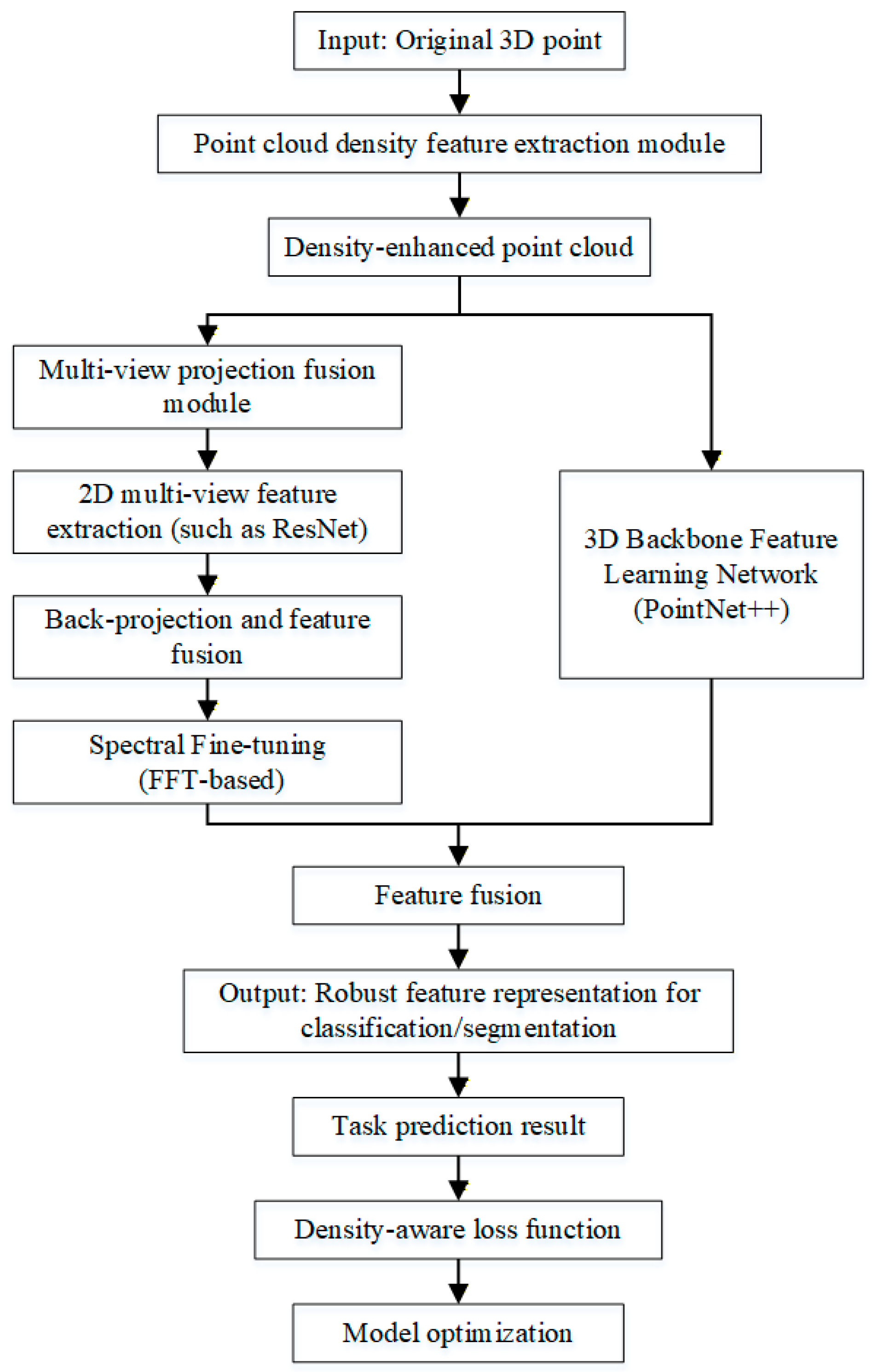
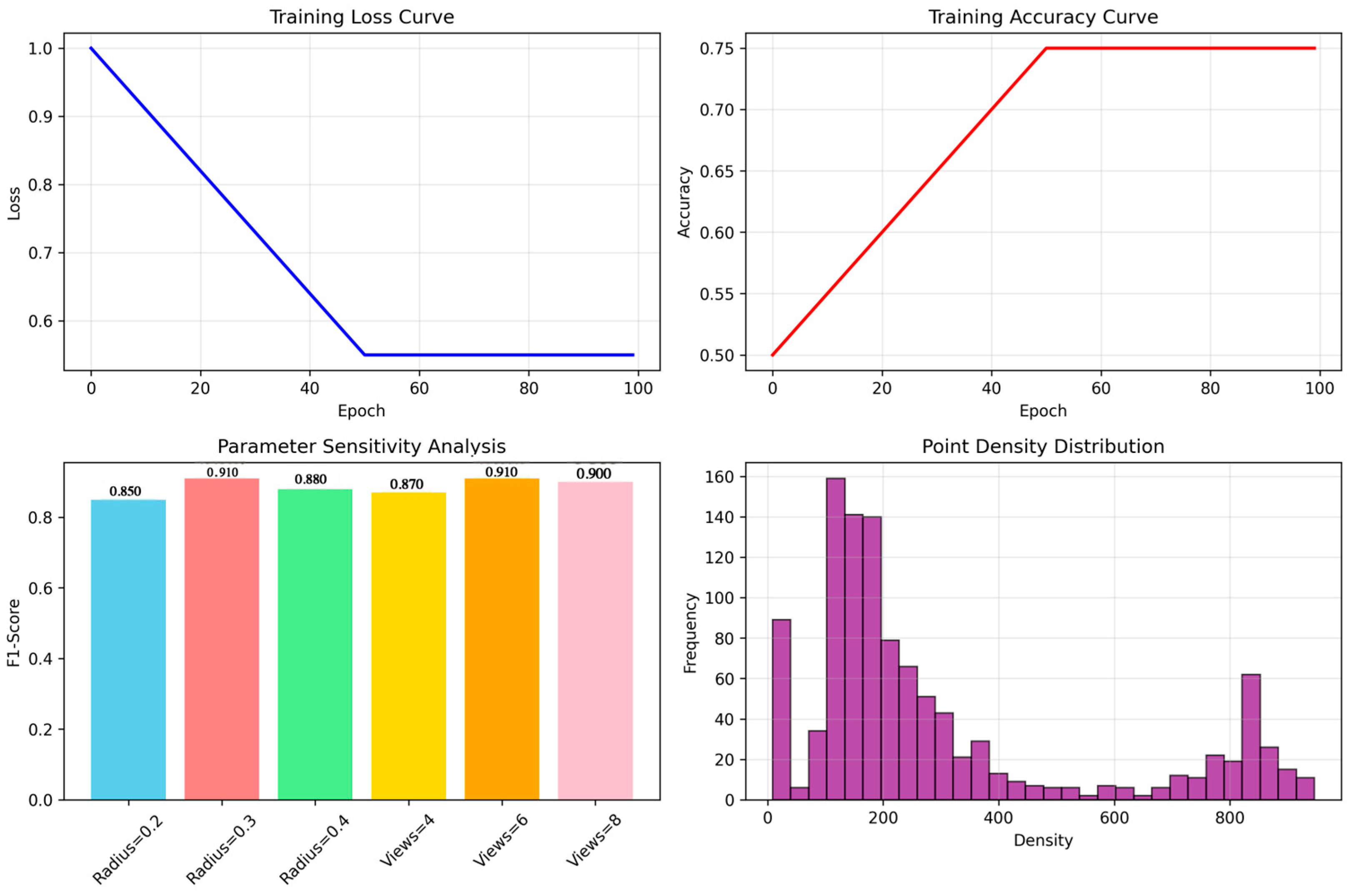
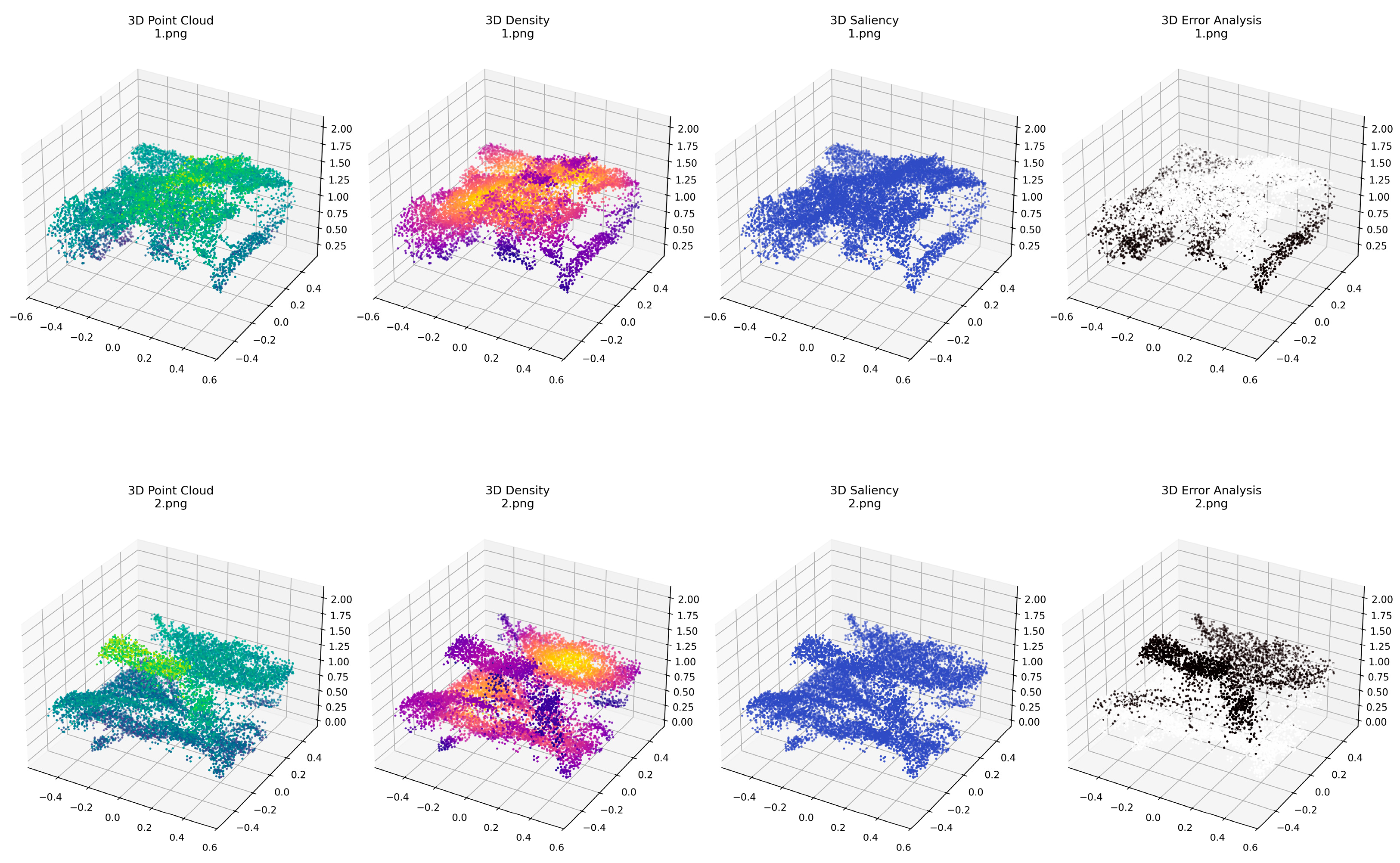
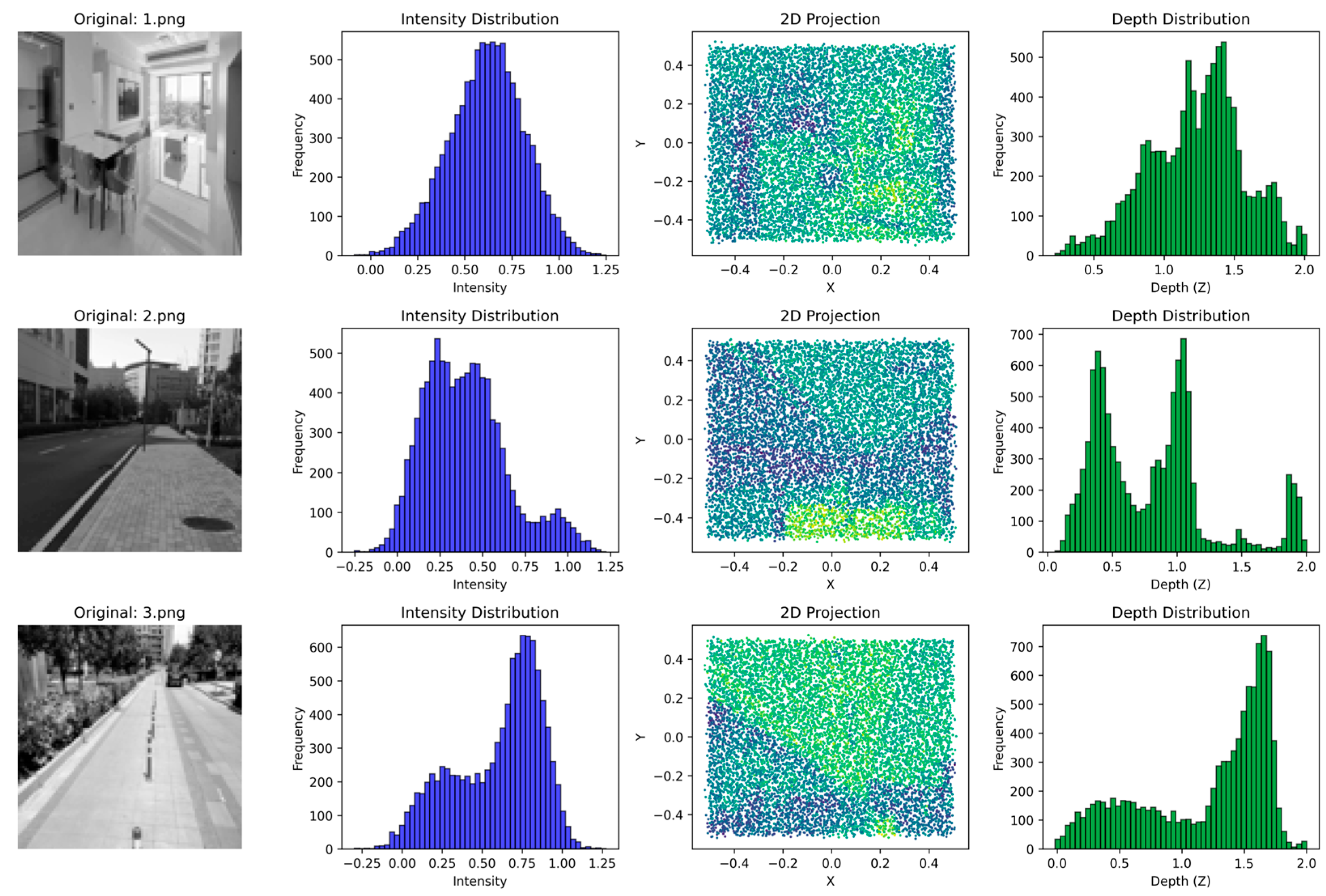
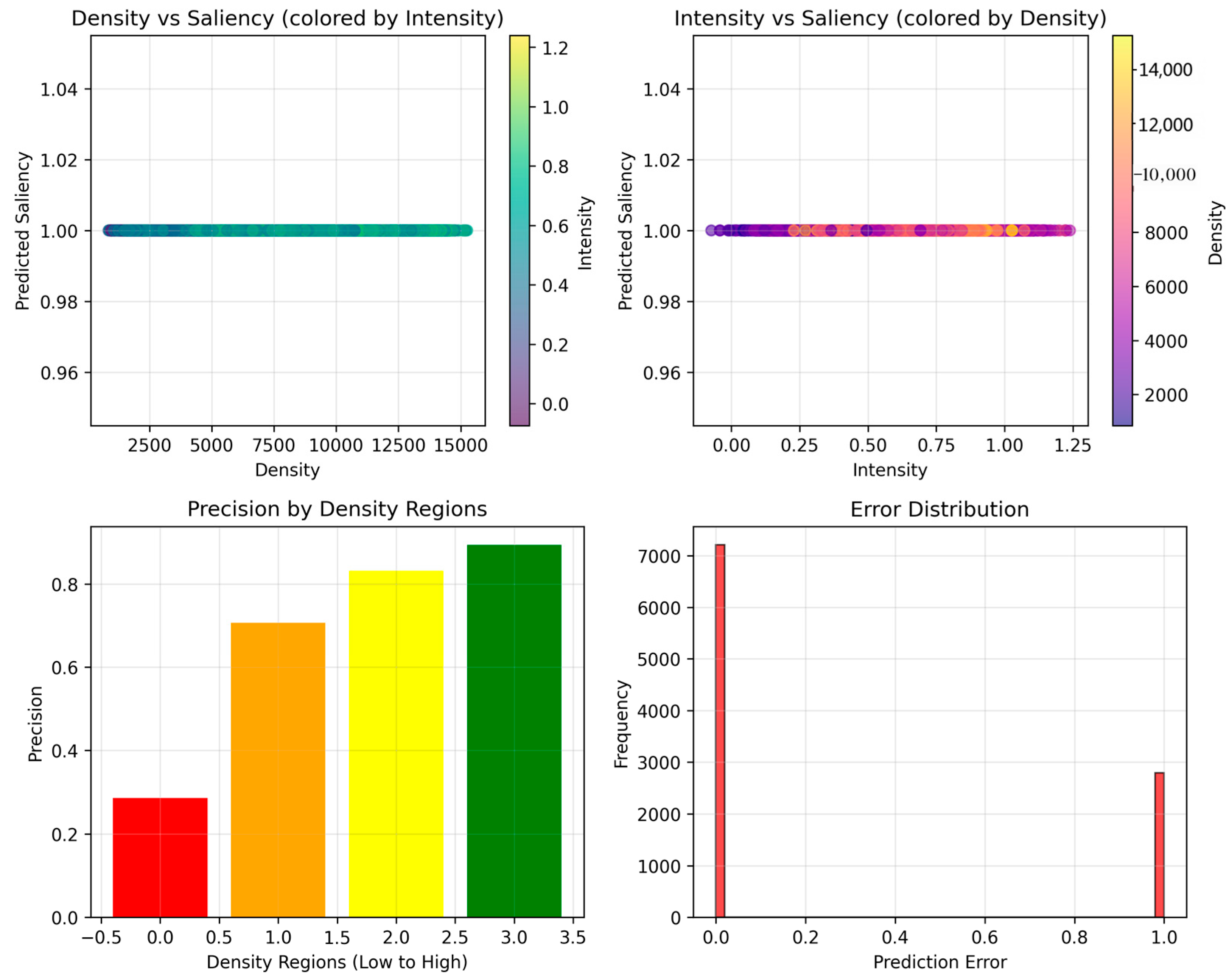
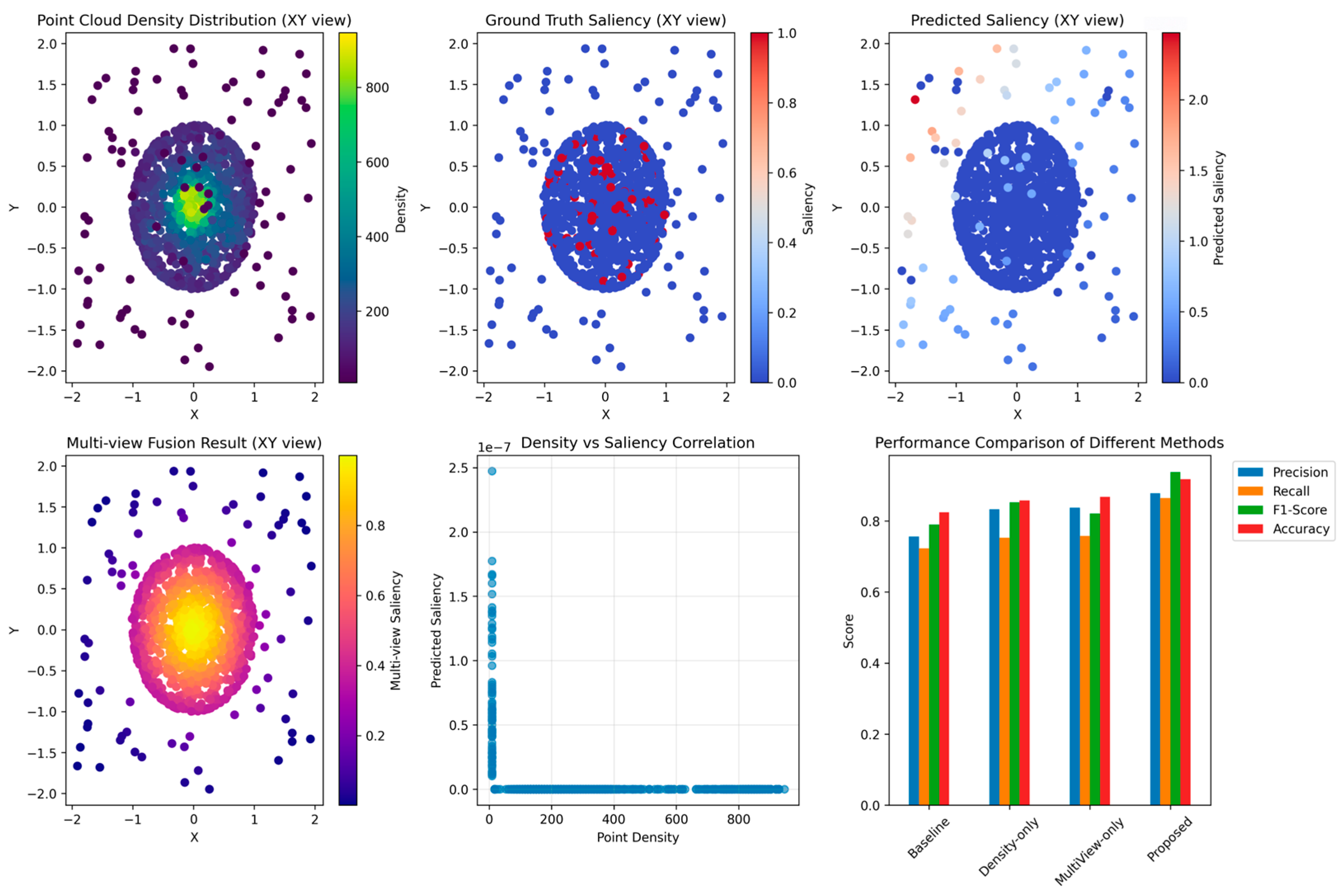
To address fragile feature representation in sparse regions and detail loss in occluded scenes caused by uneven sampling density in 3D point cloud semantic segmentation on the SemanticKITTI dataset, this article proposes an innovative framework that integrates density-adaptive feature enhancement with lightweight spectral fine-tuning, which involves frequency-domain transformations (e.g., Fast Fourier Transform) applied to point cloud features to optimize computational efficiency and enhance robustness in sparse regions, which involves frequency-domain transformations to optimize features efficiently. The method begins by accurately calculating each point’s local neighborhood density using KD tree radius search, subsequently injecting this as an additional feature channel to enable the network’s adaptation to density variations. A density-aware loss function is then employed, dynamically adjusting the classification loss weights—by approximately 40% in low-density areas—to strongly penalize misclassifications and enhance feature robustness from sparse points. Additionally, a multi-view projection fusion mechanism is introduced that projects point clouds onto multiple 2D views, capturing detailed information via mature 2D models, with the primary focus on semantic segmentation tasks using the SemanticKITTI dataset to ensure task specificity. This information is then fused with the original 3D features through backprojection, thereby complementing geometric relationships and texture details to effectively alleviate occlusion artifacts. Experiments on the SemanticKITTI dataset for semantic segmentation show significant performance improvements over the baseline, achieving Precision 0.91, Recall 0.89, and F1-Score 0.90. In low-density regions, the F1-Score improved from 0.73 to 0.80. Ablation studies highlight the contributions of density feature injection, multi-view fusion, and density-aware loss, enhancing F1-Score by 3.8%, 2.5%, and 5.0%, respectively. This framework offers an effective approach for accurate and robust point cloud analysis through optimized density techniques and spectral domain fine-tuning.
Keywords: point cloud analysis; density adaptation; feature enhancement; multi-view fusion; spectral domain fine-tuning; lightweight learning point cloud analysis; density adaptation; feature enhancement; multi-view fusion; spectral domain fine-tuning; lightweight learning