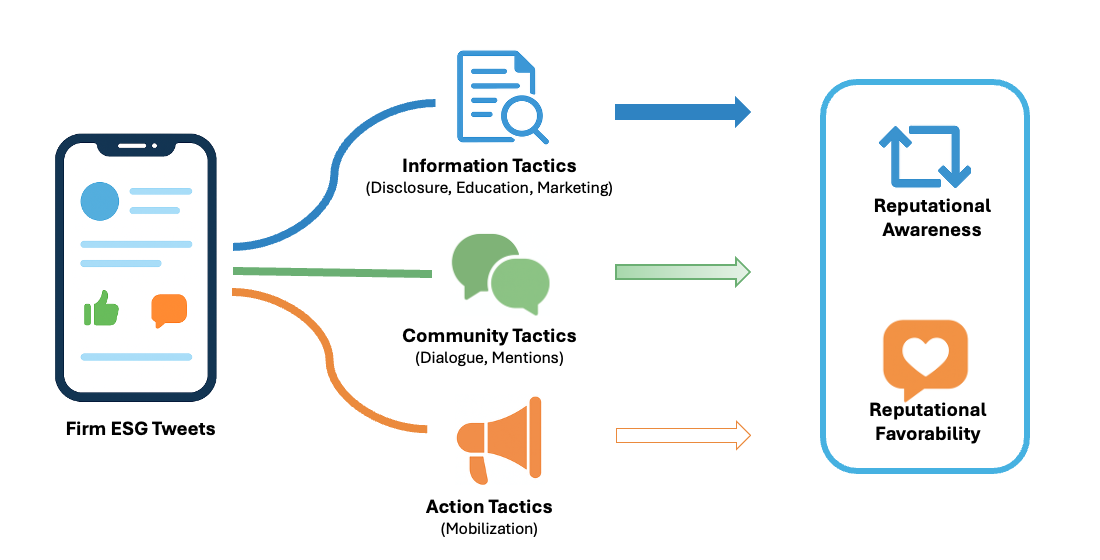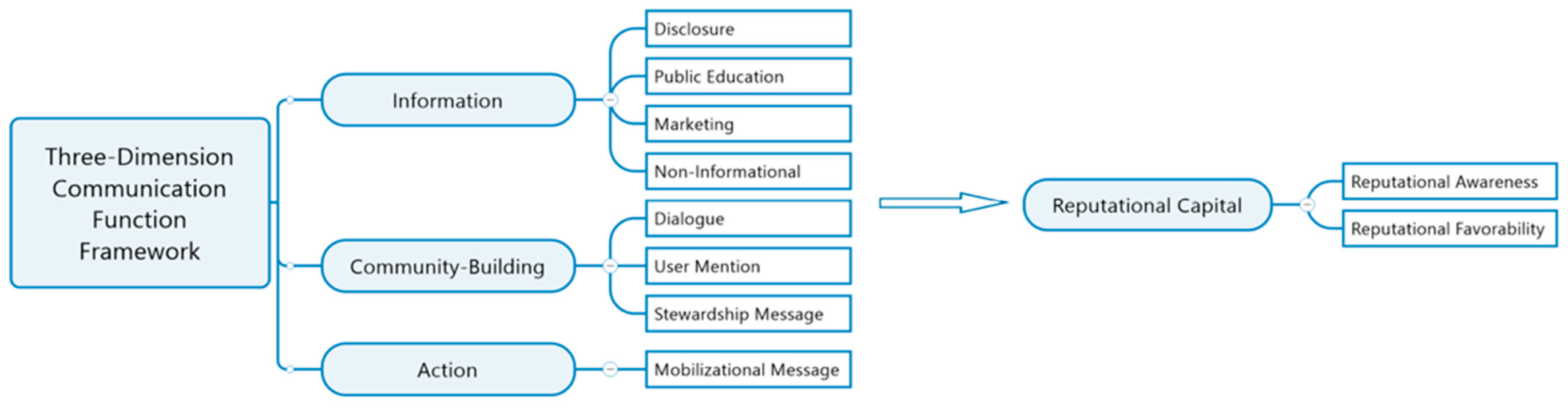

ESG Communication Tactics and Reputational Capital on Social Media



Abstract
1. Introduction
2. ESG Communication and Corporate Reputation
2.1. ESG and Reputational Capital
Two Dimensions of Reputational Capital: Reputational Awareness and Favorability
2.2. ESG Communication on Social Media to Gain Reputational Capital
3. Method
3.1. Sample and Data
3.2. Dependent Variables: Reputational Awareness and Favorability
3.3. Independent Variables: Communicative Tactics
3.4. Control Variables
4. Results
4.1. Descriptive Analyses
4.1.1. Control Variables
4.1.2. Dependent Variables
4.1.3. RQ1: Eight Communicative Tactics
We’re proud of our commitment to #diversity, #equality and inclusion at all levels. we know first-hand the importance & value of board diversity and we encourage other companies to rise to this moment. #theboardchallenge https://t.co/h8tmatkidi.
the #nasdaq inc. stock exchange’s new #diversity rules will impose a board diversity disclosure requirements on nasdaq-listed companies. will these mandatory disclosure requirements nudge companies to improve the diversity of their boards? https://t.co/h0z0ftb1ts https://t.co/sxecyhldfu.
this #earthday and every day, we’re proud to partner with @energystar to deliver cost-saving #energyefficiency solutions that improve air quality and protect the climate. together, we can create a more sustainable future. #energychoicescount https://t.co/tzfkffzfcw.
@tsahia sounds like a nice place! just be sure to include the hashtags #sweepstakes and #eatitforward for your nomination to count! *keegs
Pls join the #P4SPchat on citizen engagement. Starts in 45 min, Noon ET http://t.co/GobUBqy3Qe.
@dannyuseswords thank you for taking the time to share your experience with us! we’re so glad to hear our driver went above and beyond for your delivery.#deliveringsmiles.


hess recently donated $40,000 to @prairie_grit in our continued support of the minot, nd #community. the donation will be used to increase the clinic size to allow for more therapists, services & expanded insurance coverage options that will include @teamminot military families.
thank you to our hard-working #naturalgas employees and all you do to care for the safety and comfort of our communities, every day. #nguwday #gasworkersday #natgas https://t.co/dxegyaejso.
we are proud to once again be nominated as a @womenintrucking top company for women to work for in transportation. if you think j.b. hunt is a great place for women to work, then click the link and cast your vote! #womenintransporation #inclusion https://t.co/jgqmhn9crk https://t.co/vz0zblcin8.
4.2. Tests of RQ2
4.3. RQ3: Testing Interactions with Disclosure
4.4. Additional Analyses
4.4.1. Generalizability to All S&P 500 Tweets
4.4.2. B2C vs. B2B Firms
4.5. Robustness Tests
5. Discussion and Conclusions
Supplementary Materials
Author Contributions
Funding
Institutional Review Board Statement
Informed Consent Statement
Data Availability Statement
Acknowledgments
Conflicts of Interest
Appendix A. Variable Definitions

| Variable | Description |
|---|---|
| Dependent Variables REPUTATIONAL AWARENESS Retweet Count | The number of retweets each firm tweet received |
| REPUTATIONAL FAVORABILITY Positive Replies | The number of positive replies each firm tweet received |
| Independent Variables INFORMATION | Tweet coded as containing a disclosure, public education, or marketing tactic (0, 1) |
| Disclosure | Tweet discloses information on firm’s ESG activities (0, 1) |
| Public Education | Tweet contains information intended to educate public on ESG-related issue (0, 1) |
| Marketing | Tweet contains information marketing the company’s products or services (0, 1) |
| Non-Informational | Tweet conveys no information (0, 1) |
| COMMUNITY-BUILDING | Tweet contains dialogue and/or mobilization tactic (0, 1) |
| Dialogue | Tweet contains a dialogic tactic—asking a question, responding to public query, engaging in tweetchat (0, 1) |
| User Mention | Tweet contains a mention of another user (0, 1) |
| Stewardship Message | Tweet conveys a message thanking or congratulating another Twitter user (0, 1) |
| ACTION | |
| Mobilizational Message | Tweet contains a mobilizational tactic—asking audience members to, for instance, vote or retweet message (0, 1) |
| Control Variables ACCOUNT-LEVEL Followers | Number of followers of the firm’s Twitter account |
| Time on Twitter | Number of days firm has managed Twitter account (as of 1/1/2020) |
| Prior Statuses Count | Cumulative number of tweets sent by firm’s Twitter account (as of 1/1/2020) |
| FIRM-LEVEL Size | Logged Total Assets (Compustat) |
| Sales | Logged sales (Compustat) |
| ESG Risk | Morningstar Sustainalytics’ [74] overall ESG risk score, determined by assessing a company’s exposure to material ESG risks and its effectiveness in managing them. |
References
- Lunawat, R. The Role of Information in Building Reputation in an Investment. Trust Fund. Eur. Account. Rev. 2013, 22, 513–532. [Google Scholar] [CrossRef]
- Lev, B.; Gu, F. The End of Accounting and the Path Forward for Investors and Managers; John Wiley & Sons, Inc.: Hoboken, NJ, USA, 2016. [Google Scholar]
- Ivanov, A.; Sharman, R. Impact of User-Generated Internet Content on Hospital Reputational Dynamics. J. Manag. Inf. Syst. 2018, 35, 1277–1300. [Google Scholar] [CrossRef]
- Lodhia, S.; Stone, G. Integrated Reporting in an Internet and Social Media Communication Environment: Conceptual Insights. Aust. Account. Rev. 2017, 27, 17–33. [Google Scholar] [CrossRef]
- She, C.; Michelon, G. Managing Stakeholder Perceptions: Organized Hypocrisy in CSR Disclosures on Facebook. Crit. Perspect. Account. 2019, 61, 54–76. [Google Scholar] [CrossRef]
- Tang, Q.; Gu, B.; Whinston, A.B. Content Contribution for Revenue Sharing and Reputation in Social Media: A Dynamic Structural Model. J. Manag. Inf. Syst. 2012, 29, 41–76. [Google Scholar] [CrossRef]
- Castelló, I.; Etter, M.; Årup Nielsen, F. Strategies of Legitimacy through Social Media: The Networked Strategy. J. Manag. Stud. 2016, 53, 402–432. [Google Scholar] [CrossRef]
- Unerman, J.; Bennett, M. Increased Stakeholder Dialogue and the Internet: Towards Greater Corporate Accountability or Reinforcing Capitalist Hegemony? Account. Organ. Soc. 2004, 29, 685–707. [Google Scholar] [CrossRef]
- Lovejoy, K.; Saxton, G.D. Information, Community, and Action: How Nonprofit Organizations Use Social Media. J. Comput. Commun. 2012, 17, 337–353. [Google Scholar] [CrossRef]
- Bellucci, M.; Manetti, G. Facebook as a Tool for Supporting Dialogic Accounting? Evidence from Large Philanthropic Foundations in the United States. Account. Audit. Account. J. 2017, 30, 874–905. [Google Scholar] [CrossRef]
- King, K.K.; Wang, B.; Escobari, D.; Oraby, T. Dynamic Effects of Falsehoods and Corrections on Social Media: A Theoretical Modeling and Empirical Evidence. J. Manag. Inf. Syst. 2021, 38, 989–1010. [Google Scholar] [CrossRef]
- Michelon, G.; Rodrigue, M.; Trevisan, E. The Marketization of a Social Movement: Activists, Shareholders and CSR Disclosure. Account. Organ. Soc. 2020, 80, 101074. [Google Scholar] [CrossRef]
- Jiang, L.; Gu, Y.; Dai, J. Environmental, Social, and Governance Taxonomy Simplification: A Hybrid Text Mining Approach. J. Emerg. Technol. Account. 2023, 20, 305–325. [Google Scholar] [CrossRef]
- Bebbington, J.; Larrinaga, C.; Moneva, J.M. Legitimating Reputation/the Reputation of Legitimacy Theory. Account. Audit. Account. J. 2008, 21, 371–374. [Google Scholar] [CrossRef]
- Go, A.; Bhayani, R.; Huang, L. Twitter Sentiment Classification Using Distant Supervision. In CS224N Project Report; Stanford University: Stanford, CA, USA, 2009; pp. 1–12. [Google Scholar]
- Wang, Y.Y.; Wang, T.; Yoon, K. A Methodology for the Sport Industry to Capture Public Perceptions and Responses in the Time of {COVID}-19. J. Emerg. Technol. Account. 2021, 18, 205–211. [Google Scholar] [CrossRef]
- Wang, Y.; Wang, T. Python Code and Illustrative Crisis Management Data from Twitter. J. Inf. Syst. 2022, 36, 211–217. [Google Scholar] [CrossRef]
- Lange, D.; Lee, P.; Dai, Y. Organizational Reputation: A Review. J. Manag. 2011, 37, 153–184. [Google Scholar] [CrossRef]
- Rindova, V.P.; Williamson, I.O.; Petkova, A.P.; Sever, J.M. Being Good or Being Known: An Empirical Examination of the Dimensions, Antecedents, and Consequences of Organizational Reputation. Acad. Manag. J. 2005, 48, 1033–1049. [Google Scholar] [CrossRef]
- Saxton, G.D.; Gomez, L.; Ngoh, Z.; Lin, Y.-P.; Dietrich, S. Do CSR Messages Resonate? Examining Public Reactions to Firms’ CSR Efforts on Social Media. J. Bus. Ethics 2019, 155, 359–377. [Google Scholar] [CrossRef]
- Moser, D.V.; Martin, P.R. A Broader Perspective on Corporate Social Responsibility Research in Accounting. Account. Rev. 2012, 87, 797–806. [Google Scholar] [CrossRef]
- Tsang, A.; Frost, T.; Cao, H. Environmental, Social, and Governance (ESG) Disclosure: A Literature Review. Br. Account. Rev. 2023, 55, 101149. [Google Scholar] [CrossRef]
- Patten, D.M. Seeking Legitimacy. Sustain. Account. Manag. Policy J. 2019, 11, 1009–1021. [Google Scholar] [CrossRef]
- Aguinis, H.; Glavas, A. What We Know and Don’t Know about Corporate Social Responsibility: A Review and Research Agenda. J. Manag. 2012, 38, 932–968. [Google Scholar] [CrossRef]
- Gödker, K.; Mertins, L. CSR Disclosure and Investor Behavior: A Proposed Framework and Research Agenda. Behav. Res. Account. 2018, 30, 37–53. [Google Scholar] [CrossRef]
- Bouten, L.; Hoozée, S. On the Interplay between Environmental Reporting and Management Accounting Change. Manag. Account. Res. 2013, 24, 333–348. [Google Scholar] [CrossRef]
- Fombrun, C.; Van Riel, C. The Reputational Landscape. Corp. Reput. Rev. 1997, 1, 5–13. [Google Scholar] [CrossRef]
- Cen, L.; Chen, F.; Hou, Y.; Richardson, G.D. Strategic Disclosures of Litigation Loss Contingencies When Customer-Supplier Relationships Are at Risk. Account. Rev. 2018, 93, 137–159. [Google Scholar] [CrossRef]
- Cook, J.; Kowalewski, Z.T.; Minnis, M.; Sutherland, A.; Zehms, K.M. Auditors Are Known by the Company They Keep. J. Account. Econ. 2020, 70, 101314. [Google Scholar] [CrossRef]
- Bigus, J.; Hua, K.P.M.; Raithel, S. Definitions and Measures of Corporate Reputation in Accounting and Management: Commonalities, Differences, and Future Research. Account. Bus. Res. 2024, 54, 304–336. [Google Scholar] [CrossRef]
- Raithel, S.; Schwaiger, M. The Effects of Corporate Reputation Perceptions of the General Public on Shareholder Value. Strateg. Manag. J. 2015, 36, 945–956. [Google Scholar] [CrossRef]
- Saxton, T. The Effects of Partner and Relationship Characteristics on Alliance Outcomes. Acad. Manag. J. 1997, 40, 441–463. [Google Scholar] [CrossRef]
- Pollock, T.G.; Rindova, V.P. Media Legitimation Effects in the Market for Initial Public Offerings. Acad. Manag. J. 2003, 46, 631–642. [Google Scholar] [CrossRef]
- Wei, J.; Ouyang, Z.; Chen, H. Well Known or Well Liked? The Effects of Corporate Reputation on Firm Value at the Onset of a Corporate Crisis. Strateg. Manag. J. 2017, 38, 2103–2120. [Google Scholar] [CrossRef]
- Fraustino, J.; Connolly-Ahern, C. Corporate Associations Written on the Wall: Publics’ Responses to Fortune 500 Ability and Social Responsibility Facebook Posts. J. Public Relat. Res. 2015, 27, 452–474. [Google Scholar] [CrossRef]
- Gómez-Vásquez, L. Me Gusta o Te Sigo Análisis de La Comunicación de Prácticas de Responsabilidad Social Corporativa a Través de Los Medios Sociales. Corresp. Análisis 2013, 3, 89–109. [Google Scholar] [CrossRef]
- Lee, K.; Oh, W.-Y.; Kim, N. Social Media for Socially Responsible Firms: Analysis of Fortune 500’s Twitter Profiles and Their CSR/CSIR Ratings. J. Bus. Ethics 2013, 118, 791–806. [Google Scholar] [CrossRef]
- Cade, N.L. Corporate Social Media: How Two-Way Disclosure Channels Influence Investors. Account. Organ. Soc. 2018, 68, 63–79. [Google Scholar] [CrossRef]
- Blankespoor, E.; Miller, G.S.; White, H.D. The Role of Dissemination in Market Liquidity: Evidence from Firms’ Use of Twitter. Account. Rev. 2014, 89, 79–112. [Google Scholar] [CrossRef]
- Barnett, M.L.; Jermier, J.M.; Lafferty, B.A. Corporate Reputation: The Definitional Landscape. Corp. Reput. Rev. 2006, 9, 26–38. [Google Scholar] [CrossRef]
- Rowbottom, N.; Lymer, A. Exploring the Use of Online Corporate Reporting Information. J. Emerg. Technol. Account. 2009, 6, 27–44. [Google Scholar] [CrossRef]
- King, B.G. A Social Movement Perspective of Stakeholder Collective Action and Influence. Bus. Soc. 2007, 47, 21–49. [Google Scholar] [CrossRef]
- Vasi, I.B.; Walker, E.T.; Johnson, J.S.; Tan, H.F. “No Fracking Way!” Documentary Film, Discursive Opportunity, and Local Opposition against Hydraulic Fracturing in the United States, 2010 to 2013. Am. Sociol. Rev. 2015, 80, 934–959. [Google Scholar] [CrossRef]
- Saxton, G.D.; Waters, R.D. What Do Stakeholders ’like’ on Facebook? Examining Public Reactions to Nonprofit Organizations’ Informational, Promotional, and Community-Building Messages. J. Public Relations Res. 2014, 26, 280–299. [Google Scholar] [CrossRef]
- Trinkle, B.S.; Crossler, R.E.; Bélanger, F. Voluntary Disclosures via Social Media and the Role of Comments. J. Inf. Syst. 2015, 29, 101–121. [Google Scholar] [CrossRef]
- Kane, G.C.; Alavi, M.; Labianca, G.J.; Borgatti, S. What’s Different about Social Media Networks? A Framework and Research Agenda. MIS Q. 2014, 38, 274–304. [Google Scholar] [CrossRef]
- Bellucci, M.; Simoni, L.; Acuti, D.; Manetti, G. Stakeholder Engagement and Dialogic Accounting. Account. Audit. Account. J. 2019, 32, 1467–1499. [Google Scholar] [CrossRef]
- Colleoni, E. CSR Communication Strategies for Organizational Legitimacy in Social Media. Corp. Commun. Int. J. 2013, 18, 228–248. [Google Scholar] [CrossRef]
- Merkl-Davies, D.M.; Brennan, N. A Theoretical Framework of External Accounting Communication: Research Perspectives, Traditions, and Theories. Account. Audit. Account. J. 2017, 30, 433–469. [Google Scholar] [CrossRef]
- Cho, C.H.; Laine, M.; Roberts, R.W.; Rodrigue, M. Organized Hypocrisy, Organizational Façades, and Sustainability Reporting. Accounting, Organ. Soc. 2015, 40, 78–94. [Google Scholar] [CrossRef]
- Malik, A.; Heyman-Schrum, C.; Johri, A. Use of Twitter across Educational Settings: A Review of the Literature. Int. J. Educ. Technol. High. Educ. 2019, 16, 1–22. [Google Scholar] [CrossRef]
- Hull, K.; Dodd, J.E. Faculty Use of Twitter in Higher Education Teaching. J. Appl. Res. High. Educ. 2017, 9, 91–104. [Google Scholar] [CrossRef]
- Read, W.; Robertson, N.; McQuilken, L.; Ferdous, A.S. Consumer Engagement on {T}witter: Perceptions of the Brand Matter. Eur. J. Mark. 2019, 53, 1905–1933. [Google Scholar] [CrossRef]
- Zhou, M.; Lei, L.; Wang, J.; Fan, W.; Wang, A.G. Social Media Adoption and Corporate Disclosure. J. Inf. Syst. 2015, 29, 23–50. [Google Scholar] [CrossRef]
- Gómez-Carrasco, P.; Guillamón-Saorín, E.; García Osma, B. Stakeholders versus Firm Communication in Social Media: The Case of Twitter and Corporate Social Responsibility Information. Eur. Account. Rev. 2021, 30, 31–62. [Google Scholar] [CrossRef]
- Lei, L.G.; Li, Y.; Luo, Y. Social Media and Voluntary Nonfinancial Disclosure: Evidence from Twitter Presence and Corporate Political Disclosure. J. Inf. Syst. 2018, 33, 99–128. [Google Scholar] [CrossRef]
- Waters, R.D. Redefining Stewardship: Examining How Fortune 100 Organizations Use Stewardship with Virtual Stakeholders. Public Relat. Rev. 2011, 37, 129–136. [Google Scholar] [CrossRef]
- Taylor, J.; Pagliari, C. Mining Social Media Data: How Are Research Sponsors and Researchers Addressing the Ethical Challenges? Res. Ethics 2017, 14, 1–39. [Google Scholar] [CrossRef]
- González-Bailón, S.; Paltoglou, G. Signals of Public Opinion in Online Communication: A Comparison of Methods and Data Sources. Ann. Am. Acad. Pol. Soc. Sci. 2015, 659, 95–107. [Google Scholar] [CrossRef]
- Hopkins, D.; King, G. A Method of Automated Nonparametric Content Analysis for Social Science. Am. J. Pol. Sci. 2010, 54, 229–247. [Google Scholar] [CrossRef]
- Landis, J.; Koch, G. The Measurement of Observer Agreement for Categorical Data. Biometrics 1977, 33, 159–174. [Google Scholar] [CrossRef] [PubMed]
- Miles, M.B.; Huberman, A.M. Qualitative Data Analysis: A Sourcebook of New Methods; Sage: Beverly Hills, CA, USA, 1984; ISBN 0803922744. [Google Scholar]
- Strauss, A.; Corbin, J. Basics of Qualitative Research, 2nd ed.; Sage: Thousands Oaks, CA, USA, 1998. [Google Scholar]
- Bakshy, E.; Hofman, J.M.; Mason, W.A.; Watts, D.J. Everyone’s an Influencer: Quantifying Influence on Twitter. In Proceedings of the Fourth ACM International Conference on Web Search and Data Mining, Hong Kong, China, 9–12 February 2011; pp. 65–74. [Google Scholar]
- Suddaby, R.; Saxton, G.D.; Gunz, S. Twittering Change: The Institutional Work of Domain Change in Accounting Expertise. Account. Organ. Soc. 2015, 45, 52–68. [Google Scholar] [CrossRef]
- Srinivasan, R.; Lilien, G.L.; Sridhar, S. Should Firms Spend More on Research and Development and Advertising during Recessions? J. Mark. 2011, 75, 49–65. [Google Scholar] [CrossRef]
- Larcker, D.F.; Rusticus, T.O. On the Use of Instrumental Variables in Accounting Research. J. Account. Econ. 2010, 49, 186–205. [Google Scholar] [CrossRef]
- Du, S.; Yu, K. Do Corporate Social Responsibility Reports Convey Value Relevant Information? Evidence from Report Readability and Tone. J. Bus. Ethics 2021, 172, 253–274. [Google Scholar] [CrossRef]
- Schultz, F.; Castelló, I.; Morsing, M. The Construction of Corporate Social Responsibility in Network Societies: A Communication View. J. Bus. Ethics 2013, 115, 681–692. [Google Scholar] [CrossRef]
- KPMG International. KPMG International Survey of Corporate Responsibility Reporting 2011; KPMG International: Eindhoven, The Netherlands, 2011. [Google Scholar]
- Hillman, A.J.; Hitt, M.A. Corporate Political Strategy Formulation: A Model of Approach, Participation, and Strategy Decisions. Acad. Manag. Rev. 1999, 24, 825–842. [Google Scholar] [CrossRef]
- Brivot, M.; Gendron, Y.; Guénin, H. Reinventing Organizational Control: Meaning Contest Surrounding Reputational Risk Controllability in the Social Media Arena. Account. Audit. Account. J. 2017, 30, 795–820. [Google Scholar] [CrossRef]
- Oppong-Tawiah, D.; Webster, J. Corporate Sustainability Communication as ‘Fake News’: Firms’ Greenwashing on Twitter. Sustainability 2023, 15, 6683. [Google Scholar] [CrossRef]
- Morningstar Sustainalytics ESG Risk Ratings Methodology. Available online: https://www.sustainalytics.com/esg-data (accessed on 15 March 2025).

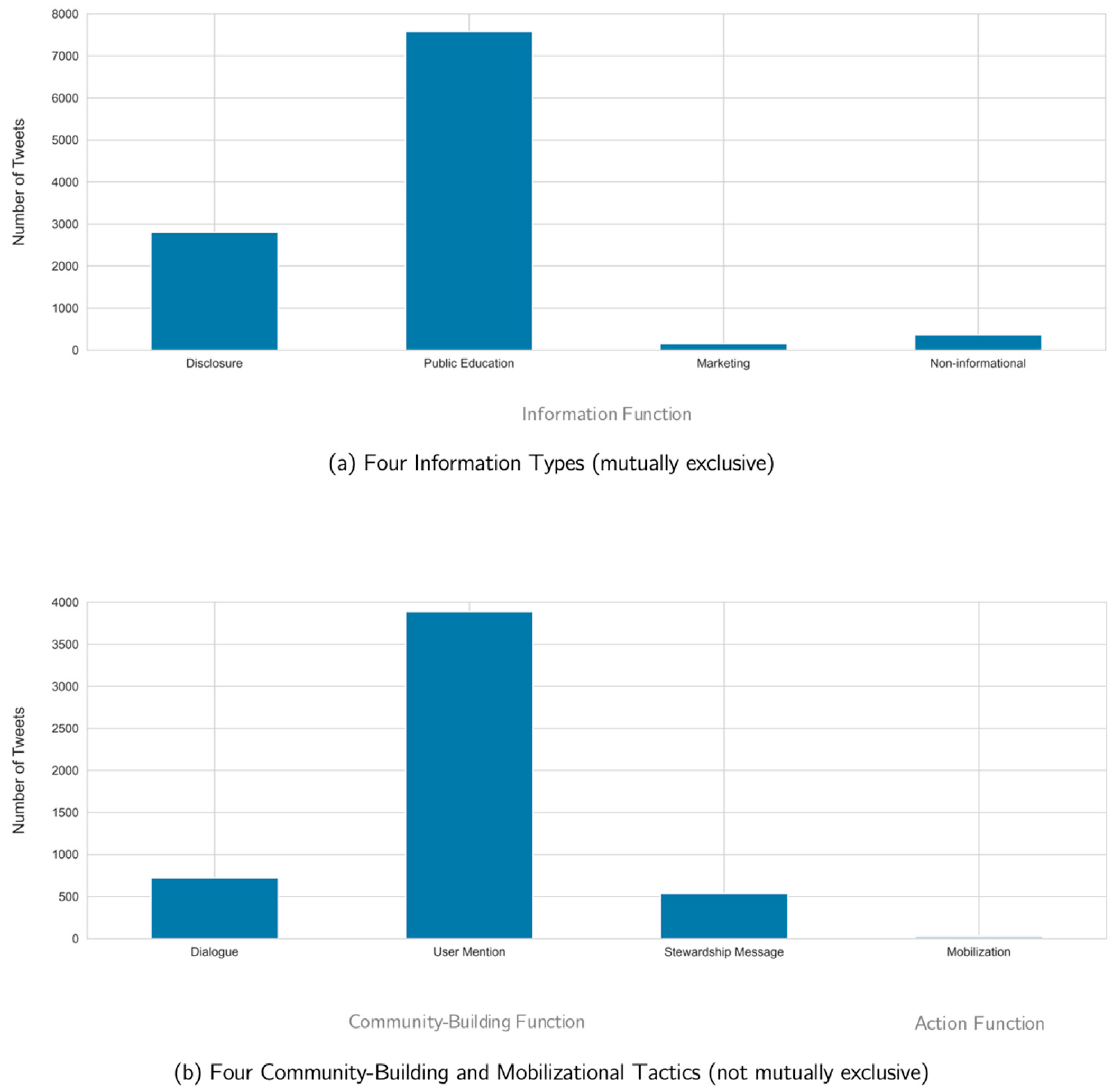
| Number of Tweets | |
|---|---|
| All tweets sent by S&P 500 firms 2020–2022 | 2,309,573 |
| Less: Non-ESG Tweets | (2,300,928) |
| Less: Missing control variable data | (36) |
| Total ESG tweets | 10,851 |
| Variable | Count | Mean | Std Dev | Min. | Max |
|---|---|---|---|---|---|
| Dependent Variables REPUTATIONAL AWARENESS Retweet Count | 10,851 | 2.132 | 7.214 | 0 | 325 |
| REPUTATIONAL FAVORABILITY Positive Replies | 10,851 | 0.069 | 0.462 | 0 | 20 |
| Independent Variables INFORMATION | 10,851 | 0.967 | 0.179 | 0 | 1 |
| Disclosure | 10,851 | 0.257 | 0.437 | 0 | 1 |
| Public Education | 10,851 | 0.696 | 0.460 | 0 | 1 |
| Marketing | 10,851 | 0.014 | 0.116 | 0 | 1 |
| Non-Informational | 10,851 | 0.033 | 0.179 | 0 | 1 |
| COMMUNITY | 10,851 | 0.436 | 0.496 | 0 | 1 |
| Dialogue | 10,851 | 0.066 | 0.249 | 0 | 1 |
| User Mention | 10,851 | 0.357 | 0.479 | 0 | 1 |
| Stewardship Message | 10,851 | 0.049 | 0.216 | 0 | 1 |
| ACTION | |||||
| Mobilizational Message | 10,851 | 0.003 | 0.056 | 0 | 1 |
| Control Variables ACCOUNT-LEVEL | |||||
| Followers | 10,851 | 148.018 | 599.817 | 0.357 | 13,187.786 |
| Time on Twitter | 10,851 | 45.013 | 7.581 | 10.41 | 57.72 |
| Prior Statuses Count | 10,851 | 8.921 | 1.044 | 4.277 | 14.695 |
| FIRM-LEVEL Assets | 10,851 | 10.127 | 1.136 | 6.862 | 14.705 |
| Sales | 10,851 | 9.511 | 1.014 | 6.253 | 13.23 |
| ESG Risk | 10,851 | 23.035 | 7.509 | 6.988 | 50.947 |
| Variables | (1) | (2) | (3) | (4) | (5) | (6) | (7) | (8) | (9) | (10) | (11) | (12) | (13) | (14) | (15) | (16) | (17) |
|---|---|---|---|---|---|---|---|---|---|---|---|---|---|---|---|---|---|
| (1) Retweet Count | 1 | ||||||||||||||||
| (2) Positive Replies | 0.18 * | 1 | |||||||||||||||
| (3) Information | 0.00 | −0.01 | 1 | ||||||||||||||
| (4) Disclosure | 0.01 | 0.01 | 0.11 * | 1 | |||||||||||||
| (5) Public Education | −0.01 | −0.01 | 0.28 * | −0.89 * | 1 | ||||||||||||
| (6) Marketing | 0.00 | −0.01 | 0.02 * | −0.07 * | −0.18 * | 1 | |||||||||||
| (7) Community | −0.01 | 0.00 | −0.15 * | 0.06 * | −0.12 * | 0.00 | 1 | ||||||||||
| (8) Dialogue | −0.05 * | 0.00 | −0.34 * | 0.05 * | −0.18 * | 0.00 | 0.30 * | 1 | |||||||||
| (9) User Mention | 0.01 | 0.00 | 0.07 * | 0.04 * | −0.01 | 0.00 | 0.85 * | −0.15 * | 1 | ||||||||
| (10) Stewardship Message | 0.00 | 0.01 | −0.41 * | 0.02 * | −0.17 * | −0.02 | 0.26 * | 0.18 * | 0.01 | 1 | |||||||
| (11) Mobilizational Message | 0.00 | 0.00 | −0.01 | 0.00 | −0.01 | −0.01 | 0.00 | 0.02 | 0.00 | 0.00 | 1 | ||||||
| (12) Followers | 0.18 * | 0.08 * | −0.27 * | 0.00 | −0.10 * | −0.02 * | 0.07 * | 0.29 * | −0.07 * | 0.08 * | 0.03 * | 1 | |||||
| (13) Time on Twitter | 0.08 * | 0.03 * | −0.06 * | 0.05 * | −0.07 * | 0.00 | −0.08 * | 0.05 * | −0.10 * | 0.02 * | −0.01 | 0.15 * | 1 | ||||
| (14) Prior Statuses Count | 0.06 * | 0.07 * | −0.19 * | −0.07 * | −0.01 | 0.00 | 0.06 * | 0.22 * | −0.04 * | 0.07 * | 0.01 | 0.31 * | 0.30 * | 1 | |||
| (15) Size | 0.12 * | 0.06 * | −0.12 * | 0.02 * | −0.07 * | −0.01 | 0.05 * | 0.20 * | −0.04 * | 0.05 * | −0.01 | 0.27 * | 0.04 * | 0.20 * | 1 | ||
| (16) Sales | 0.11 * | 0.03 * | −0.14 * | 0.02 | −0.07 * | −0.02 | 0.08 * | 0.24 * | −0.03 * | 0.04 * | 0.00 | 0.36 * | −0.01 | 0.23 * | 0.75 * | 1 | |
| (17) ESG Risk | −0.03 * | 0.00 | −0.06 * | −0.01 | −0.02 * | 0.02 | −0.04 * | 0.04 * | −0.07 * | 0.06 * | 0.00 | 0.00 | −0.04 * | −0.15 * | 0.16 * | 0.12 * | 1 |
| DV = Retweet Count | DV = Positive Replies | |||
|---|---|---|---|---|
| (1) | (2) | (3) | (4) | |
| INFORMATION | 0.79 ** | 0.60 * | ||
| (0.10) | (0.28) | |||
| Disclosure | 0.30 ** | 0.36 | ||
| (0.12) | (0.31) | |||
| Public Education | 0.29 * | 0.13 | ||
| (0.11) | (0.31) | |||
| Marketing | 0.34 * | −0.19 | ||
| (0.17) | (0.60) | |||
| COMMUNITY-BUILDING | −0.06 * | 0.10 | ||
| (0.03) | (0.10) | |||
| Dialogue | −0.95 ** | −1.17 ** | ||
| (0.09) | (0.28) | |||
| User Mention | 0.06 + | 0.22 * | ||
| (0.03) | (0.10) | |||
| Stewardship Message | 0.10 | 0.39 + | ||
| (0.08) | (0.21) | |||
| ACTION | ||||
| Mobilizational Message | −0.30 | −0.16 | −0.64 | −0.59 |
| (0.27) | (0.29) | (1.06) | (1.05) | |
| ACCOUNT-LEVEL CONTROLS | ||||
| Followers | 0.001 ** | 0.001 ** | 0.001 ** | 0.001 ** |
| (0.001) | (0.001) | (0.001) | (0.001) | |
| Time on Twitter | 0.01 ** | 0.01 ** | 0.01 | 0.01 |
| (0.001) | (0.001) | (0.01) | (0.01) | |
| Prior Statuses Count | −0.02 | −0.10 ** | 0.29 ** | 0.31 ** |
| (0.02) | (0.02) | (0.06) | (0.06) | |
| FIRM-LEVEL CONTROLS | ||||
| Size | 0.35 ** | 0.28 ** | 0.75 ** | 0.70 ** |
| (0.02) | (0.02) | (0.08) | (0.08) | |
| Sales | −0.07 ** | −0.07 * | −0.71 ** | −0.63 ** |
| (0.03) | (0.03) | (0.10) | (0.10) | |
| ESG Risk | −0.02 ** | −0.03 ** | −0.01 | −0.01 |
| (0.00) | (0.00) | (0.01) | (0.01) | |
| _cons | −3.15 ** | −0.28 | −5.58 ** | −6.74 ** |
| (0.31) | (0.35) | (1.06) | (1.09) | |
| Industry Fixed Effects | YES | YES | YES | YES |
| N | 10,851 | 10,851 | 10,851 | 10,851 |
| Model Sig. (χ2) | 1052.89 ** | 822.70 ** | 196.19 ** | 237.08 ** |
| Log likelihood | −19,388.79 | −19,430.89 | −2356.57 | −2339.00 |
| DV = Retweet Count | DV = Positive Replies | |||
|---|---|---|---|---|
| (1) | (2) | (3) | (4) | |
| INFORMATION | ||||
| Disclosure | 0.87 ** | 0.42 ** | 0.71 * | 0.34 |
| (0.11) | (0.12) | (0.32) | (0.37) | |
| Public Education | 0.83 ** | 0.40 ** | 0.53 + | 0.19 |
| (0.10) | (0.11) | (0.29) | (0.35) | |
| Marketing | 0.93 ** | 0.55 ** | 0.15 | −0.13 |
| (0.15) | (0.15) | (0.59) | (0.62) | |
| COMMUNITY-BUILDING | −0.001 | 0.09 | ||
| (0.03) | (0.12) | |||
| Dialogue | −1.48 ** | −0.87 ** | ||
| (0.11) | (0.33) | |||
| User Mention | 0.10 ** | 0.17 | ||
| (0.03) | (0.12) | |||
| Stewardship Message | 0.19 * | 0.16 | ||
| (0.09) | (0.29) | |||
| ACTION | ||||
| Mobilizational Message | −0.93 * | −0.86 * | −20.43 | −21.33 ** |
| (0.41) | (0.40) | (25575.98) | (1.14) | |
| INTERACTIONS | ||||
| Disclosure × Community | −0.20 ** | 0.00 | ||
| (0.06) | (0.21) | |||
| Disclosure × Dialogue | 0.06 | −0.87 | ||
| (0.17) | (0.58) | |||
| Disclosure × User Mention | −0.05 | 0.16 | ||
| (0.06) | (0.21) | |||
| Disclosure × Stewardship Message | −0.42 ** | 0.57 | ||
| (0.15) | (0.43) | |||
| Disclosure × Mobilizational Message | 1.50 ** | 1.39 * | 20.64 | 21.77 |
| (0.57) | (0.57) | (25575.98) | (28.05) | |
| Account-level Controls | YES | YES | YES | YES |
| Firm-level Controls | YES | YES | YES | YES |
| Industry Fixed Effects | YES | YES | YES | YES |
| N | 10,851 | 10,851 | 10,851 | 10,851 |
| Model Sig. (χ2) | 1073.14 ** | 1393.31 ** | 199.55 ** | 114.14 ** |
| Log likelihood | −19378.19 | −19185.17 | −2353.93 | −2335.56 |
| DV = Retweet Count | DV = Positive Replies | |||
|---|---|---|---|---|
| (1) | (2) | (3) | (4) | |
| INFORMATION | 1.54 ** | 0.03 ** | ||
| (0.01) | (0.01) | |||
| Disclosure | 0.44 ** | −0.05 ** | ||
| (0.01) | (0.01) | |||
| Public Education | 0.35 ** | −0.39 ** | ||
| (0.01) | (0.01) | |||
| Marketing | 0.30 ** | −0.07 ** | ||
| (0.01) | (0.02) | |||
| COMMUNITY-BUILDING | −1.78 ** | −1.36 ** | ||
| (0.01) | (0.01) | |||
| Dialogue | −4.52 ** | −2.22 ** | ||
| (0.01) | (0.01) | |||
| User mention | 0.13 ** | −0.21 ** | ||
| (0.01) | (0.01) | |||
| Stewardship Message | −0.18 ** | 0.14 ** | ||
| (0.01) | (0.01) | |||
| ACTION | ||||
| Mobilizational Message | 1.01 ** | 0.24 ** | 0.87 ** | 0.59 ** |
| (0.04) | (0.03) | (0.06) | (0.05) | |
| ACCOUNT-LEVEL CONTROLS | ||||
| Followers | 0.00 ** | 0.00 ** | 0.00 ** | 0.00 ** |
| (0.00) | (0.00) | (0.00) | (0.00) | |
| Time on Twitter | 0.02 ** | 0.02 ** | −0.00 | −0.00 * |
| (0.00) | (0.00) | (0.00) | (0.00) | |
| Prior Statuses Count | −0.50 ** | −0.01 ** | 0.01 ** | 0.15 ** |
| (0.00) | (0.00) | (0.00) | (0.00) | |
| FIRM-LEVEL CONTROLS | ||||
| Size | −0.01 | 0.20 ** | 0.20 ** | 0.25 ** |
| (0.00) | (0.00) | (0.01) | (0.01) | |
| Sales | 0.09 ** | 0.10 ** | −0.23 ** | −0.23 ** |
| (0.00) | (0.00) | (0.01) | (0.01) | |
| ESG Risk | −0.01 ** | 0.00 ** | −0.01 ** | −0.01 ** |
| (0.00) | (0.00) | (0.00) | (0.00) | |
| _cons | 3.86 ** | −1.91 ** | 1.87 ** | 0.65 ** |
| (0.04) | (0.03) | (0.06) | (0.06) | |
| Industry Fixed Effects | YES | YES | YES | YES |
| N | 2,309,171 | 2,309,171 | 2,309,171 | 2,309,171 |
| Model Sig. (χ2) | 305,368.36 | 610,936.38 | 38,186.50 | 60,633.92 |
| Log likelihood | −1.58 × 10⁶ ** | −1.41 × 10⁶ ** | −5.70 × 10⁵** | −5.60 × 10⁵ ** |
| DV = Retweet Count | DV = Positive Replies | |||||||
|---|---|---|---|---|---|---|---|---|
| (1) | (2) | (3) | (4) | (5) | (6) | (7) | (8) | |
| B2C | B2B | B2C | B2B | B2C | B2B | B2C | B2B | |
| INFORMATION | 1.63 ** | 0.18 | 1.64 ** | −0.21 | ||||
| (0.26) | (0.11) | (0.57) | (0.34) | |||||
| Disclosure | 0.38 | 0.02 | −0.36 | −0.14 | ||||
| (0.30) | (0.12) | (0.79) | (0.37) | |||||
| Public Education | 0.38 | 0.05 | −0.57 | −0.22 | ||||
| (0.30) | (0.12) | (0.79) | (0.36) | |||||
| Marketing | 0.63 | 0.28 + | −14.85 | −0.34 | ||||
| (0.50) | (0.17) | (2689.55) | (0.63) | |||||
| COMMUNITY-BUILDING | −0.15 + | −0.10 ** | 0.27 | 0.14 | ||||
| (0.08) | (0.03) | (0.24) | (0.12) | |||||
| Dialogue | −3.40 ** | −1.33 ** | −2.71 ** | −0.73 * | ||||
| (0.41) | (0.11) | (0.77) | (0.34) | |||||
| User Mention | 0.05 | 0.04 | 0.60 * | 0.24 + | ||||
| (0.07) | (0.03) | (0.24) | (0.12) | |||||
| Stewardship Message | −0.09 | −0.02 | −0.60 | 0.42 | ||||
| (0.17) | (0.09) | (0.54) | (0.26) | |||||
| ACTION | ||||||||
| Mobilizational Message | −1.59 * | −0.15 | −1.30 * | −0.20 | −14.94 | 0.06 | −14.90 | 0.04 |
| (0.68) | (0.35) | (0.66) | (0.35) | (1638.06) | (1.10) | (2492.35) | (1.10) | |
| Account-level Controls | YES | YES | YES | YES | YES | YES | YES | YES |
| Firm-level Controls | YES | YES | YES | YES | YES | YES | YES | YES |
| Industry Fixed Effects | YES | YES | YES | YES | YES | YES | YES | YES |
| N | 1632 | 6551 | 1632 | 6551 | 1632 | 6551 | 1632 | 6551 |
| Model Sig. (χ2) | 269.51 ** | 1105.38 ** | 385.31 ** | 1260.47 ** | 989.96 ** | 60.65 ** | 1512.37 ** | 73.23 ** |
| Log likelihood | −2579.51 | −12047.41 | −2508.40 | −11948.46 | −392.92 | −1505.14 | −378.04 | −1499.33 |
Disclaimer/Publisher’s Note: The statements, opinions and data contained in all publications are solely those of the individual author(s) and contributor(s) and not of MDPI and/or the editor(s). MDPI and/or the editor(s) disclaim responsibility for any injury to people or property resulting from any ideas, methods, instructions or products referred to in the content. |
© 2025 by the authors. Licensee MDPI, Basel, Switzerland. This article is an open access article distributed under the terms and conditions of the Creative Commons Attribution (CC BY) license (https://creativecommons.org/licenses/by/4.0/).
Share and Cite
Ahmed, T.; Maharaj, G.; Saxton, G.D.; Zhang, S. ESG Communication Tactics and Reputational Capital on Social Media. Information 2025, 16, 1063. https://doi.org/10.3390/info16121063
Ahmed T, Maharaj G, Saxton GD, Zhang S. ESG Communication Tactics and Reputational Capital on Social Media. Information. 2025; 16(12):1063. https://doi.org/10.3390/info16121063
Chicago/Turabian StyleAhmed, Tahmina, Gajindra Maharaj, Gregory D. Saxton, and Shujie Zhang. 2025. "ESG Communication Tactics and Reputational Capital on Social Media" Information 16, no. 12: 1063. https://doi.org/10.3390/info16121063
APA StyleAhmed, T., Maharaj, G., Saxton, G. D., & Zhang, S. (2025). ESG Communication Tactics and Reputational Capital on Social Media. Information, 16(12), 1063. https://doi.org/10.3390/info16121063