
VCAC: A Blockchain-Based Virtual Care Access Control Model for Transforming Legacy Healthcare Information Systems and EMRs into Secure, Interoperable Patient-Centered Virtual Hospital Systems


Abstract
1. Introduction
Research Contributions
- Developing a blockchain-based VCAC model that extends—rather than replaces—legacy healthcare information systems and EMRs, thus enabling secure, patient-centered (PC) data exchange without disrupting existing infrastructure.
- Introducing a six-tier information classification scheme that maps clinical responsibilities to treatment phases, enabling fine-grained, role-based access control across institutional boundaries.
- Designing a neutral security domain that harmonizes local and collaborative policies, preserving institutional autonomy while enforcing unified access rules through distributed ledger technology.
- Demonstrating the feasibility and real-world applicability of the proposed model via a breast cancer outpatient scenario, showcasing its potential for adoption in resource-constrained healthcare settings and its adaptability to other virtual care contexts.
2. Virtual Healthcare Service Delivery Model: Fundamentals
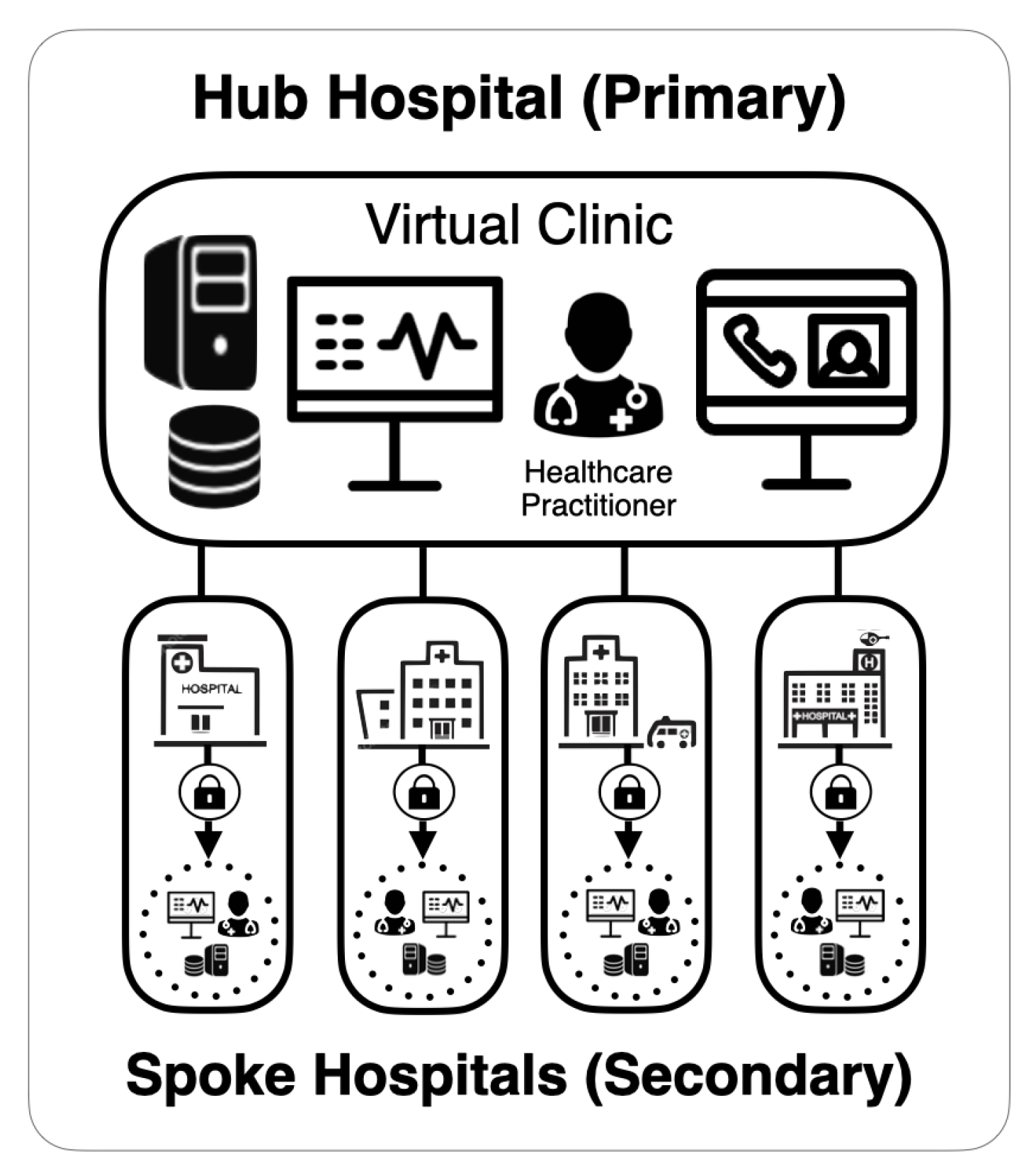
2.1. The Virtual Model as the New Norm
2.2. Virtual Healthcare and the Imperative of Patient-Centeredness
3. Challenges in Incorporating Legacy Healthcare Information Systems and EMRs in Virtual Healthcare Settings
3.1. The Data-Sharing vs. Data Protection Dilemma
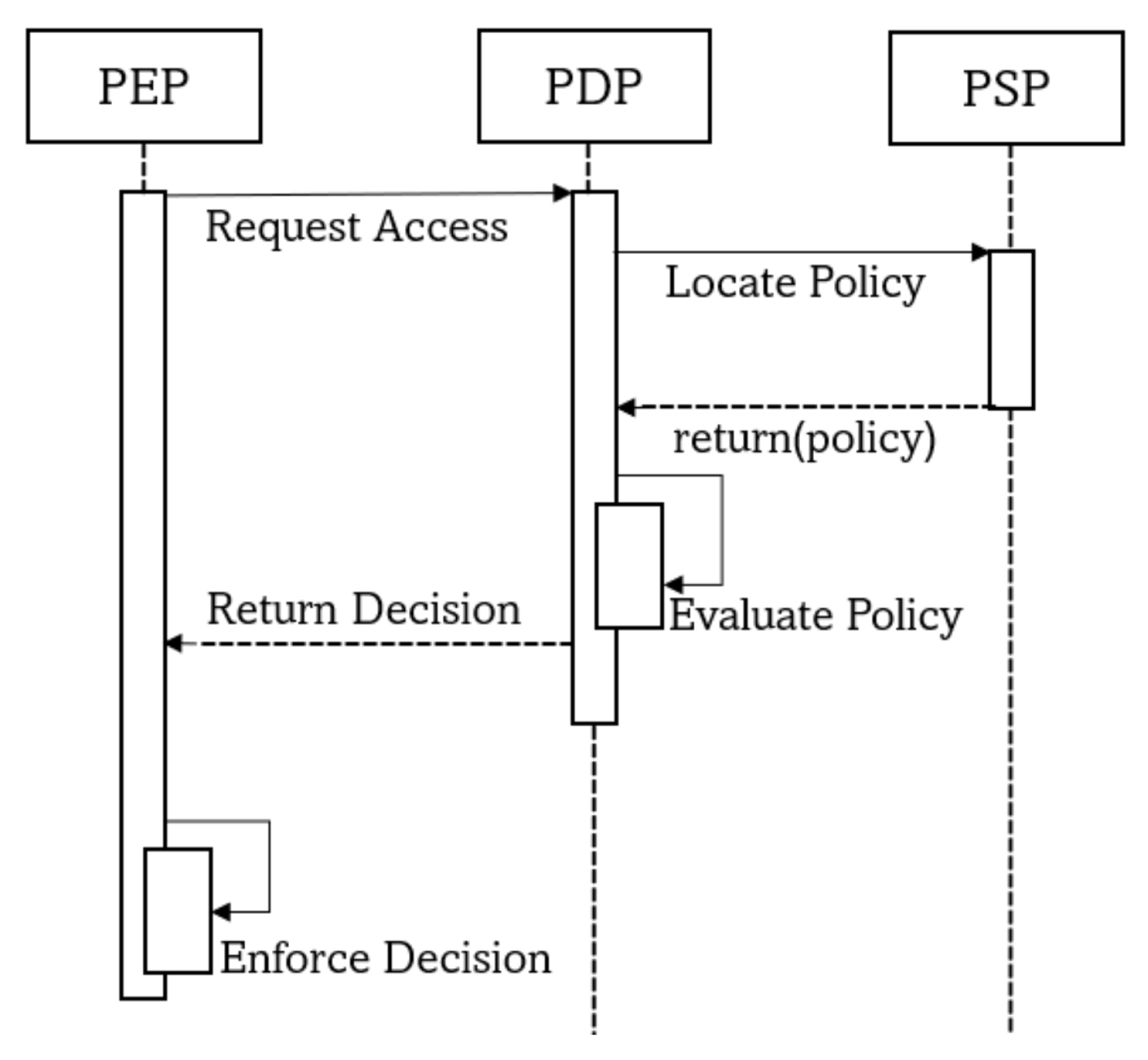
3.2. Access Control Models in Traditional Hospital Information Systems and EMRs
3.3. Limitations of Traditional Access Control Models
3.4. Information Security Threats in Legacy Hospital Information Systems and EMRs
- Lack of interoperability across EMRs and hospital information systems that inhibits collaboration across hospitals.
- Over-permissioned access models in legacy information systems and EMRs that compromise patient privacy and role-based precision.
- Absence of cross-institutional access control, resulting in fragmented care delivery in virtual settings.
- Limited auditability and traceability of shared information in multi-domain healthcare environments.
4. Distributed Ledger Technology and Legacy Healthcare Systems
5. Related Work
6. Materials and Methods
- Threat Analysis, Modeling, and Risk Assessment: A comprehensive threat analysis and modeling exercise was performed to identify security vulnerabilities associated with legacy EMR and hospital information systems, particularly in the context of managing patient-centered data in distributed virtual care environments. This assessment laid the foundation for determining appropriate security controls. Table 1 summarizes the key threats identified.
- Information Security Controls: Based on the risk assessment, a set of targeted controls was identified to mitigate critical threats. These security controls were designed to align with best practices in secure information governance and to strengthen the system’s resilience against data breaches and system failures.
- Information Classification Scheme: A policy-driven information classification scheme was developed to guide access control decisions in virtual care scenarios. This scheme categorizes patient data according to sensitivity and intended usage. It serves as a foundational component for enabling fine-grained, role-aware access. Further details are provided in Section 6.
- VCAC Model Design for Virtual Hospitals: Building on the classification scheme, a novel fine-grained VCAC model was designed to govern data sharing across the virtual hospital network. The model introduces an independent information layer that interfaces with legacy systems and aligns access permissions with patient treatment pathways. This study extends previous work [20] by integrating the updated classification model and blockchain infrastructure for enhanced auditability and trust.
- Blockchain Architecture Design for VCAC Model Implementation: A custom blockchain component was implemented to operationalize the access control model. This component enforces role-based access decisions using the classification scheme while maintaining integrity, availability, and confidentiality across distributed settings—key requirements for secure virtual healthcare delivery.
- System Evaluation: The final step involved evaluating the proposed system against the threat landscape defined in the initial assessment. The evaluation focused on the model’s ability to mitigate identified vulnerabilities, preserve data integrity, ensure data availability across institutional boundaries, and protect sensitive patient information in a decentralized environment.
7. Blockchain-Based VCAC Model for Breast Cancer Use Case
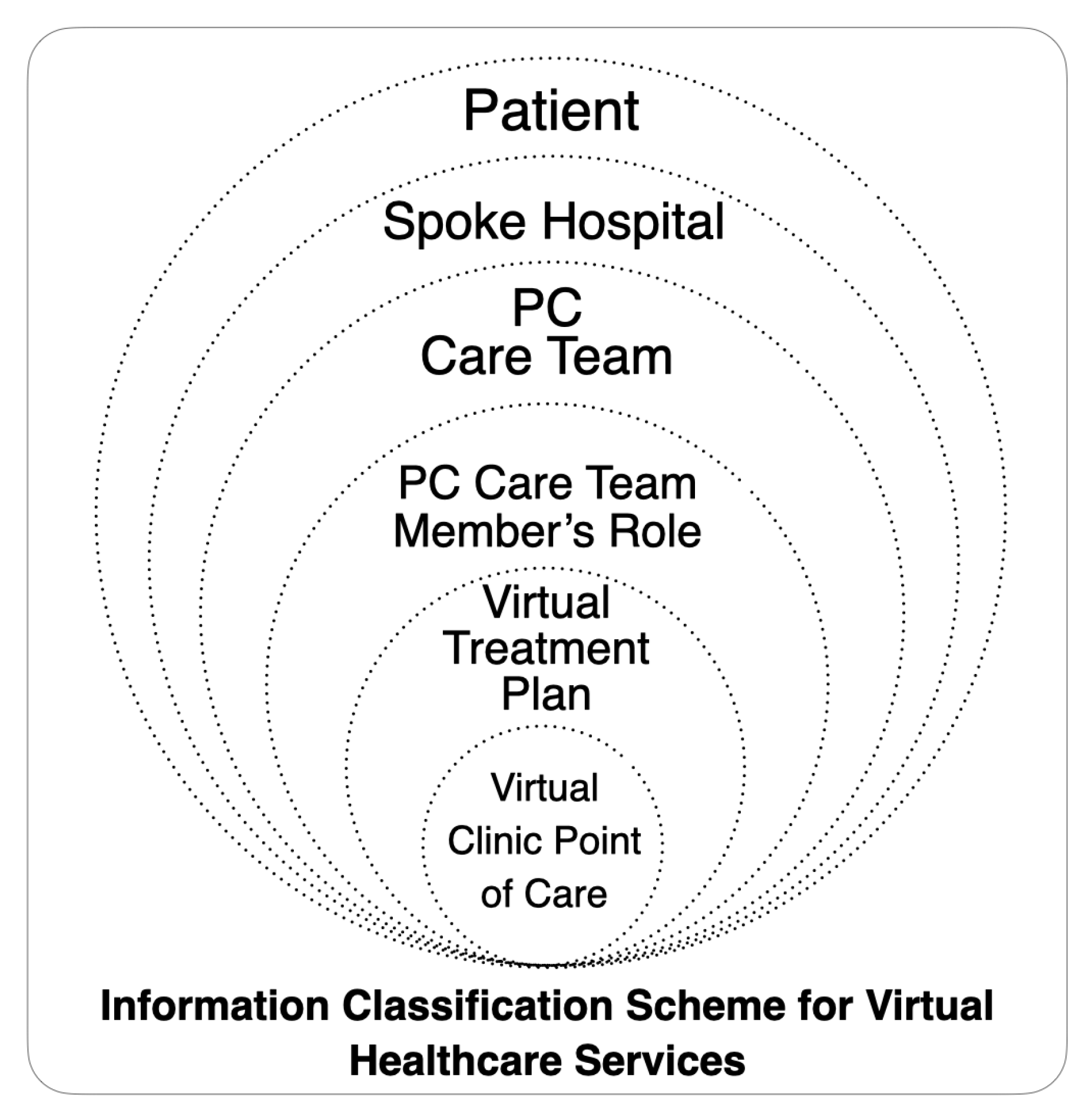
7.1. Six-Tier Information Classification Scheme Design
- Access is restricted to members of the PC care team assigned to a given patient.
- Each member may access only the subset of data required to perform their role in the designated treatment plan.
- Information is accessible only at the specific virtual healthcare point of care during active service provision.
7.2. Blockchain-Based VCAC Model
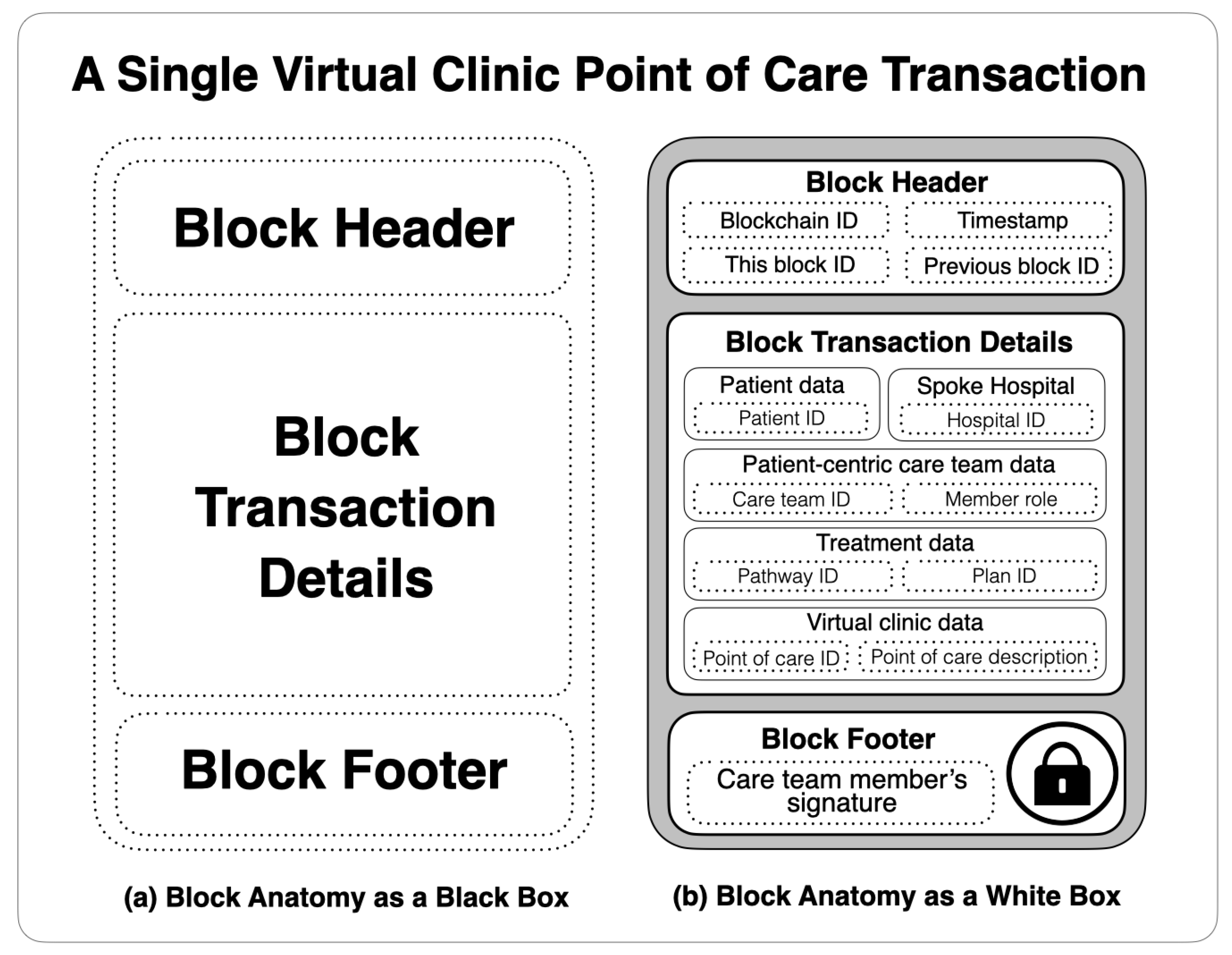
7.2.1. Component 1: Granular Block Anatomy
- The patient receiving care;
- The spoke hospital storing patient EMRs;
- The assigned PC care team;
- The roles of care team members;
- The treatment plan in progress;
- The virtual point of care.
7.2.2. Component 2: Neutral Layer for VCAC Model Implementation
- u is the user identity;
- r is the user’s role;
- is the domain;
- is the information tier;
- is the policy function, written as follows:
7.2.3. Component 3: Layered Architecture Integration of All Components
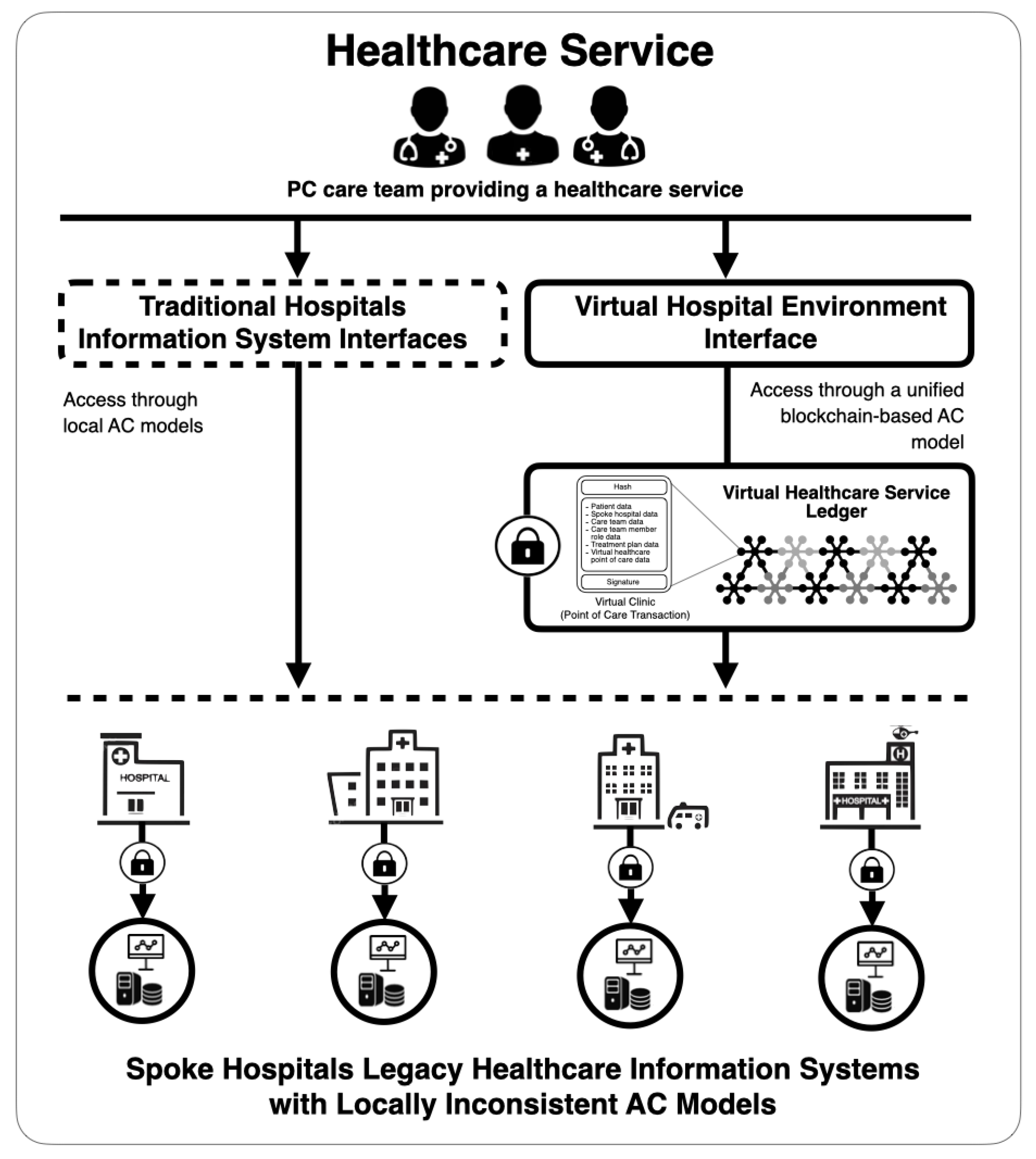
- In Component 1 (Granular Block Anatomy), blockchain blocks act as secure metadata containers, recording treatment events, role assignments, and access decisions without storing full EMRs.
- In Component 2 (Neutral Layer), smart contracts implement the six-tier classification scheme to automatically enforce cross-institutional policies.
- In Component 3 (Layered Architecture), the blockchain provides the neutral governance domain that mediates inter-institutional data sharing, storing only metadata and cryptographic proofs while full EMRs remain in local hospital systems.
7.2.4. Consensus, Throughput, and Scalability Considerations
Load Budget (Analytical)
Scalability
7.3. Breast Cancer Treatment Workflow: A Use Case for the VCAC Model
- Step-by-Step Virtual Oncology Follow-Up (Synthetic Scenario)
- Context binding: The patient visit (V2025-06-03) is registered at S-A. The care team role is oncologist (O45) at hub H-B.
- Consent token: Patient P123 issues a digital consent token: .
- Access request: The oncologist submits a VCAC request: .
- Policy evaluation: The smart contract verifies identity, confirms that c is valid, and checks that requested tiers align with the treatment plan.
- Decision and logging: Access is granted. The blockchain logs hashes of the authorized datasets: imaging (T2: ), laboratory results (T3: ), and genomics (T5: ).
- Off-chain retrieval: The EMR adapter at S-A resolves each hash to the corresponding local repository; only metadata and proofs are shared on-chain, while full EMRs remain in local databases.
- The patient’s current treatment stage, which maps to multiple tiers (e.g., , , and );
- The oncologist’s domain and role (hub hospital, treatment supervisor);
- Whether allows role-tier access for this clinical context;
- Whether the spoke hospital’s constraints have been reconciled with (e.g., local imaging access permissions).
- Emergency Access (“Break-Glass” Scenario)
- Emergency flag: The triage physician (EDPhys) raises in the access request, signaling an emergency override.
- Consensus approval: The smart contract triggers a rapid consensus check among designated on-call approvers (e.g., senior clinicians or system administrators). Approval is scoped narrowly (e.g., Tier T3 laboratory data) and time-limited (e.g., 2 h).
- Access granted: The decision is recorded on-chain as “Emergency Override,” signed by all endorsers, and enforced immediately.
- Audit requirement: After the event, the override is subject to mandatory review. The immutable blockchain log ensures transparency and accountability, deterring misuse.
8. VCAC Model Evaluation
8.1. Mitigating Information Integrity Threats
- Chronological data recording: The VCAC model maintains an immutable, time-stamped sequence of transactions, each representing a patient treatment point. This chronological structure allows care teams to trace the origin of erroneous data and act accordingly.
- Indelible audit trail: All blocks are cryptographically signed by care team members, ensuring data authenticity and accountability. Updates are never overwritten or deleted but appended, preserving historical accuracy for medical decision-making and legal compliance.
- System-wide consistency: By serving as a decentralized, tamper-proof source of truth, the blockchain reduces inconsistencies that arise when patient data are duplicated across fragmented systems. It eliminates the risk of conflicting records due to redundant data entry or system silos.
8.2. Mitigating Information Availability Threats
- Decentralized and fault-tolerant architecture: By distributing data across multiple blockchain nodes, the system eliminates single points of failure that are commonly exploited in ransomware, DoS, or DDoS attacks. Each node maintains a synchronized copy of the ledger, supporting data replication and fault recovery.
- Orchestrated care continuity: The blockchain stores a sequential record of treatment events in cryptographically linked blocks, allowing care teams to access a longitudinal view of a patient’s medical history. This structure supports comorbidity-aware navigation of treatment data and ensures clinical information is presented in a timely, relevant, and actionable manner.
- Dynamic access for emergencies: In life-threatening scenarios, the availability of patient information must override routine access controls. The proposed model incorporates “break-glass” mechanisms using smart contracts that permit temporary access to sensitive data, governed by consensus and recorded with full transparency and auditability.
- Smart filtering and tiered visibility: To prevent cognitive overload, the system enables care team members to retrieve only relevant data using fine-grained filters based on the six-tier classification. Access permissions are enforced through cryptographic techniques and can be tailored to specific clinical roles and contexts.
- Referral and handoff readiness: Although automated referral workflows are not yet implemented, the model lays the groundwork for future integration with clinical pathway engines and business process management tools. These would allow seamless, rule-based patient handoffs between providers, preserving continuity and minimizing information loss.
- Geographically distributed resilience: By replicating the full ledger across locations, the system guarantees data availability even in the event of local infrastructure failures. Moreover, outdated nodes can be flagged or isolated using version-control policies at the blockchain level, further reducing operational risk.
8.3. Mitigating Information Confidentiality Threats
8.4. VCAC Workflow Algorithm and Performance Considerations
| Algorithm 1 VCAC access control workflow integrating local and virtual domain policies. |
Algorithm VCAC_Workflow Input: userID u, role r, domain d, tier t 1: VerifyIdentity(u) 2: if d == LocalDomain then 3: decision ← PolicyCheckLocal(u, r, t) 4: else if d == VirtualDomain then 5: decision ← PolicyCheckVirtual(u, r, t) 6: end if 7: if decision == "Granted" then 8: RecordLog(u, r, d, t, "Granted") 9: return "Access Granted" 10: else if EmergencyFlag(u) == True then 11: if ConsensusApprove(u, r, d, t) == True then 12: RecordLog(u, r, d, t, "Emergency Override") 13: return "Emergency Access Granted" 14: end if 15: end if 16: RecordLog(u, r, d, t, "Denied") 17: return "Access Denied" |
Performance Metrics
- Transaction latency: the time required for an access request to be validated and recorded on-chain.
- Block recording time: the time required to append a new block with the access decision.
- Data access time: the end-to-end delay from request initiation to data availability for the authorized user.
8.5. Evaluation Design and Comparative Benchmarks
- Performance Metrics
- Transaction latency—time from access request to final blockchain log entry.
- Decision throughput—transactions per second sustained by the system.
- Access completion time—end-to-end time for a clinician to access the required off-chain EMR after on-chain validation.
- Audit verifiability—time required to trace and verify N prior access events.
- Administrative overhead—effort needed to update or revoke policies across institutions.
- Qualitative Comparison
- Usability Plan
9. Discussion and Future Work
- Automated Referral Management: One limitation noted in the current model is the lack of automated inter-organizational referral processes. Future work will investigate the integration of blockchain with Business Process Management (BPM) tools to enable dynamic, rule-based clinical pathway orchestration and automated patient referrals across institutions.
- Privacy-Preserving Data Analytics: To enable population-level analysis while protecting individual privacy, future iterations of the system will explore integrating federated learning or homomorphic encryption over blockchain to support secure, privacy-aware analytics.
- Interoperability Standards Compliance: Further development is needed to align the model with international interoperability frameworks such as HL7 FHIR and IHE profiles to enhance compatibility and adoption across diverse healthcare systems.
- Scalability Testing in Real-World Environments: Simulation and pilot deployments will be conducted to evaluate performance, scalability, and resilience of the system under realistic operational loads and network conditions in virtual hospital settings.
- Regulatory and Ethical Compliance: Expanding the model to accommodate regulatory requirements, such as GDPR, HIPAA, and the Saudi Health Information Exchange Policy [50], will be essential to support cross-border and local deployments.
- Prototype Implementation and Testing: A permissioned blockchain prototype of the VCAC model will be implemented and evaluated under realistic healthcare workloads. Planned experiments will measure transaction latency, throughput, and scalability, while task-based usability studies with clinicians will assess workflow integration and adoption feasibility.
9.1. Security Analysis
9.2. Feasibility Analysis
10. Conclusions
Funding
Institutional Review Board Statement
Informed Consent Statement
Data Availability Statement
Conflicts of Interest
References
- World Health Organization. Global Strategy on Digital Health 2020–2025; World Health Organization: Geneva, Switzerland, 2022. [Google Scholar]
- Rockwell, K.L.; Gilroy, A.S. Telemedicine in the Time of COVID-19. J. Pediatr. Health Care 2020, 34, e47–e49. [Google Scholar]
- Wootton, R.; Craig, J.; Patterson, D. Introduction to Telemedicine; CRC Press: Boca Raton, FL, USA, 2012. [Google Scholar]
- Dorsey, E.R.; Topol, E.J. State of Telehealth. N. Engl. J. Med. 2016, 375, 154–161. [Google Scholar] [CrossRef] [PubMed]
- Epstein, R.M.; Street, R.L. The Values and Value of Patient-Centered Care. Ann. Fam. Med. 2011, 9, 100–103. [Google Scholar] [CrossRef] [PubMed]
- Barry, M.J.; Edgman-Levitan, S. Shared Decision Making—The Pinnacle of Patient-Centered Care. N. Engl. J. Med. 2012, 366, 780–781. [Google Scholar] [CrossRef]
- Shigekawa, E.; Fix, G.; Corbett, G.; Roby, D.H.; Coffman, J. The Current State of Telehealth Evidence: A Rapid Review. Health Aff. 2018, 37, 1975–1982. [Google Scholar] [CrossRef]
- Adler-Milstein, J.; Huckman, R.S. The Impact of Health Information Technology on Clinical Care and Patient Outcomes: A Systematic Review. Health Aff. 2018, 37, 1102–1109. [Google Scholar]
- Zhang, P.; White, J.; Schmidt, D.C.; Lenz, G.; Rosenbloom, S.T. Blockchain technology use cases in healthcare. Adv. Comput. 2018, 111, 1–41. [Google Scholar]
- Roehrs, A.; da Costa, C.A.; da Rosa Righi, R. OmniPHR: A distributed architecture model to integrate personal health records. J. Biomed. Inform. 2017, 71, 70–81. [Google Scholar] [CrossRef]
- Nakamoto, S. Bitcoin: A Peer-to-Peer Electronic Cash System. In Bitcoin White Paper; Bitcoin.org: Helsinki, Finland, 2008; Available online: https://bitcoin.org/bitcoin.pdf (accessed on 4 October 2025).
- Buterin, V. Ethereum: A Next-Generation Smart Contract and Decentralized Application Platform. In Ethereum White Paper; Ethereum Foundation: Zug, Switzerland, 2013; Available online: https://ethereum.org/en/whitepaper/ (accessed on 4 October 2025).
- Azaria, A.; Ekblaw, A.; Vieira, T.; Lippman, A. MedRec: Using blockchain for medical data access and permission management. In Proceedings of the 2016 2nd International Conference on Open and Big Data (OBD), Vienna, Austria, 22–24 August 2016; pp. 25–30. [Google Scholar]
- Haleem, A.; Javaid, M.; Singh, R.P.; Suman, R.; Rab, S. Blockchain technology applications in healthcare: An overview. Int. J. Intell. Netw. 2021, 2, 130–139. [Google Scholar] [CrossRef]
- Carvalho-Junior, M.A.; Bandiera-Paiva, P. Role-based access control in health information systems: Trends and limitations. J. Healthc. Eng. 2018, 2018, 6510249. [Google Scholar] [CrossRef]
- Elrod, J.K.; Fortenberry, J.L. The hub-and-spoke organization design: An avenue for serving patients well. BMC Health Serv. Res. 2017, 17, 457. [Google Scholar] [CrossRef]
- World Health Organization. Delivering Quality Health Services: A Global Imperative for Universal Health Coverage; World Health Organization: Geneva, Switzerland; Organisation for Economic Co-operation and Development: Paris, France; The World Bank: Washington, DC, USA, 2018; Available online: https://www.who.int/publications/i/item/9789241513906 (accessed on 26 September 2025).
- Perry, A.F.; Federico, F.; Huebner, J. Telemedicine: Ensuring Safe, Equitable, Person-Centered Virtual Care; IHI White Paper; Institute for Healthcare Improvement: Boston, MA, USA, 2021; Available online: https://www.ihi.org/library/white-papers/telemedicine-ensuring-safe-equitable-person-centered-virtual-care#downloads (accessed on 4 October 2025).
- Aziz, S. Telemedicine Use Is Rising amid COVID-19 Pandemic. Will It Become the Norm? Global News, 2021. Available online: https://globalnews.ca/news/7902460/telemedicine-future-covid-canada/ (accessed on 4 October 2025).
- Alsalamah, S.A.; Alsalamah, S.; Alsalamah, H.; Lu, C.T. Towards a Patient-Centered Virtual Hospital Ecosystem: A Fine-Grained VHealth-AC Model for Hospitals’ Legacy Information Systems. In Proceedings of the 2022 IEEE International Conference on Dependable, Autonomic and Secure Computing, Pervasive Intelligence and Computing, Cloud and Big Data Computing, Cyber Science and Technology Congress (DASC/PiCom/CBDCom/CyberSciTech), Falerna, Italy, 12–15 September 2022; pp. 1–8. [Google Scholar] [CrossRef]
- Dawson, J.; Tulu, B.; Horan, T.A. Towards patient-centered care: The role of e-health in enabling patient access to health information. In Patient-Centered E-Health; Wilson, E.V., Ed.; IGI Global: London, UK, 2009. [Google Scholar]
- Brunner, J.; Chuang, E.; Goldzweig, C.; Cain, C.L.; Sugar, C.; Yano, E.M. User-centered design to improve clinical decision support in primary care. Int. J. Med. Inform. 2017, 104, 56–64. [Google Scholar] [CrossRef]
- Alsalamah, S. Information Classification Scheme for Next Generation Access Control Models in Mobile Patient-Centered Care Systems. In Proceedings of the 12th International Conference on Cyber Warfare and Security (ICCWS), Dayton, OH, USA, 2–3 March 2017; pp. 1–9. [Google Scholar]
- World Health Organization. Regulatory Considerations on Artificial Intelligence for Health; World Health Organization: Geneva, Switzerland, 2023; Available online: https://iris.who.int/handle/10665/373421 (accessed on 4 October 2025).
- Alsalamah, S.; Alsalamah, H.A.; Nouh, T.; Alsalamah, S.A. HealthyBlockchain for Global Patients. Comput. Mater. Contin. 2021, 68, 2431–2449. [Google Scholar] [CrossRef]
- Goldwater, J. The Use of a Blockchain to Foster the Development of Patient-Reported Outcome Measures. Natl. Qual. Forum 2016. Available online: https://www.healthit.gov/sites/default/files/6-42-use_of_blockchain_to_develop_proms.pdf (accessed on 4 October 2025).
- Ainslie, M.; Brunette, M.F.; Capozzoli, M. Treatment Interruptions and Telemedicine Utilization in Serious Mental Illness: Retrospective Longitudinal Claims Analysis. JMIR Ment Health 2022, 9, e33092. [Google Scholar] [CrossRef] [PubMed] [PubMed Central]
- Abu-elezz, I.; Hassan, A.; Nazeemudeen, A.; Househ, M.; Abd-alrazaq, A. The benefits and threats of blockchain technology in healthcare: A scoping review. Int. J. Med. Inform. 2020, 142, 104246. [Google Scholar] [CrossRef]
- European Union Agency for Cybersecurity (ENISA). ENISA Health Threat Landscape 2023; ENISA: Athens, Greece, 2023; Available online: https://www.enisa.europa.eu/publications/health-threat-landscape (accessed on 4 October 2025).
- Ferraiolo, D.F.; Kuhn, D.R.; Chandramouli, R. Role-Based Access Control, 2nd ed.; Artech House Computer Security Series; Artech House: Boston, MA, USA, 2007. [Google Scholar]
- Burnap, P.R.; Spasic, I.; Gray, W.A.; Hilton, J.C.; Rana, O.F.; Elwyn, G. Protecting patient privacy in dis-tributed collaborative healthcare environments by retaining access control of shared information. In Proceedings of the 14th International Conference on Collaboration Technologies and Systems (CTS), Denver, CO, USA, 21–25 May 2012; pp. 490–497. [Google Scholar]
- Pipkin, D.L. Information Security: Protecting the Global Enterprise; Prentice Hall PTR: Upper Saddle River, NJ, USA, 2000. [Google Scholar]
- Ferreira, A.; Cruz-Correia, R.; Antunes, L. Improving the Implementation of Access Control to Electronic Medical Records. In Proceedings of the IEEE International Carnahan Conference on Security Technology, San Jose, CA, USA, 5–8 October 2010. [Google Scholar]
- Park, J.; Sandhu, R. Towards Usage Control Models: Beyond Traditional Access Control. In Proceedings of the Seventh ACM Symposium on Access Control Models and Technologies (SACMAT ’02), New York, NY, USA, 3–4 June 2002; pp. 57–64. [Google Scholar]
- Karp, A.H.; Haury, H.; Davis, M.H. From ABAC to ZBAC: The Evolution of Access Control Models; Technical Report; HP Laboratories: Palo Alto, CA, USA, 21 February 2009. [Google Scholar]
- Zhang, R.; Liu, L.; Xue, R. Role-Based and Time-Bound Access and Management of EHR Data. Secur. Commun. Netw. 2014, 7, 994–1015. [Google Scholar] [CrossRef]
- Whitman, M.E.; Mattord, H.J. Principles of Information Security, 7th ed.; Cengage Learning: Boston, MA, USA, 2021. [Google Scholar]
- UK Parliament. Data Protection Act 2018, Chapter 12. In Force 25 May 2018. Available online: https://www.legislation.gov.uk/ukpga/2018/12/contents/enacted (accessed on 26 July 2025).
- Alarfaj, K.A.; Rahman, M.M.H. The Risk Assessment of the Security of Electronic Health Records Using Risk Matrix. Appl. Sci. 2024, 14, 5785. [Google Scholar] [CrossRef]
- Khan, F.; Khan, S.; Tahir, S.; Ahmad, J.; Tahir, H.; Shah, S.A. Granular Data Access Control with a Patient-Centric Policy Update for Healthcare. Sensors 2021, 21, 3556. [Google Scholar] [CrossRef]
- Liu, Y.; Zhang, Y.; Ling, J.; Liu, Z. Secure and Fine-Grained Access Control on e-Healthcare Records in Mobile Cloud Computing. Future Gener. Comput. Syst. 2018, 78, 1020–1026. [Google Scholar] [CrossRef]
- Paparella, T. Healthcare Legacy Systems: How to retire them, reduce costs and maintain access to all the data using active data archiving. HIMSS Weekly Insider 2013, 1–4. [Google Scholar]
- Bisbal, J.; Lawless, D.; Grimson, J. Legacy Information Systems: Issues and Directions. IEEE Softw. 1999, 16, 103–111. [Google Scholar] [CrossRef]
- Cobrado, U.N.C.; Sharief, S.; Regahal, N.G.; Zepka, E.; Mamauag, M.; Velasco, L.C. Access control solutions in electronic health record systems: A systematic review. Inform. Med. Unlocked 2024, 49, 101552. [Google Scholar] [CrossRef]
- Ramamoorthi, K.; Stamenova, V.; Liu, R.H.; Bhattacharyya, O. The implementation of federated digital identifiers in health care: Rapid review. J. Med. Internet Res. 2024, 26, e45751. [Google Scholar] [CrossRef] [PubMed]
- Agbo, C.C.; Mahmoud, Q.H.; Eklund, J.M. Blockchain technology in healthcare: A systematic review. Healthcare 2019, 7, 56. [Google Scholar] [CrossRef] [PubMed]
- Sookhak, M.; Jabbarpour, M.R.; Safa, N.S.; Yu, F.R. Blockchain and smart contract for access control in healthcare: A survey, issues and challenges. J. Netw. Comput. Appl. 2021, 178, 102950. [Google Scholar] [CrossRef]
- Ettaloui, N.; Arezki, S.; Gadi, T. Blockchain-Based Electronic Health Record: Systematic Literature Review. Hum. Behav. Emerg. Technol. 2024, 2, 4734288. [Google Scholar] [CrossRef]
- Zhang, P.; White, J.; Schmidt, D.C.; Lenz, G.; Rosenbloom, S.T. FHIRChain: Applying Blockchain to Securely and Scalably Share Clinical Data. Comput. Struct. Biotechnol. J. 2018, 16, 267–278. [Google Scholar] [CrossRef]
- Saudi National Health Information Center (NHIC). Saudi Health Information Exchange Policies, Version 1.0; Saudi National Health Information Center (NHIC): Riyadh, Saudi Arabia, 2022. Available online: https://nhic.gov.sa/standards/Policies/IS0303-Saudi-Health-Information-Exchange-Policies-v1.0.pdf (accessed on 27 July 2025).



| Threat Category | Threat Description |
|---|---|
| Threats to Information Integrity |
|
| Threats to Information Availability |
|
| Threats to Information Confidentiality |
|
| Symbol | Meaning |
|---|---|
| B | Block size (transactions per block) |
| Block interval/ordering epoch (s) | |
| Per-transaction endorsement/validation cost (s) | |
| End-to-end network delay (s) |
| Threat Description | Mitigation Strategy |
|---|---|
| Human error (e.g., incorrect data entry or overwriting) | Enforce role-based access, digital signatures, and append-only updates with audit logging in the blockchain ledger |
| Inconsistent or conflicting data across disparate systems | Use a shared, tamper-proof blockchain ledger as a single source of truth across all institutions |
| Data tampering due to insufficient logging and audit controls | Employ cryptographic signatures and immutable blockchain-based audit trails with precise timestamping |
| Threat Description | Mitigation Strategy |
|---|---|
| Ransomware attacks leading to system outages | Decentralize data storage using DLT to eliminate single points of failure |
| DoS and DDoS attacks on hospital infrastructure | Isolate blockchain nodes from clinical interfaces and deploy redundant network nodes |
| Disconnected systems at critical data exchange points | Use blockchain as an intermediary layer for synchronized and reliable inter-institutional communication |
| Legacy software lacking failover or redundancy mechanisms | Integrate blockchain nodes with resilient cloud infrastructure and automated backup replication |
| Downtime due to poor patch management | Limit access to non-updated nodes by enforcing software versioning at blockchain level |
| Inflexible access policies during emergencies | Incorporate break-glass policies governed by smart contracts with full traceability |
| Untraceable or manual referral management workflows | Use blockchain to automate referrals and record provenance of care transitions |
| Inconsistent or outdated backup and recovery protocols | Ensure full chain replication across geographically dispersed blockchain nodes |
| Threat Description | Mitigation Strategy |
|---|---|
| Insider misuse or unauthorized access by staff | Enforce patient-centered role-based access rules using the granular six-tier classification and blockchain-enforced policy rules |
| Excessive permissions due to coarse-grained access control | Use fine-grained classification scheme to constrain access to minimal necessary data |
| Data leakage through misconfigured cloud services | Avoid centralized cloud storage; rely on encrypted blockchain metadata and off-chain pointers |
| Improper disclosure of PHI via unsecured channels (e.g., fax and email) | Use blockchain-integrated APIs for secure, encrypted data exchange and audit logging |
| Design Axis | VCAC | MedRec | FHIRChain |
|---|---|---|---|
| Patient consent tokens | Explicit, on-chain validation | Patient-mediated pointers | Not native, FHIR access rules |
| Cross-institution policy | Neutral blockchain domain | App-level only | Standard-driven interoperability |
| On-chain storage | Metadata, hashes, access logs | Pointers to EMRs | Pointers to FHIR resources |
| Audit immutability | Consortium blockchain | Smart contract logs | Blockchain audit trail |
| Emergency override | Consensus-based break-glass | Limited | Not specified |
Disclaimer/Publisher’s Note: The statements, opinions and data contained in all publications are solely those of the individual author(s) and contributor(s) and not of MDPI and/or the editor(s). MDPI and/or the editor(s) disclaim responsibility for any injury to people or property resulting from any ideas, methods, instructions or products referred to in the content. |
© 2025 by the author. Licensee MDPI, Basel, Switzerland. This article is an open access article distributed under the terms and conditions of the Creative Commons Attribution (CC BY) license (https://creativecommons.org/licenses/by/4.0/).
Share and Cite
AlSalamah, S. VCAC: A Blockchain-Based Virtual Care Access Control Model for Transforming Legacy Healthcare Information Systems and EMRs into Secure, Interoperable Patient-Centered Virtual Hospital Systems. Information 2025, 16, 972. https://doi.org/10.3390/info16110972
AlSalamah S. VCAC: A Blockchain-Based Virtual Care Access Control Model for Transforming Legacy Healthcare Information Systems and EMRs into Secure, Interoperable Patient-Centered Virtual Hospital Systems. Information. 2025; 16(11):972. https://doi.org/10.3390/info16110972
Chicago/Turabian StyleAlSalamah, Shada. 2025. "VCAC: A Blockchain-Based Virtual Care Access Control Model for Transforming Legacy Healthcare Information Systems and EMRs into Secure, Interoperable Patient-Centered Virtual Hospital Systems" Information 16, no. 11: 972. https://doi.org/10.3390/info16110972
APA StyleAlSalamah, S. (2025). VCAC: A Blockchain-Based Virtual Care Access Control Model for Transforming Legacy Healthcare Information Systems and EMRs into Secure, Interoperable Patient-Centered Virtual Hospital Systems. Information, 16(11), 972. https://doi.org/10.3390/info16110972