Companion Robots Supporting the Emotional Needs of the Elderly: Research Trends and Future Directions


Abstract
1. Introduction
2. Related Concepts
2.1. Elderly Companion Robot
- (1)
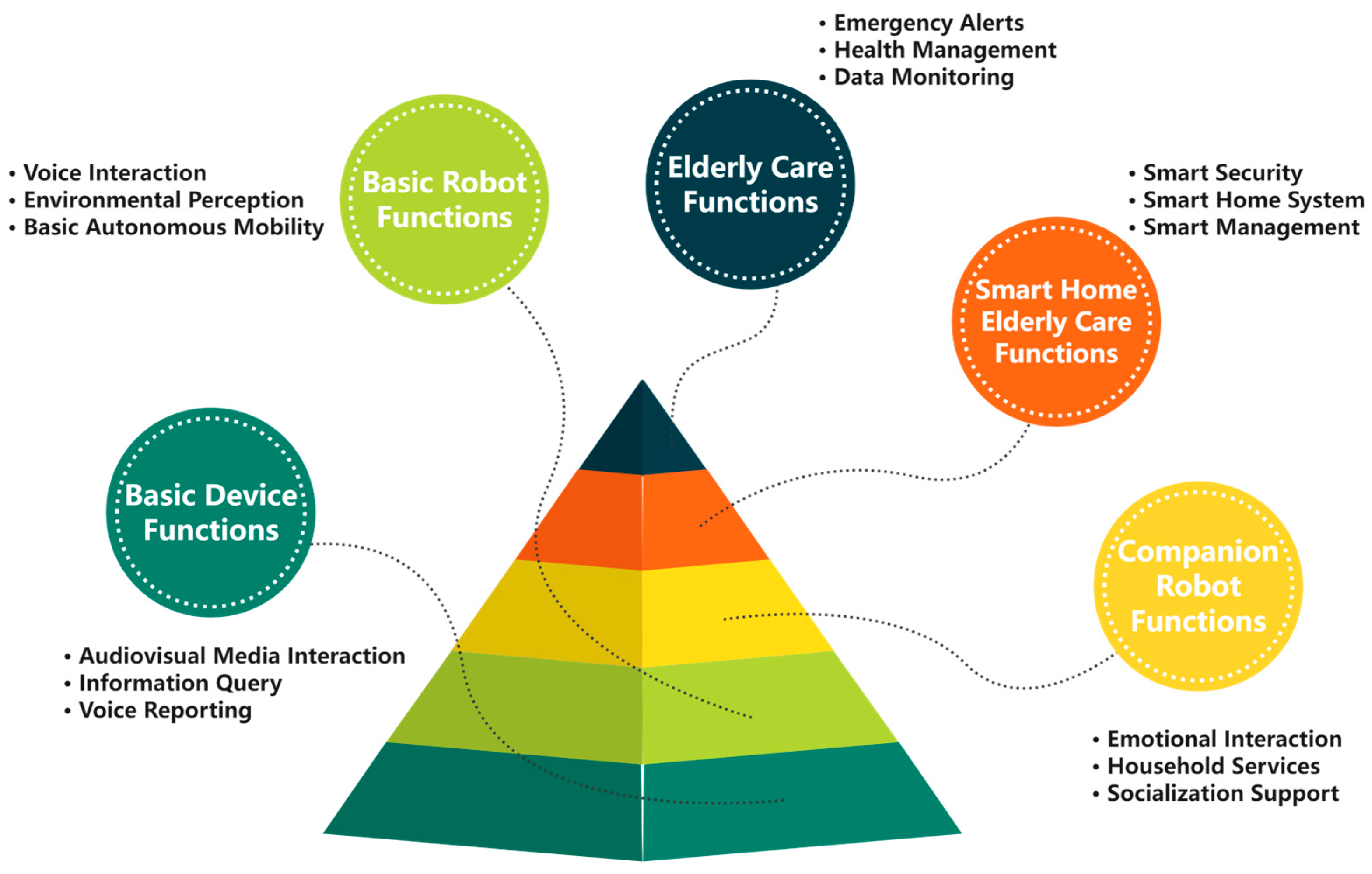
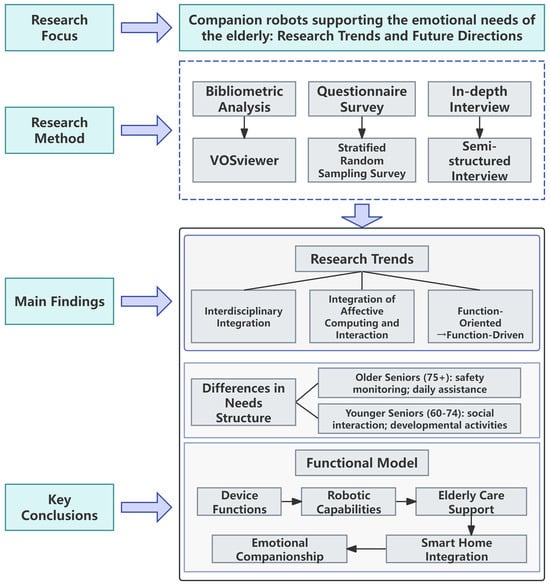
- The first tier comprises basic device functions, including auxiliary services such as audiovisual media interaction, information query, and voice reporting [8].
- (2)
- The second tier entails basic robotic functions, encompassing modules such as voice interaction, environmental perception, and basic autonomous mobility, providing the robot with fundamental responsive and movement abilities [9].
- (3)
- The third tier consists of elderly care functions, focusing on core safety and health needs by providing limited-scope health management services such as fall detection, emergency alerts, physiological monitoring, and medication reminders [10].
- (4)
- The fourth tier represents smart home elderly care functions, demonstrated through coordinated operation with smart home systems to enable automated management of environmental elements, including lighting, security, and door or window status, thereby enhancing both home safety and daily convenience [11].
- (5)
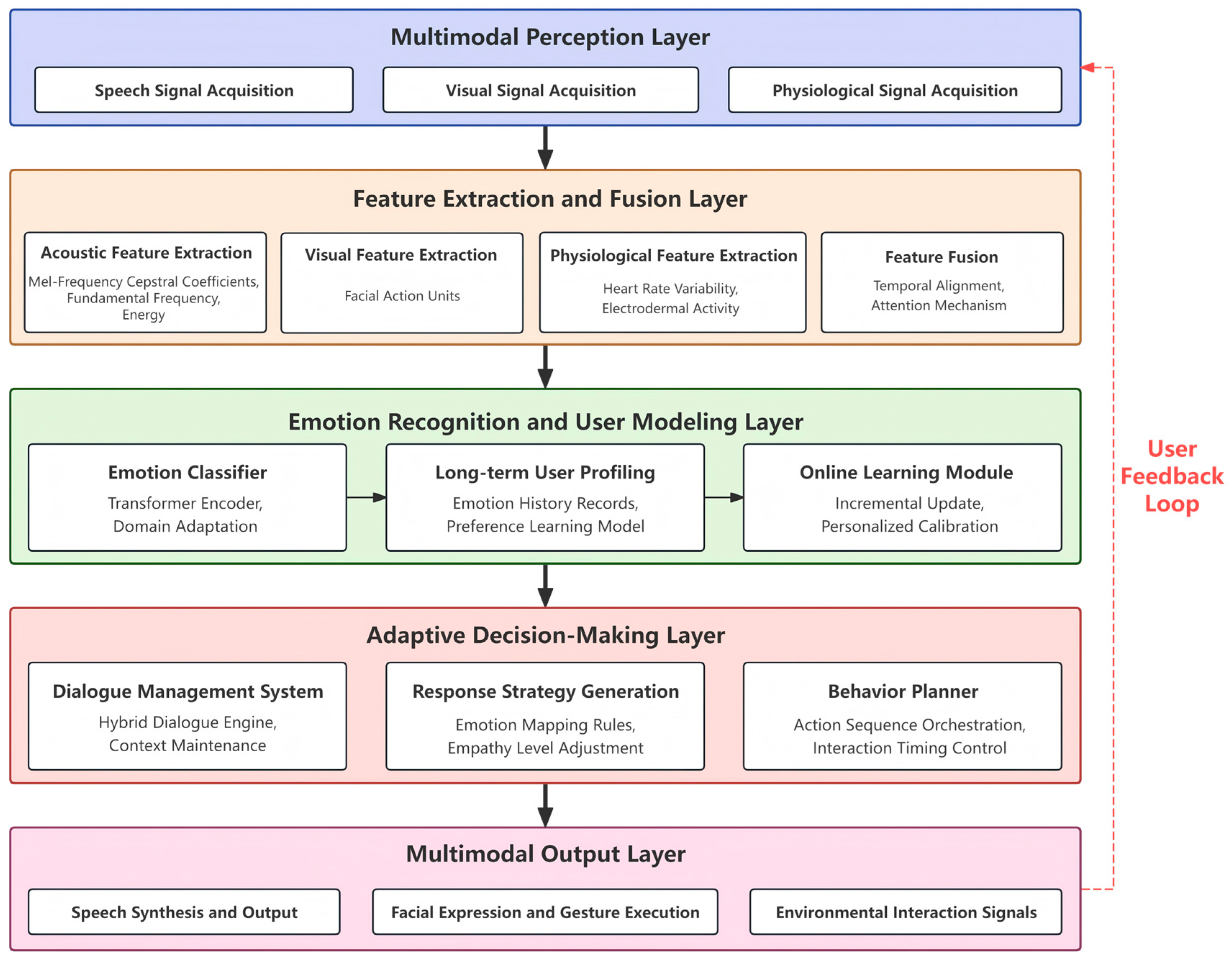
- The highest level, the fifth tier, constitutes companion robot functions. This tier is what fundamentally distinguishes companion robots from conventional medical or assistive robots. The core technology of this functionality is built upon multimodal affective computing, long-term user modeling, and adaptive dialogue systems. In terms of emotion recognition, to address the limitations of single-modality perception, the system employs a multimodal information fusion strategy that coordinately analyzes vocal features, including tone and rhythm, visual signals encompassing facial muscle action units and body posture, and physiological data such as heart rate variability and electrodermal activity acquired with user authorization through non-contact sensors or wearable devices [12]. This integrated mechanism effectively accommodates the distinctive emotional expression characteristics of older adults, such as subtle facial expression variations due to reduced muscle tone or vocal characteristic changes resulting from laryngeal muscle aging. Through cross-validation of multi-source information, it significantly enhances the robustness and accuracy of affective state inference.
2.2. Elderly User Characteristics
2.3. Human–Computer Interaction Design
3. Materials and Methods
3.1. Literature Data Collection and Screening
3.2. Sampling and Research Methods
4. Results
4.1. Bibliometric Analysis
4.1.1. Elderly Companion Robot Design Research
4.1.2. Research on Emotional Design for the Elderly
4.1.3. Research on the Emotional Needs of the Elderly
4.2. Analysis of Survey Results
5. Conclusions
5.1. Comparison of Research Findings with Existing Literature
5.2. Technical Approach and Solutions
5.3. Research Limitations and Future Work
Author Contributions
Funding
Institutional Review Board Statement
Informed Consent Statement
Data Availability Statement
Conflicts of Interest
References
- Chang, A.Y.; Bolongaiat, S.; Cao, B.C.; Castro, M.C.; Karlsson, O.; Mao, W.H.; Norheim, O.F.; Ogbuoji, O.; Jamison, D.T. Epidemiological and demographic trends and projections in global health from 1970 to 2050: A descriptive analysis from the third Lancet Commission on Investing in Health, Global Health 2050. Lancet 2025, 406, 940–949. [Google Scholar] [CrossRef]
- O’Suilleabháin, P.S.; Gallagher, S.; Steptoe, A. Loneliness, Living Alone, and All-Cause Mortality: The Role of Emotional and Social Loneliness in the Elderly During 19 Years of Follow-Up. Psychosom. Med. 2019, 81, 521–526. [Google Scholar] [CrossRef] [PubMed]
- Ren, Z.Y.; Luo, Y.A.; Liu, Y.D.; Gao, J.T.; Liu, J.F.; Zheng, X.Y. Prolonged loneliness and risk of incident cognitive decline and dementia: A two-cohort study. J. Affect. Disord. 2025, 378, 254–262. [Google Scholar] [CrossRef] [PubMed]
- Morese, R.; Palermo, S. Feelings of loneliness and isolation: Social brain and social cognition in the elderly and Alzheimer’s disease. Front. Aging Neurosci. 2022, 14, 896218. [Google Scholar] [CrossRef] [PubMed]
- Xu, W.B.; Lu, Z.Z.; Mu, L. Factors influencing proxy online health information seeking among the elderly: A study from the perspective of the elderly with chronic illnesses. Technol. Health Care 2024, 32, 861–871. [Google Scholar] [CrossRef] [PubMed]
- Irfan, B.; Kuoppamäki, S.; Skantze, G. Recommendations for designing conversational companion robots with older adults through foundation models. Front. Robot. AI 2024, 11, 1363713. [Google Scholar] [CrossRef]
- Sun, X.X.; Chen, Z.J.; Jiang, Q.L. An Empirical Study on the Willingness of Young Elderly to Use Elderly Companion Robot. Int. J. Hum.-Comput. Int. 2025, 41, 4015–4036. [Google Scholar] [CrossRef]
- Do, H.M.; Pham, M.; Sheng, W.H.; Yang, D.; Liu, M.Q. RiSH: A robot-integrated smart home for elderly care. Rob. Auton. Syst. 2018, 101, 74–92. [Google Scholar] [CrossRef]
- Udupa, S.; Kamat, V.R.; Menassa, C.C. Shared autonomy in assistive mobile robots: A review. Disabil. Rehabil.-Assi. 2023, 18, 827–848. [Google Scholar] [CrossRef]
- Melkas, H.; Hennala, L.; Pekkarinen, S.; Kyrki, V. Impacts of robot implementation on care personnel and clients in elderly-care institutions. Int. J. Med. Inform. 2020, 134, 104041. [Google Scholar] [CrossRef]
- Kim, H.; Kong, M.; Jung, S.; Jeoung, J.; Kang, H.; Hong, T. Technological applications of social robots to create healthy and comfortable smart home environment. Build. Environ. 2025, 267, 112269. [Google Scholar] [CrossRef]
- Li, M.M.; Guo, F.; Li, Z.X.; Ma, H.Y.; Duffy, V.G. Interactive effects of users’ openness and robot reliability on trust: Evidence from psychological intentions, task performance, visual behaviours, and cerebral activations. Ergonomics 2024, 67, 1612–1632. [Google Scholar] [CrossRef]
- Sreevidya, P.; Veni, S.; Murthy, O.V.R. Elder emotion classification through multimodal fusion of intermediate layers and cross-modal transfer learning. Signal Image Video Process. 2022, 16, 1281–1288. [Google Scholar] [CrossRef]
- Abdollahi, H.; Mahoor, M.H.; Zandie, R.; Siewierski, J.; Qualls, S.H. Artificial Emotional Intelligence in Socially Assistive Robots for Older Adults: A Pilot Study. IEEE Trans. Affect. Comput. 2023, 14, 2020–2032. [Google Scholar] [CrossRef]
- Li, M.Y.; Yang, C.M. E-Commerce User Shopping Preference Ranking Toward Million-Scale Products: A Hierarchical Feature Learning and Huge Purchase Graph Clustering Framework. IEEE Access 2025, 13, 168628–168642. [Google Scholar] [CrossRef]
- Um, H.K.; Noh, E.; Yoo, C.; Lee, H.W.; Kang, J.W.; Lee, B.H.; Lee, J.R. Mobile Sleep Stage Analysis Using Multichannel Wearable Devices Integrated with Stretchable Transparent Electrodes. ACS Sens. 2025, 10, 4016–4026. [Google Scholar] [CrossRef] [PubMed]
- Pu, Y.C.; Zhang, J.H.; Li, M.J.; Mou, Y. Design of smart elderly care emotion recognition and elderly care system based on transfer learning. J. Comput. Methods Sci. 2025, 5, 4600–4615. [Google Scholar] [CrossRef]
- Liu, X.F.; Lv, Q.C.; Li, J.; Song, S.Y.; Cangelosi, A. Multimodal Emotion Fusion Mechanism and Empathetic Responses in Companion Robots. IEEE Trans. Cognit. Dev. Syst. 2025, 17, 271–286. [Google Scholar] [CrossRef]
- Udahemuka, G.; Djouani, K.; Kurien, A.M. Multimodal Emotion Recognition Using Visual, Vocal and Physiological Signals: A Review. Appl. Sci. 2024, 14, 8071. [Google Scholar] [CrossRef]
- Zhu, L.A.; Zhu, Z.C.; Zhang, C.W.; Xu, Y.F.; Kong, X.J. Multimodal sentiment analysis based on fusion methods: A survey. Inf. Fusion 2023, 95, 306–325. [Google Scholar] [CrossRef]
- Liang, S.B.; Wu, D.; Zhang, C.Y. Enhancing image sentiment analysis: A user-centered approach through user emotions and visual features. Inf. Process. Manag. 2024, 61, 103749. [Google Scholar] [CrossRef]
- As’ad, M.; Faran, N.; Joharji, H. AI-Supported Shared Decision-Making (AI-SDM): Conceptual Framework. JMIR AI 2025, 4, e75866. [Google Scholar] [CrossRef]
- Yang, F.; Fang, L.; Suo, R.; Zhang, J.; Whang, M. Development of an Interactive Digital Human with Context-Sensitive Facial Expressions. Sensors 2025, 25, 5117. [Google Scholar] [CrossRef]
- Wang, T.X.; Liu, L.; Yang, L.; Yue, W. Creating the optimal design approach of facial expression forthe elderly intelligent service robot. J. Adv. Mech. Des. Syst. 2023, 17, 0061. [Google Scholar] [CrossRef]
- Liu, Z.Y.; Yu, X.R. Development of a T2D App for Elderly Users: Participatory Design Study via Heuristic Evaluation and Usability Testing. Electronics 2024, 13, 3862. [Google Scholar] [CrossRef]
- Jose Alarcon-Jimenez, J.J.; Nielsen-Rodriguez, A.; Romance, R.; Gomez-Huelgas, R.; Rosa Bernal-Lopez, M.R. Physical Activity and Social Cognition in the Elderly. Sustainability 2020, 12, 4687. [Google Scholar] [CrossRef]
- Chen, M.S.; Chen, W.R.; Ho, H.H.; Lin, S.C. Effect of stimuli type on affective memory of patients with different severities of cognitive impairment. Aging Ment. Health 2022, 27, 1226–1232. [Google Scholar] [CrossRef] [PubMed]
- Rossi, S.; Di Napoli, C.; Garramone, F.; Salvatore, E.; Santangelo, G. Personality-Based Adaptation of Robot Behaviour: Acceptability Results on Individuals with Cognitive Impairments. Int. J. Soc. Robot. 2024, 16, 211–226. [Google Scholar] [CrossRef]
- Souto, P.M.I.; Deus, J.E.R.; Maceira, A.D.; Pais, M.E.M.; Ares, E.M.T. Suitability of Social Services for the Elderly: Analysis of Degree of Fit between Needs and Services. J. Aging Soc. Policy 2021, 33, 285–304. [Google Scholar] [CrossRef] [PubMed]
- Murad, S.; Qusef, A.; Muhanna, M. CHR vs. Human-Computer Interaction Design for Emerging Technologies: Two Case Studies. Adv. Hum.-Comput. Inter. 2023, 2023, 8710638. [Google Scholar] [CrossRef]
- Chu, M.; Qu, J.; Zou, T.; Li, Q.B.; Bu, L.G.; Shen, Y.R. Design and evaluation of AR-based adaptive human-computer interaction cognitive training. Int. J. Hum.-Comput. Stud. 2025, 199, 103504. [Google Scholar] [CrossRef]
- Wang, Y.; Feng, Z.Q.; Wang, H.Y. Multimodal intent understanding and interaction system for elderly-assisted companionship. CCF Trans. Pervasive Comput. Interact. 2024, 6, 52–67. [Google Scholar] [CrossRef]
- Auer, S.; Oelen, A.; Haris, M.; Stocker, M.; D’Souza, J.; Farfar, K.E.; Vogt, L.; Prinz, M.; Wiens, V.; Jaradeh, M.Y. Improving Access to Scientific Literature with Knowledge Graphs. Bibl. Forsch. Und Prax. 2020, 44, 516–529. [Google Scholar] [CrossRef]
- Chatterjee, A.; Prinz, A.; Riegler, M.A.; Das, J. A systematic review and knowledge mapping on ICT-based remote and automatic COVID-19 patient monitoring and care. BMC Health Serv. Res. 2023, 23, 1047. [Google Scholar] [CrossRef]
- Xu, X.F.; Liu, Z.T.; Liu, W.Z.; Pei, C.T.; Wu, X.F.; Nie, Z.Y. A sustainable development benchmarking framework for energy companies based on topic mining and knowledge graph: The case of oil and gas industry. Renew. Sust. Energ. Rev. 2024, 196, 114350. [Google Scholar] [CrossRef]
- Felicetti, A.M.; Corvello, V.; Ammirato, S. Digital innovation in entrepreneurial firms: A systematic literature review. Rev. Manag. Sci. 2024, 12, 315–362. [Google Scholar] [CrossRef]
- Farooq, R. A review of knowledge management research in the past three decades: A bibliometric analysis. Vine J. Inf. Knowl. Man. 2024, 54, 339–378. [Google Scholar] [CrossRef]
- Qin, Y.; Xu, Z.S.; Wang, X.X.; Skare, M. Artificial Intelligence and Economic Development: An Evolutionary Investigation and Systematic Review. J. Knowl. Econ. 2024, 15, 1666–1702. [Google Scholar] [CrossRef]
- Huang, T.Y.; Huang, C.W. Elderly’s acceptance of companion robots from the perspective of user factors. Univers. Access Inf. 2020, 19, 935–948. [Google Scholar] [CrossRef]
- Zeng, H.; Qiu, T.; Zhu, J.W.; Xu, S. Research Evolution, Current Status, Trends, and Sustainable Development of Smart Product-Service Systems. IEEE Access 2025, 13, 5974–5994. [Google Scholar] [CrossRef]
- Wang, C.L.; Chen, X.J.; Yu, T.; Liu, Y.D.; Jing, Y.H. Education reform and change driven by digital technology: A bibliometric study from a global perspective. Humanit. Soc. Sci. Commun. 2024, 11, 256. [Google Scholar] [CrossRef]
- Peel, C.; Baker, P.S.; Roth, D.L.; Brown, C.J.; Bodner, E.V.; Allman, R.M. Assessing mobility in older adults: The UAB Study of Aging Life-Space Assessment. Phys. Ther. 2005, 85, 1008–1019. [Google Scholar] [CrossRef] [PubMed]
- Zhao, J.; Aziz, F.A.; Cheng, Z.Y.; Ujang, N.; Zhang, H.; Xu, J.J.; Xiao, Y.; Shi, L. Post-Occupancy Evaluation of the Improved Old Residential Neighborhood Satisfaction Using Principal Component Analysis: The Case of Wuxi, China. ISPRS Int. J. Geo-Inf. 2024, 13, 318. [Google Scholar] [CrossRef]
- Zhao, J.; Wang, F.; Liu, S.Q. Practices of integrated care for the elderly in Wuxi, China: A qualitative case study. Int. J. Integr. Care 2025, 25, 419. [Google Scholar] [CrossRef]
- Pollet, T.V.; Thompson, A.; Malcolm, C.; McCarty, K.; Saxton, T.K.; Roberts, S.G.B. Are we measuring loneliness in the same way in men and women in the general population and in the older population? Two studies of measurement equivalence. PLoS ONE 2022, 17, e0266167. [Google Scholar] [CrossRef] [PubMed]
- Elmstahl, S.; Berglund, J.S.; Fagerstrom, C.; Ekstrom, H. The Life Satisfaction Index-A (LSI-A): Normative Data for a General Swedish Population Aged 60 to 93 Years. Clin. Interv. Aging 2020, 15, 2031–2039. [Google Scholar] [CrossRef]
- Li, Z.; Tian, Z.G.; Wang, J.W.; Wang, W.M.; Huang, G.Q. Dynamic mapping of design elements and affective responses: A machine learning based method for affective design. J. Eng. Des. 2018, 29, 358–380. [Google Scholar] [CrossRef]
- Zeng, H.; Zhu, J.W.; Lin, H.X.; Chen, J.M. Older Users Acceptance of Smart Products: An Extension of the Technology Accpetance Model. IEEE Access 2024, 12, 49408–49428. [Google Scholar] [CrossRef]
- Chen, K.; Chan, A.H.S. Predictors of gerontechnology acceptance by older Hong Kong Chinese. Technovation 2014, 34, 126–135. [Google Scholar] [CrossRef]
- Schrepp, M.; Hinderks, A.; Thomaschewski, J. Design and Evaluation of a Short Version of the User Experience Questionnaire (UEQ-S). Int. J. Interact. Multi. 2017, 4, 103–108. [Google Scholar] [CrossRef]
- McHugh, M.L. Interrater reliability: The kappa statistic. Biochem. Medica 2012, 22, 276–282. [Google Scholar] [CrossRef]
- Saunders, J.; Syrdal, D.S.; Koay, K.L.; Burke, N.; Dautenhahn, K. “Teach Me-Show Me”-End-User Personalization of a Smart Home and Companion Robot. IEEE Trans. Hum.-Mach. Syst. 2016, 46, 27–40. [Google Scholar] [CrossRef]
- Huschilt, J.; Clune, L. The Use of Socially Assistive Robots for Dementia Care. J. Gerontol. Nurs. 2012, 38, 15–19. [Google Scholar] [CrossRef] [PubMed]
- Culley, K.E.; Madhavan, P. A note of caution regarding anthropomorphism in HCI agents. Comput. Hum. Behav. 2013, 29, 577–579. [Google Scholar] [CrossRef]
- Safran, V.; Smrke, U.; Ilijevec, B.; Horvat, S.; Flis, V.; Plohl, N.; Mlakar, I. Feasibility of a computerized clinical decision support system delivered via a socially assistive robot during grand rounds: A pilot study. Digit. Health 2025, 11, 20552076251339012. [Google Scholar] [CrossRef] [PubMed]
- Fischer, B.; Peine, A.; Ostlund, B. The Importance of User Involvement: A Systematic Review of Involving Older Users in Technology Design. Gerontologist 2020, 60, E513–E523. [Google Scholar] [CrossRef]
- Wirtz, J.; Patterson, P.G.; Kunz, W.H.; Gruber, T.; Lu, V.N.; Paluch, S.; Martins, A. Brave new world: Service robots in the frontline. J. Serv. Manag. 2018, 29, 907–931. [Google Scholar] [CrossRef]
- Kim, J.; Kim, S.; Kim, S.; Lee, E.; Heo, Y.; Hwang, C.Y.; Choi, Y.Y.; Kong, H.J.; Ryu, H.; Lee, H. Companion robots for older adults: Rodgers’ evolutionary concept analysis approach. Intel. Serv. Robot. 2021, 14, 729–739. [Google Scholar] [CrossRef]
- Mahdi, H.; Akgun, S.A.; Saleh, S.; Dautenhahn, K. A survey on the design and evolution of social robots—Past, present and future. Robot. Auton. Syst. 2022, 156, 104193. [Google Scholar] [CrossRef]
- Wu, Y.H.; Wrobel, J.; Cornuet, M.; Kerherve, H.; Damnee, S.; Rigaud, A.S. Acceptance of an assistive robot in older adults: A mixed-method study of human-robot interaction over a 1-month period in the Living Lab setting. Clin. Interv. Aging. 2014, 9, 801–811. [Google Scholar] [CrossRef]
- Righi, V.; Sayago, S.; Blat, J. When we talk about older people in HCI, who are we talking about? Towards a ‘turn to community’ in the design of technologies for a growing ageing population. Int. J. Hum.-Comput. St. 2017, 108, 15–31. [Google Scholar] [CrossRef]
- Strohmann, T.; Siemon, D.; Khosrawi-Rad, B.; Robra-Bissantz, S. Toward a design theory for virtual companionship. Hum.-Comput. Interact. 2023, 38, 194–234. [Google Scholar] [CrossRef]
- Zhang, T.; Kaber, D.B.; Zhu, B.W.; Swangnetr, M.; Mosaly, P.; Hodge, L. Service robot feature design effects on user perceptions and emotional responses. Int. Serv. Robot. 2010, 3, 73–88. [Google Scholar] [CrossRef]
- Pengnate, S.; Antonenko, P.A. Multimethod Evaluation of Online Trust and Its Interaction with Metacognitive Awareness: An Emotional Design Perspective. Int. J. Hum.-Comput. Int. 2013, 29, 582–593. [Google Scholar] [CrossRef]
- Talamo, A.; Camilli, M.; Di Lucchio, L.; Ventura, S. Information from the past: How elderly people orchestrate presences, memories and technologies at home. Univers. Access Inf. 2017, 16, 739–753. [Google Scholar] [CrossRef]
- Jo, S.; Hong, S. The Development of Human-Robot Interaction Design for Optimal Emotional Expression in Social Robots Used by Older People: Design of Robot Facial Expressions and Gestures. IEEE Access 2025, 13, 21367–21381. [Google Scholar] [CrossRef]
- Chen, Y.D.; Fan, J.Y.; Zhou, T. A theoretical approach for therapeutic artificial supplementary lighting in elderly living spaces. Build. Environ. 2021, 197, 107876. [Google Scholar] [CrossRef]
- Mohd, T.A.M.T.; Yunus, R.M.; Hairi, F.; Hairi, N.N.; Choo, W.Y. Social support and depression among community dwelling older adults in Asia: A systematic review. BMJ Open 2019, 9, e026667. [Google Scholar] [CrossRef]
- Nagamachi, M. Kansei engineering as a powerful consumer-oriented technology for product development. Appl. Ergon. 2002, 33, 289–294. [Google Scholar] [CrossRef]
- Ehn, M.; Eriksson, L.C.; Akerberg, N.; Johansson, A.C. Activity Monitors as Support for Older Persons’ Physical Activity in Daily Life: Qualitative Study of the Users’ Experiences. JMIR Mhealth Uhealth 2018, 6, e34. [Google Scholar] [CrossRef]
- Demirbilek, O.; Demirkan, H. Universal product design involving elderly users: A participatory design model. Appl. Ergon. 2004, 35, 361–370. [Google Scholar] [CrossRef]
- Kullman, K. Prototyping bodies: A post-phenomenology of wearable simulations. Des. Stud. 2016, 47, 73–90. [Google Scholar] [CrossRef]
- Scandurra, I.; Hagglund, M.; Koch, S. From user needs to system specifications:: Multi-disciplinary thematic seminars as a collaborative design method for development of health information systems. J. Biomed. Inform. 2008, 41, 557–569. [Google Scholar] [CrossRef] [PubMed]
- Feng, G.H.; Wang, H.E.; Wang, M.D.; Zheng, X.; Zhang, R.Z. A Research on Emotion Recognition of the Elderly Based on Transformer and Physiological Signals. Electronics 2024, 13, 3019. [Google Scholar] [CrossRef]
- Torta, E.; Werner, F.; Johnson, D.O.; Juola, J.F.; Cuijpers, R.H.; Bazzani, M.; Oberzaucher, J.; Lemberger, J.; Lewy, H.; Bregman, J. Evaluation of a Small Socially-Assistive Humanoid Robot in Intelligent Homes for the Care of the Elderly. J. Intell. Robot. Syst. 2014, 76, 57–71. [Google Scholar] [CrossRef]
- Wen, C.; Albert, C.; Von Haaren, C. The elderly in green spaces: Exploring requirements and preferences concerning nature-based recreation. Sustain. Cities Soc. 2018, 38, 582–593. [Google Scholar] [CrossRef]
- Curumsing, M.K.; Fernando, N.; Abdelrazek, M.; Vasa, R.; Mouzakis, K.A.; Grundy, J. Emotion-oriented requirements engineering: A case study in developing a smart home system for the elderly. J. Syst. Softw. 2019, 147, 215–229. [Google Scholar] [CrossRef]
- Steptoe, A.; Deaton, A.; Stone, A.A. Subjective wellbeing, health, and ageing. Lancet 2015, 385, 640–648. [Google Scholar] [CrossRef] [PubMed]
- Tsiotsou, R.H.; Boukis, A. In-home service consumption: A systematic review, integrative framework and future research agenda. J. Bus. Res. 2022, 145, 49–64. [Google Scholar] [CrossRef]
- Hoque, R.H.; Sorwar, G. Understanding factors influencing the adoption of mHealth by the elderly: An extension of the UTAUT model. Int. J. Med. Inform. 2017, 101, 75–84. [Google Scholar] [CrossRef]
- Hung, J.Y.; Lu, K.S. Research on the Healthy Lifestyle Model, Active Ageing, and Loneliness of Senior Learners. Educ. Gerontol. 2014, 40, 353–362. [Google Scholar] [CrossRef]
- Zaharia, G.; Ibanez-del Valle, V.; Cauli, O.; Corchon, S. The Long-Lasting Effect of Multidisciplinary Interventions for Emotional and Social Loneliness in Older Community-Dwelling Individuals: A Systematic Review. Nurs. Rep. 2024, 14, 3847–3863. [Google Scholar] [CrossRef] [PubMed]
- Sun, S.J.; Qi, N.; Li, H.R.; Xiao, L. Examining factors influencing the adoption of smart integrated devices by the elderly in the digital era: Insights from behavioral design theory. Front. Psychol. 2025, 16, 1540201. [Google Scholar] [CrossRef]
- Li, Y.; Aierken, A.; Ding, X.W.; Pan, Y.Y.; Chen, Y. Dependency-associated individual, family, community, and social factors from a resilience framework among elderly people. Curr. Psychol. 2023, 42, 26207–26216. [Google Scholar] [CrossRef]
- van der Zanden, L.D.T.; van Kleef, E.; de Wijk, R.A.; van Trijp, H.C.M. Understanding heterogeneity among elderly consumers: An evaluation of segmentation approaches in the functional food market. Nutr. Res. Rev. 2014, 27, 159–171. [Google Scholar] [CrossRef]
- Young, K.; Bunn, F.; Trivedi, D.; Dickinson, A. Nutritional education for community dwelling older people: A systematic review of randomised controlled trials. Int. J. Nurs. Stud. 2011, 48, 751–780. [Google Scholar] [CrossRef]
- Sun, Y.; Yu, B.; Song, J.; Han, Y.H.; Zhang, X.D. The impact of emotional support on active aging among the elderly in China. ACTA Psychol. 2024, 150, 104531. [Google Scholar] [CrossRef]
- Wang, Y.; Feng, R.F.; Bao, D.F. Effect of cognitive-behavioral therapy for the elderly on driving behavior and emotional state: A randomized controlled trial. CCF Trans. Pervasive Comput. Interact. 2023, 5, 139–156. [Google Scholar] [CrossRef]
- Quiroga-Mendez, M.D. Attachment and Old Age, a Perspective for Understanding Well-being and Emotional Regulation in Elders. Univ. Psychol. 2023, 22, 15–18. [Google Scholar] [CrossRef]
- Rosen, C.A. Complications of phonosurgery: Results of a national survey. Laryngoscope 1998, 108, 1697–1703. [Google Scholar] [CrossRef] [PubMed]





| Structure | Core Content and Objectives | Key Variables/Example Questions |
|---|---|---|
| Part 1: Introduction and Informed Consent | Building Trust and Clarifying Rights and Responsibilities | Research Background, Research Purpose, Emphasis on Response Value, Participant Rights, Estimated Duration |
| Part 2: Basic Profile of Interviewed Elderly Users | Collected for Basic Demographic and Background Information for Subsequent Subgroup Analysis | Age, Gender, Education Level, Health Status, Living Arrangements, Proficiency with Smart Devices, Routine Social Activities |
| Part 3: Current Status of Emotional and Companionship Needs Among Elderly Users | Assessment of Current Emotional State and Primary Companionship Needs | Loneliness (UCLA Loneliness Scale), Life Satisfaction (Life Satisfaction Index-A), Primary Emotional Needs, Desired Companionship Content |
| Part 4: Experiences and Evaluations of Existing Companionship Products | To Assess the Strengths and Weaknesses of Existing Solutions and Identify Unmet Needs | Primary Sources of Companionship, Satisfaction Level, Pain Points |
| Part 5: Perceptions, Expectations, and Concerns Regarding Elderly Companion Robots | To Investigate the Acceptance, Functional Expectations, and Potential Concerns Regarding Emerging Technologies | Perceptions and Impressions, Functional Expectations, Interaction Mode Preferences, Appearance Form Preferences, Usage Concerns |
| Part 6: Preferences and Acceptance of Emotional Design Elements | Investigation of Specific Emotional Design Elements (Core Section) | Anthropomorphism, Voice and Dialogue Style, Emotional Feedback Mechanisms, Proactivity and Personalization |
| Part 7: Open-ended Questions and Suggestions | To Collect Personalized, In-depth Information Beyond the Reach of Quantitative Data | “What would your ideal elderly companion robot be like?” “Do you have any additional thoughts, suggestions, or concerns regarding the design?” “Any suggestions for improving this questionnaire?” |
| Characteristics | 60–69 Years (N = 195) | 70–79 Years (N = 188) | 80+ Years (N = 120) | Total (N = 503) | Test Statistic | p-Value |
|---|---|---|---|---|---|---|
| Gender (Male/Female) | 48.2%/51.8% | 45.7%/54.3% | 42.5%/57.5% | 46.1%/53.9% | χ2 = 1.24 | 0.538 |
| Mean Age ± SD (years) | 64.7 ± 2.8 | 74.3 ± 2.9 | 83.9 ± 3.5 | 73.1 ± 7.6 | F = 1250.67 | <0.001 |
| Education Level (Primary school and below) | 25.6% | 38.8% | 55.0% | 37.8% | χ2 = 38.52 | <0.001 |
| Marital Status (Married) | 78.5% | 65.4% | 40.8% | 64.6% | χ2 = 62.31 | <0.001 |
| Living Arrangements (Living alone) | 15.4% | 25.0% | 35.8% | 23.9% | χ2 = 20.15 | <0.001 |
| Monthly Income (<¥3000) | 30.3% | 40.1% | 48.2% | 38.6% | χ2 = 15.84 | <0.01 |
| Self-rated Health (Mean ± SD, 1–5 points) | 3.8 ± 0.9 | 3.2 ± 1.0 | 2.7 ± 1.1 | 3.3 ± 1.1 | F = 65.34 | <0.001 |
| Number of Chronic Diseases (≥2 types) | 45.1% | 60.6% | 75.8% | 58.4% | χ2 = 36.77 | <0.001 |
| Smartphone Proficiency (Proficient/Relatively proficient) | 75.9% | 55.3% | 28.3% | 57.1% | χ2 = 85.90 | <0.001 |
| Affective Expression Modalities | 60–69 Years (N = 195) | 70–79 Years (N = 188) | 80+ Years (N = 120) | Total (N = 503) | F-Value (p-Value) |
|---|---|---|---|---|---|
| Varied Vocal Tones | 4.0 ± 0.9 | 3.8 ± 1.0 | 3.5 ± 1.1 | 3.8 ± 1.0 | 9.87 (<0.001) |
| Dynamic Facial Expressions on Screen | 3.7 ± 1.1 | 3.4 ± 1.2 | 3.0 ± 1.2 | 3.4 ± 1.2 | 15.23 (<0.001) |
| Simple Light/Sound Signals | 4.2 ± 0.8 | 4.1 ± 0.8 | 4.0 ± 0.9 | 4.1 ± 0.8 | 2.15 (0.117) |
| Bionic Movements | 3.3 ± 1.2 | 3.0 ± 1.3 | 2.6 ± 1.3 | 3.0 ± 1.3 | 13.56 (<0.001) |
Disclaimer/Publisher’s Note: The statements, opinions and data contained in all publications are solely those of the individual author(s) and contributor(s) and not of MDPI and/or the editor(s). MDPI and/or the editor(s) disclaim responsibility for any injury to people or property resulting from any ideas, methods, instructions or products referred to in the content. |
© 2025 by the authors. Licensee MDPI, Basel, Switzerland. This article is an open access article distributed under the terms and conditions of the Creative Commons Attribution (CC BY) license (https://creativecommons.org/licenses/by/4.0/).
Share and Cite
Zeng, H.; Sheng, Y.; Zhu, J. Companion Robots Supporting the Emotional Needs of the Elderly: Research Trends and Future Directions. Information 2025, 16, 948. https://doi.org/10.3390/info16110948
Zeng H, Sheng Y, Zhu J. Companion Robots Supporting the Emotional Needs of the Elderly: Research Trends and Future Directions. Information. 2025; 16(11):948. https://doi.org/10.3390/info16110948
Chicago/Turabian StyleZeng, Hui, Yuxin Sheng, and Jinwei Zhu. 2025. "Companion Robots Supporting the Emotional Needs of the Elderly: Research Trends and Future Directions" Information 16, no. 11: 948. https://doi.org/10.3390/info16110948
APA StyleZeng, H., Sheng, Y., & Zhu, J. (2025). Companion Robots Supporting the Emotional Needs of the Elderly: Research Trends and Future Directions. Information, 16(11), 948. https://doi.org/10.3390/info16110948