Article

M-Ary Direct Modulation Chirp Spread Spectrum for Spectrally Efficient Communications

by
Jocelyn Edinio Zacko Gbadoubissa
1,2,
Ado Adamou Abba Ari
1,3,
Emanuel Radoi
4,* and
Abdelhak Mourad Gueroui
3
1
Department of Computer Science, University of Maroua, Maroua P.O. Box 814, Cameroon
2
African Institute for Mathematical Sciences, Limbé P.O. Box 608, Cameroon
3
DAVID Lab, University of Versailles Saint-Quentin-en-Yvelines, 45 Avenue des États-Unis, 78000 Versailles, France
4
Lab-STICC, CNRS, Univ Brest, CS 93837, 6 Avenue Le Gorgeu, CEDEX 3, 29238 Brest, France
*
Author to whom correspondence should be addressed.
Information 2023, 14(6), 323; https://doi.org/10.3390/info14060323
Submission received: 31 March 2023 / Revised: 30 May 2023 / Accepted: 3 June 2023 / Published: 6 June 2023
(This article belongs to the Special Issue Advances in Wireless Communications Systems)

Abstract

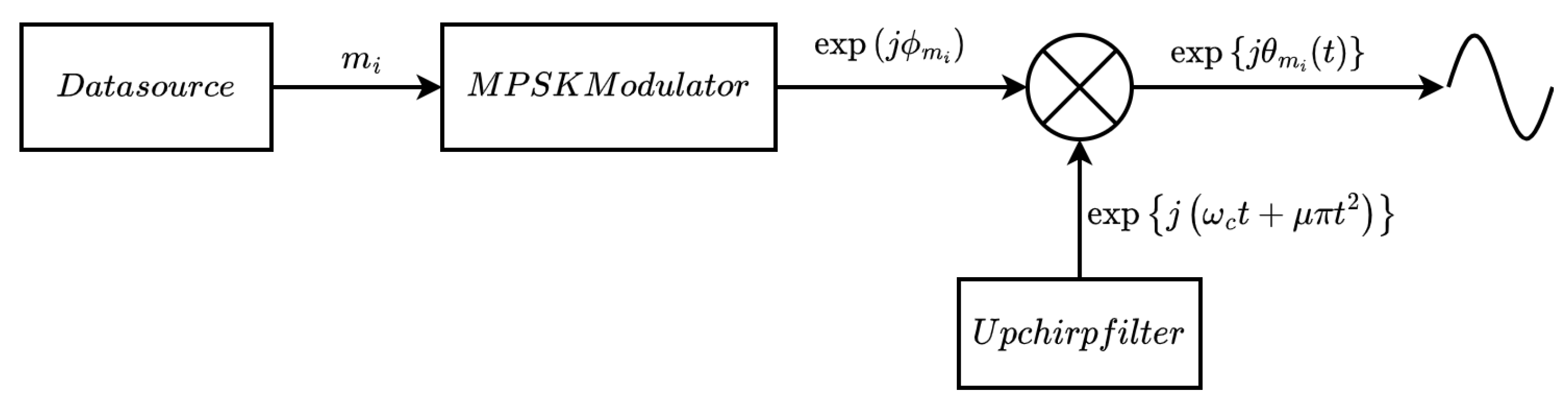
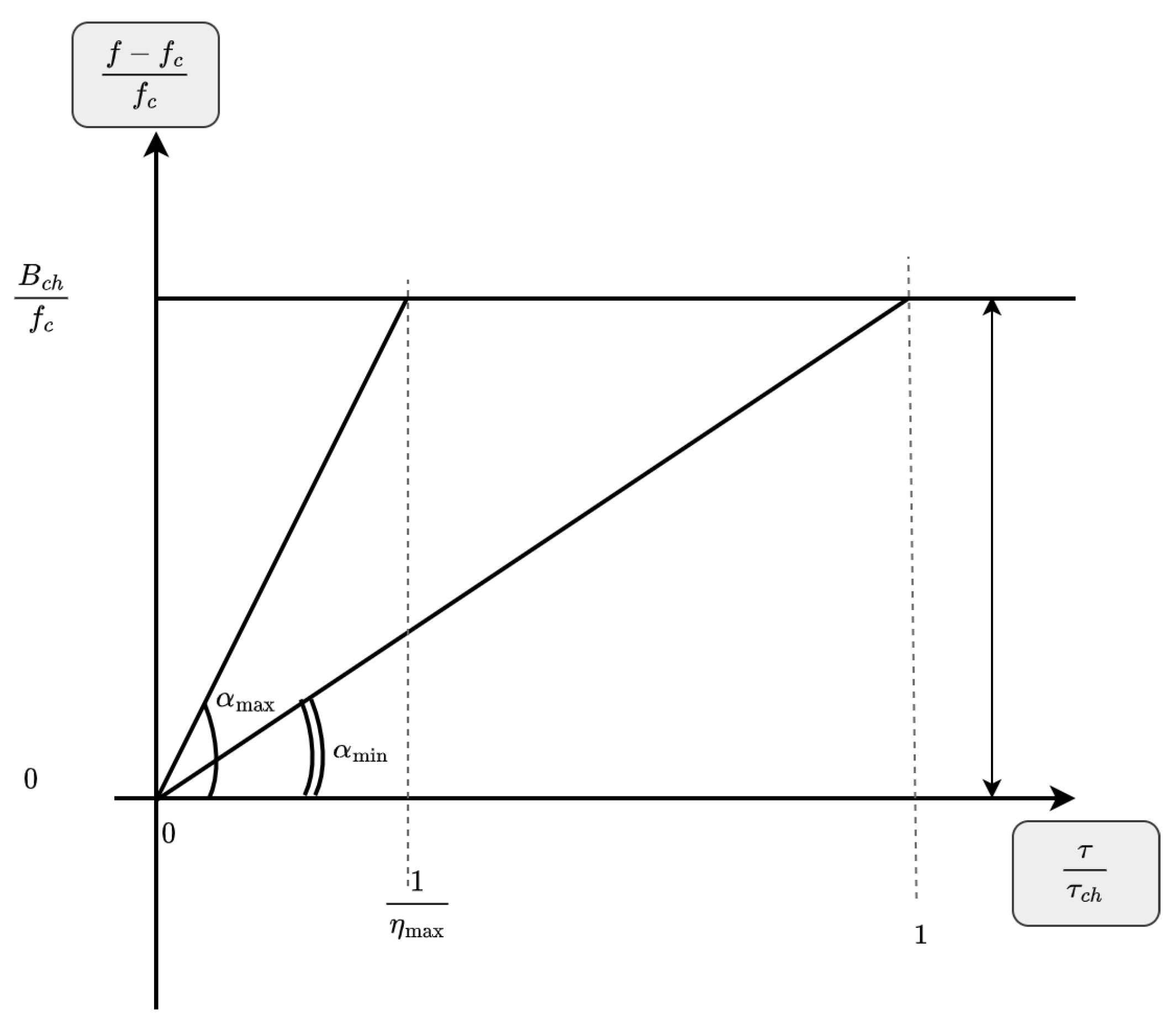
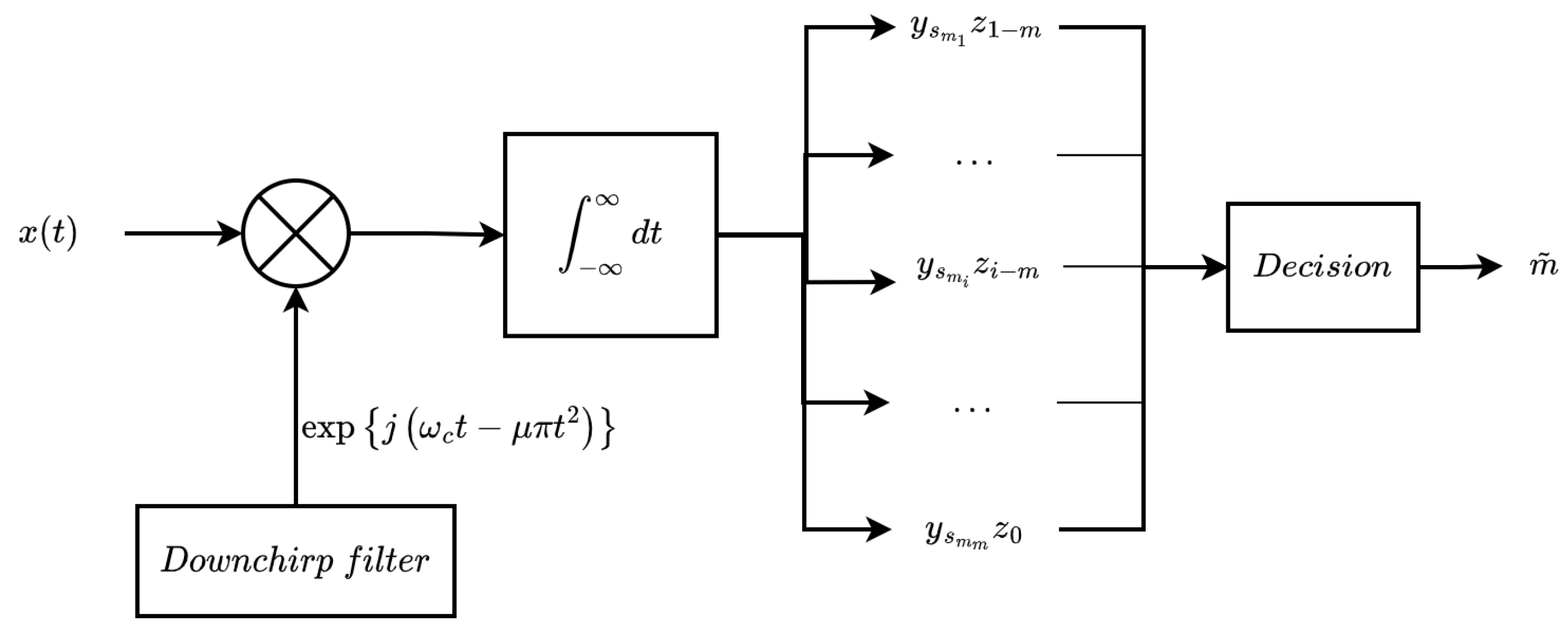
Spread spectrum techniques, such as the Chirp Spread Spectrum (CSS) used by LoRa technology, are important for machine-to-machine communication in the context of the Internet of Things. They offer high processing gain, reliable communication over long ranges, robustness to interference and noise in harsh environments, etc. However, these features are compromised by their poor spectral efficiency, resulting in a very low data transmission rate. This paper deals with a spectrally efficient variant of CSS. The system uses M-ary phase keying to modulate the data and exploits CSS’s properties to transmit the modulated symbols as overlapping chirps. The overlapping of chirp signals may affect the system performance due to inter-symbol interference. Therefore, we analyse the relationship between the number of overlaps and the effect of inter-symbol interference (ISI), and we also determine the BER expression as a function of the number of overlaps. Finally, we derive the optimal number of overlapping symbols that corresponds to the minimum error probability.
Keywords: internet of things; chirp spread spectrum; MPSK; overlapping chirps; inter-symbol interference; spectral efficiency internet of things; chirp spread spectrum; MPSK; overlapping chirps; inter-symbol interference; spectral efficiency