
Article

Decision-Making Model for Reinforcing Digital Transformation Strategies Based on Artificial Intelligence Technology
Seoul Business School, Seoul School of Integrated Sciences and Technologies (aSSIST), Seoul 03767, Korea
*
Author to whom correspondence should be addressed.
Information 2022, 13(5), 253; https://doi.org/10.3390/info13050253
Submission received: 7 March 2022 / Revised: 9 May 2022 / Accepted: 12 May 2022 / Published: 13 May 2022

Abstract

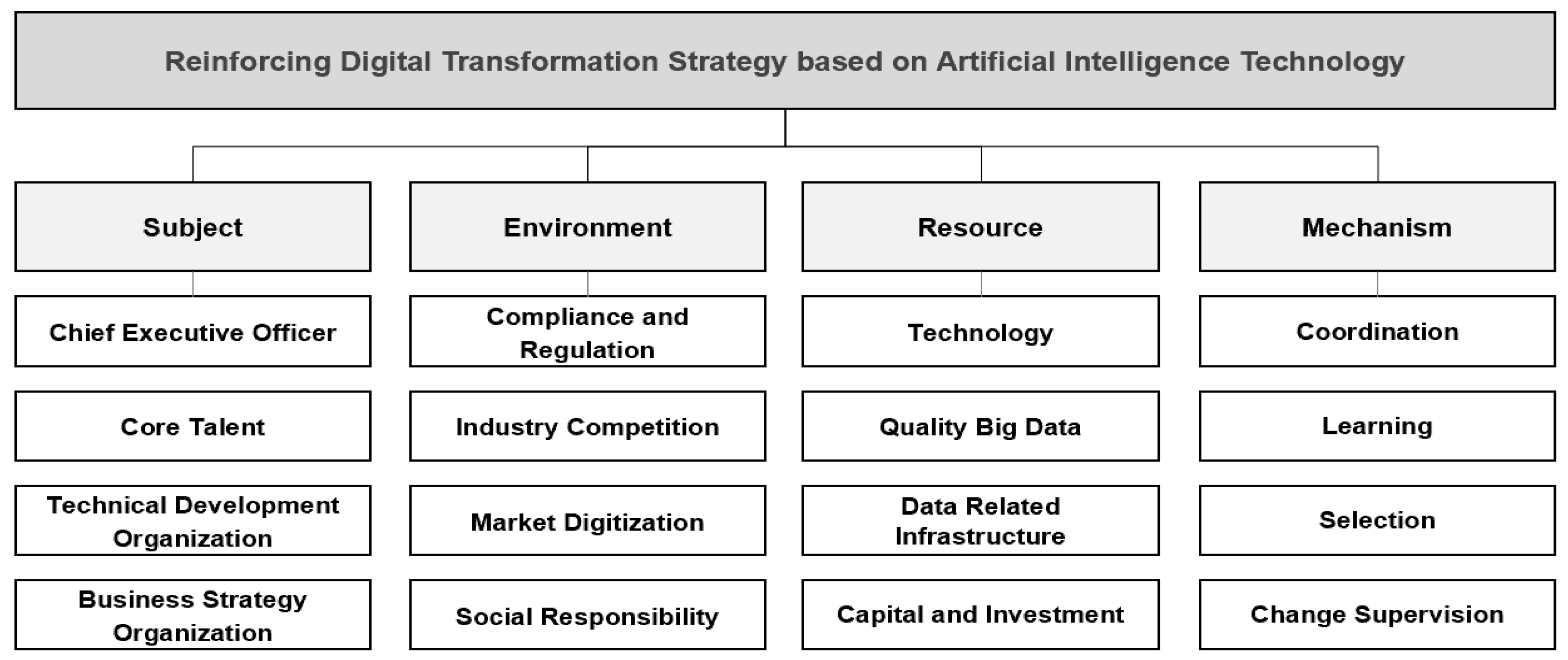
Firms’ digital environment changes and industrial competitions have evolved quickly since the Fourth Industrial Revolution and the COVID-19 pandemic. Many companies are propelling company-wide digital transformation strategies based on artificial intelligence (AI) technology for the digital innovation of organizations and businesses. This study aims to define the factors affecting digital transformation strategies and present a decision-making model required for digital transformation strategies based on the definition. It also reviews previous AI technology and digital transformation strategies and draws influence factors. The research model drew four evaluation areas, such as subject, environment, resource, and mechanism, and 16 evaluation factors through the SERM model. After the factors were reviewed through the Delphi methods, a questionnaire survey was conducted targeting experts with over 10 years of work experience in the digital strategy field. The study results were produced by comparing the data’s importance using an Analytic Hierarchy Process (AHP) on each group. According to the analysis, the subject was the most critical factor, and the CEO (top management) was more vital than the core talent or technical development organization. The importance was shown in the order of resource, mechanism and environment, following subject. It was ascertained that there were differences of importance in industrial competition and market digitalization in the demander and provider groups.
Keywords: digital transformation; AI technology; digital strategy; decision model; SERM model digital transformation; AI technology; digital strategy; decision model; SERM model