
Navigations for Hospitality Human Resource Management Research: Observing the Keywords, Factors, Topics under the COVID-19 Pandemic




Abstract
1. Introduction
2. Literature Review
2.1. Hospitality Industry and Crisis
2.2. Hospitality HRM
2.3. Grounded Theory and NVivo
3. Methodology
3.1. Software Selection
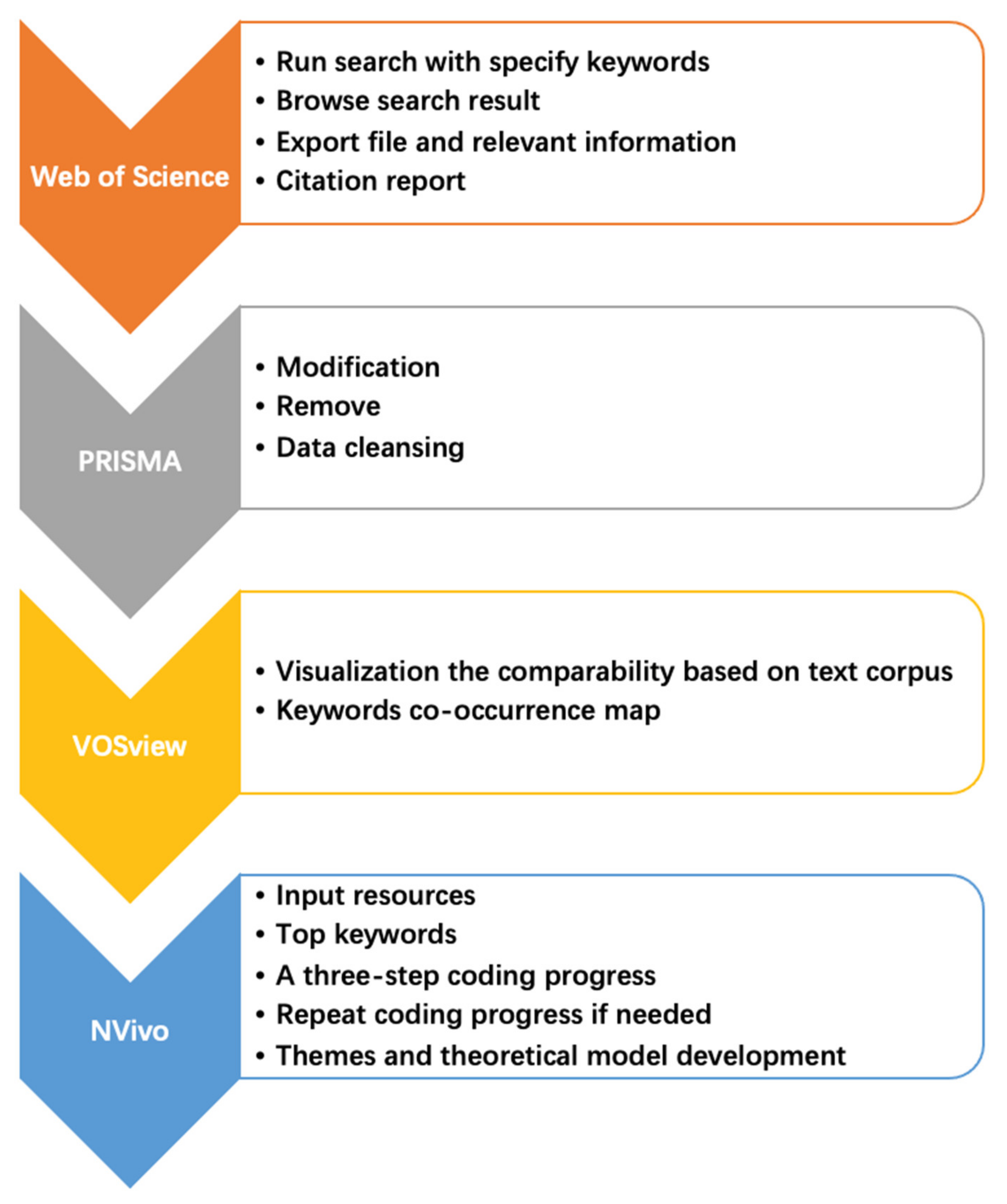
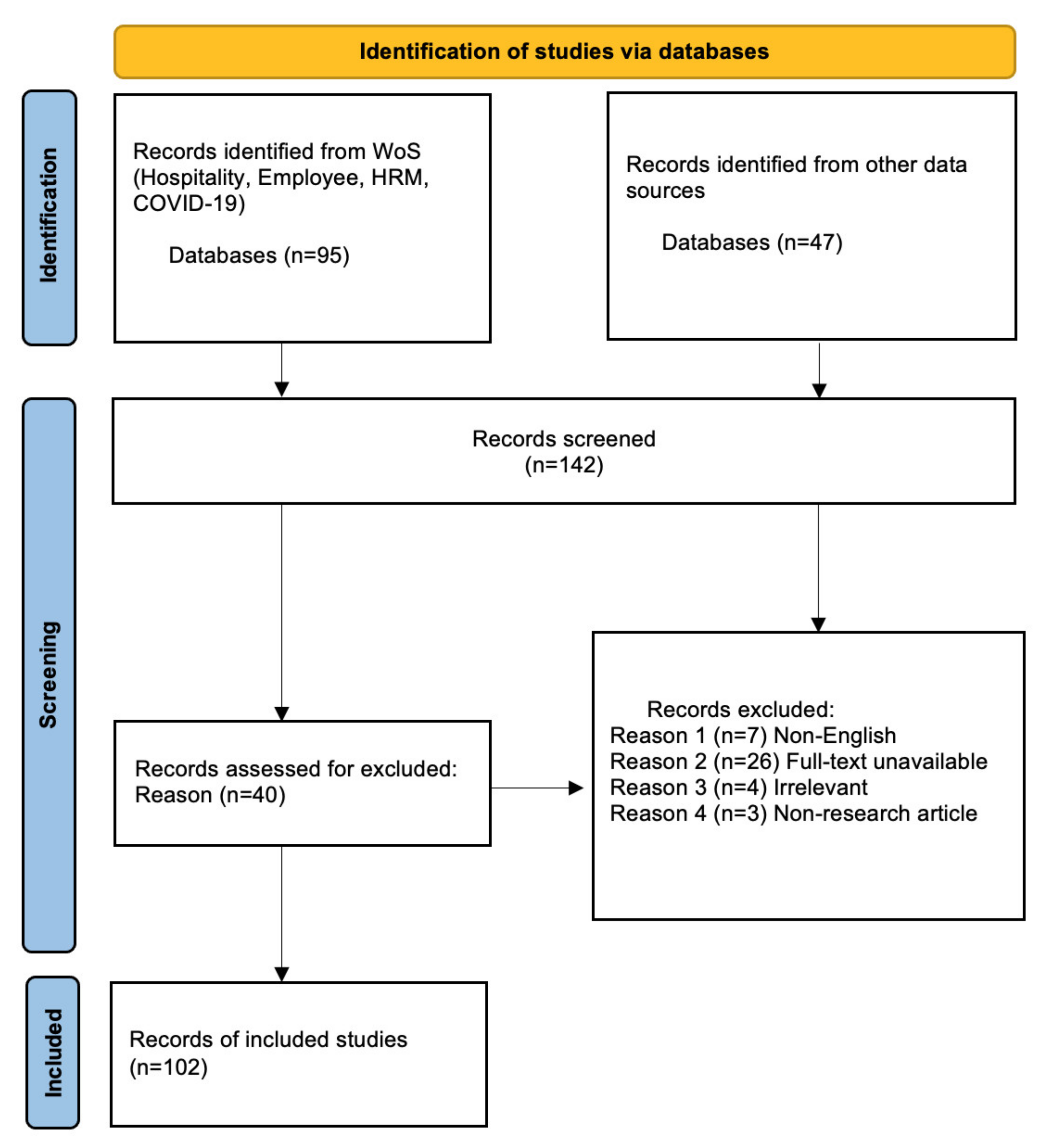
3.2. Procedure
4. Results
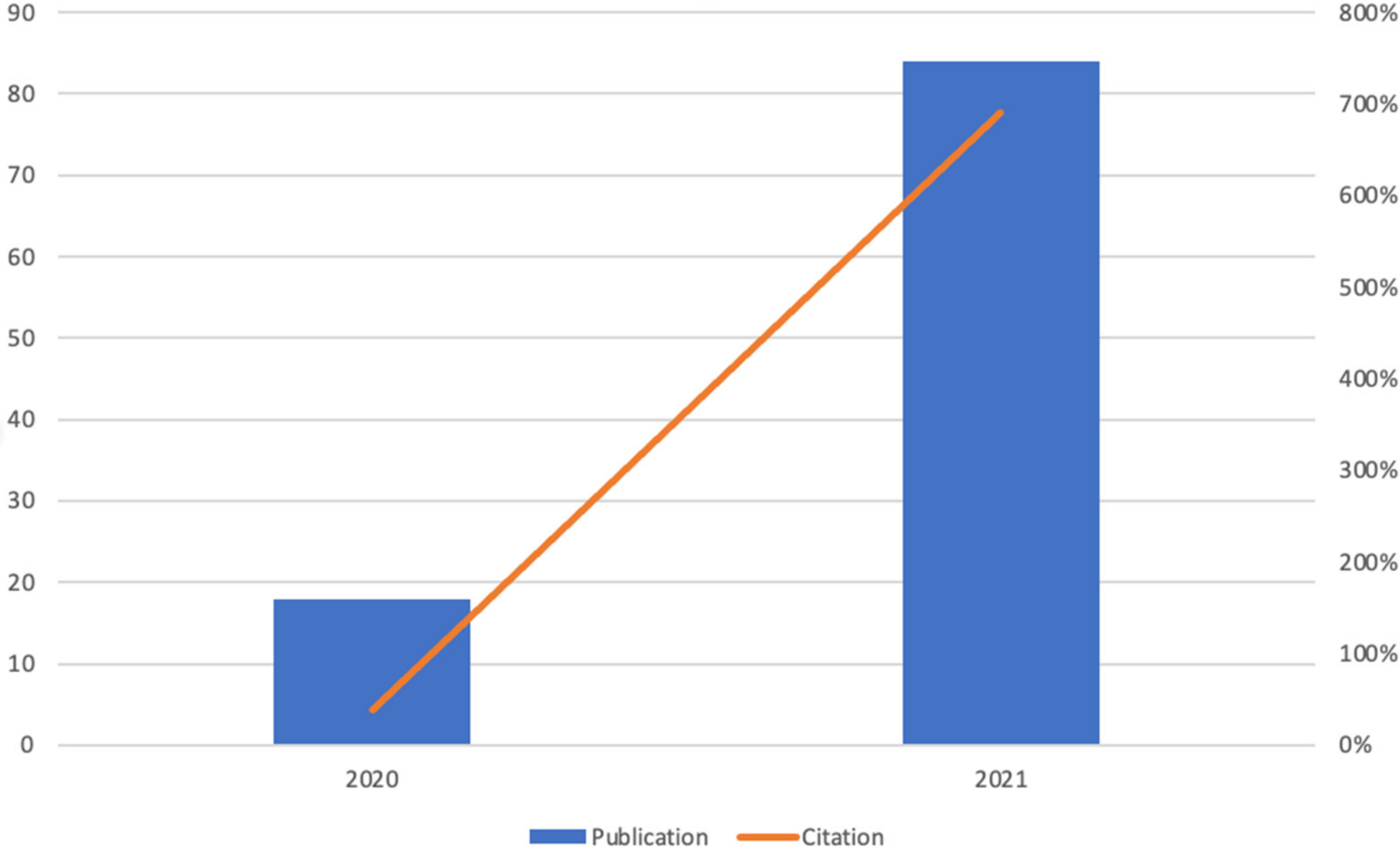
4.1. Overview of Publications
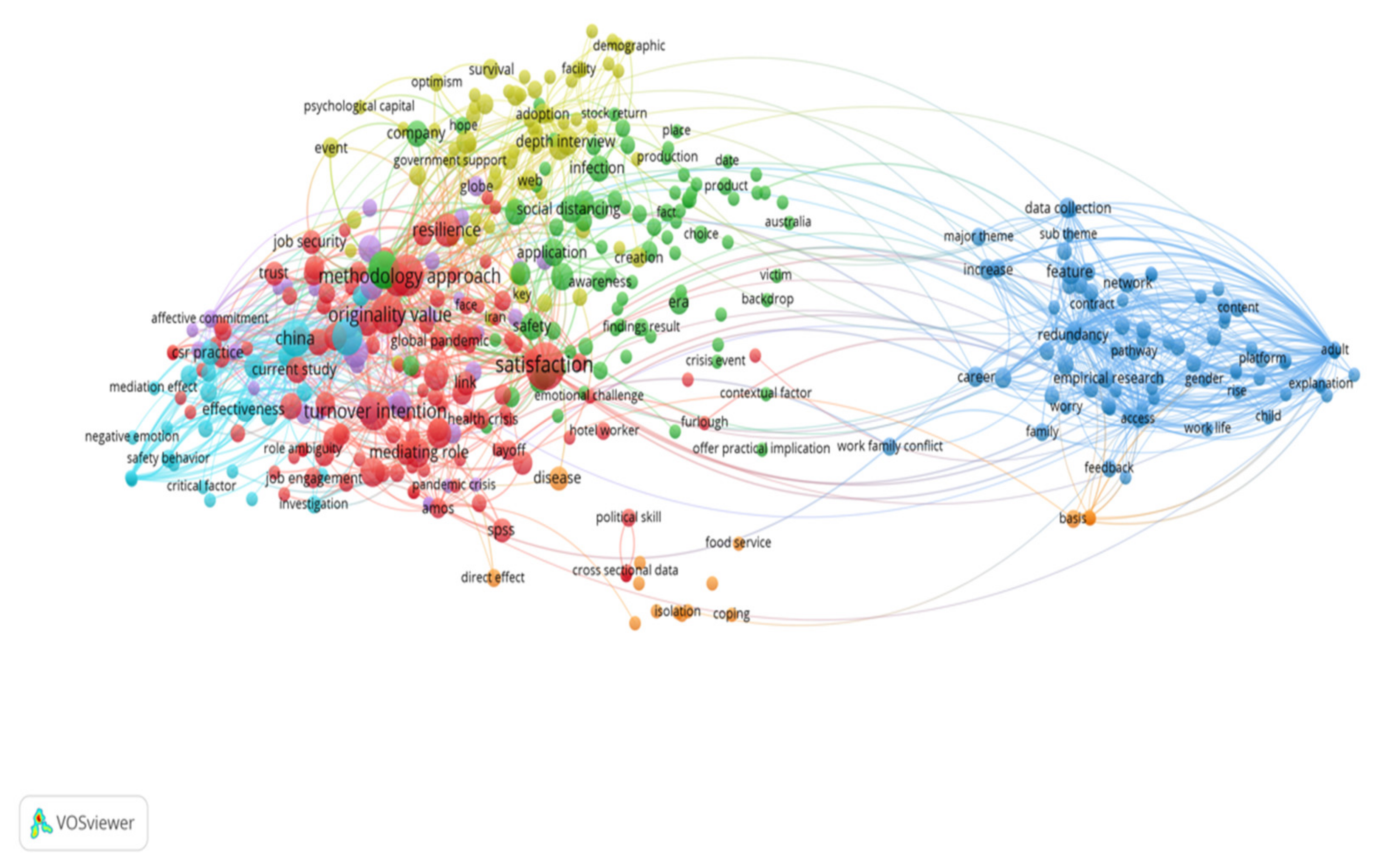
4.2. Keywords and Co-Occurrence Analysis
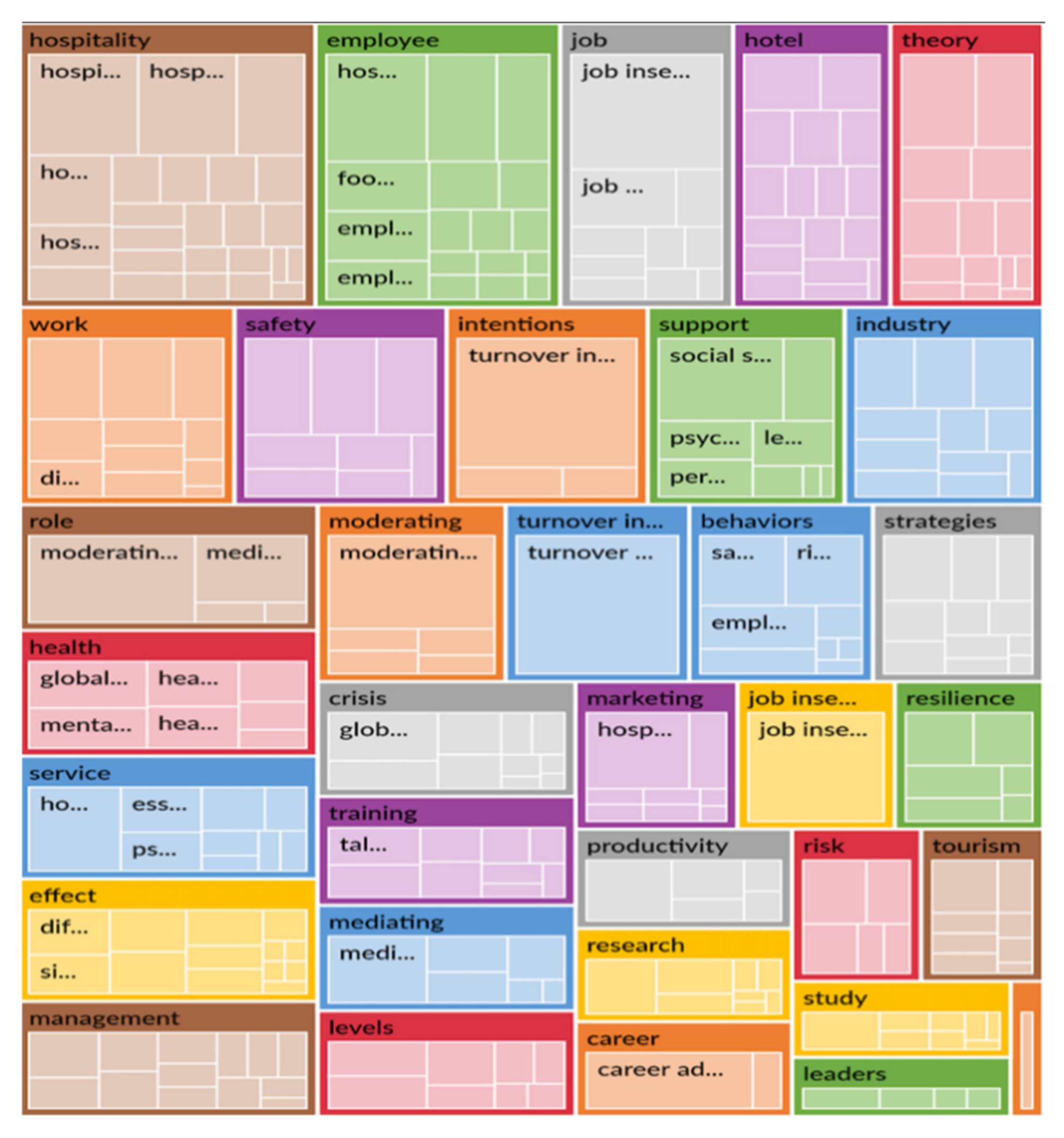
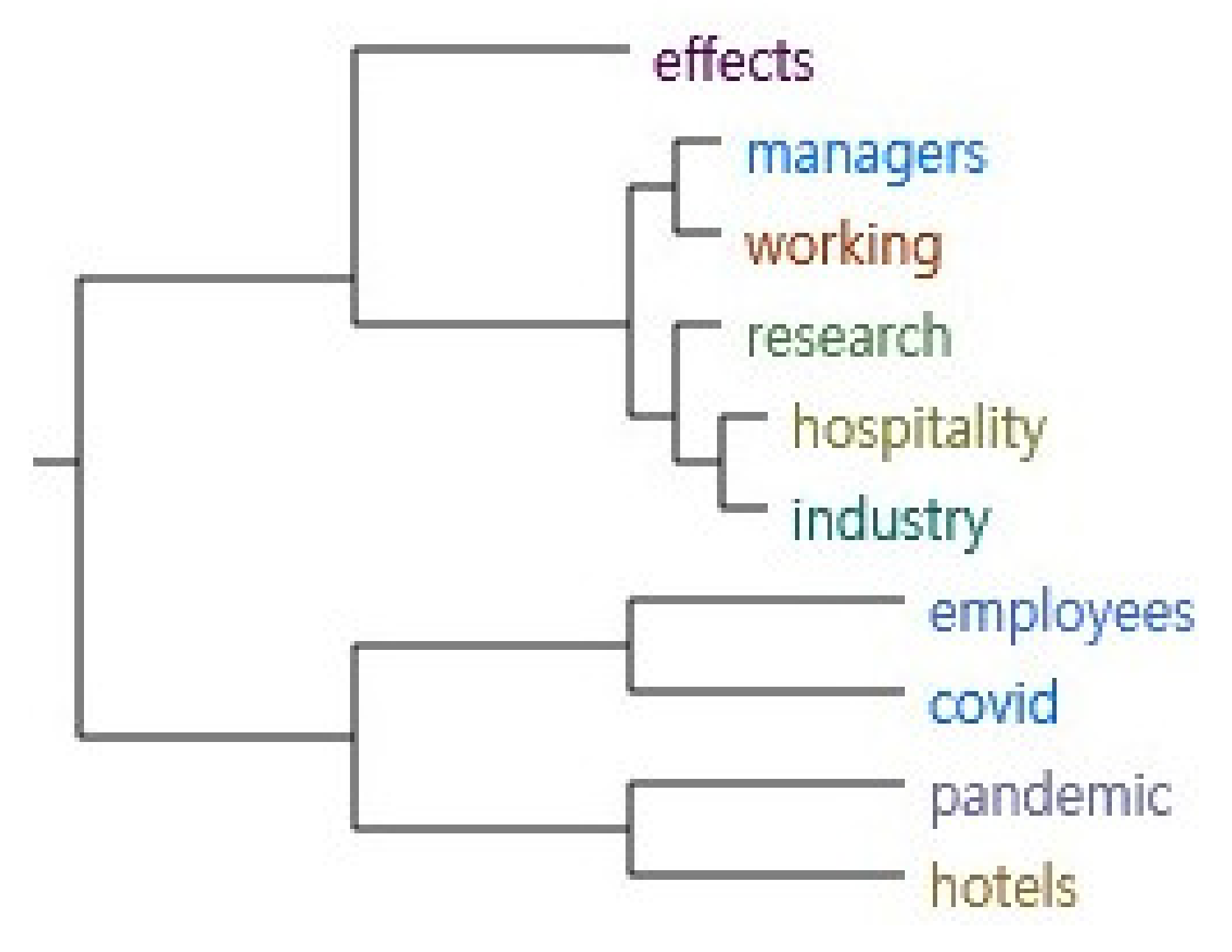
4.3. Coding Process
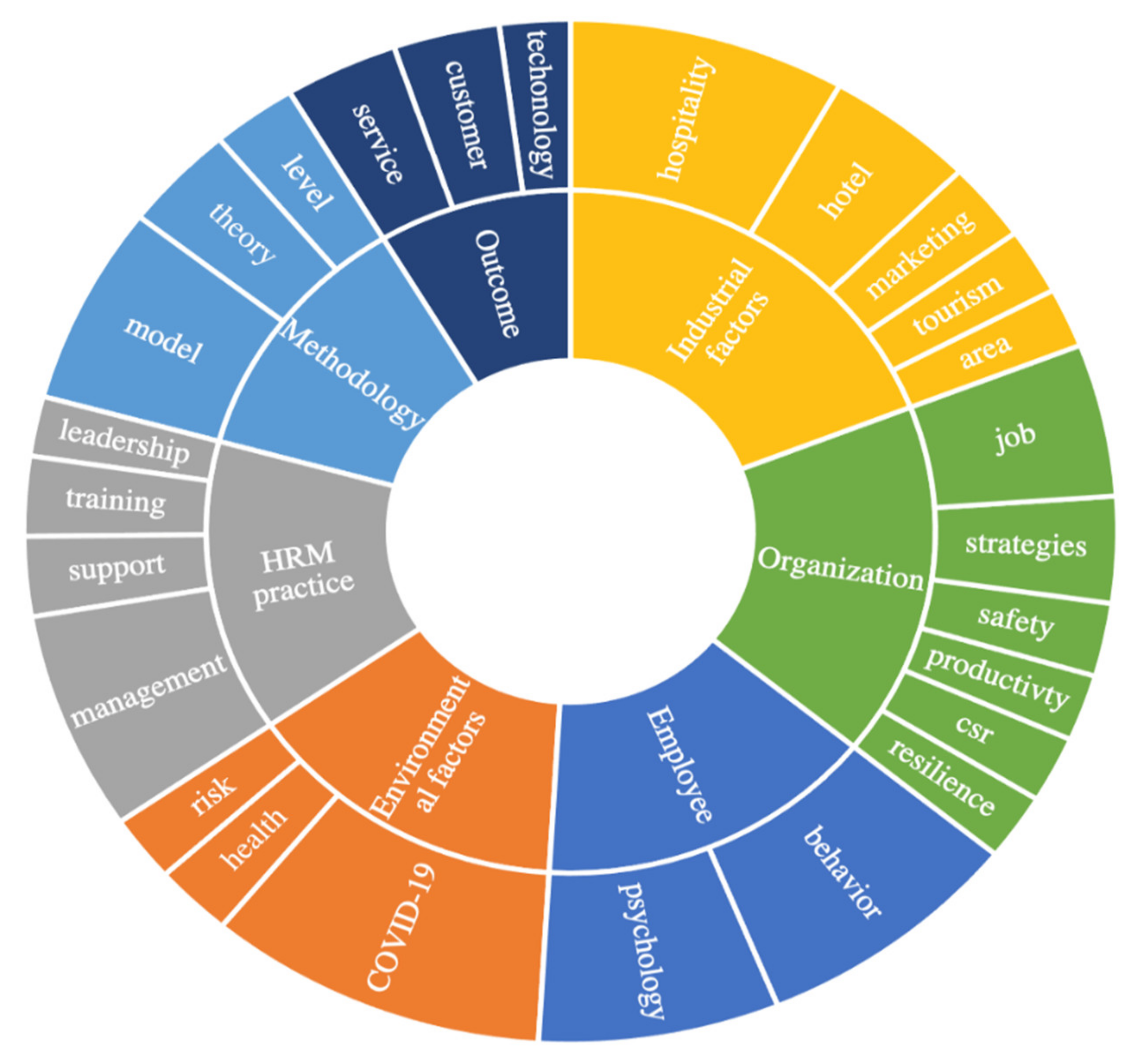
4.4. Conceptual Network
4.4.1. Theme 1: Input: Environmental Factors
4.4.2. Theme 2: Input: Industrial Factors
4.4.3. Theme 3: Progress: HRM Practice
4.4.4. Theme 4: Outcome: Influence on the Employee
4.4.5. Theme 5: Outcome: Influence on the Organization
4.4.6. Theme 6: External Outcome: Service, Customer, Technology
4.4.7. Theme 7: Methodology
5. Agenda for Hospitality HRM
6. Conclusions
Author Contributions
Funding
Institutional Review Board Statement
Informed Consent Statement
Data Availability Statement
Conflicts of Interest
Appendix A

| Authors | Y. | Title | Journal | |
|---|---|---|---|---|
| 1 | Khawaja, Kausar Fiaz; Sarfraz, Muddassar; Rashid, Misbah; Rashid, Mariam | 2021 | How is COVID-19 pandemic causing employee withdrawal behavior in the hospitality industry? An empirical investigation | Journal of Hospitality and Tourism Insights |
| 2 | Park, Eunhye; Kim, Woo-Hyuk; Kim, Sung-Bum | 2020 | Tracking tourism and hospitality employees’ real-time perceptions and emotions in an online community during the COVID-19 pandemic | Current Issues in Tourism |
| 3 | Tsui, Pei-Ling | 2021 | Would organizational climate and job stress affect wellness? An empirical study on the hospitality industry in Taiwan during COVID-19. | International Journal of Environmental Research and Public Health |
| 4 | He, Jie; Mao, Yan; Morrison, Alastair M.; Coca-Stefaniak, J. Andres | 2021 | On being warm and friendly: the effect of socially responsible human resource management on employee fears of the threats of COVID-19 | International Journal of Contemporary Hospitality Management |
| 5 | Bajrami, Dunja Demirovic; Terzic, Aleksandra; Petrovic, Marko D.; Radovanovic, Milan; Tretiakova, Tatiana N.; Hadoud, Abosa | 2021 | Will we have the same employees in hospitality after all? The impact of COVID-19 on employees’ work attitudes and turnover intentions | International Journal of Hospitality Management |
| 6 | Tu, Yidong; Li, Diwan; Wang, Hai-Jiang | 2021 | COVID-19-induced layoff, survivors’ COVID-19-related stress and performance in hospitality industry: The moderating role of social support | International Journal of Hospitality Management |
| 7 | Yan, Jiaqi; Kim, Sunghoon; Zhang, Stephen X.; Foo, Maw-Der; Alvarez-Risco, Aldo; Del-Aguila-Arcentales, Shyla; Yanez, Jaime A. | 2021 | Hospitality workers’ COVID-19 risk perception and depression: A contingent model based on transactional theory of stress model | International Journal of Hospitality Management |
| 8 | Chadee, Doren; Ren, Shuang; Tang, Guiyao | 2021 | Is digital technology the magic bullet for performing work at home? Lessons learned for post COVID-19 recovery in hospitality management | International Journal of Hospitality Management |
| 9 | Ruiz-Palomino, Pablo; Yanez-Araque, Benito; Jimenez-Estevez, Pedro; Gutierrez-Broncano, Santiago | 2022 | Can servant leadership prevent hotel employee depression during the COVID-19 pandemic? A mediating and multigroup analysis | Technological Forecasting and Social Change |
| 10 | Karatepe, Osman M.; Saydam, Mehmet Bahri; Okumus, Fevzi | 2021 | COVID-19, mental health problems, and their detrimental effects on hotel employees’ propensity to be late for work, absenteeism, and life satisfaction | Current Issues in Tourism |
| 11 | Chen, Chun-Chu (Bamboo); Chen, Ming-Hsiang | 2021 | Well-being and career change intention: COVID-19’s impact on unemployed and furloughed hospitality workers | International Journal of Contemporary Hospitality Management |
| 12 | Mioch, Dymphie; Kuiper, Sandra; van den Bijllaardt, Wouter; van Jaarsveld, Cornelia H M; Kluytmans, Jan; Lodder, Esther; Wissing, Michel D | 2021 | SARS-CoV-2 antibodies in employees working in non-medical contact-intensive professions in the Netherlands: Baseline data from the prospective Co-study. | Preventive Medicine Reports |
| 13 | Rezapouraghdam, Hamed; Karatepe, Osman M. | 2020 | Applying health belief model to unveil employees’ workplace COVID-19 protective behaviors: insights for the hospitality industry | International Journal of Mental Health Promotion |
| 14 | Altinay, Levent; Arici, Hasan Evrim | 2021 | Transformation of the hospitality services marketing structure: a chaos theory perspective | Journal of Services Marketing |
| 15 | Hu, Xiaowen; Yan, Hongmin; Casey, Tristan; Wu, Chia-Huei | 2021 | Creating a safe haven during the crisis: How organizations can achieve deep compliance with COVID-19 safety measures in the hospitality industry | International Journal of Hospitality Management |
| 16 | Qiu, Shangzhi (Charles); Jiang, Jianing; Liu, Xinming; Chen, Ming-Hsiang; Yuan, Xina | 2021 | Can corporate social responsibility protect firm value during the COVID-19 pandemic? | International Journal of Hospitality Management |
| 17 | Kang, Sung-Eun; Park, Changyeon; Lee, Choong-Ki; Lee, Seunghoon | 2021 | The stress-induced impact of COVID-19 on tourism and hospitality workers | Sustainability |
| 18 | Chalupa, Stepan; Chadt, Karel | 2021 | The perception of soft skills and their training at hotel front-office in connection to COVID-19 pandemics | TEM Journal |
| 19 | Im, Jinyoung; Kim, Haemi; Miao, Li | 2021 | CEO letters: Hospitality corporate narratives during the COVID-19 pandemic | International Journal of Hospitality Management |
| 20 | Agarwal, Promila | 2021 | Shattered but smiling: Human resource management and the wellbeing of hotel employees during COVID-19 | International Journal of Hospitality Management |
| 21 | Park, In-Jo; Hai, Shenyang | 2021 | How does career future time perspective moderate in the relationship between infection anxiety with the COVID-19 and service behavior among hotel employees? | Tourism Management Perspectives |
| 22 | Vo-Thanh, Tan; Vu, Thinh-Van; Nguyen, Nguyen Phong; Nguyen, Duy Van; Zaman, Mustafeed; Chi, Hsinkuang | 2020 | How does hotel employees’ satisfaction with the organization’s COVID-19 responses affect job insecurity and job performance? | Journal of Sustainable Tourism |
| 23 | Park,, Chang-Yeon; Choong-Ki, Lee | 2020 | The effects of the perceived stress and job anxiety of tourism industry employees on job satisfaction and life satisfaction in the context of COVID-19: Focusing on the moderating effect of government trust | Korean Journal of Hospitality and Tourism |
| 24 | Baum, Tom; Mooney, Shelagh K. K.; Robinson, Richard N. S.; Solnet, David | 2020 | COVID-19’s impact on the hospitality workforce—new crisis or amplification of the norm? | International Journal of Contemporary Hospitality Management |
| 25 | Diep Ngoc Su; Diep Luc Tra; Hanh My Thi Huynh; Hai Hong Thi Nguyen; O’Mahony, Barry | 2021 | Enhancing resilience in the Covid-19 crisis: lessons from human resource management practices in Vietnam | Current Issues in Tourism |
| 26 | Guzzo, Renata F.; Wang, Xingyu; Madera, Juan M.; Abbott, JeAnna | 2021 | Organizational trust in times of COVID-19: Hospitality employees’ affective responses to managers’ communication | International Journal of Hospitality Management |
| 27 | Farooq, Rayees; Sultana, Almaas | 2021 | The potential impact of the COVID-19 pandemic on work from home and employee productivity | Measuring Business Excellence |
| 28 | Chi, Oscar Hengxuan; Saldamli, Asim; Gursoy, Dogan | 2021 | Impact of the COVID-19 pandemic on management-level hotel employees’ work behaviors: Moderating effects of working-from-home | International Journal of Hospitality Management |
| 29 | Burhan, Muhammad; Salam, Muhammad Talha; Abou Hamdan, Omar; Tariq, Hussain | 2021 | Crisis management in the hospitality sector SMEs in Pakistan during COVID-19 | International Journal of Hospitality Management |
| 30 | Mensah, Christopher | 2021 | Using web-survey to collect data on psychological impacts of COVID-19 on hotel employees in Ghana: A methodological review | Cogent Psychology |
| 31 | Shah, Chetan; Chowdhury, Abhishek; Gupta, Vikas | 2021 | Impact of COVID-19 on tourism and hospitality students’ perceptions of career opportunities and future prospects in India | Journal of Teaching in Travel and Tourism |
| 32 | Jung, Hyo Sun; Jung, Yoon Sik; Yoon, Hye Hyun | 2021 | COVID-19: The effects of job insecurity on the job engagement and turnover intent of deluxe hotel employees and the moderating role of generational characteristics | International Journal of Hospitality Management |
| 33 | Unguren, Engin; Tekin, Omer Akgun; Avsalli, Huseyin; Kacmaz, Yasar Yigit | 2021 | The Moderator Role of Financial Well-Being on the Effect of Job Insecurity and the COVID-19 Anxiety on Burnout: A Research on Hotel-Sector Employees in Crisis | Sustainability |
| 34 | Aguiar-Quintana, Teresa; Nguyen, Thi Hong Hai; Araujo-Cabrera, Yasmina; Sanabria-Diaz, Jose M. | 2021 | Do job insecurity, anxiety and depression caused by the COVID-19 pandemic influence hotel employees’ self-rated task performance? The moderating role of employee resilience | International Journal of Hospitality Management |
| 35 | Luu Trong Tuan | 2021 | Employer event communication and hospitality workers’ resilience during the COVID-19 crisis: the role of core beliefs examination and family support | International Journal of Contemporary Hospitality Management |
| 36 | Wang, Yao-Chin; Chi, Christina Geng-Qing; Erkilic, Eren | 2021 | The impact of religiosity on political skill: evidence from Muslim hotel employees in Turkey | International Journal of Contemporary Hospitality Management |
| 37 | Filimonau, Viachaslau; Derqui, Belen; Matute, Jorge | 2020 | The COVID-19 pandemic and organizational commitment of senior hotel managers | International Journal of Hospitality Management |
| 38 | Choi, Miju; Choi, Youngjoon | 2021 | Employee perceptions of hotel CSR activities during the COVID-19 pandemic | International Journal of Contemporary Hospitality Management |
| 39 | Khatri, Puja; Raina, Khushboo; Dutta, Sumedha; Pahwa, Harshleen; Kumari, Preeti | 2021 | Reaction to COVID-19, social media engagement and well-being: a mediation analysis | A Journal of The Social and Economic Relations of Work |
| 40 | Seyitoglu, Faruk; Ivanov, Stanislav | 2021 | Service robots as a tool for physical distancing in tourism | Current Issues in Tourism |
| 41 | Lin, Fang-Yi | 2021 | Effectiveness of the talent cultivation training program for industry transformation in Taiwan during the COVID-19 pandemic | Service Business |
| 42 | Manoharan, Ashokkumar; Jones, Janice; Jiang, Zhou; Singal, Manisha | 2021 | Career optimism of culturally and linguistically diverse hotel workers in the pandemic age | International Journal of Hospitality Management |
| 43 | Canhoto, Ana Isabel; Wei, Liyuan | 2021 | Stakeholders of the world, unite!: Hospitality in the time of COVID-19 | International Journal of Hospitality Management |
| 44 | Kaushal, Vikrant; Srivastava, Sidharth | 2021 | Hospitality and tourism industry amid COVID-19 pandemic: Perspectives on challenges and learnings from India | International Journal of Hospitality Management |
| 45 | Bozovic, Tamara; Blesic, Ivana; Knezevic, Milena Nedeljkovic; Deri, Lukrecija; Pivac, Tatjana | 2021 | Resilience of tourism employees to changes caused by COVID-19 pandemic | Journal of The Geographical Institute |
| 46 | Zhang, Jiangchi; Xie, Chaowu; Morrison, Alastair M. | 2021 | The effect of corporate social responsibility on hotel employee safety behavior during COVID-19: The moderation of belief restoration and negative emotions | Journal of Hospitality and Tourism Management |
| 47 | Singh, Nidhi; Bhatia, Shikha; Nigam, Shailendra | 2021 | Perceived vulnerability of job loss and satisfaction with life in the hospitality sector in times of pandemic: a multi-mediational approach | International Journal of Contemporary Hospitality Management |
| 48 | Wu, Gang; Liang, Lifang; Gursoy, Dogan | 2021 | Effects of the new COVID-19 normal on customer satisfaction: Can facemasks level off the playing field between average-looking and attractive-looking employees? | International Journal of Hospitality Management |
| 49 | Lee, Patrick C.; Xu, Shi (Tracy); Yang, Wan | 2021 | Is career adaptability a double-edged sword? The impact of work social support and career adaptability on turnover intentions during the COVID-19 pandemic | International Journal of Hospitality Management |
| 50 | Bichler, Bernhard Fabian; Petry, Tanja; Peters, Mike | 2021 | ‘We did everything we could’: how employees’ made sense of COVID-19 in the tourism and hospitality industry | Current Issues in Tourism |
| 51 | Chen, I-Shuo | 2020 | Turning home boredom during the outbreak of COVID-19 into thriving at home and career self-management: the role of online leisure crafting | International Journal of Hospitality Management |
| 52 | Zhang, Jiangchi; Xie, Chaowu; Wang, Jianying; Morrison, Alastair M.; Coca-Stefaniak, J. Andres | 2020 | Responding to a major global crisis: the effects of hotel safety leadership on employee safety behavior during COVID-19 | International Journal of Hospitality Management |
| 53 | Teng, Yi-Man; Wu, Kun-Shan; Lin, Kuan-Ling; Xu, Dan | 2020 | Mental health impact of COVID-19 on quarantine hotel employees in China | Risk Management and Healthcare Policy |
| 54 | Kim, Seontaik; Kim, Peter Beomcheol; Lee, Gyumin | 2021 | Predicting hospitality employees’ safety performance behaviors in the COVID-19 pandemic | International Journal of Hospitality Management |
| 55 | Gurlek, Mert; Kilic, Ilker | 2021 | A true friend becomes apparent on a rainy day: Corporate social responsibility practices of top hotels during the COVID-19 pandemic | Current Issues in Tourism |
| 56 | Farrer, James | 2020 | How are Tokyo’s independent restauranteurs surviving the pandemic? | Asia-Pacific Journal-Japan Focus |
| 57 | Song, Hanqun; Ma, Emily; Cheng, Mingming | 2021 | Dining with distance during the pandemic: an enquiry from the theory of proxemics and social exchange | Current Issues in Tourism |
| 58 | Yuan, Yue; Kong, Haiyan; Baum, Tom; Liu, Yining; Liu, Chao; Bu, Naipeng; Wang, Kangping; Yin, Zihan | 2021 | Transformational leadership and trust in leadership impacts on employee commitment | Tourism Review |
| 59 | Yu, Heyao; Lee, Lindsey; Popa, Iuliana; Madera, Juan M. | 2021 | Should I leave this industry? The role of stress and negative emotions in response to an industry negative work event | International Journal of Hospitality Management |
| 60 | Abdalla, Moh’d Juma; Said, Hamad; Ali, Laiba; Ali, Faizan; Chen, Xianglan | 2021 | COVID-19 and unpaid leave: Impacts of psychological contract breach on organizational distrust and turnover intention: Mediating role of emotional exhaustion | Tourism Management Perspectives |
| 61 | Zhong, Yifan; Li, Yameng; Ding, Jian; Liao, Yiyi | 2021 | Risk Management: Exploring emerging human resource issues during the COVID-19 pandemic | Journal of Risk and Financial Management |
| 62 | Bhrammanachote, Winayaporn; Sawangdee, Yothin | 2021 | Sustaining or surviving? An exploratory case study on COVID-19’s impact towards hotel businesses | Tourism and Hospitality Management |
| 63 | Salem, Islam Elbayoumi; Elbaz, Ahmed Mohamed; Elkhwesky, Zakaria; Ghazi, Karam Mansour | 2021 | The COVID-19 pandemic: The mitigating role of government and hotel support of hotel employees in Egypt | Tourism Management |
| 64 | Yu, Yang | 2021 | Situation of hotels in henan under the influence of COVID-19 epidemic prevention and control | Basic and Clinical Pharmacology and Toxicology |
| 65 | Murray, William C.; Holmes, Mark R. | 2021 | Impacts of employee empowerment and organizational commitment on workforce sustainability | Sustainability |
| 66 | Yacoub, Laurent; ElHajjar, Samer | 2021 | How do hotels in developing countries manage the impact of COVID-19? The case of Lebanese hotels | International Journal of Contemporary Hospitality Management |
| 67 | Salem, Islam Elbayoumi; Elkhwesky, Zakaria; Ramkissoon, Haywantee | 2021 | A content analysis for governments and hotels’ response to COVID-19 pandemic in Egypt | Tourism and Hospitality Research |
| 68 | Goh, Edmund; Baum, Tom | 2021 | Job perceptions of Generation Z hotel employees towards working in Covid-19 quarantine hotels: the role of meaningful work | International Journal of Contemporary Hospitality Management |
| 69 | Mejia, Cynthia; Pittman, Rebecca; Beltramo, Jenna M. D.; Horan, Kristin; Grinley, Amanda; Shoss, Mindy K. | 2021 | Stigma and dirty work: In-group and out-group perceptions of essential service workers during COVID-19 | International Journal of Hospitality Management |
| 70 | Abbas, Muhammad; Malik, Mehwish; Sarwat, Nosheen | 2021 | Consequences of job insecurity for hospitality workers amid COVID-19 pandemic: does social support help? | Journal of Hospitality Marketing and Management |
| 71 | Kaygin, Erdogan; Topcuoglu, Ethem | 2020 | The effects of COVID-19 pandemic upon tourism: A sample from the city of Kars | Journal of Mehmet Akif Ersoy University Economics and Administrative Sciences Faculty |
| 72 | Brizek, Michael G.; Frash, Robert E.; McLeod, Brumby M.; Patience, Melinda O. | 2021 | Independent restaurant operator perspectives in the wake of the COVID-19 pandemic | International Journal of Hospitality Management |
| 73 | Rawal, Yashwant Singh; Pal, Sanjeeb; Bagchi, Purnendu; Dani, Rakesh | 2020 | Hygiene and safety: A review of the hotel industry in the era of COVID-19 pandemic | Bioscience Biotechnology Research Communications |
| 74 | Kearney, N; Hambly, R; Alsharqi, A; Kirby, B | 2021 | Not relevant responses in the era of COVID-19—are we underestimating dermatology life quality index values? | The British Journal of Dermatology |
| 75 | Gupta, Vikas; Sahu, Garima | 2021 | Reviving the Indian hospitality industry after the COVID-19 pandemic: the role of innovation in training | Worldwide Hospitality and Tourism Themes |
| 76 | Yorulmaz, Murat; Sevinc, Figen | 2021 | Supervisor support and turnover intentions of yacht captains: the role of work-family conflict and psychological resilience during the COVID-19 pandemic | International Journal of Contemporary Hospitality Management |
| 77 | Robinson, Richard N. S.; Brenner, Matthew L. | 2021 | Wage theft in professional kitchens: Conned or complicit? | Hospitality and Society |
| 78 | Rosemberg, Marie-Anne S.; Adams, Mackenzie; Polick, Carri; Li, Wei V.; Dang, Jenny; Tsai, Jenny Hsin-Chun | 2021 | COVID-19 and mental health of food retail, food service, and hospitality workers | Journal of Occupational and Environmental Hygiene |
| 79 | Robina-Ramirez, Rafael; Medina-Merodio, Jose-Amelio; Moreno-Luna, Libertad; Jimenez-Naranjo, Hector V.; Sanchez-Oro, Marcelo | 2021 | Safety and health measures for COVID-19 transition period in the hotel industry in Spain | International Journal of Environmental Research and Public Health |
| 80 | Grandey, Alicia A.; Sayre, Gordon M.; French, Kimberly A. | 2021 | A blessing and a curse: Work loss during coronavirus lockdown on short-term health changes via threat and recovery | Journal of Occupational Health Psychology |
| 81 | Ramkissoon, Haywantee; Mavondo, Felix; Sowamber, Vishnee | 2020 | Corporate social responsibility at LUX* resorts and hotels: satisfaction and loyalty implications for employee and customer social responsibility | Sustainability |
| 82 | Pathak, Deepti; Joshi, Gaurav | 2021 | impact of psychological capital and life satisfaction on organizational resilience during COVID-19: Indian tourism insights | Current Issues in Tourism |
| 83 | Li, Minglong; Yin, Dexiang; Qiu, Hailian; Bai, Billy | 2021 | A systematic review of AI technology-based service encounters: Implications for hospitality and tourism operations | International Journal of Hospitality Management |
| 84 | Fuste-Forne, Francesc; Filimon, Nela | 2021 | Using social media to preserve consumers’ awareness on food identity in times of crisis: The case of bakeries | International Journal of Environmental Research and Public Health |
| 85 | Haarmeyer, David | 2020 | Private equity and the COVID-19 economic downturn: Opportunity for expansion? | Journal of Applied Corporate Finance |
| 86 | Ponting, Sandra Sun-Ah | 2021 | Responding to organizational identity change: ethnographic insights from multinational hotel subsidiaries | Journal of Hospitality and Tourism Technology |
| 87 | Acheson, Jean | 2021 | Job turnover and the policy response in the COVID-19 era | Economic and Social Review |
| 88 | Fitzgerald, Niamh; Uny, Isabelle; Brown, Ashley; Eadie, Douglas; Ford, Allison; Lewsey, Jim; Stead, Martine | 2021 | Managing COVID-19 transmission risks in Bars: An interview and observation study | Journal of Studies on Alcohol and Drugs |
| 89 | Sharma, Abhinav; Shin, Hakseung; Jesus Santa-Maria, Maria; Luis Nicolau, Juan | 2021 | Hotels’ COVID-19 innovation and performance | Annals of Tourism Research |
| 90 | Boccia, Mark; Cseh, Maria | 2021 | Full-service restaurants as learning organizations: a multiple-site case study | Learning Organization |
| 91 | Ferreira, Sandra; Pereira, Olga; Simoes, Claudia | 2021 | Environmental sustainability in the hotel industry: A perspective from eco hotel managers in Portugal | International Journal of Marketing Communication and New Media |
| 92 | Hong, Semyung | 2021 | The effect of job image and occupational values on the employment preparation Behavior among university students with majors related to aviation tourism | Journal of Tourism Enhancement |
| 93 | Williams, Colin C.; Kayaoglu, Aysegul | 2020 | COVID-19 and undeclared work: impacts and policy responses in Europe | Service Industries Journal |
| 94 | de Vries, Klaas; Erumban, Abdul; van Ark, Bart | 2021 | Productivity and the pandemic: short-term disruptions and long-term implications: The impact of the COVID-19 pandemic on productivity dynamics by industry | International Economics and Economic Policy |
| 95 | Hyoseon, Park; Hany, Kim | 2021 | The relationship between job insecurity and pro-social service behavior of LCC flight attendants, and the effect of job stress and AB personality type | Korean Journal of Hospitality and Tourism |
| 96 | Irvine, Annie Louise | 2020 | Qualitative evidence on the relationships between precarious employment and mental health in western economies: a scoping review protocol | Open Science Framework |
| 97 | Mao, Yan; He, Jie; Morrison, Alastair M.; Coca-Stefaniak, J. Andres | 2021 | Effects of tourism CSR on employee psychological capital in the COVID-19 crisis: from the perspective of conservation of resources theory | Current Issues in Tourism |
| 98 | Aigbedo, Henry | 2021 | Impact of COVID-19 on the hospitality industry: A supply chain resilience perspective | International Journal of Hospitality Management |
| 99 | Breier, Matthias; Kallmuenzer, Andreas; Clauss, Thomas; Gast, Johanna; Kraus, Sascha; Tiberius, Victor | 2021 | The role of business model innovation in the hospitality industry during the COVID-19 crisis | International Journal of Hospitality Management |
| 100 | Yu, Jongsik; Seo, Jungwoon; Hyun, Sunghyup Sean | 2021 | Perceived hygiene attributes in the hotel industry: customer retention amid the COVID-19 crisis | International Journal of Hospitality Management |
| 101 | Jiang, Yangyang; Wen, Jun | 2020 | Effects of COVID-19 on hotel marketing and management: a perspective article | International Journal of Contemporary Hospitality Management |
| 102 | Zhai, Huayun; Xiao, Mingsheng; Chan, Kam C.; Liu, Qingzhuo | 2020 | Physical proximity, corporate social responsibility, and the impact of negative investor sentiment on stock returns: Evidence from COVID-19 in China | International Review of Finance |
Appendix B
| Word | Length | Count | Weighted Percentage | Similar Words | |
|---|---|---|---|---|---|
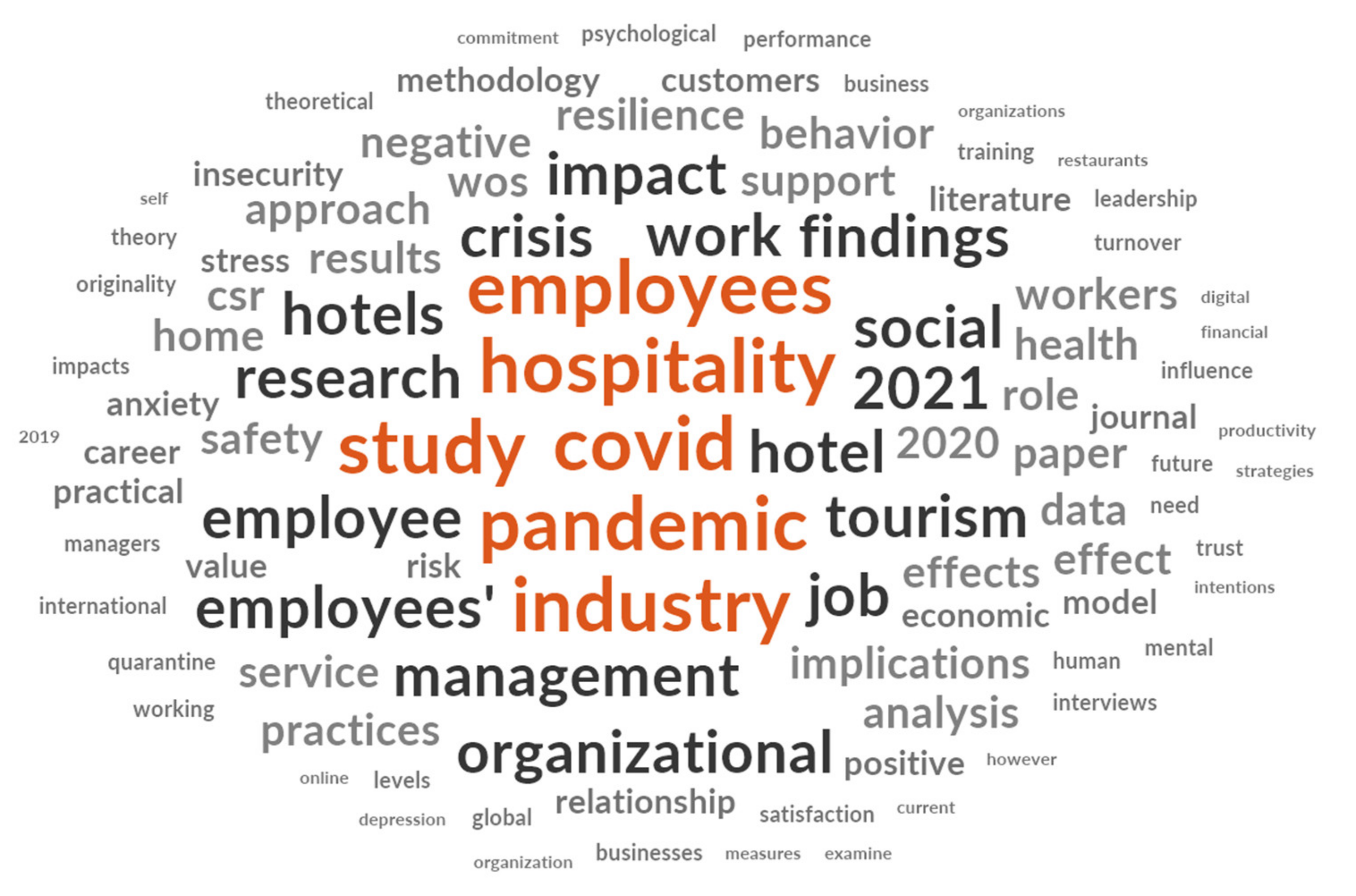
| 1 | employees | 9 | 433 | 2.02% | employee, employees, employees’ |
| 2 | covid | 5 | 310 | 1.44% | ‘covid, covid |
| 3 | hotels | 6 | 239 | 1.11% | hotel, hotels, hotels’ |
| 4 | hospitality | 11 | 235 | 1.09% | hospitality, hospitals |
| 5 | working | 7 | 207 | 0.96% | work, worked, working, works |
| 6 | pandemic | 8 | 193 | 0.90% | pandemic, pandemics |
| 7 | managers | 8 | 179 | 0.83% | manage, manageable, managed, management, manager, managers, managers’, managing |
| 8 | effects | 7 | 172 | 0.80% | effect, effective, effectively, effectiveness, effects |
| 9 | job | 3 | 170 | 0.79% | job, jobs |
| 10 | industry | 8 | 164 | 0.76% | industrial, industries, industry |
| 11 | social | 6 | 136 | 0.63% | social, socially |
| 12 | health | 6 | 134 | 0.62% | health |
| 13 | impact | 6 | 121 | 0.56% | impact, impacted, impactful, impacting, impacts |
| 14 | employed | 8 | 120 | 0.56% | employed, employer, employers, employing, employment |
| 15 | practices | 9 | 118 | 0.55% | practical, practically, practice, practices |
| 16 | role | 4 | 115 | 0.54% | role, roles |
| 17 | organizational | 14 | 108 | 0.50% | organizational |
| 18 | crisis | 6 | 93 | 0.43% | crisis |
| 19 | tourism | 7 | 88 | 0.41% | tourism |
| 20 | support | 7 | 88 | 0.41% | support, supported, supportive, supports |
| 21 | relationship | 12 | 87 | 0.41% | relationship, relationships |
| 22 | behavior | 8 | 80 | 0.37% | behavior, behavioral, behaviors |
| 23 | examining | 9 | 79 | 0.37% | examination, examine, examined, examines, examining |
| 24 | mental | 6 | 78 | 0.36% | mental |
| 25 | precariousness | 14 | 74 | 0.34% | precari, precarious, precariously, precariousness |
| 26 | well | 4 | 74 | 0.34% | well, wellness |
| 27 | service | 7 | 74 | 0.34% | service, services, servicing |
| 28 | positively | 10 | 74 | 0.34% | posited, position, positionality, positions, positive, positively, posits |
| 29 | responsibility | 14 | 74 | 0.34% | response, responses, responsibility, responsible |
| 30 | model | 5 | 73 | 0.34% | model, modeling, modelling, models |
| 31 | relations | 9 | 73 | 0.34% | relate, related, relates, relating, relation, relational, relations, relative, relatively |
| 32 | negative | 8 | 71 | 0.33% | negative, negatively, negatives, negativities |
| 33 | data | 4 | 70 | 0.33% | data |
| 34 | influence | 9 | 69 | 0.32% | influence, influenced, influences, influencing |
| 35 | moderation | 10 | 68 | 0.32% | moderate, moderated, moderates, moderating, moderation, moderator |
| 36 | review | 6 | 67 | 0.31% | review, reviewed, reviewer, reviews |
| 37 | satisfaction | 12 | 67 | 0.31% | satisfaction |
| 38 | csr | 3 | 66 | 0.31% | csr |
| 39 | workers’ | 8 | 66 | 0.31% | worker, workers, workers’ |
| 40 | mediators | 9 | 65 | 0.30% | mediate, mediated, mediates, mediating, mediation, mediational, mediator, mediators |
| 41 | analysis | 8 | 64 | 0.30% | analysis |
| 42 | implications | 12 | 64 | 0.30% | implications |
| 43 | customer | 8 | 64 | 0.30% | customer, customers, customers’, customized |
| 44 | approaches | 10 | 63 | 0.29% | approach, approaches |
| 45 | affect | 6 | 63 | 0.29% | affect, affected, affecting, affective, affects |
| 46 | psychological | 13 | 62 | 0.29% | psychological, psychologically, psychology |
| 47 | provide | 7 | 62 | 0.29% | provide, provided, provides, providing |
| 48 | intentions | 10 | 61 | 0.28% | intent, intention, intentions |
| 49 | resilience | 10 | 61 | 0.28% | resilience, resiliency, resilient |
| 50 | significantly | 13 | 60 | 0.28% | significance, significant, significantly |
| 51 | organization | 12 | 60 | 0.28% | organization, organizations, organized, organizing |
| 52 | perceived | 9 | 60 | 0.28% | perceive, perceived |
| 53 | career | 6 | 59 | 0.27% | career, careers, careers’ |
| 54 | shows | 5 | 58 | 0.27% | show, showed, showing, shows |
| 55 | insecurity | 10 | 57 | 0.27% | insecure, insecurity |
| 56 | safety | 6 | 57 | 0.27% | safety |
| 57 | times | 5 | 57 | 0.27% | time, timely, times |
| 58 | levels | 6 | 57 | 0.27% | level, levels |
| 59 | stress | 6 | 57 | 0.27% | stress, stress’, stressful, stressing |
| 60 | home | 4 | 56 | 0.26% | home |
| 61 | factors | 7 | 54 | 0.25% | factor, factors |
| 62 | performed | 9 | 54 | 0.25% | perform, performance, performances, performed, performing |
| 63 | develops | 8 | 53 | 0.25% | develop, developed, developing, development, develops |
| 64 | based | 5 | 52 | 0.24% | base, based |
| 65 | purposive | 9 | 52 | 0.24% | purpose, purposes, purposive, purposively |
| 66 | survey | 6 | 50 | 0.23% | survey, surveyed, surveying, surveys |
| 67 | change | 6 | 50 | 0.23% | change, changed, changes, changing |
| 68 | risk | 4 | 50 | 0.23% | risk, risks |
| 69 | theory | 6 | 50 | 0.23% | theories, theory |
| 70 | perceptions | 11 | 49 | 0.23% | perception, perceptions |
| 71 | trust | 5 | 47 | 0.22% | trust |
| 72 | turnover | 8 | 47 | 0.22% | turnover |
| 73 | resource | 8 | 47 | 0.22% | resource, resources |
| 74 | structural | 10 | 47 | 0.22% | structural, structure, structured, structures |
| 75 | business | 8 | 46 | 0.21% | business, businesses, businesses’ |
| 76 | sector | 6 | 46 | 0.21% | sector, sectoral, sectors |
| 77 | need | 4 | 46 | 0.21% | need, needed, needs |
| 78 | including | 9 | 45 | 0.21% | include, included, includes, including |
| 79 | self | 4 | 44 | 0.20% | self |
| 80 | aims | 4 | 44 | 0.20% | aim, aimed, aims |
| 81 | methodology | 11 | 44 | 0.20% | methodological, methodology |
| 82 | design | 6 | 44 | 0.20% | design, designed |
| 83 | experiment | 10 | 43 | 0.20% | experience, experiences, experiment |
| 84 | theoretical | 11 | 40 | 0.19% | theoretical, theoretically |
| 85 | knowledge | 9 | 40 | 0.19% | knowledge, knowledgeable |
| 86 | discussion | 10 | 40 | 0.19% | discuss, discussed, discusses, discussion |
| 87 | 2020 | 4 | 40 | 0.19% | 2020 |
| 88 | online | 6 | 38 | 0.18% | online |
| 89 | future | 6 | 38 | 0.18% | future, futures |
| 90 | new | 3 | 38 | 0.18% | ‘new, new |
| 91 | human | 5 | 37 | 0.0017 | human, humanized |
| 92 | addition | 8 | 37 | 0.0017 | addition, additional, additionally |
| 93 | contributes | 11 | 37 | 0.0017 | contribute, contributed, contributes, contributing, contribution, contributions |
| 94 | values | 6 | 37 | 0.0017 | value, values |
| 95 | commitment | 10 | 37 | 0.0017 | commitment, commitments, committed |
| 96 | family | 6 | 36 | 0.0017 | families, families’, family |
| 97 | emotional | 9 | 36 | 0.0017 | emotional, emotions |
| 98 | marketing | 9 | 36 | 0.0017 | market, marketers, marketing, markets |
| 99 | group | 5 | 36 | 0.0017 | group, groups |
| 100 | qualitative | 11 | 35 | 0.0016 | qualitative |
References
- Nicole, M.; Alsafi, Z.; Sohrabi, C.; Kerwan, A.; Al-Jabir, A.; Losifidis, C.; Agha, M.; Agha, R. The socio-economic implications of the coronavirus and COVID-19 pandemic: A review. Int. J. Surg. 2020, 78, 185–193. [Google Scholar] [CrossRef] [Scilit] [PubMed]
- McIntosh, R.W.; Goeldner, C.R.; Ritchie, J.B. Tourism in perspective. In Tourism: Principles, Practices, Philosophies, 7nd ed.; John Wiley and Sons: Hoboken, NJ, USA, 2007; pp. 3–35. [Google Scholar]
- Hao, F.; Xiao, Q.; Chon, K. COVID-19 and China’s hotel industry: Impacts, a disaster management framework, and post-pandemic agenda. Int. J. Hosp. Manag. 2020, 90, 102636. [Google Scholar] [CrossRef] [Scilit] [PubMed]
- Kim, Y.; Kim, H.; Kim, H. Understanding the effects of COVID-19 on the Starbucks perception through big data analytics: A comparative study. Culin. Sci. Hosp. Res. 2021, 27, 1–14. [Google Scholar] [CrossRef]
- Mun, J.; Ban, H.; Kim, H. A study on consumers’ perception of meal-kit: After the spread of coronavirus infectious disease-19 (COVID-19). Culin. Sci. Hosp. Res. 2020, 26, 198–207. [Google Scholar]
- Fitzgerald, N.; Uny, I.; Brown, A.; Eadie, D.; Ford, A.; Lewsey, J.; Stead, M. Managing COVID-19 transmission risks in bars: An interview and observation study. J. Stud. Alcohol Drugs Suppl. 2021, 82, 42–54. [Google Scholar] [CrossRef] [Scilit]
- Alonso, A.D.; Kok, S.K.; Bressan, A.; O’Shea, M.; Sakellarios, N.; Koresis, A.; Solis, M.A.B.; Santoni, L.J. COVID-19, aftermath, impacts, and hospitality firms: An international perspective. Int. J. Hosp. Manag. 2020, 91, 102654. [Google Scholar] [CrossRef] [Scilit]
- Harney, B.; Collings, D.G. Navigating the shifting landscapes of HRM. Hum. Resour. Manag. R. 2021, 31, 100824. [Google Scholar] [CrossRef] [Scilit]
- Wright, P.M. Rediscovering the “Human” in strategic human capital. Hum. Resour. Manag. R. 2021, 31, 100781. [Google Scholar] [CrossRef] [Scilit]
- Hu, X.; Yan, H.; Casey, T.; Wu, C.H. Creating a safe haven during the crisis: How organizations can achieve deep compliance with COVID-19 safety measures in the hospitality industry. Int. J. Hosp. Manag. 2021, 92, 102662. [Google Scholar] [CrossRef] [Scilit]
- Hewett, R.; Shantz, A. A theory of HR co-creation. Hum. Resour. Manag. R. 2021, 31, 100823. [Google Scholar] [CrossRef] [Scilit]
- McMackin, J.; Heffernan, M. Agile for HR: Fine in practice, but will it work in theory? Hum. Resour. Manag. R. 2021, 31, 100791. [Google Scholar] [CrossRef] [Scilit]
- Jooss, S.; McDonnell, A.; Conroy, K. Flexible global working arrangements: An integrative review and future research agenda. Hum. Resour. Manag. R. 2021, 31, 100780. [Google Scholar] [CrossRef] [Scilit]
- Page, M.J.; McKenzie, J.E.; Bossuyt, P.M.; Boutron, I.; Hoffmann, T.C.; Mulrow, C.D.; Shamseer, L.; Tetzlaff, J.M.; Akl, E.A.; Brennan, S.E. The PRISMA 2020 statement: An updated guideline for reporting systematic reviews. Int. J. Surg. 2021, 88, 105906. [Google Scholar] [CrossRef] [PubMed]
- Braun, V.; Clarke, V. Using thematic analysis in psychology. Qual. Res. Psychol. 2006, 3, 77–101. [Google Scholar] [CrossRef] [Scilit]
- Du Plessis, A.; Douangphichit, N.; Dodd, P. HRM in relation to employee motivation and job performance in the hospitality industry. J. Int. Bus. Res. Mar. 2016, 1, 12–21. [Google Scholar] [CrossRef] [Scilit]
- Pizam, A.; Shani, A. The nature of the hospitality industry: Present and future managers’ perspectives. Anatolia 2009, 20, 134–150. [Google Scholar] [CrossRef] [Scilit]
- Kotler, P.; Makens, J.C.; Bowen, J.T.; Baloglu, S. Marketing for Hospitality and Tourism; Pearson Education: Hoboken, NJ, USA, 2018. [Google Scholar]
- Davidson, M.C.; McPhail, R.; Barry, S. Hospitality HRM: Past, present and the future. Int. J. Contemp. Hosp. Manag. 2011, 23, 498–516. [Google Scholar] [CrossRef] [Scilit]
- Wieczorek-Kosmala, M. COVID-19 impact on the hospitality industry: Exploratory study of financial-slack-driven risk preparedness. Int. J. Hosp. Manag. 2021, 94, 102799. [Google Scholar] [CrossRef] [Scilit]
- McIntosh, R.; Goeldner, C.; Ritchie, J. Hospitality and related services. In Tourism: Principles, Practices, Philosophies, 7th ed.; John Wiley and Sons: Hoboken, NJ, USA, 2007; pp. 116–131. [Google Scholar]
- Chien, G.C.; Law, R. The impact of the severe acute respiratory syndrome on hotels: A case study of Hong Kong. Int. J. Hosp. Manag. 2003, 22, 327–332. [Google Scholar] [CrossRef] [Scilit]
- Wen, Z.; Huimin, G.; Kavanaugh, R.R. The impacts of SARS on the consumer behaviour of Chinese domestic tourists. Curr. Issues Tour. 2005, 8, 22–38. [Google Scholar] [CrossRef] [Scilit]
- Kim, S.S.; Chun, H.; Lee, H. The effects of SARS on the Korean hotel industry and measures to overcome the crisis: A case study of six Korean five-star hotels. Asia Pac. J. Tour. Res. 2005, 10, 369–377. [Google Scholar] [CrossRef] [Scilit]
- Lee, C.K.; Song, H.J.; Bendle, L.J.; Kim, M.J.; Han, H. The impact of non-pharmaceutical interventions for 2009 H1N1 influenza on travel intentions: A model of goal-directed behavior. Tour. Manag. 2012, 33, 89–99. [Google Scholar] [CrossRef] [Scilit] [PubMed]
- Hung, K.K.; Mark, C.K.; Yeung, M.P.; Chan, E.Y.; Graham, C.A. The role of the hotel industry in the response to emerging epidemics: A case study of SARS in 2003 and H1N1 swine flu in 2009 in Hong Kong. Glob. Health 2018, 14, 1–7. [Google Scholar] [CrossRef] [Scilit]
- Park, D.; Kim, W.G.; Choi, S. Application of social media analytics in tourism crisis communication. Curr. Issues Tour. 2019, 22, 1810–1824. [Google Scholar] [CrossRef] [Scilit]
- Alan, C.; So, S.; Sin, L. Crisis management and recovery: How restaurants in Hong Kong responded to SARS. Inter. J. Hos. Manag. 2006, 25, 3–11. [Google Scholar] [CrossRef] [Scilit]
- Pillai, S.G.; Haldorai, K.; Seo, W.S.; Kim, W.G. COVID-19 and hospitality 5.0: Redefining hospitality operations. Inter. J. Hos. Manag. 2021, 94, 102869. [Google Scholar] [CrossRef] [Scilit]
- Im, J.; Kim, H.; Miao, L. CEO letters: Hospitality corporate narratives during the COVID-19 pandemic. Inter. J. Hos. Manag. 2021, 92, 102701. [Google Scholar] [CrossRef] [Scilit]
- Snell, S.; Bohlander, G.W.; Bohlander, G. Principles of Human Resource Management; South-Western Cengage Learning: Mason, OH, USA, 2010. [Google Scholar]
- Kusluvan, S.; Kusluvan, Z.; Ilhan, I.; Buyruk, L. The human dimension: A review of human resources management issues in the tourism and hospitality industry. Cornell. Hosp. Q. 2010, 51, 171–214. [Google Scholar] [CrossRef] [Scilit]
- Guerrier, Y.; Deery, M. Research in hospitality human resource management and organizational behaviour. Int. J. Hosp. Manag. 1998, 17, 145–160. [Google Scholar] [CrossRef] [Scilit]
- Singh, N.; Hu, C.; Roehl, W.S. Text mining a decade of progress in hospitality human resource management research: Identifying emerging thematic development. Int. J. Hosp. Manag. 2007, 26, 131–147. [Google Scholar] [CrossRef] [Scilit]
- Sharma, B.; Gursoy, D. HRM practices in hospitality and tourism industry: A review of the literature. In Proceedings of the 8th Advances in Hospitality and Tourism Marketing and Management (AHTMM) Conference, Bangkok, Thailand, 25–29 June 2018. [Google Scholar]
- Hervie, D.M.; Illés, C.B.; Dunay, A.; Khalife, M.A. Bibliometric analysis of human resource management (HRM) in the hospitality and tourism industry. J. Manag. 2021, 37, 37–59. [Google Scholar] [CrossRef]
- Wang, J.; Dagvadorj, A.; Kim, H. Research trends of human resources management in hotel industry: Evidence from south korea by semantic network analysis. Culin. Sci. Hosp. Res. 2021, 27, 68–78. [Google Scholar] [CrossRef]
- Hsieh, H.F.; Shannon, S.E. Three approaches to qualitative content analysis. Qual. Health Res. 2005, 15, 1277–1288. [Google Scholar] [CrossRef] [Scilit]
- Corbin, J.M.; Strauss, A. Grounded theory research: Procedures, canons, and evaluative criteria. Qual. Sociol. 1990, 13, 3–21. [Google Scholar] [CrossRef] [Scilit]
- Hutchison, A.J.; Johnston, L.H.; Breckon, J.D. Using QSR-NVivo to facilitate the development of a grounded theory project: An account of a worked example. Int. J. Soc. Res. Methodol. 2010, 13, 283–302. [Google Scholar] [CrossRef] [Scilit]
- Richards, L. Using NVivo in Qualitative Research; Sage: Thousand Oaks, CA, USA, 1999. [Google Scholar]
- Lee, M. Evolution of hospitality and tourism technology research from Journal of Hospitality and Tourism Technology: A computer-assisted qualitative data analysis. J. Hosp. Tour. Technol. 2021; in press. [CrossRef] [Scilit]
- Suryaningtyas, D.; Asna, A. The strategic roles of human resource managers to achieve competitive advantage in hospitality industry. J. Appl. Manag. 2017, 15, 169–175. [Google Scholar] [CrossRef] [Scilit]
- Allaberganov, A.; Preko, A.; Mohammed, I. Government commitment to tourism and hospitality sector during COVID-19 pandemic. Tour. Criti. Pract. Theory 2021, 2, 153–169. [Google Scholar] [CrossRef] [Scilit]
- Sinkovics, N. Enhancing the foundations for theorising through bibliometric mapping. Int. Mark. Rev. 2016, 33, 327–350. [Google Scholar] [CrossRef] [Scilit]
- Van Eck, N.J.; Waltman, L. Software survey: VOSviewer, a computer program for bibliometric mapping. Scientometrics 2010, 84, 523–538. [Google Scholar] [CrossRef] [Scilit]
- Goulding, C. Grounded theory methodology and consumer behaviour, procedures, practice and pitfalls. In NA-Advances in Consumer Research; Hoch, S.J., Meyer, J.R., Eds.; Association for Consumer Research: Provo, UT, USA, 2000; Volume 27, pp. 261–266. [Google Scholar]
- Moher, D.; Liberati, A.; Tetzlaff, J.; Altman, D.G.; Group, P. Preferred reporting items for systematic reviews and meta-analyses: The PRISMA statement. PLoS Med. 2009, 6, e1000097. [Google Scholar] [CrossRef] [Scilit] [PubMed]
- Baum, T.; Mooney, S.K.; Robinson, R.N.; Solnet, D. COVID-19’s impact on the hospitality workforce–new crisis or amplification of the norm? Int. J. Contemp. Hosp. Manag. 2020, 32, 2813–2928. [Google Scholar] [CrossRef] [Scilit]
- Shaw, J.B.; Tang, S.F.; Fisher, C.D.; Kirkbride, P.S. Organizational and environmental factors related to HRM practices in Hong Kong: A cross-cultural expanded replication. Int. J. Hum. Resour. Manag. 1993, 4, 785–815. [Google Scholar] [CrossRef] [Scilit]
- Genc, K.Y. Environmental factors affecting human resources management activities of Turkish large firms. Int. J. Bus. Manag. 2014, 9, 102–122. [Google Scholar] [CrossRef] [Scilit]
- Bowen, J.; Morosan, C. Beware hospitality industry: The robots are coming. Worldw. Hosp. Tour. Themes 2018, 10, 726–733. [Google Scholar] [CrossRef] [Scilit]
- Tuomi, A.; Tussyadiah, I.P.; Stienmetz, J. Applications and Implications of Service Robots in Hospitality. Cornell. Hosp. Q. 2021, 62, 232–247. [Google Scholar] [CrossRef] [Scilit]
- Qiu, H.; Li, M.; Shu, B.; Bai, B. Enhancing hospitality experience with service robots: The mediating role of rapport building. J. Hosp. Market. Manag. 2020, 29, 247–268. [Google Scholar] [CrossRef] [Scilit]
- Seyitoglu, F.; Ivanov, S. Service robots as a tool for physical distancing in tourism. Curr. Issues. Tour. 2021, 24, 1631–1634. [Google Scholar] [CrossRef] [Scilit]
- Li, J.; Bonn, M.A.; Ye, B.H. Hotel employee’s artificial intelligence and robotics awareness and its impact on turnover intention: The moderating roles of perceived organizational support and competitive psychological climate. Tour. Manag. 2019, 73, 172–181. [Google Scholar] [CrossRef] [Scilit]
- Zhang, J.; Xie, C.; Wang, J.; Morrison, A.M.; Coca-Stefaniak, J.A. Responding to a major global crisis: The effects of hotel safety leadership on employee safety behavior during COVID-19. Int. J. Contemp. Hosp. Manag. 2020, 32, 3365–3389. [Google Scholar] [CrossRef] [Scilit]
- Karatepe, O.M.; Saydam, M.B.; Okumus, F. COVID-19, mental health problems, and their detrimental effects on hotel employees’ propensity to be late for work, absenteeism, and life satisfaction. Curr. Issues Tour. 2021, 24, 934–951. [Google Scholar] [CrossRef] [Scilit]
- Rosemberg, M.A.S.; Adams, M.; Polick, C.; Li, W.V.; Dang, J.; Tsai, J.H.C. COVID-19 and mental health of food retail, food service, and hospitality workers. J. Occup. Environ. Hyg. 2021, 18, 169–179. [Google Scholar] [CrossRef] [Scilit] [PubMed]
- Abdalla, M.D.J.; Said, H.; Ali, L.; Ali, F.; Chen, X. COVID-19 and unpaid leave: Impacts of psychological contract breach on organizational distrust and turnover intention: Mediating role of emotional exhaustion. Tour. Manag. Perspect. 2021, 39, 100854. [Google Scholar] [CrossRef] [Scilit] [PubMed]
- Yorulmaz, M.; Sevinc, F. Supervisor support and turnover intentions of yacht captains: The role of work-family conflict and psychological resilience during the COVID-19 pandemic. Int. J. Contemp. Hosp. Manag. 2021, 33, 1554–1570. [Google Scholar] [CrossRef] [Scilit]
- Bajrami, D.D.; Terzic, A.; Petrovic, M.D.; Radovanovic, M.; Tretiakova, T.N.; Hadoud, A. Will we have the same employees in hospitality after all? The impact of COVID-19 on employees’ work attitudes and turnover intentions. Int. J. Hosp. Manag. 2021, 94, 102754. [Google Scholar] [CrossRef] [Scilit] [PubMed]
- Lee, P.C.; Xu, S.; Yang, W. Is career adaptability a double-edged sword? The impact of work social support and career adaptability on turnover intentions during the COVID-19 pandemic. Int. J. Hosp. Manag. 2021, 94, 102875. [Google Scholar] [CrossRef] [Scilit]
- Shah, C.; Chowdhury, A.; Gupta, V. Impact of COVID-19 on tourism and hospitality students’ perceptions of career opportunities and future prospects in India. J. Teach. Travel. Tour. 2021, 21, 359–379. [Google Scholar] [CrossRef] [Scilit]
- Huang, R.; Xie, C. Pressure, state and pesponse: Configurational analysis of antecedents of hotel employees’ career prospect perceptions following the COVID-19 pandemic crisis. Tour. Tribune. 2021, 36, 103–119. [Google Scholar]
- Yan, J.; Kim, S.; Zhang, S.X.; Foo, M.D.; Alvarez-Risco, A.; Del-Aguila-Arcentales, S.; Yanez, J.A. Hospitality workers’ COVID-19 risk perception and depression: A contingent model based on transactional theory of stress model. Int. J. Hosp. Manag. 2021, 95, 102935. [Google Scholar] [CrossRef] [Scilit]
- Tsui, P.L. Would Organizational Climate and Job Stress Affect Wellness? An Empirical Study on the Hospitality Industry in Taiwan during COVID-19. Int. J. Environ. Res. Public Health 2021, 18, 10491. [Google Scholar] [CrossRef] [Scilit]

| Field: Research Areas | Record Count | % of 102 |
|---|---|---|
| Hospitality Leisure Sport Tourism | 64 | 62.745 |
| Management | 24 | 23.529 |
| Environmental Science | 10 | 9.804 |
| Green Sustainable Science Technology | 8 | 7.843 |
| Environmental Studies | 7 | 6.863 |
| Business | 6 | 5.992 |
| Public Environment Occupational Health | 5 | 4.902 |
| Economics | 3 | 2.941 |
| Business Finance | 2 | 1.961 |
| Sociology | 2 | 1.961 |
| Area Studies | 1 | 0.980 |
| Theme: Environmental | Node Count | Example Nodes (Numb. of Points) |
|---|---|---|
| Environmental factors | 40 | |
| COVID-19 | 25 | crisis management (1) crisis preparedness (1) crisis responses (1) extraordinary crisis situation (1) global crisis (2) global health crisis (10) pandemic crisis (10) |
| Health | 9 | health crisis (1) additional health (1) health complaints (1) health risk (4) mental health problems (2) |
| Risk | 6 | risk perception (1) health risk (2) home risks (1) risk reduction strategies (1) various risks (1) |
| Theme: Industrial | Node Count | Example Nodes (Numb. of Points) |
|---|---|---|
| Industrial factors | 59 | |
| Tourism | 10 | domestic tourism (1) food tourism (1) fragile tourism (1) tourism industry (3) tourism organizations (2) tourism sector (1) tourism workforce (1) |
| Area | 5 | Canadian lodging industry (1) Indian hospitality industry (1) Taiwanese tourism (1) Chinese hospitality industry (1) Egypt (1) |
| Hotel | 18 | boutique hotel (1) chain-managed five-star hotels (5) hotel industry (8) Lebanese hotels (1) multinational hotel corporation experience (1) robot-staffed hotels (1) rural hotels (1) subsidiary hotel properties (1) |
| Hospitality | 25 | hospitality industry (12) hospitality sectors (5) hospitality context (2) industry revival (1) large-scale industry transformation (1) private equity industry (1) service industries (1) multinational hospitality companies (2) |
| Marketing | 10 | stock markets (1) changing marketing channels (2) competitive market (1) hospitality services marketing structure (4) market adjustment (1) transformative marketing structure (1) |
| Theme: HRM Practice | Node Count | Example Nodes (Numb. of Points) |
|---|---|---|
| HRM practice | 41 | |
| Training | 11 | certificate training (1) employee training (1) crisis awareness training (1) confidence-building training (2) contemporary training (1) innovative training (1) talent cultivation training (3) safety coaching (1) |
| Support | 12 | community support (2) income support (2) personal support networks (1) psychological support services (1) religious support (1) social support (2) supervisor support (3) |
| Management | 16 | crisis management (4) human resource management (11) impression management tactics (1) management safety practices (1) |
| Leadership | 2 | leader conscientiousness (1) hotel safety leadership (1) |
| Theme: Employee | Node Count | Example Nodes (Numb. of Points) |
|---|---|---|
| Employee level | 54 | |
| Behavior | 26 | employee withdrawal behavior (3) human behavior (1) instilling servant behaviors (1) prompting safety behaviors (1) risk-taking behavior (2) safety performance behaviors (2) work behavior (1) career adaptability (7) employee productivity (5) employee empowerment (2) employee entitlements (1) |
| Psychology | 28 | aggregation (1) career change intention (4) turnover intention (10) employee anxiety (1) employee fears (3) employee focus (1) employee loyalty (4) employee wellbeing (2) psychological resilience (1) psychological support services (1) |
| Theme: Organization | Node Count | Example Nodes (Numb. of Points) |
|---|---|---|
| Organizational level | 59 | |
| Job | 30 | building job satisfaction (2) job shadows (2) job creation (1) job destruction rates (1) job insecurity (9) job loss (9) job motivation (4) job performance (1) prevented job destruction (1) |
| Strategies | 10 | organizational crisis strategies (2) branding strategies (2) corporate narrative strategies (1) different information search strategies (1) innovative strategies (1) recovery strategy development (1) risk reduction strategies (2) |
| Resilience | 9 | resilience factors (3) organizational resilience (4) resilience action (2) |
| Safety | 4 | organizational safety climate (2) safety procedures (1) safety regulations (1) |
| CSR | 1 | social responsibility (1) |
| Productivity | 5 | pre-pandemic productivity trend (1) productivity collapse (1) productivity dynamics (2) productivity growth (1) |
| Theme: Outcomes | Node Count | Example Nodes (Numb. of Points) |
|---|---|---|
| Service, customer, technology | 18 | |
| Service | 14 | corporate service departments (4) essential service workers (2) personal services sectors (4) |
| Customer | 3 | re-visit intention (2) consumption behaviors (1) |
| Technology | 1 | service robots (1) |
| Theme: Methodology | Node Count | Example Nodes (Numb. of Points) |
|---|---|---|
| Research methodology | 34 | |
| Model | 16 | mediating mechanism (6) moderating mechanism (8) gender moderates (1) double mediators (1) chaos theory perspective (1) event system theories (1) expectancy-valence theory (1) impression management theory (1) learning theories (1) |
| Theory | 12 | occupational stigma theory (1) proxemics theory (1) resource allocation theories (1) self-categorization theory (1) social exchange theory (1) stakeholder theory (1) transactional theory (1) |
| Level | 6 | depression levels (1) increasing levels (1) individual level (1) industry level (1) social interaction levels (1) team level (1) |
Publisher’s Note: MDPI stays neutral with regard to jurisdictional claims in published maps and institutional affiliations. |
© 2022 by the authors. Licensee MDPI, Basel, Switzerland. This article is an open access article distributed under the terms and conditions of the Creative Commons Attribution (CC BY) license (https://creativecommons.org/licenses/by/4.0/).
Share and Cite
Wang, J.; Ban, H.-J.; Joung, H.-W.; Kim, H.-S. Navigations for Hospitality Human Resource Management Research: Observing the Keywords, Factors, Topics under the COVID-19 Pandemic. Information 2022, 13, 126. https://doi.org/10.3390/info13030126
Wang J, Ban H-J, Joung H-W, Kim H-S. Navigations for Hospitality Human Resource Management Research: Observing the Keywords, Factors, Topics under the COVID-19 Pandemic. Information. 2022; 13(3):126. https://doi.org/10.3390/info13030126
Chicago/Turabian StyleWang, Jue, Hyun-Jeong Ban, Hyun-Woo Joung, and Hak-Seon Kim. 2022. "Navigations for Hospitality Human Resource Management Research: Observing the Keywords, Factors, Topics under the COVID-19 Pandemic" Information 13, no. 3: 126. https://doi.org/10.3390/info13030126
APA StyleWang, J., Ban, H.-J., Joung, H.-W., & Kim, H.-S. (2022). Navigations for Hospitality Human Resource Management Research: Observing the Keywords, Factors, Topics under the COVID-19 Pandemic. Information, 13(3), 126. https://doi.org/10.3390/info13030126