1. Introduction
1.1. Brain and Planetary Health Are Interconnected
Climate change is one of the major global threats to human health and societal functioning in the 21st century [
1,
2]. While its impacts on cardiovascular, respiratory, and infectious diseases are well established, its effects on brain health remain under-recognized, despite growing evidence of widespread and lifelong consequences. Brain health refers to the integrity of neurological and neurobiological function, mental health, and cognitive, behavioral, emotional, and psychosocial abilities. It is a fundamental determinant of human wellbeing, productivity, societal functioning, and quality of life [
3].
Emerging research shows that climate-related stressors affect brain development, cognitive function, mental health, and the risk of neurological disease across the lifespan [
4,
5]. Extreme heat has been linked to cognitive impairment, increased risk of stroke, worsening of pre-existing neurological conditions such as dementia or multiple sclerosis, and adverse mental health outcomes [
4]. Air pollution, especially exposure to fine particulate matter (PM2.5), has been associated with increased risks of stroke, dementia, depression, anxiety, and neurodevelopmental disorders [
6,
7,
8,
9]. Beyond heat and air pollution, climate change influences brain health through extreme weather events, including wildfires; food and water insecurity; increased exposure to environmental neurotoxins, such as pesticides and heavy metals; and the spread of vector-borne infections.
Growing evidence further suggests that environmental exposures may also influence brain health indirectly through alterations of the gut microbiome and the gut–brain axis. Within a broader neuroecological and exposome framework, climate- and environment-related changes, including pollution, environmental toxins, dietary shifts, biodiversity loss, and food system disruption, may alter microbial ecosystems that interact with immune, metabolic, endocrine, and neural pathways relevant to brain function. These interconnected pathways may contribute to neuroinflammation, stress regulation, cognition, emotional well-being, and behavior, underscoring the importance of considering the microbiome as part of the complex biological systems linking planetary and brain health [
10,
11,
12,
13].
Although the specific mechanisms vary across environmental exposures, evidence increasingly points to several converging biological pathways mediating climate-related brain health effects. The most consistently implicated include neuroinflammation, oxidative stress, and blood–brain barrier disruption, with additional contributions from mitochondrial dysfunction, microbiome–gut–brain interactions, and altered neural connectivity [
14,
15,
16,
17]. Rather than acting independently, these pathways frequently interact and reinforce one another, highlighting the need for systems-based approaches to understanding how climate and environmental change affect brain health across the lifespan.
The resulting impacts are cumulative and interacting, shaped by biological, environmental, and social determinants. Children, older adults, pregnant individuals, people with pre-existing neurological or mental health conditions are particularly vulnerable to climate-related environmental stressors, and climate change disproportionately impacts populations in low- and middle-income countries (LMICs), where exposure is often the highest and adaptive capacity is limited [
10]. Consequently, climate change is not only a brain health issue. It acts as a multiplier of existing inequities, disproportionately affecting populations already facing social, economic, and environmental disadvantages.
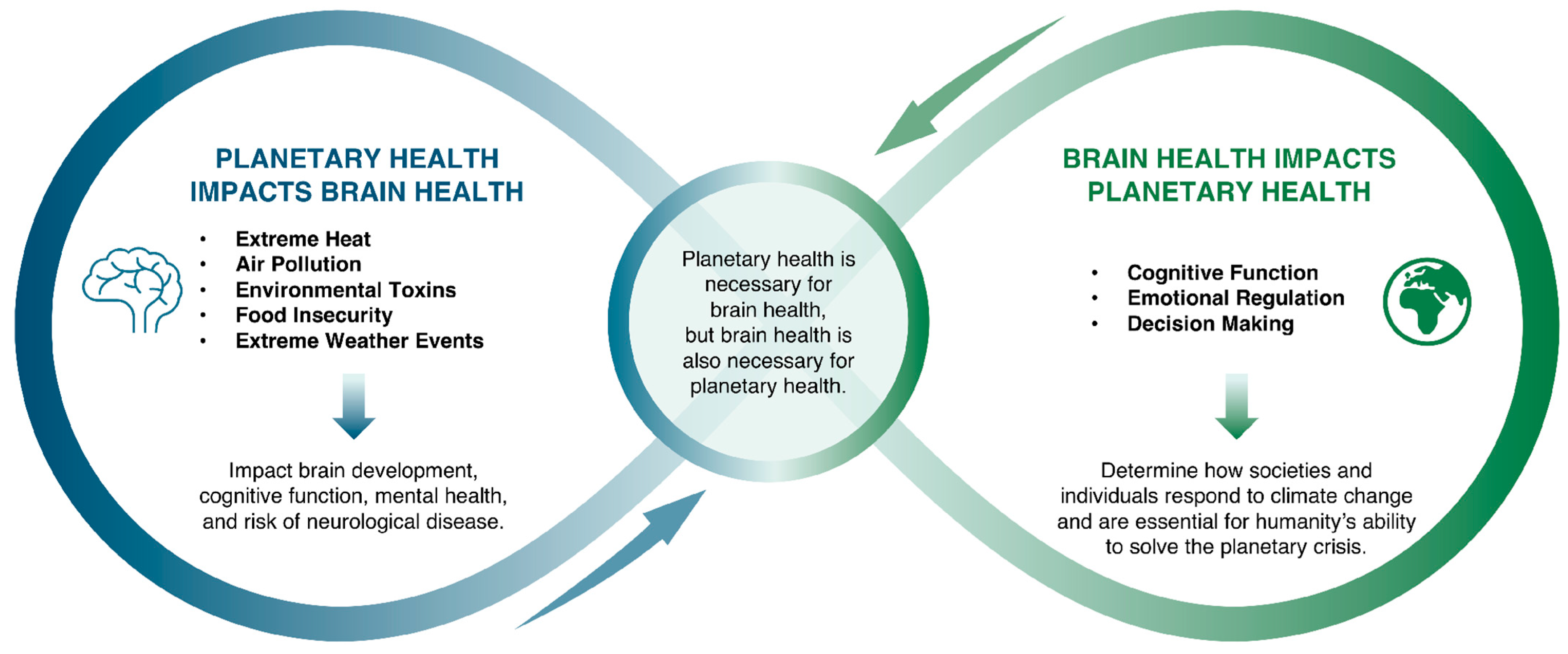
At the same time, brain health is also a determinant of planetary health. Human cognition, emotional regulation, and decision-making shape how individuals, communities, and societies respond to climate change [
18]. From individual behavior to public policy, brain health therefore influences humanities’ ability to mitigate, adapt to, and solve planetary crises. In this sense, we can speak of a bidirectional relationship: planetary health is necessary for brain health, but brain health is also necessary for planetary health (
Figure 1). Recognizing this interdependence positions brain health at the core of the planetary health agenda.
1.2. The Limits of Fragmented Approaches
Despite increasing recognition of these links, research and action at the intersection of climate change and brain health remain fragmented. Much of the existing literature focuses on single exposures in isolation, rather than examining the interacting effects of multiple environmental stressors such as heat and air pollution. Studies are often conducted within disciplinary silos, limiting integration across neuroscience, medicine, environmental science, public health, and the social sciences [
4].
This fragmentation extends beyond research into policy and practice. Scientific findings are frequently slow to translate into actionable strategies, and brain health remains underrepresented in climate and health policies, funding priorities, and economic analyses. As a result, opportunities to mitigate harm and build resilience are often missed.
These challenges are particularly pronounced in LMICs, where the burden of climate-related exposures is the greatest, but research infrastructure, data availability, and policy integration are often limited [
1,
4]. The populations most affected by climate-related brain health risks are therefore among the least represented in the evidence base and in decision-making processes.
1.3. A Need for Transdisciplinary, Action-Oriented Networks
Addressing the above-mentioned gaps as well as the complex, multidimensional nature of climate change and its impacts on brain health requires a shift in how we organize knowledge production, collaboration, and action. As traditional research approaches are usually discipline-bound, geographically concentrated, and often disconnected from community engagement, implementation, and policy translation, they are insufficient to address the interacting and rapidly evolving planetary health challenges.
Instead, there is a growing need for networks that are:
Transdisciplinary, integrating neuroscience, climate science, public health, and social sciences while engaging stakeholders, affected communities, and implementation efforts;
Globally distributed, with meaningful representation and leadership from LMICs;
Solution-oriented, embedding policy translation, intervention, and implementation from the outset;
Community-engaged, co-creating knowledge and interventions with affected populations;
Adaptive and networked, capable of responding to emerging risks and opportunities.
In this Perspective, we present the International Neuro Climate Working Group (NCWG) as a case study of such a transdisciplinary collaborative model at the intersection of climate change and brain health. We describe its organizational structure, conceptual framework, and ongoing initiatives and discuss how these relate to the broader planetary and brain health agenda. No systematic review, formal qualitative analysis, or quantitative evaluation was performed for this article. We further consider how adopting similar collaborative models may provide a promising approach to addressing the complex challenges of planetary and human health and strengthening resilience.
2. The International Neuro Climate Working Group: A Case Study of a Transdisciplinary Collaborative Network
The International Neuro Climate Working Group (NCWG) was established in 2024, aiming to advance a more integrated, action-oriented approach to understanding and addressing the impacts of climate change on brain health [
19].
Designed as a global action-oriented network, NCWG brings together neuroscientists, clinicians, public health professionals, environmental scientists, policymakers, architects, and community leaders to co-produce knowledge and translate it into real-world impact. At its core, NCWG’s mission is to advance understanding of how climate and environmental change affect brain health across the lifespan and to translate this knowledge into actionable solutions that protect brain health. Its broader vision is to place brain health at the center of climate and planetary health strategies, recognizing it as both a critical outcome and a key lever for societal resilience and decision-making (see
Figure 1).
2.1. An Integrated Model: Research, Policy, Advocacy, and Community
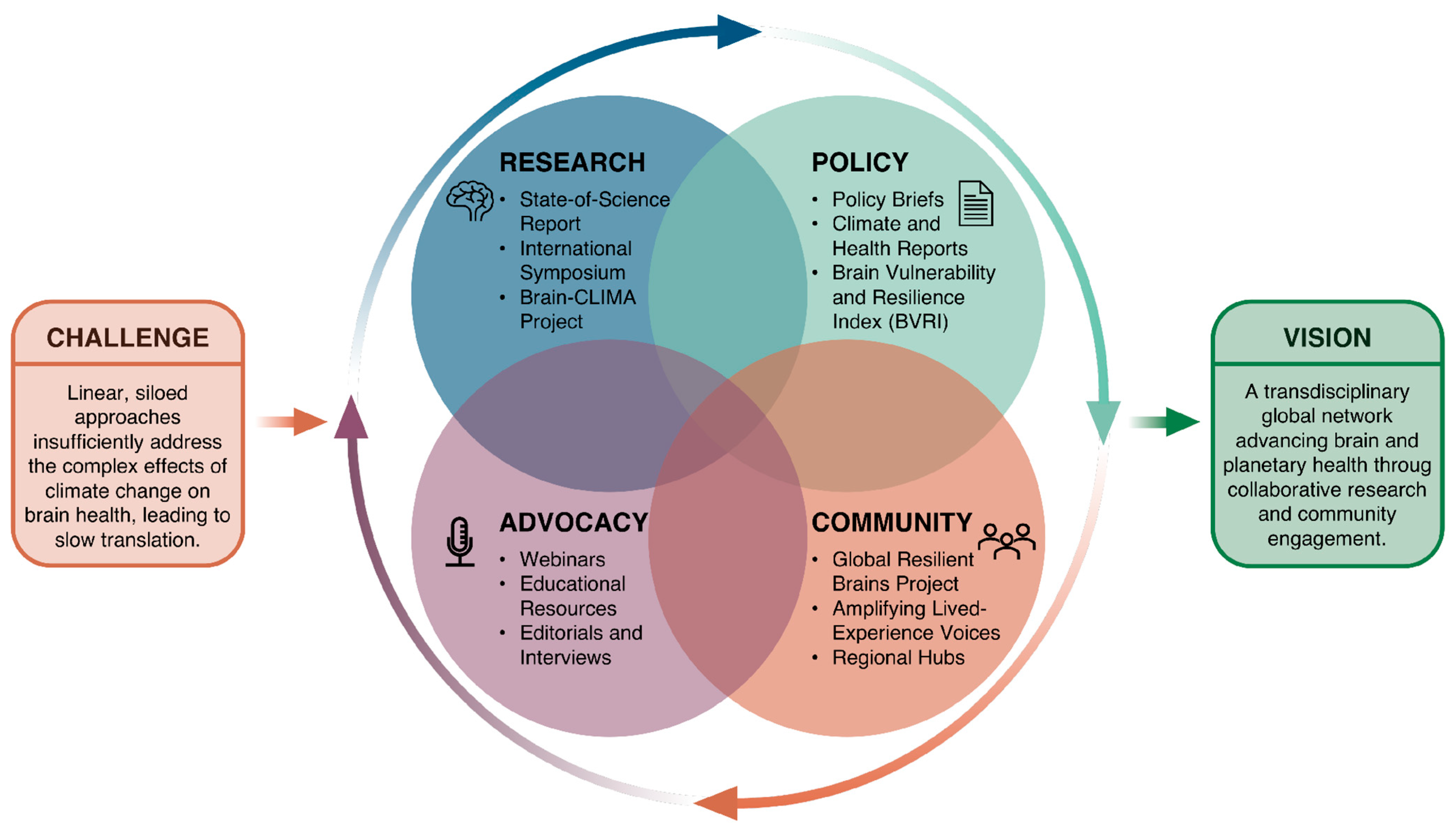
NCWG’s work is organized around four interconnected pillars: Research, Policy, Advocacy, and Community, which function as an integrated system rather than isolated domains (
Figure 2). This model reflects a deliberate shift from linear research-to-policy pipelines toward iterative, collaborative, and implementation-oriented approaches.
Table 1 provides an overview of selected NCWG projects.
2.1.1. Research: From Single Exposures to Complex Systems
NCWG aims to advance research that moves beyond single-exposure frameworks to examining interacting environmental stressors and their combined effects on brain health. A central example is the Brain-CLIMA project, a multidisciplinary, international effort investigating how combined exposures to heat and air pollution affect brain aging and neurological health across Latin America [
20]. This work integrates epidemiological data, neuroimaging, and molecular neurobiology with community engagement and policy translation, ensuring that findings are directly relevant to regional resilience strategies. Complementary efforts in South Asia, including work in India, focus on vulnerable populations such as children and young adults: This study examines how interacting climate exposures influence cognitive development and mental health in children while engaging local communities, schools, and policymakers to co-design interventions that are scalable and context-specific [
21].
NCWG also supports broader collaborative research initiatives, such as the EU-funded CliCBrain project [
22] and global research efforts like the Heat and Cognition Many Labs project [
23], which aim to standardize and expand understanding of climate-related cognitive and mental health outcomes across diverse populations.
These research projects initiated by NCWG or their members exemplify a shift from single-exposure studies toward integrated, multi-factor approaches that combine mechanistic, epidemiological, and policy-relevant, community-informed insights with a focus on LMIC settings (see
Table 1).
2.1.2. Policy: Embedding Brain Health into Climate Action
A defining feature of NCWG’s approach is the integration of policy translation throughout the research process. As the impact of climate change on brain health remains poorly represented in public health strategies, research funding priorities, and economic analyses, NCWG advocates for policies that integrate brain health into climate and health agendas at all levels—from local communities to global organizations. To this end, NCWG has developed an integrative model of climate-related brain health impacts and mapped where and how brain health can be embedded across governance levels [
24]. Examples of proposed policy actions encompass exposure reduction (e.g., through air quality standards and heat prevention strategies), equitable adaptation frameworks (e.g., by integrating brain health into Loss and Damage discussions), and surveillance and monitoring strategies (e.g., including brain health indicators in environmental and climate health monitoring reports such as the Lancet Countdown on Health and Climate Change).
Additional efforts include participation in major climate and health reports and collaborations with organizations such as the World Health Organization (WHO) and the United Nations Children’s Fund (UNICEF). As a result of NCWG’s engagement, brain health was included for the first time in the State of Global Air 2025 report, marking an important step toward climate policies that reflect brain health [
9].
2.1.3. Advocacy and Education: Translating Knowledge into Action
NCWG’s evidence-based advocacy and education efforts focus on translating scientific knowledge into accessible, actionable information for healthcare professionals, policymakers, and the public. Through global webinars, training programs, and collaborations with international organizations, NCWG has contributed to educating clinicians and stakeholders on the links between environmental change and brain health. Examples include the creation of a training module on air pollution and brain health together with WHO [
25], a dedicated brain health website on the Planetary Health Alliance’s webpage [
26], presentations at leading global health and climate meetings, and multiple publications and interviews in both scientific and lay press media.
These advocacy and education efforts emphasize both risks and solutions, including the co-benefits of climate mitigation strategies, such as clean air policies, on both brain and planetary health. By combining scientific evidence with narratives, lived experiences, and multimedia approaches, NCWG aims to enhance engagement and support broader awareness and action.
2.1.4. Community and Engagement: Co-Creating Solutions
Community engagement is central to NCWG’s model. Recognizing that climate-related brain health risks are heavily shaped by sociodemographic factors and local contexts, NCWG prioritizes the co-creation of knowledge and interventions with affected populations, particularly in LMICs. This includes capacity-building initiatives such as the NCWG Youth Council, which empowers students and early-career leaders to engage in advocacy and research, and regional networks like the South and East Asia Neuro Climate Group, which facilitate locally grounded research and collaboration, such as the above-mentioned research project on the effects of air pollution and heat on children’s cognition. Broader efforts, such as the Global Resilient Brains Project, aim to identify and scale community-driven strategies that support cognitive and emotional resilience in the face of environmental stressors (see also
Table 1 and
Section 3.2).
These initiatives provide an example of how working with affected communities and their local knowledge can help to co-create evidence-based solutions that support brain resilience in the face of climate threats and to ensure that these solutions are inclusive, just, and globally relevant.
Table 1.
Representative NCWG projects, initiatives, and implementation frameworks. Examples were purposively selected to illustrate how each initiative integrates multiple pillars of the framework (see
Figure 2 and column 6 of this table) and to represent the diversity of NCWG’s activities across geographic regions, stages of development, and research-to-policy translation pathways.
Table 1.
Representative NCWG projects, initiatives, and implementation frameworks. Examples were purposively selected to illustrate how each initiative integrates multiple pillars of the framework (see
Figure 2 and column 6 of this table) and to represent the diversity of NCWG’s activities across geographic regions, stages of development, and research-to-policy translation pathways.
| Project Name | Description | Project Status | Geographic Scope | Outputs | Corresponding Pillars |
|---|
| Brain-CLIMA project | Supported by the Wellcome Trust, the Brain-CLIMA Project (Climate-Brain Health in Latin America) is a research consortium led by NCWG and partners, including Latin American Brain Health Institute, Columbia University, Brown University, and the University of Oxford. The project investigates how heat and air pollution affect blood–brain barrier integrity and brain aging in Latin American populations, combining epidemiological data, neuroimaging, molecular neurobiology, and community-level adaptation research to inform regional resilience policies [20]. | Ongoing | Latin America | Cohort study; policy translation activities; stakeholder engagement; scientific publications (in preparation); resilience recommendations | Research
Policy
Community |
| CliCBrain—Climate, Cities and Brain Health | NCWG is a partner in a European Commission-funded project investigating the impacts of climate change on brain health. The project aims to develop an exposome-based framework and generate evidence-informed strategies and policy recommendations to protect brain health at the individual and community level [22]. | Ongoing | Europe with global collaborations | Exposome framework; multicenter research; policy recommendations; scientific publications | Research
Policy
Community |
| Global Resilient Brains Project | International collaborative knowledge and implementation platform that identifies, synthesizes, and disseminates evidence on community-driven brain resilience strategies and policy innovations to support climate adaptation across diverse settings. The Global Resilient Brains Project is a collaborative initiative uniting researchers and policymakers from more than 60 countries to map brain health resilience across diverse ecological and socioeconomic contexts. The project aims to identify and collect community-driven strategies that protect cognitive and emotional well-being amid climate and environmental stressors, providing a foundation for global policy recommendations and equity-based action. | Early development | Global | Global Brain Resilience Observatory (planned); international resilience database; policy recommendations; community case studies | Research
Community
Policy |
| Brain Vulnerability and Resilience Index | A decision-support framework under development that integrates environmental exposures, brain health indicators, and social determinants of health to characterize climate-related brain health vulnerability and resilience across populations. The framework is intended to support evidence-informed adaptation planning, intervention prioritization, and policy decision-making. | Under development | Global | Decision-support framework; vulnerability mapping; implementation guidance; validation studies (planned) | Research
Policy
Community |
| NCWG Youth Council | The NCWG Youth Council brings together students and early-career professionals to raise awareness of the neurological and mental health impacts of climate change. Activities include campus advocacy, peer mentorship, participation in global events, contribution to outreach and communication activities, and the development of educational resources. | Ongoing | Global | Youth statement on brain and planetary Health (planned); Planetary Health Alliance webinar; educational resources; mentorship and networking activities | Community
Advocacy
Research |
| South and East Asia Neuro Climate Group | This Asia-based regional NCWG promotes collaborative, data-driven research at the nexus of neuroscience, climate, and public health. Current projects include investigating the effects of air pollution and heat on children’s cognition | Ongoing | South and East Asia | Regional position paper; India school-based research project; regional collaborations; policy engagement | Research
Community
Advocacy
Policy |
| Brain and Planetary Health Webpage | Hosted by the Planetary Health Alliance, this dedicated online resource synthesizes evidence on the links between environmental change and brain health and highlights the importance of protecting brain health as a foundation for planetary resilience [26]. | Completed | Global | Publicly available website (published) | Advocacy
Community |
| The Ecological and Green Neuroscience Book | In collaboration with MIT Press, NCWG is co-editing and co-authoring a book that reexamines neuroscience through an ecological and green lens. The volume seeks to expand traditional neuron-centered perspectives by integrating environmental, societal, and planetary dimensions of neuroscience | In preparation | International | Edited book; conceptual framework; multidisciplinary chapters integrating neuroscience and planetary health | Research
Advocacy |
| Video—The built environment and children’s brain development | NCWG developed an expert educational video for UNICEF exploring how the built environment shapes children’s brain development and health over the life course [27]. | Completed | Worldwide | Publicly available video (published) | Advocacy
Community |
2.2. Structure, Participation, and Networked Collaboration
NCWG operates as a distributed, collaborative network rather than a centralized institution. Its structure includes a small coordinating leadership team supported by an international and transdisciplinary advisory board, enabling flexibility and responsiveness.
NCWG membership is open to researchers, clinicians, public health professionals, policymakers, advocates, and other stakeholders interested in the intersection of climate change and brain health. Individuals join through a low-threshold online registration process, receive onboarding materials and, where possible, an introductory meeting with a member of the leadership team, and gain access to an internal member directory to facilitate collaboration. Members engage through multiple pathways, including monthly global meetings, thematic working groups, collaborative research projects, and policy and education initiatives. This flexible engagement model allows individuals from diverse disciplines, experiences, and regions to contribute meaningfully while fostering cross-sector collaboration. As of 6 July 2026, the network includes 426 members across 63 countries and dozens of fields of expertise, with strong representation from LMICs [
19].
Strategic partnerships with global organizations, including WHO, UNICEF, the Planetary Health Alliance, and academic institutions, further enhance NCWG’s ability to align research, policy, and implementation efforts.
Taken together, NCWG serves as an illustrative case study of how transdisciplinary collaboration can be structured to connect research, policy, advocacy, and community engagement at the intersection of brain and planetary health. While the specific organizational structure is context-dependent, the underlying principles may inform the development of similar initiatives across different settings and contexts.
3. Future Perspectives: From Mapping Impacts to Building Resilience
3.1. Knowledge Gaps and Need for Research Translation
Despite growing literature on the effects of climate and environmental change on brain health, major research gaps remain: First, the synergistic and long-term brain health impacts of multiple environmental stressors acting together (e.g., air pollution and heat) remain poorly understood, despite the fact that environmental exposures in real-world settings are typically cumulative and rarely occur in isolation. Moreover, key pathophysiological mechanisms by which climate-related exposures impact brain health are only partially understood, limiting the development of targeted interventions. In this context, future research should also investigate converging biological pathways that may mediate climate and environmental change-related brain health consequences. These include the gut–brain axis, the immune system, and metabolism. Building on exposome and One Health frameworks and by integrating neuroscience with environmental and planetary health, research may improve understanding of how multiple interacting environmental exposures converge to influence brain development, aging, cognition, and behavior across the life course.
Research is also needed to identify vulnerability factors and social determinants of risk. At the moment, most existing evidence originates from high-income countries, highlighting the need for research from LMICs and the Global South, where climate-related health impacts are often greatest. Additionally, other particularly vulnerable groups, such as children, older adults, or frontline communities, are often excluded from research, resources, and decision-making.
Finally, because brain health remains largely absent from climate policy, urban planning, and disaster preparedness efforts, implementation research is needed to identify effective pathways for embedding brain health considerations into adaptation and mitigation strategies across local, national, and global policy frameworks. Ultimately, there is still a lack of comprehensive understanding of how climate and environmental change influence brain health across the planet. Together with the fact that science, health, and infrastructure sectors usually work in silos, this limits our ability to appropriately adapt to and mitigate these consequences, develop policy interventions, and community adaptation strategies.
NCWG aims to address these challenges through its integrated four-pillar approach (see
Figure 2), which helps to ensure that research projects and climate–brain health solutions are collaborative, community-informed, implementation-oriented, equitable, and globally relevant.
3.2. Toward Brain-Healthy, Climate-Resilient Systems
While understanding the impacts of climate change on brain health is essential, the ultimate goal is to build resilience across communities, health systems, and societies. Building systems and communities that protect brain health in a changing climate requires integrating brain health into climate adaptation strategies, urban planning, disaster response, education, and public health systems. Moreover, there is an urgent need to translate science into action and to identify interventions that deliver co-benefits across sectors, such as reducing air pollution to improve both environmental and neurological outcomes.
To support the translation of science into action, NCWG is developing the Brain Vulnerability and Resilience Index (BVRI), a decision-support framework designed to characterize both vulnerability and resilience to climate-related brain health risks across populations. Rather than functioning as a single composite score, the BVRI is envisioned as an integrative framework that combines environmental exposures (e.g., heat, air pollution, green space, and extreme weather), brain health indicators (e.g., neurological, cognitive, and mental health outcomes), and social determinants of health (e.g., socioeconomic conditions, healthcare access, housing quality, and community resilience). By integrating these domains, the framework aims to identify populations at greatest risk, highlight protective factors, and support evidence-informed decision-making across sectors. Future work will focus on refining indicators, evaluating the framework across diverse geographic, cultural, and socioeconomic settings, and assessing its ability to inform climate adaptation planning, urban design, public health strategies, and the prioritization of interventions that strengthen brain resilience in a changing climate (see
Table 1).
Complementing this effort, the Global Resilient Brains Project is being developed as an international collaborative platform to identify, synthesize, and disseminate evidence on community-driven strategies that strengthen brain resilience to climate and environmental change. By bringing together researchers, policymakers, practitioners, and communities from diverse geographic and socioeconomic settings, the initiative aims to create a global repository of evidence, case studies, policy innovations, and resilience strategies that can support cross-country learning and inform adaptation efforts. Together with the BVRI, the project is envisioned as a mechanism for translating emerging evidence into practical guidance, identifying successful interventions, and accelerating implementation of brain-health-informed climate resilience strategies worldwide (see
Table 1).
Thus, by placing brain health at the core of local and global climate resilience strategies and by integrating research, policy, and community engagement, NCWG seeks to contribute to a broader transformation towards brain-healthy and climate-resilient systems.
4. Limitations
As a Perspective, this manuscript proposes a conceptual framework and uses NCWG as an illustrative case study rather than providing a formal evaluation of the effectiveness of transdisciplinary networks. While such collaborative models offer considerable potential to accelerate research translation and systems change, they also face important challenges. Sustaining global networks requires long-term funding, effective governance structures, equitable leadership and participation across regions, particularly among low- and middle-income countries (LMICs), as well as mechanisms to ensure meaningful community engagement. Building and sustaining capacity across diverse regions, including mentoring and supporting early-career researchers and practitioners, also requires dedicated resources, long-term institutional commitment, and equitable access to leadership and collaboration opportunities. In addition, assessing the real-world impact of transdisciplinary networks remains challenging, as outcomes extend beyond traditional academic metrics to include policy influence, implementation, capacity building, community resilience, and systems change. Future work should therefore develop robust evaluation frameworks and implementation metrics to assess how collaborative networks contribute to scientific innovation, policy change, health equity, and measurable improvements in planetary and brain health outcomes.
5. Conclusions: Advancing Planetary Health and Brain Health Requires Systems Change
The relationship between brain health and planetary health extends far beyond the impacts of environmental exposures on neurological and mental health outcomes. The same cognitive, emotional, and social processes that are shaped by climate change also influence how individuals, communities, and institutions perceive risk, make decisions, cooperate, innovate, and respond to complex challenges. In this sense, brain health is not only an outcome of planetary change but also a determinant of our collective capacity to address it.
The planetary health movement has successfully highlighted the dependence of human health on natural systems. Yet the role of brain health within this framework remains underdeveloped. Cognitive function, emotional resilience, learning, creativity, and decision-making underpin society’s ability to anticipate environmental threats, evaluate evidence, adopt sustainable behaviors, design effective policies, and build resilient communities. When environmental stressors impair these functions across populations, the consequences extend beyond individual health and may affect societal resilience, productivity, governance, and adaptive capacity.
This perspective is particularly important in an era characterized by increasing environmental complexity and uncertainty. Addressing climate change, biodiversity loss, pollution, food insecurity, and other interconnected planetary challenges requires unprecedented levels of cooperation across sectors, disciplines, cultures, and generations. Brain health is closely linked to the cognitive and emotional capacities required to respond to these challenges. As such, protecting and promoting brain health can be viewed as an investment in societal resilience, sustainable development, and the capacity for collective action.
The case of NCWG illustrates how transdisciplinary networks can help address these complex challenges by connecting neuroscience, environmental science, public health, policy, and lived experience. However, the broader lesson extends beyond any single organization. If planetary health seeks to create conditions in which both people and ecosystems can flourish, brain health should become a more explicit and integrated component of that vision. Future research agendas, policy frameworks, educational initiatives, and resilience strategies should thus recognize brain health as both vulnerable to environmental change and essential to solving it.
The planetary health challenges ahead cannot be addressed through isolated disciplines, institutions, or sectors acting alone. They require collaborative infrastructures that enable knowledge sharing, co-creation, and implementation at scale. By investing in brain health, fostering transdisciplinary collaboration, and strengthening global networks that connect science to action, we can help build societies that are better equipped to adapt, innovate, and thrive in a rapidly changing world. Protecting and advancing planetary health and brain health are ultimately inseparable goals.