Article

Reconsidering Material Culture in Unified Silla’s Pure Land Buddhism
Korea Heritage Service, Daejeon 35208, Republic of Korea
Religions 2026, 17(5), 571; https://doi.org/10.3390/rel17050571 (registering DOI)
Submission received: 19 March 2026 / Revised: 1 May 2026 / Accepted: 6 May 2026 / Published: 10 May 2026

Abstract

This paper challenges the conventional assumption that the widespread popularity of Pure Land Buddhism in Unified Silla naturally resulted in mass production of Amitābha statues. Drawing on historical records, inscriptions, and reliable iconographic evidence, it can be demonstrated that only twenty-two extant statues can be definitively identified as Amitābha—far fewer than earlier scholarly estimates, which often relied on insufficient criteria such as hand gestures and orientation toward the west. How, then, can we account for this discrepancy between Pure Land Buddhism’s broad appeal and the relatively limited production of Amitābha imagery? The answer lies in two defining features of Amitābha devotion in Unified Silla: its appeal to ordinary lay believers and its emphasis on name-recitation. Historical records indicate that Pure Land Buddhism was especially widespread among commoners, who primarily practiced name-recitation without reliance on Buddhist images rather than engaging in the costly commissioning of statues. Doctrinally, Buddhist scriptures emphasized that recitation was spiritually equivalent to—or even a substitute for—other meritorious deeds, including image making, thereby providing justification for this accessible practice. Monks active in Silla likewise underscored the salvific efficacy of name-recitation. Given these devotional priorities and the socioeconomic constraints facing ordinary practitioners, the scarcity of Amitābha statues becomes explicable.

1. Introduction

The production of Buddhist images has often been interpreted as reflecting the popularity and influence of related religious beliefs or doctrinal traditions. This perspective has significantly shaped scholarly discussions of the relationship between Pure Land Buddhism and material culture in Unified Silla (676–935), Korea. Specifically, previous studies have largely assumed that the flourishing of Pure Land Buddhism in Unified Silla led to the widespread production of Amitābha statues (Hong 1997, p. 144; Mun 1997, p. 86; 2003a, pp. 122, 127; McBride 2020, pp. 78–80). To support this view, many scholars have identified unnamed statues as Amitābha based on iconographic features such as hand gestures (Skt. mudrā 手印) and orientation toward the west.1 However, these two criteria are insufficient for reliably identifying Amitābha, as they lack both consistency and distinctiveness.2 Nevertheless, Amitābha statues classified on this basis have been repeatedly referenced by later scholars without critical re-examination. Moreover, beyond art history, these examples have in turn been treated in Buddhist historical scholarship as important evidence for the popularity of Pure Land Buddhism in Unified Silla.
Acknowledging such iconographic ambiguities, this article calls for a reconsideration of earlier assumptions. Using methodologically rigorous criteria, it demonstrates that the number of statues that can be identified as actual or highly plausible representations of Amitābha in Unified Silla is surprisingly small. This finding suggests that Amitābha statues were relatively few in number, particularly when compared with other Buddhist images of the same period—a situation that seems paradoxical given the broader contemporary influence of Pure Land Buddhism.
Why, then, do so few Amitābha statues remain despite Pure Land Buddhism’s widespread influence? While the loss of works made from fragile materials such as wood or clay, as well as cases of misidentification, may partially account for this discrepancy, this paper proposes a further explanation. It offers an alternative perspective that within Unified Silla’s distinctively popular Pure Land tradition, the practice of name-recitation (Ch. chengming nianfo 稱名念佛) enabled devotional life to flourish without necessarily entailing a corresponding reliance on image-making.
This interpretation, however, should not be taken to imply a universal relationship between name-recitation and image-making. Even when similar practices were shared across East Asia, their meanings and material expressions could vary according to local contexts.3 In Unified Silla, the distinctly popular character of Pure Land Buddhism may have shaped a different relationship between verbal practice and material devotion. Although visual images continued to play a role in devotional life, historical accounts indicate that name-recitation could be—and often was—performed independently of material representations. In this light, this study challenges the general assumption that faith and material culture necessarily exist in proportional relation, arguing instead that Buddhist devotion could manifest in diverse forms that did not always entail the production of material icons.4

2. Iconographic Challenges and the Scarcity of Amitābha Statues in Unified Silla

Identifying Amitābha among the anonymous Buddha statues of Unified Silla is not an easy task. This is because, aside from Esoteric Buddhist texts, there are no detailed descriptions of Amitābha’s visual characteristics. Conventional iconographic features such as the cross-legged posture 交脚 associated with Maitreya or the medicine bowl 藥器 held by Medicine Buddha are also not attested in the case of Amitābha. Furthermore, hand gestures and orientation, though traditionally used to identify Amitābha in Unified Silla, are not dependable.
As shown in Table 1 below, the hand gestures of Amitābha statues from the Unified Silla period appear in eight distinct forms, with no recognizable or consistent pattern established (Table 1). Moreover, except for the marvelous-observation-wisdom gesture (no. ⑦ of Table 1), which is found in Esoteric Buddhist art, the remaining gestures are not exclusive to Amitābha but are common iconographic elements shared with other Buddhas. Therefore, although they may serve as supporting references, they cannot be regarded as definitive criteria. The case is no different for the orientation. The west is commonly understood as the realm presided over by Amitābha, as supported by Buddhist scriptures such as the Amituo jing 阿彌陀經 and Guan Wuliangshou jing 觀無量壽經, which state that Amitābha resides in the Western Pure Land.5 For this reason, when Buddha images are carved on all four sides of a pagoda’s body or a natural rock surface, the figure facing west is generally interpreted as Amitābha. However, a closer examination of all extant four-sided Buddha images from Unified Silla reveals that the arrangement of the four Buddhas varies considerably.6 For example, Buddhas with Amitābha-associated hand gestures appear on north faces, while west faces feature other Buddhas as well.7 These cases indicate an absence of a consistent pattern in either iconography or spatial arrangement, thus calling into question whether any fixed rule ever governed the placement of specific Buddhas on orientation. Considering these iconographic ambiguities, a reassessment of the Amitābha identifications conventionally made on the basis of these two criteria has become unavoidable.
In this context, how can we distinguish Amitābha from other Buddhas? Although comparison with contemporaneous Chinese images may seem relevant, Tang-period Amitābha statues likewise exhibit considerable variation in both hand gestures and orientation. Moreover, the validity of such comparisons remains uncertain when we examine specific cases. For instance, most Tang-period Amitābha images depict the right hand in the fear-not gesture, with the left hand resting on the knee (no. ② of Table 1). If Buddhist iconography and style had been directly and consistently transmitted from China, this hand gesture would be expected to appear more widely in Unified Silla. Yet it is attested in only three examples, even when statues of uncertain identity are included. Moreover, certain hand gestures employed in Unified Silla Amitābha images are also rarely found in Tang examples (nos. ④, ⑧ of Table 1). This difference suggests that reference to Chinese Buddhist sculpture is less straightforward than it might appear at first glance (Chŏng 2024a, pp. 61–83; 2024b, pp. 170–76).
Meanwhile, this effort to distinguish the identities of Buddhist figures reflects a wider scholarly challenge in Buddhist art history, one not limited to Amitābha or the Unified Silla period. Moreover, the question itself arises from a modern art-historical perspective. For the people in Unified Silla, the precise identification of a statue as a specific Buddha may not always have been a primary concern, and a single image could have been understood differently by different individuals and times. Despite these limitations, the process of seeking an answer remains methodologically significant. It prompts reconsideration of the criteria underlying the identification of Amitābha images and challenges prevailing assumption that religious devotion was directly reflected in the production of corresponding statues.
Accordingly, rather than relying on speculative attribution, this study seeks to adopt criteria that are as rigorous and verifiable as possible. Based on a close analysis of inscriptions, historical records, and visually distinctive features, approximately twenty-two statues can be either confidently identified as Amitābha or regarded as highly likely to represent this Buddha, as follows:
(1) Rock-carved Standing Buddha Triad in Sŏak-tong, Kyŏngju 慶州 西岳洞 磨崖如來三尊立像, mid-7th century; (2) Buddhist Stele of Amitābha with the Year Kyeyu 癸酉銘全氏阿彌陀佛碑像, 673; (3) Buddhist Stele with the Year Muin and Pedestal at Yŏnhwasa Monastery, Sejong 世宗市 蓮花寺 戊寅銘佛碑像 臺座, 678; (4) Buddhist Stele of Amitābha with the Year Kich’uk 己丑銘阿彌陀佛碑像, 689; (5) Amitābha Buddha Triad, Kunwi 軍威 阿彌陀如來三尊像, late 7th century; (6) Gilt-bronze Buddha Plaque Excavated from Wŏlji Pond 1 月池 金銅板佛 1, late 7th century to early 8th century; (7) Gilt-bronze Buddha Plaque Excavated from Wŏlji Pond 2 月池 金銅板佛 2, late 7th century to early 8th century; (8) Gold Seated Buddha from Kuhwang-dong, Kyŏngju 慶州 九黃洞 金製如來坐像, ca, 706; (9) Stone Standing Amitābha Buddha of Kamsansa Monastery, Kyŏngju 慶州 甘山寺 石造阿彌陀如來立像, 719; (10) Four-directional Buddha Statue at Kulbulssa Monastery Site, Kyŏngju 慶州 掘佛寺址 石造四面佛像, mid-8th century; (11) Stone Standing Amitābha Buddha at Mita-am Hermitage, Yangsan 梁山 彌陀庵 石造阿彌陀如來立像, mid-to-late 8th century; (12) Stone Seated Amitābha Buddha Excavated from the Well at Punhwangsa Monastery 芬皇寺 石造阿彌陀如來坐像, early 9th century; (13) The Relief Image on the West Face of the Three-story Stone Pagoda at Chinjŏnsa Monastery Site, Yangyang 襄陽 陳田寺址 三層石塔 西面像, early 9th century; (14) Stone Seated Amitābha Buddha of Pirosa Monastery, Yŏngju 榮州 毘盧寺 石造阿彌陀如來坐像, mid-9th century; (15) Gilt-bronze Seated Amitābha Buddha of Pulguksa Monastery, Kyŏngju 慶州 佛國寺 金銅阿彌陀如來坐像, mid-to-late 9th century; (16) The Relief Image on the West Face of the Three-story Stone Pagoda at Paekchang-am Hermitage of Silssangsa Monastery, Namwŏn 南原 實相寺 百丈庵 三層石塔 西面像, late 9th century; (17) The Relief Image on the West Face of the Stupa of Venerable Wŏn’gwang at the Kŭmgoksa Monastery Site 金谷寺址 圓光法師 浮屠塔 西面像, late 9th century; (18) The Relief Image on the West Face of the Central Body Stone of the Four-directional Buddha Pagoda in Tongch’ŏn-dong, Kyŏngju 慶州 東川洞 四方佛 塔身石 西面像, late 9th century; (19) The Stone Amitābha Buddha from the Supposed Kŭmgwangsa Monastery Site in Changch’ang-gok Valley, Namsan 南山 長倉谷 傳 金光寺址 石造阿彌陀如來像, 9th century; (20) The Relief Image on the North Face of the Pedestal Lotus from the Stone Pagoda Excavated at Ch’angnimsa Monastery Site, Namsan 南山 昌林寺址 石塔 仰花 北面像, 9th century; (21) Stone Seated Amitābha Buddha in Chingwan-dong, Sŏul 津寬洞 石造阿彌陀如來坐像, late 9th century to 10th century; (22) The Relief Image on the West Face of the Central Body Stone of the Pagoda at Pŏbungsa Monastery, Wŏnju 原州 法雄寺 塔身石 西面像, early 10th century.
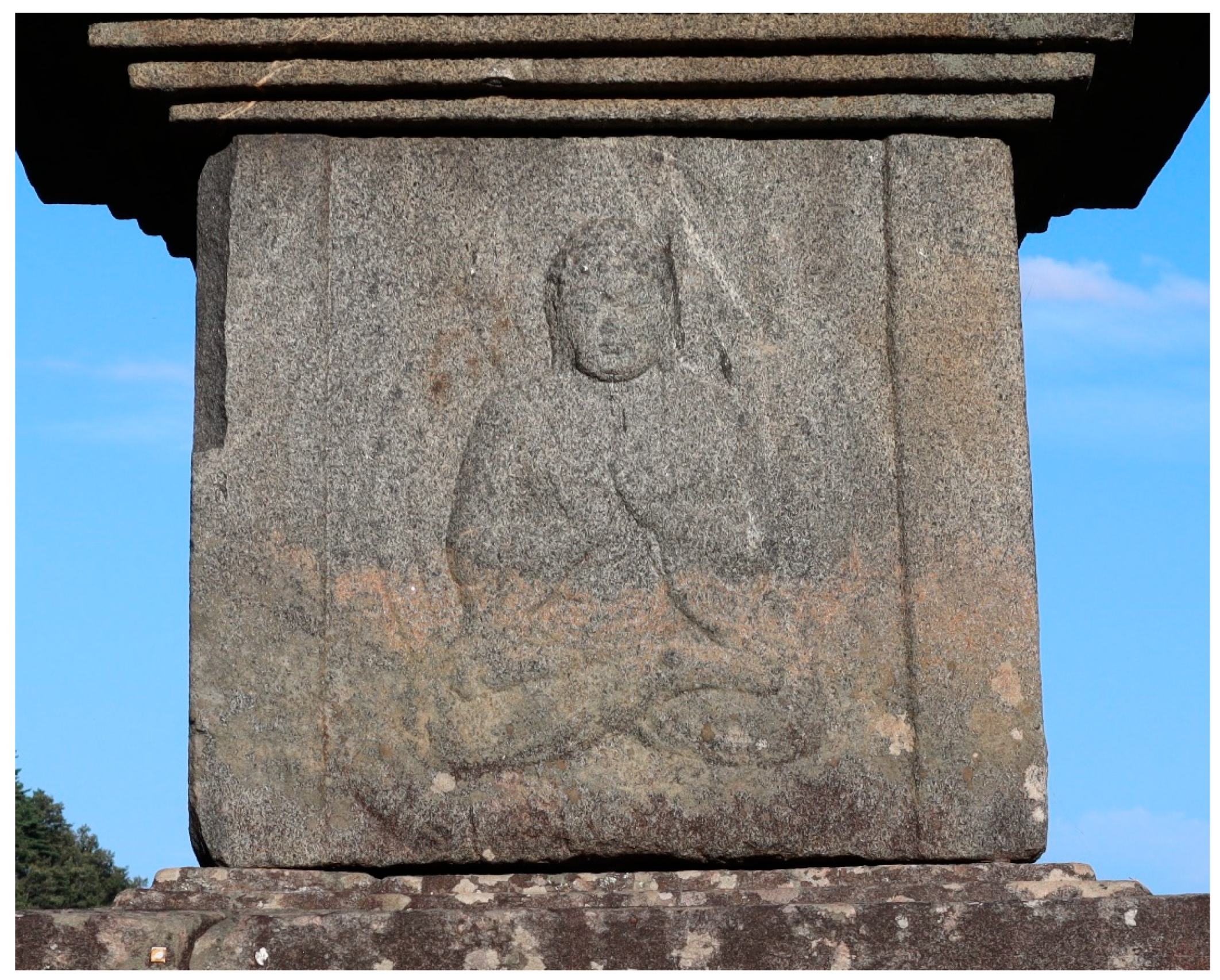
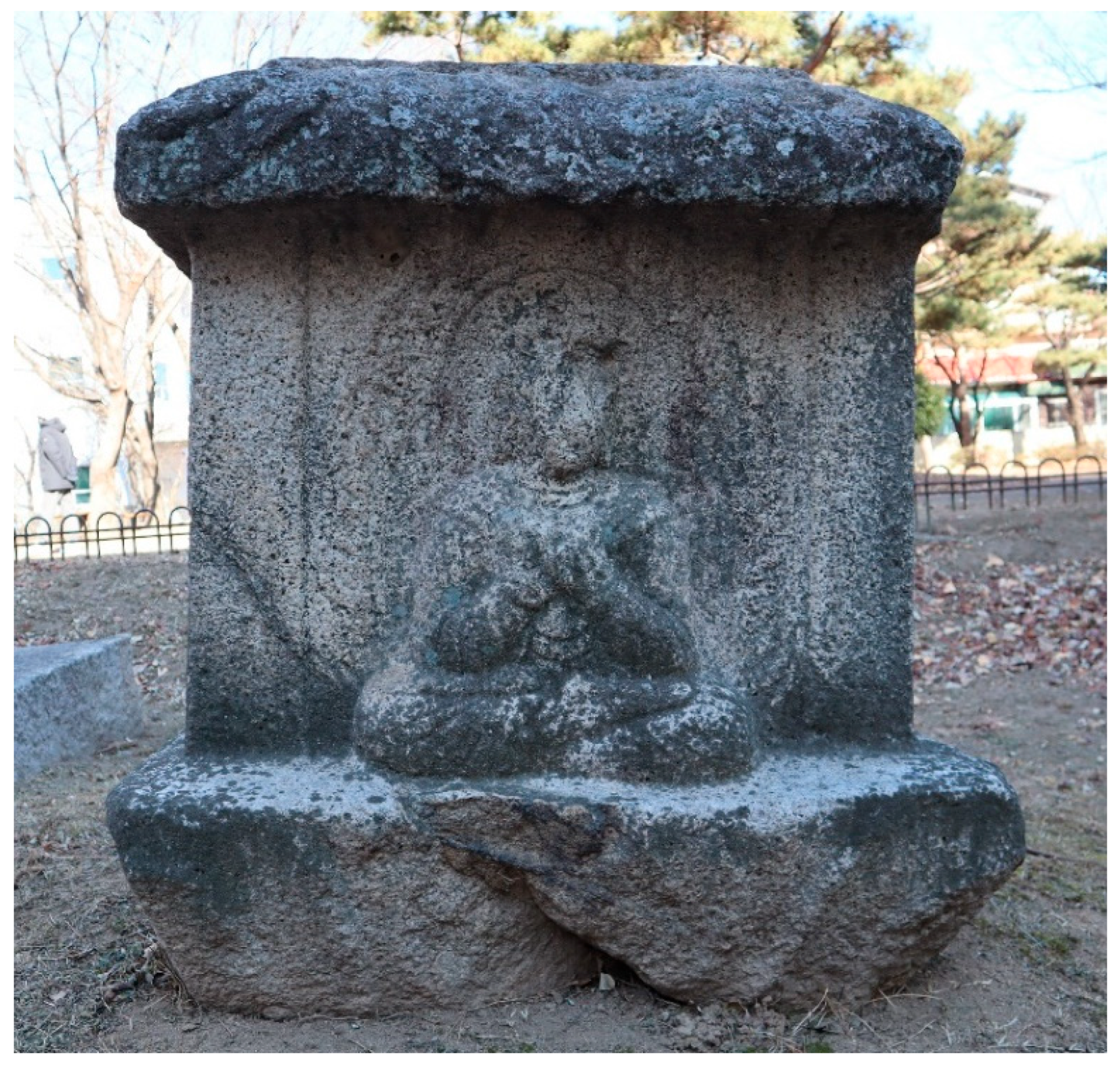
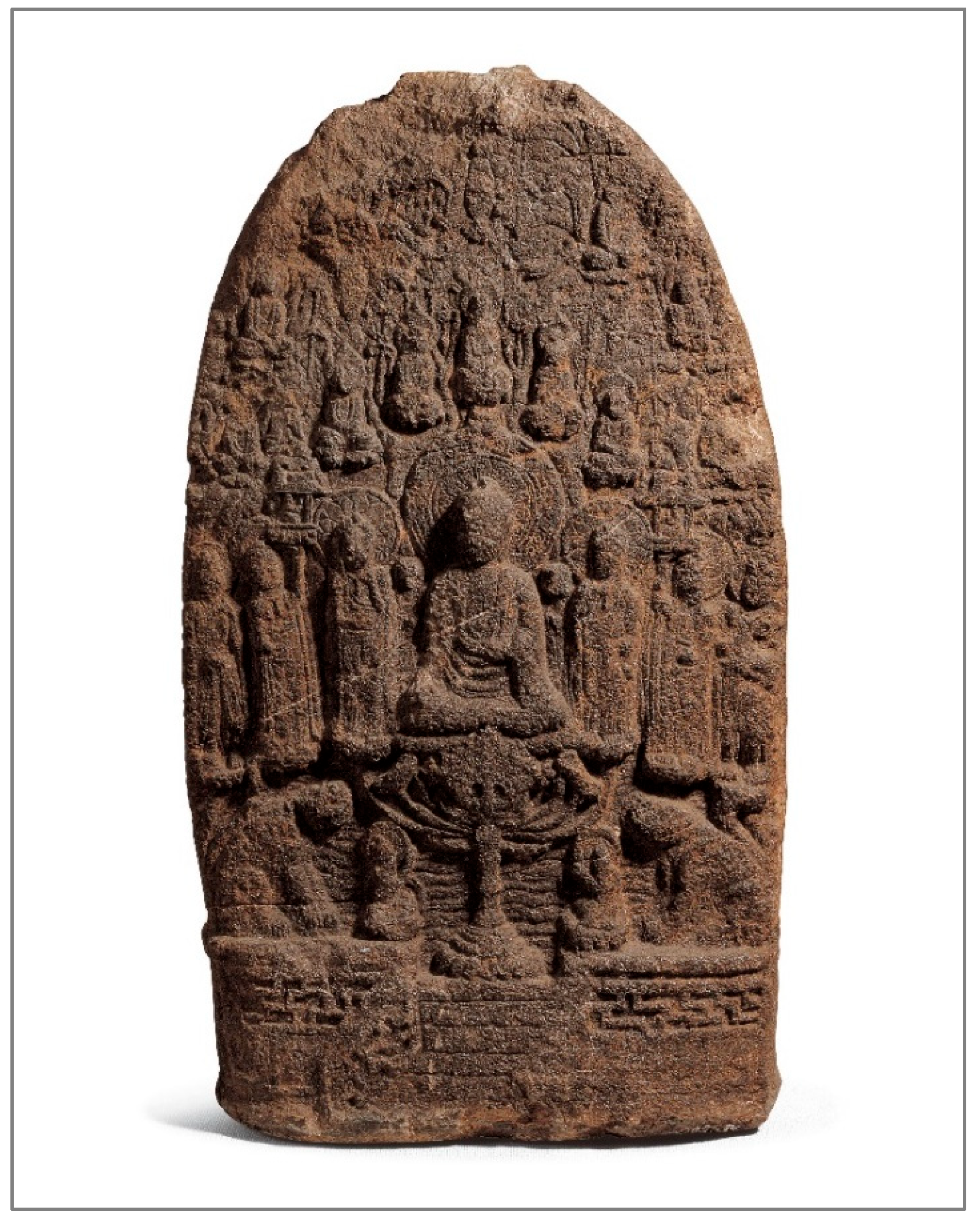
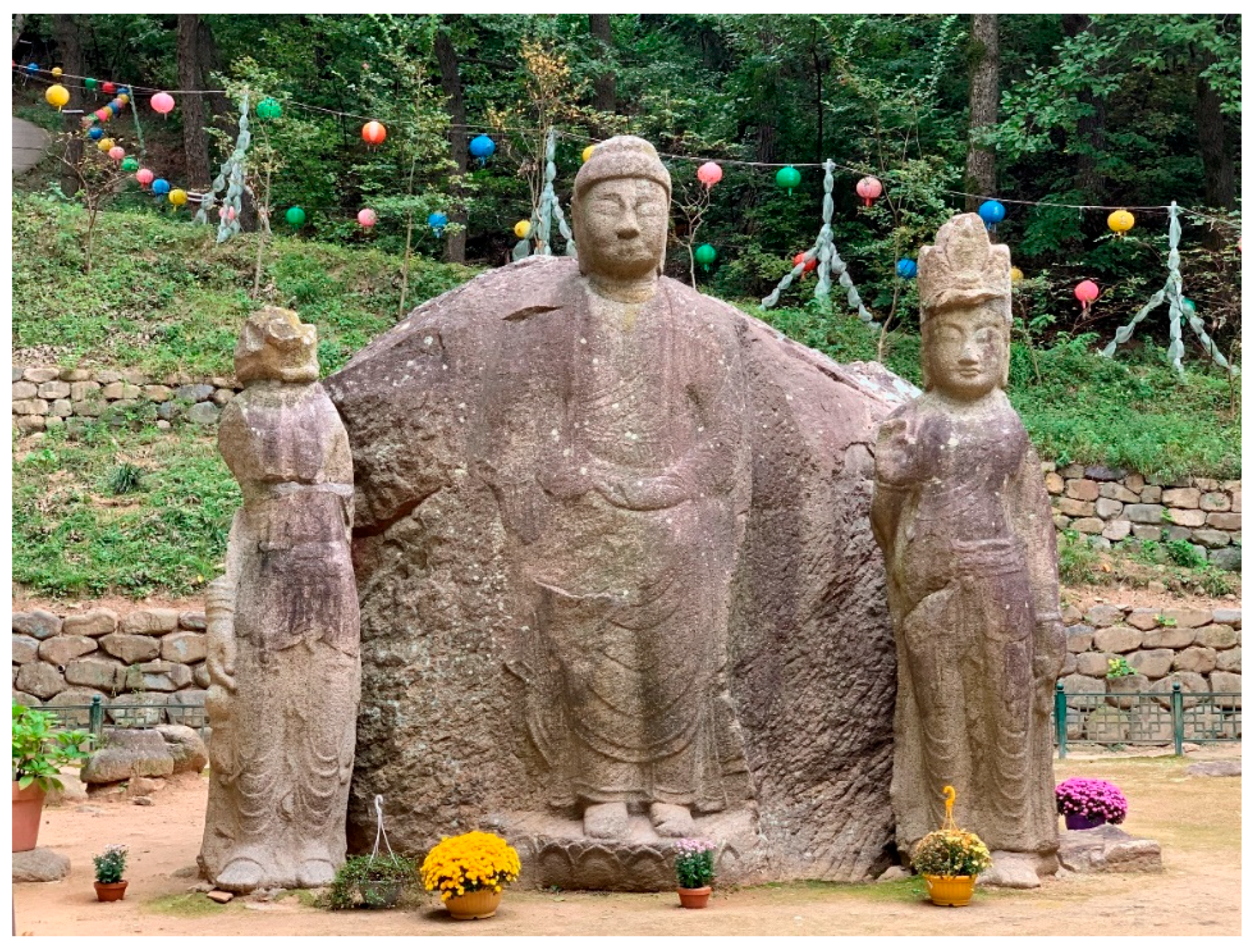
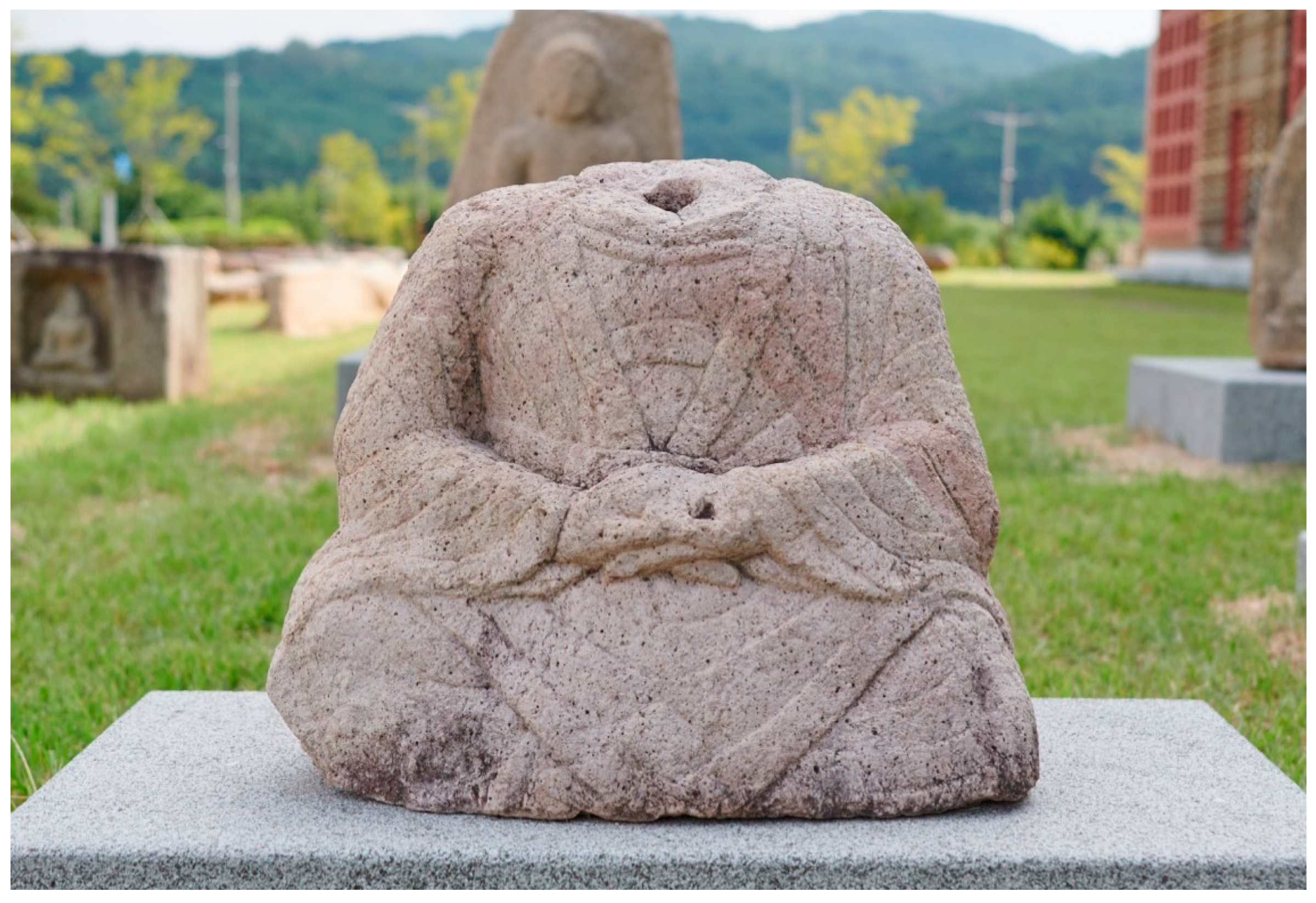
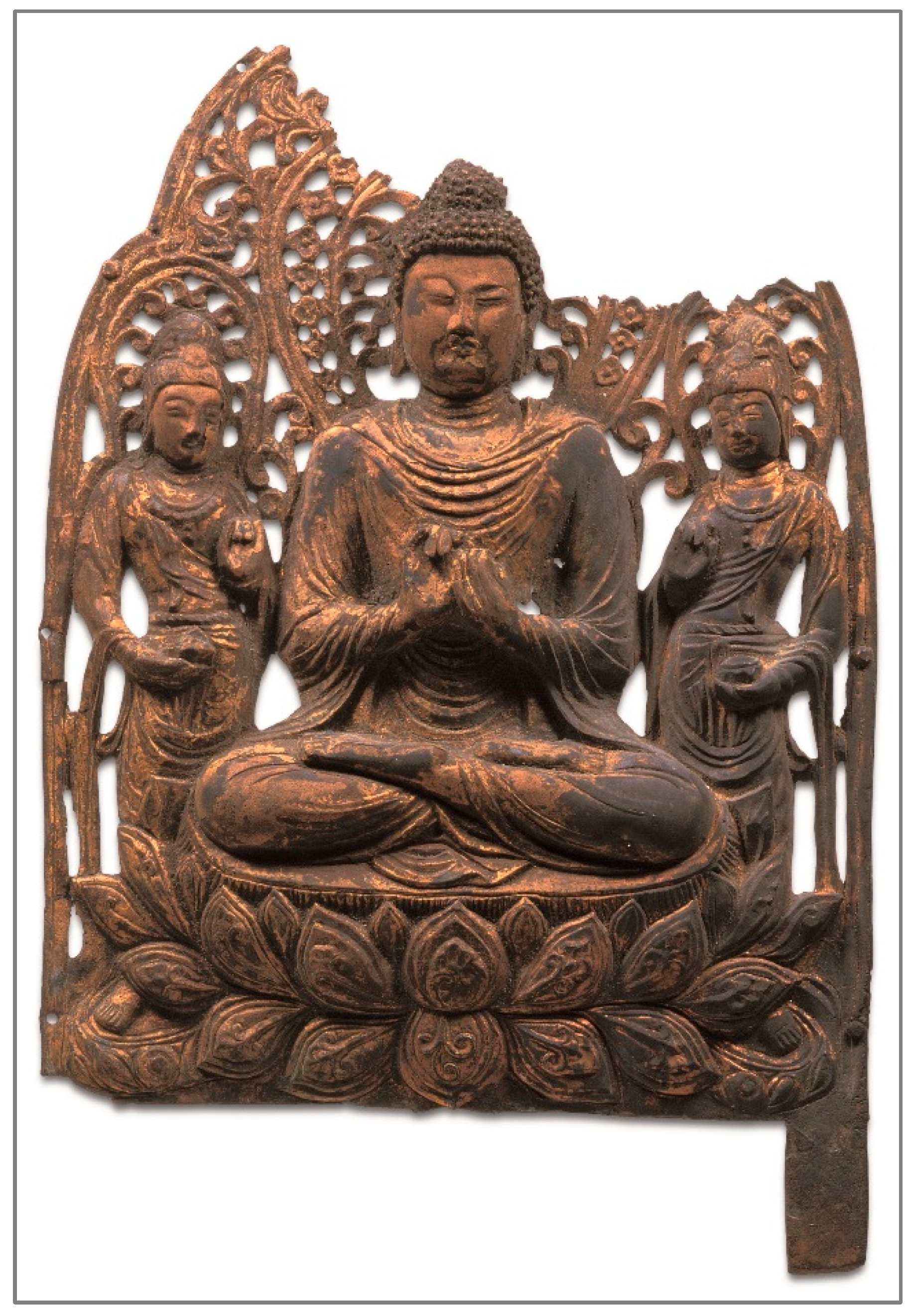
These twenty-two statues include six (2, 4, 8, 9, 10, 11) supported by inscriptions or historical records (Figure 1 and Figure 2); six (12, 14, 16, 19, 20, 21) featuring the marvelous-observation-wisdom gesture, which, as noted above, is distinctive to Esoteric Buddhist images of Amitābha (Figure 3); three (1, 3, 5) inferred to represent Amitābha based on the presence of attendant bodhisattvas or other Pure Land-related motifs; two (6, 7) that share iconographic, and stylistic features with contemporaneous East Asian Amitābha triads in a transregional context (Figure 4); one (15) identified through its pairing with a Vairocana Buddha statue created alongside it, as well as the characteristics of the enshrinement site; and finally, four (13, 17, 18, 22) four-sided Buddha images that meet both of the following criteria: they face west and display the wheel-turning gesture (no. ⑥ of Table 1), which was a widely used mudrā in relief-style artworks of Amitābha not only in China but also in Japan during the same period (Figure 5 and Figure 6).8
Although this figure of twenty-two may be subject to adjustment as additional evidence emerges, and despite the possibility of misclassification in some cases, the overall numerical variation is unlikely to be substantial. Above all, this corpus provides a sufficient basis for a meaningful analysis of Amitābha statue production in Unified Silla, and more importantly, it calls into question the long-standing assumption that Amitābha statues were actively produced during this period. Comparative analysis with other Buddha statues from the same period reveals a more complex pattern. For instance, a systematic examination of individual Unified Silla Buddhist statue indicates that the number of Vairocana statues displaying the wisdom-fist gesture (Skt. bodhaśrī mudrā 智拳印) stands at approximately eighty-five, a figure significantly higher than that of Amitābha statues. Similarly, Medicine Buddha statues holding a medicine bowl number around thirty-eight, clearly surpassing the count of Amitābha statues. In addition, approximately sixty-four Buddha statues exhibit the earth-touching gesture originally associated with Śākyamuni at the moment of enlightenment, making them the second most numerous Buddha after Vairocana statues.
Admittedly, the picture would change if the approximately sixty-six statues of uncertain identity excluded from this corpus were all identified as Amitābha. However, many of these works lack clear provenance, display unusual iconographic features, or are not supported by relevant historical records, making such an extreme assumption difficult to maintain. Moreover, even if this extreme assumption were provisionally accepted, the overall distribution would not change as dramatically as might be expected. The number of Amitābha statues would increase, but only to a level comparable to—at most slightly exceeding—that of other major Buddha types, such as Vairocana, making it difficult to argue that Amitābha images were dominant in Unified Silla sculptural production.
The production period introduces a further layer of complexity. With few exceptions, most Vairocana statues date to the ninth and early tenth centuries, while earth-touching Buddha statues are similarly concentrated between the mid-eighth and early tenth centuries. By contrast, Amitābha statues appear to have been produced over a longer span, from the mid-seventh to the early tenth century (Table 2). Despite this extended chronology, the overall number of Amitābha statues remains comparatively small. Although the longevity of Pure Land Buddhism might be interpreted as evidence of sustained vitality, this observation simultaneously raises a more critical question: why, despite such temporal breadth, was the production of Amitābha statues relatively limited? Based solely on the extant sculptural corpus, one might even question whether Pure Land Buddhism was in fact as widespread in Unified Silla as has often been assumed. This possibility, however, is not supported by broader historical evidence, which is examined in the next chapter.

3. The Popularization of Pure Land Buddhism Among the General Populace

Although the exact time and routes of transmission remain unclear, Pure Land Buddhism appears to have been actively embraced on the Korean Peninsula around the time of Silla’s unification (660–676). From the late seventh century onward, it gradually spread among the general populace and, by the eighth century, had become a central form of lay religious practice. This view is supported by the emergence of explicit textual references to Amitābha from the late seventh century, as shown in Table 3, as well as by a concurrent rise in the production of Amitābha statues during this period (Table 3; see the list of Amitābha statues in the preceding chapter).
The late seventh century was a chaotic time for Silla. Although Silla had successfully conquered Paekche 百濟 (18 BCE–660 CE) and Koguryŏ 高句麗 (37 BCE–668 CE), moreover secured dominance over the Korean Peninsula against Tang China, the unification process was far from smooth. The ongoing wars left the people of Silla in constant fear of death at any time and place. In such unstable circumstances, turning to Amitābha devotion, which centered on rebirth in the Pure Land and the promise of a better afterlife, can be understood as a natural response to collective trauma.
Historical accounts in the Samguk yusa (Memorabilia of the Three Kingdoms 三國遺事) provide more detailed depictions of Pure Land Buddhism in Unified Silla, highlighting two key aspects: the emphasis on the practice of name-recitation and its close integration into the everyday lives of ordinary people. The Samguk yusa contains a total of thirteen Amitābha-related accounts, six of which concern the practice of name-recitation (nos. 2, 3, 11, 13, 15, 16 of Table 3). Among these, particularly four narratives are noteworthy for demonstrating how widely this practice had spread among the general populace.
The first is the account of monk Wŏnhyo 元曉 (617–686), whose popular dissemination of the Dharma enabled even the impoverished and illiterate to know the name of Amitābha (no. 2 of Table 3). The second is the narrative from the reign of King Munmu 文武王 (r. 626–681), which recounts the story of Kwangdŏk 廣德 and Ŏmjŏng 嚴莊, two commoners who attained rebirth in the Pure Land through name-recitation and sixteen visualizations (Ch. shiliu guan 十六觀) (no. 3 of Table 3). The third is the account of monk Yŏmbul 念佛師, which describes how the chanting of Amitābha’s name resounded throughout the capital city of Kyŏngju 慶州 (no. 15 of Table 3). The fourth is the story of the female slave Ukmyŏn 郁面 during the reign of King Kyŏngdŏk 景德王 (r. 742–765), who devoted herself to the constant recitation and was ultimately reborn in the Pure Land (no. 16 of Table 3). Collectively, these four accounts demonstrate that by the mid-eighth century, Pure Land Buddhism in Unified Silla had transcended social boundaries, reaching even the lowest strata of society, including enslaved individuals.9 Moreover, the practice of chanting Amitābha’s name had come to constitute an essential part of religious life among the broader populace.
In China, as many scholars have demonstrated, the practice of this vocal devotion had already become well established. Beginning with Tanluan 曇鸞 (ca. 488–554), who emphasized that the name Amitābha itself possessed the inherent power to eliminate sin and karma,10 successive Pure Land preceptors systematically developed and disseminated the doctrine of the salvific efficacy of name-recitation. Daochuo 道綽 (562–645) not only practiced name-recitation himself but also actively promoted it among people of all social backgrounds.11 Shandao 善導 (613–681) further institutionalized the practice throughout the imperial capital of Chang’an 長安.12 This well-established tradition of vocalized Amitābha devotion in China likely provided both doctrinal precedent and practical momentum for its adoption in Unified Silla.
Beyond these external influences, domestic conditions also played a vital role, especially through the preaching efforts of Buddhist monks.13 Wŏnhyo, for instance, traveled to numerous villages and towns, spreading the name of Amitābha through performative practices of singing and dancing. He emphasized that even those of inferior spiritual capacity could attain rebirth in the Pure Land through the recitation of Amitābha’s name (McBride 2020, pp. 37–43). This is evident from his Wuliangshou jing chongyo 無量壽經宗要, in which he explicitly cites a passage from the Guan Wuliangshou jing, stating that the sincere invocation of Amitābha’s name can eradicate karmic offenses in a single moment and thereby ensure rebirth in the Pure Land.14
Ŭisang 義湘 (625–702), despite his primary reputation as a prominent Hwaŏm 華嚴 scholar, also demonstrated profound devotion to Amitābha. He is said to have spent his life facing west in aspiration for rebirth in the Pure Land and to have enshrined an Amitābha Buddha—rather than the doctrinally expected Vairocana—as the principal icon at the Hwaŏm Monastery Pusŏksa 浮石寺. Other monks, including Pŏbwi 法位 (fl. 7th century), Hyŏnil 玄一 (fl. 7th century), Ŭijŏk 義寂 (fl. 681–701), and Kyŏnghŭng 憬興 (fl. late 7th–early 8th century), may not have been as directly involved in the propagation of Pure Land belief, but they nonetheless contributed to the dissemination of faith in Amitābha and the efficacy of name-recitation,15 thereby supporting its broader diffusion.
As briefly noted at the beginning of this chapter, the wartime conditions of this period likely served not only as a critical historical context for the expansion of Pure Land Buddhism, but also for the growing practice of name-recitation. What made Amitābha devotion particularly compelling for a war-weary Silla society was the assurance that even in the face of imminent death, salvation could be attained through this simple act. The emotional and spiritual appeal of such an accessible path to deliverance must have been considerable. The spread of Pure Land Buddhism and the popularization of name-recitation thus appear to have been mutually reinforcing phenomena, each sustaining and amplifying the other. As the next chapter will demonstrate in detail, this devotional pattern also had important implications for material culture, particularly in shaping the distinctive development of Amitābha statue production in Unified Silla.

4. Name-Recitation: A Preferred Merit-Making Practice to Buddhist Statue Creation

Pure Land Buddhism exerted considerable influence in Unified Silla, becoming a widespread form of devotion deeply integrated into the everyday lives of ordinary people. However, only about twenty-two extant statues can be confidently identified, or reasonably assumed, as depictions of Amitābha.16 This relatively small number suggests that the production of Amitābha statues was disproportionately limited in comparison to the broad diffusion of the devotion itself.
It remains possible that some Amitābha statues have yet to be identified. As noted above, Amitābha statues cannot always be securely distinguished on iconographic features alone; consequently, among the statues excluded from the present analysis due to lack of clear identifying evidence, there are very likely examples that do in fact represent Amitābha. In addition, statues made of fragile materials such as wood or clay may have deteriorated completely over time. This issue is particularly pertinent on the Korean Peninsula, where numerous Buddhist artworks have been lost through repeated warfare and invasions. The significance of such losses becomes clearer considering Pure Land Buddhism’s widespread embrace among the general populace in Unified Silla.17 For ordinary devotees, small-scale statues made of wood or clay—being more affordable and easier to produce, yet also more susceptible to damage—were likely preferred. These considerations suggest that the surviving corpus may not fully reflect the original scale of production.
Nevertheless, given that the goal of Pure Land Buddhism was rebirth in the Pure Land at the moment of death, image production may not have been considered essential as an expedient means for achieving this end. In other words, alternative forms of devotional practice that were simpler and more accessible may have taken precedence over sculptural production, with the result that Amitābha images may not have been produced in large numbers. From the perspective of ordinary believers, the commissioning of Buddhist images would have been a labor-intensive and costly undertaking, likely posing significant obstacles for those of lower social strata. This pattern is consistent with existing evidence suggesting that the production of Amitābha statues was primarily supported by elite patrons rather than by commoners in the Unified Silla period.
The Buddhist Stele of Amitābha dated to the kyeyu year 癸酉 (673) exemplifies this pattern. Its creation involved approximately fifty donors, including a high-ranking Baekje official of Talsol 达率; members of the Chŏn clan 全氏, a regional elite group from the Yŏn’gi 燕岐 area where the stele was discovered; and members of the Chinmo clan 眞牟氏, one of the most politically powerful aristocratic families of Baekje. A similar pattern can be observed in the paired stone statues of Amitābha and Maitreya (719) at Kamsansa Monastery 甘山寺. Their patron, Kim Chisŏng 金志誠 (652–720), held the prestigious rank of Ach’an 阿飡 and later served as Sirang 侍郞, an official within the Ministry of State Affairs 执事部. Royal sponsorship is likewise apparent in the Amitābha Buddha statue (801) at Mujangsa Monastery 鍪藏寺, commissioned by Queen Kyehwa 桂花 (fl. late eighth–early ninth century), which mobilized substantial state resources, including six ceremonial robes and funds drawn from nine state granaries.18 Other known examples do not differ significantly from this pattern.
Moreover, a notable pattern emerges in that these statues were not created primarily to secure the donor’s own rebirth in the Pure Land. Rather, as with many other Buddhist images, they were commissioned for the posthumous benefit of the deceased or for political purposes (K. Yi 1986, pp. 141–59, 160–77; Chŏng 2024a, p. 219). This suggests that, in Unified Silla, the production of Buddhist images was not actively pursued as a principal path to rebirth in the Pure Land. What forms of devotional practice, then, were preferred instead?
As discussed above, the Amitābha-related accounts in the Samguk yusa suggest that, among commoners and enslaved individuals, the most fervently practiced means of attaining rebirth was the chanting of Amitābha’s name (nos. 3, 14, 16 of Table 3). A similar pattern is even more clearly observable in Chinese narratives of Pure Land rebirth. From the Northern and Southern Dynasties 南北朝時代 (386–589) through the Tang period, recollection of Amitābha or the recitation of his name constituted the dominant form of practice for attaining rebirth in the Pure Land, while the commissioning of Buddha statues played a comparatively minor role (Y. Kim 1994, pp. 37, 397–406). Even though a larger number of Amitābha statues and Pure Land tableau paintings were produced in China, this does not necessarily indicate that they were primarily commissioned for the purpose of securing rebirth in the Pure Land. Rather, as in the case of Unified Silla, relatively few of these can be clearly identified as having been created with such an explicit soteriological aim (S. Kim 1995, p. 37).19
The religious efficacy and doctrinal legitimacy of name-recitation are clearly affirmed in Buddhist scriptures. For example, the Guan Wuliangshou jing states that if one recites Amitābha’s name with utmost sincerity, sins and karmic offenses will be eliminated, and rebirth in the Pure Land will be attained at the moment of death.20 Similar doctrines are also found in the Amituo jing.21 The Wuliangshou jing 無量壽經, as cited below, further emphasizes this point by stating that rebirth in the Pure Land is accessible not only to those who accumulate merit through monastic ordination, donations for the construction of stupas and images, or offerings to the sangha, but even to those unable to engage in such practices, who may attain rebirth simply by reciting Amitābha’s name. In other words, the practice of name-recitation is regarded as spiritually equivalent to these meritorious deeds and even capable of replacing them (Y. Kim 1994, pp. 119–20; S. Kim 2014, p. 379).22
The middle grade of aspirants are the devas and humans in the worlds of the ten directions who sincerely desire to be born in that land. Although unable to become monks and cultivate much merit, they awaken aspiration for the highest enlightenment, single-mindedly recollect (or recite) of Amitāyus, perform some good deeds, observe the precepts of abstinence, build stupas, donate Buddhist statues, give alms to mendicants, hang banners, light candles, scatter flowers, burn incense, and so forth. They transfer the merit of those practices to his land, aspiring to be born there. When they are about to die, … be born in the Pure Land, where they will dwell in the stage of non-retrogression. … The lower grade of aspirants are the devas and humans in the worlds of the ten directions who sincerely desire to be born in that land. Although unable to do many meritorious deeds, they awaken aspiration for highest enlightenment and single-mindedly recollect (or recite) Amitāyus even ten times, desiring birth in his land. When they hear the profound Dharma, they joyfully accept it and do not entertain any doubt; and so, thinking of the Buddha even once, they sincerely aspire to be born in that land. When they are about to die, they will see the Buddha in a dream. Those aspirants, too, will be born in the Pure Land.
其中輩者, 十方世界諸天人民, 其有至心願生彼國, 雖不能行了源手作沙門大修功德, 當發無上菩提之心, 一向專念無量壽佛. 多少修善, 奉持齋戒, 起立塔像, 飯食沙門, 懸繒然燈, 散華燒香, 以此迴向願生彼國. 其人臨終, … 卽隨化佛往生其國, 住不退轉, … 其下輩者, 十方世界諸天人民, 其有至心欲生彼國, 假使不能作諸功德, 當發無上菩提之心, 一向專意乃至十念, 念無量壽佛, 願生其國. 若聞深法歡喜信樂, 不生疑惑, 乃至一念念於彼佛, 以至誠心願生其國. 此人臨終夢見彼佛, 亦得往生, 功德智慧次如中輩者也.23
These scriptures are sometimes thought to have been introduced to Silla around 565, based on a record in the Samguk yusa which states that “in the sixth year of Tianjia 天嘉 during the reign of King Chinhŭng 眞興王 (r. 540–576), the Chen 陳 (557–589) envoy Liu Si 劉思 and the monk Mingguan 明觀 brought more than 1700 volumes of Buddhist scriptures” (Y. Kim 1985, p. 36; Y. Kim 1994, p. 72). However, the precise date of their transmission remains uncertain. Beginning with Chajang, who was active in the mid-seventh century, and followed by Wŏnhyo, Pŏbwi, Hyŏnil, Ŭijŏk, and Kyŏnghŭng, several monks composed commentaries on these texts. This indicates that they had reached Silla by the seventh century at the latest and had become the subject of discussion among learned monks. Some of these writings highlight the efficacy of name-recitation for attaining rebirth in the Pure Land, particularly for those of lower social status, and also provide doctrinal and ideological justification for this practice (Y. Kim 2011, p. 193; McBride 2020, pp. 37–51). This, in turn, contributed to its broader recognition during the Unified Silla period.
Taken together, although Pure Land Buddhism flourished in Unified Silla, its practice appears to have been centered primarily on the recitation of Amitābha’s name.24 This tendency seems to have been particularly pronounced among the general populace, for whom name-recitation offered an accessible and effective means of attaining rebirth. In such a context, devotional practices that required fewer material resources would likely have been more widely adopted than those involving the production of costly images. This may have created a disjunction between widespread devotion to Amitābha and its material expression in the form of statue production. The relatively limited number of Amitābha statues may therefore be understood as reflecting a religious framework that placed greater emphasis on non-material practices. Rather than indicating a lack of devotion, this pattern may instead point to a different mode of religious expression—one in which faith was enacted primarily through performative and recitational practices rather than through material forms.
Whether this interpretation holds, however, depends on a prior question: to what extent did name-recitation practice actually rely on material supports such as Buddha images? Images were generally regarded as objects that amplified Pure Land practice (Marchman 2024, pp. 140–46). For example, Shandao emphasized the advantages of Pure Land tableaux (Ch. bianxiang, 變相圖) for visualization practice,25 and Huiyuan 慧遠 (334–417) practiced the nianfo samādhi together with 123 monks and lay devotees before a Buddha statue at the Prajñā Terrace-Hall on Mt. Lu 廬山—both illustrating how images could enrich the practice.26 Yet the tradition equally attests to name-recitation performed without any material support, as illustrated in the narratives cited below: in a chamber at the moment of death, on a boat, while walking along the road, or even before a grave—contexts in which no image was present or required.
The monk … resting on his right side, with his feet placed one upon the other and his head supported by his hand, he quietly recited the name of Amitābha and passed away in the Main Dharma Hall of the Monastery of the Great Master Taehŭng.
法師 … 右脇累足. 枕手怗然稱念彌陀. 卒於大, 興善寺本院傳法之堂矣.27
The monk Demei … He devoted himself solely to the Western Pure Land, and even at the moment of death he passed away while reciting the name of Amitābha with his mouth. … with his hands joined in reverence, chanting the Buddha’s name, he died.
釋徳美 … 專固西方. 口誦彌陀終于命盡. … 合掌稱佛. 卒.28
Chan master Changmin and one of his disciples … facing the Western direction, he joined his palms and called upon Amitābha Buddha. As he continued to recite the Buddha’s name without interruption, the boat sank. Before long, his body disappeared and his voice faded away, and thus he ended his life. … The Chan Master had one disciple, whose place of origin is unknown. Lamenting and shedding tears, he likewise recited the name of Amitābha and died alongside his master.
於是合掌西方稱彌陀佛. … 念念之頃舶沈身沒. 聲盡而終. … 有弟子一人. 不知何許人也. 號咷悲泣. 亦念西方與之倶沒.29
A person … after completing his worship, he recited “Namo Amitābha” aloud, the sound continuing without interruption. Leaving the gate of Guangming Monastery, he climbed to the top of a willow tree, joined his palms, and faced the west. Then he threw himself headfirst to the ground, and thus died.
有人 … 其人禮拜訖. 口誦南無阿彌陀佛聲聲相次出光明寺門. 上柳樹表. 合掌西望. 倒投身下. 至地遂死.30
More than ten people, both monks and lay followers, accompanied the funeral procession as it departed from the city. At the tomb, seven monks were invited to perform the ten recitations of the Buddha’s name and pray for the deceased’s rebirth in the Pure Land.
送殯出城人僧俗共計十餘人. 扵墓殯前請七僧稱名十念咒願.31
In the case of Unified Silla, historical records of name-recitation likewise do not provide clear evidence that it was performed in the presence of an image (nos. 2, 3, 11, 13, 15, 16 of Table 3).32 This holds true not only for highly trained practitioners but also for laypeople, and even for slaves (nos. 2, 3, 16 of Table 3). While the presence of a Buddha image may have offered additional support to the practitioner, the diverse cases suggest that an image was by no means essential, and its absence posed no significant difficulty for practice. The limited production of Amitābha statues in Unified Silla, therefore, need not be read as evidence of weak devotion; rather, it reflects a form of practice that was self-sufficient without material mediation—one that thrived precisely because it required nothing but the recitation of a name.

5. Conclusions

Pure Land Buddhism was introduced into Silla around the time of the unification of the Three Kingdoms and grew rapidly into a popular religious movement by the eighth century, aided by the historical circumstances of warfare, the influence of the Tang dynasty, and the proselytizing activities of Buddhist monks. This flourishing belief has often led to the expectation that a considerable number of Amitābha statues must have been produced during this period. Indeed, many previous scholars have identified numerous statues as Amitābha primarily on the basis of hand gestures and orientation. However, these two criteria prove insufficient for securely identifying Amitābha images. The hand gestures display considerable variation and were often shared by multiple Buddhas rather than serving as exclusive iconographic features of Amitābha, while orientation was not consistently fixed.
Based on clear textual and visual evidence, this study therefore proposes a more cautious assessment: only approximately twenty-two extant statues can be confidently identified as Amitābha or are highly likely to represent this Buddha. Given the widespread popularity of Amitābha belief, this number is strikingly small. To account for the apparent discrepancy between the widespread popularity of Pure Land Buddhism and the relatively limited production of Amitābha statues, this study, while acknowledging the possibility of both loss and misidentification, offers an alternative perspective. It draws attention to the popular character of Amitābha belief in Unified Silla and to the practice of vocal name-recitation that many believers emphasized. As a simple and accessible devotional practice, name-recitation likely served as a practical alternative to the costly production of statues for many among the general populace.
This argument does not deny the religious significance or efficacy of Buddha images within Pure Land devotion or in the accumulation of merit for rebirth in the Pure Land. Rather, it highlights the considerable economic and social barriers that statue production posed for large segments of the population, and thus challenges the conventional assumption that the flourishing of Amitābha belief would necessarily have been accompanied by a proportional increase in the production of Amitābha images.
Accordingly, the discrepancy between the widespread devotion to Amitābha and the relatively limited production of Amitābha statues may be understood as one of the clearest indications that Pure Land Buddhism in Unified Silla possessed a distinctly popular character. In this context, the chanting of Amitābha’s name functioned not merely as a supplementary practice but, for many practitioners, as a practical and effective alternative to the production of devotional images.
The relatively small number of Amitābha statues proposed in this study reflects the use of stricter criteria for identification. I fully acknowledge that the failure to confirm a statue as Amitābha does not mean that it represents a different Buddha, and that the absence of clear iconographic markers does not necessarily preclude such an identification. However, when we ask whether additional statues can be included within the Amitābha corpus, it remains difficult to present examples supported by evidence that would be broadly convincing. This study is therefore an attempt to reconsider, from a different perspective, the prevailing tendency in the field to assume that Amitābha images were widely produced on the basis of such ambiguity. Just as earlier approaches relying on ambiguous evidence may be understood as one form of inference, the present study should likewise be regarded as a new interpretive proposal.

Funding

This research received no external funding.

Institutional Review Board Statement

Not applicable.

Informed Consent Statement

Not applicable.

Data Availability Statement

The original contributions presented in this study are included in the article. Further inquiries can be directed to the corresponding author.

Conflicts of Interest

The author declares no conflicts of interest.

Notes

1
See (Mun 2003b, p. 99; 2003c, pp. 132–45; Chi 2012, pp. 38–44; Pae 2016, p. 70; H. Yi 2018, pp. 181–82) for the identification of Amitābha statues of Unified Silla based on hand gestures. See also (Mizuno 2003, pp. 28–47; Cho 2006, pp. 381–421; Y. An 2011, pp. 49–74) for identification based on westward orientation.
2
There is growing skepticism about the appropriateness of using iconographic features to determine the identity of medieval Buddha images. For a critique of this approach, see (Rhi 2023, pp. 12–41). Yet this perspective remains widely used in many studies.
3
The interpretation proposed here raises the question of whether similar patterns can be observed in contemporaneous China or Japan, or whether this represents a phenomenon distinctive to Unified Silla. While a definitive answer requires further comparative research, it may be suggested that Pure Land Buddhism in Unified Silla was more strongly oriented toward the general populace than in China and Japan. Its markedly popular character—favoring relatively simple practices such as the recitation of Amitābha’s name over the more resource-intensive production of statues—may have contributed to the pattern observed here. This issue will require further examination and will be taken up in a separate study.
4
“Material culture” refers to the cultural attributes of objects produced and used within specific spatial and temporal contexts, functioning across social, political, economic, and religious spheres. The production of Buddhist images falls within this framework, as it is shaped by factors such as religious belief, ritual practice, technological conditions, and intercultural exchange. While Pure Land material culture encompasses a wide range of media—including painting, sculpture, architecture, and the decorative arts—this article adopts a narrower definition, focusing primarily on sculptural production. This is because, in the case of Unified Silla, both the surviving material and textual evidence related to Amitābha are overwhelmingly concentrated on sculpture.
5
Amituo jing 阿彌陀經, T. 12, no. 366, 1.346c10–12; Guan Wuliangshou jing 觀無量壽經, T. 12, no. 365, 1.341c5–8.
6
Through repeated repairs and restorations, stone pagodas may have lost their original locations or had their orientations altered. Given that Medicine Buddhas holding a medicine bowl are carved on most faces of the pagoda, the orientations of the other faces were determined by designating the Medicine Buddha as the eastern face, regardless of the pagoda’s present cardinal orientation. This approach follows the interpretation of Hŏ Hyŏnguk (Hŏ 2023, pp. 15–16).
7
On the north face of the stone pagodas at Ch’ŏngju 淸州 T’ap-tong 塔洞, Kimch’ŏn 金泉 Sudo-am Hermitage 修道庵, Yangp’yŏng 楊平 Chip’yŏng-ri 砥平里, and Ŭisŏng 義城 Ch’isŏn-dong 致仙洞 are carved Buddha images displaying the wheel-turning gesture (no. ⑥ of Table 1). In addition, a statue of Vairocana Buddha is carved on the west face of the reliquary outer case from Tonghwasa Monastery 桐華寺, Taegu 大邱.
8
Extensive research has been conducted on each of these statues, which cannot be reviewed here due to limitations of space. For previous scholarship on each statue, as well as for a more detailed discussion of the criteria for classifying them as Amitābha, see (Chŏng 2024a, pp. 131–98).
9
The popular character of Pure Land Buddhism in Unified Silla has been widely discussed in previous scholarship. Representative studies include (T. Kim 1988, pp. 1–16; Y. Kim 1994, pp. 113–62; 2011, pp. 173–200; Mun 2003a, pp. 105–31; Pae 2016, pp. 66–93).
10
Wuliangshou jing Youposheshe yuansheng ji zhu 無量壽經優婆提舍願生偈註, T. 40, no. 1819, 2.835b19–839a28.
11
Xu Gaoseng Zhuan 續高僧傳, T. 50, no. 2060, 20.594a23–25; Jingtu Lun 淨土論, T. 47, no. 1963, 2.98b14–17.
12
Fozu Tongji 佛祖統紀, T. 49, no. 2035, 53.469b14–16.
13
This point has also been briefly discussed in previous scholarship; see (Y. Kim 2011, p. 193).
14
Muryangsu kyŏng chongyo 無量壽經宗要, T. 37, no. 1747, 1.129a22–28.
15
For the biographies of these monks, see (K. An 1976).
16
There are also Amitābha Buddha statues known only through textual records. Examples include the Amitābha statue at Pusŏksa Monastery (ca. 676), the Amitābha statue transmitted to Japan in 689 for the memorial service of Emperor Tenmu, the Amitābha statue at Namsa Monastery on Mt. Paegwŏl (764), and the Amitābha statue at Mujangsa Monastery (801) (nos. 5, 7, 18, 19 of Table 3). These are not counted among the twenty-two figures.
17
It is by no means the case that the ruling elite of Unified Silla lacked devotion to Amitābha; nevertheless, their primary religious interest lay particularly in doctrinal Buddhism, such as Hwaeom 華嚴 and Yogācāra 唯識. In their patronage of Buddha statues, they likely prioritized the creation of Vairocana or Śākyamuni statues, which were closely associated with the doctrinal principles they esteemed. This tendency is evident in the predominance of Vairocana and Śākyamuni statues as the principal icons in major monasteries of this period. For the influence of Hwaeom and Yogācāra Buddhism on the Unified Silla royal court, see (Ch’oe 2005, pp. 241–73).
18
The information presented here is derived from the inscription on the sculpture itself or on an associated stele.
19
A total of approximately forty-eight Amitābha statues dating to the Northern and Southern Dynasties have been identified. Among these, only nine inscriptions explicitly express a wish for rebirth in the Pure Land. Even in such cases, however, the vow is frequently directed not toward the patron’s own rebirth but toward that of deceased others, or is framed in broader soteriological terms, such as the attainment of enlightenment or Buddhahood. Furthermore, although the production of Amitābha images increased substantially during the Tang period, this general pattern appears to have remained largely unchanged. Inscriptions associated with Tang-period Amitābha images likewise tend to emphasize the transfer of merit to the deceased, the attainment of enlightenment, or the realization of awakening.
20
Guan Wuliangshou jing, T. 12, no. 365, 1.346a18–22.
21
Amituo jing, T. 12, no. 366, 1.347b10–15.
22
Wuliangshou jing 無量壽經, T. 12, no. 360, 2.272b24–c10.
23
There have been various interpretations of the concept of the “十念” mentioned in the cited passage. This issue has been widely debated not only in contemporary scholarship but also among monks in Unified Silla. For further discussion, see (McBride 2020, pp. 35–56). While a more detailed investigation is beyond the scope of this study, it follows both the commentaries of some Silla monks and Yongmi Kim’s interpretation, which understands the ten recollections as verbal recitations of Amitābha’s name performed over ten thought-moments (Y. Kim 1994, pp. 97, 120–21). Whether understood as recollection or recitation, the scriptures themselves affirm that devotional acts operating on a level different from material offerings could function as effective means for attaining rebirth. This suggests that the pursuit of rebirth in the Pure Land was not necessarily dependent on the production of sculptural images.
24
As emphasized repeatedly in this study, the recitation of the Buddha’s name played a crucial role in Pure Land Buddhism in Unified Silla. This emphasis is particularly evident in the accounts preserved in Samguk yusa (Table 3). Admittedly, since the Samguk yusa was compiled in the late Koryŏ period (1281 CE), its portrayal may reflect later perceptions of name-recitation. However, this is not the whole picture, as the writings of Unified Silla monks also emphasize the importance of such practice.
25
Fozu tongji 佛祖統紀, T. 49, no. 2035, 53.469b14–16; Guan nian Amituo Fo xiang hai sanmei gongde famen 觀念阿彌陀佛相海三昧功德法門, T. 47, no. 1959, 1.25a4–11.
26
Gaoseng zhuan 高僧傳, T. 50, no. 2059, 6.358c21–28.
27
Datang Zhenyuan xu Kaiyuan Shijiao lu 大唐貞元續開元釋教錄, T. 55, no. 2156, 2.760a12–18.
28
Fayuan Zhulin 法苑珠林, T. 53, no. 2122, 86.920b22–29.
29
Datang Xiyu qiufa gaoseng zhuan 大唐西域求法高僧傳, T. 51, no. 2066, 1.3a1–19.
30
Xu gaoseng zhuan 續高僧傳, T. 50, no. 2060, 27.684a15–19.
31
Nittō guhō junrei kōki 入唐求法巡禮行記, vol. 4.
32
Certain passages may imply the presence of images. In particular, the account of the female slave Ukmyŏn, who is said to have attained rebirth through name-recitation, describes her practice in a temple setting; although no image is explicitly mentioned, this context may suggest the presence of a Buddha image (no. 16 of Table 3). Conversely, a late ninth-century record of monks enshrining an Amitābha mural at Pulguksa Monastery makes no reference to name-recitation, though it may have been performed in imitation of Huiyuan’s assembly at Mt. Lu (no. 20 of Table 3). Such possibilities remain speculative, and there are also instances of name-recitation that appear to have been conducted without an image.

References

  1. Primary Sources 

    Amituo jing 阿彌陀經 [The Amitābha Sūtra], T. 12, no. 366.
    Datang Xiyu qiufa gaoseng zhuan 大唐西域求法高僧傳, T. 51, no. 2066.
    Datang Zhenyuan xu Kaiyuan Shijiao lu 大唐貞元續開元釋教錄, T. 55, no. 2156.
    Ennin 圓仁. Nittō guhō junrei kōki 入唐求法巡禮行記 [Record of a Pilgrimage to China in Search of the Dharma].
    Fozu tongji 佛祖統紀 [Comprehensive Record of the Buddhas and Patriarchs], T. 49, no. 2035.
    Gaoseng zhuan 高僧傳 [The Biographies of Eminent Monks], T. 50, no. 2059.
    Guan nian Amituo Fo xiang hai sanmei gongde famen 觀念阿彌陀佛相海三昧功德法門, T. 47, no. 1959.
    Guan Wuliangshou jing 觀無量壽經 [The Sūtra on the Contemplation of the Buddha of Immeasurable Life], T. 12, no. 365.
    Jingtu Lun 淨土論, T. 47, no. 1963.
    Samguk yusa 三國遺事 [Memorabilia of the Three Kingdoms].
    Wŏnhyo 元曉. Muryangsu kyŏng chongyo 無量壽經宗要 [Doctrinal Essentials of the Wuliangshou jing], T. 37, no. 1747.
    Wuliangshou jing 無量壽經 [The Sūtra of the Buddha of Immeasurable Life], T. 12, no. 360.
    Wuliangshou jing Youposheshe yuansheng ji zhu 無量壽經優婆提舍願生偈註, T. 40, no. 1819.
    Xu gaoseng zhuan 續高僧傳 [The Continued Biographies of Eminent Monks], T. 50, no. 2060.
  2. Secondary Sources 

  3. An, Kyehyŏn 안계현. 1976. Silla chŏngt’o sasangsa yŏn’gu 新羅淨土思想史硏究 [A Study of the History of Pure Land Buddhism in Silla]. Sŏul: Asea Munhwasa 아세아문화사. (In Korean) [Google Scholar]
  4. An, Yŏjin 안여진. 2011. T’ongil Silla hadae (9–10 segi) sabang pulsang ŭi tosang kwa hyŏngsik 통일신라 하대 (9~10세기) 사방불상의 도상과 형식 [The Iconography and Form of the Four Directional Buddha Statues in Late Unified Silla]. Kangjwa misulsa 강좌미술사 The Art History Journal 37: 49–74. (In Korean) [Google Scholar]
  5. Chi, Kangi 지강이. 2012. Silla hadae Hapch’ŏn Ch’iin-ri maaebul ipsang yŏn’gu 신라하대 합천 치인리 마애불입상 연구 [A Study on the Rock-Carved Standing Buddha at Ch’iin ni, Hapch’ŏn from Late Silla]. Misul sahak yŏn’gu 미술사학연구 Korean Journal of Art History 274: 31–54. (In Korean) [Google Scholar]
  6. Cho, Wŏnyŏng 조원영. 2006. Silla sabangbul ŭi hyŏngsik kwa chosŏng paegyŏng 신라 사방불의 형식과 조성 배경 [The Form and Background of the Four Directional Buddhas in Silla]. Yŏksa wa segye 역사와 세계 History & the World 30: 381–421. (In Korean) [Google Scholar]
  7. Ch’oe, Yŏn-sik 최연식. 2005. 8-segi Silla pulgyo ŭi tonghyang kwa tong Asia pulgyogye 8세기 신라 불교의 동향과 동아시아 불교계 [The Transformation of Silla Buddhism in 8th Century in the Context of East Asian Buddhism]. Pulgyohak yŏn’gu 불교학연구 Korea Journal of Buddhist Studies 12: 241–73. (In Korean) [Google Scholar]
  8. Chŏng, Chinyŏng 정진영. 2024a. Amita sinang kwa pulsang yŏn’gu 아미타 신앙과 불상 연구 [A Study of Amitābha Faith and Material Culture in Unified Silla Dynasty]. Ph.D. dissertation, Ewha Womans University 이화여자대학교, Seoul, Republic of Korea. (In Korean) [Google Scholar]
  9. Chŏng, Chinyŏng 정진영. 2024b. T’ongil Silla ch’okchiingye Amit’a pulsang e taehan sigo: Hangma ch’okchiin tosang ŭi chŏnyong kwa hwaksan yoin 통일신라 ‘촉지인계’ 아미타불상에 대한 試考: 항마촉지인 도상의 轉用과 확산 要因 [A Preliminary Thought on the Bhumisparsha Mudra Amitabha in Unified Silla: The Factors of Transformation and Expansion]. Silla munhwa 신라문화 Silla Culture 64: 161–85. (In Korean) [Google Scholar]
  10. Hong, Yunsik 홍윤식. 1997. Han’guk ŭi Pulgyo misul 한국의 불교미술 [Buddhist Art of Korea]. Sŏul: Taewŏnsa 대원사. (In Korean) [Google Scholar]
  11. Hŏ, Hyŏnguk 허형욱. 2023. T’ongil Silla samyŏn pulsang ŭi Yaksayŏraesang tosang kwa paech’i pangsig yŏn’gu 통일신라 四面佛像의 약사여래상 도상과 배치방식 연구 [A Study of the Iconographic Characteristics and Relative Placement of the Bhaisayaguru Buddha Among the Buddhas in Four Directions During the Unified Silla Period]. Misulsa Yŏn’gu 미술사연구 Art History Studies 44: 7–44. (In Korean) [Google Scholar]
  12. Kim, Sŏngsun 김성순. 2014. Tong Asia yŏmbul kyŏlsa ŭi yŏn’gu: Ch’ŏnt’ae kyodan ŭl chungsim ŭro 동아시아 염불결사의 연구: 천태교단을 중심으로 [A Study of Nianfo Societies in East Asia: Focusing on the Tiantai Order]. Sŏul: Pium kwa sot’ong 비움과 소통. (In Korean) [Google Scholar]
  13. Kim, Sŏngyŏng 김선경. 1995. Tangdae Amit’a samjonbul ŭi tosang kwa Chang’an Kwangt’aeksa Chilpodae Amit’a samjonsang 唐代 阿彌陀三尊佛의 圖像과 長安 光宅寺 七寶臺 阿彌陀三尊像 [Iconography of the Amitābha Triad Images during the Tang Dynasty and the Amitābha Triad Images in Qibaotai of Guangzhaisi in Chang’an]. Ph.D. dissertation, Seoul National University 서울대학교, Seoul, Republic of Korea. (In Korean) [Google Scholar]
  14. Kim, Tongyun 김동윤. 1988. Silla Amit’a Sinang ŭi Minjung Chihyangjŏk Chŏn’gae wa Kŭ Paegyŏng 新羅 阿彌陀信仰의 民衆指向的 展開와 그 背景 [The Popular Development of Amitābha Belief in Silla and Its Background]. Kyŏngju Sahak 경주사학 Kyŏngju Historical Studies 7: 1–16. (In Korean) [Google Scholar]
  15. Kim, Yŏngmi 김영미. 1994. Silla pulgyo sasangsa yŏn’gu 新羅佛敎思想史硏究 [A Study on the History of Buddhist Thought in Silla]. Sŏul: Minjoksa 민족사. (In Korean) [Google Scholar]
  16. Kim, Yŏngmi 김영미. 2011. Samguk yusa Kamt’ong p’yŏn Kwangdŏk Ŏmjang cho wa Amit’a sinang 三國遺事 感通篇 廣德嚴莊 조와 阿彌陀信仰 [The Account of Kwangdŏk and Ŏmjang in the Kamt’ong Section of the Samguk yusa and Amitābha Devotion]. Silla munhwa 신라문화 Silla Culture 32: 173–200. (In Korean) [Google Scholar]
  17. Kim, Yŏngt’ae 김영태. 1985. Han’guk Chŏngt’o sasang yŏn’gu 韓國淨土思想硏究 [A Study of Pure Land Buddhism in Korea]. Sŏul: Tongguk Taehakkyo Ch’ulp’anbu 동국대학교출판부. (In Korean) [Google Scholar]
  18. Marchman, Kendall. 2024. Material Culture in Pure Land Buddhist Practice. In The Oxford Handbook of Lived Buddhism. Edited by Courtney Bruntz and Brooke Schedneck. Oxford: Oxford University Press, pp. 139–54. [Google Scholar]
  19. McBride, Richard, II. 2020. Aspiring to Enlightenment: Pure Land Buddhism in Silla Korea. Honolulu: University of Hawaii Press. [Google Scholar]
  20. Mizuno, Saya 水野さや. 2003. Tōitsu Shinra Kōrai Zenki no Sekitō ni okeru Shibutsu ni tsuite: Tōmen no Enkei Jibutsu o Toru Nyorai-zō o Chūshin ni 統一新羅高麗前期の石塔における四佛について: 東面の圓形持物を執る如來像を中心に [Four Directional Buddhas in Stone Pagodas from Unified Silla to Early Koryŏ: Focusing on the East-Facing Buddha Holding a Circular Object]. Mikkyō zuzō 密敎圖像 The Journal of Buddhist Iconography 22: 28–47. (In Japanese) [Google Scholar]
  21. Mun, Myŏngdae 문명대. 1997. Han’guk Pulgyo misul ŭi hyŏngsik 한국불교미술의 형식 [Formal Characteristics of Korean Buddhist Art]. Sŏul: Han’guk ŏnron charyo kanhaenghoe 한국언론자료간행회. (In Korean) [Google Scholar]
  22. Mun, Myŏngdae 문명대. 2003a. Kyŏngdŏg wangdae ŭi Amit’abul chosang munje 경덕왕대의 아미타불 조상 문제 [The Question of Amitābha Statue Production during the Reign of King Kyŏngdŏk]. In Han’guk ŭi pulsang chogak 한국의 불상 조각 [Buddhist Sculpture of Korea]. Sŏul: Yegyŏng 예경, vol. 3, pp. 105–31. (In Korean) [Google Scholar]
  23. Mun, Myŏngdae 문명대. 2003b. Kyŏngju Sŏak Amit’a bulsang 경주 서악 西岳 아미타불상 [The Amitābha Buddha Statue of Sŏak, Kyŏngju]. In Han’guk ŭi pulsang chogak 한국의 불상 조각 [Buddhist Sculpture of Korea]. Sŏul: Yegyŏng 예경, vol. 3, pp. 92–104. (In Korean) [Google Scholar]
  24. Mun, Myŏngdae 문명대. 2003c. Silla Ch’ŏlbul chosŏng munje wa Silsangsa ch’ŏl Amit’a bulsang chwasang 신라 철불 조성 문제와 실상사 實相寺 철아미타불좌상 [Issues in the Production of Iron Buddha Statues in Silla and the Iron Seated Amitābha of Silsangsa Monastery]. In Han’guk ŭi pulsang chogak 한국의 불상 조각 [Buddhist Sculpture of Korea]. Sŏul: Yegyŏng 예경, vol. 3, pp. 132–45. (In Korean) [Google Scholar]
  25. Pae, Chaeho 배재호. 2016. Amit’a pulsang kwa sinang 아미타불상과 신앙 [Amitābha Statues and Faith]. In Silla ch’ŏnnyŏn ŭi yŏksa wa munhwa 신라 천년의 역사와 문화 [A Thousand Years of Silla History and Culture]. Yech’ŏn: Kyŏngbuk Arts & Culture Foundation Cultural Heritage Center, vol. 19, pp. 66–93. (In Korean) [Google Scholar]
  26. Rhi, Juhyung. 2023. Does Iconography Really Matter? Iconographical Specification of Buddha Images in Pre-Esoteric Buddhist Art. In Gandharan Art in Its Buddhist Context. Edited by Peter Stewart and Wannaporn Rienjang. Oxford: Archaeopress Publishing Limited, pp. 12–41. [Google Scholar]
  27. Yi, Hŭijin 이희진. 2018. Kyŏngju Namsan Yŏram-gok saji sŏkcho pulsang yŏn’gu 경주 남산 열암곡사지 석조불상 연구 [A Study on the Stone Buddha Statues at Yŏramgoksa Site on Namsan Mountain, Kyŏngju]. Misul sahak yŏn’gu 미술사학연구 Korean Journal of Art History 299: 163–98. (In Korean) [Google Scholar]
  28. Yi, Kibaek 이기백. 1986. Silla sasangsa yŏn’gu 新羅思想史硏究 [A Study on the History of Religious Thought in Silla]. Sŏul: Ilchogak 일조각. (In Korean) [Google Scholar]
Figure 1. Buddhist Stele of Amitābha with the Year Kich’uk 己丑銘阿彌陀佛碑像. Unified Silla dynasty, 689. H, 57.0 cm. Ch’ŏngju National Museum, acc. no. 신수 550-2 (© National Museum of Korea).
Religions 17 00571 g001
Figure 2. Four-directional Buddha Statue at Kulbulssa Monastery Site, Kyŏngju 慶州 掘佛寺址 石造四面佛像. Unified Silla dynasty, mid-8th century. H. 350.0 cm (Photograph by the author).
Religions 17 00571 g002
Figure 3. Stone Seated Amitābha Statue Excavated from the Well at Punhwangsa Monastery 芬皇寺 石造阿彌陀如來坐像. Unified Silla dynasty, early 9th century. H. 44.0 cm. Kyŏngju National Museum, acc. no. 경주 1121 (© Kyŏngju National Museum).
Religions 17 00571 g003
Figure 4. Gilt-bronze Buddha Plaque Excavated from Wŏlji Pond 2 月池 金銅板佛 2. Unified Silla dynasty, late 7th century to early 8th century. H. 26.0 cm. Kyŏngju National Museum, acc. no. 안압지 1485 (© Kyŏngju National Museum).
Religions 17 00571 g004
Figure 5. The Relief Image on the West Face of the Three-story Stone Pagoda at Chinjŏnsa Monastery Site, Yangyang 襄陽 陳田寺址 三層石塔 西面像. Unified Silla dynsty, early 9th century (Photograph by the author).
Religions 17 00571 g005
Figure 6. The Relief Image on the West Face of the Central Body Stone of the Four-directional Buddha Pagoda in Tongch’ŏn-dong, Kyŏngju 慶州 東川洞 四方佛 塔身石 西面像. Unified Silla dynsty, late 9th century. H. 60.0 cm (Photograph by the author).
Religions 17 00571 g006
Table 1. The Eight Representative Hand Gestures of Amitābha Buddha Statues in Unified Silla Dynasty.
Right hand—The fear-not gesture (skt. abhaya mudrā 施無畏印)Right hand—Placed at the right chest, Fingers being folded
Left hand
—The wish-granting gesture (skt. varada mudrā 與願印)
Left hand
—Resting on the left lap
Left hand
—Placed at the chest or abdomen
Left hand
—Being let down
Religions 17 00571 i001Religions 17 00571 i002Religions 17 00571 i003Religions 17 00571 i004
The earth-touching gesture (skt. bhūmisparśa mudrā 降魔觸地印)The wheel-turning gesture (skt. dharmacakra mudrā 轉法輪印)The marvelous-observation-wisdom gesture (skt. pratyavekṣa jñāna mudrā 妙觀察智印)The teaching gesture (skt. dharmacakra mudrā 說法印)
Religions 17 00571 i005Religions 17 00571 i006Religions 17 00571 i007Religions 17 00571 i008
[Source: Author’s photographs (①, ⑤); National Museum of Korea (②, ③, ④); Korea Heritage Service (⑥); Encyclopedia of Korean Culture (⑦, ⑧)].
Table 2. Comparison of the Quantity and Production Periods of Śākyamuni, Vairocana, Medicine Buddha, and Amitābha Statues in Unified Silla.
TypeŚākyamuniVairocanaMedicine BuddhaAmitābha
Repre
-sentative
Example
Religions 17 00571 i009Religions 17 00571 i010Religions 17 00571 i011Religions 17 00571 i012
Number64853822
Main
Period
Mid-8th to
early 10th century
9th to early 10th century8th to early 10th centuryMid-7th to
early 10th century
The figures are based on the author’s survey of collections in museums and monasteries, as well as exhibition catalogs and scholarly publications. As further cases come to be identified, the figures may increase or change. Small-scale gilt-bronze statues and Buddha images carved on stone pagodas are excluded from the analysis, except in the case of Amitābha. Approximately sixty-six statues of unidentified Buddhas were also documented [Source: National Museum of Korea; Korea Heritage Service].
Table 3. Silla’s Amitābha-related Historical Records and Epigraphs.
PeriodSourceContents and Information
1Reign of Queen Sŏndŏk
善德女王 (r. 632–647)
Tōiki dentō mokuroku
東域傳燈目錄
Only the titles of two books written by monk Chajang 慈藏 (590–658)―Amit’a kyŏng so and Amit’a gyŏng ŭigi―are listed.
Butten sochō mokuroku
佛典疏鈔目錄
2Reign of King Munmu
文武王 (r. 661–681)
“Wŏnhyo pulgi
元曉不羈,”
in Samguk yusa, vol. 4
Through monk Wŏnhyo 元曉 (617–686), even the impoverished and uneducated people in villages far and wide came to know Amitābha’s name.
3Reign of King Munmu
文武王 (r. 661–681)
“Kwangdok Ŭmjang
廣德嚴莊,”
in Samguk yusa, vol. 5
Kwangdok and Ŭmjang were reborn in the Pure Land through the practice of chanting Amitābha’s name and the sixteen visualizations. This practice was likely carried out individually, perhaps at home.
4The 13th Year of King Munmu’s Reign
文武王 (673)
Buddhist Stele of Amitābha Triad with Inscription of Kyeyu
癸酉銘全氏阿彌陀佛碑像
The Production of Amitābha, Avalokiteśvara, and Mahāsthāmaprāpta statues
5The 16th Year of King Munmu’s Reig
文武王 (676)
Wŏn’yung Guksa Stele
in Pusŏksa Monastery
浮石寺圓融國師碑
The monk Ŭisang 義湘 (625–702) enshrined an Amitābha Buddha statue at Pusŏksa Monastery.
6The 9th Year of King Sinmun’s Reign
神文王 (689)
Buddhist Stele of Amitābha Buddha Triad with Inscription of Kich’uk
己丑銘阿彌陀佛碑像
The Production of Amitābha, Other Buddhas, and Bodhisattva Statues
7The 9th Year of King Sinmun’s Reign
神文王 (689)
Nihon shoki 日本書紀, vol. 30An Amitābha triad was sent for the posthumous merit of Emperor Tenmu
天武 (r. 673–686).
8The 3rd Year of King Hyoso’s Reign
孝昭王 (694)
“Munmu wang Pŏmmin
文武王法敏,”
in Samguk yusa, vol. 2
When Kim Inmun 金仁問 passed away, Inyongsa Monastery 仁容寺 was converted into a Amitābha Sanctuary.
9Reign of King Sŏngdŏk
聖德王 (r. 702–737)
“Taesan oman chinsin
臺山五萬眞身,”
in Samguk yusa, vol. 3
Amitābha Buddha resides on Mt. Odae 五臺山.
10The 5th Year of King Sŏngdŏk’s Reign
聖德王 (706)
The Reliquary Found in the Three-story Stone Pagoda of Kuhwang-dong 九黃洞An Amitābha Buddha statue was enshrined inside the pagoda to honor King Sinmun, Queen Sinmok, and King Hyoso’s posthumous merit, as well as to secure worldly blessings.
11The 8th Year of King Sŏngdŏk’s Reign
聖德王 (709)
“Nambaegwŏl isŏng Nohilbudŭk Taldalbakpak
南白月二聖 努肹夫得
怛怛朴朴,”
in Samguk yusa, vol. 3
Nohilbudŭk and Taldalbakpak attained Buddhahood as Maitreya and Amitābha through the help of Avalokitesvara and the practice of recitation.
12The 18th Year of King Sŏngdŏk’s Reign
聖德王 (719)
“Namwŏlsan 南月山,”
in Samguk yusa, vol. 3
Kim Chisŏng 金志誠 (652–720) commissioned an Amitābha Buddha statue and a Maitreya Bodhisattva statue for his deceased parents.
Stone Standing Amitābha Buddha of Kamsansa Monastery, Kyŏngju
慶州 甘山寺
石造阿彌陀如來立像
13Reign of King Kyŏngdŏk
景德王 (r. 742–765)
“Sabulsan Kulbulssan
Manbulsan
四佛山 掘佛山 萬佛山,”
in Samguk yusa, vol. 3
King Kyŏngdŏk heard the sound of recitation coming from the ground at Paengnyulsa Monastery 柏栗寺. Upon digging, the four directions Buddhas emerged.
14Reign of King Kyŏngdŏk
景德王 (r. 742–765)
“Yŏngyŏsa 迎如師,”
in Samguk yusa, vol. 5
Five monks recollected Amitābha on Mt. P’och’ŏn 布川山 and were reborn in the Western Pure Land.
15Reign of King Kyŏngdŏk
景德王 (r. 742–765)
“Yŏmbulssa 念佛師,”
in Samguk yusa, vol. 5
There was a monk at the temple who constantly recited the name of Amitābha, and the sound of his chanting could be heard everywhere.
16Reign of King Kyŏngdŏk
景德王 (r. 742–765)
“Ungmyŏn pi yŏmbul sŏsŭng
郁面婢念佛西昇,”
in Samguk yusa, vol. 5
Dozens of people built a monastery and chanted together in a group to attain rebirth in the Pure Land. Ungmyŏn, a slave, recited the name of Amitābha in the temple courtyard, following the monk. When told to enter the hall, she continued chanting inside and was ultimately reborn in the Western Pure Land.
17The 19th Year of King Kyŏngdŏk’s Reign
景德王 (760)
“Wŏlmyŏngsa Tosolga
月明師兜率歌,”
in Samguk yusa, vol. 5
Wŏlmyŏngsa composed the Tosolga for his deceased sister, praying to meet her at an Amitābha monastery.
18The 23nd Year of King Kyŏngdŏk’s Reign
景德王 (764)
“Nambaegwŏl isŏng Nohilbudŭk Taldalbakpak
南白月二聖 努肹夫得
怛怛朴朴,”
in Samguk yusa, vol. 3
King Kyŏngdŏk, upon hearing the enlightenment of Nohilbudŭk and Taldalbakpak, built a monastery, enshrining statues of Maitreya and Amitābha.
19The 2nd Year of King Aejang’s Reign
哀莊王 (801)
“Mujangsa 鍪藏寺,”
in Samguk yusa, vol. 3
Queen Kyehwa 桂花 (fl. late 8th–early 9th century) enshrined an Amitābha Buddha statue at Mujangsa Monastery, praying for the rebirth of King Sŏsŏng in the Western Pure Land.
Stele for the Production of Amitābha Buddha Statue at Mujangsa Monastery
鍪藏寺址 阿彌陀佛
造像 事蹟碑
20Late 9th CenturyHwaŏm Pulguksa Amit’a bulssang ch’an pyŏngsŏ
華嚴佛國寺
阿彌陀佛像讚幷序
Monks, praying for rebirth in the Western Pure Land, enshrined an Amitābha Buddha mural on the west wall of the lecture hall at Pulguksa Monastery; however, the practice of chanting is not mentioned.
Disclaimer/Publisher’s Note: The statements, opinions and data contained in all publications are solely those of the individual author(s) and contributor(s) and not of MDPI and/or the editor(s). MDPI and/or the editor(s) disclaim responsibility for any injury to people or property resulting from any ideas, methods, instructions or products referred to in the content.