Article

A Case Study of Cave-Dwelling Mountain Ascetic Practices in the “Immortal Taoism 神僊道教” During the Early 4th Century: The Connection Between Xiaokouyu Cave 小口峪洞 in Jinan, Shandong, and Daoist Priest Zhang Zhong 張忠

School of Publishing, Shandong University, Jinan 250100, China
Religions 2026, 17(5), 535; https://doi.org/10.3390/rel17050535
Submission received: 4 November 2025 / Revised: 20 March 2026 / Accepted: 25 March 2026 / Published: 29 April 2026
(This article belongs to the Special Issue Heavens and Grottos: New Explorations in Daoist Cosmography)

Abstract

This paper attempts to confirm Xiaokouyu Cave 小口峪洞 as a specific case of the stone chambers in famous mountains 名山石室 where early Daoist priests pursued their hermitic practice in mountainous seclusion. It classifies the cave as a site for early “Immortal Taoism 神僊道教” practice aimed at cultivating immortality. By cross-referencing with the knowledge system of mountain-dwelling practices outlined in Baopuzi Neipian 抱樸子內篇, the cave’s internal and external physical features, such as natural stone altars, stalactites, and the female genital symbol-like rock formation, can be correspondingly linked to the Daoist priests’ activities of jiao rituals 醮祭, Ingesting Elixirs 服食, and Intensive Meditation 精思. Meanwhile, from the perspectives of philology, visual culture, and fine arts, this paper discusses the implications of Daoist visual culture in the mountain where Xiaokouyu Cave is located and its possible connection with Mountain Dwelling and Spiritual Cultivation of Daoist Zhang Zhong 張忠 in a comprehensive manner.

Compared with the increasing academic attention to the study of Daoist grotto-heavens 洞天, the study of real mountain-dwelling stone chambers or caves of Daoists has received little attention1. The underlying reason for this, undoubtedly, is the need for a shift from traditional textual research towards material culture studies. However, it cannot be denied that it is indeed challenging to establish an effective research paradigm for natural rock chambers or caves, akin to what has been done for Buddhist grottoes. Some studies on late Daoist caves are actually based on the research paradigm of Buddhist grotto sculptures. Jing Anning 景安寧, in his review of Quanzhen Daoist 全真教 grottoes, also explicitly excludes naturally occurring stone caves that have been discovered and utilized (Jing 2012, p. 236). However, the use of natural caves is an integral part of the history of Daoist material culture that cannot be ignored. In addition to the establishment of a research paradigm for Daoist mountain-dwelling stone chambers or caves, a greater challenge lies in accurately identifying the association between natural caves and well-known Daoists.
Therefore, based on the backgrounds of art history image research, material culture research, and material space research, I will make an attempt to conduct a preliminary exploration of how natural caves were used in the early Daoist context. This also involves the practical identification of actual cases of early Daoist mountain residences, using them to explore the spatial forms and meanings of Daoist cave-based sacred spaces, their functions as ritual venues, meditation sites, and living space, as well as the underlying ideas and practical activities associated with them.

1. Identification of “West Dragon Cave Mountain 西龍洞山” and “Zhang Zhong’s Cave 張忠洞”

In the Changqing 長清 District of Jinan 濟南 City, Shandong 山東 Province, there lies a village named XiYeLao 西野老村, situated at the entrance of a small valley on the eastern edge of the Lingyan Mountain 靈岩山 range, one of the twelve branches of Mount Tai 泰山. Locally known as “Xiaokouyu 小口峪,” it is separated from Lingyan Temple 靈岩寺 by the main mountain of Fangshan 方山. To reach the backside of Fangshan Mountain from Xiaokouyu, one merely needs to traverse a small valley to the south. On the cliff halfway up the mountain southwest of Xiaokouyu, there is a natural cave locally called “Xiaokouyu Cave 小口峪洞” or “Yinxian Cave 隱僊洞”/”Yingxian Cave 迎僊洞.” In recent years, there have been news reports in the Tai’an 泰安 and Jinan areas of Shandong Province that trace the connection between this cave and the Daoist Zhang Zhong 張忠 (fl. 4th century CE) from the Western Jin period (W. Liu 2011). However, there has been a lack of necessary discussion on the validity of this material itself. Before we can use it as effective material for the study of Daoist material culture, we need to exclude the possibility of later textual interpretations being superimposed on actual material relics due to intertextuality. Therefore, it is first necessary to sort through and confirm this material. The author believes that the reasons for establishing a connection with Zhang Zhong’s relics can be synthesized based on documentary and material evidence, as well as cultural environmental factors, as follows:

1.1. Three Documentary References from the Ming and Qing Dynasties

The primary basis for contemporary identification comes from the Lingyan Zhi 靈岩志, compiled by Ma Daxiang 馬大相 (fl. 1696) and printed in the 35th year of the Kangxi reign (1696 CE). Its second volume states: “East of the temple (Lingyan Temple), crossing the ridge for about five li, there is an ancient settlement called Yelao Zhuang, which was the hermitage of the Jin dynasty person Zhang Zhong.”2 Furthermore, the Taishan Daoli Ji 泰山道里記, completed in the 38th year of the Qianlong reign by Nie Wen 聶鈫 (1715–ca.1796), also perpetuates Ma Daxiang’s record linking Yelao Village 野老村 with Zhang Zhong: “North of (Huayan Temple) five li Yelao Village, the old hermitage of Zhang Zhong of Zhongshan 中山 from the Eastern Jin.”3 The current XiYeLao is located just south of today’s Huayansi Village 花嚴寺村. Although these two sources only confirm the relationship between Yelao Village and Zhang Zhong, when connected with the phrase “Zhong 忠常穴居” from the Shiliuguo Chunqiu 十六國春秋, the Xiaokouyu Cave in the valley of Yelao Village naturally points to the stone chamber where Zhang Zhong practiced seclusion. Additionally, the Dailan 岱覽, compiled by Tang Zhongmian 唐仲冕 (1753–1827) in the Qing dynasty, volume 26, records a Ming Jiajing 嘉靖 period stele inscription for the Chongxiu Yuhuangmiao Bei 重修玉皇廟碑 which contains a statement similar to Nie Wen’s 聶鈫, suggesting that the text Nie relied upon might date back to the Ming period (Z. Tang 2023, p. 925). Admittedly, these materials all refer only to Yelao Village, do not mention the cave, and are chronologically late. Relying solely on them would be rather tenuous.

1.2. Important Corroborating Evidence from Yu Qin’s 于欽 Yuan Dynasty Record of the “West Dragon Cave 西龍洞

Yu Qin’s 于欽 (1284–1333) Qi Cheng 齊乘, volume 1, entry for “West Dragon Cave Mountain 西龍洞山” states: “Located sixty li south of the prefectural seat. Daoyuan said: During the Fu Qin period, there was the Seng Lang, a disciple of Fotucheng, profoundly learned and erudite, who lived here with the recluse Zhang Juhe, hence the name Lang Gong Valley. Today there is Lang Gong Temple, also a famous monastery of the Three Qi regions, with stelae from successive dynasties. The valley has the Kunrui Stream; its waters pass by Jade Talisman Mountain and are also called Jade River, flowing to Zhu’e before entering the Ji River. Nowadays, the stream water divides east and west; people in the mountains say: ‘The west branch originates from Baotu, the east from Baimai.’ Investigation confirms this. The claim that it flows directly into the Ji River is mistaken. Southwest of the Dragon Cave is Fang Mountain (within Changqing County boundaries); it is suspected to be the Jade Talisman Mountain mentioned in the Shui Jing.”4 If we identify the present-day Xiaokouyu Mountain 小口峪山 as West Dragon Cave Mountain, then Gongde Peak 功德頂 of Lingyan Temple (formerly called Gongzi Peak 公子頂), which is Fang Mountain, lies precisely to its southwest. The two peaks are connected and form adjacent parts of the central section of the north–south ridge of Lingyan Mountain. The large valley west of Fang Mountain is where Lingyan Temple is located, along with the smaller valley, Bei Yu 北峪. The valley east of Xiaokouyu Mountain is XiYeLao, while the valley to its west is the large valley where Shenbao Temple 神寶寺 is situated—Jingmo Valley 靜默谷. The distance of sixty li south of the prefectural city also clearly identifies it as the Lingyan Mountain range. Yu Qin’s identification of Fang Mountain at Lingyan 靈岩 as Jade Talisman Mountain 玉符山 was also adopted by the Qianlong Emperor 乾隆皇帝 (r.1735–1796) in the Qing 清 dynasty, who left two long poems, Deng Yufu Shan 登玉符山 (Ascending Jade Talisman Mountain), inscribed on the cliff face above the Kegong Chuang 可公床 halfway up the mountain behind Lingyan Temple. The Kangxi 康熙 and Daoguang 道光 editions of the Changqing Xianzhi 長清縣志, Li Xingzu’s 李興祖 (1646–ca.1706) Lingyan Zhi 靈岩志, and Yue Jun’s 岳濬 (?–1753) Shandong Tongzhi 山東通志 also consistently maintained the view that Lingyan’s Fang Mountain was Kunrui 琨瑞 or Jade Talisman Mountain (Yue 1986, vol. 541, p. 805).
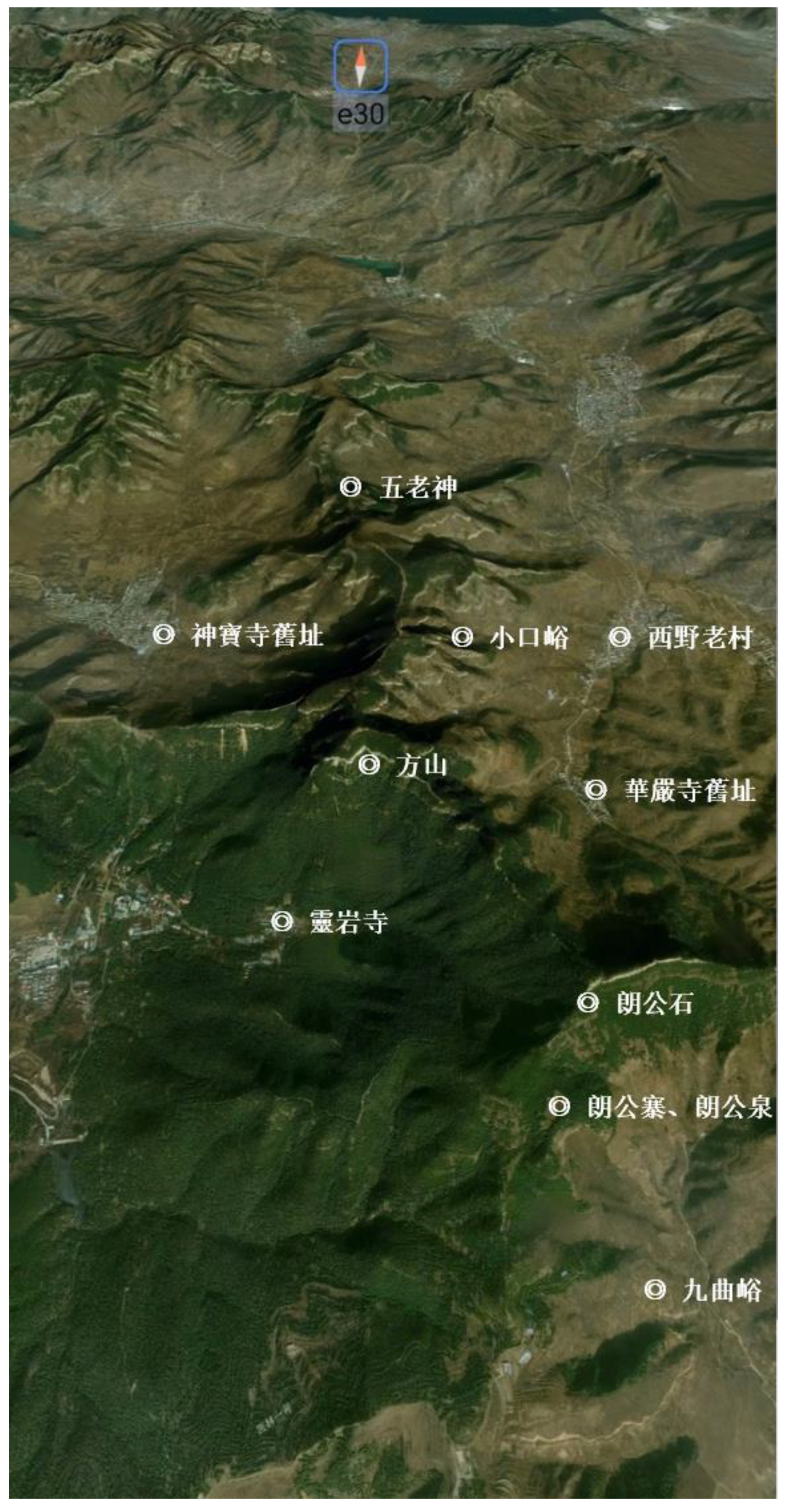
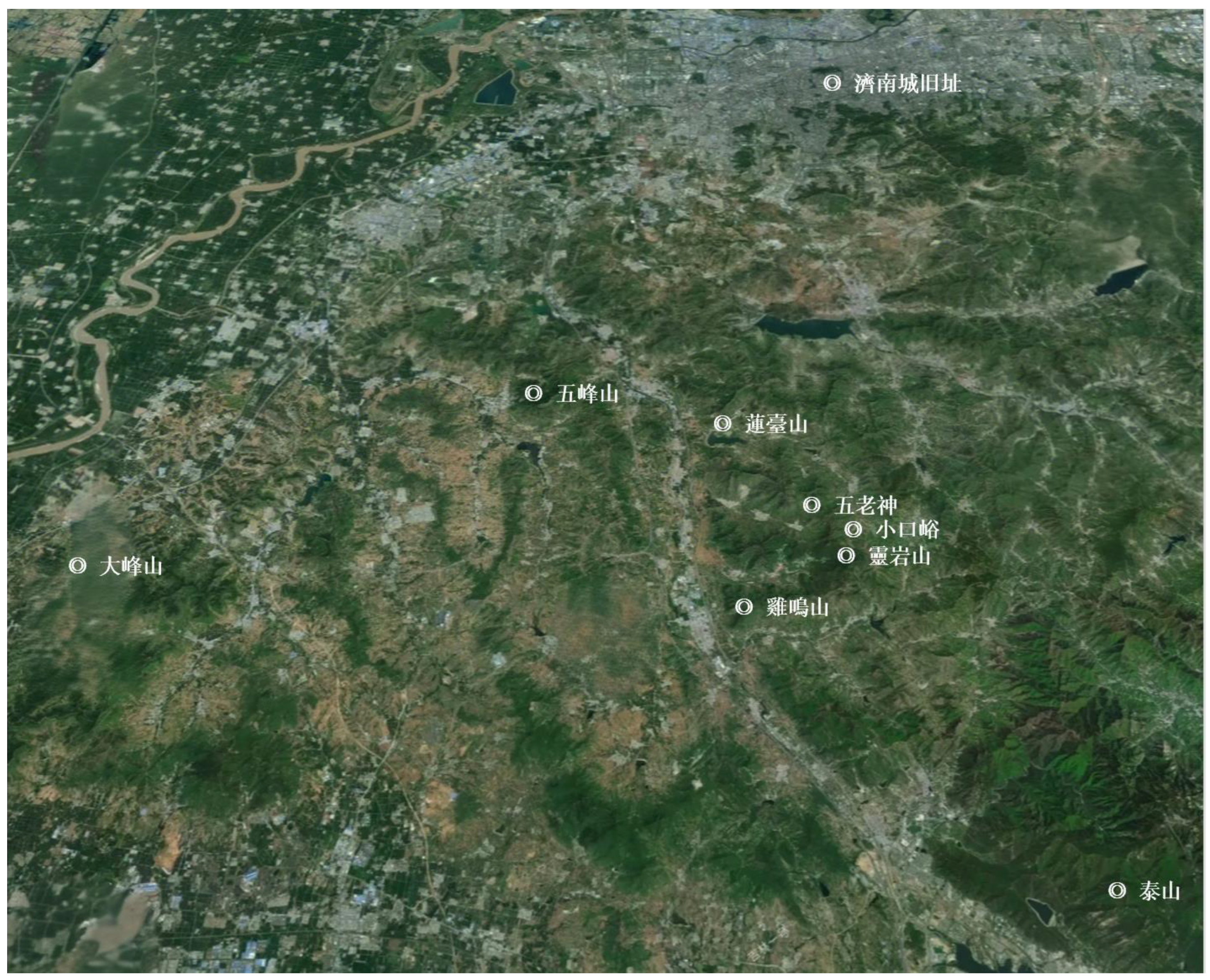
This touches upon a long-standing human-geographical debate concerning the specific location of the monastery of Seng Lang 僧朗 (fl. 4th century CE). According to the Shiliuguo Chunqiu 十六國春秋: “(Seng Lang) moved to prognosticate Mount Tai, secluding himself in the Kunlun Mountains of Jinyu Valley; hence it was called Lang Gong Valley. He formed a woodland pact with the recluse Zhang Zhong, often spending time together. (僧朗)移卜泰山,隱于金輿谷之昆侖山中,因謂之朗公谷。與隱士張忠為林下之契,每共遊處。” (Cui 1986, vol. 463, p. 684) Although based on current common knowledge, the locations of Lang’s valley 朗公谷, Jinyu Valley 金輿谷, and Jinyu Mountain 金輿山 are firmly identified as the site of Shentong Temple 神通寺, 20 kilometers northeast of Lingyan Temple, Yu Qin’s view—that West Dragon Cave Mountain (i.e., Lingyan Mountain) was Jade Talisman Mountain and Lang Gong Valley 朗公谷—was repeatedly questioned during the Qing and Republican periods (Mao et al. 2007, p. 41). This reveals the persistent challenge this alternative theory posed across different eras. To this day, no architectural remains of a monastery built by Seng Lang during the Sixteen Kingdoms period have been found at the Shentong Temple site. In contrast, Lingyan Mountain boasts a richer concentration of cultural relics named after Seng Lang, such as Lang Gong Mountain 朗公山, Lang Gong Stone 朗公石, Lang Gong Fortress 朗公寨, and Lang Gong Spring 朗公泉. These remains are concentrated on the southern edge of the Lingyan range, south of Fang Mountain. The large south-facing valley there is called Jiuqu Yu 九曲峪 today, with a stream flowing north before turning southeast. The stream below Fang Mountain flows west. It is preliminarily speculated that the Lang Gong Valley 朗公谷 mentioned by Yu Qin might refer to the Lang Gong Mountain and Jiuqu Yu area of the Lingyan range. In Figure 1, we can visually observe the specific locations of the aforementioned place names, which also helps us further understand the possible close relationship between the area surrounding Lingyan Mountain and the monastery established by Seng Lang. Therefore, the specific location of Seng Lang’s early Buddhist sites—whether in the Lingyan Mountain area or the Shentong Temple area—can still be regarded as two differing opinions regarding the of Lang Gong Valley’s location.

1.3. Corroboration from the Cave’s Material Form

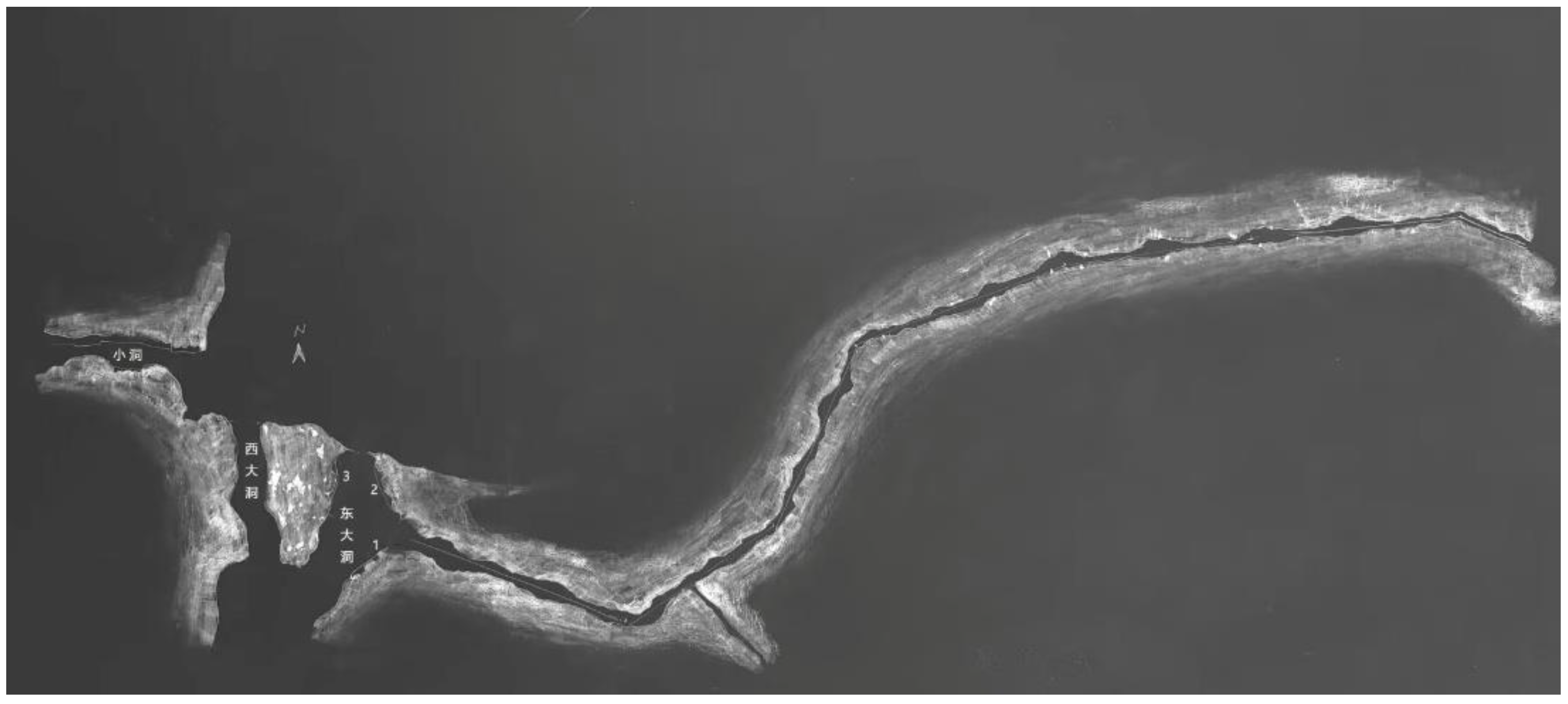
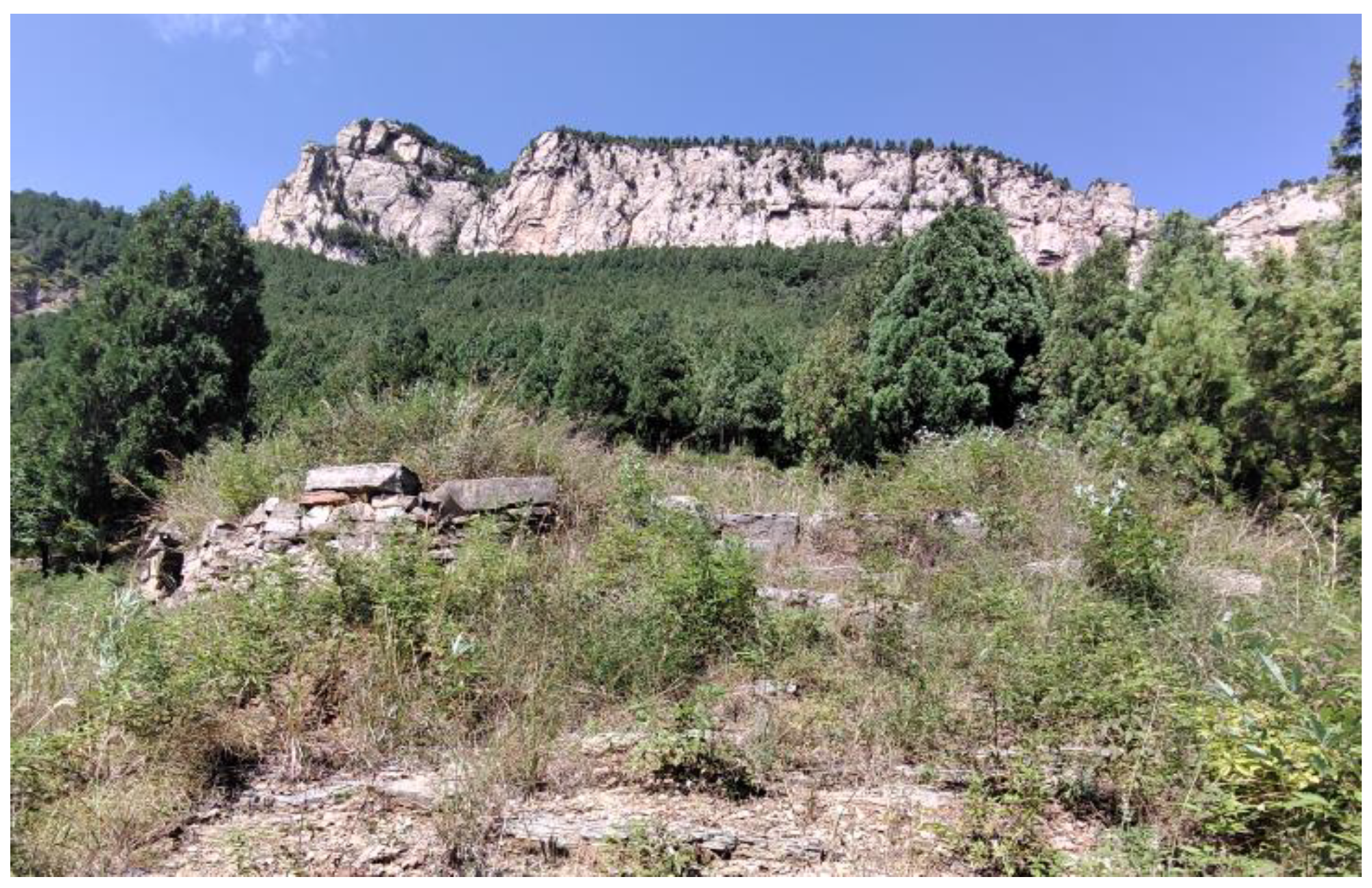
Based on Yu Qin’s description, the mountain range known geographically today as Lingyan Mountain should have been referred to collectively as “West Dragon Cave Mountain” at that time. This phenomenon of a mountain being named after its cave also occurred with “East Dragon Cave Mountain 東龍洞山,” located about thirty li southeast of Jinan 濟南. Qi Cheng, volume 1, also records this “East Dragon Cave Mountain 東龍洞山” (also known as Yu Deng Mountain 禹登山), mentioning specifically that this dragon cave “penetrates deeply for over one li; one can enter carrying torches. 透深一里許,秉火可入” (Q. Yu 2012, p. 84) Regarding this Dragon Cave Mountain 龍洞山 and its cave, the author has previously conducted in-depth investigation and specialized research on the creation of Buddhist cave temples within this natural cave during the Eastern Wei period. The basic form of the Yu Deng Mountain dragon cave (Figure 2) is a natural solutional tunnel piercing through the mountain’s core, located on the cliff face halfway up the mountain. It can be accessed by climbing an earthen slope below the rock face, although the path is gentler compared to that to Xiaokouyu Cave. The east entrance, i.e., the tunnel’s entry point, is on the eastern side of Yu Deng Mountain, facing east. A winding stone staircase leads up to it from the hillside next to the ruins of the mountain gate of the lower temple, Shousheng Monastery 壽聖院. The tunnel is 87 m long, with a width varying between 1 and 2 m, and a height between 2 and 4 m, reaching a maximum of 8.2 m. “The cave twists like a spiral shell, sometimes high, sometimes low, sometimes broad, sometimes narrow. 洞中如旋螺,或高或低,或闊或狹” (Y. Yang 2007, p. 107). It was traditionally said to have eighteen chambers, probably including the two consecutive hall-like large caverns at the western end of the tunnel. The eastern large chamber connected to the tunnel entrance is roughly rectangular, with a maximum depth of 8.9 m north–south, a maximum width of 4.9 m east–west, and a maximum height of 8.45 m. Passing through a passage on the south side of this chamber and turning north, one reaches the final western large chamber, roughly parallel to the eastern one, about 8 m deep north–south and 2 m wide. Its northern end is the north-facing exit. Both hall-like caverns were sculpted with Buddha images and developed into Buddhist cave temples during the Eastern Wei and Northern Qi periods. The entire tunnel and hall-like caverns are located in the middle section of the semi-circular mass of Yu Deng Mountain. Exiting the cave door, one can descend the mountain along the western cliff slope on the western edge of the semi-circular mountain body. The experience of entering directly through the east entrance (Figure 3) and traversing the tunnel (Figure 4), with its sense of difficulty and fear, combined with the spatial imagination of passing through the mountain’s belly, creates a strong psychological impact, often causing travelers to exaggerate the actual distance of the tunnel section. A tunnel length of only about 87 m was described as “over one li 一里許” “two or three li 二三里,” or even “eight or nine li deep 深八九里.” (Han, forthcoming).
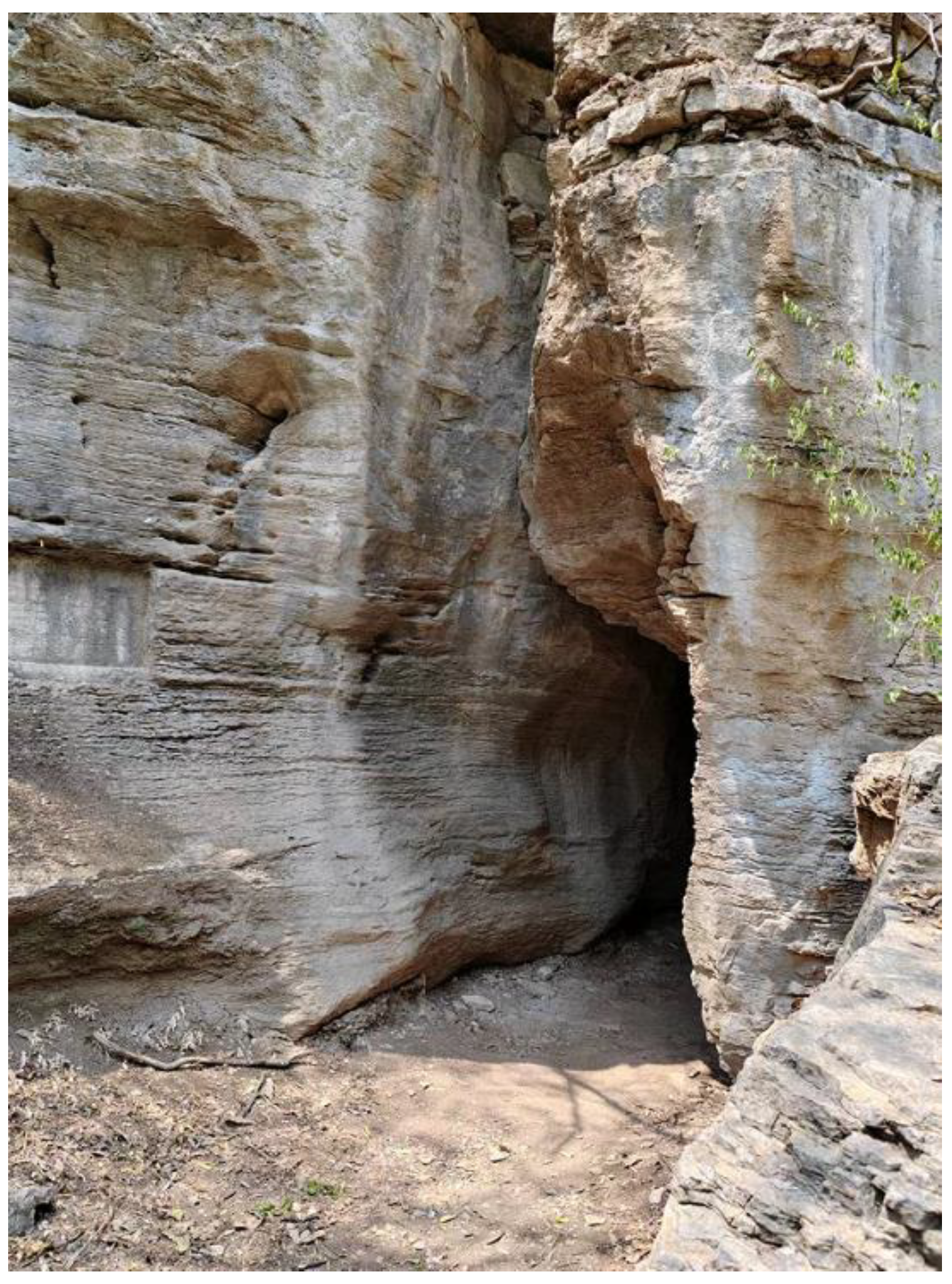
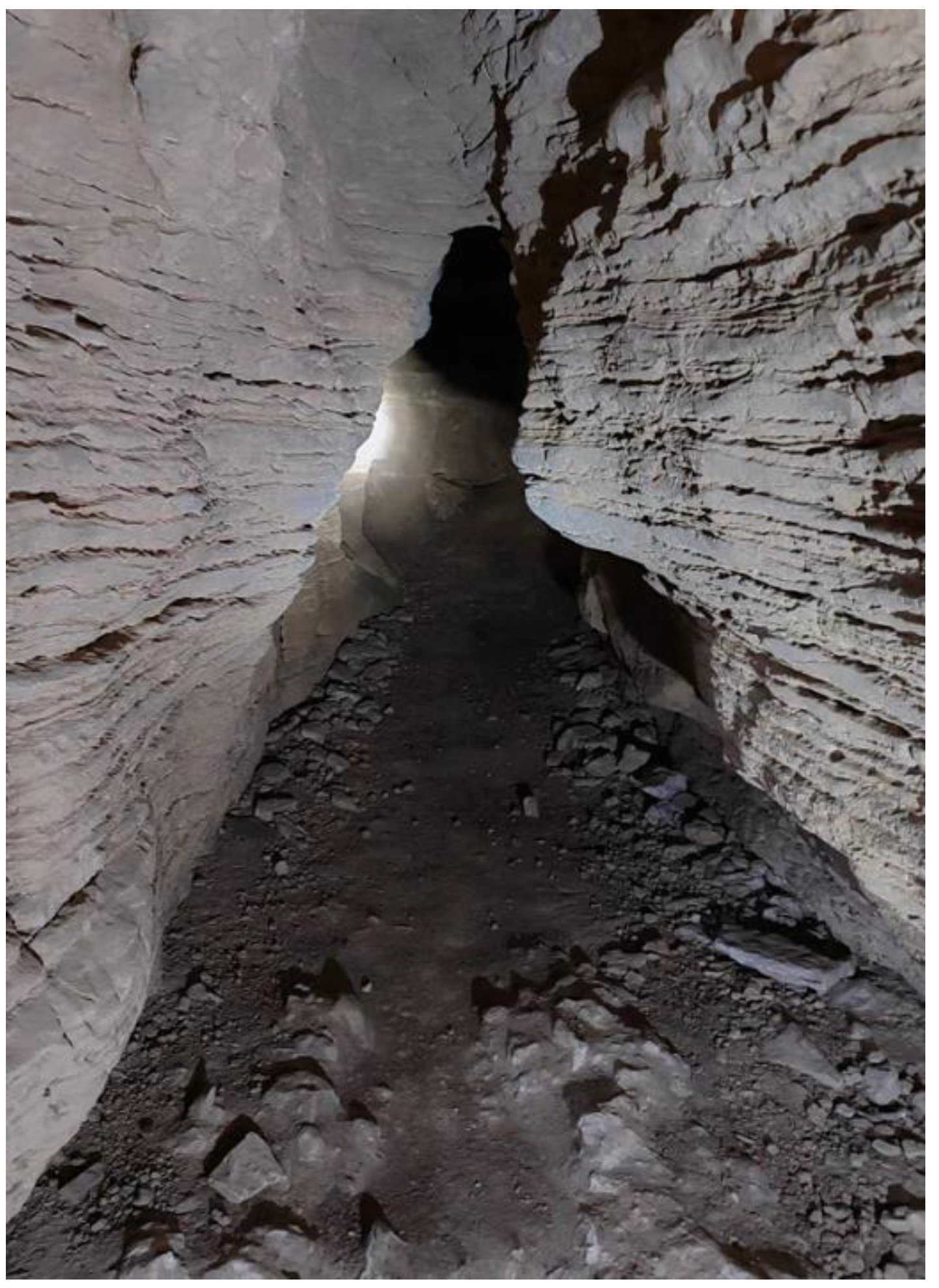
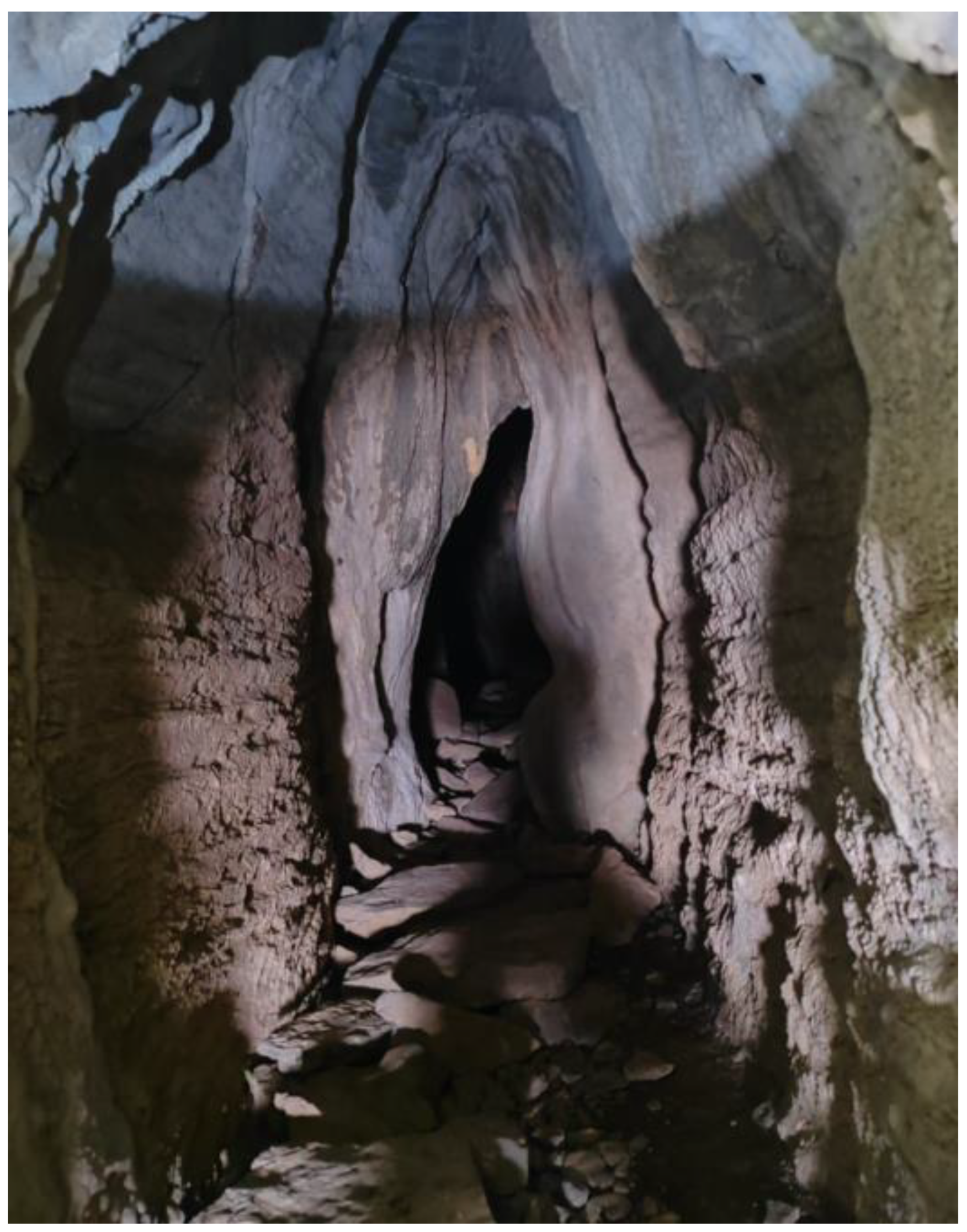
The form of Xiaokouyu Cave is very similar to that described above. Starting from the southern edge of XiYeLao and proceeding about one kilometer southwest into the valley’s interior along mountain paths, one must push through vines and thorns, climbing over several sloping terraces to reach the cave. Its location is at an altitude of approximately 500 m. Relative to XiYeLao’s altitude of about 300 m, the relative height difference is about 200 m. However, many sections of the path are narrow, steep, and easy to get lost on. Even with a villager guiding the way, the trek is extremely arduous. Villagers mostly choose to ascend in late winter or early spring when vegetation has withered. At other times, lush grasses and trees often obscure the path, and even villagers very familiar with the route find the ascent daunting. The cave entrance faces east, is nearly square, 1.7 m high and 1.22 m wide. Below it is a natural stone threshold, 1.8 m thick. Immediately north of the entrance is the cliff face, while the rock wall to the south extends slightly forward, similar to the situation at the east entrance of Yu Deng Mountain’s dragon cave. Its internal structure can also be divided into a hall-like section and a tunnel section. The natural doorframe on the north side of the entrance shows clear traces of artificial widening, likely done by local villagers seeking refuge in the cave in modern times to increase interior light. Inside the entrance is a rectangular, hall-like space (Figure 5), 3 m deep and 2.3 m wide, with a ceiling consisting of slab-like stones with a flat bottom surface, 3.5 m from the floor. Beyond this, it narrows into a tunnel, only 0.8–1.2 m wide and 2–2.5 m high, extending 48 m deep. The total length of the cave is 58 m. Moreover, just as the tunnel of Yu Deng Mountain’s dragon cave is segmented into over a dozen sections, the tunnel part of Xiaokouyu Cave can also be divided into six sections based on successive natural door-like structures, making seven sections including the front part. The description of Yu Deng Mountain’s tunnel—“groping the rocks, crouching and crawling, suddenly low, suddenly open, suddenly ascending like a tower chamber; the rocks all have swirling patterns; looking up, there are no openings; only when illuminated by torchlight can they be seen 捫石俯伏,忽卑忽敞,忽上通如樓閣,石皆迴旋紋,顧上無竅,以火燭之乃見” (Z. Liu 2007, vol. 1, p. 386)—can basically be applied to describe Xiaokouyu Cave. However, the upward openings in the swirling patterns of the latter are mostly smaller than those in the former, and the stalactitic components on the two walls and tunnel ceiling are more pronounced, exhibiting the characteristics of an early stage of karst cave development. The front hall-like section of Xiaokouyu Cave is relatively dry. After passing the vulva-shaped “Feminine Gate 牝門” about 10 m in, the interior becomes increasingly damp, and at the far end, there is a perennial drip of water. Historically, Yu Deng Mountain’s dragon cave also had spring water; moisture even often emanated from the rock walls (T. Zhang 2007, vol. 1, p. 388).
It is certain that by at least the Yuan Dynasty, both were referred to as “Dragon Caves 龍洞”, a naming likely based on their shared physical forms and characteristics. The consistency in material form and characteristics actually stems from their common geological attributes and tectonic formation mechanisms as natural solutional caves. Both belong to the Cambrian stratigraphic structure, with limestone rock. The stratigraphic profile of Lingyan Mountain is composed of limestone and shale deposited in a shallow marine environment during the early Paleozoic era. The initial formation of the dragon cave cavities was likely due to subsurface water erosion forming sinkholes and horizontal solution caves during this period. The long, narrow, low tunnel form probably corresponds to a former underground river. During later mountain-building processes, collapse debris and loess accumulation formed the steep slope from the entrance down to the ground level.
Reconnecting this with Qi Cheng’s statement that “southwest of the (West) Dragon Cave is Fang Mountain (西)龍洞西南有方山,” we can definitively confirm that the dragon cave referred to in Qi Cheng as belonging to West Dragon Cave Mountain is undoubtedly Xiaokouyu Cave. As for the Taishan Daoli Ji identifying the “Heifeng Cave 黑風洞” on Jinniu Mountain 金牛山 (also called Jinyu Mountain) near Shentong Temple as Qi Cheng’s “West Dragon Cave,” this is a clear misinterpretation. Moreover, the location of Shentong Temple lies directly south on the extended line from Yu Deng Mountain’s dragon cave; whereas Xiaokouyu Cave is located southwest of Yu Deng Mountain, making it justifiable to be called the West Dragon Cave.
The Daoist scripture Sanhuang Neimiwen 三皇內秘文 mentions three principles for Daoists selecting mountain cave abodes for immortality, concerning orientation, door height, and the prosperity of vegetation in the facing valley (DZ. 0855:18, p. 574b). Stone chambers facing due east or due south are considered beneficial for practice; those in other directions are caves gathering essences and evils. The cave door must be taller than 50 chi 尺 and less than 3 zhang 丈. Furthermore, it requires that trees and rocks in the area must be lush and moist during spring and summer; otherwise, it is not a suitable dwelling (DZ. 0855:18, p. 574b). Knowing this, both of the aforementioned dragon caves 龍洞 meet the criteria for Daoist immortal cave abodes in the mountains. This also indicates that by the Eastern Wei period, or the mid-6th century, such indigenous Daoist concepts of natural caves as sacred space had already been absorbed by Buddhism in the region and endowed with corresponding Buddhist connotations. In terms of the temporal layers of cultural relics in the Jinan 濟南 area, Zhang Zhong’s use and development of Xiaokouyu Cave as a Daoist sacred space in the early Sixteen Kingdoms period (4th century) might have been the prototype for the Buddhist appropriation of this material form of natural solutional cave for creating Buddhist cave temples in the 6th century.

1.4. Concentration of Daoist Cultural Relics in the Area and Reinterpretation of “One Cliff Northwest of Mount Tai 泰山西北之一岩

The Tang dynasty work Miscellaneous Morsels from Youyang Zazu 酉陽雜俎 contains two pre-Tang records related to Daoism on Lingyan Mountain: the legend of Huansheng 奂生 attaining immortality through cultivation on Fang Mountain, and the story of the Mingjing Cliff on Fang Mountain being lacquered shut during the Southern Yan period, causing it to lose its spiritual power: “In Jinan Commandery there is Fang Mountain. Tradition says that Huansheng attained immortality on this mountain. To the south is the Mingjing Cliff, a square rock three zhang 丈, where demons and spirits moving and hiding are clearly visible in the mirror. During the Southern Yan period, the cliff/mirror was then lacquered over. Common saying holds that the mountain spirit disliked it reflecting things, hence it was lacquered.”5 Huansheng is not found in the current Ming Dao Zang 道藏. From Duan Chengshi’s 段成式 (ca.803–863) record, it is known that he was likely a well-known immortal before and during the Tang. The story of the Mingjing Cliff 明鏡崖 is also thought-provoking. Mirrors were commonly used ritual objects in Daoism; their use is involved in later Daoist ordination, visualization, and internal alchemy practices (Huang 2022, p. 248). Ge Hong 葛洪 (284–344), a contemporary of Zhang Zhong, records in Baopuzi Neipian 抱樸子內篇 the use of mirrors for Daoists entering the mountains (DZ.1185:28, p. 236a). This shows that by the 4th century, the defensive and protective role of mirrors for Daoists practicing concentrated meditation in mountain stone chambers was already important knowledge. Examining Fang Mountain at Lingyan during the Sixteen Kingdoms period, the notion of a natural mirror stone on the southern mountain that could expose and ward off evil spirits reflects, to some extent, a strong Daoist atmosphere on the mountain at that time. The numerous stone chambers on its southern side, such as Baiyun Cave 白雲洞, Chaoyang Cave 朝陽洞, Guanyin Cave 觀音洞, and Heiyun Cave 黑雲洞, likely also hosted cultivating Daoists. The story behind the lacquering of the mirror stone might possibly involve a struggle for discursive authority between Daoism and local mountain deity cults, a point worth further discussion.
The legend of Huansheng achieving immortality on Fang Mountain might have been an important attraction for Daoists like Zhang Zhong to come and practice in nearby mountain stone chambers. While early Daoist practice caves or temple sites around Fang Mountain cannot be traced back now, those dating to the Yuan, Ming, and Qing periods include the Mayi Cave 麻衣洞 and Yuhuang Hall 玉皇殿 on Jiming Mountain 雞鳴山 (Nie 1968, p. 158), and the Yuhuang Hall 玉皇殿 in Jingmo Valley 靜默谷. Jiming Mountain 雞鳴山, traditionally seen as the gateway to Lingyan Temple, is located about 6 km southwest of Xiaokouyu.
It is important to note that when we appropriately enlarge our perspective and geographical scale, we find that other Daoist-related cultural relics in the adjacent area reflect that the region from northwest of Lingyan’s Fang Mountain to Liantai Mountain 蓮台山 and Wufeng Mountain 五峰山 had long been a concentrated area of Daoist culture around Jinan, attracting not only Daoists for cultivation but also often featuring altars 壇 chosen by them.
About 1000 m in a straight line to the northwest (slightly west of north) of Xiaokouyu, there are five mountain rocks standing atop the mountain peak, visible from the summit of Xiaokouyu. These rocks have retained the name “Five Elders Deities 五老神” to this day, though the local people remain unaware of its origin. The “Five Elders Deities” refer to the “Five Elders Sovereigns 五老帝君” in the ancient Lingbao Scriptures 古靈寶經 (C. Wang 2006), also known as the “Primordial Five Elders 元始五老”. They evolved from the Five Heavenly Emperors of the Han Dynasty’s Chenwei 讖緯 traditions, drawing parallels between the Five Heavenly Emperors 五方天帝 and Taiyi 太一. The Lingbao Taoism further created a relationship between the Five Elders 五老 and the Yuanshi Tianzun 元始天尊, with one theory suggesting that the Five Elders were transformations of the Yuanshi Tianwang. The author believes that the association of the mountain rock formations with the Five Elders 五老 roughly carries two layers of meaning: first, it stems from the imaginative projection of the “Five Elders Paving the Way 五老啟途”; second, it reflects the purpose of Daoist practitioners in establishing the Five Elders as exemplars of attaining immortality through Daoist cultivation. The phrase “Five Elders Paving the Way 五老啟途”, commonly found in pre-Tang Lingbao 靈寶 and Shangqing 上清 Daoist scriptures, indicates that whenever figures such as the Yuanshi Tianzun 元始天尊 or the Three Primordial Sovereigns 三元君 went on excursions, ascended, or descended to the divine realm, the Five Elders 五老 would lead the way (DZ.1313:33, p. 381a). Thus, being the first to see the Five Elders would allow one to anticipate the rest of the procession. Furthermore, Wang Chengwen 王承文 argues that the citation from Yiqie Daojing Yinyi Miaomen Youqi 一切道經音義妙門由起, which quotes from the Lingbao Zhenwen Duren Benxing Jing 靈寶真文度人本行經, represents lost text from the Duren Benxing Jing 度人本行經. This emphasizes that the incarnation of the Primordial Five Elders 元始五老 as humans was intended to set an example of diligent Daoist cultivation for the world (C. Wang 2018, vol. 2). Additionally, from this naming event, we can also draw inspiration: while naming the stone peaks atop the mountain as the Five Elders was undoubtedly based on the “visual imagination” of the rock formations’ shapes (Harrist 2003, pp. 39–45), it may represent an earlier visual cultural event compared to the naming of the Langgong Stone 朗公石 on the summit of the southern valley adjacent to it (Figure 6). Consequently, this provides us with a deeper understanding of the pre-Tang Daoist cultivation atmosphere in this region.
In addition, regarding Taoist relics in the surrounding areas, there is Liantai Mountain 蓮臺山 located 8 km away in a straight line to the northwest of Xiaokouyu;6 northwest of Xiaokouyu, about 15 km linear distance, is Wufeng Mountain 五峰山;7 west of Xiaokouyu, about 32 km away, is Dafeng Mountain 大峰山.8 Even considering the entire modern administrative area of Jinan City, the concentration of famous Daoist mountains with such dense Daoist landscape features from the Lingyan range to Liantai 蓮台, Wufeng 五峰, and Dafeng 大峰 mountains is unique. This reflects the long-standing, rich Daoist atmosphere in this region. Furthermore, starting from Xiaokouyu Mountain and Fang Mountain, the center of Daoist activity in the Changqing area shows a trend of gradually shifting northwestward over time (Figure 7). As early as the Yuan dynasty, Du Renjie 杜仁杰, in his Zhangshan Dongxu Guan Ji 張山洞虛觀記 (Record of the Zhangshan Dongxu Abbey), discussed the lushness and beauty of the northern shade of Mount Tai (Z. Zhang 2020, p. 377), suggesting this might have been the basic reason for Zhang Zhong and Seng Lang to choose the “one cliff northwest of Mount Tai 泰山西北之一岩” for cultivation during the Sixteen Kingdoms period. The Daoist and Daoist cultural inclination towards the feminine (yin 陰) might also have been a reason for Zhang Zhong’s choice of a stone chamber on the mountain’s shady side. Moreover, the cave faces east, the direction of Zhen 震, associated with life, a direction favored in Daoism. More crucially, from the perspective of the Later Heaven 八卦 (Eight Trigrams) arrangement, the northwest is the direction of Qian 乾/Heaven. The tendency from the main peak of Mount Tai to Fang Mountain, Liantai Mountain 蓮臺山, Wufeng Mountain, and Dafeng Mountain depends on this mode of thinking that emphasizes the Qian 乾 direction.
Furthermore, we may even speculate: when Daoist practitioners used natural rock caverns as entrances to the Grotto-Heavens 洞天, did they regard the caves around Fang Mountain, northwest of Mount Tai’s main peak, as entry points into Mount Tai’s Pengxuan Grotto-Heaven 蓬玄洞天? Moreover, could there be some connection between the name “Gongzi Peak,” the summit of Fang Mountain at Lingyan, and the governing deity 治神 of the Pengxuan Grotto-Heaven 蓬玄洞天, the “Shantu Gongzi 山图公子”?

1.5. Daoist Cultural Connotations of the Names “Jinyu Mountain” and “Yufu Mountain”

The American art historian Robert E. Harrist Jr. has specifically discussed the logic of “visual imagination” and naming of mountain rocks in Chinese mountain culture (Harrist 2003, pp. 39–45). From the perspective of the region’s imagined role as the Daoist Qian 乾/Heaven and its actually rich Daoist atmosphere, we might re-examine the cultural connotations of “Jinyu Valley” and “Jade Talisman Mountain” within a Daoist context, and the specific visual logic behind their “visual imagination” based on rock formations.
Searching pre-Tang Daoist scriptures, we find that “Jinyu 金輿 (Golden chariots)” invariably refers to the cloud-chariots 雲車 or divine vehicles ridden by celestial beings:
Golden chariots with jade wheels, and phoenix-drawn carriages sway gracefully. 金輿瓊輪,鳳軒婆娑。 (DZ.1373:34, p. 18c).
I wish to join the Central Supreme Emperor Daojun and his consort in riding the eight-scenery golden chariot, ascending to the Shangqing Palace.9
Celestial beings of great virtue, supreme sages of high esteem, exalted practitioners of subtle ways, the Supreme Consort Yuanjun of the Guanghan Upper Palace, imperial concubines and celestial officials, radiant golden boys and shimmering jade maidens, along with countless other beings, arrive through the air. Against a backdrop of pure clouds and jade skies, golden chariots with jade wheels, adorned with plumage-covered canopies casting shade, emit a stream of jade-like radiance. The vast and splendid colors fill the expanse of space, illuminating the celestial realm.10
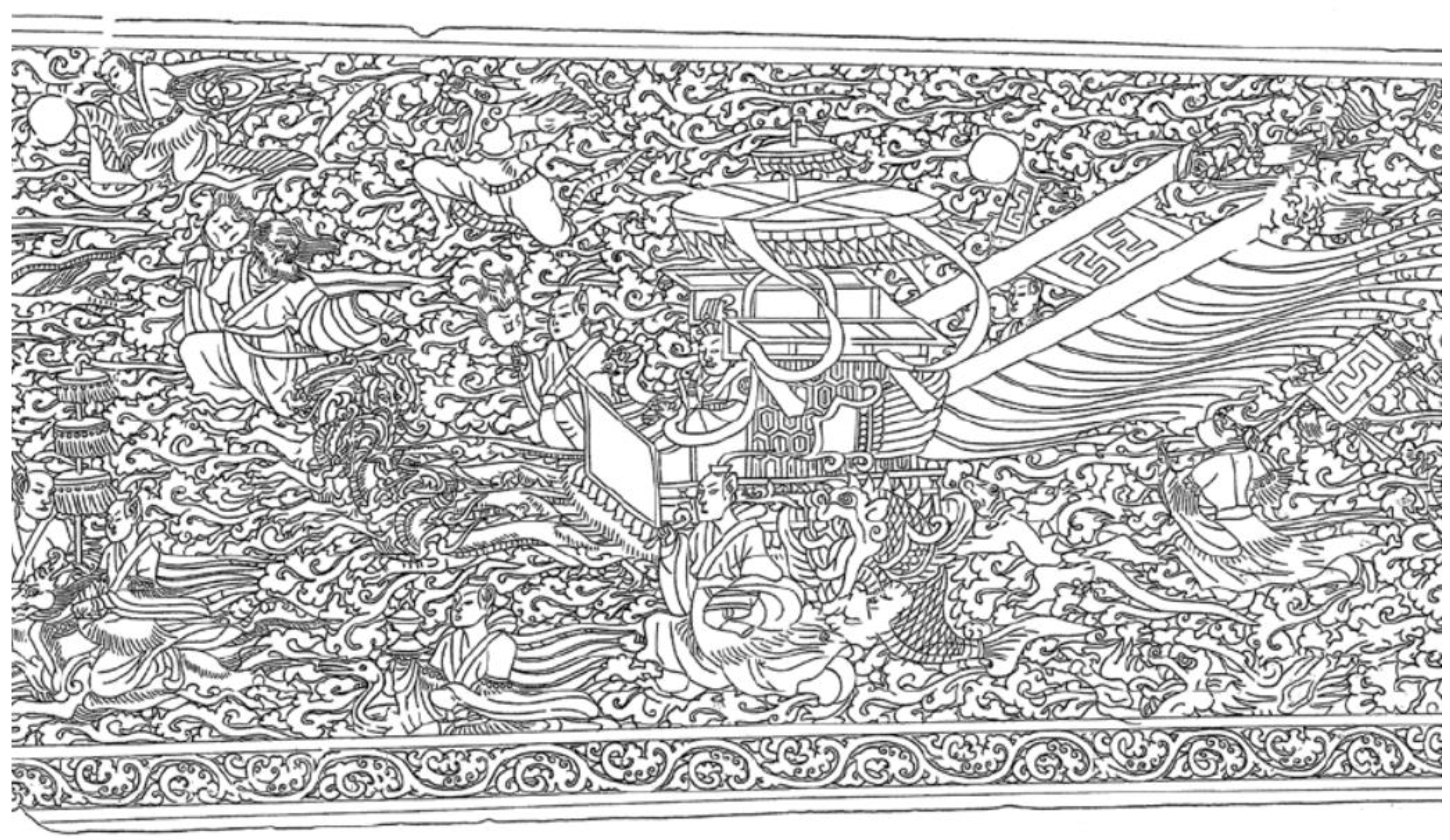
Images of cloud chariots 雲車 drawn by dragons and phoenixes have persisted from the Western Han Dynasty through the early Tang Dynasty. Cloud chariots 雲車 were also a prevalent concept in the general belief system regarding celestial beings’ vehicles during this timeframe. It can be said that the concept and imagery of cloud chariots 雲車 evolved from indigenous Chinese beliefs and visual representations within Daoism. Related remnants can be found in Dunhuang 敦煌 murals, Maijishan 麥積山 murals, and stone coffin paintings from Sui and Tang Dynasty tombs (Tanaka 2003). The name “golden chariot 金輿” likely derives from the expression of the Han and Wei Dynasties’ imperial golden-rooted chariot 金根車, which Images drawn by six dragons and four dragons respectively appear in the “The Painting of Ode to the Luoshen Goddess 洛神賦圖” and the stone coffin painting from the Sui Dynasty’s Shuicun 稅村 Tomb (Figure 8). The nomenclature of these imperial-grade carriages thus contributed to the concept of celestial “golden chariots 金輿”. Figure 8 is the Shuicun Tomb murals that even depict the image of an elder leading the way and a jade-like youth 玉郎 assisting. This also reflects the widespread and deeply ingrained dissemination of such visual culture in the indigenous context. The cloud chariots 雲車 soaring through the celestial realm are led by the Five Elders 五老 and accompanied by numerous deities, and should also be drawn by six or four dragons. The Lingbao Scriptures 靈寶經 even describe a grand procession of divine beings: “All riding on auspicious clouds, with crimson carriages and azure chariots, adorned with floral canopies and ornate wheels, drawn by yellow phoenixes and five-colored golden dragons. They bear the banners of Taiyi, with the flags of primordial essence fluttering ahead, accompanied by the roars of mythical beasts and the harmonious songs of phoenixes and cranes. Lions and mythical creatures ward off evil, singing and chanting in unison. The Five Elders lead the way, while a multitude of immortals flank the carriage. Countless chariots and riders float through the air.”11 In Daoist scriptures from the Song Dynasty and beyond, such as the “Yulu Zidu Zaochao Yi 玉籙資度早朝儀”, it is still stated: “The golden chariot with plumage-covered canopy ascends through the clear void to the realm of the Great Brahma; with the grace of phoenixes and the elegance of orioles, it steps onto the jade-like flowers to ascend to the paradise of Langyuan.”12
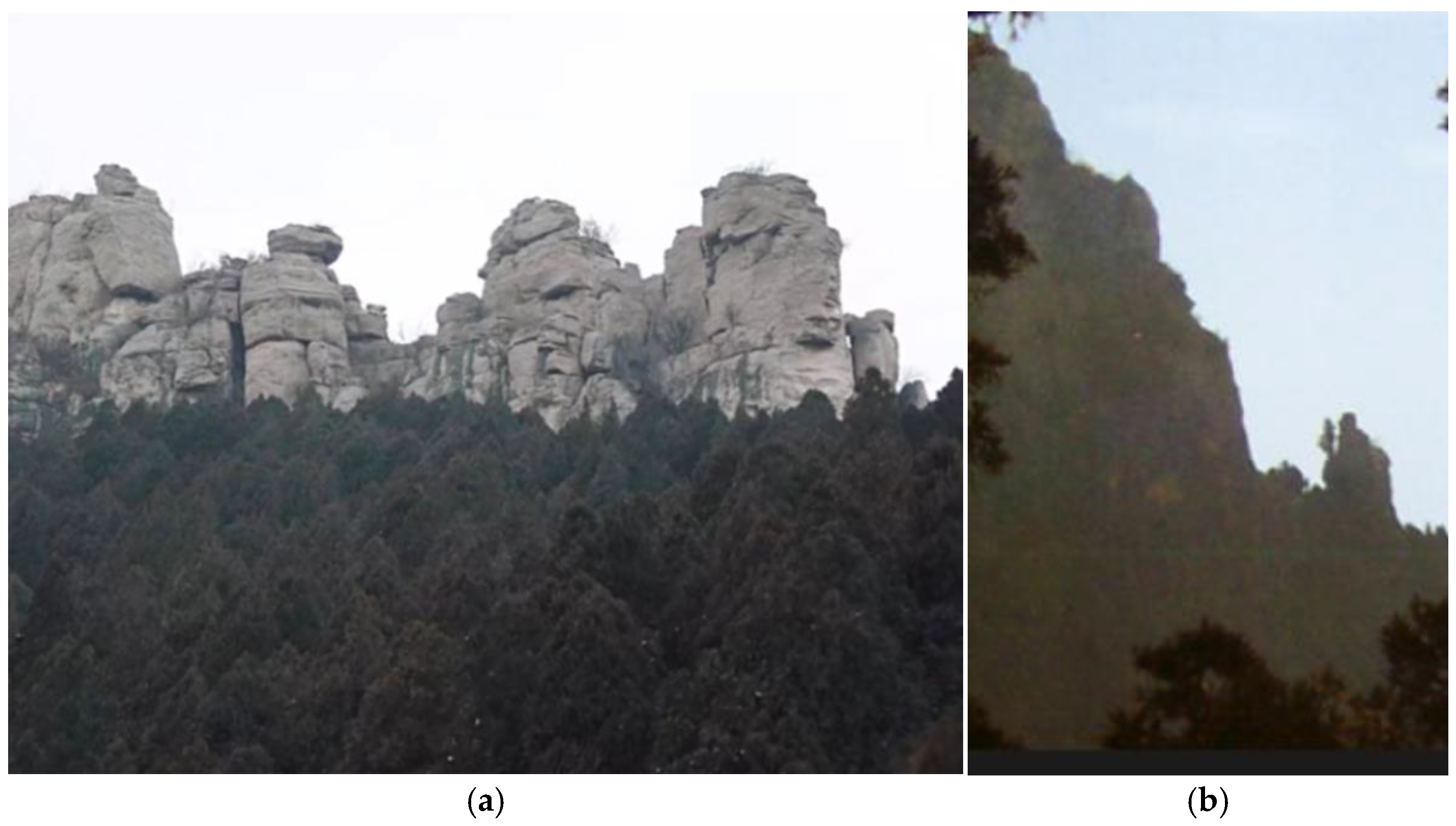
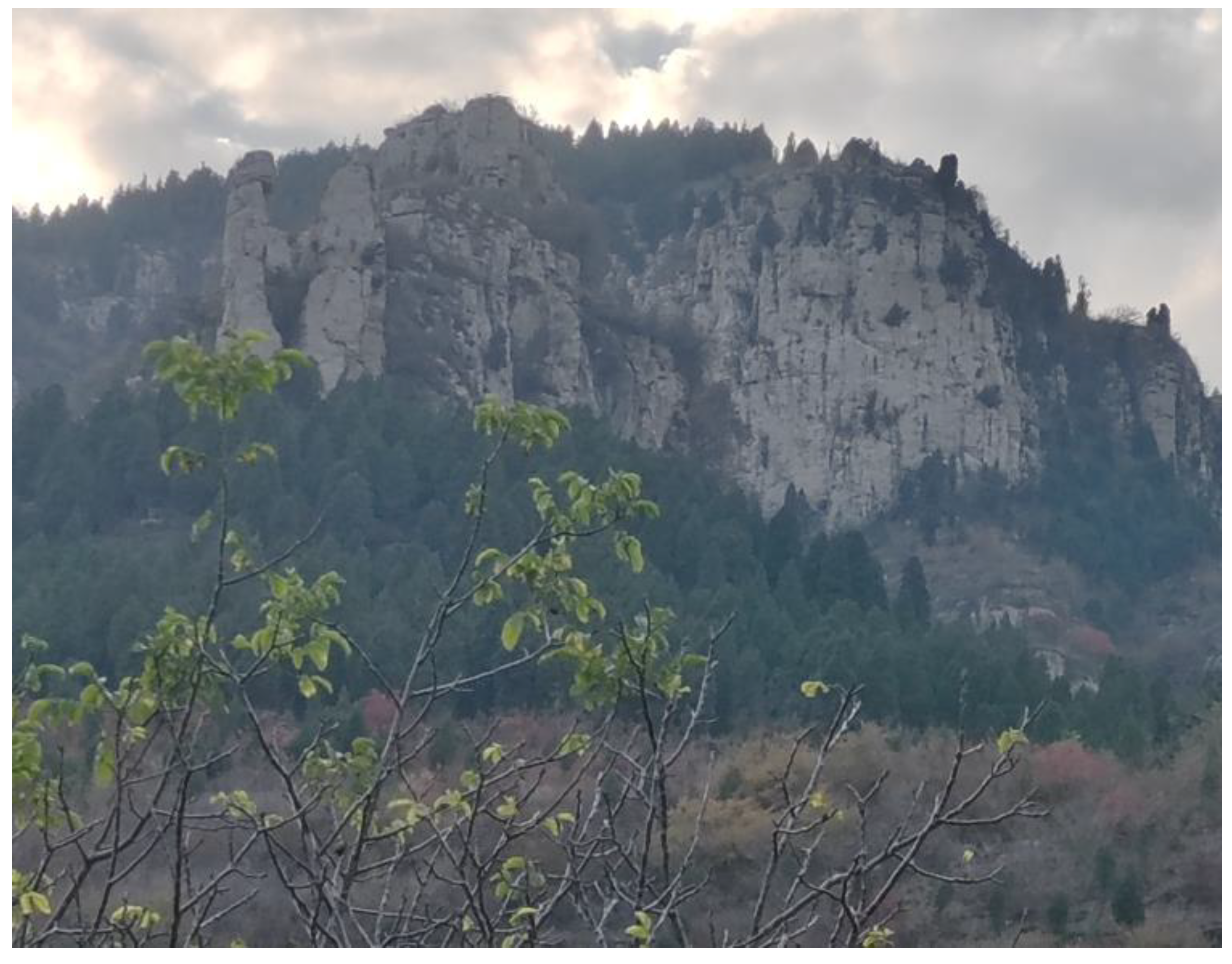
Therefore, we can return to the logical framework underlying the visual imagination of mountainous landscapes, such as those associated with Langgong Stone and the Five Elders deities. On the eastern edge of the mountain ranges flanking Xiaokouyu, there are pairs of rock formations resembling dragon horns. The one on the northern mountain is now known as “Yangjiao Stone 羊角石”, while the one on the southern mountain is even larger and visible from afar at the foot of the mountain (Figure 9), though its name has been lost. From a side view, it resembles a colossal dragon raising its neck and lowering its head. Paired with the immortal cave facing due east, the U-shaped valley enclosed by three stone walls may more closely resemble the wheelless carriage imagined in visual terms. If, as suggested by Yu Qin, Xilongdong Mountain indeed corresponded to Jinyu Mountain during the Sixteen Kingdoms period, then the mountain with dragon horn markers on either side of Xiaokouyu may more closely resemble the form characteristics of the celestial beings’ carriage believed in at that time than Fangshan or Langgong Mountain. We might even view the western mountain’s extended wings as the two ceremonial pikes and banners behind the golden chariots 金輿. Once these mountainous visual features are linked with indigenous Daoist imagery of the time and used to construct visual culture within a Daoist context, it becomes natural to create a mountainous visual cultural landscape of celestial carriages drawn by pairs, four, or six dragons. The establishment of this series of visual logics implies that the dragon horn formations on the flanks of Xiaokouyu represent the six dragons drawing the golden chariot 金輿, while the Five Elders 五老 mentioned earlier are the assisting immortals on the right side of the carriage, with the entire mountainous landscape symbolizing the ascent and soaring of the golden chariot 金輿 in the sky.
Following this logic, Xiaokouyu Cave being called “Dragon Cave 龍洞” may also be related to this. The name “Dragon Cave 龍洞” has spread widely across China, making it nearly impossible to count. Notably, records of the name “Dragon Cave 龍洞” date back to the transition between the Western Jin and Eastern Jin Dynasties (Han, forthcoming). The emergence of “Jinyu Mountain” and mountainous features with dragon horn visual characteristics allows us to re-examine the connotations of Xiaokouyu’s “Xilongdong”. Moreover, its naming likely originated as early as the Sixteen Kingdoms period and has been passed down until the Yuan Dynasty. In this reasoning, we have also provided an alternative option for the unresolved mystery regarding the location of Seng Lang’s residence. However, even if Seng Lang’s Langgong Valley was situated on “Xilongdong Mountain,” this golden chariot mountain, the question of whether its specific location corresponds to the current sites named Langgongzhai and Langgong Spring on Lingyan Mountain 靈岩山 remains to be further explored.
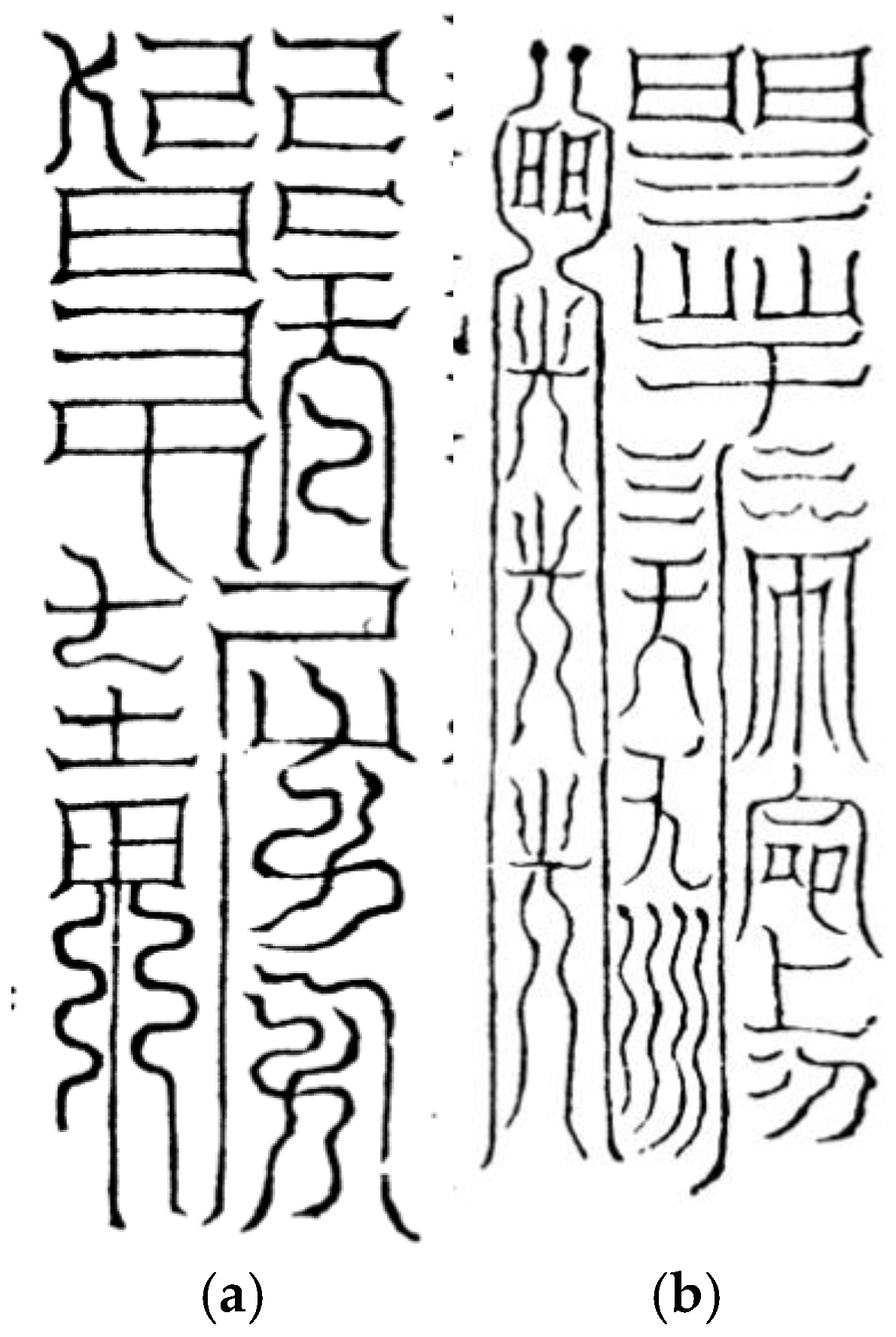
While adding new Daoist elements to the Daoist context of Lingyan Mountain and its surroundings, we also find that the name “Yufu Mountain” similarly carries Daoist connotations. Yufu 玉符 is a type of Daoist talismanic diagram (Figure 10), similar to the Lingbao Five Talismans 靈寶五符, which can be written in five colors on silk. Some can also be placed under the feet or buried beneath doorways for use (DZ.1365:33, p. 807c). In the “Wushang Miyao 無上秘要”, which quotes the “Dongzhen Qionggong Lingfei Liujia Jing 洞真瓊宮靈飛六甲經”, the five-colored, five-spirit jade talismans are also held as sacred objects by the five Upper Qing Emperor Jun 上清帝君 (DZ.1138:25, p. 39a). If one were to force an interpretation, the horizontal striped mountain rocks on the southernmost peak of Lingyan Mountain’s Langgong Mountain section (Figure 11), the horizontal striped mountain rocks on the southern peak of Fangshan, and the horizontal striped mountain rocks known as the “Stone Great Wall 石長城” on the northwestern peak of Beiyu 北峪could all be potentially associated with the Daoist “Yufu 玉符”.
The “Yunji Qiqian 雲笈七簽” records a type of Eight Efflorescences divine true jade talisman 八景神真玉符 used for cultivating immortality: “The eight-scenery divine true jade talisman, composed of the natural qi of the Shangyuan Cave Heaven, governs the Eight Efflorescences of the upper part, stationed within the Shangyuan Palace of the human body. After wearing it for eight years, the Eight Efflorescences will manifest. One will then have attained a profound understanding of subtle matters, perceive nature intuitively, be able to sit and stand at will, summon celestial beings, and ascend to the celestial realm in broad daylight, accompanied by thousands of chariots and riders, cloud chariots with plumage-covered canopies.”13 The “Dongxuan Lingbao Ershisi Shengtu Jing 洞玄靈寶二十四生圖經” (Scripture of the Twenty-Four Birth Images of Dongxuan Lingbao) also presents another system of Eight Efflorescences jade talismans 八景玉符 (DZ1407:34, p. 339b). The Eight Efflorescences 八景 are the eight different types of cloud-qi chariots 雲氣車 imagined in Daoism, often representing the celestial beings’ mounts that can be visualized 存想 during different seasons. The Eight Efflorescences jade talismans 八景玉符 provided in various Daoist scriptures from the Six Dynasties 六朝 period are all important talismans that help Daoist practitioners summon celestial cloud chariots雲車 to welcome them. Therefore, the imagery of “Yufu 玉符” and “Jinyu 金輿” may both be crucial links in establishing the connection between a Daoist practitioner’s individual activities of entering mountains for cultivation and achieving immortality by ascending to the celestial realm.
Undoubtedly, once the visual cultural associations between the imagery of dragons drawing chariots and celestial palace chariots, along with other imagery such as “the Five Elders Leading the Way 五老啟途” “jade talismans 玉符” and “golden carriages 金輿” are established in relation to the mountainous landscape, the stone chamber practice in Xiaokouyu Cave can serve as the most direct symbolic method for mortals seeking immortality to enter the divine chariots through the principle of similarity and ascend to the heavens alongside the immortals. During on-site experiences, sitting on the stone platform at the entrance of Xiaokouyu Cave and gazing northeastward towards the valley mouth is precisely akin to sitting inside the colossal compartment of a carriage (Figure 12). The distant mountain directly ahead, known as Loutai Mountain 樓臺山. If possible, one might interpret it as the destination of flight, a metaphorical heavenly palace pavilion.

2. The Material Characteristics of Xiaokouyu Cave and Their Connection to Daoism

The earliest biography of Zhang Zhong comes from the Shiliuguo Chunqiu·Qin Lu 10 十六國春秋·秦錄十 compiled by Cui Hong 崔鴻 (478–525) of the Northern Wei:
Zhang Zhong, styled Juhe, was a native of Zhongshan. During the turmoil of the Yongjia period (307–313 AD), he retreated into seclusion in Mount Tai. He was tranquil and indifferent to worldly desires, adhering to the practices of Daoist self-cultivation by consuming qi in a state of emptiness and purity, partaking of ganoderma mushrooms and mineral elixirs, and following methods of spiritual nourishment. In winter, he wore a coarse quilted robe, and in summer, he tied himself with a rope. Sitting upright like a corpse, he had no comforts of zithers or books, nor did he engage in the promotion of classical teachings. Instead, he took the Supreme Dao and the principle of emptiness and nothingness as his guiding principles. He resided by towering cliffs and secluded valleys, excavating the earth to create cave dwellings. His disciples also lived in similar cave chambers, spaced about sixty paces apart. They would gather once every five days, and his teachings were conveyed through bodily gestures rather than words. When disciples received instruction, they would observe his form and then withdraw. A Daoist altar was erected above the cave, and every morning, he would pay homage to it. He used earthenware vessels for eating and carved stones into cauldrons. To this day, the people of Mount Tai still emulate his practices. When neighbors or residents nearby offered him clothing or food, he accepted none of it. Some eager young men inquired about omens of floods or droughts, to which Zhong replied, “The heavens do not speak, yet the four seasons proceed, and all things flourish. Matters of yin and yang are beyond the knowledge of a reclusive hermit in the mountains.” His detachment from external affairs was evident in all such matters. Despite reaching an advanced age of a hundred years, his sight and hearing remained unimpaired.
The ruler Qin Jian dispatched an envoy to summon him. When the envoy arrived, Zhong bathed and rose, saying to his disciples, “I have few years remaining and cannot go against the will of the ruler.” After bathing, he boarded the carriage and traveled to Chang’an. Jian bestowed upon him clothing and a hat, but Zhong declined, saying, “My hair is thin and my years are advanced; I am unworthy of wearing a hat and formal attire. Please allow me to present myself in rustic garments.” Jian granted his request. Upon meeting Jian, Zhong was addressed as follows: “Sir, you have retired to the mountains and forests, dedicating yourself to the study of the Dao. While your virtue in cultivating personal excellence is abundant, your contributions to benefiting others are lacking. Therefore, I have humbly sought your presence, intending to entrust you with a position akin to that of the Duke of Qi (Jiang Ziya 姜子牙).” Zhong replied, “In the past, due to the chaos of war, I sought refuge in Mount Tai, living alongside birds and beasts to preserve my life from day to day. Had I lived in the age of Yao and Shun, I would have longed to serve the sage ruler. Now, with my age advanced and my aspirations faded, I am unfit to render service. The role of the Duke of Qi is not one I dare to assume. My nature is suited to the mountains and forests, and my heart yearns for the cliffs and peaks. I beg to be allowed to spend my remaining years and return to die in Mount Tai.” Jian sent him back in a comfortable carriage. As he traveled to Huayin Mountain, Zhong sighed, saying, “I, a Daoist priest of the Eastern Peak, shall die at the Western Peak. Such is fate—what can be done?” After traveling fifty li, he reached the pass and passed away. The envoy quickly sent a messenger to report this to Jian, who dispatched the Huangmen Shilang Wei Hua with an imperial edict to conduct a funeral rite, offering sacrifices with a full bovine offering, bestowing an official robe as a posthumous honor, and granting the posthumous title of “Gentleman of Tranquil Dao.”14
Ge Hong, a contemporary of Zhang Zhong, stated in his Baopuzi Neipian 抱檏子内篇》that “When Daoist priests dwell in the mountains, they take shelter among rocks and caves; it is not necessary to have the warmth of richly decorated surroundings.“15 Essentially, during the Northern Dynasties period of the Six Dynasties, mountain-dwelling Daoist priests in the north mostly chose stone chambers as intermediary places for their pursuit of longevity and immortality. This should be considered part of the secretive master-disciple tradition of the Taoism of the Immortals, which was distinct from the group missionary work of other Daoist sects (Eskildsen 1998; Yoshikawa 1984, pp. 425–61). This tradition of individual self-cultivation for immortality is often referred to as “xiandao 僊道”, or “the way of transcendence’” in classical texts (Campany 2015). Chinese and Japanese scholars call it “The Taoism of the Immortals” or “Shenxian Dao 神僊道” (Yamada 1990 Hu 1989). Some scholars, therefore, argue that the mountain-dwelling practices of Daoist priests of the Taoism of the Immortals during this period were akin to asceticism but not strictly asceticism. This view is based on a comparison with the ascetic practices of Christianity and Buddhism and is perhaps still open to debate (Q. Sun 2024, vol. 15, 83, p. 183). Sun Qi 孫齊 also mentions the mountain-dwelling of Daoist priests recorded in Shui Jing Zhu 水經注, noting that “northern ascetics largely lived in stone chambers, while their southern counterparts mostly constructed temple buildings” (Q. Sun 2024). I believe that the perception that northern Daoists primarily resided in stone chambers and southern Daoists in temple buildings may be somewhat biased. Tao Hongjing 陶弘景 (456–536), in his annotations to Zhen Gao 真誥, even went so far as to suggest that the construction of thatched huts on Maoshan Mountain was a choice out of necessity due to the absence of suitable grottoes (DZ.1016:20, p. 569). If we do not confine ourselves to a single textual record, we can still find traces and examples of early Daoist priests residing in mountain stone chambers across the vast southern regions of China. I believe that during this period, the concept of mountain-dwelling among southern Daoist priests of the Taoism of the Immortals was largely similar to that of their northern counterparts, with a preference for stone chambers and grottoes as superior places for cultivation, while also showing a tendency to combine or substitute huts and cave dwellings.
This indigenous practice of dwelling in rock caves and mountains even influenced Buddhist monks of the same period. The Biographies of Eminent Monks: Meditation 高僧传·习禅 records numerous instances of eminent monks engaging in “meditation in stone chambers.” Similarly, Shui Jing Zhu 水經注 extensively documents cases where certain mountain grottoes were inhabited by immortal recluses or divine beings. Consequently, stone chambers came to embody religious sanctity, serving as repositories for divine scriptures, dwelling places for immortals, and sites for spiritual cultivation and meditation. This also illustrates that the sacred significance of natural caves in mountainous regions within the tradition of the Taoism of the Immortals was, in fact, the true motivation behind Daoist priests choosing stone chambers and grottoes as their cultivation sites.
Up to this point, based on the preceding analysis, there are six pieces of evidence in total: 1. Confirmation in the literature since the Ming and Qing dynasties; 2. The West Dragon Cave recorded in the Yuan dynasty literature is indeed this cave, which is closely associated with the locations where the stories of Seng Lang and Zhang Zhong took place; 3. This cave shares similar physical characteristics with the East Wei Buddhist grotto in Jinan, also known as the “Dragon Cave,” which can corroborate that by at least the East Wei period, such caves could serve as sacred spaces. Moreover, both conform to the principles outlined in Sanhuang Neimiwen for Taoist practitioners selecting mountainous immortal abodes; 4. Pre-Tang dynasty records related to Taoism on Lingyan Mountain indicate the existence of early Taoist activities in the surrounding area. As the “northwestern rock of Mount Tai,” its northwest Qian (heaven) connotation continuously attracted Taoist practitioners to reside and practice in the vicinity, forming a special gathering area for Taoism throughout the generations in the entire Jinan region. This fully demonstrates the enduring recognition of the importance of its relative position to Mount Tai in the Taoist context; 5. Through the shaping logic of indigenous mountain visual imagination, the “Golden Chariot” imagery in Xiaokouyu can be more fully narratively constructed through visual imaginations such as the carriage, dragon horns, and Five Elders deities of nearby mountains, thereby enabling a complete interpretation of the location where the stories of Seng Lang and Zhang Zhong took place—Jinyu Valley—within a fully Taoist context; 6. The tradition of stone chambers for mountain-dwelling Taoist priests in the Northern Dynasties.
Therefore, it can be sufficiently inferred that this stone chamber, once known as the “West Dragon Cave” during the Yuan dynasty, holds extraordinary significance within the Taoist context of the Mount Tai periphery and meets the conditions for Taoist selection of mountain cave abodes for immortality. By at least the East Wei period, there were only two such “Dragon Cave” sacred spaces with these physical characteristics on the northern slopes of Mount Tai, and it is highly likely that the Buddhist Dragon Cave Grotto also drew inspiration from the earlier well-known West Dragon Cave in the locality. Thus, the fame of the West Dragon Cave, benefiting from the activities of Seng Lang and Zhang Zhong, gains a more reasonable explanation. Furthermore, the identification of Jinyu Valley as the location where the activities of Seng Lang and Zhang Zhong took place during the Sixteen Kingdoms period will also carry greater weight. So the identifications in the Ming and Qing dynasty literature likely have relatively credible information sources. Based on this, it can be largely concluded that Zhang Zhong used the cave in Xiaokouyu as his mountain residence and place for intensive meditation and cultivation.
As late as the Republican era, the entrance of the cave in Xiaokouyu still retained inscriptions carved on the cliff, with the dating of these inscriptions unknown. In 1935, Changqing Xianzhi, provided a detailed description of the “Yingxian Cave 迎僊洞”, which is the cave in Xiaokouyu, in Volume 1:
It is located in the Ye Lao Mountain, over two li southwest of Shi Baoxi Ye Lao Zhuang. Engraved on it are the three characters “Ying Xian Dong”, while the smaller characters on both sides are blurred and illegible. From the cave entrance to the innermost part, there are a total of seven layers of gates, spanning approximately over one hundred and twenty paces. To the right of the first-layer gate stands a stone shaped like a tiger. Upon reaching the north side of the fourth-layer gate, there is a small cave, about the size of a Buddhist niche, roughly over two feet in height, one and a half feet in width, and half a foot in depth. Adjacent to it are stone pillars, with extremely slender upper and lower sections. The stone flaws are exquisitely charming. Hanging from the ceiling above are three clusters of stones resembling grapes. Water flows down from beneath these grape-like stones. Although the water source is small, it is insufficient for ten people but more than enough for one. From here to the sixth-layer gate, the stone formations on both walls resemble lions, elephants, rows of thousand Buddhas, and galloping horses and people. Upon reaching the seventh-layer gate, it resembles a hanging beaded curtain. The extraordinary scenery inside the gate is even more spectacular, truly living up to the description of a spiritual cave abode. According to “The Book of Qin,” it is said, “Lang once traveled with the recluse Zhang Juhe, who often lived in a cave.” There is no doubt that this cave served as the dwelling place of Mr. Zhang.16
This is the most detailed record of the cave’s physical characteristics in the surviving textual materials to date. Some details, such as the stone tiger at the cave entrance, have apparently disappeared and might have been used to confirm it as an auspicious sign of a famous sacred cave. The observers at the time were most attentive to the inscriptions and the stone formations’ resemblance to various shapes, using these natural stone formations’ so-called “wonders” as the criteria for defining it as a “sacred cave of the spirit mountains.” Such travel results do not sufficiently support the association of the cave in Xiaokouyu with Taoist practitioners’ cultivation. So, how could such a natural rock cave truly meet the needs of Taoist practitioners at the time? What internal and external physical conditions might the rock cave have possessed that influenced the actual choices of Taoist practitioners? And how exactly did the rock cave mountain-dwelling life, which seems to have extremely harsh living conditions to ordinary people, proceed? The following sections will briefly examine these questions under several points.

2.1. Equipment for Daoist Priests’ Mountain Dwelling: Use of Stone Altars 石壇, Talismans and Diagrams 符圖, and Time Management

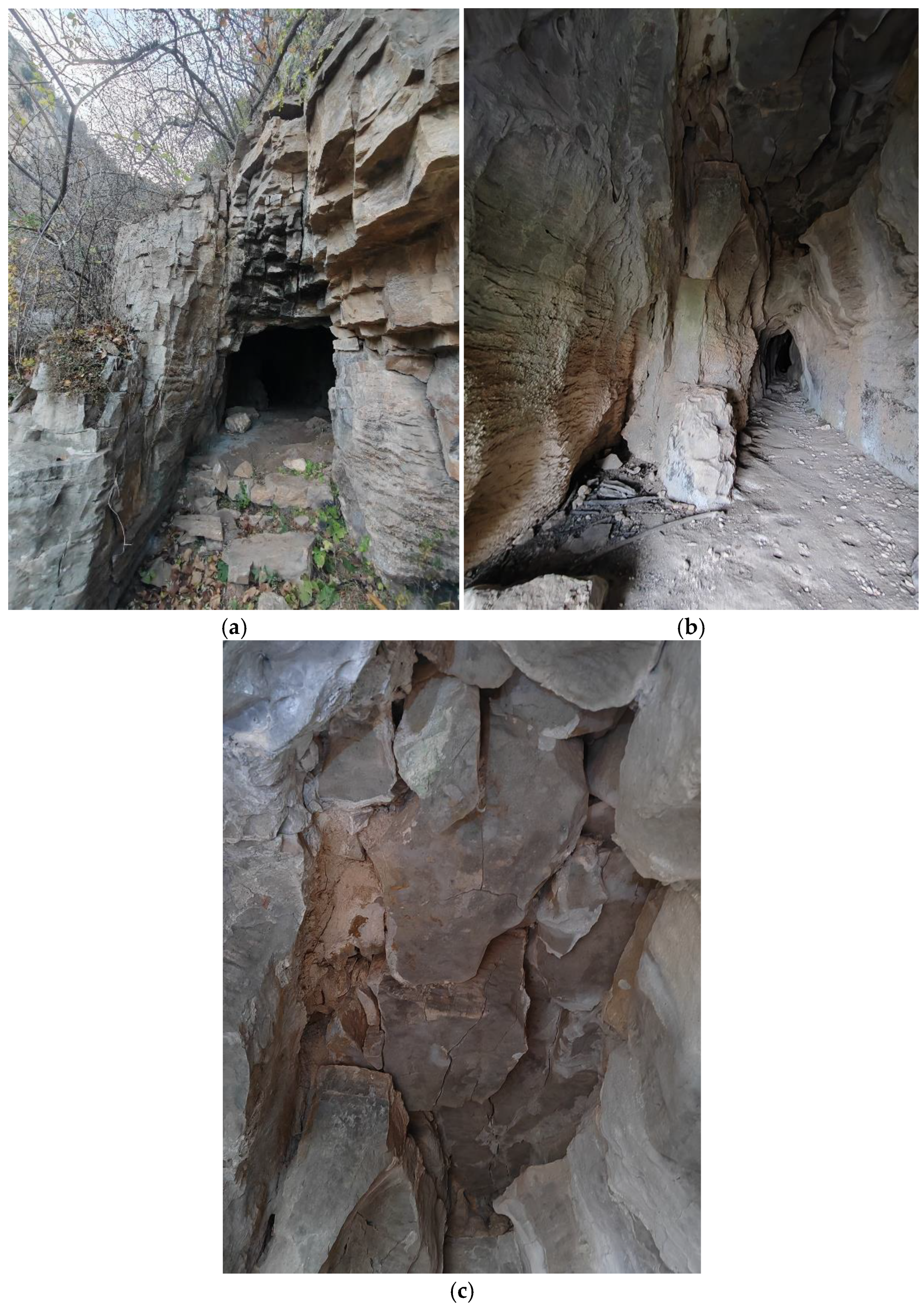
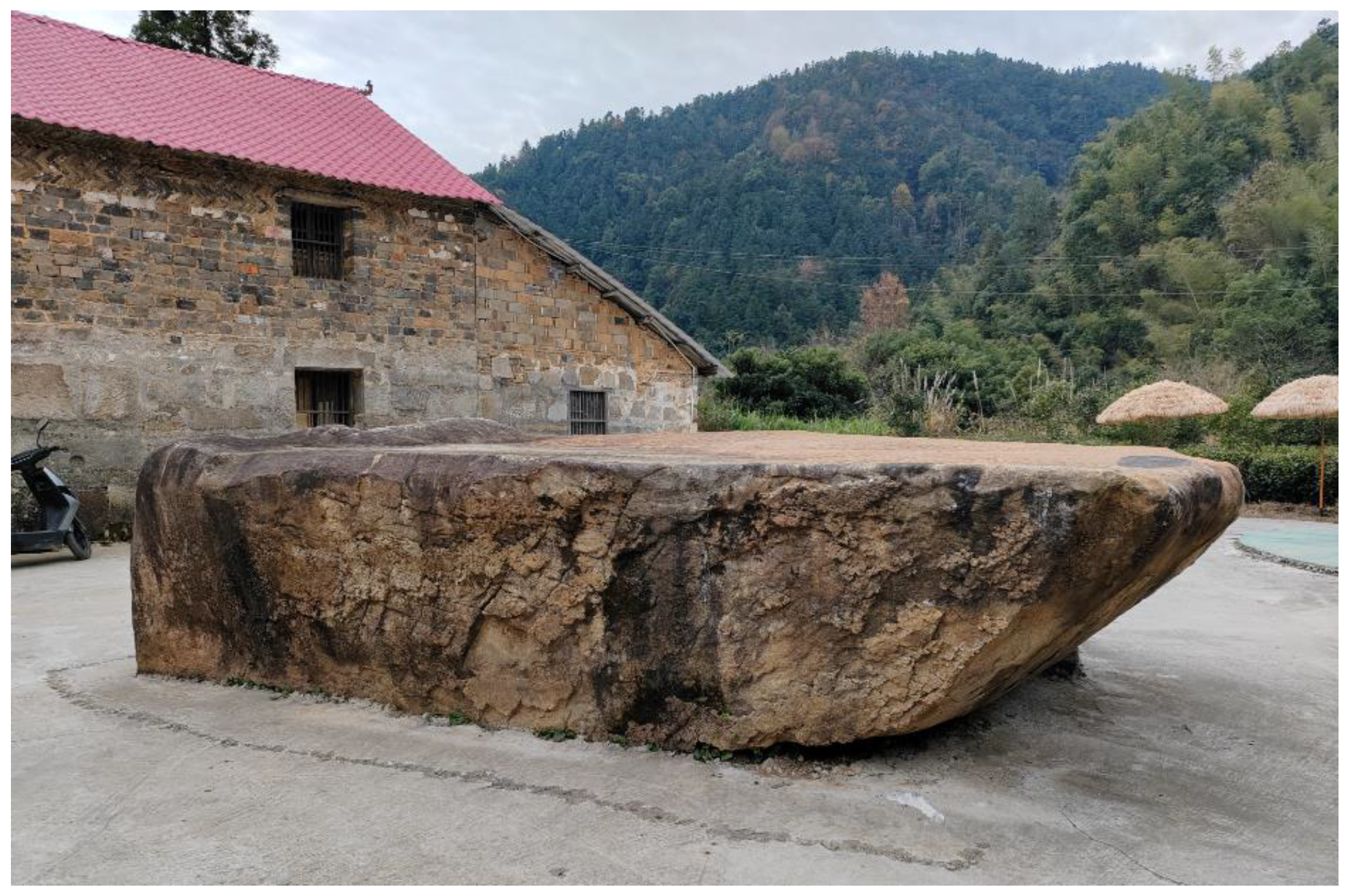
The biography of Zhang Zhong mentions that he “established a Daoist altar on the cave and performed morning rituals towards it daily. 立道壇於窟上,每旦朝拜之。” Adjacent to the southeast of the Xiaokouyu cave 小口峪洞 entrance, we can identify a space suitable for an altar site. There is a relatively flat, square platform measuring 2 m by 2 m located to the right front of the cave entrance (the vantage point for taking Figure 13a is near the eastern wall side of the cave entrance). To the east lies a natural stone staircase descending the mountain. The southern side of the platform is relatively square-shaped and overlooks a deep ravine. Due to the confined space at the site, there is a lack of suitable vantage points for capturing a full view of the altar area, especially on the eastern stone staircase. Photography can only be conducted from below the staircase, resulting in the inability to showcase the platform’s surface in the upper space, as depicted in Figure 13b. Coincidentally, there is a large flat rock on the eastern side of the platform, as shown in Figure 13c, which stands about 0.5 m high. The upper surface of this rock measures approximately 1.3 m in length and 1 m in width, nearly square in shape. These two square stone surfaces precisely form a two-tiered natural Daoist altar 道壇.
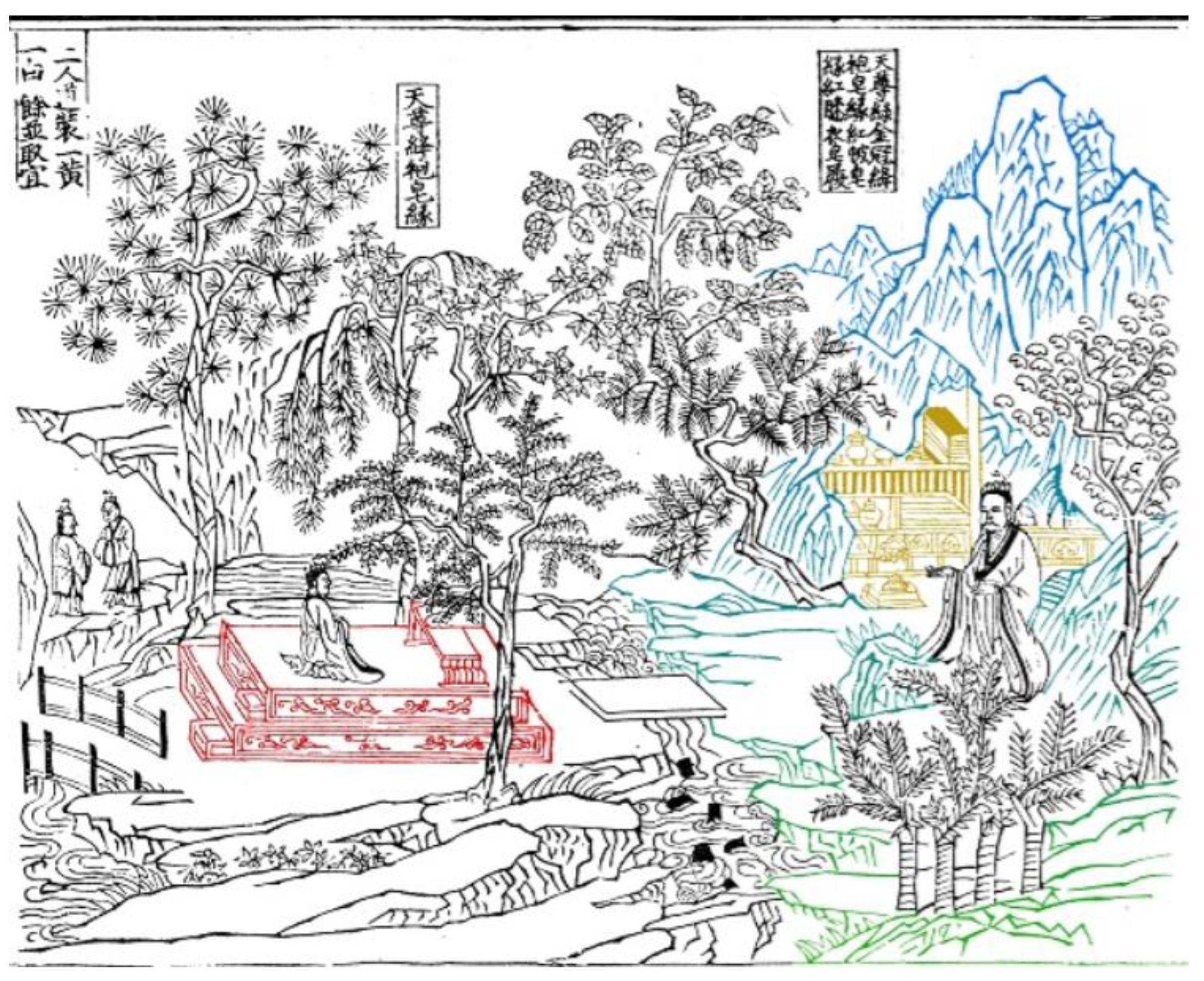
This type of natural stone altar outside a mountain cave, used for jiao rituals, is recorded in Zhen Gao 真誥, scroll 20: “The Assistant (i.e., Xu Hui) was then on the northern stone altar north of the northern cave, burning incense and performing rites. He remained prostrate and did not rise. The next morning, his form was seen as if alive. This altar still exists clearly today.”17 This spatial configuration of an external altar site in relation to the cave chamber can also be observed in the fifth illustration of Sima Chengzhen’s 司馬承禎 (647–735) Tongbo Zhenren Zhen Tuzan 桐柏真人真圖贊 (Zhang and Han 2012, vol. 3), where the cave interior contains shelves for scriptures, ritual implements, and daily utensils, while Wang Ziqiao 王子喬 kneels and pays respects on the altar outside the cave, facing towards the cave chamber (Figure 14). Sanhuang Neimiwen explicitly discusses the necessity of performing a jiao ritual to the mountain’s presiding deity 山主神靈 before selecting a cave for dwelling (DZ.0855:18, p. 574a). Regarding natural stone altars and earthen altars, Sanhuang Neimiwen also provides specifications, stating that stone altars are superior to earthen ones: “The altar should be eight chisquare; a stone mound is best, an earthen mound is next.”18 Another early Daoist example of using a natural stone altar can be cited from the “Lidou shi 禮斗石”, a natural stone altar in front of the main hall ruins of Jianji Guan 簡寂觀 on Mount Lu 廬山 (Figure 15). Therefore, the altar site outside the Xiaokouyu cave can reasonably be regarded as a natural stone altar.
Considering Xu Hui’s 許翽 (341–ca.370) intention to pray for entry into the Huayang Dongtian 華陽洞天, we might infer that Zhang Zhong’s establishment of the altar was likely for the purpose of praying for his own ascension into the grotto-heaven 洞天 world of that mountain, viewing the cave as the entrance to the grotto-heaven. Zhen Gao 真誥 also presents the notion that “Juedong 絕洞 (Absolute Cave)” serves as the “habitat of earthly immortals 地仙棲處” (DZ.1016:20, p. 573b). However, since the grotto-heaven 洞天are inherently associated with earthly immortals地仙, the author of this paper contends that the text merely elucidates the existence, during that time, of additional the grotto-heaven 洞天 for earthly immortals, which are not constrained by the number thirty-six, rather than positing a dichotomy between Juedong 絕洞 and the grotto-heaven 洞天. Tao Jin 陶金 and others suggest that such “external ritual spaces of cave dwellings were often specifically established for paying respects to the invisible deities within the cave (such as the cave mansion’s celestial bureaucracy 洞府仙曹).” (Tao and Qu 2020, vol. 11) However, judging from the practice of erecting altars in front of Tianzun Halls 天尊堂 during the Tang dynasty, it is likely that these natural stone altars outside cave chambers served functions similar to the later open-air altar spaces in front of the main halls of Daoist temples. The objects of the jiao rituals performed there probably were not limited solely to the mountain deity or cave master but were applicable to various types of jiao rituals. Su Shi’s 蘇軾 (1037–1101) record of the “Zhu Zhenren Chaodou Tan” 朱真人朝鬥壇 south of the Zhuming Cave 朱明洞 on Mount Luofu 羅浮山 during the Northern Song period may serve as evidence (Su 1986, vol. 1107, p. 331).
Zhen Gao 真誥 also discusses the establishment of an outer quiet hut 外靜舍 when practicing in a cave chamber. It needed to be not too far from human settlements yet convenient for travel to and from the cave. However, it is very clear that the primary function of the outer quiet dwelling was to receive guests. (DZ.1016:20, p. 558a) So it was not the place where the practitioner themselves resided and cultivated. Northeast of the Xiaokouyu cave, on the southeastern slope beneath the cliff face opposite, there are four shallow, round-bottomed stone hollows, locally known as the “Four Dog Holes四狗窩”. Some believe these to be the sites where Zhang Zhong’s disciples “dug the ground to make chambers 鑿地為室”, which is likely accurate. If these thatched huts and quiet chambers 靜室 are used by disciples for spiritual cultivation, then their shared outer retreat for accommodating visitors might be located in XiYeLao Village at the foot of the mountain.
Furthermore, the aforementioned function of establishing an altar for jiao rituals was to pray for the protection of the mountain spirits 山靈. However, the necessary self-protection measures for entering the mountains were not limited to this. For any human, deep mountains and remote valleys are domains full of various dangers. Without essential knowledge, skills, and protective measures, the result could only be “foolish people presumptuously go, and all return dead. 愚人妄往,至皆死歸。” Therefore, Baopuzi Neipian 抱樸子內篇, scroll 15 “Za Ying 雜應”, includes methods such as grain abstention 斷穀, ways to avoid cold and heat, methods to ward off illness, techniques to avoid weapons 辟五兵, the art of concealment (i.e., invisibility 隱淪之道), and so on (DZ.1185:28, pp. 226b–230b). Scroll 17 “Deng She 登涉” discusses the “method for entering the mountains 入山法”, pointing out that there are “thousands of methods for warding off evil and protecting the body. 卻惡防身者,乃有數千法。” Examples include selecting auspicious days and times, using Daoist mirrors, and employing talismans and charts such as the Sheng Shan Fu 升山符, Sanhuang Neiwen 三皇內文, Wuyue Zhenxing Tu 五嶽真形圖, and Bawei Zhi Jie 八威之節; carrying items like the Laozi Yu Ce 老子玉策; and using talismanic seals like the Qishier Jing Zhen Fu 七十二精鎮符, Zhu Guan Yin 朱官印, Bao Yuan Shi Er Yin 包元十二印, and Huang Shen Yue Zhang 黃神越章之印. There were also specific Daoist pharmacological knowledge and numerological techniques for avoiding snakes, poisonous insects, tigers, and wolves (DZ.1185:28, p. 236b). The most numerous among these were methods involving talismans and Diagrams 符圖, and prohibitive incantations 禁制. The pre-Tang text Sanhuang Neiwen Yimi 三皇內文遺秘 was also created to protect Daoists practicing “cultivation in rocky valleys 岩谷修真” from harm by mountain spirits 精怪 and evil deities 邪神, providing various talismans and Diagrams 符圖, secret seals 秘印, and spells 咒语 specifically for Daoists entering the mountains (DZ0856:18, p. 581a). This vast and complex system of knowledge reflects the prolonged process of accumulation and synthesis of knowledge and skills for mountain dwelling within the Daoist tradition at that time. Consequently, for an individual Daoist, only after achieving a relatively systematic mastery of this type of knowledge and technical skill could they dare to actually practice cultivation in mountain cave chambers.
Fu Jian 苻堅 (338–385) of the Former Qin 前秦 summoned Zhang Zhong to Chang’an 长安, “intending to appoint him as Qí Shàngfù” 將任以齊尚父 (Cui 1986, vol. 463, p. 682), meaning he expected him to display military talents akin to Jiang Shang 姜尚. From this, it can be inferred that Zhang Zhong was likely skilled in the arts of calculation and prognostication 術數. During the Sixteen Kingdoms period, there were several cases of individuals outside the official sphere being summoned and appointed to political or military positions, or even titled as kings. Li Xiong 李雄 (274–334), the founder of the Cheng-Han 成漢 regime, once wanted to honor the Daoist Fan Changsheng 范長生 (?–318) as ruler, and later honored him as the “Great Master of Heaven and Earth for the Four Seasons and Eight Nodes 四時八節天地太師”, which was greatly related to Fan’s expertise in calendrical astronomy and calculation 曆算推步 (Z. Yang 2021, p. 74). Zhu Senglang, who practiced on Mount Tai 泰山 alongside Zhang Zhong, was repeatedly summoned by various regimes. Murong De 慕容德 (336–405) of the Southern Yan 南燕 even wanted to enfeoff him as the King of Dongqi 東齊王, precisely because Senglang was proficient in the studies of atmospheric-celestial observations氣緯 and celestial divination 占候 and once participated in Murong De’s military strategic decisions. Fu Jian had also previously summoned Senglang, but Senglang refused on grounds of old age and illness, whereas Zhang Zhong accepted the summons and traveled to Chang’an 长安. This suggests that Zhang Zhong had some confidence in his own learning, which likely included Yin-Yang theory, calendrics, calculation, and prognostication 陰陽曆算占候.
In fact, for Daoists practicing in mountains and caves, knowledge of astronomy, calendrics, calculation, and prognostication was an essential skill. The Southern Dynasties Daoist scripture Shangqing Jinque Dijun Wudou Sanyi Tujue 上清金闕帝君五鬥三一圖訣 specifically mentions that because a Daoist devoted to learning, hidden in quietude in the mountain forests, long secluded in a cave chamber, far cut off from the human world 道士志學,山林隱靜,久遁洞室,遠絕人間” could not calculate the seasonal nodes and could not frequently go down the mountain to ask commoners, it prescribed a simplified method for correlating dates (DZ.0765:17, p. 220b). This inversely reflects the need for hermits in the mountains to master calendrical knowledge for time management. Activities such as altar rituals 坛场醮祭, collecting fungi 采芝, compounding medicines 合药, alchemy 煉丹, visualization practices 存思, and entering the mountains 入山, all had strict requirements regarding dates and times (Taiping Jing Hejiao 太平經合校 1960, p. 698). Therefore, calendrics, calculation, and prognostication were among the “necessities for cultivating the Dao 修道所須”, as stated by Tao Hongjing. As for the biography’s specific emphasis on the anecdote where a youth asked him about omens of flood and drought 水旱之祥, Zhang Zhong denied understanding Yin-Yang arts 陰陽術數, the author of the biography likely viewed this as a clever rhetorical strategy to “reject external things 遣諸外物”, that is, to remain unburdened by worldly matters.

2.2. The Issue of Ingesting Elixirs 服食, Along with Stone Nectar 石乳, White Bats 白蝙蝠, and Stone Cauldrons 石釜

As early as the Taiping Jing 太平經, there was a systematic understanding of the three cultivation methods found in Han dynasty techniques for achieving immortality: ingesting energy 食氣, consuming medicines 服藥, and abstaining from grains 辟穀. Ingesting energy and consuming medicines correspond to communication between humans and Heaven and Earth. Furthermore, settling in a mountain cave dwelling also signifies a practical process of “becoming more connected to the earth and sharing in its efficacy 與地更相通,共食功”.
The issue of Ingesting Elixirs inherently involves the basic livelihood concerns of mountain-dwelling practitioners, such as diet. Whether the mountain environment can provide water sources and food necessary for sustaining basic human survival must be the primary consideration for such practitioners. The nearest spring water to the Xiaokouyu cave is located in the Xiye Lao village downhill, which is quite distant; therefore, the dripping water within the cave likely served as their main water source for survival. Regarding food, Zhang Zhong’s biography mentions that while dwelling in the mountains he “purified the void, ingested energy, consumed fungi, and ingested stones 清虛服氣,餐芝餌石”, yet also states that he used earthenware 瓦器 and a stone cauldron 石釜 for eating, and refused clothing and grain offered by villagers. Essentially, the historical text’s author subjectively believed he might not need ordinary food and drink. If so, what was the purpose of the earthenware and stone cauldron? On this point, we can refer to the example of Bai Shisheng 白石生 from Zhen Gao 真誥. Bai Shisheng白石生 used earnings from raising pigs and sheep to buy Daoist elixirs 僊藥 for consumption, but the staple he ingested was “white stones白石”, though he occasionally drank wine, ate meat, and consumed grains (DZ.1016:20, p. 520b). This indicates that activities like ingesting substances 服餌 and grain abstention 辟穀 were not necessarily contradictory to consuming normal grains and meat; however, some elixirs explicitly prohibited the consumption of meat, leafy greens, sour/salty flavors, and sexual activity (DZ.0855:18, p. 576a).
Could the elixirs ingested by Daoists completely replace grain, akin to “boiling white stones for sustenance 煮白石為糧”? Ge Hong stated, “Medicines for curing illnesses are taken before eating; medicines for nourishing nature are taken after eating.”19 This shows that, in principle, elixirs and food could not substitute for each other. Regarding the specific categories of “elixirs”, Baopuzi Neipian 抱樸子內篇, scroll 11, provides a very detailed explanation. Based on this, the author further summarizes that elixirs can be roughly classified into five categories: Cinnabar type, including cinnabar, gold, silver; Five Fungi 五芝 type; Five Jades 五玉 type; Mineral type; and Herbal medicine type. Among these, “the Five Fungi, as well as ingesting cinnabar, jade slips, Zengqing, realgar, orpiment, mica, and Taiyi Yu Yu Liang, can each be taken alone, and all enable one to fly and achieve longevity.”20 The herbal medicine category often involved stories of achieving immortality through long-term solitary ingestion of substances like pine resin, pine needles/leaves, atractylodes 朮, shan jing 山精, calamus 菖蒲, rehmannia 地黃, poria 茯苓, and asparagus root 天門冬. Notably, it separately mentions the Maonü 毛女, who survived in the mountains solely on pine needles and pine nuts, enabling her to be “neither hungry nor thirsty, not cold in winter, not hot in summer 不饑不渴,冬不寒,夏不熱”. Clearly, in the mindset of Daoists at that time, these plants, roots, or fruits, which promised longevity and ascension after prolonged consumption, could also serve to alleviate hunger and replace grain. Moreover, the Sanhuang Neimiwen 三皇內秘文 explicitly records boiling atractylodes, white poria 白茯苓, and asparagus root according to the method, combining them into a paste, ingesting it with wine, and after persisting for a year, being able to completely cease eating the five grains (DZ.0855:18, p. 576b).
The biography’s statement that Zhang Zhong “consumed fungi and ingested stones” 餐芝餌石 is extremely important information. It contains no reference to the alchemical practices 丹道 of southern Daoists like Ge Hong or Pan Muming 潘茂名, who were active around the same period. “Ingesting stones 餌石” primarily corresponds to the mineral category mentioned in the Baopuzi Neipian 抱樸子內篇. However, considering the actual conditions of the Xiaokouyu cave, it probably mainly relied on the stalactites within the cave. The Dadong Ciyi Yujian Wulao Baojing 大洞雌一玉檢五老寶經 uses “36 hu of the clear water of stone nectar from profound cliffs and secluded springs among high mountains 高山玄岩絕泉石乳之清水三十六斛” as an ingredient for compounding elixirs 仙药. As mentioned earlier, inside the Xiaokouyu cave, beyond the third “gate,” the walls and ceiling are covered with stalactites (Figure 16). Particularly inside the fourth and sixth “gates,” there are typical karst formations resembling grapes, lions, elephants, bead curtains, and stone columns. Furthermore, the dripping water from the cave ceiling is the prerequisite condition for the formation of these calcium carbonate stalactites. The dripping water from such stalactites was referred to by the ancients as “stone nectar” 石乳 or “stone nectar water” 石乳水. It is especially worth noting that, according to information provided by villagers, a species of white bat has always existed in this cave. By the Tang dynasty at the latest, white bats 白蝙蝠 were regarded as “immortal mice 仙鼠”—“After a thousand years, their bodies become white as snow; they roost upside-down, and likely drink nectar water to achieve longevity.”21 Such caves were called “nectar grottoes 乳窟” or “jade caverns 玉洞”, and the water therein “jade springs 玉泉”. Judging from Qing dynasty poetry, the Longdong 龍洞 on Yudeng Mountain also historically had white bats and stone nectar water: “Flying springs and bellicose stones emerge from the rock crevices, hanging down like tears and saliva, forming hairpin stems, traces of roof leaks, in five colors.”22 “Wheel-like white bats, look up to feast on the beauty of the immortal nectar. Footwear muddied by the stench of snake saliva, clothing imbued with the scent of stone marrow.”23
The section in the Baopuzi 抱樸子 concerning the Five Fungi mentions five categories: stone fungi 石芝, wood fungi 木芝, grass fungi 草芝, flesh fungi 肉芝, and mushroom fungi 菌芝. “These various fungi are found in many famous mountains, but ordinary and mediocre Daoists, whose hearts are not focused and pure, whose conduct is defiled and virtue meager, and who are also ignorant of the methods for entering the mountains, even if they obtain the charts, do not know their appearances, and ultimately cannot acquire them. There are no mountains, large or small, without ghosts and spirits. If these spirits and ghosts do not give the fungi to humans, then even if people tread on them, they cannot be seen.”24 The Sanhuang Neimiwen mentions 27 types of fungi, including nine from the mountains, nine from the waterside, and nine from cavernous stone chambers 洞府石室. The latter have distinctions like flower forms, water forms, wood forms, beast forms, bird forms, “Their origin lies in the condensation of cloud-roots and mist-tips. Their size is immeasurable; their appearance is like stone nectar 石乳, transformed into forms of dragons, tigers, flying birds, and human figures, adhering to the stone walls… If one encounters and gathers them, after ingestion, one ascends to the Milky Way, transforms mortal bones into immortal bones, changes an immortal person into a realized person, transcends the ordinary and enters the sagehood, the body soars to the nine heavens. Therefore, the ancient immortals said, ‘When the numinous fungus enters the belly, one ascends in broad daylight to the heavens above.”25 Not only these stone fungi 石芝, but also the Stone Honey Fungus 石蜜芝 and Stone Cassia Fungus 石桂芝 mentioned in the Baopuzi Neipian 抱樸子內篇 grow within stone chambers and stone caves, likely also belonging to this category of stalactite formations. Therefore, the author believes that the most abundant resources within the Xiaokouyu cave—the stalactites 石乳 and stone nectar water 石乳水 for Daoist medicinal stones, along with the potential acquisition of mountain resources including the stone fungi among the Five Fungi—were probably the direct motivation attracting Daoists like Zhang Zhong to decide to reside in this cave.
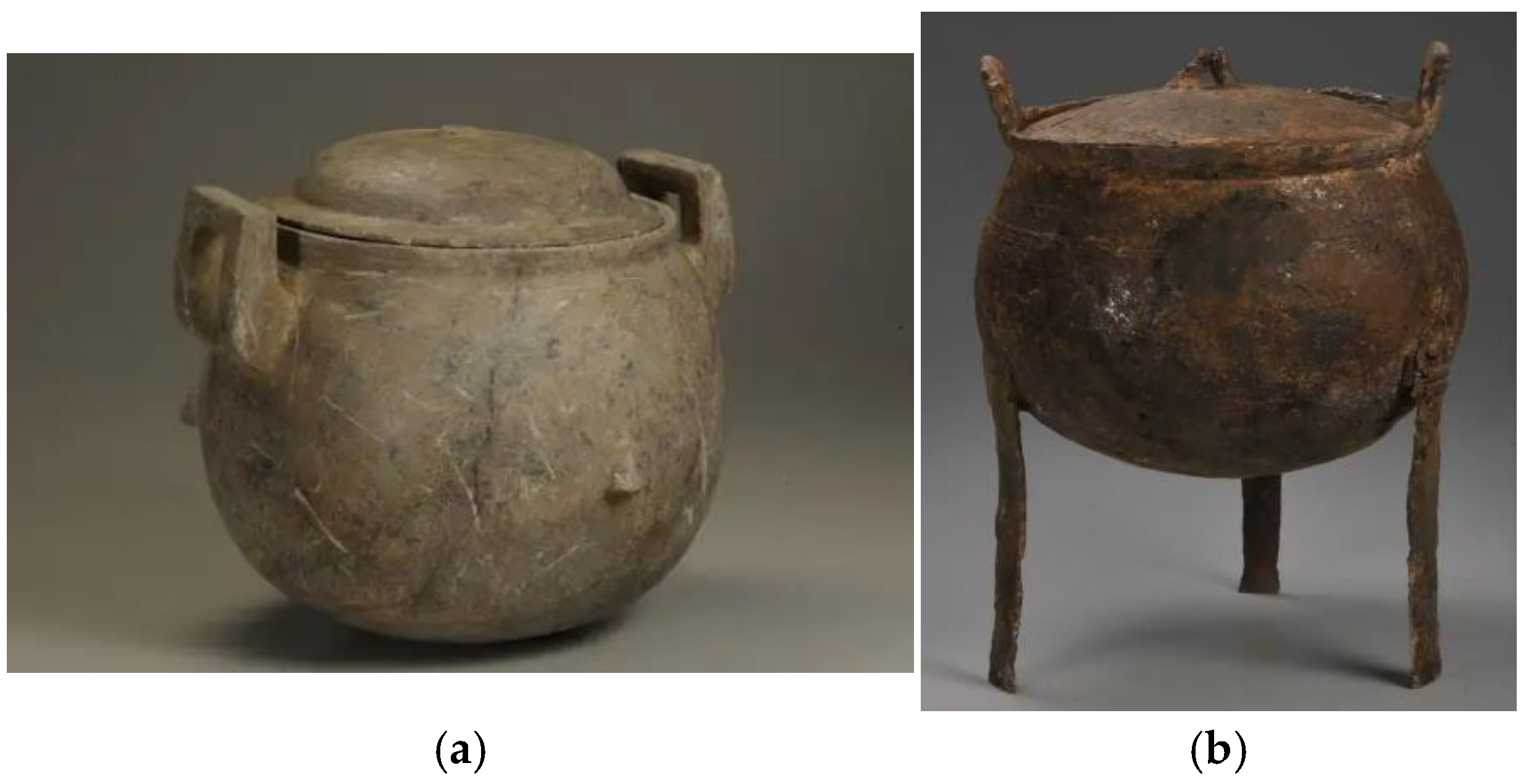
As for the production of the stone cauldron 石釜, i.e., a stone pot, Zhang Zhong’s biography says it had already evolved into a local custom by that time, indicating it was used as a cooking vessel for steaming and boiling, rather than solely for Daoist medicine preparation, which explains its widespread dissemination. Coincidentally, the production of such stone cauldrons 石釜 as food vessels is also recorded in Liu Xun’s 劉恂 (fl. late Tang dynasty) Lingbiao Luyi 嶺表錄異 from the Tang dynasty: “Over a hundred li north of Yuecheng County in Kangzhou, there is a scorched stone cave in the mountains. Every year the local people carve them into vessels for cooking food. They simply heat the stone until thoroughly hot, place it on a support, set it on a plate, and immediately add raw fish, meat, scallions, leeks, pickles, preserves, and such; it cooks instantly and remains boiling throughout the meal. In the south, when relatives and friends gather, they often use it.”26 This shows that the stone cauldron 石釜 even gradually became a specialized food vessel for creating particular delicacies by utilizing the stone’s heat conduction properties. Lu Yu’s 陸羽 (733–ca.804) Classic of Tea 茶經 also records the stone cauldron 石釜 of his time, mentioning that in the Laizhou 萊州 area of Shandong during the Tang dynasty, the use of stone pots 石鍑 (cauldrons) was widespread. However, Lu Yu believed that neither porcelain nor stone cauldrons lasted long when used for boiling tea, and he favored silver cauldrons.27 Daoist texts often emphasize using an “iron cauldron” 鐵釜 for compounding medicines, likely a traditional concept stemming from usage habits, similar to Lu Yu’s preference. Whether Zhang Zhong also used a stone cauldron 石釜 for compounding medicines is unknown.
In reality, Zhang Zhong’s initial use of such a stone cauldron 石釜 was probably motivated by the convenience and simplicity of utilizing locally available materials for mountain life. The Jingde Chuandeng Lu 景德傳燈錄 from the Song dynasty records monks meditating in stone chambers often using a “broken-legged tripod” 折腳鐺子as a cooking vessel.28 This portable, foldable tripod used by Song dynasty Chan monks was an essential, portable necessity. Its rationale is the same as Zhang Zhong’s use of stone for making cauldrons: both adhere to the principle of utmost simplicity in mountain living.
Early stone cauldrons 石釜have not survived, but we can observe the form of stone cauldrons from the Northern Song period unearthed archaeologically. However, the stone cauldrons 石釜 used by families of famous Song officials were exquisitely made (Figure 17), completely imitating the form of metalware, and should be quite distant material-wise from the crude, simple stone cauldrons of Zhang Zhong’s innovative period. Nevertheless, they effectively illustrate the widespread popularity of this material for food vessels in later times.

2.3. The Connection Between the Feminine Gate 牝門, Water Source, Small Niche and Intensive Meditation 精思

As previously mentioned, Changqing Xianzhi describes the Xiaokouyu cave as having seven naturally formed “gates” and details a small niche-like space on the northern wall inside the fourth gate. However, it omits the description of the most impressive feature: the third gate, known as the Feminine Gate 牝門 discussed earlier. This gate is located about 10 m from the cave entrance (Figure 18). Beyond a hall-like section, the cave ceiling abruptly lowers to about 2 m, creating a roughly 7-m-long passageway leading to the Feminine Gate. The opening of this gate resembles the female genitalia, is extremely narrow, and allows only one person to pass sideways with great difficulty while squatting.
Contemporary scholarship has elucidated the creative, mother-goddess connotations within Laozi’s 老子 discourse on the Dao 道. The phrase “the gateway of the mysterious female is the root of Heaven and Earth 玄牝之門,是為天地根” is interpreted as representing the profound and distant reproductive organ that gives birth to all things in Heaven and Earth (S. Zhang 1981, p. 38), which aligns with the original intent of Daoist theory. Although later commentaries often followed Heshang Gong’s 河上公 (fl. 2nd century BCE) interpretation of “the mysterious female” 玄牝 as the mouth and nose, the Xiang’er Commentary on the Laozi 老子想爾注 explicitly states that the “gate of the mysterious female玄牝之門” is “modeled on the female, with the yin orifice as the gate 女像之,陰孔為門”29. This latter commentary was, in fact, the most popular one from the Six Dynasties through the Tang period (Y. Tang 2016, p. 93). When the Huangdi Neijing Suwen Yipian 黃帝內經素問遺篇 explains that “the ultimate truth and essence lies in the Celestial Mystery 至真之要,在乎天玄”,it says: “While in the mother’s womb, humans first connect with the breath of the Celestial Mystery; this is called the Mysterious Female, also named the Gate of the Valley Spirit, also called the Divine Countenance, the Earthly Door of the Upper Region, the Mountain within Humanity, the Gate of Fetal Breathing, the Key to Connecting with Heaven. If humans can forget cravings and desires, stabilize joy and anger, and let their movements follow the breath of the Celestial Mysterious Female, severing their thoughts, as if in the time within the mother’s womb, this is called returning to the Celestial Breath. By returning to the mandate and reverting, entering quiescent extinction, returning to the Great Beginning, one practices the Dao of reverting to the primordial fetal breath.”30 Laozi’s statements, “Each returns to its root; returning to the root is called stillness; this is called returning to the mandate” 各歸複其根,歸根曰靜,是曰覆命, and “Under Heaven has a beginning, which can be considered the mother of Heaven and Earth… Once you know the children, return to guard the mother, and you will be free from peril to the end of your days” 天下有始,以為天下母。…知其子,複守其母,沒身不殆, also express his advocacy for humans to return to the state of the uncarved block, the infant, to return to the primordial “womb” or “mother’s belly” of the cosmic origin, to go back to the beginning of Heaven and Earth (X. Wang 2010, p. 2). Therefore, the “Mysterious Female” metaphorically refers to the reproductive organ that gives birth to Heaven and Earth and all things, and is also the gateway to entering the “Mysterious” 玄 and the “Dao” 道. The concept of the “Mysterious Female” was naturally applied to various internal cultivation methods in later times. Internal Alchemy 內丹學, for instance, considers the “Gate of the Mysterious Female” as the critical point of transition from the Supreme Ultimate 太極 to the Two Modes 兩儀, from the Post-Heaven 後天 to the Pre-Heaven 先天 state, hence also calling it the “Mysterious Pass 玄關” (G. Ge 2022, p. 5).
Another point worth noting is that for the Feminine Gate in the Xiaokouyu cave to successfully metaphorically represent the maternal body of Heaven and Earth’s origin, the element of dripping water from the ceiling inside the fourth gate is crucial. The concept in the Da Dai Liji 大戴禮記 that classifies landforms by gender, “hills as male 牡, valleys and streams as female 丘陵為牡,溪谷為牝” implicitly uses water as a metaphor for the yin/female principle. Yu Chengbao 于成寶 has discussed how the concept of the “Great One Generating Water 太一生水” is also an extension of the maternal reproductive metaphor in the Daodejing 道德經. Water is the symbol of reproductive power within the “Mysterious Female” and is indispensable (C. Yu 2013, p. 6).
Using the return to the source of the cosmic maternal body as a metaphor for one’s own cultivation and the rebirth of all things implies a logic of reaching the ultimate Dao by returning to the origin of cosmic life. This method of internal cultivation was generally termed “Intensive Meditation” during the late Han and Six Dynasties period. The connotation of this concept, between the Jin and Tang dynasties, essentially corresponded to the method of “Sitting in Forgetfulness 坐忘” aimed at cleansing inner desires and turbid qi 浊氣. It was often equated with the activity of “Visualization” 存思 of the body’s spirits, and sometimes could also encompass methods of refining qi 炼氣.
There are many cases of practicing Intensive Meditation to seek the Dao of immortality between the Han and Jin periods. Records exist of figures from the late Han like Zhang Daoling 張道陵 (34–156), Zuo Ci 左慈 (fl. mid-2nd–late 3rd century CE), and Ge Xuan 葛玄 (164–244) to Tang dynasty Daoists using Intensive Meditation as a cultivation technique. Among these, some combined Intensive Meditation with the ingestion of substances:
“Bo Shanfu was a man of Yongzhou. On Mount Hua, he practiced Intensive Meditation and ingested substances. From time to time he returned to his hometown to visit his family. In this manner, he remained unaged for over two hundred years.”31
“Fan Boci was a man of Guiyang He entered Mount Tianmu to practice and ingested sesame. After seventeen years of Intensive Meditation, the Sovereign of Destiny, a True Immortal of the Supreme Ultimate, descended and bestowed upon him thirty-six scrolls of scriptures. Later, he ingested Cyclically Transformed Elixir and ascended to heaven in broad daylight. He is now the Perfected of the Mysterious One.”32
By the time of Sima Chengzhen in the Tang dynasty, he still regarded Intensive Meditation for refining the spirit and the ingestion of medicines for transforming the physical substance—”refining the spirit through Intensive Meditation, transforming the substance by ingesting medicines 精思以煉神,餌藥以變質”—as the primary cultivation methods for achieving immortality.
For early Daoists engaged in Intensive Meditation, the fundamental path to “longevity and immortality 長生不死” and “attaining the Dao and becoming an immortal 得道成仙”, advocated from the Taiping Jing 太平經 to the Baopuzi Neipian 抱樸子內篇, was “Guarding the One” 守一. Intensive Meditation was the means to achieve “Guarding the One守一”, maintaining the spirit’s non-dissipation and its unity with the body (Taiping jingchao 太平經鈔 1988, p. 377).
Simultaneously, we must note that this skill in Intensive Meditation was also a prerequisite and necessity for further Daoist activities such as gathering herbs 采药, compounding medicines合药, alchemy 煉丹, and conducting jiao rituals. Precisely because it is the fundamental way to achieve “cleansing the mysterious mirror 滌除玄覽” and returning to a state of tranquility. Not only was “cultivating purification, performing rites and invitations, with Intensive Meditation as the priority 修齋禮請,以精思為先” (as Lu Xiujing 陸修靜 stated) essential when establishing an altar, but sometimes the gathering of rare mountain fungi like stone zhi and compounding medicines also required observing the practices of mental fasting 心齋, Intensive Meditation, and jiao rituals (DZ.1185:28, p. 209b). The Baopuzi Neipian 抱檏子内篇 further divides “Guarding the One” 守一 into “Guarding the Genuine One” 守真一 and “Guarding the Mysterious One” 守玄一, considering that both can provide protective effects, making one “invulnerable to all [harm] 無所不辟” (DZ.1185:28, p. 243).
Therefore, for Zhang Zhong, the protagonist of this paper, on one hand, he needed to coordinate with the ingestion of substances 服餌 aimed at physical immortality to achieve the internal and external cultivation of body-spirit unity. On the other hand, he also had to consider the need for self-protection in the dangerous mountain environment and the requirements of other activities like herb gathering. All these factors made Intensive Meditation, aimed at “Guarding the One”, an inevitable, even indispensable, internal cultivation method, not to be left even for a moment.
Furthermore, according to the Sandong Zhunang 三洞珠囊quoting the Taiping Jing: “Now, the spirit and essence 神精, by their nature, always reside in empty and idle places; they do not reside in filthy and turbid places. If you wish to concentrate your thoughts and return the spirit, you must always practice fasting and abstinence 齋戒. Hang the images in a fragrant chamber, and all illnesses will vanish. Without fasting and abstinence 齋戒, the essence and spirit 精神are unwilling to return to the person.”33 This means that in early “Guarding the One” practices, the presence of images of the body’s spirits was required. According to scholarly research, by the Wei-Jin period following the Taiping Jing, “suspended images” 懸象—flat paintings used for hanging—for the purpose of visualizing the body’s spirits were already common, though their use was limited and not yet employed in sacrificial and worship activities. Before the widespread use of ritual statues, Daoism typically used spirit seats 神座 (i.e., spirit tablets, wooden masters 木主) (Zhao 2022, p. 3).
Synthesizing the above analysis, the author believes that Zhang Zhong’s Daoist cultivation activities within the Xiaokouyu cave certainly included the element of Intensive Meditation, corresponding to what his biography describes as “sitting upright as if a corpse, without the comforts of zithers or books, not studying classics to encourage teaching 端拱若屍,無琴書之適,不修經典勸教” but practicing the “methods of cultivating the Dao and nurturing life 修道養之法”.The location for this Intensive Meditation should have been chosen inside the “Gate of the Mysterious Female”, to achieve a state of unity with the spirit of Heaven and Earth, returning to the primordial beginning. The small niche-like hole within the fourth gate could potentially have been the space used for hanging images or placing the wooden tablets of the body’s spirits during his Intensive Meditation activities.

3. Concluding Remarks

As a site for early The Taoism of the Immortals focused on immortality, aimed at mountain-dwelling cultivation, famous mountain grottoes 名山洞府 were the primary choice, while quiet hut 靜舍merely served auxiliary functions like receiving guests. This concept within the Shenxian Daoism system of the Western and Eastern Jin periods was not limited by north–south boundaries. The case of Zhang Zhong may illustrate that within the mountain-dwelling cultivation tradition of this period, under the premise of the master-disciple system, a distinctive form of small-scale communal hermitage in mountainous areas had already emerged.34 In such a context, caves and quiet huts静舍might have served as separate spaces for the master and disciples to engage in their respective cultivation practices.
Yamada Toshiaki 山田利明has relatively systematically outlined the developmental trajectory of Shenxian Dao. He posits that it originated from the fusion of Daoist health-preserving techniques and the alchemist’s theories of immortality during the Qin and Han 漢 dynasties. By the late Eastern Han Dynasty, he argues, “the content of Xianxian Dao in both the northern and southern regions had become essentially identical, primarily focusing on alchemy and elixir-making, supplemented by physical exercises and breathing techniques such as Daoyin 導引 and Qigong 行氣, as well as methods involving the ingestion of herbal remedies, sexual cultivation practices 房中, incantations 禁咒, and divination” (Yamada 1990, p. 302). In terms of the technical aspects of immortality cultivation, the lineage represented by Ma Mingsheng 馬鳴生 (fl. 1st–2nd century CE), Yin Changsheng 陰長生 (fl. 1st–2nd century CE), and Bao Jing 鮑靚 (278–362) in the Qi 齊 region converged with the lineage of Zuo Ci, Ge Xuan, and Zheng Yin 鄭隱 (253–330) in the regions south of the Yangtze River 長江, culminating in Ge Hong (Yamada 1990, p. 302; Hu 1989, p. 104). Both Ma and Yin advocated elixir-making 煉丹, whereas Zhang Zhong’s cultivation methods did not encompass the refinement of golden elixirs 金丹. It can be speculated that Zhang Zhong, hailing from Zhongshan 中山, likely inherited certain regional traditions from the Shenxian Dao 神仙道 of the Yan 燕 region, which explains the similarities and differences between his practices and those of the Qi 齊and Jiangnan 江南 lineages. Such individual cases approximately suggest that forms of Shenxian Dao devoid of golden elixir-making persisted in regions like Yan and Qi at least until the early 4th century. Consequently, Yamada Toshiaki’s aforementioned assertion may require further refinement.
In the Baopuzi Neipian 抱樸子内篇, Ge Hong expresses the highest respect for recluses who truly abandoned glory and a life of ease with passionate enthusiasm: “Rinsing one’s hat-strings in the Canglang waters, neither submitting nor being humiliated; using the fragrant woods as towers and pavilions, the steep peaks as great mansions, the verdant orchids as bundled beds, the green leaves as curtains and drapes; wearing coarse cloth instead of royal robes, vetches and pulse as fine food; if not tilling oneself, not using it to fill hunger; if not a wife’s weaving, not using it to cover the body—in a thousand years, there might occasionally be such people. How much more so if they add to this leaving their six relatives among the state and clan, harming their own families without regard, turning their backs on glory and wealth as if discarding footprints, cutting off desirable things from their hearts, scaling the high peaks alone to wander, accompanying echoes and shadows in the famous mountains, looking inward into the realm of the formless, listening back into the utmost silence—within the eight confines, how many will there be?”35 Facing the extremely harsh natural environment of a cave like Xiaokouyu, coupled with the danger to life posed by the unknown perils of the deep mountains, compels our deep respect for the mountain-dwelling cultivation practices of early Daoists. However, Zhang Zhong, who called himself a “Daoist of the Eastern Peak” 東嶽道士, ultimately did not return to these mountains he so cherished. The dual aspects of engagement and pure cultivation among Daoists during the Sixteen Kingdoms period seem to resonate with the concepts of self-liberation and liberating others associated with the so-called Greater and Lesser Vehicles in Buddhism since its introduction. How did the tradition of political concern among hermits dwelling in rocky caves (Vervoorn 1990), accumulated since the Qin and Han periods, evolve into a tradition of pure immortality-seeking after the Wei-Jin periods? Did the strategy of “relying on the ruler of the state” 依國主 to revitalize the religious doctrine, to some extent, take precedence over the achievements of the Daoists’ own cultivation practices? In other words, how to harmonize “responding to the monarch” 應帝王 and “nourishing the lord of life” 養生主 might be questions requiring separate consideration.
The significance of this paper also lies in the fact that for the knowledge system of early Daoist mountain-dwelling cultivation, the Baopuzi Neipian 抱樸子内篇 already provides a sufficiently rich and rigorous framework, yet today there are very few identifiable specific cases of early Daoist mountain-dwelling cultivation in famous mountain stone chambers. The confirmation of the Xiaokouyu cave in Changqing, as the cultivation cave chamber of Zhang Zhong from the Sixteen Kingdoms period can largely make up for this deficiency. Simultaneously, it provides a rare opportunity to combine the study of a cave chamber instance from the same period with Daoist textual materials, offering an earlier reference point for the conceptual and material forms of the famous mountain grotto-heavens 名山洞天 up to the Tang dynasty.
The analysis of the similarity between the morphological features of the Xiaokouyu cave itself and the Buddhist Longdong Grottoes in the Jinan area further expands the historical value and significance of this cave as an early Daoist cultivation site. The relationship between these two so-called “Dragon Caves” in the Jinan area touches upon the issue of the use of mountainous material forms by Buddhism in the Shandong region prior to the Tang dynasty, involving interaction. Through the construction of the Yudeng Mountain Longdong Grottoes during the Eastern Wei period, Buddhism appropriated and transformed the early Daoist concept of the cave chamber, exemplified by the Xiaokouyu cave. This cultural adaptation to the new environment resulted in the unexpected catalyzing of a regional sub-tradition of creating Buddhist cave temples based on natural rock caves in Shandong from the medieval period onward. This convergence is certainly due to the trend towards homogeneity in the belief environment of the same region, leading to conceptual convergence; it is also the result of deep exchange and penetration between different beliefs regarding the cognition and utilization of cavernous sacred space. Therefore, the confirmation of the Xiaokouyu cave as Zhang Zhong’s cultivation site holds significance as a point of origin. Simultaneously, it provides the most compelling example for the conceptual and material forms of cavernous sacred space commonly traced back by both Buddhism and Daoism in the Shandong region.


Funding

This research received no external funding.

Institutional Review Board Statement

Not applicable.

Informed Consent Statement

Not applicable.

Data Availability Statement

No new data were created or analyzed in this study. Data sharing is not applicable to this article.

Conflicts of Interest

The author declares no conflict of interest. No new data were created or analyzed in this study. Data sharing is not applicable to this article. The authors declare no conflict of interest.

Abbreviations

DZDao zang 道藏. Beijing: Cultural Relics Publishing House, Shanghai: Shanghai Bookstore Publishing House, Tianjin: Tianjin Classics Publishing House, 1988.
TTaisho 大正藏. Tokyo: Taisho Shinshu Daizokyo Publishing Committee, 1934.

Notes

1
Here are only a few field survey records involving cave chambers, which provide specific descriptions of the internal conditions of caves in combination with relevant historical documents. For example, Wu Zhen’s 吴真 “Changes in Feng Shui and Chess Games in the Deep Mountains: Notes on the Rediscovery of Qizhen Cave,” 风水变局与深山棋会:栖真洞再发现手记 available at http://www.163.com/dy/article/FUJS9E320514R9P4.html, (accessed on 23 February 2026). In addition, there is a considerable amount of textual research on Daoist immortals and deities (especially their biographies) in Western academia, including works such as Stephan Bumbacher’s The Fragments of the Daoxue zhuan (2001), and Robert Campany’s To Live as Long as Heaven and Earth (2002) and Making Transcendents (2009). These works also touch upon topics such as early Daoist cave-dwelling and related ascetic practices. Although they do not provide specialized or concentrated attention and research on the actual ascetic caves themselves, they offer valuable references for our practical engagement with relevant material artifacts.
2
在寺(靈岩寺)東,逾嶺五里許,古疃一處,名野老莊,乃晉人張忠隱居處也。 (Ma 1994).
3
(華嚴寺)北五里為野老村,東晉中山張忠舊隱處。 (Nie 1968, p. 169).
4
府南六十里。道元云:符秦時有竺僧朗,事佛圖澄,碩學淵通,與隱士張巨和居此,因號朗公谷。今有朗公寺,亦三齊名刹,歷代有碑。谷有琨瑞溪水,過玉符山,又名玉水,至祝阿入濟。今溪水東西分流,山中人云:’西發趵突,東發百脈’,驗之信然。謂徑入濟者,誤也。龍洞西南有方山(長清縣界),疑即《水經》之玉符山。 (Q. Yu 2012, p. 81).
5
濟南郡有方山,相傳有奐生得仙於此山。南有明鏡崖,石方三丈,魑魅行伏,了了然在鏡中。南燕時,鏡上遂使漆焉。俗言山神惡其照物,故漆之。 (Duan, 1922).
6
This mountain has old traditions of Han figures like Lou Jing 婁敬 and Zhang Liang 張良 secluding themselves there for bigu 辟谷 practices, hence its old names “Zhang Mountain 張山,” “Lou Valley 婁峪,” and “Loujing Cave Mountain 婁敬洞山.” The mountain boasts numerous caves and stone chambers suitable for Daoist residence, including Chaoyang Cave 朝陽洞, Feng Cave 風洞, Bagua Cave 八卦洞, Huolong Cave 火龍洞, etc., totaling about a dozen, traditionally known as the “Thirty-Six Small Grotto-Heavens 三十六小洞天.” According to the Chuangxiu Zhangxian Ci Bei Ji 創修張仙祠碑記 there, Daoists practiced on the mountain from the Tang, Song, Yuan, Ming, Qing up to the Republic of China. A Dongxu Abbey 洞虛觀 was built during the Yuan period. Numerous stelae from the Yuan to the Republic of China periods recording the construction and renovation of Daoist halls and cave chambers still remain.
7
Changqing Xianzhi state its Daoist temples were established since the Northern Wei. A Dongzhen Abbey 洞真觀 was built during the Jin period (L. Wang 1968, p. 1602). It flourished greatly during the Ming, when the Ming court bestowed the complete Dao Zang 道藏 and granted the name Longshou Palace 隆壽宮. Its five peaks are named Huixian Peak 會僊峰, Zhixian Peak 志僊峰, Qunxian Peak 群僊峰, Wangxian Peak 望僊峰, and Juxian Peak 聚僊峰. It has caves like Qizhen Cave 棲真洞, Chongyuan Cave 崇元洞, Yinxian Cave 隱僊洞, and Lianhua Cave 蓮花洞. Buddhist statues and inscriptions from the Eastern Wei and Northern Qi periods have been unearthed or remain on the mountain (L. Wang 1968, pp. 1614–17); whether there was contemporary Daoist activity awaits investigation.
8
With its Xuanji Cave 璇璣洞, Jinchan Cave 金蟾洞, Fengyun Abbey 峰雲觀, Shengxian Terrace 昇僊臺, and Taishan Xinggong 泰山行宮. Many Ming and Qing stelae remain, stating that “since its founding, many have cultivated and refined here. 自開創以來,修煉者不少” (Z. Zhang 2020, p. 1024).
9
願得與中央太皇道君、君夫人,共乘八景金輿,上登上清宮。 (DZ.0426:6, p. 654b).
10
天真大神,上聖高尊,妙行真人,廣寒上宮後妃元君,嬪禦仙官,散輝金童,燿華玉女,無鞅數眾,乘空而來。素雲玉霄,金輿瓊輪,羽蓋垂蔭,流精玉光,灝彩郁奕,洞煥太空。 (DZ.0001,1, p. 97c).
11
並乘祥雲,絳輿青輦,華蓋文輪,驂駕黃鳳,五色金龍,建太一之節,元精靈旛前嘯,貔虎齊唱後吹,鸞鶴同鳴,師子辟邪,嘯歌噰噰,五老啟途,群仙翼轅,億乘萬騎,浮空而來。 (DZ.0001:1, p. 87a).
12
金輿羽葆,沖清虛而歸大梵之天;鳳表鸞姿,步瑤華而陟閬苑之境。 (DZ.0502a:9, p. 143b).
13
八景神真玉符,上元洞天自然之氣,以部上部八景,鎮在人身,上元宮中。服之八年,八景見形。為已通達幽微之事,洞觀自然,坐在立亡,降致天仙,千乘萬騎,雲輿羽蓋,白日登晨。 (DZ.1032:22, p. 571b).
14
張忠字巨和,中山人也。永嘉之亂,隱于泰山。恬靜寡欲,清虛服氣,飱芝餌石,修道養之法。冬則緼袍,夏則帶索。端拱若屍,無琴書之適,不修經典勸教,但以至道,虛無為宗。其居也,依崇岩幽谷,鑿地為窟室,弟子亦居窟室,相去六十余步,五日一朝,其教以形不以言。弟子受業,觀形而退。立道壇於窟上,每旦朝拜之。食用瓦器,鑿石為釡,泰山人於今猶法之。左右居人贈之衣食,一無所受。好事少年或問以水旱之祥,忠曰:”天不言而四時行焉,萬物生焉。陰陽之事,非窮山野叟所能知之。”其遣諸外物皆此類也。年在期頤,而視聽無爽。堅遣使者征之,使者至,忠沐浴而起,謂弟子曰:”吾餘年無幾,不可以逆時主之意。”浴訖就車,及至長安。堅賜以衣服及冠,辭曰:”年朽發落,不堪冠衣,請以野服入覲。”從之。及見堅,謂之曰:”先生考槃山林,研精道素,獨善之美有餘,兼濟之功未也。故遠屈先生,將任以齊尚父。”忠曰:”昔因喪亂,避地泰山,與鳥獸為侶,以全朝夕之命。屬堯舜之世,思一奉聖顏,年衰志謝,不堪展效,尚父之況,非敢竊擬。山林之性,情存岩岫,乞還餘齒,歸死岱宗。”堅安車送之,行至華陰山,歎曰:”我東嶽道士,沒于西嶽,命也奈何。”行五十里,及關而死。使者馳驛白之,堅遣黃門侍郎韋華持節策吊祀,乙太牢褒賜命服,諡曰安道先生。 (Cui 1986, vol. 463, p. 682).
15
道士山居,棲岩庇岫,不必有絪縟之溫。 (DZ.1185:28, p. 239b).
16
在石保西野老莊西南二里餘野老山中。鐫迎僊洞三字,兩旁小字模糊不清。自洞口至極深處,共有七層門,約一百二十餘步。頭層門右有一石,其形如虎。至四層門北面有一小洞,如佛龕大,約高有二尺餘,寬有尺半,深有半尺。旁有石柱,柱之上下皆絕細,石疵玲瓏可愛,頂上懸石如葡萄三穗。有水自葡萄下流,水源雖小,十人用之不足,一人用之有餘。自此至六層門,兩壁石形有如獅者、有如象者、有似千佛羅列者、有似人馬奔競者。至七層門又似垂珠簾櫳之式。門內奇景更有可觀,真所謂靈山洞府地也。《秦書》曰:’(僧)朗嘗與隱士張巨和游,張常穴居。’此洞為先生所居無疑矣。 (L. Wang 1968, pp. 221–22).
17
掾(即許翽)乃在北洞北石壇上,燒香禮拜,因伏而不起,明旦視形如生。此壇今猶存歷然。 (DZ.1016:20, p. 609a).
18
壇方八尺,石丘為上,土丘為次。 (DZ.0855:18, p. 572a).
19
服治病之藥,以食前服之;養性之藥,以食後服之。 (DZ.1185:28, p. 214b).
20
五芝及餌丹砂、玉札、曾青、雄黃、雌黃、雲母、太乙禹餘糧,各可單服之,皆令人飛行長生。 (DZ.1185:28, p. 208c).
21
Li Bai’s 李白 “On Tea 茶述”. As annotated by Yang Qixian 楊齊賢 and supplemented by Xiao Shiyun 蕭士贇 in The Classified and Supplemented Poems of Li Taibai 分類補注李太白詩, Vol. 19, p. 542. in the Sibu Congkan series 四部叢刊): “I have heard that near the Jade Spring Temple in Jingzhou, amidst the mountains along Clear Creek, caves often harbor stalactites grottos where jade springs flow in intersection. Within these caves dwell white bats, as large as crows. According to the Scriptures of the Immortals, bats are also known as immortal mice. 余聞荊州玉泉寺近清溪諸山,山洞往往有乳窟,窟中多玉泉交流。其中有白蝙蝠,大如鴉。按仙經,蝙蝠一名仙鼠。’”
22
飛泉鐘乳出石縫,如涕唾下垂,為釵股、屋漏痕,成五色。 (Chen 2010, Vol. 687, p. 333).
23
如輪白蝙蝠,仰餐仙乳美。屨泥腥蛇涎,衣氣香石髓。 (Bai 2010, Vol. 750, p. 302).
24
此諸芝名山多有之,但凡庸道士,心不專精,行穢德薄,又不曉入山之術,雖得其圖,不知其狀,亦終不能得也。山無大小,皆有鬼神,其神鬼不以芝與人,人則雖踐之,不可見也。 (DZ.1185:28, p. 211a).
25
其本出雲根煙梢凝結而所化也。其大小不測,狀若石乳,生成龍虎飛禽人物之象,貼於石壁也。…得遇而采之者,以服訖,上升雲漢,點凡骨作仙骨,化仙人作真人,超凡人聖,身騰九霄,故古仙有言靈芝入腹,白日升於天上者是也。 (DZ.0855:18, p. 575a).
26
康州悅城縣北百餘里山中,有樵石穴。每歲,鄉人琢為燒食器。但燒令熱徹,以物襯閣,置之盤中,旋下生魚肉及蔥韭齏菹腌之類,頃刻即熟,而終席煎沸。南中有親朋聚會,多用之。 (Shang and Pan 1988, p. 37).
27
(Shen 2006, p. 21). The original text reads:In Hongzhou, they are crafted from porcelain, while in Laizhou, they are made of stone. Both porcelain and stone are elegant materials, yet they lack durability and are not suited for long-lasting use. If crafted from silver, they would be exceedingly pure, but this would verge on extravagance. While they would indeed be elegant and pure, if used consistently, one would ultimately resort to silver. 洪州以瓷爲之,萊州以石爲之。瓷舆石皆雅器也,性非堅實,難可持久。用銀爲之,至潔,但涉於侈麗。雅則雅矣,潔亦潔矣,若用之恒,而卒歸於銀也。
28
T.2076:51, p. 444. The original text reads: Look at that ancient virtuous Monk. After attaining enlightenment, he lived in a humble thatched cottage with a stone chamber, cooking meals in a broken-legged tripod, and eating in such simplicity for thirty or twenty years 看他古德道人得意之後,茆茨石室,向折脚鐺子裏煮飯,喫過三十二十年.
29
(Rao 2015, p. 14). Furthermore, according to Hunyuan Shengji 混元聖紀, scroll 30: “During the Taihe era of Wei, the Daoist Kou Qianzhi obtained the version belonging to Heshang Zhangren. 魏太和中道士寇謙之得河上丈人本。” (DZ.0770:17, p. 815a) Perhaps the renewed popularity of the Heshang Gong commentary version during the Six Dynasties 六朝 occurred after this.
30
人在母腹,先通天玄之息,是謂玄牝,名曰谷神之門,一名神顗,一名上部之地戶,一名人中之岳,一名胎息之門,一名通天之要。人能忘嗜欲,定喜怒,又所動隨天玄牝之息,絕其想念,如在母腹中之時,命曰返天息,而歸命回,入寂滅,反太初,還元胎息之道者也。 (DZ.1021:21, p. 473b).
31
伯山甫者,雍州人也。在華山中精思服餌,時時歸鄉里省親,如此二百餘年不老。 (H. Ge 1989, p. 19).
32
范伯慈者,桂陽人也。入天目山服食,餌胡麻,精思十七年,太上真僊司命君下降,授三十六卷經,後服還丹,白日升天,今為玄一真人也。 (DZ1139:25, p. 322).
33
夫神精,其性常居空閒之處,不居污濁之處也。欲思還神,皆當齋戒,懸象香室中,百病消亡。不齋不戒,精神不肯還反人也。 (DZ.1139:25, p. 303b).
34
Hu Fuchen 胡孚琛 proposed in his research, In the Shenxian Daoism 神僊道教 system during the Jin Dynasty, such small groups were relatively common, often consisting of 10 to 50 individuals. (Hu 1989, p. 106).
35
濯纓滄浪,不降不辱,以芳林為台榭,峻岫為大廈,翠蘭為捆床,綠葉為幃幙,被褐代袞衣,薇藿當嘉膳,匪躬耕不以充饑,匪妻識不以蔽身,千載之中,時或有之,況又加之以委六親於邦族,損室家而不顧,背榮華如棄跡,絕可欲於胸心,淩嵩峻以獨往,侶影響於名山,內視於無形之域,反聽乎至寂之中,八極之內,將遽幾人? (DZ.1185:28, p. 200b).

References

  1. Bai, Yongxiu 白永修. 2010. Dragon Cave Tour 游龍洞. In Collected Poems and Prose of the Qing Dynasty 清代诗文集汇编. Shanghai: Shanghai Ancient Books Publishing House 上海古籍出版社, vol. 750, p. 302. [Google Scholar]
  2. Campany, Robert Ford. 2015. Abstinence Halls 齋堂 in Lay Households in Early Medieval China. Studies in Chinese Religion 1: 1–21. [Google Scholar]
  3. Chen, Jin 陳錦. 2010. Record of Dragon Cave and Foyu 龍洞佛峪記. In Collected Poems and Prose of the Qing Dynasty 清代诗文集汇编. Shanghai: Shanghai Ancient Books Publishing House 上海古籍出版社, vol. 687, p. 333. [Google Scholar]
  4. Cui, Hong 崔鴻. 1986. Shiliuguo Chunqiu 十六國春秋 Vol. 42. Wenyuange Siku Quanshu 文淵閣四庫全書 Vol. 463. Taipei: Taiwan Commercial Press 臺灣商務印書館. [Google Scholar]
  5. Duan, Chengshi 段成式. 1922. Zazu Youyang 酉陽雜俎. Qianji 前集, Juan 10, Sibu Congkan 四部叢刊 edition. Shanhhai: Shanghai Hanfenlou. [Google Scholar]
  6. Eskildsen, Stephen. 1998. Asceticism in Early Daoist Religion. Albany: State University of New York Press. [Google Scholar]
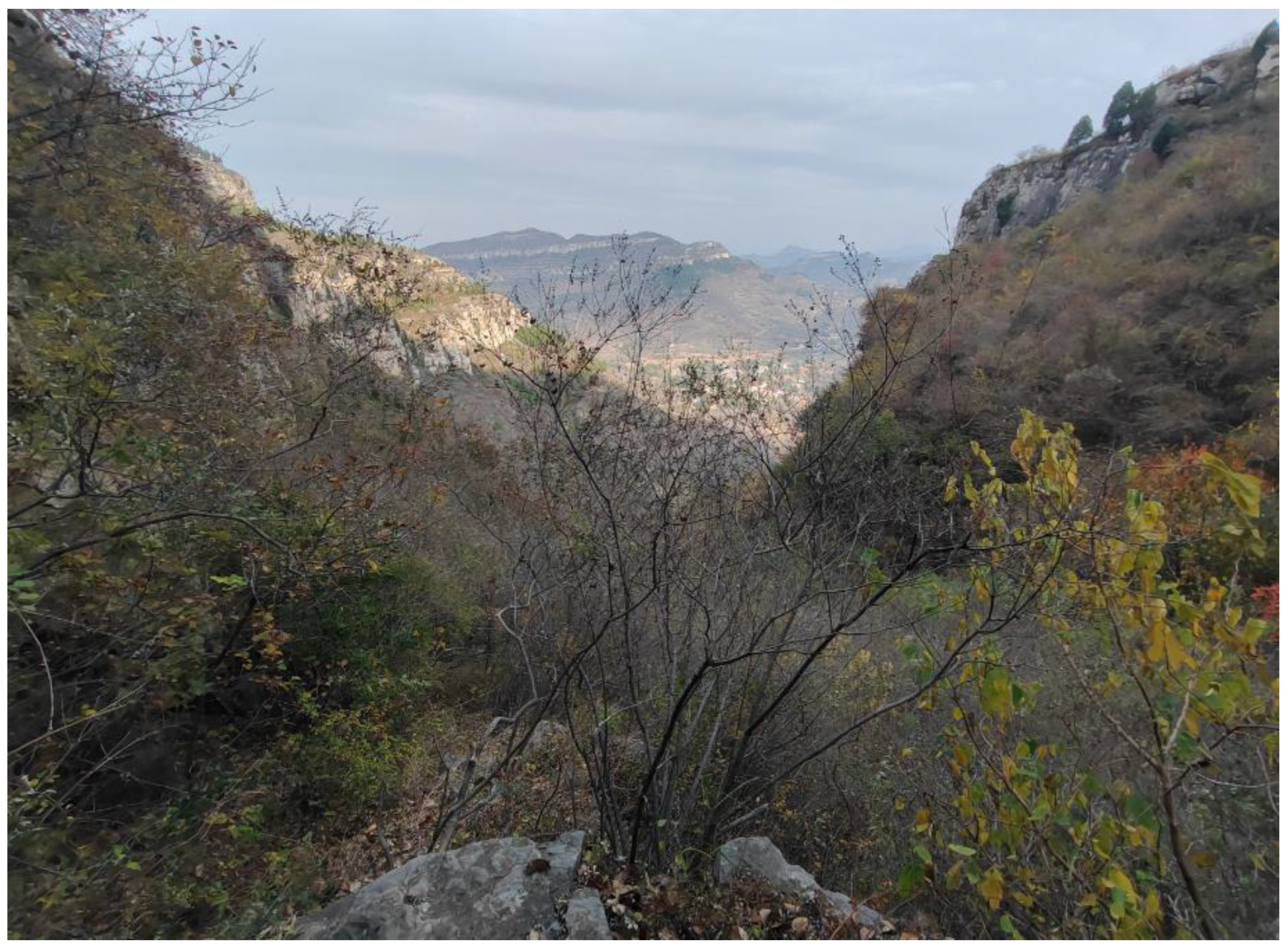
  7. Ge, Guolong 戈國龍. 2022. “Lun Daojiao Neidanxue de ‘Xuanguan Yiqiao’” 論道教內丹學的“玄關一竅”. Shijie Zongjiao Yanjiu 世界宗教研究. no. 5. [Google Scholar]
  8. Ge, Hong 葛洪. 1989. Shenxian Zhuan 神僊傳. In Dao Zang Jinghua Lu 道藏精華錄. Hangzhou: Zhejiang ancient book Publishing House 浙江古籍出版社, Vol. 3. [Google Scholar]
  9. Han, Meng 韓猛. Forthcoming. Grottoes and Secluded Realms: The Beginning of a Shandong Regional Sub-Tradition of Early Cave Temples as Exemplified by Jinan’s Longdong Cave 石窟與秘境:以濟南龍洞為例試論早期石窟山東地域子傳統的開端.
  10. Harrist, Robert E., Jr. 2003. Mountains, Rocks, and Picture Stones: Forms of Visual Imagination in China. Orientations 34: 39–45. [Google Scholar]
  11. Hu, Fuchen 胡孚琛. 1989. Weijin Shenxian Daojiao 魏晉神僊道教. Beijing: Renmin Publishing House 人民出版社. [Google Scholar]
  12. Huang, Shishan. 2022. Picturing the True Form: Daoist Visual Culture in Traditional China. Cambridge: Harvard University Asia Center. [Google Scholar]
  13. Jing, Anning. 2012. The Complete Perfection: Daoist Monasticism, Sculpture, and Sacred Space in Quanzhen Tradition. Honolulu: University of Hawai’i Press. [Google Scholar]
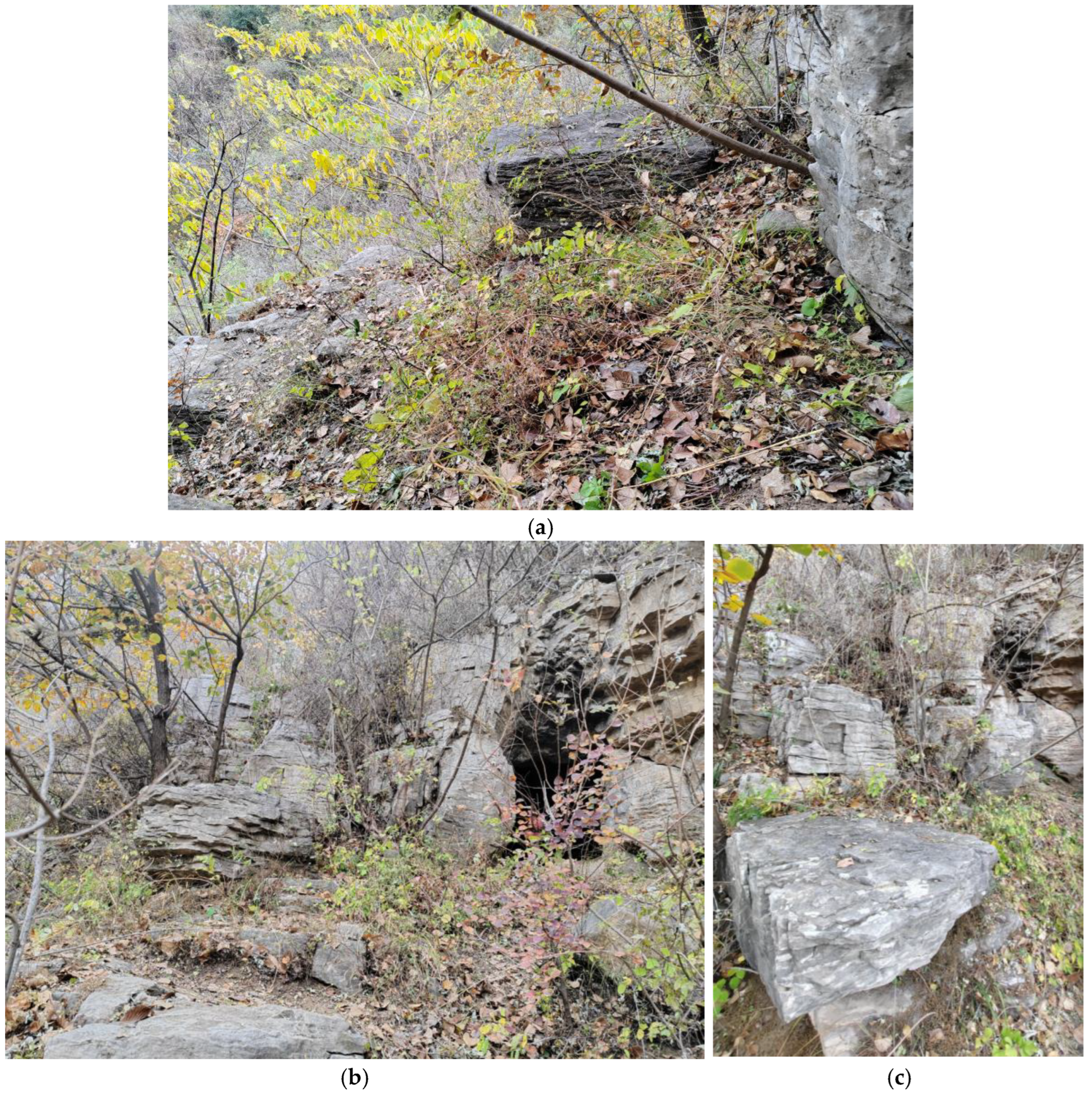
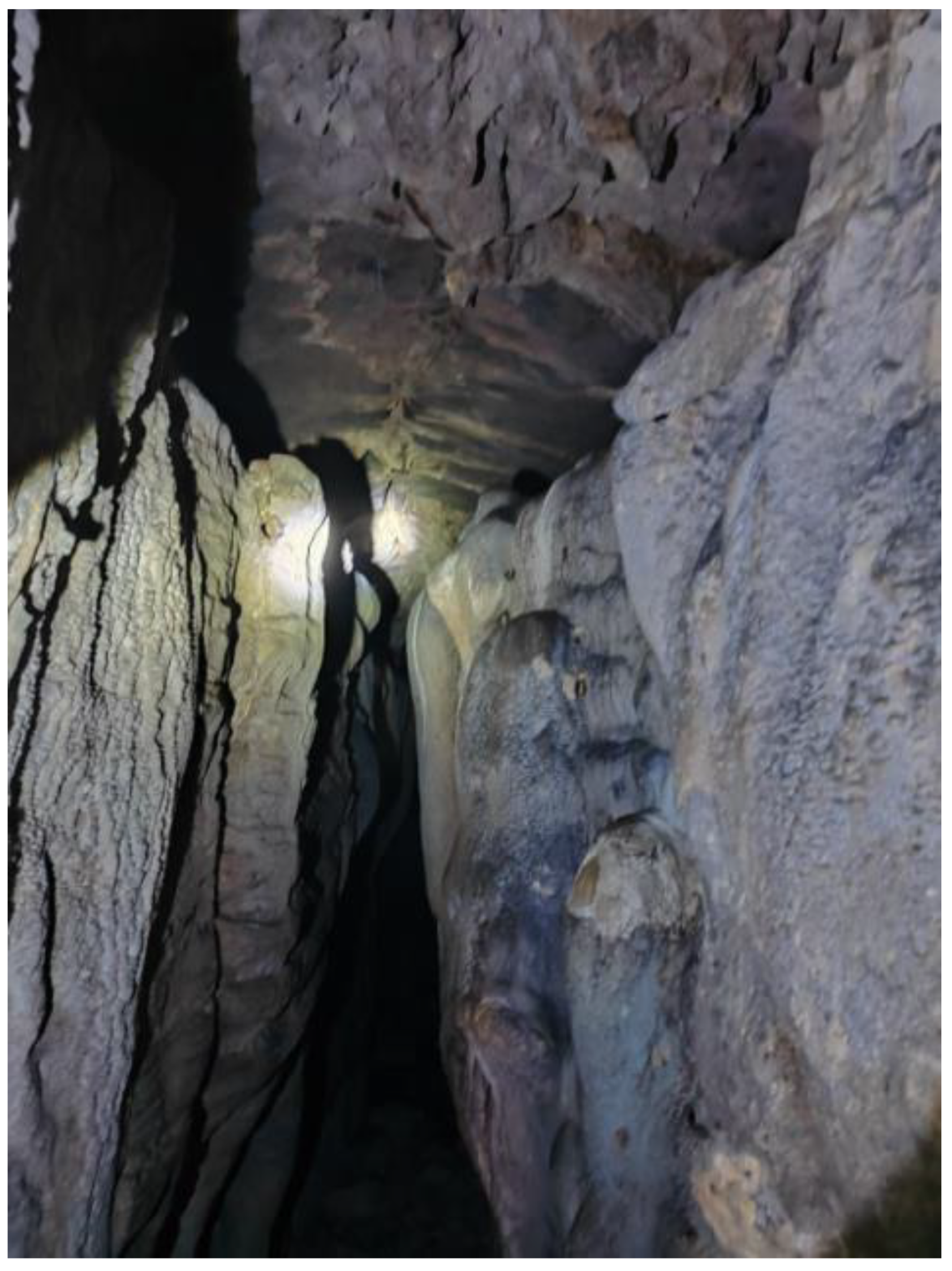
  14. Liu, Wenwen 劉雯雯. 2011. Taishan Xuezhe Faxian Jinchao Daoshi Zhang Zhong Yinjudi 泰山學者發現晉朝道士張忠隱居地. Taian: Zhonghua Taishan Wang 中華泰山網. [Google Scholar]
  15. Liu, Zao 劉藻. 2007. “You Longdong Ji” 遊龍洞記. In Licheng Xianzhi Zhengxu Hebian 歷城縣誌正續合編. Jinan: Jinan Chubanshe濟南出版社, Vol. 1. [Google Scholar]
  16. Ma, Daxiang 馬大相. 1994. Lingyan Zhi 靈岩志. Collated and punctuated by Fanxin Kong 孔凡信. Jinan: Shandong Youyi Chubanshe 山東友誼出版社. [Google Scholar]
  17. Mao, Chenglin 毛承霖, comp. 2007. Xuxiu Licheng Xianzhi 續修歷城縣誌. In Licheng Xianzhi Zhengxu Hebian 歷城縣誌正續合編. Jinan: Jinan Chubanshe 濟南出版社, Vol. 3. [Google Scholar]
  18. Nie, Qin 聶鈫. 1968. Taishan Daoli Ji 泰山道里記. Taipei: Chengwen Chubanshe 成文出版社. [Google Scholar]
  19. Rao, Zongyi 饒宗頤. 2015. Laozi Xiang’er Zhu Jiaozheng 老子想爾注校證. Hong Kong: Zhonghua Book Company 中华书局. [Google Scholar]
  20. Shaanxi Provincial Institute of Archaeology 陕西省考古研究院. 2013. Tongguan Shuicun Sui Dynasty Painted Tomb 潼关税村隋代壁画墓. Beijing: Cultural Relics Press 文物出版社. [Google Scholar]
  21. Shaanxi Provincial Institute of Archaeology 陕西省考古研究院, Xi’an Municipal Institute of Cultural Heritage and Archaeology 西安市文物保护考古研究院, and Shaanxi History Museum 陕西历史博物馆. 2018. Lü Clan Cemetery, Lantian 蓝田吕氏家族墓园. Beijing: Cultural Relics Press 文物出版社. [Google Scholar]
  22. Shang, Bi 商壁, and Bo Pan 潘博. 1988. Lingbiao Luyi Jiaobu 嶺表錄異校补. Nanning: Guangxi Ethnic Publishing House 广西民族出版社. [Google Scholar]
  23. Shen, Dongmei 沈冬梅. 2006. Chajing Jiaozhu 茶經校注. Beijing: China Agriculture Press 中國農業出版社. [Google Scholar]
  24. Su, Shi 蘇軾. 1986. Dongpo Complete Works 東坡全集. In Wenyuange Siku Quanshu 文淵閣四庫全書. Taipei: Taiwan Commercial Press 臺灣商務印書館, Vol. 1107. [Google Scholar]
  25. Sun, Qi 孫齊. 2024. The Celestial Masters and the Origins of Daoist Monasticism. Religions 15: 83. [Google Scholar] [CrossRef]
  26. Tanaka, Chisako 田中知佐子. 2003. Paintings of Dragon Carriage and Phoenix Carriage at Mogaoku, Dunhuang Grottoes 敦煌莫高窟の「竜車・鳳車図」について. Ars Buddhica 仏教芸術 269: 85–111. [Google Scholar]
  27. Tang, Yijie 湯一介. 2016. Early Daoist History 早期道教史. Beijing: China Renmin University Press 中國人民大學出版社. [Google Scholar]
  28. Tang, Zhongmian 唐仲冕. 2023. Dailan 岱覽. Jinan: Shandong People’s Publishing House. [Google Scholar]
  29. Tao, Jin 陶金, and Shuang Qu 曲爽. 2020. Di Yi Dongtian: Mindong Jiaocheng Huotong Shan Kaocha Suibi 第一洞天:閩東蕉城霍童山考察隨筆. The Paper 澎湃新聞, November 1.
  30. Vervoorn, Aat. 1990. Men of the Cliffs and Caves: The Development of the Chinese Eremitic Tradition to the End of the Han Dynasty. Hong Kong: The Chinese University Press. [Google Scholar]
  31. Wang, Chengwen 王承文. 2006. “Gulingbaojing ‘Wulao Dijun’ Yu Zhonggu Daojiao Jingjiao Xueshuo De Jiangou” 古靈寶經”五老帝君”與中古道教經教學說的建構. In 2006 Nian Taiwan Dao Wenhua Guoji Xueshu Taolunhui Lunwenji 2006 年臺灣道文化國際學術討論會論文集. Taipei: Changjing Wenhua Chubanshe. [Google Scholar]
  32. Wang, Chengwen 王承文. 2018. Dunhuang Gulingbaojing Dongxuan Benxing Jing Banben Jiegou Lunkao 敦煌古靈寶經《洞玄本行經》版本結構論考. Dunhuangxue Jikan 敦煌學輯刊 2: 118–34. [Google Scholar]
  33. Wang, Lianru 王連儒. 1968. Changqing Xianzhi 長清縣誌. Taipei: Chengwen Press 成文出版社. [Google Scholar]
  34. Wang, Xiaodun 王小盾. 2010. Lun Laozi Shouzhang Jiqi ‘Dao’ de Yuanxing 論《老子》首章及其”道”的原型. Zhonghua Wenshi Luncong 中華文史論叢 2: 287–312. [Google Scholar]
  35. Yamada, Toshiaki 山田利明. 1990. Shenxian Dao 神僊道. In Daoism: Volume I 道教 第一卷. Supervised by Fukui Yasuzō 福井康順 et al. Translated by Yueli Zhu 朱越利. Shanghai: Shanghai Ancient Books Publishing House 上海古籍出版社. [Google Scholar]
  36. Yang, Yansi 楊衍嗣. 2007. You Longdong Jilue 游龍洞紀略. In Licheng Xianzhi Zhengxu Hebian 歷城縣誌正續合編. Jinan: Jinan Publishing House 濟南出版社, Vol. 1. [Google Scholar]
  37. Yang, Zilu 楊子路. 2021. The Intellectual and Cultural History of the Interaction between Taoism and Traditional Chinese Mathematics 道教與中國傳統數學互動的思想文化史. Chongqing: Southwest China Normal University Press 西南師範大學出版社. [Google Scholar]
  38. Yoshikawa, Tadao 吉川忠夫. 1984. Rikucho Seishinshi Kenkyu. Kyoto: Dōhōsha. [Google Scholar]
  39. Yu, Chengbao 于成寶. 2013. Cong 《Laozi》 Muxing Shengzhi Chongbai de Jiaodu Jiedu 《Taiyi Shengshui》——Jian Lun Qi Zai Xianqin Xueshuoshi Shang de Yiyi 從《老子》母性生殖崇拜的角度解讀《太一生水》——兼論其在先秦學術史上的意義. Minsu Yanjiu 民俗研究 112: 59–60. [Google Scholar]
  40. Yu, Qin 于欽. 2012. Qi Cheng Xiao Shi 齊乘校釋. Collated and annotated by Dunyuan Liu 劉敦願, et al. Beijing: Zhonghua Shuju 中華書局. [Google Scholar]
  41. Yue, Jun 岳濬, comp. 1986. Shandong Tongzhi 山東通志. In Wenyuange Siku Quanshu 文淵閣四庫全書. Taipei: Taiwan Commercial Press 臺灣商務印書館, Vol. 541. [Google Scholar]
  42. Zhang, Lujun 張魯君, and Han Jishao 韓吉紹. 2012. Shangqing Shidicheng Tongbo Zhenren Zhen Tu Zan Kaolun 《上清侍帝晨桐柏真人真圖贊》考論. Zongjiao Xue Yanjiu 宗教學研究 3: 48–53. [Google Scholar]
  43. Zhang, Songru 張松如. 1981. Laozi Jiaodu 老子校讀. Changchun: Jilin People’s Press 吉林人民出版社. [Google Scholar]
  44. Zhang, Taiheng 張泰亨. 2007. Xinxiu Longdong Linghui Gong Miaoji 新修龍洞靈惠公廟記. In Licheng Xianzhi Zhengxu Hebian 歴城縣誌正續合編. Jinan: Jinan Chubanshe: Vol. 1. [Google Scholar]
  45. Zhang, Zhaosen 張昭森, ed. 2020. Changqing Stele Inscriptions 長清碑刻(上). Jinan: Jinan Publishing House, Vol. 1. [Google Scholar]
  46. Zhao, Chuan 趙川. 2022. Daojiao Zaoxiang Qiyuan Xintan 道教造像起源新探. Wen Shi 文史 3: 99–116. [Google Scholar]
Figure 1. Relative positional relationship diagram of Xiaokouyu 小口峪 and its surrounding areas.
Religions 17 00535 g001
Figure 2. Plan sketch of Yudeng 禹登 Mountain’s Dragon Cave 龍洞 and Buddhist grottoes, created by Han Meng.
Religions 17 00535 g002
Figure 3. East entrance of Dragon Cave 龍洞 on Yudeng Mountain, photographed by Han Meng.
Religions 17 00535 g003
Figure 4. Interior of the tunnel in Dragon Cave 龍洞 on Yudeng Mountain’s, photographed by Han Meng.
Religions 17 00535 g004
Figure 5. (ac): The entrance, the hall section, and the top of the hall of Xiaokouyu Cave, photographed by Han Meng.
Religions 17 00535 g005
Figure 6. (a,b): Visual imagination based on the shapes of the boulders—Five Elders Deities 五老神 and Langgong Stone. Photographed by Han Meng.
Religions 17 00535 g006
Figure 7. Mountainous Taoist temples, monasteries, and spiritual retreats closely associated with Taoism in the northwest direction of Mount Tai 泰山.
Religions 17 00535 g007
Figure 8. Cloud chariot and ceremonial guard of honor with Yulang 玉郎 on the linear stone carvings from the Sui 隋 Dynasty tomb in Suicun 税村, Tongguan 潼关 (Shaanxi Provincial Institute of Archaeology 2013).
Religions 17 00535 g008
Figure 9. The mountain on the southern side of Xiaokouyu and the dragon-horn-shaped boulder at its forefront, photographed by Han Meng.
Religions 17 00535 g009
Figure 10. (a,b): Two types of jade talismans: (a). One of the Eight Efflorescences Spirit-True Jade Talismans 八景神真玉符; (b). The Jade Talisman for Dispelling Transformations and Attaining Liberation as a River-Flowing Scene 解形逯变灭度作江河流景玉符. Sourced respectively from Yunji Qiqian 雲笈七簽 (DZ.1032:22, p. 571b); and Shangqing Yuanshi Pulu Taizhen Yujue 上清元始谱籙太真玉诀 (DZ.1365:33, p. 807c).
Religions 17 00535 g010
Figure 11. The horizontally striped rock formation at the summit of Langgong Hill, located at the southernmost part of Lingyan Mountain, photographed by Han Meng.
Religions 17 00535 g011
Figure 12. Sitting at the entrance of Xiaokouyu Cave and gazing eastward, photographed by Han Meng.
Religions 17 00535 g012
Figure 13. (ac): View of the natural stone altar on the southeast side outside the Xiaokouyu Cave 小口峪洞 entrance, photographed by Han Meng.
Religions 17 00535 g013
Figure 14. The fifth illustration from Sima Chengzhen’s 司馬承禎“Ode to the True Image of the Tongbai Real Person Who Attends the Emperor in the Morning in the Shangqing Tradition 上清侍帝晨桐柏真人真圖贊” (DZ.0612:11, p. 629), colored by Tao Jin 陶金 (Tao and Qu 2020).
Religions 17 00535 g014
Figure 15. The Lidou Stone 禮斗石 at the ruins of Jianji monastery 簡寂觀 on Mount Lu 廬山, photographed by Han Meng.
Religions 17 00535 g015
Figure 16. Stalactites inside Xiaokouyu Cave, photographed by Han Meng.
Religions 17 00535 g016
Figure 17. (a): Lishan Stone Cauldron 骊山石釜 (M25:1) from the Lv Family Tomb in Lantian 蓝田吕氏墓, Xi’an 西安 (Shaanxi Provincial Institute of Archaeology et al. 2018); (b): Triple-Legged Iron Tripod 三高足铁鼎 (M2:66) from the Lv Family Tomb in Lantian 蓝田吕氏墓, Xi’an 西安 (Shaanxi Provincial Institute of Archaeology et al. 2018).
Religions 17 00535 g017
Figure 18. The Feminine Gate 牝门 inside Xiaokouyu Cave, photographed by Han Meng.
Religions 17 00535 g018
Disclaimer/Publisher’s Note: The statements, opinions and data contained in all publications are solely those of the individual author(s) and contributor(s) and not of MDPI and/or the editor(s). MDPI and/or the editor(s) disclaim responsibility for any injury to people or property resulting from any ideas, methods, instructions or products referred to in the content.