Article

The Formation of Daoist Thought and Spatial Transformations of the Yongzhen Grotto-Heaven on Mount Lu

1
School of Philosophy and Religious Studies, Minzu University of China, Beijing 100081, China
2
School of History and Culture, Henan University, Kaifeng 475001, China
*
Author to whom correspondence should be addressed.
Religions 2026, 17(6), 627; https://doi.org/10.3390/rel17060627
Submission received: 30 November 2025 / Revised: 10 May 2026 / Accepted: 13 May 2026 / Published: 22 May 2026
(This article belongs to the Special Issue Heavens and Grottos: New Explorations in Daoist Cosmography)

Abstract

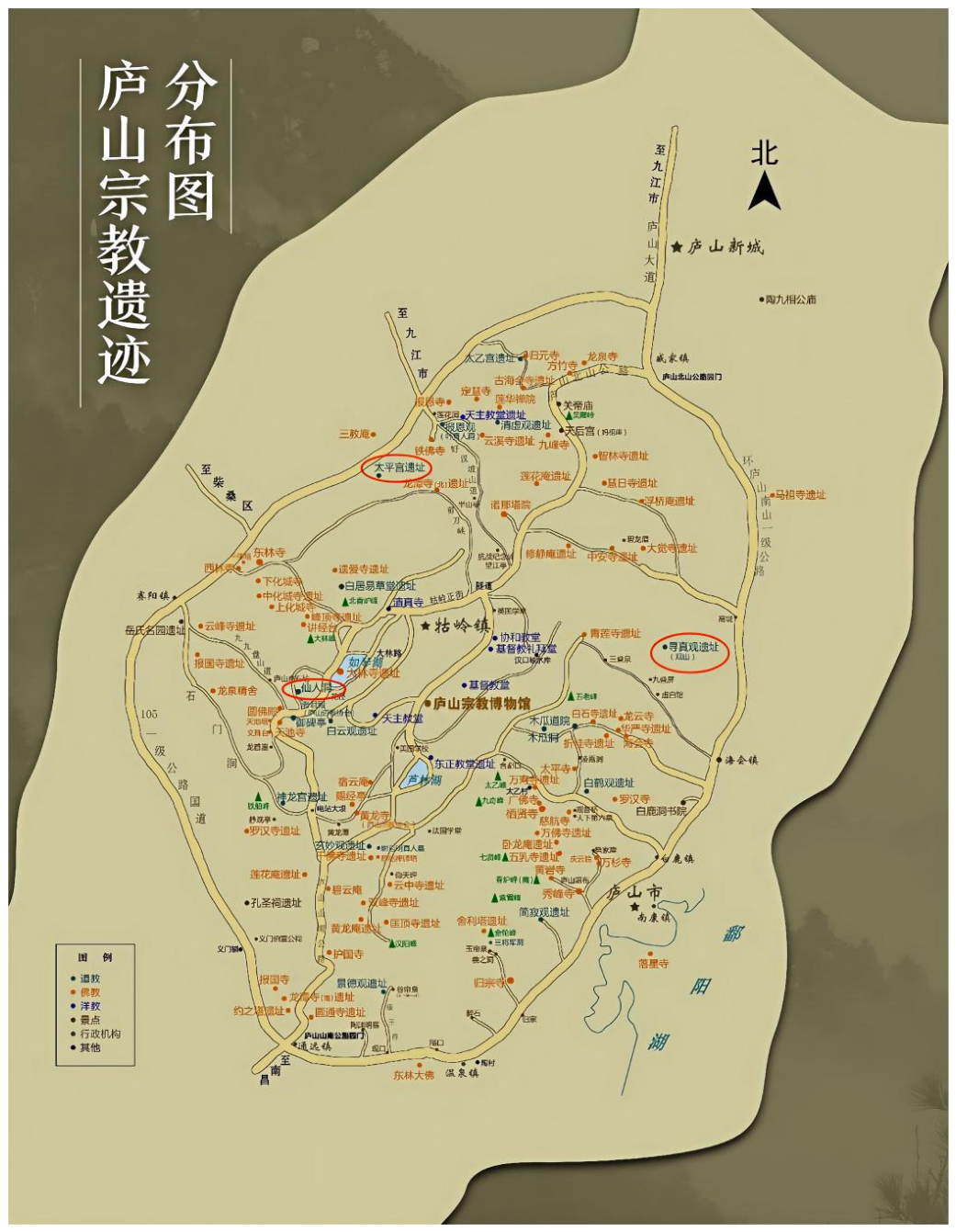
The thought of the Yongzhen Grotton-Heaven on Mount Lu was historically constructed and was continually adjusted and reshaped in response to changing historical circumstances. The Xunzhen Abbey in Wulao Peak, Taiping Palace, Feiyun Cave, and Xianren Cave all used to be regarded as Yongzhen Grotto. Several Daoist centers in Mount Lu in different periods attempted to incorporate this belief element into their own abbeys in order to enrich their sacredness and authority. Examining the Daoist thought and the changing locations of the Yongzhen Grotto-Heaven reveals not only that this theoretical knowledge was created through a complex, collaborative process but also directly show the unimaginable complexity of the impacts that the knowledge could trigger after being implemented in local society.

Mount Lu 廬山, one of China’s most celebrated mountains, is renowned for its picturesque scenery and profound cultural heritage. Located beside Poyang Lake 鄱陽湖, Mount Lu became a richly textured realm. Here, Confucian, Buddhist, Daoist traditions converged, shaping an ideal of harmony between heaven and humankind. As a sacred mountain of Chinese humanistic culture, Mount Lu has historically been a site where Confucian, Buddhist, and Daoist traditions all enjoyed periods of remarkable flourishing. In terms of Buddhism, Huiyuan’s 慧遠 (334–417) established the Donglin 東林 Monastery on Mount Lu. Dozens of other monasteries were also founded in the mountain area. Together, they made Mount Lu a major center of the Pure Land tradition in China. On the Confucian side, the lecturing activities of Li Bo 李渤 (773–831) and his brother, together with those of Zhu Xi 朱熹 (1130–1200), as well as the establishment of the White Deer Grotto Academy (Bailu dong shuyuan 白鹿洞書院), turned Mount Lu into an important center of Confucian learning. In Daoist history, Lu Xiujing’s 陸修靜 (406–477) cultivation at the Jianji 簡寂 Abbey on Mount Lu, where he played a crucial role in the compilation and systematization of the Lingbao 靈寶 scriptures, as well as the legendary transmission of teachings from Zhongli Quan 鐘離權 (168–256) to Lü Dongbin 呂洞賓 (796–?) on this mountain, likewise secured Mount Lu a prominent place in Daoist tradition. From the late Qing 清 (1644–1912) to the Republican period (1912–1949), missionaries such as Edward Selby Little purchased land in Guling 牯嶺 on Mount Lu and subsequently undertook its development, which rapidly propelled the mountain onto a path of “modernization”. Mount Lu subsequently became the summer capital of the Republican government, with Chiang Kai-shek 蔣介石 (1887–1975) and many senior political figures establishing long-term offices and residences there. As a result, this mountain became the site of a number of major political events, including the famous “Speech at the Mount Lu Conference” (Lushan jianghua 廬山講話, 7 July 1937). After the founding of the People’s Republic of China, leaders such as Mao Zedong 毛澤東 (1893–1976) for a time continued the Republican tradition of conducting summer work at Mount Lu. The “Mount Lu Conference” (Lushan huiyi 廬山會議) (August 1959), which triggered major political upheaval, was named precisely because it was held at Mount Lu. It is thus clear that Mount Lu has occupied an exceptionally important place in Chinese social and cultural history. Compared with the flourishing presence of Buddhism and Confucianism on Mount Lu, Daoism occupied a smaller sphere and more limited physical space. Yet, it profoundly enriched the mountain’s cultural character. Daoism’s most enduring contribution to Mount Lu was the promotion of its identity as a “grotto-heaven” (dongtian 洞天).
The study of “grotto-heaven” has already become an important field within Daoist studies, and has generated a substantial body of valuable scholarship.1 Western scholars, in particular, have long been engaged with this topic. Nearly a century ago, Édouard Chavannes, in his seminal work “Le jet du dragon”, systematically introduced the Daoist system of the Thirty-Six Grotto-Heavens (sanshi liu dontian 三十六洞天), treating them as sites employed by the imperial state for the performance of “casting the dragon slips” (toulong 投龍) ritual. Over the past three decades, Franciscus Verellen’s studies of grotto-heaven beliefs, approached through the lenses of Daoist cosmology and ritual, have become classics in the field, providing especially influential interpretations of their religious significance. Gil Raz’s comprehensive discussion of Daoist “sacred geography” further presents a relatively complete account of grotto-heaven beliefs and their constituent elements. Moreover, the system of grotto-heavens and blessed-lands (fudi 福地) is now on the path to UNESCO World Heritage recognition, serving as a cultural bridge between past and present, and between China and the world (Xu 2021).
Within Mount Lu, more precisely, beneath it, there lies a grotto-heaven, which constitutes one of the major reasons for the mountain’s prominence as a site of both official and popular pilgrimage and worship in the premodern era. Despite a certain body of scholarship on the Daoist history of Mount Lu, focused discussions of its grotto-heaven remain very rare.2 The underlying reason may be that Daoism on Mount Lu was far less prosperous than Buddhism and Confucian traditions there and therefore received correspondingly less scholarly attention. Additionally, a lack of familiarity with grotto-heaven beliefs—especially the tendency to treat them as purely legendary myths while ignoring their real-world associations, such as specific caves—has further limited awareness of the topic. In light of this, this paper examines the establishment of the conception of Mount Lu’s grotto-heaven within the Daoist knowledge system, as well as the evolving locations of its physical “entrances” (or caves) from the Tang dynasty to the modern era. It further aims to reveal the complex interplay between grotto-heavens as constructed through Daoist thought and the local environment.

1. The Establishment of Mount Lu’s Grotto-Heaven Within the Daoist Thought

The recognition of Mount Lu as the “Grotto-Heaven of Praising the Perfected” (Yongzhen dongtian 詠真洞天, hereafter Yongzhen grotto-heaven), ranked eighth among the thirty-six lesser grotto-heavens (sanshiliu xiao dongtian 三十六小洞天), did not form part of the initial formation of Daoist grotto-heaven thought. In brief, Mount Lu received little attention in Daoist grotto-heaven thought during the Southern Dynasties (220–589). It was only around the High Tang period that it became recognized as an official grotto-heaven. This recognition emerged as a result of the continued systematization of the Daoist grotto-heavens. The following discussion of selected early Daoist texts will reveal the process through which the recognition of Yongzhen grotto-heaven was established.
Scholars generally believe that the notion of “grotto-heaven” was first introduced by the Daoist “Upper Clarity” (Shangqing 上清) tradition of the Southern Dynasties. The Inner Biography of the Perfected of Purple Yang (Ziyang zhenren neizhuan 紫陽真人內傳) is an important Shangqing classic of the Southern Dynasties. This text states that “a mountain contains a hollow space known as a cave … The mountain’s interior is hollow, which is referred to as a cave-court” 山無謂之洞……山腹中空虛,是謂洞庭 (Ziyang zhenren neizhuan 1988, p. 546a, 紫陽真人內傳). These hollow caves scattered within mountains are secret abodes where the perfected beings reside. Daoist grotto-heavens are sacred realms illuminated by a distinct sun and moon, nurturing fungi and potent herbs, interlinked with each other, and governed by the transcendent and perfected beings. Early Shangqing texts, including one of the most important Shangqing works, The Declarations of the Perfected (Zhen’gao 真誥), provide extensive descriptions of grotto-heavens, a body of knowledge that can be traced as far back as the Eastern Jin dynasty (317–420). In the medieval period, the grotto-heaven system was diverse rather than uniform, generally consisting of three categories: (1) the ten great grotto-heavens, (2) the thirty-six grotto-heavens, and (3) the thirty-six lesser grotto-heavens. The original (2) thirty-six grotto-heavens actually include the so-called ten great grotto-heavens and thus differ from the thirty-six lesser grotto-heavens systematized and compiled by Sima Chengzhen 司马承祯 (639–735) during the Tang dynasty (618–907).3 According to extant sources, pre-Tang records on the thirty-six grotto-heavens, encompassing the ten great grotto-heavens, make no reference to whether Mount Lu is part of this grotto-heaven system.
Two scholars from the Liang dynasty (502–557), Tao Hongjing 陶弘景 (456–536) and Ren Fang 任昉 (460–508), shed considerable light on this matter.
The Declarations of the Perfected states:
Within the Great Heaven, there are thirty-six subterranean grotto-heavens. The eighth is the cave of Mount Juqu, with a circumference of 150 li, named the Heaven of Huayang of Golden Altar. [Note: the following is the annotation] The Biography records the tenth grotto-heaven, and the deities of Fengdu, the Five Marchmounts and the Eight Seas. Caves in distant barbarian lands, as they fall outside this scope, are not recorded here. 大天之內有地中之洞天三十六所,其第八是句曲之洞,周迴一百五十里,名曰金壇華陽之天。《傳》中所載,至第十天,並及酆都、五岳、八海神仙。遠方夷狄之洞,既非此限,並不獲疏出。
Ren Fang’s The Records of Strange Phenomena (Shuyi Ji 述異記) states:
Among the thirty-six grotto-heavens in the human realm, only ten are known. The remaining twenty-six [grotto-heavens] are documented in the Records on Ninefold Tenuity but (the text?) does not circulate in the world. 人間三十六洞天,知名者十耳。餘二十六天出《九微志》,不行于世也。
(Ren 1592, p. 16)
Both Tao Hongjing and Ren Fang attested to having heard that there were thirty-six grotto-heavens, yet only ten of them were identified. The Records on Ninefold Tenuity (Jiuwei zhi 九微志) mentioned by Ren Fang has long been lost; thus, its contents remain unclear. The claim that “the remaining twenty-six grotto-heavens” are “not in circulation” seems to conflict with the statement that they are “derived from the Records on Ninefold Tenuity.” It is possible that this work describes many sacred mountains but does not indicate which are to be identified as the remaining twenty-six grotto-heavens. The Biography that records the ten grotto-heavens claimed by Tao Hongjing should refer to The Inner Biography of Lord Mao of the Supreme Origin (Taiyuan Mao Jun neizhuan 太元茅君內傳, also known as Mao Jun neizhuan 茅君內傳, Taiyuan neizhuan 太元內傳 or Mao Jun zhuan 茅君傳). This work primarily focuses on the cultivation experiences of the Shangqing perfected beings—the three Lords Mao (san Mao jun 三茅君). It is a highly important “hagiography” within the Southern Dynasties Shangqing tradition, intended to offer contemporaneous Daoist practitioners an exemplary model worthy of veneration and emulation. The quotation “within the Great Heaven… the Heaven of Huayang of Golden Altar” is also cited in The Records of Mount Mao (Maoshan Zhi 茅山志), which asserts that this passage derived from The Inner Biography of the Supreme Origin (Taiyuan neizhuan 太元內傳) (Liu and Wang 2016, pp. 139–40).
Insights into the textual evolution of the Inner Biography of Lord Mao (Maojun neizhuan 茅君內傳) and its treatment of grotto-heavens are crucial for determining when the concept of the grotto-heaven of Mount Lu took shape. The independent edition of The Inner Biography of Lord Mao has long been lost. However, its contents survive in both The Records of Mount Mao and Seven Slips of a Cloudy Satchel (Yunji qiqian 雲笈七籤). The former preserves an expanded version under the title “The Perfected Descendants of Lord Mao” 茅君真胄, while the latter contains a more concise version entitled “The Biography of the Perfected Lord of Director of Destiny, High Official of the Eastern Marchmount, the Perfected of Supreme Origin” 太元真人東岳上卿司命真君傳.4 Scholars like Isabelle Robinet have argued that “The Perfected Descendants of Lord Mao” largely reflects the original content of the Inner Biography of Lord Mao (Robinet 1984, pp. 389–98), but this version makes no mention of the thirty-six grotto-heavens or the ten great grotto-heavens. Similarly, the simplified version preserved in the Seven Slips of a Cloudy Satchel does not mention them either. However, based on the materials cited in the Declarations of the Perfected, the Inner Biography of Lord Mao as seen by Tao Hongjing indeed contains the content about grotto-heavens. Shi Qing’s 石青 research lends further support to the argument that this version of the Inner Biography of Lord Mao functioned as a key textual source for grotto-heaven beliefs (See Shi 2022, esp. 62). A passage in the Imperial Readings of the Taiping Era (Taiping Yulan 太平御覽) (found in the “Transmission” 傳授 subsection of the “Daoism” section 道部) citing the Biography of Lord Mao (Maojun zhuan 茅君傳) does in fact provide the names of the ten grotto-heavens:
At the end of the Jian’an reign period (196–220) of the Han Dynasty (202 BCE–220 CE), Zuo Ci heard that the mountain was situated in the Jiangdong region, so he came to seek it. After observing a three-month period of fasting and purification, he ascended the mountain and eventually found its entrance. He entered the cave and visited the hidden palace. The middle Lord Mao granted him three types of divine fungi. Zuo Ci spent more than one year moving throughout the grotto chambers, observing that the rules were rigorous and the atmosphere solemn. He exclaimed, “I did not expect that such a wonder still exists in the world!” As for the subterranean grotto-heavens, there are thirty-six in total, including Wangwu, Weiyu, Xicheng, Xixuan, Qingcheng, Chicheng, Luofu, Juqu, Linwu, Kuocang, Kunlun, Penglai, Yingzhou, Fangzhang, Canglang, Baishan, Bating, and the like. The Five Marchmounts and other famous mountains all contain grotto chambers, some extending thirty, twenty, or ten li, while the grotto chambers of Marchmounts extend up to a hundred li. 漢建安之末,左慈聞江東有此山,故尋之。齋戒三月而登山,乃得其門,入洞虛造陰宮。二茅君授以神芝三種,慈周旋洞室經年,制度甚肅,歎曰:“不圖天下復有如此之異乎!”至於地中洞天,有三十六所,王屋、委羽、西城、西玄、青城、赤城、羅浮、句曲、林屋、括蒼、昆侖、蓬萊、瀛洲、方丈、滄浪、白山、八停之屬也,五嶽及諸名山皆有洞室,或三十里,二十里,十里。岳洞方百里也。
(F. Li 1960, pp. 3025b–26a)
This passage lists the names of the ten grotto-heavens, ranging from Mount Wangwu 王屋山 to Mount Kuocang 括蒼山. Beginning with Kunlun 昆侖, it then enumerates the more traditionally recognized legendary realms. The text is introduced through the story of Zuo Ci 左慈 (155–220). The Perfected Descendants of Lord Mao concludes with an account of this figure, stating that Li Zhongfu 李仲甫 studied alongside Lord Mao under Lord Wang of Western City (Xicheng Wangjun 西城王君): “Zhongfu once transmitted the divine method of Seven Transformations to Zuo Yuanfang (i.e., Zuo Ci), who practiced it, and achieved myriad transformations” 仲甫曾以七變神法傳左元放,元放修之,亦變化萬端矣 (Liu and Wang 2016, p. 133). The Perfected Descendants of Lord Mao abruptly ends at this point. The excerpt cited above from the Imperial Readings of the Taiping Era appears to have been meant to continue the text but may have been omitted by the compilers of the Records of Mount Mao due to its less connection to Lord Mao.
In the early grotto-heaven system presented in the Biography of Lord Mao, as cited in the Imperial Readings of the Taiping Era, there is no mention of the secondary grotto-heavens, including the later “eighth lesser grotto-heaven”—Mount Lu. However, certain post-Tang texts claim to have drawn their knowledge of the “lesser grotto-heavens” from the Biography of Lord Mao. For example: the Yuan scholar, Deng Mu’s 鄧牧 (1246–1306) the Records of the Grotto Heaven of Great Purification (Dadi dongtian ji 大滌洞天記) reads:
The Biography of Mao Lord states: The thirty-fourth grotto-heaven is named the Heaven of Mysterious Canopy of Great Purification, with a circumference of 400 li. Within it, there are the divided essence of the sun and moon, golden halls and jade chambers, where serves as the place where celestial officials examine calamities and blessings. It is presided over by the Perfected Jiang and secretly connected to the grotto-heavens of Huayang and Linwu through subterranean paths. 《茅君傳》云:“第三十四洞天名大滌玄蓋之天,周迴四百里,內有日月分精,金堂玉室,仙官校災福之所,姜真人主之,與華陽、林屋隧道暗通。”
(Deng 1988, p. 149b)
The Comprehensive Mirror of Perfected Immortals Who Embodied the Dao of All Ages (Lishi zhenxian tidao tongjian 歷世真仙體道通鑒) is a Yuan-Dynasty Daoist hagiographical compendium compiled by the Daoist master, Zhao Daoyi 趙道一 (fl. 1294–1307). It states:
According to the Inner Biography of Lord Mao, there are thirty-six grotto-heavens acknowledged by the transcendent beings, among which Mount Wuyi is the sixteenth grotto-heaven, known as the Heaven of Ascending Perfection and Mysterious Transformation. 按《茅君內傳》云:“仙家有三十六洞天,武夷山乃第十六洞,昇真玄化之天。”
(Zhao 1988a, p. 129a)
The Ming-Dynasty work, the Historical Records of Mount Tai (Dai shi 岱史) states:
According to the Biography of Lord Mao: “The transcendent beings recognize a total of thirty-six grotto-heavens. Mount Tai, with a circumference of more than thirty li, is known as the Heaven of Three Palaces and Empty Cavern.” 《茅君傳》曰: “仙家凡三十六洞天。泰山周迴三十餘里,名三宮空洞之天。”
(Kui 1988, p. 682c)
The Ming scholar Sang Qiao’s桑喬 (d. 1564) the Record of Events at Mount Lu (Lushan jishi 廬山紀事) states:
The Inner Biography of Lord Mao states: “within the Great Heaven, there are thirty-six subterranean grotto-heavens. The eighth is Mount Lu, known as the Heaven of the Transcendent Spirits Praising the Perfected. Its circumference is one thousand and seven hundred li.” 《茅君內傳》:“大天之內有地中之洞天三十六所,其八曰廬山,名山(仙)靈詠真之天。周迴一千七百里。”
(Sang 1932, p. 610b)
These records undoubtedly complicate the matter further. If the original Biography of Lord Mao indeed contained such contents, including the accounts of secondary grotto-heavens (“thirty-six lesser grotto heavens”), such as the grotto-heaven of Mount Lu, then the system of secondary grotto-heavens would have been formed as early as the Eastern Jin period. However, this account contradicts the reports of Tao Hongjing and Ren Fang, as well as the absence of pre-Tang materials detailing the “lesser grotto-heavens” and their rankings. A plausible explanation is that, after the Tang dynasty, a version of the Inner Biography of Lord Mao circulated that had been revised and supplemented by later generations. This “supplemented version” may have developed a more extensive and systematic theory of grotto-heavens, which was not fully established until the Tang period.
Returning to the issue of the grotto-heaven of Mount Lu, it can be confirmed that no definitive evidence has yet been found to indicate that Daoism before the Tang regarded Mount Lu as a site containing a grotto-heaven. However, another type of Daoist sacred geography from the Southern Dynasties—the True Form Charts of the Five Marchmounts (Wuyue zhenxing tu 五嶽真形圖)—confirms that Mount Lu contains a divine realm. The True Form Charts of the Five Marchmounts, preserved in several versions, is an important medieval Daoist work. The text holds that celebrated sacred mountains such as the Five Marchmounts (Wuyue 五嶽), beyond their visible physical forms, each possesses a hidden “true form” (zhenxing 真形). Only by apprehending this “true form” can one locate the entrance to the sacred realms concealed within these mountains. The visual representations known as the True Form Charts of the Five Marchmounts symbolize the sacred power of the mountains and were believed to possess apotropaic efficacy, protecting those who possessed them.5
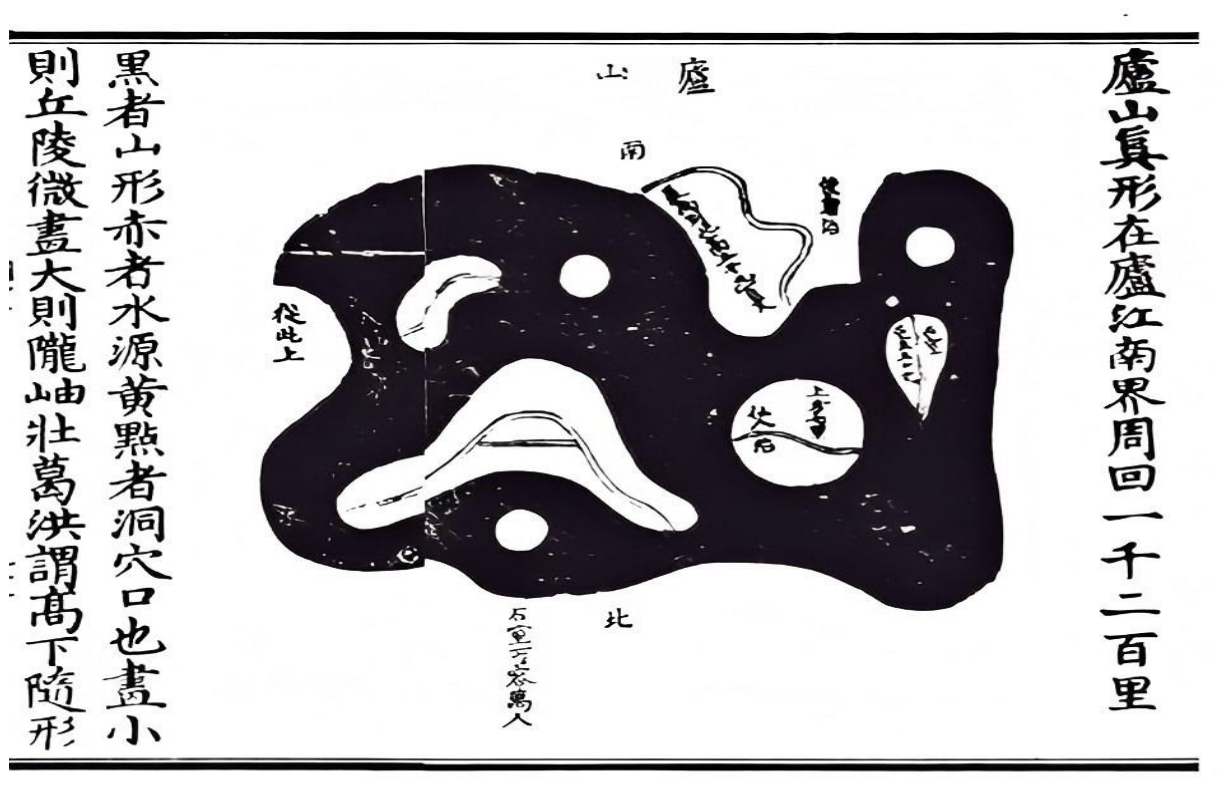
According to Sun Qi 孫齊, the True Form Charts of Ancient Version of Five Marchmounts of Numinous Treasure of Mysterious Cavern (Dongxuan lingbao wuyue guben zhenxing tu 洞玄靈寶五嶽古本真形圖, hereafter the True Form Charts of Ancient Version) was likely composed sometime after Xu Lingqi 徐靈期 (d. 474) of the Liu Song period (420–479) and before Tao Hongjing of the Liang dynasty (Q. Sun 2011). In this text, the section on Mount Lu depicts a chart identified as the “stone chamber entrances” (shixue kou 室穴口). The True Form Charts of Ancient Version also states that after the Yellow Emperor (Huangdi 黃帝) conquered the world, he “appointed Mount Lu as the messenger” 署廬山為使者. The text provides two true form charts of Mount Lu, and one of them describes “Mount Lu as situated in the southern domain of River Lu, with a circumference of 1100 li” 在廬江南界,周迴一千一百里. In this chart, “black represents the mountain shape; red represents the water source; white represents the chamber entrance” 黑者,山形;赤者,水源;白者,是室穴口也. Another chart in the same text notes that the stone chamber “can accommodate tens of thousands of people” 室可容萬人 (Figure 1) (Dongxuan lingbao wuyue guben zhenxing tu 1988, p. 740a, 洞玄靈寶五嶽古本真形圖). The Daoist Canon (Daozang 道藏) printed in black ink cannot display the original colors of the chart, but the “white” marking for the cave entrance (another chart uses “yellow dots”) clearly refers to the white circles shown in the chart.
The True Form Chart of Mount Lu shows three entrances to the mountain’s divine realm, yet the idea that all three could serve as gateways to the same sacred domain finds no echo in later conceptualizations of the grotto-heaven of Mount Lu. While both describe Mount Lu as a site containing a divine realm, the true form charts and grotto-heaven beliefs belong to two separate systems of Daoist sacred geography, each with its own origins. There is an essential difference between the two systems. Nevertheless, when the renowned Tang Daoist master Sima Chengzhen 司馬承禎 (639–735) sought to refine the system of grotto-heavens,6 Mount Lu, already endowed with a “true form”, was easily incorporated into the new framework. This inclusion was subsequently inherited in later grotto-heaven compendia by Du Guangting 杜光庭 (850–933) and Li Sicong 李思聰 (fl. 1049).
Sima Chengzhen’s Charts of the Palaces and Bureaus of the Heavens and Lands (Tiandi gongfu tu 天地宮府圖) is regarded as the first work to systematically present and completely enumerate the ten great grotto-heavens and thirty-six lesser grotto-heavens. The text states:
The eighth [of the thirty-six lesser grotto-heavens] is the cave of Mount Lu. Its circumference is 180 li. It is named the “True Heaven of Penetrating Spirits”, located in De’an county of Jiang prefecture. It is governed by the Perfected Zhou Zhengshi. 第八廬山洞。周迴一百八十里,名曰洞靈真天,在江州德安縣,真人周正時治之。
(Sima 2003, p. 613)
Sima Chengzhen’s description of Mount Lu’s grotto-heaven differs from the spiritual realm depicted in the True Form Charts of Ancient Version. This discrepancy is clear even in their respective accounts of the divine realm’s size: 180 li versus 1100 li. However, the following evidence demonstrates that Sima Chengzhen is by no means unfamiliar with Daoist ideas concerning the “Five Marchmounts and related sacred mountains” (including Mount Lu). During the Tang dynasty, at the height of imperial reverence for Daoism, Sima Chengzhen proposed to Emperor Xuanzong 唐玄宗 (r. 712–756) the establishment of the temples of the Perfected Lords of Upper Clarity (Shangqing Zhenjun 上清真君) at the Five Marchmounts, arguing that the presence of the Perfected Lords of Upper Clarity rather than the blood-sacrificed deities constituted the true source of the mountains’ efficacy. Emperor Xuanzong accepted Sima Chengzhen’s suggestion and, in addition to the official temples of Five Marchmounts, established separate temples dedicated to the Perfected Lords of Upper Clarity. Subsequently, the Temple of the Elder Qingcheng (Qingcheng zhangren 青城丈人) and the Temple of the Nine Heavens Messenger (Jiutian shizhe 九天使者) were also established at Mount Qingcheng 青城山 and Mount Lu, respectively (See Lei 2003, pp. 35–83; Niu 2020, pp. 182–96). Sima Chengzhen’s conception of “Messenger of Mount Lu” was clearly indebted to the True Form Charts of the Five Marchmounts. Moreover, in his Charts of the Palaces and Bureaus of the Heavens and Lands, Sima Chengzhen incorporated all Five Marchmounts into the system of lesser grotto-heavens, placing them before the grotto-heaven of Mount Lu.
Following Sima Chengzhen, the Jade Scripture of Tortoise Mountain (Guishan yujing 龜山玉經),7 Du Guangting of the late Tang and Five Dynasties (907–960), and Li Sicong of the Song dynasty (960–1279) each incorporated Mount Lu into their respective grotto-heaven system. The Record of Famous Mountains, Grotto-Heavens and Blessed-Lands (Mingshan dongtian fudi ji 名山洞天福地記) (note: copied from the Jade Scripture of Tortoise Mountain) records:
The eighth grotto-heaven (of thirty-six lesser grotto-heavens), Mount Lu, with a circumference of 260 li, is called the Heaven of Penetrating Spirits and Praising the Perfected, located in Jiang prefecture. (三十六小洞天)第八洞,廬山,周回二百六十里,名洞靈詠真之天,在江州。8
Du Guangting’s Record of Grotto-Heavens, Blessed-Lands, Waterways and Famous Mountains with Preface (Dongtian fudi yuedu mingshan ji xu 洞天福地嶽瀆名山記序) reads:
The [grotto-heaven] of Mount Lu is called the Grotto-Heaven of Praising the Perfected and Penetrating the Void. It spans 300 li, and is located in Deyang county, Jiang prefecture, where the Nine Heavens Messenger [resides]. 廬山洞虛詠真洞天,三百里,在江州德陽縣,九天使者。
(G. Du 1988a, p. 57c)
Li Sicong’s Anthology of the Abyssal Cavern (Dongyuan ji 洞淵集) reads:
The eighth [of the thirty-six lesser grotto-heavens] is Mount Lu, with a height of 3900 zhang, a circumference of 1700 li, named the Heaven of Transcendent Spirits Praising the Perfected, also known as Three Banners Mountains of the Son of Heaven…It is governed by the two perfected beings, Wang Chang and Zhao Sheng. [The grotto-heaven] is located in Deyang county, Jiang prefecture. 第八廬山,高三千九百丈,洞周迴一千七百里,名仙靈詠真之天,故名天子三幛山……即王長、趙昇二真人所治,在江州得陽縣。
(S. Li 1988, p. 839b)
Although Mount Lu’s grotto-heaven maintained a highly stable ranking as the eighth of the thirty-six lesser grotto-heavens, the three sources noted above present accounts that differ markedly from that of Sima Chengzhen.
As mentioned earlier, the Charts of the Palaces and Bureaus of the Heavens and Lands is the earliest known work to systematically categorize Daoist grotto-heavens, a synthesis that Sima Chengzhen likely achieved through a series of innovative proposals. For example, the designation of Mount Lu’s grotto-heaven as “True Heaven of Penetrating Spirits” (Dongling zhentian 洞灵真天) and the claim that it covers 180 li cannot be found in contemporary or earlier sources. Moreover, that the grotto-heaven is said to have been overseen by Zhou Zhengshi 周正時 further illustrates the “inventive nature” of the Charts of the Palaces and Bureaus of the Heavens and Lands. According to the Declarations of the Perfected compiled by Tao Hongjing, at the end of the Han dynasty (202 BCE–220 CE), Liu ping’a 劉平阿 of Jiujiang 九江, was granted the art of longevity after encountering the transcendent Zhou Zhengshi (Tao and Zhao 2021, p. 252). Given that Mount Lu is located in Jiujiang, it is plausible that Sima Chengzhen’s designation of Zhou Zhengshi as the overseer of Mount Lu was influenced by this account. Nevertheless, Zhou Zhengshi occupies no prominent place in Shangqing texts, and he is rarely mentioned in Daoist sources after the Tang dynasty.
In addition, while the Jade Scripture of Tortoise Mountain may have influenced Du Guangting’s description of Mount Lu’s grotto-heaven, a comparison of the tables reveals that Du Guangting also introduced certain innovations of his own.9 During Du Guangting’s time, the Nine Heavens Messenger of Mount Lu enjoyed far greater renown than the little-known Zhou Zhengshi. The notion of “Messenger” associated with Mount Lu is already reflected in the aforementioned the True Form Charts of Ancient Version.10 The construction of the Temple of Nine Heavens Messenger at Mount Lu during Emperor Xuanzong’s reign also greatly enhanced the Messenger’s renown, making it far more plausible—and socially acceptable—for him, rather than Zhou Zhengshi, to be regarded as the overseer of Mount Lu’s grotto-heaven (See Table 1). The establishment of the Temple of Nine Heavens Messenger and its associated cult at Mount Lu will be discussed in greater detail later.
Through the endorsement of Sima Chengzhen, the Jade Scripture of Tortoise Mountain and Du Guangting, the status of Mount Lu as the eighth lesser grotto-heaven became firmly established. After the Tang dynasty, “the Grotto-Heaven of Praising the Perfected” (Yongzhen dongtian 詠真洞天) was regarded as the official name of the grotto-heaven, replacing Sima Chengzhen’s designation, “True Heaven of Penetrating Spirits” 洞靈真天. However, the description provided by Li Sicong in the Anthology of the Abyssal Cavern reveals specific adjustments in detail. For example, Li Sicong claimed that “the Grotto-Heaven of Praising the Perfected” spans “1700 li” that may derive from an expanded Biography of Lord Mao, if such a recension indeed existed. What is evident, however, is that the range of “1700 li” differs significantly from the descriptions provided by Sima Chengzhen, the Jade Scripture of Tortoise Mountain and Du Guangting. Therefore, even if this description indeed derived from an expanded Biography of Lord Mao, the associated knowledge cannot be directly traced back to the works of Sima Chengzhen and others. It is quite possible that “1700 li” arose from directly appropriating the depiction of Mount Lu’s true form as “1100 li” in the True Form Charts of Ancient Version and applying it to the grotto-heaven’s range. The discrepancy between “1 (一)” and “7 (七)” may arise from an unintentional scribal mistake. If this is the case, it reflects a blending of Daoist notions of “true form” and “grotto-heaven” in the course of the Daoist conceptual development.
Moreover, the decision to designate Wang Chang 王長 and Zhao Sheng 趙昇 as the overseers of the Yongzhen grotto-heaven of Mount Lu may be due to Li Sicong’s reference to Daoist texts such as the Records of the Assemblies of the Supreme Perfected and Transcendents of Primordial Commencement (Yuanshi shangzhen zhongxian ji 1988 元始上真眾仙記). This text, which was likely compiled during the Southern Dynasties (420–589), suggests that Mount Lu was the parish governed by Zhang Daoling 張道陵, with his disciples Wang Chang and Zhao Sheng serving as the Protector-Generals of the Three Heavens of Correct Unity (Zhengyisantian duhu 正一三天都護) (Yuanshi Shangzhen Zhongxian Ji 1988, p. 271c, 元始上真眾仙記). This account from the Records of the Assemblies of the Supreme Perfected and Transcendents of Primordial Commencement is cited in the Tang dynasty Supreme Secrets of Various Deities of All Scriptures of Upper Clarity (Shangqing zhongjing zhuzhen shengmi 1988, pp. 786a–b, 上清眾經諸真聖秘), indicating that the Records enjoyed a certain degree of authority within Daoist circles. It is worth noting that Sang Qiao’s Record of Events at Lushan declares that the account of “the two perfected beings, Wang Chang and Zhao Sheng, governing [the realm]” originates from the Records on Ninefold Tenuity (Sang 1932, p. 611a). If this is indeed the case, the Records on Ninefold Tenuity, which records the names of famous mountains and transcendent realms, could have served as a direct reference for Li Sicong. Furthermore, there is a possibility of interrelated or overlapping content between the Records on Ninefold Tenuity and other texts such as the Records of the Assemblies of the Supreme Perfected and Transcendents of Primordial Commencement. However, by the time Li Sichong lived, the belief in the Nine Heavens Messenger of Mount Lu had already become deeply ingrained and widely accepted. Thus, his claim that Wang Chang and Zhao Sheng oversee the grotto-heaven failed to gain broader recognition.
After undergoing repeated processes of grotto-heaven construction and integration with the true form tradition, the conception of the Yongzhen grotto-heaven at Mount Lu gradually took shape. In the course of such compromises and syntheses, a general consensus was reached—as exemplified by local gazetteers such as Sang Qiao’s Record of Events at Lushan. The name of Yongzhen grotto-heaven and its status as the eighth of the thirty-six lesser grotto-heavens became universally acknowledged; its overseer was firmly identified as the Nine Heavens Messenger. Although interpretations of its spatial scope varied, the issue did not provoke significant debate (Sang 1932, pp. 730a–b).
While the faith tradition and the mapping of knowledge were crucial factors in the formation of the concept of Yongzhen grotto-heaven at Mount Lu, on a practical level, the specific location of the grotto-heaven (or, more precisely, the entrance to the grotto-heaven) remained a matter requiring continual investigation and verification.

2. From the Xunzhen Abbey to the Taiping Monastery: The Shifting Perceptions of the Location of Grotto-Heaven at Mount Lu Since the Tang Dynasty

In reality, the Daoist grotto-heavens are often situated in natural caves within famous mountains. Even if no one can reach the transcendent realm through exploring the caves, this is often explained as a lack of predestined affinity, with the grotto-heaven’s gate not opening for them—yet the cave itself is still regarded as an entrance to the transcendent world. Thus, for devout practitioners, searching for or identifying the entrance to a grotto-heaven carried immense significance. When these grotto-heavens were valued and regarded by the imperial courts as sacred sites or used as venues for state rituals, the pursuit of grotto-heavens’ entrances could become even more urgent.
The Yongzhen grotto-heaven at Mount Lu had, by no later than the Tang, already begun to attract Daoist practitioners (as discussed below). In the Northern Song scholar, Fan Zhen’s 范鎮 (1007–1088) the Records from the Eastern Studio (Dongzhai jishi 東齋紀事), among the twenty officially recognized grotto-heavens for casting dragon tablets (tou longjian 投龍簡) preserved under Emperor Renzong 仁宗 (r. 1022–1063), the Yongzhen grotto-heaven of Mount Lu in Nankang Military District (Nankang jun 南康軍) appears on the list (Fan and Ru 1980, pp. 4–5). A particularly intriguing phenomenon presents itself to us: throughout history, multiple sites on Mount Lu have been identified as Yongzhen grotto-heaven, but these sites were not all literal caves in the physical sense. Sang Qiao of the Ming dynasty had already observed this issue and offered a particularly noteworthy summary:
On Mount Lu, there are three locations are referred to as the Yongzhen Grotto-Heaven: Wulao Peak (associated with the legend of Liu Deben 劉德本), Lingxiao Peak (mentioned in the Old Gazetteer of Nankang 南康舊志), and Taiping Monastery (initiated by Daoist schools in recent years). Tracing these claims to their origins, they all appear to stem from the story of Liu Deben. Both the Inner Biography of Lord Mao and the Records on Ninefold Tenuity state: “Mount Lu spans 1700 li and is known as the Heaven of Transcendent Spirits Praising the Perfected.” It is a grotto-heaven, not a literal cave. The Records of Spiritual Traces of the Grotto Heavens mentions the story of Liu Deben in which the spiritual realm manifested itself beneath Wulao Peak. However, it does not refer to a single grotto or cave. Lingxiao Peak, located beneath Wulao Peak, is identified as the Yongzhen Grotto-Heaven, precisely as described in the Records of Spiritual Traces. As for the Taiping Monastery, it was originally established for the purpose of worshiping [the Perfect Lord of Collection and Investigation 采訪真君], its association with the Yongzhen Grotto-Heaven and the Gate of Purple Clouds and Phosphor Radiance is merely a borrowing in name, not an account of any true manifestation of spiritual traces…(The three records agree that a small cave within Feiyun Cave contains a stone chamber. This description is exactly the same as the present cave and therefore, the [Yongzhen grotto-heaven] can be identified as Feiyun Cave.) 廬山言詠真洞者三: 五老峰、凌霄峰、太平宮也。推本其說,蓋自劉德本始。《茅君傳》、《九微志》皆曰:“廬山周迴一千七百里,名山靈詠真之天。”乃洞天,非洞也。《洞天靈跡記》所言劉德本事,乃靈境化見於五老峰下,非謂一洞一穴。而凌霄在五老峰下,其言詠真洞,正《靈跡記》所云者。惟太平宮本以祀采訪故,假借詠真洞天及紫雲景曜之門而言之,非真有化見事也……(三志所述飛雲洞內壁小洞有石室之,正與今洞同。故斷為飛雲洞。)
(Sang 1932, p. 752b)
In his summary, Sang Qiao presents four potential locations for Yongzhen grotto-heaven: Wulao Peak (Wulaos feng 五老峰), Lingxiao Peak (Lingxiao feng 凌霄峰),11 Taiping Monastery (Taiping gong 太平宮), and Feiyun Cave (Feiyun dong 飛雲洞). However, he regards the first three as problematic and concludes that Feiyun Cave, aligning with historical records, is the true location of the grotto-heaven. Sang Qiao’s sharp observation is commendable, but his discussion is neither entirely accurate nor sufficiently in depth. In fact, although multiple views regarding the location of the Yongzhen grotto-heaven circulated from the Tang through the late Qing, they were mainly concentrated around two sites: the Abbey of Seeking the Perfected (Xunzhen guan 尋真觀) on Wulao Peak and the Temple of Nine Heavens Messenger (Jiutian shizhe miao 九天使者廟) (or the Monastery of Great Peace and Flourishing the State 太平興國宮). The evolution of these views reflects the underlying reality of a shift in the Daoist center of gravity within the mountain.

2.1. The Abbey of Seeking the Perfected Beneath Wulao Peak

Wulao Peak (or the Peak of Five Elders), also known as Screen Fold (Pingfeng die 屏風疊) or Nine-Folds Screen (Jiudie ping 九疊屏),12 is a chain of interconnected mountain peaks that form the iconic landscapes of Mount Lu. Based on the materials currently available, the view that the Yongzhen grotto-heaven is located at Wulao Peak can be traced back no later than the Mid-Tang period. Li Tengkong 李騰空, the daughter of the Tang Chief Minister, Li Linfu 李林甫 (683–753), practiced the dao on Mount Lu.13 Li Bai 李白 (701–762), who composed two poems collectively titled “Seeing Off My Wife to Look for the Daoist Nun, Li Tengkong, on Mount Lu” (Song Nei Xun Lushan Nü Daoshi Li Tengkong Er Shou 送內尋廬山女道士李騰空二首) significantly contributed to Li Tengkong’s renown (B. Li 1999, pp. 1191–92). According to records from the Song dynasty and Yuan dynasty (1271–1368), Li Tengkong did not practice the dao alone. She was accompanied on Mount Lu by Cai Xunzhen 蔡尋真, a fellow Daoist priestess. The site where Cai Xunzhen cultivated herself was considered by her contemporaries as the location of Yongzhen grotto-heaven. In the Song dynasty, Yang Jie 楊杰 (died during the Yuanyou 元祐 period [1086–1090], at the age of seventy) recorded in his “Records of Zhaode Abbey” (Zhaode guan ji 昭德觀記) that Li Tengkong “initially travelled by following Cai Xunzhen” 初從蔡女遊. Both of them were skilled in Daoist techniques (Daoshu 道術), capable of using elixirs and talismans to heal and alleviate human suffering. They “gathered at the Yongzhen grotto-heaven during the Three Primes and Eight Notes” 三元八節,會於詠真洞天. Liu Hun 柳渾 (714–789), the Governor of Jiujiang 九江, reported their activities to the imperial court which subsequently established the Zhaode Abbey for Li Tengkong. During the Song dynasty, the abbey was granted a new name: Yanzhen Abbey 延真觀 (Yang 1961–1966, pp. 42–43). The Song scholar Chen Shunyu 陳舜俞 (1026–1076) provided a similar account in his Records of Mount Lu (Lushan Ji 廬山記) and claimed that Yanzhen Abbey was granted the name during the third year of Zhiping reign 治平 (1066) and it was formerly Zhaode Abbey.
During the Zhenyuan reign (785–805) of the Tang dynasty, [the abbey] was built by the Daoist priestess Li…Liu Hun, having served as the military governor of Jiang prefecture, entered the imperial court, coinciding with the passing of Empress Zhaode (d. 786). Because [Liu Hun] reported that Cai Xunzhen and Tengkong resided at the Yongzhen grotto-heaven, the court granted a temple name to honor and commemorate them. Emperor Dezong (r. 779–805) subsequently named the Yongzhen grotto-heaven “Seeking the Perfected” (or Xunzhen); as for the abbey, it was named “Illuminating Virtues” (or Zhaode) in accordance with the empress’s posthumous title. 唐貞元中,李女真所創……柳渾自江州刺史入朝,會昭德皇后薨,因言詠真洞蔡尋真並騰空所居,可賜觀名,以伸追奉。德宗因以尋真名詠真洞;而是觀也,以昭德之謚名之。
The most detailed account of Cai Xunzhen comes from the Comprehensive Mirror of Perfected Immortals Who Embodied the Dao of All Ages. This account closely aligns with the descriptions provided by Yang Jie and Chen Shunyu, stating that Cai Xunzhen and Li Tengkong “entered Mount Lu together as companions. Xunzhen resided in the Yongzhen grotto-heaven, located south of Screen Fold and east of Wulao Peak, while Tengkong lived north of Screen Fold, beneath Lingyun Peak” 相友入廬山,尋真居詠真洞天,屏風疊南,五老峰東;騰空居屏風疊北,凌雲峰下。
(Zhao 1988b, p. 480a)
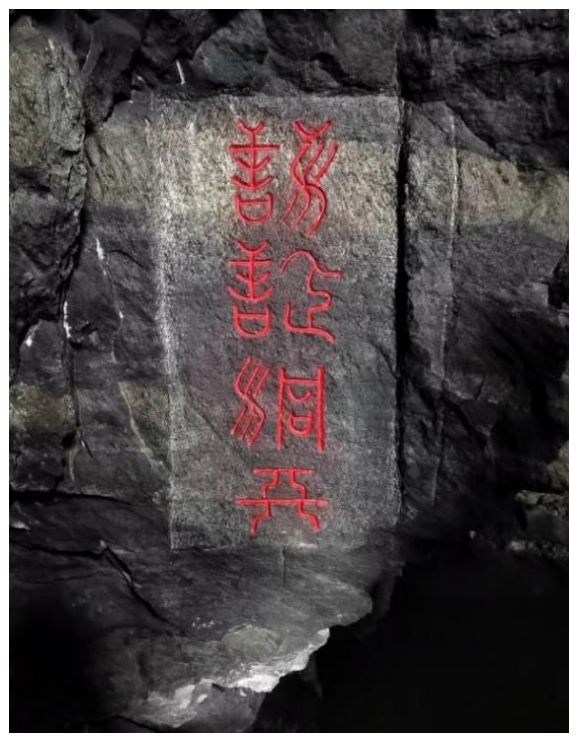
To date, no Tang dynasty sources regarding Cai Xunzhen have been discovered, but legends concerning Cai Xunzhen and Li Tengkong circulated on Mount Lu and post-Song materials regarding them are comparatively plentiful. The identification of Xunzhen Abbey (Figure 2) with the Yongzhen grotto-heaven became quite popular after the Song dynasty. The Song literatus, Chen Shunyu’s 陳舜俞 (1026–1076) Record of Mount Lu offers a representative account of the Xunzhen Abbey:
In the west of Zhaode Abbey, after traveling 20 li along the official road, one arrives at the Xunzhen chongxu Abbey, which was originally known as the Yongzhen grotto-heaven. According to the Daoist text Declarations of the Perfected, there are thirty-six grotto-heavens and the Yongzhen grotto-heaven ranks the eighth; there are seventy-two blessed-lands and Mount Lu is the Yuanchen blessed-land. This abbey is precisely the Yongzhen grotto-heaven, with Wulao Peak situated directly behind it. During the Zhenyuan reign of the Tang, the Daoist priestess Cai Xunzhen resided here, and the abbey was subsequently named after her. Behind the abbey lies the White Dragon Pond, into which a hanging waterfall pours. 昭德之西,出官道二十里,至尋真沖虛觀,古名詠真洞。道書《真誥》述三十六洞天,詠真洞天第八;七十二福地,廬山為元辰福地。是觀也,即詠真洞天。五老峰正在其後。唐貞元年,女真蔡尋真居之,因以為名。觀後有白龍潭,懸瀑注焉。
After the Song and Yuan dynasties, the exact location of Xunzhen (or chongxu) Abbey became uncertain.14 However, its spatial relationship to Wulao Peak is relatively clear—it is situated beneath the peak. This view was widely held during the Song dynasty. For instance, Zhou Bida 周必大 (1126–1204), in his “Later Record of Mount Lu” (Lushan houlu 廬山後錄), included in the Records of Sailing on Rivers and Roaming in Mountains (Fanzhou youshan lu 泛舟遊山錄), documented his visit to the Xunzhen Abbey. He noted, “the Declarations of the Perfected states that Mount Lu is the Yuanchen blessed-land, and this abbey is the eighth Yongzhen grotto heaven, with Wulao Peak directly behind it, leaning against Xianglu Peak” 《真誥》言廬山乃元辰福地,而此觀為第八詠真洞天,五老峰正在其後,而依香爐峰 (B. Zhou 2018, pp. 21–22). Zhu Xi 朱熹 (1130–1200) and others visited Xunzhen Abbey in the Xinchou 辛丑 year of the Chunxi reign 淳熙 (1181) and composed inscriptions for it.15 In addition, Wang Ruan 王阮 (1140–1208) wrote a poem entitled “Xunzhen Abbey” (Xunzhen guan 尋真觀), whose preface describes the abbey as the site where “the Daoist transcendent Cai ascended [to the heaven] by riding on a simurgh, located beside Wulao Peak and beneath Nine-Folds Screen. The Record of Mount Lu records that the Yongzhen grotto-heaven lies at the bottom of the Dragon Pond” 唐蔡真人乘鸞處,蓋五老峰側九疊屏下也。《記》云詠真洞天在龍潭底. The poem contains the line, “[I] know that the entrance to the grotto-heaven is concealed beneath the water” 知有洞門藏水底 (R. Wang 1983, pp. 558a–b) which corresponds to the account in Chen Shunyu’s Records of Mount Lu mentioning a White Dragon Pond behind the Xunzhen Abbey (Chen and Hua 2024, p. 212). In the Record of Events at Mount Lu, it is recorded that because golden serpents were said to appear at the White Dragon Pond, the site came to be regarded as a place for rain-prayers, leading to the establishment of the temple dedicated to the Dragon King of Benefiting the Rain (Huize longwang 惠澤龍王), which by then was already abandoned (Sang 1932, p. 728). Subsequent local gazetteers such as Mao Deqi’s 毛德琦 (fl. 1714) Gazetteer of Mount Lu (Lushan zhi 廬山志) largely repeated this account (Mao and Xu 1991, pp. 299–300).
With the passage of time, Xunzhen Abbey had long fallen into ruin and eventually disappeared, yet the view that identified it as the Yongzhen grotto-heaven continued to exert influence. According to local gazetteers compiled after the Ming dynasty, the peak where Xunzhen Abbey and the Yongzhen grotto-heaven were situated came to be known as “Abbey Mountain” (Guanshan 觀山),16 a designation derived from the presence of the abbey. Travelers passing through this area could occasionally recall that this place had once been regarded as the Yongzhen grotto-heaven. For example, Huang Zongxi 黃宗羲 (1610–1695) recorded that when he passed by Luo’s Academy (Luoshi shuyuan 羅氏書院) (constructed by Luo Nian’an 羅念庵 (1504–1564) on the site of the former Zhaode Abbey), he noted: “beside it is the former site of Xunzhen Abbey, where Tang Daoist priestess practiced the dao. The Declarations of the Perfected identifies this site as the eighth Yongzhen grotto-heaven and the name ‘Xunzhen’ derives from this association” 其旁為尋真故地,唐女冠學道處。《真誥》以此地為第八詠真洞天,尋真之名,伊此故也 (Z. Huang 2018, p. 170).
Since Xunzhen Abbey, which represented the Yongzhen grotto-heaven, stood beneath Wulao Peak, it became a common belief that the Yongzhen grotto-heaven itself was located at Wulao Peak. The Record of Events at Mount Lu cites the Records of Travel Accounts (Ji you ji 紀遊集) by stating: “on Wulao Peak there is the Yongzhen grotto-heaven” 五老峰上有詠真洞天 (Sang 1932, pp. 730a–b); Mao Deqi in the Gazetteer of Mount Lu noted: “the Continued Record [states that] the Yongzhen grotto-heaven is located south of the Nine-Folds Screen, and east of Wulao Peak” 《續志》詠真洞,在九疊屏南,五老峰東 (Mao and Xu 1991, p. 225). A rather distinctive view comes from the Qing poet Wu Songliang 吳嵩梁 (1766–1834). In the poem “Li Taibai’s Reading Terrace” (Li Taibai dushu tai 李太白讀書臺), he claimed that “the grotto-heaven is located on the central peak of Wulao [Peak]” 洞天即在五老中峰 (S. Wu 1996). This view seems to have been a spur-of-the-moment creative expression, as no other supporting materials are found for this interpretation; thus, the view was not accepted by later generations.
Interestingly, a legend concerning the Nine Heavens Messenger of Mount Lu, which appeared no later than the Song dynasty, accepted the belief that the Yongzhen grotto-heaven was located at Wulao Peak. The seven-scroll edition of the True Record on the Perfected Lord of Collection and Investigation of the Taiping xingguo Monastery on Mount Lu (Lushan Taiping xingguo gong caifang zhenjun shishi 廬山太平興國宮採訪真君事實, hereafter referred to as the True Record on the Perfected Lord) claims in its preface to have been compiled in the twenty-fourth year of the Shaoxing reign 紹興 (1154). The text includes the legend of “Liu Deben donating money to relieve famine” (Liu Deben juancai zhenji 劉德本捐財賑饑). According to this legend, in the sixth year of the Qianfu reign 乾符 (879), during the turmoil caused by Huang Chao 黃巢 (d. 884), Liu Deben donated his wealth to help alleviate the famine and then sought refuge on Mount Lu. After spending a year traveling the mountain, he enjoyed the scenery beneath Wulao Peak, where an elder guided him into a deep gorge. After walking four or five li, he saw a gate with a plaque inscribed “Gate of the Purple Prime and Phosphor Brilliance” (Ziyun jingyao zhi men 紫元景曜之門). Inside were palace halls and pavilions. The elder told him, “this is the Yongzhen grotto-heaven” 此詠真洞天也. The True King of the Nine Heavens Messenger (Jiutian shizhe zhenwang 九天使者真王), recognizing Liu Deben’s virtuous deeds, granted him a visit to the transcendent abode (Y. Ye 1988, p. 698b).
The creator of this legend was evidently a devotee of the Nine Heavens Messenger, and the legend itself highlights the power and authority of the Nine Heavens Messenger over the Yongzhen grotto-heaven of Mount Lu. As noted in the earlier discussion, the earliest extant Daoist source to designate the Nine Heaven Messenger as the master of the Yongzhen grotto-heaven is the work of Du Guangting. This suggests that the legend of Liu Deben entering the Yongzhen grotto heaven likely emerged after the late Tang dynasty, but before the compilation of the True Record on the Perfected Lord. The legend repeatedly emphasizes the authority of the Nine Heavens Messenger, but interestingly, the entrance to the grotto-heaven remains beneath Wulao Peak, even though the Taiping xingguo Monastery, where the Nine Heavens Messenger is venerated, is located on the opposite side of Mount Lu.17 Based on this, it can be inferred that the original creator of the legend in which Liu Deben enters the Yongzhen grotto-heaven was likely a devotee of the Nine Heaven Messenger, rather than necessarily a Daoist of the Taiping Monastery. What is even more interesting, however, is that we will soon see the legend of Liu Deben being appropriated to create a new narrative positioning Taiping Monastery as the actual location of the Yongzhen grotto-heaven.

2.2. The Rise of the Temple of Nine Heavens Messenger (Taiping Xingguo Monastery) and the Relocation of the Yongzhen Grotto-Heaven

As noted above, the reign of Emperor Xuanzong of the Tang marked a height of Daoism’s prosperity in Chinese history. Emperor Xuanzong accepted Sima Chengzhen’s suggestions to build separate Temples for the Perfected Lords at Five Marchmounts (Wuyue zhenjun ci 五岳真君祠). At the same time, the Temple for Nine Heavens Messenger was also constructed on Mount Lu as part of this initiative. The construction process of the Temple of Nine Heavens Messenger is described in detail in the “Inscription on the Temple of Nine Heavens Messenger in the Taiping Monastery” (Taiping gong jiutian shizhe miaoji 太平宮九天使者廟記) by Li Ci 李玼 (also written as 李泚, fl. 731).18 According to the colophon (tiba 題跋) to the inscription written by the compiler of the True Record on the Perfected Lord, when Emperor Xuanzong decided to build the Temple of Nine Heavens Messenger, he publicly solicited inscriptions for the temple. A total of 681 scholars responded to the call, but only Li Ci’s inscription was selected. The preface further mentions that the “old record on the Taiping xingguo Monastery (jiuji 舊記)” was incomplete, and the full text was later obtained from the Palace Library (Mishu sheng 秘書省) in the Yisi 乙巳 year of Chunyou reign 淳佑 (1245). The “Inscription on the Temple of Nine Heavens Messenger in the Taiping Monastery” records that on the twenty-first day of the eighth month in the nineteenth year of the Kaiyuan reign開元 (731), Emperor Xuanzong issued an order to construct the Temple of Nine Heavens Messenger on Mount Lu, “in accordance with the model of the Temples of the Perfected Lords at Five Marchmounts” 宜准五嶽真君廟例 and five virtuous priests were selected to maintain the temple, performing rituals and offerings. An imperial court envoy was also assigned to serve within the temple, carrying the true form of the Nine Heavens Messenger to oversee the construction of the temple as well as all related rites and ceremonies (Xian Li 1988, p. 683a). The True Record on the Perfected Lord, when recounting the origins of the Temple of Nine Heavens Messenger, mentions various instances of “spiritual manifestation” (lingying 靈應).
One notable account records that on the night of the fifteenth day of the second month in the nineteenth year of the Kaiyuan reign (731), Emperor Xuanzong encountered the Nine Heavens Messenger in a dream. The latter requested that the emperor builds a temple for him on Mount Lu and promises, in turn, to “bestow blessings upon all living beings for the next five hundred years” 後五百年福及生靈.19 However, this legend was most likely composed by Song authors five hundred years after the construction, in order to strengthen the contemporary political significance of the Taiping xingguo Monastery and the Nine Heavens Messenger. In fact, the earliest known reference to Emperor Xuanzong’s dream of the Nine Heavens Messenger and the miraculous response that led to the temple’s construction comes from Du Guangting’s Records of Marvels (Luyi ji 錄異記), but its account is rather brief and does not include phrases like “for the next five hundred years” (G. Du 2013, pp. 17–18). The Temple of Nine Heavens Messenger was renamed the “Tongyuan Bureau” (Tongyuan fu 通元府) in the second year of the Shengyuan reign 昇元 (938) of the Southern Tang (937–975). In the second year of the Taiping xingguo reign 太平興國 (977) of the Northern Song (960–1127), the temple was officially renamed “Taiping xingguo Abbey” (Taiping xingguo guan 太平興國觀) by the imperial decree. Later, in the sixth year of the Xuanhe reign 宣和 (1124), Emperor Huizong 徽宗 of the Song (r. 1100–1126) elevated the “abbey” to “monastery,” renaming it the “Taiping Xingguo Monastery” (abbreviated as Taiping Monastery) (Y. Ye 1988, p. 667c). From the Tang dynasty to the Song dynasty, the Taiping Monastery received continuous support from the imperial court, making it the most prominent and prosperous Daoist center in the area of Mount Lu (Y. Ye 1988, pp. 663b–64b). By the Song dynasty, at its peak, it is said that the monastery housed as many as three thousand Daoist practitioners (Z. Wu 1996, p. 95).
The Taiping Monastery is not a cave, but certain materials from the Ming (1368–1644) and Qing (1616–1911) clearly identify it as the location of the Yongzhen grotto-heaven. As mentioned earlier, Luo Nian’an, who purchased the former site of Zhaode Abbey and rebuilt it as an academy, was a highly influential literatus in Jiangxi 江西 region during the Ming dynasty. His “Travel Notes from the Summer of Jiayin Year” (Jiayin xia you ji 甲寅夏遊記) records that during his trip to Mount Lu, he traveled “forty li to the Taiping Monastery, which is the Yongzhen grotto-heaven” 四十里入太平宮,宮乃詠真洞天 (Luo 2018, p. 71). According to Cai Ying’s 蔡瀛 (1777–1857) Minor Gazetteer of Mount Lu (Lushan xiaozhi 廬山小志), Luo Nian’an once inscribed a plaque for the Taiping Monastery with the words “The [Abode of] the Transcendent Lord of Collection and Investigation—The Eighth Grotto-Heaven” 仙家采訪第八洞天 (Cai 2000, p. 176b. Also see Sang 1932, p. 753). In his poem “A Poem on the Yongzhen Grotto-Heaven Following the Rhyme of Longxi” 詠真洞天次龍溪韻, Luo Nian’an wrote that “the remnants still show traces of the Dao” 瓦礫道非無, which seems to allude to the then-decaying Taiping Monastery (Z. Wu 1996, p. 287). These indications demonstrate that Luo Nian’an indeed regarded the Taiping Monastery as the Yongzhen grotto-heaven.
Additionally, the preface to “Accounts of Traveling the Taiping Monastery” (You Taiping gong jishu ershi yun 遊太平宮紀述二十韻) composed by the Ming scholar Yu Anqi 俞安期 (fl.1596), states that “the monastery is the Yongzhen [grotto-heaven], recognized as the eighth grotto-heaven. Emperor Xuanzong of Tang issued an imperial decree to worship the Nine Heavens Messenger. The grandeur of the monastery was unparalleled, [but] it was later destroyed by war and fire” 宮為詠真第八洞天,唐玄宗詔祀九天使者,宮殿之盛,自古未有,後毀兵燹 (Yu 1997, p. 154a). By the Qing Dynasty, Zha Shenxing 査慎行 (1650–1727) also referred to Taiping Monastery as the Yongzhen grotto-heaven in his travel notes on Mount Lu, saying: “five li south of the peak, after crossing a bridge, lies the Taiping Monastery, which Daoists refer to as the eighth Yongzhen grotto-heaven” 嶺南五里渡橋,為太平宮,道家所謂第八詠真洞天 (Zha 2018, p. 197). Clearly, the surviving textual evidence equating the Taiping Monastery with the Yongzhen grotto-heaven is largely concentrated in the Ming and Qing periods, with Luo Nian’an seemingly being its earliest advocate. However, the cultural construction that subtly linked Taiping Monastery to the Yongzhen grotto-heaven can be traced back as early as the Song dynasty.
The two plaque inscriptions from the Taiping Monastery, dating to the Song Dynasty, may offer valuable insights. According to the True Record on the Perfected Lord, the plaque on the third gate of Taiping Monastery bore the inscription “Gate of the Purple Prime and Phosphor Brilliance”, written by Zhang Yuhu 張于湖, while the inner pavilion plaque was inscribed with “Yongzhen grotto-heaven,” written by Zhang Chuliao 張樗寮 (Y. Ye 1988, p. 664a). Zhang Yuhu, also known as Zhang Xiaoxiang 張孝祥 (1132–1170), was a Principal Graduate (zhuangyuan 狀元) of the Song dynasty, while Zhang Chuliao, also known as Zhang Jizhi 張即之 (1186–1263), was Zhang Xiaoxiang’s nephew, who was a calligrapher and statesman. The inscription “Yongzhen grotto-heaven” requires no further clarification. The phrase “Gate of the Purple Prime and Phosphor Brilliance” had already appeared in the previously mentioned legend of Liu Deben’s entry into the Yongzhen grotto-heaven, and it was considered the plaque over the gate of grotto-heaven. Applying these two names, which both refer to the Yongzhen grotto-heaven, to the buildings of the Taiping Monastery implicitly conveys the intention of equating Taiping Monastery with the Yongzhen grotto-heaven. On this point, Sang Qiao’s earlier critique is relevant: “the Taiping Monastery was originally established for the purpose of worshiping [the Perfected Lord of Collection and Investigation]. Its association with the ‘Yongzhen Grotto-Heaven’ and the ‘Gate of Purple Clouds and Phosphor Radiance’ is merely a borrowing in name, rather than a genuine manifestation of spiritual traces” 惟太平宮本以祀採訪故,假借詠真洞天及紫元景曜之門而言之,非真有化見事也.
In the record written for the Taiping Monastery by the Song Daoist master Bai Yuchan 白玉蟾 (fl. from early 12th to early 13th century), he wrote: “in the old county of Jiujiang, Mount Lu standing a thousand years, hosts the Yongzhen grotto-heaven inhabited by transcendent spirits, and serves as the divine abode of purple prime and phosphor brilliance” 九江故郡,千古廬山,乃仙靈泳(詠)真之洞,實紫元景曜之神府, which aligns with the plaque inscriptions of the Taiping Monastery. This account also implicitly suggests a connection between the Taiping Monastery and the Yongzhen grotto-heaven (Y. Bai 2004, p. 82). However, in the Song dynasty, the efforts of Taiping Monastery to associate the Yongzhen grotto-heaven with the monastery did not stop at simply commissioning famous scholars to inscribe plaques. The creation of the legend of “Liu Yue’s stone” (Liu Yue shi 劉越石) demonstrates a deliberate and thoughtful attempt to strengthen this connection.
After the establishment of the Temple of Nine Heavens Messenger, it quickly attracted attention from the imperial court and soon became the Daoist center on Mount Lu. According to Du Guangting’s Records of Marvels, the Nine Heavens Messenger had become the most prominent deity among the local deities of Mount Lu. At the same time, as previously mentioned, in Du Guangting’s system of Daoist grotto-heavens, the Nine Heavens Messenger replaced Zhou Zhengshi as the governor of the Yongzhen grotto-heaven. The legend of Liu Deben undoubtedly further reinforced the idea that the Yongzhen grotto-heaven was under the control of the Nine Heavens Messenger. These circumstances likely motivated the Daoist priests of the Taiping Monastery, who worshiped the Nine Heavens Messenger, to incorporate the Yongzhen grotto-heaven within the precincts of their own monastery, thereby enhancing the religious authority of their monastery. However, during the Tang and Song periods, the Yongzhen grotto-heaven was generally identified with the Xunzhen Abbey, situated beneath Wulao Peak on the eastern side of Mount Lu. In contrast, the Taiping Monastery was located on the northwestern side of the mountain, making the two locations quite distant from one another. The “fixed” location of the grotto-heaven initially left the Daoists of Taiping Monastery uncertain about how to associate the monastery with the Yongzhen grotto heaven. However, the growing popularity of the legend of Liu Deben may have provided them with inspiration.
The legend of Liu Deben seems to have suggested to seekers of the Yongzhen grotto-heaven that its entrance could be a stone rather than a permanent cave. Because stone are both widespread and mobile, this notion obscured any fixed identification of the grotto-heaven’s entrance. The later legend of Liu Yue’s stone or Liu Yue’s grotto-heaven associated with Taiping Monastery clearly drew upon and benefited from this idea. The earliest references to Liu Yue’s stone at the entrance of the Taiping Monastery can be traced back to the Song Dynasty, appearing in the works of Chen Shunyu’s Records of Mount Lu and Ye Yiwen’s 葉義問 (1098–1170) True Record on the Perfected Lord. The Records of Mount Lu records that to the left of Taiping Monastery, there was a stone known as “Liu Yue’s stone” and “during the Zhidao reign (995–997), Sun Mai, the Commander Governor and Director of Bureau of Evaluation, erected a stele and built a shrine at the site” 至道中,郡守考功員外郎孫邁,始立碣置祠焉. It is said that when the transcendent Kuang Su 匡俗 lived at Mount Lu, a young man named Liu Yue 劉越 frequently visited him. The young man invited Kuang Su to visit his residence, and Kuang Su agreed. However, when Kuang Su arrived, he only saw a stone. He “knocked on it, and then the stone opened, leading him to see the residence of the transcendent” 乃扣之。石為之開,因遇神仙洞府之事 (Chen and Hua 2024, p. 47). The True Record on the Perfected Lord contains a similar account, saying that “Liu Yue entered and exited through [the stone]. When the transcendent Kang Fu (likely referring to Kuang Su) responded to Liu’s invitation, he knocked on the stone and entered. Then he met [the transcendent] in the cave residence. Nowadays, there is a pavilion, called Transcendent Liu’s Stone” 劉越者從此出入,康阜真人赴劉約,叩此石而入,會於洞府。今有亭曰: 劉仙石 (Y. Ye 1988, p. 664a). Based on the account of the True Record on the Perfected Lord that a stele and shrine were first erected during the Zhidao reign, one may surmise that “Transcendent Liu’s Stone” at the Taiping Monastery began to attract attention and evolve into a significant legend around that time, and not much earlier. At Taiping Monastery, the identification of “Liu Yue’s stone” as the gateway to the grotto-heaven was made with great clarity. In the True Record on the Perfected Lord, Sun Mai, the official who oversaw the erection of the stele and the construction of the shrine composed a poem entitled “Transcendent Liu’s Stone” (Liu Xian shi 劉仙石), in which he explicitly declared: “Who knows Liu Yue’s stone? It is the entrance to the grotto-heaven” 誰知劉越石,便是洞天門.20
Apart from the legend of Liu Deben, the creation of the legend of Liu Yue’s stone at the Taiping Monastery also appears to have drawn upon the legend of Liu Dun 劉敦. According to Du Guangting’s Records of Marvels, outside the Temple of Nine Heavens Messenger, “there was a stone shaped like a clay steamer, smooth and lustrous, which people often admired for its miraculous [qualities].” 有石如瓦甑,光滑瑩潔,人嘗看玩之,頗有靈異. One day, a child was playing with the stone, sitting and urinating on it. Liu Dun then sued the child for his behaviors. The local officials investigated and confirmed that the child had indeed done so, “but there were no traces of Liu Dun’s residence in front of the temple” 而無劉敦廟前居住蹤跡. However, the Venerable Master Mao 毛尊師in the temple reported that he had recently encountered someone claiming to be Liu Dun who was quite an extraordinary person. “He complained that [the child] sat on his head and also urinated on it. It is probably this very stone.” 既言坐其頭上,又云溺之,恐是此石. This prompted the locals to dig beneath the stone. After digging three or four feet, they uncovered a large stone that extended deep into the ground. Awed by this numinous sign, they specially erected a small pavilion there (G. Du 2013, pp. 54–55). Undoubtedly, “Liu Dun’s stone” mentioned here refers to the very same stone later identified as the “Liu Yue’s stone” in the True Record on the Perfectes Lord. In fact, Cai Ying had already pointed out that the legend of “Transcendent Liu’s Stone” outside the Temple of Nine Heavens Messenger originated from Liu Dun’s story, whereas the actual grotto-heaven (or Liu Yue’s stone) was located near Lianhua Cave (Lianhua dong 蓮花洞) (Cai 2000, pp. 174b–75a). According to Sang Qiao’s account, as Taiping Monastery fell into disrepair, “Liu Yue’s stone” (also known as “Liu Yue’s grotto-heaven”) “is now of unknown where it is” 今不知所在 (Sang 1932, p. 754). Based on the discussion above, it is evident that the legend of “Liu Yue’s stone” at the Taiping Monastery, emerged during the Song dynasty, was a composite of elements from the legends of Liu Deben and Liu Dun’s stone. This legend bears unmistakable signs of fabrication, with a deliberate intention: to “relocate” the Yongzhen grotto-heaven to the Taiping Monastery.
This section concludes with a brief discussion of Feiyun Cave 飛雲洞. As Sang Qiao noted, during his time, Feiyun Cave was also regarded as Yongzhen grotto-heaven. However, the identification of Feiyun Cave with the Yongzhen grotto-heaven was in fact shaped by the influence of Taiping Monastery. The True Record on the Perfected Lord already contains a reference to Feiyun Cave, noting that it was located behind the monastery:
The [Feiyun] Cave can accommodate twenty to thirty people, and within it there is a small opening, faintly leading inward. Recently, a stone has appeared at the entrance, blocking the way. However, whenever clouds arise, rain follows; when the clouds gather, the sky clears. The people in front of the mountain use this as a sign to forecast changes between brightness and darkness. 洞中可坐二三十人,又有一竅,隱隱而入。近生一石當門,不可入。但雲起則雨,雲聚則晴。山前人以此驗其晦明。
(Y. Ye 1988, p. 664b)
The True Record on the Perfected Lord elaborates extensively on the cult of the Nine Heavens Messenger and its relationship with the Yongzhen grotto-heaven. However, the passage quoted above clearly does not regard Feiyun Cave, located near the Taiping monastery, as the Yongzhen grotto-heaven. Nevertheless, perhaps due to the cave’s natural features and its proximity to the monastery, Feiyun Cave came to be associated with the Yongzhen grotto-heaven in later times. Wu Zongci’s 吴宗慈 (1879–1951) Gazetteer of Mount Lu (Lushan zhi 廬山志), quoted from the Gazetteer of Dehua County (Dehua Xianzhi 德化縣志) compiled during the Tongzhi reign 同治 (1862–1875), states that the Yongzhen grotto-heaven was located on the mountain behind the Taiping Monastery. “[It’s] known as Feiyun Cave. Gui Xinyuan once secluded himself there and was nicknamed ‘Gui the Madman’. Later, he released by means of the corpse. It is unclear in which period he lived.” 一名飛雲洞,桂心淵隱此,人謂之桂瘋子,後尸解去,要不知何代人也 (Z. Wu 1996, p. 98). Wu Zongci, drawing on the Record of Events at Mount Lu, further noted that Feiyun Cave, located on the middle peak among the three peaks northeast of Shengzhi Peak 聖治峰, is “now called Yongzhen grotto-heaven” 今人呼為詠真洞 (Z. Wu 1996, p. 174). Gui Xinyuan 桂心淵, originally from the Yuan dynasty, is recorded in the Supplement to Comprehensive Mirror of Perfected Immortals Who Embodied the Dao of All Ages (Lishi zhenxian tidao tongjian xubian 歷世真仙體道通鑒續編) as a fellow student of Jin Pengtou 金蓬头 who achieved “corpse liberation” at Mount Lu (Zhao 1988c, p. 448a). The New Edition of Gazetteer of Nanchang Prefecture (Wanli xinxiu Nanchang fu zhi 萬曆新修南昌府志) provides further information about him, stating that “he was a Daoist from a young age, residing at Longxing and Ziji Monasteries” 少為道士,居龍興、紫極宮 and many miraculous stories were associated with him (Fan and Zhang 1588, pp. 22a–b). His retreat in Feiyun Cave is further corroborated in the “Travel Notes on Mount Lu” (Lushan youji 廬山遊記) by Li Xiong 李泂 (1274–1334) from the Yuan dynasty. Li Xiong recorded that during his visit to Mount Lu, he “entered Feiyun Cave to seek the recluse Gui Xinyuan, but did not encounter him” 入飛雲洞,訪隱者桂心淵,不遇 (J. Li 2018, p. 34). However, the materials that describe Gui Xinyuan’s seclusion in Feiyun Cave do not identify this cave as Yongzhen grotto-heaven. In the materials examined here, Sang Qiao’s Record of Events at Mount Lu from the Ming dynasty is the earliest to claim that Feiyun Cave is the Yongzhen grotto-heaven, suggesting that this identification likely emerged during the Yuan-Ming period.
Local gazetteers preserve a striking account: during the Tianqi reign天啟 (1621–1627), a man of unknown origin named Sun Huanan 孫化南 is said to have secluded himself in the Yongzhen grotto-heaven on Mount Lu, where he built a tomb beside the grotto-heaven. He entered the tomb to practice the dao for three years. One night, he emitted the fire of samadhi. His hair and beard scorched. He then transformed and left (Z. Wu 1996, p. 174). According to Sang Qiao and other sources, it appears that during the Ming period, many locals considered Feiyun Cave as the Yongzhen grotto-heaven. Therefore, it is highly likely that Sun Huanan (if this person indeed existed) cultivated himself beside Feiyun Cave and achieved his transformation there.
It can be observed that as early as the Song dynasty, the Daoists of Taiping Monastery had already begun attempting to incorporate the Yongzhen grotto-heaven into their monastery’s domain. However, the identification of either Taiping Monastery itself or Feiyue Cave with the Yongzhen grotto-heaven may not have fully taken shape until the Ming dynasty. One possible reason for the relatively late emergence of this view is that the association of the Yongzhen grotto-heaven with the Xunzhen Abbey at Wulao Peak had long exerted a strong influence and thus could not be easily displaced. However, with the decline of Xunzhen Abbey, the continued development of the influence of the Nine Heavens Messenger, and the Ming literati’s nostalgic recollection of the former grandeur of Taiping Monastery, the area surrounding Taiping Monastery ultimately came to be regarded as the site of the Yongzhen grotto-heaven.

3. The Implications of the “Grotto Heaven” of the Transcendent’s Cave Subtly Emerged from the Late Qing

The shifts in the religious landscape, that began in the transition between the Northern and Southern Song, gradually pushed Daoism off the central stage of state ritual. On Mount Lu, this was most clearly reflected in the decline of major Daoist sites such as Xunzhen Abbey and Taiping Monastery that had once enjoyed substantial imperial patronage, a process that unfolded during the Ming and Qing periods. At this time, although views that the Yongzhen grotto-heaven was located beneath Wulao Peak or within Feiyun Cave had not completely disappeared, a large cave at the summit of Mount Lu gradually began to be seen as the entrance to the grotto-heaven. The cave is known as the Transcendent’s Cave (or Xianren dong 仙人洞). The tendency to identify Xianren Cave with the Yongzhen grotto-heaven originated in the Ming dynasty, with the indiscriminate use of the term “grotto-heaven”. The identification became more explicit in the late Qing when Daoists settled in the cave and established a temple there. The association continues to be constructed to this day.
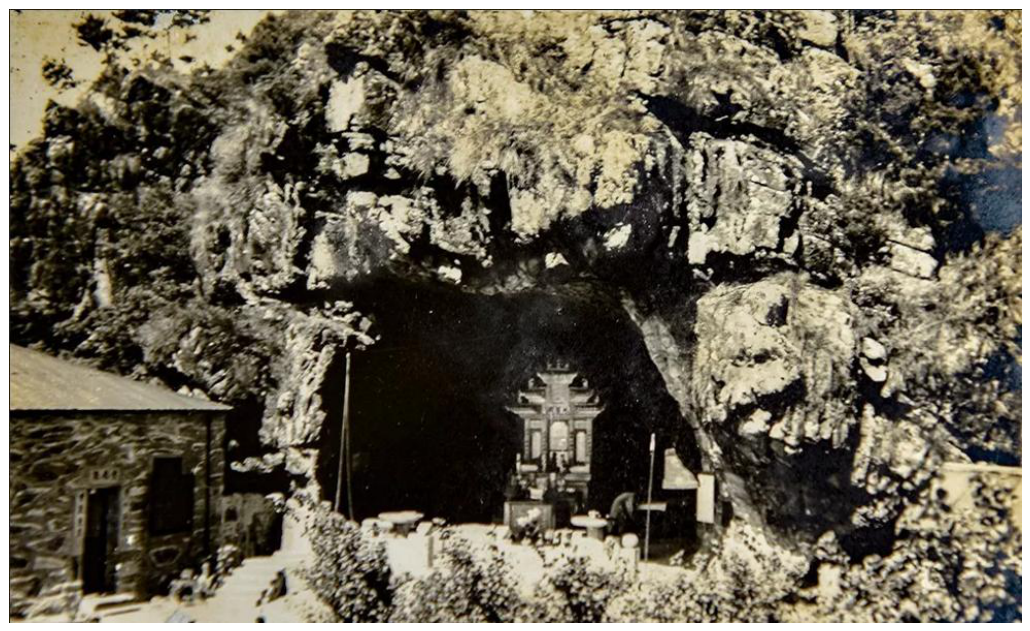
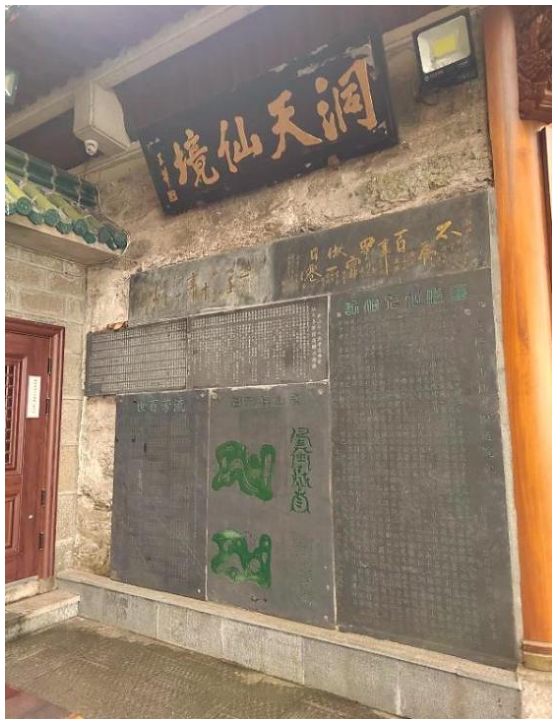
As some scholars have already noted, before the Ming and Qing dynasties, the main centers of Daoism on Mount Lu were concentrated on the southern slope (such as Jianji Abbey 簡寂觀) and northern slope (such as Xunzhen Abbey and Taiping Monastery) (Ouyang 2013, p. 114). However, repeated devastations of warfare, along with the significant resource pressures exerted by Buddhism, made large-scale Daoist temples on Mount Lu increasingly rare during the Ming and Qing periods. By the Mid-to-Late Qing period, the most active Daoist center on Mount Lu had shifted to the Xianren Cave at the summit,21 which soon became the most renowned Daoist site on Mount Lu in modern times (G. Wu 2011, p. 372). The Xianren Cave, originally named “Buddha’s Hand Rock” (Foshou yan 佛手岩, Figure 3), is a vast natural cave. It lies near the Imperial Stele Pavilion (Yubei ting 御碑亭), which Emperor Zhu Yuanzhang 朱元璋 (r. 1368–1398) erected for the transcendent Zhou Dian 周顛.22 Located at the summit of Mount Lu, the cave is large enough to accommodate a hundred people. According to the Biographies of Eminent Monks Written during Song Dynasty (Song gaoseng zhuan 宋高僧傳), during the Southern Tang, the monk Xingyin 行因 (fl. 955), traveled through the Jianghuai 江淮 region. When he “saw the rock to the north of Mount Lu that, from a distance, resembled a hanging hand, with a hollow beneath it extending three to five zhang in depth” 見廬山北有岩, 遙望如垂手焉,手下則深邃可三五丈許, he settled there to practice meditation (Zan and Fan 1987, p. 314). The cave is named Foshou Rock because the shape of the rock at the cave entrance resembles a Buddha’s hand. According to Zhou Bida’s record, the hand-shaped rock had “recently been cracked by a wildfire” 近為野火焚裂 (B. Zhou 2018, p. 19), which slightly altered the hand-like form. Within Foshou Rock, mountain springs converged, and in ancient times, pools were constructed to collect the water for brewing tea for visitors. In his Minor Gazetteer of Mount Lu, Cai Ying recorded the inscription “Jade Liquid of Grotto-Heaven” (Dongtian yuye 洞天玉液) which was written to praise the water in the pools (Cai 2000, p. 126b). Wu Zongci’s Gazetteer of Mount Lu provides a more detailed account of the inscription, noting that there was a preface before the four characters. It records that on the twenty-second day of the first month in the Gengchen 庚辰 year of Wanli reign 萬曆 (1580),
[A group of people] rose early and reached the Foshou Rock. The black rock and green cliff made it truly a grotto-heaven. To the right, a spring dripped down from the stone, and its water was pleasant to drink. They then inscribed the four characters “Jade Liquid of Grotto-Heaven” to commemorate it. 晨起至佛手岩,蒼岩翠壁,真一洞天。右有泉從石□中滴下,飲之□□可愛。因書 “洞天玉液” 四字以識之
(Z. Wu 1996, p. 192)
This inscription represents the earliest extant material that links Foshou Rock with the grotto-heaven. However, the phrase “Jade Liquid of Grotto-Heaven” here appears to reflect only a general use of the term “grotto-heaven”. Yet this inscription, which has endured from the Ming dynasty to the present, came to serve as a symbolic marker for later visitors, signaling the site’s sacred character and religious significance.
According to the Travel Journal of A Mountain Trip (Youshan riji 遊山日記) by Shu Menglan 舒夢蘭 (1759–1835), the Foshou Rock still housed resident Buddhist monks in the ninth year of the Jiaqing reign 嘉慶 (1804) (Shu 2018, p. 254). Thus, even though the Foshou Rock already bore the inscription “Jade Liquid of Grotto-Heaven” in the Ming dynasty, its identity as a Buddhist sacred site means that the Daoist grotto-heavenization of the cave made little progress for a long time. It was not until the Jiaqing reign (1796–1821) when the monks vacated the Foshou Rock, and Daoists moved in to undertake sustained construction, that this formerly Buddhist site was rapidly transformed into a Daoist grotto-heaven. Moreover, the Daoist priest Yan Chunyi 晏純一 (unknown) expanded the Lüzu 呂祖 (Lü Dongbin 呂洞賓) shrine inside the cave into the Pure Yang Hall (Chunyang dian 純陽殿) and simultaneously renamed the Foshou Rock as Xiren Cave. In the thirty-first year of the Guangxu reign光緒 (1905), the Daoist priest from Chang’an 長安, Jingyangzi 靜陽子 (unknown) built Lord Lao Hall (Laojun dian 老君殿) beside the cave. The Daoist Abbey of Xianren Cave then began to take shape. Since then, under the stewardship of several generations of Daoists, including Luo Lisong 羅理松 (1880–1956), Zhan Daoren 詹道人 (unknown), Xu Daoren 徐道人(unknown), Zhang Lisong 張理松 (1924–1976), and Ye Zhiming 葉至明 (1960–2014), Xianren Cave has continued to serve as a Daoist site (See Z. Ye 2000, p. 76; Xiaohong Li 2003, pp. 46–47; G. Wu 2011, pp. 375–76; Lushan Zhi Bianzuan Weiyuanhui 2020, pp. 168–70).
The imperial stele commemorating the transcendent Zhou Dian and the “White Deer Platform for Ascending to Transcendence” (Bailu shengxian tai 白鹿昇仙臺) stood nearby and the Daoists of Xianren Cave were also connected to them, for instance, they made and sold rubbings of the imperial stele for profit.23 However, it seems that because Zhou Dian continued to be venerated at the Heavenly Pond Temple (Tianchi Temple 天池寺), not far from the Foshou Rock (See Y. Du 2018, pp. 140–45), the Daoists did not readily invoke the legend of Zhou Dian when transforming Xianren Cave into a Daoist divine realm. In the late Qing and Republican periods, Daoists’ transformation of Xianren Cave into a Daoist sacred site primarily relied on appropriating the cult of Lü Dongbin, a practice most clearly reflected in the construction of the Lüzu Hall (Lü Zu dian 呂祖殿) within the cave, and the worship dedicated to Lü Dongbin there. There is no record explaining why Lü Dongbin’s was enshrined in Foshou Rock, but it likely stems from associating the site with the widespread Daoist legend of Lü Dongbin meeting Zhongli Quan 鐘離權 on Mount Lu. For example, one influential version of this legend appears in the Complete Perfection (Quanzhen 全真) text, Record of the Orthodox Lineage of the Golden Lotus (Jinlian zhengzong ji金蓮正宗記), which records:
[Lü Dongbin] later was appointed as the magistrate of Wufeng in Lushan District. During his leisure time, he visited the scenic spots of Mount Lu, where he encountered Master Zhengyang. In a brief conversation, their hearts and minds resonated. Lü Dongbin was secretly granted the Sword Method of Heavenly Escape of Great Dao and the Secret Texts of Gold Elixir of Dragon and Tiger, receiving the title “Master Pure Yang”. 後任五峰廬山縣令,因暇日遊廬山之勝跡,偶與正陽先生相遇,一話一言之間,心與心契,密受大道天遁劍法、龍虎金丹秘文,賜號純陽子。
(Qin 2020, p. 11)
Before the late Qing, the legends of Lü Dongbin did not mention any connection to Foshou Rock. However, the Daoists who transformed Foshou Rock into Xianren Cave actively crafted these new narratives, and disseminated them orally to curious visitors who came to explore the site.
A travelogue of Mount Lu published in 1925 notes that the Daoist priest who resided in a thatched hut at Foshou Rock offered tea and other services to visitors in order to sustain himself while worshiping “Li Chunyang” 李純陽 (an apparent error for Lü Chunyang, also known as Lü Dongbin) inside the cave (S. Zhu 1926, p. 32). This aligns with Huang Kan’s 黃侃 observations during his visit to Xiren Cave in 1929 where he recorded, “in the center is a statue of Lü Yan, and the niche is made of white stone, which is very new. This was not present on previous visits.” 中置呂岩像,白石為龕,甚新,前度來無此也 (K. Huang 1929, p. 92). Zhou Yuhan’s 周育涵 Travel Notes of Mount Lu (Lushan youji 廬山遊記) published in 1930 and Shanfu’s 善夫 Travel Notes after Returning from Mount Lu (Luyou guiji 廬遊歸記) published in 1932 contain similar descriptions (Y. Zhou 1930, p. 11; Shanfu 1932, p. 42). These consistent accounts from the same period indicate that the Daoists who occupied Xianren Cave and established the Lord Lao Hall indeed worshiped Lü Dongbin and actively engaged with tourists.
The association of Lü Dongbin with this cave is reflected in travelogues from the same period. For example, Wang Hongwen’s 王鴻文 travel notes states: “it is said that this cave was where Transcendent Lü ascended to heaven, hence it was named Xianren Cave. It contains a spiritual tablet dedicated to Lüzu” 相傳此洞為呂仙昇天處,故名仙人洞,有呂祖靈位在焉 (H. Wang 1932, p. 28). In 1945, a visitor known as Xiaolu 小魯 heard that:
This was the place where Lü Dongbin cultivated himself. Lü Yan was a magistrate of Jiujiang during the Tang dynasty, and after retiring from his official post, he entered the mountain to become a Daoist practitioner. As for whether he actually achieved transcendence, that is merely a matter of anecdote. 這是呂洞賓修煉的所在,呂岩唐時在九江為令,卸篆以後,才入山做了道士,至於成仙與否,不過說說而已。
(Xiaolu 1944, p. 12)
In the following year, Sanen 三恩 remarked that Xianren Cave “is traditionally believed to be the place where Lü Chunyang attained the Dao” 相傳為呂純陽得道處 (Sanen 1945, p. 26). These accounts vary in detail, yet all link Xianren Cave to Lü Dongbin’s religious experiences and most likely originate from the narratives of the Daoists who lived there. The worship of Lü Dongbin in Xianren Cave, along with the creation of related legends, appears to have been remarkably successful.24 Through continuous preaching and promotion, the association between Lü Dongbin and Xianren Cave gradually gained acceptance, and the cave itself emerged as a new grew Daoist center on Mount Lu. The Travel Notes of Mount Kuanglu (Kuanglu youji 匡廬遊記), published in 1941, records a visit to Xianren Cave during the Mid-Autumn Festival of 1934:
Many women and children from the mountain frequently came to offer incense. At sunset, the light reflected inside the cave, creating shifting patterns of brightness and shadow, giving the place a unique atmosphere… The cave enshrined a statue of Lüzu, with incense and offerings arranged in a varied assortment, and the dust was heavy, making the scene resemble the secular world. 山上婦孺,多往進香。夕陽反射洞中,明暗開闔,別具氣象……且洞中供呂祖像,香帛雜陳,塵土滃郁,未免稍近世俗。
(Dongxian 1934, p. 190)
This account shows that the Lü Dongbin cult at Xianren Cave had gained recognition among the local populace. In 1946, organized by the Chamber of Commerce of Mount Lu (Lushan shanghui 廬山商會), the Daoist Temple of Xianren Cave held a scripture-recitation ceremony “to pray for victory in the Second Sino-Japanese War and to deliver the souls of died soldiers” 祈禱抗日勝利,超度陣亡將士 (Lushan Zhi Bianzuan Weiyuanhui 2020, p. 700), which also reflects that Xianren Cave had become an influential Daoist center.
Looking at the outcome, after successfully leveraging the Lü Dongbin cult to establish the Daoist legitimacy of Xianren Cave, the idea of identifying Xianren Cave with the Yongzhen grotto-heaven gradually came onto the agenda. As mentioned earlier, the inscription “grotto-heaven” inside Foshou Rock already existed from the Ming dynasty, and such inscription might have prompted the Daoists who later occupied Xianren Cave to further “grotto-heavenize” it. Although no textual sources openly disclose these esoteric ideas, the inscriptions, couplets and newly erected stelae at Xianren Cave, from the Republican era to the present, consistently reflect this inclination. The Xianren Cave developed by Daoists became a famous tourist spot during the Republican era, attracting numerous prominent literati to compose inscriptions.25 The “Seven Days Travel Notes of Mount Lu” (Luyou qiri ji 廬遊七日記) published in 1937 records three inscriptions inside the cave, two of which mention “grotto-heaven”: “seeking a cool lesser grotto-heaven” 覓得清涼小洞天 and “the ancient cave of the transcendents contains an otherworldly realm” 仙人古洞別有天 (Meng 1937, p. 37). More interestingly, around this time, the inscription “Yongzheng Gtotto-Heaven” (Yongzheng dongtian 詠證洞天) officially appeared inside the cave. Based on my fieldwork at Mount Lu in early 2023, this inscription, which lacks any identifying marks about the inscriber, indeed writes as “Yongzheng” 詠證 (see Figure 4). It is suspected that this resulted from problems with the erroneous materials used by the inscriber. Wu Zongci’s Gazetteer of Mount Lu (completed in 1932) records the four-character inscription “Yongzhen Grotto Heaven” (Yongzhen dongtian 詠真洞天) inside Foshou Rock (note: Wu Zongci gives the correct name) (Z. Wu 1996, p. 564). The same record is also preserved in Wu Zongci’s A Comprehensive Collection of Inscriptions and Steles on Mount Lu (Lushan jinshi huikao 廬山金石匯考) (Z. Wu 2011, p. 332). However, earlier records and travelogues of Mount Lu make no mention of the four-character inscription within Xianren Cave. Moreover, considering that an inscription such as “Yongzhen Grotto-Heaven” with strong Daoist overtones, could only have been carved after Daoists took possession of Foshou Rock, it can be inferred that the inscription was most likely created in the early Republican period.
In 1989, Xianren Cave was handed back to Daoist custodianship. The Daoist Temple at this site underwent renovation in 1990 and in 2000, the Jiujiang Daoist Association (Jiujiang shi daojiao xiehui 九江市道教協會) was founded with its headquarters located here (Lushan Zhi Bianzuan Weiyuanhui 2020, pp. 700–1). During the renovation, a plaque inscribed “Transcendent Realm of Grotto Heaven” (Dongtian xianjing 洞天仙境), a stone carving of “the True Form of Mount Lu” (Lushn zhenxing tu 廬山真形圖, Figure 5), and a couplet at the Lord Lao Hall—“in this blessed-land rests the green ox, while in the stone chamber mist lingers for eternity; within this grotto-heaven soars the white crane, as the years of Penghu pass through a thousand autumns” 福地臥青牛石室煙霞萬古, 洞天翔白鶴蓬壺歲月千秋 (Z. Ye 2000, p. 115)—were added, all unmistakably pointing to the correspondence between Xianren Cave and the Yongzhen grotto-heaven. The First Edition of the Daoism on Mount Lu (Lushan daojiao chubian 廬山道教初編) compiled by the Daoist community of Mount Lu states that today’s Xianren Cave Daoist Temple “truly embodies the profound mystical aura and cultural atmosphere of the Eighth Grotto-Heaven and Blessed-Land” 真正體現了第八洞天福地的濃厚神秘色彩和文化氣息 (Z. Ye 2000, pp. 173–74). The 2020 officially compiled local gazetteer of Mount Lu directly states that Xianren Cave was “historically designated by the Chinese Daoist community as the ‘Eighth Blessed-Land of the Thirty-Six Grotto-Heavens’” 歷史上曾被中國道教界定為 “三十六洞天第八福地” (note: the phrase “Blessed-Land” here is likely a scribal error for “Grotto-Heaven”) (Lushan Zhi Bianzuan Weiyuanhui 2020, p. 700). All these phenomena collectively reflect that a new localized conception of the Yongzhen grotto-heaven was gradually taking shape.

4. Conclusions: A Roaming Grotto-Heaven in an Indeterminate World

This article first examines how the Daoist conception of the “Yongzhen grotto-heaven” at Mount Lu came into being, emphasizing that such an idea was absent in the early stages of the development of the grotto-heaven beliefs. Rather, it was a later creation that emerged alongside the gradual evolution of the grotto-heaven system. The generation and transformation of this conception not only advanced the theory of grotto-heaven but also showcased the creative ability of Daoism to integrate diverse forms of knowledge, such as those in the True Form Charts of the Five Marchmounts. The basic conception of the Yongzhen grotto-heaven was only established after the Tang and Song dynasties.
However, when the conception is considered within the context of the actual geographical environment, the issue of the Yongzhen grotto-heaven becomes more complex. As a true sacred site, a grotto-heaven (or more precisely, the cave entrance, that represents the grotto-heaven) is often marked by a specific location within a vast mountain range. Therefore, while Mount Lu contains the Yongzhen grotto-heaven, Mount Lu is not synonymous with Yongzhen grotto-heaven. As indicated by the previous discussion, the Xunzhen Abbey located on Wulao Peaks was considered as the site of the Yongzhen grotto-heaven during the Mid-Tang at the latest. With the flourishing of the Taiping Monastery during the Song Dynasty, Daoist priests reinterpreted the legend of Liu Yue’s stone, transforming the entrance to the Yongzhen grotto-heaven from a fixed natural cave into a stone that could appear anywhere. As a result, the idea of identifying the Taiping Monastery with the Yongzhen grotto-heaven began to emerge. Influenced by the belief that the Taiping monastery is the site of the Yongzhen grotto-heaven, the nearby Feiyun Cave began to be considered as the Yongzhen grotto-heaven starting from the Ming dynasty. Perhaps beyond the expectations of the Daoists of the Taiping monastery, the view that identified Feiyun Cave as the Yongzhen grotto-heaven in fact restored the original understanding that the entrance to the Yongzhen grotto-heaven should be a natural cave. Since the Ming and Qing dynasties, the traditional Daoist temples on Mount Lu began to decline. By transforming from a Buddhist site into a Daoist sacred space, Xianren Cave at the mountain’s summit has embarked on a distinctive process of “Yongzhen grotto-heaven-ization”, a transformation that has already begun to yield tangible results. The shifting locations of the Yongzhen grotto-heaven closely mirror the historical shifts of Daoist centers on Mount Lu. In this context, the new Daoist center sought to appropriate this crucial religious resource, undertaking various promotional and creative initiatives to secure broader social recognition for the newly constructed tradition.
An examination the conception of the Yongzhen grotto-heaven on Mount Lu from both ideological and practical perspectives, demonstrates that Daoist grotto-heavens can be created, re-associated, relocated and contested as religious resources. The case of the Yongzhen grotto-heaven illustrates that the discovery or creation of a grotto-heaven is not only shaped by complex real-world influences but also produces multifaceted impacts on the surrounding environment and society. Therefore, studying how the Daoist conception of the Yongzhen grotto-heaven emerged and how it was located in the real world offers valuable theoretical insights for research in sacred geography.

Author Contributions

Conceptualization, Z.B.; methodology, Z.B.; software, W.W.; validation, Z.B. and W.W.; formal analysis, W.W.; investigation, Z.B.; resources, Z.B.; data curation, Z.B. and W.W.; writing—original draft preparation, Z.B. and W.W.; writing—review and editing, Z.B. and W.W.; visualization, Z.B. and W.W.; supervision, Z.B.; project administration, Z.B.; funding acquisition, Z.B. All authors have read and agreed to the published version of the manuscript.

Funding

This research received no external funding.

Informed Consent Statement

No applicable.

Data Availability Statement

Data sharing is not applicable. No new data were created or analyzed in this study.

Acknowledgments

I am especially grateful to Hua Hongbin 滑紅彬 of Jiujiang University for his valuable suggestions on this study.

Conflicts of Interest

The authors declare no conflict of interest.

Notes

1
Research on Daoist grotto-heavens has already garnered considerable attention in scholarly circles. For example: (Chavannes 1919, pp. 53–220; Verellen 1995, pp. 265–90; Raz 2009, pp. 1399–442; Zhang 2008, pp. 588–648; H. Li 2014, pp. 73–77). As well as the related studies cited in the aforementioned works. In addition, the journal Studies on Grotto-Heavens and Blessed Lands (Dongtian Fudi Yanjiu 洞天福地研究), edited by Tsuchiya Masaaki 土屋昌明, is devoted to the study of Daoist grotto-heavens, providing a specialized platform for presenting the latest research in this field.
2
Systematic studies on the Daoist grotto-heaven on Mount Lu remain relatively rare. See (Z. Ye 2000; G. Wu 2011).
3
The formation processes of the “ten great grotto-heavens,” the “thirty-six grotto-heavens,” and the “thirty-six lesser grotto-heavens” have been widely discussed, though there are conflicting views. Scholars such as Edouard Chavannes, Michel Soymié, Miura Kunio 三浦國雄, and Franciscus Verellen have each contributed their perspectives to this debate. Zhang Guangbao has systematically reviewed these opinions and provided a more nuanced and reasonable interpretation. See (Zhang 2008, pp. 598–602).
4
“Maojun zhenzhou” 茅君真胄, in (Liu and Wang 2016, pp. 121–33). “Taiyuan zhenren dongyue shangqing siming zhenjun zhuan” 太元真人東嶽上卿司命真君傳 in (Zhang and Li 2003, pp. 2254–62).
5
The major research achievements on Wuyue zhenxing tu 五嶽真形圖 are summarized in (Q. Sun 2011) (no page numbers, footnote 1). More recently, Shih-shan Susan Huang analyzed the Wuyue zhenxing tu from the perspective of art history in her book (Huan 2012, pp. 165–77).
6
As for Sima Chengzhen, see (Kirkland 1997, pp. 110–11; Lin 2009, pp. 31–60; Y. Zhu 2016a, pp. 10–15; Y. Zhu 2016b, pp. 31–35).
7
The Jade Scripture of Tortoise Mountain, also known as the White Jade Scripture of Tortoise Mountain 龜山白玉經, or the Supreme Scripture of White Jade of Tortoise Mountain 龜山白玉上經 has been lost for a long time. It is a comprehensive text that systematically explains the system of grotto-heavens and blessed-lands. Du Guangting, in his Record of Grotto Heavens, Blessed Lands, Waterways and Famous Mountains with Preface and Record of the Traces of the Sages of the Heavenly Altar at Mount Wangwu (Tiantan Wangwu shan shengji xu 天壇王屋山聖跡敘) quoted the White Jade Scripture of Tortoise Mountain to introduce the situation of grotto-heavens (see G. Du 1988b, p. 55b). However, Sima Chengzhen never mentioned this scripture, suggesting that it was likely composed during the High-Tang to Late-Tang period. According to Qu Shuang 曲爽, the Record of Famous Mountains, Grotto Heavens, and Blessed Lands (Mingshan dongtian fudi ji 名山洞天福地記), preserved in the Sea of Learning of A Hundred Streams (Baichuan xuehai 百川學海), a collection that probably compiled during the Song Dynasty, states that it “carefully follows the Supreme Scripture of White Jade of Tortoise Mountain,” which lists the names of famous mountains and grotto-heavens. This provides a general idea of the content of the Jade Scripture of Tortoise Mountain.
8
As for The Record of Famous Mountains, Grotto Heavens, and Blessed Lands, see (Y. Li et al. 2007, p. 473b).
9
Lennert Gesterkamp examines the sources of the system of Daoist sacred sites presented in Du Guangting’s Dongtian fudi yuedu mingshan ji, arguing that Du Guangting introduced many innovative ideas in this text, which later became fundamental to the understanding of Daoist sacred sites. See (Gesterkamp 2017, pp. 1–39).
10
Sima Chengzhen, who lived earlier, does not seem to have fully accepted the accounts found in the Guben wuyue zhenxing tu. In creating the grotto-heaven system, he appears to have drawn inspiration primarily from Shangqing texts. Notably, as discussed above, the Temple of the Nine Heavens Messenger, the Temple of Elder Qingcheng, and the Temple of the Perfected Lords at the Five Marchmounts exemplify Daoism’s “true form” system. The construction of these temples reflects the practical impact of Daoist true form beliefs. When the effects of the true form system and the grotto-heaven system overlapped at prominent sacred mountains such as Mount Lu, the integration of these two belief frameworks likely occurred naturally.
11
The identification of Lingxiao Peak as the site of the Yongzhen grotto-heaven originates from Nankang Jiuzhi 南康舊志. Sang Qiao expressed his skepticism toward this claim. See (Sang 1932, p. 735a). The basis for this statement in Nankang jiuzhi remains unclear, and the view did not gain significant traction, so this paper will not discuss it further.
12
* Viewed from different vantage points, the mountain assumes different forms. The name “Wulao Peak” (or Five Elders Peak 五老峰) indicates that, from a particular angle, the mountain appears as five distinct summits, while the designation “Nine-Folds Screen” (Jiudie ping 九疊屏) refers to its appearance from another perspective, in which it resembles a broad, screen-like formation.
13
As for the life and historical significance of Li Tengkong, see (Z. Bai 2022, pp. 20–25).
14
During the Ming dynasty, Li Mengyang 李夢陽 (1473–1530), passing by Wulao Peak, noted: “upon arriving at Xunzhen Abbey, one finds the abbey is now in ruins, though a stone bridge still remains” 至尋真觀,觀今廢,然有石橋. See (M. Li 2018, p. 51). According to the records of Zha Shenzhi 查慎行 (1651–1728), Zhaode Abbey (Yanzhen Abbey) had already been abandoned and converted into a residential house during the Ming dynasty. Luo Nian’an 羅念庵 purchased the land and converted it into an academy, which was later turned into a monk’s residence. See (Zha 2018). Sang Qiao recorded that the stone bridge in front of Zhaode Abbey had long collapsed, and “the location of Yongzhen grotto-heaven and the burial site of Xunzhen are unknown” 詠真洞與尋真瘞處,不知所在. See his Lushan jishi, 8.728. Wu Guofu’s 吳國富 research suggests that during the Qianlong reign 乾隆 (1736–1795), Zhaode Abbey lacked sufficient resources to sustain itself and was placed under the administration of Dong Yuanmiao Abbey (Dongyuan miao guan 東元妙觀). See (G. Wu 2011, p. 343).
15
“Xin’an Zhu Xi deng timing” 新安朱熹等題名, in (Z. Wu 1996, p. 572).
16
According to “Abbey Mountain”, “it is located east of Wulao Peak, and takes its name from Xunzhen Abbey” 觀山在五老峰東,以尋真觀名. See (Sang 1932, p. 728a). Similar records can be found in (Cai 2000, p. 164b; Mao and Xu 1991, pp. 299–300; Z. Wu 1996, p. 78).
17
The legend of Liu Deben 劉德本 entering the Yongzhen grotto-heaven began to circulate after the Song dynasty. For instance, Wang Xiangzhi 王象之 (1163–1230) in his Yudi jisheng 輿地紀勝 mentions the legend of Liu Deben when describing the location of the Yongzhen grotto-heaven. He also clearly states that the Yongzhen grotto-heaven is “located within the stone gate beneath Wulao Peak” 在五老峰下石門之中. See (X. Wang 1992, p. 1319).
18
As for the basic information of this inscription, see (Z. Wu 2011, p. 228).
19
Such assurances are repeatedly noted in Lushan Taiping xingguo gong caifang zhenjun shishi, as found in the Daozang, 32: 661b, 662b, 669c and 675a. Another Song dynasty source recounting Emperor Xuanzong’s dream encounter with the Nine Heavens Messenger also refers to the promise of “bringing blessings to living beings five hundred years later” 五百年後,福及生靈. See (Xie 1988, p. 862b).
20
(M. Sun 1991, p. 333). For a brief account of Sun Mai, refer to (Chen and Hua 2024, p. 48).
21
Wu Guofu argues that after the Ming dynasty, religious development on Mount Lu shifted from the foothills to the summit, a trend partially attributable to Zhu Yuanzhang’s 朱元璋construction of the Imperial Stele Pavilion (Yubei ting御碑亭) for Zhou Dian 周顛at the mountain’s peak. (G. Wu 2011, p. 370).
22
For details on this stele and the legend of Zhou Dian, see (Y. Du 2018 pp. 133–88).
23
Tian Daofeng 田稻豐 records “the entire rubbing was sold by Daoists in this cave, with the prices starting at one yuan or higher” 全帖此洞道士出售,價在一元以上. See (Tian 1917, p. 22).
24
In fact, the most recent officially compiled Lushan zhi explicitly states, “according to the legend, Lü Dongbin cultivated himself here from the first to the fifteenth year of Xiantong reign (860–874) of the Tang” 據傳, 唐咸通元年至十五年,呂洞賓曾在此修煉. See (Lushan Zhi Bianzuan Weiyuanhui 2020, p. 169).
25
Tian Daofeng recorded, “on both sides of the cave are scribbled writings, most likely left by visitors as commemorations” 洞之左右亂筆模糊,蓋遊人所題之紀念字也. See (Tian 1917, p. 22).

References

  1. Bai, Yuchan 白玉蟾. 2004. Taiping gong ji 太平宮記 [Accounts of the Taiping Monastery]. In Bai Yuchan quanji jiaozhu ben 白玉蟾全集校註本. Edited by Zhu Yihui 朱逸輝. Haikou: Hainan chubanshe 海南出版社. [Google Scholar]
  2. Bai, Zhaojie. 2022. Tangdai nüguan Li Tengkong jiqi Lushan yichan 唐代女冠李騰空及其廬山遺產 [The female Daoist priest of the Tang Dynasty Li Tengkong and her cultural legacy on Lushan]. Jiujiang Xueyuan Xuebao 九江學院學報 4: 20–25. [Google Scholar]
  3. Cai, Ying 蔡瀛. 2000–2001. Lushan xiaozhi 廬山小志 [Minor Gazetteer of Mount Lu]. In Gugong zhenben congkan 故宮珍本叢刊. Edited by Gugong Bowuyuan 故宮博物院. Haikou: Hainan Chubanshe, vol. 260. [Google Scholar]
  4. Chavannes, Édouard. 1919. Le jet du dragon. Mémoires Concernant l’Asie Orientale 3: 53–220. [Google Scholar]
  5. Chen, Shunyu 陳舜俞, and Hongbin Hua 滑紅彬, eds. 2024. Lushan ji jiaojian 廬山記校箋 [The Correctons and Annotation on Records of Mount Lu]. Nanchang: Jiangxi Renmin Chubanshe 江西人民出版社. [Google Scholar]
  6. Deng, Mu 鄧牧. 1988. Dadi dongtian ji 大滌洞天記 [Records of the Grotto Heaven of Great Purification]. In Daozang. Beijing: Wenwu Chubanshe, Shanghai: Shanghai Shudian, Tianjin: Tianjin Guji Chubanshe, vol. 1. [Google Scholar]
  7. Dongxian 東賢. 1934. Kuanglu youji 匡廬遊記 [Travel Notes of Mount Kuanglu]. Xin dongfang zazhi 新東方雜誌 3: 186–93. [Google Scholar]
  8. Dongxuan lingbao wuyue guben zhenxing tu 洞玄靈寶五嶽古本真形圖 [True Form Charts of Ancient Version of Five Marchmounts of Numinous Treasure of Mysterious Cavern]. 1988, In Daozang. Beijing: Wenwu Chubanshe, Shanghai: Shanghai Shudian, Tianjin: Tianjin Guji Chubanshe, vol. 6.
  9. Du, Guangting 杜光庭. 1988a. Dongtian fudi yuedu mingshan ji 洞天福地嶽瀆名山記 [Record of Grotto-Heavens, Blessed-Lands, Waterways and Famous Mountains with Preface]. In Daozang. Beijing: Wenwu Chubanshe, Shanghai: Shanghai Shudian, Tianjin: Tianjin Guji Chubanshe, vol. 11. [Google Scholar]
  10. Du, Guangting 杜光庭. 1988b. Tiantan Wangwu shan shengji xu天壇王屋山聖跡敘 [Record of the Traces of the Sages of the Heavenly Altar at Mount Wangwu]. In Daozang. Beijing: Wenwu Chubanshe, Shanghai: Shanghai Shudian, Tianjin: Tianjin Guji Chubanshe, vol. 19. [Google Scholar]
  11. Du, Guangting. 2013. Luyi ji 錄異記 [Records of Marvels]. In Du Guangting jizhuan shizhong jijiao 杜光庭記傳十種輯校. Edited by Luo Zhengming 羅爭鳴. Beijing: Zhonghua Shuju. [Google Scholar]
  12. Du, Yuling. 2018. Zhou Dian xinyang de jiangou: Yi Lushan jishi wei zongxin 周顛信仰的建構: 以《廬山紀事》為中心 [The construction of Zhou Dian’s belief: Centered on record of events at Mount Lu]. In Shehui Wenhua Shi Shiye Xia de Lushan Wenxian Yanjiu 社會文化視野下的廬山文獻研究. Nanchang: Jiangxi Renmin Chubanshe. [Google Scholar]
  13. Fan, Lai 範淶, and Huang Zhang 章潢. 1588. (Wanli) Xinxiu Nanchang Fuzhi (萬曆)新修南昌府志 [(Wanli) The New Edition of Gazetteer of Nanchang Prefecture]. The Woodblock Edition. [Google Scholar]
  14. Fan, Zhen 范鎮, and Pei Ru 如沛, eds. 1980. Dongzhai Jishi 東齋紀事 [Records from the Eastern Studio]. Beijing: Zhonghua Shuju. [Google Scholar]
  15. Gesterkamp, Lennert. 2017. The Synthesis of Daoist Sacred Geography: A Textual Study of Du Guangting’s Dongtian fudi yuedu mingshan Ji (901). Daoism: Religion, History and Society 9: 1–39. [Google Scholar]
  16. Huan, Shih-shan Susan. 2012. Picturing the True Form: Daoist Visual Culture in Traditional China. Cambridge, MA and London: Harvard University Asia Center. [Google Scholar]
  17. Huang, Kan 黃侃. 1929. You Lushan ji遊廬山記 [Record of the traveling on Mount Lu]. Guoli Zhongyang daxue banyue kan 國立中央大學半月刊 1: 91–97. [Google Scholar]
  18. Huang, Zongxi 黃宗羲. 2018. Kuanglu youlu 匡廬遊錄 [Record of the traveling on Kuanglu]. In Lushan Gudai Youji Huibian. Nanchang: Jiangxi Renmin Chubanshe. [Google Scholar]
  19. Jiujiang Tongzhan 九江統戰. 2020. Daojiao Fudi Tiansheng Yige Xianren Dong 道教福地·天生一個仙人洞 [Daoist Blessing Place: Naturally Formed a Daoist Immortal Cave]. Available online: https://mp.weixin.qq.com/s?__biz=MzU5NTE1NDc2OA==&mid=2247495961&idx=2&sn=e5c93f5a96597130859f73e598a72e57&chksm=fe74f326c9037a30a8b23b19ad012da370b60902b1472cff5b425337ee6ed0633a091489af63&scene=27 (accessed on 10 May 2026).
  20. Kirkland, Russell. 1997. Ssu-ma Cheng-zhen and the Role of Taoism in the Medieval Chinese Polity. Journal of Asian History 31: 105–38. [Google Scholar]
  21. Kui, Zhilong 奎志隆. 1988. Dai shi 岱史 [Historical Records of Mount Tai]. In Daozang. Beijing: Wenwu Chubanshe, Shanghai: Shanghai Shudian, Tianjin: Tianjin Guji Chubanshe, vol. 35. [Google Scholar]
  22. Lei, Wen 雷聞. 2003. Wuyue zhenjun ci yu Tangdai guojia jisi 五嶽真君祠與唐代國家祭祀 [The temples of the Perfected Lords at Five Marchmounts and Tang Dynasty state sacrifices]. In Tangdai Zongjiao Xinyang Yu Shehui 唐代宗教信仰與社會. Edited by Rong Xinjiang 榮新江. Shanghai: Shanghai Cishu Chubanshe 上海辭書出版社. [Google Scholar]
  23. Li, Bai 李白. 1999. Song nei xun Lushan nü daoshi Li Tengkong 送內尋廬山女道士李騰空 [Seeing off my wife to look for the Daoist nun, Li Tengkong, on Mount Lu]. In Li Taibai quanji 李太白全集. Edited by Qi Wang 王琦. Beijing: Zhonghua Shuju. [Google Scholar]
  24. Li, Fang 李昉, comp. 1960. Taiping Yulan 太平御覽 [Imperial Readings of the Taiping Era]. Beijing: Zhonghua Shuju. [Google Scholar]
  25. Li, Hailin 李海林. 2014. Daojiao dongtian fudi xingcheng xinkao 道教洞天福地形成新考 [A new study on the Formation of Daoist Grotto Heavens and Blissful Lands]. Zongjiaoxue Yanjiu 宗教學研究 4: 73–77. [Google Scholar]
  26. Li, Jiong 李泂. 2018. Lushan youji 廬山遊記 [Travel notes on Mount Lu]. In Lushan Gudai Youji Huibian. Nanchang: Jiangxi Renmin Chubanshe. [Google Scholar]
  27. Li, Mengyang 李夢陽. 2018. You Lushan ji 遊廬山記 [Record of the traveling on Mount Lu]. In Lushan Gudai Youji Huibian 廬山古代遊記彙編. Nanchang: Jiangxi Renmin Chubanshe. [Google Scholar]
  28. Li, Sicong 李思聰. 1988. Dongyuan ji 洞淵集 [Anthology of the Abyssal Cavern]. In Daozang. Beijing: Wenwu Chubanshe, Shanghai: Shanghai Shudian, Tianjin: Tianjin Guji Chubanshe, vol. 23. [Google Scholar]
  29. Li, Xian 李玼. 1988. Taiping gong jiutian shizhe miao ji 太平宮九天使者廟記 [Inscription on the temple of Nine Heavens Messenger in the Taiping monastery]. In Daozang. Edited by Yiwen Ye. Beijing: Wenwu Chubanshe, Shanghai: Shanghai Shudian, Tianjin: Tianjin Guji Chubanshe, vol. 32. [Google Scholar]
  30. Li, Xiaohong 李曉宏. 2003. Tiansheng yige xianren dong, wuxian fengguang zai xianfeng: Ji Lushan xianren dong daoyuan 天生一個仙人洞,無限風光在險峰——記廬山仙人洞道院 [Naturally formed a Daoist immortal cave, with boundless beauty on the perilous peaks: The record of the immortal cave monastery in Lushan]. Zhongguo Zongjiao 中國宗教 11: 46–47. [Google Scholar]
  31. Li, Yongxian 李勇先, Chenxing Fu 付昊星, and Shunxiang Gao 高順祥. 2007. Mingshan dongtian fudi ji 名山洞天福地記 [the Record of Famous Mountains, Grotto Heavens, and Blessed Lands]. In Songyuan Dili Shiliao Huibian 宋元地理史料彙編. Chengdu: Sichuan Daxue Chubanshe 四川大學出版社, vol. 3. [Google Scholar]
  32. Lin, Tingyu 林庭宇. 2009. Sima Chengzhen shengping xiangkao 司馬承禎生平詳考 [Detailes survey of Sima Chengzhen’s life]. Guowen xuebao 國文學報 46: 31–60. [Google Scholar]
  33. Liu, Dabin 劉大彬, and Gang Wang 王崗, eds. 2016. Maoshan zhi 茅山志 [The Records of Mount Mao]. Shanghai: Shanghai Guji Chubanshe. [Google Scholar]
  34. Luo, Hongxian 羅洪先. 2018. Jiayin xiayou ji 甲寅夏遊記 [Travel notes from the summer of Jiayin year]. In Lushan Gudai Youji Huibian. Nanchang: Jiangxi Renmin Chubanshe. [Google Scholar]
  35. Lushan Zhi Bianzuan Weiyuanhui 廬山志編纂委員會. 2020. Lushan Zhi 廬山志 [Gazetteer of Mount Lu]. Beijing: Fangzhi Chubanshe 方志出版社. [Google Scholar]
  36. Mao, Deqi 毛德琦, and Xinjie Xu 徐新傑, eds. 1991. (Kangxi) Lushan Zhi (康熙)廬山志 [(Kangxi) Gazetteer of Mount Lu]. Jiujiang: Zhongguo Renmin Zhengzhi Xieshang Huiyi Jiangxisheng Jiujiangshi Lushanqu Weiyuanhui Wenshi Weiyuanhui, Xingzixian Weiyuanhui Wenshi Ziliao Yanjiu Weiyuanhui 中國人民政治協商會議江西省九江市廬山區委員會文史委員會, 星子縣委員會文史資料研究委員會. [Google Scholar]
  37. Meng, Jia 孟嘉. 1937. Luyou qiri ji 廬遊七日記 [Seven days travel notes of Mount Lu]. Zhixing yuekan 知行月刊 7: 34–41. [Google Scholar]
  38. Niu, Jingfei 牛敬飛. 2020. Wuyue Jisi Yanbian Kaolun 五嶽祭祀演變考論 [Research on the Evolvement of the Sacrifice to the Five Marchmounts in Ancient China]. Beijing: Zhonghua Shuju. [Google Scholar]
  39. Ouyang, Zhen 歐陽鎮. 2013. Lushan daojiao wenhua chuyi 廬山道教文化芻議 [A brief discussion on Daoist culture in Lushan]. Shijie Zongjiao Wenhua 世界宗教文化 6: 114–16. [Google Scholar]
  40. Qin, Zhi’an 秦志安. 2020. Jinlian zhengzong ji 金蓮正宗記 [Record of the Orthodox Lineage of the Golden Lotus]. In Quanzhen Shizhuan Wuzhong Jijiao 全真史傳五種集校. Edited by Liyang Gao 高麗楊. Beijing: Zhonghua Shuju. [Google Scholar]
  41. Raz, Gil. 2009. Daoist Scared Geography. In Early Chinese Religion, Part 2: The Period of Division (220–589 AD). Edited by John Lagerwey and Pengzhi Lü. Leiden: Brill. [Google Scholar]
  42. Ren, Fang 任昉. 1592. Shuyi ji 述異記 [The Records of Strange Phenomena]. In Hanwei Congshu 汉魏丛书. Engraved by the Cheng family of Xin’an 新安程氏. [Google Scholar]
  43. Robinet, Isabelle. 1984. La Revelation du Shangqing dans l’histoire du taoisme. Paris: École Francaise D’ ExtrÉme-Orient. [Google Scholar]
  44. Sanen 三恩. 1945. Lushan zhi yi 廬山之憶 [Memories of Lushan]. Fengyu Tan 風雨談 21: 25–26, 31. [Google Scholar]
  45. Sang, Qiao 桑喬. 1932. Lushan jishi 廬山紀事 [Record of Events at Mount Lu]. In Yuzhang Congshu 豫章叢書. Edited by Sijing Hu 胡思敬. Nanchang: Yuzhang Congshu Biankeju 豫章叢書編刻局. [Google Scholar]
  46. Shanfu 善夫. 1932. Luyou guiji 盧遊歸記 [Record after traveling Mount Lu]. Dianyou 電友 11: 42–45. [Google Scholar]
  47. Shangqing Zhongjing Zhuzhen Shengmi 上清眾經諸真聖秘 [Supreme Secrets of Various Deities of All Scriptures of Upper Clarity]. 1988, In Daozang. Beijing: Wenwu Chubanshe 文物出版社, Shanghai: Shanghai Shudian 上海書店, Tianjin: Tianjin Guji Chubanshe 天津古籍出版社 Guji Chubanshe, vol. 6.
  48. Shi, Qing 石青. 2022. Maoshan jiangshen yu shida dongtian shuo zhi qiyuan-yi Maojun neizhuan wei xiansuo 茅山降神與十大洞天說之起源——以<茅君內傳>為線索 [The spirit writing at Maoshan and the origin of the theory of the Ten Great Grotto Heavens: Clues from the Esoteric Biography of Lord Mao]. Wenshi 文史 1: 41–62. [Google Scholar]
  49. Shu, Menglan 舒夢蘭. 2018. Youshan riji 遊山日記 [Travel Journal of A Mountain Trip]. In Lushan Gudai Youji Huibian. Nanchang: Jiangxi Renmin Chubanshe. [Google Scholar]
  50. Sima, Chengzhen 司馬承禎. 2003. Tiandi gongfu tu 天地宮府圖 [Charts of the Palaces and Bureaus of the Heavens and Lands]. In Yunji Qiqian 雲笈七籤. Edited by Junfang Zhang 張君房 and Yongsheng Li 李永晟. Beijing: Zhonghua shuju. [Google Scholar]
  51. Sun, Mai 孫邁. 1991. Liu Xian shi shi劉仙石詩 [Poem on transcendent Liu’s stone]. In (Kangxi) Lushan Zhi. [Google Scholar]
  52. Sun, Qi. 2011. Wuyue zhenxing tu de chengli—Yi Nanyue wei zhongxin de kaocha 五嶽真形圖的成立——以南嶽為中心的考察 [The establishment of the Five Great Mountains True Form Diagram: A study centered on Nan Yue Mountain]. In Diqi jie Beijing Daxue Shixue Luntan Lunwen Ji 第七屆北京大學史學論壇論文集. [Google Scholar]
  53. Tao, Hongjing 陶弘景, and Yi Zhao 趙益, eds. 2021. Zhen’gao 真誥 [The Declarations of the Perfected]. Beijing: Zhonghua Shuju 中華書局. [Google Scholar]
  54. Tian, Daofeng 田稻豐. 1917. Lushan lüxing ji廬山旅行記 [Travel note of Mount Lu]. Xing Hua 興華 34: 20–24. [Google Scholar]
  55. Verellen, Fanciscus. 1995. The Beyond Within: Grotto-Heaven (Dongtian 洞天) in Taoist Ritual and Cosmology. Cahiers d’Etrême-Asie 8.1: 265–290. [Google Scholar]
  56. Wang, Hongwen 王鴻文. 1932. Lushan shiri ji 廬山十日記 [The record on traveling in Mount Lu in ten days]. Xuesheng Wenyi Congkan 學生文藝叢刊 43: 25–33. [Google Scholar]
  57. Wang, Ruan 王阮. 1983. Xunzhen guan yishou 尋真觀一首 [A poem on the Abbey of Seeking the Perfected]. In Yifeng ji 義豐集. Jingyin Wenyuange Siku Quanshu 景印文淵閣四庫全書. Taibei: Taiwan Shangwu Yinshugan 台灣商務印書館, vol. 1154. [Google Scholar]
  58. Wang, Xiangzhi 王象之. 1992. Yudi Jisheng 輿地紀勝 [Geographical Wonders and Achievements]. Beijing: Zhonghua Shuju. [Google Scholar]
  59. Wu, Guofu 吳國富. 2011. Lushan Daojiao Shi 廬山道教史 [The Daoist history of Mount Lu]. Nanchang: Jiangxi Renmin Chubanshe 江西人民出版社. [Google Scholar]
  60. Wu, Songliang 吳嵩梁. 1996. Li Taibai dushu tai 李太白讀書臺 [Li Taibai’s reading terrace]. In Lushan Zhi. Edited by Zongci Wu. Nanchang: Jiangxi Renmin Chubanshe, vol. 2. [Google Scholar]
  61. Wu, Zongci 吳宗慈. 1996. Lushan Zhi 廬山志 [Gazetteer of Mount Lu]. Nanchang: Jiangxi Renmin Chubanshe. [Google Scholar]
  62. Wu, Zongci 吳宗慈. 2011. Lushan jinshi huikao 廬山金石匯考 [A Comprehensive Collection of Inscriptions and Steles on Mount Lu ]. In Zhongguo shijie wenhua he ziran yichan lishi wenxian congshu 中國世界文化和自然遺產歷史文獻叢書. Edited by Wang Tingzhi 王挺之, Yongxian Li 李勇先 and Guoqiang Fan 范國強. Shanghai: Shanghai Jiaotong Daxue Chubanshe 上海交通大學出版社, vol. 36. [Google Scholar]
  63. Xiaolu 小魯. 1944. Xunlu jixing潯盧紀行 [Journey through Xunyang and Mount Lu]. Tiandi 天地 14: 10–13. [Google Scholar]
  64. Xie, Shouhao 謝守灝. 1988. Hunyuan shengji 混元聖紀 [Annals of the Sage of Undifferentiated Beginning]. In Daozang. Beijing: Wenwu Chubanshe, Shanghai: Shanghai Shudian, Tianjin: Tianjin Guji Chubanshe, vol. 17. [Google Scholar]
  65. Xu, Zhilan 徐知蘭. 2021. Dushi Taohuayuan: Dongtian fudi shenbao shijie yichan chutan 度世桃花源: 洞天福地申報世界遺產初探 [The Peach Blossom Spring that could escape disasters: A preliminary exploration of the Grotto-Heavens and Blessed-Lands’ application for World Heritage Status]. In 2019 Nian Diyi Jie Dongtian Fudi Yanjiu Yu Baohu Guoji Yantaohui Lunwen Ji 2019 年第一屆洞天福地研究與保護國際研討會論文集. Edited by Zhou Lü 呂舟 and Guanghai Cui 崔光. Beijing: Kexue Chubanshe. [Google Scholar]
  66. Yang, Jie 楊傑. 1961–1966. Zhaode guan ji 昭德觀記 [Records of Zhaode Abbey]. In (Zhengde) Nankang Fuzhi (正德)南康府志. Shanghai: Shanghai Guji Shudian 上海古籍出版社. [Google Scholar]
  67. Ye, Yiwen 葉義問. 1988. Lushan Taiping xingguo gong caifang zhenjun shishi 廬山太平興國宮採訪真君事實 [The True Record on the Perfected Lord of Collection and Investigation of the Taiping xingguo Monastery on Mount Lu]. In Daozang. Beijing: Wenwu Chubanshe, Shanghai: Shanghai Shudian, Tianjin: Tianjin Guji Chubanshe, vol. 32. [Google Scholar]
  68. Ye, Zhiming 葉至明. 2000. Lushan Daojiao Chubian 廬山道教初編 [First Edition of the Daoism on Mount Lu]. Beijing: Huawen Chubanshe 華文出版社. [Google Scholar]
  69. Yu, Anqi 俞安期. 1997. You Taiping gong jishu ershi yun 遊太平宮紀述二十韻 [Accounts of traveling the Taiping Monastery]. In Lulu ji 翏翏集. Siku Quanshu Cunmu Congshu 四庫全書存目叢書. Edited by Siku Quanshu Cunmu Congshu Bianzuan Weiyuanhui 四庫全書存目叢書編纂委員會. Jinan: Qilu shushe齊魯書社, vol. 143. [Google Scholar]
  70. Yuanshi Shangzhen Zhongxian Ji 元始上真眾仙記 [Records of the Assemblies of the Supreme Perfected and Transcendents of Primordial Commencement]. 1988, In Daozang. Beijing: Wenwu Chubanshe, Shanghai: Shanghai Shudian, Tianjin: Tianjin Guji Chubanshe, vol. 3.
  71. Zan, Ning 贊寧, and Xianyong Fan 范祥雍, eds. 1987. Song Gaoseng Zhuan 宋高僧傳 [Biographies of Eminent Monks Written during Song Dynasty]. Beijing: Zhonghua Shuju. [Google Scholar]
  72. Zha, Shenzhi 查慎行. 2018. Lushan youji 廬山遊記 [Travel notes on Mount Lu]. In Lushan Gudai Youji Huibian. Nanchang: Jiangxi Renmin Chubanshe. [Google Scholar]
  73. Zhang, Guangbao 張廣保. 2008. Daojiao dongtian fudi lilun de qiyuan ji lishi fazhan 道教洞天福地理論的起源及歷史發展 [The origin and historical development of the theory of Daoist Grotto-Heavens and Blessed-Lands]. In Daojia de Genben Daolun Yu Daojiao De Xinxing Xue 道家的根本道論與道教的心性學. Chengdu: Bashu Shushe巴蜀書社. [Google Scholar]
  74. Zhang, Junfang 張君房, and Yongsheng Li 李永晟, eds. 2003. Yunji Qiqian 雲笈七籤 [Seven Slips of a Cloudy Satchel]. Beijing: Zhonghua Shuju. [Google Scholar]
  75. Zhao, Daoyi 趙道一. 1988a. Lishi zhenxian tidao tongjian 歷世真仙體道通鑒 [Comprehensive Mirror of Perfected Immortals Who Embodied the Dao of All Ages]. In Daozang. Beijing: Wenwu Chubanshe, Shanghai: Shanghai Shudian, Tianjin: Tianjin Guji Chubanshe, vol. 5. [Google Scholar]
  76. Zhao, Daoyi 趙道一. 1988b. Lishi zhenxian tidao tongjian houji 歷世真仙體道通鑒後集 [Continuation of the Comprehensive Mirror of Perfected Immortals Who Embodied the Dao of All Ages]. In Daozang. Beijing: Wenwu Chubanshe, Shanghai: Shanghai Shudian, Tianjin: Tianjin Guji Chubanshe, vol. 5. [Google Scholar]
  77. Zhao, Daoyi 趙道一. 1988c. Lishi zhenxian tidao tongjian xubian 歷世真仙體道通鑒續編 [Supplement to Comprehensive Mirror of Perfected Immortals Who Embodied the Dao of All Ages]. In Daozang. Beijing: Wenwu Chubanshe, Shanghai: Shanghai Shudian, Tianjin: Tianjin Guji Chubanshe, vol. 5. [Google Scholar]
  78. Zhou, Bida 周必大. 2018. Lushan houlu 廬山後錄 [Later record of Mount Lu]. In Lushan Gudai Youji Huibian 廬山古代遊記彙編. Edited by Hongbin Hua 滑紅彬 and Jiajia Liu 劉佳佳. Nanchang: Jiangxi Renmin Chubanshe. [Google Scholar]
  79. Zhou, Yuhan 周育涵. 1930. Lushan youji 廬山遊記 [Travel notes on Mount Lu]. Lüxing zazhi 旅行雜誌 6: 7–16. [Google Scholar]
  80. Zhu, Shui 竹水. 1926. Lushan youji 廬山遊記 [Travel notes on Mount Lu]. Qingxin Zhong 清心鐘 2: 30–34. [Google Scholar]
  81. Zhu, Yueli 朱越利. 2016a. Jiedu Sima Chengzhen zhuanji shang 解讀司馬承禎傳記(上) [Interpretation of the biography of Sima Chengzhen (Part 1)]. Zhongguo Daojiao 中國道教 4: 10–15. [Google Scholar]
  82. Zhu, Yueli 朱越利. 2016b. Jiedu Sima Chengzhen zhuanji xia 解讀司馬承禎傳記(下) [Interpretation of the biography of Sima Chengzhen (Part 2)]. Zhongguo daojiao 5: 31–35. [Google Scholar]
  83. Ziyang zhenren neizhuan 紫陽真人內傳 [Inner Biography of the Perfected of Purple Yang]. 1988, In Daozang 道藏. Beijing: Wenwu Chubanshe, Shanghai: Shanghai Shudian, Tianjin: Tianjin Guji Chubanshe, vol. 5.
Figure 1. The True Form Chart of Mount Lu preserved in the True Form Charts of Ancient Version of Five Marchmounts of Numinous Treasure of Mysterious Cavern (from Daozang, 6: 739c–740a).
Religions 17 00627 g001
Figure 2. Distribution Map of Religious Sites on Mount Lu produced by Mount Lu Museum; provided by Zeng Liangliang of the Mount Lu Museum. The small circles mark the locations of the Xunzhen Abbey ruins, the Taiping Monastery ruins and the Xianren Cave.
Religions 17 00627 g002
Figure 3. The Xianren Cave during the Republican periods. Inside the cave lies the Lüzu Hall (Cited from Jiujiang Tongzhan 2020).
Religions 17 00627 g003
Figure 4. “Yongzheng dongtian” engraved in Xianren Cave; photographed by the author, early 2023.
Religions 17 00627 g004
Figure 5. The Daoist Temple of Xianren Cave; photographed by the author, early 2023.
Religions 17 00627 g005
Table 1. The Differences in the Accounts about the Grotto-Heaven of Mount Lu.
Text NameCharts of the Palaces and Bureaus of the Heavens and LandsJade Scripture of Tortoise Mountain (The Record of Famous Mountains, Grotto Heavens, and Blessed Lands)Record of Grotto Heavens, Blessed Lands and Famous MountainsAnthology of the Abyssal Cavern
Grotto heaven’s nameTrue Heaven of Penetrating SpiritsHeaven of Penetrating Spirits and Praising the PerfectedGrotto Heaven of Praising the Perfected of Penetrating the VoidHeaven of Transcendent Spirits Praising the Perfected
Scope180 li260 li300 li17,000 li
Overseeing PerfectedZhou ZhengshiUnknownNine Heavens MessengerWang Chang and Zhao Sheng
Disclaimer/Publisher’s Note: The statements, opinions and data contained in all publications are solely those of the individual author(s) and contributor(s) and not of MDPI and/or the editor(s). MDPI and/or the editor(s) disclaim responsibility for any injury to people or property resulting from any ideas, methods, instructions or products referred to in the content.