1. Introduction
In recent decades, Western democracies have witnessed a shift in the classic paradigm of secularisation between the persistence and reconfiguration of religion in the public sphere. In this context, some authors have identified that we are facing a post-secular scenario (
Ruiz Andrés 2022), identifying this with a new interrelation between religion, pluralism and the public dimension that cannot be interpreted under the logic of a progressive disappearance of religion. At the same time, contemporary states are undergoing profound transformations that are reconfiguring the exercise of power and authority, characterised by processes of decentralisation, cosmopolitanisation and globalisation (
Beck 2007;
Featherstone et al. 1995), along with institutional transformations that complicate the political system, increase the number of actors and require coordination strategies (
Peters 2015).
In this context of transformation, the concept of governance is positioned as a key analytical category for understanding new forms of relationship in the public sphere. In contrast to top-down or bottom-up models, governance includes more horizontal, polycentric and relational relationships, in which both public and private actors participate in public decision-making (
Kooiman 2003;
Rosenau 1990). State power is not diluted, but rather dispersed across networks, coordination mechanisms and deliberative spaces that transcend the classic logic of sovereignty and authority. In decentralised political environments, governance is also intertwined with the multilevel system, in which several territorially defined levels distribute power territorially and functionally (
Hooghe and Marks 2003).
The concept of governance, applied to the religious sphere, allows us to analyse how religious communities and the state relate to each other beyond the sphere of legal recognition and models of relationship with religious denominations. Talking about religious governance involves all those intermediate actors who mediate, coordinate and structure this relationship in the public sphere.
On the other hand, as the specialised literature shows, the needs of religious communities are not homogeneous, but respond to different levels of institutional recognition and collective imaginaries associated with each denomination (
Salguero Montaño and Vázquez 2025). These different needs influence the way in which religious communities organise themselves in relation to public authorities. However, relationship models are often marked by how the state relates to religious communities. In the case of Spain, the relationship model is one of positive cooperation, insofar as Article 16 of the Constitution (
Agencia Estatal Boletín Oficial del Estado 1978) itself calls on public authorities to actively cooperate with religious denominations, this being a principle of public action according to
Suárez Pertierra (
2012) and recognising the autonomy of religious denominations, acting as a counterpart to the emancipation of the religious from the secular (
Vázquez Alonso and de la Vega 2012).
The Spanish model of relations has opted to sign cooperation agreements with those denominations that are well established, i.e., that demonstrate that they have sufficient influence in Spanish society to be on an equal footing with the Catholic Church, which signed its agreement with the Holy See in 1979. Thus, the Spanish model of relations consists of different levels of relations depending on their legal status, giving priority to the sociological and historical influence of minority denominations. Recognition as a religious community is determined by its proper registration in the Register of Religious Entities. Thus, there are denominations that enjoy deep-rootedness and have agreements (approved in the 1990s); other denominations that are recognised as having deep-rootedness but do not have agreements (declared around 2000, with the last one recognised in 2023); other denominations that are registered as religious communities; and those that are not registered and remain under an association regime.
To simplify relations between the State and religious communities, the legislator established religious federations as a means of dialogue between public authorities and religious denominations, as well as an institutional framework to guarantee compliance with the requirements for declaring a religious group to be well-established (
Agencia Estatal Boletín Oficial del Estado 2015: RD 593/2015), facilitating better administrative coordination and collectively articulating the demands and needs of very diverse religious denominations. Following Salinas Mengual, religious federations are defined as “a grouping, more or less integrated into homogeneous religious entities, which voluntarily constitute another higher and more complex entity with decision-making powers over matters agreed upon by the federated entities. They do not constitute a new denomination, but rather an entity at the service of the federated denominations, which retain their identity” (
Palomino Lozano and Jorge 2020).
However, although religious federations have been conceived as an institutional design that favours the simplification of the collective organisational structures of religious denominations, the organisational reality is not homogeneous. In practice, although there is a predominant model that follows the strategy proposed by the legislator, there are other less integrated organisational strategies. This leads us to pose the research question of this article: how are religious federations in Spain’s minority autonomous communities organised territorially and institutionally, and what factors are associated with these configurations? The aim is to explore the analytical tension between institutional normative design and organisational practice.
3. Results
Following a descriptive and visual analysis of the available data, the research results show an institutional environment of governance of religious federations in which two models coexist: the nested model and the non-nested model. The presence of these models is not balanced, as nested religious federations are predominant in absolute terms throughout the territory and also for each province as a whole. However, if we look more closely at non-nested religious federations, we can see that they are concentrated in certain autonomous communities.
3.1. Territorial Distribution of Religious Federations
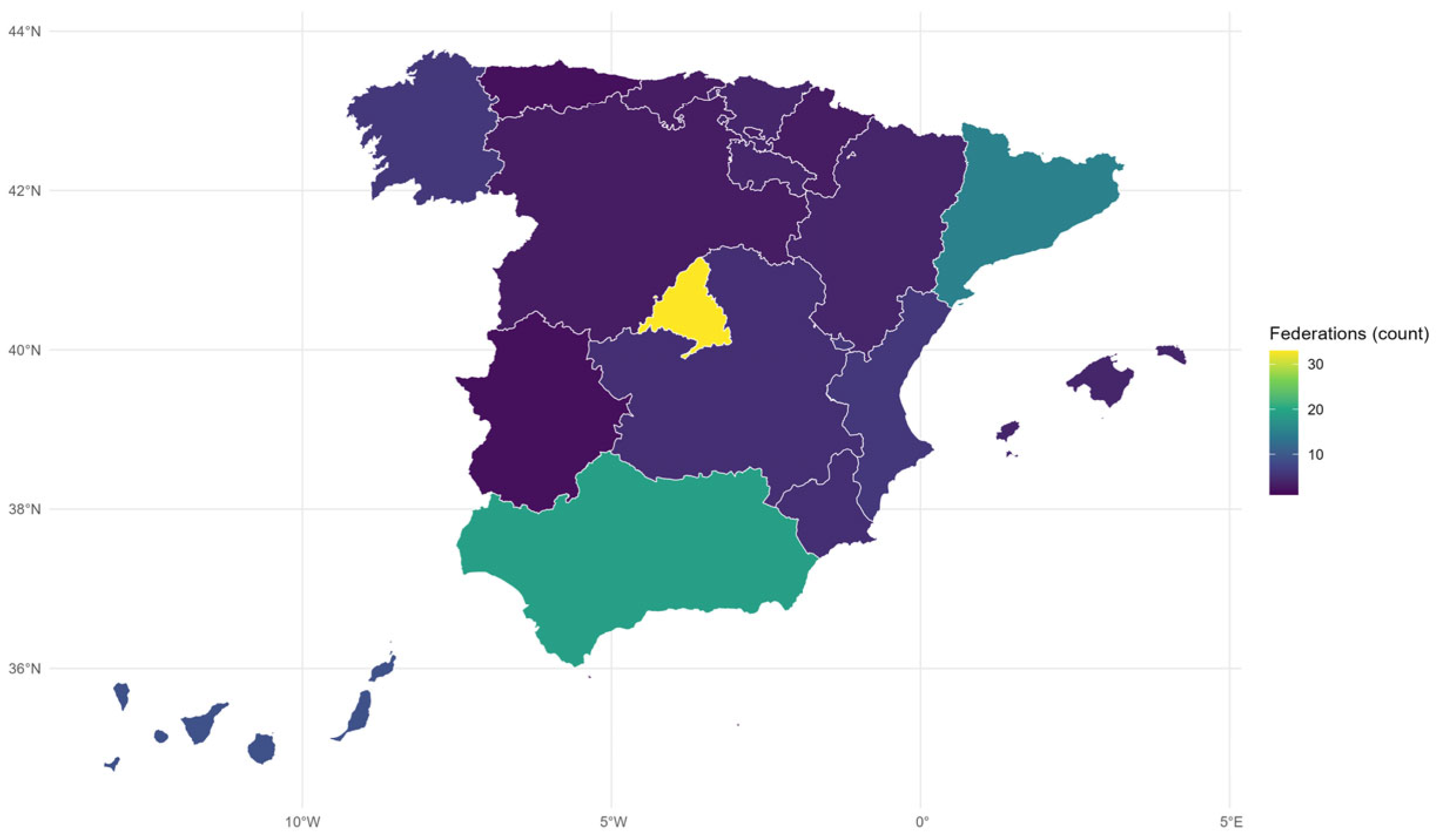
Figure 1 shows the geographical distribution of religious federations by autonomous community. There are 129 federations in total. At first glance, analysis of the map shows that the federations are unevenly distributed across the territory. In statistical terms, the geographical distribution of the federations is asymmetrical. With regard to measures of central tendency, we find a median value of 4 and a mean of 6.8 federations. Likewise, if we look at the interquartile range (Q1 = 3; Q3 = 6), we find that half of the communities have values between 3 and 6 federations. These data contrast with the extreme values, which are 33 as the maximum value and 1 as the minimum value.
In terms of the distribution of these values by autonomous community, the Community of Madrid stands out with the highest value (33), while at the other end of the scale are the Autonomous Cities of Ceuta and Melilla, with a score of 1, and regions such as Asturias and Extremadura, with a score of 2. Other atypical values also stand out, such as Andalusia (with a value of 19), Catalonia (with a value of 15) and the Canary Islands (with a value of 9).
3.2. The Institutional Environment of Religious Federations
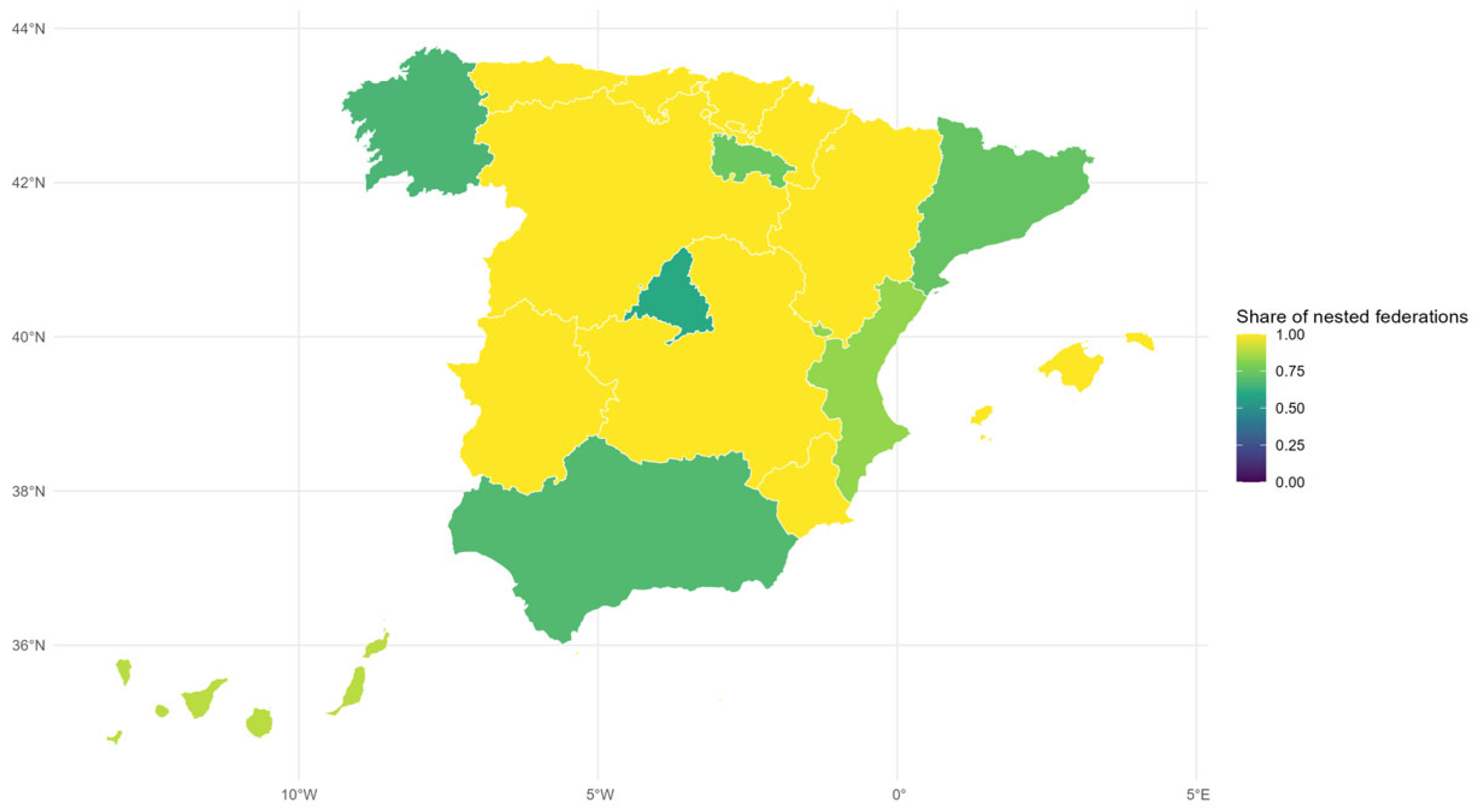
Figure 2 analyses the organisational configuration of religious federations by autonomous community through the proportion of nested federations. The partial results corresponding to this figure show that there is a clear predominance of the nested model, i.e., there is a preference within the institutional environment of religious federations for nested organisation. However, as can be seen from a superficial analysis of the figure, there are Autonomous Communities that have a lower proportion of nested federations, particularly the Community of Madrid, but also others such as Andalusia, Galicia, Catalonia, La Rioja, Valencia and the Canary Islands.
With regard to measures of central tendency, we can see that the median is at the maximum value (1), indicating that in at least half of the autonomous communities, all federations are nested. Looking at the first quartile, we can see that it is around 0.9, which also indicates a predominance of nested federations in those where non-nested federations are present. In light of the partial results in
Figure 1, we can see that they show a distinct heterogeneity of values, suggesting that the institutional presence of federations and their organisational forms (nested or non-nested) respond to semi-independent dynamics.
3.3. The Non-Nested Model of Federations
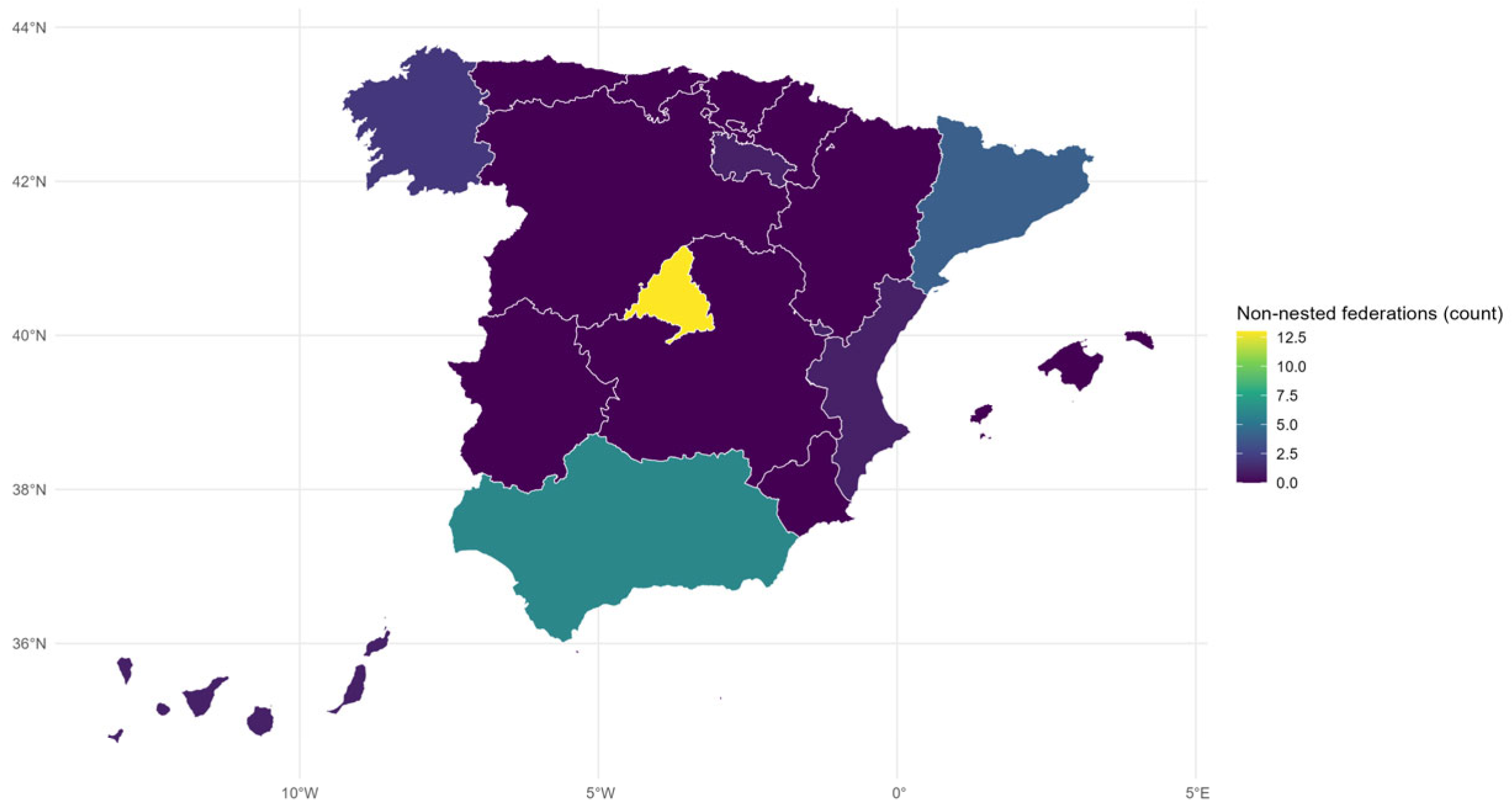
Figure 3 shows the territorial distribution of the organisational form of non-nested federations. As can be seen, and in line with the other figures, the non-nested organisational form is marginal in the overall institutional environment of federations. However, a detailed analysis reveals interesting results for the research: they are concentrated in certain territories. The figure expresses their institutional presence in absolute terms to provide greater clarity. The total number of non-nested federations is 28. Based on measures of central tendency, the median number of federations is 2, which reinforces the idea that this is an organisational model with a low presence. However, looking at the quartiles, the first has a value of 1 and the third quartile a value of 5, which indicates the concentration of non-nested federations in a few Autonomous Communities. The maximum value, with 13 federations, is found in the Community of Madrid. It is followed by Andalusia with 6 federations and Catalonia with 4 federations.
3.4. Confessional Diversity Among Federations
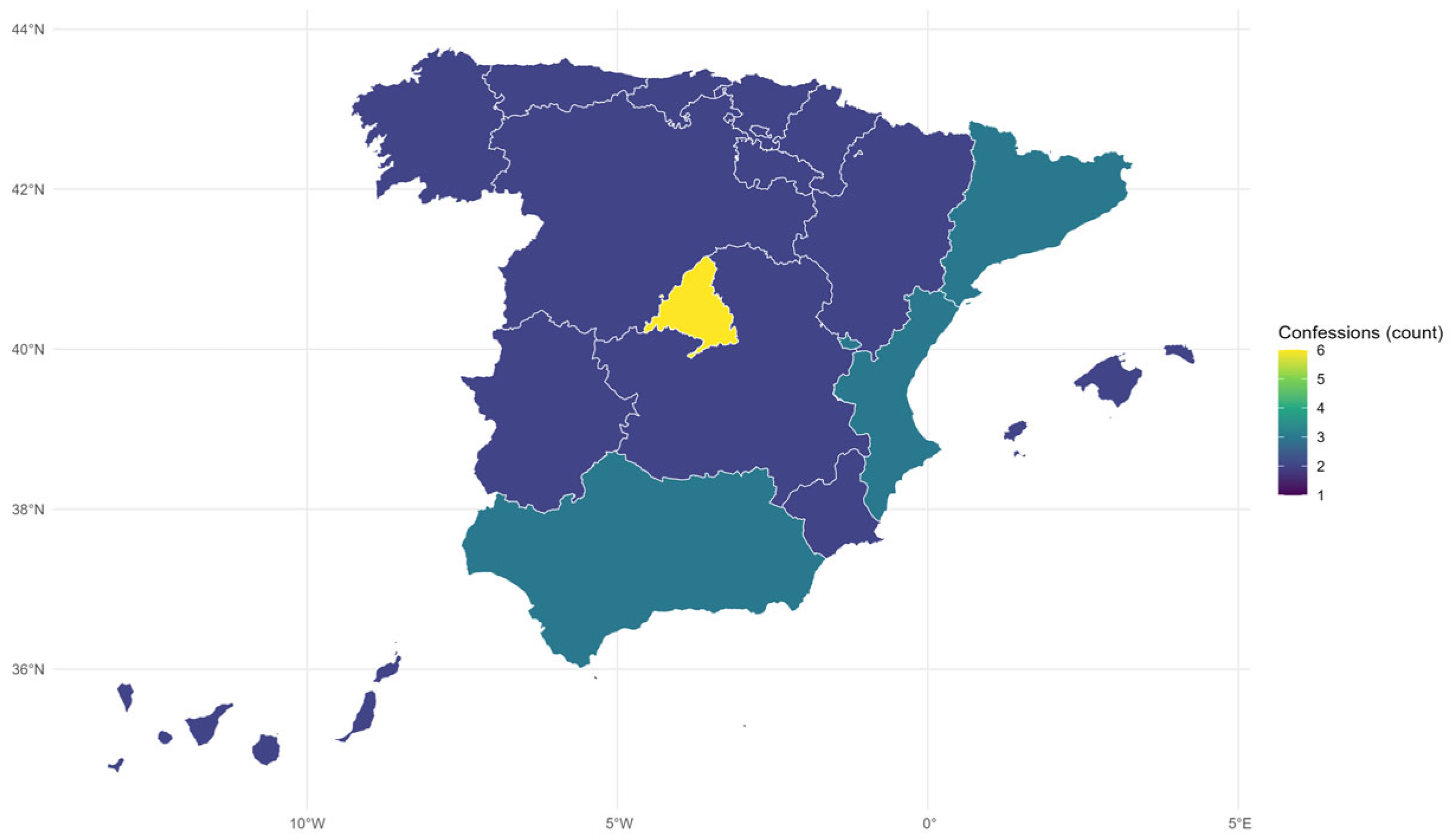
With regard to
Figure 4, in general terms, in the institutional environment of religious federations, there is little confessional diversity among federations by Autonomous Community. Looking at the measures of central tendency, we can see that the median is 2, with a minimum value of 1 and a maximum value of 6. These partial results indicate that even in the Autonomous Community with the greatest confessional diversity among federations, which is the case of the Community of Madrid, the values remain moderate.
A comparative examination of autonomous communities with contrasting institutional profiles provides a clearer picture of the variation observed across the data as a whole. The Community of Madrid has the highest institutional density, with 33 registered federations (13 of which are non-nested) and religious diversity comprising six different denominations. At the opposite end of the spectrum, Asturias has only two federations, both of which are nested, and two denominations. Andalusia occupies an intermediate position with 19 federations (13 nested and six non-nested) and three denominations represented. This gradation illustrates the association between greater institutional density and denominational diversity and a greater presence of non-nested structures. This pattern is consistent with the results of Spearman’s correlation and the hypothesis that more complex institutional environments favour more diverse organisational configurations.
In order to study the institutional environment of religious federations as a whole from a broader perspective, Spearman’s correlation coefficient was applied. An analysis was conducted to determine whether the absolute number of federations per region and confessional diversity are associated with institutional configurations. Firstly, a strong negative association was observed between the variable of the number of federations and the “share of nested federations” (ρ = −0.78, p < 0.001), suggesting that regions with a greater presence of federations have a lower relative presence of nested federations. Secondly, we also find a negative, albeit somewhat weaker, association between the confessional diversity of federations and the “share of nested federations” (ρ = −0.69, p < 0.01). Thus, while the results do not show a causal relationship in any case, it can be said that there is a correlation between the territorial configuration and the organisation of religious federations. In other words, the number and diversity of federations seem to function as factors of institutional dispersion.
4. Discussion
Findings suggest federations may play a relevant role in religious governance in Spain. It has been identified that within the institutional environment of religious federations, two models coexist: nested federations and non-nested federations. This coexistence shows a clear dominance of the nested federation model and, therefore, a trend towards territorially structured organisation. However, looking at the institutional presence of non-nested federations in detail, it can be said that they are highly concentrated territorially.
In general terms, the results are consistent with how the institutional organisation of religious federations cannot be explained solely by the territorial distribution of entities or by a high presence of federations in each territory. On the other hand, the coexistence of nested and non-nested federations in the same territory suggests that denominations may maintain different organisational strategies when it comes to relating to public authorities. In this sense, religious governance in Spain is not homogeneous, but is articulated differently depending on the regional context.
Following
Kooiman’s (
2003) perspective on governance, the results suggest that the exclusivity of state institutions and actors in religious governance in Spain is being overcome, as political, social and religious actors adopt different practices of coordination and control within the democratic system. Thus, the case of Spanish religious governance combines more centralist approaches in terms of federative organisation with other more open options within the territory.
If we include the perspective of multilevel governance in the discussion of the results, territorial differences take on greater significance. For decentralised systems, the concept of multilevel governance encompasses polycentric decision-making systems in which different territorial levels and types of organisations participate under territorial and functional criteria (
Hooghe and Marks 2003). The concentration of non-nested federations in territories with greater institutional density suggests that more complex institutional environments favour more diversified organisational configurations. The Spanish case thus reflects polycentric institutional dynamics in which intermediate actors play a relevant role without the state authority disappearing (
Ostrom 2010;
Sørensen and Torfing 2021).
Religious federations are a clear example of intermediate actors within religious governance in Spain. From a public management perspective, they are also the main instrument for dialogue with religious communities, as they channel voices and demands to the various administrative bodies that deal with religious affairs. At the state level, the Advisory Commission on Religious Freedom stands out as a consultative body in which various religious federations participate directly on behalf of their members. Likewise, at the regional level, there are also administrative bodies involved in religious affairs, such as the Advisory Council for Religious Freedom of Catalonia or the Basque Interreligious Council provided for in Ley 8/2023, de 29 de junio, de lugares o centros de culto y diversidad religiosa en la Comunidad Autónoma del País Vasco (
Agencia Estatal Boletín Oficial del Estado 2023). On the other hand, although less specific, the participation of religious federations in the Community of Madrid as a social agent in the field of public innovation through the Smart Specialisation Strategy policy is also noteworthy. This responds to what authors specialising in the subject identify as a trend towards the development of participatory and coordination bodies (
Amérigo Cuervo-Arango 2025).
The institutional presence of the federations within these bodies is not coincidental, but rather reflects a broader regulatory framework that encourages religious communities to organise themselves at the regional level of the Autonomous Communities. This framework operates on two interconnected levels. At the state level, the regulatory framework governing the relationship between public authorities and religious minorities—in particular the requirements for the declaration of well-established roots (
Agencia Estatal Boletín Oficial del Estado 2015: RD 593/2015) and the composition of the Advisory Committee on Religious Freedom (
Agencia Estatal Boletín Oficial del Estado 2013: RD 932/2013)—establishes the federations as the State’s preferred interlocutors, thereby creating an institutional incentive for federative organisation. At the regional level, the Autonomous Communities hold substantive powers in areas that directly affect the day-to-day exercise of religious diversity, such as education, which drives federations to develop a territorial presence at that level in order to interact effectively with the relevant administrative bodies. This dual dynamic helps to explain why the territorial organisation of federations tends to align with the decentralised structure of the Spanish state, and suggests that the patterns observed cannot be understood without reference to the multi-level institutional context in which federations operate.
If we consider the territorial perspective in the analysis, the Autonomous Communities show variety in terms of the environment of religious federations. The case of the Community of Madrid stands out, concentrating the largest number of federations, presenting organisational variety in terms of nested and non-nested federations and with greater denominational diversity among them. This is followed by Andalusia and Catalonia, with a lower institutional presence of federations, as well as less diversity among them and the presence of the organisational type of non-nested federations. Likewise, autonomous communities such as the Valencian Community and La Rioja also have a high proportion of nested federations, which means that they are more closely aligned with the dominant model of the institutional environment of federations.
Thus, the results offer preliminary evidence to nuance the scope of the Spanish model of cooperation between the State and minority religious groups. Although federations were envisaged by legislators as a means of simplifying dialogue and vertical structuring of institutional organisation, empirical evidence shows that in regions with greater territorial density and religious diversity, less integrated forms of federation organisation emerge. This negative association suggests that the complexity of the institutional environment favours more autonomous federative structures. The findings suggest that the institutional design developed by the legislator does not determine the organisational configuration of federations, but rather that territorial and contextual dynamics play a role in this.
The Spanish case of religious governance, based on a study of the federative organisation of minority religious communities, shows how cooperative models do not necessarily generate a homogeneous relationship model, but rather produce different organisational configurations when they interact with decentralised systems of power. It provides empirical evidence for the debate on multilevel governance regarding the adaptation of organisational strategies to specific territories. Thus, understanding religious governance must include the perspective of the dynamic interaction between legal norms, institutional density and territorial plurality.
The analysis of the Spanish case suggests that the formal legal framework does not entirely determine the organisational structures of religious communities; rather, these respond to a broader and more complex institutional environment. This idea resonates in other European contexts, such as Germany, where minority religious communities have developed pragmatic ways of engaging with the state that go beyond the institutional design envisaged in the constitutional framework, as illustrated both by the opportunities for public participation available to communities organised under private law (
Spielhaus and Herzog 2015) and by the contracts concluded between the city-state of Hamburg and Muslim umbrella organisations (
Körs 2019). Although the legal frameworks differ substantially, both cases suggest that the institutional relationships and organisational strategies of religious communities constitute a relevant variable for understanding religious governance beyond the formal normative framework.
Like any study based on aggregated administrative data, this research has a number of limitations that must be taken into account. The information is limited exclusively to federations registered in the RER, which leaves the interaction of non-institutionalised organisations outside the scope of interpretation. Furthermore, by analysing it at the regional level, local dynamics have been excluded from the analysis, which may also be relevant for understanding the daily interaction of federations with public authorities. On the other hand, with regard to the descriptive analysis, caution is called for when extrapolating the results, as the sample size is small and there are outliers. Furthermore, as this is a cross-sectional analysis, the study is unable to capture temporal dynamics; the question therefore remains as to whether the patterns observed represent a stable equilibrium or an ongoing process of organisational change. These limitations highlight the need for future research to develop analyses that incorporate the local level and qualitative approaches that delve deeper into the complexity of the reality of religious governance. In this regard, the absence of a qualitative dimension in this study is a deliberate methodological choice, consistent with the descriptive-quantitative scope defined for this research, which forms part of a broader study in which a qualitative approach to the institutional strategies of the federations and their member organisations is planned as a subsequent phase.
5. Conclusions
Religious federations emerge as relevant actors in the institutional governance of religious communities in Spain. The findings and discussion in this article confirm the predominance of nested federative organisation, consistent with the cooperative institutional design of the model governing the relationship between the state and religious denominations. However, empirical evidence indicates that institutional design does not necessarily imply a homogeneous configuration across the entire territory.
The coexistence of nested and non-nested organisational models shows that federative organisation not only responds to the provisions of the law, but is also influenced by a contextual environment marked by the interaction between regulations, religious pluralism and decentralisation of power. From the perspective of multilevel governance, federations act as intermediate actors that develop differentiated organisational strategies depending on the institutional environment in which they find themselves. The organisation of Spanish religious federations includes both vertical coordination logics with certain margins of territorial autonomy, which reproduce the tensions between centralisation and decentralisation characteristic of the Spanish political system.
Consequently, the results offer grounds to nuance the idea that the cooperative model necessarily implies uniformity in the relationship. Territorial decentralisation introduces a key variable in mapping religious diversity in Spain, thus highlighting different processes of organisational adaptation by federations based on territorial differentiation and institutional polycentrism.