The Springtime of Nations in 1990, the Fall of the Iron Curtain and of the Berlin Wall signified one of the greatest victories over the Evil Empire in the history of the world. Without firing a single shot, Ronald Reagan, Margaret Thatcher and, above all, John Paul II, led the slaves of darkness into a new light of freedom. Although the enormity of the event has never been fully acknowledged and accepted by the winning West, it was thoroughly recognized as a New Birth by those who, overnight, turned from Communism’s slaves into free creators of their own destinies. A New Europe, as we have it today, became a possibility, and then a reality. Even with ensuing back sliding and retreats, we, today, live in a better and freer world. The book Strateško komuniciranje država (Strategic Communication Between Sovereign States) edited by Božo Skoko (
Skoko 2021), contains a large group of texts by the author and co-authors dealing with the issues relevant for our topic in the area of Central and Eastern Central Europe.
This is without a shadow of a doubt the case for Croatia, which came out of the upheavals of warfare, political oppression, and economic exploitation as one of the new, free, and independent countries of the new, united Europe. This paper will briefly examine some of the spiritual background of such efforts, concentrating on cultural phenomena, fine arts in particular, as a partner and, on occasion, even a substitute for religion in that process.
1Do we, and to what extent, understand one of the key phenomena in our lives—the arts. In a critique of Plato, Aristotle saw the arts as an improved and not a debased version of reality. The arts are materialization, embodiment of the spirit, and the only way for us to experience the spirit in forms recognizable by our senses. As a shortcut to a higher reality, the art experience comes close to religion. It makes us better, happier, more complete human beings (
Daiches 1956).
As Communism kept losing its original zeal, some religious monuments started being repaired, primarily as important monuments of culture. But as it was rather unpopular with the Yugoslav authorities to advertise Croatian culture (the Orthodox and the Muslim communities faring not much better), investments in restoration and repair work, let alone new construction, were scarce. Yet such mega phenomena as Međugorje, which is located in the heart of the ethnic Croatian territory in Bosnia and Hercegovina, could not be totally ignored even by an inimical government. Briefly, religion, both as a set of doctrines defining one’s relation to eternity and a social phenomenon providing special ways of interhuman bonding, started to turn from a repressed lair for hiding for the enemies of the people to a tolerated factor determining human values and relationships. The more the religious mode was repressed under Communism, the more liberating under the new conditions it proved to be. The new “Europe between the Seas”—the Baltic, the Adriatic, and the Black Sea—has made, in my opinion, an incredibly fast transition from slavery to the “Evil Empire” to the world of freedom and, in many ways, even assumed a leading role in promoting the values of the common European house. The job is far from complete, but the direction has been set, and the goal is clear. The survival of the religious sphere through decades of communist oppression is, in my opinion, one of the key factors in the national survival of the people that, for much of a century, suffered under the totalitarian fist.
2This is without a shadow of a doubt the case for Croatia, which came out of the upheavals of warfare, political oppression, and economic exploitation as one of the new free and independent countries of the New Europe. As an example of a very old European political and national unit at a very precarious point between major political, cultural, and religious heavyweights, it has demonstrated how, thanks to a stubborn and persistent reliance on key national values (i.e., those of space and spirit), it has, against all odds, achieved its centennial ambitions of sovereignty and freedom. This paper will briefly examine the spiritual basis of such efforts, concentrating on cultural phenomena, and art in particular, as a partner and even a substitute for religion in that process (
Goss 2020b).
3People exist in space. It is the material basis and the framework of our existence. But in order to be, the space must be experienced by someone’s spirit. Human beings are the spiritual axis of the space they live in, the locus of contact between the matter and the spirit, as they join hands within a human being. Space is the material framework of any spiritual activity, but it remains a dead matter without the spirit which resides therein, endowing it with sense and substance (
Goss 2016).
4The Society of Croatian Architects truly saw the light when it named its journal Man and Space (founded in 1954).
This invisible spirit may be recognized when it is embodied in a form accessible to our senses. We call this process creativity; its palpable form accessible to the senses is art, i.e., works of art.
Initially, art exists only in the spirit of its creator. Once translated into matter, it becomes public property. Art is artificial, not natural. It is
created. As such, it is, paradoxically, more truthful than the truth itself—as already claimed by Aristotle and copiously argued more recently by David Daiches (
Daiches 1956). It is produced so that we may realize the who, what, where, and why of our existence. A work of art comes into being as an especially gifted observer recognizes something worthy of particular attention and decides to communicate this in forms accessible to our senses.
Thus, art is the embodiment of the spirit in matter. The artist captures the spirit and gives it a palpable form. Invents. Creates. Art is invention. But it is also our only palpable link with eternity and endlessness. In that, I venture to state, art is in partnership with religion. It seeks to identify the original cause and final goal of human existence and to record it in a manner accessible to human senses. By postulating such a goal, religion might be seen as a kind of humanist super-discipline—an endless and recurring search for the ultimate answer.
The repression of religion within the Communist Bloc in Europe was universal, but its intensity and direction varied. Universally, it was a terror of those in power over those who had none, i.e., the class enemy, but it could have been combined, intensified, and assume a particular direction when those in power considered it useful to their cause. Such was, for example, the tendency to exterminate or expel all people of German origin (
Volksdeutschers,
Saxons,
Danubian Swabians, etc.), or domestic Turks, e.g., from Yugoslavia, Bulgaria, and Romania, or Istrian Italians from Yugoslavia. The form of terror obviously combined punishment both for a national and religious orientation. Herein, the central role of religion as a mark of national identity was unquestionable, and it triumphed over political orientation. Croatian communists, mostly men, went to war to defend their new country from Serbian aggression in 1990, the Muslims in Bosnia turned into fierce Jihadists, and the Kosovo Albanians did not check their comrades’ party IDs. The wartime leader and the first president of independent Croatia, Franjo Tudjman, had been a communist general. As land and nationality are key markers of national identity, it is no surprise that a religious revival promptly overtook any class or party allegiance. According to the Census in 2011, 83.2% of the Croatian population was Catholic, 3.32% was Orthodox, 1.32% was Muslim, 0.34% was protestant. 4.71% declared themselves atheist, 1.68% were agnostics and sceptics, and 1.72% declined to answer. Croatia and Poland are the two countries with the highest percentage of Catholics among the Slavs. According to the Eurostat, 67% of those interviewed claimed to “believe in God”. 70% claimed that religion is an important aspect of their daily life. Yet only 24% of the population regularly attends religious services.
5Croatians belonging to the world of Christianity goes back to the earliest days of their presence in Southeastern Europe. Some of them may have arrived as early as ca. 600 as tributaries of the invading Avars. The major move of the Slavs into the Eastern Adriatic and its hinterland occurred at the end of the eighth century during the efforts of Charlemagne to expel the Avars and take control of the Adriatic and its Pannonian background. The Slavic participation in that move, which ended due to the total annihilation of the Avar power in 798, was not spontaneous but a well-organized military campaign with the objective of a military victory, followed by resettling the conquered lands. The Slavs from a wide arch ranging from the Central German and Laba River districts through Silesia, the Carpathian area, and the lands to the north of the Black Sea were enlisted as Frankish allies and settled in the newly conquered lands. The Slavs ended up settling in the territory of Pannonia, the Eastern Alps, and the Eastern Adriatic coastland and its hinterland. This encompasses the present day EU states of Slovenia and Croatia, and also Bosnia and Hercegovina, and parts of today’s Austria, Hungary, and Romania. Besides Croatia, the Croats are a constituent nation in Bosnia and Hercegovina and a minority in Slovenia, Austria, Hungary, Romania, Serbia, and Monte Negro (
Katičić 2007;
Katičić 2017;
Goss 2020a).
6The Croats, who moved with the Franks into Pannonia and the Eastern Adriatic, were baptized around 800 under “the father of Duke Borna” at the place later called Villa regalis, and nowadays Biskupija, near Knin, at the church of SS. Mary and Stephen, originally a Slavic sanctuary consisting of a hall preceded by a cemetery of the elite and overseen by a “gomila” (hillock) from where the leaders addressed the people standing in a hall preceded by the area of burials (
Jurčević 2016). All this can still be identified at the site, as well as the ruins of the ruler’s court along the northern wall of the hall.
7The Franks organized the conquered territory into two dukedoms—Pannonian Croatia with Sisak, with the ancient Roman Siscia as the capital; and Coastal Croatia with a capital at Nin and a seat in the Croatian church for its bishop. As elsewhere within the Frankish Empire, the language of the church was Latin, with a proviso that the native language could be used where Latin was not understood. This meant most of the Carolingian state, including, of course, the Croatian Duchies. The use of common language was reinforced as the followers of the Cyrillo–Methodian movement dispersed from the Greater Moravia throughout Southeastern Europe in late nineth ct. In Croatia, this resulted in a native Croatian church using Church Slavic as the language of its liturgy and a specific Croatian Glagolitic script until the Second Vatican Council (1962–1965), when it was decided that Holy Mass should be celebrated in a national language, which the Old Croatian of the Glagolitic church was not. At the peak of its expansion, Glagolism spread from its centre in the Northern Adriatic into the Highlands and almost as far as the Drava River (Lovčić, Brodski Drenovac, and Rudina). The Croatian Glagolitic Church was respectfully treated by the Croatian political leadership, as proven by donations such as that of King Dimitri Zvonimir (1075–1089) to the monastery of the Glagolitic monks at Jurandvor on the Island of Krk, recorded in stone on the panel of Baška (end of the 11th ct.), and later by the patronage of the top Croatian noble families such as the Zrinskis and Frankopans (
Misal kneza Novaka 1368;
Fučić 1982). The first printed book among the Croats and among the Southern Slavs,
The Misal According to the Use of the Roman Court, was published in Kosinj in the Croatian Highlands in 1483, just 28 years after Gutenberg’s
Bible, in Croatian Church Slavonic and in Croatian Glagolitic script. Thus, the Croatian Glagolitic Church was just another Croatian church of Roman Catholic orientation. It played an enormous role in maintaining the national identity in the Northern Adriatic in opposition to Italian Irredentism. The Catholic clergy of the area was instrumental in providing lists of the population in Istria after the Second World War, which were eventually decisive in turning most of Istria and the Kvarner islands over to Yugoslavia (i.e., Croatia and Slovenia) after World War II. Yugoslav communist leadership made several attempts to declare the Glagolitic Church a predecessor to the “Classless Society” with no success. Its loyalty to the culture of the Croatian countryside is indisputable, but it never strayed from its Roman Catholic and Croatian national orientation.
8As Communism kept losing its original zeal, some religious monuments started being repaired, primarily as important monuments of culture. But at least some restorations and embellishments of church institutions became, reluctantly, possible. And occasionally, it even resulted in great art such as the paintings (fresco, vitrail, mosaic, etc.) by an outstanding modern Croatian painter, Ivo Dulčić, largely working for the Bosnian Franciscans but also within Croatia. The phenomenon of Međugorje, which is located in the heart of ethnic Croatian territory in Bosnia and Hercegovina, was also a mega event which could not be totally ignored even by an inimical government.
9Even under the conditions mandated by the ever-present Social Realism, there were some successful flights into “decadence”. One such event was the famous EXAT 51 exhibition in Zagreb (Picelj, Rašica, Kristl, and Srnec), the opening of which, at the Architects Club in Zagreb in February 1953, I witnessed as an 11-year-old boy. It was a show of “decadent”, “abstract”, “antisocial” paintings, the first of such within the entire Communist Bloc. It was closely watched by hundreds of police but passed without incidents and with just some mild criticism. Today, it is obvious that it was tolerated because Yugoslavia, threatened by the Russians, wanted to show its “tolerance” and “pro-western” leanings in such an innocuous area as the arts. From that point on, Croatian modern art followed Western trends (and fads) unopposed and unchallenged. In fact, the official Croatian modernisms have rarely gotten over the bland versions of Western modernisms. Yes, there are exceptions, as there are great artists among Croatia’s “Moderns”—Murtić, Bakić, Džamonja, Gliha, Šulentić, Šimunović, Vaništa, and Marija Ujević, etc.—on par with the relevant phenomena elsewhere, yet, primarily, they are followers of world-wide trends. May we call it escapism into an emotional neutrality?
10They were equally respected by the domestic censors, and the foreign critics. Thus, even though there are some marked deviations from the socialist vision of culture and art, there is very little in the arts in terms of exploring the ultimate truths, which is the sphere of the religious experience. As the search for the ultimate and its explanation is a basic need of the human soul, one is encouraged to look for substitute activities. In a way, the EXAT 51, in spite of its absolute secular orientation, is one such activity—a search of meaning in a non-figured form as a bearer of transcendental experience. In as much as it can be even conceived of, any art possesses transcendental ambitions of looking beyond the visible, i.e., investing the invisible with a palpable form, thus expanding its communication abilities, as any art is research in the spiritual world.
This means that, regardless of the political or social system within which it operates, art could substitute and/or expand a religious experience. What follows is an attempt to demonstrate this by using examples of two outstanding Croatian artists who spanned the periods of Communism and its aftermath. I hasten to add that they practice different branches of visual art—sculpture and painting—they speak different Croatian dialects—čakavijan and kajkavijan—and consequently belong to different areas of the country—the coast and the continent—and differ in social class status—one belonging to a bourgeois core within a rural environment, the other being a peasant with considerable professional ties to a metropole. The sculptor, Ljubo Dekarina, was born in the metropolitan city of Rijeka in 1948 but has mostly lived and worked in the small township of Brseč in Liburnian Istria, the native place of his ancestors (
Vučemilović and Župan 2017). The painter, Ivan Rabuzin, born in a small Croatian Zagorje village of Ključ in 1921, died in the city of Varaždin in 2008, and maintained considerable ties with the Croatian capital of Zagreb. In this mix of town and county, theirs are quite exemplary Croatian destinies. Antun Gustav Matoš, a leading early 20th century Croatian poet, summed it up neatly by saying: “Croatian places are people, and the people are places.” (
Matoš 1912;
Goss 2023a).
11Within any unit of organized space, the city is the place of entrance of foreign ideas, the village the locus of tradition. When those two elements are brought together in a creative way, a road to masterwork is open. The Croatian cultural duality still exists today. The city is a positive link with the world, the village with tradition, with the
Genius Loci. Or, as the leading expert on Croatian naïve art, Vladimir Crnković wrote: “It is clear that the naïve art became an alternative to disintegrational, destructive and nihilist tendencies in contemporary Croatian art. From Matoš to Ljubo Babić the Croatian art criticism has debated the issue of the
native expression. Assuming that this includes also the spirit of the environment then the naïve art is a prime example thereof. Ivan Rabuzin is an artist outside the presumed regular stream of history as the naive art is, in general, outside that stream” (
Crnković 2018).
It was not meant to be so. Namely, naïve art was a project by a group of progressive artists in the 1930s, a mix of communists and HSSs (Croatian Peasant Party) led by Krsto Hegedušić, who recognized the talent of a number of peasant painters in the northwestern Croatian region of Podravina and attempted to direct it toward socially conscious, anti-bourgeois art. Whereas some of the artists crossed the line into social radicalism (even such great talents as Virius), the overall result was far from what the social reformers had hoped for.
12As Crnković goes on, the miracle of the naïve is on par with the best achievements of Croatian art. It is not “rustic” or “primitive”; it enters the urban milieus through museums, exhibitions, monographs, critical reviews, and social and professional contacts. It is technically superb. It is a legitimate part of the
Genius Patriae, i.e., it is “at home” in both urban and rural manifestations of Croatian existence, and it records and keeps the tradition in the best sense of the word. The works of naïve art are also valuable documents of time and space, witnesses of life and collective memory; in short, records of the
genius loci or, on an even higher level,
genius patriae. As traditional religious fervour of the Croatian village lived on through the decades of Communism, religious topics, often transformed into the mystique of natural phenomena, took over the role of religion, where under the guise of Christian matter, the naïve artist revives the atmosphere of the ancient myths of life and land, endowing with the spirit of Holiness every ray of sunshine, every falling leaf, every blade of grass. An iconography of a new religion of land and life comes into being in front of our eyes, a religion of endurance, vitality, and beauty of formal perfection. The leftists of the 1930s barked upon wrong trees. But thanks to them, we have discovered a world in which natural beauty is converted into an artistically contrived beauty and truth of eternal presence and into a
genius patriae, which definitely possesses the boundlessness of the religious experience. The world, in the case of Rabuzin, is one of hills and groves, of rounded trees and well-petalled flowers, scattered hay-roofed homes, church towers, and haystacks, within garlands of giant flowers or embraced by smooth hills made of round-shaped trees. At its best, and Rabuzin is the tallest peak, Croatian naïve art is truly a substitute for the religious experience as a glimpse into another world (please see
https://www.google.com/search?udm=2&q=ivan+rabuzin&rlz=1C1GCEA_enHR1106HR1106&sourceid=chrome&ie=UTF-8, accessed on 5 January 2026). Briefly, it is a short cut to the eternal bliss of paradise.
13Yet, it is clearly an illusion. For, in the entire Rabuzin opus, there is just a handful, a dozen or two, of human figures, a bird-catching woman holding by its legs an upside down bird, a youth holding a glass receptacle with an image of a village inside, identified by the title as “My Son”, two women digging in a field, etc., a strangely selective and restricted sample of the elected, providing that what Rabuzin keeps representing with its hills, groves, and clouds is an image of paradise. A village or two, a church and a hall, within the wreaths of hills and trees—a paradise available to just a few, presumed and invisible, the criteria of selection escaping the logic of human intuition or reasoning.
A paradise, yes, there is no doubt about it. But there is also no doubt that the paradise is available to a very select few and on the basis of apparently arbitrary criteria. Rabuzin shows us one paradise after another, one more beautiful and harmonious than another—yet is it just bait? We have seen paradise. How do we get there? And yet, there is a certain overwhelming peace and harmony in Rabuzin’s art. Maybe we would accept that there is beauty and harmony somewhere, that we are allowed to have a good view of it but no permanent residence. Yet? The world of Rabuzin’s forests and fields is not the dark northern wood of an Altdorfer, although it may possess a like mystique. It is our gentle northern Croatian forest which, ultimately, should be a pleasant place to rest when He calls us to do so. Rabuzin has shown us paradise, but he gave us no clue of how to get there. Maybe this is an invitation that we should strive to create, each of us, in Rabuzin’s image, a paradise of our own.
14Rabuzin has shown us the goal. Dekarina may indicate the way.
In the small township of Brseč, in the rocky Liburnian Istria falling steeply into the waves of the Kvarner gulf, as different from Rabuzin,’s gentle groves as possible, another great artist, a sculptor, Ljubo Dekarina, pries into primordial memories in a space of pre-urban forms archeologically recorded in the ruins of prehistoric forts a few steps from the artist’s residence.
15Dekarina’s early career did not promise such immersions into the abyss of time, but even when present, figuration was minimal (Veli Jože, 1987; Reliefs, 1989; Wrapped forms, 1997; Masks, 1999–2000, the doors of the cathedral of St. Vitus in Rijeka, 2002). The artist appears to follow natural forms implicit in the organic sculpture endowed with a strange eroticism of surfaces and tactile refinement. Yet, from the fullness of the organic sculpture, Dekarina can, in a minute, switch to The Verticals, with slim, plant-like apparitions vibrating in the light. He experiments with colour and texture, combines stone, wood, metal, carving, engraving, and painting.
And then, in 1983, Dekarina creates his trademark—the penetrations—a form implicit in the rocky cliffs and caves of his Istrian surroundings falling steeply into the waves of the Kvarner gulf (
Vučemilović and Župan 2017;
Goss 2023b).
According to the author, the “penetrations took off when I noticed a brightly lit opening in a wall of a dark interior of my home at Jakovci near Brseč”. Light and fire stand for spirit. Thus, the gap of a penetration stands for an immaterial, spiritual essence of a human being surrounded by matter; a petrified frame.
There are numerous penetration-like formations in the Liburnian/Meranian landscape. From short bays with sandy beaches among the rocks, they cut into the flanks of the cliffs, some coming through as tunnel-like passages. There is, indeed, one super mega “penetration”, the Učka tunnel linking Liburnia through the Učka mountain with Central and Northern Istria.
If the window at Jakovci were a way to the endless and eternal spirit, the cracks in the rocks are roads to darkness with no exit. One must stop and return. On the other hand, if we stand at the terrace of the home at Starac, we are facing an endless penetration of air, sunshine, fire, wind, and water, the ends of which we can neither fathom nor imagine.
The penetration can enslave us and also grant us an unlimited freedom. Claustrophobia merging with Agorophobia? Briefly,
la condition humaine!16A standard Dekarina penetration is an upright block of stone with a pointed, rounded, or straight upper end, and with, but not always, a roughly concentric opening in its wider sides. The variations are endless. The heavy columns of Dekarina’s penetrations march through the rocky landscape of Merania and watch us from the vaults of the kažuni, Istrian stone huts, and from between the rocks and the rocky walls.
When one says “passage way” or “penetration”, one has in mind a vertical opening cut into a vertical surface, i.e., the wall. This opening leads from “this” side (“outside”) through a presumed inner space to another wall featuring an exit. A penetration has two faces: front and back. But which is which, and what, if anything, is in between? What is reasonably certain is that, in viewing the entrance, we can assume that there is an exit on the other side of the presumed interior of the “penetration”. We do realize that the penetration is an image of our progress from our exterior space into another unfamiliar and mysterious area. And what next?
Doors and entranceways need not lead exclusively into one closed space; they may lead into a series of rooms through the walls defining a spatial sequence. As a “penetration”, Dekarina’s opening in the exterior wall is a picture of an entranceway into a space behind, the kind of which we can only guess. Anything from a closet to an endless universe, which, from the outside, we cannot define. We can just guess or dream about it. Could a penetration be simultaneously an entrance and exit? Does Dekarina himself know the answer to the riddle, and does he care to share it with us? What is quite certain is that a penetration takes us from a well-defined world of everyday existence into an unknown, secretive world beyond. The penetration leads into a world of secrets in spite of the fact that, by changing our position, we may view it from both sides. And what is the amount of space between the two “entrances”? A tiny nook or a universe? And does this matter at all?
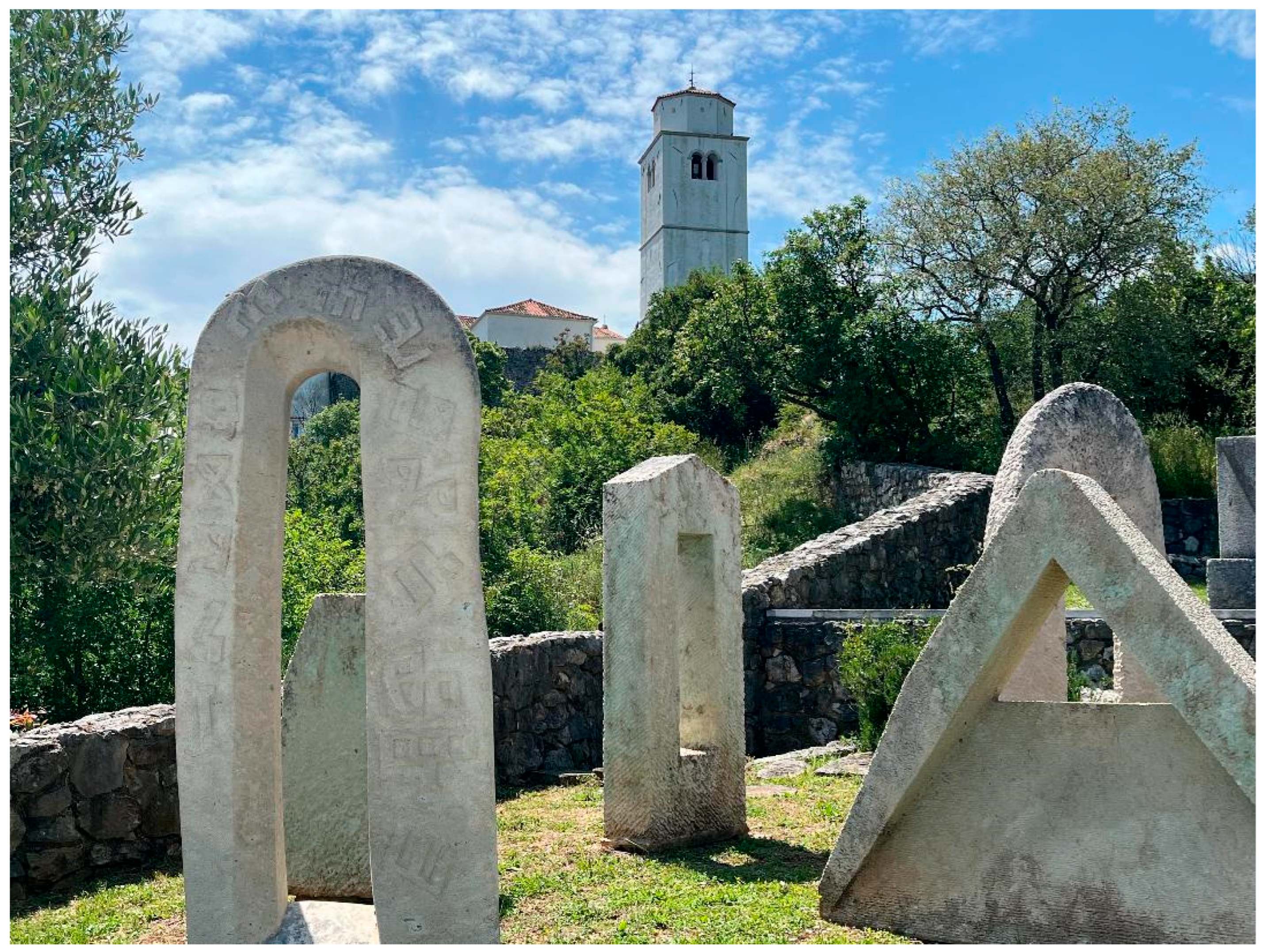
Facing cohorts of Dekarina’s penetrations is not light entertainment. At the family estate of Starac, over a gentle green meadow climbing toward the Brseč parish church, its fortress-like tower, and the township wall, Dekarina has displayed (open to the public) 73 stone sculptures, 80% of which are penetrations (
Figure 1). Not easy company to bear but nonetheless eloquent, provided that we understand the idiom of their discourse. Luckily, the author, after all, seems to be willing to provide us with some clues.
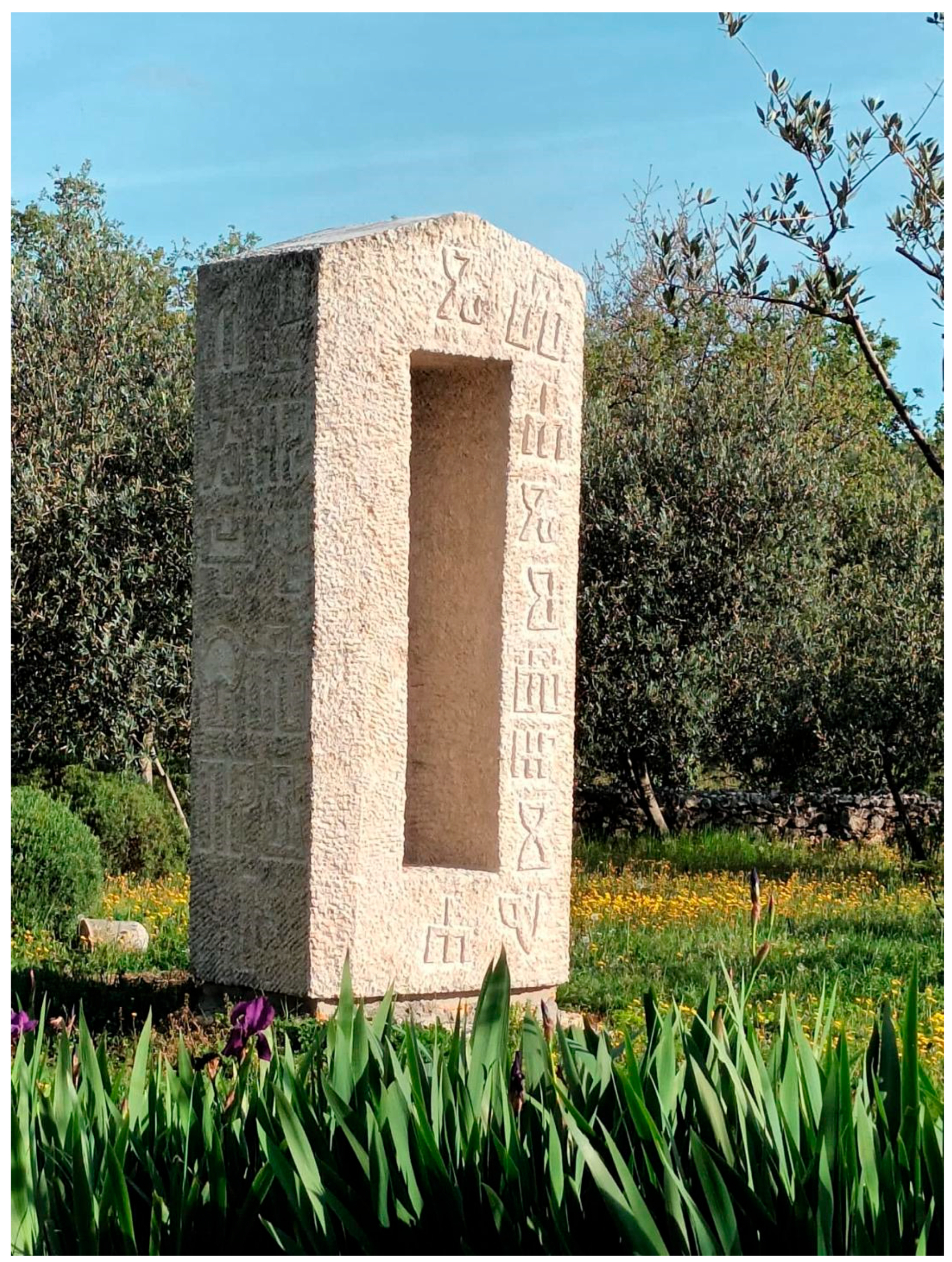
17At the entrance to the estate there is a majestic, wonderfully proportioned penetration (
Figure 2), into the surfaces of which are carved, like a fine but firm network, Croatian Glagolitic letters. Among the other 72 penetrations at Starac, there is another such piece: smaller, with a reduced selection of letters. A trial version of the “real thing”?
18And here, by a direct reference to the ancestral culture, Dekarina may be disclosing a part of the “penetration” mystique, confirming that it has, after all, something to do with one of the most valuable aspects of mankind’s history—its ability to mark its presence in a certain space through signs pertaining to the area of the nation’s spirituality—which, in this case, is its native script as a repository of ideas, visions, and creed. This is not the first nor the only time that Dekarina uses the native script as inspiration for his art. Nor is this his only attempt to connect his art with the eternal links of human beings and space—creativity, culture, and its palpable incarnation in art.
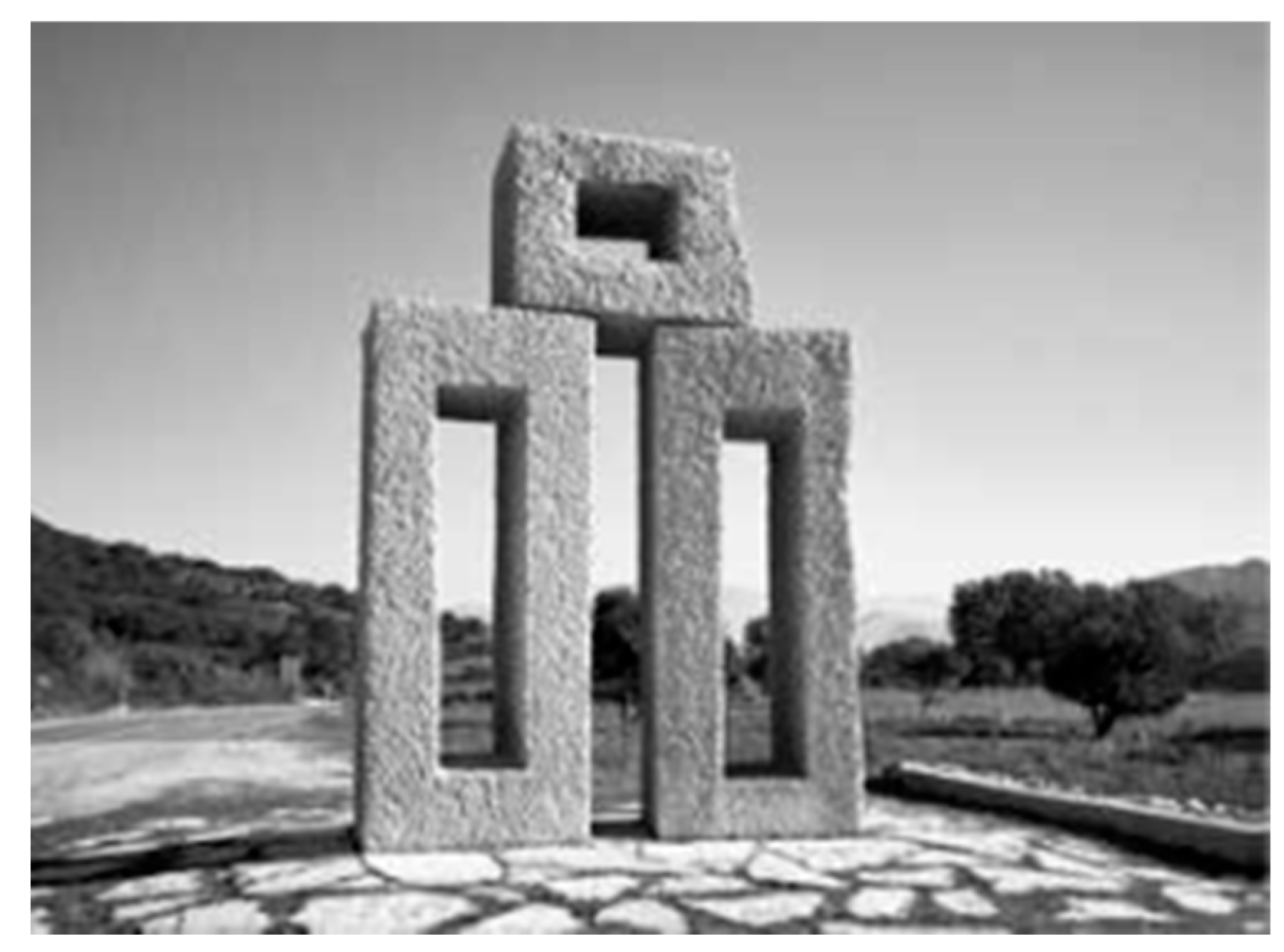
The monumentality of the big “penetration” at Starac reminds one of the images of the Glagolitic letters Dekarina used to mark one of the holiest landscapes of Croatia’s history, the area of the famous Glagolitic abbey of St. Lucy at Jurandvor near Baška on the island of Krk (c. 1100) (
Figure 3), the home of the precious panel of Baška, the altar area railing, recording in a long Glagolitic inscription a donation to the monastery by the greatest of old Croatian kings, Dimitri Zvonimir (1072–1088). These are the letters A, L, and V, and an Ω in Baška itself, conceived as a Rose of the Winds. It is fascinating how the letters, blown up to architectural dimensions, reflect the proportions, silhouettes, and the logic of the bodily and spatial organization of pre-Romanesque churches in Croatia, in particular, of the so called “free form” typical of the Northern Adriatic. The architect and sculptor of those miniature wonders may have also been the author of their interlaced sculpture and inscription in the typical Croatian straight line Glagolitic script, aware of an aesthetics of addition, cell organization, and axial symmetry which defines, in general, his creativity. Glagolitic script is no doubt a
brand of Croatian literacy and history, as it was practiced by the same people, the same milieu, and the same culture as the visual arts.
19We introduced our discussion with an invective against one of the totalitarianisms darkening the skies of the 20th century. Abolishing Nazism and Communism were certainly great common achievements. Somewhat optimistically, we claim that art played a positive role in the process, supplanting some of the losses in the sphere of religious search for the ultimate and the absolute, and satisfying the human need to face the things ultimate. To look inside Dekarina’s “penetrations”, to take heart in viewing Rabuzin’s forest paradise, I am not going to deny what I have said. I do stand behind it. But…with (at least) one proviso.
Both Rabuzin’s and Dekarina’s careers spanned many decades. Dekarina’s still goes on. A large segment of their lives and careers was spent under an absolutist regime. But in practicing their trade, their pre- and post-communist productions are basically the same. Dekarina did his first “penetrations” in the early 1980s. Rabuzin painted his spheric trees both before and after 1990.
Does it mean that art can indeed replace religion?
Please do not push me. I do not want to answer this question, because it is simply unanswerable. But what I am quite ready to argue is that the entire area of culture, including the search for the ultimate truth (which is the sphere of religion), is basically one and has a single goal—making us ever more human—with the arts being a palpable record of our achievement therein. Long live Aristotle and his concept of the arts as a record of an ever better and more human world which we should strive to emulate in our everyday activities. In that I see the areas of arts and humanities as equal, non-competing spheres of human beings’ search for God or whatever you want to name “It”. What Rabuzin and Dekarina have created has nothing to do with the social systems they happened to belong to. They would have done the same under any system. Maybe in a different form, but they would not have sat still! They are the chosen ones who see better and know how to better communicate their experiences. They are the eternal visionary regardless of their trade. They elevate the rest of us through showing us their visions.
It is the humanities, taken as a whole, that make us human. Art and religion, as they communicate the essence of being, are two aspects of that pool which makes us and keeps us going in spite of all pressures and threats of burning hell.