Article

A Sacred Ambition: Mosaic Symbolism of Spiritual Ascent in Gregory of Nyssa and Giovanni Pico Della Mirandola

by
Francisco Bastitta-Harriet
1,2,3
1
Instituto de Filosofía “Dr. Alejandro Korn”, Facultad de Filosofía y Letras, Universidad de Buenos Aires, Buenos Aires C1406CQJ, Argentina
2
Facultad de Teología, Pontificia Universidad Católica Argentina, Buenos Aires C1107AAZ, Argentina
3
CONICET, Buenos Aires C1425FQB, Argentina
Religions 2026, 17(4), 421; https://doi.org/10.3390/rel17040421
Submission received: 16 February 2026 / Revised: 19 March 2026 / Accepted: 21 March 2026 / Published: 26 March 2026
(This article belongs to the Special Issue Words and Images Serving Christianity)

Abstract

This study offers a comparative analysis of the symbolism of the soul’s ascent in Gregory of Nyssa’s De vita Moysis and Giovanni Pico della Mirandola’s Oratio. Rather than attempting to establish a linear or exclusive dependence, it focuses on a series of Mosaic themes that articulate a dynamic conception of perfection in both authors. Beginning with Moses as a paradigm of virtuous life, the paper examines the shared anthropology of desire underlying Nyssen’s notion of unending progress and Pico’s sacra ambitio. It then traces the ordered sequence of symbols as it develops in Gregory’s treatise: light and darkness, the mountain of the knowledge of God, Jacob’s ladder, the tabernacle, the eagle, death as consummation, and divine friendship. Through the interplay of these symbols both thinkers configure spiritual growth as an ever-deepening participation in divine unity and truth. Particular attention is given to integration of the classical disciplines of the ancient philosophical curriculum within the Mosaic itinerary, as well as to the conception of truth as gradually apprehensible but ultimately inexhaustible. The paper concludes by pondering the results of the comparative study and reflecting on Pico’s way of assimilating the wide variety of sources in his project of philosophical concord.

1. Introduction

More than a millennium separates the lives of Gregory of Nyssa (ca. 335–ca. 394), the great Cappadocian thinker of the 4th century, and Giovanni Pico della Mirandola (1463–1494), one of the most prominent humanists and philosophers of the early Italian Renaissance. Despite the differences in their historical and cultural contexts, several common traits can be identified. Born to rich aristocratic families, they both received an excellent education in pagan and Christian literature from an early age. Intellectually daring and impetuous, they were fascinated by a wide range of philosophical traditions current in their day and were able to combine them with rhetorical sophistication and the highest forms of theological speculation. Furthermore, their innovative intellectual endeavors were not without consequences. On more than one occasion, their concordist inclinations and fierce defense of human freedom and dignity brought them into tension with close associates or ecclesiastical authorities (See, for example, Silvas 2007, pp. 27, 30–31, 76–81; Copenhaver 2022b).
Elsewhere, we tried to prove the reception of Nyssen’s anthropology in Giovanni Pico, drawing on a broad range of Greek manuscripts and Latin translations of Gregory of Nyssa known to Pico—including evidence of his typical reading marks in two codices from the Abbey of Fiesole—alongside a detailed analysis of Gregory’s ideas on human greatness and creative freedom in Pico’s thought (Bastitta Harriet 2023, pp. 175–83, 209–47).1
Now, the present study proceeds according to a more austere methodological approach. It consists of a comparative analysis of the symbolism of spiritual ascent in Gregory of Nyssa’s De vita Moysis and Giovanni Pico’s Oratio. Such a comparison does not mean to assume an exclusive line of dependence, nor does it aim at a comprehensive grasp of the Mosaic mysteries as they appear in Pico’s thought. Pico’s interpretation of Moses is shaped by a wide range of Christian, Jewish, and Kabbalistic traditions, while his framework of spiritual ascent in the Oratio is also informed by other numerous pagan and Arabic philosophical sources whose relevance extends beyond the Mosaic paradigm. Our analysis therefore concentrates on those features of the narrative of Exodus and Numbers in the Oratio that display particularly close affinities with Gregory of Nyssa’s anagogical exegesis of the Mosaic life (Conway-Jones 2022; Boersma 2013, pp. 231–46) and its underlying anthropological views.
Our study develops through a series of closely related Mosaic themes that trace spiritual ascent as a progressive itinerary of perfection. It begins by examining the figure of Moses himself as a paradigm of spiritual striving, with particular attention to the dynamics of desire so characteristic of both authors—here, Pico’s oxymoron of a sacra ambitio is read in light of Nyssen’s notion of an unending impulse toward perfection. We then explore the symbolism of light and darkness as expressions of both the knowledge of truth and its inexhaustible depth. Subsequent analysis turns to the spatial and hierarchical symbols of the mountain of God, Jacob’s ladder, and the holy tabernacle. Before reaching our conclusion, we consider the imagery of the celestial eagle, Moses’ death as consummation, and divine friendship as the ultimate horizon of perfection.
Lastly, although no attempt is made to demonstrate beyond reasonable doubt Pico’s direct dependence on Gregory of Nyssa, attention will nevertheless be drawn at various points to the marginal annotations found in one of the Fiesolan manuscripts, Laur. Faesul. 45, now preserved in the Biblioteca Medicea Laurenziana, whose final folios transmit George of Trebizond’s Latin translation of De vita Moysis. The Byzantine scholar completed the translation in 1446 and dedicated it to the powerful cardinal Ludovico Trevisan (Monfasani 1976, p. 57). The codex was in all likelihood read and annotated by Pico as early as 1484, or perhaps during his first brief stay in Florence shortly before 1480, at the time of his initial meeting with Poliziano in Fiesole (Cf. Bastitta Harriet 2023, pp. 178–82).

2. Mosayca Mysteria and a Sacred Ambition

In the long preface to his De vita Moysis, a response to a certain Caesarius who asked for counsel regarding a perfect life, Gregory of Nyssa describes human perfection (τελειότης) as difficult to comprehend by discursive reason and even harder to apply to one’s life (Vit. Moys. I, 3). Even though physical perfection is enclosed by certain limits, he argues, spiritual perfection is virtue, whose boundary is to have no boundary (ὅρον [...] τὸ μὴ ἔχειν αὐτὴν ὅρον), as Gregory learns from the Apostle Paul (Vit. Moys. I, 5). Indeed, perfect virtue is identified with the primordial and true Good (τὸ πρώτως καὶ κυρίως ἀγαθόν), the infinite God himself (Vit. Moys. I, 7).
To catch a glimpse of this ever-growing human perfection, Nyssen therefore turns to the example of great saints and patriarchs, and among them he chooses Moses as the paradigm of the virtuous life (Vit. Moys. I, 11–15). Let us examine a later passage where Gregory describes Moses in such a role. I transcribe the text of Trebizond’s Latin version as it appears in the Fiesolan manuscript, together with the original Greek and a modern English translation.
Vit. Moys. II, 319(Malherbe and Ferguson 1978, pp. 136–37)2Laur. Faesul. 45, f. 267r
Ταῦτά σοι, ὦ ἄνθρωπε τοῦ θεοῦ, περὶ τῆς τοῦ βίου τοῦ κατ’ ἀρετὴν τελειότητος, Καισάριε, ὁ βραχὺς ἡμῶν οὗτος ὑποτίθεται λόγος, οἷόν τι πρωτότυπον ἐν μορφῇ κάλλους τὸν τοῦ μεγάλου Μωϋσέως ὑπογράψας σοι βίον, ἐφ’ ᾧ τοὺς καθ’ ἕκαστον ἡμῶν διὰ τῆς τῶν ἐπιτηδευμάτων μιμήσεως ἐν ἑαυτοῖς μεταγράφειν τοῦ προδειχθέντος ἡμῖν κάλλους τὸν χαρακτῆρα. Τοῦ γὰρ κατωρθωκέναι τὸν Μωϋσέα τὴν ἐνδεχομένην τελειότητα τίς ἂν ἡμῖν ἀξιοπιστότερος εὑρεθείη μάρτυς τῆς θείας φωνῆς ἥ φησι πρὸς αὐτὸν ὅτι· ἔγνων σε παρὰ πάντας.These things concerning the perfection of the life according to virtue, O Caesarius, man of God, this brief discourse of ours sets before you, outlining the life of the great Moses as it were a kind of archetype in the form of beauty, so that each one of us, through imitation of his pursuits, might transcribe within ourselves the imprint of the beauty that has been shown to us. For what more trustworthy witness could be found for us that Moses attained the perfection which was possible than the divine voice which says to him: I have known you above all others (Exod 33:12, 17).Habes de vita perfecta in brevi hac oratione meum iudicium. Nam tanquam exemplar quoddam perfectionis vitam Moysi descripsimus, ex qua unum hominum monstrate huius pulchritudinis caracthera (sic) depingere licebit. Quod autem perfectionem bomini possibilem Moyses assecutus est, divine vocis testimonio perhibetur. Cognovi te, inquit, preter omnes.
Of course, the paradigmatic role of Moses as king, prophet, priest, and judge—embodying the Greek philosophical ideal of wisdom and virtue—had long been central to Alexandrian exegesis, beginning with Philo’s De vita Moysis and subsequently developed by Clement and Origen.3 All these authors were known to Pico when he prepared his inaugural speech in 1486.4
However, one distinctive feature of Gregory’s interpretation of Moses seems particularly consonant with the passionate and exhortatory tone of the Oratio. Beyond the allegorical reading of individual episodes, Gregory interprets the entire narrative sequence (ἀκολουθία) of Exodus as a coherent and organic progression of and invitation to the virtuous life, in which each event functions as a symbolic stage within an ordered ascent (Daniélou 1968, pp. 24–25). Moreover, as will be shown, Nyssen integrates into this Mosaic itinerary the successive stages of philosophical formation in the schools of Late Antiquity—ethics and dialectics, natural philosophy and theology—already present in Origen’s exegesis and inspired by the initiatory patterns in ancient Greek mysteries (Daniélou 1944, pp. 17–23; Hadot 1979).
Immediately after his opening exaltation of the human condition in the Oratio, Pico unfolds precisely such a gradual spiritual and philosophical path, resorting to diverse cultural and philosophical traditions, at which point the figure of Moses assumes a central role. He first mentions him as one who accomplished the three stages of angelic life in himself: the love of the seraphim, the intelligence of the cherubim and the judgement of the thrones. “Moses loved God whom he saw, and as judge, he administered to the people what he formerly saw as contemplator on the mountain (amavit Moses deum quem vidit, et administravit iudex in populo quae vidit prius contemplator in monte)” (Oratio 64, Wallis 1998, p. 8).
This exemplary role is later reinforced when Pico rhetorically turns to the patriarch himself: “Let us also cite Moses himself, scarcely inferior to the fountain fullness of holy and inexpressible intelligence, whence the angels are drunken on their own nectar (citemus et Mosen ipsum, a sacrosanctae et ineffabilis intelligentiae fontana plenitudine, unde angeli suo nectare inebriantur, paulo deminutum)” (Oratio 98, Wallis 1998, p. 12). In the heights of his spiritual and moral perfection, Moses is thus no longer measured against the angelic orders but is said to fall short only of divine unity itself. The formulation clearly recalls the paulo deminutum of Psalm 8 cited by Pico earlier in Oratio 3—where it marks human inferiority with respect to the angels—but now reapplied to Moses as the divinized fulfillment of the human vocation.
Interestingly, whereas Gregory himself articulates the exhortation to the virtuous and divine life for his addressee through the example of Moses, Pico places the exhortative voice directly in the mouth of the lawgiver. Here follow the two passages, each with its English translation, and, in the case of the first, with Trebizond’s Latin as well.
Vit. Moys. I, 1; (Malherbe and Ferguson 1978, p. 29)5;
Laur. Faesul. 45, f. 243v
Oratio 102; (Wallis 1998, p. 13)
ὅτι σου κατὰ τὸ τῆς ἀρετῆς στάδιον καλῶς ἐναγωνιζομένου τῷ θείῳ δρόμῳ καὶ πρὸς τὸ βραβεῖον τῆς ἄνω κλήσεως πυκνοῖς τε καὶ κούφοις συντεινομένου τοῖς ἅλμασιν ὑποφωνῶ τε καὶ ἐπισπεύδω καὶ ἐπιτείνειν τῇ σπουδῇ τὸ τάχος διακελεύομαι.
Since you are competing nobly in the divine race along the course of virtue, straining with frequent and nimble leaps towards the prize of the upward calling, I exhort, urge and encourage you to zealously increase your speed.
Nam cum tu in virtutis spectaculo, probe divino cursu ac certamine perseveres, et ad superne vocationis premia crebris levissimisque saltibus festines, acclamo atque impello, et diligentia studioque intendere velocitatem iubeo.
Haec nobis profecto Moses et imperat et imperando admonet, excitat, inhortatur, ut per philosophiam ad futuram caelestem gloriam, dum possumus, iter paremus nobis.
Moses gives us these direct commands, and in giving them he advises us, arouses us, urges us to make ready our way through philosophy to future celestial glory, while we can.
It is worth noting that both Gregory and Pico employ here a series of three paraenetic verbs: ὑποφωνῶ—ἐπισπεύδω—διακελεύομαι and admonetexcitatinhortatur. Although they are certainly not identical, and in Pico, the cluster functions more neatly as a rhetorical tricolon, they equally express the call to virtue with urgency and encouragement.
In addition, both exhortations to the virtuous life ultimately depend on a very peculiar conception of desire. The movement of ascent described by Gregory and by Pico presupposes a dynamism of the soul that is motivated neither by fear of punishment nor by the expectation of rewards, but by an intense love for the Good itself. This conception is certainly Platonic in origin, yet it undergoes a decisive transformation within Christian thought, first in Origen and, more radically, in Gregory of Nyssa (Horn 1925; von Balthasar 1942, pp. 101–39; Daniélou 1944, pp. 175–307; Laird 2004; Cadenhead 2018; Limone 2020; Cvetkovic 2021).
In the Oratio, Pico gives a striking formulation to this anthropology of desire through the paradoxical expression “a certain sacred ambition” (sacra quaedam ambitio) (Oratio 47), later echoed in letters to his nephew Gianfrancesco as sancta quaedam ambitio and sanctissima ambitio (Epist. I, 83; XLVII, 148, de Lubac 1974, p. 379). By this sort of consecration of a term traditionally associated with excess, rivalry, and worldly striving, Pico deliberately signals an inversion of the traditional understanding of ambition. However, what is at stake is not the suppression or even the mitigation of desire, but its redirection and elevation: an impulse that refuses to remain satisfied with intermediate states and urges the soul towards the utmost forms of life.
Oratio 47–48(Wallis 1998, p. 7)6
Invadat animum sacra quaedam et Iunonia ambitio, ut mediocribus non contenti anhelemus ad summa, adque illa (quando possumus, si volumus) consequenda totis viribus enitamur. Dedignemur terrestria, caelestia contemnamus, et, quicquid mundi est denique posthabentes, ultramundanam curiam eminentissimae divinitati proximam advolemus.Let a certain holy ambition invade our soul, so that we may not be content with mean things but may aspire to the highest ones and strive with all our forces to attain them (for if we will to, we can). Let us spurn earthly things; let us struggle toward the heavenly. Let us put in last place whatever is of the world; and let us fly beyond the world to the chamber nearest the most lofty divinity.
A closely analogous transfiguration of desire is articulated by Gregory of Nyssa in his treatise De mortuis, which Pico possessed in an important Greek manuscript that was probably lost together with most of his library collection during the fire of the Venetian Library of Saint Anthony in 1687 (Bastitta Harriet 2023, pp. 176–78).
In a remarkable passage, Gregory explicitly rehabilitates terms such as ambition or love of glory (φιλοδοξία), greediness (πλεονεξία), and even insatiability (ἀπληστία) in order to paradoxically describe the soul’s eternal longing for divine Beauty and Wisdom beyond this world. When directed toward the true and inexhaustible Good, these passionate dispositions are no longer condemned but exalted.
Mort. 61, 19–24Our translation
ἐκεῖ γὰρ ὁ ἔρως τοῦ ἀληθινοῦ κάλλους ὁ ἄπαυστος, ἐκεῖ ἡ ἐπαινετὴ τῶν τῆς σοφίας θησαυρῶν πλεονεξία καὶ ἡ καλή τε καὶ ἀγαθὴ φιλοδοξία ἡ τῇ κοινωνίᾳ τῆς τοῦ θεοῦ βασιλείας κατορθουμένη καὶ τὸ καλὸν πάθος τῆς ἀπληστίας οὐδέποτε κόρῳ τῶν ὑπερκειμένων πρὸς τὸν ἀγαθὸν πόθον ἐπικοπτόμενονThere, indeed, abides the unceasing love of true Beauty; there, a praiseworthy greediness for the treasures of wisdom, and a beautiful and noble ambition, set aright through participation in the kingdom of God; and the lovely passion of insatiability, never cut short in its longing for the Good by any satiety with regard to the things above.
The cadence and wording of this passage from De mortuis finds a clear resonance in Pico’s formulation of his sacra ambitio. Apart from their common recasting of the human desire for glory and honor, both texts share a broader network of linguistic and thematic affinities: the language of longing (πόθος, anhelare), the abandonment of earthly concerns, the loving orientation toward what is highest (τὰ ὑπερκείμενα, ad summa), and a persistent striving along the upward path.7
In addition, with this doctrine Gregory explicitly distances himself from Pico’s beloved Origen and his notion of satiety (κόρος), which implies the possibility of the fall from the divine Good. Nyssen proposes instead a desire that knows no limit, a position closer to Pico’s own.
So, let us now move forward to our more detailed analysis of what Pico calls the Mosayca mysteria (Oratio 103), in other words, the mysteries and symbols revealed by Moses as phases of the soul’s journey.

3. Light and Darkness

In both Gregory and Pico, the spiritual path is closely bound to an increasing knowledge of divine truth. As in many philosophical and mystical traditions, this process is articulated through a symbolic interplay of darkness and light. These do not represent always the same realities, but are normally connected with stages in the apprehension of truth.
There is a first form of darkness defined by the mere privation of light, associated with intellectual ignorance and moral decadence. Gregory refers to it as a kind of gloom (ζόφος), either of ignorance (τῆς ἀγνοίας) or of vice (τῆς κακίας) (Vit. Moys. II, 65; 81). Trapezuntius translates it as tenebrae ignorantie and viciorum tenebrae (Laur. Faesul. 45, ff. 251r; 252r). Pico evokes it at one point as the darkness of reason (rationis caligo) and the filth of ignorance and vice (ignorantiae et vitiorum sordes) (Oratio 71).
According to Gregory, this darkness is dispelled in the first theophany of Exodus, the episode of the burning bush, marked by God’s revelation through light. When Nyssen first mentions the episode in the initial narrative section of his treatise (ἱστορία, or hystoria in Trebizond’s Latin) (Vit. Moys. I, 20), he says: “At high noon a light (φῶς) brighter than the sunlight (ὑπὲρ τὸ ἡλιακὸν φῶς) dazzled his eyes (τὰς ὄψεις περιαστράψαντος)” (Vit. Moys. I, 20). Trebizond’s version in the Fiesole codex reads: “In medio enim claroque die alia prestantior quam solaris lux circa oculos suos offulsit” (Laur. Faesul. 45, f. 245r).
Precisely on the margin of this passage in the Latin manuscript we find the first occurrence of Pico’s typical reading marks, characterized by a vertical line crowned with two and three dots.8 It might not be incidental that the young humanist also describes in the Oratio the encounter with the divine light as “the very radiant brightness of the midday sun (meridiantis solis fulgidissimum iubar)” (Oratio 135, Wallis 1998, p. 16).
Now, when Gregory interprets the theophany of the burning bush in the second ‘spiritual’ or ‘contemplative’ section of De vita Moysis (θεωρία, which George renders as tropologia), he unambiguously identifies that light with divine truth (ἀλήθεια) (Vit. Moys. II, 19–20). He similarly sees in Moses’ peaceful (εἰρηνική) and unwarlike (ἀπόλεμος) life in the wilderness a symbol of the inner pacification required for the revelation of that truth, which is God himself (θεὸς δέ ἐστιν ἡ ἀλήθεια) (Vit. Moys. II, 19). This topic, as well as the symbolism of the removal of the sandals “from the feet of the soul” (τῶν τῆς ψυχῆς βάσεων) (Vit. Moys. II, 22), reappears in the Oratio, as will be seen.
Gregory ultimately understands the light of Mount Horeb as the person of Christ, the Word of God incarnate (Vit. Moys. II, 20–21; 26–36). Even though Pico avoids mentioning Jesus by name in the first two sections of the Oratio, the indirect allusions to him are always associated with light. Indeed, departing from the mysteries in the Orphic Hymns, he first speaks of “the true, not the invented Apollo (non fictus, sed verus Apollo), who illuminates every soul coming into this world (qui illuminat omnem animam venientem in hunc mundum)” (Oratio 115; 119), a transparent evocation of Jesus as the true light in the Gospel of John 1:9.
Later, Pico points in a similar direction as Gregory with the burning bush, reading the sudden effulgence of truth from Plato’s seventh letter (341cd) from a Christian perspective: “Might that radiance of truth (ille veritatis fulgor) which Plato mentions in his Letters begin to shine more clearly (clarius illucesceret) upon our souls, like the sun rising from on high (quasi sol oriens ex alto)” (Oratio 192, Wallis 1998, p. 23)9. Apart from echoing, as Gregory does, the allegory of the Good as the sun in the sixth book of Plato’s Republic, this text again alludes to Jesus as “the sunrise from above” (in the Vulgate, oriens ex alto), from the canticle of Zechariah (Luke 1:78).
Following this first unveiling of divine light, the spiritual ascent leads in both Gregory and Pico to a new and higher form of darkness. As Daniélou pointed out in his classical study of Nyssen’s spiritual doctrine (Daniélou 1944, pp. 18–20), the gradation of light and darkness in Moses’ life is well summarized in one of Gregory’s homilies In Canticum canticorum (Cant. XI, 322–23). In the eleventh homily, Gregory affirms: “The first withdrawal (ἀναχώρησις) from false and erroneous notions about God takes the form of a transition from darkness to light (ἀπὸ τοῦ σκότους εἰς φῶς) [...]. But the soul that has made its way through these stages to higher things (πρὸς τὰ ἄνω), having left behind whatever is accessible to human nature, enters within the innermost shrine of the knowledge of God (ἐντὸς τῶν ἀδύτων τῆς θεογνωσίας) and is entirely seized about by the divine darkness (τῷ θείῳ γνόφῳ πανταχόθεν διαληφθεῖσα)” (Norris 2012, pp. 340–41).
The passive participle of the verb διαλαμβάνειν in this last phrase is very illustrative. It implies that Moses was grasped and separated completely from the world and his people by obscurity. Pico famously links the highest level of human perfection with a similar state: “And if one is not contented with the lot of any creature (nulla creaturarum sorte contentus) but takes himself up (se receperit) into the center of his own unity, then, made one spirit with God (unus cum deo spiritus) in the solitary darkness of the Father (in solitaria Patris caligine), he who was established above all things will stand ahead of all (qui est super omnia constitutus omnibus antestabit)” (Oratio 30, Wallis 1998, p. 5)10. Pico is evidently recalling once more the figure of Moses, now referring to his entrance into the darkness in Exodus 20:21 (Moyses autem accessit ad caliginem in qua erat deus, according to the Vulgate).
Of course, Pico could have read comparable anagogical exegeses of Moses’ entrance into the darkness in Philo, Origen or the mystical theology of his beloved Pseudo Dionysius, whom Pico himself portrays in De ente et uno (V, 236–38) as having reached the divine darkness (Bausi 2014, p. 14; Conway-Jones 2021). However, Pico’s combination of three different factors, (a) the allusion to Moses’ solitude and isolation, (b) the terminology of the Greek mysteries and (c) the darkness understood as the last of a series of spiritual steps (which is blurred in Dionysius), makes the influence of Nyssen more plausible.
We may go one step further. When Pico characterizes his last, so to say, Mosaic stage of perfection, he writes that the one established above all things (qui est super omnia constitutus) would stand ahead of all (omnibus antestabit) (Oratio 30). This seemingly redundant phrase is rendered intelligible if read alongside Gregory’s portrayal of Moses discussed above. For, while remaining fully human and therefore the crowning point of all creation, Nyssen’s Moses brings the divine image to its highest realization and thus is addressed by God himself: “I have known you above all (ἔγνων σε παρὰ πάντας/cognovi te praeter omnes)” (Vit. Moys. II, 319; Laur. Faesul. 45, f. 267r).
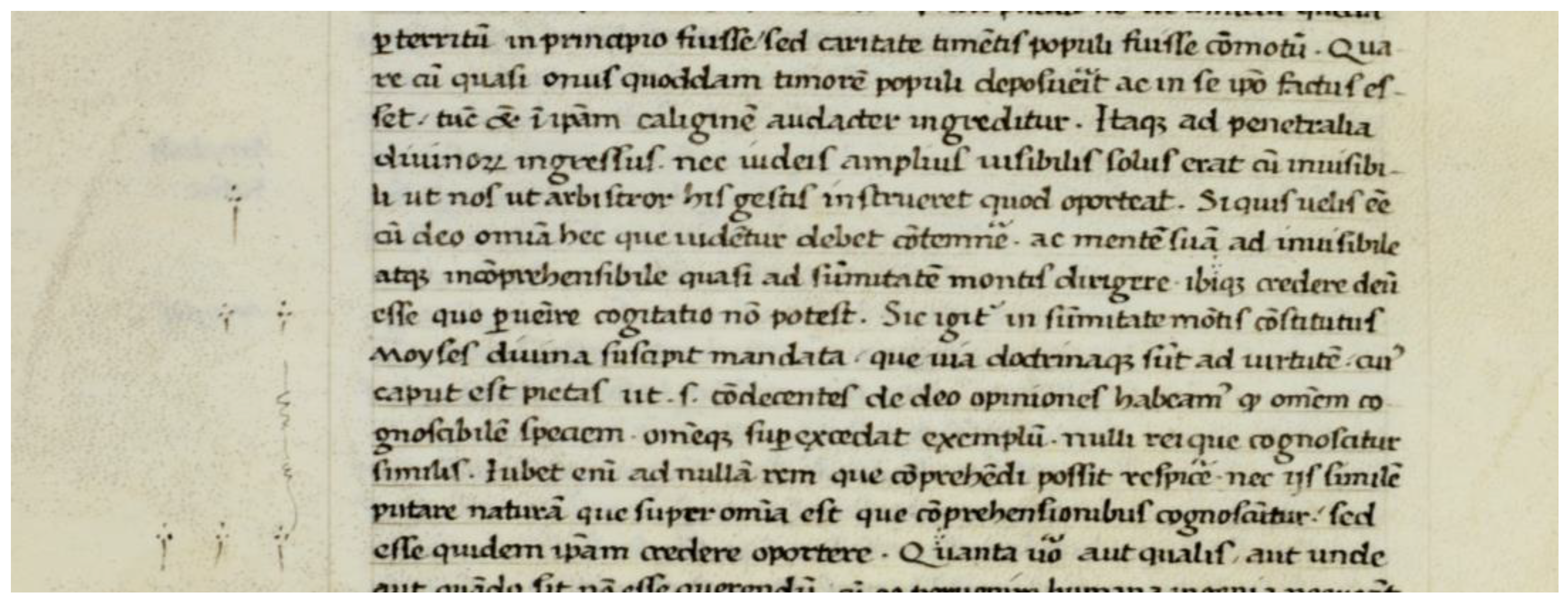
The passage in which Gregory first describes Moses’ entry into the darkness (Vit. Moys. I, 46–47) further highlights the affinity between the two interpretations. In fact, it was also marked in Fiesole—and quite enthusiastically—by its Quattrocento reader. As can be seen in Figure 1, the bibliophile’s attention was drawn to that particular passage, which was annotated with several of the aforesaid marginal signs and with the so-called serpentine. As we transcribe Trebizond’s Latin version below—next to the Greek original and its English translation—we include the reading marks horizontally between brackets in the body of the text and underline the words encompassed by the serpentine.
Vit. Moys. I, 46–47(Malherbe and Ferguson 1978, p. 43)11Laur. Faesul. 45, f. 246v
Ἐπειδὴ τοίνυν, οἷόν τινος ἄχθους τῆς δειλίας τοῦ λαοῦ γυμνωθείς, ἐφ’ ἑαυτοῦ ἦν, τότε καὶ αὐτοῦ κατατολμᾷ τοῦ γνόφου καὶ ἐντὸς τῶν ἀοράτων γίνεται μηκέτι τοῖς ὁρῶσι φαινόμενος. πρὸς γὰρ τὸ ἄδυτον τῆς θείας μυσταγωγίας παραδυείς ἐκεῖ τῷ ἀοράτῳ συνῆν μὴ ὁρώμενος, διδάσκων, οἶμαι, δι’ ὧν ἐποίησεν, ὅτι δεῖ τὸν μέλλοντα συνεῖναι τῷ θεῷ ἐξελθεῖν πᾶν τὸ φαινόμενον καὶ ἐπὶ τὸ ἀόρατόν τε καὶ ἀκατάληπτον τὴν ἑαυτοῦ διάνοιαν, οἷον ἐπί τινα ὄρους κορυφήν, ἀνατείναντα ἐκεῖ πιστεύειν εἶναι τὸ θεῖον ἐν ᾧ οὐκ ἐφικνεῖται ἡ κατανόησις. γενόμενος δὲ ἐν ἐκείνῳ δέχεται θεῖα προστάγματα [...]. καὶ κελεύεται πρὸς μηδὲν τῶν καταλαμβανομένων ἐν ταῖς περὶ τὸ θεῖον ὑπολήψεσι βλέπειν μηδέ τινι τῶν ἐκ καταλήψεως γινωσκομένων ὁμοιοῦν τὴν τοῦ παντὸς ὑπερκειμένην φύσιν, ἀλλὰ τὸ εἶναι πιστεύοντα.Since he was by himself, having been stripped as it were of the people’s fear, he boldly approached the darkness and entered the invisible things where he was no longer seen by those watching. After he entered the inner sanctuary of divine initiation into the mysteries, there, while not being seen, he was in company with the invisible. He teaches, I think, by the things he did that the one who is going to associate intimately with God must go beyond all that is visible and, lifting up his own mind, as to a mountaintop, to the invisible and incomprehensible, believe that the divine is there where the understanding does not reach. Having arrived there, he received the divine ordinances [...]. He was commanded to heed none of those things comprehended by the notions with regard to the divine nor to liken the transcendent nature to any of the things known by comprehension. Rather, he should believe that the Divine exists.Quare quasi onus quoddam timorem populi deposuerit ac in se ipso factus esset, tunc etiam in ipsam caliginem audacter ingreditur. Itaque ad penetralia divinorum ingressus, nec iudeis amplius visibilis solus erat cum invisibili ut nos ut arbitror his gestis instrueret quod oporteat. [·:–] Si quis velit esse cum deo, omnia hec que videntur debet contemnere, ac mentem suam ad invisibile atque incomprehensibile quasi ad summitatem montis dirigere, ibique credere deum esse quo pervenire cogitatio non potest. [·:– ·:–] Sic igitur in summitate montis constitutus Moyses divina suscipit mandata [...]. Iubet enim ad nullam rem que comprehendi possit respicere, nec iis similem putare naturam que super omnia est que comprehensionibus cognoscuntur, [·:– ·:– ·:–] sed esse quidem ipsam credere oportere.
If we compare Gregory’s and Pico’s accounts, Moses’ entry into the darkness indicates for both a decisive moment of the ascent, where the movement toward perfection reaches its highest tension. In Gregory’s text, Moses’ lonely withdrawal from the people (ἐφ’ ἑαυτοῦ ἦν/in se ipso factus... solus erat) and his advance into the divine darkness signify the passage beyond all that is visible or knowable. The mind (διάνοια/mens) abandons every form of representation in order to be with God (esse cum deo). Pico appears to echo this process when he describes the soul’s withdrawal into the solitary darkness of the Father (in solitaria Patris caligine) at the summit of its elevation, where spiritual unity with God (unus cum deo spiritus) is no longer mediated by sensible, rational or even angelic types of knowledge. In both cases, this darkness does not signal lack or negativity, but the excess of what transcends all understanding.
When Gregory resumes the symbol of darkness in Mount Sinai (Vit. Moys. II, 162–64), he plunges deeper into its allegorical significance and expresses the radically apophatic knowledge of God within the darkness by two renowned oxymorons later reshaped by Pseudo Dionysius12: “seeing in not seeing” (τὸ ἰδεῖν ἐν τῷ μὴ ἰδεῖν) (Vit. Moys. II, 163)—which George of Trebizond renders a bit loosely as: “ut videas quod videri non possit” (Laur. Faesul. 45, f. 257v)—and “radiant darkness” (λαμπρὸς γνόφος/splendidissima caligo) (Vit. Moys. II, 163; Laur. Faesul. 45, f. 257v). Some lines before, the Latin manuscript again bears one of Pico’s typical opening marginal signs.
Vit. Moys. II, 162–63(Malherbe and Ferguson 1978, p. 95)13Laur. Faesul. 45, ff. 257r–v
Προϊὼν δὲ ὁ νοῦς καὶ διὰ μείζονος ἀεὶ καὶ τελειοτέρας προσοχῆς ἐν περινοίᾳ γινόμενος τῆς τῶν ὄντων κατανοήσεως, ὅσῳ προσεγγίζει μᾶλλον τῇ θεωρίᾳ, τοσούτῳ πλέον ὁρᾷ τὸ τῆς θείας φύσεως ἀθεώρητον. Καταλιπὼν γὰρ πᾶν τὸ φαινόμενον, οὐ μόνον ὅσα καταλαμβάνει ἡ αἴσθησις, ἀλλὰ καὶ ὅσα ἡ διάνοια δοκεῖ βλέπειν, ἀεὶ πρὸς τὸ ἐνδότερον ἵεται, ἕως ἂν διαδύῃ τῇ πολυπραγμοσύνῃ τῆς διανοίας πρὸς τὸ ἀθέατόν τε καὶ ἀκατάληπτον κἀκεῖ τὸν θεὸν ἴδῃ.As the intellect progresses and, through an ever greater and more perfect diligence, comes to ponder the apprehension of beings, as it further approaches towards contemplation, it plainly sees the unfathomable character of the divine nature. For leaving behind everything manifest, not only what sense grasps but also what appears to be seen by the mind, it ever hastens further within, until by the mind’s industriousness it slips into the invisible and incomprehensible, and there it sees God.[·:–] Verum mens hominis ad maiora semper et perfectiora procedens, quanto magis ad dei speculationem accedit, tanto magis perspicit quod divina natura invisibilis atque incomprehensibilis est. Nam cum reliquerit non solum omnia que sensu percipiuntur, verum etiam cuncta que mente inspiciuntur, ac semper ad interiora progreditur, tunc cali[gine] undique circumseptus in invisibili et incomprehensibili deum videt.
Gregory insists upon the preeminence of this second stage of luminous darkness over the boundaries of intellectual nature. Once initiated into this level, Moses is said to advance continually toward what lies further within, into the mind’s depth (ἀεὶ πρὸς τὸ ἐνδότερον ἵεται/semper ad interiora progreditur). Both statements recall, once more, Pico’s description of the perfected individual as one who, having left behind even the intellectual seeds and sprouts (semina et germina... intellectualia), “takes himself up into the center of his own unity” (in unitatis centrum suae se receperit) (Oratio 27–30).
Considered together, all these passages show that the alternation of light and darkness in both Gregory and Pico is not a simple opposition between knowledge and ignorance of the truth, but a complex and ordered itinerary of ascent, where oppositions eventually coincide. It is from this dynamic of progressive withdrawal and elevation towards the infinite and ungraspable light of truth that the remaining Mosaic symbols in De vita Moysis and the Oratio—such as the mountain of God, Jacob’s ladder, and the tent of meeting—unfold their full significance.

4. The Mountain, the Ladder, and the Tabernacle

It is already striking that De vita Moysis and the Oratio alike treat all these three spatial images of Exodus and Genesis as parallel and complementary symbols that organize the phases of spiritual progress. Even more significant, however, is the fact that both texts inscribe the series of disciplines of the philosophical curriculum within the very logic of these hierarchical structures of ascent.
As noted above, Moses’ arrival at the crowning stage of the ascent of Mount Sinai, the mountain’s peak (ἐπί τινα ὄρους κορυφήν/in summitate montis), is described by Gregory and his Latin translator with the language of pagan mystagogy, as the innermost sanctuary (τὸ ἄδυτον/penetralia) of divinity (Vit. Moys. I, 46; Laur. Faesul. 45, f. 246v). Nyssen later makes explicit that this “mountain truly steep and hard to approach” (ὄρος γάρ ἐστιν ὡς ἀληθῶς ἄναντες καὶ δυσπρόσιτον/mons arduus vere ac ascensu difficilis) represents the knowledge of God, namely, theology (θεολογία/theologia) (Vit. Moys. II, 158; Laur. Faesul. 45, f. 257r).
In a significant passage, Pico likewise associates Moses with the arrival at the mountain’s summit and the discovery of theology, embedding the figure of the patriarch among references to the Bacchic and Orphic mysteries, Kabbalah, Plutarch, and Ficino (Bausi 2014, pp. 52–53; Copenhaver 2022a). The precondition of the ascent is to be “faithful like Moses” (si uti Moses erimus fideles), through which one may be “raised to the loftiest height of theology” (in illius eminentissimam sublimati speculam), at which point that “holiest of sciences” will approach and inspire a twofold frenzy (accedens sacratissima theologia duplici furore nos animabit) (Oratio 112–13; Wallis 1998, p. 14)14.
We should keep in mind that in the context of both Gregory’s and Pico’s works, the word theology does not limit itself to Christian doctrine. It is certainly not solely the sacra doctrina of medieval universities, but the direct knowledge of things divine, and it expresses the highest form of wisdom in ancient philosophy and all the mystery traditions.15 In order to arrive to the heights of theology, therefore, one needs a thorough preparation. Both Gregory and Pico involve in it traditional purificatory disciplines to refine the mind and rectify the soul, raising them to natural philosophy and the understanding of the created world before entering the halls of theology.
While both authors presuppose this ancient understanding of theology and its preparatory disciplines, Pico articulates the path toward it with a more explicit structural clarity. What in Gregory is unfolded primarily through the symbolic sequence of Mosaic episodes, Pico reformulates as a stable progression of three or four ascending stages—ethics (often coupled with dialectic), natural philosophy, and theology—revisited from multiple traditions (Oratio 69–141; Bori 2000, pp. 44–65). Again and again, Pico maps this same evolving framework onto biblical figures, philosophical schools, and mystery traditions alike, showing their convergence within a single, ordered process of intellectual and spiritual refinement.
In Gregory’s view, the life of Moses constitutes a privileged repository of images through which this path can be deciphered. Even Moses’ miraculous rescue from the Nile river as a baby is read in light of the ideal of Greek Paideia. The little ark (κιβωτός/fiscella) where he was placed, constructed out of various boards, signifies “an education put together from the manifold disciplines (ἡ ἐκ ποικίλων μαθημάτων συμπηγνυμένη παίδευσις)”, one that would keep any young man safe from the waves of life (Vit. Moys. II, 7). Trebizond translates it as: “doctrina multis atque variis disciplinis in unum collecta” (Laur. Faesul. 45, f. 248v). Notably, Pico describes in a similar vein the ascending soul as “wrapped in a multiple variety of teachings (multiplici scientiarum circumdata varietate)” (Oratio 97, Wallis 1998, p. 12)16.
As previously touched upon, the removal of Moses’ sandals in the Horeb signifies leaving behind the sensitive nature and its false opinions. This in turn leads to the knowledge of truth (ἡ τῆς ἀληθείας γνῶσις). As Gregory states: “The cognition of being (ἡ γὰρ τοῦ ὄντος ἐπίγνωσις) comes about by purifying our opinion concerning nonbeing (τῆς περὶ τὸ μὴ ὂν ὑπολήψεως καθάρσιον)” (Vit. Moys. II, 22; Malherbe and Ferguson 1978, p. 60). Marking the beginning of a new series of serpentine reading signs, Trebizond’s version in Fiesole reads: “ut ipsius qui est cognitio possit suspici, que opiniones de eo qui non est falsas penitus repellit” (Laur. Faesul. 45, f. 249r). Elsewhere, even the ten commandments are interpreted as a purification of the mind (διάνοια) (Vit. Moys. I, 49).
This same knowledge of truth (cognitio veritatis), which Pico describes as always having been intensely desired by him (a me semper plurimum desideratae veritatis cognitionem) (Oratio 148), is at the very heart of his project of philosophical concord. As with Nyssen, one can only approach this knowledge with a purified mind and soul.
Oratio 71–72(Wallis 1998, p. 9)17
Per moralem scientiam affectuum impetus cohercentes, per dialecticam rationis caliginem discutientes, quasi ignorantiae et vitiorum eluentes sordes animam purgemus, ne aut affectus temere debacchentur, aut ratio imprudens quandoque deliret. Tum bene compositam ac expiatam animam naturalis philosophiae lumine perfundamus, ut postremo divinarum rerum eam cognitione perficiamus.By confining the assaults of the affections by means of moral science, and by shaking off the mist of reason by means of dialectic, as if washing off the filth of ignorance and vice, let us purge the soul, that the affections may not audaciously run riot, nor an imprudent reason sometime rave. Then, over a soul set in order and purified, let us pour the light of natural philosophy, that lastly we may perfect it with the knowledge of divine things.
The explicit mention of these Greek philosophical disciplines appears in De vita Moysis when Gregory interprets Moses’ marriage to a foreign wife and the spoiling of Egyptian treasures by the Israelites, both of which were traditionally related to the Christian use of pagan wisdom. Concerning the first episode, he comments: “Indeed, moral and natural philosophy (ἡ ἠθική τε καὶ φυσικὴ φιλοσοφία) may become at certain times a comrade, friend, and companion of life (σύζυγός τε καὶ φίλη καὶ κοινωνός) to the higher way (τῷ ὑψηλοτέρῳ βίῳ)” (Vit. Moys. II, 37; Malherbe and Ferguson 1978, pp. 62–63). Trebizond translates: “Moralis enim naturalisque phylosophia coniugi potest profecto sublimiori vite carissimaque coniux eius ac socia fieri” (Laur. Faesul. 45, f. 249v).
Regarding the second episode, Nyssen includes dialectic along with the other disciplines: “Moral and natural philosophy (ἠθικήν τε καὶ φυσικὴν φιλοσοφίαν/moralem naturalemque phylosophiam), geometry, astronomy, the system of dialectics (τὴν λογικὴν πραγματείαν/dyalecticam), and whatever else is sought by those outside the Church” (Vit. Moys. II, 115; Laur. Faesul. 45, f. 254r). This immaterial variety of sciences would eventually serve “to beautify the divine sanctuary of mystery with the riches of reason (τὸν θεῖον τοῦ μυστηρίου ναὸν διὰ τοῦ λογικοῦ πλούτου καλλωπισθῆναι)” (Vit. Moys. II, 115; Malherbe and Ferguson 1978, p. 81).
This sanctuary stands for the soul, whose disciplinary embellishments Pico describes in a similar fashion, for she can only access theology and divine inhabitation “after she has, through morals and dialectics (per moralem et dyalecticam), cast off her meanness and adorned herself with a manifold philosophy (multiplici philosophia se exornarit) as with a courtly garment” (Oratio 96; Wallis 1998, p. 12)18.
The Israelites’ ascent to the mountain also requires, according to Nyssen, an inner and outer purification. In De vita Moysis, the divine command to wash their garments, abstain from sexual intercourse, and drive away the animal herds from the mountain is interpreted as a call to cleanse the stains and impurities of the body and the soul, to purge all sensitive and irrational movements (πάσης αἰσθητικῆς τε καὶ ἀλόγου κινήσεως προκαθᾶραι/ab omni sensuali et irrationali motu mentem suam permundare), and to wash from the mind every opinion derived from preconceptions (πᾶσαν δόξαν τὴν ἐκ προκαταλήψεώς τινος γεγενημένην τῆς διανοίας ἐκπλύναντα/omnem opinionem que ex sensibus originem habeat ex monte [sic] abstruserit). Only then is anyone able to access the contemplation of beings (ἡ τῶν ὄντων θεωρία/studia) and subsequently to initiate the ascent to loftier intellections (ἀνάβασις τῶν ὑψηλῶν νοημάτων/ad altissimas ascendat speculationes) (Vit. Moys. II, 154–57; Laur. Faesul. 45, ff. 256v–257r).
In other places, the call for purging includes specifically the two lower aspects of the Platonic soul, the desiring part (τὸ ἐπιθυμητικόν) and the spirited part (τὸ θυμοειδές), which need to be anointed with the Passover blood as the lower doorposts of the Israelites (Vit. Moys. II, 96ff) or even submerged and washed clean by the Red Sea as the Egyptian charioteers and their horses, a symbol of Baptism (Vit. Moys. II, 122ff).
Pico similarly addresses the need to purify the two lower parts of the soul, picturing them as the hands and feet whereby to climb Jacob’s ladder (Oratio 75–79). “Let us wash (abluamus)—he urges—these hands and these feet (has manus, hos pedes) in moral philosophy as in living water (morali philosophia quasi vivo flumine)” (Oratio 80, Wallis 1998, p. 9).
Needless to say, the symbol of Jacob’s ladder in the Oratio could justifiably be related to numerous other Jewish and Christian sources, both ancient and medieval (Bausi 2014, pp. 30–36; Borghesi et al. 2012, pp. 143–49; Copenhaver 2022a, pp. 262–65). Nevertheless, we remind here that the same biblical image is exploited on many occasions by Gregory to outline the spiritual path (Beat. II; IV; V; VI; Cant. V; Bas. 9), particularly in his beautiful discourses on the Beatitudes, which Pico also kept in Greek and almost certainly used in the Oratio and the Heptaplus (Bastitta Harriet 2023, pp. 177–78, 242–44).
In the context of De vita Moysis, we find it quite unusual that Gregory inserts Jacob’s ladder into the story of Moses (Vit. Moys. II, 227). He wants to stress once more the lawgiver’s unceasing drive for spiritual progress, which was also underscored by Pico. We can compare their respective treatments of the image of Jacob’s ladder in the following parallel texts.
Vit. Moys. II, 227; (Malherbe and Ferguson 1978, pp. 113–14)19;
Laur. Faesul. 45, f. 262r
Oratio 81; (Wallis 1998, p. 10)20
ἅπαξ ἐπιβάντα τῆς κλίμακος ᾗ ἐπεστήρικτο ὁ θεός, καθώς φησιν Ἰακώβ, εἰσαεὶ τῆς ὑπερκειμένης βαθμίδος ἐπιβαίνειν καὶ μηδέποτε ὑψούμενον παύεσθαι διὰ τὸ πάντοτε εὑρίσκειν τῆς κατειλημμένης ἐν τῷ ὕψει βαθμίδος τὸ ὑπερκείμενον.
Once having set foot on the ladder on which God rested, as Jacob says, he continually climbed to the step above and never ceased to rise higher, because he always found a step higher than the one he had attained.
Cum semel per scalam in qua Deus inixus erat, ut Jacob dicit, ascendere cepisset nunquam stetit, nunquam terminum motus novit, sed semper de gradu in gradum ascendebat. Nec enim deficere unquam potest altior gradus.
At nec satis hoc erit, si per Iacob scalam discursantibus angelis comites esse volumus, nisi et a gradu in gradum rite promoveri, et a scalarum tramite deorbitare nusquam.
But, if we want to be the companions of the angels moving up and down Jacob’s ladder, this will not be enough, unless we move forward duly from step to step, never to turn aside from the main direction of the ladder.
Both authors insist on the continual advancement of the spiritually initiated. Trebizond’s version and Pico’s Latin seem here especially close. While George translates that Moses ascended “from one step to another” (de gradu in gradum), Pico likewise exhorts to progress “a gradu in gradum”. The Byzantine scholar restates that Moses never stood still (nunquam stetit), never knew a limit to his movement (nunquam terminum motus novit), for a higher step could never be wanting (nec deficere unquam potest altior gradus), whereas the young humanist suggests that mere purification would not be enough (nec satis hoc erit), and similarly urges to go forward and never wander from the ladder’s path (promoveri et a scalarum tramite deorbitare nusquam).
The last—and perhaps most important—of these spatial symbols of spiritual ascent in De vita Moysis and Pico’s Oratio is the holy tabernacle, which Moses is shown and instructed to build within the divine darkness. Indeed, after citing Moses himself in his inaugural discourse and placing him above the angelic choirs (Oratio 98), Pico imagines what the lawgiver would convey to those initiated into the spiritual journey, much as he had earlier elucidated the creation of humanity through God’s fictional address to Adam (Oratio 17–23).
Oratio 99–101(Wallis 1998, pp. 12–13)21
Audiemus venerandum iudicem nobis in deserta huius corporis solitudine habitantibus leges sic edicentem: «Qui polluti adhuc morali indigent, cum plebe habitent extra tabernaculum sub divo, quasi Thessali sacerdotes interim se expiantes. Qui mores iam composuerunt, in sanctuarium recepti, nondum quidem sacra attractent, sed prius dialectico famulatu, seduli levitate philosophiae, sacris ministrent. Tum ad ea et ipsi admissi, nunc superioris Dei regiae multicolorem, idest sydereum aulicum ornatum, nunc caeleste candelabrum septem luminibus distinctum, nunc pellicea elementa in philosophiae sacerdotio contemplentur, ut postremo, per theologicae sublimitatis merita in templi adyta recepti, nullo imaginis intercedente velo divinitatis gloria perfruantur».Let us hear the venerable judge promulgating laws to us who dwell in the desert solitude of this body: “Let those who are still unclean and in need of moral discipline dwell with the people outside the tabernacle under the sky, purifying themselves like Thessalian priests. Those who have already ordered their conduct, once received into the sanctuary, may not yet lay hands upon the sacred objects; but first, as zealous Levites of philosophy, let them minister to the sacred things through the service that is dialectic. Then, after they have been admitted to those things, let them contemplate in the priesthood of philosophy now the multicolored, that is, the sidereal royal decoration of the higher palace of God, now the celestial candelabrum divided by seven lights, now the hide-covered elements, that finally they may be received through the merits of sublime theology into the innermost part of the temple and may enjoy, unhindered by any veil of image, the glory of divinity”.
These are the spiritual counsels and exhortations that Pico articulates in Moses’ voice, which we earlier saw characterized by his rhetorical tricolon admonetexcitatinhortatur (Oratio 102). Pico here outlines the stages of his philosophical and mystagogic curriculum onto the very structure of the tabernacle.
Gregory is certainly less schematic than Pico in correlating the distinct sections of the tabernacle with clearly articulated stages of progress. Pico evidently synthesizes elements from a great variety of exegetical perspectives on the holy tabernacle, including Philo, Origen, and medieval Jewish and Christian traditions. However, the parallel between the tabernacle’s design and the process of initiation in the mystery traditions is also present in Gregory.
In De vita Moysis, the heavenly tabernacle is quite innovatively identified with the person of Christ (Vit. Moys. II, 167–83; Conway-Jones 2014, pp. 97–115), whereas its earthly construction is compared with the Church (Vit. Moys. II, 183–88). Beginning the whole section on the earthly tabernacle in the Fiesolan manuscript, we find another of Pico’s typical reading marks (Laur. Faesul. 45, f. 259r).
Although Gregory does not linger on the significance of the outer courtyard of the tabernacle, he does interpret the skins and woven coverings around the tent as the cleansing of sin, the mortification of the passions, and the harsh way of life consisting in self-mastery (ἐγκράτεια/abstinentia atque continentia) (Vit. Moys. II, 187). These elements might be compared with Pico’s prohibition from entering the tabernacle (extra tabernaculum sub divo) to those “in need of moral discipline”, still undergoing ethical cleansing before any access to higher contemplation (Oratio 99).
Another similarity with respect to Pico’s Mosaic exhortation concerns the ministry of sacred things within the sanctuary. Gregory identifies the pillars, lamps, and structural supports of the tabernacle with those who actively sustain the Church. He calls them the “servants of the divine mystery” (ὑπηρέται τοῦ θείου μυστηρίου) (Vit. Moys. II, 184), a phrase reminiscent of the Eleusinian secret rites which Trebizond piously Christianizes as “ministri mysteriorum ecclesiae” (Laur. Faesul. 45, f. 258v). As noted above, Pico adopts a similar language concerning those servants and ministers within the sanctuary, who must first serve through dialectic (dialectico famulatu) (Oratio 100) before advancing toward the adyta.
One of the most interesting aspects of Nyssen’s exegesis of the tabernacle, however, is related not only to Moses’ exhortation in the Oratio, but to the main purpose of Pico’s entire philosophical project, as will be seen below. We refer to Gregory’s exegesis of the Holy of Holies.
Vit. Moys. II, 188(Malherbe and Ferguson 1978, pp. 102–3)22Laur. Faesul. 45, f. 259r
Εἰ δὲ τὸ ἔνδον, ὅπερ Ἅγιον ἁγίων λέγεται, τοῖς πολλοῖς ἐστιν ἀνεπίβατον, μηδὲ τοῦτο ἀπᾴδειν τῆς τῶν νοηθέντων ἀκολουθίας νομίσωμεν. Ἀληθῶς γὰρ ἅγιόν τι χρῆμά ἐστι καὶ ἁγίων ἅγιον καὶ τοῖς πολλοῖς ἄληπτόν τε καὶ ἀπρόσιτον ἡ τῶν ὄντων ἀλήθεια. Ἧς ἐν τοῖς ἀδύτοις τε καὶ ἀπορρήτοις τῆς τοῦ μυστηρίου σκηνῆς καθιδρυμένης ἀπολυπραγμόνητον εἶναι χρὴ τῶν ὑπὲρ κατάληψιν ὄντων τὴν κατανόησιν, πιστεύοντας εἶναι μὲν τὸ ζητούμενον, οὐ μὴν τοῖς ὀφθαλμοῖς πάντων προκεῖσθαι, ἀλλ’ ἐν τοῖς ἀδύτοις τῆς διανοίας μένειν ἀπόρρητον.If the interior, which is called the Holy of Holies, is not accessible to the multitude, let us not think that this is at variance with the sequence of what has been conceived. For the truth of beings is truly a holy thing, a holy of holies, ungraspable and inaccessible to the multitude. Since it is set in the innermost and ineffable chamber of the tabernacle of mystery, the consideration of beings above apprehension should not be pried into; one should rather believe that what is sought exists; not that it lies visible to all, but that it remains in the innermost and ineffable chambers of the mind.Que vero intus erant sancta sanctorum nominabantur, ad que multitudo pervenire non poterat: hec rerum veritatem significant. Veritatem hanc misterii [sic] nostri dico rem sanctam et sanctam sanctorum, et multis incomprehensibilem atque inaccessibilem. hec veritas in abditis tabernaculis [sic] constituta absque curiositate aliqua intelligi ac recipi debet. Credendum enim est ita esse ut Ecclesia predicat, non tamen oculis omnium cerni posse, sed in mentis ipsius penetrabilibus [sic] indubitabilem veritatem permanere.
We already mentioned the knowledge of truth (ἡ τῆς ἀληθείας γνῶσις) that Gregory envisioned in the theophany of the burning bush, which he described as a cognition of being (ἡ τοῦ ὄντος ἐπίγνωσις) (Vit. Moys. I, 19–22). In this description of the tabernacle, he places the fulfilment of that knowledge within the Holy of Holies, at the very heart of the sanctuary. This divine “truth of beings” (ἡ τῶν ὄντων ἀλήθεια/rerum veritatem) he deems unreachable, ungraspable, and inaccessible to the multitude (ἀνεπίβατον... ἄληπτόν τε καὶ ἀπρόσιτον/ad que pervenire non poterat... incomprehensibilem atque inaccessibilem).
This symbolism of the adyton could be compared with Pico’s access into the innermost part of the temple (in templi adyta recepti), where the glory of God (divinitatis gloria) was experienced without any veils (Oratio 101).
But how does this notion of truth relate to Pico’s central purpose in the Oratio? In the last section of the discourse, where he explains the scope and the different sections of his proposed debate, Pico famously sketches a retrospective catalogue of eminent philosophers, ranging from the Latin scholastics back to the ancient Platonists, where each author and tradition is characterized according to its distinctive philosophical mode. This enumeration closely mirrors the order of the first body of the nine hundred Conclusiones he intended to defend in 1487 before the pope and the learned men gathered from across Europe (Oratio 186–90; Copenhaver 2025, pp. ix–x).
Yet the meaning of this entire chain of philosophers becomes clear only through a brief passage which was suppressed in the final version of the discourse. It is preserved in an early draft discovered and first edited by Garin (1961). Pico likely excluded the fragment in subsequent redactions to avoid further conflict with ecclesiastical authorities. There he articulates a conception of truth that challenges any claim to exhaustive comprehension by a single doctrine or tradition.
Early draft of the Oratio (Bausi 2014, p. 151)Our translation
Nemo aut fuit olim aut post nos erit cui se totam dederit veritas comprehendendam: maior illius immensitas quam ut par sit ei humana capacitasThere never was in the past nor will there be after us anyone to whom truth could offer herself to be fully comprehended; its immensity is greater than what human capacity can equal.
What emerges here is a conception of veritas as a universal foundation shared by all philosophical traditions, while remaining in itself inexhaustible and irreducible to any of them. For Pico, it is only through a comparison of the various schools (hac complurium sectarum collatione) and the discussion of a manifold philosophy (multifariae discussione philosophiae) that the radiance of truth may begin to shine more clearly (clarius illucesceret) upon the souls (Oratio 192). From this perspective, it is ultimately upon this boundless conception of truth that Pico’s entire Roman project rests: the Oratio as its programmatic introduction and the nine hundred theses assembled from the most diverse traditions, to be contrasted in view of their deeper concord.
Elsewhere, we have discussed Nicholas of Cusa, Seneca, and Cicero as possible sources for this notion of truth in Pico (See Bastitta Harriet 2021). His perspective also resonates with Gregory of Nyssa’s conception of the truth of beings (ἀλήθεια τῶν ὄντων/veritas rerum) within the Holy of Holies (ἅγιον ἁγίων), a truth that remains beyond intellectual grasp.
What is more, Gregory and Pico find their way toward that inaccessible shrine of divine truth along an inward itinerary into the depths of the soul. We saw earlier that, at the summit of the spiritual ascent, both authors describe a withdrawal from exterior and mediated forms of knowledge, so that the soul’s approach to God coincides with a continual movement further within. This same inward movement recurs in their treatment of the adyton, and the proximity of Pico’s language to Gregory’s text and Trebizond’s Latin again deserves attention.
While Gregory’s ineffable truth “dwells in the innermost recesses of the mind” (ἐν τοῖς ἀδύτοις τῆς διανοίας μένειν/in mentis ipsius penetralibus permanere) (Vit. Moys. II, 188), Pico’s pure contemplator (purus contemplator)—the same who entered the solitary darkness of the Father—is “gathered within the innermost places of the mind” (in penetralia mentis relegatum) (Oratio 40). In the Heptaplus, Pico takes up this image again and explicitly resorts to Moses as mystagogue: “Advancing after Moses’ footsteps (post Moseos vestigia incedentes), let us come into ourselves, let us enter the innermost chambers of the spirit (ingrediamur animi penetralia), with the prophet himself disclosing the sanctuary for us (ipso nobis Propheta aditum reserante), so that we may auspiciously come to know in ourselves, together with all the worlds, also the Father and our fatherland” (Heptaplus IV, proem., pp. 268–70; our translation).
It would require a separate study to follow Gregory’s exegesis of each section and object in the tabernacle, a level of detail that is simply lacking in Pico’s Oratio. One of its symbols, however, does reappear. Gregory’s treatment of the priestly vestments makes clear that they signify not material coverings but a “certain adornment of the soul” (τινα κόσμον ψυχῆς/alius quidam ornatus anime), woven through virtuous pursuits (Vit. Moys. II, 190; Laur. Faesul. 45, ff. 259r–v). The splendid and colorful tunic, bells, pomegranates, breast-piece, and diadem together indicate the realization of a life purified, disciplined, and destined for practical and contemplative philosophy (πρακτικὴ φιλοσοφία... κατὰ θεωρίαν/praxis... speculatio), culminating in the crown (διαδήματι/corona) reserved to a virtuous and saintly life (Vit. Moys. II, 191–201; Laur. Faesul. 45, ff. 259r–260r).
Pico, without unfolding the imagery, nonetheless invokes the priestly figure at significant moments of the ascent. Already within the Mosaic exhortation, apart from the Thessalian priests undergoing purification, he refers to the “priesthood of philosophy” (philosophiae sacerdotium), through which the sacred realities can be contemplated in their true meaning (Oratio 99–101). Later, in the case of those “veterans in the service of philosophy” (sub stipendiis philosophiae emeritos), Pico introduces the Archangel Michael as the high priest (sacerdoti summo) who marks the soul with the priesthood of theology (theologiae sacerdotium) as with a crown of precious stones (quasi corona preciosi lapidis) (Oratio 141). Thus, even if only Gregory develops the symbolism of the vestments in detail, in both authors the priestly figure and its attributes play an important role in the movement toward perfection.

5. The Eagle, Death, and Divine Friendship

Although less central to the primary aims of Gregory’s and Pico’s works, some rare symbols that occur in both texts may conceal unexpected exegetical convergences. The three examined in this final section could be described as metaphors of consummation. They converge to form a coherent sequence in the final stages of Nyssen’s De vita Moysis, yet their connection is not so explicit in the Oratio.
The first of these images is the eagle, a symbol of spiritual elevation in both the biblical and classical traditions, which Gregory uses to illustrate the patriarch’s unceasing transcendence of his present state of perfection: “For he who, through so many ascents, elevates his life above all things never fails to become even loftier than himself (ἑαυτοῦ ὑψηλότερος/sublimiorem seipso), until—as I think—his life may be seen in every respect like an eagle (ἀετοῦ δίκην/quasi aquila) above the clouds and borne aloft, circling about the ether of intelligible ascent (περὶ τὸν αἰθέρα τῆς νοητῆς ἀναβάσεως/ad ipsum ethera intellectualem circulari ascensu)” (Vit. Moys. II, 307; Malherbe and Ferguson 1978, p. 13323; Laur. Faesul. 45, f. 266v).
Pico likewise employs the metaphor to characterize the ultimate stage of spiritual perfection, at the same time resuming the previously discussed themes of the gradations of light and truth and the supremacy of theology over the other disciplines: “Then, let us accustom ourselves in natural contemplation to bear the still weak light of truth (debile adhuc veritatis lumen), the beginning of the rising sun, as it were, so that finally by theological piety (per theologicam pietatem) and the most sacred worship of the gods24 we may, like heavenly eagles (quasi caelestes aquilae), endure bravely the very radiant brightness of the midday sun (meridiantis solis fulgidissimum iubar fortiter perferamus)” (Oratio 135; Wallis 1998, p. 16)25.
In both passages, the eagle conveys a life raised above its former state and borne beyond the reach of earthly knowledge. Their convergence lies in the association of elevation with a transformation of the soul’s cognitive capacity. Yet, while Gregory invites Moses’ followers to a perpetual surpassing of themselves, Pico focuses on the spiritual strength required for the soul to endure the divine radiance proper to theology.
The second metaphor is death—or rather, a new oxymoron: a living death (τελευτὴ ζῶσα). After deploying the image of the eagle, Nyssen’s narrative develops into a condensed Mosaic encomium. Through a careful accumulation of deeds, Moses’ life is recast as a series of ever higher triumphs and as the highest model of virtue, bearing the clear imprint of epideictic rhetoric (Vit. Moys. II, 308–13). At the very point where this life reaches its crowning (κορυφή), Gregory introduces death, by citing the scriptural notice of Deuteronomy 34:5: “Moses, the servant of the Lord, ended his life by the word of God” (ἐτελεύτησε Μωϋσῆς οἰκέτης κυρίου διὰ ῥήματος θεοῦ). (Vit. Moys. II, 143).
Nyssen immediately develops an interesting wordplay that resists translation. In the Septuagint account, the verb τελευτᾶν unambiguously denotes Moses’ death. Gregory, however, draws upon the wider semantic range of the verb and its cognates to transpose the meaning of the event into one of accomplishment and fulfilment.
Vit. Moys. II, 314(Malherbe and Ferguson 1978, p. 135)26Laur. Faesul. 45, f. 267r
Τοῦτο δὲ αὐτῷ καὶ τέλος ἐστὶ τοῦ κατ’ ἀρετὴν βίου διὰ ῥήματος θεοῦ κατορθούμενον, ὃ δὴ τελευτὴν ἡ ἱστορία λέγει, τελευτὴν ζῶσαν, ἣν οὐ διαδέχεται τάφος, ᾗ οὐκ ἐπιχώννυται τύμβος, ἡ τοῖς ὀφθαλμοῖς ἀμαυρότητα καὶ τῷ προσώπῳ διαφθορὰν οὐκ ἐπάγουσα.This is, for him, the end of the virtuous life, brought to realization through the word of God. The narrative speaks, indeed, of a completion, a living completion, not followed by the grave nor covered over by the tomb, which brings no dimness to the eyes nor decay to the faceHoc autem ipsi virtuose quoque vite huius seculi finem affert verbo Dei consumatum [sic], finem dico vivum cui non succedit sepultura, cui non additur tumulus, cui nullam oculis caliginem, nullam faciei corruptionem induat.
The effectiveness of this exegetical shift allows Gregory to reread Moses’ death no longer as the mere conclusion of his earthly life, but as a further realization of his ever-advancing perfection in virtue. Such a shift depends upon the semantic proximity between τελευτή and τέλος, a term which ancient philosophy had long associated with the end, the purpose, and the realization of all life and nature. Trebizond’s Latin version is able to preserve the oxymoron: “finis vivus”, but finds it difficult to reproduce the semantic resonance that allows death and consummation to converge in a single verbal family. Indeed, Trebizond omits the first part of the central clause: “ὃ δὴ τελευτὴν ἡ ἱστορία λέγει”, and instead derives his own oxymoron from the preceding mention of τέλος (finis).
A section of Pico’s Oratio reproduces an almost identical semantic shift in a passage that, tellingly, appears immediately before his citation of Moses and the tabernacle. Pico is reformulating the biblical allegory of the bride who leaves behind her people and her father’s house seeking union with the bridegroom (Psalm 44:11–12), an image through which he depicts the soul’s detachment and desire for union with God.
Oratio 97(Wallis 1998, p. 12)27
A quo ne unquam dissolvatur dissolvi cupiet a populo suo, et domum patris sui, immo se ipsam oblita, in se ipsa cupiet mori ut vivat in sponso, in cuius conspectus preciosa profecto mors sanctorum eius: mors—inquam—illa, si dici mors debet plenitudo vitae, cuius meditationem esse studium philosophiae dixerunt sapientes.Lest she ever be separated from him, she will long to be separated from her own people and, forgetful of her father’s house, indeed, forgetful of herself, she will long to die in herself that she may live in her bridegroom, in whose sight the death of his saints is surely precious; I mean that death—if it ought to be called death, being the fullness of life—the meditation of which the wise have declared to be the study of philosophy.
When Pico seeks to qualify the particular kind of saintly death that is “precious” in the sight of God, his formulation comes remarkably close to Gregory’s oxymoron: “That death—I say—, if it ought to be called death, being the fullness of life” (mors—inquam—illa, si dici mors debet plenitudo vitae). Pico thus articulates the same semantic reversal as Nyssen: death conceived as plenitude, a living death.
The convergence between the two passages lies not only in the shared paradox. In both authors, the end of life is recast as the consummation of the soul’s spiritual itinerary. Moreover, Pico’s inquam recalls Trebizond’s use of dico—a wording the young humanist likely encountered in the Fiesolan manuscript. In each case, the interjected verb (inquam/dico) rhetorically prepares the reader for the nearly identical paradox that follows.
That said, Pico’s eloquent expression develops the oxymoron in closer correspondence with the semantic richness of Nyssen’s Greek, beyond what Trebizond’s Latin text alone would readily suggest. Pico might also have known the Greek text of De vita Moysis directly, whether through his own collection or through the humanist circles in which he moved, although no direct manuscript evidence has yet been identified.
The expression “servant of the Lord” (οἰκέτης κυρίου), used in the Septuagint to describe Moses at the time of his death, signifies in Gregory’s eyes that the lawgiver and those who follow his way of life attain an absolute superiority over every other reality, as Nyssen and Pico elsewhere suggest. Gregory thus affirms: “For to be called servant of God (οἰκέτης θεοῦ/Dei servus) is precisely the same as saying that one has become superior to all (παντὸς κρείττων/omnia superavit)” (Vit. Moys. II, 314; Laur. Faesul. 45, f. 267r).
This provides a natural transition to our final metaphor of consummation. Indeed, toward the close of his treatise, Gregory transforms this divine servitude into friendship, recalling Exodus 33:11, where God is said to speak with Moses face to face (ἐνώπιος ἐνωπίῳ), as one who speaks with his friend (πρὸς τὸν ἑαυτοῦ φίλον).
Friendship with the gods was a very important literary and philosophical notion in Ancient Greece, although it did not imply genuine reciprocity between gods and humans (Konstan 1996). However, a tradition that begins with Philo and continues with Christian authors such as Clement of Alexandria and Gregory of Nyssa adapts the philosophical notions of friendship and reciprocity among equals to the intimate relationship between the biblical God and figures like Moses and Abraham (Sterling 1997; Dudziková 2020).
In Gregory, this intimate divine–human reciprocity is universalized and, rooted in a radical conception of the human image of God, it implies a certain equality between Creator and creature. The bond of divine friendship thus consists of a complete union with God, in carrying oneself the distinctive features of the divine (ἐφ’ ἑαυτοῦ τὰ γνωρίσματα φέρει) (Vit. Moys. II, 318).
As De vita Moysis draws to a close, Nyssen invokes this ideal of divine friendship to characterize the essence and culmination of the virtuous life. It is at this point that we encounter the final two marginal signs left by the Renaissance reader in the Fiesolan manuscript.
Vit. Moys. II, 320(Malherbe and Ferguson 1978, p. 137)28Laur. Faesul. 45, f. 267v
Τοῦτο γάρ ἐστιν ὡς ἀληθῶς ἡ τελειότης τὸ μηκέτι δουλοπρεπῶς φόβῳ κολάσεως τοῦ κατὰ κακίαν βίου χωρίζεσθαι, μηδὲ τῇ τῶν μισθῶν ἐλπίδι τὸ ἀγαθὸν ἐνεργεῖν, πραγματευτικῇ τινι καὶ συναλλαγματικῇ διαθέσει κατεμπορευομένους τῆς ἐναρέτου ζωῆς, ἀλλ’ ὑπεριδόντας πάντων καὶ τῶν ἐν ἐπαγγελίαις δι’ ἐλπίδος ἀποκειμένων, μόνον ἡγεῖσθαι φοβερὸν τὸ τῆς φιλίας τοῦ θεοῦ ἐκπεσεῖν, καὶ μόνον τίμιόν τε καὶ ἐράσμιον ἑαυτοῖς κρῖναι τὸ φίλον γενέσθαι θεῷ, ὅπερ ἐστί, κατά γε τὸν ἐμὸν λόγον, ἡ τελειότης τοῦ βίου.For this is truly perfection: not to separate oneself from a wicked life in a slavish manner out of fear of punishment, nor to perform the good in hope of rewards, as if making a trade of the virtuous life by some commercial or transactional disposition. On the contrary, disregarding all things—even those promises laid up through hope—, to hold as fearful only this: falling from the friendship of God; and to judge only this as precious and desirable: becoming a friend of God, which is, at least as I would define it, the perfection of life.Id enim certe perfectio est, ut non timore penarum, sicuti mancipium a viciis declines, nec virtutem spe premiorum quasi mercator amplectaris. [·:–] sed unum tantummodo terribile arbitreris ab amicitia dei repelli; [·:–] unum expetibile solum amicitiam dei qua sola meo iudicio vita hominis perficiatur.
The comparison of the different motives for the virtuous or religious life reappears in Nyssen’s In Canticum canticorum (Cant. I, 15–16; XV, 461) and plausibly derives from Philo’s De Abrahamo (119–130; Bendová 2019). Even though this notion of friendship draws on a complex Jewish and Christian tradition, as well as a great number of ancient theories of love—Pythagorean, Platonic, Aristotelian, and Stoic, among others—it is expressed here in extremely simple terms. Trebizond’s Latin renders the language even more austere, abbreviating the passage and omitting certain expressions.
Friendship is likewise a significant theme in Pico’s Oratio, where the young poet-philosopher dwells more extensively on the rich diversity of his sources. The following passage occurs within his well-known praise of peace, a late addition to the discourse placed under the name of Job the just.
Oratio 94–95(Wallis 1998, pp. 11–12)29
Tam blande vocati, tam benigniter invitati, alatis pedibus, quasi terrestres Mercurii, in beatissimae amplexus matris evolantes, optata pace perfruemur: pace sanctissima, individua copula, unianimi amicitia, qua omnes animi in una mente, quae est super omnem mentem, non concordent adeo, sed ineffabili quodammodo unum penitus evadant. Haec est illa amicitia quam totius philosophiae finem esse Pythagorici dicunt; haec illa pax quam facit Deus in excelsis suis.So sweetly called and with such kindness invited, as we fly on winged feet like earthly Mercuries into the embrace of our most blessed mother, let us enjoy the longed-for peace: a most holy peace, an indivisible bond, a friendship of one heart and spirit, whereby all spirits do not merely accord in one mind that is above every mind but in some inexpressible fashion become absolutely one. This is that friendship which the Pythagoreans say is the end of all philosophy, this is that peace which God makes on his heights.
Friendship is again presented here as the ultimate state of perfection and placed beyond all forms of knowledge, in the heights of spiritual ascent. Pico’s text closely links the notions of this friendly love (amicitia) with those of peace (pax) and concord, the latter evoked both by the verb concordare and by the adjective unianimis, which verbally mirrors ὁμόνοια, the Greek equivalent of concordia.
It is possible that Pico’s notion of peaceful agreement (foedus pacis) between the flesh and the spirit in the Oratio echoes Nyssen’s seventh homily on the Beatitudes (“Blessed are the peacemakers...”; Bastitta Harriet 2023, pp. 242–44). That same covenant of peace is referred to in the Heptaplus as a foedus pacis et amicitiae (Heptaplus VIII, 382). Pico urges to seal such a most holy agreement “so that in mutual charity we may be one with each other (mutua caritate invicem simus unum), and at the same time through the true love of God we may all happily become one with him (omnes per veram Dei dilectionem cum illo unum feliciter evadamus) (Heptaplus VIII, 382; our translation)30.
We may note an earlier passage in De vita Moysis that likewise brings together concord, love, and peace. It is Gregory’s exegesis of the curtains surrounding the tabernacle, which symbolize “the loving and peaceful concord between the believers (τὴν ἀγαπητικήν τε καὶ εἰρηνικὴν τῶν πιστευόντων ὁμόνοιαν)” (Vit. Moys. II, 186); Trebizond renders this as: “pacem, concordiam et caritatem credentium” (Laur. Faesul. 45, f. 259r). Notably, while Gregory supports his claim by referring to God as peacemaker in the book of Psalms (147:3): “He who established your boundaries as peace (θεὶς τὰ ὅριά σου εἰρήνην/qui ponis terminos tuos pacem)”, Pico’s passage in the Oratio invokes God in that same role by alluding to a similar verse from the book of Job (25:2): “Who makes peace in the highest (qui facit pacem in excelsis)” (cf. Oratio 83).
Although they belong to different contexts and are arranged differently in De vita Moysis and the Oratio, these three symbols of spiritual realization—the celestial eagle, living death, and divine friendship—converge once again upon a conception of perfection as movement. They imply a continual transformation and intensification of communion in the divine, rather than a terminus that would arrest the soul’s ascent.

6. Conclusions

The comparison undertaken in these pages does not aim to dissolve the distance between Gregory of Nyssa’s De vita Moysis and Pico’s Oratio. The two works arise from different contexts, address distinct audiences, and pursue divergent immediate purposes. Yet the reappearance of the same complex network of symbols—related in one way or another to the figure of Moses—suggests more than a superficial coincidence.
What strikes the most about these symbols in both texts is not so much their numerous shared characteristics and connotations, but rather their overall orientation. For both authors, these images converge upon the conception of a passionate spiritual desire. This dynamic, intensifying, and open-ended longing is none other than the Platonic soul’s eternal ἔρος for divine Beauty. Fully Christianized and projected to infinity by Gregory, this love does not culminate in restful possession but in perpetual transformation.
What Pico paradoxically calls a sacra ambitio, Nyssen had formulated as “a beautiful and noble ambition”, “a praiseworthy greediness for the treasures of wisdom”, “the lovely passion of insatiability”. In De vita Moysis, Gregory reads the entire spiritual biography of the prophet as such loving desire and continuous transfiguration. In the Oratio, Moses’ figure likewise operates as a model of perfection: legislator, contemplator, and guide into the inner sanctuary of the soul. Even if the lawgiver is not the only exemplary figure thematized by Pico, the person of Moses himself and the rest of the spiritual symbols analyzed in these pages are imbued in the Oratio with the same conception of spiritual desire we find in De vita Moysis.
Particularly noteworthy is the recurrence in both texts of certain semantic twists and symbolic paradoxes. For example, Gregory’s exegetical reconfiguration of death in the oxymoron τελευτὴ ζῶσα, his identification of perfection with friendship to God, his inward transposition of the Holy of holies, all these gestures reappear, differently inflected, within Pico’s discourse. The parallels, although not identical, usually reveal a comparable symbolic logic.
Such doctrinal and symbolic coincidences between Gregory and Pico must be understood within the broader horizon of Pico’s intellectual formation and his use of sources. As Paul Oskar Kristeller keenly observed: “Some of the more striking ideas expressed in Pico’s writings invite a comparison with the ideas of other, earlier writers, and may show at least a partial indebtedness to these earlier ideas, which Pico did not always explicitly acknowledge, or of which he may not even have been conscious, since these ideas had been absorbed, digested and transformed by him in the course of his intellectual development” (Kristeller 1965, p. 38).
If Gregory indeed stands behind part of the symbology of the Oratio, one might wonder about the motives for Pico’s silence. Could it be related to the Origenist traces in certain doctrines associated with Gregory, such as apokatastasis and the division of the sexes?31 Or perhaps to Gregory’s limited auctoritas within the Roman intellectual milieu? Or, finally, did Pico deliberately choose to reshape Nyssen’s rich symbolic and anthropological doctrines, without explicitly naming their source? (Cf. Bastitta Harriet 2023, pp. 244–46) Be that as it may, the textual and doctrinal parallels traced along this study corroborate the presence of a common symbolic logic of spiritual ascent in both works, one that converges upon Moses as model figure of an ever-deepening participation in the divine.

Funding

This research received no external funding.

Institutional Review Board Statement

Not applicable.

Informed Consent Statement

Not applicable.

Data Availability Statement

No new data were created or analyzed in this study. Data sharing is not applicable to this article.

Acknowledgments

I gratefully acknowledge The Andrew W. Mellon Foundation and the welcoming scholarly community at Villa I Tatti, The Harvard University Center for Italian Renaissance Studies, for the short-term residential fellowship that supported the research on Gregory of Nyssa’s manuscript tradition in the Quattrocento from which this article ultimately derives. I also thank Francesca Gallori, the Biblioteca Medicea Laurenziana, for permission to reproduce the image of the manuscript discussed in this article.

Conflicts of Interest

The author declares no conflicts of interest.

Abbreviations

The following abbreviations are used in this manuscript:
Laur. Faesul. 45Firenze, Biblioteca Medicea Laurenziana, MS Faesulanus 45.
GNO Gregorii Nysseni Opera. 1952–. Ed. Werner Jaeger et al. Leiden: Brill. 10 vols.
SChSources Chrétiennes. 1941–. Paris: Éditions du Cerf.
Editions of the works by Gregory of Nyssa
Vit. Moys.De vita Moysis. 1968. Ed. Jean Daniélou. SCh 1 ter (GNO VII/1).
Beat.De beatitudinibus. 1992. Ed. John F. Callahan. GNO VII/2.
Or. Dom.De oration dominica. 1992. Ed. John F. Callahan. GNO VII/2.
Cant.In Canticum canticorum. 1960. Ed. Hermann Langerbeck. GNO VI.
Mort.De mortuis. 1967. Ed. Günter Heil. GNO IX.
Bas.In Basilium fratrem. 1990. Ed. Otto Lendle. GNO X/1.
Editions of the works by Giovanni Pico della Mirandola
OratioOratio. 2014 [2003]. Ed. Francesco Bausi. Parma: Guanda.
HeptaplusHeptaplus. 1942. Ed. Eugenio Garin. Firenze: Vallecchi.
De ente et unoDe ente et uno. 2010. Eds. Franco Bacchelli and Raphael Ebgi. Milano: Bompiani.
Epist.Epistulae. 2018. Ed. Francesco Borghesi. Firenze: Leo S. Olschki.

Notes

1
Several earlier studies noted Gregory of Nyssa’s probable influence on Pico della Mirandola. See, for example, (Garin 1938, pp. 125–26; Monnerjahn 1960, p. 173; Trinkaus 1970, vol. II, pp. 506–7; de Lubac 1974, pp. 171–73, 188–89; Boulnois 1993, pp. 309–10, 321–22; Mahoney 1994, pp. 204–8; Safa 2001, pp. 148–52). Some studies particularly mentioned Nyssen’s De vita Moysis (Bori 2000, pp. 42–43, 46; Busi and Ebgi 2004, pp. 204–8; Bausi 2014, pp. 13–14, 46–47).
2
Slightly modified.
3
Cf., e.g., Philo, De vita Moysis II, 1–7; Clement of Alexandria, Stromata I, xxiii–xxvi, 151–170; Origen, Homiliae in Exodum, passim. See (Geljon 2002).
4
Regarding Origen’s profound influence on Pico, see (Wind 1954; Mahoney 1994; Terracciano 2018; Bastitta Harriet 2025). Pico owned manuscripts with texts by Philo, Clement, and Origen (Kibre 1936, pp. 124, 150, 182, 187) and could also consult some of their works in other collections, for example, some volumes from the library of San Marco in Florence formerly owned by Niccolò Niccoli and Cosimo de’ Medici (Ullman and Stadter 1972, pp. 135–37, 145–47, 261; Gentile 2000).
5
Slightly modified.
6
With slight changes.
7
Although they do not include such paradoxical expressions, Gregory’s words at Vit. Moys. II, 238–239 fully express this unceasing dynamic of desire and were marked in the Fiesolan manuscript by its Renaissance reader with serpentine—a line running vertically down the margin, interrupted by series of two or three arches facing the text. Cf. Laur. Faesul. 45, f. 262v: “Est ergo interminabilis divina natura, et interminabile comprehendi non potest. Quare qui divinam pulchritudinem videre desiderat et ad id tendit in hoc cursu semper consistit. Et id est vere deum videre, ut nunquam id desiderium terminetur. Quare necesse est ut cum videamus sicut nobis possibile est maiore videndi desiderio exardescamus. Et sic nullus unquam terminus abscidet nobis iter huius, cum neque ipsius boni terminus aliquis sit, nec satietas desiderii huius possit fieri”.
8
Cf. (Gentile 1997, pp. 372–73, 388–90; 1994, pp. 96–100; Murano 2018). See Figure 1 below.
9
Slightly modified.
10
With slight changes.
11
Slightly modified.
12
Cf. Dionysius the Areopagite, De mystica theologia II.
13
With changes.
14
Slightly modified.
15
In this sense, we do not agree with Brian L. Copenhaver’s recent proposal of Magic, Kabbalah, and mystical union as three additional stages above theology in the Oratio’s structure of spiritual ascent—the first four being (1) ethics, (2) dialectic, (3) natural philosophy, and (4) theology (Copenhaver 2022a, pp. xliv–l). In our view, apart from presupposing a markedly restricted understanding of theologia, this approach also risks overemphasizing the centrality of particular philosophical and mystical traditions invoked by Pico. What Pico seems rather to do is to integrate all these traditions within a basic overarching structure of three or four ascending stages, each encompassing both theoretical and practical dimensions. This is why he explicitly presents magia as both the practical part of natural philosophy and a scientia divinorum (Oratio 214; 223), and refers to Kabbalah as a form of theology: Hebreorum theologia secretior (Oratio 35), including its own metaphysics and natural philosophy (Oratio 250). Accordingly, the same supreme stage of theology is also identified by Pico with ultimate happiness, mystical union, and the ἐποπτεία of the Eleusinian mysteries (Oratio 82; 92–93; 96; 101; 106; 135).
16
The couple “circumdata varietate” is taken from Psalm 44:10.
17
With slight changes.
18
Slightly modified.
19
With changes.
20
Slightly modified.
21
With changes.
22
With changes.
23
Modified.
24
Bausi corrects the reading of the edition princeps: “Dei cultum”, to the form preserved in the early draft of the discourse: “deorum cultum”, with its paganizing connotation. Such pious interventions were characteristic of Gianfrancesco Pico della Mirandola, Pico’s nephew and editor, who likewise suppressed several references to Greek mythology, especially in his uncle’s letters (Bausi 2014, pp. 167–69; Farmer 1998, pp. 151–76).
25
With slight changes.
26
With changes.
27
With changes.
28
Modified.
29
With changes.
30
See also De ente et uno X, 268–70.
31
See, for example, the negative judgement on Gregory’s doctrine about the absence of sexual union before the fall of none other than Thomas Aquinas, Summa theologiae I, q. 98, a. 2, co.

References

  1. Bastitta Harriet, Francisco. 2021. Coincidentia Philosophorum. La Unidad de La Verdad y La Pluralidad de Las Filosofías En Nicolás de Cusa y Giovanni Pico. In Nicolás de Cusa: Unidad En La Pluralidad. Homenaje a Jorge Mario Machetta. Edited by Claudia D’Amico, Gianluca Cuozzo and Nadia Russano. Buenos Aires: Facultad de Filosofía y Letras, Universidad de Buenos Aires, vol. 1. [Google Scholar]
  2. Bastitta Harriet, Francisco. 2023. An Ontological Freedom: The Origins of the Notion in Gregory of Nyssa and Its Influence unto the Italian Renaissance. Patristic Studies in Global Perspective 5. Leiden: Brill, Schöningh. [Google Scholar]
  3. Bastitta Harriet, Francisco. 2025. Studying, Translating, and Editing the Greek Fathers in Lorenzo’s Florence: Pico, Poliziano, and Ficino. Journal of the History of Ideas 86: 339–53. [Google Scholar] [CrossRef] [PubMed]
  4. Bausi, Francesco, ed. 2014. Giovanni Pico Della Mirandola: Discorso Sulla Dignità Dell’uomo. Parma: Guanda. [Google Scholar]
  5. Bendová. 2019. The Influence of Philo’s De Abrahamo on Gregory of Nyssa’s De Vita Moysis|Acta Universitatis Carolinae Theologica. Acta Universitatis Carolinae Theologica 8: 91–109. [Google Scholar] [CrossRef]
  6. Boersma, Hans. 2013. Embodiment and Virtue in Gregory of Nyssa: An Anagogical Approach. Oxford Early Christian Studies. Oxford: Oxford University Press. [Google Scholar]
  7. Borghesi, Francesco, Michael Papio, and Massimo Riva, eds. 2012. Giovanni Pico Della Mirandola. Oration on the Dignity of Man: A New Translation and Commentary. Cambridge: Cambridge University Press. [Google Scholar]
  8. Bori, Pier Cesare. 2000. Pluralità Delle Vie: Alle Origini Del Discorso Sulla Dignità Umana Di Pico Della Mirandola. Milano: Feltrinelli. [Google Scholar]
  9. Boulnois, Olivier. 1993. Humanisme et dignité de l’homme selon Pic de la Mirandole. In Jean Pic de la Mirandole: Œuvres Philosophiques. Edited by Olivier Boulnois and Giuseppe Tognon. Paris: Presses Universitaires de France. [Google Scholar]
  10. Busi, Giulio, and Amos Ebgi. 2004. Giovanni Pico Della Mirandola: Mito, Magia, Qabbalah. Torino: Einaudi. [Google Scholar]
  11. Cadenhead, Raphael A. 2018. The Body and Desire: Gregory of Nyssa’s Ascetical Theology. Christianity in Late Antiquity 4. Berkeley: University of California Press. [Google Scholar]
  12. Conway-Jones, Ann. 2014. Gregory of Nyssa’s Tabernacle Imagery in Its Jewish and Christian Contexts. Oxford Early Christian Studies. Oxford: Oxford University Press. [Google Scholar]
  13. Conway-Jones, Ann. 2021. Exegetical Puzzles and the Mystical Theologies of Gregory of Nyssa and Dionysius the Areopagite. Vigiliae Christianae 75: 1–21. [Google Scholar] [CrossRef]
  14. Conway-Jones, Ann. 2022. Anagogical Exegesis: Gregory of Nyssa and Moses’ Ascent of Mount Sinai. In Patristic Spirituality Classical Perspectives on Ascent in the Journey to God. Edited by Don W. Springer and Kevin M. Clarke. Studies in Theology and Religion 30. Leiden: Brill. [Google Scholar] [CrossRef]
  15. Copenhaver, Brian P., ed. and trans. 2022a. Gianfrancesco Pico Della Mirandola: Life of Giovanni Pico Della Mirandola. Giovanni Pico Della Mirandola: Oration. The I Tatti Renaissance Library 93. Cambridge, MA: Harvard University Press. [Google Scholar]
  16. Copenhaver, Brian P. 2022b. Pico Della Mirandola on Trial: Heresy, Freedom, and Philosophy. Oxford: Oxford University Press. [Google Scholar]
  17. Copenhaver, Brian P., ed. and trans. 2025. Giovanni Pico Della Mirandola: 900 Conclusions. The I Tatti Renaissance Library 100. Cambridge, MA: Harvard University Press. [Google Scholar]
  18. Cvetkovic, Vladimir. 2021. Eros and Distance: Transformation of Desire in St Gregory of Nyssa. In Love—Ancient Perspectives. Edited by Karim Grødum, Henny Fiskå Hägg, John Kaufman and Torstein Theodor Tollefsen. Oslo: Cappelen Damm Akademisk/NOASP. [Google Scholar] [CrossRef]
  19. Daniélou. 1944. Platonisme et Théologie Mystique. Essai Sur La Doctrine Spirituelle de Saint GrégJeanoire de Nysse. Paris: Aubier. [Google Scholar]
  20. Daniélou, Jean, ed. and trans. 1968. Grégoire de Nysse: La Vie de Moïse, Ou Traité de La Perfection En Matière de Vertu, 3rd ed. Sources Chrétiennes, 1 ter. Paris: Éditions du Cerf. [Google Scholar]
  21. de Lubac, Henri. 1974. Pic de la Mirandole: Études et discussions. Paris: Aubier-Montaigne. [Google Scholar]
  22. Dudziková, Markéta. 2020. Friendship with God as an Ultimate Ideal in the Writings of Philo of Alexandria. AUC Theologica 10: 9–25. [Google Scholar] [CrossRef]
  23. Farmer, Stephen A. 1998. Syncretism in the West: Pico’s 900 Theses (1486): The Evolution of Traditional, Religious, and Philosophical Systems: With Text, Translation, and Commentary. Tempe, AZ: Medieval & Renaissance Texts & Studies. [Google Scholar]
  24. Garin, Eugenio. 1938. La ‘dignitas hominis’ e la letteratura patristica. La Rinascita 1: 102–46. [Google Scholar]
  25. Garin, Eugenio. 1961. La Prima Redazione Dell’Oratio de Hominis Dignitate. In La Cultura Filosofica Del Rinascimento Italiano: Ricerche e Documenti. Edited by Eugenio Garin. Firenze: Sansoni. [Google Scholar]
  26. Geljon, Albert C. 2002. Philonic Exegesis in Gregory of Nyssa’s De Vita Moysis. Studia Philonica Monographs 5. Providence: Brown Judaic Studies. [Google Scholar]
  27. Gentile, Sebastiano. 1994. Pico e La Biblioteca Medicea Privata. In Pico, Poliziano e l’Umanesimo Di Fine Quattrocento. Edited by Paolo Viti. Firenze: Olschki. [Google Scholar]
  28. Gentile, Sebastiano, ed. 1997. Umanesimo e Padri Della Chiesa: Manoscritti e Incunaboli Di Testi Patristici Da Francesco Petrarca al Primo Cinquecento. Rome: Rose–Ministero per i beni culturali e ambientali. [Google Scholar]
  29. Gentile, Sebastiano. 2000. Traversari e Niccoli, Pico e Ficino: Note in Margine Ad Alcuni Manoscritti Dei Padri. In Tradizioni Patristiche Nell’umanesimo. Edited by Mariarosa Cortesi and Claudio Leonardi. Firenze: SISMEL–Edizioni del Galluzzo. [Google Scholar]
  30. Hadot, Pierre. 1979. Les Divisions Des Parties de La Philosophie Dans l’Antiquité. Museum Helveticum 36: 201–23. [Google Scholar] [CrossRef]
  31. Horn, Gabriel. 1925. L’amour Divin: Note Sur Le Mot Eros Chez Grégoire de Nysse. Revue D’ascétique et de Mystique 6: 378–89. [Google Scholar]
  32. Kibre, Pearl. 1936. The Library of Pico Della Mirandola. New York: Columbia University Press. [Google Scholar]
  33. Konstan, David. 1996. Problems in the History of Christian Friendship. Journal of Early Christian Studies 4: 87–113. [Google Scholar] [CrossRef]
  34. Kristeller, Paul Oskar. 1965. Giovanni Pico Della Mirandola and His Sources. In L’Opera e Il Pensiero Di Giovanni Pico Della Mirandola Nella Storia Dell’Umanismo. Firenze: Istituto Nazionale Di Studi Sul Rinascimento, vol. 1, pp. 35–133, Reprinted in 1993, Paul Oskar Kristeller, Studies in Renaissance Thought and Letters. Rome: Edizione Di Storia e Di Letteratura, Vol. III, Chap. 12, pp. 227–304. Reprinted in 2006, The Renaissance: Critical Concepts in Historical Studies. Volume IV: Anti-Humanism and Anti-Renaissance. New York: Routledge. [Google Scholar]
  35. Laird, Martin. 2004. Gregory of Nyssa and the Grasp of Faith: Union, Knowledge, and Divine Presence. Oxford Early Christian Studies. Oxford: Oxford University Press. [Google Scholar]
  36. Limone, Vito. 2020. The Desire in Origen and Gregory of Nyssa. In Desire and Human Flourishing: Perspectives from Positive Psychology, Moral Education and Virtue Ethics. Edited by Magdalena Bosch. Positive Education. Berlin and Heidelberg: Springer International Publishing. [Google Scholar] [CrossRef]
  37. Mahoney, Edward P. 1994. Giovanni Pico Della Mirandola and Origen on Humans, Choice, and Hierarchy. Vivens Homo 5: 359–76. [Google Scholar]
  38. Malherbe, Abraham J., and Everett Ferguson. 1978. Gregory of Nyssa. The Life of Moses. Translated by Abraham J. Malherbe, and Everett Ferguson. New York: Paulist Press. [Google Scholar]
  39. Monfasani, John. 1976. George of Trebizond: A Biography and a Study of His Rhetoric and Logic. Leiden: Brill. [Google Scholar]
  40. Monnerjahn, Eberhard. 1960. Giovanni Pico Della Mirandola: Ein Beitrag zur Philosophischen Theologie des Italienischen Humanismus. Stuttgart: Franz Steiner Verlag. [Google Scholar]
  41. Murano, Giovanna. 2018. La Biblioteca Di Giovanni Pico Della Mirandola. Un Primo Censimento. Scriptorium 72: 213–50. [Google Scholar] [CrossRef]
  42. Norris, Richard Alfred. 2012. Gregory of Nyssa, Homilies on the Song of Songs. Writings from the Greco-Roman world 13. Atlanta: Society of Biblical Literature. [Google Scholar]
  43. Safa, Karine. 2001. L’humanisme de Pic de la Mirandole: L’esprit en Gloire de Métamorphoses. Paris: Vrin. [Google Scholar]
  44. Silvas, Anna. 2007. Gregory of Nyssa: The Letters. Supplements to Vigiliae Christianae 83. Leiden: Brill. [Google Scholar]
  45. Sterling, Gregory E. 1997. The Bond of Humanity: Friendship in Philo of Alexandria. In Greco-Roman Perspectives on Friendship. Edited by John T. Fitzgerald. New York: Scholars Press. [Google Scholar]
  46. Terracciano, Pasquale. 2018. The Origen of Pico’s Kabbalah: Esoteric Wisdom and the Dignity of Man. Journal of the History of Ideas 79: 343–61. [Google Scholar] [CrossRef] [PubMed]
  47. Trinkaus, Charles. 1970. In Our Image and Likeness: Humanity and Divinity in Italian Humanist Thought. Chicago: The University of Chicago Press, 2 vols. [Google Scholar]
  48. Ullman, Berthold L., and Philip A. Stadter. 1972. The Public Library of Renaissance Florence: Niccolò Niccoli, Cosimo de’ Medici and the Library of San Marco. Padova: Antenore. [Google Scholar]
  49. von Balthasar, Hans Urs. 1942. Présence et Pensée. Essai Sur La Philosophie Religieuse de Grégoire de Nysse. Paris: Aubier. [Google Scholar]
  50. Wallis, Charles Glenn. 1998. Pico Della Mirandola. On the Dignity of Man. Edited by Charles Glenn Wallis, Paul J. W. Miller and Douglas Carmichael. Translated by Charles Glenn Wallis. Indianapolis: Hackett Publishing Company. [Google Scholar]
  51. Wind, Edgar. 1954. The Revival of Origen. In Studies in Art and Literature for Belle Da Costa Greene. Princeton: Princeton University Press. [Google Scholar]
Figure 1. Pico’s typical reading marks on the margin of Trebizond’s version of Vit. Moys. I, 46–47. Firenze, Biblioteca Medicea Laurenziana, MS Faesulanus 45, f. 246v. By permission of the MiC. Further reproduction by any means is prohibited.
Religions 17 00421 g001
Disclaimer/Publisher’s Note: The statements, opinions and data contained in all publications are solely those of the individual author(s) and contributor(s) and not of MDPI and/or the editor(s). MDPI and/or the editor(s) disclaim responsibility for any injury to people or property resulting from any ideas, methods, instructions or products referred to in the content.