Article

Upholding Dignitas Personae in the Human Gene Editing Debate

by
Maria Antonietta Castaldi
1,* and
Fabio Gragnano
2
1
High Risk Pregnancy Unit, Azienda Ospedaliera Universitaria San Giovanni di Dio e Ruggi d’Aragona, Largo d’Ippocrate, 1, 84100 Salerno, Italy
2
Studio Filosofico Domenicano, P.za S. Domenico, 13, 40124 Bologna, Italy
*
Author to whom correspondence should be addressed.
Religions 2026, 17(3), 341; https://doi.org/10.3390/rel17030341
Submission received: 16 December 2025 / Revised: 8 February 2026 / Accepted: 20 February 2026 / Published: 9 March 2026

Abstract

This essay offers a philosophical and bioethical upholding of Dignitas Personae §27, which cautions against the use of human gene editing (HGE) for non-therapeutic purposes. After situating the debate within the historical development of gene-editing technologies, the essay classifies enhancement-oriented interventions—physical, behavioral, and cognitive—and argues that such practices risk violating human dignity, diminishing authentic freedom, and promoting a deterministic anthropology. Drawing on a personalist framework, the analysis incorporates insights from neuroscience, genetics, and natural law. In the second part, the essay examines Aristotelian–Thomistic metaphysics, integrating Ernest Mayr’s notion of teleonomy to explain how the rational soul actualizes its perfect operations. It is argued that non-therapeutic HGE, especially germline modifications, may disrupt the ontological structure of the human person by impairing the soul’s expression through properly disposed prime matter. Ultimately, Dignitas Personae stands as a coherent and prescient response to emerging biotechnologies, defending the human person against technocratic reductionism and the ideological drive to transcend our embodied finitude.

1. Introduction

In the present essay, we aim to uphold the instruction “Dignitas Personae on certain Bioethical Questions” (DP 2008) issued in 2008 by the then Congregation for the Doctrine of Faith, which addresses, among other topics, new advances in the area of human genetics. In particular, DP at paragraph 27 states the following:
The question of using genetic engineering for purposes other than medical treatment also calls for consideration. Some have imagined the possibility of using techniques of genetic engineering to introduce alterations with the presumed aim of improving and strengthening the gene pool. Some of these proposals exhibit a certain dissatisfaction or even rejection of the value of the human being as a finite creature and person. Apart from technical difficulties and the real and potential risks involved, such manipulation would promote a eugenic mentality and would lead to indirect social stigma with regard to people who lack certain qualities, while privileging qualities that happen to be appreciated by a certain culture or society; such qualities do not constitute what is specifically human. This would be in contrast with the fundamental truth of the equality of all human beings which is expressed in the principle of justice, the violation of which, in the long run, would harm peaceful coexistence among individuals. Furthermore, one wonders who would be able to establish which modifications were to be held as positive and which not, or what limits should be placed on individual requests for improvement since it would be materially impossible to fulfil the wishes of every single person. Any conceivable response to these questions would, however, derive from arbitrary and questionable criteria. All of this leads to the conclusion that the prospect of such an intervention would end sooner or later by harming the common good, by favoring the will of some over the freedom of others. Finally, it must also be noted that in the attempt to create a new type of human being one can recognize an ideological element in which man tries to take the place of his Creator. In stating the ethical negativity of these kinds of interventions which imply an unjust domination of man over man, the Church also recalls the need to return to an attitude of care for people and of education in accepting human life in its concrete historical finite nature
(DP, §27).
The main concern of DP §27 here is to warn humanity against the risk of genetically modifying human beings for purposes other than medical treatment. Numerous scholarly articles and mass-media debates concerning DP §27 have emerged, some supportive and others critical, arising both from within the Catholic Church and from without, and together introducing into the discussion a wide spectrum of arguments: the intrinsic or extrinsic dignity of the human person and confrontations with other traditions, such as Jewish thought or post-metaphysical perspectives.1 DP fundamentally rests upon a personalist framework2 that emphasizes the intrinsic dignity inherent in the human person, whilst simultaneously invoking a cautionary stance against the perils of eugenic ideology.
The upholding plan of DP advanced in the present essay is twofold. First, we aim to substantiate the conclusion articulated in DP §27, which endorses the ethical negativity of genetic engineering when pursued for purposes beyond the therapeutic. DP articulates this position through a concern for the possible constraints such practices may impose upon human freedom, as well as the concomitant risks of objectification and determinism. Our argument will proceed within the personalistic framework of DP, drawing upon an integrated perspective informed by neuroscience, interpersonal neurobiology, neuroethics, genetics, post-metaphysical thought, and principles derived from natural law (Section 2, Section 3 and Section 4). In the second part of the essay, we shall endeavor to uphold the metaphysical principles that undergird DP, particularly in response to the question—raised by Jürgen Habermas (2003), one of the most influential theorists affirming how technological interventions into human life may affect autonomy and moral self-understanding. Habermas asks why we display an instinctive and emotional opposition to human gene editing (HGE) when it is employed for non-therapeutic ends. To address this concern, we draw upon Aristotelian-Thomistic hylomorphism revisited, reapplying Ernest Mayr’s notion of teleonomy (Section 5 and Section 6).
Our arguments will unfold in five sections as follows: We shall first attempt to pave the way with a brief historical overview of gene editing technologies, from early genetic manipulation to the advent of CRISPR-Cas9 and beyond, in order to situate the current bioethical discourse within its scientific and historical context (Section 2). We shall then elucidate the nature of those interventions that are pursued for purposes beyond medical treatment and classify them into three principal domains: physical enhancement, behavioral enhancement, and cognitive enhancement (Section 3). Third, we shall endorse the position articulated in DP §27 concerning the ethical impermissibility of such non-therapeutic interventions, focusing in particular on the implications for human freedom, the risk of objectification, and the threat of determinism. Illustrative examples are drawn from both speculative and emerging biotechnologies to elucidate these concerns (Section 4). Fourth, we shall turn to the metaphysical hylomorphic underpinnings of DP, drawing on the Aristotelian-Thomistic framework and incorporating Ernest Mayr’s concept of teleonomy (Mayr 1961), which allows for a biologically coherent account of finality within living systems (Section 5). Finally, we shall explore the metaphysics of substantial change, arguing that any ethically coherent bioethics must take seriously the ontological status of the human being as a unified substance rather than a manipulable aggregate (Section 6).

2. Human Gene Editing: A Brief History

Hereby, we will start with a brief history of gene editing, from its inception to the current state of the field in 2025. The trajectory of genome engineering represents a profound scientific revolution beginning with Friedrich Miescher’s 1869 isolation of ‘nuclein’—DNA (Hall and Sankaran 2021). Watson and Crick’s 1953 discovery of DNA’s double-helical structure (Watson and Crick 1953) enabled subsequent identification of DNA synthesis molecules. In 1958, Arthur Kornberg discovered DNA polymerases and achieved in vitro DNA synthesis, earning the Nobel Prize (Kornberg 1958).
The following decade saw characterization of essential DNA synthesis enzymes—DNA ligases and restriction enzymes—particularly in the burgeoning scientific community of Silicon Valley. A decisive shift towards manipulation occurred in the early 1970s when Paul Berg pioneered recombinant DNA techniques (Morrow and Berg 1972; Jackson et al. 1972), followed by Cohen and Boyer’s creation of the first genetically modified organism (Cohen et al. 1973).
In 1974, concerns about SV40-derived plasmids and other biohazards prompted Paul Berg and colleagues to propose a moratorium through the National Academy of Sciences. This led to the 1975 Asilomar conference, establishing the proposal of a set of safety regulations governing genetic engineering that are still valid today (Rasmussen 2015).
The 1980s focused on hybrid cells for medical therapies and vaccines, culminating in 1982’s recombinant insulin—the first FDA-approved genetically engineered therapy, marking biotechnology’s clinical entrance (Riggs 2021). Kary Mullis’s 1983 discovery of polymerase chain reaction revolutionized molecular genetics, enabling unprecedented DNA amplification efficiency (Mullis et al. 1994). In 1985, Zinc Finger Nucleases (ZFNs) were discovered, engineered proteins capable of recognizing specific DNA sequences by binding to a set of three base pairs (Miller et al. 1985). These nucleases induce double-stranded breaks (DSBs) within the DNA double helix, thereby enabling the targeted modification of defined genomic loci.
With the cloning of Dolly the sheep in 1996—an event that rekindled ethical discourse surrounding the permissible boundaries of biotechnology—scientific attention was further galvanized towards the human genome (Campbell et al. 1996). In this context, the Human Genome Project (1990–2003) emerged as an international collaborative endeavor of unprecedented ambition and scope, culminating in the production of the first comprehensive draft of the human genetic code. The landmark findings were published simultaneously in Nature and Science in 2001, led by Francis Collins (on behalf of the publicly funded consortium) and J. Craig Venter (representing the private initiative, Celera Genomics), respectively. Though neither was awarded the Nobel Prize, their contributions fundamentally transformed the landscape of biomedical research (International Human Genome Sequencing Consortium 2001; Venter et al. 2001).
In 2010, the second-generation transcription activator-like effector nucleases (TALENs) was introduced. TALENs provided a single-nucleotide recognition, with high specificity and a reduced cytotoxicity, though they remain limited by their large size, which complicates in vivo delivery and expression, and by the relative technical challenge of achieving efficient gene knock-ins compared to knock-outs (Christian et al. 2010). However, it was not until 2013 that the field was truly transformed, when Doudna and Charpentier repurposed the CRISPR-Cas9 bacterial immune system into a precise, accessible genome-editing platform (Charpentier and Doudna 2013). In the years that followed, CRISPR was rapidly adopted across biological disciplines and controversially applied in human embryos in 2018, provoking a resurgence of bioethical debate (Regalado 2018; Normile 2019). The awarding of the 2020 Nobel Prize in Chemistry to Doudna and Charpentier signified international recognition of this technology’s epochal significance.
By 2023, CRISPR-based therapies—most notably those targeting haemoglobinopathies such as sickle cell disease—had received regulatory approval and entered clinical practice, thereby marking the transition of genome editing from experimental promise to therapeutic reality. As of 2025, a further milestone was achieved with the successful administration of the first personalized CRISPR/Cas9-based therapy for a metabolic disorder in a pediatric patient at the Children’s Hospital of Philadelphia—an unprecedented case that demonstrated both the technical feasibility and the clinical efficacy and safety of somatic genome editing in a real-world setting (Musunuru et al. 2025).
The field of genome engineering continues to evolve at a remarkable pace. Emerging techniques such as base editing and prime editing—the latter introduced in 2019 and distinguished by its capacity to induce precise edits through single-stranded DNA breaks—offer refined approaches to genetic correction with reduced off-target effects (Anzalone et al. 2019).
Alongside developments in synthetic genomics, these technologies are extending the frontiers of biological design and intervention. In addition, with regard to HGE, the scientific community distinguishes between somatic gene editing (S-GE) and heritable (germline) gene editing (H-GE) (Almeida and Ranisch 2022). According to the statement issued by the Organizing Committee of the Third International Summit on Human Genome Editing (2023), “Somatic human genome editing refers to the editing of somatic cells, which are non-reproductive cells, and changes made in these cells affect only the person who receives the genome editing. Germline human genome editing refers to the editing of human embryos or gametes in a research setting, with no plans for those embryos or gametes to be used for human reproduction”; heritable refers to HGE in reproductive context. Crucially, the implications of this classification transcend the laboratory, raising profound questions at the intersection of science, ethics, jurisprudence, and public policy, given that H-GE remains under an international moratorium (WHO 2019).

3. Gene Editing for Purposes Other than Medical Treatment

DP §27 states: “The question of using genetic engineering for purposes other than medical treatment also calls for consideration. Some have imagined the possibility of using techniques of genetic engineering to introduce alterations with the presumed aim of improving and strengthening the gene pool. […] In stating the ethical negativity of these kinds of interventions which imply an unjust domination of man over man, the Church also recalls the need to return to an attitude of care […]”. It is thus necessary to examine these interventions that use genetic engineering for purposes other than medical treatment to improve and enhance human beings.3 It is worth noting first and foremost that, as of today, no HGE technology is applied to human beings for purposes other than therapy.
Additionally, it is important to underscore two key facts at the current stage of HGE: first, that H-GE remains under an international moratorium (WHO 2019), and second, that, to date, only S-GE for therapeutic purposes is permitted and clinically implemented (Lesmana et al. 2024; Musunuru et al. 2025). Indeed, no gene-editing technology has yet been applied to human beings for purposes beyond the treatment of a disease.
We shall now examine interventions that fall outside the realm of therapeutic necessity and are instead aimed at improving the gene pool (DP §27). These prospective applications, which seek to enhance rather than heal, may be broadly categorized into three principal domains: physical enhancement, behavioral enhancement, and cognitive enhancement.4
First, physical enhancement that does not involve genetic modification includes physically enhancing drugs, 3D bioprints, bioweapons, and wearables (Jensen et al. 2018, pp. 101–8), whereas genetic interventions that target biological processes, such as aging, may include the amplification of physical traits such as muscle strength, height, or pigmentation, as well as the extension of the human lifespan. Advances in sensory modification promise the refinement of existing senses, such as heightened vision or hearing, and the introduction of entirely novel sensory modalities. Reproductive traits, too, may be altered, enabling precise control over fertility and timing. In the realm of athletic performance, genetic modifications may be employed to significantly increase endurance, speed, and physical recovery. Metabolic enhancements, designed to optimize nutritional efficiency or reduce caloric dependency, suggest further possibilities for redefining human physiological baselines. Finally, aesthetic modifications pursued for cosmetic or sociocultural reasons can be included in this category of enhancement. Two illustrative examples from current animal research demonstrate the potential of genetic interventions targeting muscle strength and lifespan in mice. One prominent case involves the development of so-called “marathon mice”, transgenic mice engineered to overexpress a chimeric PEPCK-C gene. These mice exhibited a running capacity of approximately 30 times greater than that of their wild-type counterparts (Hakimi et al. 2007). Notably, these mice exhibited an extended lifespan compared to the control animals (Hakimi et al. 2007; Hanson and Hakimi 2008). In the context of aging, one of the most promising targets seems to be the telomeres, including both their genetic and epigenomic mechanisms, whose activity has already been targeted in cancer cells and mice (Azani et al. 2025; Jones-Weinert et al. 2025).
The second set of genetic modifications we seek to analyze may be grouped under the term behavioral enhancement. We prefer this designation over the more common term moral enhancement for two principal reasons. First, the term moral is notably polysemic and nuanced, encompassing a wide spectrum of meanings: it ranges from the classical Thomistic conception of moral action—that is, a human act performed with deliberation and free will (Aquinas 1946, ST I-II, 1, 1; ST I-II, 1, 3)—to an interpersonal and relational dimension rooted in its normative (ethical life)5 content. Second, the term behavior, understood as the manner of conducting oneself, lends itself to empirical investigation and scientific analysis. Behavioral enhancement thus refers to the genetic modification of traits potentially influencing temperament, personality, or predispositions to specific patterns of conduct (i.e., virtuous ones6). To give some examples of genes involved in behavioral features, for instance, in the animal realm, the modification of CaMKII in neurons of Drosophila leads to the active suppression of courtship (Mehren and Griffith 2004). Behavioral studies in Alzheimer’s patients have shown that features such as agitation, anxiety, and irritability are associated with APOE ε4 carrier status (de Oliveira et al. 2021). This genetic factor also appears to influence the pharmacological response to antidepressants in terms of behavioral enhancement (de Oliveira et al. 2022). To give another example, in human beings, the connection of genes associated with addictive behavior and appetite control, such as the TaqI A1 allele of the dopamine D2 receptor (DRD2) with the leptin receptor gene (LEPR), has been linked to the development of obesity (Bender et al. 2011; Carpenter et al. 2013). Accordingly, the modification of such genes could potentially reduce susceptibility to compulsive behaviors related to drugs and food.
Third, cognitive enhancement, which is a multidimensional endeavor, includes improvements in memory formation, working memory, attention, visuospatial skills, social cognition, cognitive flexibility, numerical learning, or emotional resilience (Dresler et al. 2019). In addition, some tentative methods to improve cognitive abilities include deep brain stimulation, drugs, and neural implants (See Section 4, III). Therefore, several genes have been detected that could be possible targets for gene editing to improve cognitive domains. In animals, still referring to Drosophila, the overexpression of a dCREB2 activator has been shown to enhance memory formation (Tubon et al. 2013). In humans, one example is provided by a genome-wide association study (GWAS) by Lam et al. (2017), which identified 70 independent genomic loci associated with general cognitive ability, implicating approximately 350 genes involved in the biological foundations of cognition. These genes may represent potential targets for nootropic drug development and future gene editing interventions. We will further examine cognitive enhancement in the context of mind–brain–body debate in Section 4, III. While speculative or emerging in nature, these interventions nevertheless illustrate the broad and ambitious scope of non-therapeutic gene editing, which raises substantial ethical concerns. In the following section, we uphold the position set forth in DP §27 regarding the ethical negativity of such interventions.

4. Three Criteria

Particular attention must be given to the bioethical implications of non-therapeutic HGE for three principal reasons: it undermines human freedom, involves the risk of objectifying the human subject, and anticipates the broader threat of genetic determinism. In this context, the technocratic visions of enhancement—advanced by those7 who advocate for the genetic improvement in the human species beyond its normative limits—are especially troubling. To elucidate these concerns, we draw upon an integrated personalistic perspective informed by neuroscience, interpersonal neurobiology, neuroethics, genetics, post-metaphysical thought, classical hylomorphism, and principles derived from natural law and Aristotelian–Thomistic philosophy. Examples from both speculative scenarios and developing biotechnologies will be given.

4.1. Freedom

Human beings have intellect and free will, yet the exercise of this freedom is, in the present ontological disposition (the current condition of human nature), necessarily mediated through the actual embodied form (μορφή) specific to the human species. In other words, any attempt to drastically alter this status naturae could therefore threaten the conditions for authentic freedom (ST I-II, 49, 2, co.; ST III Suppl. 80, 5, ad1). We shall now illustrate this argument with a speculative example, drawn from a potential future application of HGE. Hence, adding a quality that goes beyond human nature, for example the extraordinary olfactory capability of dogs, which far exceeds that of humans, could be a limit on our freedom. Indeed, the canine olfactory system is composed of two main parts: the main olfactory epithelium (MOE) and the vomeronasal organ (VNO) (Kokocińska-Kusiak et al. 2021). To reach the MOE, however, during sniffing, the inhaled air in the dog’s nostrils separates into two distinct pathways, one for the lungs and the other for the MOE, and this allows the dog to retain the odors for a longer time. Moreover, the phenomenon of sniffing lateralization observed in dogs should be mentioned. This phenomenon has been shown to be similar to auditory and visual perception in dogs. Dogs have a strong right nostril bias as it is the nostril through which they initially start sniffing. Then, if the smell turns out to be a familiar or non-aversive odor, such as food, they shift to using the left nostril. However, if the stimuli turn out to be novel, threatening, or arousing, such as adrenaline, the dog continues to use only the right nostril. On the contrary, if the smell is familiar, the dog starts sniffing with the left nostril, activating only the caudatus nucleus (Berns et al. 2015). Eventually, the smell molecules reach the olfactory receptors of the VNO, and these structures have specific cross-reactions, building unique systems of patterns connected to different smells, which drive different and strong behaviors. Thus, dogs behave according to their instincts, driven by their olfactory system, which is designed to elicit strong and specific neuronal responses, not simple propensities to action. In fact, dogs cannot deliberate. Humans with a sense of smell similar to that of dogs would require the same olfactory system, as the sense of smell, as shown, does not rely on a single structure but on an entire system. However, adding such a system could be detrimental to human freedom, as it would necessitate a specific drive toward predefined and compelling behaviors, just as it does in dogs.8 Hence, the force with which instincts and passions manifest themselves might not be properly governed by human free will, thus leading to an imbalance between the sensitive and rational dimensions.9 Additionally, a hypothetical superhuman capacity to regulate or enhance potentiated sense faculties would imply the possibility of acting upon the faculties of the rational soul—an implication that is, in the Aristotelian–Thomistic framework (see Section 5), metaphysically incoherent.

4.2. Objectification

The manipulation of human beings could create a severe disparity, ultimately leading to G. Orwell’s Animal Farm quote: “All animals are equals, but some are more equal than others” (Orwell 1945).
Indeed, Jurgen Habermas, in his critique of Sloterdijk,10 underlines that “the explosive alliance of Darwinism and free trade ideology give raise to a wild speculation of a handful of freaked—out intellectuals busy reading the tea leaves of a naturalistic version of posthumanism on the possibility of co-managing of evolution” (Habermas 2003, pp. 22–23). In this way, the genetic engineering of embryos, by adding a specific character, superimposes the intentions of others in a manner that is inherently irreversible, which jeopardizes a human being’s ability to conceive of themselves as the sole author of their own life (Habermas 2003, p. 63). Herein lies the fundamental difference between the mere habitual causality of nature (and/or divine providence), in which “in place of God, a peer equal to us takes over […] without needing to assume any consent, not even counterfactual, from the other person involved”—thus erasing “the difference implicit in the idea of creation” (Habermas 2003, p. 114).
Attributing responsibility to someone similar to us—such as a parent who shares our same ontology—is not the same as attributing it to inscrutable chance or to a benevolent yet equally inscrutable God, both of whom exist beyond the limits of human ontology. While resentment toward divinity is possible, it cannot take on the form of a potentially destructive and self-destructive conflict between equals (Allegra 2011).
In November 2018, Chinese scientist He Jiankui announced the birth of the first twins with an edited genome. They were born with an edited version of the CCR5 gene (NCBI Gene ID 1234), which was intended to make them resistant to HIV, smallpox, and cholera, achieved through CRISPR/Cas9 technology (Regalado 2018). Apart from the scientist’s three-year prison sentence (Normile 2019)11 and the lack of transparency surrounding the research, the modification of the CCR5 gene, while potentially achieving its intended goal, could also impair several critical functions for which CCR5 is essential, such as reducing neuronal resilience to oxidative stress and increased risk of vascular dementia (Tournier et al. 2024), chondrocyte biology (Deng et al. 2024), granulocyte lineage proliferation and differentiation (Gill et al. 2023), menstrual cycle regulation (Williams et al. 2024), and the pathogenesis of systemic lupus erythematosus (Schauren et al. 2024). Beyond these direct biological risks, permitting even seemingly minor germline interventions, as in He Jiankui’s creation of HIV-resistant embryos, could set a slippery slope toward enhancement of embryos to create designer babies with specific characteristics. Ultimately this trajectory raises serious concerns about eugenics.
Therefore, the issue here is not whether resistance to HIV constitutes a form of enhancement, which it unequivocally does not, just as the activation of the immune system through vaccines is not enhancement. Rather, what is at stake is the arbitrary decision to modify or silence a normally functioning receptor such as CCR5 in order to engineer a supposed advantage. This intervention disregards the potential benefits of the receptor’s normal function and risks undermining its essential physiological role. Furthermore, in this regard, Oderberg warns that the imposition of one individual’s will over another threatens the duty to safeguard vulnerable12 members of society (Oderberg 2005, p. 129). Such a dynamic could pave the way for a eugenic framework, wherein certain lives are deemed less worthy of preservation, ultimately compromising the ethical foundation of human dignity and the natural moral order (Oderberg 2005, pp. 129–30). From a hylomorphic perspective, this superimposition disregards the intrinsic dignity grounded in the rational soul of every human being (ST I, 93, 2, co), reducing the person to manipulable matter. Thus, it is also evident that imposing intentions of other individuals on the offspring inevitably leads to a deterministic fallacy.13

4.3. Determinism

Those who claim that evolution must be directed by humans (Huxley 1968) fail to recognize that evolution is only known for the effects and not before an evolutionary change happens. Indeed, an evolutionary change is not foreseeable nor reducible to its antecedent features, and thus it is said that evolutionary characteristics are emergent.14 Yet, what human beings can add, subtract, or simply transform through technological improvement via HGE is limited to characteristics already known—such as a specific eye color, a reduced predisposition to anxiety, or an increased capacity to acquire and retain information. The question here is as follows: how does this characteristic, which is not naturally present in a human being but is technologically (or more accurately, technocratically) added to a person, enhance the human properly disposed primary matter’s (PM) directedness toward the rational soul (See Section 6)? Therefore, we shall now address some of the ethical dilemmas posed by cognitive enhancement, beginning with a brief examination of a properly understood notion of the mind.
Without delving into the complexities of the mind–brain debate, it is nevertheless important to offer a more precise definitional account of the terms cognition, intellect, and mind. A clearer understanding of these concepts is essential for engaging with the ethical concerns surrounding HGE, particularly the risk that such interventions may introduce deterministic alterations to the human being, thereby undermining the creative capacity rooted in the human mind. To this end, it is useful to consider a scientifically informed recognition of these philosophical notions as they are understood within the framework of the perennial teaching of the Catholic Church.
The neurobioethicist, philosopher and scientist Alberto Carrara, in his work endeavoring the ethical implications of neuroscience on the concept of the soul, wisely points out that: “The concept of the mind has been a central focus of intellectual inquiry in the Western world, with its evolution marked by a rich tapestry of philosophical, psychological, and scientific developments (Carrara 2025)”. Therefore, Carrara (2025) synopsizes a unified, holistic, relational, Thomistic, and emergent vision of the human mind. Thus, he writes:
“This vision of the human mind is a holistic and integrative perspective that emphasizes the embodied, relational, and dynamic nature of mental processes. By weaving together insights from various disciplines, it provides a framework for understanding how the mind emerges from the intricate dance between the brain, the body, and the social world. This contemporary account of the body–mind problem sees the human person as a unity, neither a sole brain, nor a disembodied mind, but a third “thing”: “…[A human being] is said to be from soul and body as a third thing constituted from two things neither of which he is, for a [human] is not soul nor is he body”. This medieval understanding indicates that one body plus one soul/mind equals a third, original material: the human being, which has a dual nature (not dualistic!). It is surprising that a contemporary holistic and integrative account of the human person sounds in the line of Thomas Aquinas’ consideration that it is not the body (or the brain) that “contains” the mind, but the mind the body (De ente 2.12). According to the well-known Italian philosopher of science Evandro Agazzi, the human mind is a complex subsystem of the whole person-system characterized—according to psychiatrist Daniel J. Siegel, Thomas Fuchs, and Georg Northoff—as an emergent, self-organizing, embodied, and relational (embeddedness) process that regulates the flow of energy and information of the organism”
Moreover, in contemporary studies “the phenomenon of human mind defined as a set of cognitive faculties—including consciousness, perception, thinking, judgment, and memory—that “arise” from the complex dependencies among neural cells of the brain” (Tabaczek 2021, p. 35) is considered an emergent phenomenon lacking radical determinism. Thus, the concept articulated by Carrara can be effectively described and elucidated through the recovery of the fourfold notion of causality in both Aristotle and Aquinas, and especially formal and final causation, within the theory of emergence, as proposed by Tabaczek (2019, 2021). Although Tabaczek does not explicitly apply this framework specifically to the human mind, his insights remain thorough and offer a valuable context for understanding the complex phenomenon of human cognition.15
Cognition is a polysemic term, encompassing a range of definitions across disciplines. One definition describes cognitive processes as those responsible for knowledge and awareness. They include the processing of experience, perception, and memory, as well as overtly verbal thinking (Blackburn 2008). This is the meaning we employed in Section 3 to describe cognitive enhancement. Another defines cognition as the mental processes by which knowledge about oneself, others, and the environment is gained and interpreted. It includes thought processes such as perception, problem solving, and creativity (Kent 2006). Within the Aristotelian–Thomistic framework, the first definition corresponds primarily to the cogitative power and the common sense (sensus communis), faculties that mediate between perceptual knowledge and intellect. The second aligns more closely with the intellect (intellectus). Contemporary philosophical and cognitive scientific approaches generally do not preserve such a clear division of faculties. Accordingly, references to the intellect here are made within the context of Thomistic philosophical anthropology.
Indeed, intellect is the power of the soul whose object is truth and being (ST I, 67, 3, co.; ST I, 55, 1, sc.), but the operations of the intellect, “which does not act through the body, do not need a body as their instrument, except to supply phantasms through the senses” (ST I, 70, 3, co.).16
“Furthermore, to think is the act of the cogitative power, which is included in the sensitive part by the philosophers, since it has a specific organ” (Super III Sent. 23, 2, 2, obj. 3), namely the brain. “Cogitative power is on the border between the sensitive and intellective parts, where the sensitive part touches the intellective part. For it has something from the sensitive part, in that it considers particular forms; and it has something from the intellective, in that it compares. This is also why it exists only in humans. And since the sensitive part is better known than the intellective part, that is why, just as the intellective part’s determination is named from the senses, as was said, so too the intellect’s process of comparing is named from thinking”
(Super III Sent. 23, 2, 2, ad 3).
However, sensory capacity is not a fixed function and the ability of the senses to present phantasms to the intellect is not static; rather, it varies across the stages of human development and in response to changes in physiological conditions. Indeed, sensory function in the embryonic stage differs significantly from that in later stages of life. Recent research has demonstrated that zebrafish embryos are capable of sensing and responding to mechanical changes in their cellular microenvironment in vivo, indicating that even at early developmental stages, organisms exhibit a form of sensory responsiveness shaped by their biological context (Mongera et al. 2023). Moreover, the human embryo demonstrates the capacity for biological communication through the expression of Toll-like receptors, thereby engaging in a dynamic interaction with its maternal environment, including immune T-lymphocytes and the ciliated epithelial cells of the fallopian tubes, and revealing a remarkable degree of interpersonal relationality from the very earliest stage of life (Aboussahoud et al. 2021).
This (relational) approach can be applied across three interrelated dimensions: the soul’s capacity to know the external world, to know itself, and to apprehend immaterial realities.
First, regarding the soul’s knowledge of the external world, cognition involves a process of abstraction in which the intellect engages phantasms—mental representations originating from sensory input. While the operation of the intellect in turning toward these phantasms (conversio ad phantasmata) is immaterial, the content it engages is provided by the senses (ST I, 84, 7), which are themselves variable and subject to developmental and physiological change. This underscores that the intellect’s access to the world is mediated through the embodied and interpersonal condition of the human being (Siegel and Drulis 2023).
Second, the intellect possesses a reflexive capacity—it can become aware of its own operations. Aquinas distinguishes a twofold knowledge of the soul: a knowledge that it is and of what it is. Concerning the first type of knowledge one can know something habitually or actually: “Concerning the actual cognition by which one actually considers that he has a soul, I say that the soul is known through its acts. […] Concerning habitual knowledge, I say this, that the soul sees itself through its essence, that is, the soul has the power to enter upon actual cognition of itself from the very fact that its essence is present to it (Aquinas 2026, De Veritate 10, 8)”. Here we refer to the actual knowledge of the soul that it is. In this latter sense, the soul knows itself not by grasping its essence directly, but through the very act of knowing. This makes the human intellect an embodied intellect: it achieves self-awareness not abstractly, but through concrete acts of cognition. Thus, the soul is self-transparent in the sense that it recognizes that it is, rather than comprehending what it is in an essentialist way (ST I, 93, 7, ad 4; Barzaghi 2012, p. 23).
Third, following Aquinas (ST I, 88, 1, ad 2) and rooted in Aristotelian tradition (Aristotle 2001, Meta. II, 1 [993b]), the intellect is also capable of knowing immaterial realities, albeit in a limited and indirect manner. Aquinas acknowledges the obscurity of such knowledge, as a kind of “radiant darkness” (radium tenebrae), given the soul’s position as the lowest among immaterial beings due to its embodied nature (John of the Cross 2023, pp. 1579–85, II. 8). However, engagement with higher, immaterial truths paradoxically enhances the soul’s capacity to understand material realities more deeply (Aristotle 1907, De an. III. 1 [429b 4–5]). In other words, although the human intellect acquires knowledge of immaterial realities through sense-based cognition, and thus in a limited way (Aquinas 1949, Q. de an. 1, co.), Aquinas maintains that if it were to apprehend separate substances, it would thereby gain not less but greater understanding of lower, material things (Q. de an. 16, ad 5; De Veritate 18, 5, ad 7); indeed, since separate substances naturally possess intellectual light more perfectly than humans, they can enlighten humans in both theoretical and practical ways, strengthening the infused light so that humans see and act more perfectly (Q. de an. 11, 3, co.; ST I, 111, 1, ad 1).” Therefore, a paradigmatic example of human brain enhancement, not achieved through HGE, but rather through biomedical technology, is the recent announcement by Elon Musk’s Neuralink of a successful implantation of its first ‘brain-reading’ device in a human subject, a development that has both advanced neurotechnological discourse and provoked significant ethical anxieties (Drew 2024). Consequently, aside from the debatable concerns about freedom and determinism, it is crucial to note that augmenting the brain’s capacity to acquire and retain information does not necessarily increase intelligence or enhance the intellect. In fact, simply accumulating more information does not make humans more intelligent, or wiser, as we are not our brains (Noë 2010; Carrara 2024).17 Moreover, an introduced modification in the brain, as in the case of Musk’s brain chip, could invariably alter the emergence and creativity of the human mind.
Finally, with this expanded and scientifically informed understanding of the classic claim of the Catholic Church—namely, that the human being is a body–soul (mind) composite (Catholic Church 1997, §365), and that the superior faculties are intellect and will (Catholic Church 1997, §143, §1834)—once again, it becomes clear that what is commonly described as technological cognitive enhancement targets the brain in a deterministic, discrete, and narrowly physiological manner. Such interventions, however sophisticated, can never pertain directly to the intellect, which, according to the Thomistic metaphysical anthropology, as will be further developed in the following section, transcends the material substrate and cannot be reduced to neural function alone.18

5. Aristotelian–Thomistic Metaphysical Framework Revisited, Reapplying Ernest Mayr’s Notion of Teleonomy

Investigating the morality of genetic manipulations for non-therapeutic reasons in accord with the principles underlain DP requires a deeper metaphysical understanding of the God–human–world system proposed by the Catholic Church, which must also be coherent with the findings brought in by hard sciences. The Catholic Church, endorsing hylomorphism, as formulated by both Aristotle and St. Thomas Aquinas, holds that all that exists (substances) is made of matter (the physical stuff) and form (the immaterial principle of being).19 At a deeper level, both Aristotle and Aquinas recognize that in the dynamism of change that all substances are subjected to the act–potency dynamic, namely what actually is and what is in potency to be (ST I, 75, 5,co; Dodds 2012, pp. 23–24). They thus see the principle of actualization and call it substantial form (SF), while the principle of pure potency is termed primary matter (PM). PM can be actualized by virtually any kind of SF (Tabaczek 2024, pp. 18–56). Yet, the contribution of natural sciences tells us that not everything can be transformed into everything. Indeed, any substance that undergoes a substantial change (SC) (in Aristotelian–Thomistic language, a change that alters the very being of a given thing, Aristotle 1941, De gen. I, 4 [320a 1–2]) is subjected to the laws of physics, chemistry, biology, and so forth, and thus can enter only a limited set of changes (i.e., as Tabaczek aptly illustrates, a wooden log subjected to combustion cannot turn into a butterfly, Tabaczek 2024, p. 29). In human cellular biochemistry, for example, the capacity to generate energy is obtained through the hydrolysis of the ATP, and ATP is produced through a series of reactions involving different enzymes that are part of cellular respiration within the mitochondrial matrix: generating approximately thirty-two ATP molecules per molecule of glucose that is oxidized (Dunn and Grider 2025). This is possible on the scientific level because the world is regulated by laws that are the object of inquiry of natural sciences and on the metaphysical level because of the relative potentiality of PM, as Tabaczek instantiates it (Tabaczek 2024, pp. 30–31), which is properly disposed to undergo only a limited set of changes due to its dispositions. But where do these dispositions come from?
St. Thomas Aquinas in his De ente et essentia claims that everything in nature exists as an ens, a thing that is, and has a nature, an essence, i.e., what a thing is (Aquinas 1998, De ente Pr. 1; De ente V, 5). This essence, composed by the act–potency dynamics, namely PM and SF, exists in each particular being. Therefore, the relative potentiality of PM is inscribed within the actus essendi of a specific existing substantial form actualizing a specific set of properly disposed PM. This specific set of properly disposed PM constitutes signate matter, the unique, individuating material that constitutes a particular human being (De ente II, 6).20 Thus, through the myriad changes to which PM is continually subject, it receives its specific dispositions (accidental forms, AAFF) by means of the substantial form that actualizes it in each instance (actus essendi).
But how does this discourse then relate to HGE? Aquinas holds that form is the that by which a substance is what it is, by which it receives its being and, at a first level of reading reality, its shape (μορφή); indeed, matter is shaped, literally, by its actual SF (ST I, 75, 5, co). In other words, the human beings have their current shape or exist in their current form, one that can be scientifically investigated (i.e., a person has a head, two eyes, a thorax, two arms, two legs, and so on), because of the substantial form. If we are what we are and who we are in this human shape, this is not accidental, it is because of this substantial form, the rational soul. But Aquinas goes deeper and understands that the soul is operational and has hierarchically ordered properties (faculties) that hierarchically interplay with material stuff in the making (growth and maturing) of a human being (ST I, 77, 7, co). Faculties are organized, according to Aquinas, in a way that higher faculties (intellect and will) order inferior faculties (those pertaining to realm of emotions or passions, and to the vegetative soul, i.e., the five senses) to the completion of their activity. Pushing further this concept of hierarchical order, we can also see that in the natural realm, and particularly in human biology, things (res) are hierarchically organized. For instance, in physiology, the brain and the heart are the highest and most fundamental organs and direct and sustain the activity of other ones, whereas at the cellular and molecular level, DNA directs the activity of every single cell of an organism. This activity is regulated by a program, according to Ernest Mayr’ s notion of teleonomy. The evolutionary biologist Ernest Mayr investigated the definition and classification of purposiveness in nature, refusing the category of teleology due to its metaphysical flavor. Mayr introduced and explored the notion of teleonomy, conceptualizing it as the idea that living beings behave and act owing their goal directedness to an informational program that is somehow inscribed in their innermost structure (Mayr 1961, 1998). In his rejection of Aristotelian teleology,21 Mayr holds the merit of recognizing that living beings act through a goal-directed program, which is inscribed into the DNA, and that “it is characteristic of these genetic codes that the programming is only in part rigid. Such phenomena as learning, memory, non-genetic structural modification, and regeneration show how ‘open’ these programs are (Mayr 1961).” Thus, Mayr’s concept of teleonomy, highlighting the intrinsic goal-directedness of living systems, provides a conceptual framework for the interpretation of functional organization of the human genome.
Without falling into structural hylomorphism or holding that the soul is a program (Dodds 2012, p. 22), in the progressive development of the human being (as of other living beings), the substantial form acts through a program, which is operatively instantiated by and in the DNA. As, again, nature is hierarchical, DNA represents the apex and mover the whole activity of every single cell in the organism,22 and thus of the whole organism. We can now see that a modification occurring in the DNA not for therapeutic reasons carries the risk of faltering the most direct and foundational means by which the soul actualizes the properly disposed PM to make the human being who they are and to perform their perfect operations.
To sum up, the rational soul, the that by which that acts through matter in a hierarchical way, works the developing human being at the most basic level, mainly through the informational program inscribed into the DNA. Indeed, DNA is the same in every single cell of a human organism,23 but it is programmatically activated and transcript in different ways for each single cell and cellular type. This reflects, in different terms, what St. Thomas affirms when he states that superior faculties shape and direct the inferior ones, such as the vegetative and the sensitive, for their own proper sake and ends (ST I, 77, 7, co).
Therefore, when HGE seeks to restore what is natural and proper to the human being, as occurs with therapy, it aligns with the good, unity, and truth inherent in human nature. Conversely, interventions aimed at going beyond or distorting human nature—though accidental in metaphysical terms—by affecting the genome, which is an essential part of the material substrate (the properly disposed PM) informed by the rational soul, can hinder and thwart the very unity and activity of the body–soul composite.
According to St. Thomas Aquinas, the rational soul is immaterial and cannot be directly changed by material means. However, since the human being is one existing substance made from matter and form, changes to the body, particularly permanent alterations such as those introduced through gene editing, can influence the way the properly disposed PM underlying the body manifests or aligns or is directed towards its unity with the soul (Aquinas 1882, SCG II, 69). Consequently, while the rational soul cannot be materially corrupted, it can be affected by distortions introduced in the body’s natural order to the unity and activity of the human being (SCG IV, 90, no. 2). Thus, a permanent genetic modification that introduces a trait contrary to the truth of human nature might disrupt the proper orientation of matter toward the soul, thereby undermining the integral unity of the human person.

6. Anatomy of a Change

At this point, given that any technocratic enhancement through HGE aimed at going beyond species norm is deemed as morally illicit in DP and incompatible with human dignity,24 it becomes necessary to turn to a more fundamental analysis of the nature of the change introduced by such interventions. Indeed, as Dodds observes with respect to the natural world (Dodds 2012, p. 15), we contend that also the true dimensions of human nature can only be fully grasped when considered in relation to change itself.
We will proceed as follows: Section 6.1 first, we will offer a concise description of St. Thomas Aquinas’s account of accidental and substantial change within a hylomorphic framework, along with common pitfalls and misunderstandings associated with its interpretation; then Section 6.2, we will consider how this distinction might be translated into the conceptual framework of contemporary biology, particularly in the context of HGE.

6.1. Accidental and Substantial Change in Hylomorphism

In the thought of St. Thomas, there are two types of goodness that apply to human beings: accidental and substantial goodness. Correspondingly, human beings are subject to both substantial change (SC) and accidental change (AC), each affecting these respective forms of goodness. The latter (AC) refers to a characteristic that might enhance or improve a person without fundamentally altering its essence—such as acquiring new skills or developing virtues. In contrast, modifications introduced into substantial goodness (SC) involve a deeper transformation that affects the very nature of a human being, fundamentally changing it. In other words, AC could refine but not redefine a being, whereas SCs constitute a transformation at the core level of a considered being (Aquinas 1980, Super I Sent. 44, 1, 1, co.). This distinction, which is central to Aquinas’s metaphysics, is frequently overlooked or misinterpreted. While God, as Ipsum Esse Subsistens, can confer or withdraw aliquid from a substance, thus bringing about an entirely new entity, we, as finite agents, cannot alter a substance by adding or subtracting parts, as though it were merely a composite of elements or possessed multiple substantial forms.25 Yet some authors, such as Boyer and Meadows, fall into these errors, especially when discussing the rational soul, treating it as though it were modifiable in this way:
A basic principle of Thomistic taxonomy is that the addition or subtraction of a difference from the definition of a thing will alter the species. Just as the addition or subtraction of a unit changes the species of number, the addition or subtraction of a difference changes the species of the definiendum. If the difference added can be reduced to the category of substance, we will have a new or different species in the category of substance. If we were to add rationality to an ox, since rationality is a determination contained potentially in the genus of animal, it would cease to be an ox and would become a human
Here, Boyer and Meadows engage with this passage wherein Aquinas addresses the question of whether God may have been able to make a creature better than he did:
“[…] for example, if “rational” be added to the definition of “ox,” it will right away not be an ox, but another species, that is, man, and if “sensitive” were taken away, “living” will remain, with the life of trees”
(Super I Sent. 44, 1, 1, co.).
Three major errors in the authors’ reasoning, all foreign to Aquinas’s thought, can be identified in this passage: they implicitly assume the possibility of multiple substantial forms actualizing the same individual at the same time, treat distinct kinds of souls as separable parts, and conflate logical possibility with real metaphysical potency. Indeed, the manner in which these thinkers articulate their position suggests that there is a plurality of substantial forms, hierarchically ordered according to the structure and functions of its parts. In contrast, St. Thomas upholds the unity and unicity of the substantial form, arguing that the intellectual soul alone informs the whole body, precisely because, as a higher form, it includes within itself the perfections of the lower forms. As Aquinas states, “[T]here is no other substantial form in man besides the intellectual soul” (ST I, 76, 4, co.).26
Second, Boyle and Meadows, failing to make the critical distinctions previously discussed, treat the rational soul—along with the sensitive and vegetative souls—as if they were separable parts that could be added or removed from a substance.27 Therefore, in his commentary on Aristotle’s Metaphysics, St. Thomas Aquinas identifies five distinct meanings of part (Gragnano 2014, pp. 45–49). In this context, two of these meanings are particularly relevant:
“In a second sense, parts mean those things into which something is divided irrespective of quantity, and it is in this sense that species are said to be parts of a genus. For a genus is divided into species, but not as a quantity is divided into quantitative parts. For a whole quantity is not in each one of its parts, but a genus is in each one of its species” (Aquinas 1926, In Meta. V, lect. 21, §1094) […] And “In a fourth sense, “parts” means those things that are placed in the definition of anything, and these are parts of its intelligible structure—for example, animal and two-footed are parts of man”
(In Meta. V, lect. 21, §1096).
The second meaning is said “subjective” and refers to how a whole is divided into its species; thus, genus is contained in each of its species. In the fourth meaning, genus is considered, namely in rational (conceptual) sense, rather than as a physically separable component. Since this discussion belongs to the domain of logical analysis, St. Thomas is not speaking of the fifth category of part, namely the potential part, which is, for instance, the power of nutrition, which belongs to the rational soul but is not itself the rational soul (Gragnano 2014, p. 48).
The third problem is that the authors conflate logical potency with real potency (Tabaczek 2019, p. 276). In the cited passage from Super I Sent. 44, 1, 1, co., St. Thomas is making a logical distinction among the perfections of the soul: the vegetative corresponds to the plant realm, the sensitive to the animal, and the rational to the human. He is clearly illustrating a conceptual hierarchy, not suggesting that a rational soul could be “ontologically added” to a non-rational, four-legged animal.28

6.2. Accidental and Substantial Change in HGE

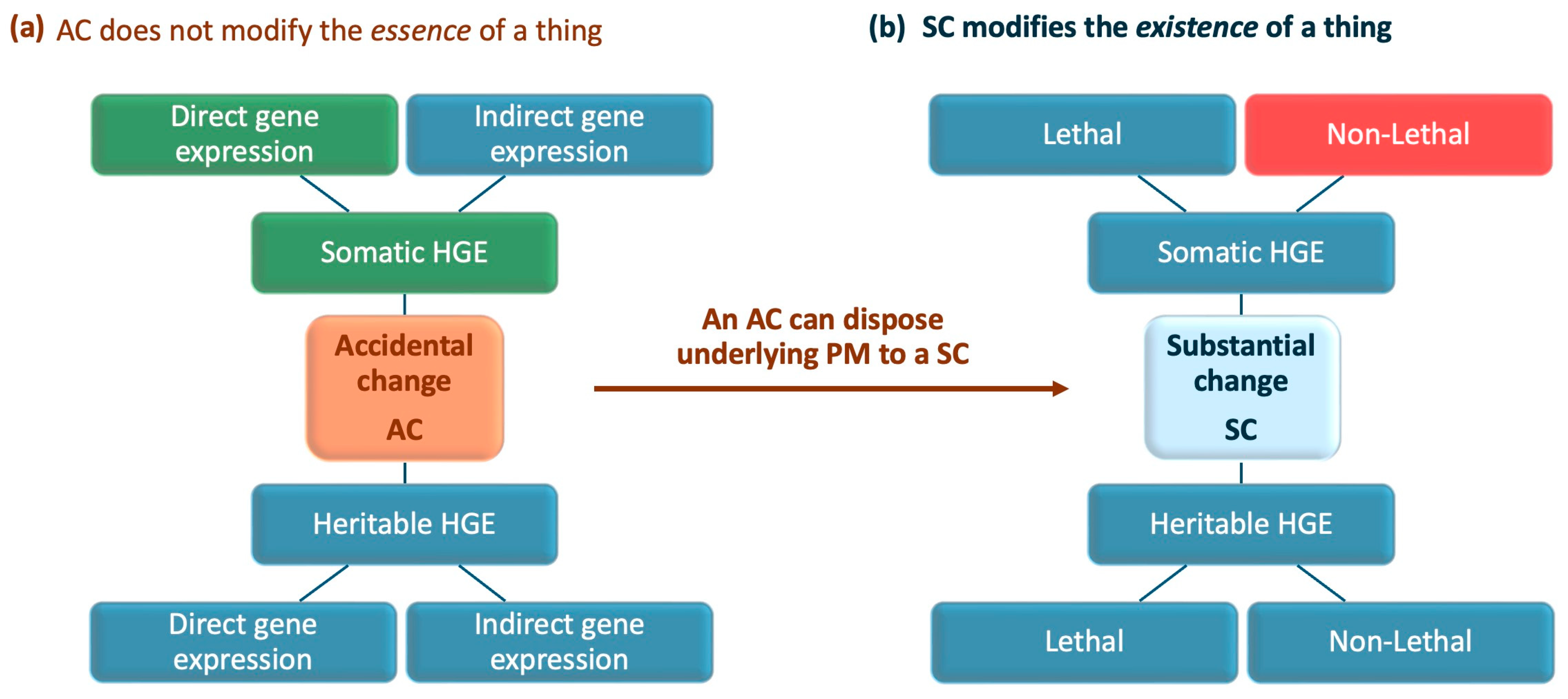
To better understand the implications of HGE, we introduced the philosophical concepts of AC and SC, particularly in relation to the unity of the human being. Both AC and SC can occur in S-GE and H-GE (see Section 2). AC may involve changes to either direct or indirect gene expression. SC, by contrast, refers to deeper ontological transformations and may be either lethal or non-lethal (see Figure 1).
Modern therapeutic S-GE provides several examples of AC, particularly those targeting direct gene expression. Current approved therapies fall within this category. For instance, the treatment of sickle cell disease now includes two somatic gene therapies—Lyfgenia™ and Casgevy™—which employ different mechanisms to restore healthy hemoglobin function (Lesmana et al. 2024) (Figure 1a), or the aforementioned personalized CRISPR/Cas9-mediated therapeutic intervention for a metabolic disease in a child (see Section 2; Musunuru et al. 2025).
Genome regulation through indirect gene expression, while still under development and tested in some organisms, has yet to be widely implemented in humans. Nevertheless, this approach is promising. It can mitigate side effects associated with mechanisms such as nonsense-mediated decay or the expression of truncated, dysfunctional proteins (Altay et al. 2022; Li et al. 2023; Dai et al. 2024). By modulating rather than eliminating gene activity, it provides a more refined strategy in cases where full gene knockout would be fatal. It also aids in identifying key regulatory elements essential for gene expression.
In Thomistic terms, SC refers to a transformation in the very existence of a being. Therefore, SC may occur in both S-GE and H-GE. In the somatic case (Figure 1b), the only possible SC is death, which signifies the end of a human being’s existence. One illustrative example of SC occurring in S-GE is the Verve 101 clinical trial, which introduced a single modification to the PCSK9 gene to prevent severe cardiovascular events (Verve Therapeutics 2024a). Despite its potential, the trial halted recruitment in April 2024 following a Grade 3 adverse event that nearly led to a patient’s death.29 This event highlights how even a seemingly minor genetic change can trigger a cascade of biological consequences, potentially culminating in SC, namely death.30
H-GE raises a different set of metaphysical and ethical concerns. While it may also produce lethal effects, it can result in non-lethal but significant ontological changes. In such cases, two distinct outcomes should be considered:
  • If the genetic modification restores natural human functions, such as those which may be possible in the future with in utero gene therapy, it remains within the bounds of human nature (Figure 1a).31
  • If the modification introduces traits or dispositions that extend beyond or distort human nature, it may result in progeny whose biological structures are no longer properly disposed to be informed by a rational soul (Figure 1b). In this latter case, the altered properly disposed PM of the gametes may lose the natural capacity to be actualized by a human soul at the moment of conception. This could lead to the emergence of a being that, metaphysically speaking, is no longer (fully) human.32 Moreover, as H-GE is applied to a single individual’s genome, another prominent concern is that, because it changes the heritable germline, it could also affect the substantial form actualizing future signate matter across generations.
Precisely for this reason, both ethical and ontological caution is necessary; indeed, H-GE remains subject to an international moratorium (WHO 2019). Therefore, it is important to recognize that, even though most moderate advocates of genetic enhancement beyond species norms do not aim to fundamentally change human nature or create beings that are no longer human, their proposals may nevertheless risk undermining the metaphysical integrity of the human person.

7. Conclusions

This essay has argued that the Catholic Church’s teachings, as expressed in DP, are both philosophically coherent and scientifically grounded. Indeed, our aim was to uphold the central ethical concern of DP §27, which is to caution against genetically modifying human beings for non-therapeutic purposes. Following a brief historical overview of human genetic engineering (Section 2), we began an analysis of the prospective forms of genetic modification aimed at enhancement. In particular, we considered interventions oriented toward the augmentation of physical capacities, the modulation of behavior, and the amplification of cognitive function (Section 3).
Our twofold upholding starts (Section 4) by using three key criteria—freedom, objectification, and determinism—to show the ethical negativity of these enhancements. Indeed, from an integrated personalistic view, non-therapeutic HGE could diminish authentic human freedom by eventually introducing new features that may impose predefined, instinct-driven behaviors and traits. It risks objectifying individuals by superimposing the irreversible intentions of others upon them from their very origin, thereby violating the principle of human equality. Finally, it promotes a deterministic worldview by attempting to technologically direct human evolution in a way that could impair the emergent nature of the human mind. Thus, there is a paramount difference between technologically (or better technocratically) surpassing the species norm and the emergence of new characteristics within the natural evolutionary process.
In the second part, we sought to recover the metaphysical framework of classical Aristotelian–Thomism. Integrating the hylomorphic description of reality as substances composed of PM and SF with Ernest Mayr’s notion of teleonomy, we described how living beings, and human beings in particular, operate in accordance with an informational program encoded into their DNA (Section 5). This program may be understood as the instrumental means by which the rational soul actualizes its perfect operations. Therefore, while Mayr’s teleonomy on its own portrays the human being as a mere aggregate, by integrating his ideas within the Aristotelian-Thomistic metaphysical system allows this error to be avoided.
The soul’s hierarchical structure—wherein the higher faculties govern the lower, both material and immaterial—provides a metaphysical rationale for resisting non-therapeutic genetic modification. For such interventions risk introducing an imbalance within the properly disposed PM, thereby impeding the soul’s ability to actualize its full potential and attain its proper telos.
Then (Section 6), the essay distinguished between AC and SC in the context of HGE. While S-GE is generally considered to introduce an accidental change, heritable genetic alterations pose a far more profound risk. If modifications to germ cells alter the properly disposed PM of the gametes and disrupt their intrinsic ordering to be informed by the rational soul in the next substantial change, this could effectively endanger the ontological identity of the resulting being.
Ultimately, while natural evolutionary development entangles teleology and entelechy directed toward the good, a possible artificial alteration that exceeds the human species norm risks to violate the dignity and unity of the human person. Such interventions, beyond violating human dignity, undermine the ontological structure of the human person. It is precisely in these two considerations that one may discern a possible account of the instinctive and emotional resistance often elicited by the prospect of HGE undertaken for ends other than therapy. Although Dignitas Personae does not directly delve into these concerns in explicit metaphysical terms, the depth of its wisdom remains unmistakable and is deserving of steadfast upholding, standing as a crucial bulwark against reductive conceptions of the human in an age increasingly tempted by technological self-reinvention.

Author Contributions

Conceptualization, M.A.C. and F.G.; methodology, M.A.C. and F.G.; vali-dation, M.A.C. and F.G.; formal analysis, M.A.C. and F.G.; investigation, M.A.C.; resources, M.A.C. and F.G.; data curation, M.A.C.; writing—original draft preparation, M.A.C.; writing—review and editing, M.A.C. and F.G.; visualization, M.A.C.; supervision, M.A.C. and F.G. All authors have read and agreed to the published version of the manuscript.

Funding

This research received no external funding.

Institutional Review Board Statement

Not applicable.

Informed Consent Statement

Not applicable.

Data Availability Statement

No new data were created or analyzed in this study. The original contributions presented in this study are included in the article. Further inquiries can be directed to the corresponding author.

Acknowledgments

We express our sincere gratitude to Mariusz Tabaczek of the Pontifical University of Saint Thomas Aquinas, Rome, Italy, for his insightful comments and constructive discussions, which opened new perspectives and significantly deepened the development of this work. We are also grateful to Maria Chiara Castaldi of the University of Salerno, Salerno, Italy, for her valuable feedback throughout the preparation of this manuscript. We also want to express our acknowledgments to the two anonymous reviewers who helped shape and improve our paper with their valuable observations.

Conflicts of Interest

The authors declare no conflicts of interest.

Abbreviations

The following abbreviations are used in this manuscript:
ACAccidental change
DPDignitas Personae on certain Bioethical Questions
DSBDouble Strand Break
H-GEHeritable (germline) gene editing
HGEHuman gene editing
MOEmain olfactory epithelium
PMPrimary matter
S-GESomatic gene editing
SCSubstantial change
SFSubstantial form
TALENTranscription activator-like effector nuclease
VNOVomeronasal organ
ZFNZinc Finger Nuclease

Notes

1
The reception of Dignitas Personae has been diverse over time, eliciting commentary across both European and American contexts, most notably within Catholic circles (Eberl 2010; Dancák 2023; Musio 2025), yet also upon secular platforms such as the American Journal of Bioethics (Delaney 2009). Such a breadth of responses attests to the document’s significance beyond confessional boundaries (Zivotofsky and Jotkowitz 2009).
2
As an anonymous reviewer wisely pointed out, a number of scholars would argue that DP uses a deductive physicalist approach rather than an inductive personalist approach. Therefore, the charge of physicalism against Church documents has been a sustained critique from revisionist Catholic moral theologians since Humanae Vitae (Paul VI 1968). Charles E. Curran argued that the natural law theory employed in the encyclical “identifies the moral and human action with the physical structure of the conjugal act itself” (Curran 1969, pp. 156–72). This critique—that magisterial documents overly emphasize biological/physical structures rather than the total personal and relational dimensions of human acts—was subsequently applied to Donum Vitae (1987) and continues to be raised against DP.
Todd A. Salzman and Michael G. Lawler have extended this critique, contrasting a person-centered morality with traditional natural law approaches (Salzman and Lawler 2008, p. 241). Ann Marie Mealey similarly expressed concern that DP’s arguments foster an overly limited view of natural law, rooted in physicalism, which risks neglecting the roles of reason and experience (Mealey 2010, pp. 111–30).
Upholders of DP have provided substantial rebuttals. A 2009 symposium in the National Catholic Bioethics Quarterly featured six moral theologians addressing the document’s strengths and methodology (Brugger 2009, pp. 461–83). Christopher Kaczor specifically addressed the charge that defining personhood at conception represents a physicalist move, arguing instead for the personalist basis of the Church’s teaching (Kaczor 2009). Paul Flaman has defended the Church’s integral vision of the person, which recognizes embodied existence without reducing moral judgments to mere biological facts (Flaman 2013).
Finally, DP itself provides its own methodological account, stating that it “draws upon the light both of reason and of faith and seeks to set forth an integral vision of man and his vocation (DP §3)”:
“The body of a human being, from the very first stages of its existence, can never be reduced merely to a group of cells. The embryonic human body develops progressively according to a well-defined program with its proper finality, as is apparent in the birth of every baby. […] The human being is to be respected and treated as a person from the moment of conception; and therefore, from that same moment his rights as a person must be recognized, among which in the first place is the inviolable right of every innocent human being to life. This ethical principle, which reason is capable of recognizing as true and in conformity with the natural moral law, should be the basis for all legislation in this area. In fact, it presupposes a truth of an ontological character, as Donum vitae demonstrated from solid scientific evidence, regarding the continuity in development of a human being (DP §4, §5)”
Eventually we emphasize that while DP endorses biological realities grounded in the essence of the human being, the notions of organism and person, although overlapping, are not totally coextensive.
3
Notably, DP does not explicitly mention any specific intervention. These are identified through the current scientific literature, particularly the SIENNA project, which remains the most comprehensive international initiative on the public attitude towards human enhancement, including HGE (Jensen et al. 2018).
4
Various attempts have been made to categorize human enhancement. One of the most widely accepted and scientifically robust frameworks is the SIENNA project (Jensen et al. 2018). Another notable classification scheme is presented by Alastair Campbell (2017), founding editor of the Journal of Medical Ethics. In the present essay, however, we opt to streamline the concept of human enhancement into three broad categories (physical, behavioral, and cognitive) for the sake of fluency and the ease of discussion and scientific inquiry.
5
Habermas (2021) highlights that within the German philosophical tradition, including the Frankfurt School, the difference between morality (Kant) and ethical life (Hegel) has been crucial. The former term refers to a universal, impartial, and deontological domain (as in Kantian ethics), while the latter concerns the interrelational, communal, juridical and historically embedded dimensions of ethical life.
6
Molhoek (2018) states, and we do agree, that “it is not possible to engineer moral virtues genetically […] What is modified through gene editing are certain traits or dispositions, but these alone are not virtues. Specific genes might contribute to the habituation of a specific virtue or a vice, but without the addition of freely chosen habit such genes cannot on their own produce virtue.”
7
Genetic enhancement has been a significant focus within transhumanist discourses, exploring the possibilities and challenges of improving human capacities beyond therapeutic aims. The Transhumanist Manifesto (Vita-More 2020) and The Transhumanist FAQ 3.0 (Humanity+ 2001) outline the philosophical and practical aspirations of transhumanism, emphasizing human progress through technology. Nick Bostrom’s seminal works (Bostrom 2003, 2008; Bostrom and Savulescu 2009) provide rigorous ethical analysis on the risks and benefits of enhancement technologies, arguing for optimism. Raymond Kurzweil (2005) presents a visionary perspective on the technological singularity and human enhancement, while David Pearce (1995) champions the abolition of suffering through biotechnological means. Natasha Vita-More’s comprehensive exploration of enhancement technologies, aesthetics, life extension, and their societal implications further enriches this field (Vita-More 2013a, 2013b). Additional important contributions include Fukuyama’s critique of biotechnology’s impact on human nature (Fukuyama 2002), Kass’s reflections on bioenhancement (Kass 2003), and Bublitz’s examination of personal identity in relation to enhancement (Bublitz 2014).
The notion of morphological freedom, emphasizing the right of individuals to control and modify their own bodies, has been robustly defended by Anders Sandberg (2013). Moreover Farahany (2019) explores the intersection of freedom, autonomy, identity, and neuroenhancement. Buchanan (2011) also contributes to this debate by discussing the societal and ethical dimensions of bodily autonomy in enhancement contexts.
In reproductive ethics, the principle of procreative beneficence, proposed by Julian Savulescu (2001, 2015), asserts that parents have a moral obligation to select the best genetic traits for their children. This principle has been critically evaluated and expanded by authors such as Harris (2007), who questions the limits of parental choice, and Levin (2024). More recent analyses, including Chaproniere (2023), examine the evolving ethical landscape surrounding genetic selection and editing technologies, addressing potential conflicts with disability rights and societal norms that were already anticipated by Parens (1998).
8
Two main objections could be raised here. First, one might argue that it is possible to imagine a situation where this is all measured, and the enhancement is introduced in a way that works perfectly with human freedom of choice. However, from a biological standpoint, it is incoherent to imagine adding a functional response without preserving the shape suited to it—for example, imagining wings that function as wings but retain the morphology of arms. In this regard, Alfred Gehlen’s notion of the human being as Mängelwesen—an incomplete or “deficient” being—offers valuable insight (Gehlen 1980). While we do not follow his conclusions, we affirm his observation that the human body is not physiologically determined for any one specific task but rather appears to be suited for the externalization of higher faculties such as intellect and will. Second, one might contend that even naturally occurring differences, such as variations in the sense of smell among human beings, can affect how people perceive and respond to the world, and therefore, in some way, also influence human freedom. However, according to St. Thomas Aquinas, there exists a broad range of natural variation within the exercise of human capacities, and whatever falls within those bounds remains properly human—for instance, differences in individuals’ capacities for smell do not undermine their shared nature (Super IV Sent. 44, 1, 3, ad 2).
9
Human free will is a complex, nuanced and polysemic issue. Although the main topic of this essay is not free will, we approach it from the Aristotelian–Thomistic perspective, informed by hard sciences. Yet different perspectives are available, for instance philosophers working within the 4E (embodied, embedded, enactive, extended) cognition framework, such as Alva Noë, have argued that abstraction is unnecessary, and that what we call “free will” may simply be the emergent result of these neural networks interacting with the environment (Noë 2008).
10
In summer 1999, Peter Sloterdijk delivered a lecture titled Regeln für den Menschenpark (Prescriptions for the Human Park) at Schloss Elmau, a response to Heidegger’s Letter on Humanism. The lecture, never intended for publication, argued that humanism had historically functioned through anthropotechnics—techniques of human domestication and breeding—and friendship-constituting telecommunication in the medium of writing, both operating in false innocence about what it means to be human. Controversially invoking Plato’s theories of shepherding and Nietzsche’s Übermensch, Sloterdijk explored how biotechnology and information technology had displaced the book as the medium of human formation (Bildung), calling for reflection on contemporary anthropotechnics. Jürgen Habermas attacked Sloterdijk as a fascistoid advocate of breeding superhumans. Coverage in Der Spiegel, Die Zeit, and other European periodicals largely missed the point: Sloterdijk was not proposing genetic engineering but questioning what it means to write and think after the end of humanist book culture. Sloterdijk responded with two letters in Die Zeit (September 1999), accusing Habermas of Jacobinism and a social-liberal dictatorship of morality, and the media of alarmism. He protested the convergence of hyper morality and over-mediatization—the decadence of philosophical criticism into a spectacle of indignation. The affair established Sloterdijk as a major if controversial continental philosopher while demonstrating the degradation of public discourse by mass media—ironically, the very problem his lecture had addressed (Tuinen 2011).
11
He Jiankui was freed in April 2022.
12
“Vulnerability is a complex notion in need of further analysis and clarification. Being introduced in the bioethical discourse via the Belmont Report in 1979 it has played an increasingly important role in international policy documents, culminating in 2005 in its formulation as a separate bioethics principle. The principle has been criticized as being too vague, too broad, too narrow, and futile since it does not provide clear moral guidance. Nevertheless, in the context of global bioethics, the language of vulnerability is indispensable. On the one hand, vulnerability is a general characteristic of the human condition. It expresses the fragility and finitude of human existence and is, therefore, a feature shared by all human beings. On the other hand, vulnerability refers to the fact that some people are more vulnerable than others, due to natural or social conditions such as disease or poverty. It expresses the normative requirement that these vulnerable fellow human beings need special care. More is needed than non-interference; they should receive assistance that will enable them to realize their potential as human beings” (Ten Have 2014, pp. 26–27).
13
Echoing the naturalistic fallacy, we argue that the imposition of specific traits upon offspring to achieve the so-called “best possible child”, as advocated by procreative beneficence (Savulescu 2001), is not justified simply because it is technologically feasible.
14
The interplay between evolution and emergence is an ongoing developmental issue, still insufficiently delineated and only partially understood. We concur with Tabaczek (2014), who argues “[…] none of the factors involved in evolution is understood as intending its eventual product. That is why we may conclude by emphasizing one more time that the proportionate cause of the emergence of the new species is not a single law or force, but a concurrence of many causal influences constitutive for an evolutionary event, or rather a history of evolutionary changes.”
15
Emergent phenomena are characterized by being irreducible to the sum of their parts. In this light, considering the human mind as an emergent phenomenon aligns naturally with the Thomistic hylomorphic framework, in which the whole is ontologically different from the mere aggregation of its components. Emergentism, understood in this way, supports rather than contradicts this view by affirming that higher-level phenomena, such as consciousness, intentionality, and rationality, cannot be fully explained by lower-level physical interactions alone, but require reference to the formal unity that grounds them. Indeed, “for all things that have several parts, and of which the whole is not a kind of heap but is something over and above the parts, have some cause that makes them one” (In Meta. VIII, lect.1, §1045a.8–10). This vision of the human mind may aptly be described in terms of “Thomistic emergence,” a concept previously invoked in other contexts by Miller (2023), Rooney (2023), and Stump (1995).
16
In ST I, 79, Aquinas distinguish the three acts of the possible intellect, namely apprehension, judgment, and reasoning, and identifies the act of abstraction as proper of the agent intellect. Altogether they form intelligence, which properly signifies the intellect’s very act, which is to understand (ST I, 79, 10, co).
17
For a comprehehnsive treatise on the complex interplay between intellectual knowledge and sensitive knowledge see also Lucas Lucas (1997, pp. 76–81, 117–43).
18
Yet the enhancement of the brain, though it may yield novel or more vivid mental images and thereby render intellectual cognition more robust or efficient, does not of itself make the human being more humane or more perfect.
19
The Catechism of the Catholic Church explicitly speaks of men in terms of body–soul composite (Catholic Church 1997 §382) and also about the sacraments in their formal and material aspects. Additionally, several Popes in their doctrinal writings endorses Aquinas’s metaphysical teaching as foundational for the Catholic Church. See as examples: Pope Pius XI Studiorum Duce (Pius XI 1923), Pope Leo XIII Aeterni Patris (Leo XIII 1879), and Pope St. John Paul II Fides et Ratio (John Paul II 1998).
20
“I call signate matter matter considered under determinate dimensions. Such matter is not included in the definition of man as man, but it would be included in the definition of Socrates, if Socrates had a definition” [De Ente, II, 6].
21
Mayr’s notion of teleology as “the cause responsible for the orderly reaching of a preconceived ultimate goal” was aptly criticized by William H. Kane, a prominent representative of River Forest Thomism, for conflating teleology with efficient causation. Kane’s critique appeared in a 1962 essay published in Science (Kane 1962), responding to Mayr’s article of the same year. Interestingly, Kane directs his criticism solely at Mayr’s concept of teleology, countering it by invoking Aristotle’s proper notion of final causality (that for which or for the sake of which something is made or done). Notably, however, Kane offers no critique of Mayr’s related concept of informational programs in living beings, namely teleonomy.
22
Indeed, the soul is said to contain the body, and it is not located in a specific part of the body, but it is present to the whole body: “the soul […] is the form of the whole body and each of its parts. […] Thus, it is necessary that each part of a man and that of an animal receive its existence and species from the soul as from its proper form (Q. de an. 10, co)”. See also (Dodds 2012, p. 20).
23
With the sole exception of gametes, as these contain a haploid genome.
24
Within the context of human cloning, DP §29 states: “The fact that someone would arrogate to himself the right to determine arbitrarily the genetic characteristics of another person represents a grave offense to the dignity of that person as well as to the fundamental equality of all people.”
25
Here the point is that to consider the whole as a mere composite of its parts is incoherent with the Aristotelian–Thomistic framework, in which the human being is neither body nor soul alone, but a third thing (De ente 2.12).
26
For a contemporary Thomistic account of the unity of substantial form, see Goyette (2009, pp. 781–90). For a historical overview of the debate concerning the unity of substantial form in Aquinas’s thought, see Whipple (2011, pp. 117–54).
27
It is fair that in the thought of St. Thomas intensifying or adding an accidental characteristic does not change the nature of a thing. Indeed, quantity is an accident, so there is a perfect quantity for any particular subject. Moreover, in the modern debate over species, Oderberg argues that no difference in degree could ever change the species (Oderberg 2014).
28
In the same way, the interpretation of Oderberg’s rational Glog, the three-headed rational creature, is to be interpreted as a logical potency, and not as a real potency, as he himself states (Oderberg 2014, p. 219): “But we should now be thinking not of the far-fetched, Glog-like case, which I used to make a metaphysical point about species membership […]”. It is important to emphasize that, in the present context, St. Thomas is referring to God, not to human beings. Therefore, given these considerations, this cannot be regarded as an accurate reflection of St. Thomas’s doctrine. Furthermore, he firmly declared that the rational soul is created directly by God ex nihilo, and it is never potentially contained in the genus of animal. Notably the Fourth Lateran Council (1215) had already defined creatio ex nihilo as a dogma, and Aquinas maintained that the immortal soul could only be created ex nihilo by God. See: ST I-II, 90. See also Tabaczek (2024 pp. 222–71).
29
In December 2024, Verve Therapeutics began recruiting participants for a new trial involving a different vector (Verve Therapeutics 2024b).
30
This is not intended as an argument against S-GE, but rather as an explanatory and cautionary note: through S-GE, and more generally HE, we are attempting to alter something whose full complexity remains unknown—an undertaking comparable to firing a bazooka at a very small, unidentified target.
31
Whatever remains within the bounds of the truth of human nature resists claims of absolute autonomy, heterodetermination, or autarky (see Ratzinger 2012, pp. 112–14). Rather, it aligns with Habermas’s view that individuals should be preserved in the characteristics intrinsic to human nature. The core concern lies in the shift from natural or divine causality to human intervention, where decisions are made without the consent of those affected by them, ultimately blurring the line between creation and manipulation (see Section 4, II). Furthermore, unless one is prepared to argue that illness itself is a constitutive feature of human nature, rather than a manifestation of the distortion and disturbance introduced by original sin (Ratzinger 2012, p. 116), then the justification for genetic alteration becomes ethically problematic.
32
One might contend that so long as what is brought into existence is a human being, the full range of moral norms pertaining to human beings obtains. By contrast, if one were to give origin to an entity that does not qualify as a human being, it is open to question whether those norms would still apply. This, however, would give rise to a host of bioethical issues, no less pressing and no less concerning.

References

  1. Aboussahoud, Wedad S., Helen Smith, Adam Stevens, Ivan Wangsaputra, Helen R. Hunter, Susan J. Kimber, Mourad W. Seif, and Daniel R. Brison. 2021. The Expression and Activity of Toll-Like Receptors in the Preimplantation Human Embryo Suggest a New Role for Innate Immunity. Human Reproduction 36: 2661–75. [Google Scholar] [CrossRef]
  2. Allegra, Antonio. 2011. Oltre l’uomo?: Alcune Varianti Postumaniste. Acta Philosophica 20: 179–88. [Google Scholar]
  3. Almeida, Mara, and Robert Ranisch. 2022. Beyond Safety: Mapping the Ethical Debate on Heritable Genome Editing Interventions. Humanities and Social Sciences Communications 9: 139. [Google Scholar] [CrossRef]
  4. Altay, Halit Yusuf, Fatma Ozdemir, Ferdows Afghah, Zeynep Kilinc, Mehri Ahmadian, Markus Tschopp, and Cavit Agca. 2022. Gene Regulatory and Gene Editing Tools and Their Applications for Retinal Diseases and Neuroprotection: From Proof-of-Concept to Clinical Trial. Frontiers in Neuroscience 16: 924917. [Google Scholar] [CrossRef] [PubMed]
  5. Anzalone, Andrew V., Peyton B. Randolph, Jessie R. Davis, Alexander A. Sousa, Luke W. Koblan, Jonathan M. Levy, Peter J. Chen, Christopher Wilson, Gregory A. Newby, Aditya Raguram, and et al. 2019. Search-and-Replace Genome Editing without Double-Strand Breaks or Donor DNA. Nature 576: 149–57. [Google Scholar] [CrossRef]
  6. Aquinas, Thomas. 1882. Summa contra Gentiles (SCG). 1926–1947. In Sancti Thomae de Aquino Opera Omnia Iussu Leonis XIII Edita. Rome: Typographia Polyglotta Vaticana, vol. 13–15, [On the Truth of the Catholic Faith. Translated by Anton C. Pegis. New York: Hanover House, pp. 1955–57]. [Google Scholar]
  7. Aquinas, Thomas. 1926. In Metaphysicam Aristotelis Commentaria (In Meta.). Turin and Rome: Marietti, [English translation: Commentary on the Metaphysics of Aristotle. Translated by John P. Rowan. Chicago: Regnery Press, 2 vols., p. 1961]. [Google Scholar]
  8. Aquinas, Thomas. 1946. Summa Theologiae (ST). 1888–1906. In Sancti Thomae Aquinatis Opera Omnia Iussu Leonis XIII P.M. Edita. Rome: Typographia Polyglotta Vaticana, vol. 4–12, [Summa Theologica. Translated by the Fathers of the English Dominican Province. New York: Benziger Bros., 3 vols.]. [Google Scholar]
  9. Aquinas, Thomas. 1949. Quaestiones Disputatae de Anima (Q. de an.). In The Soul. Translated by John Patrick Rowan. St. Louis and London: B. Herder Book Co. [Google Scholar]
  10. Aquinas, Thomas. 1980. Scriptum Super Sententiis (Super Sent.). 2018–2026. [Commentary on the Sentences, I, Vols. 1–2. Translated from the Mandonnet edition by Christopher Decaen. Lander: Aquinas Institute for the Study of Sacred Doctrine.; Commentary on the Sentences, II, Vols. 3–4. Translated from the Mandonnet edition by Christopher Decaen, Dylan Schrader, and Beth Mortensen. Lander; Commentary on the Sentences, III, Vols. 5–6. Translated from the Moos edition by Christopher Decaen and Beth Mortensen. Lander; Commentary on the Sentences, IV, Vols. 7–10. Translated from the Moos edition by Beth Mortensen]. Lander: Aquinas Institute for the Study of Sacred Doctrine. [Google Scholar]
  11. Aquinas, Thomas. 1998. On Being and Essence (De Ente). In Selected Writings. Edited and Translated by Ralph McInerny. London: Penguin. [Google Scholar]
  12. Aquinas, Thomas. 2026. The Disputed Questions on Truth (Quaestiones Disputatae de Veritate) (De Veritate). Edited by The Aquinas Institute. Translated from the Leonine edition by Robert Mulligan, James McGlynn and Br. Evagrius Hayden. Chicago: OSB, vol. 23–24. [Google Scholar]
  13. Aristotle. 1907. De Anima (De an.). Edited and Translated by R. D. Hicks. Cambridge: Cambridge University Press. [Google Scholar]
  14. Aristotle. 1941. On Generation and Corruption (De gen.), I, 4 [320a 1–2]. In The Basic Works of Aristotle. Edited by Richard McKeon. New York: Random House. [Google Scholar]
  15. Aristotle. 2001. Metaphysics (Meta.). In The Basic Works of Aristotle. Edited by Richard McKeon. Translated by William D. Ross. New York: The Modern Library, pp. 681–926. [Google Scholar]
  16. Azani, Alireza, Malihe Sharafi, Reyhaneh Doachi, Sama Akbarzadeh, Parsa Lorestani, Arash Haji Kamanaj Olia, Zahra Zahed, Hossein Gharedaghi, Haniyeh Ghasrsaz, Hassan Foroozand, and et al. 2025. Applications of CRISPR-Cas9 in Mitigating Cellular Senescence and Age-Related Disease Progression. Clinical and Experimental Medicine 25: 237. [Google Scholar] [CrossRef]
  17. Barzaghi, Giuseppe. 2012. Spirito e corporeità. Tommaso d’Aquino e la modernità: Continuità e discontinuità. Divus Thomas 115: 17–28. Available online: https://www.jstor.org/stable/48503725 (accessed on 24 January 2025).
  18. Bender, Nicole, N. Allemann, D. Marek, P. Vollenweider, G. Waeber, V. Mooser, M. Egger, and M. Bochud. 2011. Association between variants of the leptin receptor gene (LEPR) and overweight: A systematic review and an analysis of the CoLaus study. PLoS ONE 6: e26157. [Google Scholar] [CrossRef]
  19. Berns, Gregory S., Andrew M. Brooks, and Mark Spivak. 2015. Scent of the Familiar: An fMRI Study of Canine Brain Responses to Familiar and Unfamiliar Human and Dog Odors. Behavioural Processes 110: 37–46. [Google Scholar] [CrossRef] [PubMed]
  20. Blackburn, Simon. 2008. The Oxford Dictionary of Philosophy, 2nd ed. Oxford: Oxford University Press. [Google Scholar] [CrossRef]
  21. Bostrom, Nick. 2003. Human Genetic Enhancements: A Transhumanist Perspective. Journal of Value Inquiry 37: 493–506. Available online: https://nickbostrom.com/ethics/genetic (accessed on 11 November 2024). [CrossRef]
  22. Bostrom, Nick. 2008. Dignity and Enhancement. In Human Dignity and Bioethics: Essays Commissioned by the President’s Council on Bioethics. Edited by Adam Schulman. Washington, DC: President’s Council on Bioethics, pp. 173–206. [Google Scholar]
  23. Bostrom, Nick, and Julian Savulescu, eds. 2009. Human Enhancement. Oxford: Oxford University Press. [Google Scholar]
  24. Boyer, Jeffrey, and Guy Meadows. 2015. Thomas Aquinas: Teacher of Transhumanity? In Thomas Aquinas: Teacher of Humanity. Edited by John P. Hittinger and David C. Wagner. Newcastle upon Tyne: Cambridge Scholars Publishing, pp. 176–87. [Google Scholar]
  25. Brugger, Eugene C. 2009. Symposium on Dignitas Personae. National Catholic Bioethics Quarterly 9: 461–83. [Google Scholar] [CrossRef]
  26. Bublitz, Jan Christoph. 2014. Freedom of Thought in the Age of Neuroscience: A Plea and a Proposal for the Renaissance of a Forgotten Fundamental Right. ARSP: Archiv für Rechts- und Sozialphilosophie/Archives for Philosophy of Law and Social Philosophy 100: 1–25. Available online: https://www.jstor.org/stable/24756752 (accessed on 2 July 2025). [CrossRef]
  27. Buchanan, Allen E. 2011. Beyond Humanity? The Ethics of Biomedical Enhancement. Uehiro Series in Practical Ethics; Oxford: Oxford University Press. [Google Scholar] [CrossRef]
  28. Campbell, Alastair. 2017. Bioethics: The Basics, 2nd ed. London: Routledge. [Google Scholar] [CrossRef]
  29. Campbell, Katherine H., Jim McWhir, William A. Ritchie, and Ian Wilmut. 1996. Sheep Cloned by Nuclear Transfer from a Cultured Cell Line. Nature 380: 64–66. [Google Scholar] [CrossRef]
  30. Carpenter, Catherine L., Angela M. Wong, Zhaoping Li, Ernest P. Noble, and David Heber. 2013. Association of dopamine D2 receptor and leptin receptor genes with clinically severe obesity. Obesity 21: E467–73. [Google Scholar] [CrossRef]
  31. Carrara, Alberto. 2024. A Neuroethical Approach to Human Life, Identity, and Liberty of Schizophrenic Patients. CNS Spectrums 30: e4. [Google Scholar] [CrossRef]
  32. Carrara, Alberto. 2025. A Unified Understanding of the Human Mind—A Neuroethical Perspective. CNS Spectrums 30: e5. [Google Scholar] [CrossRef]
  33. Catholic Church. 1997. Catechism of the Catholic Church [CCC], 2nd ed. Vatican City: Available online: https://www.vatican.va/archive/ENG0015/_INDEX.HTM (accessed on 25 November 2024).
  34. Chaproniere, Lysette. 2023. Understanding the Relationship Between Disability and Enhancement. Pacific Philosophical Quarterly 104: 30–54. [Google Scholar] [CrossRef]
  35. Charpentier, Emmanuelle, and Jennifer Doudna. 2013. Rewriting a Genome. Nature 495: 50–51. [Google Scholar] [CrossRef] [PubMed]
  36. Christian, Michelle, Tomas Cermak, Erin L. Doyle, Christine Schmidt, Feng Zhang, Anthony Hummel, Adam J. Bogdanove, and Daniel F. Voytas. 2010. Targeting DNA Double-Strand Breaks with TAL Effector Nucleases. Genetics 186: 757–61. [Google Scholar] [CrossRef] [PubMed]
  37. Cohen, Stanley N., Annie C. Y. Chang, Herbert W. Boyer, and Robert B. Helling. 1973. Construction of biologically functional bacterial plasmids in vitro. Proceedings of the National Academy of Sciences of the United States of America 70: 3240–44. [Google Scholar] [CrossRef]
  38. Congregation for the Doctrine of the Faith. 1987. Donum Vitae. Vatican City: Libreria Editrice Vaticana, AAS 80. pp. 70–102. [Google Scholar]
  39. Congregation for the Doctrine of the Faith. 2008. Instruction Dignitas Personae: On Certain Bioethical Questions. Vatican: Libreria Editrice Vaticana, AAS 100. pp. 858–87. [Google Scholar]
  40. Curran, Charles E. 1969. The Reasonableness of Responsible Dissent from One Particular Ethical Teaching of the Encyclical. In Dissent in and for the Church: Theologians and “Humanae Vitae”. Curran, C.E., Hunt, R.E. and the “Subject Professors” with Hunt, J.F., Connelly, T.R., eds. New York: Sheed & Ward, pp. 156–72. [Google Scholar]
  41. Dai, Wanlin, Xinbo Qiao, Yuanyuan Fang, Renhao Guo, Peng Bai, Shuang Liu, Tingting Li, Yutao Jiang, Shuang Wei, Zhijing Na, and et al. 2024. Epigenetics-Targeted Drugs: Current Paradigms and Future Challenges. Signal Transduction and Targeted Therapy 9: 332. [Google Scholar] [CrossRef]
  42. Dancák, Pavol. 2023. Molecular Editing and Christian Bioethics. Studia Nauk Teologicznych PAN 18: 135–52. [Google Scholar] [CrossRef]
  43. Delaney, James J. 2009. The Catholic Position on Germ Line Genetic Engineering. The American Journal of Bioethics 9: 33–34. [Google Scholar] [CrossRef]
  44. Deng, Hongjian, Pengfei Xue, Xiaogang Zhou, Yuntao Wang, and Wei Liu. 2024. CCL4/CCR5 Regulates Chondrocyte Biology and OA Progression. Cytokine 183: 156746. [Google Scholar] [CrossRef] [PubMed]
  45. de Oliveira, Fabiano F., Sueli S. de Almeida, Evelyn S. Chen, Marcus C. Smith, and Paulo H. F. Bertolucci. 2022. APOE ε4 Carrier Status as Mediator of Effects of Psychotropic Drugs on Clinical Changes in Patients with Alzheimer’s Disease. Journal of Neuropsychiatry and Clinical Neurosciences 34: 351–60. [Google Scholar] [CrossRef] [PubMed]
  46. de Oliveira, Fabiano F., Sueli S. de Almeida, Marcus C. Smith, and Paulo H. F. Bertolucci. 2021. Behavioural Effects of the ACE Insertion/Deletion Polymorphism in Alzheimer’s Disease Depend upon Stratification According to APOE-ϵ4 Carrier Status. Cognitive Neuropsychiatry 26: 293–305. [Google Scholar] [CrossRef] [PubMed]
  47. Dodds, Michael J. 2012. Unlocking the Divine Action. Washington, DC: The Catholic University of America Press. [Google Scholar]
  48. Dresler, Martin, Anders Sandberg, Christoph Bublitz, Kathrin Ohla, Carlos Trenado, Aleksandra Mroczko-Wąsowicz, Simone Kühn, and Dimitris Repantis. 2019. Hacking the Brain: Dimensions of Cognitive Enhancement. ACS Chemical Neuroscience 10: 1137–48. [Google Scholar] [CrossRef]
  49. Drew, Liam. 2024. Elon Musk’s Neuralink Brain Chip: What Scientists Think of First Human Trial. Nature. online ahead of print. [Google Scholar] [CrossRef]
  50. Dunn, Jacob, and Michael H. Grider. 2025. Physiology, Adenosine Triphosphate. In StatPearls [Internet]; Treasure Island: StatPearls Publishing. Available online: https://www.ncbi.nlm.nih.gov/books/NBK553175/ (accessed on 11 February 2025).
  51. Eberl, Jason T. 2010. What Dignitas Personae Does Not Say. The National Catholic Bioethics Quarterly 10: 89–110. [Google Scholar] [CrossRef]
  52. Farahany, Nita A. 2019. The Costs of Changing Our Minds. Emory LJ 69: 75. [Google Scholar]
  53. Flaman, Paul. 2013. Another Response to Todd Salzman and Michael Lawler’s The Sexual Person. The Linacre Quarterly 80: 239–63. [Google Scholar] [CrossRef]
  54. Fukuyama, Francis. 2002. Our Posthuman Future: Consequences of the Biotechnology Revolution. New York: Farrar, Straus and Giroux. [Google Scholar]
  55. Gehlen, Arnold. 1980. Man in the Age of Technology. New York: Columbia University Press. [Google Scholar]
  56. Gill, Kevin S., Kritika Mehta, Jeremiah D. Heredia, Vishnu V. Krishnamurthy, Kai Zhang, and Erik Procko. 2023. Multiple Mechanisms of Self-Association of Chemokine Receptors CXCR4 and CCR5 Demonstrated by Deep Mutagenesis. Journal of Biological Chemistry 299: 105229. [Google Scholar] [CrossRef]
  57. Goyette, John. 2009. St. Thomas on the Unity of Substantial Form. Nova et Vetera 7: 781–90. [Google Scholar]
  58. Gragnano, Fabio. 2014. Una Lettura Aristotelico-Tomista della Relatività Generale di Einstein. Bologna: Editrice Domenicana Italiana. [Google Scholar]
  59. Habermas, Jürgen. 2003. The Future of Human Nature. Cambridge: Polity Press. [Google Scholar]
  60. Habermas, Jürgen. 2021. Once Again: On the Relationship between Morality and Ethical Life. European Journal of Philosophy 29: 543–51. [Google Scholar] [CrossRef]
  61. Hakimi, Parviz, Jianping Yang, Gema Casadesus, David Massillon, Felipe Tolentino-Silva, Christopher K. Nye, Marco E. Cabrera, David R. Hagen, Christopher B. Utter, Yacoub Baghdy, and et al. 2007. Overexpression of the Cytosolic Form of Phosphoenolpyruvate Carboxykinase (GTP) in Skeletal Muscle Repatterns Energy Metabolism in the Mouse. Journal of Biological Chemistry 282: 32844–55. [Google Scholar] [CrossRef]
  62. Hall, Kersten, and Neeraja Sankaran. 2021. DNA translated: Friedrich Miescher’s discovery of nuclein in its original context. British Journal for the History of Science 54: 99–107. [Google Scholar] [CrossRef]
  63. Hanson, Richard W., and Parviz Hakimi. 2008. Born to Run; the Story of the PEPCK-Cmus Mouse. Biochimie 90: 838–42. [Google Scholar] [CrossRef]
  64. Harris, John. 2007. Enhancing Evolution: The Ethical Case for Making Better People. Science Essentials. Princeton: Princeton University Press. Available online: https://www.jstor.org/stable/j.ctt7t8vz (accessed on 15 August 2025).
  65. Humanity+. 2001. Transhumanist FAQ 3.0. Humanity+. Available online: https://www.humanityplus.org/transhumanist-faq (accessed on 3 July 2025).
  66. Huxley, Julian. 1968. Transhumanism. Journal of Humanistic Psychology 8: 73–76. [Google Scholar] [CrossRef]
  67. International Human Genome Sequencing Consortium. 2001. Initial Sequencing and Analysis of the Human Genome. Nature 409: 860–921. [Google Scholar] [CrossRef] [PubMed]
  68. Jackson, David A., Robert H. Symons, and Paul Berg. 1972. Biochemical method for inserting new genetic information into DNA of Simian Virus 40: Circular SV40 DNA molecules containing lambda phage genes and the galactose operon of Escherichia coli. Proceedings of the National Academy of Sciences of the United States of America 69: 2904–9. [Google Scholar] [CrossRef] [PubMed]
  69. Jensen, Sean R., Saskia Nagel, and Philip Brey. 2018. D3.1: State-of-the-Art Review [WP3—Human Enhancement]. SIENNA Project (Stakeholder-Informed Ethics for New Technologies with High Socio-Economic and Human Rights Impact), European Union’s Horizon 2020 Research and Innovation Programme under Grant Agreement No. 741716. Luxembourg: Available online: https://cordis.europa.eu/project/id/741716/results (accessed on 26 August 2025).
  70. John of the Cross. 2023. Salita al Monte Carmelo. Roma: Edizioni OCD, pp. 1579–85. [Google Scholar]
  71. John Paul II. 1998. Fides et Ratio. Encyclical Letter. Rome: Libreria Editrice Vaticana, AAS 91. p. 5. [Google Scholar]
  72. Jones-Weinert, Corey, Laura Mainz, and Jan Karlseder. 2025. Telomere Function and Regulation from Mouse Models to Human Ageing and Disease. Nature Reviews Molecular Cell Biology 26: 297–313. [Google Scholar] [CrossRef]
  73. Kaczor, Christopher. 2009. Anthropological, Theological, and Ethical Aspects of Human Life and Procreation. National Catholic Bioethics Quarterly 9: 464–67. [Google Scholar]
  74. Kane, William H. 1962. On Cause and Effect in Biology. Science 135: 972–74. [Google Scholar] [CrossRef]
  75. Kass, Leon R. 2003. Ageless Bodies, Happy Souls: Biotechnology and the Pursuit of Perfection. The New Atlantis 1: 9–28. [Google Scholar]
  76. Kent, Michael. 2006. The Oxford Dictionary of Sports Science & Medicine, 3rd ed. Oxford: Oxford University Press. [Google Scholar] [CrossRef]
  77. Kokocińska-Kusiak, Agata, Martyna Woszczyło, Mikołaj Zybala, Julia Maciocha, Katarzyna Barłowska, and Michał Dzięcioł. 2021. Canine Olfaction: Physiology, Behavior, and Possibilities for Practical Applications. Animals 11: 2463. [Google Scholar] [CrossRef] [PubMed]
  78. Kornberg, Arthur. 1958. The Synthesis of DNA, 1953–1959. In Profiles in Science; Bethesda: U.S. National Library of Medicine. Available online: https://profiles.nlm.nih.gov/spotlight/wh/feature/synthesi (accessed on 10 September 2025).
  79. Kurzweil, Raymond. 2005. The Singularity Is Near: When Humans Transcend Biology. New York: Viking Penguin. [Google Scholar]
  80. Lam, Max, Joey W. Trampush, Jin Yu, Emma Knowles, Gail Davies, David C. Liewald, John M. Starr, Srdjan Djurovic, Ingrid Melle, Kjetil Sundet, and et al. 2017. Large-Scale Cognitive GWAS Meta-Analysis Reveals Tissue-Specific Neural Expression and Potential Nootropic Drug Targets. Cell Reports 21: 2597–613. [Google Scholar] [CrossRef]
  81. Leo XIII. 1879. Aeterni Patris. Encyclical Letter. Rome. ASS 11 (1878–79), 109. Available online: https://www.vatican.va/content/leo-xiii/en/encyclicals/documents/hf_l-xiii_enc_04081879_aeterni-patris.html (accessed on 11 February 2025).
  82. Lesmana, Harry, Sun Y. Kim, Andrés M. Corado, Sheri A. Poskanzer, and ACMG Therapeutics Committee. 2024. Casgevy (Exagamglogene Autotemcel) and Lyfgenia (Lovotibeglogene Autotemcel) for Individuals 12 Years and Older with Sickle Cell Disease (SCD) and Recurrent Vaso-Occlusive Crises (VOC): A Therapeutics Bulletin of the American College of Medical Genetics and Genomics (ACMG). Genetics in Medicine Open 2: 101875. [Google Scholar] [CrossRef] [PubMed]
  83. Levin, Abigail. 2024. What Do Prospective Parents Owe to Their Children? The Hastings Center Report 54: 34–43. [Google Scholar] [CrossRef]
  84. Li, Tianxiang, Yanyan Yang, Hongzhao Qi, Weigang Cui, Lin Zhang, Xiuxiu Fu, Xiangqin He, Meixin Liu, Pei-Feng Li, and Tao Yu. 2023. CRISPR/Cas9 Therapeutics: Progress and Prospects. Signal Transduction and Targeted Therapy 8: 36. [Google Scholar] [CrossRef]
  85. Lucas Lucas, Ramon. 1997. L’uomo Spirito Incarnato. Compendio di Filosofia Dell’uomo. Roma: Edizioni San Paolo. [Google Scholar]
  86. Mayr, Ernst. 1961. Cause and Effect in Biology. Science 134: 1501–06. [Google Scholar] [CrossRef]
  87. Mayr, Ernst. 1998. The Multiple Meanings of ‘Teleological’. History and Philosophy of the Life Sciences 20: 35–40. Available online: http://www.jstor.org/stable/23332139 (accessed on 23 January 2026).
  88. Mealey, Ann Marie. 2010. Dignitas Personae. In A Glass Darkly: Medicine and Theology in Further Dialogue. Edited by John Elford and Gareth Jones. New York: Peter Lang, pp. 111–30. [Google Scholar]
  89. Mehren, Jennifer E., and Leslie C. Griffith. 2004. Calcium-Independent Calcium/Calmodulin-Dependent Protein Kinase II in the Adult Drosophila CNS Enhances the Training of Pheromonal Cues. Journal of Neuroscience 24: 10584–93. [Google Scholar] [CrossRef]
  90. Miller, Jonathan, Andrew D. McLachlan, and Aaron Klug. 1985. Repetitive Zinc-Binding Domains in the Protein Transcription Factor IIIA from Xenopus Oocytes. EMBO Journal 4: 1609–14. [Google Scholar] [CrossRef]
  91. Miller, Ryan. 2023. Chemical Reduction and Quantum Interpretation: A Case for Thomistic Emergence. Foundations of Chemistry 25: 405–17. [Google Scholar] [CrossRef]
  92. Molhoek, Braden. 2018. Raising the Virtuous Bar: The Underlying Issues of Genetic Moral Enhancement. Theology and Science 16: 279–87. [Google Scholar] [CrossRef]
  93. Mongera, Alessandro, Marie Pochitaloff, Hanna J. Gustafson, Georgina A. Stooke-Vaughan, Payam Rowghanian, Sangwoo Kim, and Otger Campàs. 2023. Mechanics of the Cellular Microenvironment as Probed by Cells In Vivo During Zebrafish Presomitic Mesoderm Differentiation. Nature Materials 22: 135–43. [Google Scholar] [CrossRef] [PubMed]
  94. Morrow, John F., and Paul Berg. 1972. Cleavage of Simian virus 40 DNA at a unique site by a bacterial restriction enzyme. Proceedings of the National Academy of Sciences of the United States of America 69: 3365–69. [Google Scholar] [CrossRef]
  95. Mullis, Kary B., François Ferré, and Richard A. Gibbs, eds. 1994. The Polymerase Chain Reaction, 1st ed. New York: Birkhäuser. [Google Scholar]
  96. Musio, Alessio. 2025. Figli su Misura: L’eugenetica Liberale e la Crisi Della Dignità Umana. Vatican News/Osservatore Romano. July 27. Available online: https://www.osservatoreromano.va/it/news/2025-07/quo-173/figli-su-misura-l-eugenetica-liberale-e-la-crisi-della-dignita-u.html (accessed on 25 November 2025).
  97. Musunuru, Kiran, Sarah A. Grandinette, Xiao Wang, Taylor R. Hudson, Kevin Briseno, Anne Marie Berry, Julia L. Hacker, Alvin Hsu, Rachel A. Silverstein, Logan T. Hille, and et al. 2025. Patient-Specific In Vivo Gene Editing to Treat a Rare Genetic Disease. The New England Journal of Medicine 392: 2235–43. [Google Scholar] [CrossRef]
  98. Noë, Alva. 2008. Précis of Action in Perception. Philosophy and Phenomenological Research 76: 642–46. [Google Scholar] [CrossRef]
  99. Noë, Alva. 2010. Perché Non Siamo il Nostro Cervello. Milano: Raffaello Cortina Editore. [Google Scholar]
  100. Normile, Dennis. 2019. Chinese Scientist Who Produced Genetically Altered Babies Sentenced to 3 Years in Jail. Science. December 30. Available online: https://www.sciencemag.org/news/2019/12/chinese-scientist-who-produced-genetically-altered-babies-sentenced-3-years-jail (accessed on 2 July 2025).
  101. Oderberg, David S. 2005. Towards a Natural Law Critique of Genetic Engineering. In Philosophical Reflections on Medical Ethics. Edited by Nafsika Athanassoulis. London: Palgrave Macmillan, pp. 109–34. [Google Scholar]
  102. Oderberg, David S. 2014. Could There Be a Superhuman Species? The Southern Journal of Philosophy 52: 206–26. [Google Scholar] [CrossRef]
  103. Organizing Committee of the Third International Summit on Human Genome Editing. 2023. Statement from the Organizing Committee. The Royal Society. March 8. Available online: https://royalsociety.org/news/2023/03/statement-third-international-summit-human-genome-editing/ (accessed on 2 July 2025).
  104. Orwell, George. 1945. Animal Farm. London: Secker & Warburg. [Google Scholar]
  105. Parens, Erik, ed. 1998. Enhancing Human Traits: Ethical and Social Implications. Hastings Center Studies in Ethics; Washington, DC: Georgetown University Press. [Google Scholar]
  106. Paul VI. 1968. Humanae Vitae. Encyclical Letter. Rome: July 25. AAS 60. pp. 490–91. Available online: https://www.vatican.va/content/paul-vi/en/encyclicals/documents/hf_p-vi_enc_25071968_humanae-vitae.html (accessed on 25 November 2025).
  107. Pearce, David. 1995. The Hedonistic Imperative. Available online: https://dn790006.ca.archive.org/0/items/the-hedonistic-imperative/the-hedonistic-imperative.pdf (accessed on 25 November 2025).
  108. Pius XI. 1923. Studiorum Ducem. Encyclical Letter, Rome: June 29. AAS 15. pp. 7, 309–26. Available online: https://www.vatican.va/content/pius-xi/en/encyclicals/documents/hf_p-xi_enc_19230629_studiorum-ducem.html (accessed on 25 November 2025).
  109. Rasmussen, Nicolas. 2015. DNA Technology: ‘Moratorium’ on Use and Asilomar Conference. In eLS. Hoboken: John Wiley & Sons. [Google Scholar] [CrossRef]
  110. Ratzinger, Joseph (Benedict XVI). 2012. Progetto di Dio: La Creazione. Roma: Marcianum Press. [Google Scholar]
  111. Regalado, Antonio. 2018. Exclusive: Chinese Scientists Are Creating CRISPR Babies. MIT Technology Review. November 25. Available online: https://www.technologyreview.com/2018/11/25/138962/exclusive-chinese-scientists-are-creating-crispr-babies/ (accessed on 25 November 2025).
  112. Riggs, Arthur D. 2021. Making, Cloning, and the Expression of Human Insulin Genes in Bacteria: The Path to Humulin. Endocrine Reviews 42: 374–80. [Google Scholar] [CrossRef]
  113. Rooney, James Dominic. 2023. The Problem of Thomistic Parts. Dialectica 77: 45–72. [Google Scholar] [CrossRef]
  114. Salzman, Todd A., and Michael G. Lawler. 2008. Artificial Reproductive Technologies. In The Sexual Person: Toward a Renewed Catholic Anthropology. Washington, DC: Georgetown University Press, pp. 236–58. Available online: http://www.jstor.org/stable/j.ctt2tt69p.12 (accessed on 2 February 2026).
  115. Sandberg, Anders. 2013. Morphological Freedom—Why We Not Just Want It, but Need It. In The Transhumanist Reader: Classical and Contemporary Essays on the Science, Technology, and Philosophy of the Human Future. Edited by Max More and Natasha Vita-More. Oxford: Wiley-Blackwell, pp. 56–64. [Google Scholar]
  116. Savulescu, Julian. 2001. Procreative Beneficence: Why We Should Select the Best Children. Bioethics 15: 413–26. [Google Scholar] [CrossRef]
  117. Savulescu, Julian. 2015. Procreative Beneficence, Diversity, Intersubjectivity, and Imprecision. The American Journal of Bioethics 15: 16–18. [Google Scholar] [CrossRef] [PubMed]
  118. Schauren, Juliana D. S., Amanda H. de Oliveira, Camila R. Consiglio, Odirlei A. Monticielo, Ricardo M. Xavier, Natália Schneider Nunes, Joel H. Ellwanger, and José A. Bogo Chies. 2024. CCR5 Promoter Region Polymorphisms in Systemic Lupus Erythematosus. International Journal of Immunogenetics 51: 20–31. [Google Scholar] [CrossRef] [PubMed]
  119. Siegel, Daniel J., and Carly Drulis. 2023. An Interpersonal Neurobiology Perspective on the Mind and Mental Health: Personal, Public, and Planetary Well-Being. Annals of General Psychiatry 22: 5. [Google Scholar] [CrossRef]
  120. Stump, Eleonore. 1995. Non-Cartesian Substance Dualism and Materialism Without Reductionism. Faith and Philosophy 12: 505–31. [Google Scholar] [CrossRef]
  121. Tabaczek, Mariusz. 2014. An Aristotelian Account of Evolution and the Contemporary Philosophy of Biology. In Proceedings of the 1st Virtual International Conference on the Dialogue between Science and Theology: Cosmology, Life & Anthropology (Dialogo Conf 2014). Zilina: EDIS—Publishing Institution of the University of Zilina, pp. 57–67. [Google Scholar]
  122. Tabaczek, Mariusz. 2019. Emergence: Towards a New Metaphysics and Philosophy of Science. Notre Dame: University of Notre Dame Press. [Google Scholar]
  123. Tabaczek, Mariusz. 2021. Divine Action and Emergence: An Alternative to Panentheism. Notre Dame: University of Notre Dame Press. [Google Scholar]
  124. Tabaczek, Mariusz. 2024. Theistic Evolution: A Contemporary Aristotelian-Thomistic Perspective. Cambridge: Cambridge University Press. [Google Scholar] [CrossRef]
  125. Ten Have, Henk. 2014. The Principle of Vulnerability in the UNESCO Declaration on Bioethics and Human Rights. In Religious Perspectives on Human Vulnerability in Bioethics. Edited by Joseph Tham, Alberto Garcia and Gonzalo Miranda. Advancing Global Bioethics. Dordrecht: Springer, vol. 2. [Google Scholar] [CrossRef]
  126. Tournier, Benjamin B., Silvia Sorce, Antoine Marteyn, Roberta Ghidoni, Luisa Benussi, Giuliano Binetti, François R. Herrmann, Karl-Heinz Krause, and Dina Zekry. 2024. CCR5 Deficiency: Decreased Neuronal Resilience to Oxidative Stress and Increased Risk of Vascular Dementia. Alzheimer’s & Dementia 20: 124–35. [Google Scholar]
  127. Tubon, Thomas C., Jr., Jiabin Zhang, Eugenia L. Friedman, Haining Jin, Erin D. Gonzales, Hong Zhou, Diana Drier, Jason R. Gerstner, Emily A. Paulson, Robin Fropf, and et al. 2013. dCREB2-mediated enhancement of memory formation. The Journal of Neuroscience: The Official Journal of the Society for Neuroscience 33: 7475–87. [Google Scholar] [CrossRef]
  128. Tuinen, Sjoerd van. 2011. ‘Transgenous Philosophy’: Post-Humanism, Anthropotechnics and the Poetics of Natal Difference. In In Medias Res: Peter Sloterdijk’s Spherological Poetics of Being. Edited by Willem Schinkel and Liesbeth Noordegraaf-Eelens. Amsterdam: Amsterdam University Press, pp. 43–66. Available online: http://www.jstor.org/stable/j.ctt46mstx.5 (accessed on 25 November 2025).
  129. Venter, John Craig, Mark D. Adams, Eugene W. Myers, Peter W. Li, Richard J. Mural, Granger G. Sutton, Hamilton O. Smith, Mark Yandell, Cheryl A. Evans, Robert A. Holt, and et al. 2001. The Sequence of the Human Genome. Science 291: 1304–51. [Google Scholar] [CrossRef] [PubMed]
  130. Verve Therapeutics, Inc. 2024a. A Study of VERVE-101 in Patients with Familial Hypercholesterolemia and Cardiovascular Disease (ClinicalTrials.gov ID: NCT05398029). Available online: https://clinicaltrials.gov/ct2/show/NCT05398029 (accessed on 5 February 2025).
  131. Verve Therapeutics, Inc. 2024b. A Study of VERVE-102 in Patients with Familial Hypercholesterolemia or Premature Coronary Artery Disease (ClinicalTrials.gov ID: NCT06164730). Available online: https://clinicaltrials.gov/ct2/show/NCT06164730 (accessed on 5 February 2025).
  132. Vita-More, Natasha. 2013a. Art and Transhumanism. In The Transhumanist Reader: Classical and Contemporary Essays on the Science, Technology, and Philosophy of the Human Future. Edited by Max More and Natasha Vita-More. Oxford: Wiley-Blackwell, pp. 18–27. [Google Scholar]
  133. Vita-More, Natasha. 2013b. Life Expansion Media. In The Transhumanist Reader: Classical and Contemporary Essays on the Science, Technology, and Philosophy of the Human Future. Edited by Max More and Natasha Vita-More. Chichester: Wiley-Blackwell, pp. 73–82. [Google Scholar]
  134. Vita-More, Natasha. 2020. The Transhumanist Manifesto (v.4). Humanity+. Available online: https://www.humanityplus.org/the-transhumanist-manifesto (accessed on 7 March 2025).
  135. Watson, James D., and Francis H. Crick. 1953. Molecular structure of nucleic acids; a structure for deoxyribose nucleic acid. Nature 171: 737–38. [Google Scholar] [CrossRef] [PubMed]
  136. Whipple, John F. 2011. Thomas Aquinas and the Unity of Substantial Form. In Philosophy and Theology in the Long Middle Ages: A Tribute to Stephen F. Brown. Leiden: Brill, pp. 117–54. [Google Scholar]
  137. Williams, Elliott M., Felica P. Hardnett, Anandi N. Sheth, Alexander N. Wein, Zheng-Rong Tiger Li, Jessica Radzio-Basu, Chuong Dinh, Lisa B. Haddad, Elizabeth M. B. Collins, Igho Ofotokun, and et al. 2024. The Menstrual Cycle Regulates Migratory CD4 T-Cell Surveillance in the Female Reproductive Tract via CCR5 Signaling. Mucosal Immunology 17: 41–53. [Google Scholar] [CrossRef] [PubMed]
  138. World Health Organization (WHO). 2019. Statement on Governance and Oversight of Human Genome Editing. World Health Organization. Available online: https://www.who.int/news/item/26-07-2019-statement-on-governance-and-oversight-of-human-genome-editing (accessed on 5 February 2025).
  139. Zivotofsky, Ari Z., and Alan Jotkowitz. 2009. A Jewish Response to the Vatican’s New Bioethical Guidelines. American Journal of Bioethics 9: 26–30. [Google Scholar] [CrossRef] [PubMed]
Figure 1. This illustration presents the distinction between (a) accidental change (AC) and (b) substantial change (SC) in the context of human gene editing (HGE), both somatic and heritable. The blue boxes represent potential future developments, which may fall under either therapeutic applications or enhancements. The green boxes indicate therapies that are currently available and in use (Lesmana et al. 2024; Musunuru et al. 2025). Finally, the red box illustrates a concept that remains purely logical.
Religions 17 00341 g001
Disclaimer/Publisher’s Note: The statements, opinions and data contained in all publications are solely those of the individual author(s) and contributor(s) and not of MDPI and/or the editor(s). MDPI and/or the editor(s) disclaim responsibility for any injury to people or property resulting from any ideas, methods, instructions or products referred to in the content.