1. Introduction
Archaeology and tourism have a long history in Asia Minor. Paul Ricaut of Smyrna visited the Seven Churches in 1669–1670 and published his discoveries in 1678. Using inscriptions found in Akhisar, Ricaut was first to definitively localize the site of Thyatira. Ricaut was followed by many other visitors, including British chaplains like Smith, Chishull, and Arundell, who later wrote about their travels among the Seven Churches. Thomas Allom’s gravures on the Seven Churches, published in 1839, visually stirred interest in these sites. In 1869 Alexander Svoboda was the first to publish a volume of photographs capturing the antique spirit of the Seven Churches (
Wilson 2007). In
Innocents Abroad Mark Twain awakened the interest of Americans by providing a witty description of his visit to Smyrna and Ephesus in 1867 (
Wilson 2020).
Archaeological excavations began in Asia Minor in the latter half of the nineteenth century. Most well-known is Heinrich Schliemann’s work at Troy with eight excavation seasons running from 1870 to 1890. With 4000 years of history and now designation as a UNESCO World Heritage site, Troy continues with excavation activity in the present. A few years earlier, in 1863, J. T. Wood began to excavate Ephesus, where he subsequently discovered the Temple of Artemis. His findings were published in Discoveries at Ephesus in 1869. The Austrian Archaeological Institute began their excavations at Ephesus in 1895, which continue to this day. In 1878 Carl Humann began to collect fragments of Pergamum’s Altar of Zeus built into the Byzantine city wall. After receiving permission from the Ottoman Sultan, Humann brought the pieces back to Berlin for reconstruction. The altar has become the centrepiece of the Pergamum Museum. The German Archaeological Institute has continued its excavations at Pergamum to the present. The first excavation of the American Archaeological Institute was at Assos in 1880 under Joseph T. Clarke and Francis H. Bacon. It is notable that this work is contemporaneous with similar activity in Palestine and the Levant. The Palestine Exploration Fund was founded in 1865, with its sponsorship of the Survey of Western Palestine that ran from 1871 to 1877.
However, it is William M. Ramsay whose name is inextricably linked to archaeology in Asia Minor. First coming in 1880, he made repeated visits in the ensuing years, sometimes traveling with his wife and daughter, another time with the inimitable Gertrude Bell. His volumes on Anatolian inscriptions and geography along with his more popular volumes on Paul, the Seven Churches, and the early church, although somewhat dated, continue to serve as entry points for scholars and students of Asia Minor (
Gasque 1966;
Wilson 2009). After his death in 1939, Ramsay’s legacy was carried on particularly by two British scholars. The numerous publications by Stephen Mitchell on Roman and Christian history in Anatolia are standards in their fields (cf.
Mitchell 1993,
2023). Mitchell’s colleague at the British Institute in Ankara (then British Institute of Archaeology in Ankara) was David French. French spent a lifetime documenting the extant Roman roads and cataloguing their milestones in Asia Minor. His regional monographs remain invaluable for discussions of the road system upon which Paul and his companions travelled during their journeys in Asia Minor.
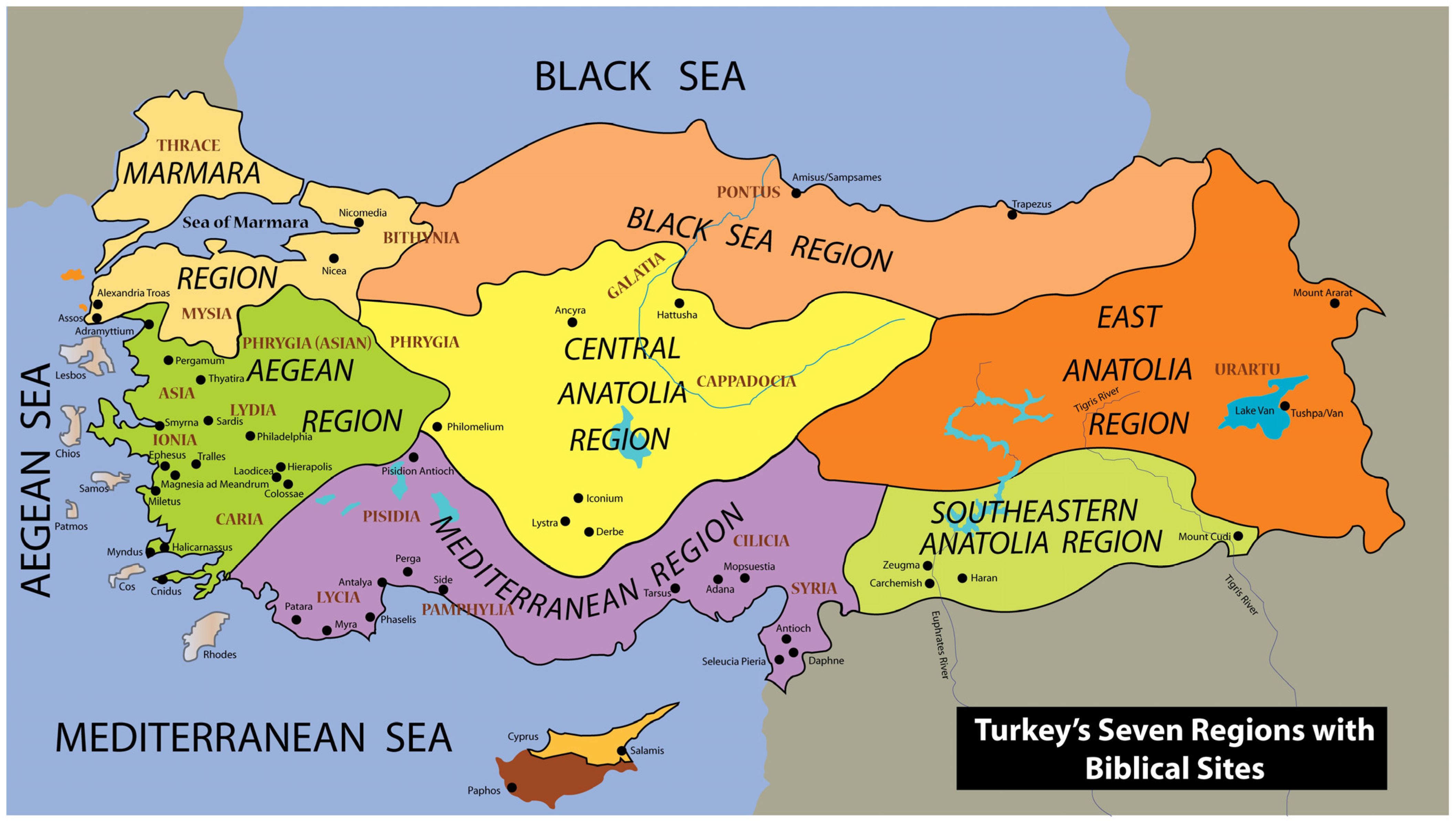
1 After Israel, Turkey has more biblical sites than any other country in the Mediterranean region (
Figure 1). These sites figure prominently in our discussion of the intersection of archaeology and tourism today.
2. Archaeotourism and Faith Tourism
Heritage tourism is one of the largest and most lucrative sectors in the global tourism industry. Two subdivisions of this sector are Archaeotourism and Faith Tourism.
Timothy et al. (
2024, p. 104) define the former as “a form of heritage tourism that focuses on visits to archaeological sites, parks and excavations, is sensitive to the delicate archaeological environment, and stimulates learning about past human activity.” Faith, or religious, tourism, according to
Choe (
2024, p. 831), is “a form of tourism in which visitors are motivated either partly or exclusively by religious reasons…visiting places of religious significance or pilgrimage sites where visitors seek to fulfil both their religious and recreational needs.” Archaeotourists and faith tourists share several distinctive features among travelers today. They are motivated by a deep interest in their subjects and are serious and purposeful in approaching their tour (
Timothy et al. 2024, p. 104). They are also willing to pay the extra cost for itineraries related to such tourism.
Tourism players in Turkey are now recognizing the importance of these expanding sectors. At a conference in Crete,
Lafli and Tsiame (
2025) discussed the rise of archaeotourism at key sites like Ephesus, Pergamum, and Sardis. They rightly note its inherent tension: “Archaeological sites are integral parts of regional histories, heritages, and identities. They are also often major tourist attractions.” How do the scientific goals of archaeologists coexist with the commercial interests of culture ministries and tourist boards? To this end, Özyürek has recently assessed the impact of archaeotourism on the coastal city of Cnidus. She suggests that archaeological tourism and cultural tourism are complementary and can exhibit mutual trust and interaction.
Özyürek (
2025, p. 56) concludes that Cnidus “holds significant potential for archaeotourism due to its geographical advantages, maritime infrastructure based on two separate harbor systems, and rich cultural heritage components.” The cultural component usually includes opportunities to watch carpets being woven in Bergama, ceramics being fired at Selçuk, or pottery being painted in Avanos. These products can then be purchased to become souvenirs and gifts for friends and family back home.
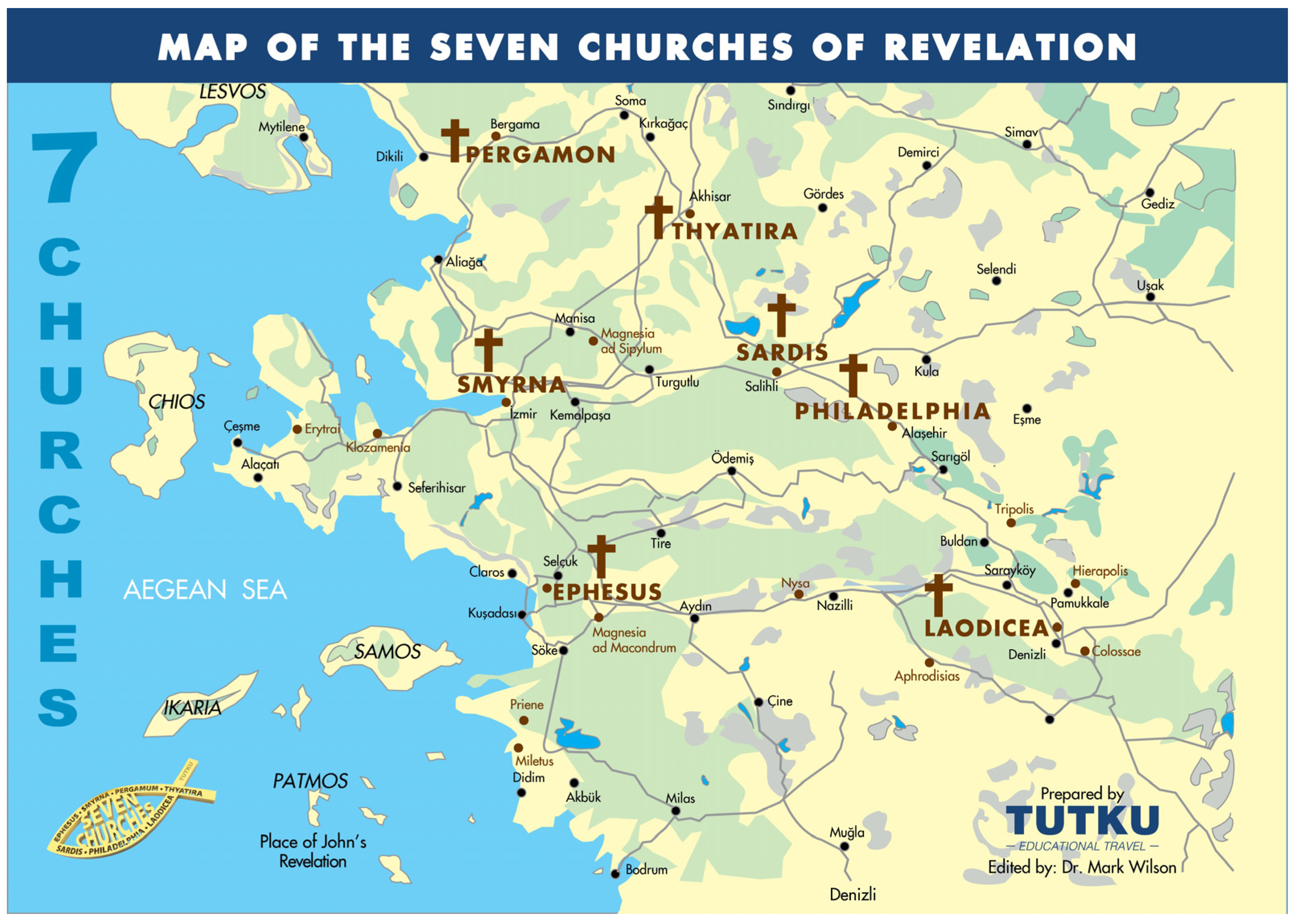
The relationship between archaeology and faith tourism is also being discussed. In 2022 the “Conference on Anatolian Landscape and Faith Tourism: Ancient Times to Present” was held in Cappadocia. It featured presentations on major sites of faith tourism in Turkey. This author was a keynote speaker presenting on “Christian Faith Tourism in Anatolia: Background, Opportunities, Challenges.” The abstracts of the papers were later published (
Tuna et al. 2022, p. 3). Several presenters discussed faith tourism at sites mentioned in this article: Nicaea, Ankara, Hierapolis, Haran, and Urfa. Significantly, the Seven Churches were the subject of three presentations at the conference (
Figure 2).
2Ünal and Çavuşoğlu McKenzie (
2022, p. 3) explored geographical indicators along the route of the Seven Churches. Their focus, however, was largely on the “possible combination of two alternative tourism experiences including faith and food tourism in terms of geographically indicated food products.” They introduced a third ever-present dimension of the tour experience, which is the cuisine. While meals in the morning and evening are generally buffets at the hotels, at lunchtime visitors can taste local food such as çop şiş kebab around Ephesus, odun köfte around Sardis, and gözleme around Laodicea. In fact, for many the gastronomic experience is often as memorable as the archaeological and religious components.
Yozukmaz (
2022, p. 15), using online interviews in English of 294 persons, explored their experiences of existential authenticity while visiting the Seven Churches. He concluded that “that these tours are indeed transformative and memorable experiences, helping individuals find their authentic self during the tours.”
Kunt (
2022, p. 11) assessed the Seven Churches as an important Faith Tourism route. Interestingly, she began the route in Patmos, then traced their order in Revelation chapters 2–3, and finally closed the circle back to Ephesus at the Church of Saint John. She concluded, “The strategy and cooperation of the two countries (Turkiye and Greece) is needed to elaborate the designed tour route.” Her presentation built on her previous studies on the symbiosis between faith tourism and the Seven Churches. In one study
Kunt (
2018, p. 6) surveyed twenty-two Turkish travel agencies organizing tours to the Seven Churches. The survey results for this “niche market” indicated first the travelers’ purpose and motivation: touristic and religious (36%), cultural (22%), emotional commitment (18%), pilgrimage and spiritual (13%), and following St. Paul (9%). Second, the origin of the groups was largely from America (40%) and Europe (50%).
Interpreting these results is somewhat challenging since the categories “religious,” “spiritual,” and “St. Paul” have significant overlap. If these categories were combined, the primary motivation for these Seven Churches tours would be religious-spiritual (58%). That Europe was the main source of these groups is quite surprising. The tourism model in Turkey’s Mediterranean and Aegean regions is an all-inclusive one (Turkish: herşey dahil). European and Russian tourists typically buy a package vacation that includes charter flights and a week in a beach hotel that includes all food and alcoholic drinks. Due to high volume, these tours can be packaged quite inexpensively. All-inclusive tourists are generally disinterested in archaeological or religious heritage, so remain in their hotels. The increased cost of a faith tour over an all-inclusive beach vacation has been a significant disincentive for European Christians to come.
A final surprising conclusion from Kunt’s survey is the Christian affiliation of the visitors: Catholics (63.64%), Protestants (31.82%), and Orthodox (4.55%). Catholic groups generally make pilgrimages to shrines like the House of Mary in Ephesus or to Jerusalem to walk the Via Dolorosa. This author has met few Catholic groups during hundreds of personal and group visits to the Seven Churches. Most memorable was a meeting in Sardis with the Archbishop of Cape Town and his group who were visiting the Seven Churches on their way to Medjugorje in Herzegovina. How did this inflated statistic regarding affiliation come about? Turks have minimal knowledge of Christianity, particularly its three branches. They are somewhat familiar with Catholics and the Orthodox, but not with Protestants since their number in Turkey is less than 15,000 today. I suspect that the travel agencies just guessed at the affiliation of their groups, and chose “Catholic” because it was more known and recognized.
3 In another article Kunt and Güngör discussed the place of the Seven Churches within faith tourism in Turkey. They (
Kunt and Güngör 2017, p. 71) close, saying that “the Seven Churches have an important place in religious tourism, both in Christian history and in Turkey”.
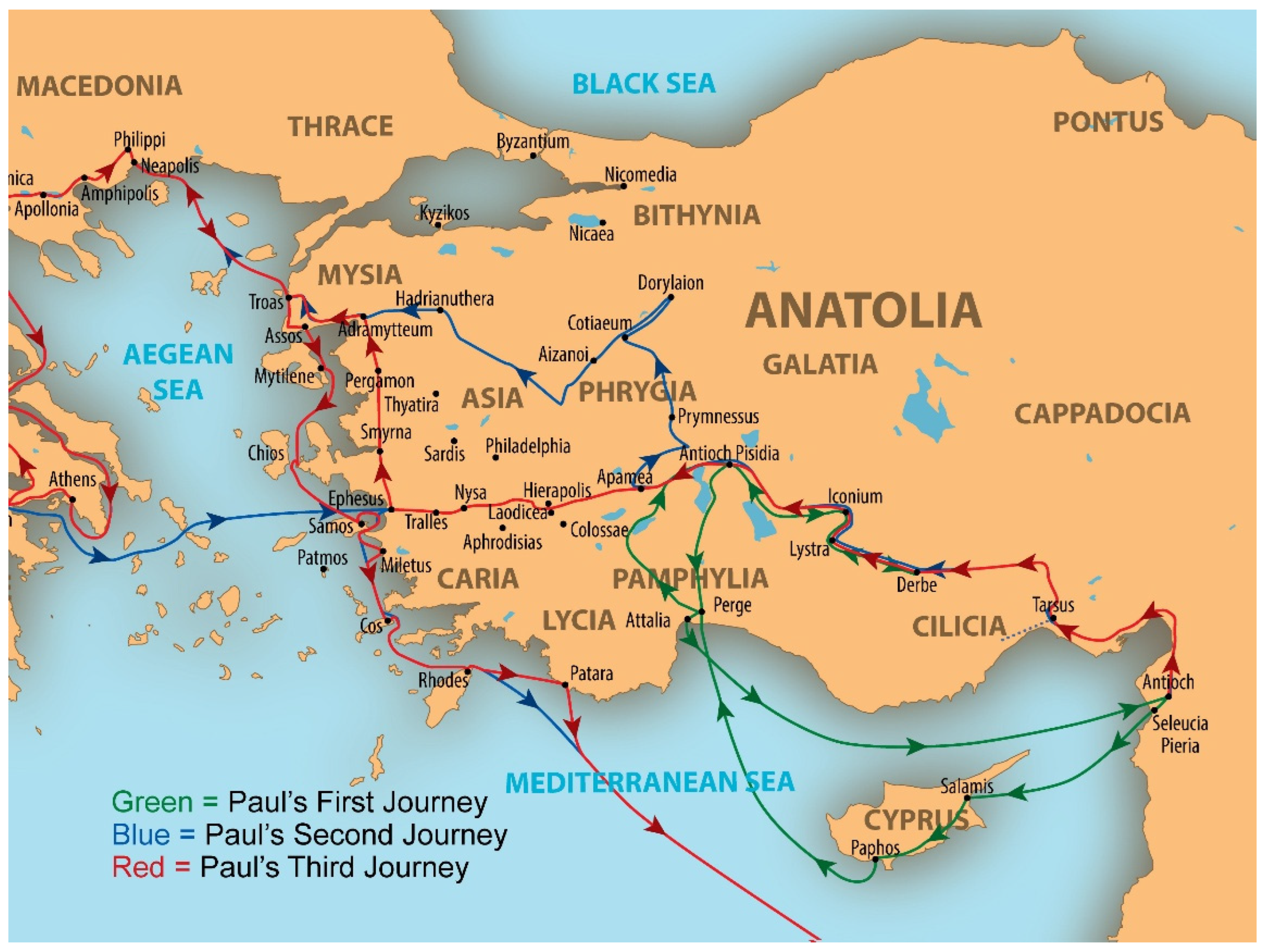
Lest the Seven Churches seem the only focus of faith tourism in Turkey, Paul and his journeys in Asia Minor are also important (
Figure 3). At an international tourism symposium in Anamur in 2019, Erçoklak, Tanrısever, and Pamukcu gave a presentation on Tarsus, the home of Paul, and its potential for faith tourism. For their data the authors asked six questions in interviews with various local players: Tarsus Municipality Cultural Affairs Manager, Tourist Guide, Tarsus Museum Director, Tourism Researchers, Priests, and Archaeologists. The three (
Erçoklak et al. 2019, p. 522) summarize: “Tarsus and St. Paul were not developed enough in faith tourism. Activities should be replicated and sustainability of awareness should be ensured.” They also noted that the lack of accommodation for tourists was an infrastructural deficiency. In an earlier study
Başer and Başçı (
2012, p. 423) had similarly concluded that “this place should not be considered as a religious tourism center because Christians frequently visit this place with one-day tours.” Daily tours predominate because Tarsus, a city of over 350,000 people, has lacked a touristic class hotel. Groups typically stay in Adana or Mersin, both one hour away. Perhaps the opening of the new Çukurova International Airport 16 miles/26 km southeast of Tarsus will change that.
Belge et al. (
2024, p. 61) conclude that potential for an increase in tourism exists in Tarsus; however, “the citizens still use the historic area in their daily life and want to continue their cultural way of life while demanding the arrangements required by contemporary life.”
The new Tarsus Archaeology Museum features a room dedicated to Paul and his travels. This acknowledgement of its native son makes the city even more attractive to faith tourism. Lastly, faith tourists desire direct tactile experiences with antiquity, particularly the opportunity to walk upon a road used by Paul. One of Turkey’s best-preserved Roman road is located north of Tarsus above the village of Sağlıklı. However, inadequate roads for large buses makes this archaeological treasure inaccessible to groups. If the municipality could provide shuttle buses to the Roman road, this would entice groups to stay at least one night in Tarsus.
3. Spiritual Practices of Archaeobiblical Tourists
The development and expansion of archaeological sites in Asia Minor have brought increasing numbers of archaeotourists who are arriving by land and sea. However, one negative hindering greater expansion is the ongoing political turmoil in the region. When travel insurance cannot be purchased or travel advisories are issued by governments, travellers, particularly student groups, must stay home. Nevertheless, faith tourism continues to expand. In this author’s experience, the Christians who visit Turkey are mainly Protestant and evangelical. They read the Bible as the Word of God and view it as historically and geographically accurate. Such Christian groups do not fit neatly into profiles of either archaeotourists or faith tourists, since they comprise a hybrid demographic here called archaeobiblical tourists. They come because they want to see and experience the places where Paul, Peter, and John ministered and to see the cities mentioned in the New Testament. Along the way they are introduced to the archaeology of Greco-Roman cities—agoras, temples, stoas, and bathhouses—but gaining this knowledge is secondary to their spiritual experience. Nevertheless, they are eager to have the dots connected between what they read in Scripture and what they see on the ground. Such an intersection can happen, for example, during a visit to the stadium at Perga where Paul’s exhortation to the Corinthians is read: “Do you not know that in a race all the runners run, but only one receives the prize? So run that you may obtain it. Every athlete exercises self-control in all things. They do it to receive a perishable wreath, but we receive an imperishable one.” (1 Corinthians 9:24–25 ESV). Here Paul uses the analogy of ancient athletic games to describe the Christian life. Connecting scriptures with archaeological realia brings texts like this to life, thus making the investment of time and money worth it.
While visiting the biblical sites, archaeobiblical groups typically read relevant scriptural passages, pray, share a word of exhortation, and even sing a hymn or worship song. While prayer and Bible reading are quiet activities, singing on site often brings the unwelcome attention of security guards. Each morning groups often have devotional time, which includes singing and praying. This usually occurs on the bus while riding to the first site, since religious activity at sites and museums is not allowed by the Turkish Ministry of Tourism. Unlike Jordan or Israel, which have allowed facilities to be built to serve Christian pilgrims, Turkey has not permitted the construction of similar facilities near sites. Catholic groups celebrate the mass each day so must have their liturgy in hotel meeting rooms. If they are in cities like Konya or Izmir, they can arrange with local priests to meet in their churches. Protestant groups similarly must use meeting rooms for worship activities. Those visiting Antalya often arrange to meet at the Saint Paul Cultural Center or to worship at the Saint Paul Union Church if there on a Sunday morning. Biblically trained tour guides are familiar with Christian worship practices and therefore can assist group leaders to find the space and time for religious meetings. In summary, since this demographic is both biblical and archaeological, the term “archaeobiblical tourists” best describes them. However, their primary motivation remains the Bible and not archaeology.
4. Biblical Archaeology Guidebooks and Study Bibles
Biblical archaeology guidebooks have played an important role in introducing the biblical sites of Asia Minor to Christians. Many armchair readers of such guidebooks have later become archaeobiblical travelers. Yamauchi published an important volume in 1980. In the United Kingdom it was entitled
The Archaeology of New Testament Cities in Western Asia Minor (
Yamauchi 1980b), while its title in the United States was modified to
New Testament Cities in Western Asia Minor with the subtitle:
Light from Archaeology on Cities of Paul and the Seven Churches of Revelation. (
Yamauchi 1980a) Significant in both titles was the connection of archaeology with ancient cities related to Paul and John. In Turkey a volume entitled
Biblical Sites in Turkey was released in (
Blake and Edmonds 1977).
4 However,
Yamauchi (
1980a, p. 34 n. 7) describes this as “disappointingly brief and superficial.” Turkish tour guide turned publisher, Fatih Cimok, produced a series of impressive volumes featuring biblical themes—
A Guide to the Seven Churches (
Cimok 1998),
Biblical Anatolia (
Cimok 2000), and
Journeys of Paul (
Cimok 2004). Though the text was popular and brief, the books offered stunning photographs taken by Takeko Harada. These volumes, although somewhat dated, continue to be sold in museum shops around Turkey. Oxford University Press, in its series of guidebooks of the antiquities of Greece and Turkey, released Fant and Reddish’s
A Guide to the Biblical Sites in Greek and Turkey (
Fant and Reddish 2003). Each archaeological site has an excellent description accompanied by grayscale photographs and some site plans. While twenty-four major sites in Turkey are discussed, secondary biblical cities receive no treatment. New discoveries over the past two decades have also dated its discussion. Fairchild published
Christian Origins in Ephesus & Asia Minor (
Fairchild 2015). It is organized around discussions of Pauline sites, the Seven Churches, and the cities of Ignatius. It includes high-quality photographs taken by the author himself. Last but not least is this author’s volume
Biblical Turkey: A Guide to the Jewish and Christian Sites of Asia Minor released in 2010. Now in its fifth printing and in a second revised edition in English (
Wilson 2025), the guide has been translated into German, Japanese, and Chinese. The biblical sites are organized within Turkey’s seven regions, and then alphabetically within the regions.
5 It also features In-Sites about personalities and events related to sites and archaeological realia. The volume is likewise sold in museum shops at archaeological sites throughout Turkey.
Study Bibles with an archaeological focus, released by the Christian publishers Zondervan and Crossway, have also created interest in archaeobiblical tourism. Zondervan’s volume is the
Archaeological Study Bible: An Illustrated Walk Through Biblical History, which was awarded the Gold Medallion Book Award for Bibles in 2007 (
Kaiser and Garrett 2005). Crossway’s title is the
ESV Archaeology Study Bible, which was the winner of the Evangelical Christian Publishers Association Book of the Year Award for Bibles in 2018 (
Currid and Chapman 2018).
6 Both had widespread sales, showing the interest among Bible readers to understand the connection between archaeology and the biblical text.
7 5. Sites in Asia Minor Related to Archaeobiblical Tourism
Some of the main sites and itineraries for archaeobiblical tour groups are discussed next, starting from the east and moving west. This geographical movement also follows the chronological trajectory of the Biblical narrative. Many potential visitors to Asia Minor are reluctant to travel to the Middle East since Turkey is usually on the negative side of the news cycle, particularly because of conflicts in bordering countries. The 2023 earthquake in southeastern Turkey caused some to cancel, not realizing that the Seven Churches were approximately 600 miles/950 km away. Often tours to western Turkey are packaged together with visits to Greece’s biblical sites. Whereas Greece is perceived as a stable European destination, Turkey remains an unknown entity. On any given land tour, someone will acknowledge that friends or family members tried to discourage them from traveling to Turkey because of the perception that it is dangerous. When asked their opinion about the security situation after traveling in Turkey, many say they felt safer during the tour than in their own hometown in the United States.
5.1. Noah’s Mountain
Christians around the world have maintained an ongoing interest in Mount Ararat as the place where Noah and the ark finally came to rest. While it is agreed that Ararat is in eastern Turkey, its localization in that region remains a matter of considerable debate. The French explorer
Navarra (
1974) claimed to have found wood from the ark when he surveyed Ararat (Turkish: Ağrı Dağı) in northeastern Turkey. Such spectacular anecdotal claims produced widespread interest in the secular and religious press. Astronaut
Irwin (
1985) led multiple expeditions in the 1970s and 1980s to the mountain. His activity also spawned numerous expeditions and publications, often for apologetic reasons. Kurdish terrorists had gained control of areas of the mountain and even held hostage some explorers for ransom. So Turkish authorities prohibited exploration on the mountain for security reasons. When security was finally stabilized, exploration resumed including a team from Media Evangelism in Hong Kong in 2003. The group even created a Noah’s Ark theme park in that Chinese city.
8 In 2005 the Turkish archaeologist Oktay Belli organized the first International Symposium of Mount Ararat and Noah’s Ark at nearby Doğubayazit. Six more symposia were to follow with the seventh held in 2023 at İbrahim Çeçen University in Ağrı. Belli edited the conference proceedings and their publication soon followed. Most recently, Belli has partnered with American archaeologist
Younker (
2021) to foster further exploration and excavation on the mountain. They have co-edited a book that discusses recent findings related to Mount Ararat (
Kaya et al. 2024).
The traditional site for Mount Ararat is located in southeastern Turkey at Judi Mountain (Cudi Dağı) above the Tigris River near the border of Turkey, Syria, and Iraq. The intrepid Gertrude Bell visited and photographed the site in 1909. Şırnak University sponsored two international symposia in 2013 and 2021 to bring attention to Cudi as the Mount Ararat known from early Jewish, Christian, and Muslim traditions.
9 A research expedition in 1987 documented seven completed Assyrian reliefs and their inscriptions on its south side facing the Mesopotamian plain. One dates probably to the reign of Tiglath Pileser I (1114–1076 BCE) while the others date to the reign of Nebuchadnezzar (705–681 BCE) (
Erkanal-Öktü and Erkanal 2020, pp. 43–58). The inaccessibility of the reliefs makes visiting them difficult. Here, Kurdish terrorist activity also made survey and excavation work on the mountain impossible for decades. With security now guaranteed, Muslim and cultural activities have resumed on Cudi. However, Christian interest in the site pales in comparison to Ağrı Dağ, although Cudi is this author’s preferred siting for Ararat.
5.2. Abraham’s Country
Şanlıurfa is an archaeotourist and faith tourist magnet in southeastern Turkey.
10 Muslims make a pilgrimage here to visit the cave where the prophet Abraham was traditionally born. Some 40 miles/64 km to the southeast is biblical Haran where eleven of the twelve patriarchs were born and from where Abraham departed with his family for the Promised Land (Genesis 12:4–5). Known as Carrhae in the Roman period, it was also the site of one of Rome’s worst military defeats in 53 BCE. Because of the rich Islamic history at Haran, particularly the university founded in 717 CE, excavations have been ongoing since 1983, with work now occurring at the citadel. East of Harran is the archaeological site of Şuayb named after the prophet Jethro. A cave home there is traditionally associated with this father-in-law of Moses. The discovery and excavation of Göbeklitepe, 20 miles/32 km northeast of Urfa, have brought global interest to the region. First dated to 8000 to 10,000 BCE, the site is now dated to 12,000 BCE. Initially claimed to be the first human temple, it is now identified as an open-air sanctuary for hunter–gatherers who lived in the region. An archaeology museum in Urfa features finds from Göbeklitepe; however, its displays are silent about the city’s rich Jewish history as well as its importance as Edessa for early Syriac Christianity. Nearby is a covered museum whose mosaics are in situ and among which an early image of Jesus was found. The fourteen-year-long civil war in Syria severely impacted archaeobiblical tourism to the region. Excavations at Carchemish, paused since the days of Leonard Wooley and T. E. Lawrence, finally resumed in 2011. The fabulous mosaics discovered at Zeugma on the Euphrates are now displayed in the Zeugma Museum in Gaziantep.
5.3. Peter’s Provinces
The recipients of Peter’s first letter resided in four Roman provinces: Pontus-Bithynia, Galatia, Cappadocia, and Asia (1 Peter 1:1). Although no cities are named, these are easily suggested from inscriptional and textual evidence along with the known road systems in these provinces. The main cities in Pontus are Amisus and Sinope; Galatia: Ancyra and Pessinus; Cappadocia: Caesarea Mazaca; north Asia: Dorylaeum; and Bithynia: Nicaea and Nicomedia. These are likely locations for early Christian communities (
Wilson 2011). Around 111 CE while in Pontus, Pliny the Younger (
Epistles 10.96) wrote Trajan about the worship practices of the Christians he encountered. The emperor instructed him not to intentionally hunt them out, but Christians could be persecuted if already in custody (
Epistles. 10.97).
Despite extensive archaeological activity at sites in north central Asia Minor and along the Black Sea, few Christians visit these ancient cities and their excavations. Some transit through Ancyra (Ankara) on their way to the Hittite capital at Hattusha. Importantly, the Turkish capital boasts the temple of Augustus with its long Latin and Greek inscription. This is the only complete copy of the Res Gestae, often called the “Queen of Inscriptions” (
Cooley 2009, pp. 1–3). The only other extant fragments of the Res Gestae are displayed at the Yalvaç Museum, which houses those from Pisidian Antioch and nearby Apollonia. Cappadocia is one of the most popular tourist sites in Turkey today with its lunar landscape of “fairy chimneys” and well-preserved Byzantine churches. However, few visit nearby Kayseri, whose eponymous name Caesarea suggests its importance as the provincial capital.
Sinope was the main Roman colony in Pontus, and probably where Paul’s companion, Aquila, hailed from (Acts 18:2). The city walls still stand, and a large bathhouse/basilica has been excavated. Its archaeology museum exhibits a number of unique artifacts. Bithynia had two major cities—Nicomedia and Nicaea. Nicomedia is probably the least-visited but most important Roman city in Turkey today. Modern Izmit has overbuilt the ancient one; however, spectacular finds from the excavation of the imperial palace of Diocletian, the last emperor to persecute Christians, are displayed in the Kocaeli Archaeology Museum. Nicaea is the best-preserved Roman city in the country. The streets of modern Iznik still reflect the Hippodamian grid plan and run to the four city gates cut through the high walls that still surround the city. The discovery of the underwater basilica in 2014 brought it international attention with
Archaeology Magazine naming the find the “Archaeological Discovery of the Year” (
Powell 2015). Despite their rich Christian history coupled with significant archaeological sites, these provinces and cities related to Peter are seldom visited today.
5.4. Paul’s Journeys
There are twenty ancient sites related to Paul in Asia Minor. Their geographical situation is twofold. Eight are landlocked, Antioch, Derbe, Lystra, Iconium, Pisidian Antioch, Colossae, Laodicea, and Hierapolis, while twelve are ports with arterial access, Seleucia, Tarsus, Perga, Attalia, Myra, Patara, Cnidus, Miletus, Ephesus, Adramyttium, Assos, and Troas. Tarsus is considered a port because it accessed the Mediterranean via the Cydnus River and the Rhegma lagoon, while Perga had access through its nearby port of Magydus. Archaeological excavation has been ongoing at most of these sites for decades. The recent earthquake in Antakya in 2023, besides causing much death and destruction, damaged Antioch’s archaeological sites and forced the temporary closure of the archaeology museum.
5.4.1. Journeys by Land
Archaeological sites related to Paul’s land journeys are usually visited along one of three itineraries. The long itinerary tracing all of Paul’s land and sea journeys begins in Antioch and ends in Troas.
11 Visiting these and the Pauline sites in between requires at least two weeks of steady travel to cover around 1050 miles/1700 km. If the coastal cities of Myra and Patara are visited, this adds at least two days and more than 300 miles/500 km to the journey. The shorter “first journey” itinerary begins in Antioch, visits Seleucia and Tarsus, and then flies to Cyprus to visit Salamis and Paphos, and to Antalya to finish with Perga and Attalia. This itinerary can be covered in a week.
A modified itinerary covering just the Pauline sites in central and western Asia Minor begins in Antalya. After visiting Attalia and Perga, the next stop is either Myra and Patara along the coast or inland at Pisidian Antioch. Both then converge in the Lycus valley to visit Colossae, Laodicea, and Hierapolis. Next, Kuşadası is used as a base to visit Ephesus and Miletus. Since travel up the coast passes through Smyrna and Pergamum, these cities of Revelation are usually visited. This itinerary ends with an overnight at the harbor in Assos. On the final day Troas and Troy are visited, with archaeobiblical groups either driving or flying back to Istanbul. If the group is continuing to Greece, they cross the border at Keşan to continue their journey with a Greek bus and guide. This itinerary is more compact geographically and takes around ten days to cover.
Two important Pauline sites remained unexcavated until 2024–2025. Lystra and Colossae were only a barren hill or tell (Turkish: höyük). Despite there being little to see, many archaeobiblical groups insisted on stopping at them. Visitors could only climb atop the mounds and take selfies showing they had been there. Excavations at Lystra were begun in 2024 by İlker Mete Mimiroğlu, an archaeology professor at nearby Necmettin Erbakan University. A news release (
Necmettin Erbakan University 2025) highlights the excavation’s significance: “The ancient city of Lystra is important for Konya and Türkiye, both with its ancient historical background and as an important destination for religious tourism.” Not only did the university promote Lystra’s significance, but the locality municipality (
Meram Municipality 2025) also touts Lystra’s importance “as an important center for the history of religions and Christianity with the visit of St. Paul.” Local mayors and other dignitaries have been hosted at the excavation and informed about Lystra’s special significance for Christians because of its mention in the New Testament. This twin refrain, often heard regarding archaeological excavations, is that they fulfil a scientific function enriching local historical heritage while also attracting archaeobiblical tourists. At Lystra they see the site where Paul was stoned (Acts 14:19) and where Timothy was raised by his Jewish mother and grandmother, Eunice and Lois (Acts 16:1–2; 2 Timothy 1:5).
Colossae is better situated for visitation since it is near Laodicea and Hierapolis. A brown sign reading “Colossae” below the tell is a photographic magnet for travelers to document their visit. Depending on time and weather, many walk up the steep path to stand atop the mound and gaze at the lush mountainous landscape. This all changed in 2025 when permission was granted by the Ministry of Culture and Tourism to begin excavations. Barış Yener, an archaeology professor at Pamukkale University in nearby Denizli had conducted surveys at the site from 2022–2024. His team excavated sixty rock-cut tombs in the north necropolis during its initial season. Artifacts from the Iron Age make Colossae the oldest settlement in the Lycus River valley.
Important to both Lystra and Colossae, as well as most other archaeobiblical sites, is the use of social media to inform interested followers. During the season, photos of the excavation along with some finds are uploaded to such platforms as Instagram and X. The websites of the excavations generally publish seasonal results, post additional photographs, and announce related publications to keep friends and supporters of the excavation informed.
5.4.2. Journeys by Sea
For the many who are interested in visiting Turkey but are hesitant to take a land tour, cruises have become an attractive option. In fact, the Mediterranean and Aegean regions have become the initial portal for many North Americans to experience biblical sites. The reason is twofold: the comfort of not having to change hotels regularly plus the feeling of security. The primary destination is Ephesus through the nearby port of Kuşadaşı. During cruise season, the streets of Ephesus are packed not only with regular visitors and biblical groups but also with thousands from the cruise ships. Cruise ships also dock at Dikili for excursions to Pergamum, Çanakkale for Assos and Troas, Izmir for Smyrna and Sardis, Didim or Bodrum for Miletus, and Antalya for Attalia and Perga. Often cruisers who take such brief shore excursions acquire the desire to return and see more sites on a land tour.
A second type of maritime tourism has developed. In 2006 Linford and Janet Stutzman moved their sailboat
SailingActs to the Mediterranean port of Finike for their homebase.
12 Having led many study-abroad programs in Israel, the Stutzmans wanted to use their boat for field studies related to Paul’s sea journeys. Their shore excursions include visits to ports and archaeological sites such as Myra-Andriake and Patara. However, due to limited capacity on
SailingActs, they began to charter larger wooden-hulled boats called gulets to accommodate their groups. The popularity of maritime tourism increased when Tutku Educational Travel began to sponsor gulet tours in cooperation with the Biblical Archaeology Society. Depending on the size of the gulet, twelve to thirty-two persons could join these archaeological tours following in the wake of Paul. Though the gulet experience is more expensive, having a private boat with a dedicated captain and crew provides a more personalized and comfortable experience. It also gives travellers the opportunity to engage with nautical archaeology along Turkey’s extensive coastline. The city of Bodrum hosts not only the Museum of Underwater Archaeology where the famous Uluburun Shipwreck is exhibited, but also the Bodrum Research Center of the Institute of Nautical Archaeology sponsored by Texas A&M University.
5.5. John’s Seven Churches
The Seven Churches is perhaps the most popular itinerary for archaeobiblical visitors to Asia Minor. They fly into the airport at Izmir and use the city as a base to visit Ephesus and Smyrna. Pergamum and Thyatira can be visited in a day with accommodations at Salihli near Sardis. Sardis, Philadelphia, and Laodicea can be toured the next day. Visits to Hierapolis and Colossae follow on the next morning with a drive back to Izmir in the afternoon, thus completing the circle. Such a tour takes four to six days, depending on the level of interest and the time spent in each of the archaeological sites. The itinerary follows modern asphalt roads, and its circular route covers approximately 420 miles/675 km.
Many also wish to visit Patmos where John received his Revelation of Jesus Christ. Complicating such a visit is the fact that Patmos is a Greek island in the Schengen Area. While passport holders from developed countries have no difficulty landing at Patmos, those from many other countries are barred from access. Public and private ferries provide transport from the Turkish port of Kuşadaşı. Visiting Patmos’ Church of the Apocalypse and the Monastery at Chora are a must-see for many groups on a Seven Churches tour.
6. Archaeological Outcomes
Archaeobiblical tourists who complete a tour of Pauline cities or the Seven Churches return home with many memories along with photographs of archaeological realia. The following list mentions only part of what was seen. Theaters, both restored and unrestored, are found at almost every site.
Ephesus: Library of Celsus, Gate of Mazaeus and Mithridates at the commercial agora.
Miletus: Jewish-Godfearer and archangel inscriptions in the theater, Lion Harbor.
Smyrna: Agora cryptoporticus with Greek pictorial and textual graffiti.
Pergamum: Imperial cult temple, Asclepium, red-brick Egyptian temple.
Assos: Temple of Athena, Hellenistic walls.
Troas: Double harbor, columns in granite quarries.
Sardis: Largest Diaspora synagogue, best-preserved Artemis temple.
Laodicea: Restored Christian basilica, nymphaeum, theater, and stoa.
Hierapolis: Plutonium, five necropolises, martyrium and basilica of the apostle Philip.
13Patara: Restored lighthouse and bouleterion.
Myra: Harbor at Andriake, Basilica of Saint Nicholas.
Attalia: Roman funerary monument, Hadrian’s gate, necropolis museum.
Perga: Roman bathhouse, Hellenistic gate, stadium.
Pisidian Antioch: Aqueducts, imperial cult temple, Res Gestae inscription.
Tarsus: Basalt street, Roman bridge, concrete temple.
Antioch: Hippodrome, Charonion rock-relief, mosaic museum.
Seleucia: Vespasian’s tunnel, harbor walls.
This brief inventory demonstrates that tours of sites in Asia Minor will enlarge any visitors’ knowledge of archaeology. As the guide and group leader(s) repeat architectural terminology along with rehearsing civilizations, dates, and rulers, travelers gain a new lens through which to view the Bible. Reading scripture has now gone from a 2D to a 3D experience after they have passed through the city gates, walked the paved streets, entered the porticoed agoras, and sat in the tiered theaters. Archaeobiblical tourists return home well satisfied that their investment of time and money was worth it.
7. Marketing Archaeobiblical Tourism
All travel agencies operating in Turkey must be certified by TÜRSAB (Türkiye Seyahat Acentaları Birliği), the Association of Turkish Travel Agencies. This ensures that groups are covered by travel insurance, have a professional bus driver, and are using a guide licensed by TÜREB (Türkiye Turist Rehberleri Birliği), the Union of Tourist Guides of Turkey. In the past groups wanting to organize a biblical tour generally contacted their local travel agent who would in turn liaise with a Turkish agency to organize the tour’s land portion. This included booking hotels, organizing transportation, purchasing entrance tickets, and selecting a guide. These agencies, often based in Istanbul, sometimes had little experience with archaeobiblical tourism and used cookie-cutter itineraries shared among the agencies.
With increased usage of the internet, the role of travel agencies diminished and groups began to book their land arrangements directly with agencies in Turkey specializing in archaeobiblical tourism. Izmir, ancient Smyrna, emerged as a center for agencies with this specialization. Tutku Educational Travel emerged as a leader in the archaeobiblical sector. In the early 2000s Levent Oral, the president of Tutku, began to exhibit at two of the leading societies for biblical scholars—the Society of Biblical Literature and the Evangelical Theological Society. In mid-November each year, the societies convene their annual meetings in the same American city. By being an annual exhibitor for over two decades at SBL and ETS, Tutku has built an extensive clientele that includes universities, seminaries, churches, and Christian organizations.
14 In 2009 Tutku sponsored two Turkish archaeologists, Akın Ersoy and Cumhur Tanriver, to travel to the annual meetings in Atlanta where they presented on their archaeological excavations in Smyrna. Plans are being made for Barış Yener to attend future ETS/SBL meetings to present the excavations at Colossae.
Tutku has been a major sponsor of conferences in Turkey to highlight its biblical sites. The Global Smyrna Meeting, held biannually in 2021, 2023, and 2025, has focused on the Seven Churches. Lectures by scholars of Revelation and site visits to each church were featured in the program. In 2024 the Antioch Conference on Peter and Paul was held in Antakya to focus on these two apostles and their legacy in this important biblical city. After two days of presentations, the group traced Paul’s first journey visiting Seleucia, Salamis and Paphos on Cyprus, and ending in Perga and Attalia. A second Antioch conference is announced for 2026.
The 1700th anniversary of the Council of Nicaea in 2025 produced numerous special events geared for faith tourists. Since most evangelical Christians know little about creeds and church history, the celebration attracted less attention among this segment of the global Christian community. Pope Francis was scheduled to visit Nicaea in the spring of 2025; however, his death on April 21 prevented that. Pope Leo XIV has announced that he will travel to Istanbul in late November to visit the Orthodox Patriarch, Bartholomew. The two will then travel to Nicaea for an ecumenical commemoration of the 1700th anniversary of the First Council. That the heads of two major branches of Christianity see Nicaea as an important milestone in church history has stimulated some of their constituencies to make the pilgrimage themselves. Travel agencies have also facilitated symposia to celebrate the anniversary. Tutku hosted a symposium on Nicaea in Iznik and Istanbul in June, while EnjoyTours sponsored a symposium entitled “Nicaea: One Lord, One Faith, One Gospel” in October 2025.
There are twenty-two properties in the list of UNESCO World Heritage sites in Turkey, most of which are archaeological sites.
15 Hierapolis-Pamukkale is one of the most visited touristic destinations today. Many tourists come to walk or bathe in the thermal pools, but get exposed to its archaeology while walking through the site. Joining it on the UNESCO list are Pergamum and Sardis along with Cappadocia and Hattusha, the Hittite capital. Troy is often visited because of its proximity to Assos and Troas; Aphrodisias is also on many itineraries because of its proximity to Laodicea and Colossae. In the Southeast, Nemrut Dağ and Göbeklitepe are often included with visits to Urfa. That these archaeological sites have UNESCO status is not significant for most archaeobiblical groups. Nevertheless, the status brought by this designation is another marketing point to attract visitors.
Transportation is a final factor important to the growth of archaeobiblical tourism in Turkey. In the 2010s direct flights to Istanbul were offered by several American air carriers. After these were discontinued, Turkish Airlines (TA) stepped into that travel vacuum. First offering direct flights only to airports like New York’s JFK, Chicago’s ORD, or Washington’s IAD, TA began to expand the number of cities for its direct flights. The opening of the new international airport in Istanbul in 2019 helped to facilitate the expansion of TA’s services. Presently it offers nonstop flights to fourteen American cities and three cities in Canada. It also offers similar services to major cities in Asia, Africa, and South America. This is significant since some archaeobiblical groups originate in Australia, New Zealand, South Korea, South Africa, and Brazil. Coupled with this expanded service has been TA’s increased advertising of Turkey’s archaeological sites. This author regularly views its well-produced infomercials on CNN International. They feature excellent drone footage of sites like Ephesus, Pergamum, and Cappadocia. The visual excellence of this advertising has been successful in attracting many new visitors to Turkey. Also, TA’s inflight magazine Skylife features promotional inserts from the Turkish Ministry of Tourism suggesting places for tourists to visit. The Seven Churches are among the destinations featured in this advertising.
8. Training for Archaeobiblical Tourism
Turkey has an extensive training program to prepare professional tour guides. Many universities have faculties of tourism where guides are trained. Because Turkey is a Muslim country, knowledge about ancient Judaism and Christianity in Asia Minor is lacking. As biblical tourism became to take off in the 2000s, George Keenan of Rainbow Tours saw the need for Turkish guides to be better trained to work with biblical groups. In 1999 he organized in Izmir the first seminar for guides. This author was invited to be the presenter. It was held in the Anglican Church and featured a full house of interested guides. One point emphasized to the guides was that most of their clients will have previously visited Israel before coming to Turkey. Israeli guides are well-trained particularly in the Old Testament, thus able to connect the archaeological sites there with the Scriptures. Whether fair or not, experiences with their Turkish guide are being compared with their interaction with an Israeli guide.
This seminar was a watershed event for the guides who attended. Many realized the potential for archaeobiblical tourism as an emerging sector. Through professional development, they began to specialize in working with archaeobiblical tourists. After Keenan’s death, Tutku began to organize similar seminars for guides in cooperation with İZRO (İzmir Turist Rehberleri Odası), the Izmir Chamber of Tourist Guides.
16 These six-day seminars combined classroom instruction with field visits led by myself or Mark Fairchild. We took the guides, numbering between 25 and 50, through the sites as we would lead an archaeobiblical group. At each site we tried to connect its archaeology with the biblical text of Revelation and Acts. Each January Tutku also sponsors a one-day seminar for guides wherein Turkish archaeologists at biblical sites present updates regarding their excavations and finds. The past two decades has seen archaeobiblical tourism expand dramatically. Many guides are now knowledgeable about biblical sites and their archaeology and thus able to give archaeobiblical visitors a more informed experience in Turkey.
9. Conclusions
This article has discussed the growing sector within heritage tourism in Turkey related to archaeobiblical tourism. Christians from around the world are motivated to see places where biblical events took place and where the apostles traveled and lived. An infrastructure is developing to facilitate such tourism from the Ministry of Tourism down to the local level. Travel agencies are preparing itineraries and guides are trained with necessary information, particularly with regard to the Seven Churches and Paul’s journeys. They facilitate visitors learning about archaeology and its related vocabulary while actually touching the stones where biblical history happened. Archaeobiblical tourists snap thousands of photographs that they post on social media or use in PowerPoints for presentations to home groups, Bible studies, and Sunday Schools. Pastors and professors likewise use their photos for sermons and lectures. This sharing of knowledge and experience functions as an important element in the pilgrim’s journey. Seeing and hearing the benefits of an archaeobiblical tour often creates a desire in friends, parishioners, and students to make their own visit. In sum, this article has demonstrated that symbiosis does exist between archaeology and archaeobiblical tourism in Asia Minor.