3.1. Phonetic Re-Semanticization: From “Mañjuśrī” to “Wen-sui”
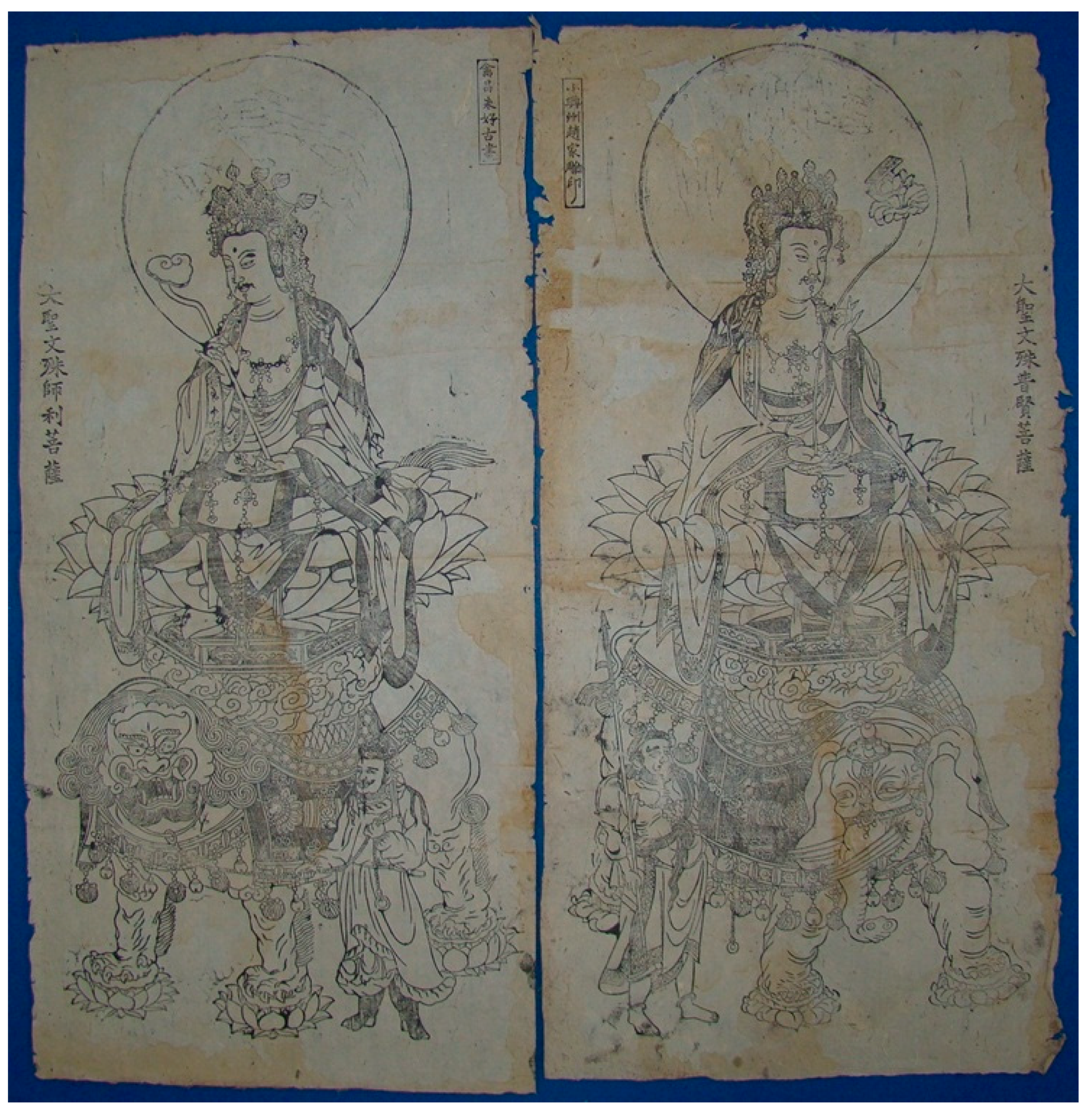
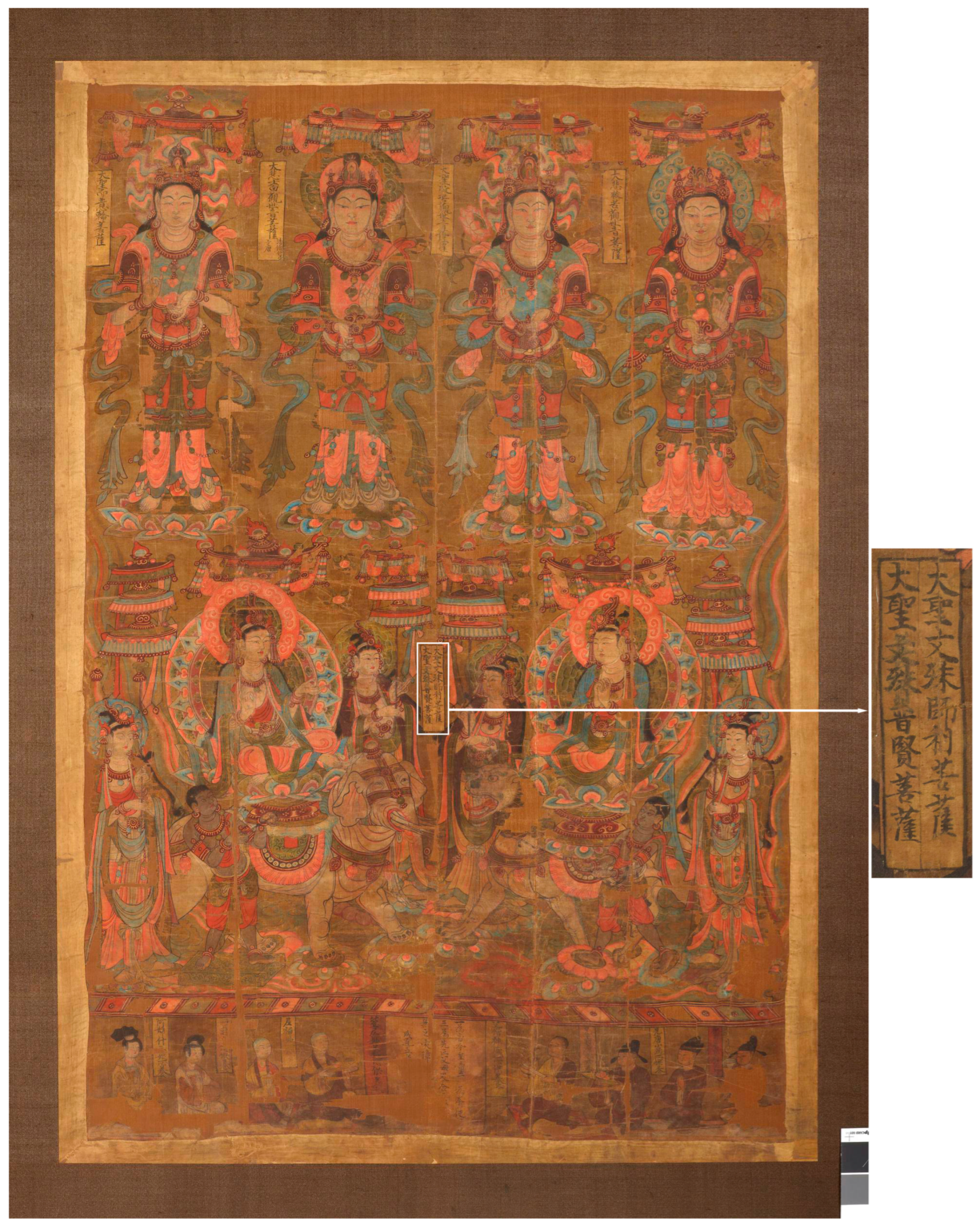
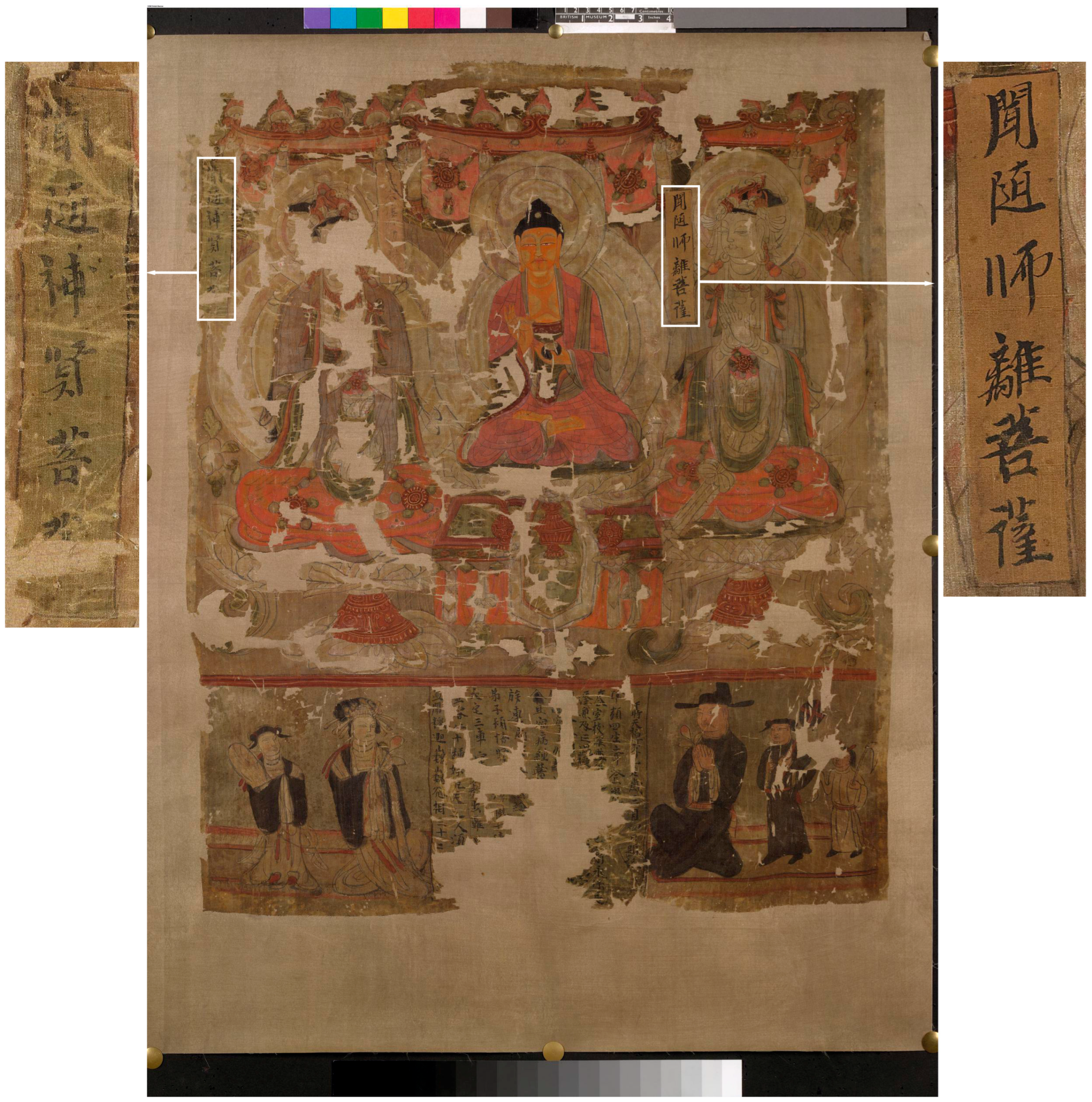
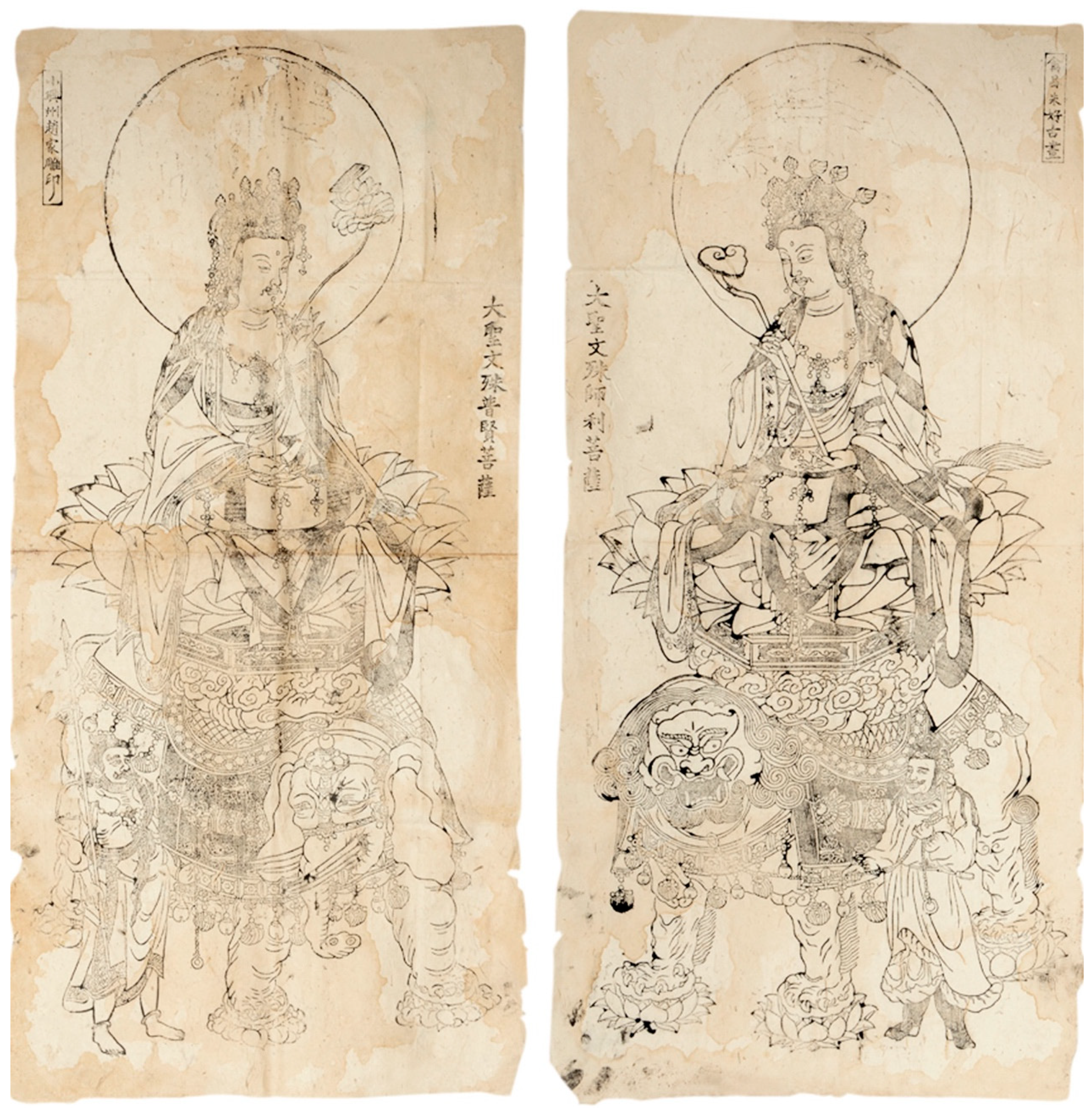
The recurrence of the variant “Wen-sui” (聞隨) in the 939 CE painting provides the crucial linguistic key to unlocking the logic of the conflation. While the standard Chinese transliteration for the Sanskrit Mañjuśrī is Wen-shu (文殊), the variant Wen-sui appears anomalous. However, when analyzed through the lens of historical phonology specific to the Northwest region, this shift reveals a coherent pattern of localization.
It is important to acknowledge that in the orthodox Qieyun (切韻) rhyme dictionary system (Early Middle Chinese) (
Baxter 1992, pp. 45–50), the two characters were distinct: Sui (隨) belonged to the Wei rhyme class (微韻), while Shu (殊) belonged to the Yu rhyme class (魚韻). However, phonological studies on Dunhuang manuscripts have identified a specific dialect feature of the Late Middle Chinese period known as “the merging of the Zhi and Wei rhymes into the Yu rhyme” (支微入魚). As demonstrated by the linguist Wang Junhu, who analyzed the phonetic patterns in the Jin-Shaan-Gan dialects and Dunhuang manuscripts, the actual speech habits in the Hexi Corridor during the late Tang and Five Dynasties differed significantly from the dictionary standard (
J. Wang 2004).
Specifically, regarding the initials, the Guangyun dictionary categorizes Sui (隨) under the Xie (邪) initial, indicated by the fanqie spelling “Xun-Wei” (旬為切). According to Wang’s reconstruction of the Northwest dialect, this syllable likely shifted towards the pronunciation xu in the local vernacular. Meanwhile, the character Shu (殊) belongs to the Chan (禪) initial class, indicated by the fanqie “Zhi-Shu” (陟輸切). The reconstructed value for this initial is ʑiu, where the symbol ʑ represents the voiced counterpart of the voiceless alveolo-palatal fricative ɕ (equivalent to the Pinyin x). Consequently, in the acoustic environment of the period, the pronunciation of Shu also approximated xu. Thus, Sui and Shu converged towards a near-identical pronunciation, providing the precise linguistic condition for “Mañjuśrī” (Wenshu 文殊) to be transcribed as “Wen-sui 聞隨.”
Yet, this transformation was not merely a passive phonetic error; it was a process of semantic reconstruction. While the character Shu (殊) in the original transliteration is a meaningless phonetic placeholder, the characters Wen (聞) and Sui (隨) carry profound intelligible meanings in Chinese: “to hear” and “to follow.” In a devotional context, these characters evoke the concepts of “Hearing the Dharma” and “Following the Buddha’s Teachings.”
Therefore, for the local practitioner, the foreign Sanskrit name was effectively domesticated. The bodhisattva was no longer just Mañjuśrī, but the deity of Wen-sui—the one who hears and follows. Once this term established itself as a meaningful, localized signifier for the bodhisattva’s function, it became a detachable linguistic unit. This explains why, in the paintings analyzed, “Wen-sui” (or its formal equivalent “Mañjuśrī”) could be applied as a functional prefix to Samantabhadra, creating the hybrid title “Wen-sui-bu-xian (聞隨補賢)” to denote a deity who encompasses the virtues of both wisdom (hearing) and practice (following).
3.2. The Theological Logic: The Non-Duality of Essence and Function
To understand why the specific iconographic synthesis of Mañjuśrī and Samantabhadra took root in the visual culture of Dunhuang, one must first recognize the region’s status as a vibrant stronghold of Huayan devotion during the late Tang and Five Dynasties. The intellectual landscape of the Guiyijun period was not merely receiving texts from the capital; it was actively visualizing Huayan cosmology as a dominant religious paradigm. As demonstrated by Dorothy Wong in her analysis of East Asian Huayan paintings, the visual evidence from Dunhuang—ranging from monumental cave murals to portable liturgies—indicates that “the Huayan doctrine was of central importance to the Buddhist community at Dunhuang” during this period (
Wong 2007, pp. 337–84). Wong notes that starting from the Mid-Tang, depictions of the Huayan bian (華嚴變 Transformation Tableaux of the Avataṃsaka) increased steadily in the cave-chapels, often occupying prime positions in the ritual space. The existence of large-scale, high-quality votive paintings on silk (similar in material to the artifact under discussion) further attests that the complex metaphysics of the Avataṃsaka were not restricted to scholastic commentaries but were integrated into the liturgical functions of the local elite.
Against this robust background of visual and doctrinal dominance, the specific anomaly in painting Ch.iv.0023 can be understood as a micro-manifestation of a broader theological paradigm. This paradigm is succinctly characterized by
Chen (
2024) as “Huayan serving as the Essence, and Esoteric practice serving as the Function” (華嚴為體,密教為用). This formulation rests upon a foundation of prior scholarship that has elucidated the intrinsic continuity between the two traditions. The theoretical groundwork was laid by the historian Yan Yaozhong (嚴耀中), who argued that Chinese Esoteric Buddhism and the Huayan tradition possess a fundamental “consistency in substance” (本體上的一致) (
Yan 1999, pp. 82–94). Yan specifically points out that the Avataṃsaka Sutra provided the theoretical basis for Esoteric concepts such as the “Three Mysteries” (三密 sanmi) and “Consecration” (灌頂 abhiṣeka). Most crucially, Yan argues that the Esoteric veneration of Mahāvairocana is fully consistent with the Huayan concept of the Dharmakaya Vairocana, stating that “Esoteric Buddhism is merely taking this Dharmakaya Buddha Vairocana [of Huayan] and further sculpting him into a speaking, formed, and personified idol”
3. This observation underscores how Esoteric iconography functions as the concrete manifestation (“Function”) of the abstract Huayan “Essence.”
This synthesis was not merely a later theoretical construction but was historically enacted by the highest authority of the Huayan School. As recorded in the “Biography of the Great Virtuous Monk Fazang of the Great Jianfu Temple in Tang” (唐大薦福寺故寺主翻經大德法藏和尚傳 Tang Da Jianfusi Gu Sizhu Fanjing Dade Fazang Hoshang Zhuan) by the Silla scholar Ch’oe Ch’iwŏn 崔致遠 (857–?), the patriarch Fazang 法藏 (643–712) himself employed Esoteric ritual technology to serve Huayan teleology. The biography records that during the Khitan rebellion in the first year of the Shengong (神功) era (697 CE), Empress Wu commanded Fazang to suppress the enemy. Fazang petitioned: “If you wish to subdue the resentful enemy, I request to employ the methods of the ‘Left Way’ (i.e., Esoteric rites)… The Master then bathed, changed his robes, and established a ritual sanctuary for the Eleven-Faced [Avalokiteśvara]…” The narrative concludes that the enemy troops saw “images of Guanyin floating in the sky” and were defeated, a victory the Empress attributed to the “blessing of Compassionate Power”
4. This primary source confirms that the integration of Esoteric rituals (such as the Eleven-Faced Guanyin altar) into the Huayan repertoire was legitimized by the school’s founder himself.
Translating this doctrinal and historical synthesis into specific terms of art history, the scholar Lai Pengju (賴鵬舉) has provided crucial iconographic evidence from the Dunhuang caves. In his analysis, Lai demonstrates that the specific Esoteric forms popular in the region—such as the Thousand-Armed Avalokiteśvara—were not isolated imports but were “derived directly from the Huayan context” of the Potalaka Palace described in the Gaṇḍavyūha. Lai argues that Esoteric icons function as the practical application (Yong) of the Huayan cosmological framework, establishing a solid iconographic mechanism where distinct Esoteric deities are visually treated as emanations of the Huayan Dharmadhātu (
Lai 2009, pp. 188–93).
This theological synthesis finds its most articulate expression in the biography of Chengguan 澄觀 (738–839), the Fourth Patriarch of the Huayan School, whose lifetime overlaps directly with the production of the Dunhuang artifacts in question. According to the Biographies of Eminent Monks of the Song Dynasty (宋高僧傳 Song Gaoseng Zhuan), Chengguan, while contemplating the composition of a commentary on the Avataṃsaka Sutra during the Dali (大曆) era (766–779), formulated a critical doctrinal insight regarding the non-dual relationship between the two bodhisattvas and the Supreme Buddha. The text records his reflection: “Moreover, Mañjuśrī governs Wisdom (智 Zhi), and Samantabhadra governs Principle (理 Li). The two sages combined constitute Vairocana. When the myriad practices are all-encompassing, this is the meaning of the Great Huayan”
5. This statement provides the decisive theological evidence for interpreting the anomaly in painting Ch.iv.0023. In the intellectual framework of the time, Mañjuśrī and Samantabhadra were not merely independent attendants flanking a central Buddha; they were understood as ontologically inseparable components that, when fused, constituted the totality of the Dharma Realm (Vairocana). Therefore, to invoke the “Two Sages” together was, in essence, to invoke the supreme power of Vairocana himself.
This theological synthesis finds its definitive expression in the Contemplations of the Perfect Interfusion of the Three Holy Ones (San-sheng yuanrong guanmen 三聖圓融觀門), a treatise attributed to Chengguan. As
Gimello (
1996, p. 358) has elucidated in his translation and study of this work, Chengguan explicitly argues for the ontological non-duality of the two bodhisattvas. Gimello notes that in Chengguan’s soteriology, Mañjuśrī (representing Faith and Wisdom) and Samantabhadra (representing Principle and Practice) function together as the “two-fold causal dimension” (er-yin 二因) that leads to the “fruition” of Vairocana. Crucially, Chengguan formulates a logic of mutual implication that directly illuminates the iconographic anomaly. He states: “Subsuming both insight and principle, there is only the dharmadhātu of the one mind. Thus, to adduce just one of the holy ones is to imply them both (攝智屬理,唯一心法界,故舉一全收)”. This doctrinal assertion—that invoking one sage automatically necessitates the presence of the other—provides the precise theological license for the donor’s inscription.
However, attributing such sophisticated exegesis to a local votive painting raises a historical paradox regarding how abstract Huayan philosophy, typically reserved for the scholastic elite, could shape the visual practice of a borderland donor. The resolution may be found in the role of monastic intermediaries who operated at the interface of elite doctrine and local practice. The donor’s close familial connection to the sangha—specifically through his father, Monk Shenwei—provides a plausible social channel through which such theological concepts could permeate the lay family’s ritual life.
In the transmission from the text of the capital to the ritual of the frontier, complex metaphysical doctrines were often compressed into performative shorthands. For the local practitioner, the compound title Mañjuśrī-Samantabhadra functioned not as a scholarly citation but as an operationalized ritual formula. The monastic elite understood the theological justification of mutual implication, while the artisans and lay donors adopted the resulting hybrid title as a potent and unified invocation for healing and protection. Thus, the anomaly represents a vernacularization of elite theology wherein the doctrine was preserved not in textual treatises but in the functional logic of the ritual image.
When applied to the visual analysis of painting Ch.iv.0023, this doctrine explains the apparent dissonance between the image and the text. The inscription “The Great Saint Mañjuśrī-Samantabhadra” is not a scribal error but a literal textual transcription of Chengguan’s formula: “The two sages combined.” By visually fusing their names into a single compound title, the donor was effectively constructing a ritual invocation of the “complete” Dharma Body through its constituent powers of Wisdom and Principle. The visual iconography retains the elephant-riding figure to identify the aspect of “Practice” (Samantabhadra), which is the visible “Function” required for the ritual; however, the inscription superimposes the name of Mañjuśrī (“Wisdom”) to ensure that this Practice is grounded in the “Essence” of the Dharma. Thus, the artifact embodies the period’s theological logic: the image serves the Esoteric function of ritual presence, while the text asserts the Huayan essence of non-dual unity.
This theological unity was further concretized by the specific structure of Esoteric rituals circulating in Dunhuang. A close examination of the Ritual Procedure for Offering to Yamarāja (焰羅王供行法次第 Yanluo Wang Gongxing Fa Cidi), composed by Amoghavajra (阿謨伽三藏,即不空), reveals the precise liturgical status of these figures. The text lists a strict sequence of invocations (“Single-mindedly invite…”). Crucially, immediately following the invocation of the Buddhas (including “Maitreya Buddha of the Future”), the text invokes the Bodhisattvas in a specific hierarchy:
Single-mindedly invite the Great Saint Mañjuśrī Bodhisattva Mahāsattva.
Single-mindedly invite the Great Saint Samantabhadra Bodhisattva Mahāsattva.
6
In this liturgical sequence, Mañjuśrī and Samantabhadra are isolated as the primordial pair, listed before even Avalokiteśvara or Mahāsthāmaprāpta. They function as the standard binary unit representing the head of the Bodhisattva assembly. Furthermore, the text’s sequence—positioning Maitreya immediately before this pair—offers a direct textual correlate to the iconography of painting Ch.00224, where Maitreya serves as the central deity flanked by the “Wen-sui” (Mañjuśrī) and “Wen-sui-bu-xian” (Samantabhadra) figures.
Consequently, the inscription “Mañjuśrī-Samantabhadra” on the paintings should be understood not as a confusion, but as a liturgical ligature. It reflects the ritual reality where these two figures are invariably invoked in tandem as a functional set. For the donor, engaging in a rite for “curing illness” or “protection,” the efficacy depended on summoning this specific “Wisdom-Practice Unit.” The compound title on the painting serves as a visual seal of this ritual coupling, affirming that the two bodhisattvas are present not as separate narratives, but as a unified agency of salvation.
3.3. The Theological Logic II: Resolving the Iconographic Asymmetry
While the macro-theory of “Huayan-Esoteric Synthesis” successfully legitimatizes the linguistic conflation of the names, it leaves unaddressed a deeper, structural paradox regarding the specific visual economy of painting Ch.iv.0023. A critical observation of the composition reveals a startling redundancy: If the figure on the left—the elephant-rider labeled “The Great Saint Mañjuśrī-Samantabhadra”—already encapsulates the ritual unity of the two sages via its inscription, does this render the separate, orthodox Mañjuśrī figure on the right (the lion-rider) theologically superfluous? Superficially, the painting presents an unbalanced equation: a “Pure Mañjuśrī” stands alone on the right, juxtaposed against a “Mañjuśrī-infused Samantabhadra” on the left. If the donor’s intent was simply to worship the unified dyad, the inclusion of an independent Mañjuśrī appears to be a chaotic duplication. However, this study proposes that this apparent redundancy may be understood as a precise visual articulation of the ontological priority of Wisdom (智 Zhi)—a specific soteriological position holding that Wisdom must exist as the distinct, generative source before it can be integrated into Practice.
To decipher this specific visual grammar, one must look beyond general Huayan doctrines to the specific exegetical perspective offered by Li Tongxuan 李通玄 (635–730) in his New Treatise on the Avataṃsaka Sutra (新華嚴經論 Xin Huayan Jing Lun). While previous scholarship often regarded Li as a marginal figure whose influence was confined to specific localities, recent bibliographic research has fundamentally reshaped our understanding of his reception in the late Tang.
Chi (
2022) has convincingly demonstrated that the widespread circulation of Li’s thought was catalyzed precisely during the Dazhong 大中 era (847–859), a period marked by the compilation of the Combined Treatise of the Avataṃsaka Sutra (華嚴經合論 Huayan Jing Helun), which fused Li’s commentary directly with the scripture.
This chronological finding is significant for our analysis. The Tang Anjian painting is dated to the 5th year of Xiantong (864 CE)—merely five years after the close of the Dazhong era. This tight chronological proximity renders it plausible to interpret the painting as a visual engagement with the theological currents exemplified by the newly circulated New Treatise. Furthermore,
Li (
2018) has highlighted that during this period, the veneration of Li Tongxuan was particularly intense in Northern China (such as Bingzhou 幷州/Taiyuan 太原), forming a distinct Northern Buddhist sphere that culturally encompassed the Hexi Corridor. Thus, it is historically reasonable to suggest that Li Tongxuan’s theology represents the intellectual zeitgeist accessible to a donor like Tang Anjian. It is within Li’s specific dialectic—which prioritizes the “Fundamental Wisdom (根本智慧)” of Mañjuśrī as the ontological prerequisite for all Practice—that we find a coherent explanatory framework for the painting’s complex iconography.
Using this exegetical framework, the specific arrangement of the figures—an independent Mañjuśrī on the right versus a conflated Samantabhadra on the left—can be decoded as a dynamic diagram representing the causal and temporal hierarchy between Wisdom (智 Zhi) and Practice (行 Xing). In Scroll 3 of the New Treatise, Li Tongxuan establishes a precise ontological relationship between the two sages using the metaphor of family lineage, but he imbues it with a counter-intuitive soteriological twist. He identifies Mañjuśrī as the “Small Boy” (小男 Xiaonan) and Samantabhadra as the “Eldest Son” (長子 Zhangzi). In a secular biological context, the eldest son precedes the younger; however, in Li’s mystical chronology, this order is reversed. The “Small Boy” represents the ontological “First” because he symbolizes the very inception of enlightenment.
To explicate this reversal, Li provides a definitive statement linking the “Small Boy” to the primordial moment of realization:
Mañjuśrī is called the ‘Small Boy’, because he is the head of [Vai]rocana’s initial generation of the mind (Skt. bodhicittotpāda) to realize the Buddha-nature of the Fundamental Wisdom of the Dharma Body; he is the initial realization of the Buddha-nature of Fundamental Wisdom, and is the ‘Family of Wisdom’ of the Holy Nature from which all Buddhas are first born.
7
This passage defines Mañjuśrī not merely as a participant in the path, but as the “Head” (首 Shou) and the “Family/Home” (家 Jia) of the Fundamental Wisdom (本智 Benzhi). He is the “Small Boy” precisely because he represents the “newborn” moment of the initial resolve—a moment that ontologically precedes the “growth” of practice.
Li further grounds this complex reversal in the cosmological symbolism of the Yijing (易經), specifically through the spatial and temporal attributes of the Eight Trigrams. He explicitly associates Mañjuśrī with the Gen Trigram (艮卦), which corresponds to the Northeast direction. In traditional Chinese cosmology, the Northeast is the critical liminal space known as Pingdan (平旦), the break of dawn where darkness ends and light begins. Li writes: “Mañjuśrī corresponds to the Northeast… to the Gen Trigram, which is the Small Boy… It represents the break of dawn, where the appearance of darkness is gone but the full sunlight has not yet manifested; it images the head of enlightenment”
8. He further specifies the attributes of this trigram: “It is Mountain (山 Shan), it is Stone (石 Shi).”
9 This imagery is theologically precise. In the Yijing tradition, the quality of the Gen (艮 Mountain) trigram is defined as “Stillness” or “Stopping” (止 Zhi). Li Tongxuan appropriates this symbol of the “immovable Mountain and Stone” to characterize the nature of Fundamental Wisdom (本智 Benzhi): it is the stable, immovable source of enlightenment, existing a priori before the dynamic “movement” of practice begins. Therefore, Mañjuśrī, as the “Small Boy” associated with the stillness of the Mountain, occupies the station of the “Static Origin”.
In strict opposition to this static source, Li associates Samantabhadra with the Zhen Trigram (震卦), which corresponds to the “Eldest Son” (長男 Zhangnan). Li explicitly locates Samantabhadra in the “East” (東方 Dongfang), the direction of sunrise and renewal. He writes: “Samantabhadra is the Eldest Son… located in the East… representing the Head, the Leader, the Green Dragon (青龍 Qinglong), Celebration, and the Growth of Spring (春生 Chunsheng); he is the beginning of the establishment of the Dharma.”
10This cluster of imagery—East, Green Dragon, Spring Growth—is theologically significant. In the Yijing, the Zhen trigram symbolizes “Thunder” (雷 Lei) and possesses the attribute of “Motion” (動 Dong). By invoking the “Growth of Spring,” Li Tongxuan characterizes Samantabhadra not as a static principle, but as the Dynamic Application (用 Yong) that expands and proliferates. Thus, while Mañjuśrī (the Small Boy/Mountain) is the Immovable Origin (體 Ti), Samantabhadra (the Eldest Son/Spring) is the Active Function (Yong) that carries out the “establishment of the Dharma.”
This textual definition dictates the visual logic of the figure on the left. The figure riding the elephant represents this “Eldest Son” in his aspect of “Spring Growth” or active practice. However, as Li warns, this action must not be separated from its source.
In contrast to the static source represented by Mañjuśrī on the right, the figure on the left—the Samantabhadra on the elephant—corresponds to the “Eldest Son” (長子 Zhangzi). In the soteriological structure defined by Li Tongxuan, this figure represents the maturation and expansion of the Dharma. However, Li issues a critical theological warning regarding the danger of viewing this figure in isolation. In the same third scroll of the New Treatise, he argues that the separation of the two sages leads to a fundamental spiritual deficiency. He writes:
If there is Mañjuśrī without Samantabhadra, it signifies that one does not yet possess Practice; if there is Samantabhadra without Mañjuśrī, it clarifies that one does not see the Fundamental Wisdom of the Dharma Body.
11
This dialectical statement provides the definitive logic for the iconographic anomaly. It implies that a depiction of Samantabhadra that is conceptually separated from Mañjuśrī represents a specific soteriological failure: the failure to “see the Fundamental Wisdom” (不見法身本智). For a devotee engaging in ritual practice, an image of Samantabhadra that does not explicitly invoke Mañjuśrī would risk being interpreted as practice disconnected from its ontological source. Therefore, necessitated by this theological logic, the iconographic program structurally intervenes in the depiction of the left-hand figure. By superimposing the name “Mañjuśrī” onto the Samantabhadra figure, the iconographic program creates a theological guarantee. It affirms that this specific Practice is not isolated; it is Practice that possesses the vision of Fundamental Wisdom.
Furthermore, Li Tongxuan explicitly defines the relationship between the Buddha and the two bodhisattvas as one of structural interpenetration. He states: “The three persons form a mutual body to constitute the Essence and Function of the One Dharma Realm.”
12 The painting Ch.iv.0023 serves as a visual realization of this “Mutual Body” (互體 Huti) doctrine. It maps the linear progression of the believer’s path:
First, the viewer encounters the Source on the right (the independent Mañjuśrī), corresponding to the “Initial Arising” of Wisdom.
Second, the viewer encounters the Application on the left (the conflated Samantabhadra), corresponding to the “Fulfillment” of Practice.
The inscription “The Great Saint Mañjuśrī-Samantabhadra” is the final seal of this integration. It confirms that the endpoint of the path is not merely Action, but Action that has fully integrated the Wisdom of the beginning. Far from being a chaotic error, the specific arrangement of Ch.iv.0023—an independent Mañjuśrī alongside a conflated Samantabhadra—offers a highly nuanced diagram of Tang Huayan thought. It illustrates Li Tongxuan’s maxim that while the Cause (Mañjuśrī) must exist as the antecedent, the Effect (Samantabhadra) must inevitably encompass the Cause to form the One True Dharma Realm (一真法界).