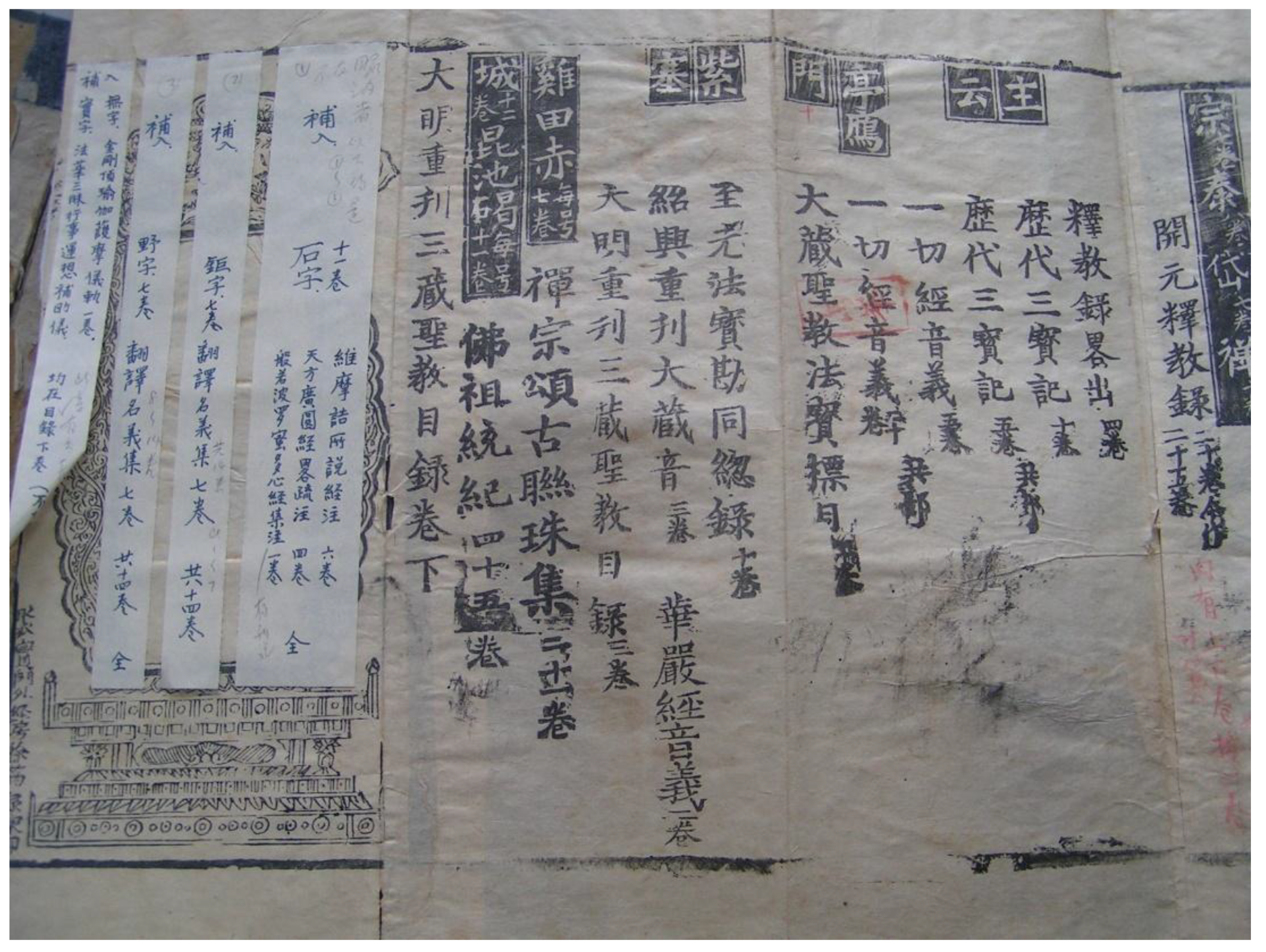
Merit-Making Through Printing, Distributing and Reading Buddhist Canon in the Late Ming Dynasty


Abstract
1. Introduction
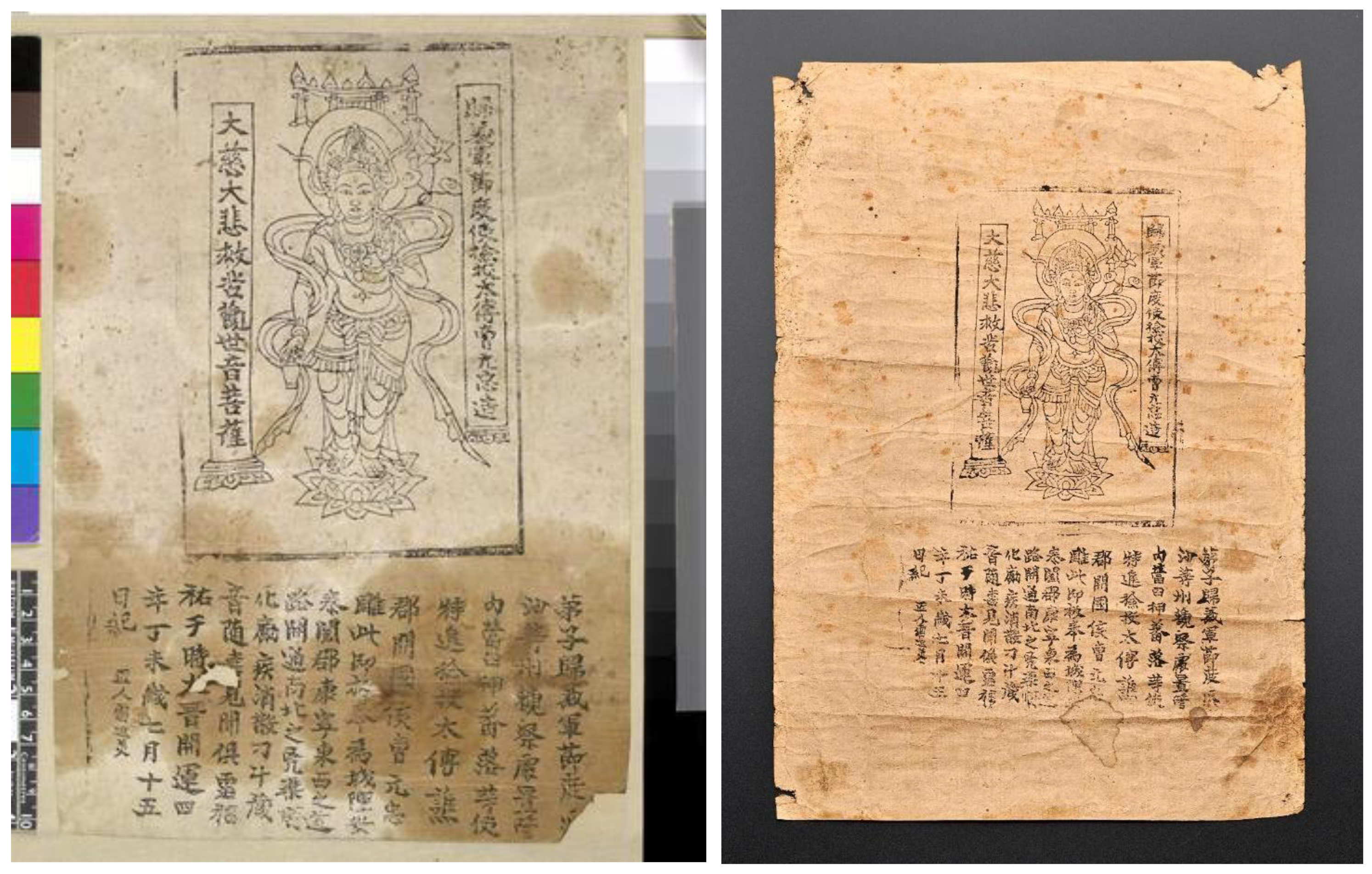
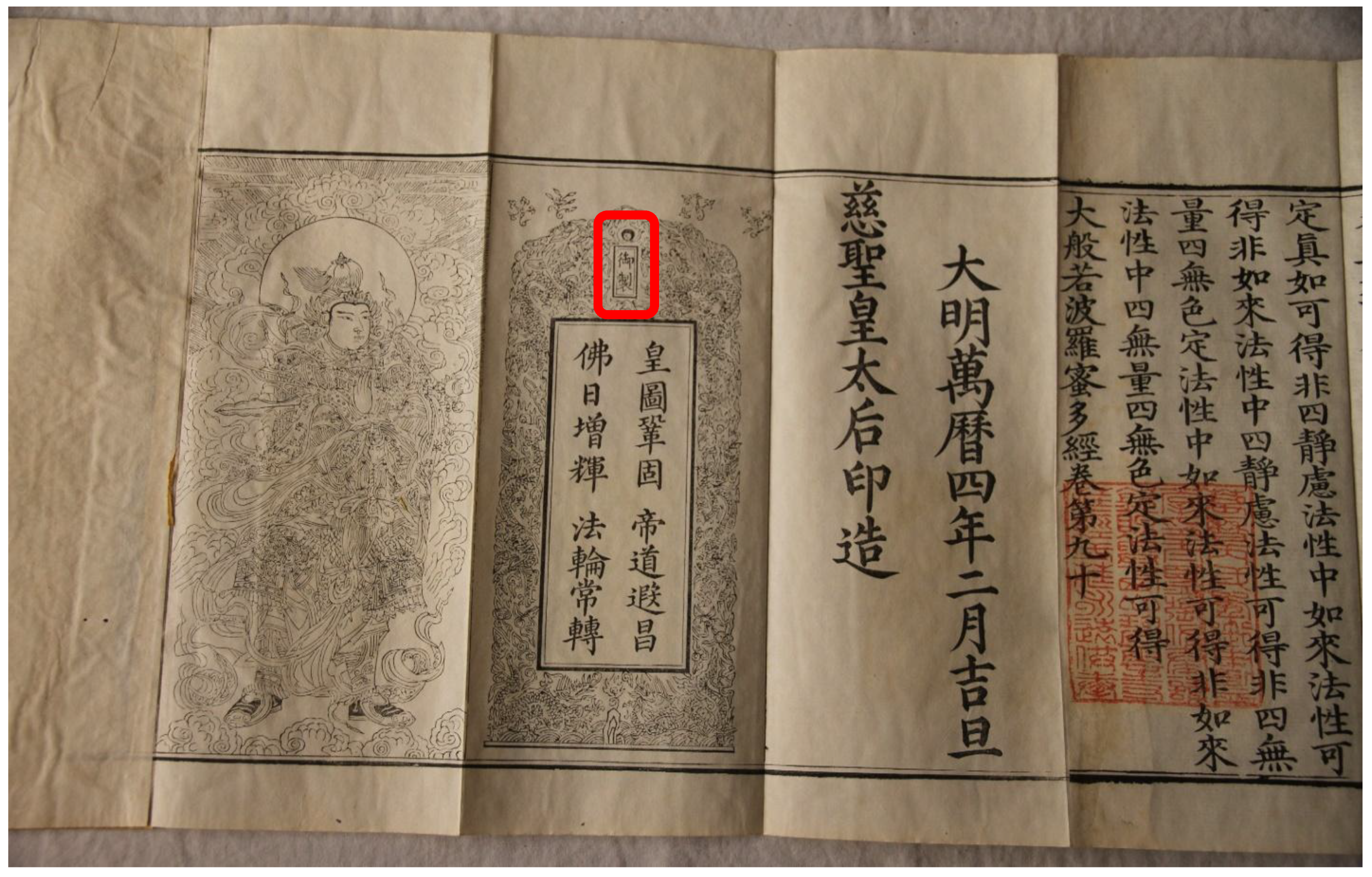
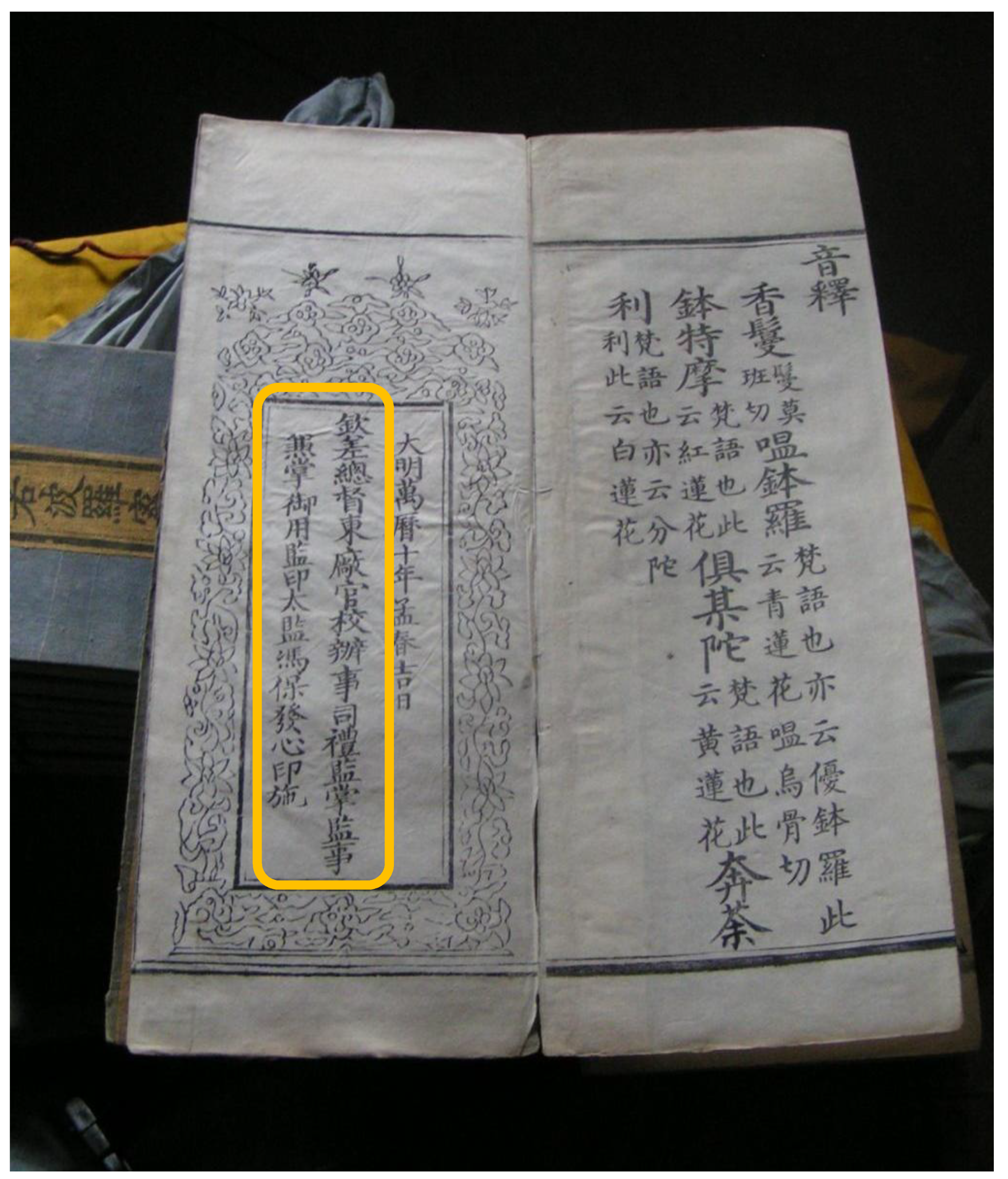
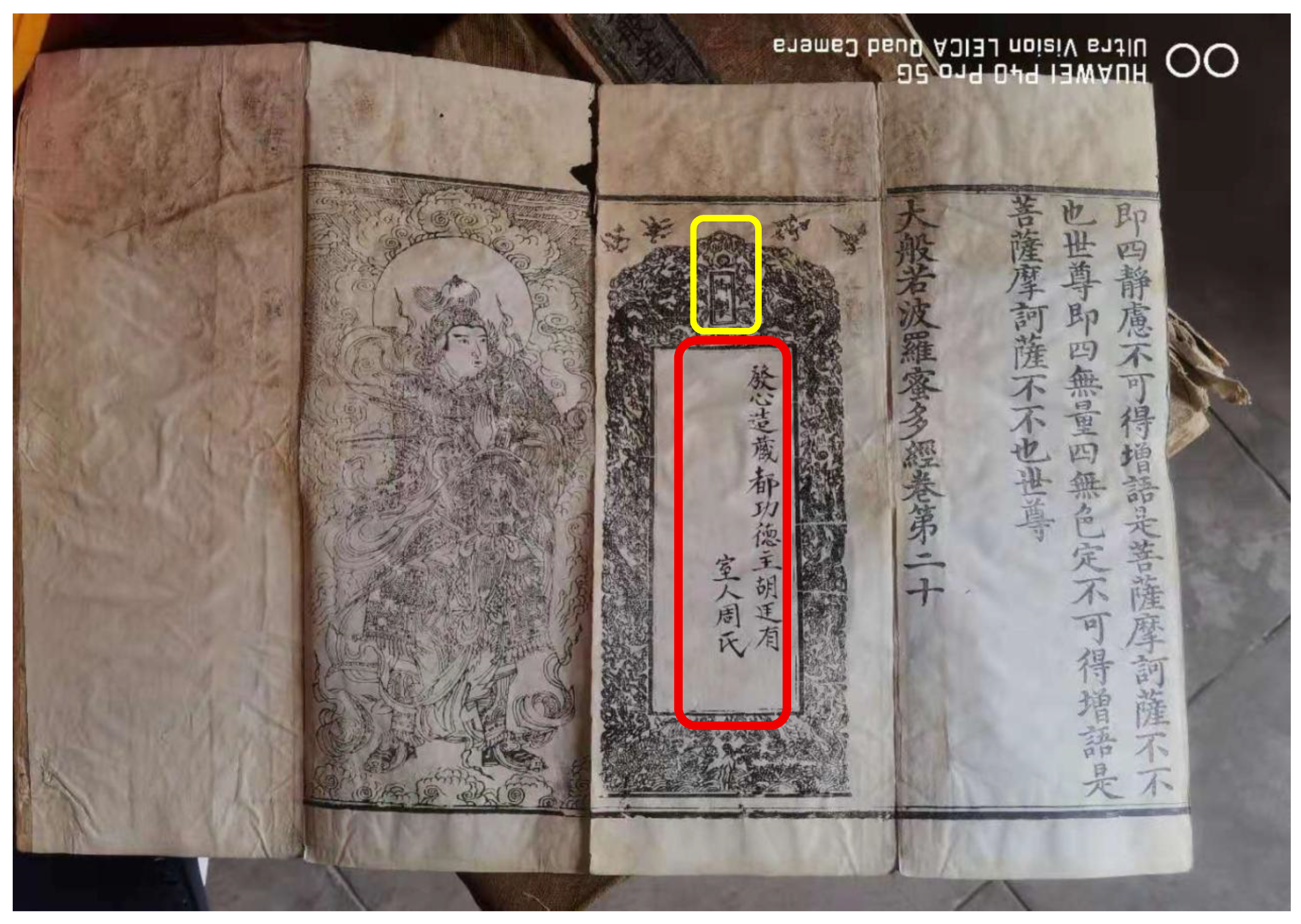
It was generally believed that the imperial court, emperors and empresses, monopolized the merit-making of printing the Buddhist canon, especially the Yongle Northern Canon. This was true. However, through meticulous fieldwork, I discovered new evidence indicating that eunuchs, palace maids, officials, and even commoners participated in funding the printing of the Buddhist canons to accumulate merits.4 These materials were overlooked by previous scholars.I who govern the realm and rest in the great foundation [established by the previous emperor, my father], I [think]: [I,] greatly benefited by my Father and Mother, and bound together by the most excellent [Imperial] line, with the difficult goal of repaying their kindness, sent an ambassador, and after his return from the West bringing a canon, had it executed in print as a beneficial gift for all, in order to benefit both my Father and Mother and cause all beings to obtain inexhaustible merit. Such benefit is inexpressible
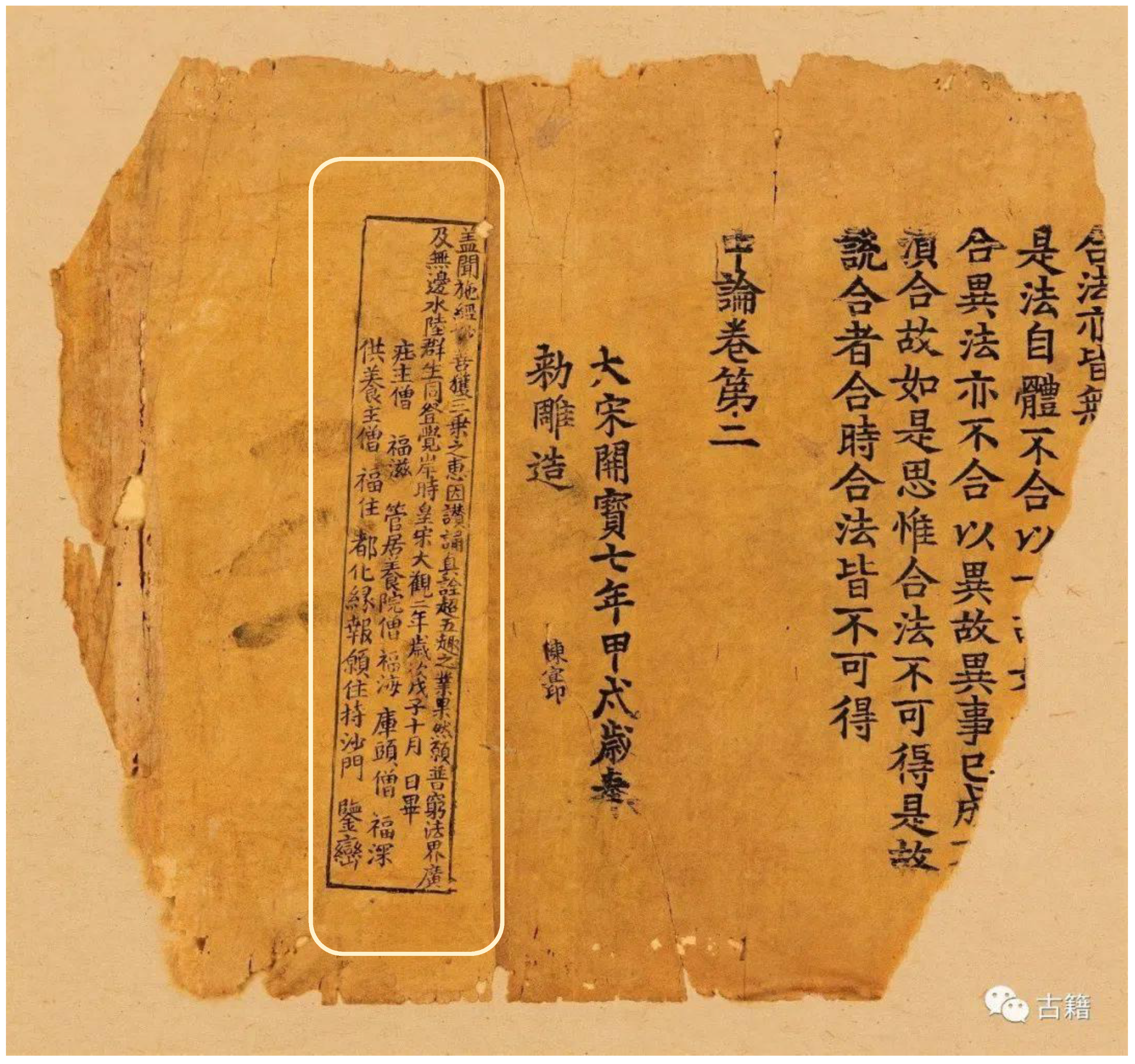
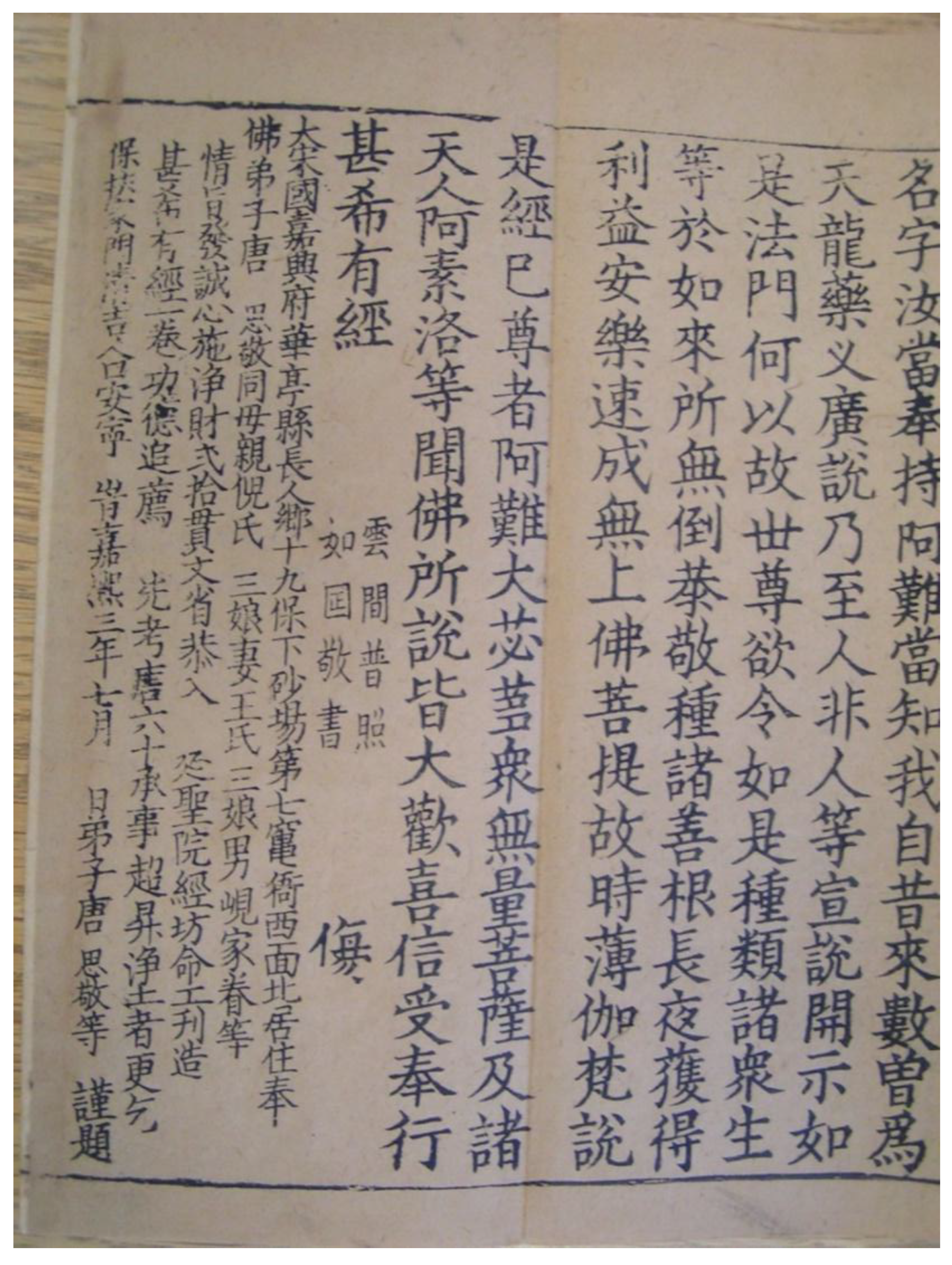
We hear that to donate [to the production of] sutras is a wonderfully meritorious act, [which will lead one to] reap the beneficial consequences of the three Vehicles, [and that] to praise and intone the discourse will save [one] from the fruits of karma leading to the five destinations [i.e., the realms of hell, ghosts, animals, men and Devas]. Thus [it is our] vow that in the whole Dharmadhātu and in the boundless waters and lands all living beings alike may ascend to the shore of enlightenment, …Completed in the year Daguan 2 [1108 CE], of the august Song [Dynasty], the cyclical year Wùzi, tenth month…8
- The Imperial Family Members’ Merit-Making
- The Eunuchs’ Donations for the Print of the Yongle Northern Canon
- A Court Lady Li Xiunü’s Donation to Print the Yongle Northern Canon
- Buddhist Monks’ Devotion to Reading the Canon for Merit Making
- Donations from Lay Devotees: Colophons from the Yongle Northern Canon
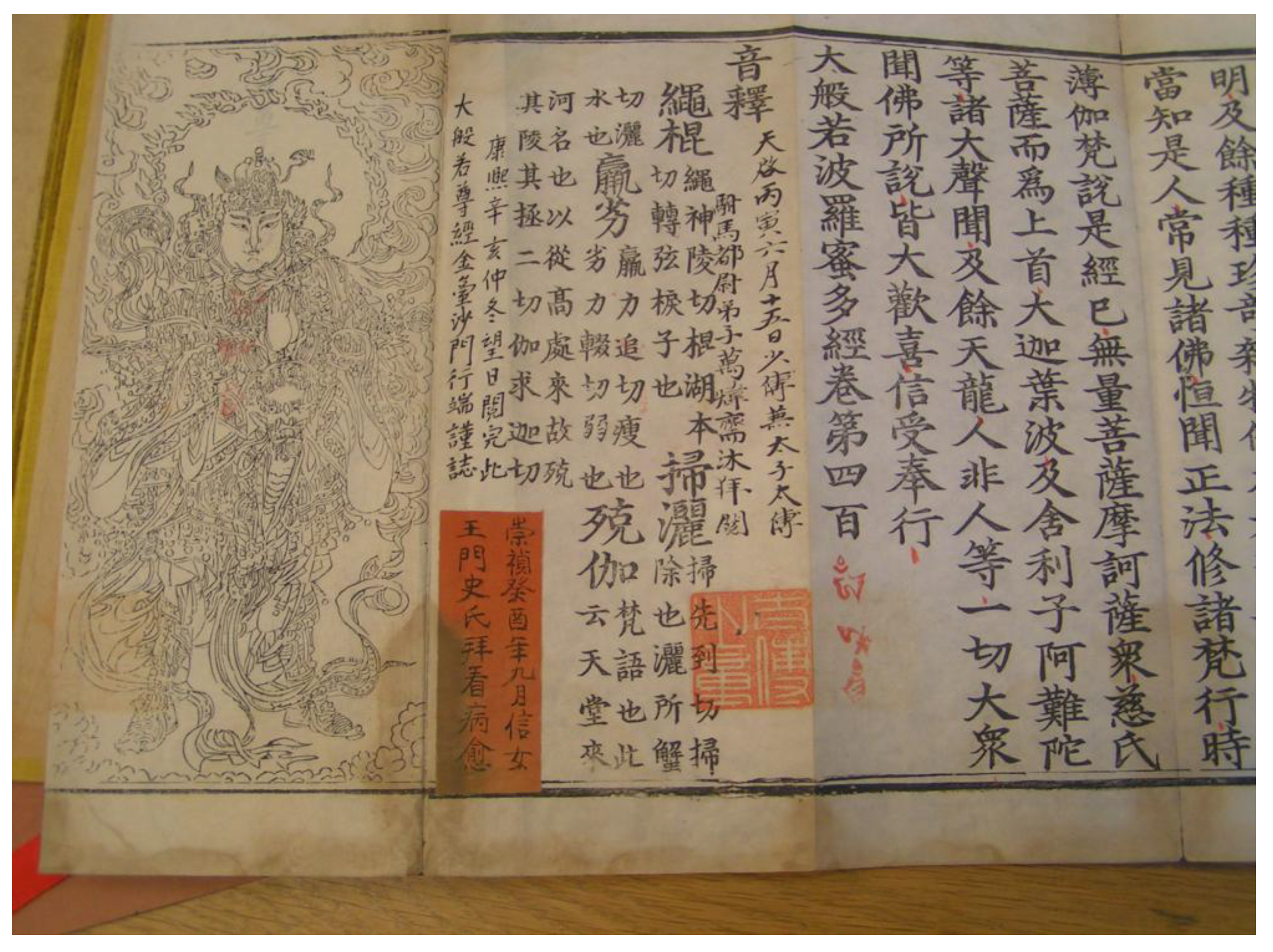
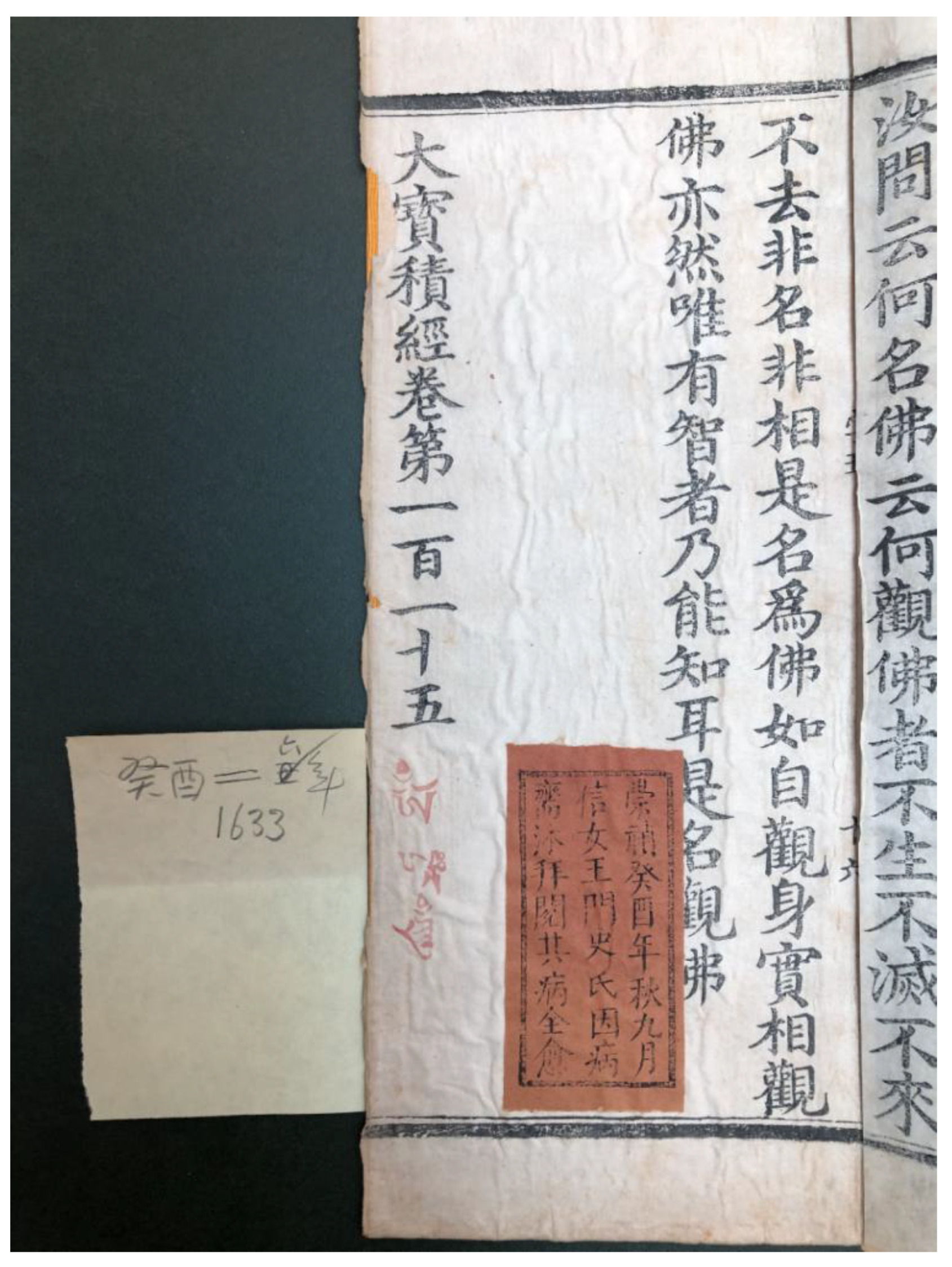
- Lay Devotees’ Donation as Recorded in the Qisha Canon
- Donations to Repair Woodblocks of the Yongle Southern Canon as a Form of Merit Making
- How Did the Local People Obtain and keep a Set of the Yongle Southern Canon
- Conclusions
2. The Imperial Family Members’ Merit-Making
2.1. Emperor, Empress and Concubine
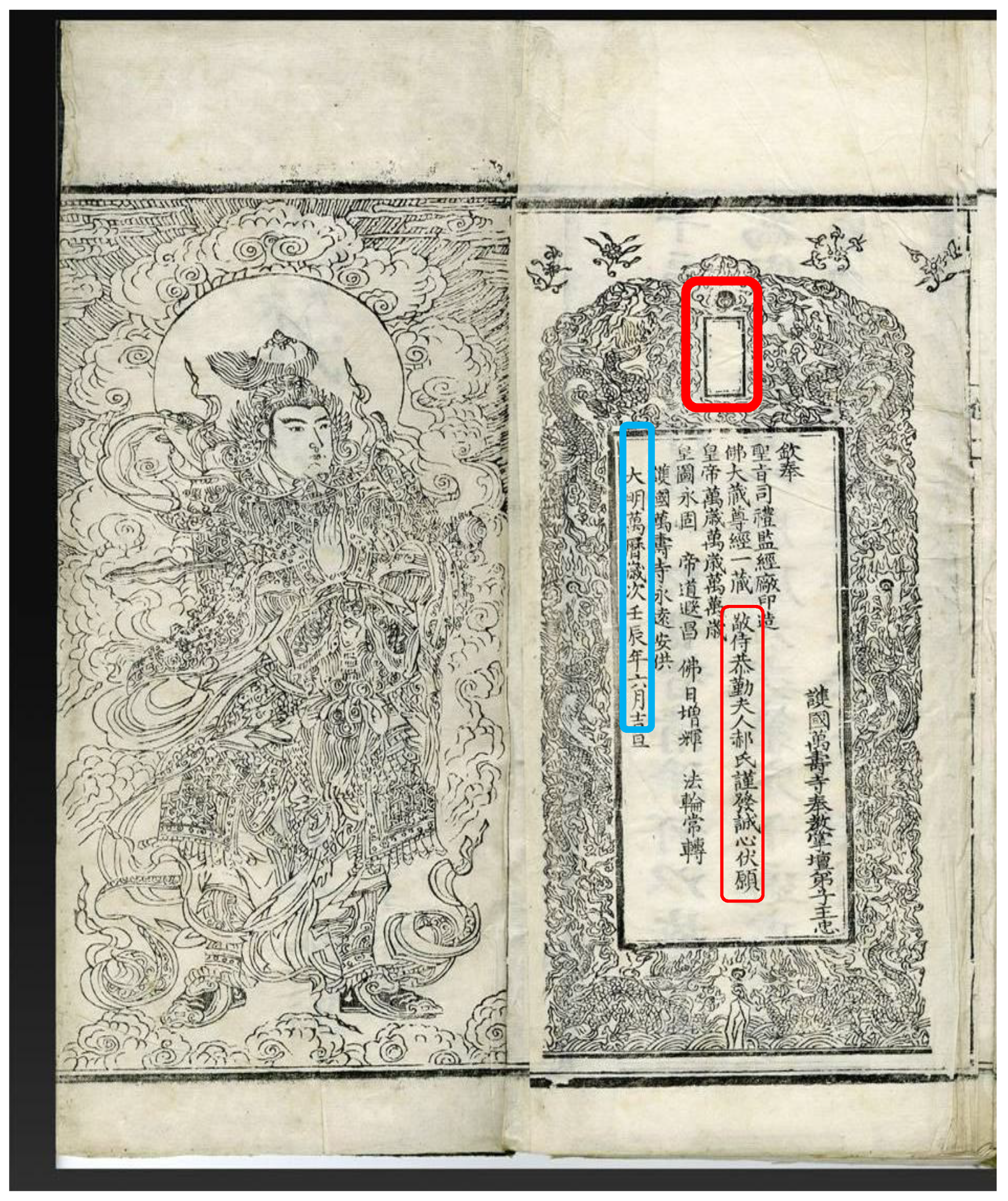
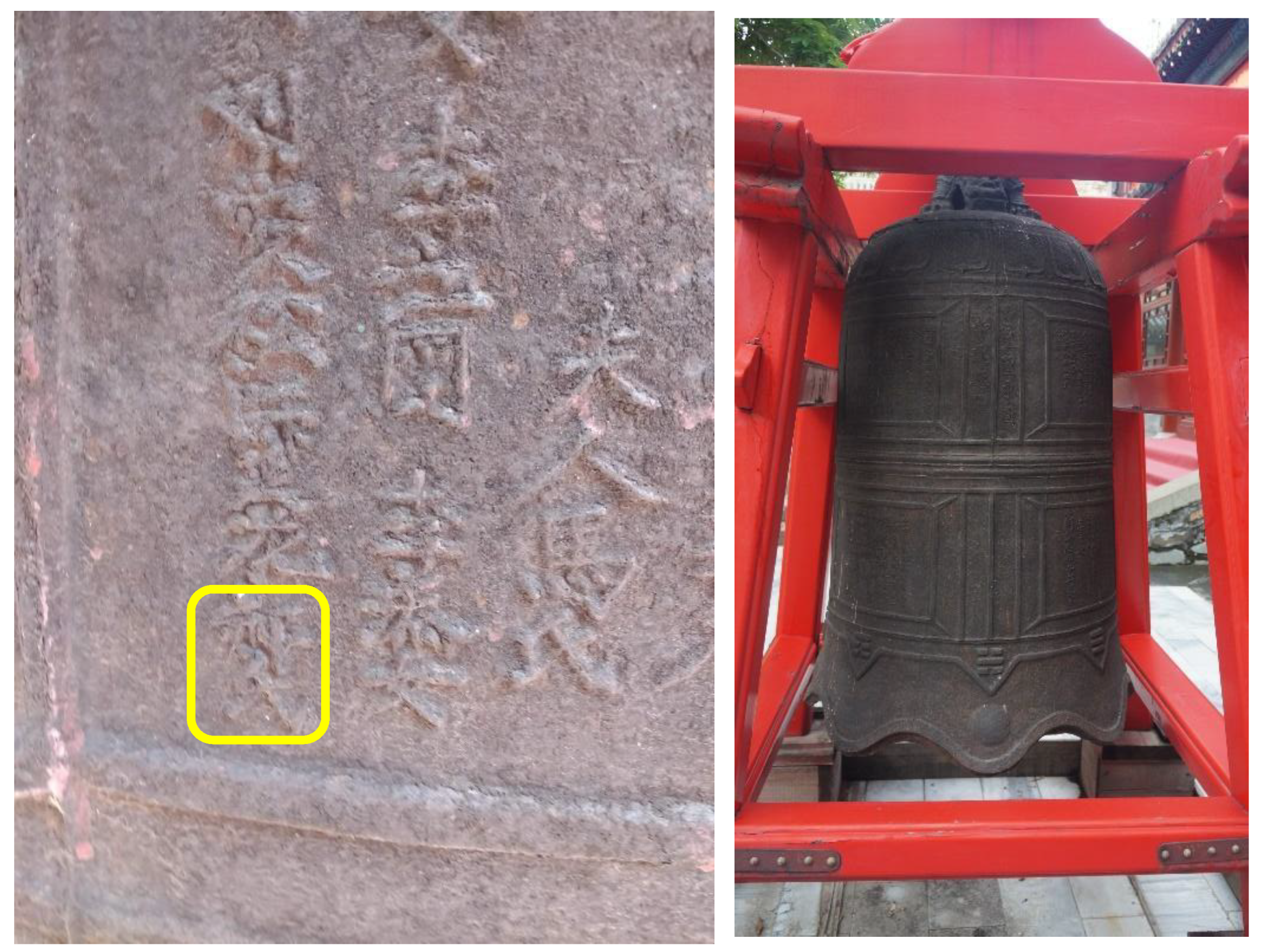
Wang Zhong 王忠, a devotee at Huguo Wanshou Monastery 護國萬壽寺, printed a set of the Buddhist canon in response to the emperor’s edict, Lady Hao 郝氏, who holds the title of jing shi gong qin 敬侍恭勤, expressed her wish that the emperor live a long, long life.
The empire shall be consolidated and prosperous. The Buddha shines and the Dharma Wheel revolves constantly.
This set of the Buddhist canon is to be kept at Huguo Wanshou Monastery forever.
On an auspicious day, the sixth month, the year of Renchen 壬辰 (1592).
Lady Wang, Great Ming Emperor’s legal wife 大明正宮嬢嬢王氏
Princess Yongning 大明永寧公主15
Emperor’s high concubine Zheng 皇貴妃鄭嬢嬢16
Emperor’s concubine Lady Xu 德妃許氏
Emperor’s concubine Lady Chang 順妃常氏
Emperor’s concubine Lady Wei 慎嬪魏氏17
Concubine Lady Shao 敬嬪邵氏
Concubine Lady Rong 和嬪榮氏
Concubine Lady Zhou 端嬪周氏
Crown Prince 皇太子
Grand Aunt Li 大李嬢嬢李氏
Second Aunt Li 二李嬢嬢李氏
Devoted Wang Ming and others 信心弟子王明等
Princes, princesses, so-and-so mistress 皇太子,長公主,?尊夫人
Liu Yingjie, a relative of the emperor 皇親劉應節18 and his wife Ma 夫人馬氏
Ji Ying 吉英, Li ?yuan 李?園, and Li Gongnü 李恭女Tian Dongnü 田棟女, Zhang Yinü 張義女, Liu Aisong 劉愛松 and Lady Hao 郝氏
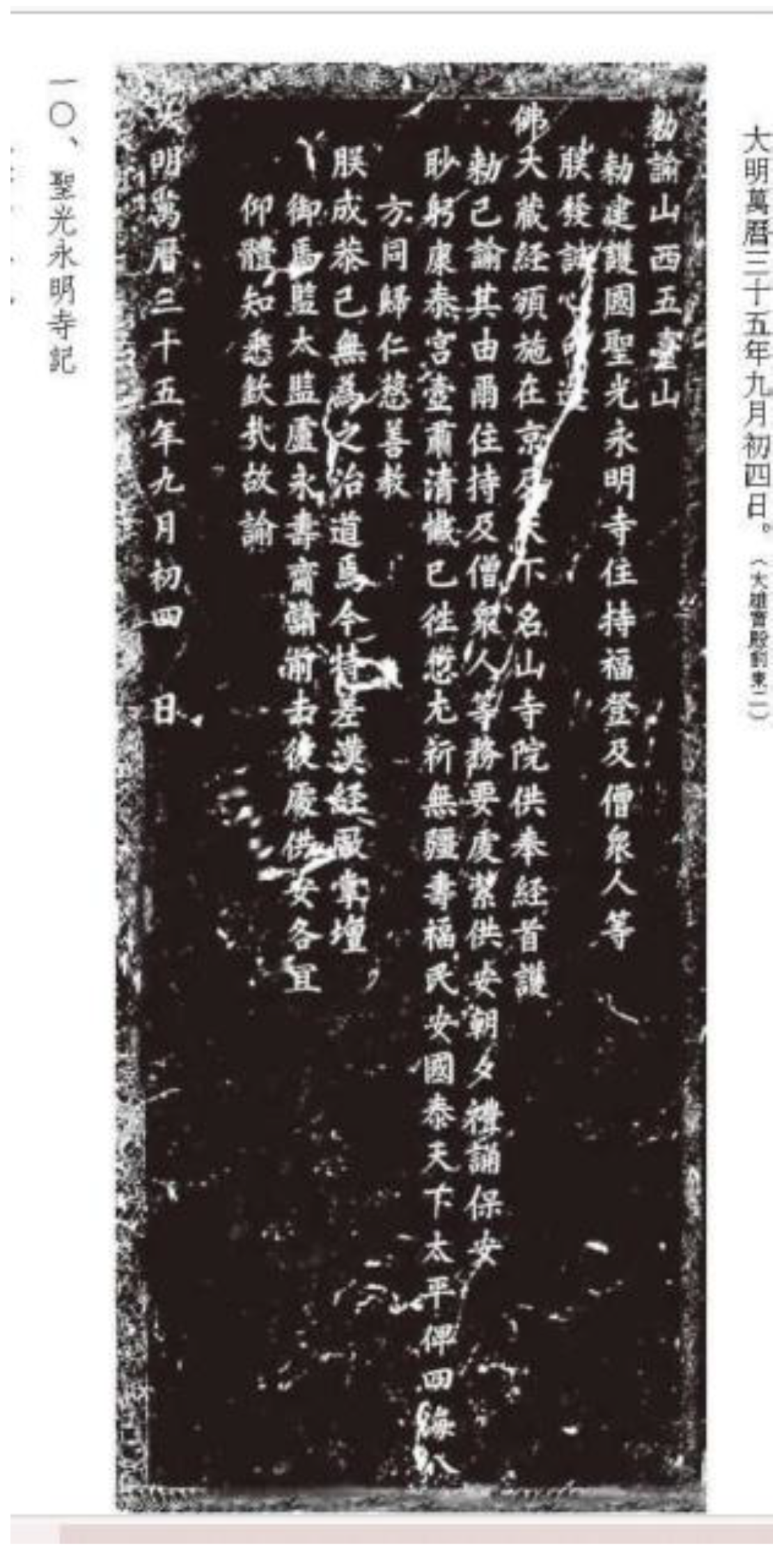
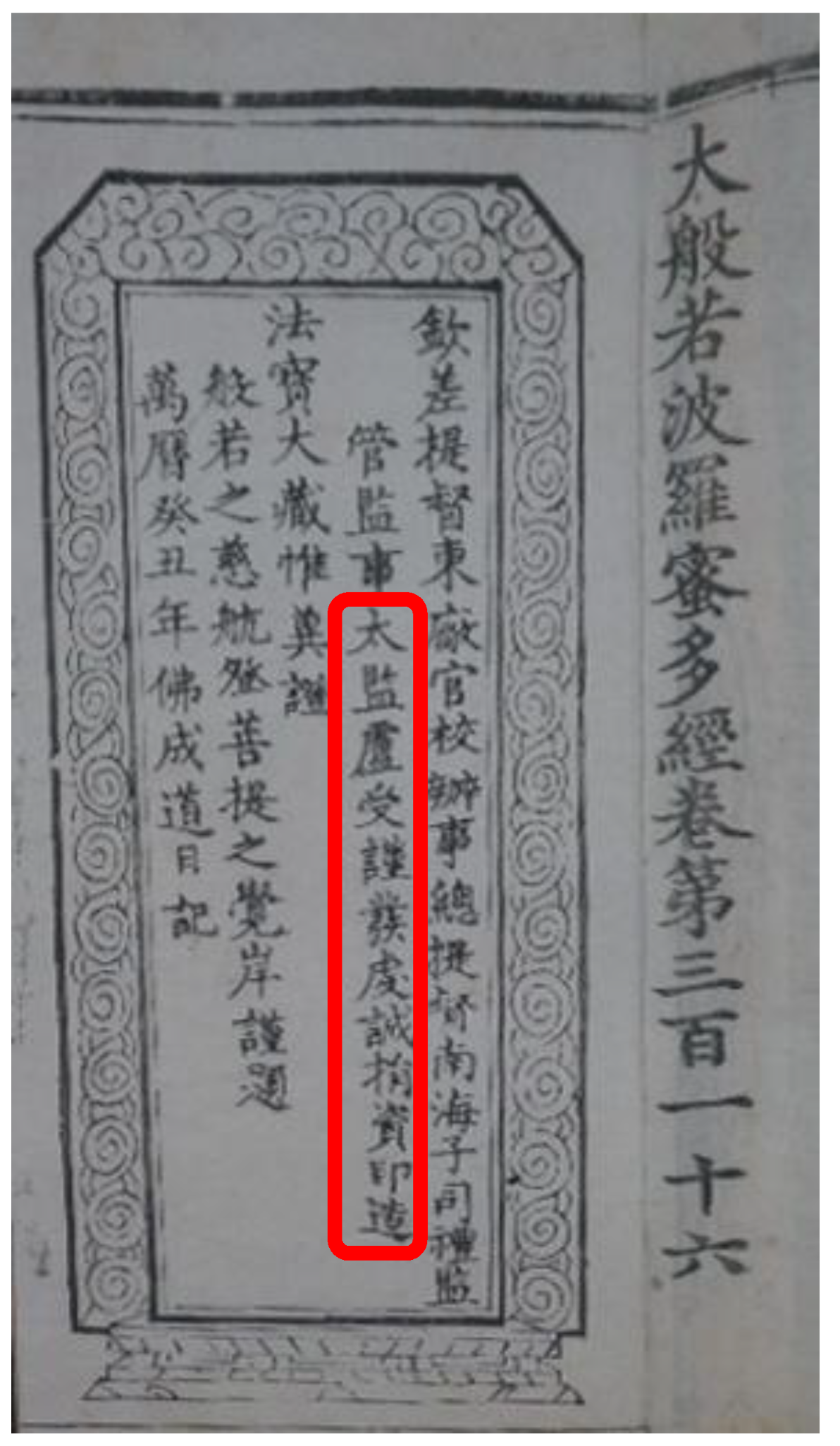
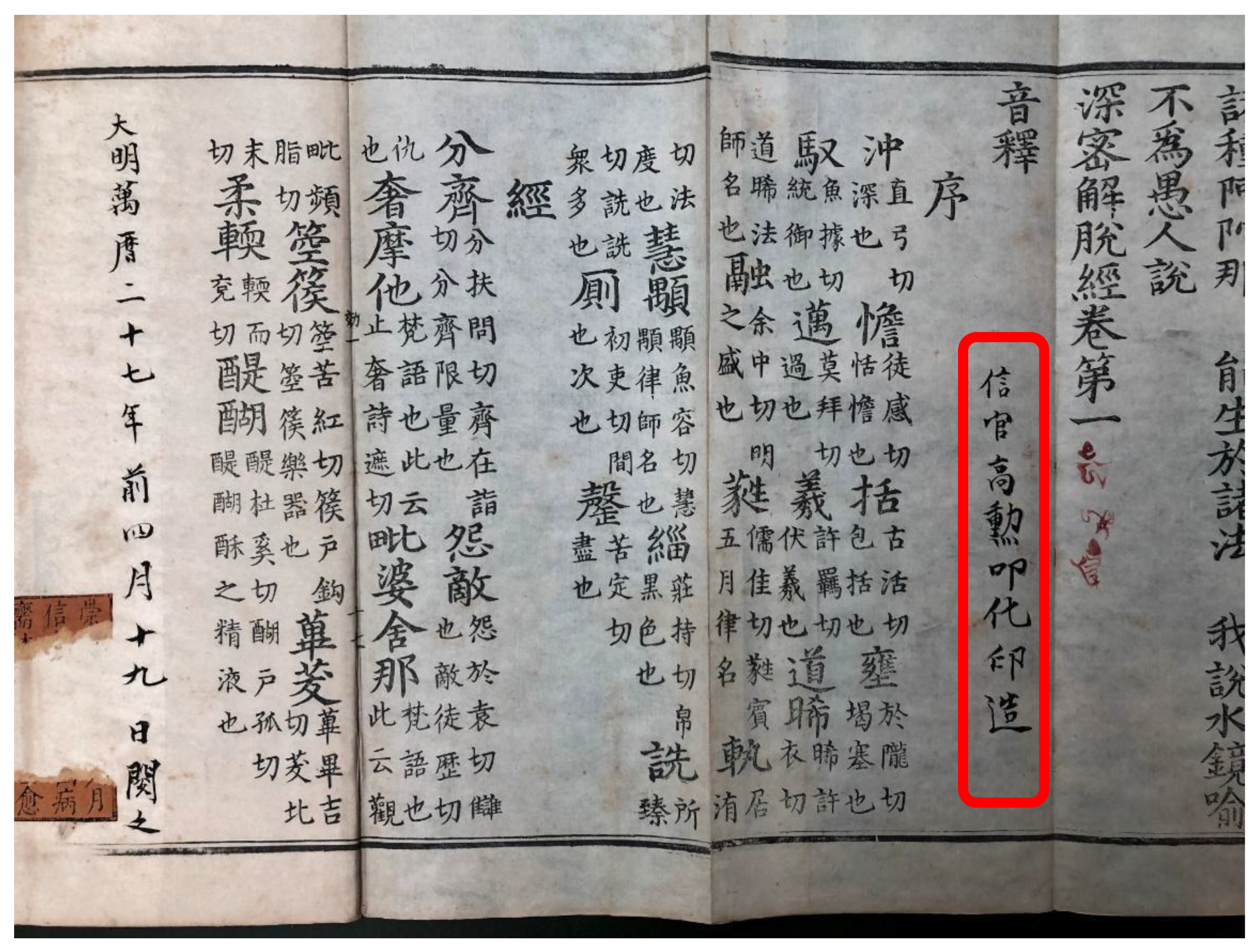
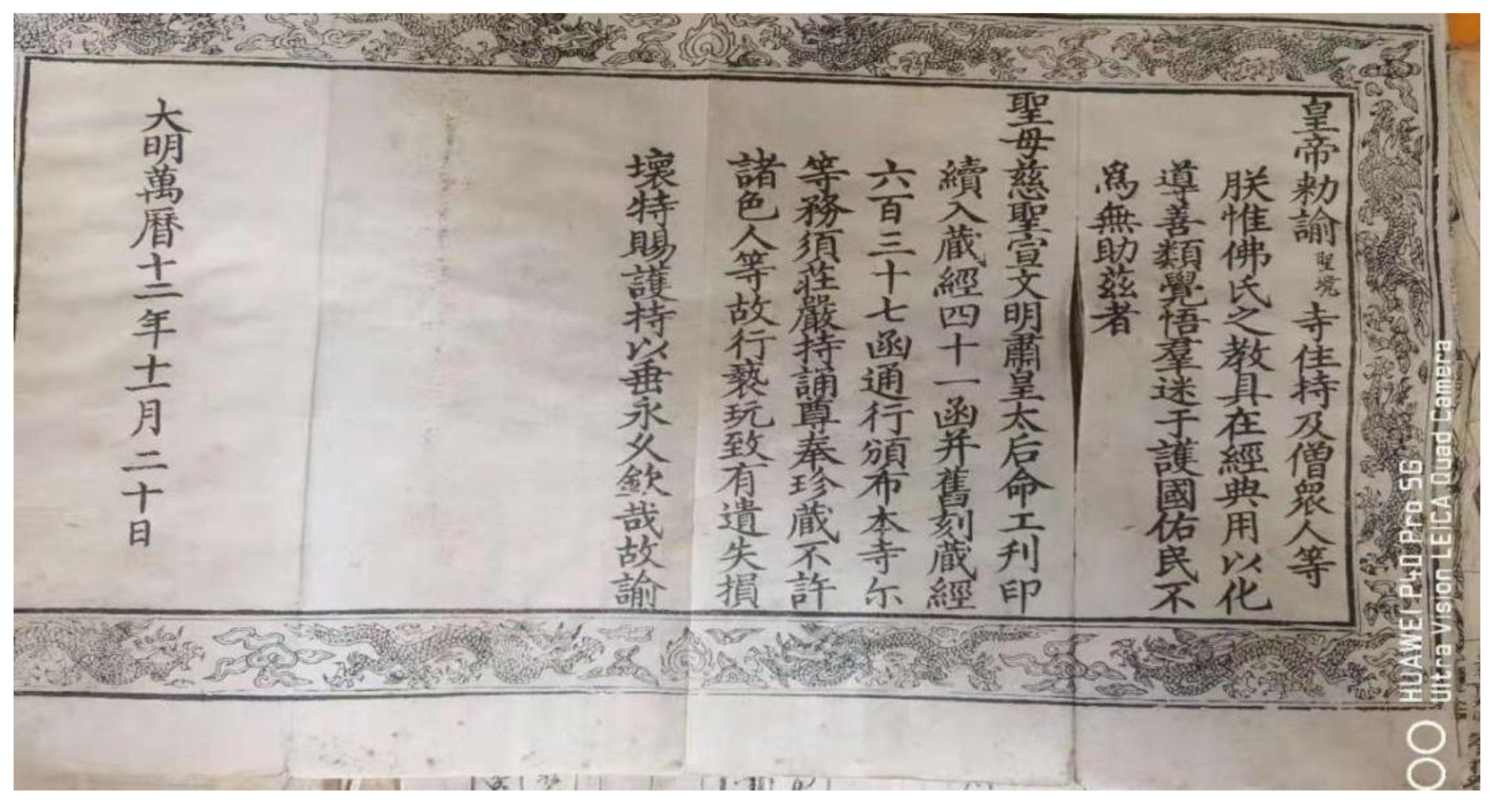
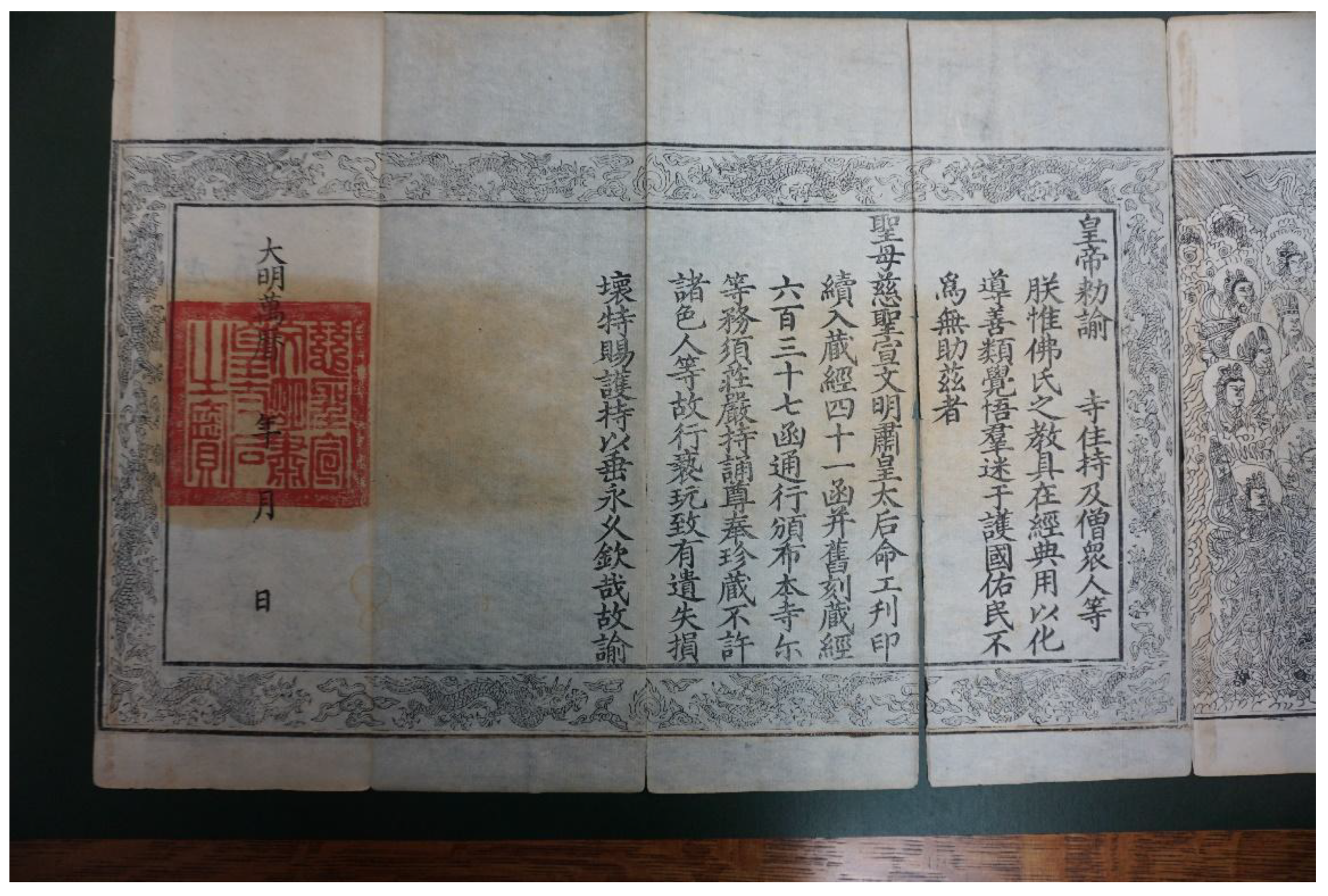
According to the record of Sakai, the first volume in the first han (‘tian’ 天) begins with these words: “to Venerable Fudeng, Abbot of Huguo Shengguang Yongming Monastery, and monks and lay devotees” and ends with the date of the fourth day, the ninth month and the thirty-fifth year of Wanli (1607) (敕建護國聖光永明寺住持福登 (妙峰) 及僧眾人等). This text shows that this set of the Buddhist canon was printed in the early seventeenth century (Figure 6).The emperor issues a decree to Abbot Fudeng 福登21 and monks of Yongming Temple 永明寺 in Mount Wutai, Shanxi Province. I, the Emperor, have decided to print the Buddhist canon and present it to famous temples in the capital and throughout China. The beginning of the Buddhist scripture explains why it is necessary to do so. Abbot, monks and lay people, you should always show your respect and sincerity by reciting the Buddha’s words from morning to evening, with reverence. [Let us] pray for the good health and safety of our Empress and for the purity of the concubines in the inner palace. [Let us] repent for the faults of the past and pray for enduring longevity. Let the people live in peace and in prosperity. Let the whole world be peaceful. Let all people convert to the benevolent teachings of Buddhism. I, the Emperor, began to govern the state in way of self-control and non-action. Now I am sending Lu Yongshou 盧永夀, eunuch in charge of horses in the printing house of the Imperial Palace, to escort a set of the Buddhist canon to your temple. All these things are made known and all should show your respect. Thus is the Emperor’s decree. In the twenty-seventh year of the Wanli era (1607).22
2.2. The Son-in-Law of the Royal Family
3. The Eunuchs’ Donations for the Print of the Yongle Northern Canon
4. A Court Lady Li Xiunü’s Donation to Print the Yongle Northern Canon
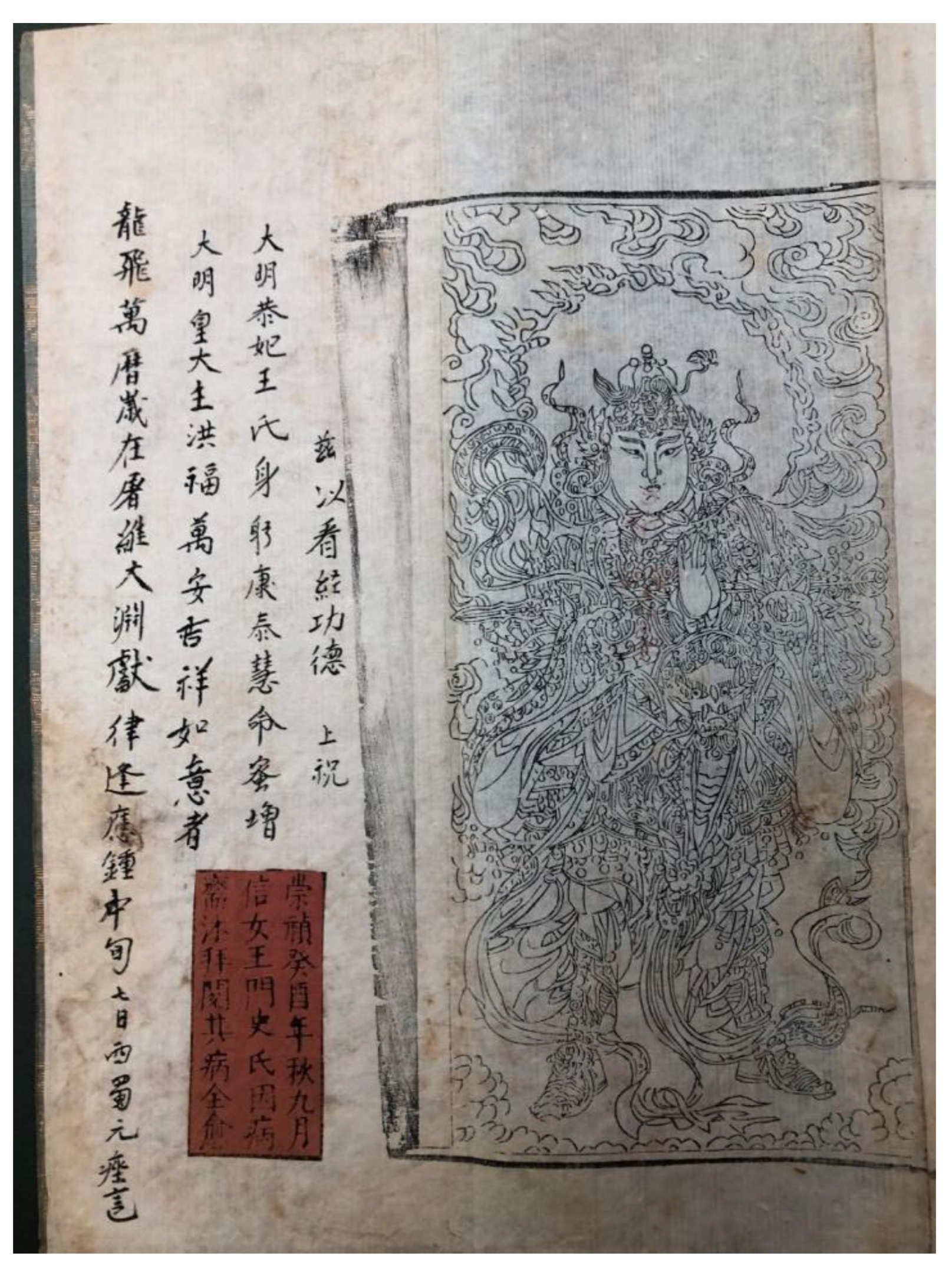
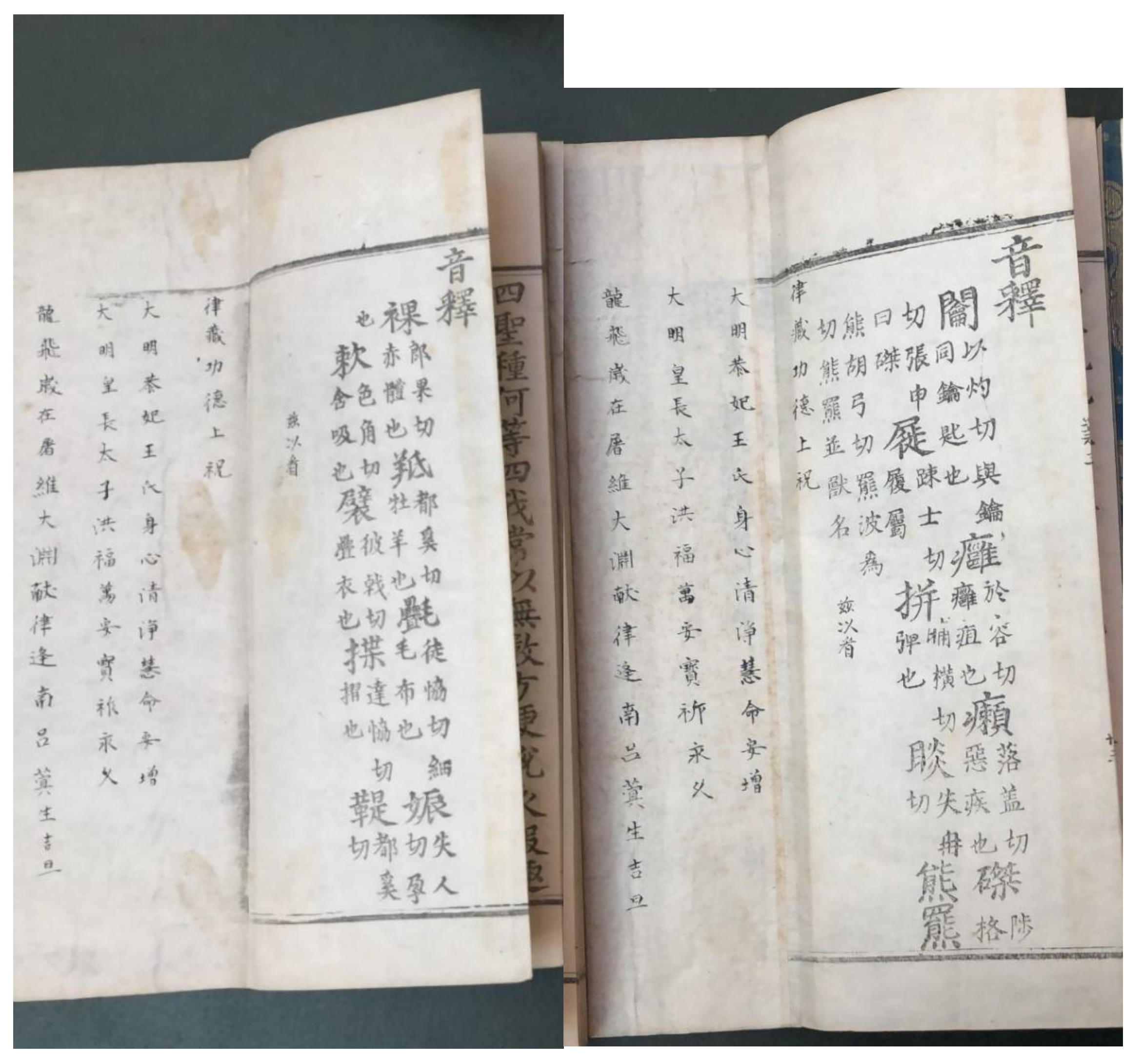
5. Buddhist Monks’ Devotion to Reading the Canon for Merit Making
We are now meeting with evil times, and if we do not rely on the ruling prince, the affairs of religion will be hard to establish (今遭兇年, 不依國主,法事難立).39
[I use my reading of this canon as a merit] to wish Consort Wang to be in good health and enjoy longevity. All disasters and obstacles are eliminated. Wishing her a permanent good life.
[I wish] the crown prince a good and peaceful life.
[I wish] for the country to enjoy prosperity forever.
[I wish] all to enjoy good health and live a joyful life.
[I wish] all to live a peaceful and pleasant life.
Written by Ruyuan, on the first day, the sixth month, twenty-seventh year of Wanli (1599).
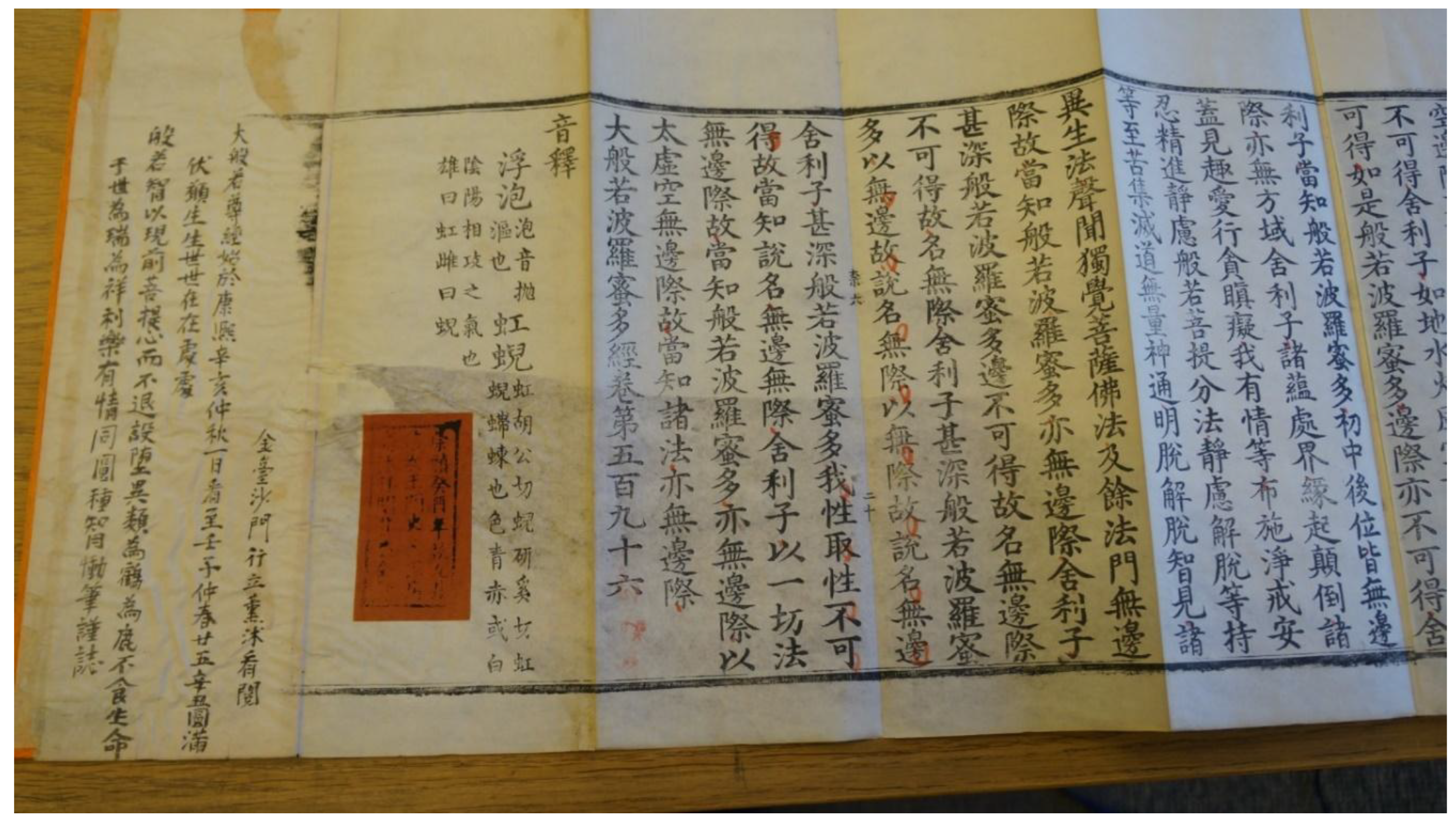
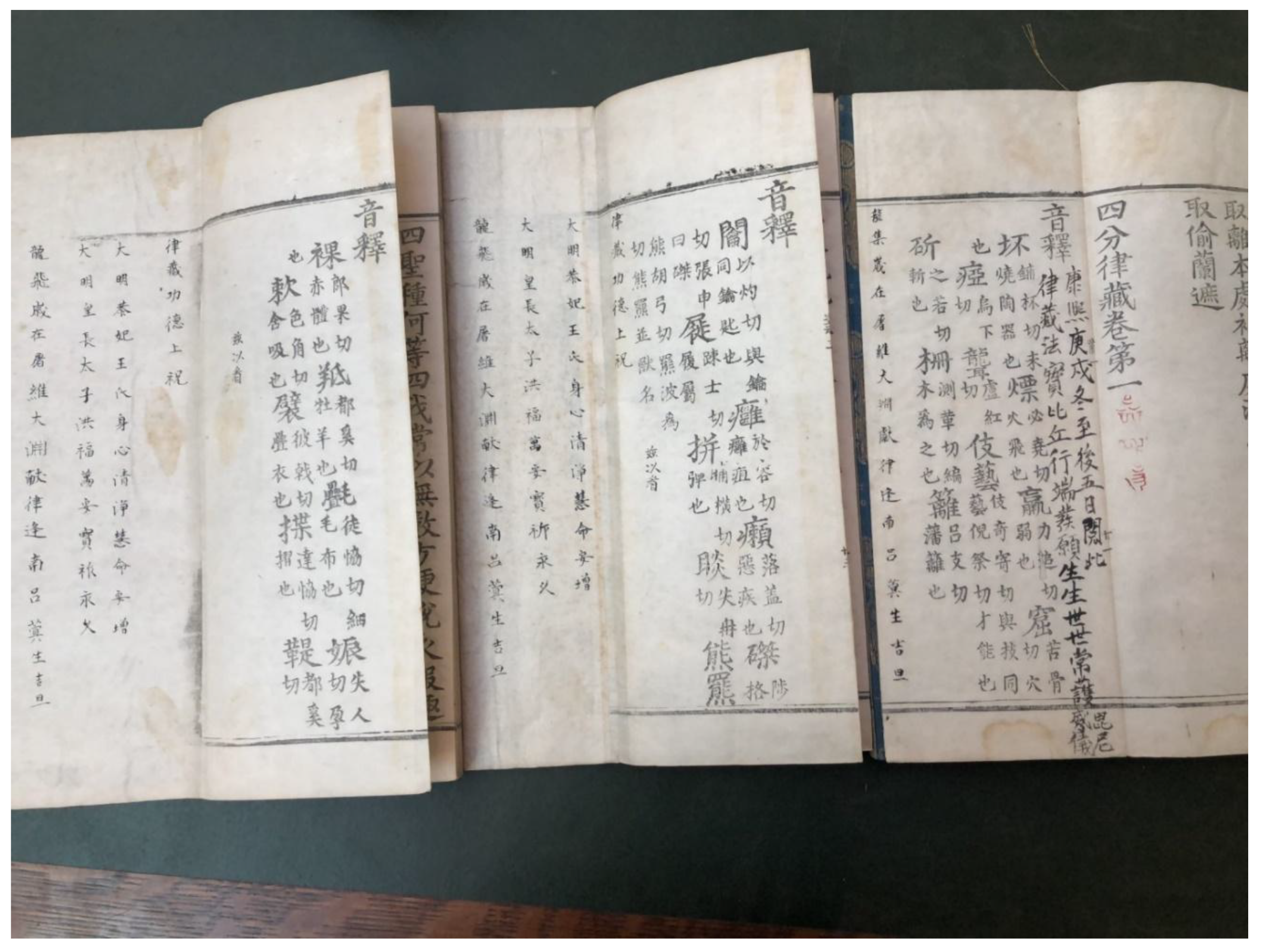
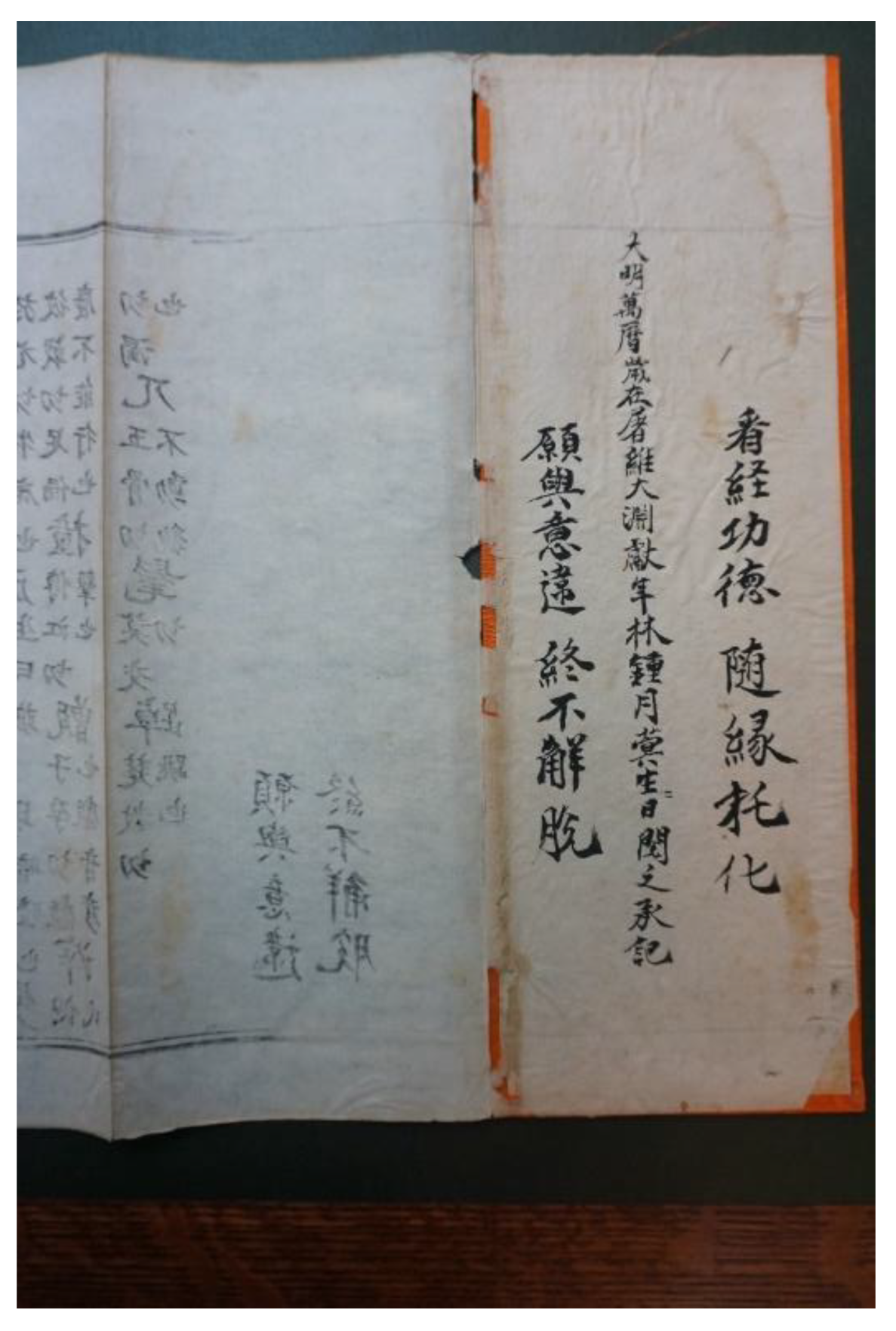
The second colophon expresses the same wish. The following is a rough translation:With my mentor Zuoyuan.40
[I use this reading of the Buddhist canon] as merit to wish:
Concubine Wang would enjoy good health and longevity.
Crown Prince of the Great Ming dynasty would enjoy a happy and peaceful life and everything would go on well.
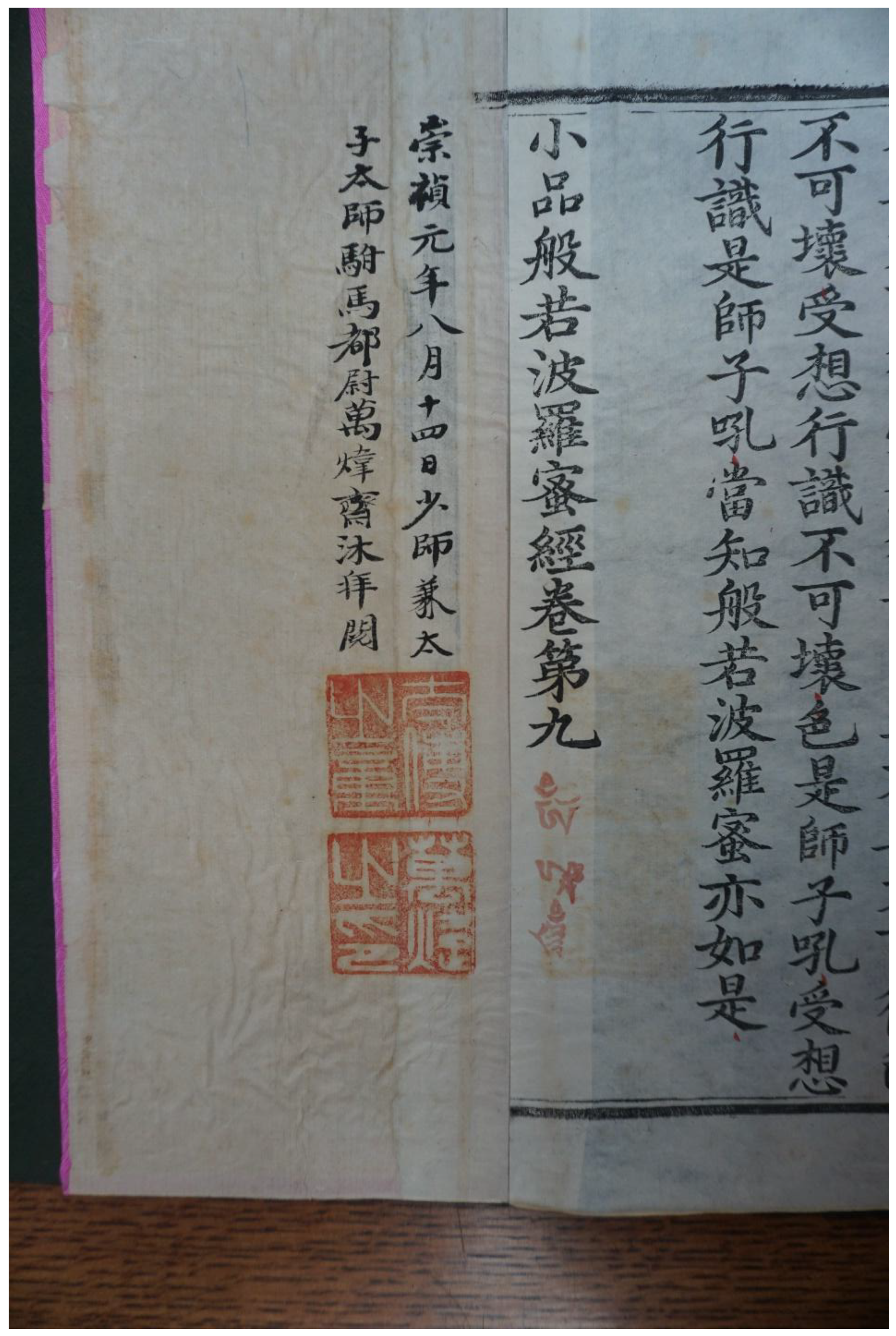
Both colophons express good wishes to Consort Wang and Crown Prince Zhu Changluo, who were never favored by Emperor Wanli. Monks who commissioned the reading of the Mahāprajñāpāramitā sūtra dedicated the merit to the crown prince and his mother, both of whom experienced untold suffering in the imperial court (Figure 14 and Figure 16).Xingtong 性通, written in the twenty-seventh year of Wanli (1599).41
6. Donations from Lay Devotees: Colophons from the Yongle Northern Canon
7. Lay Devotees’ Donation as Recorded in the Qisha Canon
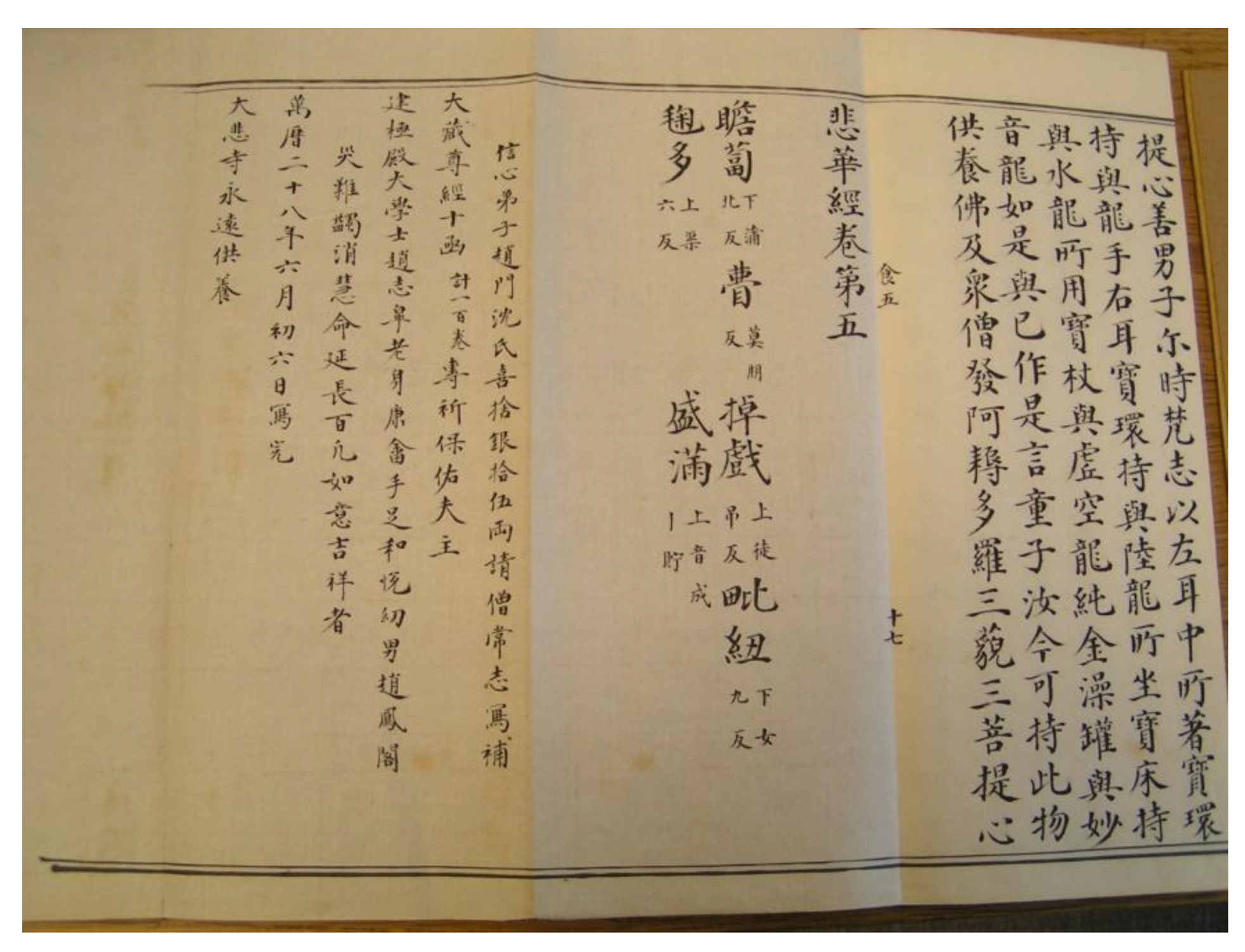
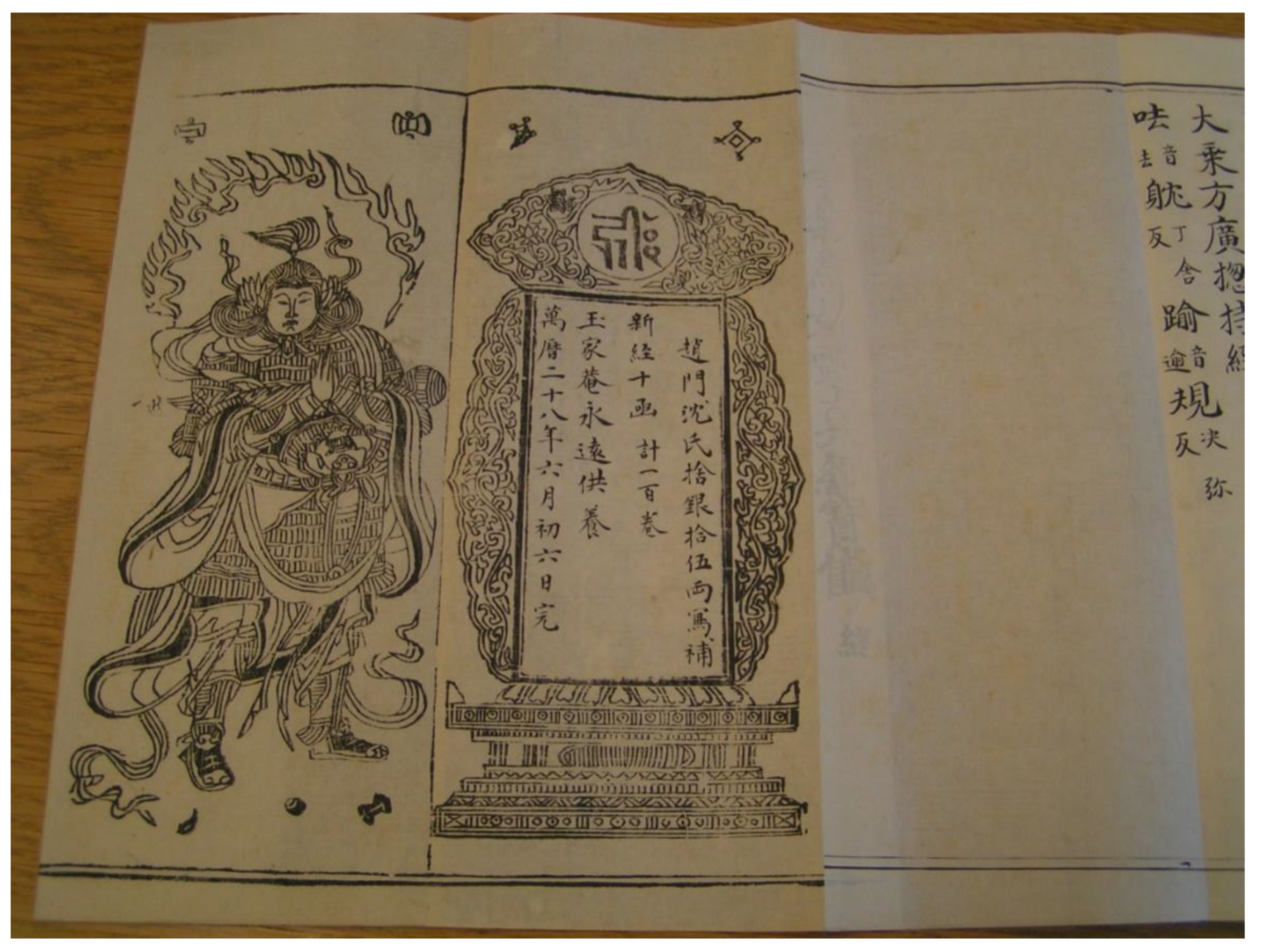
I, Mrs. Zhao, née Shen 沈氏, a devout believer, give 15 taels of silver for the purpose of copying 100 of the missing volumes of the Sacred Tripitaka with the most devout prayer that my husband, Zhao Zhigao 趙志臯, the Grand Secretary of the Jianji Palace 建極殿 [i.e., Prime Minister of the Empire], may be blessed with improved health, that his hands and feet may be restored to smooth functioning, and that our young son, Zhao Fengge 趙鳯閣, may be free from all calamities and be blessed with long life and happiness. The copies were completed on the sixth day of the Sixth Moon of the twenty-eighth year of Wanli 萬曆 (1600).46
Her husband (whose biography appears in chapter 219 of the Ming Shih) was Prime Minister from 1594 until his death in 1601, but was confined to his sickbed for about four years before he died. Her pious vow will interest the student of history, of religion, and of the development of book printing. It was the same belief in the “merit” of duplicating and spreading sacred scriptures—the belief that had been responsible for the origin of block printing in China—that made Madame Zhao contribute money for copying the missing volumes (Ibid., pp. 136–37) (Figure 26 and Figure 27).
8. Donations to Repair Woodblocks of the Yongle Southern Canon as a Form of Merit Making
9. How Did the Local People Obtain and Keep a Set of the Yongle Southern Canon?
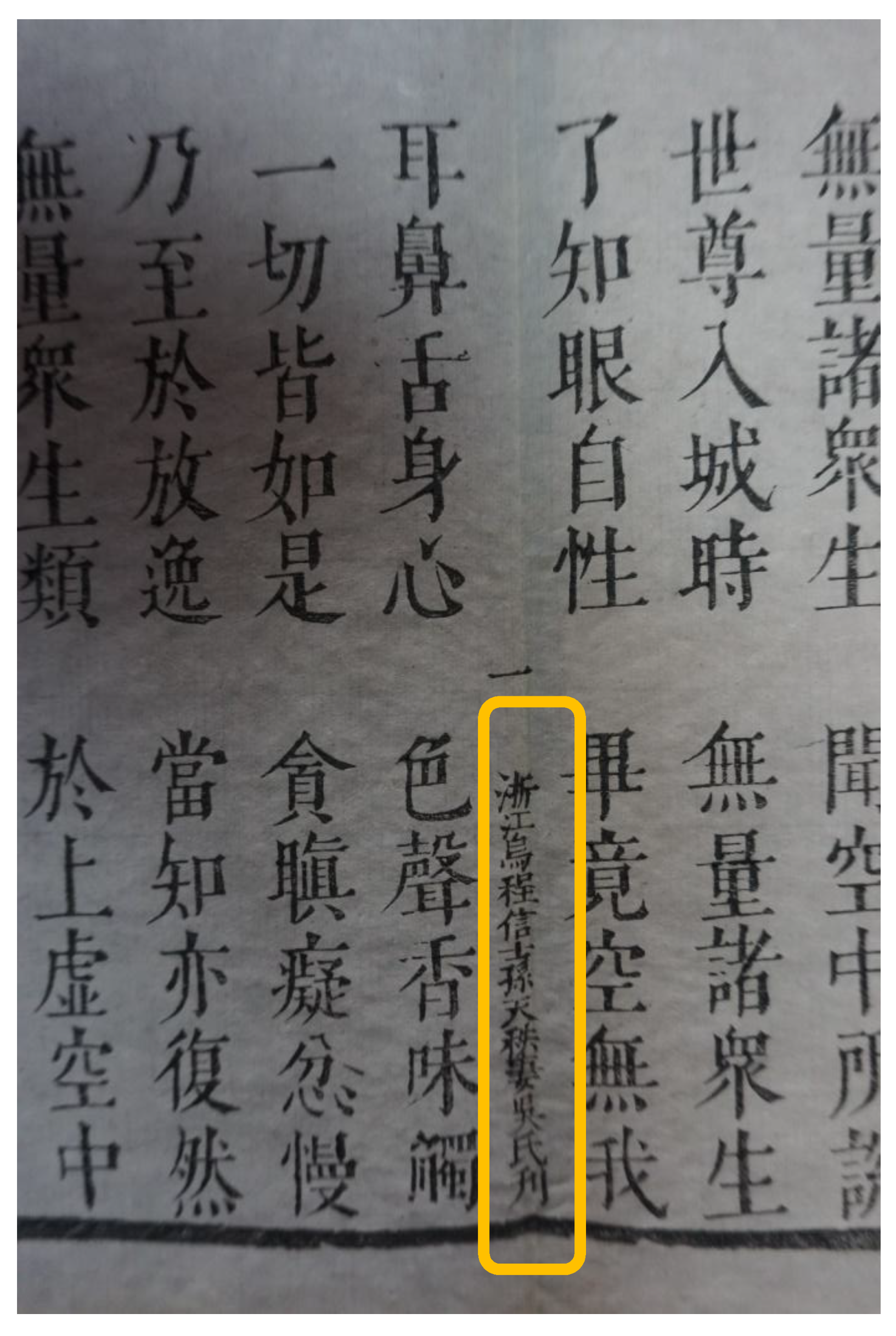
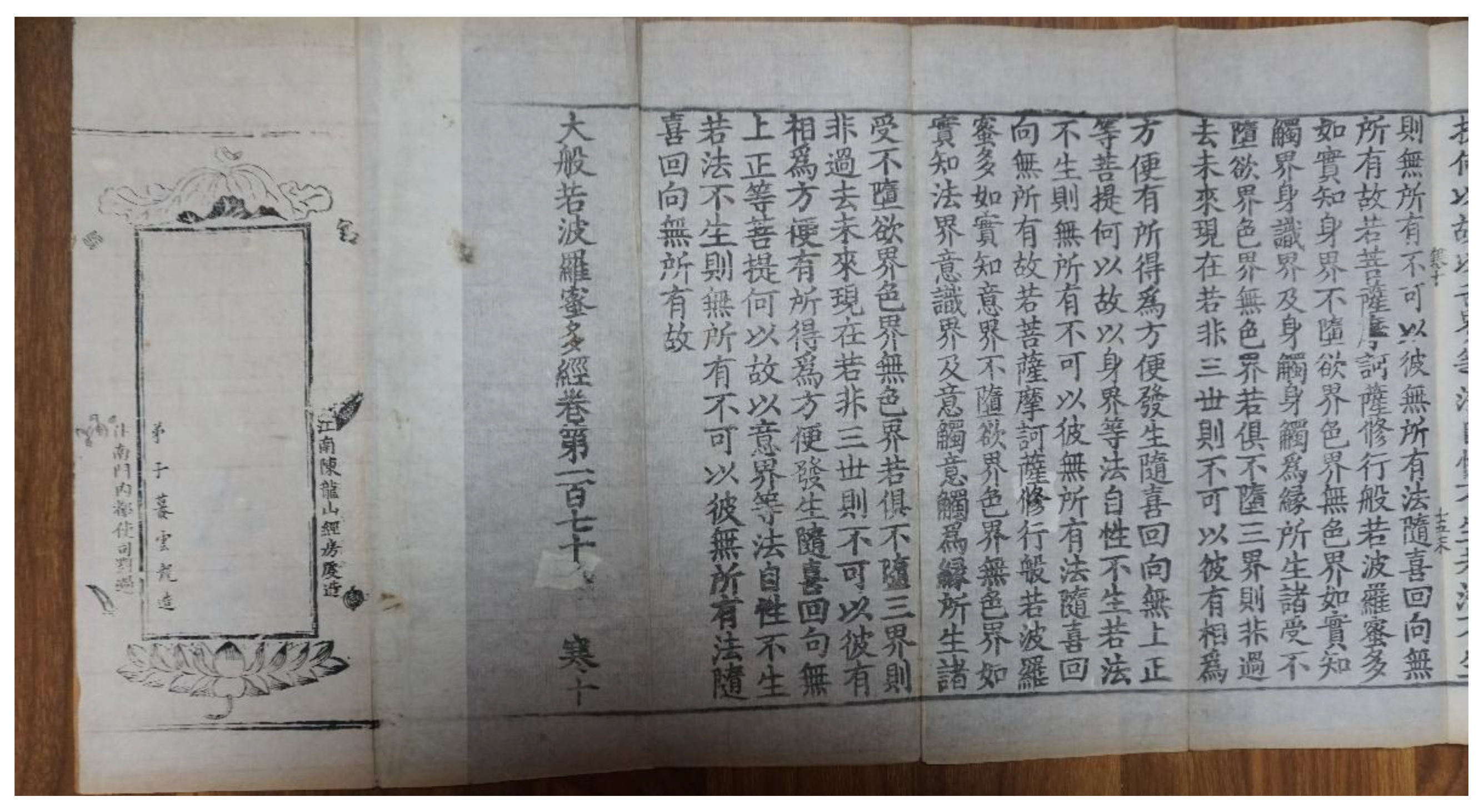
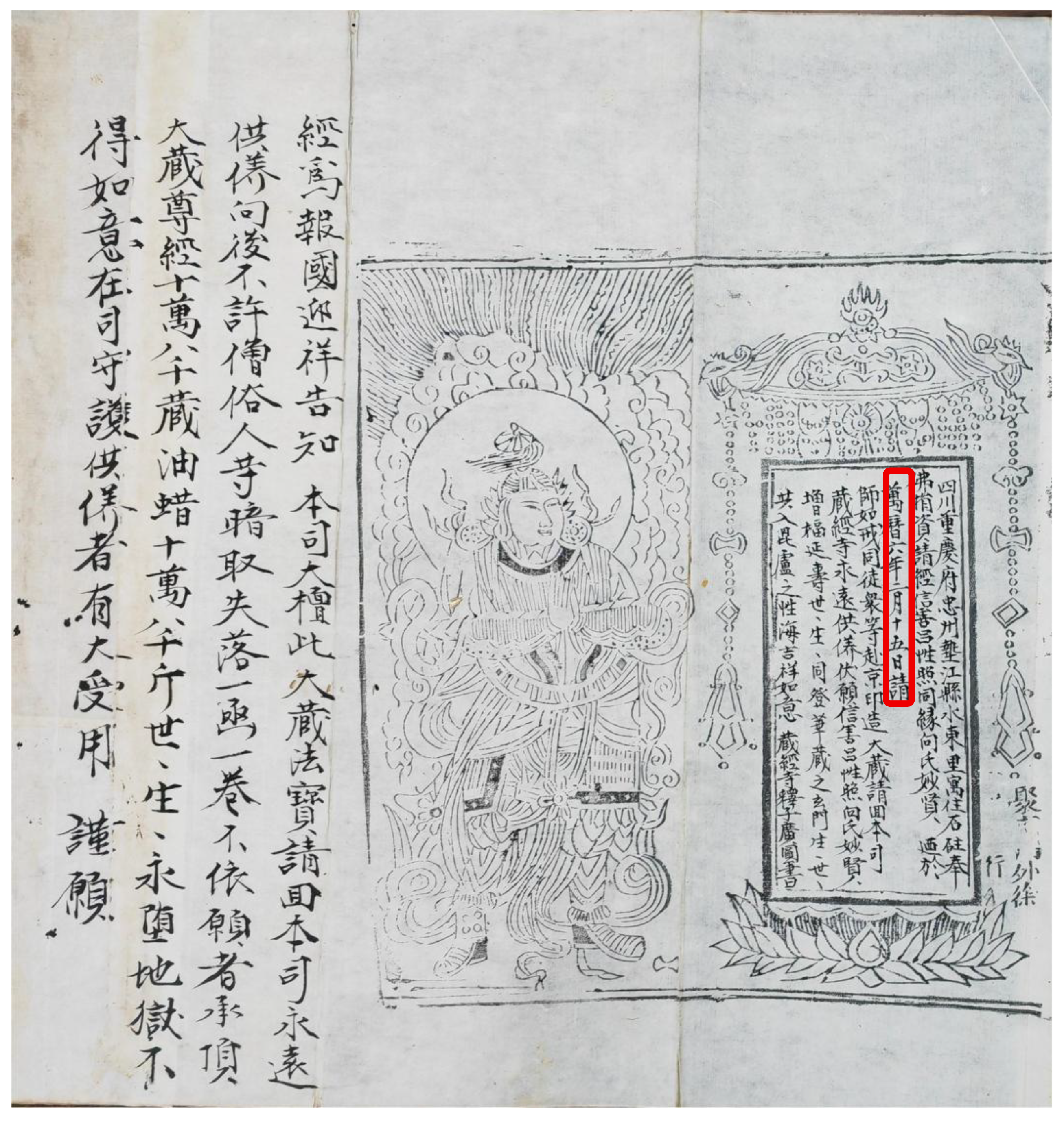
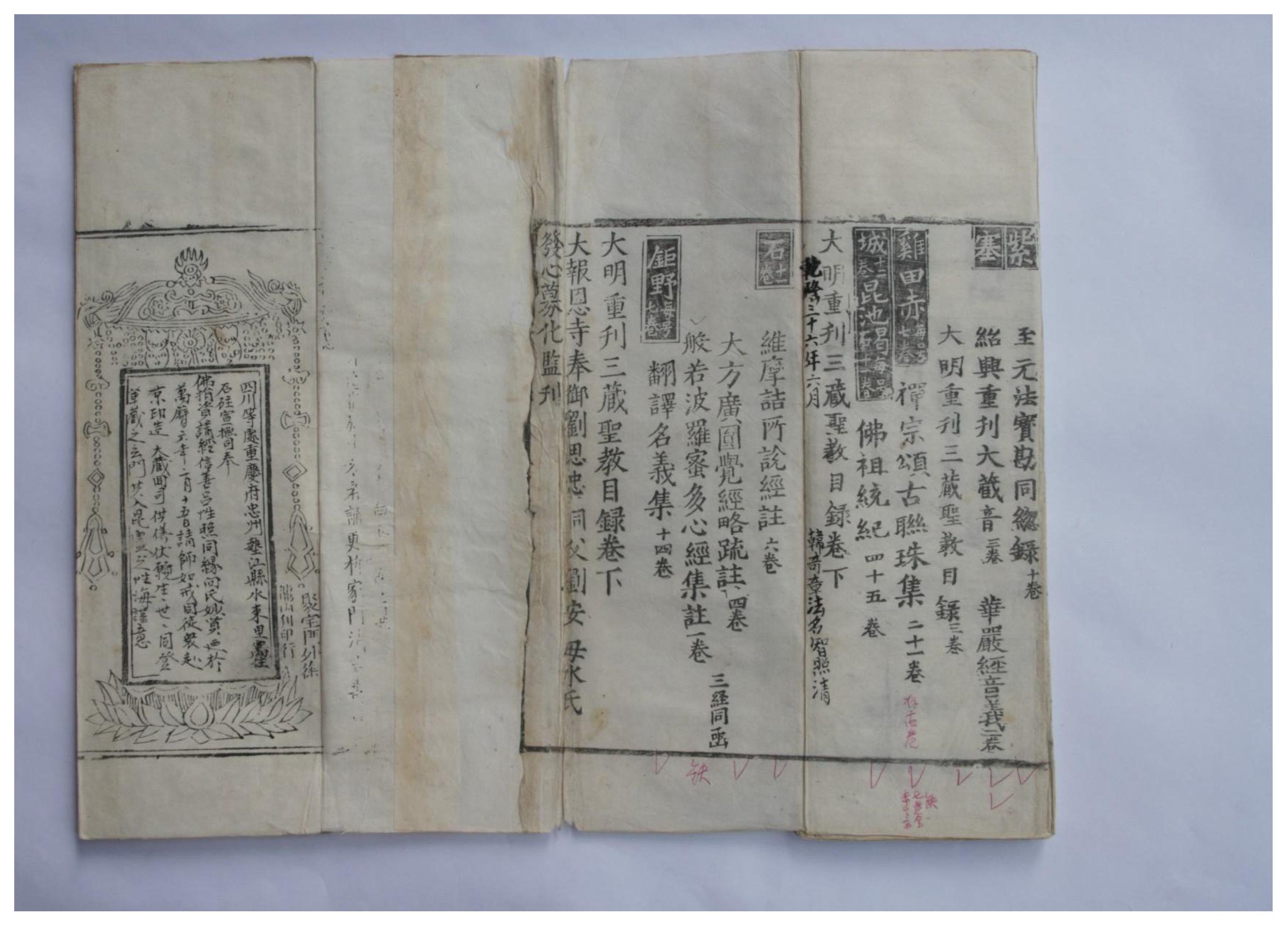
Devotee Ma Douhu 馬斗斛, pacification commissioner 宣撫司 appointed by the provincial administration commissioner 承宣布政, lived in tribal areas in Shizhu County 石砫 in Sichuan, together with his wife Lady Qin 覃氏, his son Ma Qiancheng 馬千乘 (1570–1613), daughters Ma Yuying 馬玉英 and Ma Qiongying 馬瓊英 who were to inherit the posts. Ma Douhu? sent Monk Rujie 如戒 and lay devotee Lü Xingzhao 呂性照 and others to the capital (Nanjing) to request a set of the Buddhist canon on the fifteenth day, the second month, sixth year of Wanli (1578). [They wished that] the Buddhist canon would be respected and worshiped. They wished that Lady Qin would ascend to the wondrous world of a Lotus Treasury, and flow into the sea of the Vairochana in her rebirths from generation to generation.49
The second colophon records the responsibility of the heads of the family to protect the Buddhist canon. If the person fulfilled their duty, they would be blessed; otherwise, they would be severely punished (Figure 32 and Figure 33).The Buddhist scriptures will serve the country and bring good fortune. Therefore, the rules [for its protection] should be made known. When the Buddhist canon has been housed in the shrine, it will always be maintained and sustained by the pacification commissioner’s family. Nobody is allowed to take any copy out of the library. Any person who is responsible for the loss of one volume or one han 函 (case) will offer compensation of 108,000 jin 斤 or 55,000 kg of oil and wax. This person will be born again and again into the hell realm, while the person responsible for guarding and protecting the Buddhist canon will be blessed with increasing happiness and longevity.50
10. Conclusions
Funding
Institutional Review Board Statement
Informed Consent Statement
Data Availability Statement
Conflicts of Interest
| 1 | Kieschnick (2003, pp. 164–85). He continued to discuss the term “karma” in Kieschnick (2022, pp. 79–106). |
| 2 | |
| 3 | This passage was translated by Jonathan Silk, “Notes on the History of the Yongle Kanjur,” in Hahn et al. (1996, pp. 175–78). The emperor’s hymn can be found in Zhaohe fabao zongmulu (1929, p. 1427). The Chinese original reads: 朕撫臨大統,仰承鴻基,念皇考皇妣生育之恩,垂緒之德,劬勞莫報。乃遣使往西土,取藏經之文,刊梓印施,以資為薦揚之典。下𢌿一切生靈,均霑無窮之福,如是功德有不可名言。 |
| 4 | Previous studies on Yongle Northern Canon believed that eunuchs’ involvement in printing the Buddhist canon in the year of 1613 stemmed from the “insufficient imperial finances” during the late Wanli period (1573–1620). In fact, Feng Bao’s donation for printing the same edition of the Buddhist canon in 1582, a time when the imperial treasury was not in short supply. |
| 5 | |
| 6 | For private editions of the Buddhist canon, please see Wu and Zhang (2021), and Li (2016). |
| 7 | https://www.britishmuseum.org/collection/object/A_1919-0101-0-242, accessed 12 June 2025. The translation is slightly revised. Also see Lionel Giles (1957, p. 279). The original Chinese colophon reads: 大慈大悲救苦觀世音菩薩 歸義軍節度使檢校太傅曹元忠造 弟子歸義軍節度瓜沙等州觀察,處置管內營田押蕃落等使,特進檢校太傅、譙郡開國侯曹元忠雕此印板。奉為:城隍安泰,闔郡康寧,東西之道路開通,南北之凶渠順化,厲疾消散,刁斗藏音,隨喜見聞,俱霑福祐。於時大晉開運四年丁未歲七月十五日紀。匠人雷延美. |
| 8 | The original Chinese reads: 蓋聞施經妙善,獲三乘之惠因;讚頌真詮,超五趣之業果。然願普窮法界,廣及無邊 水陸群生同登覺岸。時皇宋大觀二年歲次戊子十月日畢. This colophon has been found in a number of extant copies of Volume I of the Kaiban Canon. The English version is translated by Max Loehr (1968, p. 32). The citation is slightly changed with the pinyin system. Also see Li and He (2003, p. 72). In a number of book citations, one may find the word 戊子 Wùzi incorrectly recorded as 戌 xù. |
| 9 | Zhongguo fojiao xiehui (2004, pp. 240–96). This book lists thirteen editions of the Chinese Buddhist canon printed by woodblocks and two editions printed by were typeset using lead type. They were the Pinqie Canon 頻伽藏 and Puhui Canon 普慧藏. Readers can also check Tong Wei 童瑋 (1917–1993), (Tong 1997, pp. 7–19). |
| 10 | Nozawa believes that 79 of a total 139 sets of the Yongle Northern Canon were donated to big temples in China during the Wanli period (1573–1620). See Nozawa (2003, pp. 86–88). |
| 11 | Deng Shujun estimates the figure to be 87 sets of the Yongle Northern Canon donated to various temples during the Wanli period. See Deng (2017, pp. 62–76). |
| 12 | Cited from the translation of a bell in the British Museum. https://www.britishmuseum.org/collection/object/A_1946-0211-1 (accessed on 12 June 2025). |
| 13 | This temple is located in the Haidian District 海淀區 of Beijing. https://zh.wikipedia.org/wiki/%E4%B8%87%E5%AF%BF%E5%AF%BA_(%E5%8C%97%E4%BA%AC) (accessed on 12 June 2025). |
| 14 | Peng (2012, p. 36). |
| 15 | Her history is recorded in Tingyu Zhang (2011, p. 3675). |
| 16 | See Tingyu Zhang (2011, pp. 3537–39). |
| 17 | A number of records show that her name was “Wei,” but in this character “韋.” |
| 18 | Liu Yingjie 劉應節 was father of Concubine Liu Zhaofei 劉昭妃. Concubine Liu’s name is recorded in Zhang (2011, p. 3536). |
| 19 | |
| 20 | |
| 21 | Miaofeng Fudeng 妙峰福登 (1540–1613) was a master builder and renowned monk who enjoyed the patronage of Empress Dowager Li for thirty years during the Wanli period and was given the title of Huguo chanshi 護國襌師 (Dynasty-protecting Chan Master). He received this title, as well as the position of abbot, after completing the rebuilding of Xiantong Monastery 顯通寺 (now renamed Da huguo shengguang yongming si 大護國聖光永明寺) at Mount Wutai. A detailed biography can be found in Goodrich and Fang (1976, pp. 462–65). |
| 22 | The original Chinese of Emperor Wanli’s decree reads: 敕諭山西臺五臺山敕建護國聖光永明寺. 住持福登及僧眾人等, 朕發誠心, 印造佛大藏經, 頒施在京及天下名山寺院, 供奉. 經首護敕, 已諭其由. 爾住持及僧眾人等, 務要虔潔供安, 朝夕禮誦; 保安眇躬康泰, 宮壺肅清. 懺已往愆尤, 祈無疆壽岳. 民安國泰, 天下太平. 俾四海八方, 同歸仁慈善教, 朕成恭己無為之治道焉. 今特差漢經廠掌壇御馬監太監盧永壽, 賷請前去彼處供安, 各宜仰體知悉, 欽哉! 故諭. 大明萬曆二十七年 (1599). See Qin and Zhao (2017, p. 16). |
| 23 | |
| 24 | Ming shi lu 明實錄 [The veritable records of the Ming dynasty] Emperor Wanli, juan 168, paragraph 72380 (卷一百六十八/段 72390). |
| 25 | Tingyu Zhang (2011, pp. 3675–6). |
| 26 | Tingyu Zhang (2011, pp. 282, 293–4). See also Goodrich and Fang (1976, p. 858). |
| 27 | I wrote a paper on the colophons and inscriptions found in the copies of the Yongle Northern Canon at Princeton University and Liaoning Provincial Library. It took me more than seven years to conclusively determine that the set of the Yongle Northern Canon housed at Princeton University library came from Cilong Monastery in Beijing. |
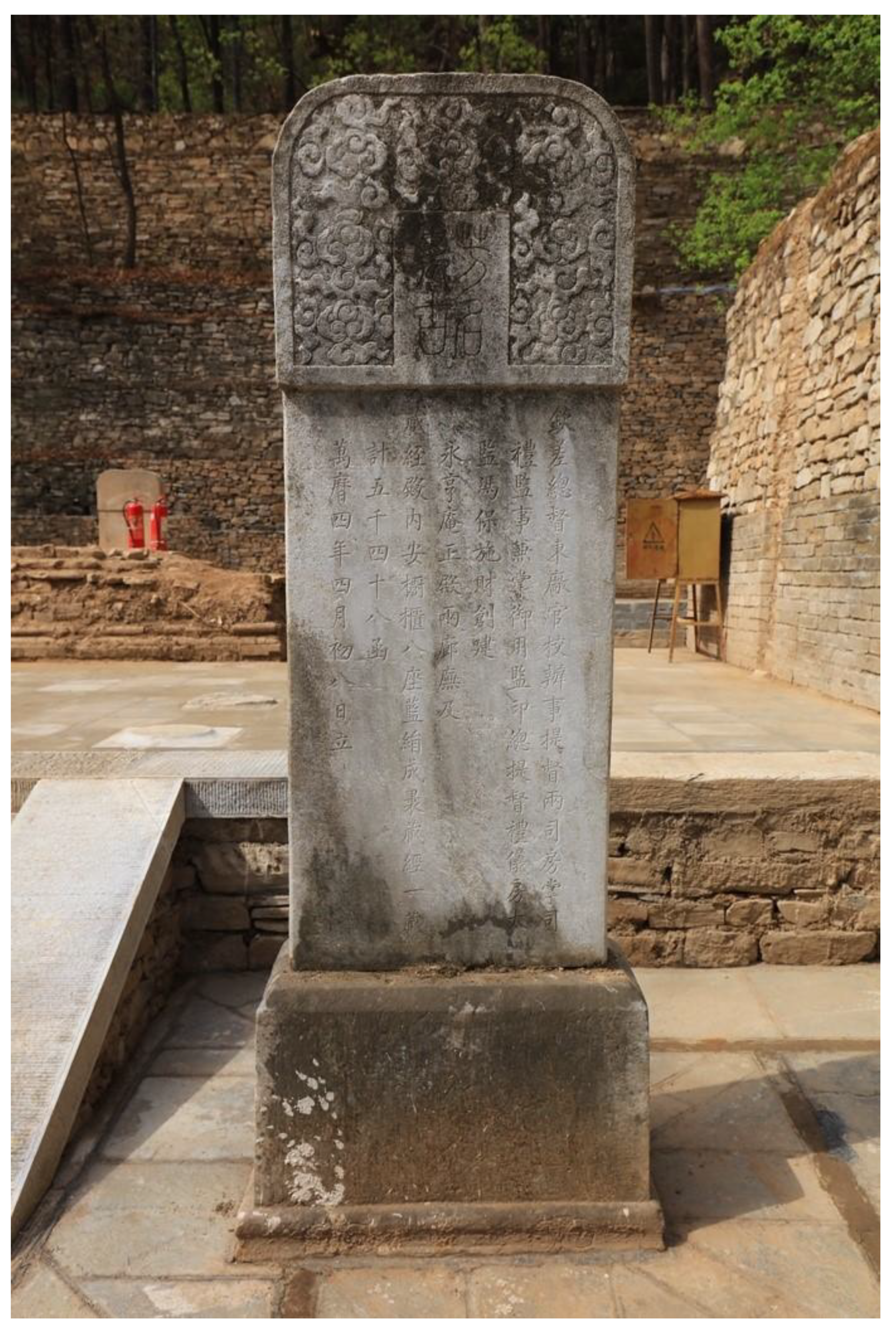
| 28 | The original Chinese reads as follows: 施財創建永亨庵正殿兩廊廡及藏經殿內安櫥櫃八座,藍絹成裹,藏經一藏,計五千四十八函。萬曆四年四月初八日 A Chinese word han 函 (cases) was probably wrong here. It should be ce 册 or juan 卷 (volume). See Yiwu Yang (2004, p. 227). |
| 29 | Dong and Min (2011, p. 215). The Chinese original reads: 大司禮樞輔馮公仰承聖母皇太后聖意,為今上皇帝祝禧錫羨彚數千金,特創梵剎,訪命徧融上人住持其事。 |
| 30 | |
| 31 | The stele records that Feng Bao was responsible for the building of the Yongheng Temple and that a collection of the Buddhist canon, totaling 5046 volumes, is housed in eight cabinets in the library hall. https://blog.sina.com.cn/s/blog_bdbef0ce0102xflb.html (accessed on 1 September 2025). |
| 32 | |
| 33 | |
| 34 | |
| 35 | Ruoyu Liu (1994, p. 124). The original Chinese reads, “或年老有病,退居于此,止給柴米、冬衣、靴料,以終殘年。” |
| 36 | For eunuchs in retirement and posthumous arrangements, see Sherry Pan (2024, pp. 185–90). |
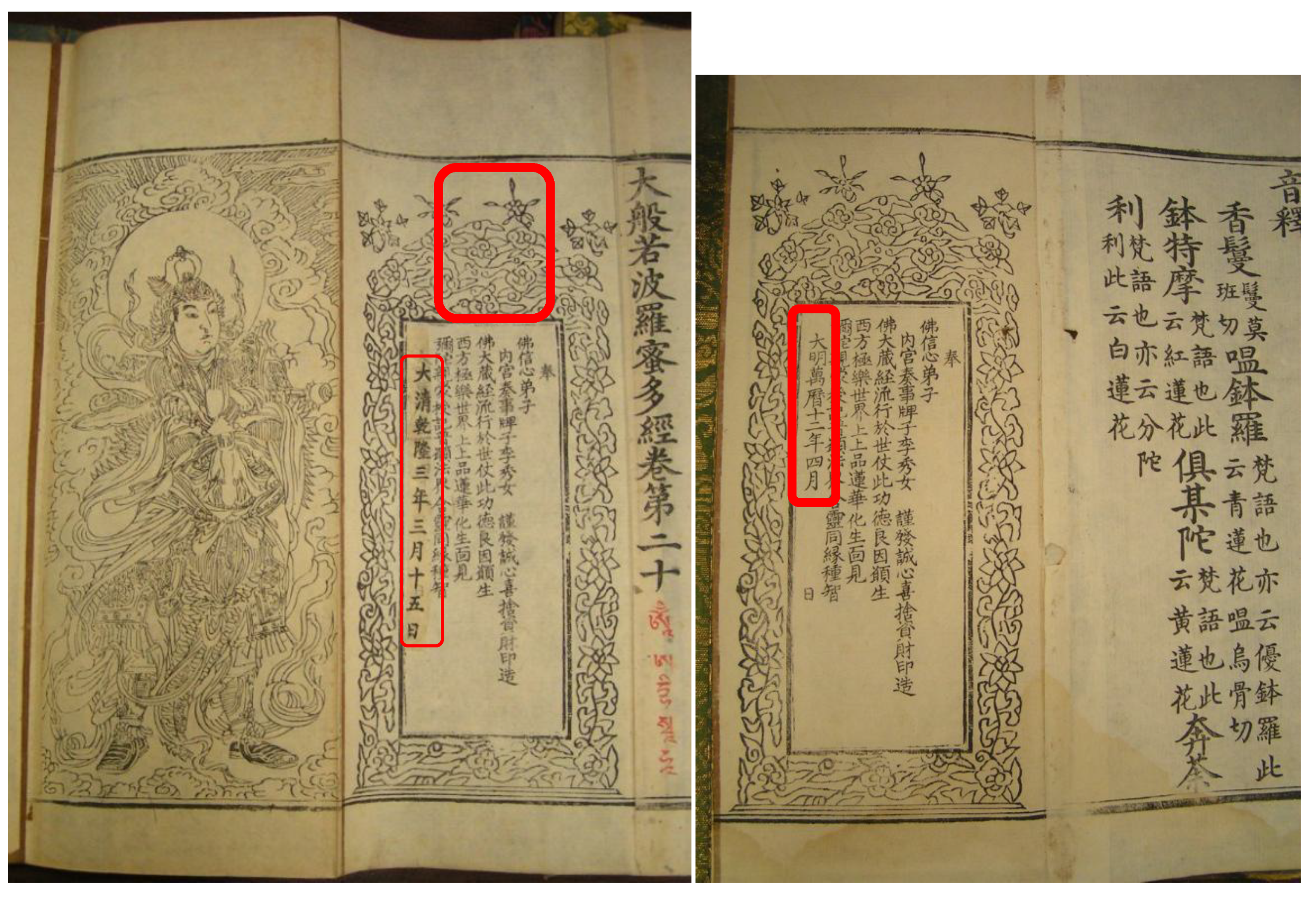
| 37 | This passage is regularly found in the last volume of every han 函. The dating of the colophon of the first han was covered by a slip of paper which changed the date from the twelfth year of Emperor Wanli (1584) to the fifteenth day, the third month, third year of Emperor Qianlong (1738). It reminds us of the literary inquisition imposed by Manchu rulers. The colophon reads: 奉佛信心弟子 内宮奏事牌子李秀女 謹發誠心喜捨資財印造佛大藏經流行於世仗此功德良因願生西方極樂世界上上品蓮華化生面見彌陀親蒙授記普願法界含靈同緣種智 大明萬曆十二年四月. |
| 38 | Usually, monks were not very well-educated. Here, the title of the crown prince’s mother “Wang Gongfei 恭妃”was wrongly written as 王宫妃. |
| 39 | Kenneth Chen points out that leaders of the Buddhist church decided that in order to propagate their faith they must attach themselves closely to the ruling prince and depend on whatever support and protection they could gain from him. See K. Chen (1973, p. 78). |
| 40 | The full text of colophon is as follows: 兹以披閱 大明恭妃王氏身躬康泰 慧命增崇 災除障盡 恆常吉慶 大明皇太子洪福安靜,國祚求久,身心恬怡 萬安如意 龍飛萬曆嵗在屠維大淵獻 年林鈡月蓂生日(萬曆二十七年,1599年,六月一日) 與座元老師誠為後來表記之亦 後學如元拙筆授 I would like to express my thanks to Professor He Xiaorong 何孝榮 and his friend Professor Zhang Zhaoyu 張兆裕, Nankai University, for their kind and generous help in deciphering some words in the colophon. With their kind help, I finally determined the date of the colophon. |
| 41 | The full text of the second colophon is as follows: 以此看念 I read this Buddhist scripture and 上祝大明宮妃王氏身躬康泰壽命延弘 I wish Lady Wang, consort of the Ming Court, good health and a long life. 大明皇長太子 洪福萬安 吉祥如意 I wish the eldest crown prince happiness and safety forever. 大明萬曆二十七年(1599)種是閲之也,弟子性通 twenty-seventh year of Wanli (1599) of the Great Ming dynasty, by Monk Xingtong. |
| 42 | Lady Shi must have come from a big family. Near Wangfujing Street王府井大街, one of the busiest streets in Beijing, there is a small lane called Shijia hutong 史家胡同 (Shi’s Lane). The famous hero General Shi Kefa 史可法 (1602–1645) lived there. This area is about 1.2 km from Cilong Temple. |
| 43 | I sent this photo to Professor Li Jining 李際寧, curator of the rare books section at the National Library of China in Beijing. He explained that this printed red slip of paper is called “tiqian 題簽.” Usually it is a label that contains the title of a work on the cover of a book. It is rare to see such a printed “tiqian” pasted on hundreds of volumes of the Buddhist canon for merit-making. |
| 44 | The Chinese colophon reads: 大宋國嘉興府華亭縣長人鄉十九保下砂場第七竈衙西面北居住奉佛弟子唐思敬同母親倪氏 三娘妻王氏三娘男峴家眷等情旨意發誠心施净財貳拾貫文省恭入 延聖院經坊坎造甚希有經一卷功德追薦先考唐六十承事超昇净土者更乞保持家門清吉合安寧 峕嘉熙三年 (1239) 七月 日弟子唐思敬等謹題 |
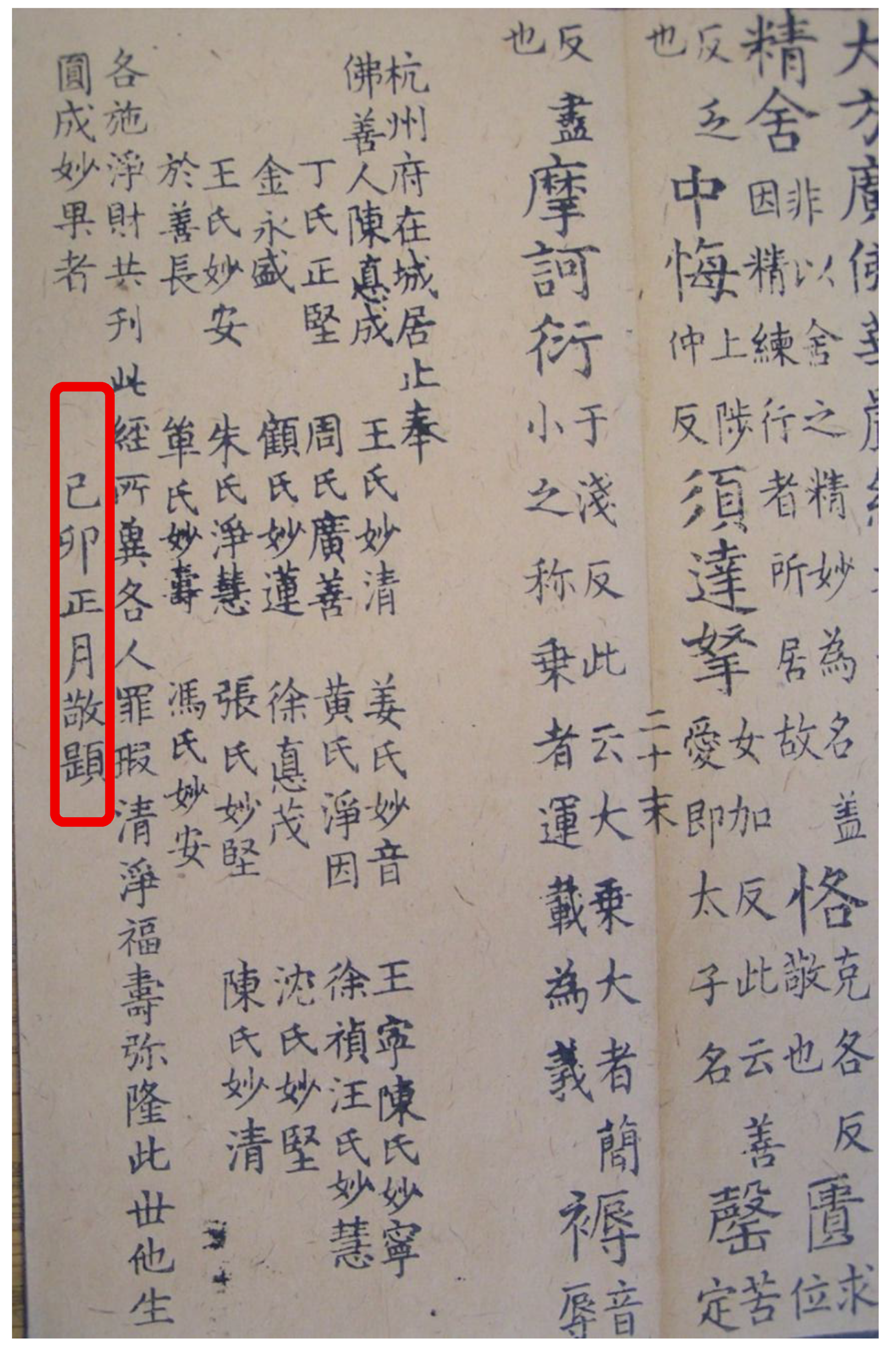
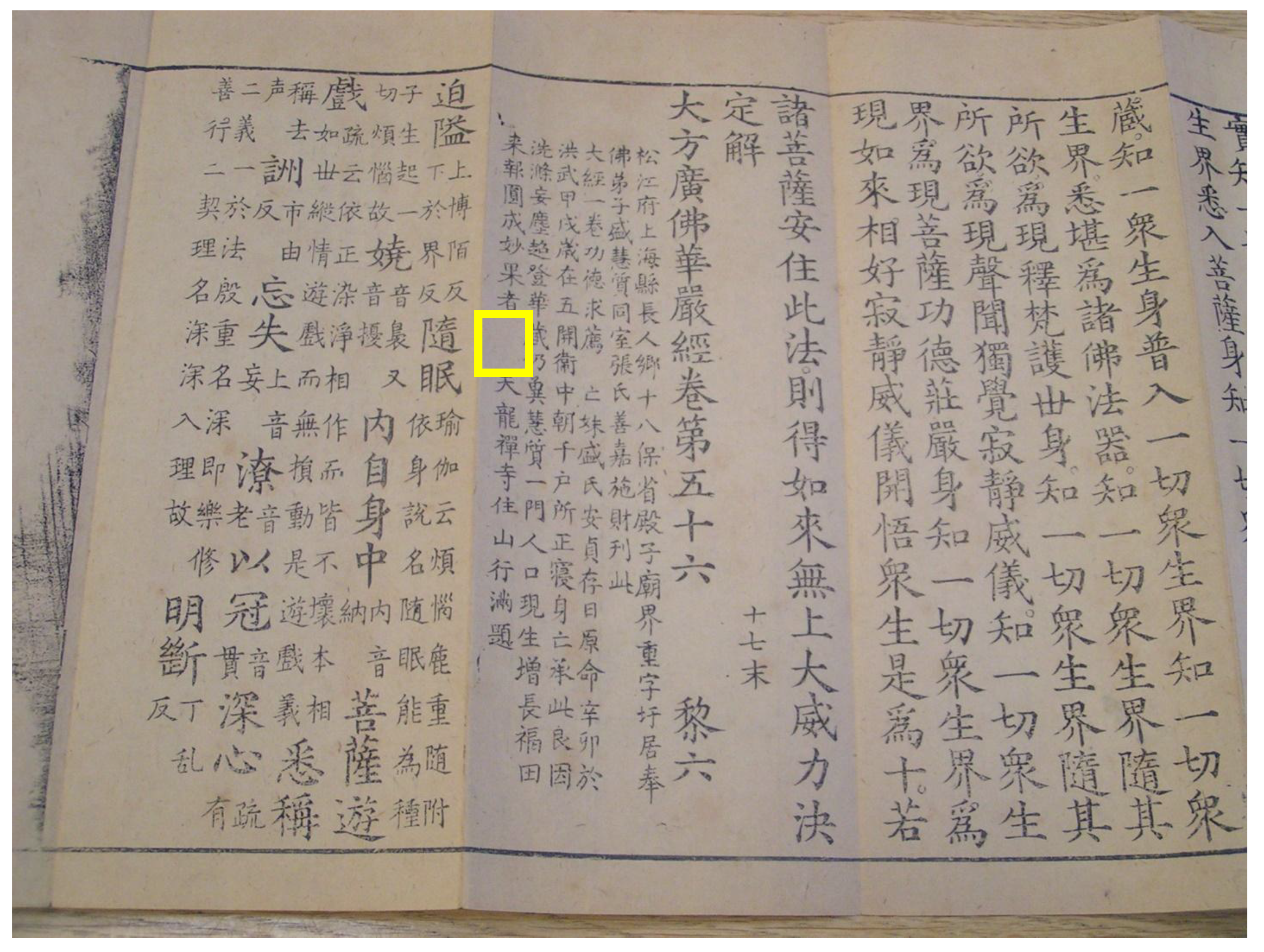
| 45 | The original Chinese reads: 松江府上海縣長人鄉十八保省殿子廟界重字圩居奉/佛弟子盛慧質同室張氏善嘉施財刊此/大經一卷功德求薦亡妹盛氏安貞存日原命辛卯於/洪武甲戌(二十七年,1394)歲在五開衛中朝千戶所正寢身亡承此良因/洗滌妄塵超登華藏仍冀慧質一門人口現生增長福田/來報圓成妙果者天龍禪寺住山行滿題。See H. Wang (2004, No. 2). |
| 46 | The English version was translated by Dr. Hu Shi (1890–1962), who was curator of the Gest Library at Princeton University. See his paper (Hu 1954). The citation is slightly different in the names of pinyin. |
| 47 | Ge ([1607] 2007, p. 738). Ge revealed that twenty sets of Yongle Souther Canon were printed. It is no strange that the woodblocks became worn out. |
| 48 | The librarians of Beibei Library 北碚圖書館 in Chongqing refuse to admit that their collection of the Buddhist canon should be classified as the Yongle Southern Canon. Instead, they claim that theirs is a copy of the Hongwu Southern Canon, similar to the one preserved in Sichuan Provincial Library in Chengdu. See both books (Beibei Tushuguan Jingpin Tulu Bianji Weiyuanhui 2014, pp. 130–35; Chongqing Beibei Tushuguan deng bajia shoucang danwei guji pucha dengji mulu bianweihui 2016, p. 9). From the dates recorded in the colophons, one can easily see that the claim set forth by the of Beibei Library is groundless. See Long (2000, pp. 112–47). |
| 49 | The original Chinese reads: 四川等處承宣布政石砫宣撫司居住奉佛捐資請經信官馬斗斛同夫人覃氏,同應襲馬千乘,官女馬玉英、瓊英,於萬曆六年二月十五日命釋子如戒同俗徒呂性照衆徒等,赴京印請大藏尊經回,轉誦頂禮供養,伏願覃氏善清世世生生同登華藏之玄門,共入毗盧之性海。 |
| 50 | The original Chinese reads: 經爲報國迎祥什子如戒告 知,此經向後只在本司永遠供養,不許諸山來司相托諸公求請藏經遠去披閱,失落一卷一函承領大藏尊經十萬八千藏油臘十萬八千斤,生生世世永墮地獲,在司守護者增福延壽。 |
| 51 | See note 5 above. |
| 52 |
References
Primary Sources
Beijing simiao lish ziliao 北京寺廟歷史資料 [Sources of history of temples in Beijing]. Beijing: Zhongguo dang’an chubanshe, 1997.Beijing tushuguan cang Zhongguo lidai shike taben huibian 北京圖書館藏中國歷代石刻拓本匯編 [Collection of rubbings of steles in Chinese history]. Zhengzhou: Zhongzhou chubanshe, 1997.Chen, Yanzhu 陳燕珠, ed. 1995. Xinbian buzheng Fangshan shijing tiji huibian 新編房山石經題記彚編 [New collections of colophons of stone Buddhist canon in Fangshan]. Taipei: Jueyuan wenjiao jijin hui.Li, Guoqing 李國慶, compiler. 2016. Jingshan zang suo zai paiji ziliao huibian《徑山藏》所載牌記資料匯編 [Collection of colophons in the Jingshan Canon]. Beijing: Guojia tushuguan chubanshe.Li, Guoqing 李國慶, compiler. 2016. Jingshan zang suo zai paiji ziliao huibian《徑山藏》所載牌記資料匯編 [Collection of colophons in the Jingshan Canon]. Beijing: Guojia tushuguan chubanshe.Liu Ruoyu劉若愚, 1994. Zhuo zhong zhi 酌中志 (A weighted and unbiased record) (ca. 1638). Beijing: Guji chubanshe.Ming shi lu 明實錄 [The Veritable Records of the Ming Dynasty]. Emperor Wanli, juan 168, paragraph 72,380 (卷一百六十八/段 72,390).Yongle Beizang 永樂北藏 [The Yongle Northern Canon]. East Asian Library, Princeton University.Yongle Beizang. Regenstein Library, University of Chicago.Yongle Beizang. Jagiellonian University Library, Poland.Yongle Beizang. Xiaoxitian Temple 小西天, Xixian County 隰縣, Shanxi Province.Yongle Beizang. Wuwei Museum 武威博物館, Gansu Province.Qisha zang 磧砂藏 [The Qisha Canon], East Aian Library, Princeton University.Yongle Nanzang 永樂南藏 [The Yongle Southern Canon], Beibei Library 北碚圖書館, Chongqing and the Xingyuan Library, Yulin City, Shaanxi Province 陕西省榆林星元圖書館.Zhang, Tingyu 張廷玉 et al. 2011. Mingshi 明史 [History of the Ming]. Beijing: Zhonghua shuju.Secondary Sources
- Beibei Tushuguan Jingpin Tulu Bianji Weiyuanhui 北碚圖書館精品圖錄編輯委員會. 2014. Beibei tushuguan jingpin tulu guji juan 北碚圖書館精品圖録古籍卷 [Illustrated Treasures in Beibei Library: Rare Classic Books]. Beijing: Zhonghua shuju. [Google Scholar]
- Buswell, Robert, and Donald S. Lopez, Jr. 2014. The Princeton Dictionary of Buddhism. Princeton: Princeton University Press. [Google Scholar]
- Chen, Kenneth. 1973. Buddhism in China: A Historical Survey. Princeton: Princeton University Press. [Google Scholar]
- Chen, Yunü 陳玉女. 2001. Mingdai ershisi yamen d huanguan yu Beijing fojiao 明代二十四衙门的宦官與北京佛教 [Ming Eunuchs in the Twenty-four Yamens and Buddhism in Beijing]. Taipei: Ruwen chubanshe. [Google Scholar]
- Chongqing Beibei Tushuguan deng bajia shoucang danwei guji pucha dengji mulu bianweihui 重慶北碚圖書館等八家收藏單位古籍普查登記目錄編委會. 2016. Chongqing shi Beibei Tushuguan deng bajia shoucang danwei guji pucha dengji mulu 重慶北碚圖書館等八家收藏單位古籍普查登記目錄 [Catalog of Classic Books Surveyed and Registered at Beibei Library and the Libraries of Seven Other Institutions in Chongqing]. Beijing: Guojia tushuguan chubanshe. [Google Scholar]
- Dang, Baohai 黨寳海. 2001. Shanxi Xixian Qianfo an Ming-Qing fodian yu baojuan 山西隰縣千佛庵明清佛典舆寳卷 [The Buddhist Canons and the Precious Scrolls Printed in Ming-Qing Dynasties as Kept in Qianfo Temple, Xi County, Shanxi Province]. Wenxian 文獻 [Chinese Classic Literature] 2: 114–32. [Google Scholar]
- Deng, Shujun 鄧淑君. 2017. Mingdai guanban fojiao dazangjing Yongle beizang kanyin yu banci yanjiu 明代官版佛教大藏經《永樂北藏》刊印與頒賜研究 [A Study on the Bestowal of Yongle Northern Canon by the Ming Court]. Master’s thesis, Taiwan National Normal University, Taipei, Taiwan. [Google Scholar]
- Dong, Xiaoping 董曉萍, and Lü Min 吕敏 (Marianne Bujard). 2011. Beijing neicheng simiao beike zhi 北京内城寺廟碑刻志 [Temples et Stèles de Pékin]. Beijing: Guojia tushuguan chubanshe, vol. 1. [Google Scholar]
- Ge, Yinliang 葛寅亮, comp. 2007. Jinling fancha zhi 金陵梵刹志 [Gazetteers of Buddhist Temples in Nanjing]. Collated by He Xiaorong 何孝榮. Tianjin: Tianjin remin chubanshe. First published 1607. [Google Scholar]
- Giles, Lionel. 1957. Descriptive Catalogue of the Chinese Manuscripts from Tunhuang in the British Museum. London: The Trustees of the British Museum. [Google Scholar]
- Goodrich, L. Carrington, and Chaoying Fang. 1976. Dictionary of Ming Biography 1368–1644 明代名人傳. New York: Columbia University Press. [Google Scholar]
- Hahn, Michael, Jens-Uwe Hartmann, and Roland Steiner, eds. 1996. Suhṛllekhāḥ: Festgabe für Helmut Eimer. Indica et Tibetica 28. Swisttal: Indica et Tibetica Verlag, pp. 175–78. [Google Scholar]
- He, Xiaorong 何孝榮. 2016. Mingdai huanguan yu fojiao 明代宦官與佛教 [Eunuchs and Buddhism in the Ming dynasty]. In Mingchao fojiaoshi lungao 明朝佛教史論稿 [Collection of Essays on History of the Ming]. Beijing: Zongjiao wenhua chubanshe. [Google Scholar]
- Hu, Shih. 1954. The Gest Oriental Library at Princeton University. The Princeton University Chronicle 15: 127. [Google Scholar] [CrossRef]
- Huang, Shih-shan Susan. 2024. The Dynamic Spread of Buddhist Print Culture: Mapping Buddhist Book Roads in China and its Neighbors. Leiden: Brill. [Google Scholar]
- Kieschnick, John. 2003. The Impact of Buddhism on Chinese Material Culture. Princeton: Princeton University Press. [Google Scholar]
- Kieschnick, John. 2022. Buddhist Historiography in China. New York: Columbia University Press. [Google Scholar]
- Levering, Miriam, ed. 1989. Scripture and Its Reception: A Buddhist Case. In Thinking Scripture: Essays from a Comparative Perspective. Albany: State University of New York Press. [Google Scholar]
- Li, Fuhua 李富華, and Mei He 何梅. 2003. Hanwen fojiao dazangjing yanjiu 漢文佛教大藏經研究 [Research on Chinese Tripitaka]. Beijing: Zongjiao wenhua chubanshe. [Google Scholar]
- Li, Jining 李際寧. 2002. Fojing banben 佛經版本 [Editions of the Buddhist Canon]. Nanjing: Jiangsu guji chubanshe. [Google Scholar]
- Loehr, Max. 1968. Chinese Landscape Woodcuts: From an Imperial Commentary to the Tenth-Century Printed Edition of the Buddhist Canon. Cambridge: The Belknap Press of Harvard University Press. [Google Scholar]
- Long, Darui. 2000. A Note on the Hongwu Nanzang, a Rare Edition of the Buddhist Canon. The East Asian Library Journal 2: 112–47. Available online: https://eal.lib.princeton.edu/EALJ/darui_long.EALJ.v09.n02.p112.pdf (accessed on 12 June 2025).
- Long, Darui 龍達瑞. 2022. Yongle Beizang de tiji, paiji yanjiu 《永樂北藏》的題記、牌記研究 [The Yongle Northern Canon: Its Colophons and Inscriptions]. Foguang xuebao 佛光學報 (Fo Guang Journal of Buddhist Studies) 8: 81–144. [Google Scholar]
- Long, Darui, and Jinhua Chen, eds. 2020. Chinese Buddhist Canons in the Age of Printing. London: Routledge. [Google Scholar]
- Mote, Frederick, and Denis Twitchett. 1988. The Cambridge History of China: The Ming Dynasty, 1388–1644, Part I. Cambridge: Cambridge University Press, vol. 7. [Google Scholar]
- Naquin, Susan. 2000. Peking Temples and City Life, 1400–1900. Berkeley: University of California Press. [Google Scholar]
- Nozawa, Yoshimi 野沢佳美. 2003. Mindai Kitazō kō: Kashi jōkyō o chūshin ni 明代北蔵考—下賜狀況を中心に (A Study of the Beijing Edition of the Tripiṭaka in the Ming Dynasty). Risshō daigaku Bungakubu ronsō 立正大學文學部論叢 [The Journal of the Department of Literature, Risshō University] 117: 81–106. [Google Scholar]
- Pan, Sherry. 2023. Forms of Practice: Religiosity of Palace Eunuchs during the Late Ming (1527–1644). Ph.D. dissertation, Brown University, Providence, RI, USA. [Google Scholar]
- Pan, Sherry. 2024. Death, Legacy, and Remembrance: Buddhism in the Mortuary Practices of Palace Eunuchs in the Late Ming. Journal of Chinese Buddhist Studies 37: 157–99. [Google Scholar]
- Payne, Richard. 2014. Scripture:Canon::Text:Context: Essays Honoring Lewis Lancaster. Berkeley: Institute of Buddhist Studies and BDK America, Inc. [Google Scholar]
- Peng, Xinglin 彭興林. 2012. Beijing Fosi yiji kao 北京佛寺遺跡考 [A study of Buddhist temple ruins in Beijing]. In Beijing Fojiao wenxian jicheng 北京佛教文獻集成 [Beijing Buddhist Literature Collection], Part 3. Edited by Wei Yin 偉印. 3 vols. Beijing: Zongjiao wenhua chubanshe. [Google Scholar]
- Qin, Jianxin 秦建新, and Lin’en Zhao 赵林恩. 2017. Wutaishan beike 五臺山碑刻 [Collection of Steles of Mount Wutai]. Taiyuan: Sanjin chubanshe, vol. 1. [Google Scholar]
- Shi, Zhenhai 釋鎮海. 1978. Qingliangshan zhi 清涼山誌 [Gazetteers of Mount Qingliang], juan 4. Taipei: Fojiao chubanshe. [Google Scholar]
- Tong, Wei 童瑋. 1997. Ershi er zhong dazangjing tongjian 二十二種大藏經通檢 [Twenty-Two Catalogues of the Chinese Buddhist Canon]. Beijing: Zhonghua shuju. [Google Scholar]
- Tsai, Shih-shan Henry. 1996. The Eunuchs in the Ming Dynasty. Albany: State University of New York Press. [Google Scholar]
- Tsien, Tsuen-Hsuin. 1985. Paper and Printing. In Science and Civilisation in China. Chemistry and Chemical Technology, Part 1. Edited by Joseph Needham. Cambridge: Cambridge University Press, vol. V. [Google Scholar]
- Wang, Han 王菡. 2004. Zai Meiguo suo du Qisha zang 在美國所讀《磧砂藏》 [Reading the Qisha Canon in America]. Wenxian 文獻 [Chinese Classic Literature] 2. Available online: https://lib.cqvip.com/Qikan/Article/Detail?id=1001100516 (accessed on 12 June 2025).
- Wang, Jin 王進. 2024. Xiancun Yongle beizang Wanli nianjian chiyu niandai ji yuzhi bei kao—Yi Xixian, Wuwei Yangxian sanbu zangjing wei li 現存永樂北藏萬曆年間敕諭年代及禦製牌考--以隰縣、武威、洋縣三部藏經爲例 [The Extant Three Copies of the Yongle Northern Canon Printed in the Wanli Period (1573–1620) with Special Reference to the Colophons in the Imperial Boards of Donation for the Buddhist Canon]. Unpublished paper, Workshop on the Buddhist Canon, Hainan University, Haikou, China. June 23. [Google Scholar]
- Weidner, Marsha Smith, Patricia Ann Berger, Helen Foresman Spencer Museum of Art, and Asian Art Museum of San Francisco. 1994. Latter Days of the Law: Images of Chinese Buddhism 850–1850. Lawrence: Spencer Museum of Art, The University of Kansas. Honolulu: University of Hawaii Press. [Google Scholar]
- Wu, Jiang, and Greg Wilkinson, eds. 2017. Reinventing the Tripitaka: Transformation of the Buddhist Canon in Modern East Asia. Lanham: Lexington Books. [Google Scholar]
- Wu, Jiang, and Lucille Chia, eds. 2016. Spreading Buddha’s Word in East Asia: The Formation and Transformation of the Chinese Buddhist Canon. New York: Columbia University Press. [Google Scholar]
- Wu, Mengling 吳夢麟, and Yongqiang Zhang 張永強. 2021. Fangshan shijing tiji zhengli yanjiu 房山石經題記整理研究 [Compilation and Research on Inscriptions of the Fangshan Stone Sūtras]. Beijing: Wenwu chubanshe. [Google Scholar]
- Yang, Yiwu 楊亦武. 2004. Shangfang shan Doushuai si 上方山兜率寺 [Doushuai Temple in Shangfang shan, Beijing]. Beijing: Huawen chubanshe. [Google Scholar]
- Zhang, Dewei 張德偉. 2020. Thriving in Crisis: Buddhism and Political Disruption in China: 1520–1620. New York: Columbia University Press. [Google Scholar]
- Zhao, Hongchuan 趙紅川. 2024. Yibu Mingdai Hanwen dazangjing de 373 nian gongyang 一部明代漢文《大藏經》的373年供養史 [A history of 373 years of offerings and maintenance of the Buddhist canon in the Ming dynasty]. Sichuan tushuguan xuebao 四川圖書館學報 [Journal of Sichuan Library] 4: 83–92. [Google Scholar]
- Zhaohe fabao zongmulu 昭和法寳總目錄. 1929. Shōwa hōbō sōmokuroku [The Shōwa Era’s Comprehensive Catalogue of Dharma Treasuries]. Available online: https://books.google.com.au/books/about/%E6%98%AD%E5%92%8C%E6%B3%95%E5%AF%B6%E7%B8%BD%E7%9B%AE%E9%8C%B2.html?id=ZcnNzQEACAAJ&redir_esc=y (accessed on 12 June 2025).
- Zhongguo fojiao xiehui 中國佛教協會. 2004. Zhongguo fojiao 中國佛教 [Chinese Buddhism]. Beijing: Zhongguo shehui kexue chubanshe, vol. 5. [Google Scholar]


Disclaimer/Publisher’s Note: The statements, opinions and data contained in all publications are solely those of the individual author(s) and contributor(s) and not of MDPI and/or the editor(s). MDPI and/or the editor(s) disclaim responsibility for any injury to people or property resulting from any ideas, methods, instructions or products referred to in the content. |
© 2026 by the author. Licensee MDPI, Basel, Switzerland. This article is an open access article distributed under the terms and conditions of the Creative Commons Attribution (CC BY) license.
Share and Cite
Long, D. Merit-Making Through Printing, Distributing and Reading Buddhist Canon in the Late Ming Dynasty. Religions 2026, 17, 61. https://doi.org/10.3390/rel17010061
Long D. Merit-Making Through Printing, Distributing and Reading Buddhist Canon in the Late Ming Dynasty. Religions. 2026; 17(1):61. https://doi.org/10.3390/rel17010061
Chicago/Turabian StyleLong, Darui. 2026. "Merit-Making Through Printing, Distributing and Reading Buddhist Canon in the Late Ming Dynasty" Religions 17, no. 1: 61. https://doi.org/10.3390/rel17010061
APA StyleLong, D. (2026). Merit-Making Through Printing, Distributing and Reading Buddhist Canon in the Late Ming Dynasty. Religions, 17(1), 61. https://doi.org/10.3390/rel17010061