Uncovering the Hijab Among Turkish Women: The Impact of Social Media and an Analysis Through Social and Cultural Capital

Abstract
1. Introduction
1.1. Conceptual Framework and Literature: Bourdieu, the Hijab, and the Digital Field
1.1.1. Introducing the Bourdieusian Toolkit: Habitus, Capital, and Symbolic Violence
1.1.2. The Hijab in the Turkish Context: From Political Symbol to Digital Performance
1.1.3. Expanding the Framework: Stigma, Dual-Sided Neighborhood Pressure, Perfect Muslim Woman Stereotype, and the Burden of Representation
1.2. Method
1.2.1. Research Design and Participant Selection
1.2.2. Researcher Positionality and Reflexivity
1.2.3. Data Collection and Data Analysis
2. Results
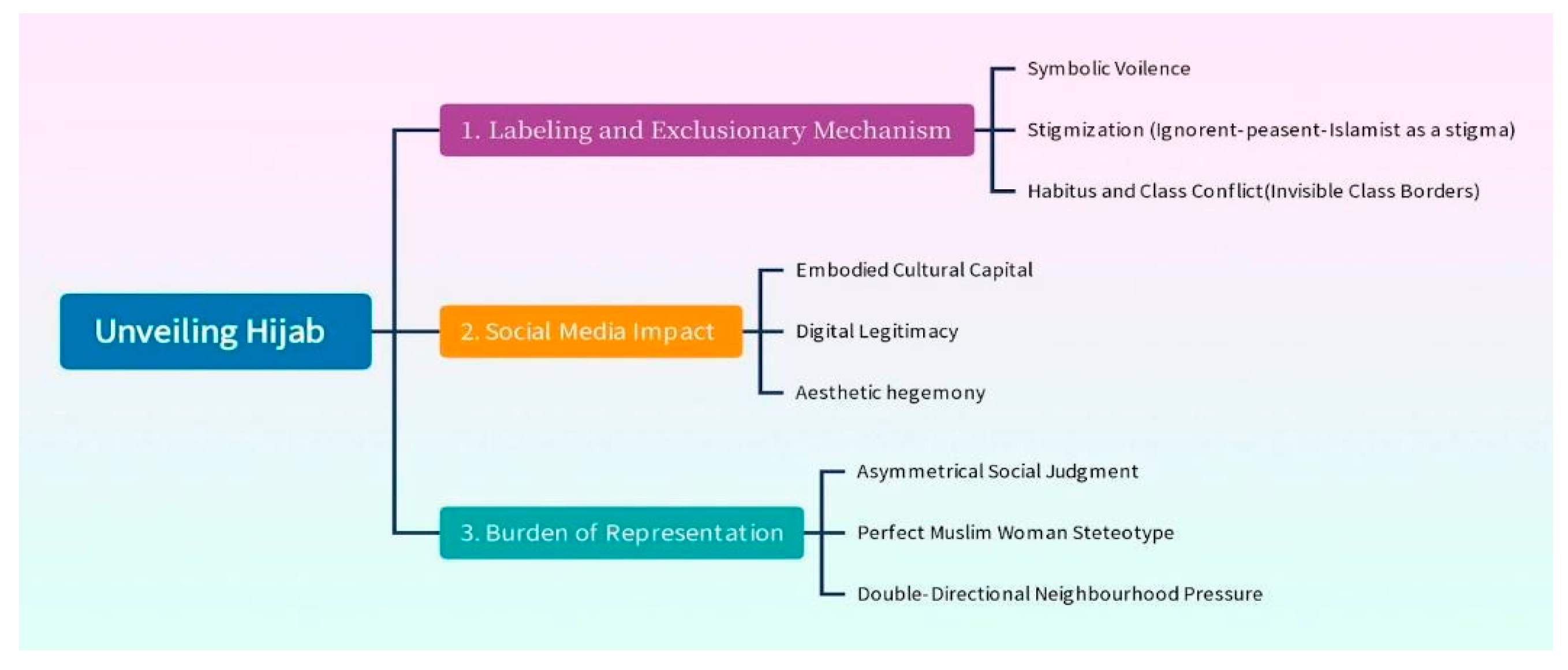
2.1. Labeling and Exclusionary Mechanisms: The Hijab as a Barrier to the Elite Habitus in Türkiye
2.1.1. Symbolic Violence: “I Felt That People Put Me in the Place of a Human Being: Internalized”
2.1.2. Stigmas: “You Could Speak Flawlessly, Hold Degrees; However, When Veiled, You’re Instantly Becoming Ignorant”
2.1.3. Habitus and Class Conflict: “Even Süslümans Are Never Seen as Upper-Class”
2.2. Social Media Impact
2.2.1. Embodied Cultural Capital: “There Is a Social Media Network That Judges Everything”
2.2.2. Digital Legitimacy: “I Got Good Job Offers from LinkedIn After I Unveiled Hijab”
2.2.3. Aesthetic Hegemony: “I Have Trouble Finding Hijab Versions of the Clothes I Like on Pinterest”
2.3. Burden of Representation: “You Are Not Just Yourself; You Represent All Veiled Women”
2.3.1. Asymmetrical Social Judgment: “They Criticize Me When I Wear a Hijab and Ride a Bike with My Child, but Suddenly I Become a Caring Mother When I Unveil”
2.3.2. Perfect Woman Stereotype: “I Felt Like God Got Rid of Me”
2.3.3. Dual-Sided Neighborhood Pressure: What Will People Say?
3. Conclusions
4. Limitations and Future Research
Author Contributions
Funding
Institutional Review Board Statement
Informed Consent Statement
Data Availability Statement
Acknowledgments
Conflicts of Interest
Appendix A

| Job | Age | Education | Marital Status | Income Level |
|---|---|---|---|---|
| Student | 20 | High school | Single | Middle |
| Student | 21 | University (2nd year) | Single | Upper-middle |
| Student | 20 | University (planning transfer) | Single | Upper-middle |
| Communication (Presidency of Türkiye) | 35 | Master’s degree | Married | Middle |
| Barista | 26 | Bachelor’s degree | Single | Middle |
| Student (Medicine) | 23 | University (3th year) | Single | Middle |
| Cook | 32 | Bachelor’s degree | Single | Upper-middle |
| Healthcare worker | 33 | Bachelor’s degree | Married | Middle |
| Service hostess | 38 | High school | Divorced | Low |
| Student | 23 | University (2nd year) | Single | Middle |
| Tour Guide | 26 | Bachelor’s degree | Single | Middle |
| Recent graduate | 25 | Bachelor’s degree | Married | Middle |
| Student | 23 | University (2nd year) | Single | Upper-middle |
References
- Ab Halim, Asyiqin, Nor Fahimah Mohd Razif, and Nur Shahidah Paad. 2022. Media and the Issue of Hijab and Veil Across European Countries. Journal of Al-Tamaddun 17: 203–11. [Google Scholar] [CrossRef]
- Adıgüzel, Muhammet Metin. 2023. Popüler Kültürün Bir Öğesi Olarak Tesettür Modası. Akademik Platform İslami Araştırmalar Jurnal 7/3: 394–419. [Google Scholar] [CrossRef]
- Akdemir, Ayşe Betül. 2020. Öğrencilerde İnanç Problemine Neden Olan Faktörlerin Belirlenmesi. Dergiabant 8: 318–42. [Google Scholar] [CrossRef]
- Akou, Heather. 2015. Becoming visible: The Role of the Internet in Dress Choices among Native-born Converts to Islam in North America. HAWWA 13: 279–96. [Google Scholar] [CrossRef]
- Akşit, Bahattin, Recep Şentürk, Önder Küçükural, and Cengiz Kurtuluş. 2012. Türkiye’de Dindarlık Sosyal Gerilimler Ekseninde İnanç ve Yaşam Biçimleri. İstanbul: İletişim Publishers. [Google Scholar]
- Alayan, Samira, and Lana Shehadeh. 2021. Religious Symbolism and Politics: Hijab and Resistance in Palestine. Ethnic and Racial Studies 44: 1051–67. [Google Scholar] [CrossRef]
- Albayrak, H. Ԟule. 2023. Justification of Headscarf Bans in Europe and Turkey: A Comparative Analysis. Asian Journal of Women’s Studies 29: 484–505. [Google Scholar] [CrossRef]
- Arab, Zainab. 2022. ‘When Have Dolce and Gabbana Ever Cared about the Hijab?’ Social Media, Fashion and Australian Muslim Women’s Perceptions and Expression of Hijab. Religions 13: 1115. [Google Scholar] [CrossRef]
- Ataman, Kemal, and M. Numan Sağırlı. 2024. Başörtüsü Örtmeyi Bırakan Kadınların Dinî Yaşantılarında Farklılaşan Tecrübeleri Üzerine Nitel Bir Araştırma. Eskiyeni 52: 9–30. [Google Scholar] [CrossRef]
- Avci, Hamide, Laura Baams, and Tina Kretschmer. 2024. A Systematic Review of Social Media Use and Adolescent Identity Development. Adolescent Research Review 10: 219–36. [Google Scholar] [CrossRef]
- Aygün, Elif Büşra. 2022. Başörtülü Kadın Kimliklerin Instagram’da Görünürlüğü: Kültür Endüstrisi Bağlamında Değerlerin Dönüşümü Üzerine Bir İnceleme. Master’s thesis, İstanbul University Social Sciences Institute, İstanbul. [Google Scholar]
- Babacan, Zehra. 2021. Yeni İletişim Araçlarında Değişen Tesettür Algısı: Instagram’da Tesettür Giyim Pratikleri. Master’s thesis, İnönü University Social Sciences Institute, Malatya. [Google Scholar]
- Başak, Duygu. 2022. Dindarlık ve Maneviyat Tutumlarında Başını Örtüp Örtmeme Tercihi Üzerine Karşılaştırmalı Nitel Bir Araştırma. Master’s thesis, Istanbul University, Institute of Social Sciences, İstanbul. [Google Scholar]
- Baulch, Emma, and Alila Pramiyanti. 2018. Hijabers on Instagram: Using Visual Social Media to Construct the Ideal Muslim Woman. Social Media + Society 4: 2056305118800308. [Google Scholar] [CrossRef]
- Bayat, Farimah, and Nancy Hodges. 2024. Just Say ‘No’ to Compulsory Hijab: Exploring the Motivations and Meanings of Bad-Hijabi in Iran. Clothing and Textiles Research Journal 42: 247–62. [Google Scholar] [CrossRef]
- Baynal, Fatma. 2017. Tarikat ve Cemaat Ekseninde Kadın. İstanbul: Rağbet Publishers. [Google Scholar]
- Bhatia, Nandini, Dimple Choudhry, Zafar Mohammad, and Himanish Dutta. 2025. Effect of Headscarves on Physical and Quality of Life in Young Females: A Narrative Revie w. International Journal of Research and Review 12: 413–20. Available online: https://www.ijrrjournal.com (accessed on 4 October 2025). [CrossRef]
- Bingaman, Kirk A. 2023. Religion in the Digital Age: An Irreversible Process. Religions 14: 108. [Google Scholar] [CrossRef]
- Bourdieu, Pierre. 1977. Outline of a Theory of Practice. Translated by Richard Nice. Cambridge: Cambridge University Press. [Google Scholar]
- Bourdieu, Pierre. 1984. Distinction: A Social Critique of the Judgement of Taste. Translated by Richard Nice. Cambridge: Harvard University Press. [Google Scholar]
- Bourdieu, Pierre. 1986. The Forms of Capital. In Handbook of Theory and Research for the Sociology of Education. Edited by John G. Richardson. New York: Greenwood Press, pp. 241–58. [Google Scholar]
- Bourdieu, Pierre. 1991. Language and Symbolic Power. Edited and Translated by Gino Raymond, and Matthew Adamson. Cambridge: Harvard University Press. [Google Scholar]
- Bourdieu, Pierre. 2014. Eril Tahakküm. İstanbul: Bağlam Press. [Google Scholar]
- Bourdieu, Pierre, and Loïc Wacquant. 1992. An Invitation to Reflexive Sociology. Cambridge: Polity Press. [Google Scholar]
- Braun, Virginia, and Victoria Clarke. 2006. Using Thematic Analysis in Psychology. Qualitative Research in Psychology 3: 77–101. [Google Scholar] [CrossRef]
- Campbell, Heidi. 2005. Exploring Religious Community Online: We Are One in the Network. Lausanne: Peter Lang Publishing. [Google Scholar]
- Creswell, John W. 2016. Araştırma Deseni: Nitel, Nicel ve Karma Yöntem Yaklaşımları. Translated by Selçuk B. Demir. Ankara: Eğiten Kitap Press. [Google Scholar]
- Çağlayan, Armağan. 2024. Nihal Candan “Paşalar Gibi Silivri’de Yattim, Lütfen Beni Unutun!”. Available online: https://www.youtube.com/watch?v=WN2NQYQhhBM (accessed on 23 April 2025).
- Çakır, Ruşen. 2008. Mahalle Baskısı: Prof. Dr. Şerif Mardin’in Tezlerinden Hareketle Türkiye’de İslam, Cumhuriyet, Laiklik ve Demokrasi. İstanbul: Doğan Kitap. [Google Scholar]
- Çetin, Adnan. 2010. Bir Kavramın Kısa Tarihi: Mahalle Baskısı. Mukaddime 3: 81–92. [Google Scholar]
- Ensonhaber. 2025. İlahiyatçı Emine Yücel Başörtüsünü Çıkardı: Bu Tepkisel Bir Eylem. Ensonhaber. Available online: https://www.ensonhaber.com/gundem/ilahiyatci-emine-yucel-basortusunu-cikardi-bu-tepkisel-bir-eylem (accessed on 23 October 2025).
- Gemici, Basak. 2023. Authoritarian Populism and Social Discomfort in Everyday Life. Social Problems 72: 1077–94. [Google Scholar] [CrossRef]
- Goffman, Erving. 1963. Stigma: Notes on the Management of Spoiled Identity. Englewood Cliffs, NJ: Prentice-Hall. [Google Scholar]
- Goffman, Erving. 2009. Günlük Yaşamda Benliğin Sunumu. Translated by Barış Cezar. Istanbul: Metis Publishers. [Google Scholar]
- Gökarıksel, Banu. 2011. The Intimate Politics of Secularism and the Headscarf: The Mall, the Neighborhood, and the Public Square in Istanbul. Gender, Place & Culture 19: 1–20. [Google Scholar] [CrossRef]
- Göle, Nilüfer. 2019. Modern Mahrem. İstanbul: Metis Publishers. [Google Scholar]
- Hamdan, A. 2007. The Issue of Hijab in France: Reflections and Analysis. Muslim World Journal of Human Rights 4: 68. [Google Scholar] [CrossRef]
- Hammami, Rema. 1990. Women, the Hijab, and the Intifada. Middle East Report 164–165: 24–28. [Google Scholar] [CrossRef][Green Version]
- Han, Byung-Chul. 2017. Dijital Dünyada Nesnelerin Yok Oluşu. İstanbul: Metis Publishers. [Google Scholar]
- Han, Byung-Chul. 2020. Psikopolitika Neoliberalizm ve Yeni İktidar Teknikleri. Translated by Haluk Barışcan. İstanbul: Metis Publishers. [Google Scholar]
- Han, Byung-Chul. 2024. Sürünün İçinde Dijital Dünyaya Bakışlar. Translated by Zeynep Sarıkartal. İstanbul: İnka Kitap. [Google Scholar]
- Hopkins, Nick, and Ronni Greenwood. 2013. Hijab, Visibility and the Performance of Identity. Sociology 47: 509–25. [Google Scholar] [CrossRef]
- Horozcu, Ümit. 2023. Kayıp Giden Başörtüsü. Ankara: Eskiyeni Publishers. [Google Scholar]
- Izharuddin, Alicia. 2021. After the Hijab: Liminal States of Post-veiling Embodiment. In (Re-)Claiming Bodies Through Fashion and Style: Gendered Configurations in Muslim Contexts. Edited by Viola Thimm. Cham: Springer International Publishing, pp. 173–89. [Google Scholar] [CrossRef]
- Jakku, Nina. 2018. Islamophobia, Representation and the Muslim Political Subject. A Swedish Case Study. Societies 8: 124. [Google Scholar] [CrossRef]
- Kalafat, Haluk. 2019. Başörtülerini Çıkartan Kadınlar Mücadelelerini #10yearchallenge ile Duyuruyor. Bianet. Available online: https://bianet.org/haber/basortulerini-cikartan-kadinlar-mucadelelerini-10yearchallenge-ile-duyuruyor-204646 (accessed on 19 September 2025).
- Karakavak, Zerrin, and Tuğba Özbölük. 2023. When Modesty Meets Fashion: How Social Media and İnfluencers Change the Meaning of Hijab. Journal of Islamic Marketing 14: 2907–27. [Google Scholar] [CrossRef]
- Kavakci, Elif, and Camille R Kraeplin. 2017. Religious Beings in Fashionable Bodies: The Online İdentity Construction of Hijabi Social Media Personalities. Media, Culture & Society 39: 850–68. [Google Scholar] [CrossRef]
- Khamis, Sahar. 2024. The Paradoxes of Modern Islamic Discourses and Socio-Religious Transformation in the Digital Age. Religions 15: 207. [Google Scholar] [CrossRef]
- Koca, Sümeyye. 2020. The Changing Dynamics of the Headscarf Question in Turkey: The Women’s Struggle to Take Off the Headscarf. Master’s thesis, Sabancı University, İstanbul. [Google Scholar]
- Kurmanaliyev, Maxat, Shamshadin Kerim, Aliy Almukhametov, and Temur Amankul. 2024. American and European Muslim Female Bloggers Increase Their Preaching Efforts in Social Media. Religions 15: 1485. [Google Scholar] [CrossRef]
- Küçük, Şeymanur. 2020. Sosyal Medya Fenomenlerinin Tesettür Algısına Etkisi: Cumhuriyet Üniversitesi Öğrencileri Örneği. Master’s thesis, Amasya University Social Sciences Institute, Amasya. [Google Scholar]
- Latiff, Zulkifli Abd, and Fatin Nur Sofia Zainol Alam Alam. 2013. The Roles of Media in Influencing Women Wearing Hijab: An Analysis. Journal of Image and Graphics 1: 50–54. [Google Scholar] [CrossRef]
- Ma, Mingjun. 2023. Young Chinese Women’s Beauty Seeking Behavior in the Chinese Social Media Appearance Gaze. Communications in Humanities Research 16: 251–57. [Google Scholar] [CrossRef]
- Mahmood, Saba. 2005. Politics of Piety: The Islamic Revival and the Feminist Subject. Princeton and Oxford: Princeton University Press. [Google Scholar]
- Mahmud, Yusr, and Viren Swami. 2010. The Influence of the Hijab (Islamic Head-Cover) on Perceptions of Women’s Attractiveness and Intelligence. Body Image 7: 90–93. [Google Scholar] [CrossRef]
- Manaf, Aini Maznina A., and Saodah Wok. 2019. The Influence of Media on Hijab wearing in Malaysia: A Study among Malays (Pengaruh Media Terhadap Pemakaian Hijab di Malaysia: Satu Kajian di Kalangan Orang Melayu). Journal of Islam in Asia 16: 325–50. [Google Scholar] [CrossRef]
- Mardin, Şerif. 2006. Religion, Society, and Modernity in Turkey. Syracuse: Syracuse University Press. [Google Scholar]
- Mavi, İbrahim. 2012. İktidar ve Beden: Türkiye’de Başörtüsü Sorunu. Master’s thesis, Afyon Kocatepe University, Institute of Social Sciences, Department of Sociology, Afyonkarahisar. [Google Scholar]
- Mernissi, Fatima. 1991. The Veil and the Male Elite: A Feminist Interpretation of Women’s Rights in Islam. Boston: Addison-Wesley. [Google Scholar]
- Mohammadi, Fatemeh. 2020. To Wear or Not to Wear the Hijab Online (A Study of the Identity Performances of Muslim Canadian Women on Facebook). Journal of Cyberspace Studies 4: 81–100. [Google Scholar] [CrossRef]
- Mwangi, Zipporah, and Ágnes Buvár. 2024. The Beauty Complex: Social Media Trends, Effects, and Opportunities. Cogent Social Sciences 10: 1–16. [Google Scholar] [CrossRef]
- Navaro-Yashin, Yael. 2002. Faces of the State: Secularism and Public Life in Turkey. Princeton: Princeton University Press. [Google Scholar]
- Nesi, Jacqueline, and Mitchell J. Prinstein. 2015. Using Social Media for Social Comparison and Feedback-Seeking: Gender and Popularity Moderate Associations with Depressive Symptoms. Journal of Abnormal Child Psychology 43: 1427–38. [Google Scholar] [CrossRef]
- Okumuş, Beyza. 2022. Bilişsel Çelişki Teorisi Bağlamında Başörtüsünü Çıkarma Davranışının İncelenmesi. Hitit İlahiyat Jurnal 21: 281–308. [Google Scholar] [CrossRef]
- Okumuş, Beyza. 2024. Kadınların Başörtüsüne Yönelik Tutumlarının Değişmesinde Psikososyal Süreçler: Başörtüsünü Çıkarma Tecrübesi. Ph.D. thesis, Bursa Uludağ University, Institute of Social Sciences, Department of Philosophy and Religious Studies, Division of Psychology of Religion, Bursa. [Google Scholar]
- Özçelik, Zeynep Berre. 2016. Müslüman Kadın ve Sosyal Medya: Başörtülü Dindar Kadınların ‘Mahremiyet’ Algılarındaki Değişimin Sosyal Medya Örneği Üzerinden İncelenmesi. Master’s thesis, Ankara University, Faculty of Communication, Department of Journalism, Ankara. [Google Scholar]
- Özensel, Rabia. 2023. Kuşaklar Üzerinden Tesettürün Değişen Yüzü ve Yeni Görünümleri: Konya İli Örneği. Master’s thesis, Karatay University Postgraduate Education Institute, Konya. [Google Scholar]
- Öztürk, Nisa. 2025. Tesettür Tipleri ve Toplum İlişkisi. Ankara: Eskiyeni Publishers. [Google Scholar]
- Reuters. 2021. Hands off my hijab! Young Muslim Women Protest Proposed French Ban. Reuters. May 4. Available online: https://www.reuters.com/ (accessed on 21 September 2025).
- Sağırlı, M. Numan. 2021. Başörtüsü Giymeyi Bırakan Üniversite Mezunu ve Çalışan Kadınlar Üzerine Nitel Bir Araştırma. Master’s thesis, Marmara University Social Sciences Institute, İstanbul. [Google Scholar]
- Saimassayeva, Aruzhan, Gulmira Abdiraiymova, and Dana Burkhanova. 2025. Hijab Research Trends: A Bibliometric Analysis Over 20 Years Using Scopus Database. Cogent Social Sciences 11: 2478324. [Google Scholar] [CrossRef]
- Sakinah, Vionita, Haykal Diaz Maulana, and Nurul Asiya Nadhifah. 2025. Navigating piety and privacy: A study on netizens’ reactions to hijab removal in Indonesia. International Journal of Law Dynamics Review 3: 39–49. [Google Scholar] [CrossRef]
- Saraç, Havva. 2019. Başörtülülerin Görünürlüğündeki Değişimin Sosyolojik Analizi. Master’s thesis, Süleyman Demirel University, Institute of Social Sciences, Department of Philosophy and Religious Studies, Isparta. [Google Scholar]
- Sayan-Cengiz, Feyda. 2018. Eroding the Symbolic Significance of Veiling? The Islamic Fashion Magazine Âlâ, Consumerism, and the Challenged Boundaries of the “Islamic Neighborhood. New Perspectives on Turkey 58: 155–178. [Google Scholar] [CrossRef]
- Schwarz, Ori. 2021. Dijital Toplumun Sosyolojik Teorisi. Translated by Hurinaz Sarı. Istanbul: Ayrıntı Publishers. [Google Scholar]
- Secor, Anna J. 2002. The Veil and Urban Space in Istanbul: Women’s Dress, Mobility and Islamic Knowledge. Gender, Place & Culture 9: 5–22. [Google Scholar] [CrossRef]
- Seekis, Veya, and Grace Barker. 2022. Does #Beauty Have a Dark Side? Testing Mediating Pathways Between Engagement with Beauty Content on Social Media and Cosmetic Surgery Consideration. Body Image 42: 268–75. [Google Scholar] [CrossRef] [PubMed]
- Sözeri, Hatice. 2022. Başörtüsü ve Sekülerleşme Tartışmaları: Başörtüsünü Çıkaran Kadınlar. Master’s thesis, Mimar Sinan Fine Arts University, Institute of Social Sciences, Department of Sociology, General Sociology and Methodology MA Program, İstanbul. [Google Scholar]
- Syahrivar, Jhanghiz. 2021. Hijab No More: A Phenomenological Study. Journal of Religion and Health 60: 1969–91. [Google Scholar] [CrossRef]
- Şan, Mustafa Kemal, and Meryem Serdar. 2021. Yasaklar, Tecritler ve Tercihler Arasında Başörtülü Kimlikler: Yalnız Değilsiniz ve Sonsuza Yürümek Filmleri Üzerinden Bir Analiz. Talim 5: 1–21. [Google Scholar]
- Şişman, Nazife. 2015. Küreselleşmenin Pençesi İslam’ın Peçesi. İstanbul: İnsan Publishers. [Google Scholar]
- Tarlo, Emma. 2010. Visibly Muslim Fashion, Politics, Faith. Oxford: Berg. [Google Scholar]
- Uğur, Zeynep B. 2019. Unveiled: The Effect of the Headscarf Ban on Women’s Tertiary Education in Turkey. Feminist Economics 26: 187–217. [Google Scholar] [CrossRef]
- Uysal, Saliha. 2019. Psychological Effects of Islamophobia on Hijab Ban Victims in Turkey in the Context of February 28 Hijab Ban Process and Religious Coping. Yakın Doğu Üniversitesi İslam Tetkikleri Merkezi Journal 5: 281–314. [Google Scholar] [CrossRef]
- Verwiebe, Roland, and Steffen Hagemann. 2024. Bourdieu Revisited: New Forms of Digital Capital–Emergence, Reproduction, İnequality of Distribution. Information, Communication & Society 28: 1861–83. [Google Scholar] [CrossRef]
- Vogel, Erin A., Jason P. Rose, Lindsay R. Roberts, and Katheryn Eckles. 2014. Social Comparison, Social Media, and Self-Esteem. Psychology of Popular Media Culture 3: 206–22. [Google Scholar] [CrossRef]
- Yalçi, Abdurrahman. 2023. Türkiye’ de Başörtüsünü Çıkaran Kadınlar Fenomenolojik Bir Durum Çalışması. İstanbul: Kaknüs Publishers. [Google Scholar]
- Yanıkoğlu, Kübra. 2014. Modernleşme ve Kadın Bedeni Bağlamında Türkiye’de Başörtüsü Sorunu. Master’s thesis, Istanbul University, Institute of Social Sciences, Department of Women’s Studies, İstanbul. [Google Scholar]
- Yıldız, Candan. 2025. Diyanet’in O Hutbesine Müslüman Feminist Bir Yanıt: Başörtüsü Bir Zorunluluk Olursa Berrin Sönmez’in Tavrının Parçası Olurum. T24. August 5. Available online: https://t24.com.tr/yazarlar/candan-yildiz/diyanet-in-o-hutbesine-musluman-feminist-bir-yanit-basortusu-bir-zorunluluk-olursa-berrin-sonmez-in-tavrinin-parcasi-olurum,51019 (accessed on 15 October 2025).
- Yoldaş, Fatma, and Adem Uysal. 2023. Determination of the Factors Affecting Hijab Clothing in the Relationship Between Fashion and Consumption. Akademik Yaklaşımlar Jurnal 14: 144–68. [Google Scholar] [CrossRef]
- Young, Sean D., Abbas Shakiba, Justin Kwok, and Mohammad Sadegh Montazeri. 2014. The Influence of Social Networking Technologies on Female Religious Veil-Wearing Behavior in Iran. Cyberpsychology, Behavior, and Social Networking 17: 317–21. [Google Scholar] [CrossRef]
- Zaenuri, Ahmad, Lahaji Lahaji, and H. Yusuf. 2020. The Role Social Media in Forming Religious Identity of Veiled Female Students in Higher Education (Study on Veiled Students Phenomena at College in Gorontalo). Bratislava: EAI. [Google Scholar] [CrossRef]

Disclaimer/Publisher’s Note: The statements, opinions and data contained in all publications are solely those of the individual author(s) and contributor(s) and not of MDPI and/or the editor(s). MDPI and/or the editor(s) disclaim responsibility for any injury to people or property resulting from any ideas, methods, instructions or products referred to in the content. |
© 2025 by the authors. Licensee MDPI, Basel, Switzerland. This article is an open access article distributed under the terms and conditions of the Creative Commons Attribution (CC BY) license.
Share and Cite
Uzunoğlu, F.; Baynal, F. Uncovering the Hijab Among Turkish Women: The Impact of Social Media and an Analysis Through Social and Cultural Capital. Religions 2026, 17, 41. https://doi.org/10.3390/rel17010041
Uzunoğlu F, Baynal F. Uncovering the Hijab Among Turkish Women: The Impact of Social Media and an Analysis Through Social and Cultural Capital. Religions. 2026; 17(1):41. https://doi.org/10.3390/rel17010041
Chicago/Turabian StyleUzunoğlu, Feyza, and Fatma Baynal. 2026. "Uncovering the Hijab Among Turkish Women: The Impact of Social Media and an Analysis Through Social and Cultural Capital" Religions 17, no. 1: 41. https://doi.org/10.3390/rel17010041
APA StyleUzunoğlu, F., & Baynal, F. (2026). Uncovering the Hijab Among Turkish Women: The Impact of Social Media and an Analysis Through Social and Cultural Capital. Religions, 17(1), 41. https://doi.org/10.3390/rel17010041