1. Introduction
From the disciplinary vantage point of communication studies—the principal framework of this article—Adventist culture and spirituality are ontologically constituted through three interrelated identity constructs that coexist in a state of dynamic tension. Paradoxically, it is this very dialectic that defines Adventism as a distinctive religious phenomenon situated at the crossroads of media, philosophy, and theology. These three historical constructs, which became institutionalized within the Seventh-day Adventist Church (SDA) during the nineteenth century and remain foundational to modern Adventism, are as follows:
Building upon these premises, this study examines the meanings and interplay of “fake news” and “Present Truth” (
Bratosin 2007)—two concepts that, though seemingly antithetical, operate synergistically within what is here conceptualized as the Adventist Digital World. This digital milieu is regarded as a product of
mediatization: a comprehensive process encompassing all dimensions of human existence—religious, cultural, and social—that are continually shaped, redefined, and transformed through evolving media technologies, from the early printing press to radio, television, the Internet, and artificial intelligence (AI).
2. Theoretical Framework: Mediatization as Anthropological Mediality
This research is grounded in
mediatization theory. While previous scholarship has primarily addressed the socio-religious construction of technology, the circulation of meaning, and the adaptation of media logics by dominant religious institutions (
Hjarvard 2008;
Sa Martino 2016), limited attention has been devoted to the
mediatization of identity and authority, particularly concerning the circulation of cultural misinformation within religious contexts.
To fill this gap, the study adopts the integrative theoretical perspective developed by the Montpellier research group, which extends
Andreas Hepp’s (
2013) conceptualization of mediatization as a
multilayered, multi-scalar process wherein culture, communication, and medium are inextricably interwoven. Complementing this, and drawing on the Marburg School—particularly Ernst Cassirer’s theory of symbolic forms (1972)—the Montpellier approach articulates mediatization through the notion of
anthropological mediality (
Rath 2017).
According to Cassirer, human beings do not have direct or unmediated access to reality; rather, they encounter the world through
symbolic universes—such as art, religion, metaphysics, and science—that mediate perception and meaning (
Cassirer 1972;
Bratosin 2007). Humans generate
symbolic forms as interpretive frameworks through which they apprehend and construct reality. These forms constitute the essential mediation defining humanity’s relationship to the world.
In this sense, mediatization underscores the increasing integration of media into everyday life, the deepening interdependence between media and society, and the dialectical unification of the heterogeneous cultural domains that compose the social world. Mediality, therefore, is not merely a collection of technological media or material mediations of a particular epoch. It is an anthropological and communicative mediation grounded in symbolization. Consequently, mediatization embodies a continuous process of anthropological mediality—a dynamic through which reality itself is constructed, transformed, and interpreted. It functions both as an interpretive framework for understanding the world and as a reflexive form of consciousness, an awareness of the mediated nature of human existence.
3. Research Questions and Hypotheses
In light of these considerations, this study is guided by three principal research questions, extending inquiries developed in prior investigations (citations to follow):
How does the mediatization and digital dissemination of Millerite fake news, as a cultural construct, influence the formation and evolution of contemporary Seventh-day Adventist identity?
How has James White’s concept of Present Truth evolved within the SDA Church—from its historical articulation to its digital mediation—and what are the implications for Adventist identity and mission?
How do the mediatizations of Millerite fake news (as culture) and Present Truth (as spirituality) interact to shape SDA identity in the digital milieu, and what do these interactions reveal about the relative weight of cultural and spiritual forces in the construction of religious identity?
Two hypotheses delimit the scope of this inquiry:
The dissemination of Millerite fake news through nineteenth-century media established enduring socio-cultural and mythic foundations that, through digital mediatization, continue to structure Adventist identity in the present.
The concept of Present Truth has evolved from a formative theological principle of early Adventism—emphasizing progressive revelation and doctrinal development—into a dynamic and adaptive framework that informs the Church’s contemporary engagement with technology, global communication, and emerging cultural challenges.
4. Historical Constructs and Digital Transformation
Within this theoretical perspective, the notion of
Millerite fake news emerges from the failed apocalyptic predictions of the early Advent movement, giving rise to a cultural identity characterized by separatism, resilience, and theological reinterpretation in the wake of prophetic disconfirmation (cf.
Bratosin 2024). By contrast, James White’s concept of
Present Truth is future-oriented and spiritually dynamic, emphasizing the progressive unfolding of revelation and its pragmatic application to changing historical contexts. While
Millerite fake news is grounded in a narrative of disappointment and rupture,
Present Truth centers on ongoing theological reflection and adaptive engagement with the world.
Both constructs, however, are inseparable from processes of mediatization. Millerite fake news harnessed nineteenth-century print media to disseminate apocalyptic urgency and shape collective belief, whereas Present Truth employed the same medium to articulate doctrinal guidance and spiritual continuity. In the contemporary Adventist Digital World, these concepts persist through digital platforms—social media, institutional websites, and online publications—continuing to influence SDA identity, mission, and eschatological imagination.
Within the historical context of the Millerite movement (1830s–1840s), the term “fake news” denotes the pervasive media portrayal of William Miller’s predictions concerning the anticipated return of Christ in 1844 as either erroneous or sensationalized. This characterization was especially pronounced following the “Great Disappointment”, when the prophecy failed to materialize. Although such media narratives sought to discredit Millerite beliefs, they simultaneously served to amplify the movement’s visibility and influence. In the contemporary digital milieu, this dynamic is reinterpreted through modern media platforms, where Adventist culture continues to engage with both its historical narratives and the present-day challenges posed by misinformation (
Henric and Serrurier 2024).
As a precursor to the Seventh-day Adventist Church, the Millerite movement was extensively mediatized through periodicals such as
Midnight Cry during the 1840s. These publications responded to accusations of “fake news” by portraying Adventists as a persecuted “remnant” faithful to divine truth. This narrative of resilience in the face of external criticism subsequently became foundational to Adventist identity. In the digital era, Adventist media outlets, including the Adventist News Network, alongside social media platforms, continue to reframe the historical accusations of Millerite “fake news” as evidence of enduring faith, thereby shaping a collective identity grounded in perseverance and divine purpose (
Bratosin 2024). The 2025 General Conference Session’s adoption of a digital-first approach (
Davis 2025) exemplifies how Adventists strategically employ contemporary media to disseminate their beliefs on a global scale, echoing the Millerite use of print media. Digital platforms such as X, YouTube, and official church websites enable Adventists to assert control over their narrative, counteract misinformation, and engage with seekers of faith, thereby reinforcing their cultural identity. This mediatization fosters community through digital engagement; Adventists utilize online forums, livestreamed events, and social media to discuss their history—including the Millerite period—thus cultivating a sense of shared identity that parallels the historical function of media in rallying believers following the Disappointment.
The mediatized depiction of “Millerite fake news” historically demarcated Adventists as a distinct group, separate from mainstream Christianity. The resulting “remnant” identity, emphasizing purity and perseverance, remains central to Adventist cultural self-understanding today. Digital media intensifies this identity by facilitating the global dissemination of Adventist narratives, thereby reinforcing theological distinctiveness. In a digital environment fraught with misinformation (e.g., 67% of Filipinos express concern regarding online disinformation—
Chua 2025), Adventists employ media literacy and digital technologies to combat false narratives, mirroring the strategies of their Millerite predecessors in countering media criticism. This proactive engagement strengthens cultural cohesion while enhancing the efficacy of their evangelistic mission through mediatization. By embracing digital platforms, Adventists connect historical narratives—such as Millerite resilience—with contemporary outreach initiatives, exemplified by projects like the Digital Strategy for Mission, which links faith seekers to local congregations (
https://adventistreview.org/news-releases/2025-general-conference-session-adopts-digital-first-approach/, accessed on 30 July 2025).
The mediatization of Millerite “fake news” established a “framework of mythical intelligibility”, wherein Adventist beliefs were articulated via media as a narrative of divine truth confronting worldly skepticism. Currently, digital mediatization fosters a participatory culture, with Adventists engaging in online discussions, sharing testimonies, and defending their beliefs. This phenomenon echoes the sociological construction of Millerite identity through public questioning and media engagement, now amplified by platforms such as X (
Bratosin 2024). The employment of digital tools parallels the Millerite era’s utilization of print media as a “paradigmatic artifact” for disseminating beliefs, enabling Adventists to maintain cultural relevance while preserving their historical narrative (
Bratosin 2024).
In Seventh-day Adventist spirituality, the concept of “Present Truth” refers to divine revelation deemed especially pertinent to a particular time or context, guiding believers toward sanctification and preparedness for salvation. James White, a seminal Adventist pioneer, emphasized this notion in his publication The Present Truth (1849–1850), which addressed foundational doctrines such as the Sabbath, the Second Coming, and obedience to God’s commandments. As a co-founder of the Seventh-day Adventist Church, White harnessed print media to propagate Adventist beliefs, thereby laying the groundwork for evangelistic outreach and doctrinal clarity. His work exemplifies the early mediatization of Adventist spirituality. Adventist spirituality encompasses the community’s beliefs, practices, and collective identity, centering on themes including the Second Coming, Sabbath observance, holistic health, and prophetic guidance through the writings of Ellen G. White. It emphasizes living in accordance with God’s truth as applicable in the present time.
The mediatization of Present Truth commenced during the Print Media era, wherein tracts and publications such as The Great Controversy established doctrinal foundations and reflected a literate, theologically oriented identity. The subsequent Early Adventist Mediatization phase, encompassing radio and television, expanded the reach of Present Truth through programs like It Is Written, introducing Seventh-day Adventist spirituality to wider audiences. While this phase reinforced SDA identity as a missionary movement, its predominantly one-way broadcast format limited community engagement and accessibility, contingent as it was on physical access to radios or televisions, aligning with a mid-twentieth-century outreach-over-interaction model.
The current Digital World phase marks a significant paradigm shift. Online platforms such as Adventist.org, Hope Channel, and X facilitate the real-time dissemination of Present Truth through sermons, blogs, and interactive forums. This digital environment enhances doctrinal clarity by providing immediate access to authoritative texts and scholarly interpretations, thereby reinforcing SDA identity as a knowledge-based faith. High scores in evangelistic outreach correspond to global streaming and social media campaigns, consistent with SDA’s mission-driven identity. Adaptation to modernity is evidenced by digital tools such as mobile applications, while community engagement expands through virtual prayer groups, reflecting a participatory ethos.
Thus, Print Media laid the doctrinal foundation, Radio/TV broadened outreach, and the digital mediatization integrates these elements into a dynamic, multifaceted identity. This interplay situates SDA identity as historically grounded yet forward-looking, adapting the concept of Present Truth to digital contexts. Although this adaptation ensures continued relevance, it faces challenges in appealing to younger demographics despite the availability of podcasts and social media content.
The mediatization of Millerite “fake news” and Present Truth, despite their differing substance, function synergistically to shape SDA identity within the digital age. The narrative of the “remnant” cultivates a shared identity as God’s chosen people, distinct from mainstream society. Digital platforms such as Adventist Review and various social media outlets reinforce this identity by disseminating stories of historical resilience, including the Great Disappointment, thereby unifying Adventists worldwide. Events such as “Family Day” in Albania and digital “singspiration” concerts in Papua New Guinea serve to strengthen community bonds, countering trends of declining institutional affiliation among younger generations.
The mediatization of Millerite prophetic predictions established core SDA doctrines—such as the 1844 investigative judgment—that remain central to SDA identity. Digital platforms now clarify these doctrines through accessible articles and videos, addressing misinformation and theological challenges. James White’s emphasis on evolving biblical understanding in
Present Truth continues through doctrinal podcasts and online Bible studies, while the authoritative status of Ellen G. White’s writings is reaffirmed through widespread digital availability, thereby reinforcing SDA beliefs (
Kim 2025). The digital environment ensures doctrinal consistency across global congregations and addresses contemporary challenges such as secularism and theological disputes, although it risks oversimplification inherent in short-form digital content.
The sensational media of the 1840s reached wide audiences, a strategy that is echoed today through digital campaigns that disseminate SDA history globally. Streaming platforms and social media extend the “remnant” narrative to new audiences, as exemplified by events such as the Mount Diamond Church’s concert, which attracted 28,000 viewers. This aligns with SDA’s mission of global evangelism. While the digital world amplifies SDA’s global presence, it also presents challenges from competing narratives and online misinformation (
Kim 2025).
Although the Millerite narrative is less directly focused on daily religious practices, it indirectly supports such practices by framing Adventists as a distinct community, thereby encouraging adherence to distinctive markers such as Sabbath observance. Digital retellings reinforce this sense of separateness. Furthermore, Adventist spirituality explicitly promotes practices including Sabbath-keeping, holistic health, and prayer, which are now disseminated through digital devotionals, health blogs, and mobile applications that facilitate spiritual encounters. While digital tools enhance accessibility to these practices, the rise of New Age spirituality and secular cultural values poses challenges to SDA’s traditional practices, particularly among younger adherents.
The Millerite narrative provides a strong historical anchor, connecting contemporary Adventists to their roots. Digital archives and articles concerning 1844 and the Great Disappointment preserve this continuity (
Bratosin 2024). At the same time, Present Truth emphasizes ongoing revelation, which can at times shift focus away from historical events toward current spiritual priorities. Digital media mediates this balance by integrating historical narratives with contemporary applications. Digital storytelling thus preserves SDA history while adapting it for modern audiences, ensuring the church’s continued relevance without sacrificing its foundational identity.
5. The Adventist Digital World: Mediatization, Culture, and Spirituality in the Digital Age
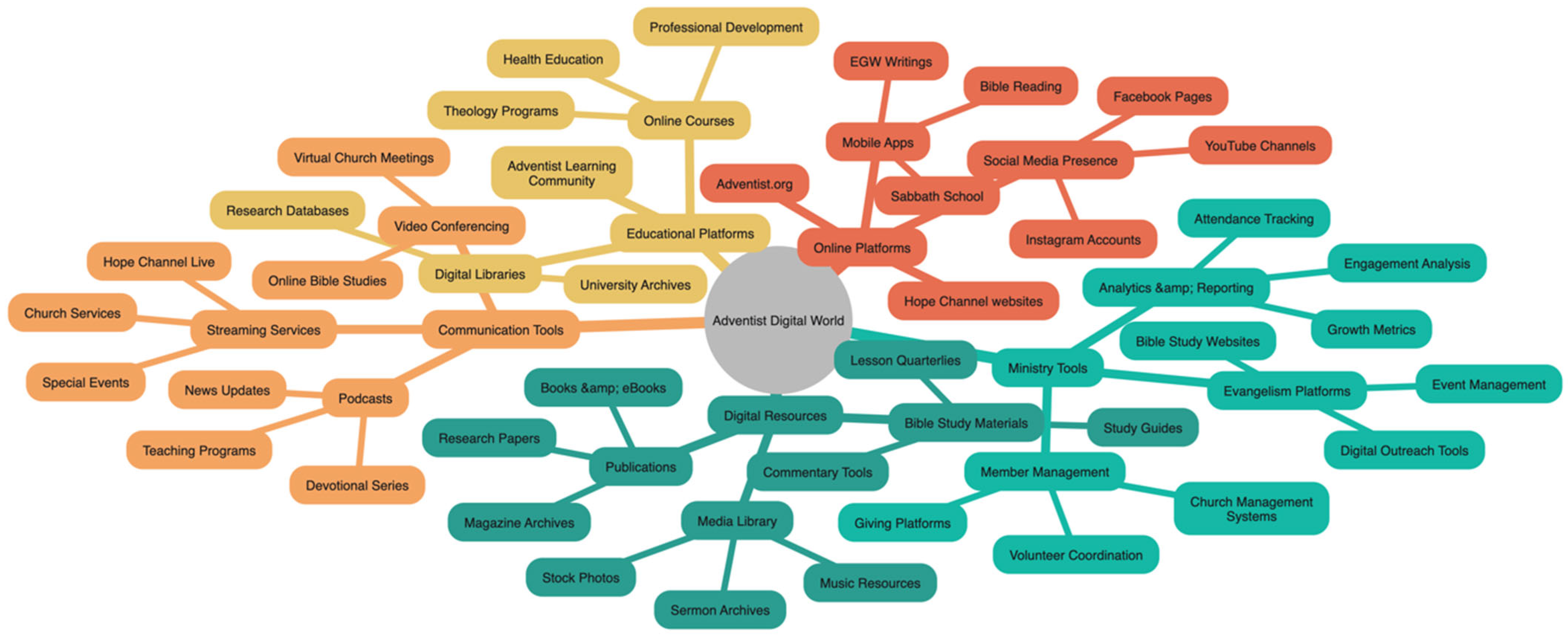
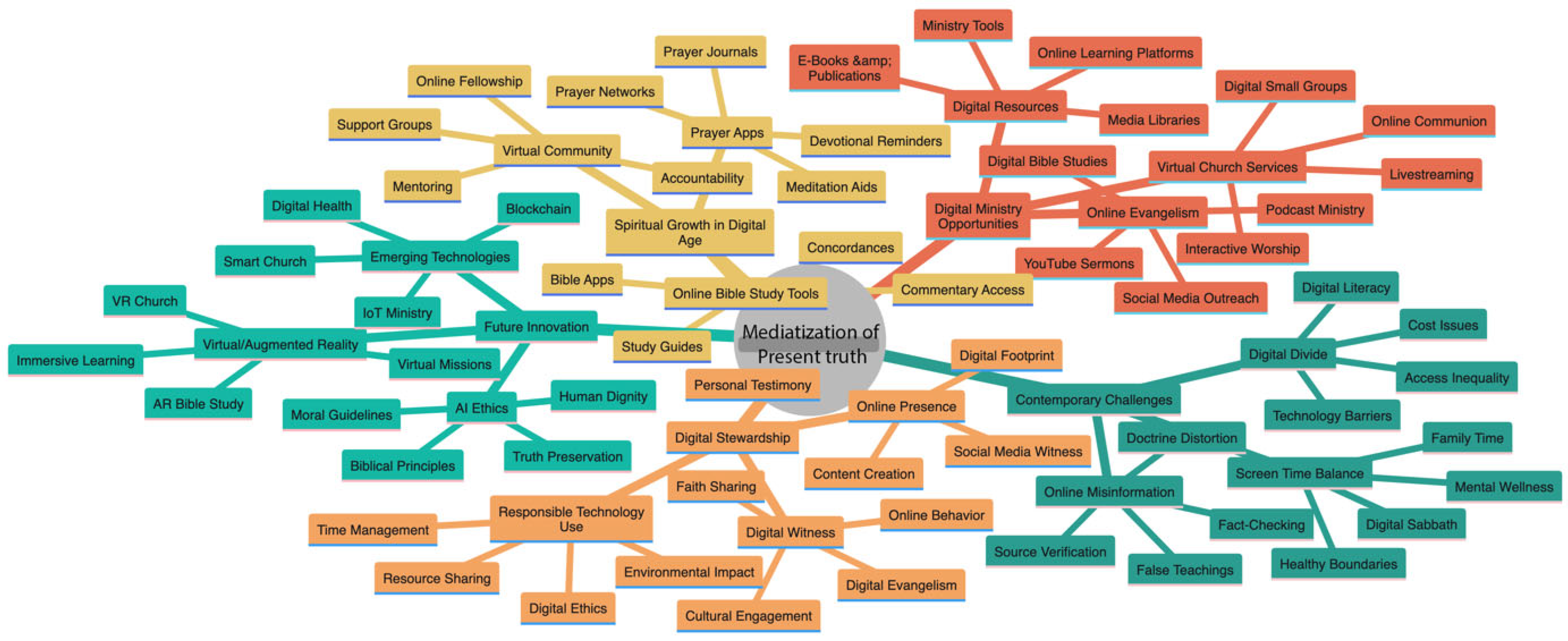
The Adventist Digital World is defined as a digital media ecosystem that brings together all the online resources, platforms, and tools used by the Seventh-day Adventist Church to spread its message, support its members, and promote its activities. It includes extensive resources, both old (digitized) and new: websites, digital social networks, media, educational resources, communication tools such as live streaming, Bible study platforms, mobile applications, and management systems for churches and ministries (e.g.,
https://www.adventistworld.org/,
https://adl.b2.adventistdigitallibrary.org/,
https://www.adventistreview.org/,
https://www.whiteestate.org/,
https://library.swau.edu/,
https://gc.adventist.org/publications/,
https://centerforadventistresearch.org/digital-resources/,
https://library.swau.edu/,
https://www.adventistarchives.org/,
https://academic.oup.com/,
https://www.adventist.digital/,
https://www.adventistbookcenter.com/, etc. all accessed on 10 June 2025). Its primary objective is to utilize technology to enhance the Adventist mission worldwide by making the Gospel accessible, facilitating communication, and supporting spiritual and community growth (
Figure 1).
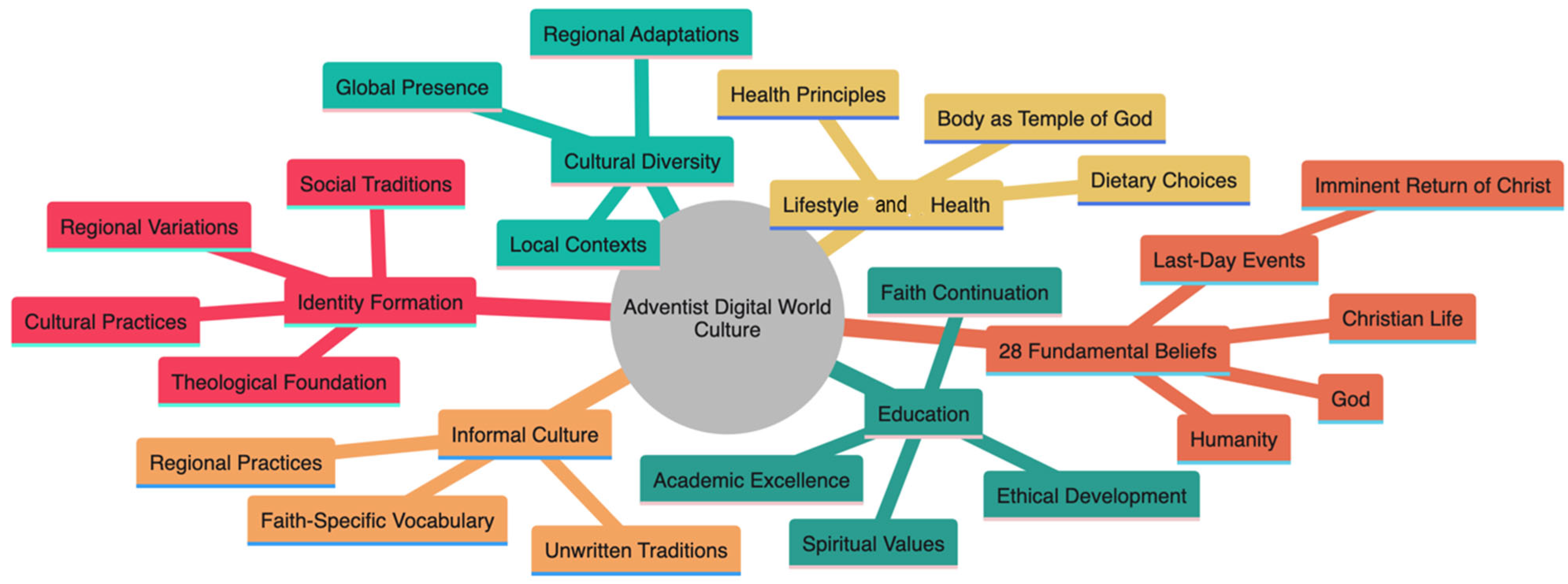
In the contemporary digital ecosystem, Adventist culture is grounded in the twenty-eight fundamental beliefs established by the Church, which center on themes such as the nature of God, humanity, Christian living, and eschatological events—the imminent return of Christ constituting a defining tenet (
Bull and Lockhart 2007;
Dederen 2000;
Floyd 2015;
Land 1987;
Morgan 2001;
Leukert 2020a;
Pearson 1990;
Vance 1999). This culture places particular emphasis on education and lifestyle. Adventist education is regarded as an extension of faith, aiming not only to achieve academic excellence but also to cultivate adherence to Adventist spiritual and ethical values (
Leukert 2018,
2020a,
2020b,
2022). With respect to lifestyle, the commitment to health holds a central place, grounded in the belief that the body is the “temple of God”.
It should be noted, however, that certain aspects of Adventist culture do not derive directly from official doctrines but rather from informal practices and unwritten traditions—for instance, faith-related vocabulary or specific dietary preferences. Moreover, despite shared values and practices, Adventist culture is characterized by significant diversity. The global presence of the Seventh-day Adventist Church has rendered its culture adaptable to national and regional contexts. Research underscores a distinction between Adventist doctrine and Adventist culture, the latter encompassing social constructs and behaviors rooted in inherited customs, which may vary across geographical or cultural settings (
Fokin 2022;
Alicea Santiago 2014). More precisely, Adventist culture integrates structured theological belief with distinctive social traditions, thereby defining Adventist identity in terms that extend beyond doctrinal conformity (
Figure 2).
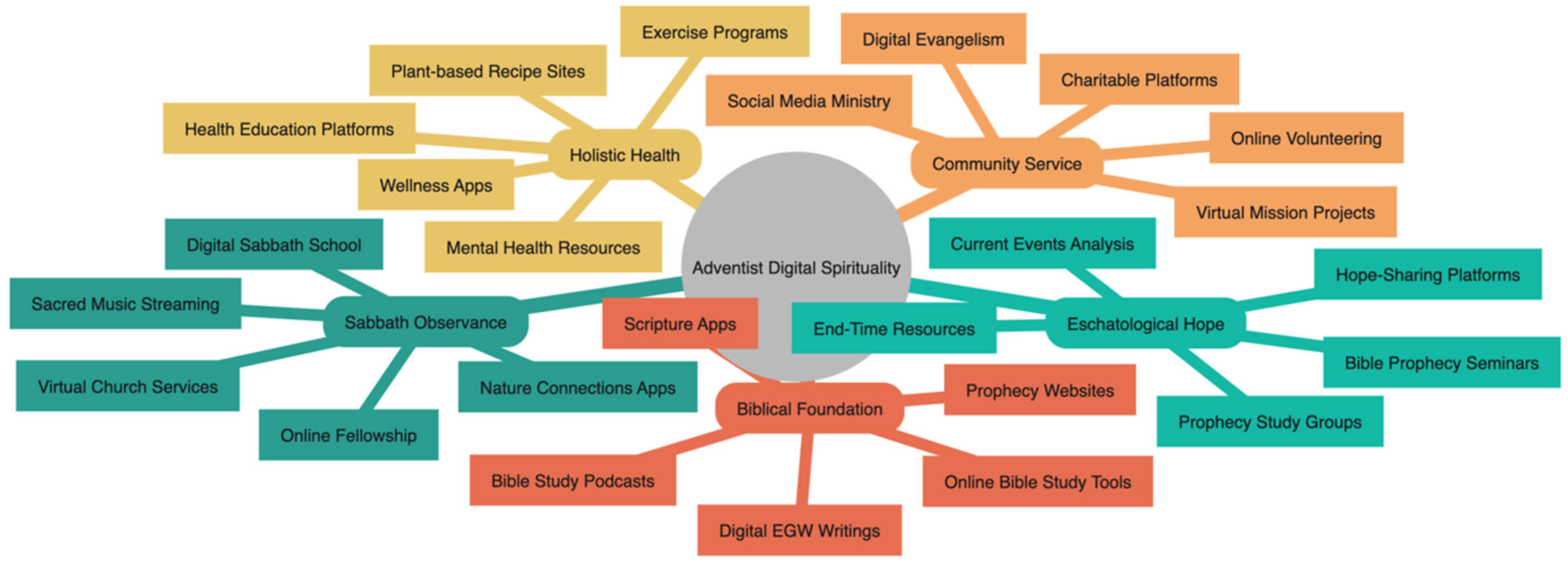
Adventist spirituality in the digital age denotes a holistic relationship with God that encompasses physical and mental well-being alongside the hope of Christ’s imminent return. This form of spirituality is deeply rooted in biblical teachings as interpreted through the writings of Ellen G. White, a central figure in Adventist theology. The observance of the seventh-day Sabbath (Saturday) constitutes the core practice of this spirituality, symbolizing rest, sanctification, and communion with God.
Adventist spirituality also emphasizes a health-conscious lifestyle, characterized by temperance in diet, abstinence from harmful substances, and engagement in physical exercise, all reflecting the belief in the sanctification of the body as a divine trust. Simultaneously, it is closely associated with generosity and community service, regarded as essential expressions of the love and compassion exemplified by Jesus.
The mediatization of Adventist meanings—specifically the notions of “Millerite fake news” and “Present Truth”—belongs to a broader corpus of research on the mediatization of Adventist representations and expressions that I have undertaken within this theoretical framework (
Bratosin 2016,
2020,
2024;
Tudor and Bratosin 2021). Conceived in its multifaceted nature (
Couldry and Hepp 2013), mediatization encompasses (a) a multidimensional theoretical paradigm that investigates the interaction between media and societal transformation, from institutionalist and socioconstructivist perspectives, to analyze the media’s influence on cultural and social dynamics, and (b) a set of transformational processes that describe the global cultural reconfigurations induced by media, including globalization itself. Within this analytical horizon, I interpret mediatization primarily as the cumulative outcome of the integral transformation of societies across successive epochs of technologically mediated communication (
Tudor and Bratosin 2021;
Abdelhak and Rhoulami 2025).
Accordingly, mediatization entails the construction of symbols through a movement of distancing—a rupture from the immediacy of lived experience. Within this framework, “Millerite fake news” emerges as a meaning-making process that exemplifies such distancing, in that it historically distorted reality through the dissemination of erroneous or manipulated information. This distortion produced a symbolic divide between the real and the fictitious, a gap that requires interpretive distance to be comprehended and theorized (
Bratosin 2024). “Millerite fake news” misrepresented temporal relations—past, present, and future—thereby transforming individuals’ perception of historical continuity. For instance, through the miscontextualization of events, it altered believers’ relationship to both historical memory and eschatological expectation.
Moreover, “Millerite fake news” elicited immediate affective reactions—such as fear or indignation—disrupting the reflective processes required for critical discernment. This phenomenon fostered the formation of myths and symbols that shaped collective Adventist belief and identity by distancing adherents from the immediacy of the present. Through the circulation of misinformation, “Millerite fake news” subverted biblical truth and disrupted the epistemological foundations of theological understanding, compelling believers to renegotiate their interpretive frameworks within a space of uncertainty. In doing so, it inhibited critical reasoning and encouraged passive information consumption, thereby weakening the connection between experiential faith and intellectual engagement.
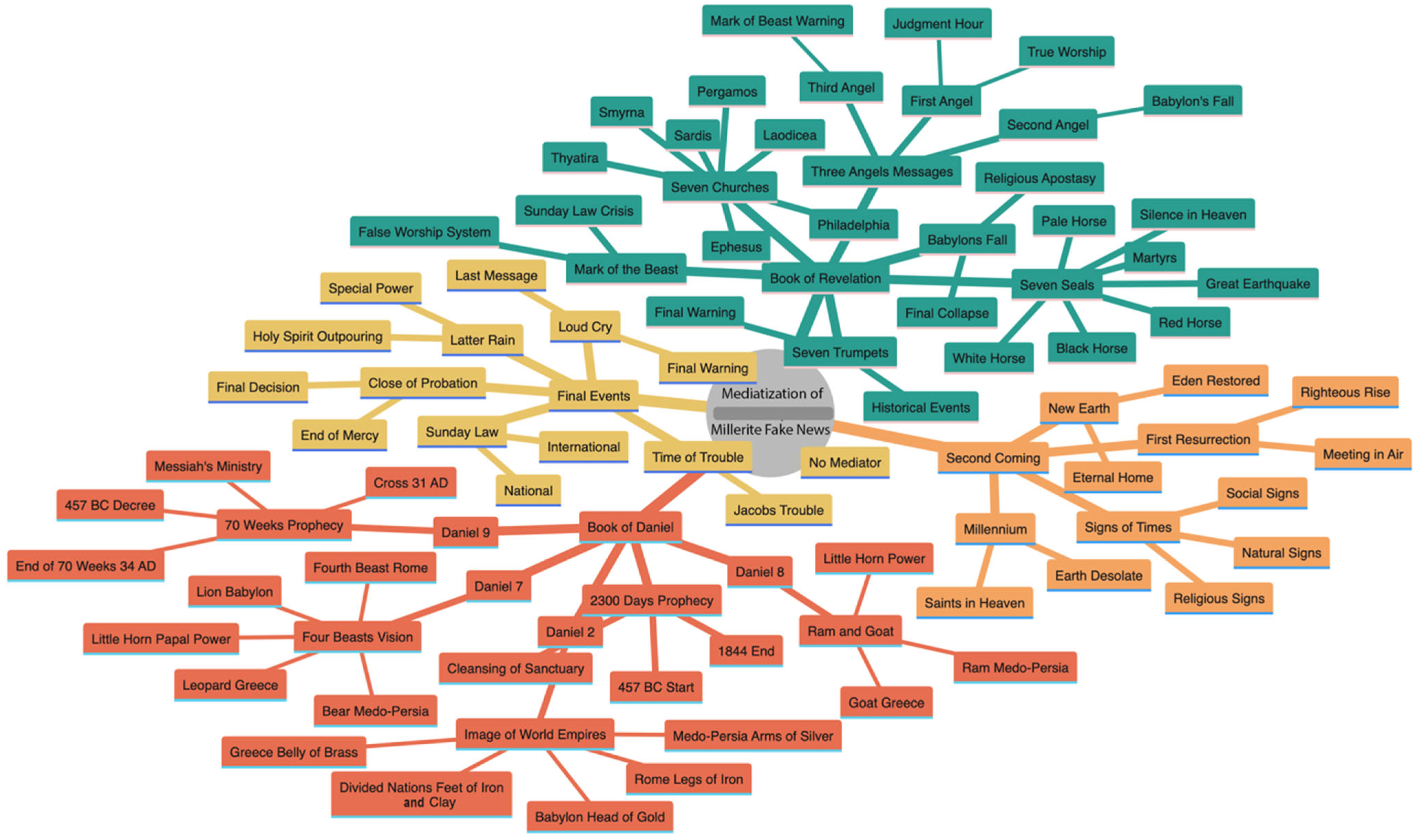
The mediatization of “Millerite fake news” thus becomes constitutive of Adventist culture in the digital era, transforming a nineteenth-century historical narrative into a globalized, apocalyptic, and separatist identity articulated through successive media forms—from print culture to digital platforms in 2025. This process embeds the Millerite narrative within the evolving media ecology, shaping cultural norms and religious self-definition. It preserves historical legacy, consolidates collective identity, advances the church’s mission, and serves as a counter-discursive response to critique. Simultaneously, it globalizes the “remnant” motif, sustains apocalyptic expectancy, reinforces communal distinctiveness, and cultivates resilience while navigating the epistemic and ethical risks of digital communication. The flowchart (
Figure 4) schematically represents this process, highlighting the continuity that links Millerite origins with the emergence of a dynamic and mediatized Adventist digital culture.
Like “Millerite fake news”, James White’s concept of “Present Truth” likewise embodies a form of distancing from the immediacy of existence, insofar as its symbolic function is constituted through reference to revelations and interpretations that evolve across temporal and historical contexts. This evolution signifies a transition from fixed or immediate readings of Scripture toward dynamic and contextually mediated spiritual understandings emerging within the Adventist faith community. The quest for “Present Truth” thus entails a mode of theological inquiry that transcends immediate perception or popular conviction, privileging instead reasoned exegesis of sacred texts and sustained intellectual reflection oriented toward situating their meanings within the contemporary horizon.
In contrast to “Millerite fake news”, which provoked impulsive emotional responses to immediate circumstances, “Present Truth” calls for an interpretive posture that rises above such immediacy, enabling Adventists to orient themselves toward enduring and transcendent realities rather than toward transient reactions. It promotes dialogical engagement within the faith community, suggesting that the discernment of truth is not reducible to individual opinion but rather constitutes a collective process of spiritual inquiry—one that presupposes a deliberate distancing from the pressures and distractions of the present moment.
Within Adventism, “Present Truth” remains linked to prophetic and eschatological perspectives on end-time events, as is the case with “Millerite fake news.” Yet, unlike the latter, it resists sectarian constriction by fostering a broader and more inclusive vision of human history and its ultimate divine telos. “Present Truth” thus invites believers to disengage from material preoccupations and immediate distractions, refocusing their attention on lasting spiritual values and on the cultivation of a transformative relationship with God. It thereby functions as a central element of Adventist identity, encapsulating a theological dynamic essential to Christian faith and praxis. By encouraging continuous theological reflection responsive to changing historical conditions, “Present Truth” sustains an evolving Adventist spirituality that remains theologically relevant amid the ongoing reconfiguration of belief systems (
Knight 2000;
Paulien 1993;
Astleford 2016;
What is the Concept of “Present Truth” 2022).
The mediatization of James White’s “Present Truth” reconfigures Adventist spirituality by rendering it increasingly accessible, interactive, and globally resonant within the digital environment. This process unfolds through the production and circulation of digital content, platform-based engagement, and the strategic use of communication technologies inspired by the Church’s evangelistic mission. It manifests in new modalities of community formation, worship, and eschatological orientation.
Figure 5 visualizes this dynamic, illustrating the interplay of doctrine, media, and spirituality that characterizes the contemporary mediatization of “Present Truth”.
6. Methodological Approach
In this study, I sought to understand and explain how the mediatization of “Millerite fake news” as a cultural phenomenon and the mediatization of James White’s “Present Truth” as a form of spirituality influence the formation and identity of the Seventh-day Adventist Church within the contemporary Adventist digital environment. To address this objective, I employed a combination of interdisciplinary methods that integrate traditional approaches from the humanities with digital research techniques, applied to a corpus extracted from the Adventist digital media ecosystem—the Adventist Digital World.
My approach consisted first of conducting a content analysis of digital texts, images, videos, and audio materials produced within the Adventist Digital World to identify recurring themes, symbols, and narratives associated with “Millerite fake news” and “Present Truth.” The purpose of this phase was to examine Adventist digital production—sermons published on YouTube, memes shared on Instagram, blog posts, websites, and other media—in order to uncover expressions of Adventist identity and theological tendencies shaped by these two Millerite concepts. At the same time, this analysis aimed to clarify how Adventist culture and spirituality incorporate and reinterpret these notions in the ongoing construction of Adventist identity.
I then integrated content analysis with network analysis. Specifically, the results of the content analysis were used to delineate network structures and to map relationships and interactions within Adventist online networks. The goal was twofold: first, to observe patterns of influence, community structures, and the diffusion of ideas related to “Millerite fake news” and “Present Truth”; and second, to highlight how Adventist digital networks culturally and spiritually amplify these foundational concepts of Adventism.
To achieve this, I employed a range of digital methods and tools:
- (a)
Web scraping and data mining, using Python 3.13.3 and Scrapy 2.12.0—an open-source Python framework selected for its speed, asynchronous request handling, capacity for large-scale scraping projects, and extensibility;
- (b)
Social media analysis, through the Netlytic platform, to summarize and visualize large volumes of text and to identify social networks emerging from conversations on platforms such as Twitter, YouTube, blogs, forums, and chats; and
- (c)
Network analysis software, including Gephi 0.10.1, to map data and visualize the centrality, connectivity, and distance of nodes within networks, and NodeXL 3.20 for social network analysis and graph visualization.
The combination of web scraping, content and network analysis, and data visualization using Gephi and NodeXL made it possible to identify not only the thematic recurrence of “Millerite fake news” and “Present Truth”, but also the relational networks through which these ideas circulate. The visualizations further inform the interpretation by revealing, for instance, that narratives surrounding “Millerite fake news” cluster around media accounts emphasizing historical identity and endurance, whereas “Present Truth” content connects nodes focused on spirituality, evangelism, and contemporary ethical issues. This evidence visually demonstrates how digital mediatization links Adventist cultural memory with living expressions of faith, exposing the dialectic between tradition and transformation that structures Adventist identity.
My analysis centers on the evolving ecosystem of digital resources that I refer to as the Adventist Digital World, which constitutes the corpus of this study. More precisely, the corpus consists of a structured set of 3506 digital documents—texts, videos, and images—collected from the twenty most visited Adventist platforms. Each document was selected according to transparent criteria, including platform traffic, audience engagement (views, reactions, and comments), and thematic relevance to the concepts of “Millerite fake news” and “Present Truth.” This corpus thus represents a living sample of Adventist digital production, combining institutional and grassroots voices, and serves as the empirical foundation for interpretive analysis. The corpus is not a neutral dataset but a cultural artifact that embodies how Adventists communicate, debate, and reinterpret their heritage in the digital age. Its analysis reveals symbolic continuities between historical Adventist narratives and their rearticulation in digital contexts, directly linking the methodological component to the interpretive discussion.
Finally, to analyze the influence of “Millerite fake news” on Adventist culture, I assessed six key dimensions on a scale from 1 to 10: Millerite Fake News, Mediatization Process, Adventist Identity, Digital Platforms, Cultural Narratives, and Community Engagement. Likewise, to grasp the interplay of key elements in the mediatization of “Present Truth” and its role in shaping Adventist spirituality in the digital world, I compared the influence of five factors—Doctrinal Clarity, Evangelistic Outreach, Community Engagement, Accessibility, and Adaptation to Modernity—across three contexts: James White’s era (print media), early Adventist mediatization (radio and television), and the contemporary digital environment. Each critical factor of the mediatization of “Present Truth”, as it evolved across these three eras, was scored from 1 to 10 according to its prominence and contribution to Adventist spirituality. Finally, I compared, using the same scale, the influence of the mediatization of “Millerite fake news” (culture) and the mediatization of “Present Truth” (spirituality) on five major dimensions of Adventist identity: Global Outreach, Spiritual Practices, Historical Continuity, Doctrinal Clarity, and Community Cohesion. The 1–10 rating scale was based on the number of direct and indirect recurrences of the items identified as key dimensions, which served as the criterion for measurement.
7. Results
7.1. Mediatization of Millerite Fake News and Adventist Culture
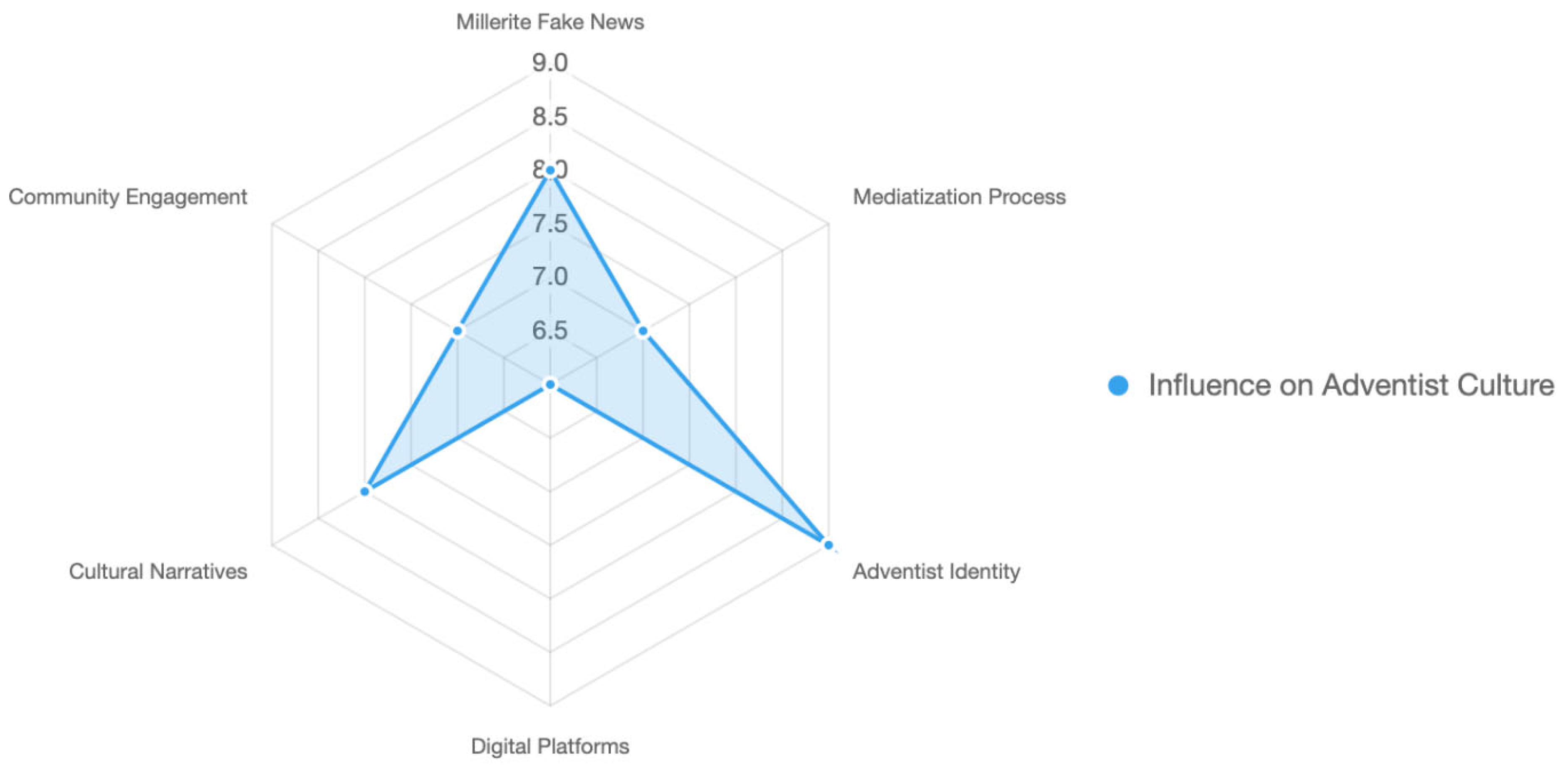
How does the mediatization and digital dissemination of Millerite fake news as Adventist culture influence the formation and identity of the modern Seventh-day Adventist Church? The influence of “Millerite fake news” on Adventist culture, measured on a scale from 1 to 10, can be analyzed across six key dimensions: Millerite Fake News, Mediatization Process, Adventist Identity, Digital Platforms, Cultural Narratives, and Community Engagement, as follows:
Adventist Identity: 8.5–9.0/10. This dimension captures the impact of mediatized Millerite fake news on the core identity of the Adventist community, including beliefs, values, and self-perception. The score indicates the strongest influence, showing that such misinformation significantly shapes or challenges the collective identity.
Millerite Fake News: 7.5–8.0/10. This measures the role of misinformation regarding the historical Millerite movement, such as exaggerated accounts of the Great Disappointment. The high score reflects its substantial contribution to cultural influence, acting as a primary driver of the mediatization process.
Cultural Narratives: 7.5–8.0/10. This dimension reflects the effect of Millerite fake news on Adventist cultural stories and traditions rooted in their Millerite origins. The score suggests a strong influence, indicating that such misinformation significantly reshapes these narratives.
Mediatization Process: 7.0–7.5/10. This represents the mechanism by which media amplify and transform narratives, including those related to Millerism. The score indicates a robust role, though slightly less dominant than the influence on identity or the misinformation itself.
Community Engagement: 6.5–7.0/10. This dimension measures the level of interaction within the Adventist community in response to mediatized Millerite fake news, such as participation in online discussions or rebuttals. The moderate score suggests active, though not maximal, engagement.
Digital Platforms: 6.0–6.5/10. This assesses the role of digital media, including social media and websites, in disseminating or countering Millerite misinformation. The lower score indicates a moderate influence, implying that digital platforms, while important, are less central than other dimensions.
Together, these six dimensions illustrate how the mediatization of “Millerite fake news” functions as an interconnected system shaping Adventist culture in the digital age. This complex interaction of elements is schematically represented in
Figure 6, highlighting the interplay between historical misinformation, media processes, and contemporary cultural identity.
In this graphic representation, each axis—such as Millerite fake news, mediatization processes, and Adventist identity—represents a key element influencing Adventist culture, with the values reflecting their relative impact on a scale from 1 to 10, based on their conceptual significance. The figure illustrates how these elements interact collectively to shape Adventist culture within digital environments.
7.2. Mediatization of “Present Truth” as Adventist Spirituality in the Digital World
How has James White’s concept of “Present Truth” evolved within the Seventh-day Adventist Church from its historical origins to its contemporary digital expression, and what are the implications for the church’s identity and mission?
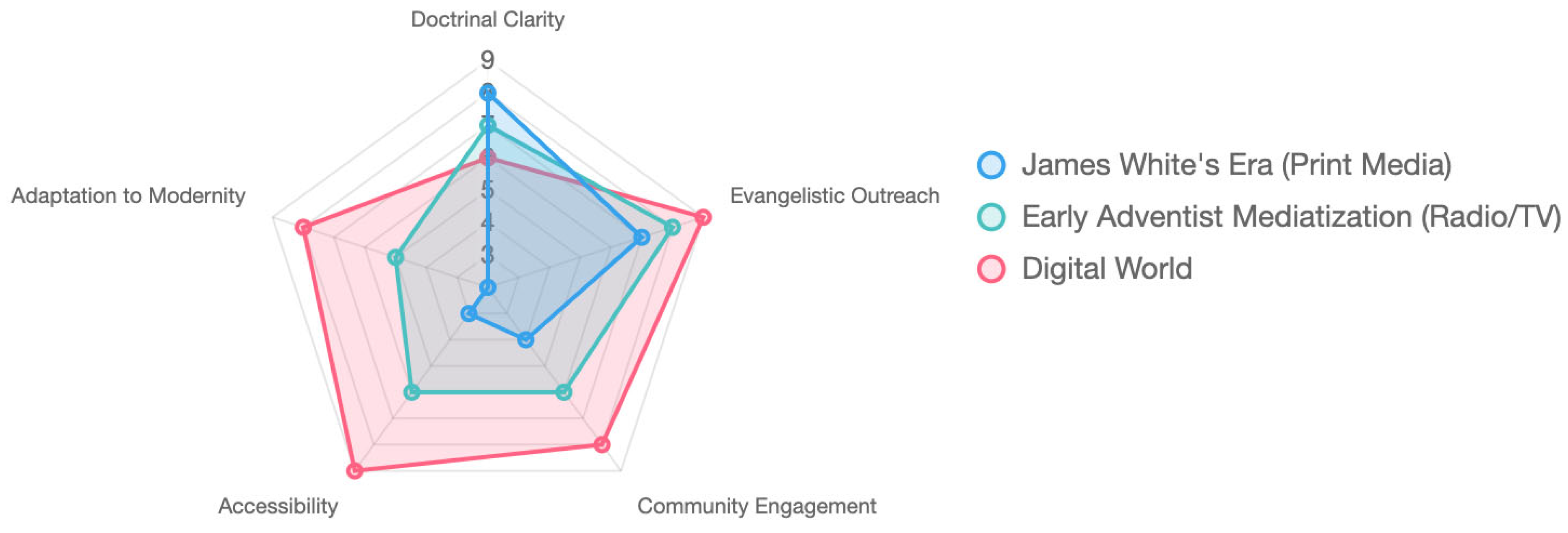
The mediatization of “Present Truth”, as a key contributor to Adventist spirituality, has unfolded across three historical eras: James White’s era (print media), early Adventist mediatization (broader media such as radio and television), and the digital world, shaped by five primary factors: doctrinal clarity, evangelistic outreach, community engagement, accessibility, and adaptation to modernity. On a scale of 1 to 10, the evolution across these factors is as follows:
Doctrinal Clarity:
James White’s Era (8/10): White’s The Present Truth articulated foundational Adventist doctrines, including Sabbath observance and the Second Coming, offering early believers clear, context-specific guidance.
Early Mediatization (7/10): Radio and television propagated these doctrines to wider audiences, though with slightly less emphasis on foundational clarity as the focus shifted toward broader outreach.
Digital World (6/10): Digital platforms provide vast information but can dilute doctrinal focus due to diverse voices and interpretations. While mediatization communicates these truths, the open nature of digital media introduces competing narratives that can slightly reduce clarity.
Evangelistic Outreach:
James White’s Era (7/10): White’s publications reached a limited yet dedicated audience, establishing a foundation for Adventist evangelism.
Early Mediatization (8/10): Radio and television significantly expanded reach, exemplified by programs like It Is Written, broadcasting Adventist messages globally.
Digital World (9/10): Websites, social media, and applications facilitate instantaneous global outreach, amplifying Present Truth to diverse audiences. Mediatization thus extends White’s vision of disseminating time-relevant truth worldwide.
Community Engagement:
James White’s Era (4/10): Print media fostered small, localized communities but offered limited interactivity.
Early Mediatization (6/10): Radio and television enabled broader community formation, though interaction remained minimal.
Digital World (8/10): Social media platforms and online forums allow real-time engagement, prayer groups, and collaborative community building, strengthening Adventist identity. Digital mediatization fosters a sense of global Adventist community, consistent with Present Truth’s call for collective sanctification.
Accessibility:
James White’s Era (3/10): Print media faced distribution and literacy limitations.
Early Mediatization (6/10): Radio and television expanded access but remained constrained by broadcast schedules and geography.
Digital World (9/10): Digital platforms provide near-universal access to Adventist resources, including Ellen G. White’s writings and official church websites, making Present Truth widely available. Mediatization thus democratizes access, enabling engagement with Adventist spirituality anytime, anywhere.
Adaptation to Modernity:
James White’s Era (2/10): Print media was static and slow to respond to cultural changes.
Early Mediatization (5/10): Radio and television adapted to mid-20th-century contexts but remained limited by technological constraints.
Digital World (8/10): Digital platforms allow rapid responsiveness to contemporary issues—such as health, prophecy, and ethics—aligning Present Truth with the needs of modern believers.
These results, schematically illustrating the evolution of the mediatization of
Present Truth across three eras and its role in shaping Adventist spirituality, are summarized in
Figure 7.
7.3. Interaction of Mediatization of “Millerite Fake News” and “Present Truth”
How do the mediatization of “Millerite fake news” (as culture) and “Present Truth” (as spirituality) interact to shape SDA identity in the digital world, and what does this reveal about the relative influence of cultural and spiritual elements across key dimensions of identity formation?
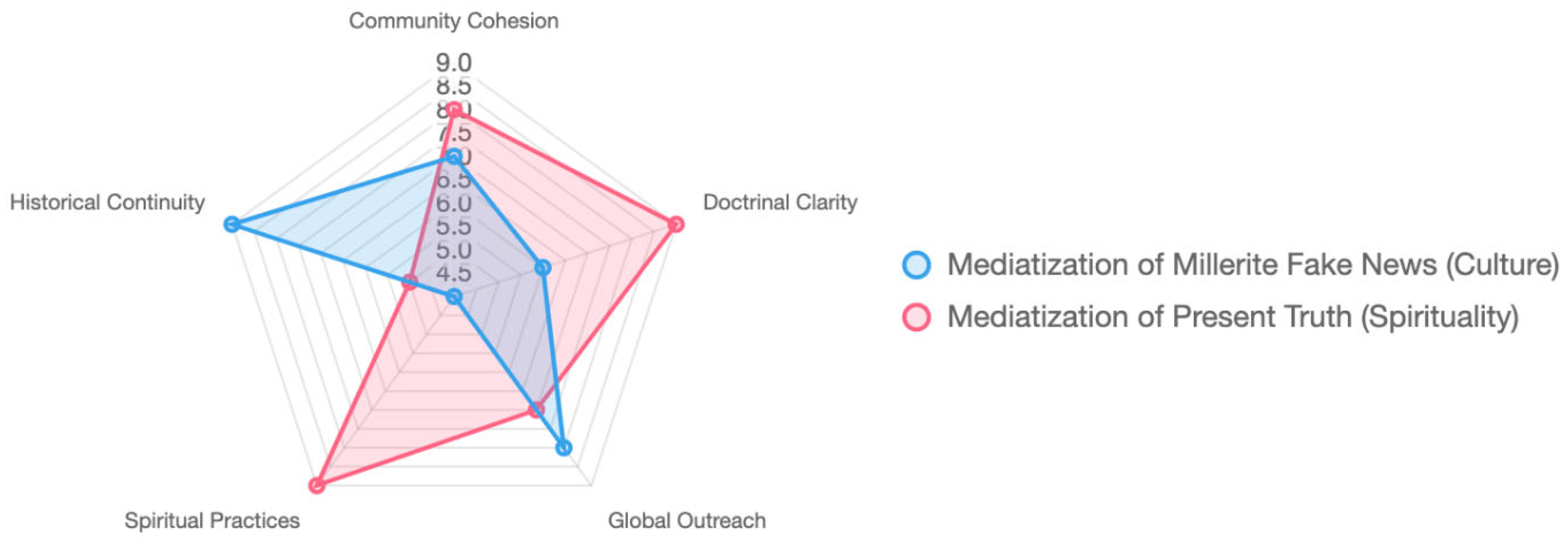
This study considers five principal dimensions of Adventist identity, scored on a scale from 1 to 10, to compare the influence of two distinct mediatization processes—the mediatization of Millerite Fake News (culture) and the mediatization of Present Truth (spirituality)—on different aspects of Adventist culture. The findings are summarized as follows:
Global Outreach: Present Truth—7/10; Millerite Fake News—8/10. Millerite Fake News exerts a slightly greater influence on global outreach than Present Truth, suggesting that misinformation may significantly shape engagement strategies or global perceptions of the church.
Spiritual Practices: Present Truth—9/10; Millerite Fake News—4/10. Present Truth has a substantially stronger influence on spiritual practices, indicating that authentic spiritual life is more effectively sustained despite the presence of misinformation.
Historical Continuity: Present Truth—6/10; Millerite Fake News—9/10. Millerite Fake News demonstrates a markedly higher impact on maintaining historical continuity, suggesting that misinformation strongly shapes narratives or interpretations of historical events within the SDA community.
Doctrinal Clarity: Present Truth—9/10; Millerite Fake News—5/10. Present Truth is more influential in promoting doctrinal clarity, while misinformation exerts comparatively less effect on doctrinal understanding.
Community Cohesion: Present Truth—7/10; Millerite Fake News—8/10. Millerite Fake News slightly surpasses Present Truth in influencing community cohesion, implying that misinformation may affect social unity within the church.
The comparative analysis of these five dimensions—Global Outreach, Spiritual Practices, Historical Continuity, Doctrinal Clarity, and Community Cohesion—is schematically represented in
Figure 8, illustrating how the mediatization of Present Truth and Millerite Fake News interact to shape SDA identity in the digital world.
8. Discussion
Drawing on the Montpellier school’s conceptualization of mediatization as an expression of anthropological mediality, the Adventist digital corpus can be interpreted as a manifestation of humanity’s intrinsic capacity to construct and inhabit symbolic worlds. In resonance with Cassirer’s notion of animal symbolicus, the digital content produced by Adventists transcends mere mediation of religious information, instead constituting a distinct mode of being-in-the-world through communication. Each post, video, or visualization operates as a symbolic form through which believers interpret their reality, reaffirm collective identity, and actively participate in the ongoing construction of meaning. Consequently, the analysis of this corpus reveals mediatization not simply as a technological phenomenon but as an anthropological constant—a fundamental process by which Adventists produce, negotiate, and transform their spiritual worlds through digital communication. Within this framework, digital tools and visualizations are not only instruments of analysis but also embodiments of the very symbolic mediation that defines the subject of study: the continual re-creation of Adventist culture and spirituality through mediated meaning-making.
The findings presented in
Section 7.1,
Section 7.2 and
Section 7.3 offer a comprehensive framework for understanding how the mediatization of “Millerite fake news” and “Present Truth” shapes the evolution of Seventh-day Adventist (SDA) spirituality and communal life. These results elucidate the interplay between cultural and spiritual dimensions in shaping modern Adventist identity, spirituality, and community dynamics, particularly within the digital age.
Section 7.1 demonstrates how misinformation about the Millerite movement, framed as “fake news”, profoundly influences Adventist culture. The elevated scores for Adventist Identity (8.5–9.0/10) and Millerite Fake News (7.5–8.0/10) indicate that distorted narratives—such as exaggerated accounts of the Great Disappointment—significantly affect how Adventists perceive themselves and their history. This dynamic suggests that misinformation constitutes a critical challenge to SDA identity, generating tensions between historical accuracy and cultural mythmaking. Similarly, Cultural Narratives (7.5–8.0/10) show how fake news reshapes Adventist historical storytelling, potentially reinforcing narratives of resilience while risking theological distortion. The Mediatization Process (7.0–7.5/10) highlights the role of media in amplifying and embedding these narratives within Adventist communities, a process accelerated in digital environments where misinformation spreads rapidly. Scores for Community Engagement (6.5–7.0/10) and Digital Platforms (6.0–6.5/10) suggest that, while Adventists actively engage with these narratives through online dialogue and rebuttal, digital platforms themselves exert a moderate influence relative to identity and cultural narratives. Collectively, these results imply that Adventist culture is dynamically shaped through the mediation and reinterpretation of historical events in digital spaces, with misinformation posing a substantive challenge to cohesive and authentic identity formation.
Section 7.2 traces the evolution of “Present Truth”, a concept introduced by James White to articulate timely Adventist doctrines, across three media epochs: print, early broadcast (radio/TV), and the digital era. The data reveal that mediatization has transformed the expression of Adventist spirituality and its implications for church identity and mission. Notably, doctrinal clarity declines from 8/10 in White’s era to 6/10 in the digital age, reflecting the difficulty of maintaining theological coherence amid diverse online voices. This suggests that while “Present Truth” remains central, its clarity is diluted in digital contexts, necessitating adaptive communication strategies. Evangelistic outreach scores increase markedly (7/10 to 9/10), indicating that digital platforms have expanded the global reach of Adventist messages, consistent with White’s vision of disseminating timely truth. Programs such as
It Is Written and websites like Adventist.org exemplify this expansion. Moreover, community engagement and accessibility improve sharply (8/10 and 9/10 respectively), underscoring how social media and online resources foster global Adventist communities and democratize access to spiritual materials, including the writings of Ellen G. White. This process strengthens collective identity and advances “Present Truth” as a call to sanctification. The improvement in Adaptation to Modernity (8/10) further highlights how digital media enable Adventists to address contemporary issues in real-time, sustaining the relevance of “Present Truth.” Overall, these findings illustrate the transformation of Adventist spirituality from a localized, print-based practice to a global, interactive, and adaptive phenomenon, while signaling the ongoing challenge of preserving doctrinal clarity.
Section 7.3 compares the relative influence of “Millerite Fake News” (culture) and “Present Truth” (spirituality) across five dimensions of SDA identity, revealing their complex interplay in shaping contemporary Adventist life. Millerite Fake News (8/10) slightly surpasses Present Truth (7/10) in influence, suggesting that misinformation commands greater global attention, likely due to its sensational character, thus complicating evangelistic efforts by overshadowing authentic spiritual messages. Conversely, in the domain of spiritual practices, Present Truth (9/10) predominates over Millerite Fake News (4/10), underscoring the resilience of core teachings in grounding Adventist worship and spirituality. Regarding Historical Continuity, Millerite Fake News (9/10) exerts a stronger influence than Present Truth (6/10), indicating that misinformation significantly shapes Adventists’ understanding of their historical roots, often distorting narratives of the Millerite movement and the Great Disappointment. For Doctrinal Clarity, Present Truth (9/10) greatly exceeds Millerite Fake News (5/10), affirming that authentic doctrinal teachings remain pivotal in sustaining theological coherence despite the proliferation of misinformation. Lastly, community cohesion scores reveal Millerite Fake News (8/10) marginally outweighs Present Truth (7/10), suggesting misinformation impacts communal dynamics by fostering debates or divisions concerning historical narratives. These results elucidate a tension between cultural and spiritual elements: while Present Truth anchors spiritual life and doctrinal clarity, Millerite Fake News significantly influences historical perception and community cohesion, thereby complicating identity formation. This dialectic illustrates how misinformation can simultaneously challenge and reinforce communal bonds through active engagement and contestation.
Taken together, these findings demonstrate that mediatization profoundly shapes Adventist spirituality and identity in the digital era. The substantial influence of Millerite Fake News on Adventist identity (8.5–9.0/10) and historical continuity (9/10) indicates that misinformation poses a critical threat to self-understanding and collective memory. Accordingly, the church must actively counter false narratives to preserve an authentic identity rooted in its Millerite heritage and theological foundations. Simultaneously, the predominance of Present Truth in spiritual practices (9/10) and doctrinal clarity (9/10) attests to the robustness of Adventist spirituality, even amidst misinformation. This resilience is bolstered by increased accessibility (9/10) and adaptability (8/10) of digital platforms, which facilitate the maintenance and dissemination of core beliefs. The strong evangelistic outreach (9/10) in the digital age reflects the efficacy of mediatized Present Truth in fulfilling the SDA mission of spreading timely spiritual messages globally. Nevertheless, the slightly greater influence of Millerite Fake News on global outreach (8/10 vs. 7/10) suggests that misinformation may complicate evangelistic endeavors by shaping external perceptions. Although digital platforms enhance community engagement (8/10), the influence of Millerite Fake News on community cohesion (8/10) highlights the need for strategies that promote unity around shared spiritual values. The complex interaction between Millerite Fake News and Present Truth thus reflects a broader dynamic wherein cultural narratives, shaped by misinformation, and spiritual doctrines vie to define Adventist identity. To navigate this tension, the church must leverage digital media strategically to promote accurate historical and theological narratives while fostering inclusive community dialogue to mitigate the divisive effects of misinformation.
From these insights, several practical implications emerge for the SDA Church: (a) the development of digital campaigns and educational resources aimed at clarifying Millerite history and countering fake news, thereby reinforcing historical continuity and identity; (b) the strategic use of digital platforms to disseminate clear, accessible teachings on Present Truth, addressing doctrinal dilution caused by diverse online voices; (c) the cultivation of online spaces for constructive dialogue to strengthen community cohesion and address misinformation-induced divisions; and (d) the continued expansion of evangelistic outreach through social media, applications, and websites, ensuring Present Truth remains relevant and accessible to a global audience.
The mediatization of Millerite Fake News and Present Truth significantly shapes Adventist spirituality, identity, and community life by influencing narratives, cohesion, and mission. While misinformation challenges historical and cultural understandings, the spiritual core of Present Truth persists as a stabilizing force, amplified by digital media.
The mediatization dynamics observed in the Seventh-day Adventist Church—specifically the interplay between “Millerite fake news” and “Present Truth”—reflect also broader patterns evident across diverse religious traditions (
Hjarvard and Lövheim 2012;
Radde-Antweiler and Zeiler 2019;
Campbell and Tsuria 2022). In Mormonism, for instance, digital misinformation surrounding foundational events and doctrines prompts both identity challenges and apologetic responses, mirroring the SDA tension between historical distortion and doctrinal fidelity. Islam similarly contends with widespread misrepresentations of key teachings via mainstream and social media, which complicate self-understanding and external perceptions. Evangelical Christianity experiences analogous processes where media amplifies both authentic spiritual messages and sensationalized narratives, influencing communal identity and doctrinal clarity. Likewise, traditions such as Buddhism, Hinduism, and Pentecostalism have mediatized core spiritual concepts—mindfulness, dharma, spiritual gifts—transitioning from localized, textual practices to global digital expressions. This expansion fosters accessibility and outreach but also introduces interpretive fragmentation akin to the challenges faced by Adventism’s “Present Truth.” Moreover, the dialectic between cultural misinformation and spiritual orthodoxy, central to the SDA case, parallels phenomena in Judaism, where media representations shape communal identity and often compete with internal religious teachings (
Mishol-Shauli and Golan 2019).
9. Conclusions
The mediatization process shapes Adventist culture by amplifying Millerite fake news, which is further disseminated through digital platforms. This amplification stimulates community engagement and reshapes both cultural narratives and collective identity. The scores indicate that Adventist Identity and Millerite Fake News exert the most significant influence, driven by the mediatization process. This dynamic constitutes Adventist culture, as the circulation of fake news compels the community to defend or reinterpret its historical roots, reinforcing its identity as a resilient group. The high scores in identity and cultural narratives underscore the centrality of these elements in how Adventists respond to external misinformation. The overall influence manifests as a strong reinforcement of Adventist identity and cultural narratives, with moderate contributions from community engagement and digital platforms. Here, the mediatization process functions as a catalyst, with fake news serving as the primary content driving these transformations.
The mediatization of Present Truth in the digital age represents a crucial development in SDA identity. It builds on the strengths of previous media eras—doctrinal clarity from print media and evangelistic outreach from radio and television—while leveraging digital tools to enhance adaptability, accessibility, and community engagement. This positions SDA spirituality as a dynamic and inclusive faith, capable of flourishing within a globalized, technology-driven context. At the same time, SDA spirituality must navigate challenges such as maintaining doctrinal integrity and sustaining community cohesion in a decentralized digital environment.
In contrast to Present Truth, the Millerite fake news narrative is relatively static, rooted in a historical failure that fostered a cultural identity characterized by separatism. Present Truth, by contrast, is dynamic, emphasizing spiritual growth and adaptability. This tension generates a dual identity: Adventists are simultaneously a historically defined “remnant” and a spiritually active community. Both narratives rely on media—historically through print and, presently, through digital platforms—to disseminate their messages. Digital media amplifies this process, making SDA culture and spirituality globally accessible and fostering a unified yet diverse identity. However, the digital landscape also introduces risks, including misinformation, secular influences, and competing spiritualities, which challenge the distinctiveness of SDA identity. Conversely, it offers opportunities for engaging younger generations and expanding the church’s global reach.
Thus, the mediatization of cultural misinformation and spiritual teachings, exemplified by the SDA’s Millerite Fake News and Present Truth, represents a pervasive phenomenon observable across religious traditions. The SDA case provides a critical lens for understanding how religious communities negotiate identity, authority, and cultural resilience within increasingly mediated and misinformed digital environments.