1. Introduction
Across East Asia, rapid technological innovation has converged with long-standing religious plurality to produce new landscapes of belief, practice, and theological imagination. Smartphones, livestreams, and algorithmic recommendation systems now mediate everyday devotional life, while simultaneously destabilizing inherited patterns of authority and interpretation. In societies where Buddhism, Islam, Christianity, Daoism, Hinduism, and a profusion of new religious movements co-exist, religion has always been negotiated in spaces of hybridity and multiplicity. Scholars have described East Asian religiosity as a “thick” cultural environment marked by layered ritual repertoires and pragmatic borrowing (
Clammer 2012;
Kuah-Pearce 2009;
Tong 2007). Digital infrastructures intensify this condition: believers now occupy media-saturated worlds in which spiritual options are continuously visible, juxtaposed, and algorithmically curated (
Han and Nasir 2016;
Lim 2009).
Singapore exemplifies these dynamics with particular clarity. A highly regulated multifaith state with 99% household internet connectivity (
IMDA 2023), Singapore combines bureaucratized religious pluralism (
Lim 2012;
Tan 2008) with an ambitious Smart Nation agenda that encourages citizens to integrate digital technologies into work, education, and community life. This intersection of technocratic governance and state-managed pluralism forms a distinctive environment for studying how religious meaning is constructed under digital conditions. Christianity—especially Pentecostal and charismatic expressions—has flourished within this socio-technological assemblage. Since the 1980s, megachurches have emerged as influential institutions, developing professionalized media infrastructures, livestreamed global worship, and youth-centred digital ministries (
Chong 2018). As I have argued elsewhere (
Choong 2025), digitalization is now integral to how Pentecostal youth in Singapore construct, express, and negotiate their faith identities across on-site and online spaces. Faith is transmitted as readily through screens as from pulpits, and modes of belonging are extended through chat groups, reels, and livestream comment threads.
SG Church (pseudonym) is emblematic of this trend. Drawing tens of thousands weekly, it operates a sophisticated media ecosystem staffed by volunteers and creative teams. Its youth ministry functions within a digital matrix of group chats, worship playlists, Instagram testimonies, and sermon clips circulated on Telegram. As Thomas, a 19-year-old polytechnic student, explains:
With my smartphone, praise and worship music becomes more available and on hand than ever before. It has helped me to be in a more constant prayer and worship mode.
His remark encapsulates a spirituality that is mediated, mobile, and ambient.
This article investigates how youth in SG Church engage in
theological tinkering: the dynamic and reflexive process through which believers in digitally mediated environments engage, adapt, and reconfigure theological ideas drawn from multiple Christian traditions. Theological tinkering is neither theological relativism nor syncretism. Instead, it reflects a mode of
liquid faith—drawing on
Bauman’s (
2000) theorization of liquid modernity to describe a form of belief characteristic of late-modern conditions in which identities, institutions, and convictions must be continually negotiated. Digital platforms collapse spatial and denominational boundaries, enabling Singaporean Pentecostals to juxtapose Hillsong worship, Reformed exegesis, prosperity-gospel preaching, contemplative devotionals, and local pastoral teachings in a single feed. As Anna, an 18-year-old polytechnic student, puts it:
… the content on my algorithm can range from personal Christian accounts, official church accounts, funny church youth accounts, or devotional art-focused accounts… from many different churches around the world!
This abundance compels believers to weigh competing truth claims beyond direct institutional mediation. Theological tinkering highlights the interpretive labour through which coherence is sustained amid algorithmic plurality: youth test, compare, and recalibrate teachings in conversation with peers, pastors, influencers, and digital platforms.
Existing scholarship on digital religion has examined ritual participation, online community, and shifting authority structures (
Campbell 2013,
2021;
Cheong 2016;
Hutchings 2017), but far less attention has been paid to theological formation—how doctrinal interpretation and reasoning themselves are reshaped in digital environments. Likewise, research on Pentecostalism in East Asia emphasizes adaptability and experiential spirituality (
Anderson 2013;
Cornelio 2016;
Kim 2011;
Yong 2020), yet the micro-dynamics of youth theological negotiation remain underexplored. Studies of hybridity describe the cultural condition of mixture, but rarely the process by which believers navigate, filter, and evaluate competing Christian influences.
This article addresses these gaps. Based on four years of ethnographic fieldwork and digital textual analysis (2019–2022), I argue that theological tinkering emerges from the interaction of three forces: (1) algorithmic exposure, which broadens theological horizons; (2) affinitive ties, which filter meaning through relational trust networks; and (3) institutional boundary-work, through which churches recalibrate authority in response.
Together, these dynamics reveal theological tinkering as both an everyday practice of discernment and a structural feature of faith in liquid modernity. The article situates the Singaporean case within broader East Asian transformations, illustrating how digitalisation reconfigures theological reasoning not by eroding faith, but by requiring believers to sustain coherence through movement.
2. Literature Review: Situating This Study…
The article proceeds from the premise that Pentecostalism, long known for its adaptability and experiential orientation, is particularly attuned to digital mediation. Its spirituality thrives on
affective immediacy, the pursuit of the felt presence of the Spirit (
Anderson 2013;
Csordas 1997),
personal testimony as a narrative mode of encounter and witness (
Cartledge 2010;
Coleman 2000;
Hollenweger 1997), and
communal participation expressed through interactive and embodied worship practices (
Miller and Yamamori 2007;
Wacker 2001). These dynamics resonate strongly with the interactive, affective, and relational logics of digital platforms. Yet digitalization also decentralizes theological control, enabling multiple voices to compete for legitimacy (
Possamai and Turner 2014). As Christian content proliferates online and alternative authorities become increasingly accessible, theological coherence can no longer rely primarily on institutional transmission. Believers (old and young) must learn to navigate, evaluate, and integrate diverse influences within a media-saturated ecosystem. This literature review synthesizes four strands of scholarship—mediatization theory, hybridity studies, digital authority, and liquid modernity—to establish the conceptual framework for
theological tinkering.
2.1. Mediatization and the Digital Conditions of Theological Formation
Over the past two decades, scholarship in religion and media has moved from treating technology as a communication tool to understanding it as a
formative environment that reshapes religious authority, identity, and practice. Mediatization theory argues that religious institutions and discourses are increasingly influenced by the logics of media—immediacy, visibility, personalization, and interactivity (
Hjarvard 2008;
Lövheim 2013). Media do not merely transmit religious content; they participate in the very
mediation of meaning (
Hoover 2006), shaping how religious worlds are lived, imagined, and contested.
In this sense, the digital environment is a
theological environment. It influences not only
what people believe but
how belief is formed, negotiated, and expressed.
Campbell (
2013) shows that online spaces cultivate norms of authenticity, authority, and community, producing
networked religious publics where legitimacy circulates through relational and technological cues. Digital Pentecostalism exemplifies this condition: livestreamed worship, Instagram testimonies, TikTok sermon clips, and YouTube teaching channels blur distinctions between official teaching and user-generated devotion.
For most young people, the smartphone functions as a
theological interface, embedding sacred texts, worship playlists, motivational sermons, and doctrinal debates within everyday life. This digital abundance, however, also heightens interpretive pressure.
Sunstein (
2017) warns that digital platforms can funnel users into echo chambers that intensify ideological and moral polarization, a concern that is increasingly applied to religious discourse as well.
Whereas Tsuria (
2020) and
Neumaier (
2020) emphasize that the same systems can just as easily expose believers to rapidly shifting, often contradictory theological claims, creating conditions that encourage dialogue, diversity, and continual discernment.
Building on these insights, the present study examines how theology becomes a digitally mediated practice—shaped not by unidirectional instruction from pulpit to pew, but by the multi-directional flows of content, conversation, and relational negotiation that characterize digital religious life. Digital mediation, I argue, establishes the conditions under which theological tinkering—as an emergent form of interpretive practice—becomes both possible and necessary.
2.2. From Syncretism to Tinkering: Negotiating Hybridity
Hybridity has long been central to understanding Asian religiosity. East Asian spiritual life often involves layered repertoires of practice that cut across Confucian ethics, Buddhist healing, Daoist ritual, and Christian devotion (
Clammer 2012;
Kuah-Pearce 2009). In Singapore, this hybridity interacts with state-managed multiculturalism (
Lim 2012), producing what
Tan (
2008) theorizes as a form of bureaucratized tolerance. Individuals frequently blend practices across traditions
and within a single tradition, as
Mathews et al. (
2021) highlight. Singaporeans often hold a high degree of
intra-religious diversity, incorporating beliefs from multiple sources within a single tradition.
However, classical discussions of hybrid religion that rely on the category of
syncretism inadequately describe the dynamics observed in digitally mediated Christian practice. Syncretism implies fusion, stable synthesis, and in Christian discourse it frequently carries theological baggage, signalling impurity, dilution, or deviation (
Stewart and Shaw 1994). While scholars of syncretism have long noted that such mixtures are rarely politically neutral and often involve complex dynamics of power and resistance (
Stewart and Shaw 1994), in common theological discourse the term frequently carries baggage, signalling impurity or deviation. Furthermore, digital religion and hybridity rarely produce stable syntheses. Instead, it generates perpetual motion, where believers navigate a steady stream of teachings and influences, without final integration. This pattern is consistent with ethnographic observations in Singapore and the region.
Han and Nasir (
2016) describe digital religiosity as
additive rather than replacement-oriented, where new elements enrich existing commitments rather than supplant them.
Cornelio (
2016) characterizes this as
creative Christianity, emphasizing intentionality, selective appropriation, and spiritual enrichment. My own work (
Choong in press) extends Han and Nasir’s insight to describe how young Pentecostals in megachurch contexts often practise
additive Christianity—drawing on diverse Christian influences to construct a spirituality that protects essential beliefs while remaining flexible about peripheral matters.
A useful sociological backdrop to this observation is the broader tradition that conceptualizes
tinkering as a late-modern mode of meaning-making.
Berger et al. (
1974) describe how technological environments cultivate a “tinkering attitude,” in which individuals assemble identity through selective experimentation and pragmatic adaptation. Later scholars extended this insight:
Turkle (
1997) linked digital engagement to identity bricolage;
Wuthnow (
2010) characterized contemporary spirituality as provisional and pieced-together; and
McClure (
2017) observed that online environments encourage continual “spiritual tinkering.” This lineage highlights how digital conditions cultivate dispositions of comparison and selective synthesis, conditions that form the backdrop against which
theological tinkering emerges.
While this lineage clarifies the broader late-modern tech-engendered dispositions toward experimentation and selective synthesis, it does not address the specifically theological work required to navigate Christian plurality in digital environments. Hybridity, similarly remains a descriptive concept. It names the
condition of multiplicity but not the interpretive
labour required to navigate it. What remains analytically absent is an account of how believers evaluate, compare, and recombine doctrinal materials as they encounter them. It is this interpretive labour that I conceptualize as
theological tinkering. Drawing on
de Certeau’s (
1984) notion of everyday tactics—small, improvised acts through which ordinary users navigate structures of power—tinkering emphasizes how believers
use,
test, and
rearrange theological materials as they encounter them. It foregrounds process over product, trial over fusion, negotiation over synthesis. For these believers, tinkering is not theological drift but the necessary, disciplined, and faithful attempt at maintaining coherence in liquid conditions.
2.3. Authority: Digital and Distributed
Another key theme in digital religion scholarship concerns the
reconfiguration of authority. Digital platforms create new forms of visibility, presence, and relationality that challenge traditional hierarchical modes of religious leadership (
Campbell 2021;
Cheong 2013). Charismatic leaders cultivate online personae, while lay believers encounter numerous alternative authorities through recommendation systems and social networks.
Hutchings (
2017) argues that this environment results in a flattening of theological authority, wherein legitimacy depends increasingly on perceived authenticity, relatability, and affective resonance rather than institutional status.
Yet flattening coexists with new hierarchies. Social media metrics—likes, shares, comments, followers, subscribers—operate as proxies for theological credibility. Digital influencers, worship collectives, and media-savvy pastors leverage platform algorithms to gain visibility, embodying what
Abidin (
2021) calls
relational micro-celebrity. For youth, this creates a paradox: the digital environment democratizes access to teaching but simultaneously demands heightened discernment.
Campbell’s (
2013) framework of
networked religion, and its subsequent expansion in
Campbell and Tsuria (
2022), is crucial here. Religious meaning and authority increasingly flow through relational networks—friends, mentors, micro-communities, and media teams—rather than strictly institutional channels. In SG Church, theological interpretation is filtered through peer conversations, youth leaders, content creators, and pastoral clarifications. This produces what could be called
distributed authority, where credibility is co-constructed.
Cheong (
2016) describes this interpretive process as everyday digital discernment—the micro-negotiations through which believers test teachings, evaluate sources, and align interpretations with communal norms.
Theological tinkering emerges precisely within this ecology: believers do not simply absorb teachings but test them through relational and algorithmic filters, drawing on communal norms and affective cues to assess plausibility. These dynamics map onto the three empirical movements this article traces: algorithmic exposure, affinitive discernment, and institutional boundary work.
2.4. Liquid Faith and the Conditions for Theological Tinkering
While mediatization, hybridity, and digital authority explain the structural conditions of contemporary Christian life,
Bauman’s (
2000) framework of
liquid modernity provides a lens for understanding how believers navigate these conditions. Liquidity describes a world where identities, commitments, and institutions are flexible and constantly renegotiated. Applied to religion, this yields
liquid faith: coherence maintained through movement rather than stability. It is important to note that for Bauman, liquidity often signalled the erosion of bonds and the fragmentation of the self. However, this study argues that for Pentecostal youth, ‘tinkering’ functions as a counter-tactic to this fragmentation. It is the adaptive labour required to construct ‘anchors’ within the flow, allowing believers to utilize the fluidity of the digital landscape without dissolving into it.
Pentecostalism is especially compatible with this liquid condition. Its experiential emphasis, theological flexibility, and creative engagement with media and technology (
Robbins 2004;
Anderson 2013) align with digital cultures of self-expression and affective engagement. Within Singapore’s mediatized Pentecostal environment, characterized by high digital literacy, pragmatic religiosity, and complex social networks, youth theological reasoning becomes a form of
everyday reflexive labour. Semi-private digital spaces—group chats, curated feeds, and peer discussions—become sites where youth compare teachings, debate interpretations, and experiment with ideas.
In this context, theological tinkering names the interpretive labour through which believers sustain faith under liquid conditions. It operates as a mechanism of liquid faith: the everyday practice through which young people maintain orientation amid the liquidity of digital pluralism. It describes how youth sustain a recognizably Pentecostal identity while continually testing, filtering, and recombining diverse Christian inputs without abandoning their core convictions. Rather than drifting into eclecticism, tinkering can be understood as a disciplined, relational, and reflexive attempt at coherence-making within flux—a form of practical theology native to liquid modernity.
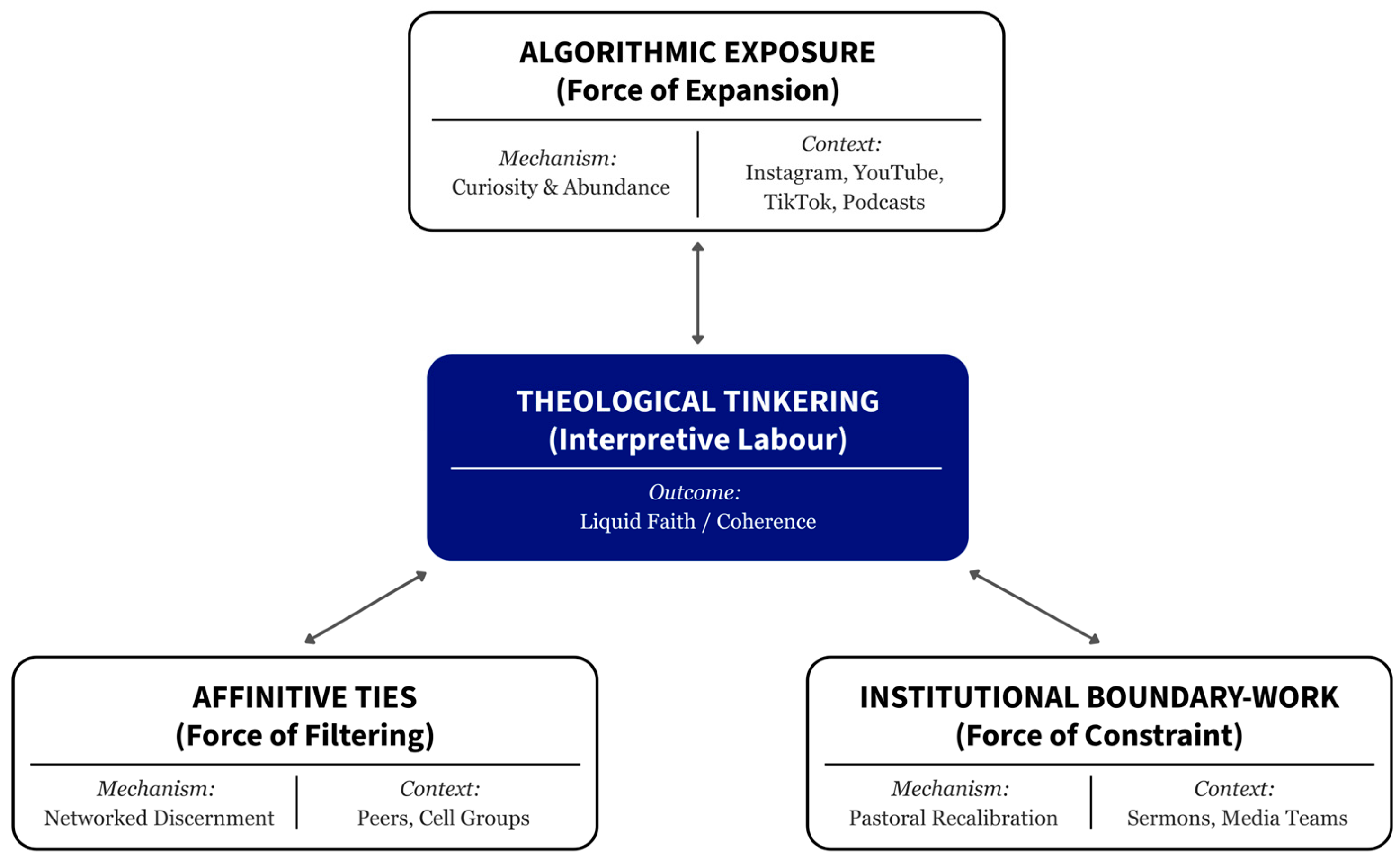
The model (
Figure 1) illustrates the interplay of three forces shaping youth theological formation.
(1) Algorithmic Exposure functions as an expansive force, widening theological horizons through digital serendipity.
(2) Affinitive Ties act as a relational filter, where peer networks validate or reject new ideas.
(3) Institutional Boundary-Work provides soft structural constraints through pastoral guidance and media curation.
Theological Tinkering (centre) emerges as the reflexive interpretive labour believers perform to sustain coherence (‘Liquid Faith’) amidst these competing inputs.
3. Methodology
This study employed an ethnographic and digital textual approach to examine how Pentecostal youth in Singapore engage in theological tinkering across onsite and online environments. Fieldwork was conducted at SG Church, one of Singapore’s largest Pentecostal megachurches, over three years (2019–2021). Combining participant observation, semi-structured interviews, and digital ethnography, the research sought to capture the lived, reflexive processes through which theology is encountered, interpreted, and adapted in a mediatized religious setting.
3.1. Field Site and Context
SG Church attracts thousands weekly, with a significant proportion under thirty-five. Its ministry model integrates charismatic worship, extensive media production, and a network of small/cell groups that extend the megachurch ethos into everyday life. Digitalization is deeply embedded in its operations: weekend services are livestreamed, sermons are archived on YouTube, and mobile applications facilitate devotional content, communication, and giving.
Fieldwork focused particularly on the youth ministry, which regularly conducts special youth-only events, conferences, and cell-group meetings, and maintains an active presence on Telegram, WhatsApp, Instagram, and other social media platforms. Research took place across these intertwined spaces—physical gatherings and digital spaces—acknowledging that the theological life of youth at SG Church moves fluidly between onsite and online contexts.
3.2. Data Collection
Data collection combined participant observation, semi-structured interviews, and digital textual analysis.
Participant observation involved attending weekend services, youth gatherings, prayer meetings, and online events. Detailed fieldnotes were kept on sermon themes, worship practices, technological mediation, and informal discussions about faith. Digital observation included participation in livestream comment sections, youth WhatsApp and Telegram conversations, and social-media threads, focusing on how members shared, evaluated, and interpreted teachings.
Interviews were conducted with thirty youth members and lay leaders (ages 15–24) and five pastoral staff. Interviews explored media habits, exposure to diverse Christian teachings, perceptions of authority, and experiences of doctrinal curiosity or tension. Open-ended questions invited participants to narrate faith development and to identify moments when digital content shaped their theological views. Quotations cited later retain participants’ pseudonyms, ages, and roles.
Digital textual analysis examined sermons, podcasts, YouTube clips, and social-media posts circulated among respondents. These included material from SG Church as well as commonly referenced external sources (e.g., Hillsong, Elevation, Bethel, Reformed teachers such as John Piper and Timothy Keller, and platforms such as BibleProject, The Gospel Coalition, and GotQuestions). This enabled comparison between institutional messaging and the wider Christian mediascape influencing youth theological discourse.
3.3. Ethics, Reflexivity, and Positionality
As a researcher with prior pastoral experience in similar Pentecostal settings, I occupied an insider-outsider position. This facilitated rapport and interpretive sensitivity but required reflexive vigilance to avoid normative bias. I maintained analytic memos documenting moments of resonance, surprise, or interpretive uncertainty; periodically triangulated interpretations with scholars and Christians familiar with the Singaporean landscape; and privileged participants’ own phrasing even when it challenged my assumptions.
Ethical procedures followed institutional and local research protocols. Digital observations were limited to publicly accessible content unless explicit consent was obtained for private-group interactions. All identifying details were anonymized, and sensitive quotations were paraphrased when necessary to protect confidentiality.
3.4. Interpretive Orientation: Lived Theology and Digital Ethnography
This study approaches theology ethnographically—as discourse and practice emerging from everyday religious life rather than solely as institutional doctrine. This aligns with
McGuire’s (
2008) lived-religion framework, the rise of lived-theology approaches in digital religion (
Campbell 2020), and emerging regional articulations of “ethnotheology” (
Mawikere et al. 2022).
In this view, theology is enacted not only in sermons and formal teaching but also in the informal digital practices through which believers engage Christian ideas: sharing clips, discussing teachings in chats, reacting to sermons on social media, or expressing spiritual resonance through worship and affect. Theological tinkering becomes visible in these narrative, conversational, and digital traces.
As with most qualitative research, this study is context-specific. SG Church represents a particularly mediatized and technologically integrated Pentecostal environment; findings may differ in smaller congregations or non-urban settings which may lack the sophisticated media ecology of SG Church. The tinkering observed here is partly enabled by the high digital integration of the megachurch context; smaller communities may face a sharper “digital divide” or rely more heavily on external content without the buffer of local media production. Nevertheless, the Singaporean case is analytically instructive for East Asia, where technological integration, urbanization, and Christian growth intersect. By tracing theology as a lived and mediated practice, the methodology illuminates how digital infrastructures, relational networks, and spiritual aspirations converge to shape the liquid faith of Pentecostal youth.
4. Findings: Theological Tinkering in Digital Pentecostalism
Digital media expose SG Church youth to unprecedented volumes of Christian teaching. Rather than receiving doctrine solely from the pulpit, believers encounter a mosaic of voices curated by algorithms, peers, and personal preference. Across interviews and observations, three intertwined processes emerged: (1) algorithmic exposure and theological curiosity, (2) affinitive ties and networked discernment, and (3) negotiating boundaries and authority. Each reveals how theological tinkering operates as both exploration and boundary work.
4.1. Algorithmic Exposure and Theological Curiosity
For most Pentecostal youths at SG Church, digital platforms are not external to faith practice; they are integral to how faith is formed, expressed, and reimagined. The smartphone functions as a pocket-sized theological library and worship space. Sermons, podcasts, playlists, and devotionals appear in the same feed as lifestyle and entertainment content, collapsing distinctions between the sacred and the mundane. Within this ecosystem, the algorithmic curation of religious material has become a subtle but powerful force shaping theological imagination.
When youth describe their media habits, they speak the language of “
feeding,” “
consuming,” and “
scrolling” as naturally as they speak of prayer or fellowship. Many explained that their phones have become their main spiritual companions. Wei Quan, a youth cell group leader, reflected:
I listen to preaching and podcasts as a way of feeding myself spiritually because I think that more than just being exposed to preaching on the weekend, I could gain more by renewing my mind from a steady, healthy flow of input through the week… With regards to my identity as a Christian, I think that at the very basic level, being intentional about downloading and listening to other preachers and sermons—on top of your own church’s weekend sermons—shapes and affects the way we identify ourselves as believers.
Wei Quan’s emphasis on intentionality is telling. For him, digital listening is not a random pastime but a disciplined practice of formation. Yet this intentionality is entangled with algorithmic exposure: podcast platforms and YouTube recommendations determine much of what appears. Youth repeatedly noted how “
one sermon leads to another,” or how they “
stumble across” new teachers when browsing online. What begins as curiosity often leads to comparison and theological reflection, a process central to theological tinkering.
Jun Xiang (university student, 24) described how digital exposure to other preachers broadened his imagination of what it means to live as a Christian:
Perhaps the biggest influence on my identity as a Christian is to be an optimistic and kind Christian. Like I would want to see myself strive to behave as a Christian brother that is helpful, kind, and most importantly, optimistic and hopeful… I guess the two preachers taught me to see things from a bigger perspective and that whatever happens, happens because the Lord allows it and I can be assured, that all will be well.
For Jun Xiang, digital sermons do not replace local teaching; they expand the affective and moral repertoire of what “being Christian” feels like. Theological tinkering, then, begins not in doctrinal deviation but in subtle shifts in tone, emphasis, and sensibility. The algorithm feeds diversity; the believer filters meaning.
However, such exposure can also exacerbate asymmetries of literacy. Some young people are well equipped to compare teachings critically; others are overwhelmed by the abundance of content. Shaun (secondary school student, 16) admitted candidly,
I don’t read [the Bible] much at all… like once or twice a month?
In contrast, another respondent, Yue Jing (junior college student, 18), explained how digital tools intensified her study habits:
I love using Bible apps… there’s one with commentaries… Sometimes I cross-check what the sermon says… I like that you can learn faster online.
Between Shaun and Yue Jing lies a widening gap that SG Church’s pastoral staff also observes. Matthias, a pastoral staff member, remarked:
What we are experiencing now is a polarization of Bible literacy… some people really are hungry for more of the Word, and with the internet, they will go on online courses… Then there are those who are Bible “illiterate”… more attuned to whatever popular culture says.
Matthias’s insight reveals the double-edged nature of digital access: it amplifies both curiosity and confusion. For some, online tools facilitate deeper learning; for others, they encourage superficial engagement. In both cases, digital exposure redefines the ecology of belief.
Algorithmic visibility not only widens access but subtly prioritizes certain theological styles. Highly produced sermon clips, emotional worship moments, and motivational soundbites dominate feeds because they perform well within the attention economy. The consequence is what Shane (university student, 23) problematizes as “the TikTokification of theology”—short, emotive, quotable fragments detached from their scriptural context. Several young people acknowledged that they occasionally preferred such clips over full sermons, not out of laziness but because “they fit into daily life.” As Agnus (secondary school student, 16) puts it, “sometimes we forget sermons we’ve heard and their posts provide a good and short reminder.”
This micro-devotional mode reflects
Campbell’s (
2013) conceptualization of
networked religion, where digital circulation shapes religious temporality and scale. Youth craft their own rhythms of theological consumption—moments of spiritual reflection interspersed with entertainment and study. For them, tinkering with theology happens not in formal Bible study sessions but in fragmented, everyday moments: during commutes, workouts, or late-night scrolling.
Yet this fragmentation can also generate dissonance. Exposure to divergent Christian messages—especially those addressing debated topics like prosperity, suffering, or sexuality—forces youth into interpretive labour. As Grace (university student, 20) admitted:
…it does bring about some confusion. Because like, some of the pastors that I follow that are on Instagram, like some of the things they share… can be quite different from what my own pastors share… And then sometimes I think: “So what is right?” Like for example, LGBT. Like I was just scrolling through like the explore page, then like this pastor comes saying that she owns like a gay church and like whatever… So then, what is right? Like for me, personally, it doesn’t feel right, but… so many people believe in that… the church is not a small number, and you start to think…
This balancing act exemplifies
liquid faith: beliefs remain committed yet flexible, anchored yet open to revision. Theological tinkering is thus not aimless mixing but the search for coherence amid plurality.
From a sociological perspective, algorithmic exposure functions as a new form of socialization. Instead of catechism by clergy, youth are catechized by code—by the algorithmic logic of personalization and engagement. However, their responses reveal agency. They appropriate, compare, and sometimes resist algorithmic offerings, guided by trust networks and personal convictions. Digital curiosity often leads back to community, prompting discussions in small groups or with mentors. As Roger (university student,22), a youth leader, described, “When someone shares a “controversial” sermon clip, we usually end up talking about it in cell group…”
In these exchanges, curiosity from a networked religion turns into a collective networked discernment. Algorithms may spark theological encounters, but interpretation remains social. Theological tinkering emerges from this interplay between digital serendipity and communal sense-making.
At the same time, algorithmic exposure has emotional consequences. Youth report both excitement and anxiety about the plurality of voices. Some express awe at global Christianity’s diversity; others worry about being “led astray.” This emotional oscillation reinforces the need for discernment as a spiritual discipline. In a sense, curiosity can be both a crisis of confusion and a chance for clarity.
In sum, algorithmic exposure cultivates theological curiosity that is neither random nor passive. It creates an expanded theological horizon in which youth must continually discern, compare, and integrate multiple teachings. Theological tinkering begins here, in the encounter between algorithmic abundance and human agency. Digital platforms mediate not only information but imagination; they shape what is thinkable about God. For Singapore’s Pentecostal youth, this process is not a departure from faith but its contemporary expression—a way of being faithful in a world where belief must be navigated, not simply inherited.
4.2. Affinitive Ties and Networked Discernment
If algorithms open the door to theological diversity, affinitive ties determine which voices stay. Among the young people at SG Church, digital exposure rarely leads to solitary belief-making. Instead, theological meaning is processed through webs of relationships—peers, mentors, and small-group networks that provide the social scaffolding for discernment. Faith formation is thus both digitally and relationally mediated: what youth believe often depends on whom they trust.
Grace (university student, 20) captures this interplay clearly:
I think that a lot of this right, is based on the [church] culture that we are in, like the groups that we belong to… although digitalization can influence the way we think right, I think a lot of it still comes from the people we hang out with. Because like, even when I see other churches online, I still go back to what my leaders or close friends think about it before I really decide if I agree or not.
Her reflection illustrates a recurring theme: belonging precedes believing. Digital theology is filtered through existing relationships, not consumed in isolation. While the algorithm proposes, the social circle disposes. For most youth, discernment takes place collectively, through dialogue, imitation, and subtle negotiation within trusted communities.
Jimmy (secondary school student, 17) expresses this relational epistemology:
…of course I still have my own beliefs and stuff, but I also trust what pastor says, he has led the church well and nothing seems to be very wrong to me about what he says also…
For Jimmy, theological evaluation rests more on
relational trust than abstract theological reasoning. His discernment process is affective: the perceived sincerity and consistency of leaders matter more than the propositional content of teaching. This dynamic reflects what
Campbell and Tsuria (
2022) identify as
networked authority in digital religion, where trust and credibility circulate through relational ties, affective resonance, and peer evaluation rather than hierarchical office.
However, as young people traverse digital environments, their affinitive networks do extend beyond the local church. Parasocial relationships develop with online preachers, worship collectives, and Christian influencers who appear personally accessible through social media. Several respondents like Krystal (secondary school student, 16) described following specific Christian influencers because they “feel real” or “feel like she gets me.” Such figures function as supplementary mentors, shaping spiritual imagination and sometimes eclipsing the influence of local leaders. Based on the diversity and frequency with which young people consume podcasts, video sermons, and devotional content from external sources, it is reasonable to infer that some may feel a greater sense of familiarity with these online personalities than with certain members of their own congregational groups. The affective intimacy of digital connection thus blurs boundaries between local and global belonging, multiplying the sources from which theological cues are drawn.
In SG Church, peer networks function as interpretive communities that both endorse and restrain these digital influences. Youth leaders often initiate discussion by sharing sermon clips or devotionals in group chats, prompting reflection. As Sarah (university student, 21) noted: “In the [cell group WhatsApp] group chat… every other day a different one will send their reflections…” These instances of digital discipleship exemplify distributed authority, where micro-discernment occurs through everyday digital exchanges and where theological credibility is co-constructed.
Yet affinitive ties also generate subtle tensions. Some youth described moments when online content resonated more strongly than local teachings, producing cognitive dissonance. Tong En (polytechnic student, 18) reflected:
…it seems that what is on BibleProject [an online educational Bible resource] sometimes seems to be different from what pastor taught… Not like opposite, but different emphasis maybe? Still, I sometimes wonder which is ‘correct’.
Such moments reveal the interpretive burden young believers bear: they must arbitrate between multiple authorities without clear hierarchies. Affinitive ties help manage this burden, but do not eliminate it. Discernment, then, becomes an ongoing relational practice, a rhythm of encounter, consultation, debate, and reassurance.
During COVID-19 lockdowns, when physical gatherings were suspended, smaller digital communities intensified this dynamic. The youth of SG Church turned to WhatsApp prayer circles, Discord chats, and Zoom devotionals became sites of theological improvisation, emotional care, and spontaneous discussion. Youth shared memes, verses, sermon notes, and struggles; they prayed for each other and debated doctrinal questions in real time. These micro-communities reflect what
Hutchings (
2017) identifies as the emergence of digital peer networks in contemporary Christianity, where meaning is co-constructed through circulation of media and commentary.
Yet these relational ecologies also constrain. While they create spaces for shared exploration, they also reproduce hierarchy and cultural expectations that limit dissent. Strong personalities, perceived maturity, or social capital often shape group interpretations. Some youths described deferring to peers “even if I don’t fully agree” because “he’s probably more experienced.” Harmony-oriented norms discourage disagreement; several respondents admitted staying silent to avoid awkwardness. These dynamics show that tinkering is never frictionless: it unfolds within hierarchies of respect, seniority, and cultural expectations around conflict avoidance—conditions that influence the practice of networked discernment.
Taken together, affinitive ties transform theological tinkering from an individual coping strategy into a communal practice of networked discernment. Through conversation, imitation, and emotional resonance, young people collectively curate their theological worlds. Within the dense relational webs of Pentecostal community life, where friendship and faith intertwine, these networks function as both conduits and constraints—encouraging exploration while maintaining coherence. Through them, young people learn to live faithfully in a liquid world: open to plurality yet anchored in belonging.
4.3. Negotiating Boundaries and Authority
If algorithmic exposure widens theological horizons and affinitive ties filter meaning, the third movement of theological tinkering appears in the negotiation of boundaries—moments where exploration encounters institutional constraint. Among SG Church youth, this negotiation is rarely dramatic or confrontational. Instead, it unfolds through subtle calibrations, quiet redirects, backstage decisions, and everyday pastoral interactions that make certain theological possibilities more plausible than others. Boundary-work, in this sense, does not simply enforce doctrine; it actively shapes the contours of what theological experimentation can look like in a highly mediatized Pentecostal environment.
One recurring form of boundary negotiation emerges when particular teachings begin circulating widely online among youth. Several respondents recalled a season when certain theological trends gained traction within their circles, prompting questions about suffering, healing, prosperity, women in leadership, predestination, or contemplative practices. When these influences reached a noticeable critical mass, SG Church’s leadership responded—typically not through direct correction, but via sermon emphases and Q&A segments. These interventions were rarely framed as disciplinary. Instead, leaders adopted pastoral language such as “seeking clarity,” “returning to Scripture,” and organizing Bible studies that indirectly engaged these outlier ideas. By presenting their responses as invitations to deeper study rather than as rebukes, leaders effectively reasserted interpretive authority while preserving relational trust.
A youth leader Yong Jie (university student, 22) described one such instance during the height of COVID-19 lockdowns:
I think pastor could sense a lot of us were watching teachings from everywhere…. [so] he had a bible study series online that lasted many weeks… you could tell he was trying to help clarify our church’s stance…
This is a form of soft boundary-work—gentle recalibration that recenters the church without explicitly forbidding external influences. In a fluid digital environment, institutional constraints must feel pastoral rather than prohibitive.
Yet boundary-work is not enacted only from the pulpit. Much of it occurs in micro-interactions between youth and their leaders. Several respondents described consulting their cell-group leaders after encountering online content that confused them. These cell-group leaders rarely dismissed external voices outright; instead, they tried their best to help their youth reconcile and resolve their thoughts (albeit to varying degrees of success). Either way, doing so subtly regulated theological intake without restricting autonomy. In Pentecostal contexts where experiential authority carries weight, such relational endorsement often guides youth more effectively than formal doctrinal statements.
Another form of boundary negotiation unfolds backstage through the media team of SG Church. Sermons destined for online dissemination undergo editorial adjustments: lengthy expositions are streamlined, key segments foregrounded, and potentially contentious phrasing softened. This blurring of boundaries between spiritual and technical expertise exemplifies what
Hjarvard (
2008) calls
the mediatization of religion—the incorporation of media logics into religious decision-making—and aligns with
Campbell’s (
2021) observation of digital creatives emerging as religious authorities. In one instance, a pastor revised an online Bible-study script after the media department advised that a particular line was “too strong” for the much wider YouTube audience. Here, technical staff (non-theologians) exercised interpretive influence, demonstrating how digital creatives—guided by platform affordances and sensitivities rather than theological training—shape which theological messages become public. The digital interface becomes a boundary-setting device in its own right.
For youth, these curated outputs form a significant part of their primary theological diet. They seldom perceive the backstage negotiations, yet they internalize the resulting theological emphasis—one that privileges clarity, emotional resonance, and public coherence over experimental or controversial teaching. In this sense, the digital infrastructures of SG Church enact a form of institutional boundary-work that is both technological and pastoral.
Boundary negotiations also unfold horizontally through peer regulation, where youth subtly police one another’s theological explorations. Several respondents recalled moments when friends or cell-group members discouraged particular teachings, not because this was an explicitly top-down directive, but because the content originated from preachers or churches their own congregation had not implicitly endorsed. These gentle corrections, often phrased as soft dissuasion (“
maybe check with [cell group leader],” “I’m not too sure about that.”), reveal how institutional norms become internalized and reproduced through social belonging rather than formal authority—an everyday enactment of what
Foucault (
1991) would term governmentality. This communal regulation, however, coexists with forms of latent tension and quiet dissent. While the church maintains hegemonic control over the pulpit, it cannot police the private screen. A number of youths admitted to privately following teachers whose views diverge from SG Church’s stance, maintaining performative harmony publicly while exploring alternative teachings in private digital spaces. This suggests that boundary-work is not always a consensual cooperation; for some, it involves a tactical negotiation of power where tinkering becomes a hidden act of resistance against institutional homogeneity. Taken together, these dynamics illuminate the complexity of liquid faith: boundaries are neither rigid nor irrelevant, but continually negotiated through a balancing of communal loyalty, personal curiosity, and the aspiration to remain faithful within conditions of plurality.
Furthermore, boundary-work is shaped by the emotional landscape of Pentecostal spirituality. Youth navigate theological plurality not only through rational comparison but through affective-spiritual intuitions—feelings of peace, discomfort, conviction, or unease. Some respondents described “feeling wrong” about certain teachings or “not sensing peace” with a particular preacher or voice online, even when they could not articulate doctrinal reasons. These affective-spiritual cues often aligned with institutional expectations, reinforcing boundary-work through what they interpreted as spiritual discernment. Emotional resonance thus becomes a theological filter, functioning as an embodied hermeneutic that subtly maintains continuity with church teaching even in the midst of digital diversity.
In sum, boundary negotiation within SG Church youth culture emerges from a constellation of practices: pastoral recalibration, relational guidance, backstage media decisions, peer regulation, quiet dissent, and spiritual-affective discernment. Exploration meets institutional constraint not through prohibition but through soft infrastructures of coherence—pastoral, relational, technological, cultural, and spiritual. Theological tinkering persists, but its trajectories are shaped by a communal ecology that encourages openness while gently steering believers toward shared boundaries.
5. Discussion: The Tension and Task of Theological Tinkering
The findings from SG Church reveal that theological tinkering is neither merely an individual cognitive activity nor simply a byproduct of digital saturation. Rather, it is an emergent practice of religious reasoning that arises from the tensions and tasks of contemporary digital Pentecostal life. Young people navigate theological plurality through a dynamic interplay of algorithmic exposure, affinitive networks, and institutional boundary-work, each intensifying both the pressures and possibilities of meaning-making in liquid modernity. Theological tinkering, then, names the interpretive labour required to negotiate competing truth claims, sustain coherence, and construct a reflexive Pentecostal identity under conditions of flux. This section examines the dual nature of this practice: the tensions it introduces into faith formation and the tasks it demands of believers, leaders, and institutions alike.
First, theological tinkering challenges conventional assumptions about doctrinal transmission. Classical models in sociology of religion often presuppose a vertical flow of belief from institutions to individuals. Yet SG Church youth inhabit a theological marketplace where the digital supply of ideas vastly exceeds institutional curation. They scroll through fragments of global Christianity—Reformed soteriology, charismatic pneumatology, contemplative spirituality, prosperity-inflected optimism—encountered side by side in algorithmically curated feeds. The result is not confusion but curiosity. Youth acquire a broader repertoire of categories, vocabularies, and sensibilities than previous generations. In this environment, tinkering becomes a mode of adaptive reasoning: a way to test, integrate, or bracket ideas while maintaining commitment to core convictions. However, this adaptive reasoning is not without epistemological risk. The shift toward ‘bite-sized’ theology can lead to a ‘thinning’ of belief, where the structural integrity of a theological system is sacrificed for the affective resonance of a 60 s clip. While tinkering demonstrates resilience, it does not guarantee depth. It creates a coherence that feels authentic but may lack doctrinal durability. Furthermore, algorithmic curation is not an innocent nor neutral epistemological process; it is driven by the logic of surveillance capitalism and the attention economy. The same feeds that deliver sermons also deliver entertainment, consumerist pressures, and potentially toxic content, collapsing the sacred and the profane into a single stream. Therefore, while “tinkering” describes the agency of youth, this agency is exercised within a highly manipulated environment designed to commodify attention rather than nurture spiritual depth.
This diversification is not unique to Singapore but emblematic of broader East Asian Christianities, which historically evolved through adaptation and hybridity. Yet digital media accelerates this process and renders it more reflexive. Young people must actively interpret theological plurality rather than passively receive tradition. In doing so, they enact what
Giddens (
1991) describes as a lifelong reflexive “project of the self”: continually revising their theological understandings in response to digital encounters while striving to sustain a coherent Pentecostal identity within liquid conditions (
Bauman 2000).
Second, the findings complicate popular narratives of decentralization. Digital religion scholarship frequently emphasizes the erosion or flattening of institutional authority. While this dynamic is present, the case of SG Church demonstrates that authority is not simply weakened; it is redistributed and rearticulated. Youth leaders, pastoral staff, Christian influencers, media teams, and peer networks all participate in shaping theological plausibility. Authority circulates through relational trust, emotional resonance, and digital mediation. The church’s influence is neither absolute nor absent; it operates through soft power—nudges, clarifications, tone-setting, and curated content. Boundary-work becomes a collaborative and dispersed task conducted formally and informally across multiple layers of church life.
This relational and distributed ecology of authority resonates with Campbell’s concept of networked religious publics but also extends it. Networked authority in SG Church is not merely descriptive of online interactions; it functions as a theological regulator. Youth rely on trusted figures and peers as interpretive filters. Leaders shape theological reception not through coercion but through proximity, virality, and relational credibility. Meanwhile, media teams exert subtle influence by selecting, editing, framing, and circulating church content. Together, these dynamics generate a hybrid form of Pentecostal authority suited to liquid modernity: flexible, affective, and negotiated, yet still recognizably institutional.
Third, the practice of tinkering reveals the emotional and spiritual dimensions of theological negotiation. Youth do not navigate plurality solely through rational comparison; they rely on
affective-spiritual cues—a sense of peace, discomfort, resonance, or dissonance—that help them gauge whether a teaching “feels right.” These affective-spiritual signals often align with institutional norms and Pentecostal sensibilities. In this way, emotions and the perceived leading of the Spirit function as tacit guardians of coherence, anchoring experimentation within shared moral and spiritual intuitions. Theologically, this reflects a distinctly Pentecostal epistemology in which spiritual discernment is considered a legitimate mode of knowing. Sociologically, it highlights how
somatic modes of attention (
Csordas 1993) operate as boundary mechanisms, simultaneously reinforcing communal norms and enabling personal exploration within the fluidity of digital religious life.
Fourth, the findings illuminate how digital infrastructures shape the conditions for theological reasoning. Algorithms do not merely recommend content; they produce new rhythms of learning—fragmented, iterative, affectively charged. These rhythms align with emerging scholarship on the “platformization” of religious authority. Recent studies indicate that religious authority is increasingly mediated through “human–machine communication” (
Cheong and Chen 2023), where algorithms do not merely distribute content but actively structure the “propositions and complexities” of theological futures (
Cheong and Campbell 2024). In the Singaporean context, the state’s aggressive push toward a thriving digital future (
Smart Nation and Digital Government Office 2024) further embeds these technologies into the fabric of daily life. Consequently, the tinkering observed in this study is likely not a transient phase, but a precursor to a more profoundly automated theological landscape. Youth develop micro-devotional habits, punctuated by short-form reflections, worship clips, and sermon highlights. Theological reflection becomes ambient, woven into daily routines rather than confined to formal study. Yet this ambient mode also produces tensions: polarization in biblical literacy, uncertainty about contested issues, and heightened interpretive burden. Tinkering becomes the method by which youth navigate these tensions—balancing digital abundance with communal belonging.
Finally, theological tinkering illuminates emerging trajectories for pastoral ministry and ecclesial identity in East Asia. As youth increasingly assemble their theological worlds through digital encounters and relational networks, formal teaching is no longer the sole or even primary site of doctrinal formation. This does not diminish the significance of ecclesial institutions; rather, it reconfigures their function. Pastors increasingly function as guides who help youth interpret a plurality of voices rather than as gatekeepers who control them. Small-group leaders act as co-discerners, facilitating conversation and reflexive evaluation rather than enforcing doctrinal uniformity. Even media teams—whose decisions shape the visibility, tone, and emphasis of church communication—participate indirectly in the theological mediation of the community.
Within this landscape, the task of ministry shifts toward cultivating environments where exploration can occur within supported boundaries and where discernment is taught as a reflexive competency. Under liquid conditions, coherence is sustained not by insulating believers from plurality but by equipping them to navigate it faithfully. Future catechesis, therefore, must shift from mere content delivery to “hermeneutical formation”: training youth not just what to believe, but how to critically evaluate the algorithmic fragments they encounter. In this sense, digital discipleship becomes less a set of online practices than a broader pastoral orientation: fostering the skills, dispositions, and communal frameworks that enable believers to engage theological abundance with wisdom, confidence, and spiritual depth.
Taken together, these findings show that theological tinkering encapsulates both the tension and the task of Pentecostal belief in digital environments. It is the tension of encountering plurality, contradiction, and asymmetries of literacy, alongside the task of constructing coherence through reflexive discernment, relational trust, and embodied intuition. In contemporary Singapore, and increasingly across urban East Asia, tinkering has become a defining feature and practice by which Pentecostal youth make sense of Christian belief under liquid conditions. Far from signalling doctrinal instability, it reveals a resilient spiritual posture: the capacity to remain rooted while moving, committed while navigating, faithful while flexible.
6. Conclusions
Theological tinkering, as observed in SG Church, illuminates a broader transformation in contemporary Christian life: faith is increasingly formed in motion. Youth inhabit environments where spiritual influence is ambient, relational, and algorithmically curated; where theological ideas are encountered not in sequence but in juxtaposition; and where meaning emerges through continual movement across platforms, conversations, and communal spaces. Rather than a deviation from “proper” formation, this mobility reflects the late-modern conditions under which faithfulness is now lived.
What distinguishes the Singaporean case is not the presence of plurality—East Asian religiosity has long been plural—but the pace and publicness of interpretation. Digital infrastructures amplify plurality while making comparison instantaneous. Peer networks render interpretation deeply social. Churches guide and moderate without fully controlling. Under these conditions, coherence is no longer inherited by default; it is achieved and re-achieved through ongoing discernment. Tinkering names this labour of coherence amid the liquidity of digital life.
This study therefore challenges models of theological formation that presume unidirectional transmission, doctrinal consolidation, or institutional enclosure. The young people in this research are not drifting from tradition but negotiating it—holding loyalty and agency together, balancing belonging with exploration, and weighing conviction alongside comparison. Such negotiation is not evidence of fragility; it is evidence of resilience. When stability can no longer be guaranteed by limiting exposure, it must be cultivated through reflexive engagement.
The findings also invite a recalibration of how digital religion is theorized in East Asia. Scholarship has often focused on ritual participation, online community, or shifting authority structures. Yet theology—how ideas about God are sourced, weighed, contested, and incorporated—proves equally shaped by digital infrastructures. Understanding this requires taking youth seriously, not as passive recipients of global Christian content but active interpreters navigating algorithmic juxtapositions through relational belonging, spiritual intuition, and communal negotiation.
Attending to theology as lived practice is therefore essential. For these youth, theological reasoning occurs not only in sermons or doctrinal statements but in the everyday micro-practices of digital circulation: sharing clips, debating teachings in chats, responding emotionally to influencers, cross-checking interpretations online, or discerning spiritual resonance or dissonance. Theological tinkering brings this lived labour into view, revealing how belief is constructed through practices that are cognitively reflexive, relationally embedded, and spiritually attuned.
These insights also point toward a pastoral and theological opportunity. Churches in East Asia need not respond to digital plurality with defensiveness or withdrawal. Theological tinkering suggests that youth are not seeking escape from tradition, but guidance within it—guidance that acknowledges complexity, cultivates discernment, and affirms exploration as part of faithful growth. The task of ministry, then, is not to eliminate plurality but to accompany believers as they learn to navigate it with wisdom and integrity. In this sense, tinkering is not a symptom of abandonment but a practice of faith.
Ultimately, theological tinkering reflects a generation learning to trust God in motion. Their faith is not marked by the absence of boundaries but by the ability to discern them together. In a region increasingly marked by digital saturation, religious diversity, and transnational Christian flows, this capacity may prove not merely adaptive but indispensable for the future of Asian Pentecostalism.