Article

Cheng 竀 or Kui 窺: A Study of Master Cheng Emerging from the Shadow of the Renowned Yogācāra Master Kuiji 窺基 (632–682)

National Institute for Advanced Humanistic Studies, Fudan University, Shanghai 200433, China
Religions 2025, 16(12), 1548; https://doi.org/10.3390/rel16121548 (registering DOI)
Submission received: 11 November 2025 / Revised: 3 December 2025 / Accepted: 4 December 2025 / Published: 9 December 2025

Abstract

The name “Kuiji 窺基”, usually attributed to the famous monk Master Ci’en慈恩法師 in the Tang Dynasty, has long been a subject of scholarly debate. Textual and manuscript evidence, however, reveals that “Kuiji” is not a single figure but a conflation of two distinct disciples of Xuanzang 玄奘: Master Cheng 竀 and Master Ji 基. During 661–664 CE, the monk Cheng, affiliated with Great Ci’en Monastery 大慈恩寺, served as a core member of Xuanzang’s translation workshop, as well as a trusted assistant who submitted memorials on Xuanzang’s behalf. Early records state that Xuanzang instructed his disciple(s) “Cheng” or “Cheng and Ji” to present memorials to the throne. However, because the character “Cheng 竀” was uncommon and visually similar to “Kui 窺”, “Cheng and Ji” was misidentified as a composite name “Kuiji” roughly since the late Tang period. This study not only traces the origin of the name “Kuiji” but also recovers the important yet overlooked figure of Master Cheng 竀法師, thereby making a crucial correction to our understanding of Xuanzang’s disciples.

1. Introduction

The renowned Tang Dynasty monk Master Ci’en 慈恩法師 (632–682), a distinguished disciple of the eminent monk Xuanzang 玄奘 (600/602–604), was regarded as the de facto founder of the Chinese Yogācāra School (Weishi School 唯識宗 or Faxiang School 法相宗). Master Ci’en is commonly believed to be named “Kuiji 窺基”; however, the origin of the name “Kuiji” has long been a subject of debate among scholars. In fact, whether the works of Master Ci’en himself, or contemporaneous texts such as Datang ci’ensi fashi jigong bei 大唐慈恩寺法師基公碑 [Inscription for Master Ji of the Ci’en Monastery of the Great Tang Dynasty]1 and Daci’ensi da fashi jigong taming bing xu 大慈恩寺大法師基公塔銘並序 [Inscription and Preface for the Pagoda of Great Master Ji at Daci’en Monastery],2 all refer to Master Ci’en as “Ji 基”, “Venerable Ji 基公”, “Master Ji 基師”, “Dacheng Ji 大乘基” or “Shamen Ji 沙門基”. All of these demonstrated that the name of Master Ci’en was undoubtedly “Ji”. The key to the problem, therefore, lies in how the character “Kui 窺” came to be added to Master Ci’en’s name. He Huanhuan 何歡歡3 once outlined the views held by earlier scholars and pointed out that most Chinese scholars conventionally use the name “Kuiji” but have rarely examined its authenticity (He 2020, pp. 7–13). Only Lü Cheng 呂澂 (1896–1989) mentioned that the character “Kui 窺” was added by people of the Song Dynasty (Lü 1979, p. 186); Tang Yongtong 湯用彤 (1893–1964), partly adopting the views of Saeki Ryōken 佐伯良謙 (1880–1963), believed that inscriptions, epigraphs, and other early records only mentioned Master Ci’en’s as “Ji 基”, while “Kuiji” first appeared in the Kaiyuan shijiao lu 開元釋教錄 [Catalogue of Buddhist Texts Made during the Kaiyuan era (713–741)] (Tang 2010, pp. 120–21). Since the late 1970s, Japanese scholars have generally agreed, perhaps also under the influence of Saeki Ryōken, that Master Ci’en’s name was actually “Ji” instead of “Kuiji”. As for the character “Kui”, Saeki Ryōken found only one clue in Tang taizong huangdi yuzhi jigong zan ji 唐太宗皇帝御製基公讚記 [Imperial Panegyric for Venerable Ji Composed by Emperor Taizong of the Tang Dynasty], inscribed by the Japanese monk Shōsan 清算 on the seventeenth day of the eighth month in the ninth year of the Taiping Xingguo era (i.e., 14 September 984 CE). It says that “Master of the Commentaries was the Mahāyāna monk of Great Ci’en Monastery 大慈恩寺 in the capital. His surname was Yuchi 蔚(尉)遲, his [religious] name was Kui, and his style name was Hongdao 洪道”.4 Saeki speculated that “Kui” might have originated because of its similar pronunciation to “Ji”, or possibly was used to replace “Ji” due to the naming taboo (避諱) related to Li Longji 李隆基 (Emperor Xuanzong of Tang唐玄宗, r. 712–756 CE), whose personal name also contained “Ji”. Some texts also record the name as “Chengji 乘基”, which seems to have been derived from “Dacheng Ji 大乘基” by omitting the character “Da 大”. The characters “Kui” and “Ji/Chengji” were subsequently combined, giving rise to the name “Kuiji”, which gradually supplanted “Ji” from the Song Dynasty onwards, profoundly shaping the collective memory of Master Ci’en’s name in East Asia (Saeki 1925, pp. 17–24). Stanley Weinstein and Watanabe Takao 渡辺隆生 did not fully accept Saeki’s viewpoints. Instead, they tended to regard “Kui” and “Ji” as two distinct disciples of Xuanzang, based on two important pieces of evidence: the single name “Kui” in Qing yuzhi daborejing xu biao 請御制《大般若經》序表 [Memorial Requesting the Imperial Preface for the Mahāprajñāpāramitā-sūtra],5 and the separately listed names “Kui” and “Ji” in Yichang liewei 譯場列位 [List of the Participants in the Translation Workshop] for the Fasc. 348 of the Mahāprajñāpāramitā-sūtra (Yakujō Retsui, pp. 5–6), neither of which was given particular emphasis in He’s article (Weinstein 1959, pp. 132–33; Watanabe 1982, p. 206).
Perhaps the major contribution of He’s article was to inspire subsequent research on the name “Kuiji” among Chinese scholars. Xu Tiancheng 許天成 analyzed the change of Master Ci’en’s name from “Ji” to “Kuiji”, with particular attention to the possibility of naming taboo. Despite the lack of new historical records, he postulated that “Kui” and “Ji” originally referred to two different disciples of Xuanzang. Due to alterations or omissions during textual copying and transmission, readers could no longer parse the sentences correctly; therefore, “Kui” and “ji” were mistakenly conflated and “Kuiji” became the name of Master Ci’en (Xu 2021, pp. 38–41). Based on three identical Yichang liewei 譯場列位 found in Fasc. 208, 232, and 348 of the Mahāprajñāpāramitā-sūtra, Yang Zurong 楊祖榮 also argued that the name “Kuiji” probably did not originate from a naming taboo but rather from the mistaken combination of the names of two monks, Kui and Ji (Z. Yang 2024). While Liu Shufen 劉淑芬 proposed that “Kuiji” was Master Ci’en’s religious name indeed, suggesting “Kui” served as a shared generational name (共名) and “Ji” as his personal name (殊名) (S. Liu 2024, pp. 144–47). This explanation seems doubtful because generational names typically use common characters like “Hui 惠” or “Dao 道”, yet there is a lack of evidence for “Kui” being used in this way elsewhere.
Through a close reading and analysis of historical texts, this article offers a new perspective on the name “Kuiji”, arguing that the character “Kui” was originally written as “Cheng 竀”, and presents new interpretations of the relevant historical records that differ from previous studies.

2. Views from the 9th to 10th Centuries

Saeki’s view was largely developed on the basis of the interpretations proposed by Qifu 栖復 (c. 9th century) and Zanning 贊寧 (919–1001). In particular, Qifu’s theory of naming taboo and Zanning’s explanation of the name “Chengji” were incorporated into Saeki’s discussion.
Qifu’s Fahuajing xuanzan yaoji 法華經玄贊要集 [Essential Collection of the Profound Panegyric to the Lotus Sūtra], also known as Jingshui chao 鏡水抄 [Collection from Jingshui Monastery], states,
The phrase “written by Ji (基撰)” indicates that the character “Ji 基” refers to the name of the commentator. During the early Tang period, this character was not subject to naming taboos, though it has become one under the current reign.6 Many disciples of Tang Sanzang (唐三藏, i.e., Xuanzang 玄奘) used single-character names following the prefix “Dacheng 大乘”, such as Master Dacheng Ji 大乘基, Master Dacheng Guang 大乘光, and so forth. Some sources record the name as “Huiji 慧基” or “Kuiji 窺基”. Among these three names, “Ji 基” and “Kuiji 窺基” are most closely related. The name “Kuiji” appears in the memorial submitted by Tang Sanzang before his passing at the monastery. Moreover, in the memorial for requesting imperial preface to the translated scriptures, it is stated that over six hundred scrolls of scriptures were translated at Yuhua Palace 玉華宮 in the third year of the Longshuo 龍朔 era of the Great Tang Dynasty (663 CE); on the twenty-third day of the eleventh month, the disciple Kuiji was ordered to present the memorial to the throne.
言“基撰”者,“基”字是疏主名。當時唐初未諱,今時國諱字也。唐三藏弟子多於“大乘”下著單名,大乘基法師、大乘光法師等。亦有云“慧基”,亦云“窺基”。三名之中,“基”與“窺基”最親。唐三藏臨亡謝寺表7中有“窺基”名字。又於奏請御制經序表中云:大唐龍朔三秊於玉華宮譯經六百餘卷,至十一月二十三日,令弟子窺基奉表聞奏。8
Zanning’s Song gaoseng zhuan 宋高僧傳 [Biographies of Eminent Monks compiled during the Song dynasty] states,
The first character of his name appears in different forms. According to the Ci’en Zhuan 慈恩傳 [Biography of Ci’en], in the third year of the Longshuo era, Master Xuanzang completed the translation of the Mahāprajñāpāramitā-sūtra at Yuhua Palace 玉華宮. On the twenty-second day of the eleventh month of that year, Master Dacheng Ji 大乘基 was ordered to present the memorial to the throne and request an imperial preface. Based on this, some texts refer to him as “Lingji靈基”, while the Kaiyuan lu 開元錄 (i.e., Kaiyuan shijiao lu 開元釋教錄) records his name as “Kuiji 窺基”. Some also mention “Chengji 乘基”, but that is incorrect. Actually that is “Dacheng Ji 大乘基”, because Huili 慧立 and Yancong 彥悰 did not write the full name explicitly, but mentioned only part of it as Cheng Ji 乘基, which does not sound natural. Similarly, the expression “respectfully dispatched Master Dacheng Guang 大乘光 to present the memorial” follows the same use case. Today, he is commonly known as Master Ci’en throughout the land.
名諱上字多出沒不同者,為以《慈恩傳》中云“奘師龍朔三年於玉華宮譯《大般若經》終筆,其年十一月二十二日,令大乘基奉表奏聞,請御制序……”由此云“靈基”,《開元錄》為“窺基”。或言“乘基”,非也;彼曰“大乘基”,蓋慧立、彥悰不全斥,故云“大乘基”,如言不聽泰耳。猶謹遣大乘光奉表,同也。今海內呼“慈恩法師”焉。9
Qifu and Zanning showed hesitation in their respective opinions. Although they confidently affirmed the names “Ji” or “Dacheng Ji”, they listed alternative versions such as “Huiji” and “Lingji” in addition to “Kuiji” without any refutation. This implies that despite its popularity during the 9th–10th centuries, “Kuiji” was not firmly established as Master Ci’en’s name; its eventual recognition as such, as they suggested, was most likely because it seemed to have more textual evidence. Therefore, the following section will undertake a detailed examination of the so-called textual evidence, focusing in particular on the records concerning Xuanzang’s disciple “Kuiji” and the two occasions on which “Kuiji” was instructed to submit memorials, as documented in historical sources such as Qing yuzhi Daborejing xu biao 請御制《大般若經》序表, Datang gu sanzang Xuanzang fashi xingzhuang 大唐故三藏玄奘法師行狀 [The Biography of the Late Tripiṭaka Master Xuanzang of the Great Tang Dynasty] by Mingxiang 冥詳 (n.d.), Xu gaoseng zhuan 續高僧傳 [Supplement to the Biographies of Eminent Monks] compiled by Daoxuan道宣 (596–667), Datang daci’ensi sanzang fashi zhuan 大唐大慈恩寺三藏法師傳 [The Biography of the Tripiṭaka Master of the Great Ci’en Monastery of the Great Tang Dynasty] by Huili 慧立 (615–676?) and Yancong 彥悰 (c. 7th century), and the ancient manuscripts of Yichang liewei 譯場列位.

3. Evidence Found in the Memorial

The text of □□si shamen xuanzang shangbiao ji □□寺沙門玄奘上表記 [Record of the Memorial Presented by Śramaṇa Xuanzang of □□ Monastery] is currently available in the reproduction copied by Kain Shōja 柯蔭精舎 and in Taishō Tripiṭaka 大正蔵. The original was a Tang Dynasty manuscript held by Koizumi Sakutarō 小泉策太郎 (1872–1937). It was probably compiled during the reign of Emperor Gaozong of Tang 唐高宗 by Xuanzang’s disciples as a collection of memorials and imperial edicts related to him (S. Liu 2009, pp. 15–16). The final document in this collection is the Qing yuzhi Daborejing xu biao 請御制《大般若經》序表, containing the sentence “[I] respectfully dispatched my disciple Kui to present this memorial 謹遣弟子窺奉表以聞”, with the signature “Respectfully submitted on the twenty-second day of the eleventh month of the third year of the Longshuo era (663 CE) by the monk Xuanzang of the Yuhua Monastery in Yijun County, Fang Prefecture 龍朔三年十一月廿二日坊州宣君懸 (em. 宜君縣)玉華寺沙門玄奘上表”.10
Here, the disciple’s name appears as the single character “Kui”. Since the character “Ji” is freely used in other memorials of this collection, the hypothesis of a naming taboo prompting scribal avoidance of the character “Ji” is untenable. The conventional interpretation posits that the character “Ji” was omitted after “Kui” in the document, and the “disciple Kui[ji]” refers to Dacheng Ji, also known as Master Ci’en, whom Xuanzang instructed to present the memorial. If so, one would expect to see “Dacheng Ji” in the memorial instead of merely “Kui”.
There are two further instances of Xuanzang entrusting a disciple to submit memorials. One is “[I] respectfully dispatched my disciple Dacheng Guang to present this memorial 謹遣弟子大乘光奉表以聞” in Xie de yi biao 謝得醫表 [Memorial in Gratitude for Medical Care], and the other is “[I] respectfully dispatched my disciple Dacheng Guang to present this memorial to express gratitude 謹遣弟子大乘光奉表陳謝” in Xie sengni deng ting yi su fatiao biao 謝僧尼等停依俗法條表 [Memorial in Gratitude for the Edict to Halt the Application of Secular Laws to the Monks and Nuns].11 If the memorial was submitted by Master Ji, then, as Zanning argued, the name in the text should have been written as “Dacheng Ji”.
As disciples of Xuanzang, it is well-known that both Master Ji and Master Guang held the title of “Dacheng 大乘”. Actually, most of Xuanzang’s single-named disciples who served as the bishou 筆受 (scribes) in the translation workshop are listed in the Kaiyuan lu 開元錄 with the title “Dacheng 大乘”, such as Dacheng Ji 大乘基, Dacheng Guang 大乘光, Dacheng Qin 大乘欽, Dacheng Yun 大乘雲, Dacheng Xun 大乘詢, Dacheng Hui 大乘暉, Dacheng Lin 大乘林, Dacheng Chen 大乘諶, and Dacheng Wei 大乘巍. Most of these disciples began their work in the translation workshop during the Zhenguan 貞觀 era (627–649). Notably, the only one without the title was a monk named Quan詮, who joined the translation work in the fifth year of the Xianqing 顯慶 era (660 CE).12
The title “Dacheng” was presumably required in official documents of that time, and memorials submitted to the emperor were certainly no exception. It not only served as a mark of being Xuanzang’s direct disciple but also had to be imperially bestowed, possibly by Emperor Taizong during the Zhenguan era. According to the Zhangzhong Shuyao Ji 掌中樞要記 [Record of the Essentials in the Palm], the Tripiṭaka Master had a direct disciple, whose secular surname was Yuchi and original name was Hongdao… Master [Xuanzang], admiring his brilliance, gave him the name “Dacheng Ji”… Master’s original name was Hongdao; later, the Emperor bestowed the name “Dacheng Ji” on him.13 Consequently, those who followed Xuanzang earlier received the title, while those who followed him later did not.
Therefore, the “disciple Kui 弟子窺” here probably does not refer to Master Ji, but to another disciple of Xuanzang. This so-called Master Kui, like Master Quan, appears in the list of the translation workshop after 660 CE. He likely began studying under Xuanzang’s guidance relatively late and thus, despite having a single-character religious name, did not receive the title “Dacheng”. It remains uncertain whether the character “Ji” was omitted after “Kui”, suggesting the memorial was submitted jointly by two disciples, or there was no omission and it was submitted by Master “Kui” alone. Although it would seem unnecessary for two disciples to deliver a single memorial, the first possibility cannot be entirely ruled out.

4. Records from the Three Major Biographies

Datang gu sanzang Xuanzang fashi xingzhuang 大唐故三藏玄奘法師行狀 [The Biography of the Late Tripiṭaka Master Xuanzang of the Great Tang] (hereafter “Text A”) by Mingxiang 冥詳 (n.d.),14 Xu gaoseng zhuan 續高僧傳 [Supplement to the Biographies of Eminent Monks] (hereafter “Text B”) compiled by Daoxuan 道宣 (596–667),15 Datang daci’ensi sanzang fashi zhuan 大唐大慈恩寺三藏法師傳 [The Biography of the Tripiṭaka Master of the Great Ci’en Monastery of the Great Tang Dynasty] (hereafter “Text C”) by Huili 慧立 (615–676?) and Yancong 彥悰 (c. 7th century)16 constitute a corpus of important historical sources documenting the life and deeds of Xuanzang. Given that the formation of the name “Kuiji” primarily derives from events recorded in the three major biographies, particularly Xuanzang’s entrusting of his disciple to submit two memorials during his final years (from the translation of the Mahāprajñāpāramitā Sūtra to his death and burial), clarifying the original context of this name requires a thorough examination of how these events were recorded and of the similarities and differences among the three texts.
It is noteworthy that the accounts of Xuanzang’s final days in these three biographies, whether in their detailed descriptions specifying exact dates and even times of day, or in their wording, narrative structure, and overall framework, are strikingly similar. These similarities strongly suggest that the three works drew upon a common historical source and may even stand in a direct textual relationship.
There is some controversy among scholars regarding the order in which the three biographies were written. Based on a comprehensive textual analysis, scholars like Yang Tingfu 楊廷福 and Wang Bangwei 王邦維 argue that Texts B and C were completed first, while Text A was composed after Text C (i.e., after 688 CE) through the consolidation and abridgment of Texts B and C (T. Yang 1988, p. 9; B. Wang 2022, p. 97). In contrast, scholars like Yinshun 印順 and Liu Shufen, focusing on textual details, propose the opposite sequence. Basing their analysis on specific passages in Text A, such as “[Xuanzang] returned to Chang’an on the twenty-fifth day of the first month in spring in the nineteenth year of the Zhenguan era (645 CE). It has now been twenty years since the Master returned to the homeland”,17 and “After sixty days, his hair gradually grew, and his complexion was as normal”,18 coupled with its omission of any description of the funeral, they contend that Text A was compiled before Xuanzang’s interment in the fourth month of 664 CE. They therefore maintain that Text A is the earliest and most reliable of the three, likely representing an authoritative account recorded by someone who witnessed the events of Xuanzang’s final years (Yinshun 1992, p. 357; S. Liu 2009, pp. 14–15).
Both of these conflicting views appear reasonable. This may be because previous scholars failed to fully consider that Text B and Text C were compiled over an extended period, with continuous additions and revisions. It is insufficient to rely solely on the completion dates of the entire works; the respective composition dates of different sections should also be examined separately. In the twenty-second year of the Zhenguan era (648 CE), Daoxuan recorded that Xuanzang was translating the Yogācārabhūmi-śāstra that year (Saitō 2014, pp. 254–57). Daoxuan continued to update Xuanzang’s biography later in accordance with his life experience. In Text B, the description of the period before Xuanzang’s burial contains a key piece of evidence for determining the writing time of this section: “On the midnight of the fifth day [of the second month], the disciples asked: ‘Will the Master surely be reborn before Maitreya?’ [Xuanzang] replied: ‘It is certain that I will be reborn there.’ After saying this, he breathed his last. It has been two months now, but his complexion and appearance remain as in life.”19 Based on this, it can be inferred that the text preceding this sentence was completed before the fourth month of the first year of the Linde 麟德 era (664 CE), just before Xuanzang’s burial. The subsequent accounts of the burial and reburial were added later by Daoxuan himself or his successors. In other words, even if it is acknowledged that Text A was also completed in 664 CE, the completion date of this section in Text B, excluding the final accounts of the imperial burial and reburial, is likely no later than that of Text A.
Furthermore, the accounts of miraculous occurrences following Xuanzang’s death may reveal interconnections among the three major biographies. Three such events were recorded in Text C: first, the monk Minghui 明慧 (c. 7th century) of the Great Ci’en Monastery witnessed a white rainbow on the night of the fifth day of the second month in 664 CE; second, the appearance of rainbow body (虹化) occurred in the capital due to Xuanzang’s death on the morning of the ninth day; and third, during the Qianfeng乾封 era (666–668 CE), Daoxuan claimed to have received a divine revelation in which a deity highly praised Xuanzang’s virtue and talent.20 Daoxuan, adhering to the style of a historian, merely mentioned in Text B that there were also miraculous occurrences, which were omitted for brevity.21 There is also a corresponding passage in Text A, which states: “Furthermore, by imperial decree, on the day of the burial of the late monk Xuanzang, the monks and nuns of the capital were to be dispatched to erect the Buddhist banners and escort to the cemetery. Accounts of miraculous events are rather numerous and complex, and therefore will not be enumerated here.”22 Both the Japanese monks Eichō 永超 (1014–1095)23 and Kenhō 賢寶 (1333–1398),24 as well as later scholars, generally believed that this sentence reflects the author’s intention to record the funeral arrangements of Xuanzang but that he was unable to complete the task due to the complexity of the material. Based on this view, the authorship of Text A has been attributed to Mingxiang 冥詳/冥祥. However, it is highly doubtful that an obscure figure like “Mingxiang”, untraceable in historical records, could have authored such a significant work. In fact, “Mingxiang” in this sentence is not the name of the author, but refers to miraculous occurrences, and the meaning of the whole sentence is essentially identical to what Daoxuan described.
If the author of Text A was not “Mingxiang”, who might the true author be? Given that Text A was not included in official Chinese Buddhist catalogues, and many of the phrases and passages in Text A were strikingly similar to those found in Text C, it can be inferred that Text A was likely an outline or an abridged version of Text C, produced by Huili himself or someone close to him. Both works shared the same purpose: to systematically compile and record Xuanzang’s deeds, thereby compensating for the absence of a stupa inscription at the time.
This insight allows for further investigation into the compilation process of Text C. Previous studies, largely based on Yancong’s preface, state that “the biography originally consisted of five fascicles”25 has generally held that Huili only composed the first five fascicles of the current version, which cover Xuanzang’s journey to the West, while the latter five fascicles, detailing Xuanzang’s life after returning to China, were written by Yancong (Daci’ensi sanzang fashi zhuan, pp. 1–2). But it is known that Huili was still alive at least until 676 CE.26 If he intended to compose a biography for Xuanzang, he would have had ample time to record the events of Xuanzang’s entire life. Moreover, as a member of Xuanzang’s translation workshop, Huili possessed the ability to obtain information promptly and document events contemporaneously. It seems unlikely that he would have confined his account solely to Xuanzang’s journey to the West, nor that there would have been any need to withhold the draft, the content of which largely overlapped with Datang xiyu ji 大唐西域記 [Great Tang Records on the Western Regions].
This article attempts to propose a more plausible hypothesis. During Xuanzang’s lifetime, Huili, following the example of his father Zhao Yi 趙毅 (c. 6–7th century), who served as an imperial diarist,27 continuously gathered materials from Xuanzang himself and his fellow disciples, documenting events contemporaneously. In the seventh month of the third year of the Xianqing era (658 CE), Huili assumed the position of Karmadāna 都維那 at Ximing Monastery 西明寺,28 and then he did not participate in the translation workshop at Yuhua Monastery 玉華寺. Therefore, the full account of Xuanzang’s residence at Yuhua Monastery until his passing was likely provided by monks who had participated in the translation work there, accompanied Xuanzang during his final days, and were subsequently disbanded after his death.29 Additionally, Huili probably exchanged information about Xuanzang’s deeds and records with Daoxuan, who was likewise compiling a biography of Xuanzang at Ximing Monastery. This may account for the similarities in narrative structure and detail between the two biographies. Shortly after Xuanzang’s death, Huili had likely completed a five-fascicle draft covering the entire life of Xuanzang. However, due to the tense political climate at that time, he concealed the manuscript and ultimately never produced a finalized version. Hence, Yancong’s statement that he “reorganized the original text, annotated it, and divided it into ten fascicles”30 may not be taken as a self-depreciatory expression. It is likely that he indeed only carried out the tasks of dividing the existing material, adding annotations, and revising Huili’s posthumous draft, without making any substantial additions of his own.
After elucidating the internal relationships among the three major biographies in their depictions of Xuanzang’s final years, we shall next turn to their accounts of the two instances in which Xuanzang ordered his disciples to present memorials for him.
Text A (Datang gu sanzang xuanzang fashi xingzhuang) states,
On the twenty-third day of the eleventh month [in the third year of the Longshuo era], [Xuanzang] instructed “Kuiji” to present the memorial inviting the Emperor to write a preface to the Mahāprajñāpāramitā Sūtra. On the seventh day of the twelfth month, [the memorial] was presented at Penglai Palace 蓬萊宮. Feng Yi 馮義, a secretarial receptionist, announced the imperial decree of consent…On the twenty-third day [of the first month in the first year of the Linde era], a feast was held. At noon, [Xuanzang] instructed the artisans in the Jiashou Hall 嘉壽殿 to anoint the fragrant wood with incense and erect the framework of the Buddha image. Facing the assembly of the monastery and his disciples, he individually bade farewell to them with joy. He also composed a final memorial, which was presented by his disciple “Kuiji”. Then he fell into silence and concentrated his mind rightly.
至十一月二十三日。命窺基齎表,請聖上製《大般若經》序。至十二月七日,於蓬萊宮美進。時通事舍人憑(馮)義宣 口勅許……至二十三日,設齊訖,正午令工人於嘉壽殿以香塗香木,樹菩薩像骨。對寺眾及門徒各乞歡喜,辭訣取別。又造遺表,弟子窺基奉進。遂默正念。31
Text B (Xu gaoseng zhuan) states,
In the eleventh month [of the third year of the Longshuo era], he submitted a memorial concerning this sutra and requested the composition of a preface to it. At the Penglai Palace, the secretarial receptionist Feng Yi conveyed the imperial decree granting permission… [In the first month in the first year of the Linde era], at the Jiashou Hall, the framework of the Buddha image was erected with fragrant wood. Facing the assembly of the monastery and his disciples, [Xuanzang] took his leave, and also composed a final memorial. Then he silently recited the name of Maitreya.
至十一月表上此經,請製經序。於蓬萊宮,通事舍人馮義宣勅許之……於嘉壽殿,以香木樹菩提像骨。對寺僧門人辭訣,并遺表訖,便默念彌勒。32
Text C (Datang daci’ensi sanzang fashi zhuan) states,
On the twenty-second day of the eleventh month [in the third year of the Longshuo era], [Xuanzang] asked his disciple “Kuiji” (or “Chengji”) to present a memorial inviting the Emperor to write a preface to the sutra. On the seventh day of the twelfth month, Feng Yi, a secretarial receptionist, announced the imperial decree of consent… On the twenty-third day [of the first month in the first year of the Linde era], the feast was held and alms given. Song Fazhi, a sculptor, was also asked to erect the framework of the Buddha image at the Jiashou Hall. After that, Xuanzang pleasently bade farewell to the monk-translators, disciples, monks of the monastery and others. At last, he said, “The filthy physical body of me is what I have deeply loathed. It is of no significance for me to linger on the world any longer after I have done what I should do. I’d like to bestow my blessing and wisdom accumulated from my religious deeds on all sentient beings, and together with them, I would like to ascend to Tuṣita Heaven to join in the inner retinue of Maitreya, and attend on Him. When the Maitreya Buddha descends into the human world, I’d like to follow Him and perform the Buddha’s deeds extensively until I attain the supreme Bodhi.” After saying those words, [Xuanzang] concentrated his mind rightly and fell into silence.33
至十一月二十二日,令弟子窺(一作“乘”)基奉表奏聞,請御製經序。至十二月七日,通事舍人馮義宣勅垂許……至二十三日,設齋䞋施。其日又命塑工宋法智於嘉壽殿竪菩提像骨已,因從寺眾及翻經大德并門徒等乞歡喜辭別,云:“玄奘此毒身深可厭患,所作事畢,無宜久住,願以所修福慧迴施有情,共諸有情同生覩史多天彌勒內眷屬中奉事慈尊,佛下生時亦願隨下廣作佛事,乃至無上菩提。”辭訖,因默正念。34
Text A mentions “Kuiji” in two instances. The first refers to Xuanzang instructing “Kuiji” on the “twenty-third day of the eleventh month in the third year of the Longshuo era” to present a memorial requesting the imperial composition of a preface to the Mahāprajñāpāramitā Sūtra, corresponding to what Qifu described as the “memorial for requesting imperial preface to the translated scriptures”. The second records Xuanzang, on the “twenty-third day of the first month in the first year of the Linde era”, foreboding his impending death and instructing his disciple “Kuiji” to submit his testamentary memorial, corresponding to Qifu’s mention of the “memorial submitted by Tang Sanzang before his passing at the monastery”. The close correspondence of events, dates, and individuals indicates that Qifu’s materials were based on the same historical source as Text A.
Text B also mentions the memorial requesting an imperial preface to the Mahāprajñāpāramitā Sūtra and the testamentary memorial, but omits the names of the disciples who submitted them. In fact, Daoxuan employed a similar method when recounting events such as “Jiashang reading the titles of the translated sutras and treatises” and “Dacheng Guang asking whether Xuanzang would be reborn among Maitreya’s inner retinue.” This reflects his concise narrative style, characterized by selective elaboration and deliberate omission.
Text C records only Xuanzang’s instruction to his disciple “Kuiji” (or “Chengji”) to request an imperial preface to the Mahāprajñāpāramitā Sūtra, omitting any reference to the final memorial. Among the events recorded on the twenty-third day of the first month in the first year of the Linde era, all other details, like “erecting the framework of the Buddha image” and “bidding farewell”, correspond with those in Texts A and B, except for the final testamentary memorial. This omission may not be coincidental but rather a deliberate act by Huili’s disciples or Yan Cong, as evidenced by two points: First, □□si shamen xuanzang shangbiao ji did not include such an important final testamentary memorial of Xuanzang. Second, although Xuanzang fell down on the ninth day of the first month, showed signs of serious illness on the thirteenth day, and submitted his final memorial on the twenty-third day, there appears to have been no response from the imperial court. It was not until the third day of the second month that officials from the translation workshop reported Xuanzang’s condition, and Xuanzang passed away two days later. Imperial physicians did not arrive at the Yuhua Monastery until the seventh day of the second month.35 Given the narrative style of Text C, which was written by Xuanzang’s disciples who likely obscured certain facts out of reverence for their venerable master, recording an unanswered final memorial that implied the Emperor Gaozong’s neglect of Xuanzang’s condition and a delayed response would have clearly undermined the image of Xuanzang as a figure closely connected to the authorities and highly esteemed within the Buddhist community. Therefore, to avoid touching upon politically sensitive issues at that time, □□si shamen xuanzang shangbiao ji and Datang daci’ensi sanzang fashi zhuan, both compiled and written by Xuanzang’s disciples, most likely selectively omitted the event of submitting the final testamentary memorial.
This omission, to some extent, also influenced the records in the Kaiyuan lu. Kaiyuan lu states,
On the twenty-second day of the eleventh month, [Xuanzang] instructed his disciple Kuiji to submit a memorial to the emperor, requesting the imperial composition of a preface to the scripture… He also ordered the sculptor Song Fazhi to erect the framework of a Buddha image at Jiaoshou Hall. Facing the assembly of the monastery and his disciples, [Xuanzang] took his leave, and also composed a final memorial. Then he silently recited the name of Maitreya.
至十一月二十二日,令弟子窺基奉表奏聞,請御製經序。至十二月七日,通事舍人馮義宣勅垂許……又命塑工宋法智,於嘉壽殿竪菩提像骨。對寺僧門人辭訣,并遺表訖,便默念彌勒。36
Evidently, the account of requesting the imperial preface to the Mahāprajñāpāramitā-sūtra was based on Text C, while the description of submitting the final testamentary memorial was supplemented from Text B. Consequently, the name “Kuiji” appears in only one recorded event.

5. Master “Cheng 竀” in Ancient Manuscripts

Regarding the name of Xuanzang’s disciple(s) who submitted the memorial requesting the imperial preface to the Mahāprajñāpāramitā-sūtra, the version of the Kaiyuan lu seen by Zanning recorded as “Kuiji”, while the Datang daci’ensi sanzang fashi zhuan recorded as “Chengji”. All currently available versions of the Kaiyuan lu record the name as “Kuiji” (Kaiyuan shijiao lu, p. 509). Therefore, the following discussion will firstly focus on the different versions of the Datang daci’ensi sanzang fashi zhuan.
In the Yiqiejing yinyi 一切經音義 [Pronunciation and Meaning in the Complete Buddhist Canon], Huilin 慧琳 (737–820) provided phonetic and semantic annotations for the Datang sanzang Xuanzang fashi benzhuan 大唐三藏玄奘法師本傳 (i.e., Datang daci’ensi sanzang fashi zhuan 大唐大慈恩寺三藏法師傳). Through Huilin’s annotations, it is possible to partly infer the version of the Datang Datang daci’ensi sanzang fashi zhuan that circulated in the early ninth century. Notably, Huilin’s Yiqiejing yinyi includes a phonetic and semantic explanation of the phrase “Chengji 竀基”, which appears in Fasc. 10 of the Datang daci’ensi sanzang fashi zhuan. He pointed out that the first character, “Cheng 竀”, shares the same initial as “Chou 丑” and the same final as “Sheng 生”, which is clearly distinct from the pronunciation of “Kui 窺”. Evidently, the version Huilin encountered must have read as “Xuanzang instructed his disciple Chengji 竀基 (or disciples Cheng 竀 and Ji 基) to present the memorial”. Yiqiejing yinyi further indicates that this character “Cheng 竀” corresponds to the character “Kui 窺” in the phrase “静脈慧窺” from Chapter 34 of the Cangjie Pian 蒼頡篇 [Book of Cangjie], a character dictionary written by Li Si 李斯 of the Qin Dynasty.37 In the newly discovered Eastern Han Dynasty wooden slips versions of the Cangjie Pian, this character already appears in the form “Kui 窺”, leading scholars to interpret it as such (H. Liu 2019, pp. 11, 93–95). However, since the character appears at the end of the phrase, it should rhyme with the “-ēŋ” rhyme group, as do the other final characters. Therefore, the character should in fact be “Cheng 竀” rather than “Kui 窺” in the original text. Previous research has shown that the Cangjie Pian gradually lost its influence after the Han dynasty. By the period in which Huilin lived, it seems that only specialists in philology still made a conscious effort to use it, whereas few others paid attention to this text. Some scholars have indicated that the text was likely lost by the Tang or Song dynasty (Liang 2015, p. ii). Therefore, since later copyists neither possessed Huilin’s advanced philological training nor had easy access to the Cangjie Pian, it is understandable that they gradually misidentified “Cheng 竀” as “Kui 窺” owing to their similar graphic forms.
The Japanese scholar Utsunomiya Kiyoyoshi 宇都宮清吉 (1905–1998) collated several versions of the Datang daci’ensi sanzang fashi zhuan, including ancient manuscripts preserved at Kōfuku-ji 興福寺 in Nara 奈良 (dated 1071–1116), as well as copies once held by Naitō Torajirō 內藤虎次郎 (dated 1126) and Matsumoto Bunzaburō 松本文三郎 (dated 1210) (Daitō Daijionji Sanzō Hōshi den, pp. 1–4). It’s worth noting that the so-called character “Kui 窺” is written as “Religions 16 01548 i001” in both the ancient manuscripts held at Kōfuku-ji and held by Matsumoto Bunzaburō (Utsunomiya 1932, p. 103), which is actually a graphic variant of “Cheng 竀”. Unfortunately, very few readers could correctly identify this character as Huilin once did.
It is evident that in earlier editions, the character preceding “Ji 基” was predominantly “Cheng 竀” rather than “Kui 窺”. As “Cheng 竀” is a relatively obscure character, it was frequently miswritten or misidentified as the more common character “Kui 窺”. Conversely, it is unlikely that “Kui 窺” would be mistakenly written as “Cheng 竀”. In addition, the meaning of “Cheng 竀”, which is “to look directly,” contrasts with that of “Kui 窺”, which means “to peep” or “to peek,” making “Cheng 竀” a more fitting and auspicious choice for a personal name. Thus, we have reason to believe that the character preceding “Ji 基” was “Cheng 竀”, and that “Kuiji 窺基” should actually be “Chengji 竀基”.
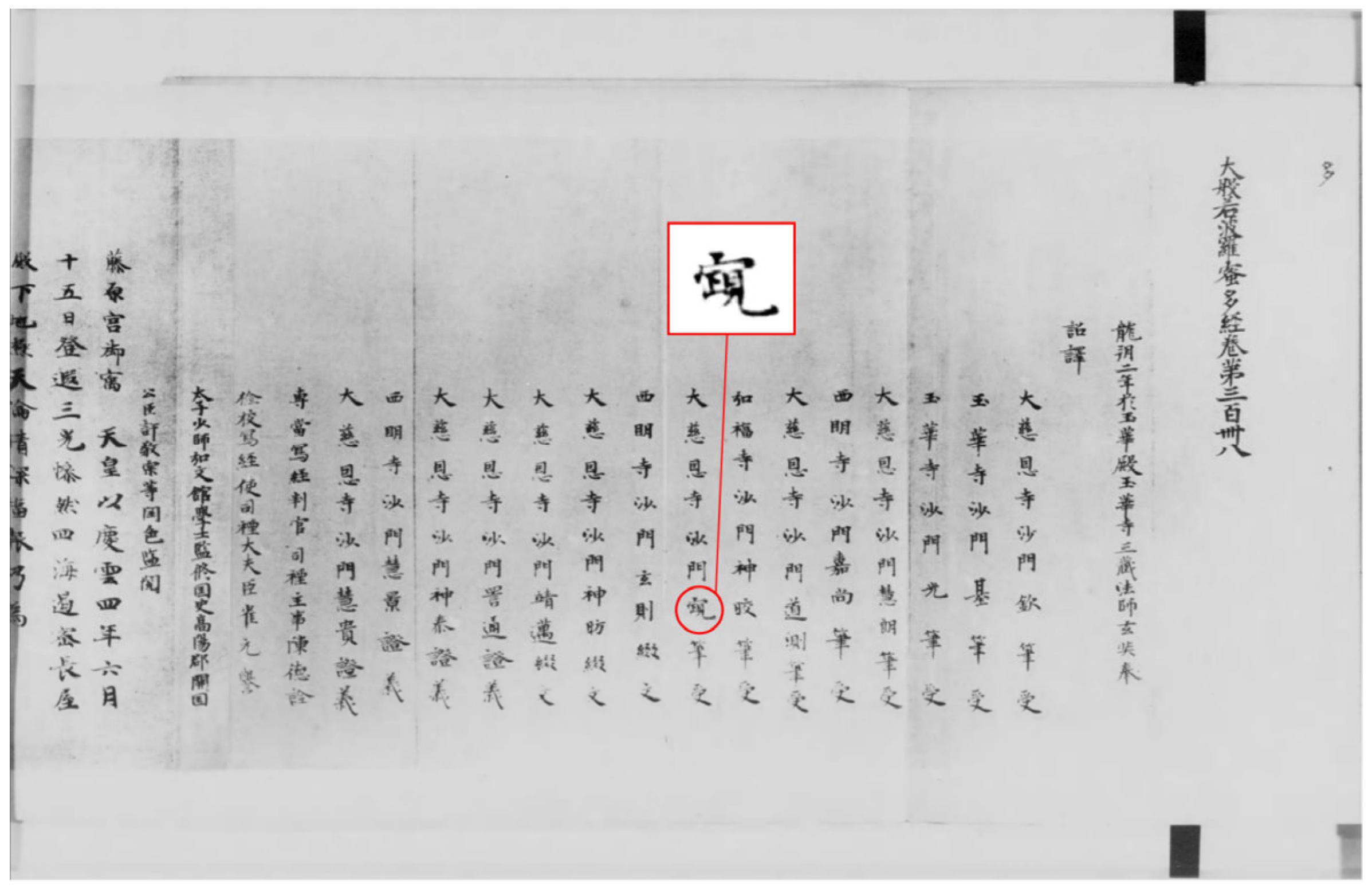
The list of translation participants (yichang liewei 譯場列位) in the manuscripts of Mahāprajñāpāramitā Sūtra is no exception. Ikeda On 池田温 separately recorded colophons at the end of Fasc. 232 and 348 of the Mahāprajñāpāramitā Sūtra, in both of which the translation participants are identical. In these lists, eight monks served as the bishou 筆受 (scribes): Śramaṇa Qin from Great Ci’en Monastery 大慈恩寺沙門欽, Śramaṇa Ji from Yuhua Monastery 玉華寺沙門基, Śramaṇa Guang from Yuhua Monastery 玉華寺沙門光, Śramaṇa Huilang from Great Ci’en Monastery 大慈恩寺沙門慧朗, Śramaṇa Jiashang from Ximing Monastery 西明寺沙門嘉尚, Śramaṇa Daoce (or Daoze) from Great Ci’en Monastery 大慈恩寺沙門道測/則, Śramaṇa Shenjiao from Hongfu Monastery 弘福寺沙門神皎 and Śramaṇa Kui from Great Ci’en Monastery 大慈恩寺沙門窺 (Ikeda 1990, pp. 204–05). Fasc. 348 of the Mahāprajñāpāramitā Sūtra was transcribed in the fifth year of the Wadō 和銅 era (712 CE). According to the image of this manuscript published in Honpō koshakyō 本邦古写経 [Ancient Buddhist Manuscripts in Japan], the so-called character “Kui 窺” is actually written as “Religions 16 01548 i002” (i.e., “Cheng 竀”) (Figure 1). Master Cheng and Master Ji are listed separately, indicating that “Chengji 竀基” refers to two of Xuanzang’s disciples rather than a single individual.
In addition, the name “Chengji 乘基” in some texts may also be interpreted in this context. Zanning once suggested that “Chengji 乘基” resulted from the omission of the character “Da 大” in “Dacheng Ji 大乘基”. Alternatively, the appearance of “Chengji 竀基” offers another theoretical possibility for the origin of the name “Chengji 乘基”, which could have arisen from a combination of phonetic similarity and associative reinterpretation between “Chengji 竀基” and “Chengji 乘基”.

6. Conclusions

Master Cheng 竀, alongside other masters with single-character names like Guang 光, Qin 欽, and Ji 基, was undoubtedly a direct disciple of Xuanzang, but he was probably not granted the honorific title “Dacheng 大乘” as he followed Xuanzang at a relatively late stage. During the Longshuo era (661–663 CE), he, affiliated with Great Ci’en Monastery 大慈恩寺, served as a scribe in the translation workshop at Yuhua Monastery. He was explicitly involved in the submission of the memorial requesting the imperial preface to the Mahāprajñāpāramitā Sūtra and probably also took part in presenting Xuanzang’s final memorial. This suggests that he was not only a core member of Xuanzang’s late translation team, but also very likely one of the close and capable assistants who attended to Xuanzang in his final days. However, following Xuanzang’s passing in the first year of the Linde era (664 CE) and the subsequent dissolution of the translation workshop, Master Cheng disappeared from the historical records. Early sources that preserved the memory of Xuanzang’s disciples, such as the Datang gu sanzang xuanzang fashi xingzhuang 大唐故三藏玄奘法師行狀, Datang daci’ensi sanzang fashi zhuan 大唐大慈恩寺三藏法師傳, and □□si shamen xuanzang shangbiao ji □□寺沙門玄奘上表記, retained traces of Master Cheng’s deeds only through their accounts of Xuanzang instructing him to submit memorials. Yet, because the character “Cheng 竀” was obscure, it was gradually misidentified in textual transmission as the graphically similar and more common character “Kui 窺”. Later readers, lacking a clear understanding of the actual religious names of Xuanzang’s disciples, attached this character to the name of Master Ji 基, thereby reconstructing it into the supposed name of Master Ci’en as “Kuiji 窺基” or “(Da)chengji (大)乘基”. Thus, Master Cheng was ultimately forgotten as an individual, yet his name, albeit erroneously embedded within “Kuiji”, was paradoxically preserved and transmitted until today.
The implications of this discovery are significant and multifaceted.
This finding compels a re-examination of the composition among Xuanzang’s disciples. It reveals that, beyond the well-known masters who bore the honorific title “Dacheng”, there were other important late-coming disciples such as Master Cheng, who, although not granted this title, were deeply involved in core activities. This provides new evidence for understanding the personnel structure and operational details of Xuanzang’s later translation workshop (especially the Yuhua Monastery period), thereby enriching and refining our understanding of Buddhist translation practices in the Tang Dynasty.
The figure of Master Ci’en (Master Ji, or Dacheng Ji), as the de facto founder of the Chinese Yogācāra School, occupies an indispensable position in Chinese Buddhist history. Disentangling “Cheng” from “Kuiji” not only restores the historical fact that Master Ci’en’s name was “Ji” or “Dacheng Ji,” thereby clarifying a long-standing nominal confusion, but, more importantly, it reveals that on the eve of the school’s formation, the community surrounding Xuanzang was more diverse and collaborative.
This research also demonstrates the effectiveness of combining textual criticism, manuscript evidence, and historical contextual analysis in addressing complex issues in medieval Buddhist history. It reminds us that, even for figures and terms that appear well established, a cautious and critical attitude is still necessary. Particular attention must be given to the frequent replacement of rare characters with common ones in textual transmission and the potential distortion of historical narratives that may result.
Finally, this research brings back to light a key figure—Master Cheng—whose identity has been obscured by the dust of history for over a millennium. He is no longer merely an erroneous component of another’s name, but a real and vital Buddhist monk who studied directly under Master Xuanzang and contributed substantively to his monumental enterprise. Restoring his independent identity is both an act of respect for history and a tribute to every individual who exerted effort in the transmission of culture. The figure of Master Cheng thus emerges from the shadow of “Kuiji”, and rightfully claims his own place within the landscape of Buddhist history in the Tang Dynasty.

Funding

This research received no external funding.

Institutional Review Board Statement

Not applicable.

Informed Consent Statement

Not applicable.

Data Availability Statement

Data is contained within the paper.

Conflicts of Interest

The author declares no conflicts of interest.

Abbreviations

TTaishō shinshū daizōkyō 大正新脩大蔵経. Ed. Takakusu Junjirō 高楠順次郎 and Watanabe Kaigyoku 渡辺海旭. 100 vols. Tōkyō: Taishō Issaikyō Kankōkai 大正一切経刊行会, 1924–1932.
XManji Shinsan Dainihon Zokuzōkyō 卍新纂大日本續藏經. 90 vols. Ed. Kawamura Kōshō 河村孝照. Tōkyō: Kokusho Kankōkai 国書刊行会, 1975–1989.

Notes

1
X no. 1651, vol. 88, pp. 381c9–2b8.
2
X no. 1651, vol. 88, p. 381a16–c6.
3
The article first appeared in Dongfang zaobao-Shanghai shuping 東方早報·上海書評 [Shanghai Review of Books] (He 2015), and then an English version was published (He 2017).
4
京大慈恩寺大乘沙門□疏主大師,姓蔚遲,諱窺,字洪道 (Jion daishi gyoei shūei 慈恩大師御影聚英, pp. 133, 213–14). But the character “Kui 窺” has been revised to “Ji 基” in the version of this work preserved in Genjō sanzō shishiden sōsho 玄奘三藏師資傳叢書 [Compendium of Biographies and Materials Related to Tripiṭaka Master Xuanzang and his Disciples]. Edited by Saeki Jōin 佐伯定胤 and Nakano Tatsue 中野達慧. X no. 1651, vol. 88, p. 382b11–12.
5
□□si shamen xuanzang shangbiao ji □□寺沙門玄奘上表記 [Record of the Memorial Presented by Śramaṇa Xuanzang of □□ Monastery]. T no. 2119, vol. 52, p. 826b17–c11.
6
This is because the personal name of Emperor Xuanzong of the Tang dynasty, Li Longji 李隆基, contains the character “Ji 基”.
7
“Linwang xie si biao 臨亡謝寺表” refers to Xuanzang’s final memorial, which was probably not the actual title of the document but rather a general statement. In X, the character “Wang 亡” appears as “Si 巳”, but “Lin si 臨巳” does not seem to make sense. In the manuscript of Jingshui chao 鏡水抄, the character more closely resembles “Wang 亡”, which would make sense as “dying” (Jion daishi gyoei shūei 慈恩大師御影聚英, p. 136). “Xie biao 謝表” (memorials of gratitude to the emperor), together with “Qing biao 請表” (memorials of petition to the emperor), were the two most common types of memorials presented by Xuanzang. Although the specific content of Xuanzang’s final memorial remains unknown, “Linwang xie si biao 臨亡謝寺表” suggests that Xuanzang’s final memorial possibly conveyed gratitude to the emperor before his passing. The phrase “Xie si biao 謝寺表” likely contains scribal errors or missing characters.
8
Fahua jing xuanzan yaoji. X no. 638, vol. 34, p. 178a20–b2.
9
Song gaoseng zhuan. T no. 2061, vol. 50, p. 726b18–26.
10
□□si shamen xuanzang shangbiao ji. T no. 2119, Vol. 52, p. 826c7–10.
11
□□si shamen xuanzang shangbiao ji. T no. 2119, Vol. 52, p. 823b12–13, c11–12.
12
Kaiyuan shijiao lu. T no. 2154, vol. 55, pp. 555b28–7b12.
13
三藏法師有親教弟子,俗姓尉遲,本名洪道……法師美其神雋,更字曰大乘基……法師本號洪道,後貞觀皇大乘基字賜此法師 (Jion daishi gyoei shūei 慈恩大師御影聚英, p. 134).
14
Datang gu sanzang xuanzang fashi xingzhuang. T no. 2052, vol. 50.
15
Xu gaoseng zhuan. T no. 2060, vol. 50.
16
Datang daci’ensi sanzang fashi zhuan. T no. 2053, vol. 50.
17
以貞觀十九年春正月二十五日,還至長安……法師還國已來,于今二十載。 Datang gu sanzang xuanzang fashi xingzhuang. T no. 2052, vol. 50, p. 220a25–b11.
18
時經六十日,頭髮漸生,顏色如常。 Datang gu sanzang xuanzang fashi xingzhuang. T no. 2052, vol. 50, p. 219c20–21.
19
至五日中夜, 弟子問曰: 和上定生彌勒前不?答曰: 決定得生。言已氣絕。迄今兩月,色貌如常。 Xu gaoseng zhuan. T no. 2060, vol. 50, p. 458b1–3.
20
Datang daci’ensi sanzang fashi zhuan. T no. 2053, vol. 50. p. 277b10–c18.
21
又有冥應略故不述。 Xu gaoseng zhuan. T no. 2060, vol. 50, p. 458b3–4.
22
又奉勅旨:故僧玄奘葬日,宜遣京城僧尼造幢,送至墓所。冥祥預表,其事寔繁,不備列。 Datang daci’ensi sanzang fashi zhuan. T no. 2053, vol. 50, pp. 219c28–20a1.
23
Eichō noted “Biography of the Tripiṭaka Master of Ci’en, One Fascicle, by Monk Yixiang 慈恩三藏行狀一卷(釋宜祥撰)” in the Tōiki dentō mokuroku 東域傳燈目錄 [Record of the Transmission of the Lamp to the Eastern Regions] in 1094 CE. The character “Yi宜” might be a scribal error for “Ming冥”. T no. 2183, vol. 55, p. 1163b17.
24
Kenhō obtained this text in 1391 CE and inscribed “authored by Mingxiang 冥祥撰云云” at the end. Datang daci’ensi sanzang fashi zhuan. T no. 2053, vol. 50, p. 220b25–26.
25
《傳》本五卷。 Datang daci’ensi sanzang fashi zhuan. T no. 2053, vol. 50, p. 221a27.
26
According to the colophon of the Dunhuang manuscript “北0690” of the Diamond Sūtra 金剛般若波羅蜜經 (transcribed by Liu Honggui 劉弘珪 on the fifteenth day of the eleventh month in the first year of the Yifeng 儀鳳 era) in the National Library of China, Huili participated in the collation of the Diamond Sūtra at Taiyuan Monastery 太原寺 in 676 CE.
27
Datang daci’ensi sanzang fashi zhuan. T no. 2053, vol. 50, p. 221a27–29.
28
Ji gujin fodao lunheng 集古今佛道論衡 [Collection of Past and Present Discussions between Buddhism and Daoism]. T no. 2104, vol. 52, p. 389c17–19.
29
It is noteworthy that in the records of Xuanzang’s final years at Yuhua Monastery in Text C, only Master Jiashang 嘉尚 (c. 7th century) among his disciples is mentioned twice. The first instance concerns a dream regarding the miraculous power of the Mahāprajñāpāramitā Sūtra, and the second describes Xuanzang instructing Master Jiashang to compile a detailed list of the translated sutras and treatises and to read it out to the assembly. (Datang daci’ensi sanzang fashi zhuan. T no. 2053, vol. 50, pp. 276a21–7a7.) Jiashang and Huili both resided at Ximing Monastery as early as 656 CE (see the colophon of the manuscript Abhidharma Mahāvibhāṣā Śāstra, T no. 1545, vol. 27, pp. 4c19–5b1. In the inscription, “Śramaṇa Jiashang of Hongfa Monastery 弘法寺沙門嘉尚” appears to be listed separately in the first column as the bishou (scribe), while other scribes are recorded consecutively in the following columns, suggesting a possible transcription error in the first column). Later, they also collaborated on the collation of Buddhist scriptures at Taiyuan Monastery (see the inscription of the Dunhuang manuscript “北0690” of the Diamond Sūtra in the National Library of China). In view of their close relationship, Jiashang was most probably the one who provided Huili with first-hand materials concerning Xuanzang’s experience at Yuhua Palace during the final years of his life in the Xianqing period.
30
錯綜本文,箋(分)為十卷。 Datang daci’ensi sanzang fashi zhuan. T no. 2053, vol. 50, p. 221b13.
31
Datang gu sanzang xuanzang fashi xingzhuang. T no. 2052, vol. 50, pp. 219a3–6, 219c4–7.
32
Xu gaoseng zhuan. T no. 2060, vol. 50, pp. 458a5–6, 458a24–26.
33
There are currently two complete English translations of Text C (Li 1995, pp. 330, 332–33; X. Wang 2024, pp. 569, 572–73).
34
Datang daci’ensi sanzang fashi zhuan. T no. 2053, vol. 50, pp. 276b21–23, 277a9–16.
35
法師病時,撿挍翻經使人許玄備,以其年二月三日奏云:”法師因損足得病。”至其月七日,勅中御府宜遣醫人將藥往看。所司即差供奉醫人張德志、程桃捧將藥急赴。比至,法師已終,醫藥不及。 Datang daci’ensi sanzang fashi zhuan. T no. 2053, vol. 50, p. 277c18–23.
36
Kaiyuan lu. T no. 2154, vol. 55, pp. 560c10–1a9.
37
竀基(上,丑生反。《蒼頡篇》”窺”也。《說文》:正視也,從穴正見,正亦聲也)。 Yiqiejing yinyi. T no. 2128, vol. 54, p. 849b18.

References

  1. Primary Sources

    □□si shamen xuanzang shangbiao ji □□寺沙門玄奘上表記 [Record of the Memorial Presented by Śramaṇa Xuanzang of □□ Monastery]. T no. 2119, vol. 52.
    Datang daci’ensi sanzang fashi zhuan 大唐大慈恩寺三藏法師傳 [The Biography of the Tripiṭaka Master of the Great Ci’en Monastery of the Great Tang Dynasty]. By Huili 慧立 (615–676?) and Yancong 彥悰 (c. 7th century). T no. 2053, vol. 50.
    Datang gu sanzang xuanzang fashi xingzhuang 大唐故三藏玄奘法師行狀 [The Biography of the Late Tripiṭaka Master Xuanzang of the Great Tang Dynasty]. By Mingxiang 冥詳 (n.d.). T no. 2052, vol. 50.
    Fahuajing xuanzan yaoji 法華經玄贊要集 [Essential Collection of the Profound Panegyric to the Lotus Sūtra]. Compiled by Qifu 栖復 (c. 9th century). X no. 638, vol. 34.
    Ji gujin fodao lunheng 集古今佛道論衡 [Collection of Past and Present Discussions between Buddhism and Daoism]. Compiled by Daoxuan 道宣 (596–667). T no. 2104, vol. 52.
    Kaiyuan shijiao lu (Kaiyuan lu) 開元釋教錄 [Catalogue of Buddhist Texts Made during the Kaiyuan era (713–741)]. Compiled by Zhisheng 智昇 (c. 8th century). T no. 2154, vol. 55.
    Song gaoseng zhuan 宋高僧傳 [Biographies of Eminent Monks compiled during the Song dynasty]. Compiled by Zanning 贊寧 (919–1001). T no. 2061, vol. 50.
    Xu gaoseng zhuan 續高僧傳. Compiled by Daoxuan 道宣 (596–667). T no. 2060, vol. 50.
    Yiqiejing yinyi 一切經音義 [Pronunciation and Meaning in the Complete Buddhist Canon]. Compiled by Huilin 慧琳 (737–820). T no. 2128, vol. 54.
    Daci’ensi sanzang fashi zhuan 大慈恩寺三藏法師傳. Edited by Sun Yutang 孫毓棠 and Xie Fang 謝方. Beijing: Zhonghua shuju 中華書局, 2000.
    Daitō Daijionji Sanzō Hōshi den 大唐大慈恩寺三蔵法師傳. By Huili 慧立 and Yancong 彥悰, collated by Utsunomiya kiyoyoshi 宇都宮清吉. Kyōto: Tōhō Bunka Gakuin Kyōto Kenkyūjo 東方文化學院京都研究所, 1932.
    Genjō sanzō shishiden sōsho 玄奘三藏師資傳叢書 [Compendium of Biographies and Materials Related to Tripiṭaka Master Xuanzang and his Disciples]. Edited by Saeki Jōin 佐伯定胤 and Nakano Tatsue 中野達慧. X no. 1651, vol. 88.
    Honpō koshakyō本邦古写経 [Ancient Buddhist Manuscripts in Japan]. Edited by Tōkyō Daizōkai 東京大蔵会. Tōkyō: Heigo Shuppansha 丙午出版社, 1917. https://dl.ndl.go.jp/pid/965985/1/8 (accessed on 13 May 2025).
    Jion daishi gyoei shūei 慈恩大師御影聚英 [A Collection of Portraits of Great Master Jion]. Edited by Kōfukuji Yakushiji Jion Daishi Miei Shūei Kankōkai 興福寺・薬師寺慈恩大師御影聚英刊行会. Kyōto: Hōzōkan法蔵館, 1982.
    Kaiyuan shijiao lu 開元釋教錄. By Zhisheng 智昇, annotated by Fu Shiping 富世平. Beijing: Zhonghua shuju. 2018.
    Yakujō Retsui 訳場列位 [List of the Participants in the Translation Workshop]. Edited by Yōro Tetsujō 養鸕徹定, 1863.
  2. Secondary Sources

  3. He, Huanhuan 何歡歡. 2015. Shishei nongcuole “Kuiji” de mingzi 是誰弄錯了”窺基”的名字 [Who got the name “Kuiji” wrong?]. Dongfang zaobao-Shanghai shuping 東方早報·上海書評 [Shanghai Review of Books], December 20. [Google Scholar]
  4. He, Huanhuan 何歡歡. 2017. Whence Came the Name ‘Kuiji’ Instead of Just ‘Ji’? The Eastern Buddhist 48: 51–67. [Google Scholar]
  5. He, Huanhuan 何歡歡. 2020. Buyi buyi 不一不异 [Neither the same nor Different]. Beijing: Shenghuo, dushu, xinzhi sanlian shudian 生活·讀書·新知三聯書店. [Google Scholar]
  6. Ikeda, On 池田温, ed. 1990. Chūgoku kodai shahon shikigo shūroku 中國古代寫本識語集錄 [A Collection of Colophons in Ancient Chinese Manuscripts]. Tokyo: Institute for Advanced Studies on Asia, The University of Tokyo. [Google Scholar]
  7. Li, Rongxi 李榮熙. 1995. A Biography of the Tripiṭaka Master of the Great Ci’en Monastery of the Great Tang Dynasty. Berkeley: Numata Center for Buddhist Translation and Research. [Google Scholar]
  8. Liang, Jing 梁靜. 2015. Chutu cangjie pian yanjiu 出土《蒼頡篇》研究 [A Study of the Excavated Cangjie pian]. Beijing: Kexue chubanshe 科學出版社. [Google Scholar]
  9. Liu, Huan 劉桓. 2019. Xinjian handu cangjie pian shi pian jiaoshi 新見漢牘《蒼頡篇》《史篇》校釋 [Collation and Interpretation of Newly Discovered Han Wooden Slip Versions of the Cangjie Pian and Shi Pian]. Beijing: Zhonghua shuju. [Google Scholar]
  10. Liu, Shufen 劉淑芬. 2009. Xuanzang de zuihou shinian, jianlun zongzhang er nian gaizang shi 玄奘的最後十年 (655–664)——兼論總章二年(669)改葬事 [The Last Ten Years of Xuanzang’s Life (655–664)—With a Discussion of His Reburial in 669]. Zhonghua wenshi luncong 中華文史論叢 [Journal of Chinese Literature and History] 3: 1–97. [Google Scholar]
  11. Liu, Shufen 劉淑芬. 2024. Xuanzang, Kuiji yu xiyu tongzi 玄奘、窺基與西域童子 [Xuanzang, Kuiji and the Lad from the Western Regions]. Zhonghua wenshi luncong 中華文史論叢 [Journal of Chinese Literature and History] 3: 141–98. [Google Scholar]
  12. Lü, Cheng 吕澂. 1979. Zhongguo foxue yuanliu lüejiang 中國佛學源流略講 [A Brief Account of the Origins and Development of Chinese Buddhist Studies]. Beijing: Zhonghua shuju. [Google Scholar]
  13. Saeki, Ryōken 佐伯良謙. 1925. Jion Daishi den 慈恩大師傳 [Biography of Master Jion]. Kyōto: Yamashiroya Fujii Sahee 山城屋藤井佐兵衛. [Google Scholar]
  14. Saitō, Tatsuya 斉藤達也. 2014. Kongōji bon Zoku kōsō den no kōsatsu: Maki yon Genjōden wo chūshin ni 金剛寺本『續高僧傳』の考察:卷四玄奘傳を中心に [A Study on the Kongōji version of the Further Biographies of Eminent Monks: Focusing on the biography of Xuanzang in the fourth fascicle]. Nihon koshakyō zenpon sōkan 日本古写経善本叢刊 [Journal of the Research Institute for Old Japanese Manuscripts of Buddhist Scriptures] 8: 246–66. [Google Scholar]
  15. Tang, Yongtong 湯用彤. 2010. Suitang fojiaoshi gao 隋唐佛教史稿 [A Draft History of Buddhism in the Sui-Tang Dynasty]. Beijing: Beijing daxue chubanshe 北京大學出版社. [Google Scholar]
  16. Utsunomiya, Kiyoyoshi 宇都宮清吉. 1932. Daitō Daijionji Sanzō Hōshi den Koi 大唐大慈恩寺三蔵法師傳考異 [A Study on the Biography of the Tripiṭaka Dharma Master of the Great Ci’en Monastery of the Great Tang Dynasty]. Kyōto: Tōhō Bunka Gakuin Kyōto Kenkyūjo 東方文化學院京都研究所. [Google Scholar]
  17. Wang, Bangwei 王邦維. 2022. Daoxuan zhuanxie de Xuanzang zhuan 道宣撰寫的《玄奘傳》 [The Biography of Xuanzang Written by Daoxuan]. Hualin guoji foxue xuekan 華林國際佛學學刊 [Hualin International Journal of Buddhist Studies] 5: 94–118. [Google Scholar]
  18. Wang, Xin 王欣. 2024. Datang daci’ensi sanzang fashi zhuan hanying duizhao 大唐大慈恩寺三藏法師傳(漢英對照) [A Biography of the Tripiṭaka Dharma Master of the Great Ci’en Monastery of the Great Tang Dynasty]. Xi’an: Shaanxi Normal University Press 陝西師範大學出版社. [Google Scholar]
  19. Watanabe, Takao 渡辺隆生. 1982. Jion Daishi no denki shiryō to kyōgaku shi teki gaiyō 慈恩大師の伝記資料と教学史的概要 [Biographical Materials and Outline of the History of Great Master Jion’s Thought]. In Jion daishi gyoei shūei 慈恩大師御影聚英 [A Collection of Portraits of Great Master Jion]. Edited by Kōfukuji Yakushiji Jion Daishi Miei Shūei Kankōkai 興福寺・薬師寺慈恩大師御影聚英刊行会. Kyōto: Hōzōkan 法蔵館, pp. 194–208. [Google Scholar]
  20. Weinstein, Stanley. 1959. A Biographical Study of Tz’ŭ-ên. Monumenta Nipponica 15: 119–49. [Google Scholar] [CrossRef]
  21. Xu, Tiancheng 許天成. 2021. Kuiji Xingming bian ‘窺基’姓名辨 [A Study on the Name of Kuiji]. Fayin 法音 [The Voice of Dharma] 6: 38–41. [Google Scholar]
  22. Yang, Tingfu 楊廷福. 1988. Xuanzang Nianpu 玄奘年譜 [A Chronological Biography of Xuanzang]. Beijing: Zhonghua shuju. [Google Scholar]
  23. Yang, Zurong 楊祖榮. 2024. Two topics on ‘Kuiji’: Origin of the name and bibliographical writings. Studies in Chinese Religions 10: 538–57. [Google Scholar] [CrossRef]
  24. Yinshun 印順. 1992. Fojiao shidi kaolun 佛教史地考論 [Studies on Buddhist History and Geography]. Taipei: Zhengwen Publishing House 正聞出版社. [Google Scholar]
Figure 1. Fasc. 348 of the Mahāprajñāpāramitā Sūtra, transcribed in the fifth year of the Wadō 和銅 era by Prince Nagaya 長屋王 (684–729 CE); https://dl.ndl.go.jp/pid/965985/1/8 (accessed on 13 May 2025).
Religions 16 01548 g001
Disclaimer/Publisher’s Note: The statements, opinions and data contained in all publications are solely those of the individual author(s) and contributor(s) and not of MDPI and/or the editor(s). MDPI and/or the editor(s) disclaim responsibility for any injury to people or property resulting from any ideas, methods, instructions or products referred to in the content.