3.1. “Disenchantment”: The Point of Departure of “Rebirth of the Goddesses” and the Origin of Its Predicament
Guo’s gaze fixes upon the “primordial energies” stored in archaic myth—the powers of nature, the vitality of life, the might of creation, extraordinary imagination, and the archaic/simple. In so doing he overturns the “culture of official historian” and its writing paradigm that eternalizes “human relations” (ritual-ethical bonds and the jostling of power) as the sole theme.
Beginning in 1915, the May Fourth New Culture movement—taking
New Youth (Xin qingnian 新青年) magazine as its principal platform—raised the twin banners of “Mr. Democracy” and “Mr. Science.” Its core demand lay in a thorough repudiation of feudalism and its ideological foundations. The movement called for overturning the old literature and the old moral order, championed the vernacular and a new literature, and sought to propel deep intellectual emancipation and social transformation (
D. Chen 1915). In the eyes of May Fourth intellectuals, traditional society—whose very skeleton was the “culture of official historian”—rested on strata of historiographical “enchantment”: sacralized narratives of the past ossified into moral-ritual codes, habits of thought, and social order, and were taken to be the roots of China’s moribund condition and impediments to modernization. Accordingly, the substance of “anti-feudalism” was the resistance to historical enchantment. The core of the May Fourth spirit lay precisely in such an awakening and vehement contestation. This intellectual current stands in diametric opposition to “enchantment,” manifesting instead as its inverse—what Max Weber termed “disenchantment” (Entzauberung). It refers to the rationalizing process that strips the world of its mystery. Weber elaborated it as the characteristics of modern society: “Our age is characterized by rationalization and intellectualization, and above all, by the disenchantment of the world” (
Weber 2004, p. 30).
Amid this historical torrent of disenchantment, mythic resources were invested with a special mandate. Lu Xun undertook vernacular myth-rewriting of the tale of Chang’e and Houyi; Mao Dun drew on Western mythology to fashion a Chinese genealogy. Such endeavors sought to mobilize myth to overturn the historical “enchantment,” to forge a new citizenry, and to steer the nation toward modernity. Guo Moruo emerged as both the wave-rider and the exemplary figure of this current. In 1919, though residing in Japan, he threw himself into patriotic activism (e.g., organizing the Summer Society 夏社, mobilizing and uniting patriotic Chinese expatriates in Japan) and, with volcanic ardor, composed
The Goddesses, thereby pioneering Chinese free-verse poetry. Marked by unrestrained self-consciousness, Romantic fervor, and a thoroughgoing revolt, his work became the most forceful poetic emblem of the May Fourth ethos of disenchantment (
Wei 2019). As Wen Yiduo incisively observed,
The Goddesses embodies the spirits of twentieth-century China as “dynamic,” “rebellious,” “scientific,” “worldly,” and “struggling to shake itself awake amid despair and despondency” (
Wen 1923). The stance and essence of “Rebirth of the Goddesses” grow from this soil.
The May Fourth generation’s near-unanimous turn to archaic myth followed a clear logic: myths born at civilization’s first light were regarded as a primordial lode unsullied by the historical accretions of enchantment. They furnished not only a starting point for overturning the palimpsest of later, layer-upon-layer enchanted writing and for restoring the sources to clarity, but also harbored an untamed vitality and creative puissance not yet constructed or confined—the detonative potential urgently required by a struggle of disenchantment.
The discussion that follows focuses on “Rebirth of the Goddesses”, analyzing how Guo Moruo excavates and deploys this mythic force, and the intrinsic tensions embedded in his very practice of disenchantment. The mythic materials Guo employs for the play are chiefly the following, which he lists in detail in the Postscript to the original verse drama: Material for the play has been taken from the following sources:
Liezi (列子), an ancient Taoist philosophical work: “… heaven and earth are also material things, and things are subject to deficiencies. hence in ancient times the goddess Nüwa forged five-coloured rocks to fill in the cracks, and broke off the turtle’s feet and set them up as the four pillars of the sky. thereafter, when Gonggong struggled with Zhuanxu for kingship, in his fury he threw himself against Buzhou mountain. he snapped this pillar of heaven and upset the balance of the four-cornered earth. as a result, the sky tilted down at the northwest corner, so that the sun, the moon and the stars now move in that direction. the earth being inclined in the southeast, all watercourses drain away thither.”
Explaining Graphs and Analyzing Characters (Shuowen Jiezi 说文解字): “Nüwa was an ancient goddess, who shaped the ten thousand things… she first invented the pipes and flute.”
Classic of Mountains and Seas: “To the north, the Buzhou mountain faces Zhupi mountain, and Yuehchong mountain is not far away; to the east it faces the salt marsh of You, which is where the yellow river disappears underground after leaving its turbid, seething source. here there are delicious fruits (Jiaguo 嘉果) which are like peaches; the leaves are like those of the jujube tree and the flowers are yellow with a red calyx. these fruits can refresh one when one is fatigued.” (
Guo [1921] 2001, pp. 26–29)
An analysis of his adaptive intention reveals his effort at disenchantment:
- —
To draw upon the powers of nature and to resist the centrality of “human relations”:
Guo Moruo seeks to draw from myth-rewriting a force native to nature. The two prototypical myths he reworks—“Nüwa Mending the Sky” and “Gonggong Striking the Mountain”—are, at bottom, a catastrophe myth and an etiological myth (one that explains natural phenomena). The former likely emerged from memories of, and resistance to, disasters such as earthquakes, floods, or meteor showers; the latter accounts for the world’s asymmetries—heaven tilting to the northwest and earth sinking to the southeast—observed in China (situated in the Northern Hemisphere, where the celestial axis appears to incline northward; the sun, moon, and stars seem to turn from the southeast toward the northwest and set below the northwestern horizon; topographically, China rises in the northwest and falls toward the southeastern seas, with rivers running seaward).
Rejecting the perennial point of departure in traditional Chinese historiography—its fixation on “man-to-man” relations (contests of influence and cycles of power)—Guo returns directly to the question of the human–nature relation. This very reorientation constitutes a resistance to a tradition centered on “renlun” (人伦 human relational ethics) and its accumulated cultural weight, and it opens the possibility of overturning that tradition’s “enchantment.” For instance, in Guo’s verse, the collapse of heaven and earth is not merely a backdrop for power struggles but a vivid, storm-like catastrophe (“The war-cries of the foe are like the fury of the breakers,”
Guo [1921] 2001, p. 19), emphasizing nature’s raw force over ethical bonds, thus concretizing disenchantment through poetic imagery.
- —
To seek the vitality of life and to resist the dead air of history:
Nüwa’s most deeply rooted image in Chinese culture is that of the “Mother Earth.” The Classic of Mountains and Seas, “Great Wilderness: West (dahuang xijing 大荒西经),” notes that “Nüwa’s intestines were transformed into deities”; the Shuowen jiezi glosses, “(Nü)wa: an ancient goddess, who shaped the ten thousand things”; and the Huainanzi, “Shuolin (说林),” records that “Nüwa therefore effected seventy transformations.” Taken together, these entries, from different vantage points, point to Nüwa as the begetter of all beings and the fons et origo of life, and to the primordial vital force of bringing forth “from nothing into being” that inheres in her figure.
In the eyes of Guo Moruo and the May Fourth generation, China’s protracted feudal order had exhausted this vitality, leaving the nation in a state of “dead air.” To return to Nüwa was to return to the source of generation itself, in search of the primordial motive power needed to overturn a feudal culture and champion a new one. Such an invocation and reanimation of primal life-energy constituted the most forceful resistance to the torpor of the national spirit induced by stratified historical “enchantment,” and in “Rebirth of the Goddesses” it is transmuted into surging affect and eruptive passion. This is evident in the goddesses’ choral invocation (“We desire to embrace all things,”
Guo [1921] 2001, p. 25), which pulses with Romantic vitality, contrasting the “dead” feudal world with life’s eruptive rebirth.
- —
To tap the might of creation and to meet the demands of the age:
The core of Nüwa’s divine essence lies in her creative power. In the myth of Nüwa creating humanity, this creativity is unquestionable. Even in the myth of Nüwa and the flood, the actions involved—mending the sky, establishing the poles, controlling the floods, slaying the black dragon, inventing musical instruments, and so on—are, at their core, acts of creation (
Yang 1997, pp. 68–71). This aligns with the universal theme found in world flood myths (e.g., the Greek myth of Deucalion and Pyrrha using stones to create humanity after the great flood; the Indian story of Manu gradually reconstructing human society after the great flood,, through seven survival Sages and their descendants; Southeast Asian myths of incestuous unions following a great flood to repopulate humanity). These myths all share the theme of breaking down the old to create a new world.
After the Opium War, China was plunged into crisis, and intellectuals sought various ways to save the nation. They looked to the West and Japan, experimenting with monarchic constitutionalism, republicanism, presidential systems, parliamentary systems, and other possible inspirations, all while facing the dilemma of how to “create” a path to modernization suitable for China. The cosmic creative power symbolized by Nüwa was precisely what Guo Moruo and the May Fourth generation sought—an energy to utterly destroy the old world, solidified by historical “enchantment,” and establish a new order. This draw on creative power was, at its core, a fundamental denial and transcendence of the old order upheld by the historical enchantment. Guo embodies this in the goddesses’ resolve (“I will go forth and create a new sun,”
Guo [1921] 2001, p. 9), shifting from mythic repair to radical invention, mirroring May Fourth demands for a “new China.”
- —
To rely on extraordinary imagination and to pursue thoroughgoing destruction:
For early peoples lacking scientific knowledge, mythic imagination was untrammeled and free-roaming. The scope of these myths is vast (often directly addressing the grandest questions of heaven, earth, and humanity), and their descriptions are uninhibited: a single individual (Gonggong) can strike a mountain and cause heaven and earth to collapse; the foot of a turtle can support the heavens; deities have the power to alter the very heavens and earth, with their forces reaching from the sky to the earth.
This powerful imagination and destructive force, transcending human will, is the very support Guo Moruo sought in his effort to utterly dismantle feudal tradition. Moreover, this imagination embodies the unique cosmology of the Chinese nation (such as the turtle supporting heaven and earth, the roundness of the sky and the square of the earth, the dualism of yin and yang, and the five elements), providing nourishment for Guo Moruo’s Romanticism (
J. Wang 2015). In the verse drama, this manifests in Gonggong’s furious call (“Crack this northern pillar of heaven!”
Guo [1921] 2001, p. 19), evoking cosmic destruction to symbolize feudal collapse, yet rationalized for modern revolutionary ends.
- —
To pursue the archaic and simple and to resist the accretions of history:
Owing to scarce writing materials and infrequent writing practices, ancient mythic records often deploy condensed language charged with profound meaning. For example, in the Liezi, the literature Guo cited in the Postscript part, a mere 90 characters encapsulate the rich narratives of Nüwa forging stones to mend the sky, severing the tortoise’s foot to prop up the pillars of heaven, Gonggong and Zhuanxu warring for dominance, and Gonggong’s head striking Mount Buzhou. The language is highly compact, and the narrative itself is remarkably succinct, often conveyed in a single sentence that captures the essence, cutting straight to the core without adding any additional events, embellishments, or descriptions. This reflects a primitive “simplicity and antiquity” in its style of writing.
Such simplicity is precisely the essence of the May Fourth generation’s pursuit of disenchantment—opposing the complexity and distortion brought about by the repetitive layers of historical writing (enchantment). Ancient myth, in its essence, represents the most simple and primal form of existence. To return to myth is, therefore, to engage in a process of subtraction for modern Chinese culture, directly resisting the intricate narratives and sacred veneer continuously accumulated during the historical process of enchantment. Guo achieves this through sparse, eruptive dialogue, such as the goddesses’ rejection (“New wine may not be contained in old skins,”
Guo [1921] 2001, p. 9), stripping historical layers for primal renewal.
3.2. “Using Enchantment”: The Tactical Appropriation of the Nüwa Myth and Its Paradoxes
What is particularly thought-provoking is that Guo Moruo’s disenchantment had to be honed on the very enchantment of history. Guo Moruo sought to utilize the Nüwa myth for creative purposes, aiming to “disenchant” it; yet, the Nüwa myth itself had long been ensnared in the domain of “enchantment.” Traversing time and space, it became the spiritual core of the Chinese nation; its image and significance have been repeatedly written, appropriated, and reconstructed across different eras and media. Understanding this process of enchantment is key to grasping the role of the Nüwa image in “Rebirth of the Goddesses” and the complexity of Guo Moruo’s engagement with both “disenchantment” and “enchantment.”
Tian Zhaoyuan argues that this historical-cultural “enchantment” is constituted by a triad of narrative mediums: the narrative of language (both oral and written), the narrative of ritual actions, and the narrative of material symbols (visual, spatial—both man-made and natural) (
Tian 2014). Similarly, Jan Assmann contends that culture is memory (
J. Assmann 2000, p. 169), and the transmission of memory relies on the dual mediation of material carriers and ritual practices. The former includes written texts and books, while the latter encompasses folklore and oral literature (
X.-b. Wang 2007). These frameworks provide us with a categorization and point of entry for studying the role of enchantment in history, and they are essential for understanding the cultural and ideological forces at play in Guo Moruo’s work.
3.2.1. The Enchanted Nüwa Myth: In Textual Canons and Ritual Materials
At the level of textual mediation, the millennia-long history of the enchantment of the Nüwa myth constitutes a cultural iron curtain woven from the layered construction of textual tradition and the lived practices of material folklore. The creation narrative in the pre-Qin period (before 221 BCE), the Classic of Mountains and Seas, “Nüwa’s intestines were transformed into ten deities,” established Nüwa’s sacred lineage as the source of all life. By the time of the Eastern Han dynasty (25–220 CE), Huainanzi, Lanming xun section, Nüwa’s heroic feats—such as forging the five-colored stones and severing the tortoise’s foot—were shaped into the ultimate paradigm of order reconstruction, marking the dawn of political metaphor. In the Shuowen Jiezi, Nüwa’s invention of the pipes and flute was celebrated as the origin of the ideal of “ritual and music” (liyüe 礼乐), becoming the orthodox worship of later generations.
When Comprehensive Discussion of Customs and Traditions (Fengsu Tongyi 风俗通义) incorporated class-based symbols into the myth of creation—associating “noble yellow earth” with the aristocracy and “humble clay people” with the common folk (“Originally Nüwa created human beings from yellow earth; when she was too tired to continue, she used a rope to pull them from the mud and shaped them into humans. Thus, the rich and noble are made of yellow earth, while the poor and common are made of clay”)—Nüwa’s divinity had already been entwined with the class structures of society. This layering of textual inscriptions reached its peak during the Tang dynasty (618–907 CE) and Song dynasties (960–1279 CE). In the Tang dynasty, Sima Zhen (司马贞)’s Supplement to the Records of the Three Sovereigns (Bu sanhuang benji 补三皇本纪), Nüwa was incorporated into the imperial genealogy, while in the Song dynasty, the Lushi, a pseudo-historical narrative was created in which “Nüwa governed the world” (Gonggong’s chaos led Nüwa to defeat him with divine power, restoring order to heaven and earth), thus completing the transfer of divine authority to imperial power (“Nüwa was established and called the Female Emperor”). Local gazetteers of the Ming dynasty (1386–1644) and Qing dynasties, such as Shexian County Gazetteer (Shexianzhi 涉县志) even fabricated tales of Nüwa “assisting Emperor Shennongs (神农) in conquering the whole China,” ultimately reducing the goddess to a mere pawn in the narrative of history.
The essence of textual enchantment lies precisely in the repeated engravings in authoritative texts, transforming Nüwa from a natural creator goddess into an ethical symbol, a political idol, and a historical entity, ultimately becoming a vessel for the discourse of power.
Parallel to the textual tradition is the belief system embodied in ritual objects, which form a “Great Wall of Faith” forged by flesh and blood. During the Tianchuan Festival (天穿节) on the 20th day of the first lunar month in northern China, peasant women bake pancakes thin and round like the sky itself. They then climb a ladder to place these pancakes on the roof, replicating the celestial mending act of Nüwa. In this way, the abstract narrative of the Huainanzi is transformed into a survival technique for averting disaster and seeking life.
In the Nüwa Temple of Tianshui (天水), Gansu Province (甘肃省), the “Nüwa Sacrifice” has continued for over a thousand years: altars are set up for offerings, sacred water is sprinkled for blessings, ceremonial rituals are held, the welcoming of divine birds occurs, offerings of three animals are made, and ritual dances are performed. Through these bodily practices, the divine grace of creation, as told in the Classic of Mountains and Seas, is repeatedly experienced and appreciated, causing the inked words of ancient texts to rise as collective memory amid rain and mist.
At the steep ladder of the Nüwa Temple in Shexian County (涉县), Hebei Province (河北省), pilgrims carrying the hopes of fertility begin their journey with the “sitting through the night” chanting as a prelude, followed by the physical climb of the “morning ascent” as a climax, culminating in the “tying the doll (拴娃娃)” ceremony, where red ropes are used to bind clay figurines. This ritual marks the flesh-and-blood contract of belief in the mother goddess. This bodily pilgrimage transforms the cold textual account of “shaping humans from clay” in the Fengsu Tongyi into a passionate prayer for life.
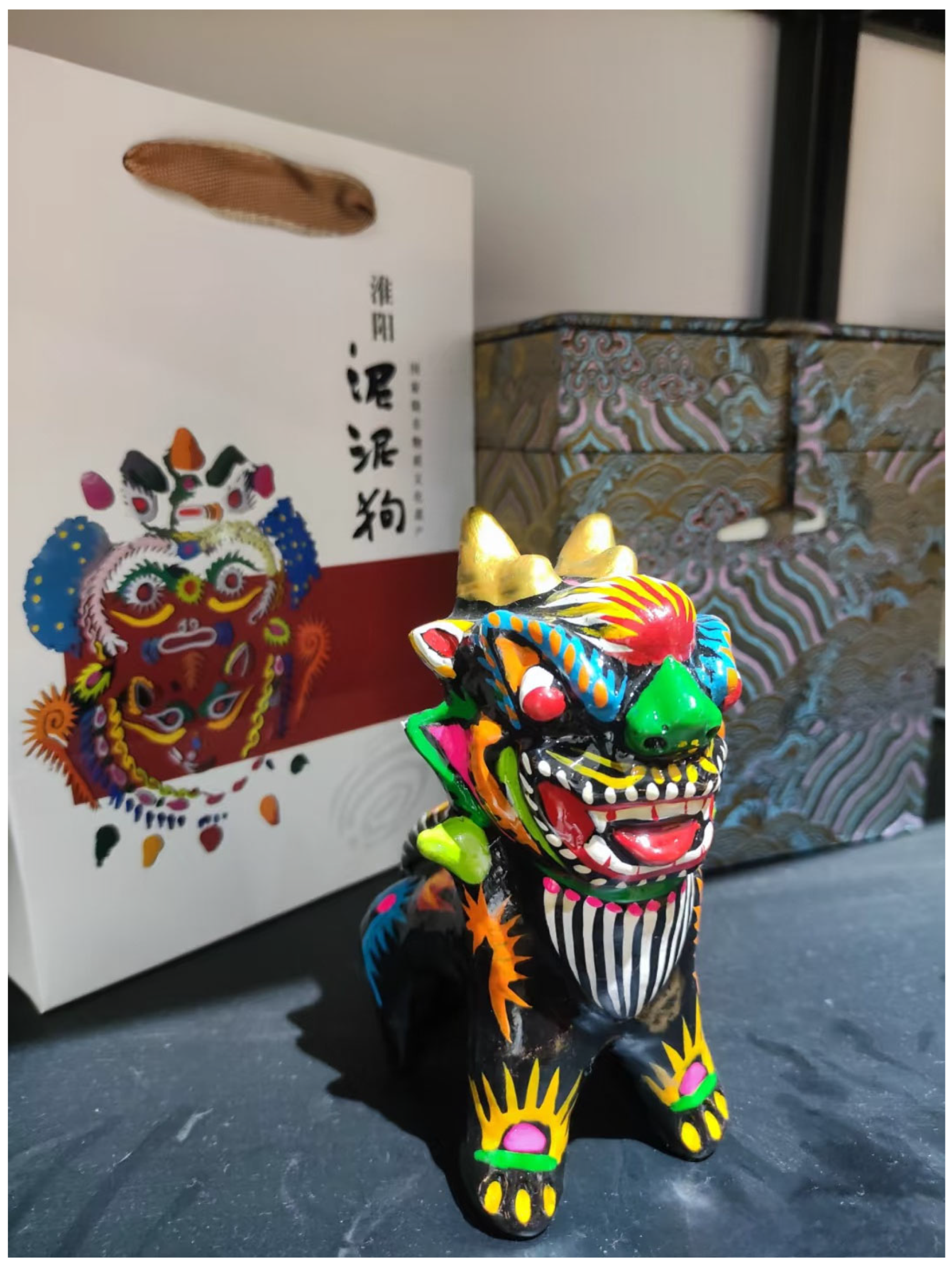
At the Huaiyang (淮阳) Temple Fair in Henan Province (河南省), the “mud dog (泥泥狗) (See
Figure 1),” originally guardian beasts before Nüwa’s tomb, are transformed into clay figurines of embryos, turning the goddess from the temple altar to the marketplace. Through playful handling, the belief becomes domesticated into daily life. The pottery itself becomes the “living fossil” of Nüwa’s creation of humanity, with the “mud dog” carrying a hole like a whistle. This turns the clay figure into the material embodiment of Nüwa as the music goddess who “first invented the pipes and flute” in the
Shuowen Jiezi. With each blowing of the whistle, the clay sculpture is imbued with “eternal life,” etching the mythic symbol into the generational memory of fertility.
Tian Zhaoyuan’s “text-ritual-symbol” three-dimensional symbiotic mechanism, or Assmann’s unified promotion of the “text-ritual” relationship, here manifests as a brutal dialectic of enchantment: the oil fragrance of the pancakes coats the narrative of Nüwa mending the sky from the Huainanzi with the urgency of survival; the breath of the pilgrims on the steep ladder of the Nüwa Temple breathes life into the imperial genealogy; the glaze of the mud dogs transforms historical writing into a tangible contract of fertility. When Guo Moruo directed the torch of enlightenment towards Nüwa, he was not cleaving a mere shadow, but rather the deeply rooted cultural flesh and bones found in the pancake’s burnt scent, the ladder’s wooden grain, and the clay figurine’s warmth—an enchanted living entity that stretches from the archives of literature to the stove and the bedroom. The blade of deconstructing myth falters here, for it cannot sever the living, sacred scripture written by the practices of countless people, bound to life itself.
3.2.2. Guo’s Use of Textual Enchantment
As illustrated above, the Nüwa myth has traversed time and space, becoming enchanted through various media such as texts and material folklore. In terms of textual application, Guo Moruo employed the myth in several ways.
Leveraging Public Symbol Consensus: Creating Subversive Tension Through Stable Frameworks
Guo Moruo profoundly utilized the Nüwa myth as a stable cultural symbol that transcended time and space, tapping into its inherent public and consensual nature. Nüwa represents a shared cultural gene of the Chinese nation; her core narratives (such as creating human beings and mending the sky) have been passed down for thousands of years, with countless appropriations and retellings. These narratives have already solidified into an “original narrative” framework, transcending regional, dynastic, and temporal boundaries. The “stability” of this narrative makes it a public symbol with strong referentiality and emotional resonance. Guo Moruo’s choice of Nüwa was precisely because of her “magical” power to instantly evoke collective memory and cultural identity across a broad audience, providing a minimal understanding threshold and an expansive base for revolutionary ideas.
This “utilization” is particularly effective within the specific historical context: since the late Qing, in the face of a profound national crisis, the Nüwa myth had already become an important resource for intellectuals to express national spirit and political ideas. Works like Nüwa’s Stone (Nüwashi 女娲石) (1904) by Haitian Duxiaozi (海天独啸子), The New Stone Record (Xin shitouji 新石头记) (1905) by Wu Jianren (吴趼人), Stone for Sky Mending (Butianshi 补天石) (1907) by Wa Hun (娲魂), successfully transformed the classic image of “heaven’s collapse and earth’s splitting” into a public metaphor for the “national crisis,” creating widespread consensus among readers. Guo Moruo did not need to explain the symbolic meaning of “heaven’s collapse and earth’s splitting”—the collective memory of Nüwa myth adaptations since the late Qing allowed readers to instantly connect it to the contemporary crisis of warlord infighting. This direct inheritance and activation of existing “enchantment” symbols (heaven’s collapse = national crisis) was a key component of his strategy, ensuring that his critical intent was communicated immediately and efficiently.
However, Guo Moruo’s use of enchantment was far from a simple inheritance. His brilliance lay in his subversive rewriting of the stable framework. At the end of his verse drama, he completely dismantled the traditional narrative stability of the Nüwa myth: he rewrote the traditional conclusion of the struggle between Zhuanxu and Gonggong (usually one victory, one defeat) to a “complete death of both,” symbolizing the total destruction of the old forces. More importantly, he had the goddesses categorically refuse to fulfill the core duty of “mending the sky,” instead declaring, “We must create a new sun.” This dual subversion of the core mythic plot (mending the sky) and the classic conclusion (victory and defeat in the struggle for power) created a powerful cognitive shock for readers familiar with the traditional narrative.
It is between the use of the “stability” framework (to establish a consensus) and its subversion (breaking traditional expectations) that a great narrative tension was generated. This tension forced readers to reflect on the familiar symbols (Nüwa, heaven’s collapse) and the unfamiliar choices (not mending the sky, creating a new sun), thus deepening their understanding of the revolutionary message Guo Moruo sought to convey—that the old world is beyond redemption, and only total destruction and complete creation can lead to salvation. Therefore, the use of “stability” serves as a bridge to lower the threshold of understanding, while its subversion becomes the blade to deliver revolutionary thought. The combination of these two elements constitutes a highly impactful aspect of Guo Moruo’s strategy of utilizing enchantment.
Relying on the Authoritative Power of Character Traits: The Radiance of the Mother Goddess and the Sanction of Orthodoxy
Guo Moruo’s strategy of utilizing enchantment equally depended on the irreplaceable authority embedded in the Nüwa image within the collective cultural psyche—what may be termed her trait-based authority. This authority is concentrated in her affective appeal as the “creator mother goddess” and her absolute orthodoxy as the “cultural progenitor.” Recognized by the Chinese nation as the “ancestral mother,” Nüwa’s image had long surpassed the confines of myth. Strengthened through successive textual elaborations (e.g., In famous novels such as
Journey to the West and
Dream of the Red Chamber, Nüwa is often depicted as the origin of the narrative, a foundational figure that traces the beginning of the story. In novels like
Investiture of the Gods, she represents the highest, inviolable and sacred existence, a symbol that cannot be desecrated or violated), and particularly sanctioned in official historiography (e.g.,
Supplement to the Records of the Three Sovereigns, which incorporated her into the “Three Sovereigns” sequence and honored her as the origin of sovereigns and ministers, the precursor of moral instruction), she was elevated to the ultimate cultural symbol: the source of the moral and cultural lineage of China, the highest exemplar of ethics, and the guarantor of absolute correctness in historical narrative. Her “divine virtue” (“The Nüwa clan bore the surname Feng. She had the body of a serpent and the head of a human. She possessed divine virtue”
Takigawa 2015, pp. 5–9) carried in the collective unconscious a vast sense of “innate correctness” and emotional resonance.
By placing this dual cultural prototype—embodying both the radiance of the “mother goddess” (symbolizing creation, nurturance, and the hope of renewal) and the orthodoxy of the “ancestral progenitor” (symbolizing power, order, and the cultural source)—at the center of his poetic drama, Guo Moruo enacted a sophisticated strategy of “using enchantment.” The mother-goddess traits, such as the declaration to “create a new sun,” instinctively evoke the public’s trust and expectation in salvific power and the promise of renewal. Simultaneously, the orthodoxy of the progenitor confers upon Guo Moruo’s revolutionary agenda—the negation of the old order and the reconstruction of a new world—a mantle of unquestionable authority derived from the cultural source. The halo of Nüwa’s “orthodoxy” is deftly transferred onto revolutionary ideals, allowing them to occupy a commanding position within the cultural psyche from the narrative outset. This deep mobilization of character traits injects Guo Moruo’s political expression with potent affective appeal and near-compulsory narrative authority, enabling it to penetrate the psychological defenses of readers and secure profound identification—so much so that questioning Nüwa (and her incarnated goddesses in the verse drama) in effect verges on desecrating the sacred source of the nation itself within the cultural unconscious.
Appropriating Mythic Textual Content: Constructing a Revolutionary Metaphoric System
Finally, Guo Moruo’s utilization of the enchantment of the Nüwa myth is deeply rooted in his creative appropriation of its core textual content—that is, the symbolic structures and narrative functions embedded within the myth itself. The trifold archetypal structure of “creation,” “salvation,” and the “mother goddess” inherent in the Nüwa myth carries profound force in Chinese culture, capable of consolidating collective identity and symbolizing the reconstruction of order. In a new historical context, Guo Moruo astutely transformed this structure into a grand metaphor for national liberation and revitalization (
Wender 1976).
Particularly significant is the embedded logic of “re-creation” within the central narrative of “mending the sky” (from creating humanity to remaking the world), which resonates historically with the late Qing emphasis on the “new citizen” and the urgent call to reconstruct Chinese civilization. In “Rebirth of the Goddesses”, Guo Moruo skillfully activates and reconfigures this latent structure. Although the goddesses in the poem ultimately renounce the traditional duty of “mending the sky,” their decisive act of “creating a fresh sun” is by no means a deviation from Nüwa’s divinity. Rather, it constitutes a continuation and revolutionary elevation of her primal divinity as the “ultimate creator” and “architect of a new order.”
By harnessing the deep structures of the mythic text in this way, Guo Moruo successfully channels the re-creative potential of the Nüwa myth toward the revolutionary objective of “building a new China,” transforming an ancient narrative into a potent metaphorical vessel for modern revolutionary ideals.
3.2.3. Guo’s Use of Ritual Enchantment
In terms of material folklore, Guo Moruo’s appropriation of the Nüwa myth is, at its core, a reverse activation of its millennia-long enchantment energy. Granet’s classic study (
Granet 1922) reveals that Chinese mythology is, in fact, a symbolic projection of ritual behaviors from agricultural civilization. The narrative of Nüwa mending the sky originated from collective rituals aimed at disaster appeasement after a catastrophe (such as the “Nüwa sacrifice” and “Tianchuan Festival” we mentioned earlier). This act, through its cyclical performances, binds the natural order (the heavens) with the social order (royal authority) as a sacred symbiosis, transforming “mending the sky” into the ultimate metaphor for restoring the legitimacy of power.
The successive dynasties’ appropriation of the mending the sky myth was, therefore, a reinforcement of this ritualistic gene’s enchantment, further solidifying the power structure’s divine authority through the repetition and ritualization of this myth.
Guo Moruo’s radicalism lies in his dual approach: on one hand, he inherits the symbolic authority of Nüwa as the “creator mother goddess” (stability, influence, orthodoxy, etc.); on the other, he decisively severs her connection to traditional rituals. The goddesses’ declaration in the verse drama—“We must create a fresh sun”—is, in fact, a rupture with the ritualistic paradigm of cosmic repair described by Granet. The struggle between Gonggong and Zhuanxu for kingship symbolizes the old world, bound to the agricultural cycle and royal ethics; whereas the creation of the new sun becomes a revolutionary declaration to reconstruct the spatial and temporal order through Enlightenment reason. This “anti-ritual” subversion transforms the goddesses from order-keepers in disaster-appeasing rituals into grave-diggers of the old order.
It is precisely the deep-rooted accumulation of folkloric ritual genes that imbues the Nüwa symbol with the potential enchantment for using. When Guo Moruo shapes the goddess as the torchbearer of enlightenment, he unwittingly taps into the collective evocative power of ritual symbols described by Granet—those deeply embedded in national memory, such as the drumbeats of the Tianchuan Festival, the incantations of mending the sky, and state sacrifices. At this moment, these symbols are fully transmuted into cultural accelerants for the birth of a new deity. The goddesses’ rebellion of “no longer mending the sky” gains legitimacy through its juxtaposition with the “ancestral mother” divinity; their vanguard role in “creating the sun” no longer seems abstract, as it draws upon the original archetypal force of the “creator of the world” in Nüwa.
From the above analysis, it is evident that Guo Moruo, while engaging in disenchantment, was deeply aware of and strategically used enchantment. He opposed the authority formed by the historical-mythological layers of tradition, yet at the same time, he had to rely on the stability, influence, orthodoxy, and textual connotations that the Nüwa myth had acquired through historical enchantment. At the material folklore level, he activated the reverse energy of enchantment to achieve his goals of enlightenment and mobilization. This contradiction between countering and utilizing, this strategy of “attacking enchantment with enchantment,” not only demonstrates his cleverness but also reveals his helplessness, marking a profound incompleteness in the rebellion of the May Fourth intellectuals. Their deconstruction of the old order presents itself as a tragic paradox: they attempted to destroy the temple of enchantment, yet were compelled to seize the sacred fire within to light a new candle. This dilemma constitutes the first layer of the challenge in their disenchantment practice.
3.3. “Becoming Enchanted”: The Verse Drama as New-Myth Writing and the Culmination of Its Predicament
As Mircea Eliade asserts, the sacred cannot be entirely eradicated; some things once revered as sacred lose their sanctity, while others evolve into new forms of sacredness (
Eliade 1963, pp. 12–14). Ironically, as Guo Moruo brandishes the sword of disenchantment, its sharpness paradoxically brings a new layer of enchantment to the goddess myth. Created during the early years of the Republic, a time of difficult exploration into modernization, this verse drama ignited “the cultural imagination and poetic passion of the readership influenced by the New Culture Movement, particularly within the context of national modernization” (
D. Zhang 2022), endowing the Nüwa myth with distinct characteristics of its era.
A key element in the formation of enchantment lies in the canonicalization of texts or rituals (Kanonisierung). Canonization refers to the process by which ordinary texts and rituals, after being organized by authoritative institutions or individuals, are designated as exemplary (
X.-b. Wang 2007). The publication of the poetry collection
The Goddesses was a significant event in the history of modern Chinese poetry and Chinese literary history. It is regarded as the first truly vernacular poetry collection in modern Chinese literary history (
Wu 2016) and is considered the milestone work in the “New Poetry Revolution,” marking its establishment (
Jiang 2003). Its canonical status is unquestionable.
“Rebirth of the Goddesses”, as the core chapter of The Goddesses, could be considered the classic within this “classic.” Guo Moruo reconstructed the fragmented and dispersed accounts of the Nüwa myth into the coherent “Rebirth of the Goddesses”, creating a new canonical text imbued with sacred authority. In this way, Guo Moruo’s adaptation itself became a new form of “enchantment,” profoundly influencing future understandings and receptions of the Nüwa myth.
3.3.1. The Transformation of Mythic Texts/Materials: The Layering of New Enchantment
This enchantment manifests primarily in the complexity and integration of the mythic materials. Chinese mythology is inherently fragmented, and Guo Moruo further selects and pieces together elements, making the related narratives more elusive. For example, in the Postscript part to his work, Guo Moruo cites the description of the “delicious fruits (Jiaguo 嘉果)” from the Classic of Mountains and Seas about Buzhou Mountain. This material is not directly related to the core narratives of Nüwa and Gonggong, but they share the location of Buzhou Mountain. Guo Moruo imposes a forced connection. By centering the “delicious fruits,” he creates new images and links, placing Gonggong’s followers in the verse drama picking the fruit, with Gonggong exclaiming, “They say the magic fruit of Puchou gives unlimited strength to the eater.” This “follower” image merges with the gluttonous characteristics of “Xiangyao” (相繇), a minister of Gonggong depicted in the Classic of Mountains and Seas’ Haiwai beijing (海外北经) section, who has the body of a serpent with nine heads and consumes the nine lands. This integration adds richness to the Nüwa myth, reflecting the author’s subjective selectivity, and it also makes the already complicated mythological pantheon more convoluted.
Furthermore, Guo Moruo fundamentally rewrites the myth’s conclusion, providing a new narrative and context for the Nüwa myth. In the traditional narrative, the outcome of Gonggong striking the mountain remains unclear, with Zhuanxu as the victor ruling the world. In “Rebirth of the Goddesses”, it is explicitly stated: “Gonggong’s followers fall dead at the foot of the mountain” (
Guo [1921] 2001, p. 19), and “A flash of lighining reveals the bodies of Gonggong, Zhuanxu and their followvers lying scattered abouit” (
Guo [1921] 2001, p. 21). By rejecting any justification for the war, Guo portrays all the participants as losers, challenging the conventional understanding and conveying an anti-war, peace-oriented message. In the traditional narrative, Nüwa’s act of mending the sky, severing the tortoise’s foot, and slaying the dragon to stop the floods represents an effort to repair the world. In Guo’s version, the goddesses declare, “Such coloured dross can serve no purpose now: however far it is set in decay, we should not patch it up again. Let our newly created sun issue forth” (
Guo [1921] 2001, p. 23). This completely subverts the core image of Nüwa as a restorer, reflecting the radical stance of the May Fourth generation that the old society is beyond redemption and must be completely overthrown and rebuilt. While Guo Moruo’s adaptation is based on the original myth, his subversive reworking creates an unprecedented “other” version of the Nüwa and Gonggong story, adding another possibility and, in fact, creating a new form of enchantment.
What is particularly paradoxical is that, the “simplicity” Guo Moruo sought through his disenchantment ironically becomes deconstructed by his own pen. As noted, the ancient simplicity is an essential trait of the Nüwa myth, and it is also one of the reasons why Guo Moruo chose it for his process of disenchantment. However, what was originally a brief description of only a few dozen characters was heavily enriched by Guo Moruo with multiple elements: feminism, anti-war sentiment, the turmoil of the times, typical characters, and iconic dialogue. This transformation makes the abstract image sketched out by the original text more concrete. The imaginative diversity supported by the “blank spaces” in the myth was, therefore, narrowed by the limitations and finiteness of the textual narrative. For instance, Guo Moruo added numerous Western elements to the original Nüwa image, transforming her into an unprecedented Westernized figure. The original mythological records (such as the Shuowen Jiezi’s “Nüwa: an ancient goddess, who shaped the ten thousand things”) left ample room for imagination. Guo Moruo’s concrete depictions (characters, dialogue, and plot) enriched the image but, to some extent, solidified understanding and narrowed the multiple possibilities inherent in the original myth.
The imagination, which Guo Moruo sought as a disenchantment factor from the Nüwa myth, was also dissolved in his actual writing. Take, for example, the way Gonggong strikes the mountain. According to
Liezi cited in the Postscript section, “In his (Gonggong) fury he threw himself against Buzhou mountain. he snapped this pillar of heaven and upset the balance of the four-cornered earth,” where a single individual crashing into the pillar of heaven is the wildest expression of primordial imagination and divine spectacle. However, in Guo Moruo’s rendition, it becomes “rationalized.” He changed it to Gonggong summoning his followers: “My followers! Lend me your skulls! Crack this northern pillar of heaven! Crack it!” (
Guo [1921] 2001, p. 19) This transforms the act into a collective behavior. While this may better fit the modern understanding of strength and war through rationality, it diminishes the mythical awe and magnificent imagination, rendering the myth ordinary and unremarkable. This rationalization exemplifies how Guo’s intervention narrows mythic openness for revolutionary ends, yet paradoxically re-enchants the narrative as a modern allegory of collective upheaval.
3.3.2. The Infusion of the May Fourth Spirit: The Core Meaning of the New Enchantment
As a representative figure of the May Fourth generation, Guo Moruo actively championed and disseminated the ethos of the May Fourth era. The imprint of May Fourth was deeply embedded in his intellectual and emotional constitution; even in his most unrestrained, subconscious expressions, the spirit of May Fourth continually erupted forth. This constitutes the core of Guo Moruo’s enchantment: fusing the spirit of the May Fourth era into the mythic narrative.
The May Fourth Spirit: Creation, Seeking Newness and Change, Rejection of Tradition
This spirit is first and foremost a forward-looking, creative spirit. At the beginning of the poetic drama, the goddesses declare, “Since when the five-hued rocks were smelted to fill the cracks in the heavens” (
Guo [1921] 2001, p. 5), where the use of “since” suggests that the traditional myth of “Nüwa mending the sky” is a past event. Thus, in the verse drama, the act of “Nüwa mending the sky” points to the present, and even the future. This reflects the essence of the May Fourth movement, which was not merely about recounting history but was aimed at modern readers and calling on them to struggle for a future new China. By rewriting the ancient myth into a “future myth,” Guo Moruo undoubtedly liberated his creativity from cultural constraints. When he altered the familiar conclusion of the struggle between Gonggong and Zhuanxu and Nüwa’s response, he felt less pressure from “modifying a classic,” since he was looking to the future rather than simply retelling history. The appearance of a stage director at the end of the verse drama, calling upon the audience, further clarifies the fable-like nature of the entire drama and encourages readers to take action: “Ladies and gentlemen, do you await the appearance of a new sun? You are bid to create it for yourselves. We will meet again under the new sun” (
Guo [1921] 2001, p. 27). This clearly points out that the entire drama is an allegory for the future, urging the readers to act in creating the sun and the new world. The chorus of the goddesses, “Sun, although you are still far away; sun, although you are still far away, now the morning bell can be heard pealing in the sea: ding-dong, ding-dong, ding-dong!” (
Guo [1921] 2001, p. 25) is full of anticipation and confidence in the future.
This is also a radical quest for newness and change. After the opening, the goddesses proclaim, “I will go forth and create new light,” and “I will go forth and create new warmth” and “New wine may not be contained in old skins,” and “I will go forth and create a new sun to contain your new light and new heat” (
Guo [1921] 2001, p. 9). This not only sets the tone for the entire poem but also establishes a pursuit of newness. The repeated use of the word “new” emphasizes a complete rejection of the old and a fervent desire for the new. This is a reflection of the attitudes of the May Fourth New Culture Movement. For the May Fourth generation, the old paths in China were no longer viable. The national crisis opened the door for China to engage with the world on a large scale. “New doctrines, new isms, and new ideas in many branches of modern knowledge were introduced and discussed” (
Chow 1960, p. 186), fueling the determination of the Chinese people to seek change. The May Fourth Movement upheld “Mr. Democracy” and “Mr. Science,” advocating for comprehensive reforms in the vernacular, new literature (reforming traditional writing, introducing new forms and creative methods), and new morality (gender equality, individual freedom)—all pursuits of the “new.” It reflected a desire for the “new” that was fundamentally different from traditional Chinese perspectives, a yearning for change itself.
The other side of the pursuit of the “new” is the rejection of tradition, a comprehensive destruction of the old world. In “Rebirth of the Goddesses”, Gonggong rallies his followers, proclaiming, “there is still a moment before the universe shivers asunder. Go on, get a bellyful of it!” (
Guo [1921] 2001, p. 19) This is not merely an act of destruction, but a total one—extending not only to Mount Buzhou, China, or the world, but to the universe itself, emphasizing fleeting annihilation and universal obliteration. Gonggong subsequently calls out, “The war-cries of the foe are like the fury of the breakers: they but hasten this helpless vessel to the bottom” (
Guo [1921] 2001, p. 19). Although the author’s stance is ultimately anti-war, the depiction is grandiose and vividly visual. The phrase “they but hasten this helpless vessel to the bottom,” directly unleashes the author’s own destructive passion for demolishing the old world. Even in the negative characterization of Gonggong as a war-monger, there is a faint aura of heroic tragic grandeur.
On the side of the goddesses, the same radical energy is evident. After the world’s destruction, they declare, “however far it is set in decay, we should not patch it up again. Let our newly created sun issue forth” (
Guo [1921] 2001, p. 23). They refuse to “mend” the shattered world; let the villains wreak havoc at will. Repairing the old order is meaningless. The goddesses’ attention is entirely on the new world, and the more thoroughly the old world is destroyed, the more justified their choice to create a new one becomes. This radical repudiation of the old world exemplifies the spirit of the May Fourth Movement. As Chen Duxiu, the leading figure of the New Culture Movement, famously asserted: “To uphold Mr. Democracy, one must oppose Confucian teachings, ritual codes, chastity, old ethics, and old politics; to uphold Mr. Science, one must oppose old art and old religion; to uphold both Mr. Democracy and Mr. Science, one must oppose national essence and old literature” (
D. Chen 1915). This spirit of relentless critique and total renewal is embedded in Guo Moruo’s poetic vision.
For the May Fourth generation, the pursuit of novelty and transformation—and the concomitant destruction of the old world—often carried an extreme quality. In his
The Crisis of Chinese Consciousness (
Lin 1979), Lin Yusheng concluded it as “totalistic antitraditionalism”: “a frame of mind which holds that the total rejection of the traditional culture is a prerequisite for the successful assimilation of modernity” (pp. 4–5). Similarly, Chow Tse-tsung
2, author of
The May Fourth Movement: Intellectual revolution in modern China, notes that the movement’s pursuit of the “new” was often “excessive,” “with vigor and enthusiasm” (186). Hu Shi, a principal figure of the movement, even advocated “complete Westernization,” meaning an uncritical adoption of all things Western and the total replacement of Chinese culture with Western culture. He argued that “we must acknowledge that we are inferior to others in all respects—not only materially, not only in mechanics, but also politically, socially, and morally” (
Hu 1930). While traditional Chinese culture (such as Confucian ethics and feudal ritual codes) contained the germ of scientific methods—for example, “gewu zhizhi” (格物致知 investigation of things to extend knowledge)—it was insufficient to sustain modern civilization. In the process of seeking the new and discarding the old, compromise was impossible; radicalism was necessary. Hu Shi emphasized that “compromise is a natural tendency of society. Human society possesses a conservative inertia: a few people may pursue extreme reform, but the majority can at most follow halfway. That is compromise” (
Hu 1919). He further noted, “The inertia of culture naturally drags us toward compromise: to emulate the highest ideal, we achieve only part of it; to follow the median path, the result is mediocre” (
Hu 1935). For the innovator, “the responsibility is merely to pursue the direction that is ‘right,’ without turning back to speak of compromise” (
Hu 1919). In the most radical instance, Qian Xuantong even proposed abolishing Chinese characters—the fundamental carrier of Chinese culture—and replacing them with the Latin alphabet (
Qian 2000). The May Fourth generation’s desire for the “new” and rejection of the “old” burned with an almost incendiary intensity.
The May Fourth Spirit: Critique of National Character
The critique of national character was a key aspect of China’s modern intellectual history and one of the central themes of the May Fourth Movement. Its core aim was to expose and critique the flaws in traditional culture and national spirit, awaken the modern consciousness of the people, destabilize the dominance of feudal culture, and promote social modernization. The critique of national character focuses on issues such as national spiritual numbness, servility, and the lack of independent personality, attempting to reshape national character through literature, education, and other means. As Lu Xun famously pointed out, the root of China’s illness lie in the in the spirit, “The people of a weak and backward country, however strong and healthy they may be… it doesn’t really matter how many of them die of illness. The most important thing, therefore, was to change their spirit, and since at that time I felt that literature was the best means to this end” (
Lu [1922] 1972, p. 3). Guo Moruo’s poetic pen, like a scalpel, similarly dissects the collective enchantment of the national character in “Rebirth of the Goddesses”. In the verse drama, he depicts figures from various social strata—including the ruling class (Zhuanxu, Gonggong), generals, soldiers, peasants, shepherds —to create a typical portrait of traditional Chinese society, which becomes the object of critique. Those actively participating in the war are directly called “wild men” (野人之群) and treated as barbarians, while those who love peace are civilized, and those who disrupt peace are deemed barbaric. This basic characterization reflects the author’s fundamental stance in critiquing the national character.
Critique of Historical Numbness
The first criticism is aimed at a national character trapped in a cycle of historical numbness. The imperial struggle between Zhuanxu and Gonggong reflects this kind of spiritual inertia. Before the battle, when Zhuanxu declares, “The ancients had a saying: there cannot be two suns in the sky, nor two rulers among the people. Why do you press your rivalry to me?,” the rebel Gonggong responds with an inverted phrase, “The ancients had a saying: there cannot be two rulers among the people, nor two suns in the sky. Why are you bent on opposing me?” (
Guo [1921] 2001, pp. 11–13) Although the form of the response is inverted, the meaning remains the same. This false resistance, embodied in the language structure, resembles a reflection in a mirror, exposing the internalized logic of violence within the people’s spiritual DNA. The seemingly opposing declarations share the same hegemonic code, with the semantic loop of “ rivalry” and “opposing” turning the alternation of power into a mechanical replay of a historical script. Zhuanxu mocks Gonggong “you… you mountain echo!” (
Guo [1921] 2001, p. 13) yet fails to recognize that he, too, is also an echo, a mere repetition of a thousand-year cycle—a nation that remains forever numb in the face of political changes, playing the role of a marionette. Asked by Zhuanxu “What necessity urges you to become ruler?” Gonggong justifies the violence of war with the question, “Why must the sun shine?” (
Guo [1921] 2001, p. 13) He shifts natural law into a justification for violence, exposing the people’s spiritual paralysis, numbed by the “Heavenly Mandate.” When universal truth is reduced to the survival of the fittest, and the sigh of “it should be this way” stifles historical reflection, the nation willingly puts on the shackles of thought. Even more frightening is the passive bystander role the people take in the game of power, passively accepting the cyclical script of “fighting to become emperor.” This inert obedience gives legitimacy to the endless cycle of violence, more corrosive than tyranny itself. Ironically, the sun in the poem retreats into darkness, no longer shining. This is the author’s direct slap in the face of this “inevitable” fate and the ultimate judgment of spiritual numbness. The darkness does not stem from divine punishment but from the inevitable consequence of collectively abandoning the sovereignty of thought: when the people sacrifice their intellectual sovereignty to an illusory mandate of heaven, and when history is driven solely by inertia, civilization will inevitably fall into an abyss devoid of light. If the spiritual shackles of “it should be this way” are not shattered, all struggles will ultimately fall into the bloodthirsty repetition of history.
Critique of Servility
The critique of servility is another significant element in “Rebirth of the Goddesses”. For instance, the “followers of Gonggong” in the poem are depicted as mindlessly following his orders—gathering when told, going to war when commanded, and showing complete obedience. This servility is entwined with feudal values of loyalty, filial piety, ritual, hierarchy, and class. These followers, even when injured and covered in wounds, continue to follow without hesitation. Ultimately, Gonggong issues a suicidal command: “ My followers! Lend me your skulls! Crack this norther pillar of heaven! Crack it!” (
Guo [1921] 2001, p. 19) This absurd act of sacrificing one’s life for destruction is the ultimate manifestation of the “slave mentality.” Even more tragically, the rulers reward them with the “delicious fruits” scattered below the mountain, reinforcing the idea that the people internalize their oppression as their means of survival. Physical scars and mental shackles reinforce each other, becoming the most ingrained genetic legacy of a nation. As Lu Xun revealed in works like The True Story of Ah Q and Blessing, “The Chinese have never fought for their ‘human worth’; at best, they have only been slaves” (
Lu 1958, p. 311).
Critique of the Vacuity of Belief
The poem also critiques the emptiness of belief. After the war between Zhuanxu and Gonggong begins, the “wild people” armed with weapons pass through the scene. They are not initially part of the war, yet they are drawn to it, seduced by its power. They opportunistically sing, “ Let us make merry while the time favours it. Let us go and join the battle beyond the mountain. The hair bends whither the wind blows: Whoever wins we stand to gain” (
Guo [1921] 2001, p. 15). Their lack of belief is clear, and their moral compass always points to the magnetic force of self-interest. The May Fourth generation deeply despised this aspect of Chinese national character. Fu Sinian (傅斯年), a leading figure of the movement, identified this as the “national malady of ‘no ideology’” (
Fu 1919). These “realists,” like wilting grass on the wall, “bend with the wind,” reflecting the systemic collapse of a sense of responsibility. The spirit of commitment, which involves setting a clear goal and path to achieve it, has been completely replaced by a “wall-sitting philosophy” of neither fully advocating one’s own ideology nor opposing others’, leading to the destruction of national roots, like termites gnawing away at the foundation.
Critique of Materialism and Pragmatism
Lastly, there is a critique of materialism and utilitarian tendencies. This is evident in the phrase “Whoever wins we stand to gain” spoken by the “wild people,” revealing the truth of souls being hijacked by material desires. Fu Sinian analyzes the root cause of this issue: the suffocating impact of a millennia-long autocratic system that stifles spiritual pursuit, leading the entire nation to fall into the black hole of materialism (
Fu 1919). “The Chinese materialist worldview, most detestable… lives only to eat and wear, seeking only the best food and clothing,” reducing ideals to mere “tools of social interaction.” Any lofty value ultimately disintegrates in the mercantile logic of “getting the best price or selling it off.” When war is reduced to a “feast of sharing a cup of soup,” and when the scale of the soul is reduced to measuring gold and silver, the national spirit is utterly commodified.
The Imprint of the Author’s Traits
Guo Moruo’s personal characteristics also add new dimensions to the Nüwa myth, as the following:
His Sincere, Intense, and Even Excessive Emotional Expression
“Rebirth of the Goddesses” is saturated with emotion, overflowing in every line of the poem. The goddesses sing, “We desire to embrace all things. Let us sing a song of welcome to the newly created sun!” (
Guo [1921] 2001, p. 25) The frequent use of “we” and the first-person exploration of inner feelings exude sincerity. This challenges the core Confucian values of “ritual,” “sincerity,” and “flexibility” that have long dominated Chinese society. These values advocate not revealing one’s true inner emotions easily. As the Confucian classic
The Analects suggests, “Do not speak unless it is in accordance with ritual,” (
Confucius 2003, p. 125) emphasizing that speech should adhere to proper ceremonial norms rather than fully expressing one’s inner truth. “Among my people, those who we consider ‘upright’ are different from this: fathers cover up for their sons, and sons cover up for their fathers. ‘Uprightness’is to be found in this” (
Confucius 2003, p. 147); this emphasis on concealing the truth to maintain social harmony is directly challenged by Guo Moruo’s emotive outpouring.
When the goddesses declare their intention to create a new sun, they say, “ However far it is set in decay, we should not patch it up again! Let our newly created sun issue forth, then will it shine through all the inner world and the outer! The limits of the celestial sphere serve no purpose now!” (
Guo [1921] 2001, p. 23) Although each sentence expresses a complete thought and is emotionally rich, Guo Moruo intensifies the emotion by ending every sentence with an exclamation mark. The use of exclamation marks at the end of every sentence escalates the emotional intensity, and their continuous application amplifies the feelings, creating a surge of emotion, a forceful outpouring. This emotion is so intense that it becomes almost excessive within the scene. The goddesses even worry that the new sun “burns too fiercely, we fear it will explode” (
Guo [1921] 2001, p. 23), a metaphor for Guo Moruo’s own “excessive” emotional intensity. This breaks with the Confucian restraint of emotions, “produced by feeling, but limiting them by ritual,” (
Confucius 1960, p. 36) and instead embraces unbridled emotional expression.
This sincere, intense, and excessive emotion is a defining feature of Guo Moruo’s writing. Zheng Boqi described this trait as “easy to stir emotions,” “rich in feeling,” “with extreme changes in temperament,” and “unrestrained by any form” (
Zheng 1921). Guo Moruo himself proposed the artistic concepts of “Wholeness” and “Beauty,” believing that literature should move readers through emotional integrity, not by adhering to social utilitarianism. His emotional expression, which he freely unleashes, is both romantic and deeply influenced by Western “new ideas,” particularly the influences of Walt Whitman and Johann Wolfgang von Goethe (
Yan 2005). When discussing Guo Moruo’s influence, Meng Chao noted, “He brought his fervent emotions into poetry, drama, and novels. If that era was one of a stormy movement, he could undoubtedly be called China’s Goethe, China’s Byron” (
K. Liu 2018). This evaluation not only affirms Guo Moruo’s achievements but also shows his inheritance of romantic approach to both thought and emotion.
The Author’s Political Enchantment
Another defining feature of Guo Moruo’s work in “Rebirth of the Goddesses” is his political enchantment of the Nüwa myth. This form of enchantment is far from a mere figurative embellishment; it represents a profound politicization and appropriation of the myth itself. Guo Moruo forcibly injects the ancient myths of Nüwa mending the sky and Gonggong striking Buzhou Mountain with sharp critiques of 1920s China and revolutionary ideals, transforming them into a modern allegory serving specific political purposes. The central images of the myth are systematically reconstructed: “mending the sky” is no longer a sacred act of salvation but becomes an allegory for the futility of late Qing “patchwork” reforms (for example, the efforts of Li Hongzhang, the Qing Dynasty’s prime minister, to save the country, which were often satirized as “patching the gaps”); “heaven’s collapse and earth’s rending” is interpreted as a metaphor for the fall of the Qing dynasty and the complete collapse of the traditional imperial order; the antagonists, Zhuanxu and Gonggong, are enchanted as embodiments of the warring, destructive warlords of the era; and the goddesses’ heroic act of “creating a new sun” is endowed with revolutionary significance, symbolizing the establishment of a democratic and free China beyond warlordism. Crucially, the very narrative structure of the drama serves this political enchantment: though the mythic theme should center on the goddesses’ “rebirth” the narrative devotes extensive space to the conflict between Zhuanxu and Gonggong, evidencing the strong imposition of political intent and the reconstruction of mythic prototypes. However, this allegorical saturation can narrow the mythic openness inherent in traditional narratives, as seen in the rationalization of Gonggong’s mountain-strike from an individual act of primordial fury to a collective endeavor. Yet, this very narrowing produces a new sacred script for modernization by channeling the myth’s polysemic potential into a focused revolutionary imperative, thereby sacralizing the May Fourth vision of national rebirth as a quasi-religious mandate.
To achieve this deep level of enchantment, Guo Moruo employs striking discursive strategies. He deliberately embeds political terminology of early Republican China into the “ancient” context, violently tearing away the myth’s historical garb and forcing readers to confront contemporary realities. When the defeated Gonggong cries out, “Party members! Though I cannot become the Fuhrer…,”
3 the terms “party members” (referring to modern political faction members) and “Fuhrer” (a very foreign and modern expression of “leader”) appear abruptly, creating what Roland Barthes would call a “punctum”, piercing the historical moment. The mythic figures are thus forcibly entwined with the intense factional struggles and power contests of 1920s China, transforming the myth into a politically charged allegory. The most subversive enchantment occurs when Gonggong declares, “I follow my nature in my desire to be emperor” (
Guo [1921] 2001, p. 11). The term “emperor” (huangdi 皇帝) did not exist in Gonggong’s ancient context (pre-Qin), and this absurd temporal dislocation is no accident; it is a carefully designed political dagger. By having an “ancient” figure utter this impossible claim, Guo achieves a threefold effect: he exposes the superficial republicanism yet latent absolutist ambitions of the warlord factions; he sharply satirizes the futility and hypocrisy of the ongoing warlord conflicts; and he transforms the mythic characters into political representatives of the power struggles among Republican warlords.
Ultimately, the goddesses’ decisive refusal to “mend the sky” becomes the final declaration of this political enchantment. This choice is enchanted as a complete repudiation of all attempts to repair the old order, especially the reformist efforts of the late Qing. It is not driven by the internal logic of the myth itself but is Guo Moruo’s declaration through the goddesses: upon the ruins of the old world, only radical revolution—“creating a new sun”—can be the path forward. The sacred veneer of the Nüwa myth is entirely stripped away, and its core is fully supplanted by the revolutionary vision and proclamation of 20th-century China. Through Guo Moruo’s political enchantment, the divinity of the goddesses is elevated into a political divinity aimed at destroying the old world and creating a new China. “Rebirth of the Goddesses” thus ceases to echo ancient myth; it becomes a battle-ready political clarion call for the birth of a new era.
In summary, the canonization of “Rebirth of the Goddesses” marks the final paradox of Guo Moruo’s “disenchantment” practice: his work itself becomes a new and significant layer of enchantment in the history of the Nüwa myth’s reception. The “simplicity” he intended to return to is complicated by the plot, dialogue, and emotions he adds; the “grand imagination” he championed is weakened in parts of the treatment (such as Gonggong striking the mountain) by its “rationalization”; the tradition of historical writing that he opposed is reproduced in his political adaptation of the myth; and the authority he critiques, through the profound influence of his work, becomes a new authority in itself. More importantly, he embeds the spirit of the May Fourth Movement (seeking newness, rejecting tradition, and critiquing national character) and his personal romantic passion deeply into the Nüwa myth, reshaping its modern interpretation. The goddesses’ decision to “no longer mend the sky” becomes an important reference for later generations in understanding Nüwa’s spirit of resistance and creation.
Guo Moruo’s rewriting of the Nüwa myth is essentially a political invocation of cultural memory. Aleida Assmann’s analysis of the dialectical relationship between “storage memory” (Speichergedächtnis) and “functional memory” (Funktionsgedächtnis) in
Cultural Memory and Western Civilization (
A. Assmann 2020, p. 211) provides a framework to decode this cycle of enchantment: when Guo Moruo dredged up the Nüwa symbol from the
Classic of Mountains and Seas,
Huainanzi, and other classics, he was not simply resurrecting fragments of myth from dormant “storage memory” (institutionalized, archival historical narratives) but activating them into “functional memory” to serve revolutionary purposes. By giving modern interpretations of “creating human beings” and “mending the sky,” with the concept of “creating a new sun,” his act of writing itself becomes what Assmann describes as a “written connective structure” (schriftliche konnektive Struktur)—a unified narrative that stitches together the fractures of collective identity (
X.-b. Wang 2007). Nüwa, the ancient deity, is transformed into a sacred totem of the Enlightenment movement, and Guo Moruo’s symbol of the “new sun” gradually rises from the new world of the Nüwa myth.