Numerical Investigation of Aerodynamic Characteristics of Biomimetic Wingsails for Unmanned Surface Vehicles

Abstract
1. Introduction
2. Numerical Model
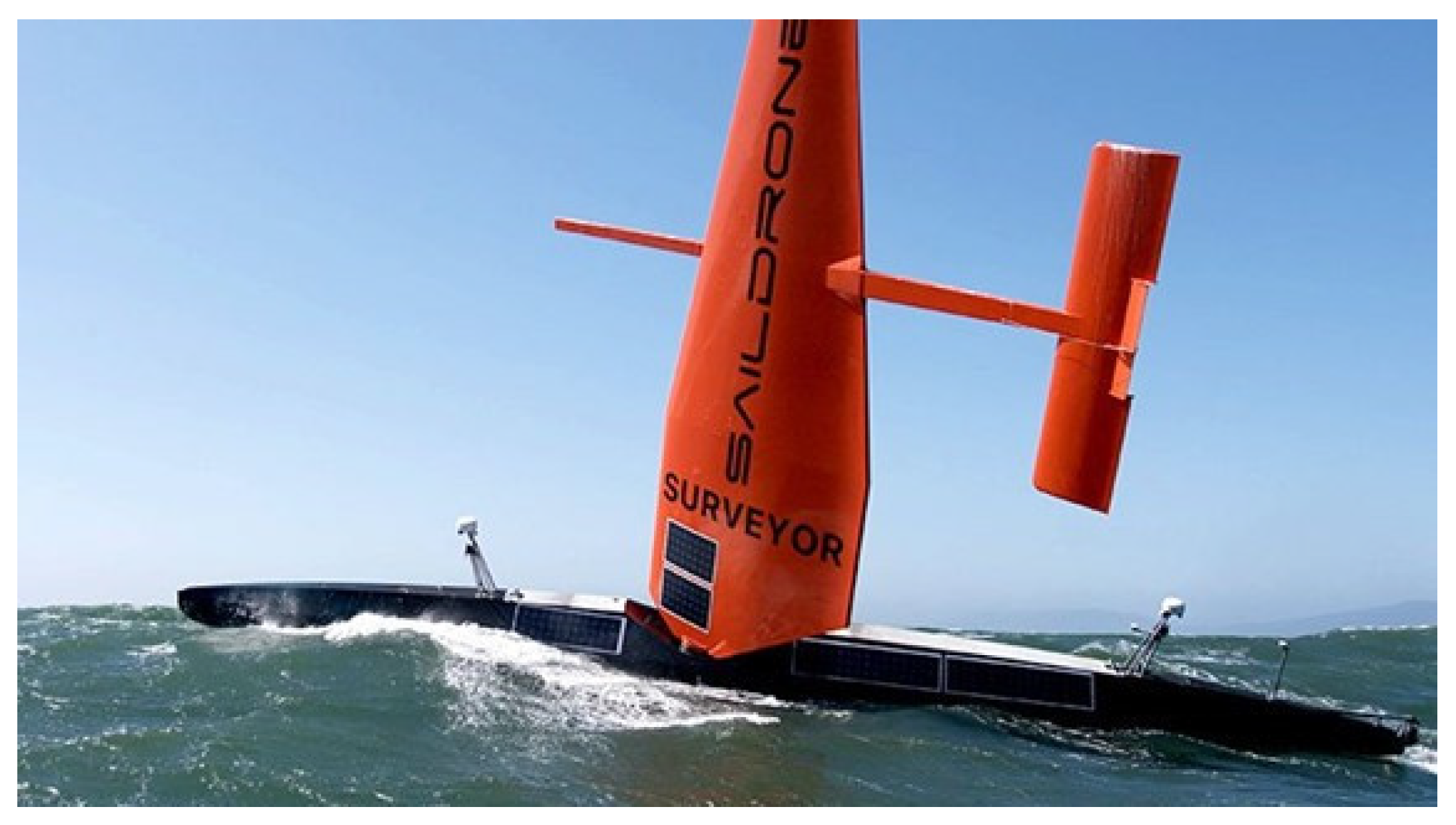
2.1. Conventional Wingsail
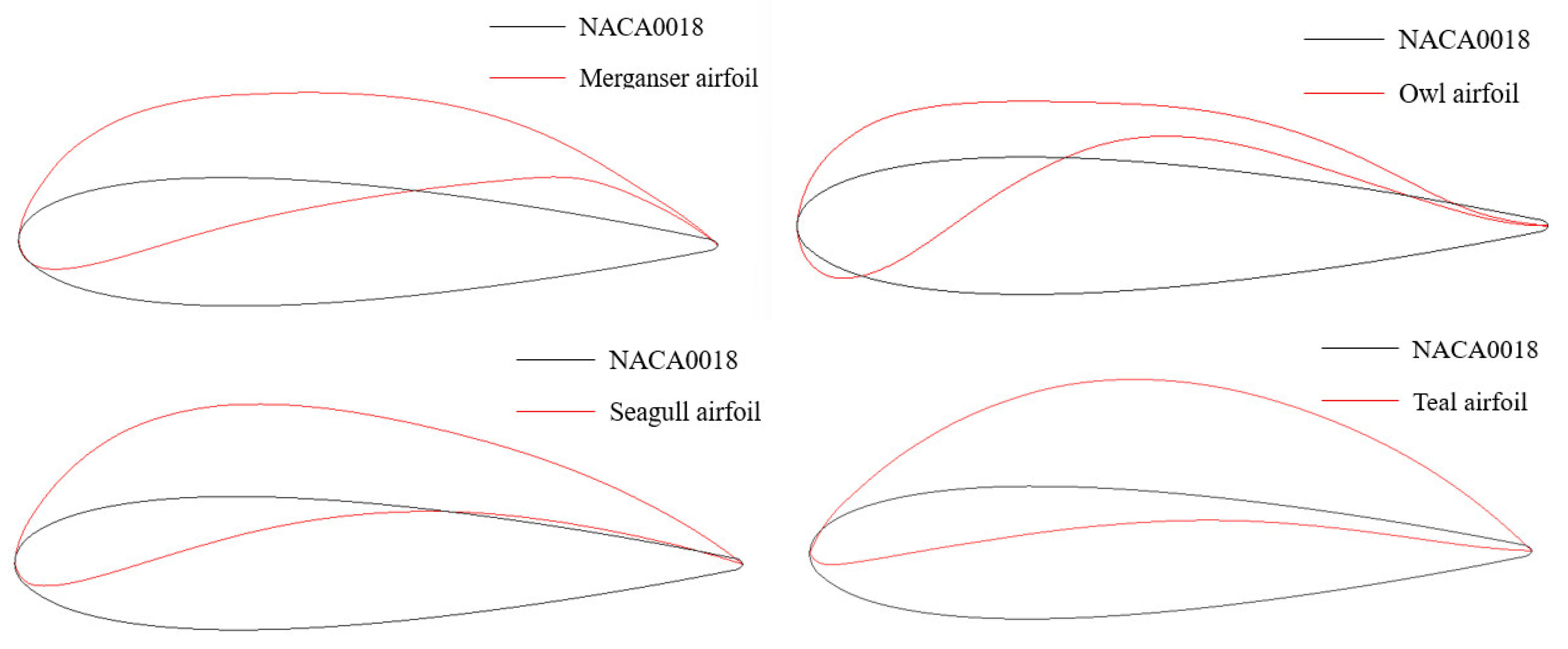
2.2. Avian Wing Model
2.3. Biomimetic Wingsail
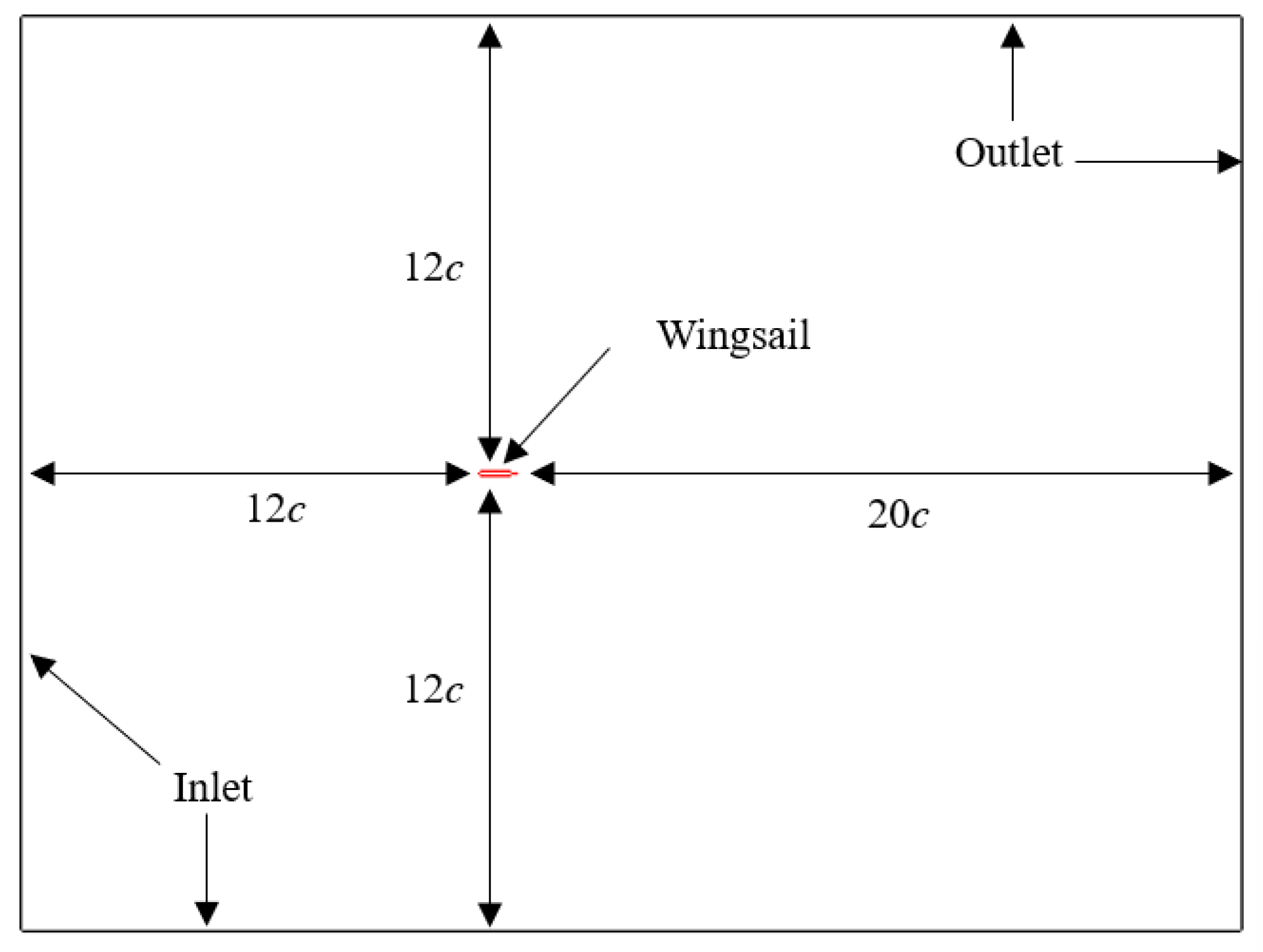
2.4. Computational Domain and Meshing
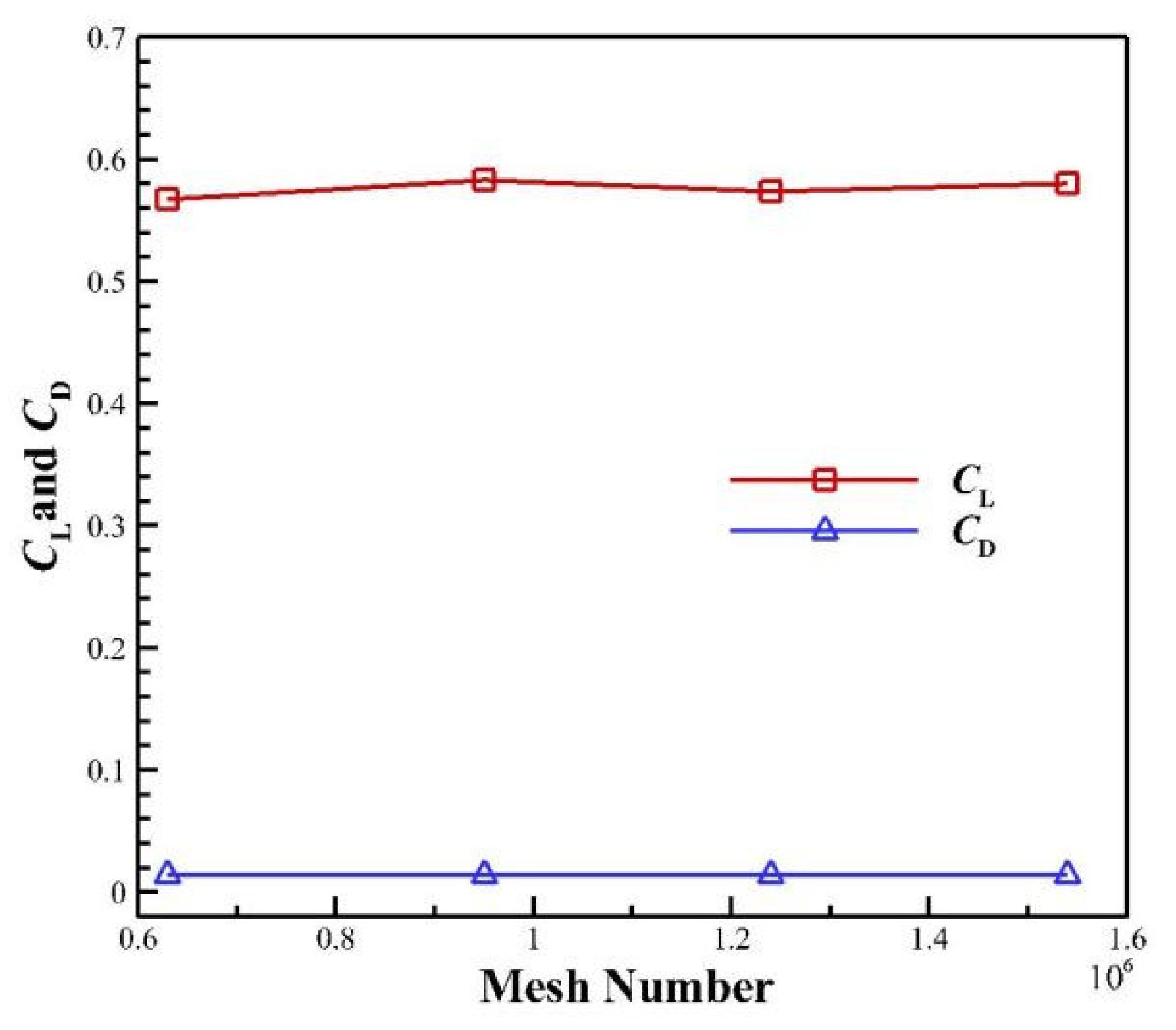
2.5. Mesh Independence Check
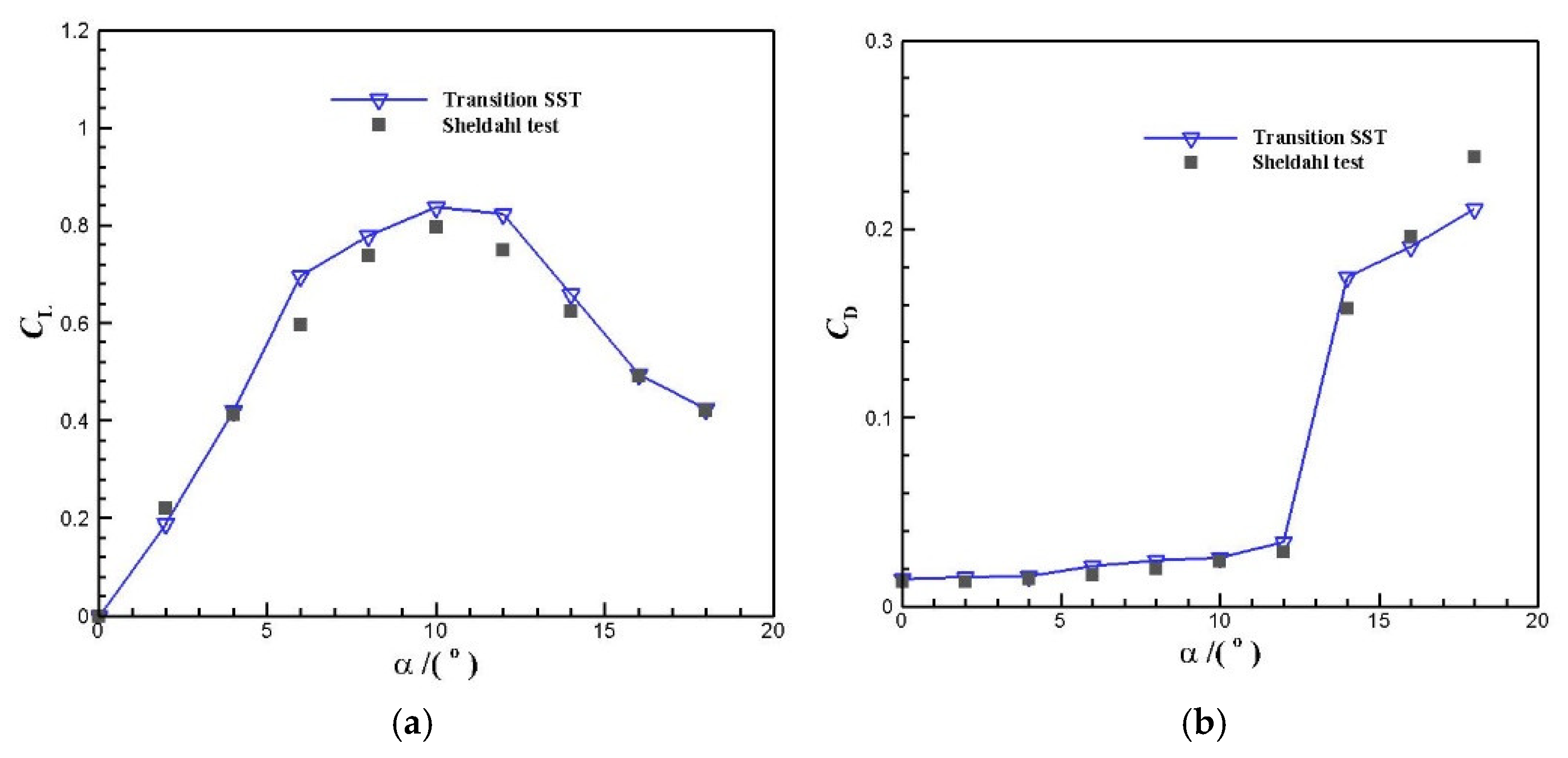
2.6. Model Validation
3. Results and Discussions
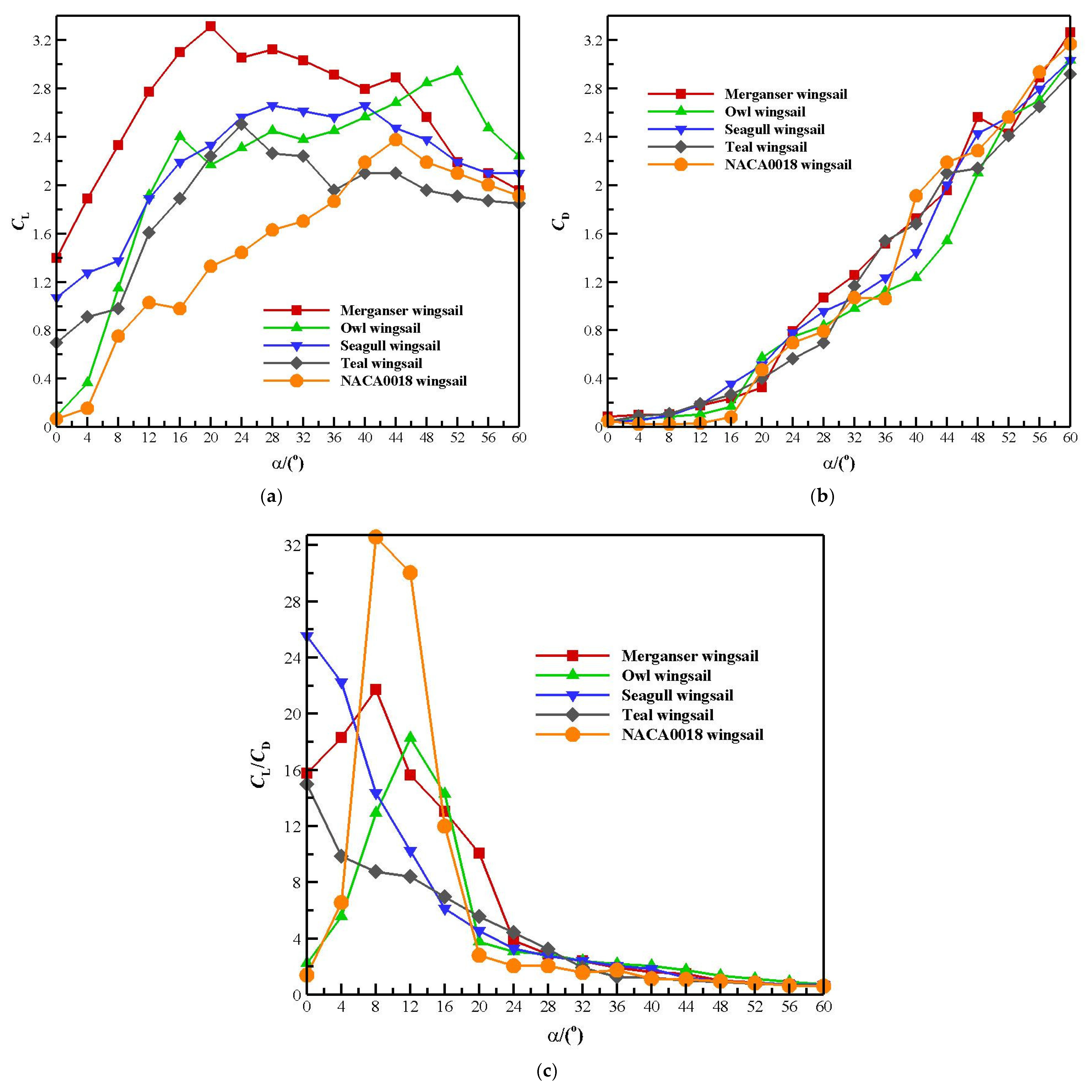
3.1. Aerodynamic Performance of Wingsail Airfoil
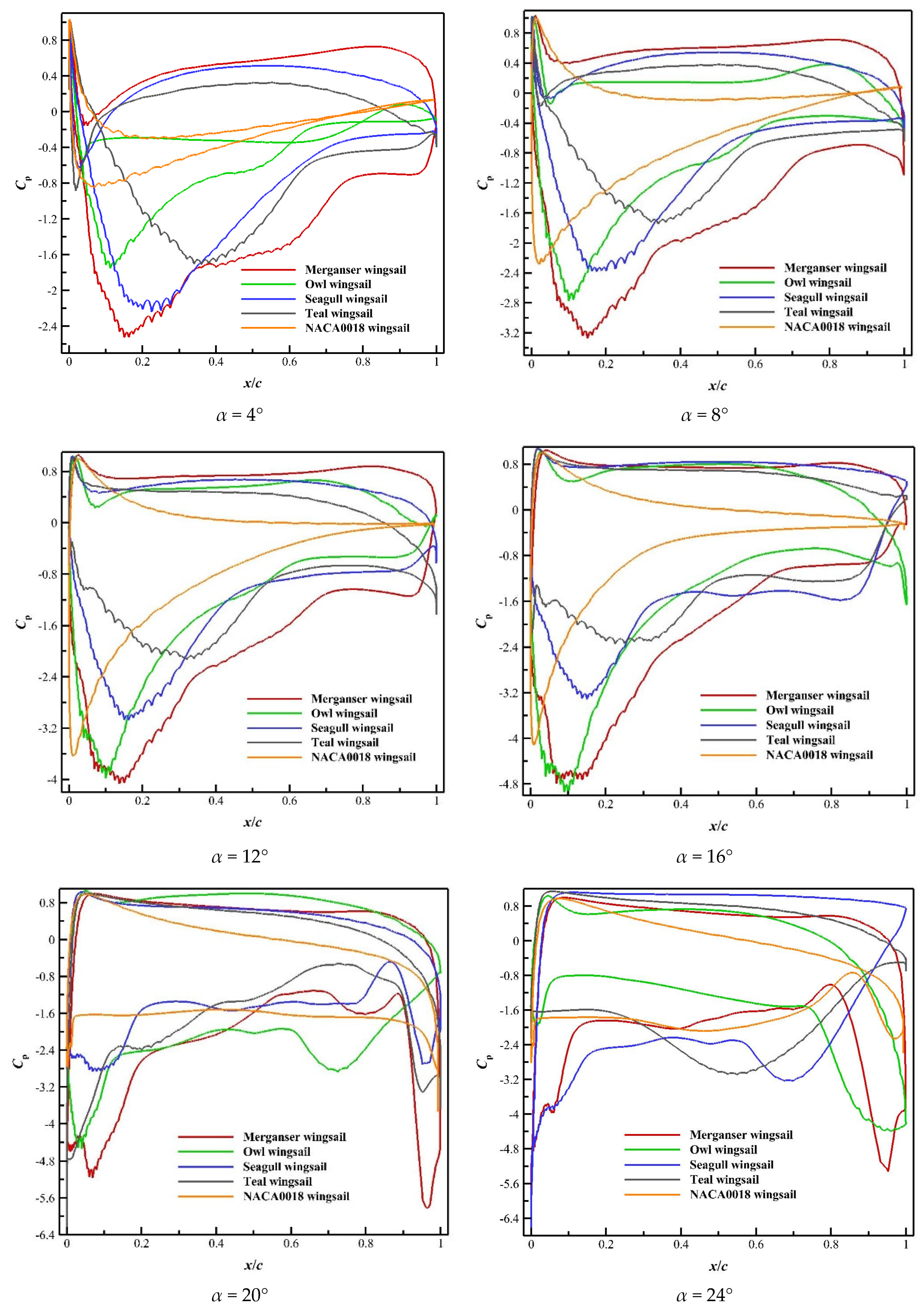
3.2. Pressure Load Distribution of Bio-Wingsail Airfoil
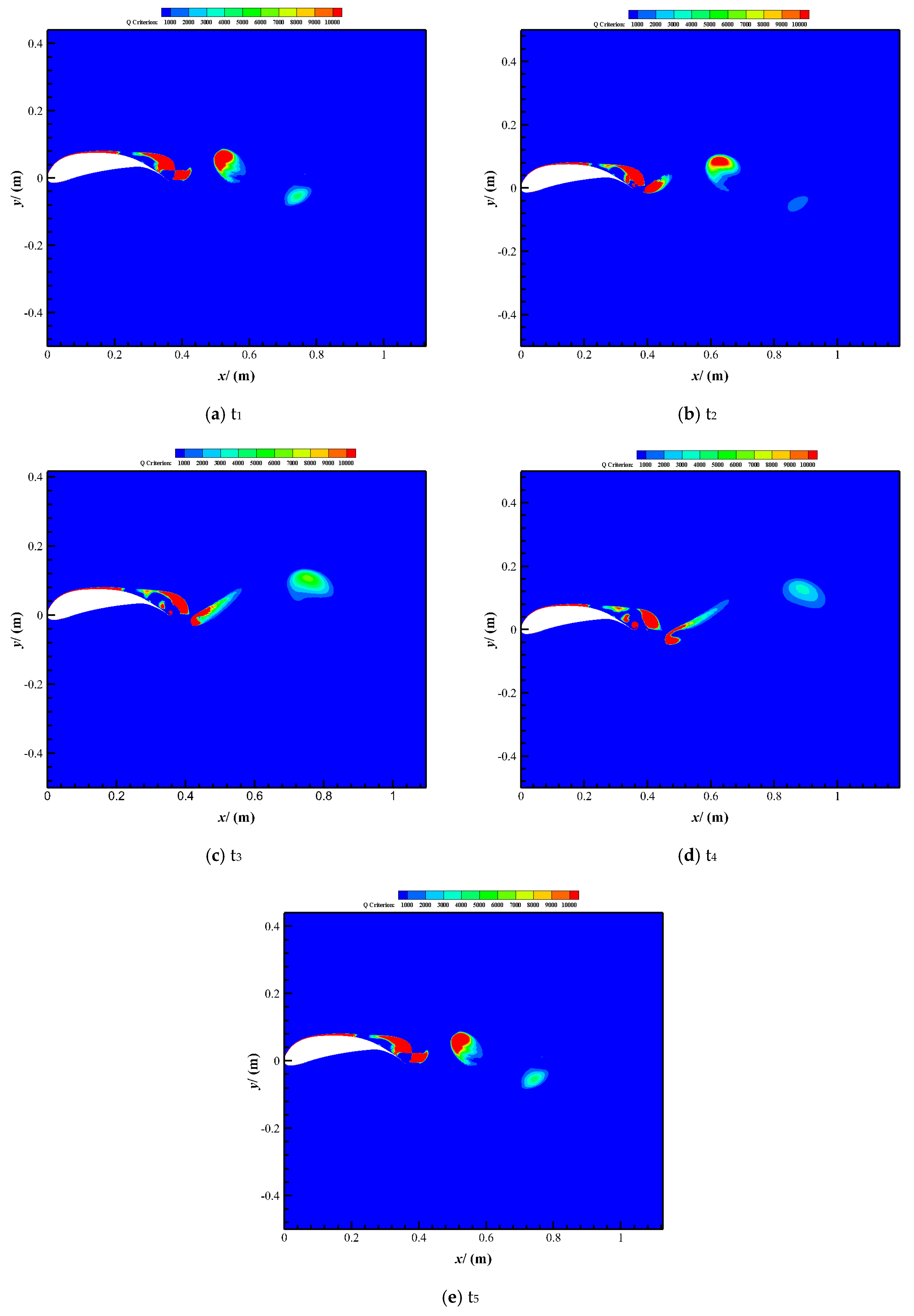
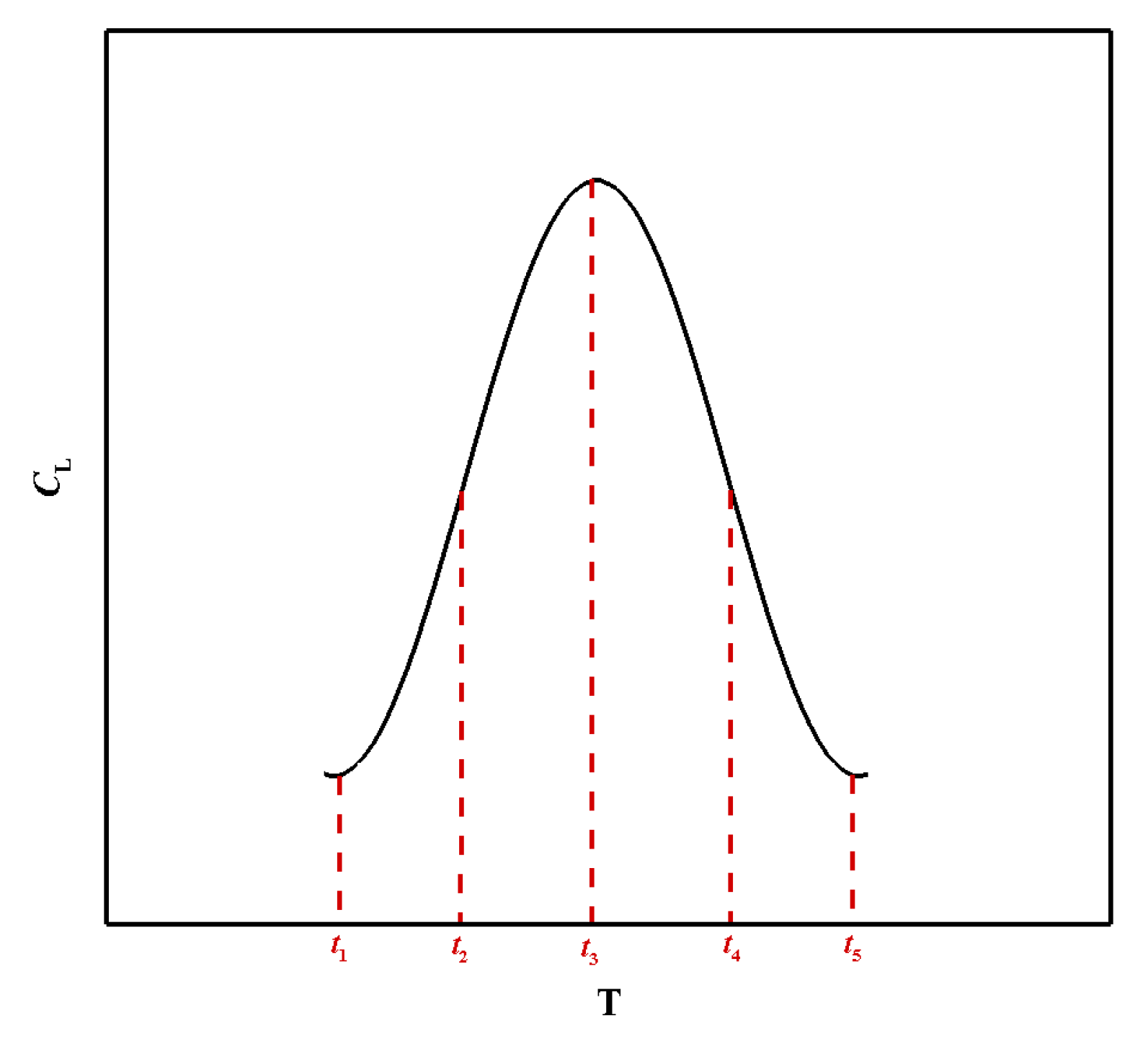
3.3. Unsteady Flow Characteristics of Bio-Wingsail Airfoil
4. Conclusions
- (1)
- It can be observed that within the AOA range of 0–45°, the merganser wingsail exhibits the highest lift coefficient, achieving a peak value of 3.21 among the biomimetic wingsails. Within the broader range of 0–60° angle of attack, the merganser wingsail demonstrated superior overall lift performance, followed by the seagull wingsail, while the teal wingsail airfoil displayed comparatively inferior lift characteristics under identical conditions.
- (2)
- At low to moderate angles of attack (0–24°), lift generation dominates the propulsive contribution of biomimetic wingsails, which is closely related to favorable pressure distribution near the leading edge. However, beyond an angle of attack of 24° up to 60°, both lift and drag coefficients must be considered simultaneously for accurate assessment of net thrust production. This is because the drag coefficient increases rapidly with the increase in angle of attack.
- (3)
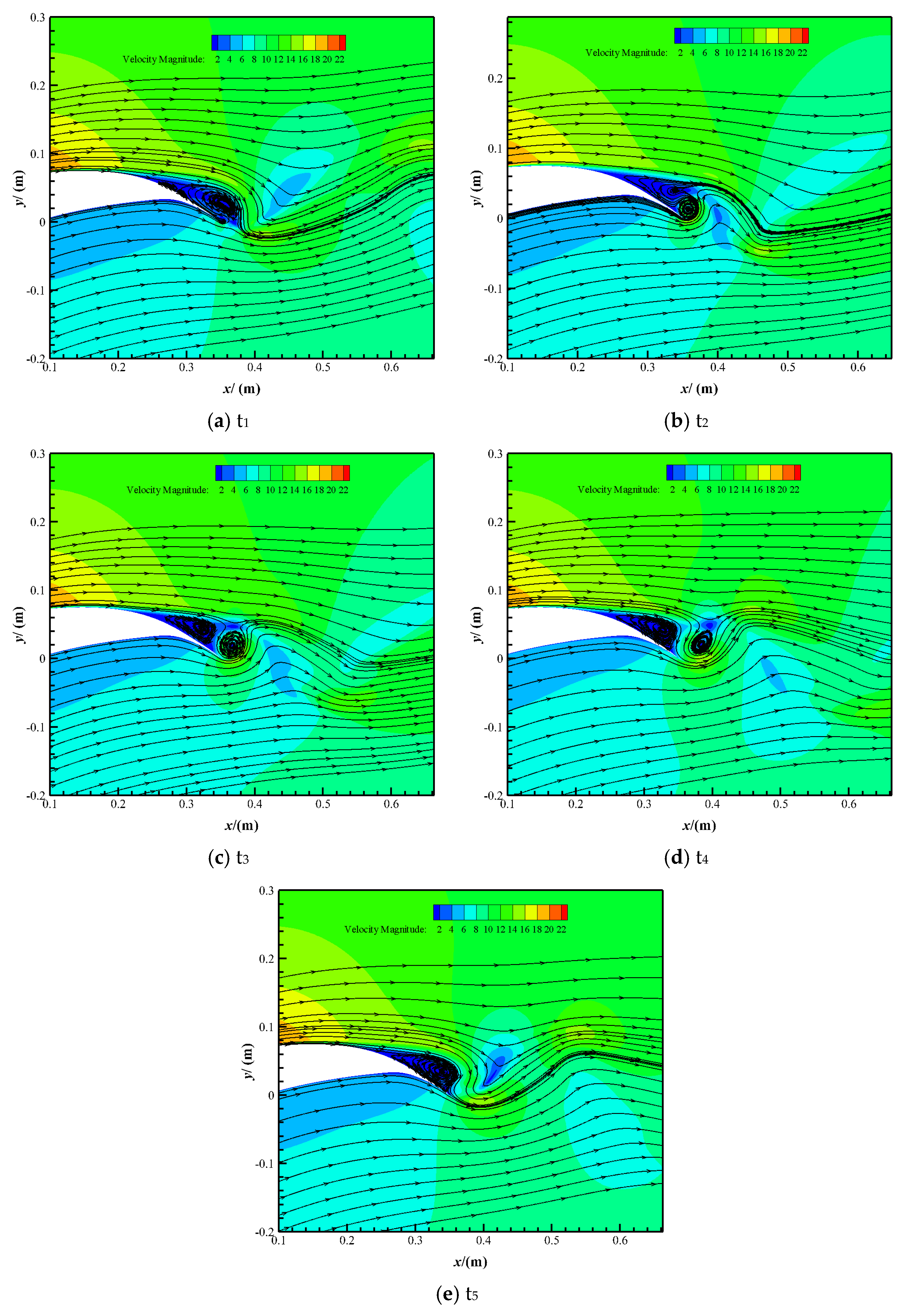
- As the angle of attack increases, flow separation initiates at the trailing edge of biomimetic wingsails, resulting in vortex formation that induces significant unsteady fluctuations in both lift and drag coefficients. For the merganser wingsail airfoil, a persistent recirculation zone persists along its suction surface and it is dynamically modulated by periodic interactions with coherent vortical structures shed from the trailing edge. The transient phenomena including initiation, growth, detachment, and dissipation of vortices exert substantial influence on the stability and magnitude of suction-side reattachment processes, thereby directly affecting temporal variations observed in the lift coefficient at 16° angle of attack.
Author Contributions
Funding
Data Availability Statement
Conflicts of Interest
Nomenclature
| Re | Reynolds number [-] |
| α | Angle of attack of the main wing (AOA) [°] |
| c | Chord of the wingsail [m] |
| CD | Drag coefficient [-] |
| CL | Lift coefficient [-] |
| y+ | Non-dimensional wall distance [-] |
| ρ | The density of the air [kg/m3] |
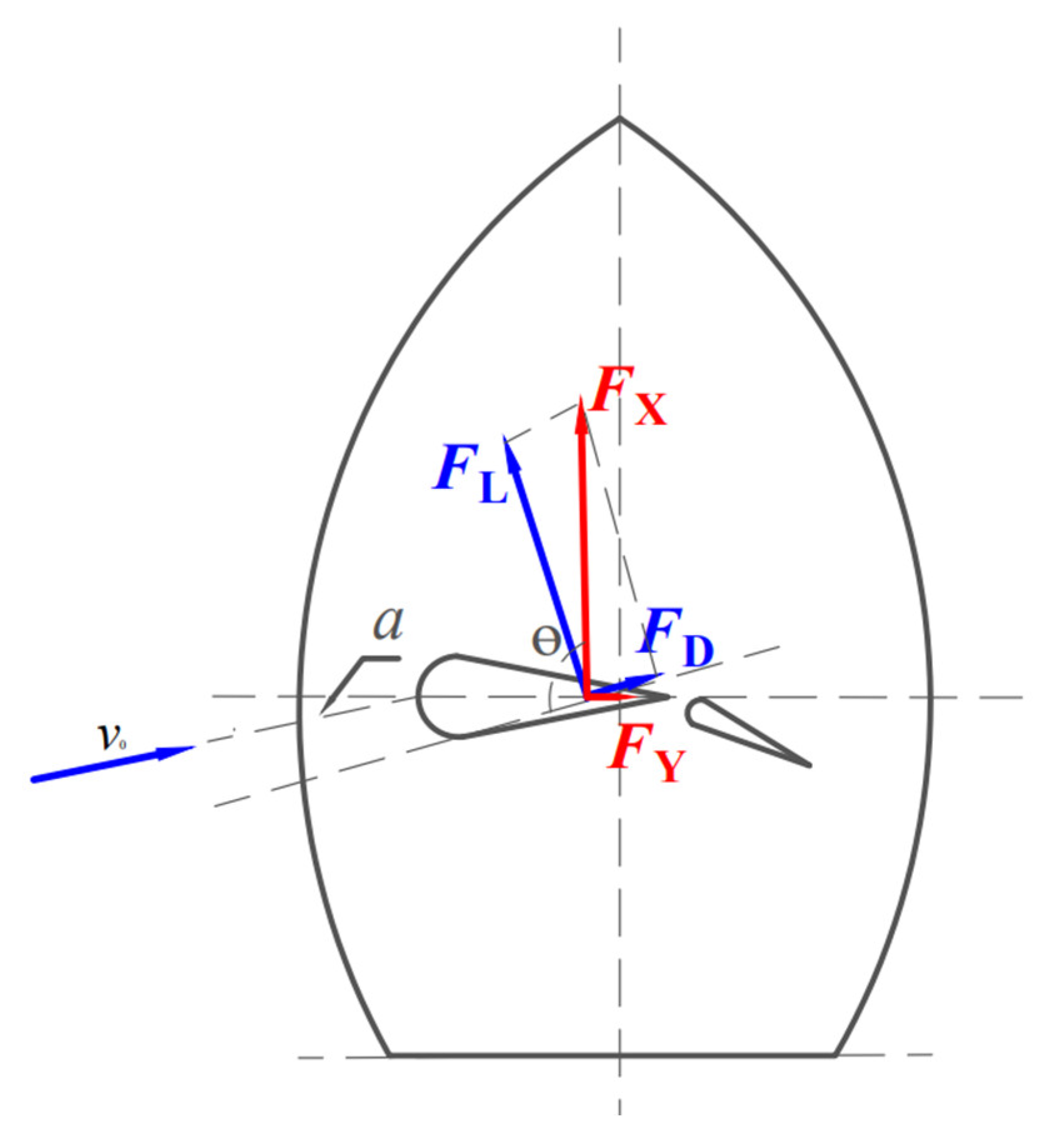
| FL | Lift force [N] |
| FD | Drag force [N] |
| v | The velocity of inflow [m/s] |
References
- Ruth, G.P.; Emily, L.; Vinay, U.; Gary, B.B.; Rachel, A.G.; Hamish, A.C. Uncrewed Surface Vessel Technological Diffusion Depends on Cross-Sectoral Investment in Open-Ocean Archetypes: A Systematic Review of USV Applications and Drivers. Front. Mar. Sci. 2021, 8, 736984. [Google Scholar] [CrossRef]
- Van Zwieten, T. Dynamic Simulation and Control of an Autonomous Surface Vehicle; Florida Atlantic University: Boca Raton, FL, USA, 2003. [Google Scholar]
- Patrick, F.R.; Karl, D.E. Unmanned autonomous sailing: Current status and future role in sustained ocean observations. Mar. Technol. Soc. J. 2009, 43, 21–30. [Google Scholar] [CrossRef]
- NEWSROOM. UNH Sails into the Next Generation of Ocean Mapping with NOAA Grant [EB/OL]. Available online: https://www.unh.edu/unhtoday/news/release/2019/12/10/unh-sails-next-generation-ocean-mapping-noaa-grant (accessed on 10 December 2019).
- Gabriel, H.E. System Identification for Precision Control of a Wingsailed Gps-Guided Catamaran; Stanford University: Stanford, CA, USA, 2001. [Google Scholar]
- Liu, T.; Kuykendoll, K.; Rhew, R.; Jones, S. Avian wing geometry and kinematics. AIAA J. 2006, 44, 954–963. [Google Scholar] [CrossRef]
- Lapsansky, A.B.; Zatz, D.; Tobalske, B.W. Alcids‘fly’ at efficient Strouhal numbers in both air and water but vary stroke velocity and angle. eLife 2020, 9, e55774. [Google Scholar] [CrossRef]
- Zhu, W.; Gao, H. Hydrodynamic characteristics of bioinspired marine propeller with various blade sections. Ships Offshore Struct. 2020, 16, 156–171. [Google Scholar] [CrossRef]
- Anthony, B.L.; Robert, H.A. Common mergansers Mergus merganser use wings to pursue a fish underwater. Mar. Ornithol. 2022, 50, 111–114. [Google Scholar] [CrossRef]
- Fish, F.E.; Lauder, G.V. Passive and active flow control by swimming fishes and mammals. Annu. Rev. Fluid Mech. 2006, 38, 193–224. [Google Scholar] [CrossRef]
- Fish, F.E.; Weber, P.W.; Murray, M.M.; Howle, L.E. The tubercles on humpback whales’ flippers: Application of bio-inspired technology. Integr. Comp. Biol. 2011, 51, 203–213. [Google Scholar] [CrossRef]
- Miklosovic, D.S.; Murray, M.M.; Howle, L.E.; Fish, F.E. Leading-Edge Tubercles Delay Stall on Humpback Whale (Megaptera novaeangliae) Flippers. Phys. Fluids 2004, 16, 39–42. [Google Scholar] [CrossRef]
- Ke, W.-l.; Hashem, I.; Zhang, W.-w.; Zhu, B.-s. Influence of leading-edge tubercles on the aerodynamic performance of a horizontal-axis wind turbine: A numerical study. Energy 2022, 239, 122186. [Google Scholar] [CrossRef]
- Ahmad, M.; Zafar, M.H. Enhancing vertical axis wind turbine efficiency through leading edge tubercles: A multifaceted analysis. Ocean Eng. 2023, 288, 116026. [Google Scholar] [CrossRef]
- Wei, Z.; Toh, J.W.A.; Ibrahim, I.H.; Zhang, Y. Aerodynamic characteristics and surface flow structures of moderate aspect-ratio leading-edge tubercled wings. Eur. J. Mech./B Fluids 2019, 75, 143–152. [Google Scholar] [CrossRef]
- Shi, W.C.; Atlar, M.; Rosli, R.; Aktas, B. Cavitation Observations and Noise Measurements of Horizontal Axis Tidal Turbines with Biomimetic Blade Leading-Edge Designs. Ocean Eng. 2016, 121, 143–155. [Google Scholar] [CrossRef]
- Martiqua, L.P.; Robert, D.; Anthony, R.S.; Hart, J.S. Effect of bio-inspired sinusoidal leading-edges on wings. Aerosp. Sci. Technol. 2018, 81, 128–140. [Google Scholar] [CrossRef]
- Gao, H.; Zhu, W. Numerical Investigation of Bionic Rudder with Leading-Edge Protuberances. J. Offshore Mech. Arct. Eng. 2020, 142, 011802. [Google Scholar] [CrossRef]
- Wood, R.; Lu, P. Leading edge topography of blades—A critical review. Surf. Topogr. Metrol. Prop. 2021, 9, 023001. [Google Scholar] [CrossRef]
- Abdulbari, H.A.; Mahammed, H.D.; Hassan, Z.B.Y. Bio-inspired passive drag reduction techniques: A review. ChemBioEng Rev. 2015, 2, 185–203. [Google Scholar] [CrossRef]
- Ivan, C.C. Soft hydraulics: From Newtonian to complex fluid flows through compliant conduits. J. Phys. Condens. Matter 2021, 18, 34. [Google Scholar] [CrossRef]
- Liu, Z.M.; Chen, R.; Tang, Z.Q.; Tian, Q.; Fang, Y.C.; Li, P.J.; Li, L.; Pang, Y. Drag Reduction Performance of Triangular (V-groove) Riblets with Different Adjacent Height Ratios. J. Appl. Fluid Mech. 2023, 16, 671–684. [Google Scholar] [CrossRef]
- Ananthan, V.B.; Akkermans, R.A.; Hu, T.; Liu, P.Q.; Rathje, N. Trailing-edge noise reduction potential of a locally applied shallow dimpled surface. J. Sound Vib. 2022, 525, 116745. [Google Scholar] [CrossRef]
- Kramer, M.O. Boundary layer stabilization by distributed damping. Nav. Eng. J. 1960, 72, 25–34. [Google Scholar] [CrossRef]
- Weihs, D. Dynamics of dolphin porpoising revisited. Integr. Comp. Biol. 2002, 42, 1071–1078. [Google Scholar] [CrossRef] [PubMed]
- İlter, Y.K.; Çetinkaya, A.; Ünal, U.O. Large eddy simulations of the turbulent channel flow over dimpled surfaces. J. Turbul. 2023, 24, 2186415. [Google Scholar] [CrossRef]
- Choi, J.; Jeon, W.P.; Choi, H. Mechanism of drag reduction by dimples on a sphere. Phys. Fluids 2006, 18, 041702. [Google Scholar] [CrossRef]
- Lu, H.W.; Shi, Y.P.; Xin, J.C.; Kong, X.Z.; Peng, B.L. Influence of Ellipsoidal Dimple Column Number on Performance of Highly-loaded Compressor Cascade. J. Appl. Fluid Mech. 2023, 17, 474–486. [Google Scholar] [CrossRef]
- Wang, L.; Liu, J.; Li, S.; Lu, H.; Zhang, L.; Cheng, L. Experimental and numerical study on the performance and separation flow characteristics of a highly loaded compressor cascade controlled by endwall-blade combined dimples. Aerosp. Sci. Technol. 2025, 167, 110642. [Google Scholar] [CrossRef]
- Hayashi, I.; Kaneko, S. Pressure Pulsations in Piping System Excited by a Centrifugal Turbomachinery Taking the Damping Characteristics into Consideration. J. Fluids Struct. 2014, 45, 216–234. [Google Scholar] [CrossRef]
- Morenko, I.V. Numerical Simulation of the Propagation of Pressure Waves in Water during the Collapse of a Spherical Air Cavity. Ocean Eng. 2020, 215, 107905. [Google Scholar] [CrossRef]
- Wu, L.; Liu, X.; Wang, M. Effects of Bionic Volute Tongue on Aerodynamic Performance and Noise Characteristics of Centrifugal Fan Used in the Air-Conditioner. J. Bionic Eng. 2020, 17, 780–792. [Google Scholar] [CrossRef]
- Tay, W.B.; Lu, Z.; Ramesh, S.S.; Khoo, B.C. Numerical simulations of serrated propellers to reduce noise. In Asian Conference on Supercomputing Frontiers; Springer International Publishing: Cham, Switzerland, 2020; pp. 87–103. [Google Scholar] [CrossRef]
- Song, W.; Mu, Z.; Wang, Y.; Zhang, Z.; Zhang, S.; Wang, Z.; Li, B.; Zhang, J.; Niu, S.; Han, Z.; et al. Comparative Investigation on Improved Aerodynamic and Acoustic Performance of Abnormal Rotors by Bionic Edge Design and Rational Material Selection. Polymers 2022, 14, 2552. [Google Scholar] [CrossRef]
- Cai, Q.; Wei, K.; Yun, Q.; Chen, Y.; Xue, D.; Yang, J. Experimental Study on the Noise Reduction Effect of Biomimetic Serrated Propeller Blades. In 2023 6th International Conference on Information Communication and Signal Processing (ICICSP); IEEE: New York, NY, USA, 2023; pp. 963–967. [Google Scholar] [CrossRef]
- Hersh, A.S.; Soderman, P.T.; Hayden, R.E. Investigation of Acoustic Effects of Leading-Edge Serrations on Airfoils. J. Aircr. 1974, 11, 197–202. [Google Scholar] [CrossRef]
- Klän, S.; Burgmann, S.; Bachmann, T.; Klaas, M.; Wagner, H.; Schröder, W. Surface structure and dimensional effects on the aerodynamics of an owl-based wing model. Eur. J. Mech.-B/Fluids 2012, 33, 58–73. [Google Scholar] [CrossRef]
- Wang, L.; Song, B.; Sun, Z.; Yang, X. Review on ultra-lightweight flapping-wing nano air vehicles: Artificial muscles, flight control mechanism, and biomimetic wings. Chin. J. Aeronaut. 2023, 36, 63–91. [Google Scholar] [CrossRef]
- Chattaraj, N.; Ganguli, R. Mechatronic Approaches to Synthesize Biomimetic Flapping-Wing Mechanisms: A Review. Int. J. Aeronaut. Space Sci. 2023, 24, 105–120. [Google Scholar] [CrossRef]
- Richard, D. A ProPosal: Modular Sailing Rigs To Provide Wind Assistance for Larger Vessels. In The Naval Architect; Royal Institution of Naval Architects (RINA): London, UK, 2004; pp. 112–114. [Google Scholar]
- Horiuchi, K.; Kanai, N.; Uemori, S. FoIdable kite sail “Manta” for small slender boats. In Oceans ‘04 MTS/IEEE Techno-Ocean’; IEEE: New York, NY, USA, 2004; Volume 2, pp. 1014–1016. [Google Scholar]
- Boris, H.; Moritz, D. Optimal Control of Towing Kites. In Proceedings of the IEEE Conference on Decision and Control; IEEE: New York, NY, USA, 2007. [Google Scholar]
- Widnall, S.E.; Cornwell, H.K.; Williams, P.J. Effects of Spanwise Flexibility on Lift and Rolling Moment of a Wingsail [EB/OL]. 2014. Available online: http://hdl.handle.net/1721.1/92344 (accessed on 15 April 2026).
- Dominguez-brito, A.C.; Valle-fernandez, B.; Cabrera-gamez, J.; Ramos-de-Miguel, A.; García, J.C. A-TIRMA G2: An oceanic autonomous sailboat. In World Robotic Sailing Championship and International Robotic Sailing Conference; Springer International Publishing: Cham, Switzerland, 2015; pp. 3–13. [Google Scholar] [CrossRef]
- Elkaim, G.H.; Boyce, C.O. Experimental validation of GPS-based control of an unmanned wing-sailed catamaran. In Proceedings of the 20th International Technical Meeting of the Satellite Division of The Institute of Navigation (ION GNSS 2007), Fort Worth, TX, USA, 25–28 September 2007; pp. 1950–1956. [Google Scholar]
- Wang, H.; Li, C.; Zuo, C.; Yuan, J.; Wu, B. Computational fluid dynamics investigation of the spacing of the aerodynamic characteristics for multiple wingsails on ships. J. Mar. Sci. Eng. 2024, 12, 985. [Google Scholar] [CrossRef]
- Timmer, W.A. Two-dimensional low-Reynolds number wind tunnel results for airfoil NACA 0018. Wind. Eng. 2008, 32, 525–537. [Google Scholar] [CrossRef]
- Bellegoni, M.; Cotteleer, L.; Srikumar, S.K.R.; Mosca, G.; Gambale, A.; Tognotti, L.; Galletti, C.; Parente, A. An extended SST k− ω framework for the RANS simulation of the neutral Atmospheric Boundary Layer. Environ. Model. Softw. 2023, 160, 105583. [Google Scholar] [CrossRef]
- Yong, X.; Liu, Y.; Tang, Y. Development of unsteady reduced-order methods for multi-row turbomachinery flow simulation based on the computational fluids laboratory three-dimensional solver. Phys. Fluids 2024, 36, 045135. [Google Scholar] [CrossRef]
- Gerakopulos, R.; Boutilier, M.; Yarusevych, S. Aerodynamic characterization of a NACA 0018 airfoil at low Reynolds numbers. In 40th Fluid Dynamics Conference and Exhibit; AIAA: Reston, VA, USA, 2010; p. 4629. [Google Scholar]
- Nakano, T.; Fujisawa, N.; Oguma, Y.; Takagi, Y.; Lee, S. Experimental study on flow and noise characteristics of NACA0018 airfoil. J. Wind. Eng. Ind. Aerodyn. 2007, 95, 511–531. [Google Scholar] [CrossRef]






| Airfoil Type | Operating Reynolds Number Range |
|---|---|
| USV Wingsail | 1 × 10⁵–10 × 105 |
| Seagull wing | 0.5 × 10⁴–3 × 10⁵ |
| Merganser wing | 0.6 × 10⁵–3 × 10⁵ |
| Teal wing | 0.5 × 10⁵–2 × 10⁵ |
| Owl wing | 0.4 × 10⁵–0.6 × 10⁵ |
| Suction Side-Merganser Wingsail | Pressure Side-Merganser Wingsail | ||
|---|---|---|---|
| X-axis coordinate | Y-axis coordinate | X-axis coordinate | Y-axis coordinate |
| 0.02 | 0.061224 | 0.95 | 0.040626 |
| 0.04 | 0.091109 | 0.9 | 0.070991 |
| 0.06 | 0.115921 | 0.8 | 0.093725 |
| 0.1 | 0.148805 | 0.7 | 0.090888 |
| 0.15 | 0.176184 | 0.6 | 0.079676 |
| 0.2 | 0.192857 | 0.5 | 0.064543 |
| 0.3 | 0.209123 | 0.4 | 0.046026 |
| 0.32 | 0.210176 | 0.32 | 0.027552 |
| 0.4 | 0.213624 | 0.3 | 0.022495 |
| 0.5 | 0.21128 | 0.2 | −0.00688 |
| 0.6 | 0.20028 | 0.15 | −0.02201 |
| 0.7 | 0.175536 | 0.1 | −0.03502 |
| 0.8 | 0.132766 | 0.06 | −0.04083 |
| 0.9 | 0.072745 | 0.04 | −0.04035 |
| 0.95 | 0.040626 | 0.02 | −0.03385 |
| 1 | 0 | 0 | 0 |
| Merganser Wingsail | Owl Wingsail | Seagull Wingsail | Teal Wingsail | NACA0018 Wingsail | |||||||||||
|---|---|---|---|---|---|---|---|---|---|---|---|---|---|---|---|
| α | CL | CD | CL/CD | CL | CD | CL/CD | CL | CD | CL/CD | CL | CD | CL/CD | CL | CD | CL/CD |
| 0 | 1.40 | 0.09 | 15.79 | 0.09 | 0.04 | 2.22 | 1.07 | 0.04 | 25.56 | 0.70 | 0.05 | 15.00 | 0.07 | 0.05 | 1.39 |
| 4 | 1.89 | 0.10 | 18.33 | 0.36 | 0.07 | 5.57 | 1.28 | 0.06 | 22.24 | 0.91 | 0.09 | 9.85 | 0.16 | 0.02 | 6.56 |
| 8 | 2.33 | 0.11 | 21.74 | 1.15 | 0.09 | 12.94 | 1.38 | 0.10 | 14.39 | 0.98 | 0.11 | 8.75 | 0.75 | 0.02 | 32.58 |
| 12 | 2.78 | 0.18 | 15.66 | 1.92 | 0.10 | 18.27 | 1.89 | 0.18 | 10.25 | 1.61 | 0.19 | 8.41 | 1.03 | 0.03 | 30.04 |
| 16 | 3.10 | 0.24 | 13.04 | 2.40 | 0.17 | 14.31 | 2.19 | 0.36 | 6.14 | 1.89 | 0.27 | 6.98 | 0.98 | 0.08 | 12.01 |
| 20 | 3.31 | 0.33 | 10.09 | 2.17 | 0.57 | 3.78 | 2.33 | 0.51 | 4.55 | 2.24 | 0.40 | 5.58 | 1.33 | 0.48 | 2.79 |
| 24 | 3.06 | 0.79 | 3.85 | 2.31 | 0.75 | 3.09 | 2.57 | 0.78 | 3.28 | 2.51 | 0.57 | 4.42 | 1.45 | 0.70 | 2.07 |
| 28 | 3.13 | 1.07 | 2.91 | 2.45 | 0.84 | 2.92 | 2.66 | 0.96 | 2.78 | 2.26 | 0.70 | 3.23 | 1.63 | 0.79 | 2.06 |
| 32 | 3.03 | 1.26 | 2.41 | 2.38 | 0.98 | 2.43 | 2.61 | 1.07 | 2.43 | 2.24 | 1.17 | 1.92 | 1.70 | 1.07 | 1.59 |
| 36 | 2.92 | 1.52 | 1.92 | 2.45 | 1.12 | 2.19 | 2.57 | 1.24 | 2.08 | 1.96 | 1.54 | 1.27 | 1.87 | 1.06 | 1.75 |
| 40 | 2.80 | 1.73 | 1.62 | 2.57 | 1.24 | 2.08 | 2.66 | 1.45 | 1.84 | 2.10 | 1.68 | 1.25 | 2.19 | 1.91 | 1.15 |
| 44 | 2.89 | 1.96 | 1.48 | 2.68 | 1.54 | 1.74 | 2.47 | 2.01 | 1.23 | 2.10 | 2.10 | 1.00 | 2.38 | 2.19 | 1.09 |
| 48 | 2.57 | 2.57 | 1.00 | 2.85 | 2.10 | 1.36 | 2.38 | 2.43 | 0.98 | 1.96 | 2.14 | 0.92 | 2.19 | 2.29 | 0.96 |
| 52 | 2.19 | 2.43 | 0.90 | 2.94 | 2.57 | 1.15 | 2.19 | 2.57 | 0.85 | 1.91 | 2.41 | 0.79 | 2.10 | 2.57 | 0.82 |
| 56 | 2.10 | 2.89 | 0.73 | 2.47 | 2.71 | 0.91 | 2.10 | 2.80 | 0.75 | 1.87 | 2.65 | 0.71 | 2.01 | 2.94 | 0.68 |
| 60 | 1.96 | 3.27 | 0.60 | 2.24 | 3.03 | 0.74 | 2.10 | 3.03 | 0.69 | 1.85 | 2.92 | 0.63 | 1.91 | 3.17 | 0.60 |
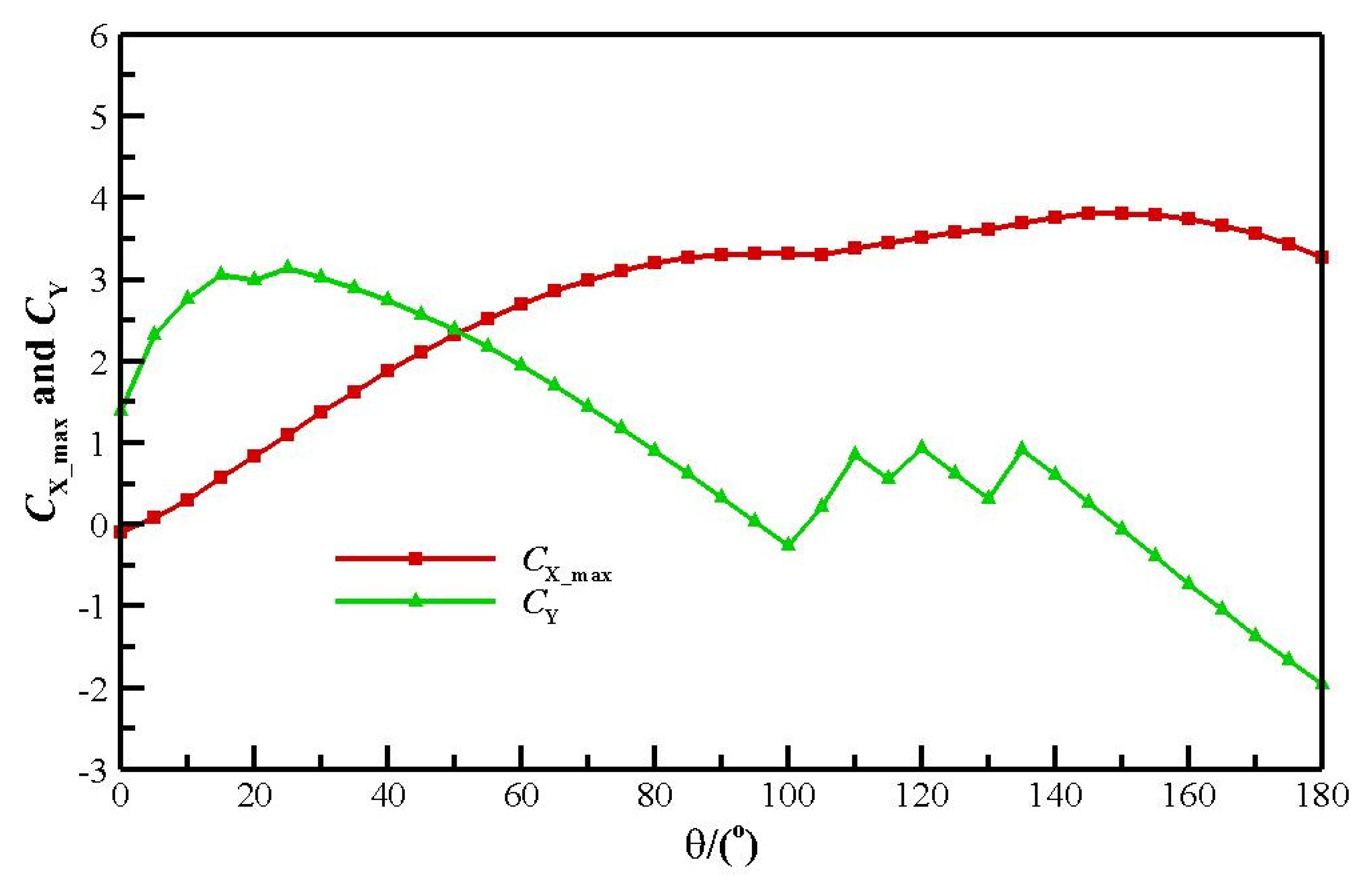
| θ (°) | α (°) | CL | CD | CX_max | CY | θ (°) | α (°) | CL | CD | CX_ max | CY |
|---|---|---|---|---|---|---|---|---|---|---|---|
| 0 | 0 | 1.4 | 0.09 | −0.09 | 1.4 | 95 | 20 | 3.31 | 0.33 | 3.3262 | 0.0403 |
| 5 | 8 | 2.33 | 0.11 | 0.0935 | 2.3307 | 100 | 20 | 3.31 | 0.33 | 3.317 | −0.2498 |
| 10 | 12 | 2.78 | 0.18 | 0.3055 | 2.769 | 105 | 28 | 3.13 | 1.07 | 3.3003 | 0.2234 |
| 15 | 16 | 3.1 | 0.24 | 0.5705 | 3.0565 | 110 | 44 | 2.89 | 1.96 | 3.3861 | 0.8534 |
| 20 | 16 | 3.1 | 0.24 | 0.8347 | 2.9951 | 115 | 44 | 2.89 | 1.96 | 3.4476 | 0.555 |
| 25 | 20 | 3.31 | 0.33 | 1.0998 | 3.1393 | 120 | 48 | 2.57 | 2.57 | 3.5107 | 0.9407 |
| 30 | 20 | 3.31 | 0.33 | 1.3692 | 3.0315 | 125 | 48 | 2.57 | 2.57 | 3.5793 | 0.6311 |
| 35 | 20 | 3.31 | 0.33 | 1.6282 | 2.9007 | 130 | 48 | 2.57 | 2.57 | 3.6207 | 0.3168 |
| 40 | 20 | 3.31 | 0.33 | 1.8748 | 2.7477 | 135 | 60 | 1.96 | 3.27 | 3.6982 | 0.9263 |
| 45 | 20 | 3.31 | 0.33 | 2.1072 | 2.5739 | 140 | 60 | 1.96 | 3.27 | 3.7648 | 0.6005 |
| 50 | 20 | 3.31 | 0.33 | 2.3235 | 2.3804 | 145 | 60 | 1.96 | 3.27 | 3.8028 | 0.2701 |
| 55 | 20 | 3.31 | 0.33 | 2.5221 | 2.1689 | 150 | 60 | 1.96 | 3.27 | 3.8119 | −0.0624 |
| 60 | 20 | 3.31 | 0.33 | 2.7015 | 1.9408 | 155 | 60 | 1.96 | 3.27 | 3.792 | −0.3944 |
| 65 | 20 | 3.31 | 0.33 | 2.8604 | 1.6979 | 160 | 60 | 1.96 | 3.27 | 3.7432 | −0.7234 |
| 70 | 20 | 3.31 | 0.33 | 2.9975 | 1.4422 | 165 | 60 | 1.96 | 3.27 | 3.6659 | −1.0469 |
| 75 | 20 | 3.31 | 0.33 | 3.1118 | 1.1754 | 170 | 60 | 1.96 | 3.27 | 3.5607 | −1.3624 |
| 80 | 20 | 3.31 | 0.33 | 3.2024 | 0.8998 | 175 | 60 | 1.96 | 3.27 | 3.4284 | −1.6675 |
| 85 | 20 | 3.31 | 0.33 | 3.2686 | 0.6172 | 180 | 60 | 1.96 | 3.27 | 3.27 | −1.96 |
| 90 | 20 | 3.31 | 0.33 | 3.31 | 0.33 |
Disclaimer/Publisher’s Note: The statements, opinions and data contained in all publications are solely those of the individual author(s) and contributor(s) and not of MDPI and/or the editor(s). MDPI and/or the editor(s) disclaim responsibility for any injury to people or property resulting from any ideas, methods, instructions or products referred to in the content. |
© 2026 by the authors. Licensee MDPI, Basel, Switzerland. This article is an open access article distributed under the terms and conditions of the Creative Commons Attribution (CC BY) license.
Share and Cite
Yuan, J.; Wei, H.; Li, C. Numerical Investigation of Aerodynamic Characteristics of Biomimetic Wingsails for Unmanned Surface Vehicles. J. Mar. Sci. Eng. 2026, 14, 777. https://doi.org/10.3390/jmse14090777
Yuan J, Wei H, Li C. Numerical Investigation of Aerodynamic Characteristics of Biomimetic Wingsails for Unmanned Surface Vehicles. Journal of Marine Science and Engineering. 2026; 14(9):777. https://doi.org/10.3390/jmse14090777
Chicago/Turabian StyleYuan, Junfu, Haijun Wei, and Chen Li. 2026. "Numerical Investigation of Aerodynamic Characteristics of Biomimetic Wingsails for Unmanned Surface Vehicles" Journal of Marine Science and Engineering 14, no. 9: 777. https://doi.org/10.3390/jmse14090777
APA StyleYuan, J., Wei, H., & Li, C. (2026). Numerical Investigation of Aerodynamic Characteristics of Biomimetic Wingsails for Unmanned Surface Vehicles. Journal of Marine Science and Engineering, 14(9), 777. https://doi.org/10.3390/jmse14090777