Article

Dynamic Trajectory Tracking and Autonomous Berthing Control of a Container Ship Based on Four-Quadrant Hydrodynamics

1
Ocean College, Zhejiang University, Zhoushan 316021, China
2
Ningbo Institute of Materials Technology & Engineering, Chinese Academy of Sciences, Ningbo 315201, China
*
Author to whom correspondence should be addressed.
J. Mar. Sci. Eng. 2026, 14(8), 724; https://doi.org/10.3390/jmse14080724
Submission received: 14 March 2026 / Revised: 5 April 2026 / Accepted: 13 April 2026 / Published: 14 April 2026
(This article belongs to the Special Issue Advanced Modeling and Intelligent Control of Marine Vehicles)

Abstract

To address the strongly nonlinear hydrodynamic coupling and complex maneuvering challenges encountered by large ships during berthing operations in restricted waters, this paper proposes a high-precision autonomous berthing control system incorporating four-quadrant propeller hydrodynamics. Based on an improved Mathematical Maneuvering Group (MMG) framework, a three-degree-of-freedom (3-DOF) dynamic model is established to accurately capture the transient thrust and torque mappings of the propeller over all four quadrants. A dynamic line-of-sight (LOS) guidance system with a nonlinearly decaying acceptance radius is tightly coupled with PD/PI controllers to coordinate and regulate the rudder angle and propeller rotational speed. The numerical solver was rigorously validated against turning-test data for the S-175 container ship, with the errors of the key parameters all controlled within 15%. Subsequently, under the environmental conditions of Yangshan Port, full-condition path-planning and berthing simulations were conducted for the novel B-573 container ship under steady-current disturbances. These simulations evaluated multiple flow directions, namely due south, due north, due west, and due east defined in the Earth-fixed coordinate system, as well as multiple intensity levels ranging from 0 to 1.5 m/s that were specifically tested under the due north current. Quantitative evaluation shows that, under the highly challenging current condition of 1.0 m/s, the dynamic corrective mechanism effectively drives the global mean absolute error (MAE) to converge to 85.50 m, representing a 62% statistical reduction relative to the transient peak value. In addition, a parameter sensitivity analysis based on the cumulative cross-track error confirms that, when subject to variations in the underlying hydrodynamic parameters, the proposed system can suppress fluctuations in trajectory error to a very low level, thereby demonstrating a certain degree of control robustness. During the terminal berthing stage, the vessel smoothly completed an extreme deceleration from an initial speed of 6.4 m/s to a full stop within 588 s, while constraining the maximum astern rotational speed to −2 rps and seamlessly passing through all four propeller quadrants. The results confirm that the proposed autopilot framework possesses a certain degree of engineering feasibility in complex maritime environments.

1. Introduction

Driven by the practical need to reduce maritime transportation costs, the trend toward increasingly large ships has become ever more pronounced. However, this development has also made maneuvering performance in restricted waters—such as port entry and departure, berthing and unberthing operations, and collision avoidance with offshore structures—substantially more challenging for ultra-large vessels. To date, research on ship maneuverability still requires further development, particularly under restricted-water conditions, where external environmental disturbances such as wind, waves, and currents cannot be neglected, thereby making the problem even more complex [1,2]. Ship maneuverability determines a vessel’s ability to maintain or alter its motion state under the intervention of control systems. Traditional single-input control methods can no longer satisfy practical operational requirements; consequently, autonomous berthing has become an important engineering control problem that urgently needs to be addressed in intelligent ship systems [3,4,5]. Under conventional operating modes, ships usually rely on auxiliary devices such as tugboats and bow thrusters to ensure the safety and accuracy of the berthing process. However, these traditional assistance measures not only increase operating costs but also impose certain constraints on the overall performance of the vessel. Therefore, the development of a high-precision automatic ship-berthing system is of considerable engineering significance.
Over the past half century, four-quadrant models have not been widely adopted, and propeller open-water tests as well as ship-motion simulations have largely been confined to the first quadrant. However, to address the complex maneuvering problems encountered during berthing operations, the investigation of four-quadrant propeller hydrodynamic characteristics is of great importance. Traditional studies on ship propulsion have mainly focused on ahead-operating conditions, whereas during berthing operations ships often need to perform astern maneuvers, requiring the propeller to operate in reverse and thereby giving rise to four distinct propulsion modes. Existing studies have established mapping methods for the hydrodynamic performance of four-quadrant propellers in order to improve the accuracy of ship-motion prediction, enabling more accurate simulations of complex operating conditions such as emergency ahead motion, emergency astern motion, and backing maneuvers [6]. In addition, studies on four-quadrant flow-field characteristics and full-condition propulsion modeling for both ahead and astern operations have shown that accounting for propeller hydrodynamic differences over the full quadrant range plays an important role in improving the accuracy of low-speed maneuvering analysis and berthing-motion prediction [7,8]. Nevertheless, research directly applying high-fidelity four-quadrant propeller hydrodynamic characteristics to the analysis of the complete ship-berthing process remains relatively limited.
In this study, vessel motion is simulated using the MMG (Mathematical Maneuvering Group) model, which is one of the most widely used mathematical models in ship maneuverability research. The modular MMG model treats the hull, propeller, and rudder separately, and calculates their respective hydrodynamic forces as well as their interaction effects individually [9]. With the development of CFD technology, the predictive accuracy of the MMG model in ship maneuvering analysis has been significantly improved, particularly in dealing with complex propulsion systems and low-speed unsteady maneuvering problems [10,11]. Meanwhile, within the MMG framework, achieving accurate and real-time prediction of ship motion responses is also essential for improving the overall performance of control algorithms [12,13].
To achieve high-precision trajectory tracking, this study further tightly couples the MMG model with a waypoint guidance system. The line-of-sight (LOS) guidance method is currently one of the most widely used heading-control algorithms between waypoints, and its core idea is to realize tracking of a prescribed path by correcting the cross-track error (XTE). In recent years, to meet the control requirements imposed by complex marine environments, a variety of improved LOS guidance methods have been proposed [14]. For example, adaptive LOS guidance laws have demonstrated good stability and convergence in three-dimensional path-following applications [15]. In addition, in the integrated design of automatic berthing and path-following systems, waypoint information may include not only geographic coordinates, but also speed constraints, environmental disturbance compensation, and safety-boundary information, thereby supporting higher-level tasks such as trajectory planning, cooperative control, and predictive control [16,17].
Although line-of-sight (LOS) guidance methods and intelligent control algorithms have advanced in recent years in the field of ship path following, existing studies still exhibit clear limitations when addressing berthing tasks in restricted waters. Most previous studies rely on idealized first-quadrant propulsion models or simple linear compensation for current disturbances, and therefore fail to accurately capture the highly nonlinear transient hydrodynamic responses of large ships under ultra-low-speed conditions, large drift angles, and frequent astern maneuvers. In addition, although some studies have recognized the importance of four-quadrant propeller models in improving the accuracy of ship motion prediction, research that deeply integrates high-fidelity four-quadrant propeller hydrodynamic characteristics with nonlinear adaptive control systems and directly applies such integration to full-process berthing analysis in real large-scale ports subject to strong current disturbances remains very limited. To address these research gaps, this paper aims to provide a high-precision integrated scheme for maneuvering-performance evaluation and control of autonomous ship berthing under complex environmental conditions. Using the novel B-573 container ship as the study object, the main contributions of this work can be summarized as follows. First, based on an improved MMG model, a nonlinear four-quadrant propeller thrust and torque mapping is systematically introduced to accurately reproduce the underlying transient hydrodynamic characteristics of the ship under complex operating conditions such as berthing and emergency astern maneuvers. Second, a nonlinear dynamic LOS guidance mechanism is developed and tightly coupled with PD/PI controllers, thereby successfully overcoming the insufficient tolerance of the conventional enclosure-circle mechanism to lateral error during the terminal berthing stage and enhancing the robustness of trajectory tracking in the presence of current disturbances. Finally, full-process simulations of the B-573 container ship, covering the transition from conventional path following to four-quadrant astern braking, were carried out in Yangshan Port, Zhoushan. These simulations effectively quantified the system responses under disturbances of different current intensities and directions, thereby providing theoretical support for the future autonomous berthing operations of large unmanned surface vehicles (USVs) and intelligent ships. To present the research framework and technical route of this study more clearly, Figure 1 illustrates the overall flowchart of the design and analysis of the autonomous berthing system. The overall research architecture can be logically divided into three core modules: the establishment and validation of the fundamental mathematical model, the design of the navigation and guidance system, and full-condition path planning and berthing simulation analysis driven by four-quadrant hydrodynamic propulsion.

2. Mathematical Modeling

2.1. Coordinate System and Motion Modeling

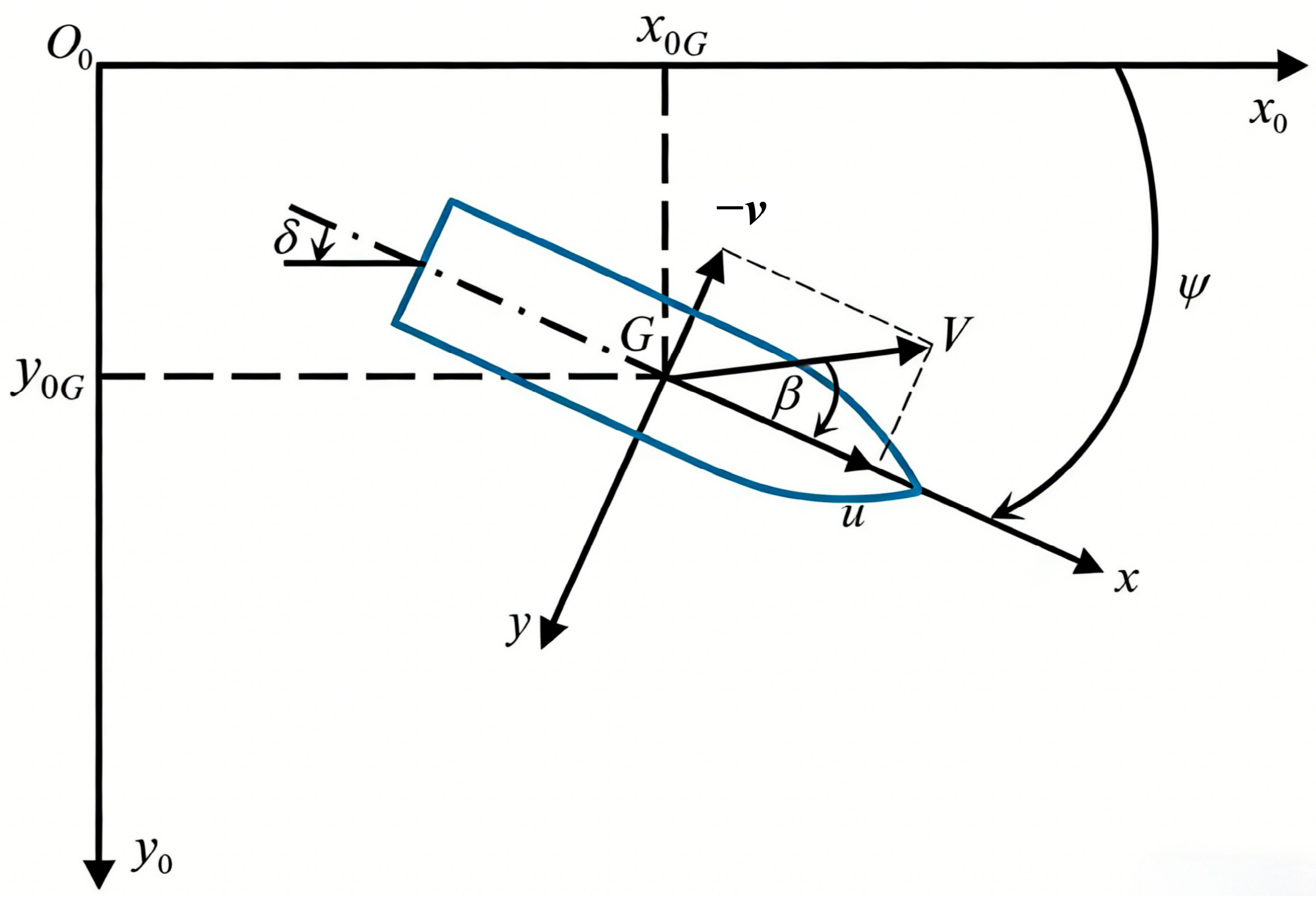
Tailored to the low-speed berthing characteristics of large container ships, this paper establishes a three-degree-of-freedom (3-DOF) planar motion model (surge, sway, and yaw), assuming that the heave, roll, and pitch responses during the berthing process are negligible. As illustrated in Figure 2, an Earth-fixed coordinate system, denoted as O0-x0y0, is established. The kinematic state of the vessel can be described by the position of its center of gravity (x0G, y0G), heading angle ψ, and their respective time derivatives. A body-fixed coordinate system, denoted as G-xy, is defined with its origin located at the ship’s center of gravity, G. The positive x-axis points toward the bow, and the positive y-axis points toward starboard. The variables u and v represent the vessel’s longitudinal and transverse velocities, respectively; r denotes the yaw rate; δ is the actual rudder angle (positive for starboard helm); and β is the drift angle, defined as the angle between the velocity vector at the center of gravity and the x-axis (positive clockwise). The kinematic transformation matrix between these two coordinate systems follows the classical MMG standard method proposed by Yasukawa and Yoshimura [9].
Based on the MMG modeling framework, the total external forces and moments acting on the ship can be decomposed into hull hydrodynamic forces, propeller thrust, rudder forces, and environmental disturbance forces. This paper primarily focuses on evaluating current disturbances, neglecting the minor transverse forces and moments generated by the propeller. The rigid-body dynamic equations of the ship can be expressed as Equation (1):
m ( u · v r ) = X I + X H + X P + X R + X C m ( v · + u r ) = Y I + Y H + Y R + Y C I z z r · = N I + N H + N R + N C
where m represents the total mass of the ship; Izz denotes the moment of inertia about the z-axis; and X, Y, and N are the resultant components of the longitudinal force, transverse force, and yaw moment, respectively. The forces on the right side of the equation can be further decomposed into inertial forces, hull hydrodynamic forces, propeller thrust, rudder forces, and current disturbance forces (denoted by the subscripts I, H, P, R, and C, respectively). Specifically, the calculation of the current disturbance forces, XC, YC, and NC, can be achieved by converting the absolute motion parameters of the ship in calm water into the relative motion parameters between the ship and the current [18].
It is particularly worth noting that XP in the equation represents the four-quadrant propeller thrust. Unlike conventional propellers operating solely in the first quadrant, investigating complex ship maneuvers (e.g., berthing and crash-astern) necessitates the introduction of a four-quadrant thrust model [9]. The calculation formula for XP, as shown in Equation (2), is as follows:
X p = ( π / 8 ) ρ ( 1 t p ) D 2 ( 1 w p ) 2 u 2 + ( 0.7 π n D ) 2 C T
where tP and wP (utilized in calculating the advance speed) denote the thrust deduction fraction and wake fraction, respectively, characterizing the complex nonlinear hydrodynamic interactions between the propeller and the hull. Following the Mathematical Maneuvering Group (MMG) standard method, the thrust deduction factor tP is assumed to remain constant at a given propeller load for simplicity. Conversely, the wake fraction wP varies dynamically during maneuvering motions. To accurately capture this dynamic interaction, wP is modeled as a function of the geometrical inflow angle to the propeller, βp, expressed as Equation (3):
( 1 w P ) / ( 1 w P 0 ) = 1 + { 1 exp ( C 1 | β P | ) } ( C 2 1 )
where wP0 is the wake fraction in straight moving; C1 represents the wake characteristic decay versus βp; and C2 denotes the limit value of (1 − wP)/(1 − wP0) at large | β P | is the water density; n is the propeller rotational speed (rps); D is the propeller diameter; and CT is the four-quadrant thrust coefficient, whose specific calculation and chart mapping will be detailed in Section 2.2.
To perform numerical simulations of the ship control system, Equation (1), combined with added mass and actuator dynamics, is expanded into the system of first-order differential equations in state-space form given in Equation (4):
u · = ( m + m y ) v r + X H + X P + X R / ( m + m x ) v · = ( m + m x ) u r + Y H + Y P + Y R / ( m + m y ) r · = ( N H + N P + N R ) / ( I z z + J z z ) ψ · = r x · G 0 = u cos ψ v sin ψ y · G 0 = u sin ψ + v cos ψ δ · = ( δ r δ ) / T E n · = ( n r n ) / T M
where δr and nr are the commanded rudder angle and commanded rotational speed output by the autopilot, respectively; TE and TM represent the response time constants of the steering gear and the main engine, respectively (reflecting first-order inertial delays); and mx, my, and Jzz denote the longitudinal added mass, transverse added mass, and added yaw moment of inertia, respectively.

2.2. Four-Quadrant Propeller Thrust and Torque

In investigating the four-quadrant hydrodynamic performance of fixed-pitch propellers (FPP), the traditional advance ratio exhibits singularities under conditions of low speed, astern operation, or extremely high slip ratios. Consequently, the hydrodynamic advance angle, βP, is introduced as a singularity-free substitute across all operating conditions [19], as shown in Equation (5):
β p = arctan V a 0.7 π n D
where Va is the speed of advance at the propeller disk; D is the propeller diameter; and n is the propeller rotational speed (rps). βP is defined at the blade section at 0.7 times the propeller radius (0.7R), which is conventionally regarded as the core load-bearing surface representative of the propeller’s overall hydrodynamic characteristics [20].
In this paper, open-water test data for the Wageningen Ka 4-70 ducted propeller equipped with a No. 37 nozzle are utilized. To eliminate the deficiencies of model simplifications present in previous studies and to obtain absolutely precise control inputs for low-speed berthing simulations, this study explicitly incorporates the hydrodynamic thrust coefficient generated by the nozzle, CTN, into the mathematical modeling. It is calculated as a nonlinear contribution to the overall thrust, thereby authentically reproducing the fluid interference effects during four-quadrant propulsion [21].
To facilitate the numerical solution of the control system, this paper adopts a mathematical expression, given in Equation (6), based on a 20-term Fourier series expansion to accurately fit the total thrust coefficient CT, torque coefficient CQ, and nozzle thrust coefficient CTN of the Ka 4-70 propeller across all four quadrants:
C T = k = 0 20 A k ( T ) cos ( k β P ) + B k ( T ) sin ( k β P ) C Q = k = 0 20 A k ( Q ) cos ( k β P ) + B k ( Q ) sin ( k β P ) C T N = k = 0 20 A k ( T N ) cos ( k β P ) + B k ( T N ) sin ( k β P )
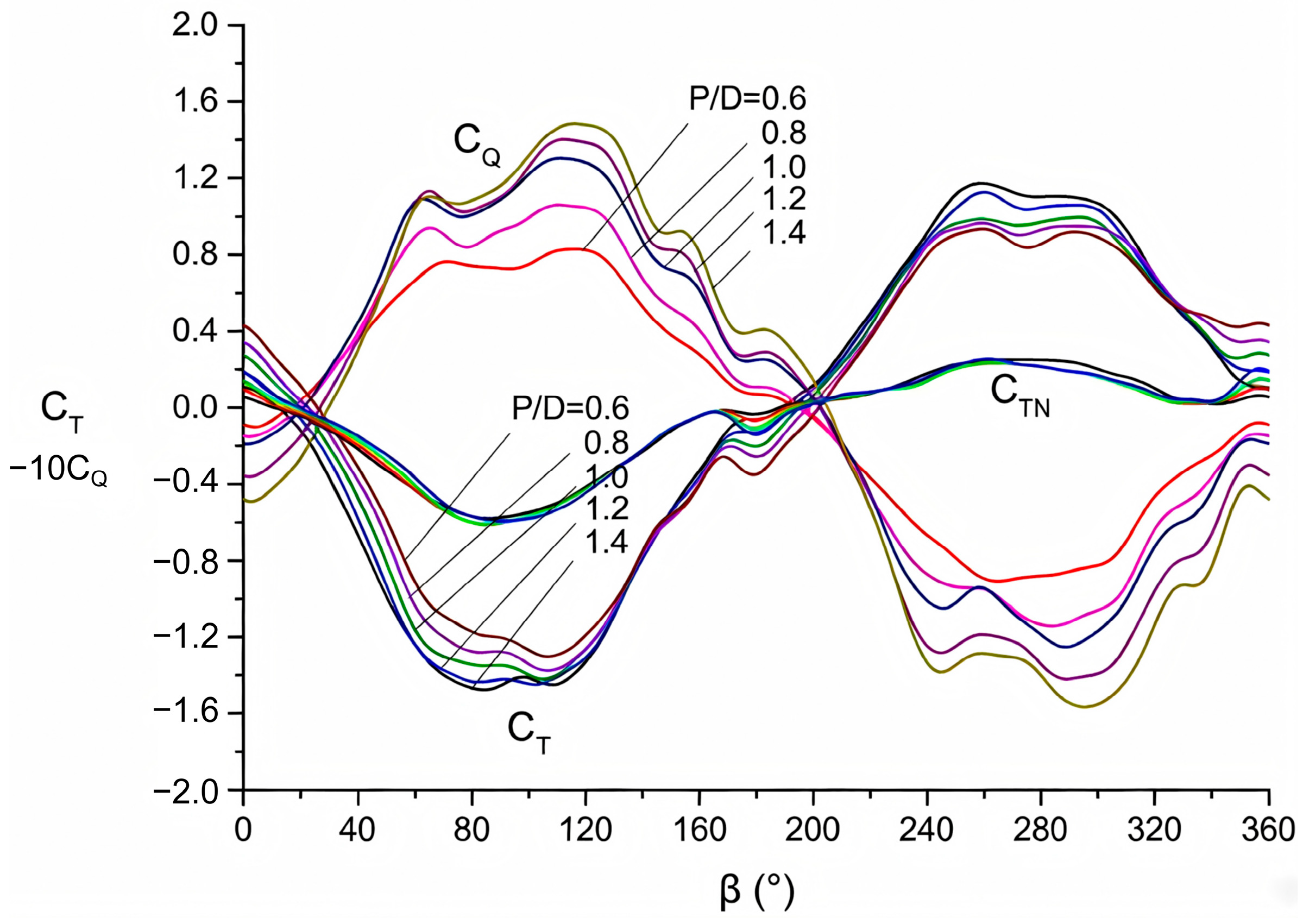
where Ak and Bk denote the Fourier expansion coefficients corresponding to the hydrodynamic coefficients. The determination of these terms is closely related to the key geometric parameters of the propeller, namely the number of blades, blade area ratio, and pitch-to-diameter ratio. Specifically, the values of Ak and Bk can be obtained from Appendix A Table A1 of the hydrodynamic coefficient data in Ref. [22]. For completeness, the full list of Fourier coefficients adopted in this study has been presented in detail in Table A1 of the Appendix A. To enhance computational efficiency and the quality of curve visualization during subsequent data processing, a customized MATLAB R2023b numerical computation program was written to iteratively solve for the four-quadrant open-water performance curves of the propeller. Figure 3 visually illustrates the highly nonlinear four-quadrant characteristics of the propeller thrust coefficient CT, torque coefficient CQ, and nozzle thrust coefficient CTN as they vary with the hydrodynamic advance angle βP and pitch ratio.

2.3. Hydrodynamic Model of Bare Hull and Rudder

According to fluid mechanics principles, added mass and added moment of inertia represent the inertial resistance of the fluid against the ship’s acceleration. Within the MMG model, the calculation formulas for fluid inertial forces and moments can be expressed as Equation (7):
m x m = 1 100 0.398 + 11.97 C b 1 + 3.73 d m B 2.89 C b L B 1 + 1.13 d m B + 0.175 C b L B 2 1 + 0.541 d m B 1.107 L B d m B m y m = 0.882 0.54 C b 1 1.6 d m B 0.156 L B 1 0.673 C b + 0.826 d m B L B 1 0.678 d m B 0.638 C b d m B L B 1 0.669 d m B J z z m = L 100 33 76.85 C b 1 0.784 C b + 3.43 L B 1 0.63 C b
where mx, my, and Jzz denote the longitudinal added mass, transverse added mass, and added yaw moment of inertia, respectively. Their magnitudes are comprehensively influenced by the ship length L, breadth B, mean draft dm, and block coefficient Cb [23].
In ship maneuvering modeling, the accurate determination of viscous hydrodynamic coefficients is of critical importance. Although a variety of computational approaches have been developed, this study employs the empirical formula proposed by Kijima and Nakiri [24] to predict ship maneuvering performance, taking into account its effectiveness and computational efficiency for engineering applications. The resulting coefficients are summarized in Table 1. To ensure the transparency of the mathematical model, it should be clarified that all nonlinear viscous hydrodynamic derivatives listed in Table 1 were obtained directly by applying this empirical formula. The principal dimensions of the B-573 container ship, namely the ship length, breadth, draft, and block coefficient, were used as direct input parameters. The fundamental expression of the viscous hydrodynamic component is given by Equation (8):
X H = X ( u ) + X v v v 2 + X v r v r + X r r r 2 Y H = Y v v + Y r r + Y v | v | v | v | + Y r | r | r | r | + Y v v r v 2 r + Y v r r v r 2 N H = N v v + N r r + N v | v | v | v | + N r | r | r | r | + N v v r v 2 r + N v r r v r 2
where X(u) is the calm-water resistance of the ship in the surge direction, and parameters such as Xvv, Yv, and Nv represent highly nonlinear non-dimensional viscous hydrodynamic derivatives.
To quantitatively and systematically evaluate the tracking performance and parameter sensitivity of the control system throughout the entire berthing process, this study adopts the cross-track error (Cross Track Error, XTE) as the core quantitative performance metric. This indicator is obtained by discretely integrating the instantaneous normal deviation distance over the entire simulation process, thereby comprehensively reflecting the overall magnitude of the vessel’s deviation from the planned target path. The sensitivity variation rate relative to the baseline condition, denoted by Srate, is defined in Equation (9):
S r a t e = | X T E perturbed X T E baseline | X T E baseline × 100 %
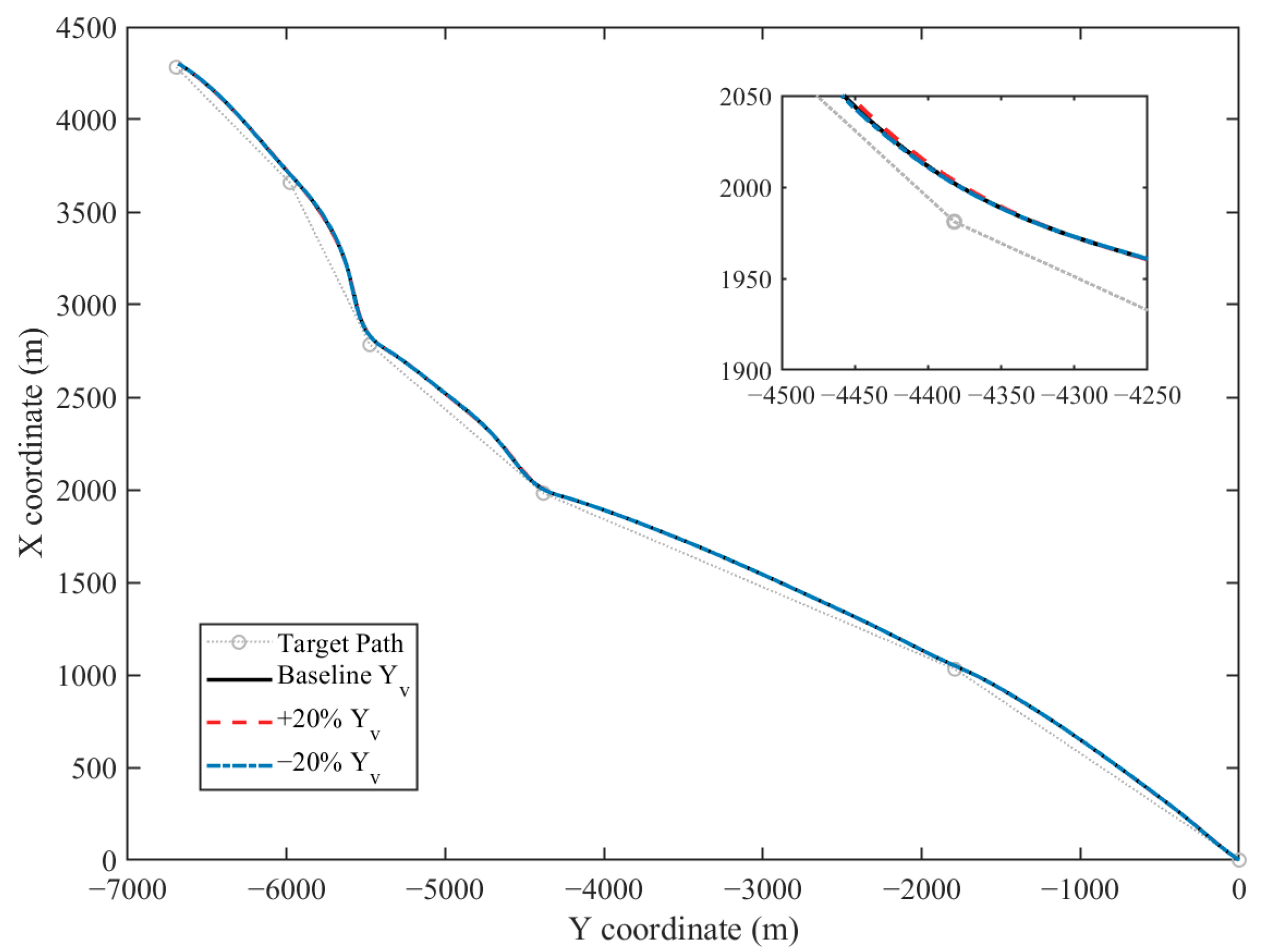
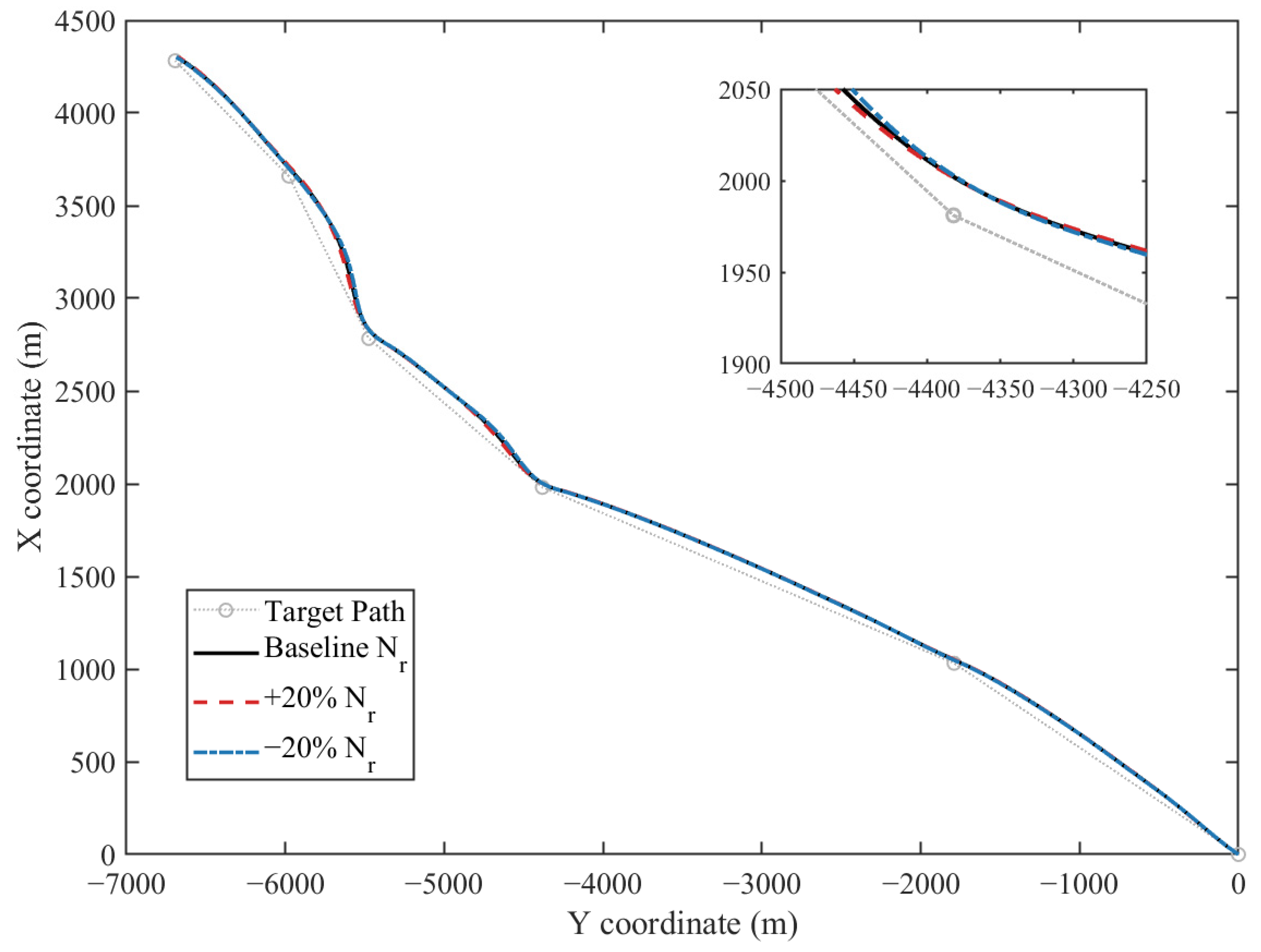
Based on this error-driven computational framework, the system was rigorously tested under a 1.0 m/s cross-current condition. When the sway derivative Yv and the yaw-rate derivative (i.e., the yaw damping derivative Nr) were individually varied by ±20%, the corresponding sensitivity variation rates Srate over the entire voyage were recorded as only 0.29% and 0.64% for Yv, and 1.18% and 1.91% for Nr, respectively. As evidenced by the enlarged views in Figure 4 and Figure 5, although such substantial parameter perturbations inevitably induced slight deviations during the transient turning phases at the waypoints, the dynamic line-of-sight (LOS) mechanism rapidly suppressed yaw oscillations and realigned the vessel with the intended route. These cumulative deviations, which remained at a microscopic level, provide strong evidence that the proposed control strategy possesses excellent robustness, effectively decoupling trajectory-tracking accuracy from the inherent bounded uncertainties in the vessel’s underlying yaw and sway dynamics.
To conduct a parametric analysis of the ship’s longitudinal resistance, this paper introduces the Todd 60 series hull form resistance model. This model encompasses a broad range of design proportions for single-propeller merchant ships and possesses high reliability in evaluating conventional hull resistance. The empirical regression equation for estimating hull resistance is expressed as Equation (10):
C t = f V s L w l , L B , B T , C b , x b
where VS is the absolute speed of the ship; Lwl is the waterline length; and xb is the longitudinal position of the center of buoyancy (expressed as a percentage of the ship length, %L, from midships). For a standard ship length of 122 m, the polynomial regression equation for its total resistance coefficient Ct122 is:
C t 122 = A 1 + A 2 L B + A 3 B T + A 4 C b + A 5 x b + A 6 L B 2 + A 7 B T 2 + A 8 C b 2 + A 9 x b 2 + A 10 L B B T + A 11 L B C b + A 12 L B x b + A 13 B T C b + A 14 B T x b + A 15 C b x b + A 16 C b 2
After calculating the total resistance coefficient Ct122 for the 122 m standard ship length via Equation (11), the actual total resistance coefficient for any target ship length can be derived by introducing a scale correction factor. Furthermore, considering the flow field deterioration and wake interference effects under astern conditions during four-quadrant maneuvers, this study sets the ship’s resistance coefficient during astern operation to 1.2 times that of the ahead condition.
During berthing maneuvers, the hydrodynamic forces and moments generated by the rudder play a decisive role in trajectory correction. Considering the complex interference among the hull, propeller, and rudder, the rudder force components, as given in Equation (12), can be expressed as:
X R = ( 1 t R ) F N sin δ Y R = ( 1 + a H ) F N cos δ N R = ( x R + a H x H ) F N cos δ
where tR, aH, and xH represent the interaction interference coefficients between the hull and the rudder, typically obtained through experiments or high-fidelity numerical simulations; xR is the longitudinal distance from the rudder’s center of pressure to the ship’s center of gravity; and δ is the actual rudder angle. The core calculation formula for the rudder normal force, FN, is expressed as Equation (13):
F N = 1 2 ρ A R f α U R 2 sin α R
where ρ is the water density; AR is the rudder area; and fα is the lift coefficient slope when the rudder blade’s angle of attack is zero. UR is the effective inflow velocity to the rudder, and αR is the effective rudder angle of attack. To accurately predict rudder forces in simulations, profound attention must be paid to the calculation of UR and αR, as they are subject to deeply coupled influences from the propeller’s intensely alternating slipstream and the hull’s wake field under four-quadrant operations [25].

3. Modeling of Berthing Autopilot System

3.1. Way-Point LOS Guidance

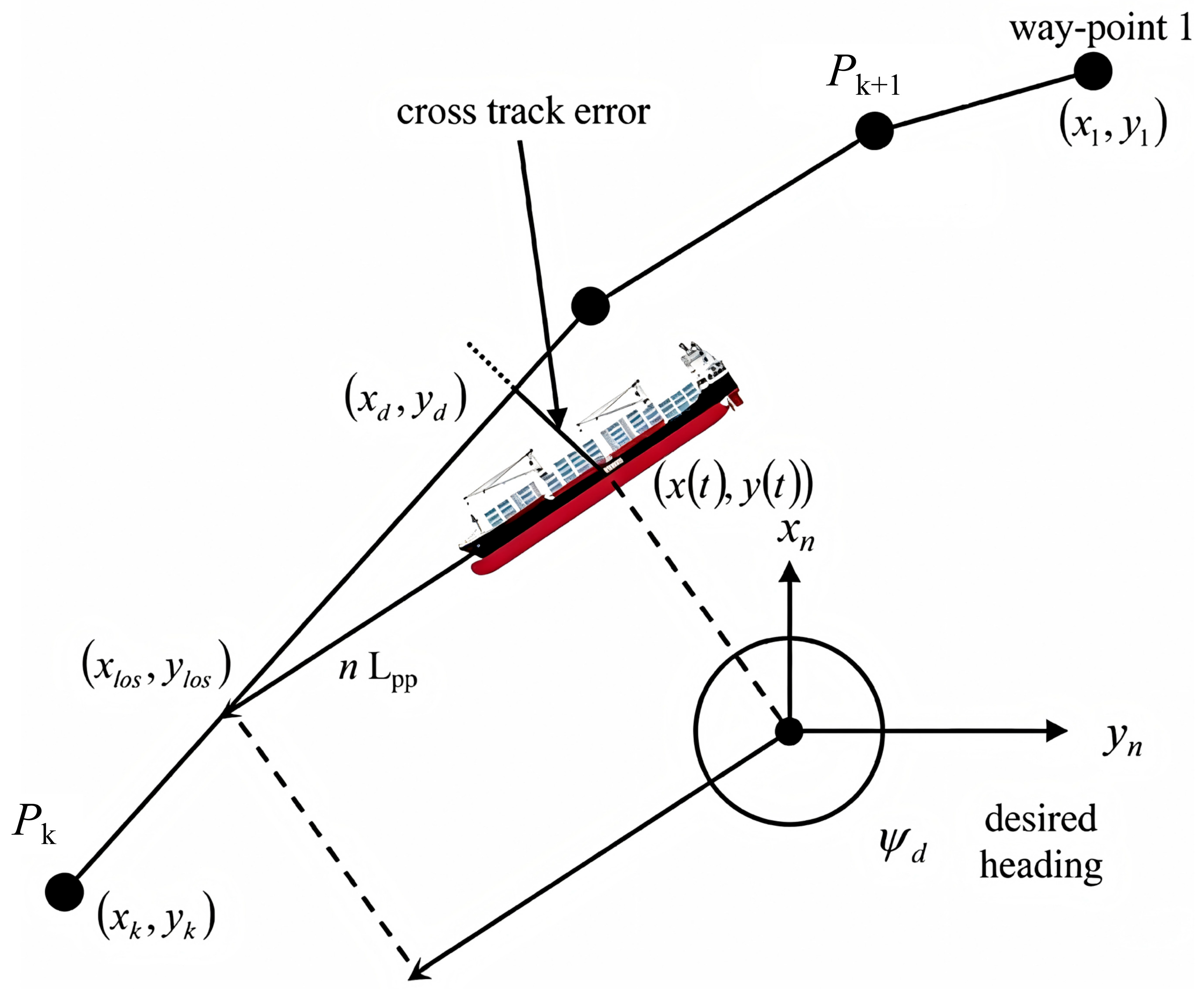
The Line-of-Sight (LOS) guidance method is frequently employed to control the heading between two waypoints, thereby enabling the vessel to navigate accurately along a predetermined route toward the subsequent waypoint. As illustrated in Figure 6, the LOS guidance law calculates the desired heading angle by introducing the XTE and eliminates this error via the steering system. Ultimately, high-precision track following is achieved by converging the heading angle to the desired value.
To fully define the logic of the LOS guidance law, the calculation of the target intersection point (xlos, ylos) on the path is based on the classical enclosure-based steering principle. Specifically, the coordinates of this intersection point are determined by solving the system of equations formed by the path line and a circle centered at the vessel’s current position, (x(t), y(t)), with a radius of R0 [26]. The desired heading angle, ψd, can then be calculated using Equation (14):
ψ d = atan 2 ( y los y ( t ) ,   x los x ( t ) )
where the coordinates of the target intersection point, (xlos, ylos), are determined from Equation (15) by solving the system consisting of the path-line equation and the enclosure-circle equation centered at the ship’s center of gravity with an acceptance radius of R0 [26]:
[ x los x ( t ) ] 2 + [ y los y ( t ) ] 2 = R 0 2 y los y k x los x k = y k + 1 y k x k + 1 x k = constant
When solving for the coordinates of the LOS intersection point, the physically meaningful real solution should be selected from the equation system according to the vessel’s sailing direction, namely the direction of the path-segment vector pk+1pk, so as to ensure that the LOS target point (xlos, ylos) always lies on the predefined path segment ahead of the vessel. To achieve continuous navigation over multiple path segments, a waypoint-switching mechanism must be introduced. The conventional Circle of Acceptance mechanism is an enclosure-based switching strategy, which requires the vessel position (x(t), y(t)) to enter a circular region centered at the current target waypoint pk+1 (xk+1, yk+1) with a radius of Rk+1. The corresponding switching criterion is given by Equation (16):
x k + 1 x ( t ) 2 + y k + 1 y ( t ) 2 R k + 1 2
In open-water conditions or during the conventional path-following stage, the aforementioned enclosure-circle method imposes unnecessarily strict constraints on the vessel’s lateral cross-track deviation. Therefore, a more flexible along-track distance criterion, i.e., sk+1s(t) ≤ Rk+1, is generally adopted during the normal navigation stage, with the acceptance radius set to a constant value (typically Rk+1 = 2Lpp based on empirical practice), so as to ensure smooth path switching without excessive interference from lateral tracking errors. However, during the low-speed autonomous berthing phase of a container ship, the system is subject to stringent spatial and physical constraints on terminal positioning accuracy. Under such circumstances, the along-track criterion alone is no longer sufficient to satisfy the requirements of safe berthing, and the two-dimensional spatial constraint provided by the enclosure circle must be reintroduced and reinforced. To this end, this study proposes a nonlinear dynamic acceptance-radius strategy. As the vessel approaches the final berthing point, the acceptance radius R0 is no longer kept constant; instead, it is reduced nonlinearly according to the real-time distance d between the vessel and the target. This reduction follows the quadratic decay rule defined in Equation (17):
R 0 ( d ) = 0.1 L p p + 1.9 L p p d D r e f 2
where Dref denotes the reference distance for entering the terminal approach stage, and Lpp represents the vessel length between perpendiculars. This strategy ensures that the guidance system retains sufficient tolerance during the initial phase of approaching the berthing area, while smoothly and proactively tightening the allowable spatial error margin during the final transient berthing process. As a result, R0 is strictly reduced to 0.1Lpp, thereby substantially improving the terminal accuracy of autonomous berthing maneuvers at the algorithmic level.

3.2. PI and PD Controllers

This system employs a closed-loop PD controller to regulate the steering gear actuator, thereby altering the ship’s heading. Due to the immense inertia and pure delay nonlinear characteristics of large container ships during maritime navigation, conventional Proportional–Integral–Derivative (PID) control is highly susceptible to integral windup when encountering large drift angles. Consequently, the integral term is omitted in the heading control loop, and a simplified PD control law, given by Equation (18), is adopted:
δ r = K p e + K d d e d t
where Kp is the proportional gain; Kd is the derivative time constant; e = ψd-ψ is the error between the desired heading and the current heading; and de/dt is the rate of change in the heading error.
Furthermore, to eliminate the static error in longitudinal speed control and enhance the system’s control precision, this study utilizes a PI controller, as shown in Equation (19),to regulate the propeller rotational speed, thereby achieving precise acceleration, deceleration, and astern berthing under four-quadrant propulsion:
n r = K p 2 e 2 + 1 T i e 2 d t
where Kp2 is the proportional gain of the speed loop; Ti is the integral time constant; and e2 = udu is the error between the desired speed and the current speed.
To further validate the robustness of this PD/PI control system under realistic and complex hydrodynamic disturbances, subsequent empirical research will rely on joint monitoring conducted by the “Zijingang” comprehensive research vessel and an accompanying unmanned surface vehicle (USV). By extracting full-scale six-degree-of-freedom (6-DOF) motion response data acquired from the shipborne high-frequency Inertial Navigation System (INS), the aforementioned proportional and derivative gains can be adaptively and dynamically calibrated, thereby compensating for the theoretical robustness limitations of traditional linear controllers under extreme sea states.

3.3. Path Planning in the Yangshan Port

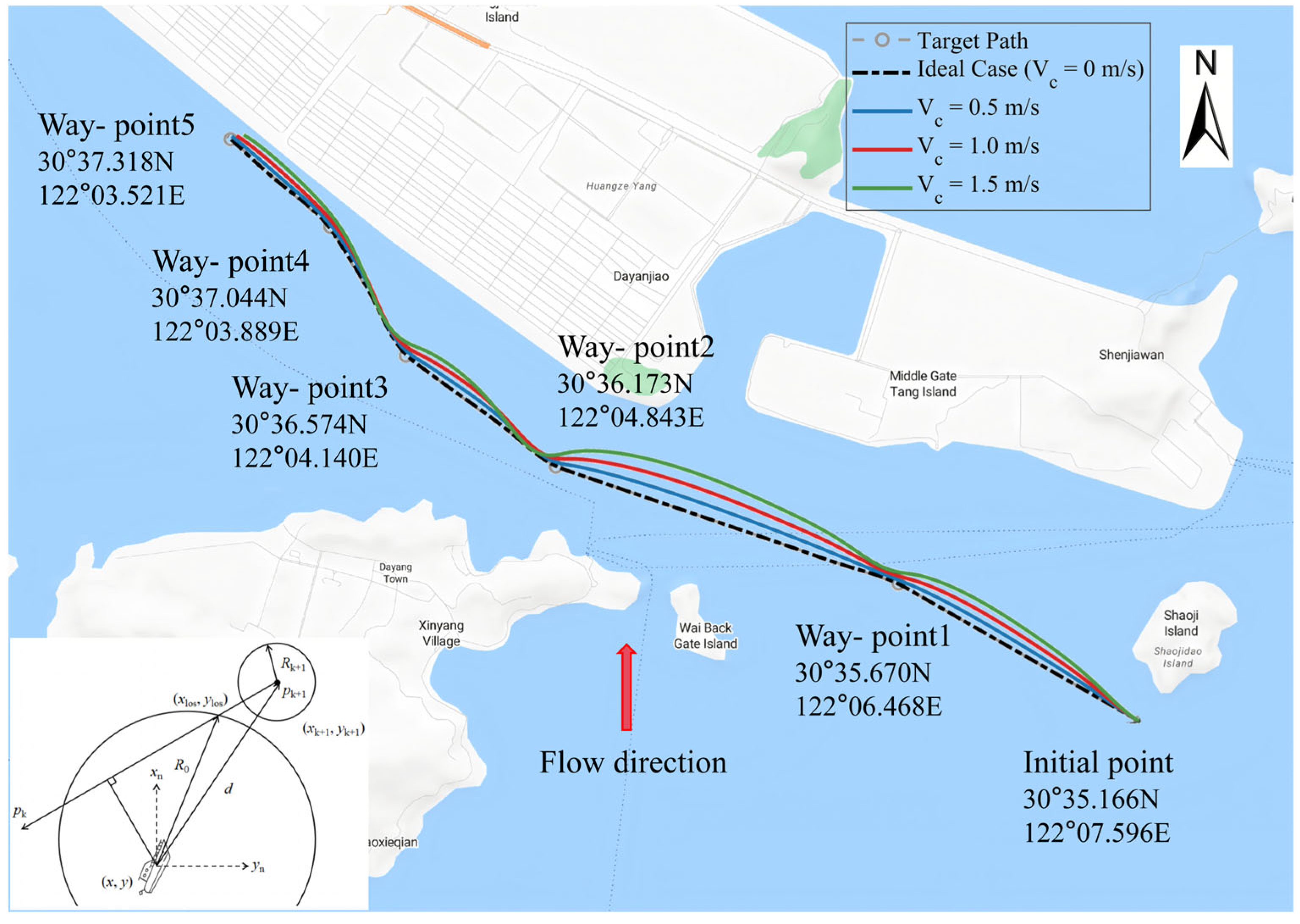
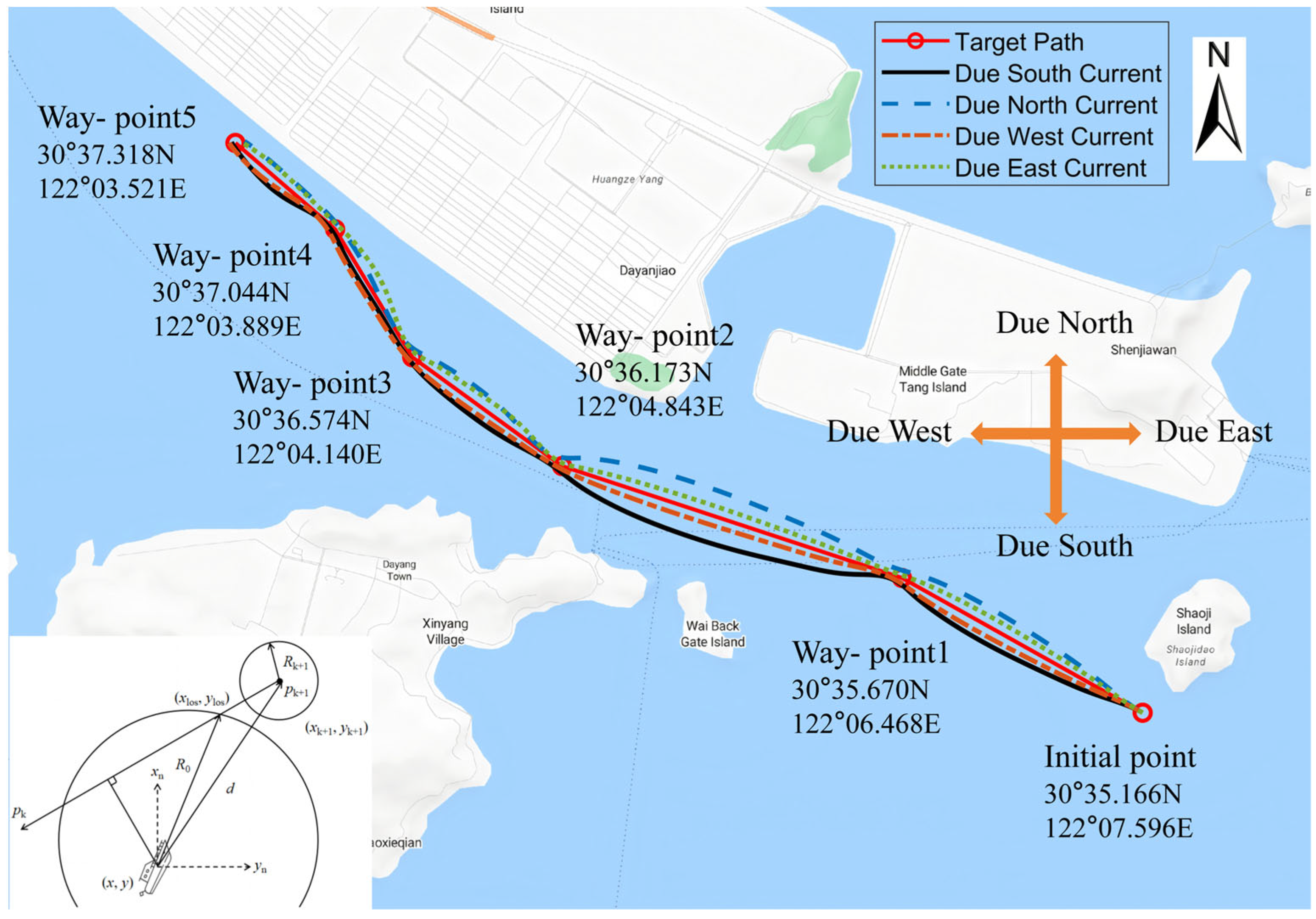
The real terminal berthing process is a highly nonlinear transient dynamic problem that involves not only the vessel’s complex spatial motions, but also the coupled effects of wind, waves, swell, currents, and the restricted hydrological conditions of port environments. To effectively isolate and highlight the underlying hydrodynamic characteristics of four-quadrant propeller propulsion during extreme maneuvering, this study applies a reasonable dimensional reduction to the complex physical scenario. Specifically, cross-comparative tests covering several typical current directions, including due south, due north, due west, and due east, were introduced, together with comparative cases involving multiple current-intensity levels, namely the ideal no-current condition of 0 m/s and the disturbed conditions of 0.5 m/s, 1.0 m/s, and 1.5 m/s (which were specifically evaluated under the due north current direction), so as to evaluate the maneuvering response and control performance of the system under key environmental variables.
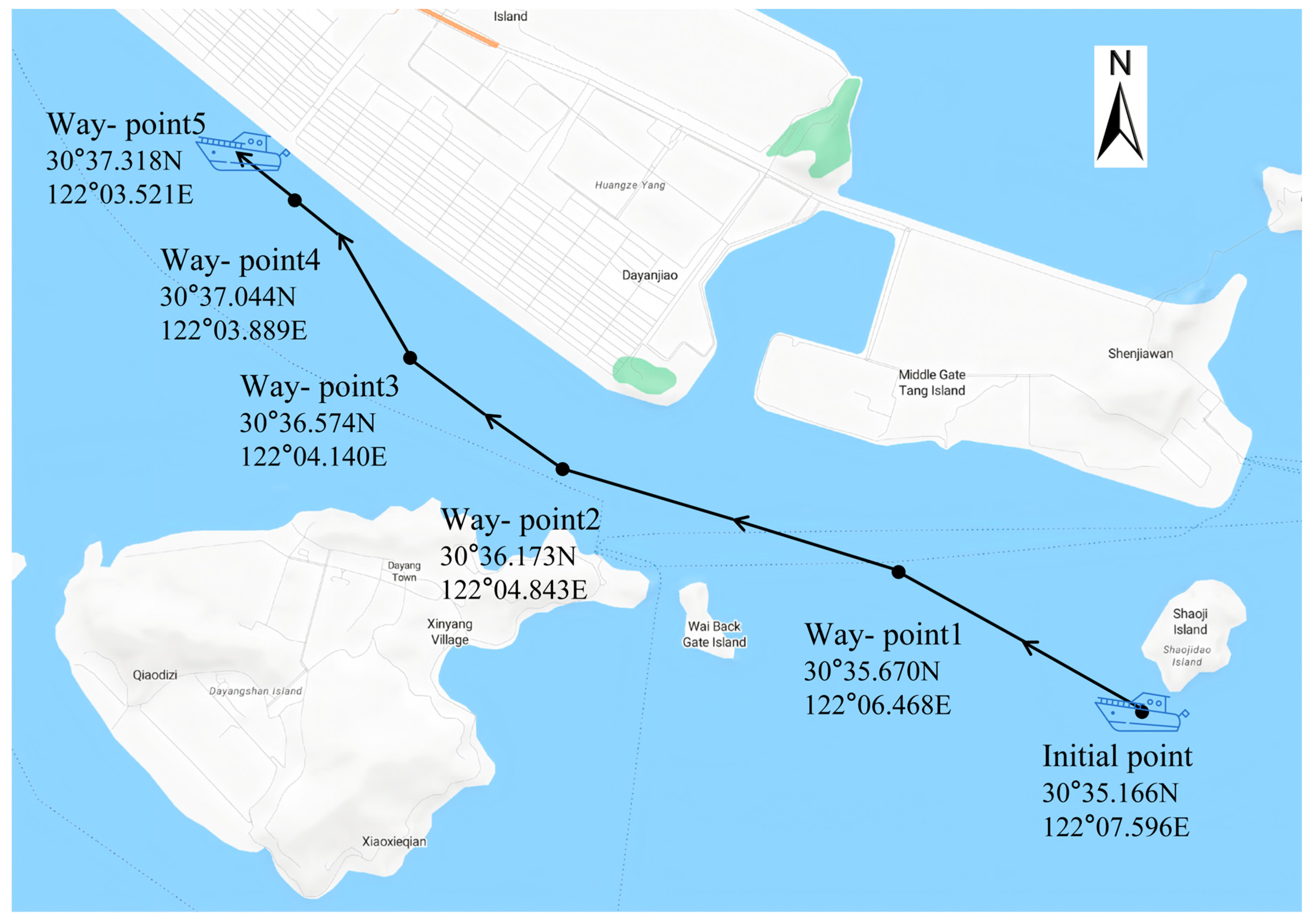
The berthing path plan for the B-573 container ship, set against the backdrop of Yangshan Port in Zhoushan, China, is illustrated in Figure 7. Departing from the initial point, the vessel sequentially passes through Way-points 1 to 4 within the channel. Upon arriving at the berth buffer zone where Way-point 5 is located, the ship reduces its longitudinal speed to zero and ultimately completes the berthing process through a series of refined operations, including shifting maneuvers, astern acceleration, and astern deceleration. This entire procedure fully stimulates the propeller’s operational potential across all four quadrants. It is noteworthy that this trajectory tracking framework, combining four-quadrant propulsion and dynamic LOS, is not only applicable to surface vessels; its underlying control logic can also be smoothly transplanted and applied to the near-bottom hovering and high-precision underwater docking operations of autonomous underwater vehicles (AUVs).

4. Simulation Results

4.1. Turning Test Verification

By comprehensively considering solution accuracy and numerical stability, this study employs the classical explicit fourth-order Runge–Kutta (RK4) method to iteratively solve the high-dimensional ordinary differential equations governing vessel motion. Given that the target ship exhibits large inertia and relatively slow hydrodynamic response during low-speed berthing maneuvers, a fixed time step of 1 s was adopted for numerical integration. This time step not only satisfies the requirements of numerical stability and minimizes local truncation error, but also effectively avoids excessive computational cost. The maximum global simulation duration was set to 10,000 s (10,000 integration steps). However, since the primary objective of the simulation is dynamic spatial trajectory tracking, the iterative termination criterion was defined by a preset spatial boundary-triggering mechanism rather than a single time threshold: the computation is terminated automatically once the vessel’s longitudinal coordinate reaches the target boundary of the berthing area at 4300 m. In addition, the principal dimensions of the target container ship B-573 and the benchmark validation ship S-175, together with the key hydrodynamic parameters of their propeller–rudder systems, are listed in detail in Table 2.
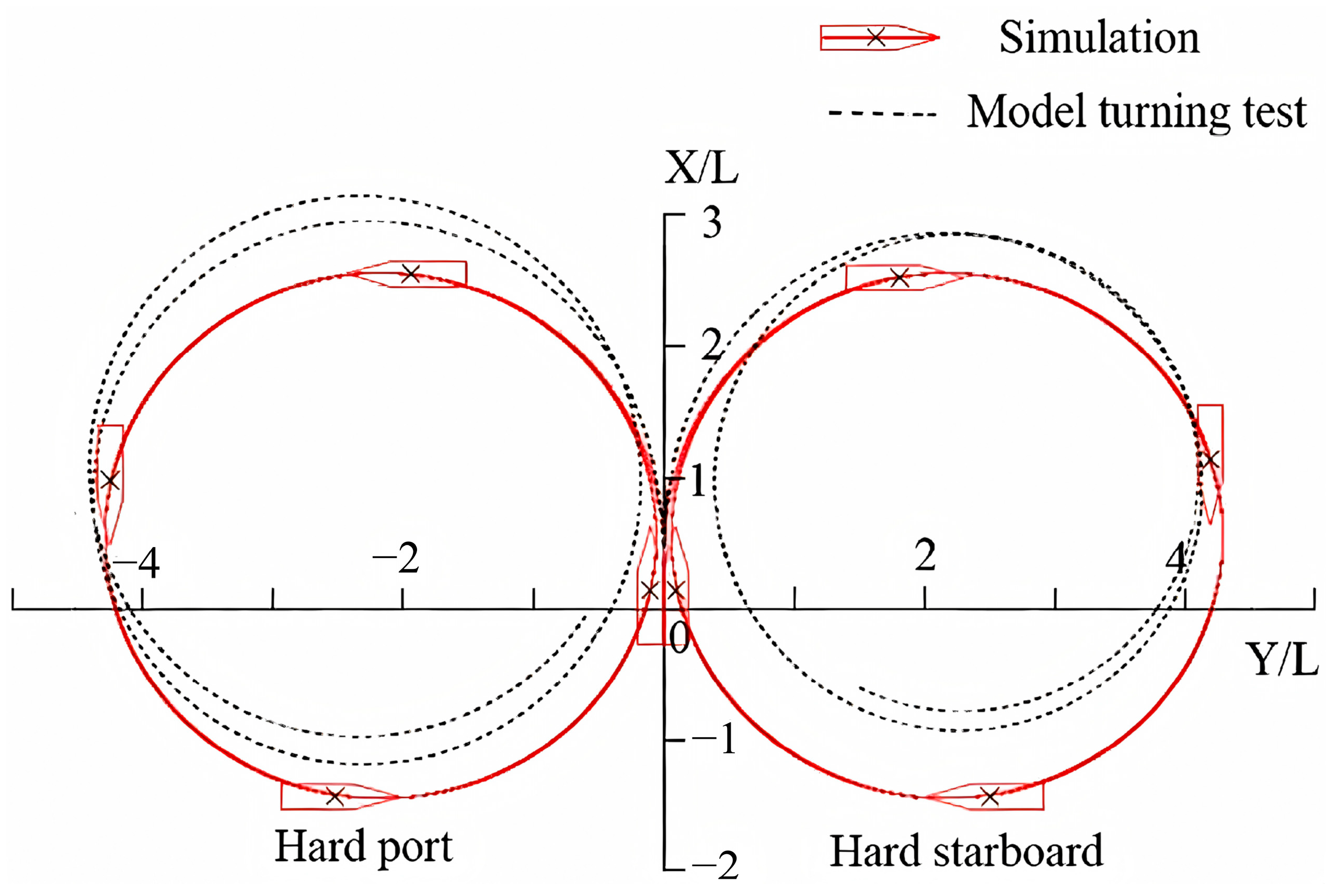
To verify the correctness of the numerical solver and control logic, a turning maneuver simulation was first conducted targeting the standard benchmark ship S-175. Figure 8 illustrates the ship’s motion trajectories under hard port and hard starboard rudder angles (±35°). As observed from the simulation results (Table 3), since the theoretical solution of the computer program excludes random disturbances present in actual sea states, the turning trajectories for hard port and hard starboard exhibit an ideally symmetrical distribution. Compared with the physical model test data, the errors of core turning parameters output by the simulation in this study, such as turning diameter, tactical diameter, and advance, are all controlled within 15%, which fully satisfies the validation standards in the field of control engineering.

4.2. Dynamic Trajectory Tracking and Interference Resistance

Under ideal conditions without environmental disturbances, the vessel trajectory closely coincides with the planned path, exhibiting an extremely smooth transition. To ensure that the system maintains optimal tracking performance in the presence of external environmental disturbances, this study determined the optimal PD controller parameters through repeated iterations of the environmental compensation loop, namely a proportional gain of KP = 4.66 and a derivative gain of KD = 1.00, enabling the cross-track error (XTE) of the system to converge successfully to a global minimum. This result is highly consistent with the findings of recent related studies, which have shown that optimized PID-type trajectory-tracking algorithms can significantly improve the navigation stability of surface vehicles under severe wind, wave, and current disturbances [27].
Based on the optimized control parameters above, Figure 9 and Figure 10 present the trajectory performance of the B-573 container ship during simulated berthing at Yangshan Port, Zhoushan, under multiple current-intensity levels (0 m/s, 0.5 m/s, 1.0 m/s, and 1.5 m/s, which are specifically set as due north currents in the Earth-fixed coordinate system). and several typical current directions, including due south, due north, due west, and due east (all explicitly defined within the Earth-fixed coordinate system). The simulation results indicate that, after current disturbances are introduced, although the vessel inevitably experiences noticeable initial lateral drift under external hydrodynamic action and during the transient waypoint-switching phase, it is still able to pass through all preset waypoints sequentially and accurately under the rapid corrective action of the dynamic line-of-sight (LOS) guidance mechanism. Throughout the entire berthing-approach process, the tightly coupled propulsion system successfully constrains the cross-track error under various complex operating conditions within the safety margin required for terminal operations, thereby confirming the practical reliability of the proposed control system in dealing with complex environmental disturbances in real port environments.
To quantitatively and multidimensionally evaluate the overall tracking performance of the PD/PI control system and the dynamic LOS guidance law under complex current disturbances, this study introduces the instantaneous cross-track error (Cross-Track Error, XTE) as the fundamental computational basis, and further extracts the maximum cross-track error (Max XTE), root mean square error (RMSE), and mean absolute error (MAE) as the core quantitative performance metrics.
Within the line-of-sight (LOS) guidance framework, the instantaneous cross-track error, XTE(t), at time t is defined as the minimum perpendicular Euclidean distance from the vessel’s current center-of-gravity position (x(t), y(t)) to the prescribed target path, which is formed by the line segment connecting the current waypoint Pk(xk, yk) and the next waypoint Pk+1(xk+1, yk+1). Let the general equation of the target path be Ax + By + C = 0, where A = yk+1yk, B = −(xk+1xk), and C = xk+1ykxkyk+1. Then, the expression for XTE(t) can be written as follows:
X T E ( t ) = | A x ( t ) + B y ( t ) + C | A 2 + B 2
Based on the discrete simulation data over the entire voyage (with a total of N time steps), the three core performance metrics are calculated as follows. Maximum cross-track error (Max XTE): this metric measures the extreme transient overshoot of the vessel from the planned path when subjected to abrupt external current disturbances or during large-angle waypoint-switching maneuvers:
M a x   X T E = max i [ 1 , N ] | X T E ( i ) |
Root mean square error (RMSE): this metric is highly sensitive to large deviations and is used to quantify the overall dispersion of the vessel trajectory from the planned path, as well as the disturbance-rejection stability of the system throughout the entire voyage [28]:
R M S E = 1 N i = 1 N X T E ( i ) 2
Mean absolute error (MAE): this metric eliminates the offsetting effect between positive and negative errors, and intuitively reflects the system’s average compensation capability and steady-state tracking accuracy over the entire spatial domain [28]:
M A E = 1 N i = 1 N | X T E ( i ) |
When evaluating the maneuvering accuracy of large ships, especially the target vessel of this study, the B-573 (with a length of L = 172 m and a breadth of B = 32.2 m), absolute errors must be interpreted in conjunction with the ship’s principal dimensions. As shown in Table 4, under the ideal no-current condition (0.0 m/s), the system exhibits a Max XTE of only 14.43 m (less than 0.5B), while the MAE, which characterizes the global steady-state accuracy, is as low as 2.47 m (less than 0.1B), demonstrating excellent baseline path-following capability. When the external current intensity increases to 1.0 m/s, the resulting Max XTE rises to 227.00 m, most of which occurs at the turning points associated with large-angle waypoint switching. For a large vessel of approximately 50,000 tons, this transient lateral deviation of about 1.3L is a physically inevitable lagging phenomenon caused by the vessel’s substantial yaw inertia under the superposition of abruptly varying hydrodynamic loads. However, compared with this extreme transient overshoot, the global MAE (85.50 m) and RMSE (98.64 m) exhibit a significant convergent reduction, with their mean values decreasing by approximately 62% relative to the peak error. This indicates that, although lateral drift is unavoidable at the instant of heading transition, the control system is capable of rapidly implementing effective dynamic correction throughout a voyage lasting more than ten minutes under continuous current disturbances. These quantitative results fully confirm that the dynamic LOS guidance mechanism and the PD/PI control algorithm successfully decouple the bounded uncertainty arising from the underlying large-inertia dynamics of the vessel. While allowing for physically reasonable transient overshoot, the proposed method demonstrates strong disturbance-rejection robustness and heading stability.
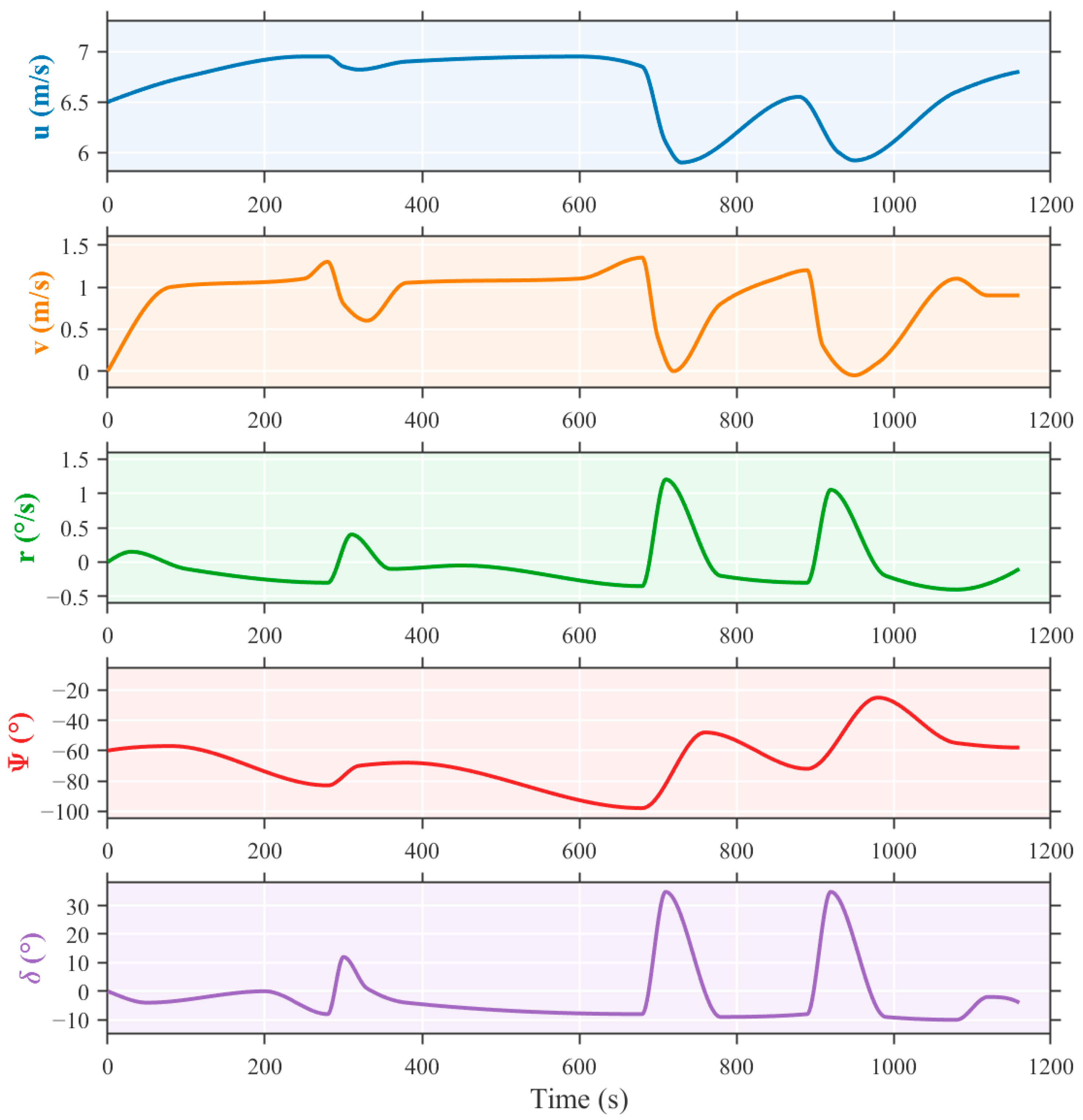
In the trajectory-planning simulation of the B-573 container ship under a current disturbance of 1.0 m/s, the voyage from the initial point to the final berthing point (Waypoint 5) lasted a total of 19 min 25 s. Figure 11 presents the time histories of the longitudinal velocity u, lateral velocity v, yaw rate r, heading angle Ψ, and rudder angle δ during this process. As can be observed from the figure, at the stages where significant heading corrections were performed, all motion variables responded rapidly while maintaining smooth transitions, demonstrating that the closed-loop PD control system possesses a satisfactory degree of control stability.

4.3. Stopping with Berthing Autopilot Test

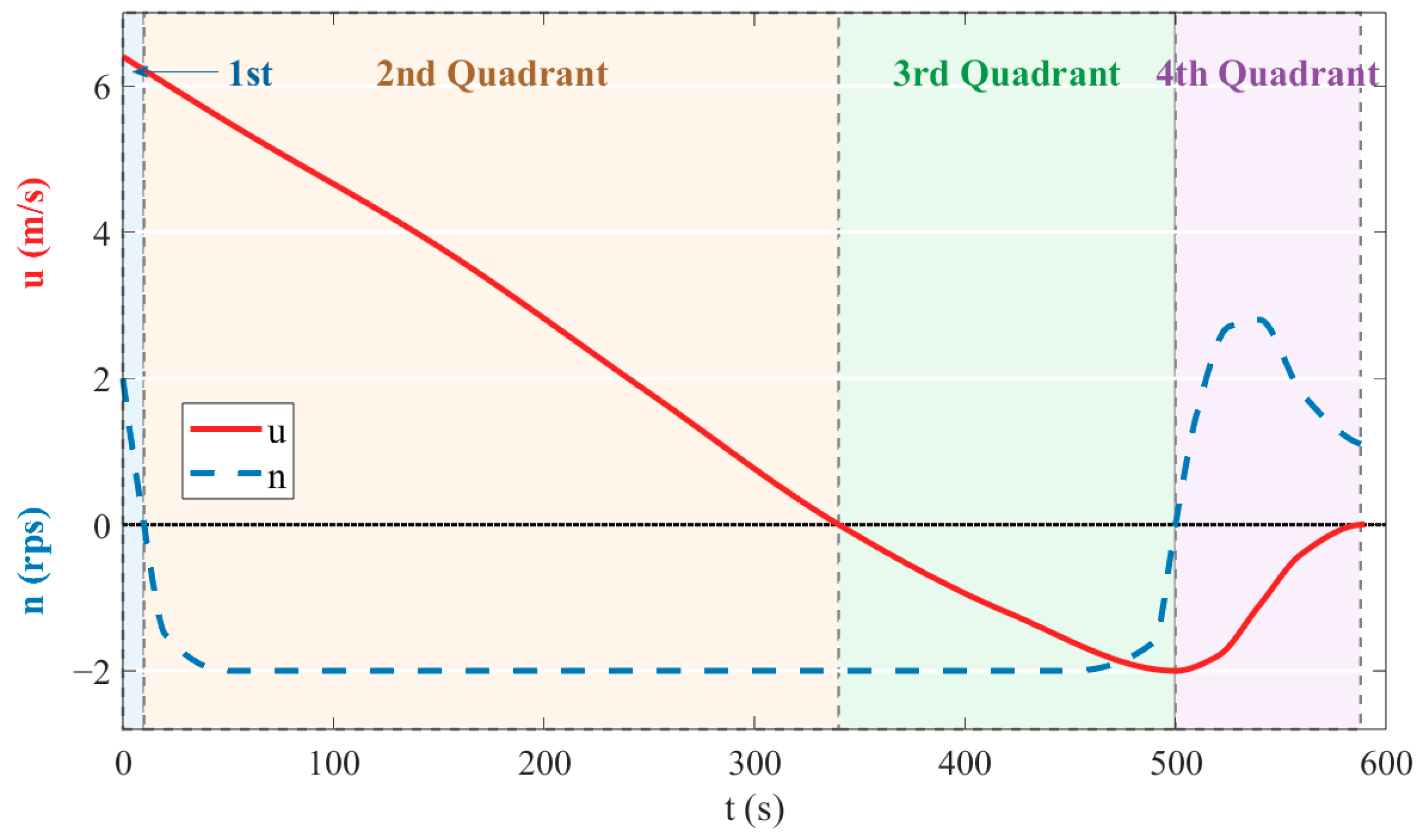
As the vessel approaches Way-point 5, the PI controller of the autopilot system engages, commanding the main engine to reverse to achieve propeller braking and astern operation. To prevent propeller blade cavitation and mechanical overload, the control algorithm strictly constrains the limit rotational speed of the propeller under astern conditions to n = −2 rps. Figure 12 reveals the transient mapping relationship between the longitudinal velocity and the propeller rotational speed during this complex shifting maneuver, which constitutes a nonlinear kinematic boundary condition that must be precisely addressed in current advanced autonomous berthing path planning based on graph search algorithms [29].
Simulation data indicate that the ship took 588 s to decelerate from an initial approach speed of 6.4 m/s to zero, subsequently accelerating astern to −2 m/s before finally coming to a completely stable halt. The entire braking process consecutively traversed the four hydrodynamic quadrants of the propeller: the first quadrant (positive speed–positive rotation), the second quadrant (positive speed–negative rotation), the third quadrant (negative speed–negative rotation), and the fourth quadrant (negative speed–positive rotation).

5. Conclusions

Addressing the profound nonlinear hydrodynamic coupling and complex maneuverability challenges faced by large ships during berthing in restricted waters, this paper successfully constructed a high-precision autonomous berthing and navigation control system that integrates four-quadrant propeller hydrodynamic characteristics. Through the systematic modeling and numerical simulation in this study, the following principal conclusions are drawn:
(1)
Based on the improved MMG framework, this study incorporates nonlinear thrust and torque mappings over all four propeller quadrants. Through benchmark comparisons with the turning-test data of the S-175 ship model, the underlying numerical solver and kinematic model were validated, with the errors of the key parameters, namely the turning diameter and advance, being strictly controlled within 15%.
(2)
By integrating a PD/PI autopilot with a dynamic adaptive line-of-sight (LOS) guidance law, precise trajectory control of the novel B-573 container ship was successfully achieved. Quantitative evaluations under multiple levels of steady-current disturbance show that the global mean absolute error (MAE) is as low as 2.47 m under ideal conditions. Under the highly challenging current disturbance of 1.0 m/s, although the maximum cross-track error (Max XTE) reaches 227.00 m during transient sharp-turning maneuvers, the dynamic LOS mechanism rapidly performs corrective action, driving the global MAE to converge to 85.50 m, which represents a 62% reduction relative to the transient peak value, thereby demonstrating excellent heading-keeping stability.
(3)
During the final berthing stage, the control system effectively constrained the propeller’s maximum astern rotational speed to −2 rps. The vessel smoothly completed an extreme deceleration process from an initial approach speed of 6.4 m/s to a full stop, while seamlessly passing through all four hydrodynamic quadrants of the propeller within 588 s, thereby verifying the engineering feasibility of the proposed system under highly nonlinear transient operating conditions.
The results of the comprehensive current-disturbance experiments confirm that the dynamically coupled line-of-sight (LOS) guidance and propulsion system can effectively compensate for lateral drift when subjected to steady currents with multiple intensity levels and directions, thereby demonstrating a sound baseline level of robustness. However, although the current three-degree-of-freedom (3-DOF) simulations have yielded preliminary results, they isolate many of the complexities present in real-world conditions, meaning that the robustness validated thus far remains confined to deterministic simulation scenarios. In reality, the terminal berthing environment is highly complex and is often characterized by stochastic wave loads, swell, and complicated dynamic constraints. Therefore, a comprehensive uncertainty analysis and complex-environment modeling framework incorporating stochastic environmental interactions has been identified as the core focus of our next stage of research, with the aim of fully characterizing the operational limits of the proposed system in real and dynamic port environments.

Author Contributions

Conceptualization, C.-W.C.; methodology, J.Y. and J.L.; software, J.Y. and Z.F. validation, C.-W.C.; formal analysis, C.-Y.C.; investigation, N.Y.; resources, Z.F.; data curation, J.Y. and J.L.; writing—original draft preparation, J.Y.; writing—review and editing, J.L.; visualization, N.Y.; supervision, C.-W.C.; project administration, C.-Y.C.; funding acquisition, C.-Y.C. All authors have read and agreed to the published version of the manuscript.

Funding

This research was funded by the National Natural Science Foundation of China (U23A20616).

Data Availability Statement

The data presented in this study are available in article.

Acknowledgments

The authors would like to thank the Editor-in-Chief, the Associate Editor, and the anonymous reviewers for their invaluable comments and suggestions. We also express our sincere gratitude to the Circular Pool Laboratory of the Ocean College at Zhejiang University for inspiring this research, and to the State Key Laboratory of Ocean Sensing for their strong support.

Conflicts of Interest

The authors declare no conflicts of interest.

Appendix A

Table A1. Fourier coefficients for Ka 4-70 propeller in a 19A duct.
Type P/D = 0.6P/D = 0.8P/D = 1.0P/D = 1.2P/D = 1.4
kAkBkAkBkAkBkAkBkAkBk
CTN0−1.48 × 10⁻¹⁰−1.31 × 10⁻¹⁰−1.10 × 10⁻¹⁰−9.09 × 10⁻²⁰−7.35 × 10⁻²⁰
18.47 × 10⁻²−1.08 × 1001.10 × 10−1−1.07 × 1001.41 × 10−1−1.06 × 1001.80 × 10−1−1.10 × 1002.29 × 10−1−9.81 × 10⁻¹
21.67 × 10⁻¹−1.80 × 10−21.58 × 10−12.42 × 10−21.58 × 10−14.73 × 10−21.50 × 10−16.15 × 10−21.49 × 10−17.15 × 10⁻²
39.66 × 10−41.18 × 10−11.84 × 10−21.28 × 10−14.55 × 10−21.31 × 10−16.57 × 10−21.37 × 10−17.53 × 10−21.42 × 10−1
41.48 × 10⁻²−7.07 × 10−31.62 × 10−2−1.41 × 10−35.16 × 10−3−7.75 × 10−35.21 × 10−3−1.73 × 10−23.41 × 10−3−2.27 × 10⁻²
5−1.18 × 10−26.29 × 10−2−3.74 × 10−37.62 × 10−2−2.56 × 10−39.35 × 10−2−6.82 × 10−39.66 × 10−2−1.16 × 10−39.11 × 10−2
6−1.49 × 10−21.15 × 10−2−1.17 × 10−21.33 × 10−2−6.05 × 10−39.25 × 10−3−6.29 × 10−35.88 × 10−31.86 × 10⁻⁴−4.03 × 10⁻³
77.33 × 10−31.71 × 10−32.55 × 10⁻³−4.23 × 10−36.74 × 10−3−1.48 × 10−21.82 × 10−2−2.26 × 10−22.70 × 10−2−2.28 × 10⁻²
87.50 × 10−32.30 × 10−31.24 × 10⁻³−2.62 × 10−36.86 × 10−3−9.66 × 10−36.07 × 10−3−1.48 × 10−22.06 × 10−3−1.67 × 10⁻²
9−1.51 × 10−21.35 × 10−2−2.08 × 10−31.63 × 10−24.72 × 10−39.62 × 10−36.19 × 10⁻³−1.04 × 10−27.87 × 10−38.70 × 10⁻³
103.30 × 10−35.48 × 10−46.97 × 10⁻³−3.40 × 10−42.36 × 10−3−7.55 × 10−42.65 × 10−3−2.93 × 10−34.69 × 10−3−4.75 × 10⁻³
113.14 × 10−34.21 × 10−35.98 × 10−32.35 × 10−38.79 × 10−32.45 × 10−31.21 × 10−24.09 × 10−31.48 × 10−22.28 × 10−3
12−2.11 × 10⁻³−5.72 × 10⁻³−1.46 × 10⁻³−6.95 × 10−31.20 × 10−3−8.80 × 10⁻³−3.57 × 10⁻³−4.44 × 10⁻³−7.51 × 10⁻³−4.94 × 10⁻³
132.94 × 10−37.47 × 10−38.35 × 10−36.19 × 10−38.38 × 10−31.82 × 10−33.30 × 10⁻³−1.22 × 10−31.50 × 10−3−2.59 × 10⁻³
143.39 × 10⁻⁴−8.48 × 10−51.11 × 10−33.50 × 10⁻⁴−8.21 × 10−42.01 × 10−3−8.87 × 10⁻⁴−2.26 × 10−32.41 × 10−3−2.51 × 10⁻³
154.12 × 10⁻³−1.34 × 10−34.19 × 10−3−1.16 × 10−32.74 × 10−3−3.31 × 10−36.98 × 10−3−3.23 × 10−35.56 × 10−3−3.37 × 10⁻³
161.63 × 10⁻³−9.19 × 10⁻⁴−1.24 × 10⁻⁴−3.26 × 10⁻⁴−2.61 × 10⁻⁴−7.92 × 10⁻⁴−1.76 × 10−41.76 × 10−3−3.82 × 10−32.82 × 10−3
171.28 × 10−32.74 × 10−33.80 × 10−36.34 × 10−41.91 × 10⁻³−3.63 × 10−42.16 × 10−31.49 × 10−32.67 × 10−3−2.22 × 10⁻⁴
kAkBkAkBkAkBkAkBkAkBk
182.06 × 10⁻³−1.02 × 10−39.01 × 10−4−2.27 × 10−33.23 × 10−4−1.94 × 10−33.54 × 10−44.54 × 10−51.57 × 10−3−5.37 × 10⁻⁴
193.42 × 10−31.98 × 10−33.11 × 10⁻³−3.68 × 10−41.52 × 10−3−1.21 × 10−32.58 × 10−3−8.87 × 10−42.45 × 10−4−3.52 × 10⁻³
20−5.87 × 10⁻⁴−1.40 × 10⁻³−1.06 × 10⁻⁴−1.24 × 10⁻³−1.02 × 10⁻³−3.17 × 10⁻⁴−1.83 × 10⁻³−9.46 × 10⁻⁴−4.24 × 10⁻⁵−4.28 × 10⁻⁴
CTN0−1.43 × 10⁻¹⁰−1.28 × 10⁻¹⁰−1.13 × 10⁻¹⁰−1.02 × 10⁻¹⁰−8.70 × 10⁻²⁰
1−5.59 × 10⁻³−2.19 × 10−16.87 × 10−4−2.41 × 10−19.33 × 10−3−2.63 × 10−11.86 × 10−2−2.78 × 10−13.00 × 10−2−2.98 × 10⁻¹
21.55 × 10−11.01 × 10−21.46 × 10−11.89 × 10−21.38 × 10−12.76 × 10−21.34 × 10−13.55 × 10−21.27 × 10−14.34 × 10−2
31.59 × 10−24.71 × 10−22.32 × 10−25.55 × 10−23.32 × 10−26.53 × 10−24.38 × 10−27.23 × 10−25.50 × 10−28.33 × 10−2
46.66 × 10⁻³−5.89 × 10−21.03 × 10−2−1.25 × 10−31.27 × 10−2−4.02 × 10−31.36 × 10−2−8.34 × 10−31.94 × 10−2−1.46 × 10⁻²
58.93 × 10⁻⁴−1.30 × 10−38.67 × 10−3−1.47 × 10−31.43 × 10−21.03 × 10−31.87 × 10−24.49 × 10−32.21 × 10−24.34 × 10⁻³
6−3.89 × 10⁻³−2.08 × 10⁻³−3.91 × 10⁻³−2.19 × 10⁻³−3.04 × 10⁻⁴−3.20 × 10−32.66 × 10−3−3.76 × 10−37.63 × 10−3−3.93 × 10⁻³
71.10 × 10−25.25 × 10−31.60 × 10−25.67 × 10−31.99 × 10⁻²−2.18 × 10−32.41 × 10−27.57 × 10−43.18 × 10−2−2.35 × 10⁻³
83.20 × 10⁻³−1.54 × 10−34.63 × 10−3−4.99 × 10−34.83 × 10−3−5.95 × 10−34.79 × 10−3−8.88 × 10−35.18 × 10−3−1.36 × 10⁻²
91.42 × 10−32.36 × 10−36.84 × 10−41.36 × 10−32.84 × 10−39.07 × 10−43.66 × 10−34.05 × 10−43.89 × 10⁻³−1.40 × 10⁻³
101.35 × 10−32.35 × 10−41.67 × 10−31.29 × 10−33.23 × 10⁻³−1.02 × 10−33.99 × 10−3−1.28 × 10−34.93 × 10−3−2.82 × 10⁻³
115.05 × 10⁻³−2.69 × 10−38.35 × 10−3−3.52 × 10−39.77 × 10−3−4.81 × 10−31.06 × 10−2−5.52 × 10−31.07 × 10−2−7.74 × 10⁻³
12−9.09 × 10⁻⁴−4.56 × 10⁻³−7.71 × 10⁻⁴−5.56 × 10⁻³−2.84 × 10⁻⁴−5.64 × 10−32.55 × 10−4−6.36 × 10−31.14 × 10−3−6.87 × 10⁻³
134.28 × 10⁻⁵−4.46 × 10−51.49 × 10−33.14 × 10−42.94 × 10−3−1.82 × 10−32.93 × 10−3−2.53 × 10−33.14 × 10−3−4.24 × 10⁻³
144.21 × 10⁻⁴−1.86 × 10−51.10 × 10−3−1.12 × 10−35.32 × 10−4−2.03 × 10−33.66 × 10−4−2.05 × 10⁻³−8.26 × 10⁻⁴−3.33 × 10⁻³
152.03 × 10⁻³−8.05 × 10−41.68 × 10−3−2.46 × 10−31.62 × 10−3−3.04 × 10−31.31 × 10−3−3.85 × 10⁻³−1.75 × 10⁻⁵−4.55 × 10⁻³
16−7.97 × 10⁻⁴−1.02 × 10⁻³−1.03 × 10⁻³−5.55 × 10⁻⁴−2.73 × 10⁻⁴−1.11 × 10⁻³−1.35 × 10⁻³−6.39 × 10⁻⁴−3.62 × 10⁻³−1.23 × 10⁻³
179.75 × 10⁻⁴−4.67 × 10−52.24 × 10−31.10 × 10−42.03 × 10−3−1.53 × 10−31.71 × 10−3−1.08 × 10⁻³−2.24 × 10⁻⁴−1.58 × 10⁻³
kAkBkAkBkAkBkAkBkAkBk
184.89 × 10⁻⁴−1.71 × 10−41.10 × 10−3−7.39 × 10−43.55 × 10−4−1.24 × 10−33.38 × 10−4−9.63 × 10⁻⁴−5.84 × 10⁻⁴−7.77 × 10⁻⁷
198.43 × 10⁻⁴−6.07 × 10−44.84 × 10−4−1.54 × 10−33.91 × 10−4−2.01 × 10⁻³−3.97 × 10⁻⁴−2.10 × 10⁻³−1.28 × 10⁻³−1.78 × 10⁻³
20−3.93 × 10⁻⁴−3.63 × 10⁻⁴−3.30 × 10−42.24 × 10−4−9.25 × 10⁻⁴−4.88 × 10⁻⁴−1.18 × 10⁻³−1.93 × 10⁻⁴−1.99 × 10−34.96 × 10−4
CQ01.71 × 10−201.94 × 10−203.52 × 10−204.38 × 10−207.32 × 10⁻²⁰
11.06 × 10⁻¹−7.81 × 10−11.71 × 10−1−9.99 × 10−12.44 × 10−1−1.17 × 1003.53 × 10−1−1.29 × 1004.73 × 10−1−1.41 × 100
2−2.74 × 10−23.81 × 10−2−1.19 × 10−23.19 × 10−2−7.39 × 10−35.12 × 10−2−1.09 × 10−25.90 × 10−2−3.33 × 10−27.17 × 10−2
3−1.18 × 10−27.43 × 10−2−2.56 × 10−38.14 × 10−22.83 × 10−28.91 × 10−24.71 × 10−29.35 × 10−26.28 × 10−21.14 × 10−1
42.87 × 10⁻²−1.36 × 10−21.78 × 10−2−3.51 × 10⁻⁴−5.60 × 10⁻³−6.57 × 10⁻³−1.08 × 10⁻²−6.11 × 10⁻³−1.95 × 10⁻²−1.34 × 10⁻²
54.25 × 10−36.66 × 10−28.21 × 10−31.06 × 10−12.66 × 10−41.42 × 10−1−1.02 × 10−21.61 × 10−1−2.76 × 10−21.75 × 10−1
6−7.88 × 10−31.03 × 10−2−3.43 × 10−31.51 × 10−21.14 × 10−27.71 × 10−3−8.88 × 10−41.46 × 10−2−3.83 × 10−32.57 × 10−2
7−7.10 × 10⁻³−1.79 × 10⁻²−2.45 × 10⁻²−2.70 × 10⁻²−4.74 × 10⁻²−3.61 × 10⁻²−3.79 × 10⁻²−5.35 × 10⁻²−2.33 × 10⁻²−5.50 × 10⁻²
87.67 × 10⁻³−3.62 × 10⁻³−1.03 × 10⁻³−5.94 × 10⁻³−6.57 × 10−34.20 × 10−3−7.03 × 10⁻³−3.16 × 10⁻³−8.45 × 10⁻³−1.26 × 10⁻²
9−1.25 × 10−21.00 × 10−2−7.49 × 10−31.11 × 10−2−7.50 × 10−32.11 × 10−3−8.10 × 10−31.44 × 10−2−4.90 × 10−31.31 × 10−2
10−7.03 × 10−35.59 × 10−31.54 × 10−38.38 × 10−31.29 × 10−31.31 × 10−27.26 × 10−39.98 × 10−34.85 × 10−31.07 × 10−2
11−1.03 × 10−26.97 × 10−3−1.42 × 10−21.52 × 10−24.65 × 10−33.10 × 10−2−5.44 × 10−33.88 × 10−2−7.19 × 10−34.41 × 10−2
122.52 × 10⁻³−4.77 × 10⁻³−2.80 × 10⁻³−5.15 × 10⁻³−4.67 × 10⁻³−9.95 × 10⁻³−2.01 × 10⁻³−4.67 × 10⁻³−5.32 × 10⁻³−1.09 × 10⁻³
139.66 × 10−38.89 × 10−31.42 × 10−21.48 × 10−23.34 × 10−31.79 × 10−23.93 × 10−31.49 × 10−21.33 × 10−31.22 × 10−2
141.49 × 10−34.91 × 10−33.47 × 10−32.50 × 10−32.20 × 10⁻³−8.19 × 10⁻³−6.53 × 10⁻⁴−6.33 × 10−36.87 × 10−3−1.41 × 10⁻³
15−2.83 × 10⁻³−5.82 × 10−52.08 × 10−3−7.86 × 10−47.00 × 10−3−7.84 × 10−41.54 × 10−22.23 × 10−31.81 × 10−21.78 × 10⁻³
16−3.04 × 10−35.20 × 10−3−2.94 × 10⁻³−2.45 × 10−33.91 × 10−27.27 × 10−33.04 × 10−37.18 × 10⁻³−1.57 × 10−33.79 × 10−3
172.09 × 10−31.25 × 10−33.01 × 10⁻³−3.22 × 10−47.37 × 10−3−4.73 × 10−35.91 × 10−31.02 × 10−31.15 × 10−25.00 × 10⁻³
kAkBkAkBkAkBkAkBkAkBk
183.19 × 10−33.31 × 10−32.77 × 10⁻³−4.86 × 10⁻⁴−9.41 × 10⁻⁴−2.57 × 10−34.14 × 10−3−5.92 × 10−31.02 × 10−2−4.24 × 10⁻³
19−9.16 × 10−45.24 × 10−31.84 × 10−43.55 × 10−36.06 × 10−31.11 × 10−34.61 × 10⁻³−1.48 × 10−38.15 × 10−4−7.73 × 10⁻³
20−2.39 × 10⁻³−2.06 × 10⁻³−8.16 × 10⁻⁵−3.49 × 10⁻⁴−4.24 × 10⁻⁴−1.55 × 10⁻³−5.74 × 10⁻⁴−4.31 × 10−31.41 × 10−3−3.45 × 10⁻³

References

  1. Sawada, R.; Hirata, K.; Kitagawa, Y.; Saito, E.; Ueno, M.; Tanizawa, K.; Fukuto, J. Path following algorithm application to automatic berthing control. J. Mar. Sci. Technol. 2020, 26, 541–554. [Google Scholar] [CrossRef]
  2. Jing, Q.; Sasa, K.; Chen, C.; Yin, Y.; Yasukawa, H.; Terada, D. Analysis of ship maneuvering difficulties under severe weather based on onboard measurements and realistic simulation of ocean environment. Ocean Eng. 2021, 221, 108524. [Google Scholar] [CrossRef]
  3. Shimizu, S.; Nishihara, K.; Miyauchi, Y.; Wakita, K.; Suyama, R.; Maki, A.; Shirakawa, S. Automatic berthing using supervised learning and reinforcement learning. Ocean Eng. 2022, 265, 112553. [Google Scholar] [CrossRef]
  4. Sun, T.; Yin, Y.; Liu, C. Integrated trajectory planning into automatic berthing control of underactuated ship based on fuzzy-backstepping method. Ocean Eng. 2024, 291, 116336. [Google Scholar] [CrossRef]
  5. Feng, K.; Wang, X.; Wang, J.; Liang, Y.; Wang, Q.; Han, J.; Chen, L.; Shen, C.; Wang, B. Robust control method for automatic berthing of unmanned ships based on weight optimal loop shaping. Appl. Ocean Res. 2025, 160, 104601. [Google Scholar] [CrossRef]
  6. Cosgun, T.; Esenkalan, M.; Kinaci, O.K. Four-quadrant propeller hydrodynamic performance mapping for improving ship motion predictions. Brodogradnja 2024, 75, 1–20. [Google Scholar] [CrossRef]
  7. Yang, Y.; el Moctar, O. A four-quadrant model for ship maneuvering in forward and backward motions. Appl. Ocean Res. 2025, 164, 104779. [Google Scholar] [CrossRef]
  8. Lu, S.; Van Hoydonck, W.; Lopez Castaño, S.; Lataire, E.; Delefortrie, G. Numerical study on propeller flow field in four quadrants. Appl. Ocean Res. 2025, 158, 104576. [Google Scholar] [CrossRef]
  9. Yasukawa, H.; Yoshimura, Y. Introduction of MMG standard method for ship maneuvering predictions. J. Mar. Sci. Technol. 2014, 20, 37–52. [Google Scholar] [CrossRef]
  10. Aram, S.; Mucha, P. Computational fluid dynamics analysis of different propeller models for a ship maneuvering in calm water. Ocean Eng. 2023, 276, 114226. [Google Scholar] [CrossRef]
  11. Du, P.; Cheng, L.; Tang, Z.-J.; Ouahsine, A.; Hu, H.-B.; Hoarau, Y. Ship maneuvering prediction based on virtual captive model test and system dynamics approaches. J. Hydrodyn. 2022, 34, 259–276. [Google Scholar] [CrossRef]
  12. Xu, H.; Guedes Soares, C. Review of system identification for manoeuvring modelling of marine surface ships. J. Mar. Sci. Appl. 2025, 24, 459–478. [Google Scholar] [CrossRef]
  13. Dong, L.; Wang, H.; Lou, J. A temporal prediction model for ship maneuvering motion based on multi-head attention mechanism. Ocean Eng. 2024, 309, 118464. [Google Scholar] [CrossRef]
  14. Gu, N.; Wang, D.; Peng, Z.; Wang, J.; Han, Q.-L. Advances in line-of-sight guidance for path following of autonomous marine vehicles: An overview. IEEE Trans. Syst. Man Cybern. Syst. 2023, 53, 12–28. [Google Scholar] [CrossRef]
  15. Fossen, T.I.; Aguiar, A.P. A uniform semiglobal exponential stable adaptive line-of-sight (ALOS) guidance law for 3-D path following. Automatica 2024, 163, 111556. [Google Scholar] [CrossRef]
  16. Liu, H.; Gu, N.; Wang, A.; Wang, Y.; Li, T.; Peng, Z. Constrained trajectory planning for automatic berthing of maritime autonomous surface ships based on input-to-state safe zeroing high order control barrier functions. Ocean Eng. 2025, 317, 119843. [Google Scholar] [CrossRef]
  17. Mwange, A.N.; Rachman, D.M.; Suyama, R.; Maki, A. A practical and online trajectory planner for autonomous ships’ berthing, incorporating speed control. J. Mar. Sci. Technol. 2025, 30, 238–254. [Google Scholar] [CrossRef]
  18. Zhang, S.; Wu, Q.; Liu, J.; He, Y.; Li, S. State-of-the-art review and future perspectives on maneuvering modeling for automatic ship berthing. J. Mar. Sci. Eng. 2023, 11, 1824. [Google Scholar] [CrossRef]
  19. Li, L.; Chen, Y.; Huang, L.; Hai, Q.; Tang, D.; Wang, C. Improvement of propeller hydrodynamic prediction model based on multitask ANN and its application in optimization design. J. Mar. Sci. Eng. 2025, 13, 183. [Google Scholar] [CrossRef]
  20. Tran, M.; Binns, J.; Chai, S.; Forrest, A.; Nguyen, H. A practical approach to the dynamic modelling of an underwater vehicle propeller in all four quadrants of operation. Proc. Inst. Mech. Eng. Part M J. Eng. Marit. Environ. 2019, 233, 333–344. [Google Scholar] [CrossRef]
  21. Zhang, W.; Xu, G.; Wang, S.; Wu, R. A simplified prediction method for the hydrodynamic performance of ship propellers under heave and pitch motions. J. Mar. Sci. Eng. 2025, 13, 2041. [Google Scholar] [CrossRef]
  22. Carlton, J. Marine Propellers and Propulsion; Butterworth-Heinemann_RM: Oxford, UK, 2018. [Google Scholar]
  23. Ueno, M.; Yoshimura, Y.; Tsukada, Y.; Miyazaki, H. Circular motion tests and uncertainty analysis for ship maneuverability. J. Mar. Sci. Technol. 2009, 14, 469–484. [Google Scholar] [CrossRef]
  24. Kijima, K.; Nakiri, Y. Prediction method of ship manoeuvrability in deep and shallow waters. In Proceedings of the International Conference on Marine Simulation and Ship Manoeuvrability, Tokyo, Japan, 4–7 June 1990. [Google Scholar]
  25. Mofidi, A.; Carrica, P.M. Simulations of zigzag maneuvers for a container ship with direct moving rudder and propeller. Comput. Fluids 2014, 96, 191–203. [Google Scholar] [CrossRef]
  26. Fossen, T.I. Handbook of Marine Craft Hydrodynamics and Motion Control; Wiley: Hoboken, NJ, USA, 2011; pp. 241–284. [Google Scholar]
  27. Wang, X.; Yi, H.; Xu, J.; Xu, C.; Song, L. PID controller based on improved DDPG for trajectory tracking control of USV. J. Mar. Sci. Eng. 2024, 12, 1771. [Google Scholar] [CrossRef]
  28. Meng, F.; Liu, A.; Hu, Y.; Ren, D.; Liu, Y.; Zhang, X. A control method for path following of AUVs considering multiple factors under ocean currents. J. Mar. Sci. Eng. 2024, 12, 2045. [Google Scholar] [CrossRef]
  29. Liu, X.; Hu, Z.; Yang, Z.; Zhang, W. Graph search-based path planning for automatic ship berthing. J. Mar. Sci. Eng. 2024, 12, 933. [Google Scholar] [CrossRef]
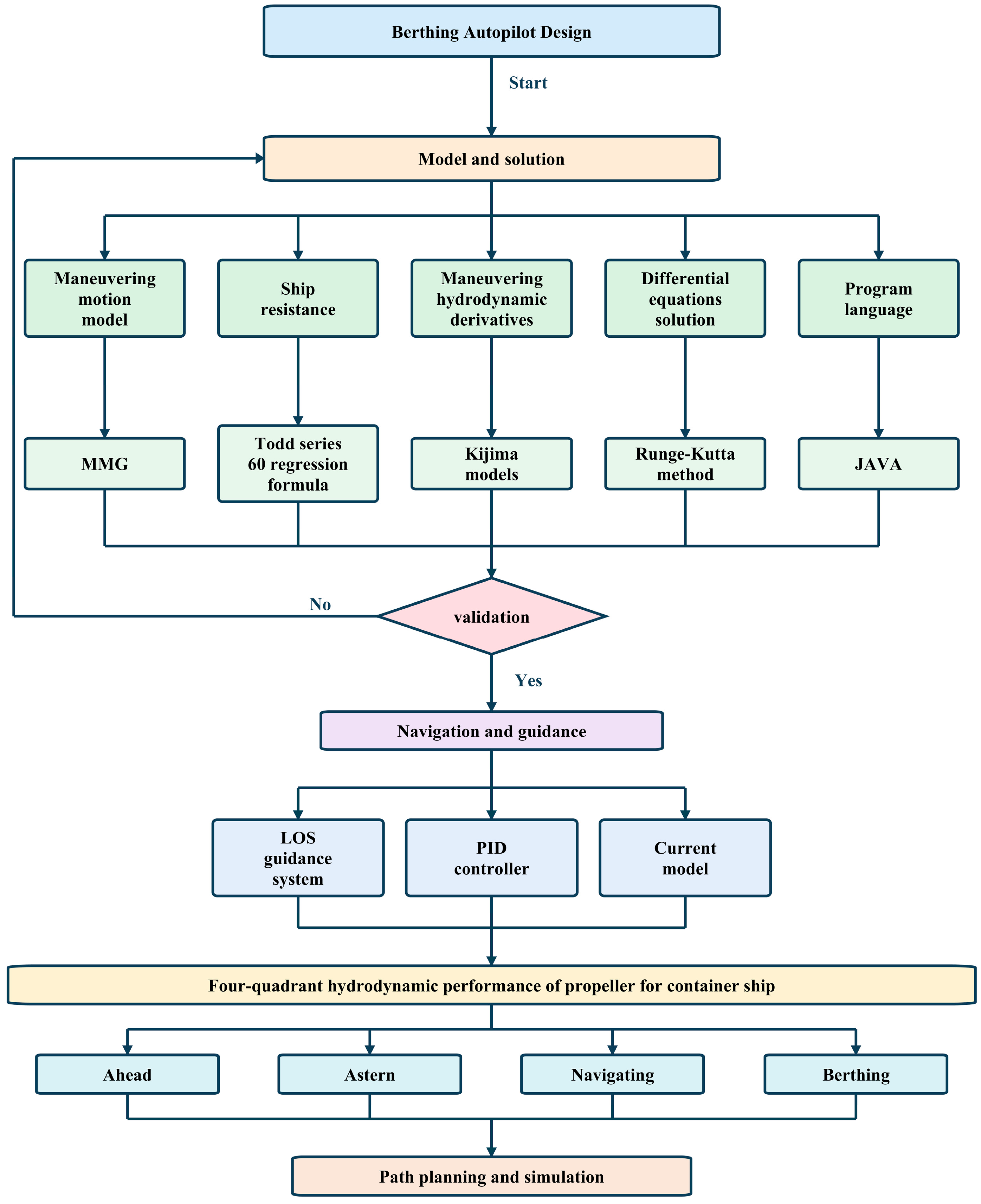
Figure 1. Flowchart of the design and analysis for the four-quadrant berthing autopilot simulation framework.
Jmse 14 00724 g001
Figure 2. Ship motion coordinates.
Jmse 14 00724 g002
Figure 3. Four-quadrant open water characteristic curves of propeller Ka 4-70 with No. 37 duct.
Jmse 14 00724 g003
Figure 4. Sensitivity analysis of sway derivative Yv under beam current (±20%).
Jmse 14 00724 g004
Figure 5. Sensitivity analysis of yaw damping derivative Nv under beam current (±20%).
Jmse 14 00724 g005
Figure 6. Schematic diagram of LOS (Line-of-Sight) guidance.
Jmse 14 00724 g006
Figure 7. Berthing route planning in the Yangshan Port.
Jmse 14 00724 g007
Figure 8. Turning motion simulation for container ship S-175.
Jmse 14 00724 g008
Figure 9. Schematic of trajectory-planning simulations for the B-573 container ship under different current disturbance intensities.
Jmse 14 00724 g009
Figure 10. Schematic of trajectory-planning simulations for the B-573 container ship under disturbances from different current directions.
Jmse 14 00724 g010
Figure 11. Time history of the B-573 ship’s state variables, including heading rate and angle, velocities in surge and sway, and rudder deflection.
Jmse 14 00724 g011
Figure 12. Variation in velocity in surge and propeller revolution versus time in four-quadrant propulsion of the berthing autopilot system.
Jmse 14 00724 g012
Table 1. Viscous hydrodynamic dimensionless coefficient of the ship.
CoefficientValueCoefficientValueCoefficientValue
X v v −0.0164 Y v v −1.4386 N r −0.0537
X v r −0.0395 Y r r 0.0271 N v v −0.0010
X r r 0.0045 Y v v r −0.2252 N r r −0.0145
Y v −0.4179 Y v r r −0.4030 N v v r −0.1326
Y r 0.0997 N v −0.1314 N v r r 0.0255
Table 2. Parameters of hull, propeller and rudder for container ship B-573 and S-175.
S-175B-573
Length between perpendiculars L/m175172
Beam B/m25.432.2
Fore draft df/m9.511.3
Aft draft da/m9.511.3
displacement /m324,380.650,500
Wetted area S/m253968201
Block coefficient Cb0.57740.807
Propeller diameter D/m6.50645.9
Pitch diameter ratio P/D0.9150.8
Blade number Z54
Area ratio EAR 0.7
Rudder aspect ratio λR1.82681.7872
Rudder height H/m7.78.4
Rudder area AR/m232.4639.48
Table 3. Comparison of simulation and experimental results for turning motion.
ParametersHard Port (Sim.)Hard Port (Exp.)Error (%)Hard Starboard (Sim.)Hard Starboard (Exp.)Error (%)
Turning diameter4.22 L4.40 L4.14.22 4.35 L3.0
Tactical diameter4.45 L4.65 L4.34.244.50 L5.8
Advance2.55 L2.95 L13.62.512.90 L13.4
Transfer1.99 L2.15 L7.41.882.10 L10.5
Table 4. Quantitative evaluation of trajectory-tracking errors of the B-573 container ship under different current intensities.
Current Intensity (Vc)Max XTE (m)RMSE (m)MAE (m)
0.0 m/s14.434.082.47
0.5 m/s84.3047.9042.16
1.0 m/s227.0098.6385.50
1.5 m/s420.96154.76127.62
Disclaimer/Publisher’s Note: The statements, opinions and data contained in all publications are solely those of the individual author(s) and contributor(s) and not of MDPI and/or the editor(s). MDPI and/or the editor(s) disclaim responsibility for any injury to people or property resulting from any ideas, methods, instructions or products referred to in the content.