Article

Assessment of Allowable Operational Limits for Floating Spar Wind Turbine Installations

Centre for Marine Technology and Ocean Engineering (CENTEC), Instituto Superior Técnico, Universidade de Lisboa, 1049-001 Lisboa, Portugal
*
Author to whom correspondence should be addressed.
J. Mar. Sci. Eng. 2026, 14(8), 723; https://doi.org/10.3390/jmse14080723
Submission received: 28 February 2026 / Revised: 7 April 2026 / Accepted: 8 April 2026 / Published: 14 April 2026
(This article belongs to the Section Ocean Engineering)

Abstract

The installation of floating offshore wind turbines presents significant operational challenges due to coupled vessel platform dynamics and sensitivity to environmental conditions. This study proposes a response-based methodology for defining allowable operational limits and assessing operability for floating wind turbine generator (WTG) installation using the Nordic Wind concept. The approach integrates hydrodynamic modelling, time-domain simulations, and probabilistic weather-window analysis to evaluate installation feasibility under realistic offshore conditions. The methodology explicitly accounts for coupled vessel spar interactions, heading-dependent system response, and response-based failure criteria, including relative motion, gripper forces, and impact velocity. Allowable sea-state limits are derived for key installation phases and applied to multiple case studies representing different geographical locations and project scales. The results show that installation operability is governed primarily by system response rather than environmental parameters alone. Peak wave period and wave heading are identified as dominant factors, with longer wave periods leading to reduced operability due to response amplification. Across all case studies, the mating phase is found to be the most restrictive operation, controlling overall installation feasibility. Head sea conditions generally provide improved operability, while following seas lead to increased relative motion and reduced performance. The comparative analysis further demonstrates that environmental severity and project scale jointly influence installation duration. Milder environments result in higher operability, whereas harsher conditions, particularly those characterised by long-period swell, significantly reduce feasible weather windows. Larger installation campaigns increase cumulative exposure to weather downtime, even under favourable conditions. The proposed framework extends existing operability assessment methods by incorporating coupled multi-body dynamics and response-based criteria specific to floating wind installations. The results provide a quantitative basis for defining operational limits and support improved planning and decision making for offshore wind turbine installation.

1. Introduction

The emerging technology of floating offshore wind offers significant potential to make offshore wind farms viable in regions that were previously inaccessible due to water depth and seabed constraints [1,2]. In recent years, the technological development and commercial prospects of floating offshore wind systems have been extensively reviewed, highlighting both key engineering challenges and pathways toward large-scale deployment [3,4,5]. Unlike conventional fixed-bottom turbines, floating wind turbines are mounted on buoyant platforms, allowing operation in deep-water environments and expanding the geographical potential for offshore wind energy production. Despite these advantages, the installation of floating offshore wind turbines differs fundamentally from that of fixed-bottom systems and introduces additional complexity in marine operations [6,7]. Installation activities represent a significant contribution to the overall cost and risk profile of offshore wind projects, particularly for floating wind turbines. Previous studies indicate that installation and logistics can account for approximately 15–20% of the total capital expenditure (CAPEX) for offshore wind projects, with additional risks arising from weather-related delays and operational constraints that may lead to schedule overruns of 20–40% during offshore execution [8]. These challenges are further amplified in deep-water floating wind developments, where complex marine operations and coupled system dynamics govern the feasibility of installation. As demonstrated by Castro-Santos et al. [9], installation costs and logistics are highly sensitive to parameters such as water depth, distance from shore, and operational strategy, highlighting the importance of efficient planning and execution. Therefore, improving the definition of operational limits and enhancing installation methodologies are essential for reducing uncertainty, mitigating risks, and optimising project execution.
Recent studies have investigated challenges in floating offshore wind installations using advanced numerical modelling approaches, demonstrating the importance of hydrodynamic interactions, environmental loading, and system configuration in governing system response during installation operations [10,11]. These studies highlight that an accurate representation of coupled vessel platform dynamics is essential for reliable prediction of operational limits. In parallel, comprehensive review studies have identified installation logistics and operability as key barriers to large-scale deployment of floating wind farms [12,13].These reviews indicate that the industry remains at a relatively early stage of commercialisation, with limited standardisation of installation practices and a strong dependence on site-specific solutions. Marine operations, including installation, operation and maintenance, and decommissioning, represent a significant opportunity for cost reduction, but also introduce substantial technical challenges due to the highly dynamic behaviour of floating systems. In contrast to fixed-bottom wind turbines, floating installations require complex multi-vessel operations, increased reliance on towing and dynamic positioning systems, and careful consideration of metocean conditions throughout all lifecycle stages. These challenges highlight the need for integrated methodologies that combine hydrodynamic response analysis, operability assessment, and logistical planning to support efficient and scalable deployment of floating wind farms.
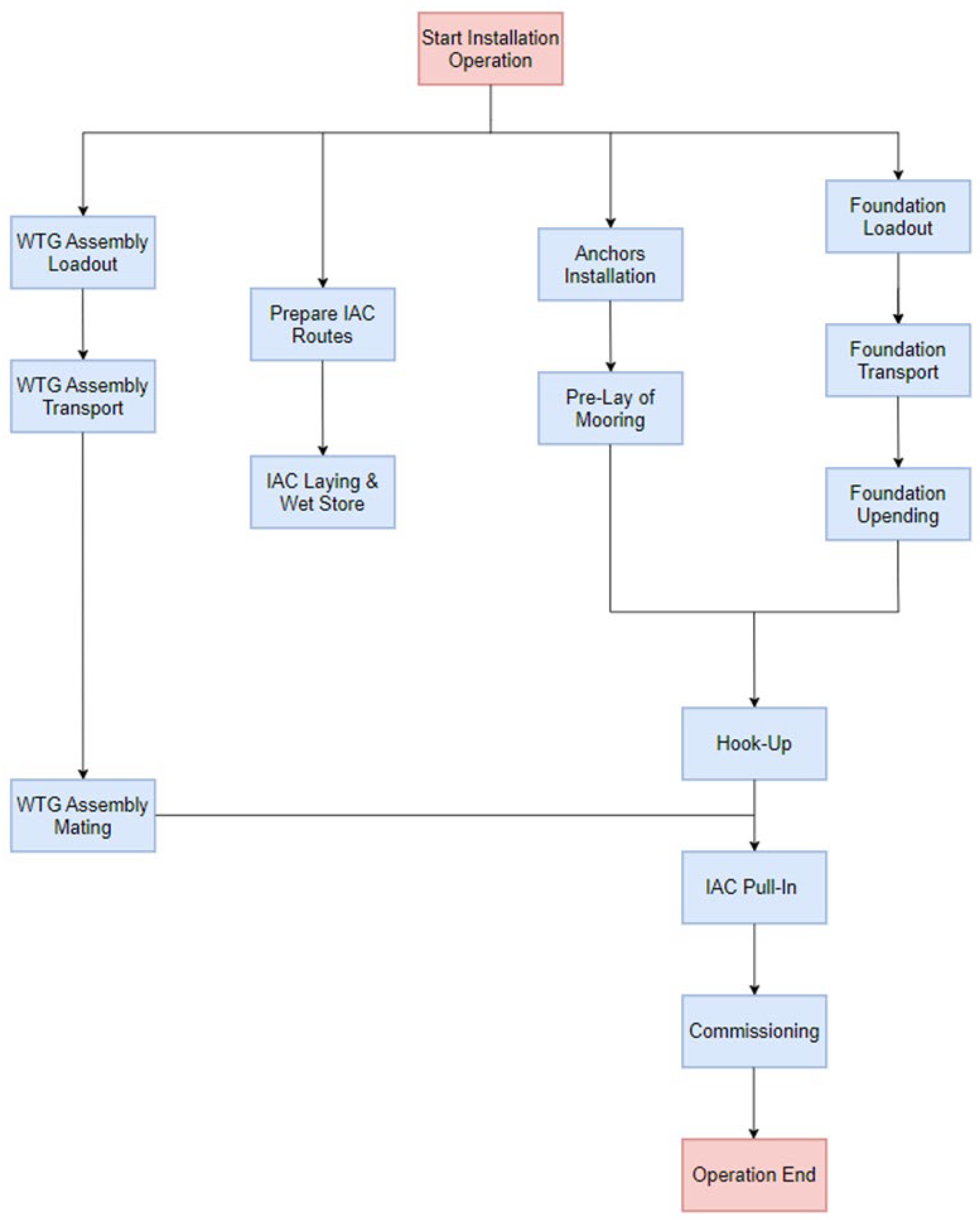
Marine operations encompass a wide range of activities that are inherently sensitive to environmental conditions. These include load-out and load-in operations, transportation and towage, lifting and lowering, tow-out and tow-in, float-over and float-off operations, and offshore construction activities [14]. Many of these operations are directly relevant to floating wind installations, including the deployment of mooring systems and associated logistical processes [15,16] as shown in Figure 1. Typically, marine operations are governed by predefined procedures that specify allowable environmental limits and operational durations. These limits are generally expressed in terms of measurable environmental parameters, such as significant wave height (Hs), peak period (Tp), and wind speed (Vw), together with the dynamic responses of vessels and structures.
However, in practice, operational limits are often defined based on industry practice rather than systematically derived from validated numerical analysis [17]. This approach may lead to conservative or inconsistent criteria, particularly for complex floating systems where hydrodynamic behaviour is strongly influenced by wave period and direction. While existing offshore standards, such as those provided by DNV [14], primarily define operational limits in terms of significant wave height, they do not explicitly account for the combined influence of peak period and wave heading, which are critical for floating structures.
For weather-restricted operations, typically lasting less than 72 h, design limits are adjusted with safety factors to account for uncertainties in environmental forecasting. Advances in forecasting techniques, including the use of real-time measurements and improved prediction models, can reduce these uncertainties and enable less conservative operational criteria [18].
Previous studies have addressed operational limits for a variety of offshore operations. Early works by Clauss and Riekert [19] and Sekita et al. [20] investigated operational criteria for floating crane vessels based on field experience and motion-response analysis, with limits often expressed in terms of sea-state parameters.
Smith et al. [21] established operational limits for jack-up vessel operations based on acceptable impact velocities derived from structural damage criteria. Del Guzzo et al. [22] further emphasised the importance of using detailed wave spectral time series for the structural assessment of pipe-laying vessels, highlighting the limitations of simplified environmental parameters in complex offshore operations.
More advanced approaches have incorporated numerical modelling, experimental testing, and field measurements to define operational limits. Cozijn et al. [23] and Graczyk and Sandvik [24] evaluated offshore lifting operations using combined numerical and experimental methods, estimating dynamic responses based on formulations such as those in [25]. In addition, numerical modelling has been widely applied to offshore installation problems, providing detailed insights into system dynamics, hydrodynamic interaction, and shielding effects [26].
Zhao [27] investigated the offshore installation of single blades using a jack-up crane vessel and identified the typical operational environmental conditions. These conditions include a mean wind speed (Uw) of less than 20 m/s and a significant wave height (Hs) between 1.5 and 2.0 m. Guachamin-Acero et al. [28] introduced a methodology to evaluate the operational limits and feasibility of marine operations. This approach involves using numerical models to estimate structural dynamic responses across various sea states. By doing so, the limiting environmental conditions that result in acceptable response levels can be identified. This methodology has been successfully applied to the installation of monopile foundations [29] and transition pieces [30].
Recent research efforts at NTNU have further advanced numerical modelling approaches for offshore wind installation operations, particularly regarding coupled vessel–structure dynamics and operational decision support [31].
Despite the growing body of research on offshore installation operations, limited work has focused on systematically defining response-based operational limits for floating wind turbine installation concepts. Existing approaches often rely on empirical criteria or simplified environmental parameters, which may not adequately capture the complex dynamics of floating systems.
This study addresses this gap by investigating the installation of floating wind turbines using the novel Nordic Wind installation method [32]. The proposed approach focuses on identifying the critical stages of the installation process for the wind turbine generator (WTG) assembly, where coupled vessel–structure interactions and relative motions become governing factors. Particular attention is given to assessing critical responses, such as relative motions and impact-related parameters, that directly influence installation safety and feasibility.
A response-based framework is developed to establish allowable operational limits by linking environmental conditions to system dynamic responses through numerical modelling. By explicitly accounting for the governing installation stages and their associated critical responses, the proposed methodology provides a more rational and physically consistent basis for defining operational limits than conventional approaches.
The outcome of this work contributes to the improved planning and execution of floating wind turbine installations by reducing uncertainty, enhancing safety, and supporting more efficient deployment of advanced installation concepts such as Nordic Wind.

2. Planning and Execution of Marine Operations

The operational framework for defining workable weather windows during both the design and execution phases of floating wind turbine installation is presented in this section. Weather-window assessment plays a critical role during the planning phase by supporting operability analysis, logistics preparation, and decision making regarding vessel selection and installation strategy. During the execution phase, it provides guidance for determining appropriate start and stop times for offshore operations under evolving environmental conditions.

2.1. Phases of Marine Operations and System Behaviour

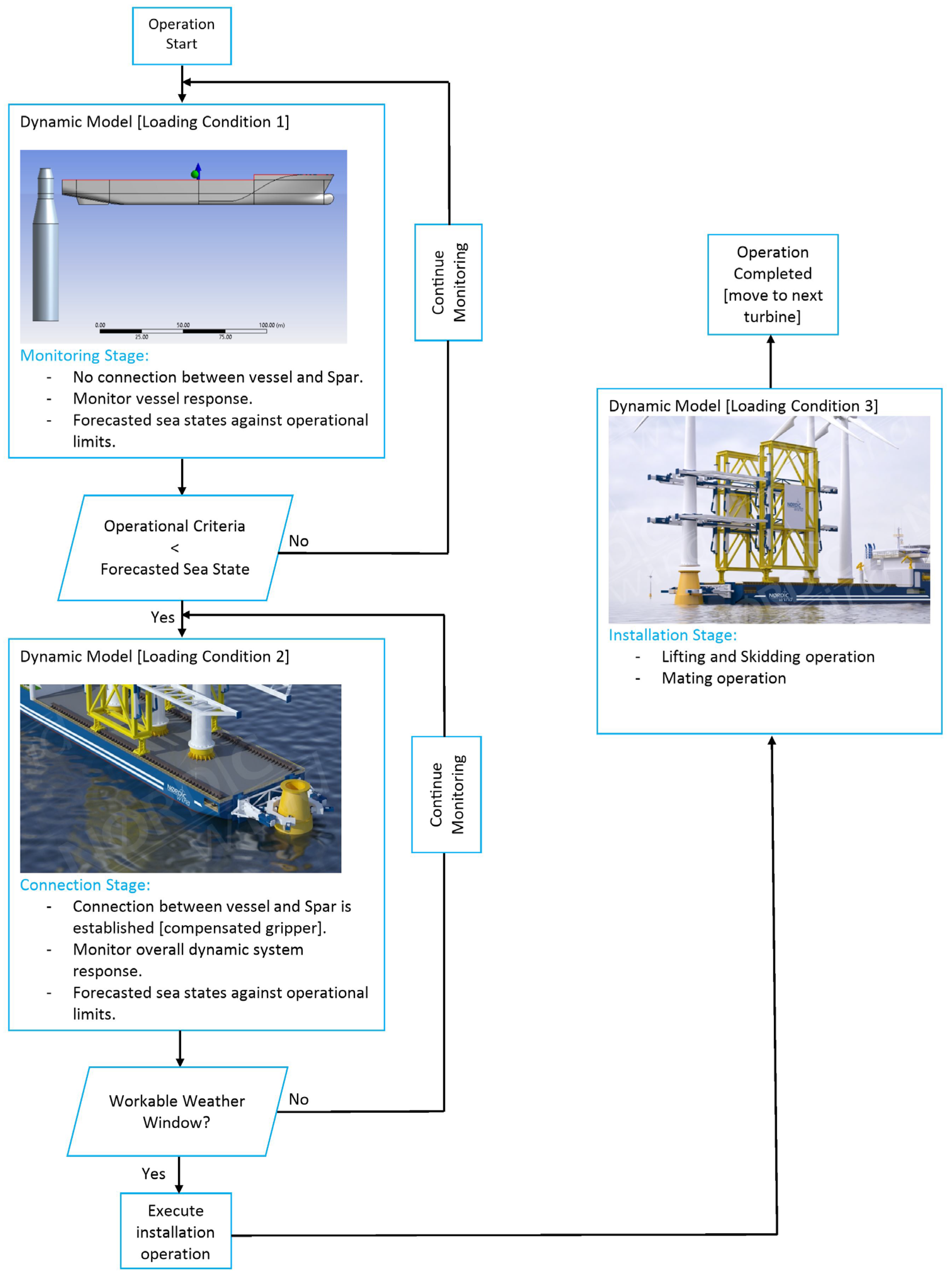
Marine installation operations for floating wind turbines can be interpreted as a sequence of evolving system configurations characterised by increasing mechanical interaction and nonlinear behaviour. Figure 2 illustrates the main dynamic configurations encountered during the installation process, following the system description by Hassan and Guedes Soares [32]. In the initial stage (LC1), prior to mechanical connection, the installation vessel and floating spar behave as two hydrodynamically interacting bodies without structural coupling. The system response is governed primarily by wave-induced motions, and the behaviour can be reasonably approximated as weakly nonlinear with stationary characteristics. Under these conditions, frequency-domain methods can be effectively utilised for response prediction and onboard decision support. As the operation progresses into the connection phase (LC2), a mechanical link is established between the installation vessel and the floating structure through the gripper system. This introduces additional constraints and increases system coupling. Although the system becomes more complex, the operation remains reversible, allowing safe interruption if necessary. In the final stage (LC3), corresponding to lifting, transfer, and mating of the wind turbine assembly, the system becomes strongly coupled and highly nonlinear. Operational complexity increases significantly, and the ability to abort the operation is limited once lifting has commenced. Consequently, this stage is typically associated with the most critical operational conditions.

2.2. Planning-Phase Considerations

Ensuring the operability of marine operations during the planning phase is essential for evaluating project feasibility and optimising installation strategies. This phase supports decisions related to vessel selection, equipment configuration, scheduling, and seasonal planning. Operability during planning can be assessed using two primary approaches. The first involves comparing allowable sea-state limits with historical hindcast environmental data to identify feasible weather windows. This enables the evaluation of operational feasibility across different months, seasons, and wave headings. The second approach involves comparing system response parameters, derived from environmental conditions, with predefined allowable limits. This approach is particularly applicable to linear or linearised systems, where system behaviour can be approximated as stationary. However, for strongly nonlinear and coupled systems, time-domain simulations are typically required, which limits the direct application of this method to large hindcast datasets due to computational constraints.

2.3. Execution-Phase Considerations

During the execution phase, weather-window identification relies on forecasted environmental data rather than historical hindcast information. Operational decisions are made based on the comparison between forecasted sea states and allowable operational limits. Uncertainty in forecasted environmental conditions is an important consideration in this phase. Variability in significant wave height (Hs), peak period (Tp), and spectral characteristics can affect the reliability of weather-window predictions. Previous studies, such as Natskår et al. [33], have demonstrated that forecast uncertainty can be quantified using probabilistic models by comparing forecast and hindcast data. In practice, allowable sea-state limits are often adjusted using reduction factors to account for forecast uncertainty and ensure an appropriate level of operational safety, as recommended in offshore standards such as DNV [14]. In addition to environmental parameters, onboard monitoring systems (e.g., motion reference units and decision-support tools) can be used to validate predicted system responses and support real-time decision making. These measurements are particularly important when discrepancies arise between forecast-based predictions and observed conditions.

2.4. Conceptual Framework for Operational Limit Assessment

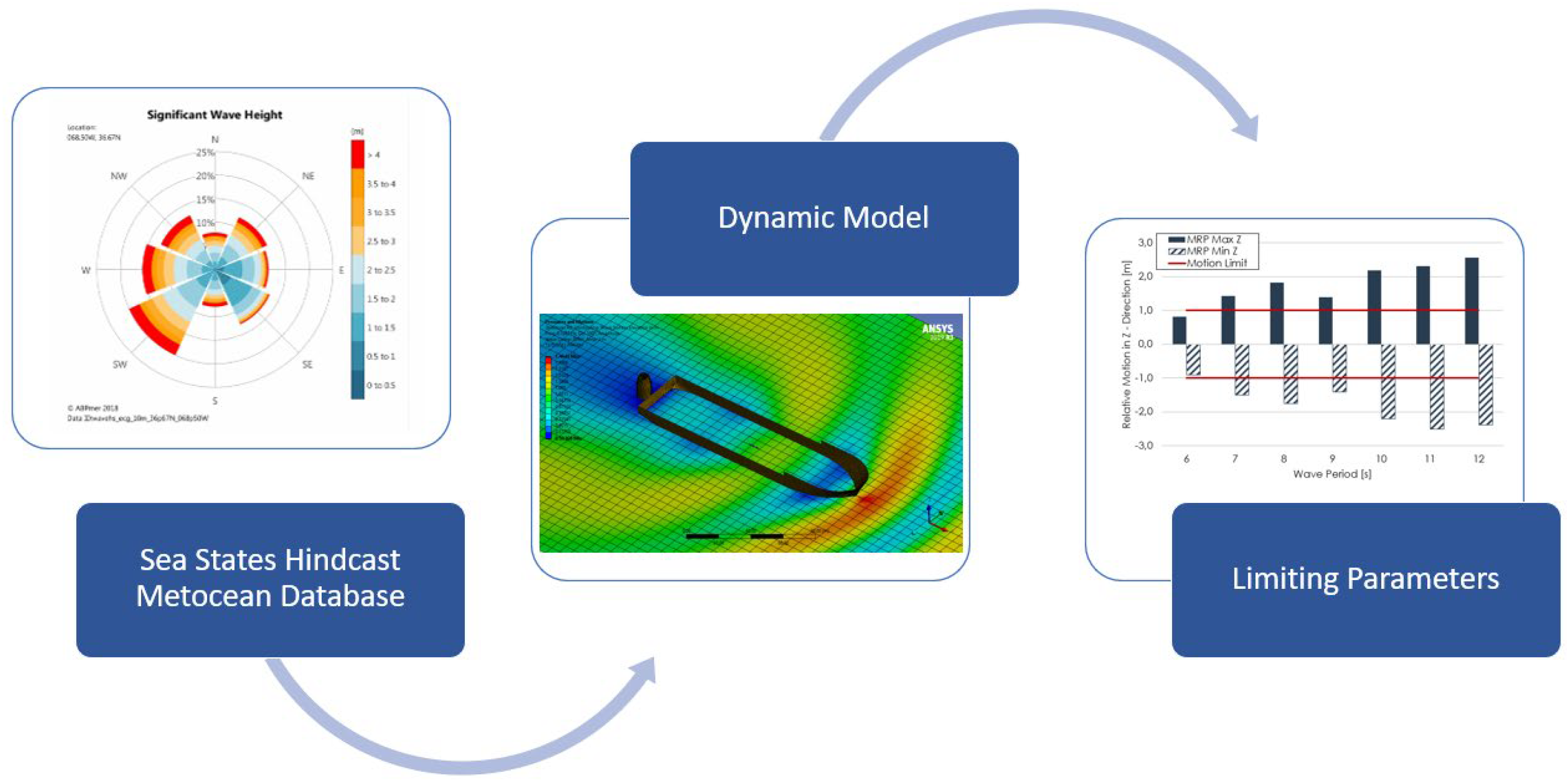
The interaction between environmental conditions, system response, and operational decision making in marine operations can be represented through a high-level framework, as illustrated in Figure 3.
Figure 3 illustrates how hindcast metocean data are used as input to dynamic models of the installation system, from which key response parameters are derived. These responses are subsequently compared against limiting criteria to evaluate the feasibility of offshore operations under given environmental conditions. This framework highlights the fundamental relationship between environmental loading, system dynamics, and operational constraints. It provides the basis for establishing response-based operational limits and evaluating operability. While Figure 3 outlines the general workflow adopted in this study, the detailed methodology, including response evaluation, allowable criteria definition, and operability assessment, is presented in Section 3.

3. Operational Limit Procedure

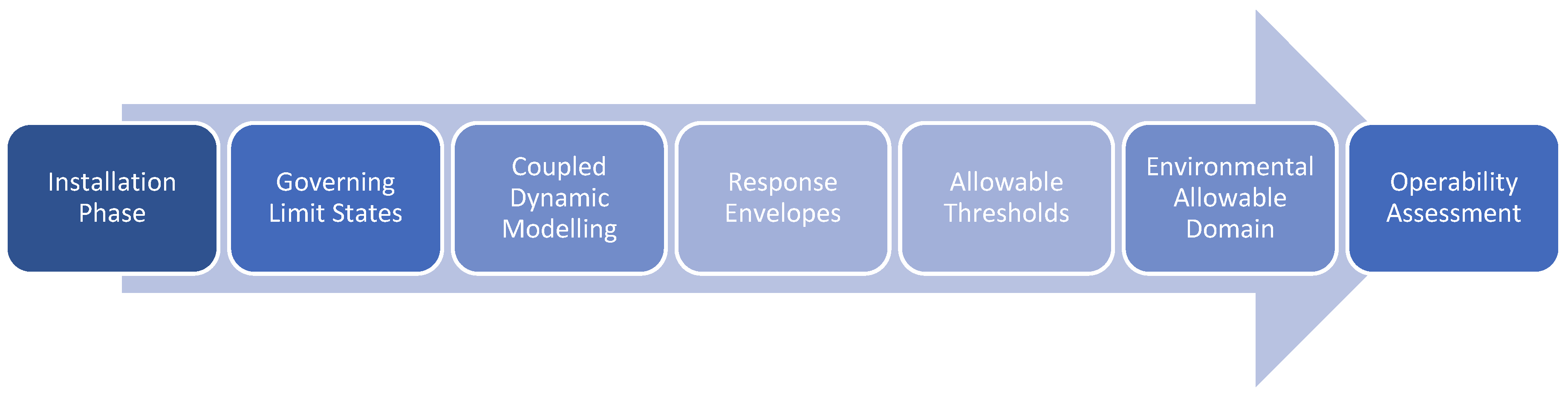
The determination of operational limits for offshore installation activities requires defining allowable environmental conditions under which the system remains within predefined safety margins. The procedure follows a systematic workflow as shown in Figure 4. The methodology is applied to the installation of floating wind turbines using the Nordic Wind concept, with particular emphasis on identifying critical installation stages governed by coupled vessel–structure dynamics. First, critical installation stages and associated failure modes are identified. Second, governing response parameters describing these failure modes are defined. Third, numerical simulations are performed to evaluate system responses under a range of environmental conditions. Fourth, allowable criteria are established based on structural, operational, or safety limits. Fifth, allowable sea states are derived by mapping response limits to environmental parameters. Finally, operability is assessed through weather-window analysis using hindcast or forecast environmental data.

3.1. Definition of Limit State and Governing Parameters

Every installation phase is associated with potential failure modes such as excessive motion, structural overload, impact loads, or loss of control during mating operations. These failure modes are first defined at the system level, accounting for the coupled interactions among the installation vessel, wind turbine components, and environmental loads. The governing response parameters are selected to represent the physical quantities associated with these failure modes. In this study, the key parameters include:
  • Relative motion between the installation vessel and floating spar;
  • Gripper forces in the handling system;
  • Impact velocity during mating.
Each governing parameter is expressed as a response variable xi(t), where i denotes the type of response. The operational safety requirement is formulated as:
X c h a r , i     X a l l o w , i
where Xchar,i represents the characteristic response obtained from numerical simulations, and Xallow,i is the allowable threshold.

3.2. Dynamic Response Evaluation

The system response is evaluated using a combination of frequency-domain and time-domain simulations. Frequency-domain analysis is applied to characterise system behaviour, while time-domain simulations are used to capture the stochastic, nonlinear response of the coupled system under irregular-wave conditions.
Time-domain simulations are performed for each environmental condition, using irregular waves characterised by significant wave height, peak period, and wave direction. For each condition, 10 distinct wave seeds are generated to cover a 1 h duration. The use of multiple wave seeds is essential to ensure that the variability of the wave-induced responses is adequately captured. Increasing the number of wave realisations improves the statistical convergence of response estimates; however, beyond a certain number, the improvement becomes marginal relative to the associated computational cost. Therefore, the use of 10 wave seeds represents a practical balance between statistical accuracy and computational efficiency.

3.3. Establishment of Allowable Criteria

For each governing response parameter, allowable thresholds are defined to ensure safe and controlled execution of the installation process. These thresholds represent the maximum permissible values beyond which the system integrity, operational feasibility, or safety may be compromised. The allowable criteria are established based on a combination of the mechanical capacity of installation equipment, the structural limitations of the components, operational tolerances required for safe installation, and engineering practice derived from offshore installation experience.
In the present study, representative allowable limits are defined for the governing parameters as follows:
  • Relative vertical motion limit of 1.0 m;
  • Gripper force limit of 2000 kN;
  • Impact velocity limit of 0.2 m/s.
The relative motion limit is introduced to ensure safe alignment between the installation vessel and the floating foundation during the positioning and connection phase. The gripper force limit is based on the mechanical capacity of the handling system and ensures that the required compensation forces remain within acceptable limits. The impact velocity limit is defined to prevent excessive loads during mating operations and to avoid structural damage.

3.4. Environmental Constraints and Allowable Sea-State Criteria

The allowable environmental conditions are determined by mapping the characteristic response values obtained from numerical simulations onto the environmental parameters of significant wave height Hs, peak period Tp, and wave direction Ɵ. For each simulated sea state, defined by a combination of Hs, Tp, and Ɵ, the characteristic response Xchar,i is evaluated and compared against the corresponding allowable threshold Xallow,i.
A sea state is considered acceptable if the following condition is satisfied for all governing parameters:
X c h a r , i   H s ,   T p , θ   X a l l o w , i
Installation activities are grouped according to their execution characteristics and duration requirements. A key distinction is made between non-continuous operations, which can be interrupted and resumed without compromising safety, and continuous operations, which must be completed within a single uninterrupted weather window once initiated. The duration of each activity defines the minimum required length of a valid weather window. Table 1 summarises the grouping of installation activities considered in this study, including their classification and representative duration, which are subsequently used in the operability assessment.

3.5. Operability Assessment During Planning

The operability of the installation process is evaluated by combining the derived allowable sea-state limits with site-specific hindcast environmental data. The objective is to quantify the proportion of time during which installation activities can be safely executed.
At each time step in the hindcast record, the environmental conditions are defined by Hs(t), Tp(t), and Ɵ(t). These conditions are compared with the allowable sea-state domain established in Section 3.4.
A time step is considered feasible if the characteristic response is below the allowable threshold. For non-continuous operations, feasibility is assessed independently at each time step. For continuous operation, the feasibility condition must be satisfied over a continuous time window of duration Δt, corresponding to the activity’s required execution time as stated in Table 1. A valid weather window is therefore defined as a continuous interval:
t 0 , t 0 + t
Feasible weather windows are identified by scanning the hindcast time series and detecting all continuous intervals that satisfy the above condition. The operability is then quantified as:
O p e r a b i l i t y =   T f e a s i b l e T t o t a l
where Tfeasible is the total duration of feasible weather windows, and Ttotal is the total analysed period.
This formulation provides a probabilistic measure of installation feasibility, accounting for both environmental variability and operational constraints. The relationship between allowable sea states and operability is illustrated in Figure 4, which summarises the overall methodology.

3.6. Execution-Phase Consideration and Forecast Uncertainty

During the execution phase, operational decisions are based on forecasted environmental conditions rather than hindcast data. Therefore, the methodology described in Section 3.4 and Section 3.5 is applied using forecast time series of significant wave height Hs, peak period Tp, and wave direction.
In practice, offshore operations are subject to uncertainties associated with environmental forecasting, modelling assumptions, and operational decision making. Forecast uncertainty, including errors in predicted wave height, wave period, and spectral energy distribution, has been widely investigated in the context of marine operations and reliability assessment (e.g., Natskår et al. [33]).
The use of response-based criteria derived from time-domain simulations has been recognised as an effective approach for assessing allowable sea states for offshore wind installation operations, particularly when considering the variability of environmental conditions (Wu et al. [34]). Floating offshore systems are sensitive not only to wave height but also to peak period, direction, and spectral characteristics. Real sea states often exhibit directional spreading and multi-peaked energy distributions, which can significantly influence the dynamic response of floating structures. Such effects have been highlighted in classical studies on wave spectrum representation [35].
In the present study, the focus is on developing a deterministic, response-based methodology to define operational limits and assess operability. Accordingly, uncertainties related to forecasting accuracy and model fidelity are acknowledged but are not explicitly quantified.
Despite this limitation, the proposed methodology provides a consistent framework for linking environmental conditions to system response and supporting operational decision making. During execution, the results of the operability assessment can be complemented by onboard monitoring systems, such as motion measurements, to validate predicted responses and support real-time decisions.
The integration of uncertainty into operational limits and weather-window assessment represents an important extension of the present work and is recommended for future research.

4. Case Study on Wind Turbine Assembly Installation

In this section, the methodology is applied to the installation of a floating wind turbine assembly using the Nordic Wind concept [32]. The analysis focuses on the planning phase, where the allowable sea-state limits are derived for critical installation activities and subsequently used to assess operability. The methodology described in Section 3 is applied without accounting for uncertainty, and the results are used to evaluate weather windows and overall installation feasibility.

4.1. Installation Procedure

A general installation procedure for the Nordic Wind concept is described in [32]. For the purpose of operational limit assessment, only the critical activities governing the feasibility of the installation process are considered.
Some activities can be performed simultaneously or are not sensitive to environmental loading; therefore, only those activities associated with significant dynamic interaction and operational risk are selected for detailed analysis.

4.2. Critical Events and Limiting Parameters

Based on the installation sequence summarised in Table 2, the critical activities include:
connection of the motion compensation gripper to the floating spar;
lifting of the WTG assembly;
transfer and mating of the WTG assembly onto the spar.

Table 2. General procedure for WTG installation—Nordic Wind method.
IDDescriptionDuration [h]Continuous Operation [Yes or No]Critical EventsLimiting Parameter (s)
1Installation preparations (Stage 1: Monitor Hs, Tp, measurable motion, decide whether to start or not start the operation)4noN.A.Wind speed, significant wave height, wave period
2Connect gripper to floating substructure (Stage 2: Monitor Hs, Tp, measurable gripper forces, decide whether to start or not start the operation)4noFailure of gripperWind speed, significant wave height, wave period, gripper forces
3Lift-off the WTG assembly 4yesFailure of lifting grippers Wind speed, significant wave height, wave period, gripper forces
4Transfer WTG assembly to the floating substructure and mating 20yesWTG structure damage Wind speed, significant wave height, wave period, relative motion, impact velocity
Notes: The duration represents the minimum uninterrupted execution time required for each activity. Continuous activities must be completed without interruption once initiated.
These activities are associated with potential critical events such as:
failure of the motion compensation gripper;
structural failure of the lifting system;
structural damage during mating operations.
The corresponding limiting parameters are:
relative motion between vessel and spar;
gripper forces;
impact velocity during mating.
Environmental parameters such as significant wave height, peak period, and wave direction influence these responses and are therefore implicitly accounted for through the response-based methodology described in Section 3.

4.3. Numerical Modelling of Installation Activities

The numerical model is formulated to capture the mechanical and hydrodynamic coupling between the installation vessel and the floating spar throughout the different stages of the operation. The modelling approach distinguishes between weakly coupled and strongly coupled system configurations, reflecting the evolution of system interaction during installation.

4.3.1. Monitoring Configuration (Pre-Connection Stage)

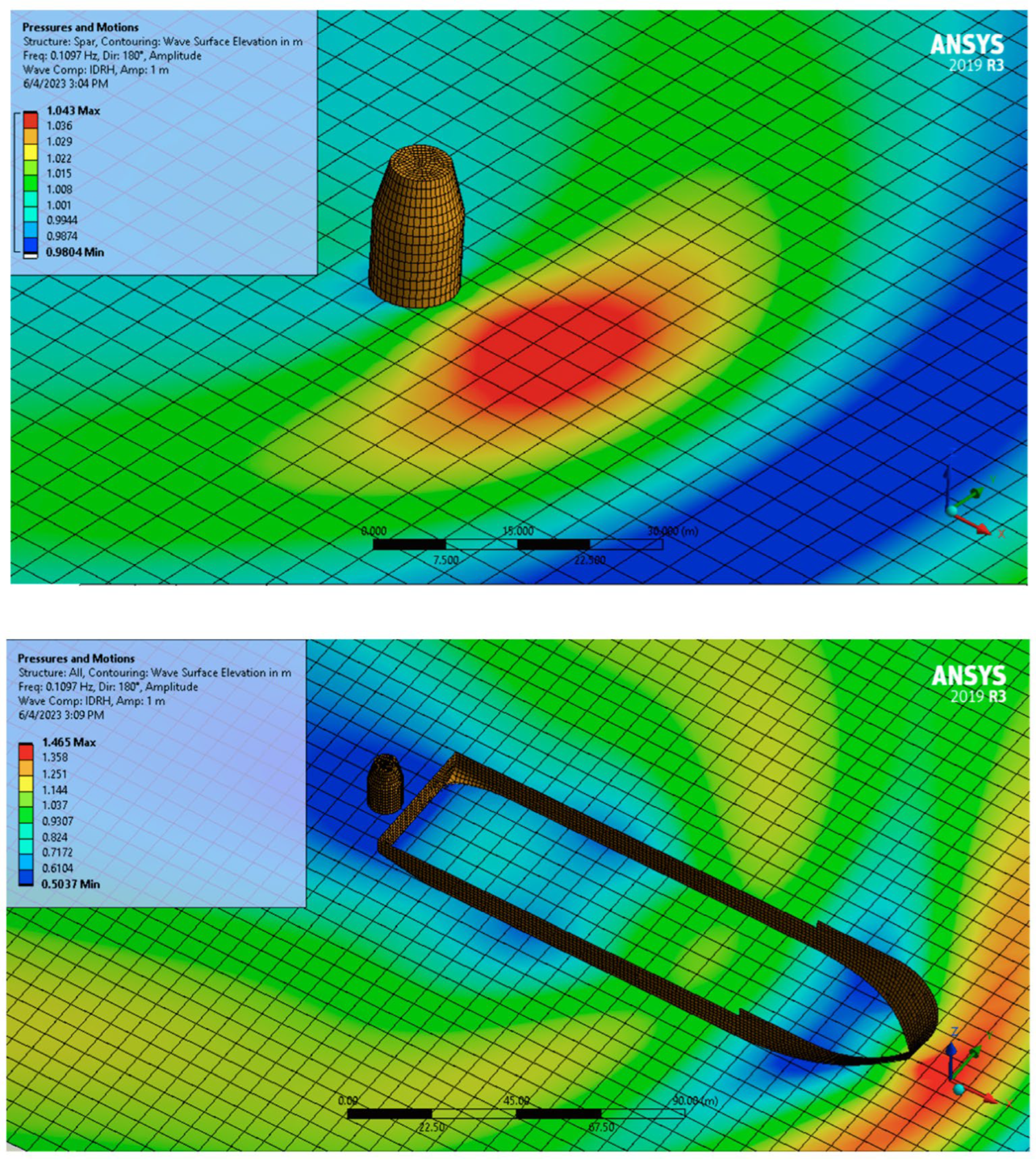
Prior to mechanical engagement, the installation vessel and spar behave as hydrodynamically interacting floating bodies without structural coupling. Under these conditions, the system is primarily governed by first-order wave-induced motions. Hydrodynamic coefficients are obtained using a three-dimensional potential flow solver, Ansys AQWA-LINE (Version 2024). The panel models used a 1 m mesh size and were generated based on existing research, with any necessary geometric modifications applied. Particular attention is given to hydrodynamic interaction effects due to reduced separation distance, as illustrated in Figure 5. This configuration establishes baseline response characteristics and quantifies relative motions between the vessel and spar. Table 3 summarises the installation vessel, floating spar, and turbine main particulars used during the dynamic study.

4.3.2. Coupled Configuration (Mechanical Connection Stage)

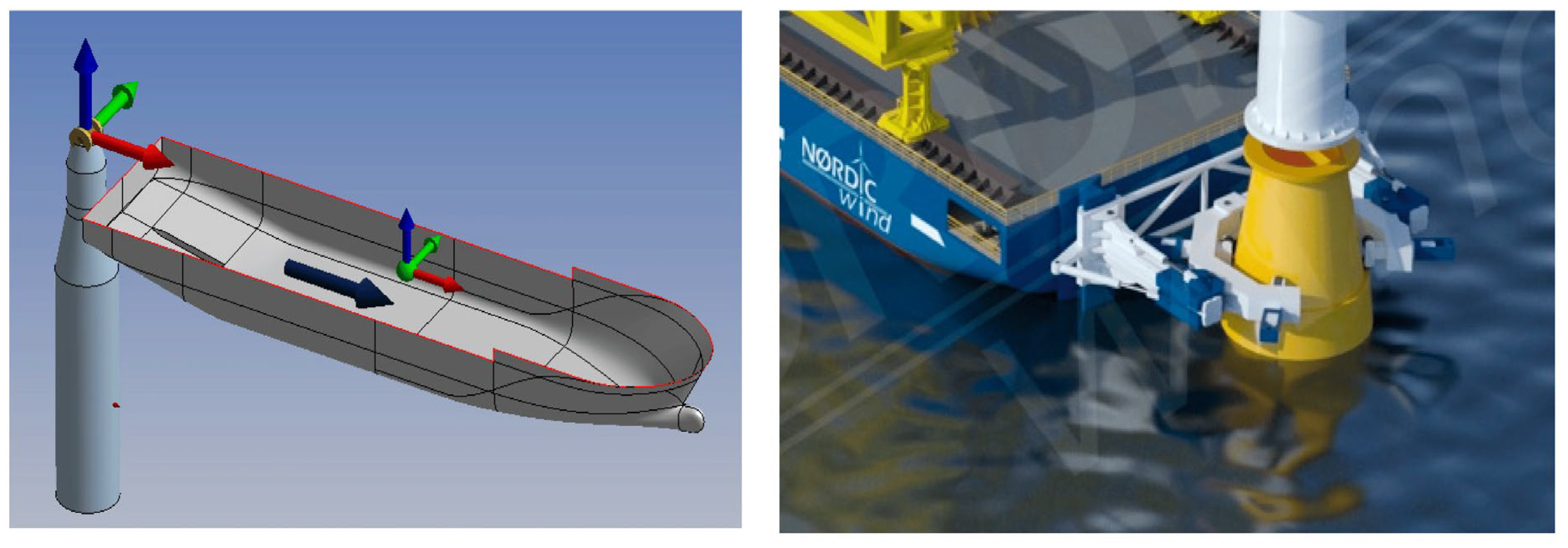
Once the motion compensation grippers are engaged, the system transitions to a mechanically coupled configuration. The connection introduces stiffness and constraints, resulting in a nonlinear multi-body response. Time-domain simulations are used to capture this behaviour. The gripping system is modelled as a mechanical joint that constrains horizontal motion while allowing rotational flexibility. The implemented modelling approach, shown in Figure 6, enables the evaluation of coupled vessel–spar dynamics and associated load-transfer mechanisms.
The floating spar is moored to the seabed using three separate lines, which are connected through bridles. The pre-tension and configuration of the bridle ensure sufficient stiffness in the yaw direction, which prevents slack in the mooring lines during normal operations. Table 4 provides further information on the specific parameters of the mooring lines used in the time-domain analysis.

4.3.3. Controlled Installation Configuration (WTG Transfer Stage)

During the transfer and lowering of the WTG assembly, the system is governed by both environmental loading and active motion control. Relative vertical motion between the turbine assembly and spar becomes the dominant response parameter. The AHC is represented by a simplified hydraulic actuator model, where the wind turbine assembly is treated as a lumped mass connected to the lifting grippers. The vertical position of the tower bottom in the global frame is expressed as:
P b = P υ + R ϕ P b h + d h
where Pυ is the installation vessel reference position, R(ϕ) is the rotation matrix from the body-fixed to the global reference coordinates, Pbh is the position of the hydraulic lifting device in the vessel fixed frame, and dh = [0, 0, −lh]T is the actuator displacement vector.
The control objective is to minimise the relative heave motion between the tower bottom and the spar top along the global vertical axis. The hydraulic actuator is modelled as a simplified variable-displacement cylinder, with equivalent dynamics written as:
m l ¨   +   f c l h ˙ = A P   F e x t
where lh is the lifting stroke, m is the combined mass of the turbine assembly and lifting system, fc is an equivalent friction coefficient, A is the cylinder area, P is the load pressure, and Fext is the external load. The actuator input is defined through the pump displacement, and the desired stroke is generated from the measured spar-top motion. To maintain computational efficiency in the coupled time-domain simulations, the AHC model assumes constant hydraulic properties, negligible pipeline dynamics, and no feedback of actuator reaction forces into the global vessel motion. This representation captures the dominant AHC effect on relative vertical motion while remaining suitable for operability assessment.
The environmental conditions considered in the numerical simulations are defined in terms of significant wave height (Hs), peak wave period (Tp), and wave heading (θ). A range of sea states is analysed to ensure representative coverage of operational conditions, with Hs varying between 0.5 m and 3.0 m, and Tp ranging from 6 s to 12 s. Multiple wave headings are considered, typically spanning head seas and following seas +/−30° relative to the installation vessel, to capture directional effects on system response. Irregular-wave conditions are modelled using the JONSWAP spectrum, which is widely adopted for representing realistic offshore sea states.

4.4. Allowable Limits of Sea States for Monitoring Phase

Allowable sea-state limits are derived by comparing the characteristic values obtained from numerical simulations with the allowable thresholds defined in Section 3. The results are presented separately for each installation phase to identify the governing parameters and understand the physical mechanism controlling operational limits.

4.4.1. Monitoring Phase

The allowable sea-state limits for the monitoring phase are governed by the relative motion between the vessel and the spar at the mating reference point. The results indicate that the relative motion is primarily driven by first-order vessel motions, as it is highly sensitive to wave height, peak period, and wave direction.
Sea states resulting in relative motion exceeding the allowable limit of 1.0 m are classified as unacceptable. The results show that allowable Hs decreases with increasing Tp, reflecting increased vessel motion at longer wave periods. Directional effects are also significant, with certain wave headings reducing relative motion and improving operability.

4.4.2. Connection Phase

During the connection phase, the governing parameter is the gripper force required to maintain relative positioning between the vessel and the spar. The results indicate that gripper forces increase with wave height and are influenced by dynamic coupling between the connected bodies. Sea states in which gripper forces exceed the allowable limit of 2000 kN are considered unacceptable. Compared with the monitoring phase, this stage exhibits greater sensitivity to coupled system dynamics.

4.4.3. Mating Phase

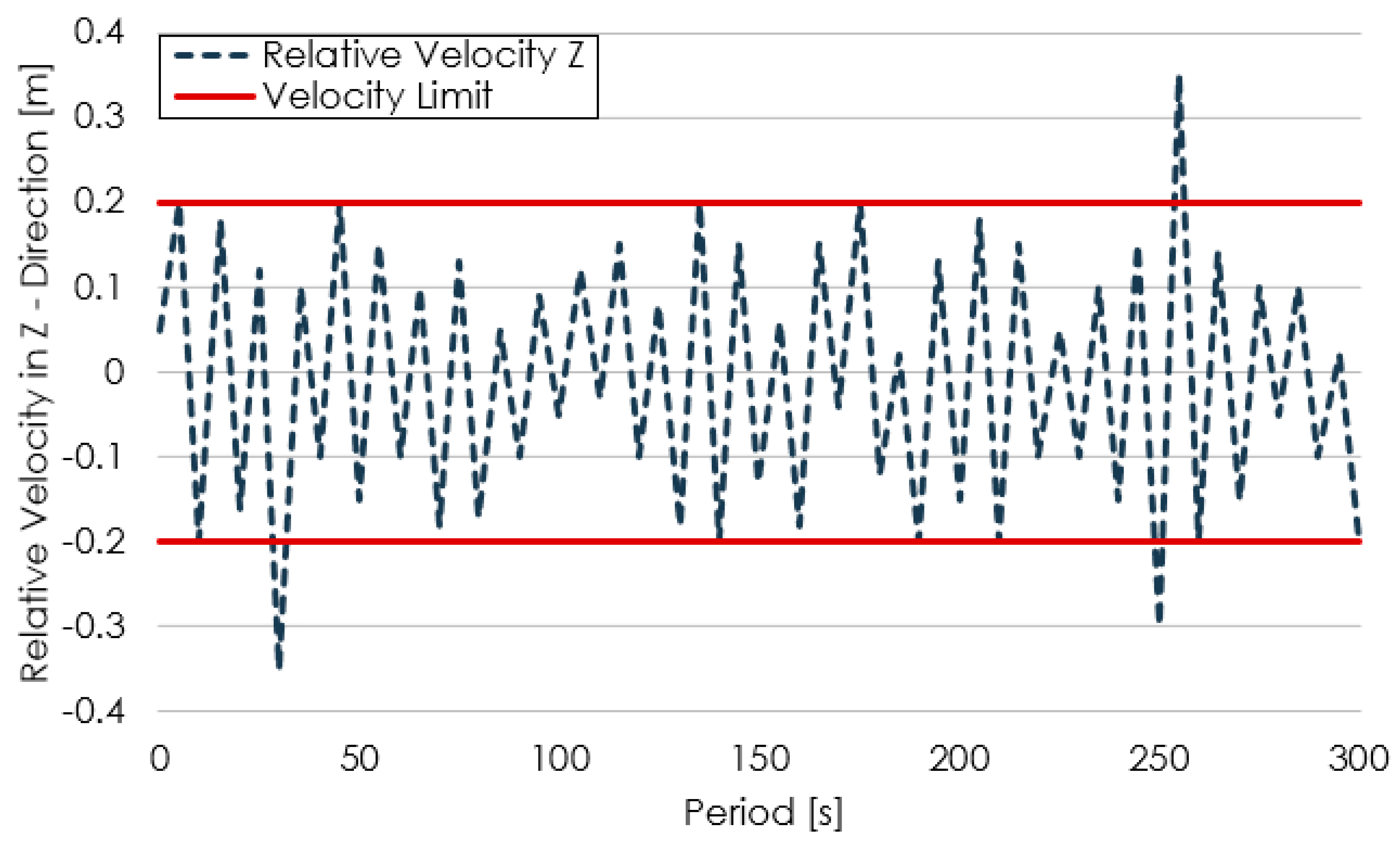
The mating phase is identified as the most critical stage of the installation process due to the direct interaction between the wind turbine assembly and the floating spar. Unlike the previous stage, where a physical clearance exists between components, the mating operation involves contact conditions, leaving minimal tolerance for excessive motion. During this stage, the governing parameter is the relative vertical velocity between the turbine assembly and the spar at the contact point. This parameter directly controls the impact loads generated during touchdown. Even a relatively small increase in velocity can result in significantly higher impact forces, potentially leading to structural damage to the turbine or supporting structure.
Time-domain simulations under irregular-wave conditions show that the relative response is strongly influenced by both wave height and peak period, with nonlinear effects becoming more pronounced during the final approach to contact. An allowable limit of 0.2 m/s is adopted to ensure that impact loads remain within acceptable structural limits. Sea states resulting in relative velocity exceeding this threshold are classified as unacceptable. Compared to the monitoring and connection phases, the mating stage presents a higher level of operational risk due to:
  • The absence of clearance between interacting components;
  • The direct relationship between relative velocity and impact loading;
  • The limited ability to interrupt or reverse the operation once initiated;
  • The increased influence of nonlinear and coupled system dynamics.
Table 5 summarises the governing parameters, allowable limits, and corresponding operational constraints for each installation phase.

4.5. Operability Analysis

Based on the allowable sea-state limits derived for each activity group and the durations defined in Table 1, an operability assessment is performed using hindcast environmental data. The methodology described in Section 3.5 is applied to identify feasible weather windows and quantify operability.

4.5.1. Site Data

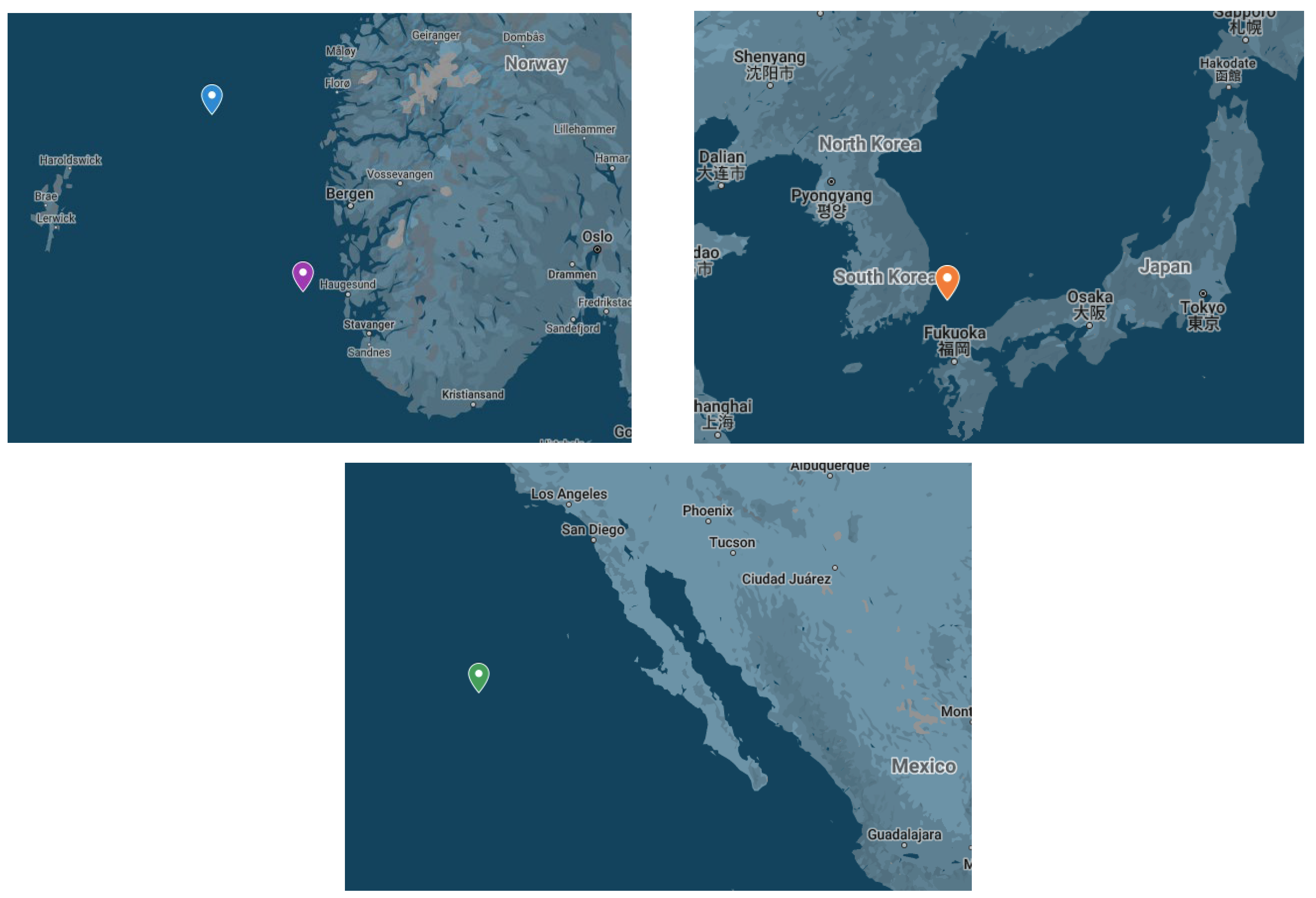
The analysis considers multiple offshore locations with varying environmental conditions, as shown in Figure 7. These locations represent a range of wave climates relevant for floating offshore wind development.

4.5.2. Project Data

Four representative project cases are selected to assess the methodology’s applicability under varying environmental and logistical conditions. The characteristics of these projects are summarised in Table 6, including their locations, water depths, and project scales.

5. Results and Discussions

5.1. Allowable Sea-State Limits

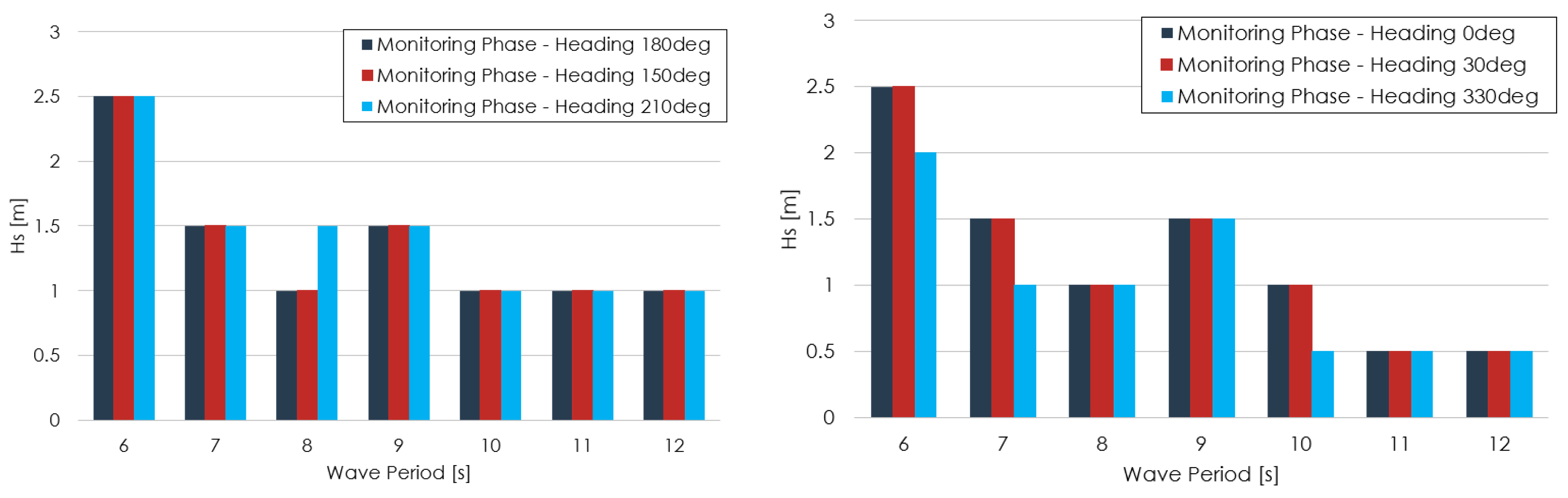
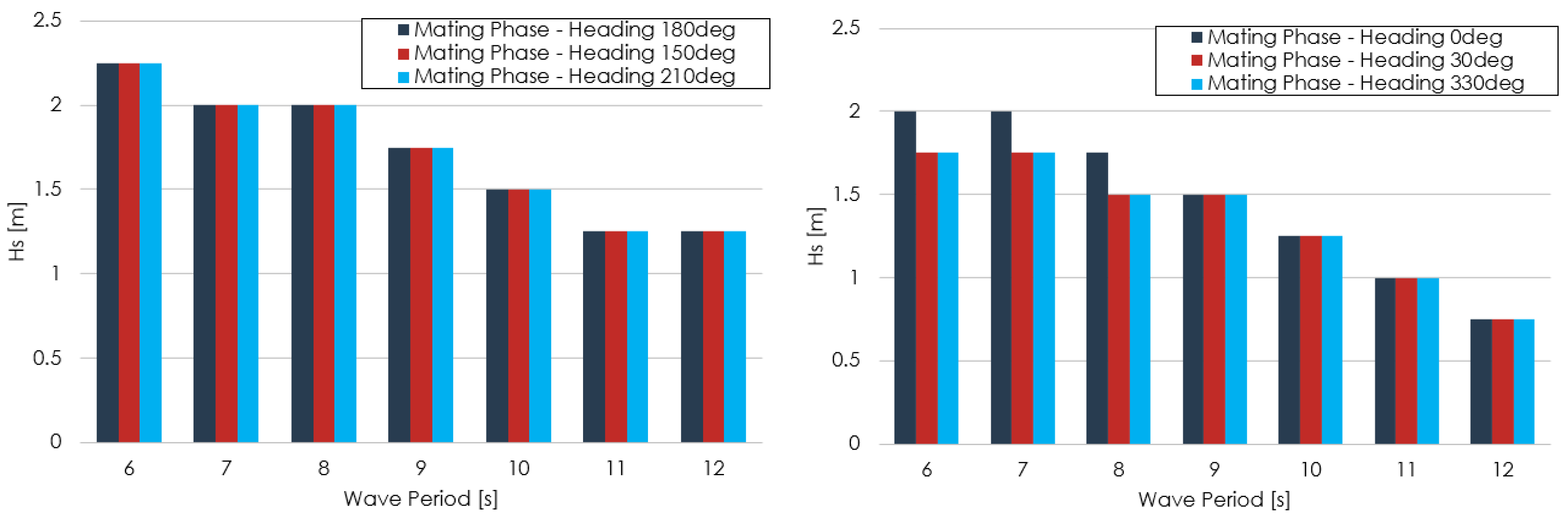
The allowable limits of sea states for each installation phase are derived from the characteristic system responses obtained from numerical simulations, with allowable thresholds defined in Section 3. These limits define the environmental conditions under which the installation activities can be safely performed. The results demonstrate that the allowable limits are governed not only by significant wave height (Hs) but also by peak period (Tp) and wave heading. This reflects the dynamic behaviour of floating systems, where response amplitudes depend on both wave energy and frequency content. Figure 8 presents the allowable sea-state limits for the monitoring phase.
The results indicate that allowable Hs decreases with increasing wave period. This behaviour is associated with the wave period approaching the natural periods of the installation vessel and floating spar, leading to motion amplification. The governing parameter during this phase is the relative motion between the vessel and the spar, which is primarily driven by first-order wave excitation. Directional effects are also observed. Certain wave headings result in reduced relative motion due to favourable alignment between the vessel and incoming waves, while others lead to increased responses. These variations are influenced by hydrodynamic interactions between the vessel and the spar, including wave shielding and diffraction effects.
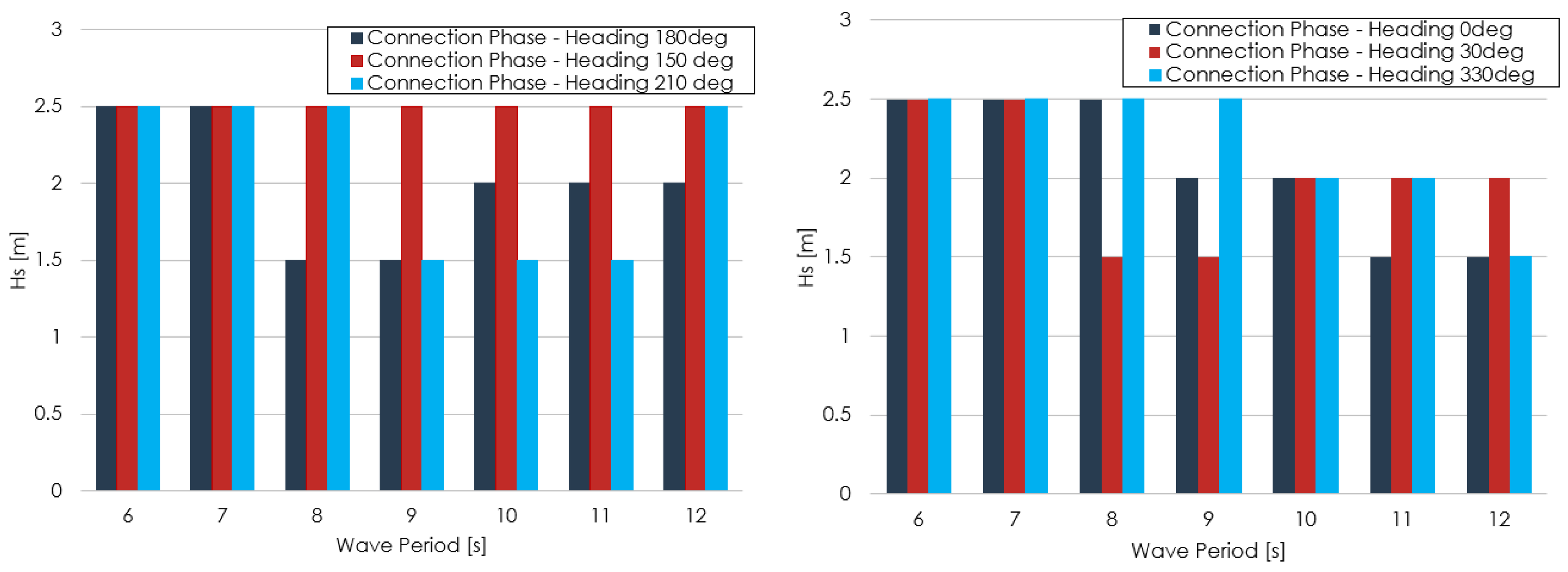
The allowable limits for the connection phase are presented in Figure 9. During this phase, the governing parameter is the gripper force required to maintain the connection between the vessel and the floating spar. The results show that allowable sea states are less sensitive to wave period compared to the monitoring phase, due to the stabilising effect of the gripper system. The mechanical connection introduces additional stiffness, reducing relative motion but increasing internal load transfer. However, as wave height increases, the gripper forces rise significantly due to the system’s coupled response. The limits are therefore defined by the mechanical capacity of the gripper system rather than motion alone.
Figure 10 presents the allowable sea-state limits for the mating phase. The mating phase is identified as the most critical stage of the installation process. The governing parameter is the relative vertical velocity between the wind turbine assembly and the floating spar at the point of contact. This parameter directly controls the impact loads during mating. The results indicate a strong sensitivity to both wave height and wave period. As the wave period increases, the relative velocity rises due to amplified heave and pitch motions, rendering operation infeasible at lower wave heights. This reflects the nonlinear, coupled nature of the system at this stage. Wave heading has a significant influence, with head sea conditions generally providing more favourable limits. This is due to reduced horizontal drift and improved alignment between the vessel and spar. In contrast, following seas introduce larger surges and low-frequency motions, increasing relative velocity and reducing allowable limits.
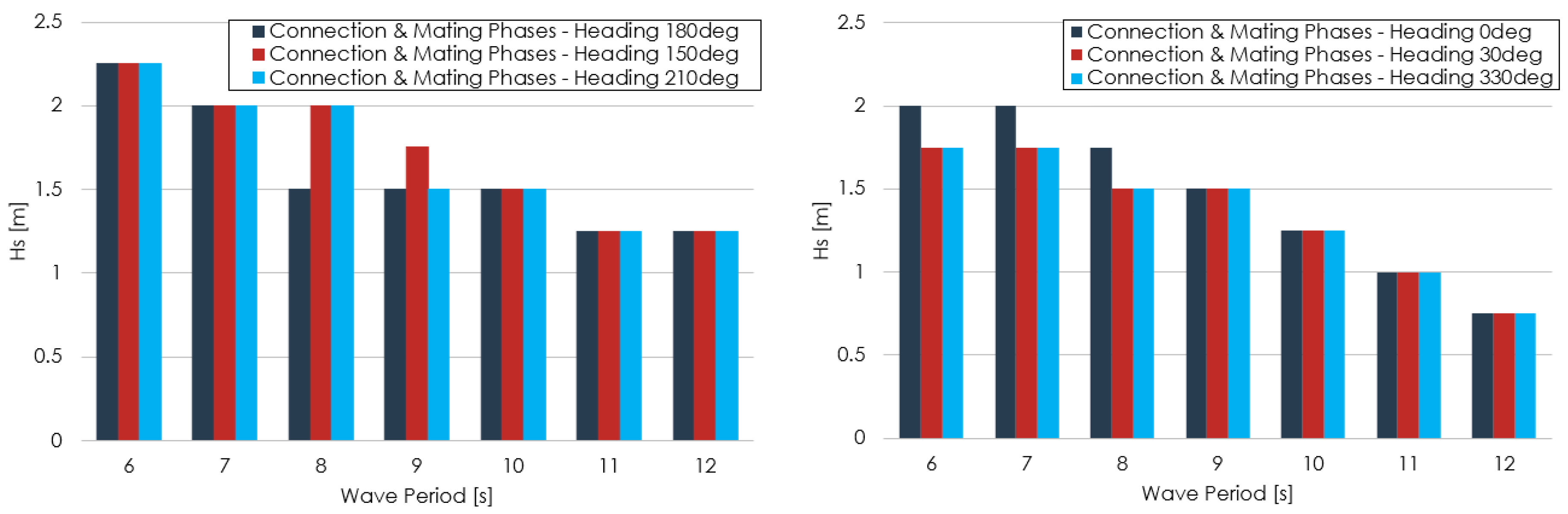
Figure 11 combines the results across connection and mating phases. The results demonstrate that allowable sea states vary significantly with wave heading and period, confirming that operational limits cannot be defined solely based on wave height. The findings highlight the importance of considering full environmental parameter combinations when defining installation criteria.

5.2. Operability Results

The operability of the installation process is evaluated by combining the allowable sea-state limits derived in Section 5.1 with site-specific hindcast environmental data, following the methodology described in Section 3.
The results reflect the combined influence of environmental conditions and system response. As demonstrated in Section 5.1, the allowable sea states are strongly dependent on peak period and wave heading, and these dependencies directly govern the operability outcomes. In general, reduced operability is observed with increasing wave periods and unfavourable wave headings, consistent with the previously identified response amplification mechanisms. As a result, the feasibility of installation activities is primarily controlled by the limiting behaviour of the most critical installation phase, namely, the mating phase.
The duration and continuity requirements of installation activities further influence operability. Continuous operations, such as mating, require uninterrupted weather windows and therefore impose more restrictive conditions compared to non-continuous activities. To provide a probabilistic interpretation of installation feasibility, operability is evaluated at P20, P50, and P90, representing increasing levels of environmental conservatism:
  • P20 corresponds to favourable environmental conditions;
  • P50 represents median conditions;
  • P90 reflects conservative conditions with increased downtime.
In the present study, these probability levels are derived from hindcast environmental data and therefore reflect natural variability in wave climate rather than forecast uncertainty. In practical offshore operations, forecast uncertainty is typically accounted for by applying correction factors (α-factors), which reduce allowable sea-state limits to ensure operational reliability. These factors are not explicitly applied in this study; therefore, the presented results represent planning-phase operability conditions.

5.2.1. Project A—North Sea

Project A is a relatively small-scale installation campaign comprising 11 turbines in the North Sea. The site is characterised by moderate-to-harsh wave conditions, typical of deep-water North Sea environments, and serves as a baseline case for evaluating installation feasibility under realistic offshore conditions.
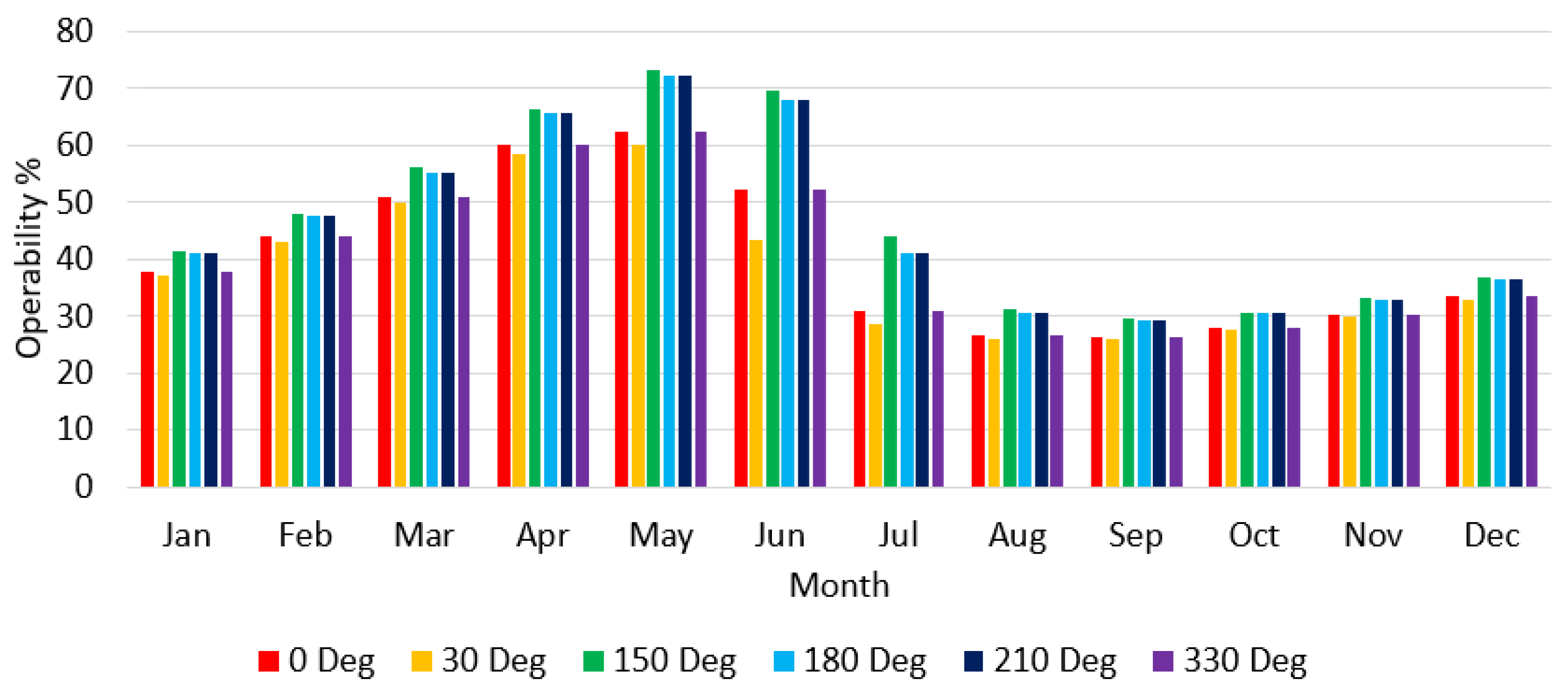
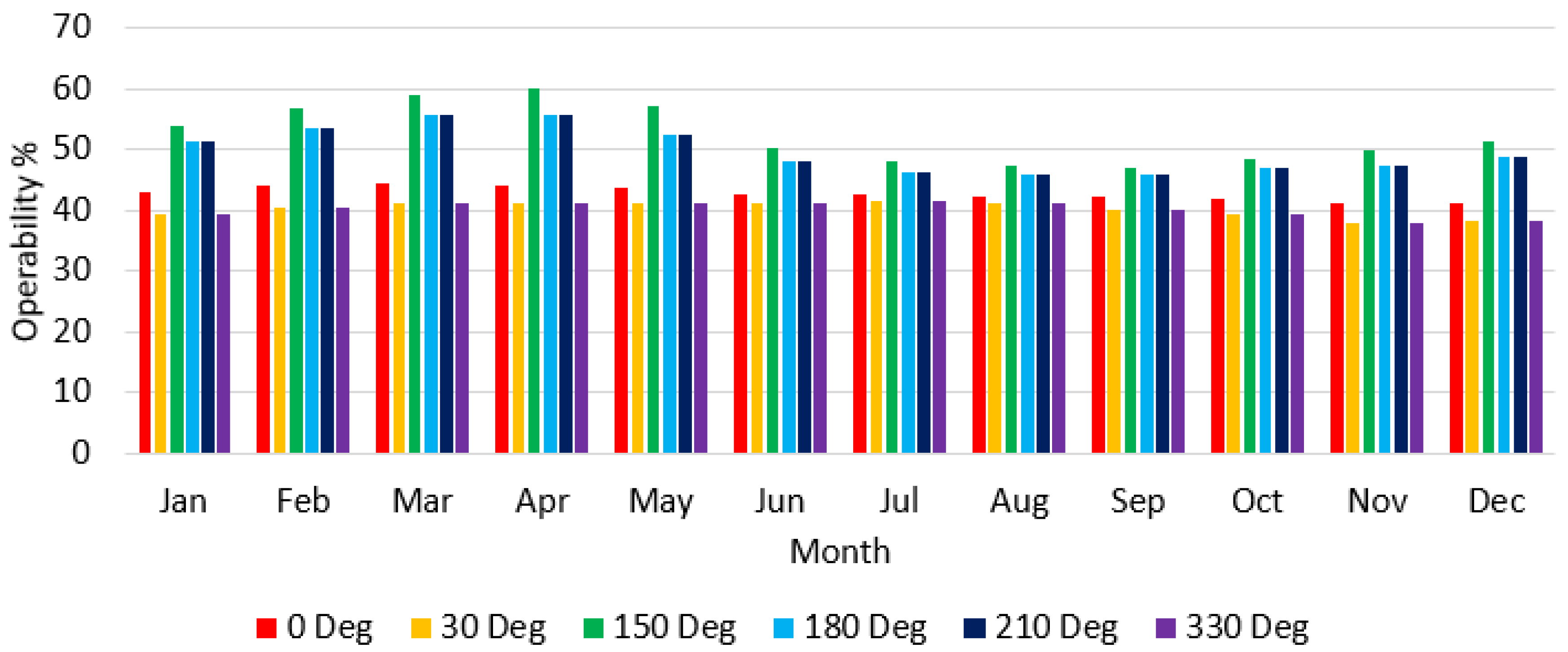
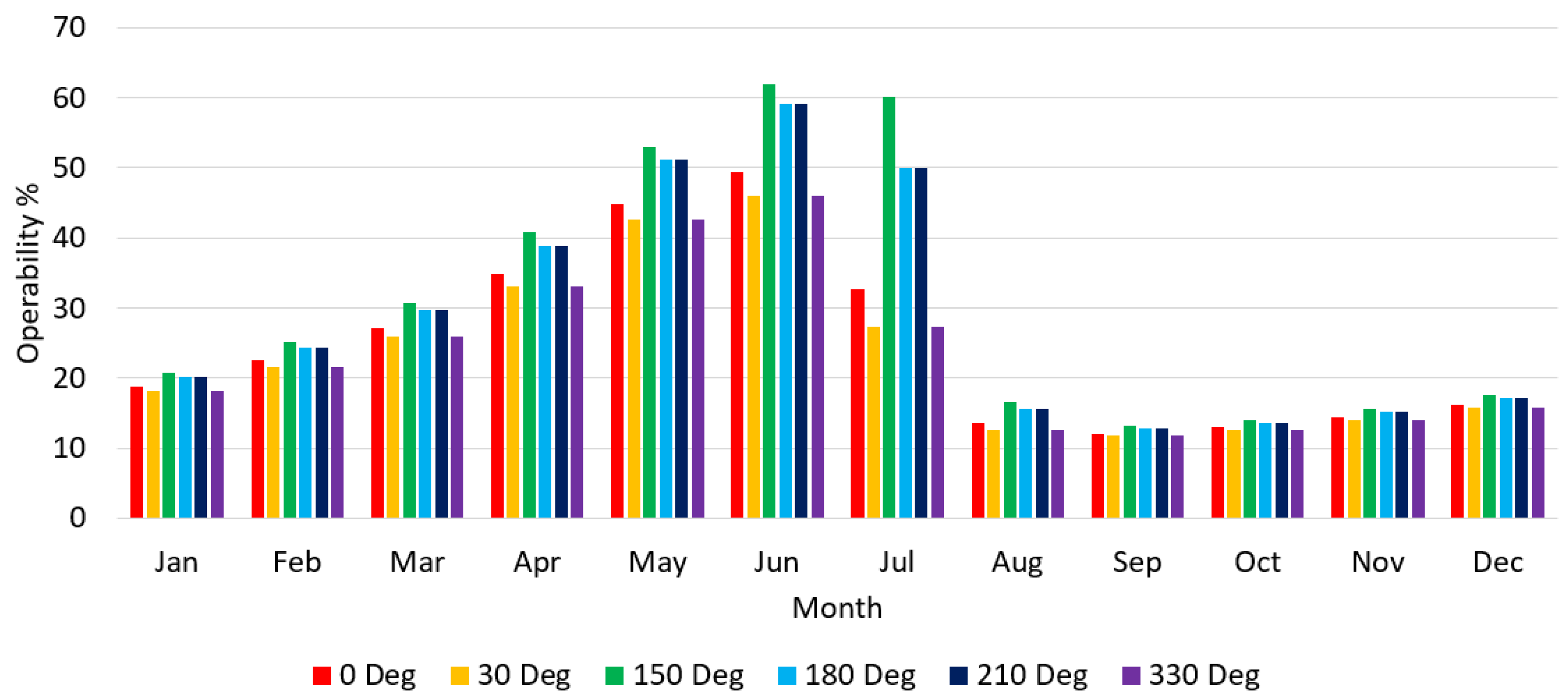
The operability results for Project A are presented in Figure 12.
Figure 12 shows that operability varies significantly with wave heading, with higher operability observed in head sea conditions. This behaviour is consistent with the response characteristics identified in Section 5.1, in which reduced surge and improved alignment between the installation vessel and the floating spar result in lower relative motion.
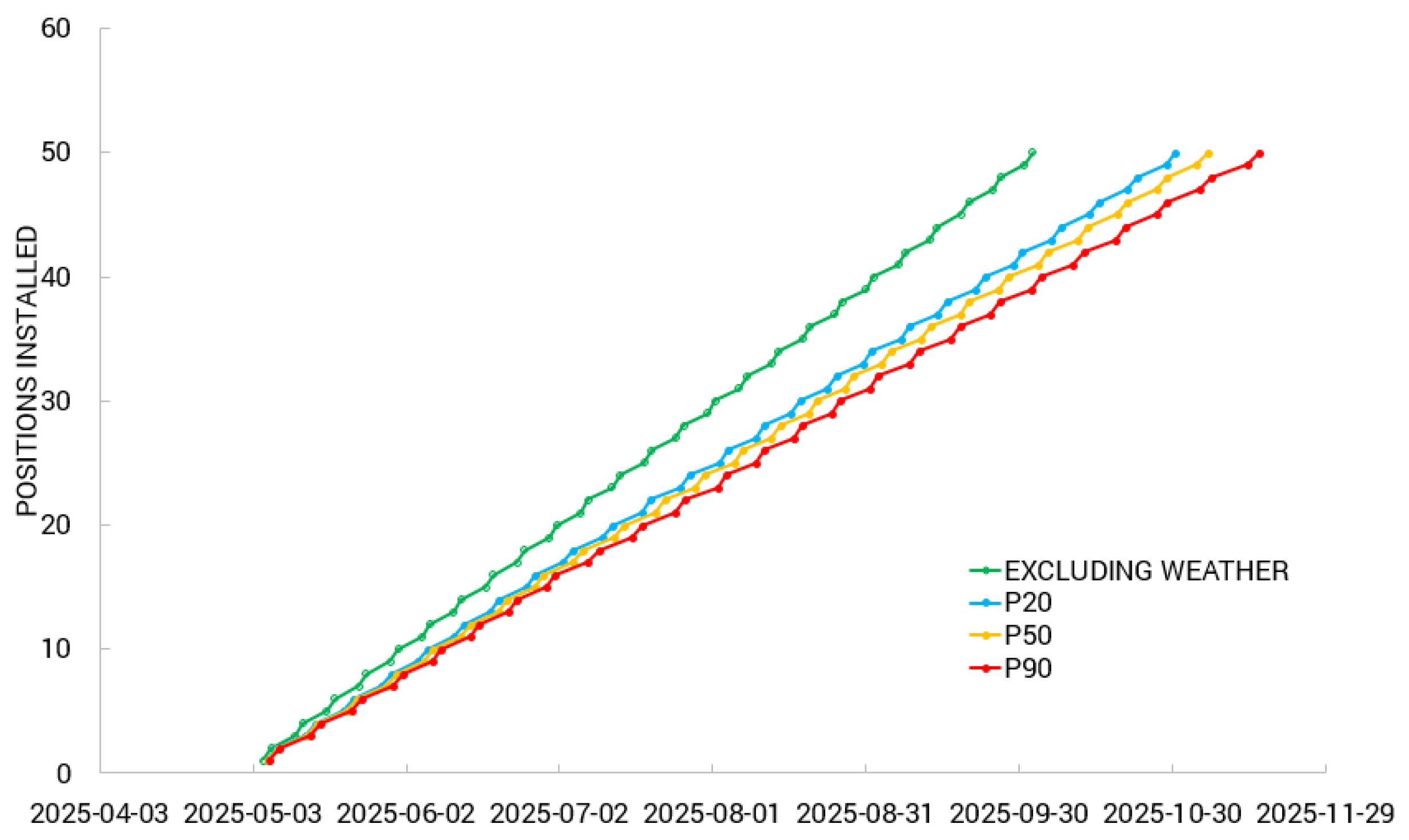
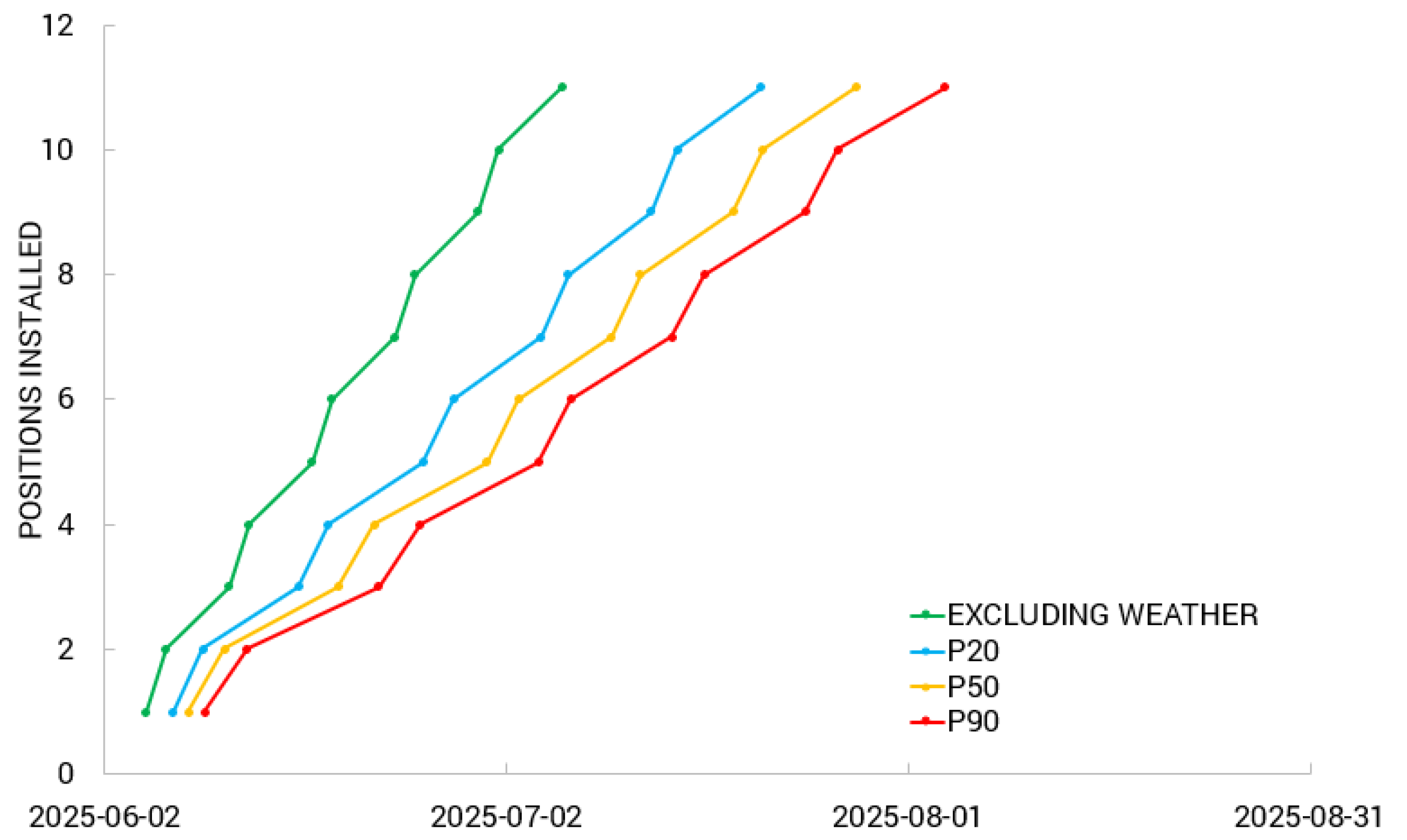
The installation time and seasonal variability are presented in Figure 13.
This figure clearly indicates that installation duration is strongly influenced by seasonal environmental conditions. The relatively limited number of turbines allows for shorter installation windows; however, weather variability remains a dominant factor, particularly under conservative (P90) conditions.
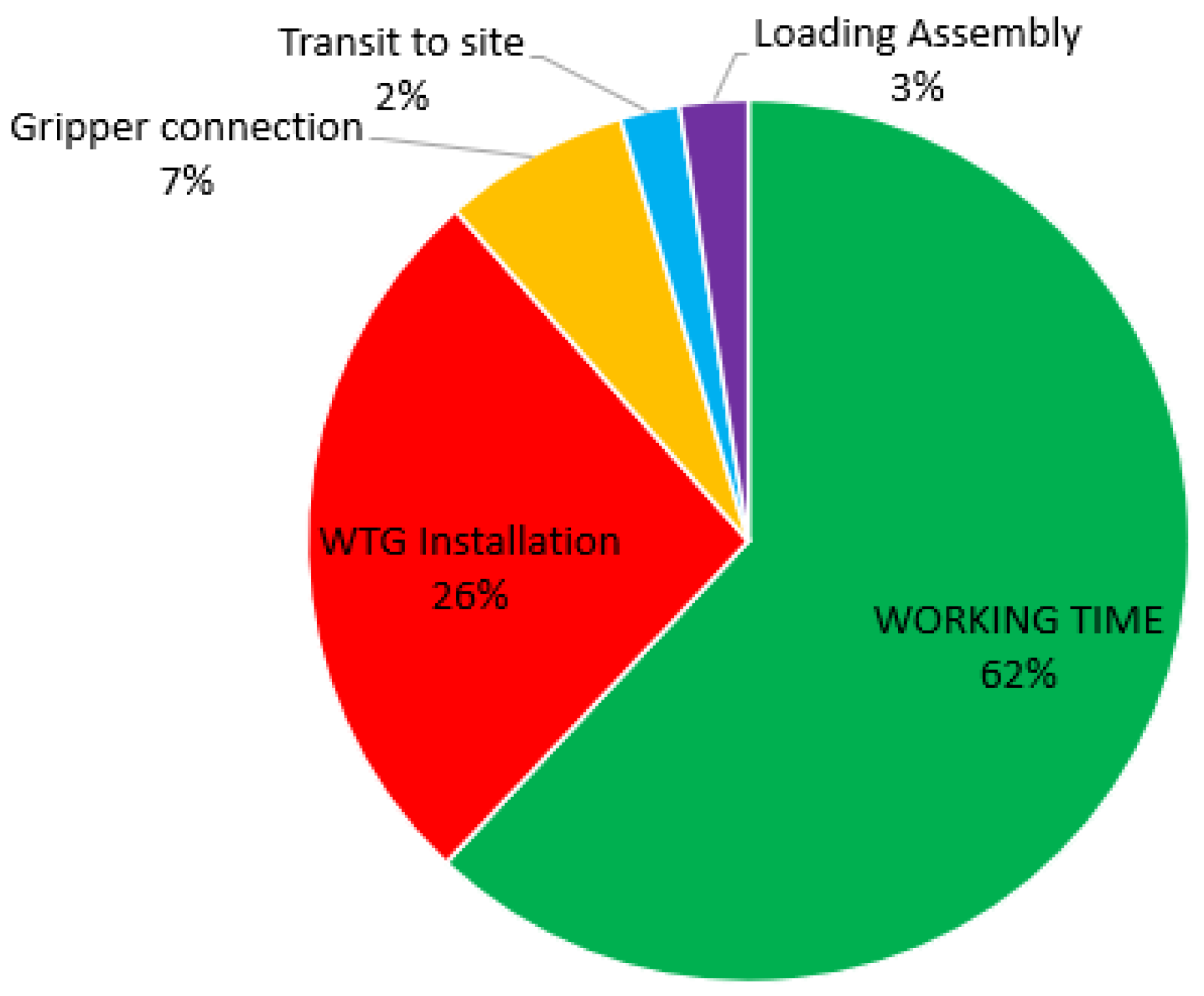
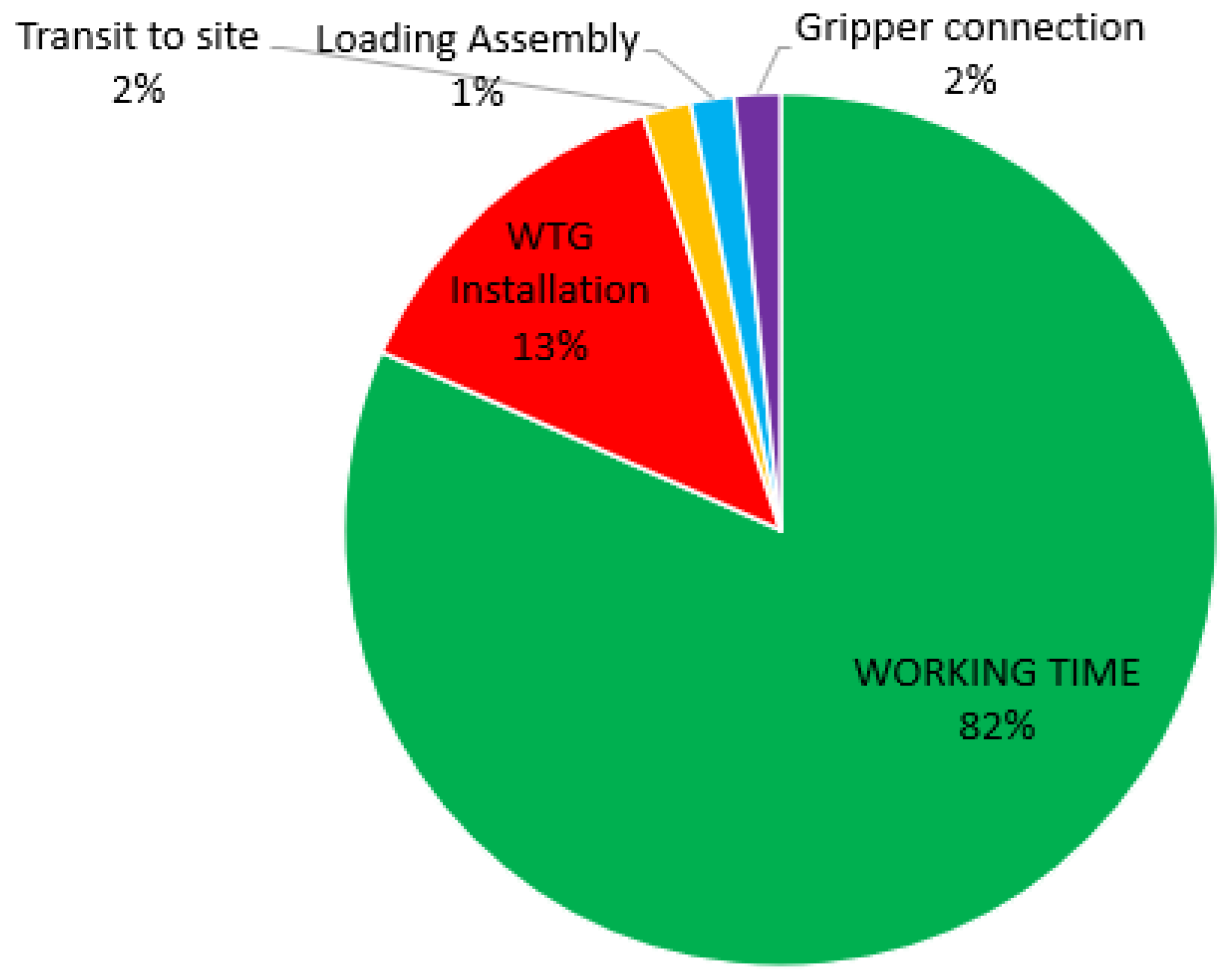
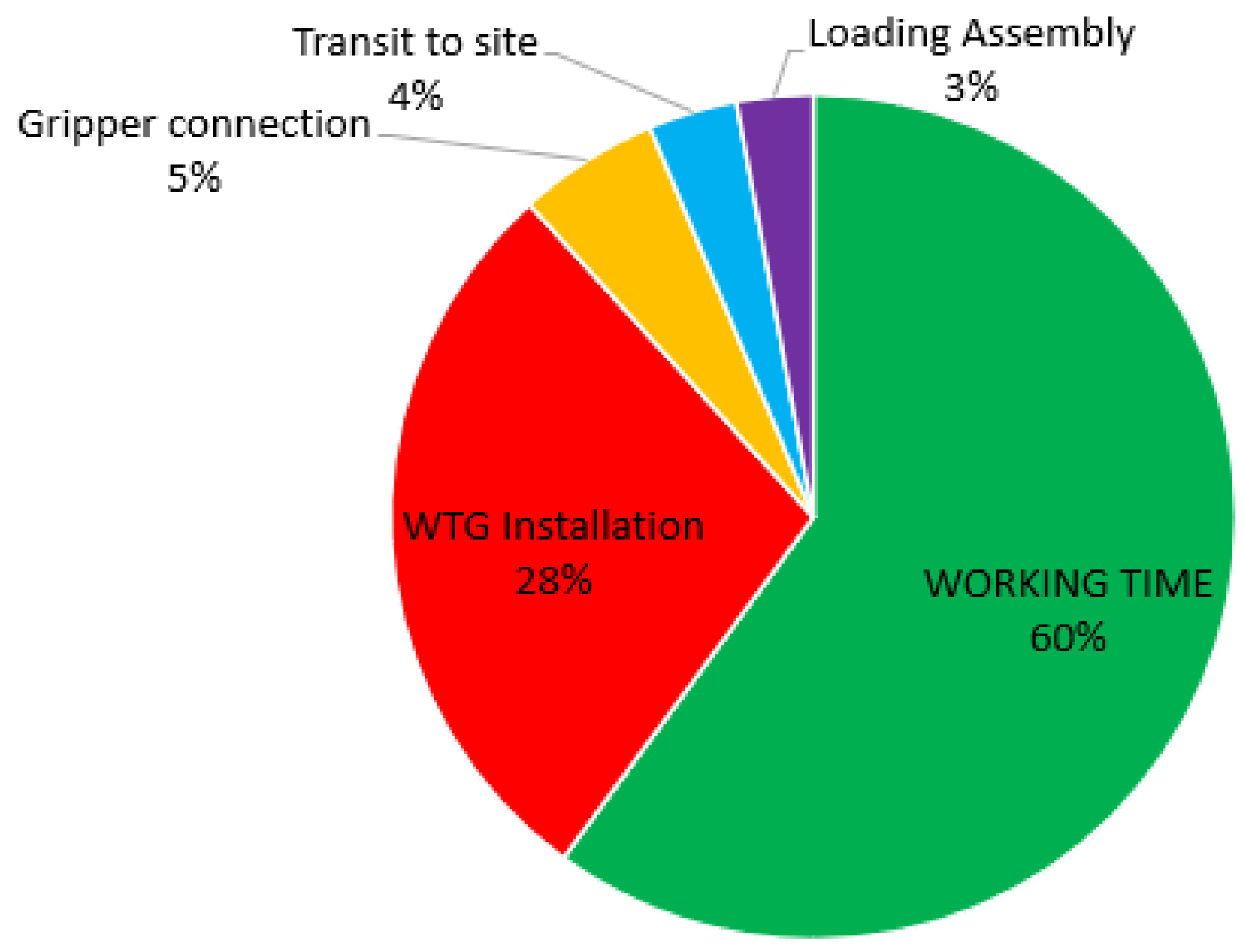
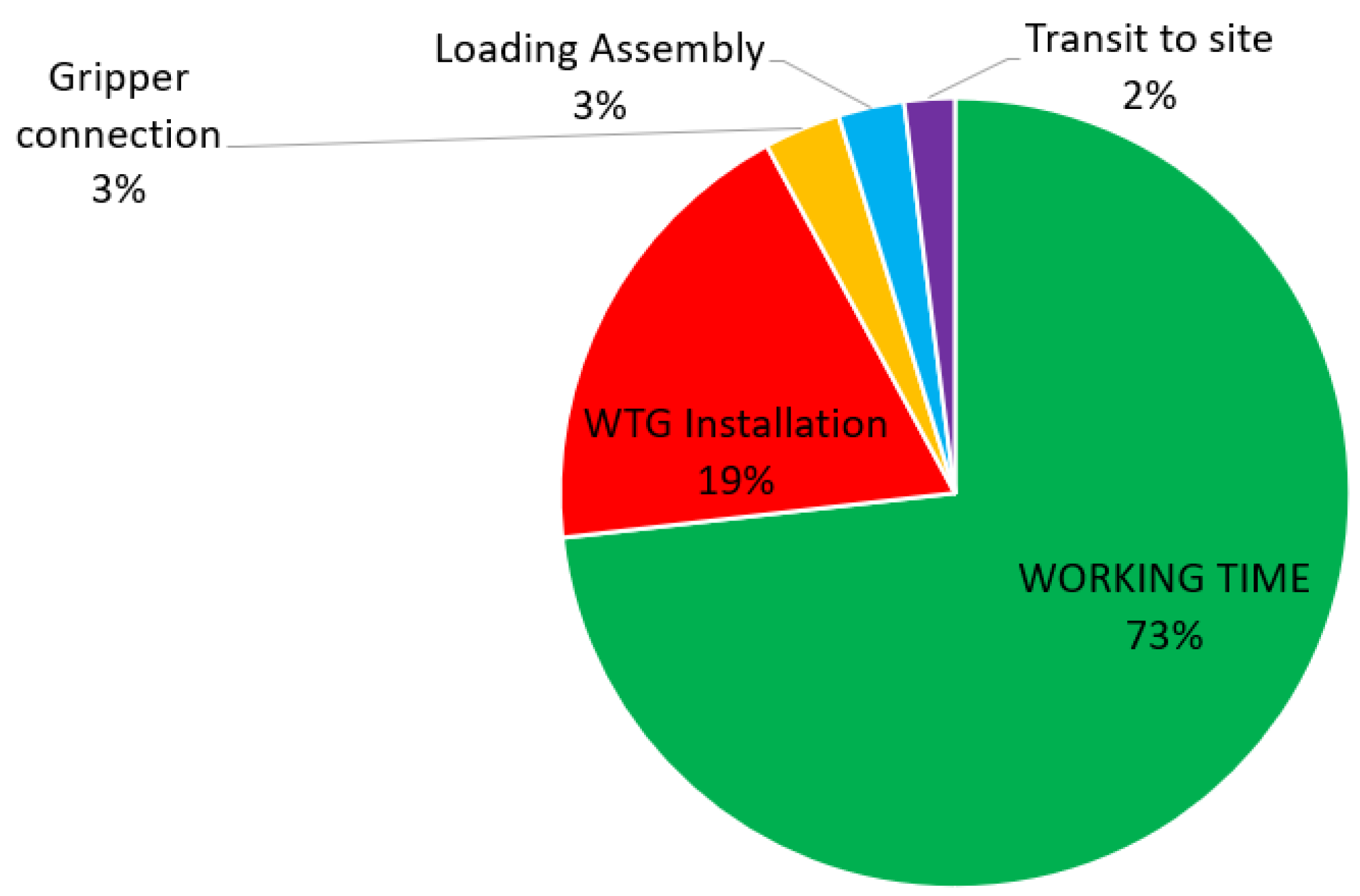
The governing operations contributing to downtime are shown in Figure 14. As can be seen, the mating phase is the primary contributor to downtime, followed by the connection phase, confirming that the most restrictive installation stage governs overall operability.

5.2.2. Project B—North Sea (Intermediate Scale)

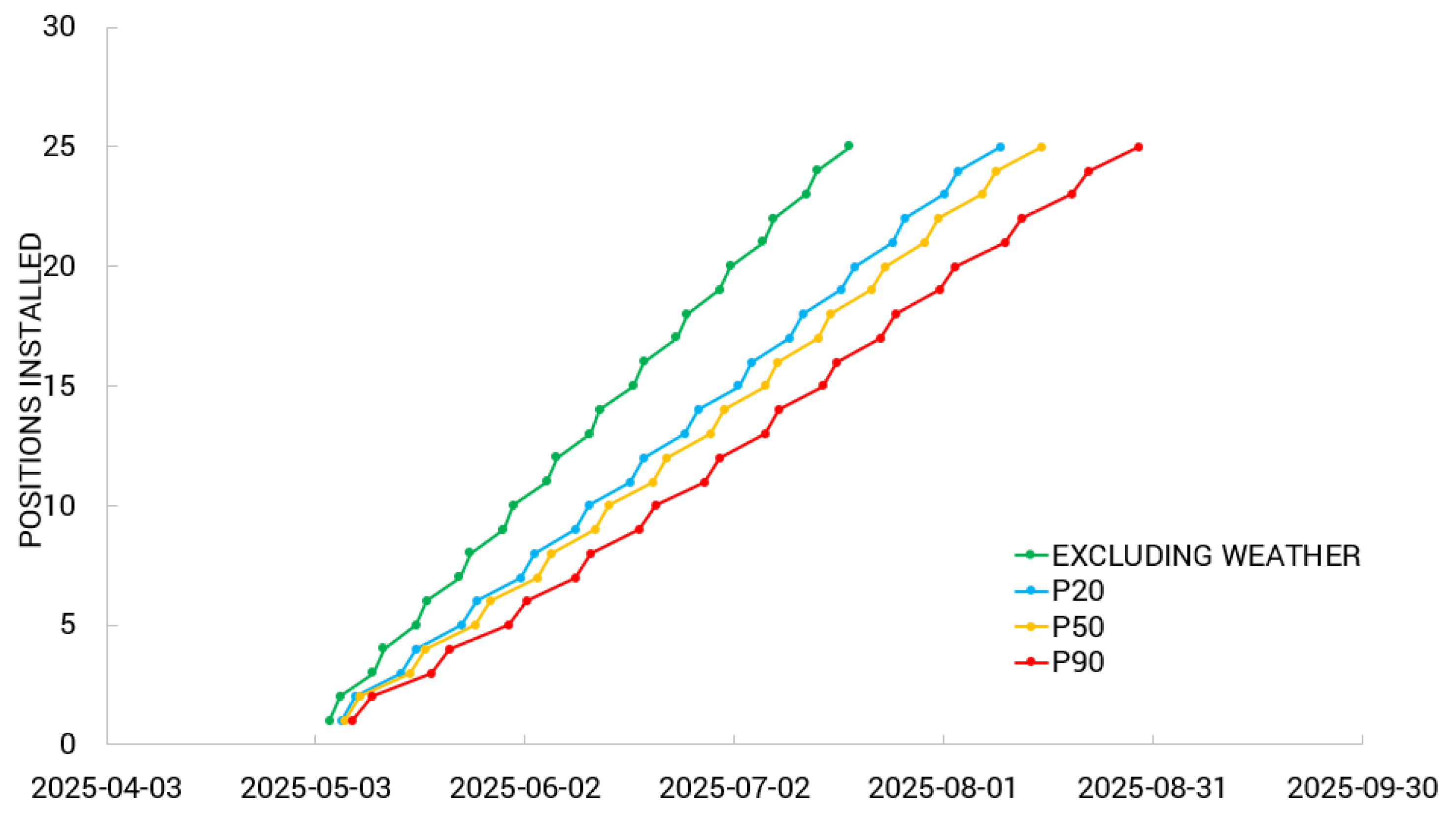
Project B represents a medium-scale development of 25 turbines, also located in the North Sea. Compared to Project A, this case reflects a larger installation campaign under similar environmental conditions, allowing assessment of the influence of project scale on operability and installation duration.
The operability results for Project B are presented in Figure 15.
Figure 15 shows trends consistent with those observed in Project A, with head sea conditions offering improved operability. However, the overall operability is slightly higher in this case due to more favourable local environmental conditions. The installation time is also shown in Figure 16, highlighting the influence of project scale: an increase in the number of turbines results in longer cumulative installation durations. Despite the improved environmental conditions, the extended campaign length increases the exposure to weather variability. The governing operations are shown in Figure 17 which confirms that the mating phase remains the controlling operation. This indicates that system dynamics continue to dominate installation feasibility, regardless of project size.

5.2.3. Project C—South Korea

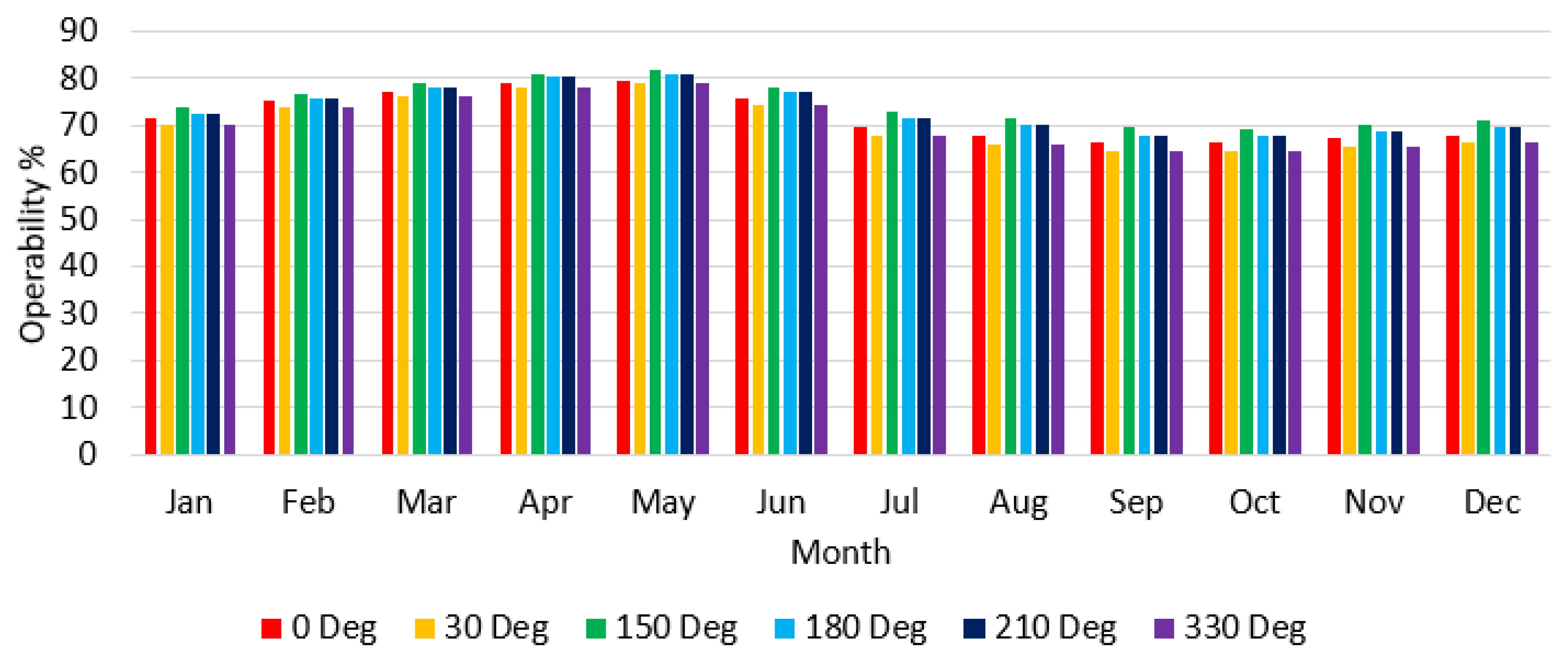
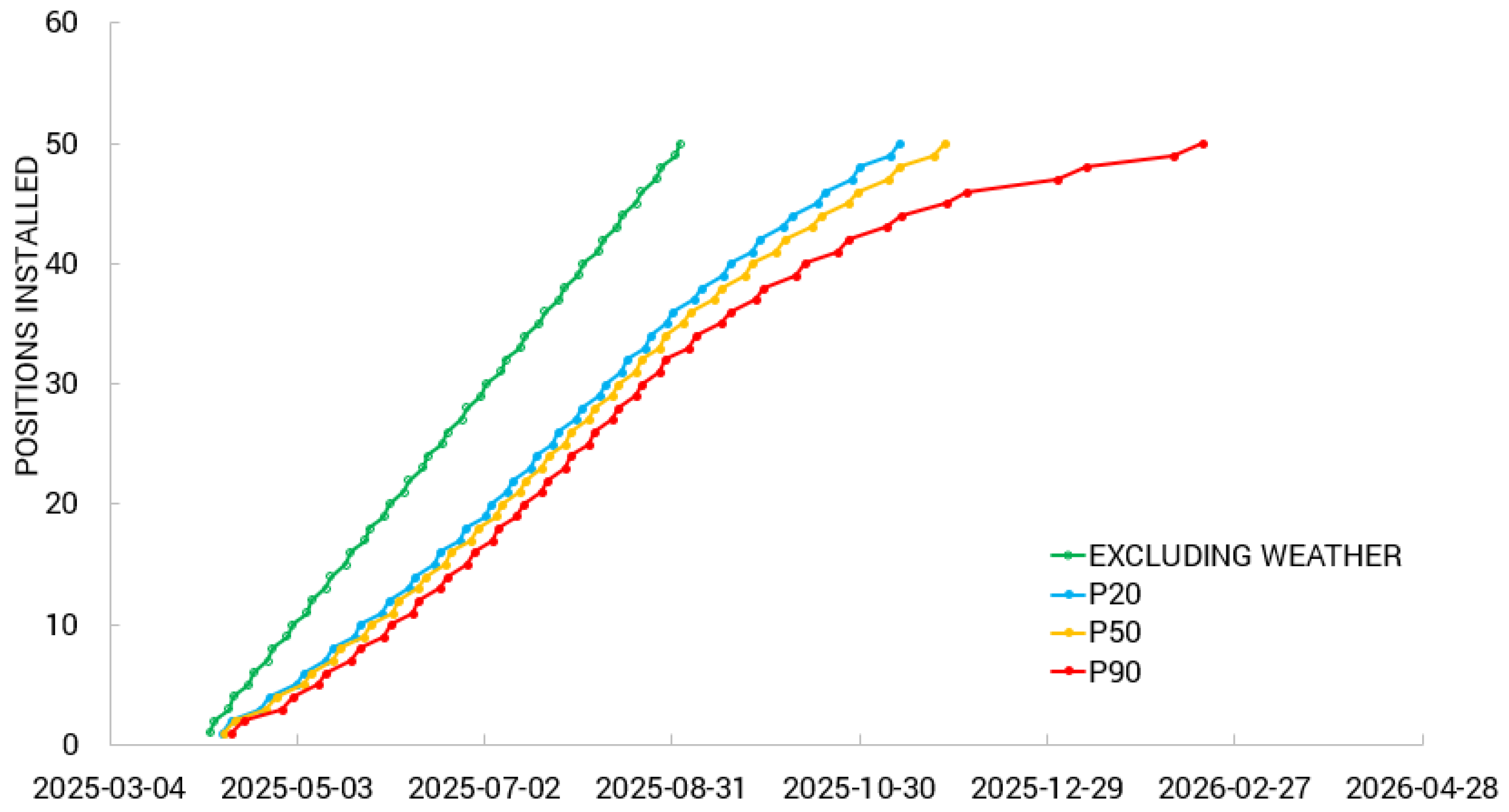
Project C represents a large-scale installation campaign involving 50 turbines located offshore of South Korea. The site is characterised by milder wave conditions compared to the North Sea, providing a contrasting environment for evaluating the methodology. The operability results for Project C are presented in Figure 18.
The results indicate improved operability across all wave headings relative to the North Sea cases, reflecting the more favourable environmental conditions. Nevertheless, directional effects remain evident. The installation time is shown in Figure 19. It demonstrates reduced weather-related downtime compared with the North Sea projects. However, the larger number of turbines leads to longer overall installation durations, highlighting the trade-off between environmental conditions and project scale.
Finally, Figure 20 shows that the mating phase remains the most critical operation, confirming that system response remains the primary factor governing operability, even under favourable environmental conditions.

5.2.4. Project D—U.S. West Coast

Project D represents a large-scale installation campaign involving 50 turbines located on the U.S. West Coast. This site is characterised by harsh environmental conditions, including long-period swell, which has a significant influence on the system response. The operability results for Project D are presented in Figure 21.
Figure 21 shows reduced operability across all headings due to the influence of long-period swell, which results in increased vessel motions and consequently lower allowable sea states. Figure 22 further highlights significant increases in installation duration, particularly under conservative conditions, reflecting the combined effects of environmental severity and project scale. Figure 23 confirms that the mating phase continues to dominate downtime, with increased sensitivity to wave period due to swell-driven response amplification.

6. Conclusions

This study presents a response-based methodology for defining allowable operational limits and assessing operability for floating offshore wind turbine installation using the Nordic Wind concept. The approach integrates hydrodynamic modelling, coupled system response analysis, and probabilistic weather-window assessment to evaluate installation feasibility under realistic environmental conditions.
The results demonstrate that installation operability is governed primarily by system response rather than environmental parameters alone. Peak wave period and wave heading are identified as key drivers of operability, consistent with the response amplification mechanisms observed in the allowable limit analysis. In particular, increasing wave period reduces operability due to resonance effects, while wave heading significantly influences system alignment and relative motion.
Across all case studies, the mating phase is consistently identified as the governing installation stage. This phase is controlled by relative velocity and impact criteria, making it highly sensitive to wave-induced motions. As a result, even moderate increases in wave period lead to significant reductions in allowable sea states and overall operability.
The operability assessment further shows that wave heading plays a dominant role in installation feasibility. Head sea conditions generally provide improved operability due to reduced surge and drift motions, while following and quartering seas lead to increased relative displacement and reduced performance.
The comparison across different geographical locations highlights the combined influence of environmental conditions and project scale. Milder environments, such as offshore South Korea, offer higher operability and reduced weather downtime, whereas harsher environments, such as the U.S. West Coast, significantly reduce operability due to long-period swell. At the same time, larger installation campaigns increase cumulative exposure to weather-related delays, even under favourable environmental conditions. The probabilistic analysis using P20, P50, and P90 levels demonstrates that installation duration and feasibility are highly sensitive to environmental variability.
Future work should focus on extending the proposed methodology toward a comparative assessment of alternative floating wind turbine installation strategies. In particular, a direct comparison between the Nordic Wind concept and conventional installation approaches, in which wind turbine assemblies are completed onshore and transported offshore as fully assembled units, should be conducted from a logistics perspective. Such analysis would enable evaluation of installation sequence efficiency, operational complexity, and sensitivity to environmental conditions. It would also support quantification of potential reductions in offshore installation time and associated exposure to weather-related delays. In addition, future studies should incorporate economic assessment of installation strategies, including their impact on overall project CAPEX and installation costs. By linking operability results with logistics planning and cost modelling, the methodology can be extended to support decision making at the project level. Further development should include integrating forecast uncertainty through α-factors and using real-time environmental data to support offshore execution.
Finally, validation using experimental data or full-scale measurements, when available, would further enhance confidence in the proposed framework.

Author Contributions

M.H.: methodology; formal analysis, visualization, writing—original draft. C.G.S.: writing—review; supervision. All authors have read and agreed to the published version of the manuscript.

Funding

This work contributes to the Strategic Research Plan of the Centre for Marine Technology and Ocean Engineering (CENTEC), which is financed by the Portuguese Foundation for Science and Technology (Fundação para a Ciência e Tecnologia—FCT) under contract UID/00134/2025 (https://doi.org/10.54499/UID/00134/2025).

Data Availability Statement

This study is based on environmental hindcast wave data, project-specific input parameters, and numerical simulation results generated by the authors. The hindcast data are obtained from established metocean datasets, while the simulation results were produced using the numerical modelling framework described in this manuscript. Due to confidentiality constraints, certain project-specific input data cannot be made publicly available. However, the modelling methodology and assumptions are described in sufficient detail to allow reproducibility of the results.

Conflicts of Interest

The authors declare no conflicts of interest.

Nomenclature

AHCActive heave compensation
DPDynamic positioning
FOWTFloating offshore wind turbine
Nordic WindName of novel installation method
RAOResponse amplitude operator
WLWaterline
WTGWind turbine generator
HsSignificant wave height
TpPeak wave period
ƟWave heading
XcharCharacteristic response
XallowAllowable thresholds
XrelRelative displacement
VrelRelative velocity
VwWind speed
FgGripper force
αForecast uncertainty factor

References

  1. Butterfield, S.; Musial, W.; Jonkman, J.; Sclavounos, P. Engineering Challenges for Floating Offshore Wind Turbines. In Proceedings of the Copenhagen Offshore Wind Conference, Copenhagen, Denmark, 26–28 October 2005. [Google Scholar]
  2. Henderson, A.; Collu, M.; Masciola, M. Overview of Floating Offshore Wind Technologies. In Floating Offshore Wind Energy; Cruz, J., Atcheson, M., Eds.; Springer: Berlin/Heidelberg, Germany, 2016; pp. 87–132. [Google Scholar]
  3. Pérez-Collazo, C.; Greaves, D.; Iglesias, G. A review of combined wave and offshore wind energy. In Renewable and Sustainable Energy Reviews; Elsevier: Amsterdam, The Netherlands, 2015; Volume 42, pp. 141–153. [Google Scholar]
  4. DNV. Floating Wind: The Power to Commercialize. Technical Report. 2020. Available online: https://www.dnv.com/Publications/floating-wind-the-power-to-commercialize-192334 (accessed on 11 April 2022).
  5. Musial, W.; Spitsen, P.; Beiter, P.; Nunemaker, J.; Gevorgian, V. Offshore Wind Market Report: 2023 Edition; U.S. Department of Energy, National Renewable Energy Laboratory (NREL): Golden, CO, USA, 2023. [Google Scholar]
  6. Weigell, J.; Jahn, C. Literature Review of Installation Logistics for Floating Offshore Wind Turbines. In Proceedings of the Hamburg International Conference of Logistics (HICL), Hamburg, Germany, 23–24 September 2021; Volume 32, pp. 599–622. [Google Scholar]
  7. Jiang, Z. Installation of offshore wind turbines: A technical review. In Renewable and Sustainable Energy Reviews; Elsevier: Amsterdam, The Netherlands, 2021; Volume 139. [Google Scholar]
  8. James, R.; Ros, M.C. Floating Offshore Wind: Market and Technology Review. 2015. Available online: https://www.carbontrust.com/sites/default/files/documents/resource/public/Floating%20Offshore%20Wind%20Market%20Technology%20Review%20-%20REPORT.pdf (accessed on 10 May 2019).
  9. Castro-Santos, L.; Filgueira-Vizoso, A.; Lamas-Galdo, I.; Carral-Couce, L. Methodology to Calculate the Installation Costs of Offshore Wind Farms Located in Deep Waters. J. Clean. Prod. 2017, 170, 1124–1135. [Google Scholar] [CrossRef]
  10. Hong, S.; Zhang, H.; Nord, T.S.; Halse, K.H. Effect of fender system on the dynamic response of onsite installation of floating offshore wind turbines. Ocean Eng. 2022, 259, 111830. [Google Scholar] [CrossRef]
  11. Hong, S.; Zhang, H.; Halse, K.H. Hydrodynamic and environmental modelling influence on numerical analysis of an innovative installation method for floating wind. Ocean Eng. 2023, 280, 114681. [Google Scholar] [CrossRef]
  12. Hong, S.; McMorland, J.; Zhang, H.; Collu, M.; Halse, K.H. Floating offshore wind farm installation, challenges and opportunities: A comprehensive survey. Ocean Eng. 2024, 304, 117793. [Google Scholar] [CrossRef]
  13. Ramachandran, R.C.; Desmond, C.; Judge, F.; Serraris, J.-J.; Murphy, J. Floating offshore wind turbines: Installation, operation, maintenance and decommissioning challenges and opportunities. Wind Energy Sci. Discuss. 2021, 2021, 1–32. [Google Scholar] [CrossRef]
  14. DNV. Offshore Standard—DNV-OS-H101, Marine Operations, General. 2011. Available online: https://rules.dnv.com/servicedocuments/dnv/#!/home (accessed on 16 August 2021).
  15. Altuzarra, J.; Herrera, A.; Matias, O.; Urbano, J.; Romero, C.; Wang, S.; Guedes Soares, C. Mooring system transport and installation logistics for a floating offshore wind farm in Lannion, France. J. Mar. Sci. Eng. 2022, 10, 1354. [Google Scholar] [CrossRef]
  16. Diaz, H.M.; Soares, C.G. Approach for installation and logistics of a floating offshore wind farm. J. Mar. Sci. Eng. 2023, 11, 53. [Google Scholar] [CrossRef]
  17. Peace, D.; Tuturea, D.; Ellis, N.; Chiwis, J. Dynamic analysis of the Hutton TLP mating operation. In Proceedings of the Offshore Technology Conference OTC 5048, Houston, TX, USA, 6–9 May 1985. [Google Scholar]
  18. Wu, M.; Moan, T.; Gao, Z. Methodology for developing a response-based correction factor (α-factor) for allowable sea state assessment of marine operations considering weather forecast uncertainty. Mar. Struct. 2021, 79, 103050. [Google Scholar] [CrossRef]
  19. Clauss, G.; Riekert, T. Operational limitations of offshore crane vessels. In Proceedings of the Offshore Technology Conference OTC6217, Houston, TX, USA, 7–10 May 1990. [Google Scholar]
  20. Sekita, K.; Kimura, H.; Tatsuta, M. Dynamic Lifting Analysis of Offshore Structures. In Proceedings of the Proceedings of the Offshore Technology Conference (OTC 5287), Houston, TX, USA, 5–8 May 1986. [Google Scholar]
  21. Smith, I.; Lewis, T.; Miller, B.; Lai, P.; Frieze, P. Limiting motions for jack-ups moving onto location. Mar. Struct. 1996, 9, 25–51. [Google Scholar] [CrossRef]
  22. Del Guzzo, A.; Gaggiotti, F.; Rossetti, C.; Di Tomaso, F.; Bruschi, R. Application of 2D Wave Spectra Time Series for Pipelaying Vessel Stinger Structural Assessment. In Proceedings of the MARINE VII: Proceedings of the VII International Conference on Computational Methods in Marine Engineering 2017, Nantes, France, 15–17 May 2017. [Google Scholar]
  23. Cozijn, J.; van der Wal, R.; Dunlop, C. Model testing and complex numerical simulations for offshore installation. In Proceedings of the Eighteenth International Offshore and Polar Engineering Conference, Vancouver, BC, Canada, 6–11 July 2008. [Google Scholar]
  24. Graczyk, M.; Sandvik, P.C. Study of landing and lift-off operation for wind turbine components on a ship deck. In Proceedings of the ASME20123 1st International Conference on Ocean, Offshore and Arctic Engineering, Rio de Janeiro, Brazil, 1–6 July 2012; pp. 677–686. [Google Scholar]
  25. DNV-RP-H103; Modelling and Analysis of Marine Operations. Det Norske Veritas: Høvik, Norway, 2014.
  26. Li, L.; Gao, Z.; Moan, T.; Ormberg, H. Analysis of lifting operation of a monopile for an offshore wind turbine considering vessel shielding effects. Mar. Struct. 2014, 39, 287–314. [Google Scholar] [CrossRef]
  27. Zhao, Y.; Cheng, Z.; Sandvik, P.C.; Gao, Z.; Moan, T.; Van Buren, E. Numerical modeling and analysis of the dynamic motion response of an offshore wind turbine blade during installation by a jack-up crane vessel. Ocean Eng. 2018, 165, 353–364. [Google Scholar] [CrossRef]
  28. Guachamin-Acero, W.; Gao, Z.; Moan, T. Methodology for Assessment of the Allowable Sea States during Installation of an Offshore Wind Turbine Transition Piece Structure onto a Monopile Foundation. J. Offshore Mech. Arct. Eng. 2017, 139, 061901. [Google Scholar] [CrossRef]
  29. Guachamin-Acero, W.; Li, L.; Gao, Z.; Moan, T. Methodology for Assessment of the Operational Limits and Operability of Marine Operations. Ocean Eng. 2016, 125, 308–327. [Google Scholar] [CrossRef]
  30. Guachamin Acero, W.; Gao, Z.; Moan, T. Numerical study of a novel procedure for installing the tower and rotor nacelle assembly of offshore wind turbines based on the inverted pendulum principle. J. Mar. Sci. Appl. 2017, 16, 243–260. [Google Scholar] [CrossRef]
  31. Gao, Z.; Verma, A.; Zhao, Y.; Jiang, Z.; Ren, Z. A Summary of the Recent Work at NTNU on Marine Operations Related to Installation of Offshore Wind Turbines. In Proceedings of the ASME 2018 37th International Conference on Ocean, Offshore and Arctic Engineering OMAE 2018, Madrid, Spain, 17–22 June 2018. [Google Scholar]
  32. Hassan, M.; Guedes Soares, C. Dynamic Analysis of a Novel Installation Method of Floating Spar Wind Turbines. J. Mar. Sci. Eng. 2023, 11, 1373. [Google Scholar] [CrossRef]
  33. Natskår, A.; Moan, T.; Alvær, P.Ø. Uncertainty in forecasted environmental conditions for reliability analyses of marine operations. Ocean Eng. 2015, 108, 636–647. [Google Scholar] [CrossRef]
  34. Wu, M.; Gao, Z.; Zhao, Y. Assessment of Allowable Sea States for Offshore Wind Turbine Blade Installation Using Time-Domain Numerical Models and Considering Weather Forecast Uncertainty. Ocean Eng. 2022, 260, 111801. [Google Scholar] [CrossRef]
  35. Guedes Soares, C. Representation of Double-Peaked Sea Wave Spectra. Ocean Eng. 1984, 11, 185–207. [Google Scholar] [CrossRef]
Figure 1. Flowchart of floating wind farm offshore installation.
Jmse 14 00723 g001
Figure 2. Dynamic system stages for WTG installation phase [26] (Reproduced with permission).
Jmse 14 00723 g002
Figure 3. Planning phase and establishing allowable limits of sea states/limiting parameters.
Jmse 14 00723 g003
Figure 4. Framework for deriving response-based operational environmental limits and linking them to operability assessment.
Jmse 14 00723 g004
Figure 5. Hydrodynamic multi-body interaction effects.
Jmse 14 00723 g005
Figure 6. Mechanical connection model (ANSYS AQWA—(Left)) and motion compensation gripper (artist impression—(Right)).
Jmse 14 00723 g006
Figure 7. Overview of the floating wind project’s locations.
Jmse 14 00723 g007
Figure 8. Allowable sea-state limits during the monitoring phase, considering different wave headings and peak periods.
Jmse 14 00723 g008
Figure 9. Allowable sea-state limits during the connection phase, considering different wave headings and peak periods.
Jmse 14 00723 g009
Figure 10. Allowable sea-state limits during the mating phase, considering different wave headings and peak periods.
Jmse 14 00723 g010
Figure 11. Allowable sea-state limits during the connection and mating phases, considering different wave headings and peak periods.
Jmse 14 00723 g011
Figure 12. Operability results as a function of wave heading for Project A.
Jmse 14 00723 g012
Figure 13. Estimated installation time and optimal execution periods for Project A under different weather risk levels (P20, P50, P90).
Jmse 14 00723 g013
Figure 14. Contribution of installation phases to weather downtime for Project A.
Jmse 14 00723 g014
Figure 15. Operability results as a function of wave heading for Project B.
Jmse 14 00723 g015
Figure 16. Estimated installation time and optimal execution periods for Project B under different weather risk levels (P20, P50, P90).
Jmse 14 00723 g016
Figure 17. Contribution of installation phases to weather downtime for Project B.
Jmse 14 00723 g017
Figure 18. Operability results as a function of wave heading for Project C.
Jmse 14 00723 g018
Figure 19. Estimated installation time and optimal execution periods for Project C under different weather risk levels (P20, P50, P90).
Jmse 14 00723 g019
Figure 20. Contribution of installation phases to weather downtime for Project C.
Jmse 14 00723 g020
Figure 21. Operability results as a function of wave heading for Project D.
Jmse 14 00723 g021
Figure 22. Estimated installation time and optimal execution periods for Project D under different weather risk levels (P20, P50, P90).
Jmse 14 00723 g022
Figure 23. Contribution of installation phases to weather downtime for Project D.
Jmse 14 00723 g023
Table 1. Group of activities for weather-window analysis.
IDOperation Sequence Activity TypeActivity Duration [h]
A1Monitoring Phase
Jmse 14 00723 i001
Non-continuous 4
A2Connection Phase
Jmse 14 00723 i002
Non-continuous4
A3Mating Phase
Jmse 14 00723 i003
Continuous24
Table 3. Installation vessel, floating spar, and turbine main parameters [32].
Installation VesselFloating SparTurbine
Length overall165 mLength 92 mWeight1200 MT
Breadth38 mBeam WL9.5 mDia_Bottom7.5 m
Draft7 mDraft76 mDia_Top4.0 m
Displacement 30,500 MTDisplacement12,600 MTHeight115 m
Table 4. Mooring line properties [32].
Installation VesselFloating SparUnit
TypeChain grade R4S-
Diameter0.23m
Mass/unit length315.36kg/m
Pre-tension1167kN
Stiffness EA1.45 × 106kN
Maximum tension13,570kN
Table 5. Installation phases and governing limits.
Installation Phases
Monitoring PhaseConnection PhaseMating Phase
Jmse 14 00723 i004Jmse 14 00723 i005Jmse 14 00723 i006
Limiting Parameters
Critical event: excessive motions, which will hinder the mechanical connection between the vessel and the spar
Limiting parameter: Relative horizontal motions at MRP for both vessel and spar + relative vertical motion between vessel and spar MRP
Critical event: Structural failure of the gripper system due to excessive forces
Limiting parameter: Gripper forces in X & Y directions
Critical event: Mating of WTG is not possible
Limiting parameter: Vertical relative motion, relative velocity, and impact force
Governing Limits Example
Jmse 14 00723 i007Jmse 14 00723 i008Jmse 14 00723 i009
Limiting Sea States
Jmse 14 00723 i010Jmse 14 00723 i011Jmse 14 00723 i012
Table 6. Key site characteristics of the reference offshore wind projects.
CaseLocationDistance to Coast [km]Water Depth [m]No. of Turbines [-]
ANorth Sea140260–30011
BNorth sea32220–28025
CSouth Korea70200–25050
DU.S. West Coast95500–120050
Disclaimer/Publisher’s Note: The statements, opinions and data contained in all publications are solely those of the individual author(s) and contributor(s) and not of MDPI and/or the editor(s). MDPI and/or the editor(s) disclaim responsibility for any injury to people or property resulting from any ideas, methods, instructions or products referred to in the content.