1. Introduction
Unmanned Surface Vehicles (USV), as a critical representative of intelligent marine equipment, have demonstrated remarkable flexibility and environmental adaptability. They are capable of performing high-risk missions that are challenging for traditional manned vessels, while significantly reducing labour and economic costs. As a result, USV has become a strategic focus of competitive development among nations [
1,
2].
However, the widespread application of USV also introduces new technical challenges, particularly in the complex and dynamic marine environment, where navigation safety remains a critical concern. Maritime obstacles are diverse, including islands, floating ice, submerged objects, and other vessels. Failure to avoid these obstacles promptly and effectively may lead to navigation accidents or mission failure. Therefore, path planning technology is essential to fully leverage the advantages of USV. Rational path planning not only serves as the foundation for efficient mission execution but also directly impacts operational safety and cost-effectiveness. Currently, USV path planning algorithms can be broadly categorized into two main types:
(1): Global Static Path Planning: Prior to mission execution, global static path planning calculates the optimal route from the starting point to the target based on known environmental information (e.g., nautical charts, obstacle distributions), making it suitable for static environments. Common algorithms include: Graph search-based traditional path planning algorithms (e.g., Dijkstra’s algorithm, A* algorithm) [
3]; Bio-inspired intelligent path planning algorithms (e.g., Particle Swarm Optimization, Genetic Algorithm, Ant Colony Optimization) [
4]; Sampling-based path planning algorithms (e.g., Rapidly exploring Random Tree, Probabilistic Roadmap) [
5]. To address the low efficiency and weak robustness of the A* algorithm, Desiderio et al. [
6] optimized the OPEN list construction strategy. If a node in the list was found with a lower cost, the higher-cost node was replaced, accelerating the optimal path search. They also introduced an expansion distance, setting a safety margin around obstacles at the grid level, thereby reducing collision risks and the number of nodes searched. Miao et al. [
7] proposed an Improved Adaptive Ant Colony Algorithm (IAACO), integrating angle guidance and obstacle repulsion factors into the transition probability. They established adaptive mechanisms for heuristic information and pheromone evaporation coefficients, along with a multi-objective optimization framework to evaluate path length, safety, and smoothness. This improved the convergence speed by over 40%. Jeong et al. [
8] developed a Quick RRT* algorithm (Q-RRT), expanding the parent node candidate set to ancestor nodes to reduce path cost and optimizing the rewiring mechanism for faster convergence. Their algorithm outperformed conventional RRT in both convergence speed and path quality. In 2021, Chou et al. [
9] introduced the Jellyfish Search (JS) algorithm, a metaheuristic optimization method that models jellyfish foraging behaviour to derive a mathematical framework for optimal solutions.
(2): Local Dynamic Path Planning: During mission execution, this approach dynamically adjusts the path based on real-time sensor data to accommodate unknown obstacles or environmental changes. Representative algorithms include the Dynamic Window Approach (DWA) [
10], Velocity Obstacle (VO) [
11,
12], Model Predictive Control (MPC) [
13], Artificial Potential Field (APF) [
14]. Xu et al. [
15] developed a Parameter Adaptive Dynamic Window Approach (PA-DWA) that optimizes velocity sampling space by incorporating real-time pose information of mobile robots. They established an environmental complexity quantification model and proposed a dual-parameter dynamic weight allocation strategy. This strategy dynamically adjusts velocity weights based on minimum obstacle distances and adaptively modifies heading angle weights according to real-time motion states, achieving balanced optimization between path planning safety and motion efficiency in complex dynamic obstacle scenarios. Huang et al. [
16] addressed the issue of restrictive assumptions in ship collision avoidance research by enhancing the Generalized Velocity Obstacles (GVO) algorithm. Their improved GVO-based collision avoidance system demonstrated higher reliability than conventional VO methods, particularly in close-range scenarios, while generating simplified avoidance strategies compliant with collision regulations. Yin et al. [
17] proposed a Grey Wolf Potential Field Algorithm (GWPFA) to overcome the slow convergence of Grey Wolf Optimizer (GWO) and path oscillation problems in APF. Their approach introduced a novel characteristic grid mapping method, incorporated dynamic adjustment factors for nonlinear parameter optimization, and established a node priority evaluation mechanism for path modelling. By using nodes planned by the improved GWO as temporary targets for APF, the method effectively resolved unreachable target issues caused by dynamic obstacles. In 2019, Jo et al. [
18] presented a hybrid local route generation algorithm that compares the robot’s detected local environment with precise local information from known maps to select optimal paths.
In recent years, significant progress has been made in Unmanned Surface Vehicle (USV) path planning technologies. However, both aforementioned planning approaches (global static and local dynamic) are fundamentally limited to generating straight navigation paths from starting points to destinations. As task complexity increases and application requirements diversify, these singular path planning paradigms have revealed notable limitations [
19,
20,
21]. As exemplified by marine environmental monitoring missions, unmanned surface vehicles (USVs) are required to: (i) follow optimized trajectories to sequentially visit multiple predetermined monitoring waypoints, and (ii) concurrently collect critical marine environmental parameters (e.g., seawater temperature, salinity, and pollutant concentrations). Such complex operational requirements cannot be adequately addressed by conventional single-mode path planning algorithms.
To accomplish multi-waypoint cruise path planning for USVs in diverse environments, this study first developed an Improved Bidirectional A*–Improved Grey Wolf Optimizer (IBA*–IGWO) global path-planning algorithm for static environments. This fusion approach significantly reduced path redundancy, decreasing both cruise path length and turning frequency while enhancing computational efficiency. Furthermore, to address dynamic environment requirements, we incorporated a Fuzzy-controlled Dynamic Window Approach (FDWA) into the IBA*–IGWO framework, enabling effective responses to unexpected obstacles or environmental changes.
Recent studies have shown that effective local route planning for maritime autonomous surface ships should evolve from purely collision-free navigation toward more practically interpretable maneuver generation under realistic maritime operating requirements. In this context, existing studies have provided useful references by addressing collision-risk inference, encounter assessment, and rule-aware local route planning within maritime navigation scenarios [
22,
23,
24]. These developments highlight the growing importance of integrating local planning performance with higher-level navigation logic in autonomous surface-vessel applications.
Against this background, the present study focuses on the coordinated use of a global cruise-path planner and an FDWA-based local reactive planner for multi-waypoint USV missions. The objective is to improve the continuity between long-range cruise guidance and short-range dynamic obstacle avoidance, so that the USV can maintain overall mission efficiency while retaining local adaptability to unexpected environmental changes. From this perspective, the proposed framework is intended to provide a structured basis for global–local path-planning integration, upon which richer decision-making, encounter interpretation, and more practically constrained maneuver generation may be further developed.
The main contributions of this work are summarized as follows:
(1) We propose a dynamic obstacle-avoidance method that integrates the fuzzy logic-controlled Dynamic Window Approach (FDWA) with IBA*–IGWO-based global cruise path planning.
(2) We establish a motion-model-based DWA framework for USVs and incorporate heading-angle adjustment during both the initialization and waypoint-transition stages to reduce orientation errors toward subsequent local targets.
(3) We introduce fuzzy control theory to adaptively tune the weighting coefficients in the DWA evaluation function, thereby improving the environmental adaptability of local path planning.
(4) We develop a hybrid navigation strategy in which key nodes extracted from the IBA*–IGWO global path are used as local guidance targets for FDWA, enabling the USV to preserve cruise continuity while responding to dynamic disturbances.
The structure of this paper is organized as follows:
Section 1 systematically reviews the domestic and international research progress on path-planning algorithms, laying a theoretical foundation for the subsequent research.
Section 2 elaborates on the principles and methods of global path planning.
Section 3 in-depth analyzes the key technologies of local path planning.
Section 4 innovatively proposes a dynamic obstacle-avoidance algorithm that integrates the FDWA algorithm with the global cruise path.
Section 5 validates the effectiveness of the proposed algorithm through comparative experiments. Finally,
Section 6 summarizes the research findings of this paper and outlines potential future research directions.
3. Local Path Planning Modelling for USVs Based on the FDWA Algorithm
By integrating the improved bidirectional A* algorithm (IBA*) with the improved grey wolf optimizer (IGWO), a complete USV patrol trajectory that visits every predefined sea area can be generated. Although this pre-planned route—computed off-line with the aid of a priori charts—successfully circumvents fixed obstacles such as reefs and islands, it remains incapable of handling uncharted static obstacles (e.g., drifting containers) or moving targets (e.g., fishing and merchant vessels). These contingencies introduce new challenges for path planning. Moreover, exclusive reliance on local planners during actual navigation frequently results in a “short-sighted” behaviour. Upon encountering floating obstacles, the USV may repeatedly re-adjust its heading within a confined region, ultimately deviating from the designated patrol zone. To overcome this limitation, a hierarchical framework combining global guidance with dynamic correction is proposed. The IBA*–IGWO global planner supplies the overall cruising direction, guaranteeing coverage of all mission waypoints, while an FDWA-based local planner performs on-the-fly collision avoidance whenever dynamic or previously unknown static obstacles are detected. This synergy enables the USV to maneuver flexibly around obstacles without compromising the fulfilment of its patrol mission.
3.1. Modelling of Unmanned Surface Vehicle (USV) Dynamics
Within the Dynamic Window Approach (DWA) framework, the determination of heading and velocity at the next time step is achieved through predictive trajectory evaluation [
10,
15]. Unlike holonomic robotic systems, unmanned surface vehicles (USVs) are subject to nonholonomic motion constraints, and their planar motion can be approximately described by surge velocity and yaw angular velocity under low-speed maneuvering conditions [
15,
20].
More specifically, the USV’s instantaneous motion vector is determined by its current heading angle θ, while the resultant trajectory emerges from the coupled influence of linear velocity v and angular velocity ω, collectively represented as the control vector . In the global coordinate system, the USV’s pose is parameterized by its planar coordinates (x, y) and orientation angle θ, where θ denotes the vehicle’s angular displacement relative to the reference frame’s principal axis.
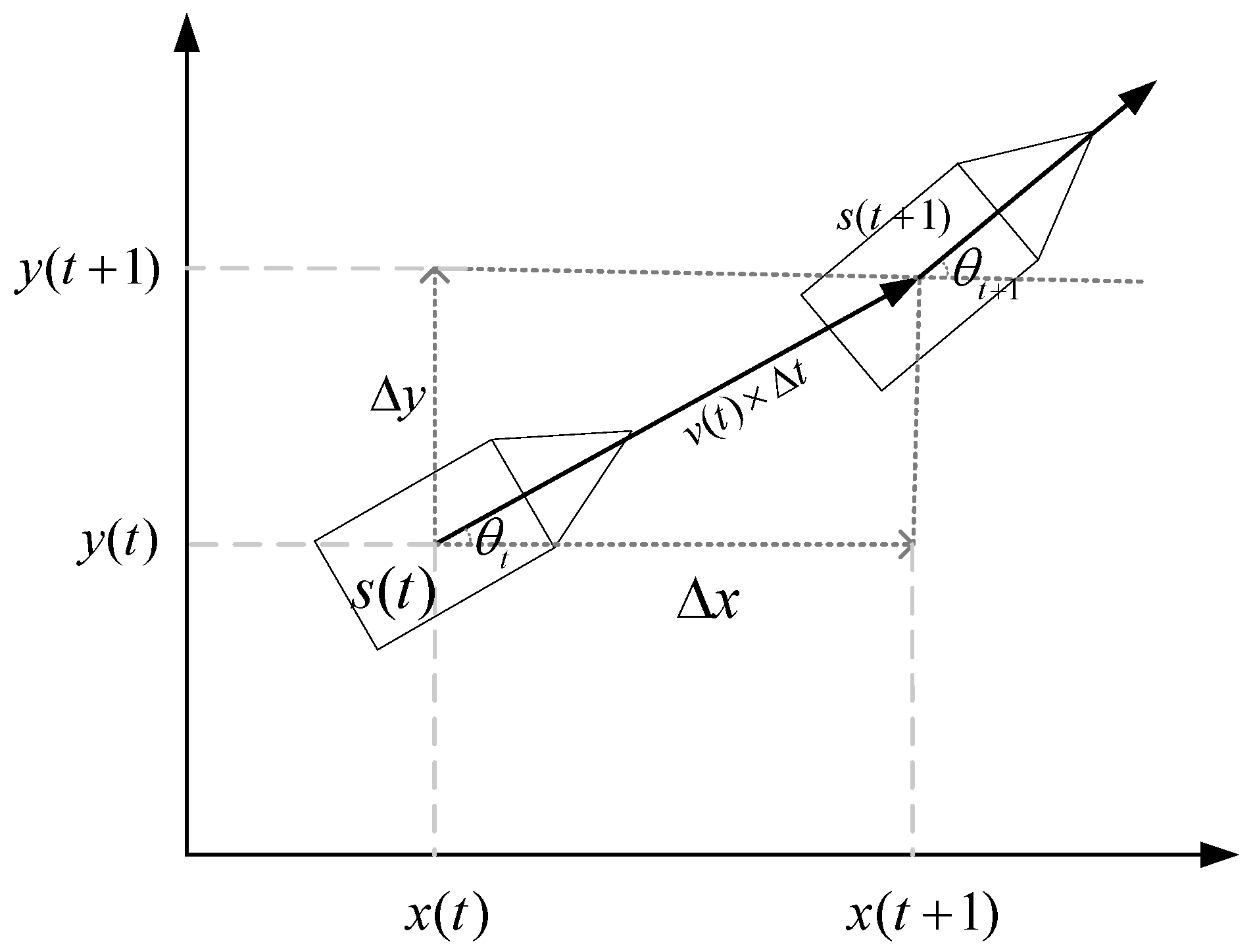
The kinematic model of the USV is illustrated in
Figure 8. At time instant t, the state vector of the vehicle is denoted by
. Let
be the discrete time-step; owing to its small magnitude, the motion within the interval is assumed to be rectilinear with constant speed. The resulting travel distance is therefore
. Projecting this displacement onto the global x- and y-axes according to the current heading angle
yields the incremental displacements
in each direction.
The USV’s motion state evolves over time in a discrete manner. By accumulating the incremental motion vector
within each sampling interval
, the position at the subsequent time step is obtained.
In Equations (10) and (11), and denote the planar coordinates of the USV at time step , denotes the heading angle, denotes the linear velocity, denotes the angular velocity, and denotes the sampling interval. Under the short-horizon assumption of DWA prediction, the velocity pair is treated as constant within one sampling interval.
3.2. Velocity Space Sampling for Unmanned Surface Vehicles
In two-dimensional space, while theoretically infinite velocity combinations exist, practical implementations are constrained by the USV’s physical characteristics and propulsion system limitations. To ensure feasible and effective path planning, the velocity space must be properly bounded before sampling for trajectory prediction.
- (1)
Velocity Boundary Constraints
Considering the USV’s hardware capabilities and environmental limitations, the admissible velocity
is bounded as follows:
where
denote the USV’s maximum and minimum linear velocities, respectively, while
represent its maximum and minimum angular velocities.
- (2)
Acceleration Constraints
Due to the limitations of the USV’s propulsion system, both linear and angular accelerations are bounded. Assuming equal magnitudes for maximum acceleration and deceleration, the admissible velocity space considering acceleration constraints is defined as:
In the equation, denote the instantaneous linear and angular velocities of the USV, respectively, while represent the maximum linear and angular accelerations permitted by the vehicle’s dynamic constraints.
- (3)
Environmental-obstacle constraint
To prevent the USV from colliding with environmental obstacles, it is necessary to verify whether the vehicle can come to a complete stop before impact when applying the maximum deceleration from its current velocity. This requirement is formalized as a safety braking-velocity constraint:
In the equation, denotes the minimal distance between the trajectory generated under the velocity pair and any obstacle. If the USV cannot achieve a complete stop prior to collision under this velocity combination, the corresponding is eliminated from the admissible set.
The final admissible velocity sampling space for the USV is determined by the intersection of all aforementioned constraints:
3.3. Trajectory Evaluation Function
Given the admissible velocity space
, uniform sampling is performed with specified resolutions, where
denote the sampling resolutions for linear and angular velocities, respectively. The total number of sampled velocity pairs is given by:
where
and
represent the lower and upper bounds of the feasible linear velocity, while
and
denote the minimum and maximum achievable angular velocities, respectively.
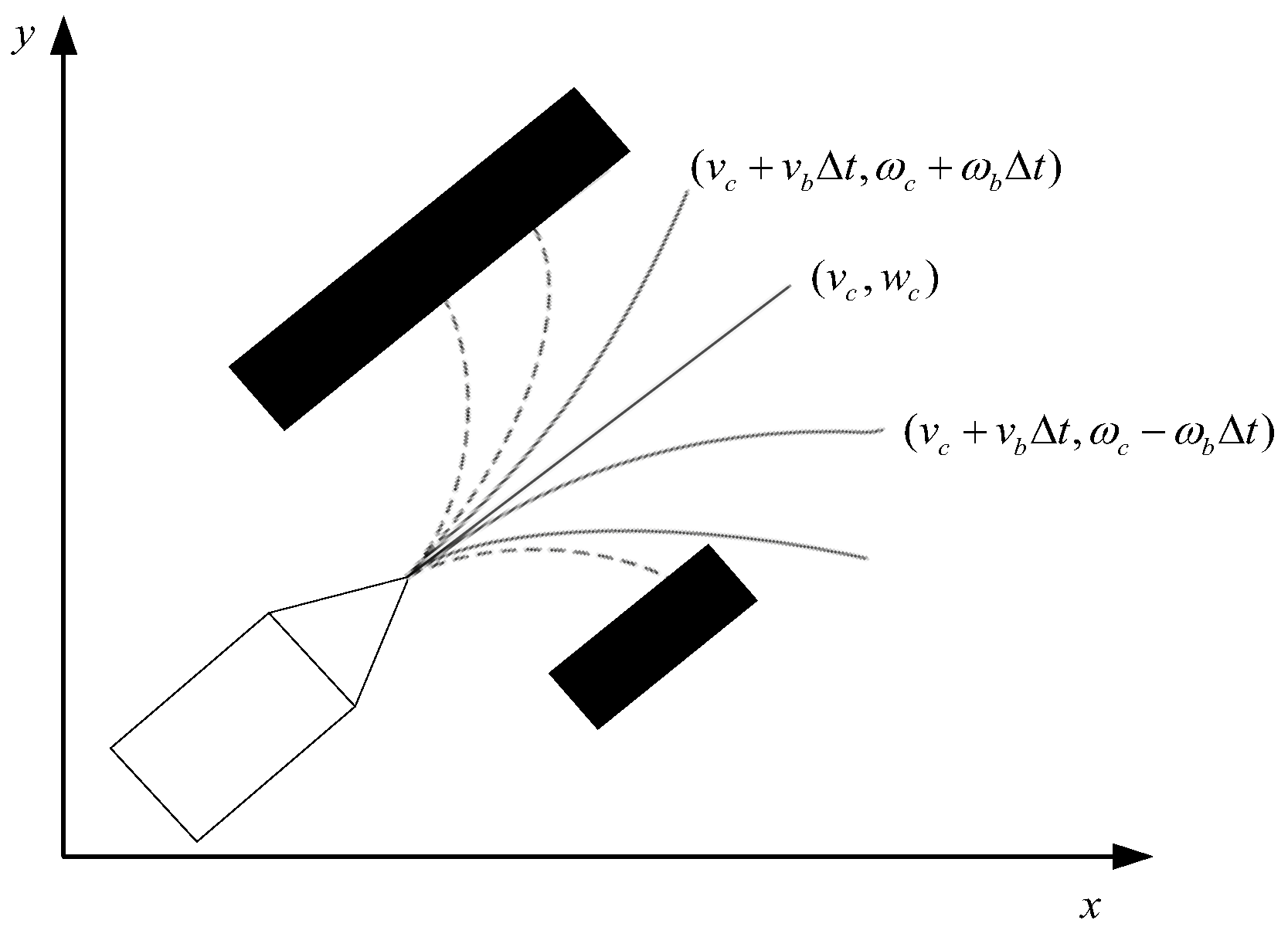
As illustrated in
Figure 9, the sampled velocity sets
are incorporated into Equations (10) and (11) to predict USV trajectories over a defined time period, generating multiple simulated paths. Among these, feasible trajectories are depicted as solid lines, while substandard ones appear as dashed lines. The optimal trajectory for subsequent USV navigation is determined through comparative evaluation using the scoring metric defined in Equation (16).
where
represents the normalization function,
serving as the weighting coefficient for three sub-evaluation functions: heading angle (
), obstacle distance (
), and velocity (
).
- (1)
Heading Angle Evaluation Function
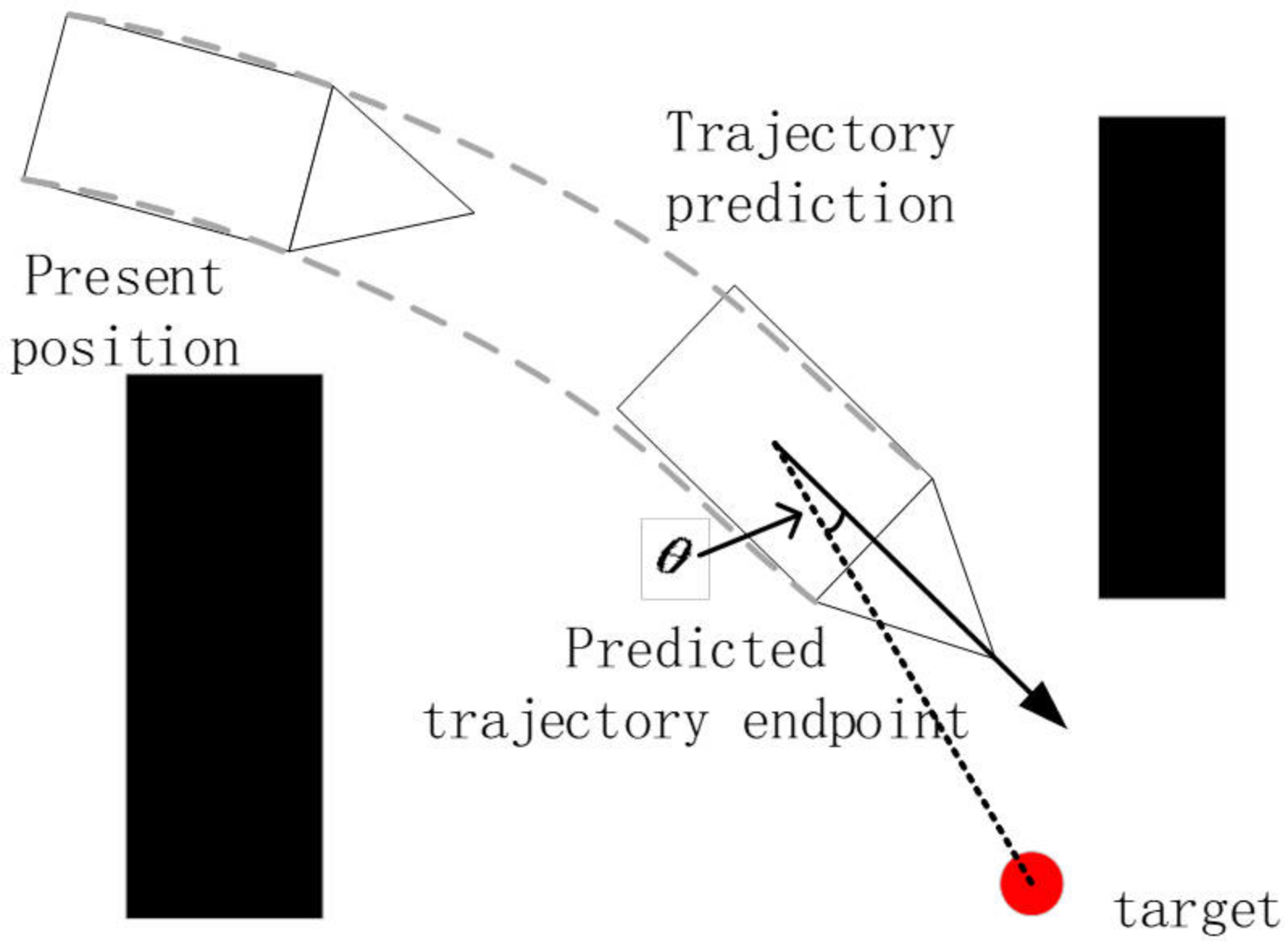
As shown in
Figure 10, during navigation, the USV should maintain a heading direction as close as possible to the target. The heading evaluation function
assesses the angular deviation between the trajectory’s terminal heading (generated using the sampled velocity set
) and the target direction, where a larger value indicates better performance:
- (2)
Obstacle Distance Evaluation Function
The obstacle distance metric quantifies the minimum distance between the predicted USV trajectory and surrounding obstacles:
To address scenarios where no obstacles exist within the immediate vicinity, the evaluation function assigns a large constant value when the minimum distance exceeds a predefined threshold .
- (3)
Velocity Evaluation Function
Provided no collision occurs, the higher the forward speed of the USV, the shorter the mission completion time. The speed evaluation function is defined as the magnitude of the current linear velocity; a larger value indicates a faster planned trajectory and thus a higher evaluation score.
To prevent dimensional inconsistency among the three evaluation metrics from biassing the optimization, each cost function is normalized to the range [0, 1] as follows:
3.4. Fuzzy Control-Based FDWA Local Path Planning Algorithm
The conventional Dynamic Window Approach (DWA) is a widely used local path planning method that enables real-time obstacle avoidance and trajectory optimization based on the USV’s current state and environmental perception. However, standard DWA implementations exhibit two critical limitations:
(1) Heading Angle Issue: When navigating toward waypoints, insufficient utilization of target direction information may cause significant initial heading deviation, resulting in frequent course corrections that increase travel time and energy consumption.
(2) Fixed Weight Parameters: Traditional DWA employs static weighting coefficients for balancing obstacle avoidance, goal convergence, and speed optimization, which cannot adapt to dynamic environments.
To address these issues, this study proposes a fuzzy control-based FDWA algorithm that optimizes the USV’s heading angle during both initial and cruising phases, while incorporating a fuzzy controller-based adaptive weight adjustment mechanism to enhance navigation efficiency and path smoothness across various mission scenarios.
3.4.1. USV Initial Heading Angle Optimization
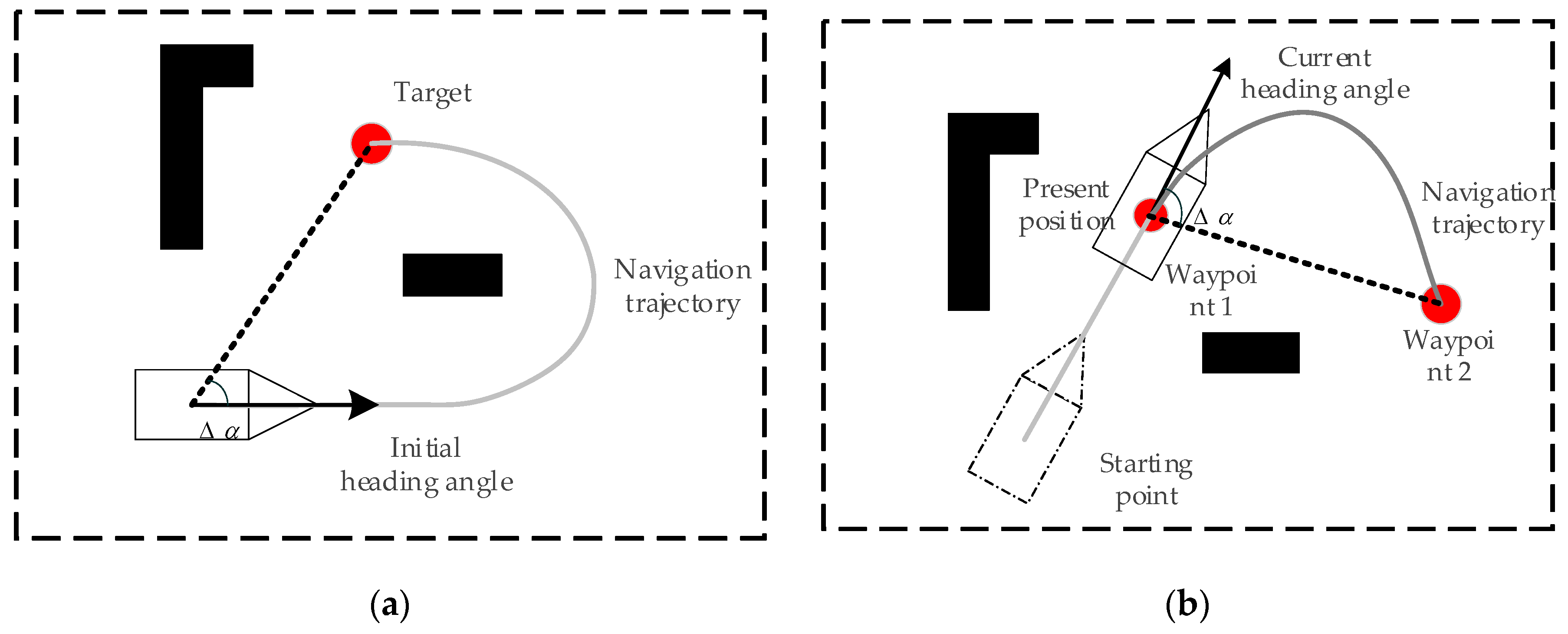
When the USV performs local path planning using the conventional DWA without fully exploiting target-point information, the initial heading may deviate excessively from the target, causing continuous extra yaw corrections, increasing unnecessary energy loss, and even leading to mission failure, as illustrated in
Figure 11a. Likewise, in multi-waypoint patrol missions, heading adjustment remains critical: after completing operations at one waypoint, the USV may exhibit heading error when proceeding to the next. By adjusting the heading angle during operation, the angular difference between the current heading and the next waypoint can be reduced, as shown in
Figure 11b. Therefore, this paper computes the target angle and adjusts the initial heading at both the departure stage and when transitioning to the next waypoint, thereby minimizing ineffective turns and improving navigation efficiency and path smoothness.
Let the USV’s current position be
and the target point (either the final destination or the next waypoint) be
. The target bearing angle
is then computed as:
Using the target bearing angle obtained from Equation (21), the angular deviation between the USV’s current heading and the target point—i.e., the required heading adjustment—is computed as:
In the equation, represents the USV’s current heading angle, and is a positive integer ensuring that is confined to the interval .
Based on the above analysis, the initial rotational angular acceleration
of the USV can be computed as:
In the equation, t denotes the time required for the USV to adjust its heading, while and represent the achievable minimum and maximum rotational velocities, respectively.
3.4.2. Adaptive Weighting Coefficients via Fuzzy Control
The conventional DWA selects an optimal trajectory for the USV through the objective function given in Equation (16), which comprises three weighted terms that respectively drive the vehicle toward the goal, avoid collisions, and maintain high speed. However, because the operational environment is typically complex and dynamic, fixed weights for these terms are often inadequate. Therefore, this paper proposes a Fuzzy-enhanced DWA (FDWA) that integrates real-time environmental information into a fuzzy-logic inference system to adaptively tune the weights of each term online.
Fuzzy control is an approximate-reasoning method based on fuzzy sets, linguistic variables, rule bases, and defuzzification, and it has been widely used in adaptive control and path-planning problems under uncertainty [
15,
29]. A standard fuzzy-system design comprises fuzzification, construction of a rule base, fuzzy inference, and defuzzification to yield the control output. In this work, two fuzzy controllers—one for guidance and one for safety—are devised on the basis of fuzzy-control theory to enable online adaptation of the three DWA weighting coefficients
, thereby ensuring robust adaptability of the USV across diverse marine environments.
- (1)
Guidance Fuzzy Controller
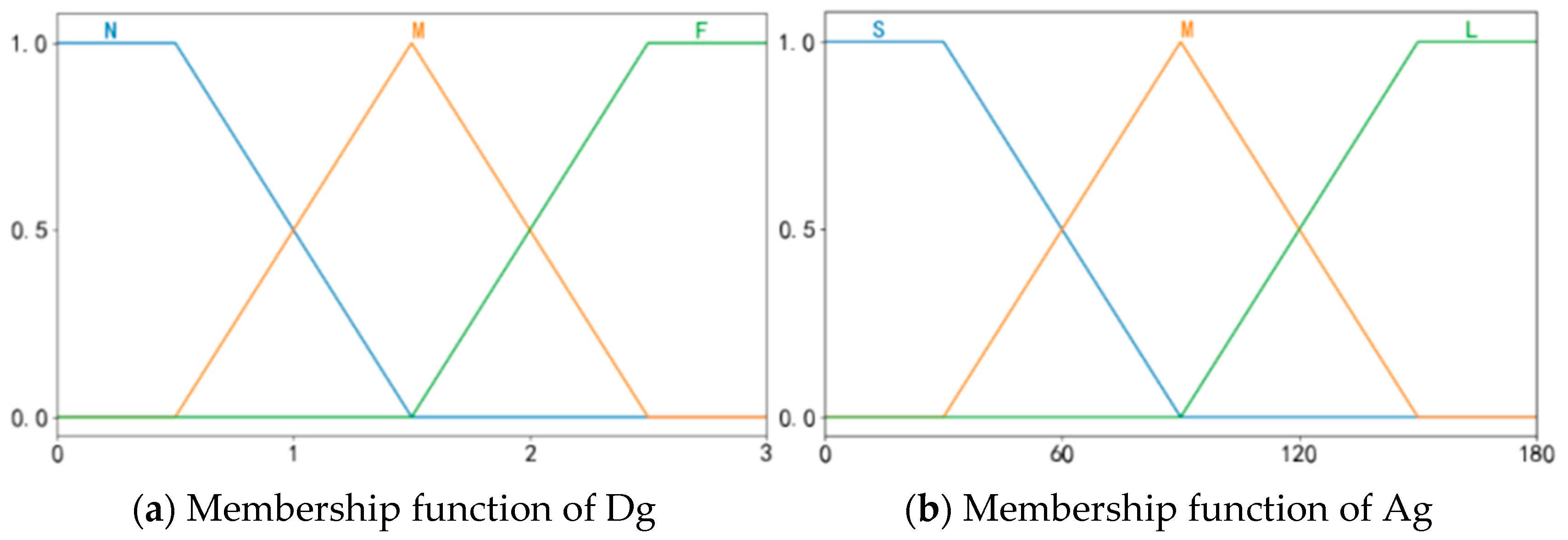
In the guidance fuzzy controller, the inputs are selected as (i) the distance Dg between the USV’s current position and the target, and the heading angle error Ag toward the target; the output is the weighting coefficient of the bearing-angle cost term.
The input and output variables of the guidance fuzzy controller are fuzzified as follows.
Input Dg: universe of discourse [0, 3], linguistic terms {Near (N), Medium (M), Far (F)}.
Input Ag: universe of discourse [0, 180], linguistic terms {Small (S), Medium (M), Large (L)}.
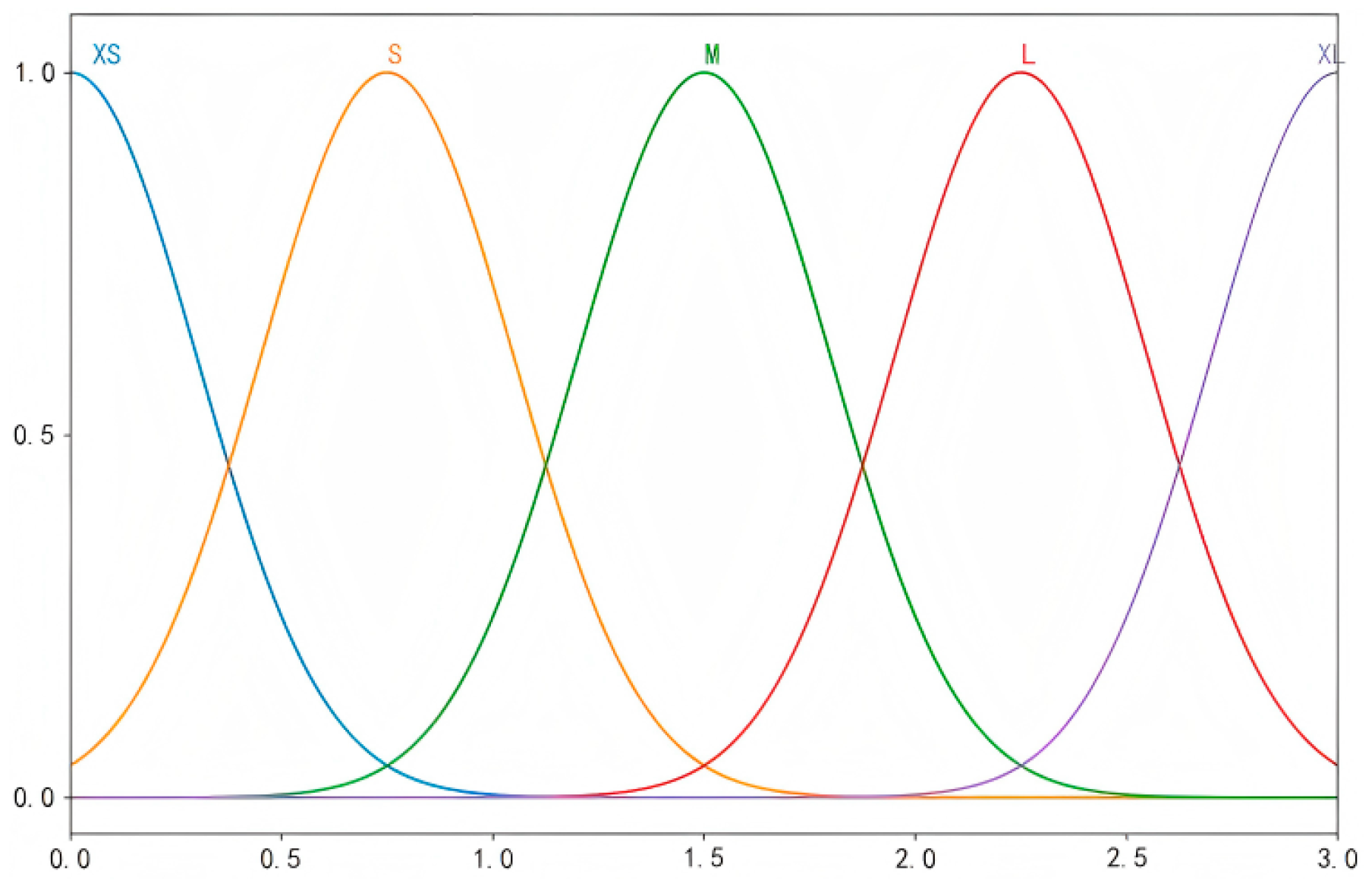
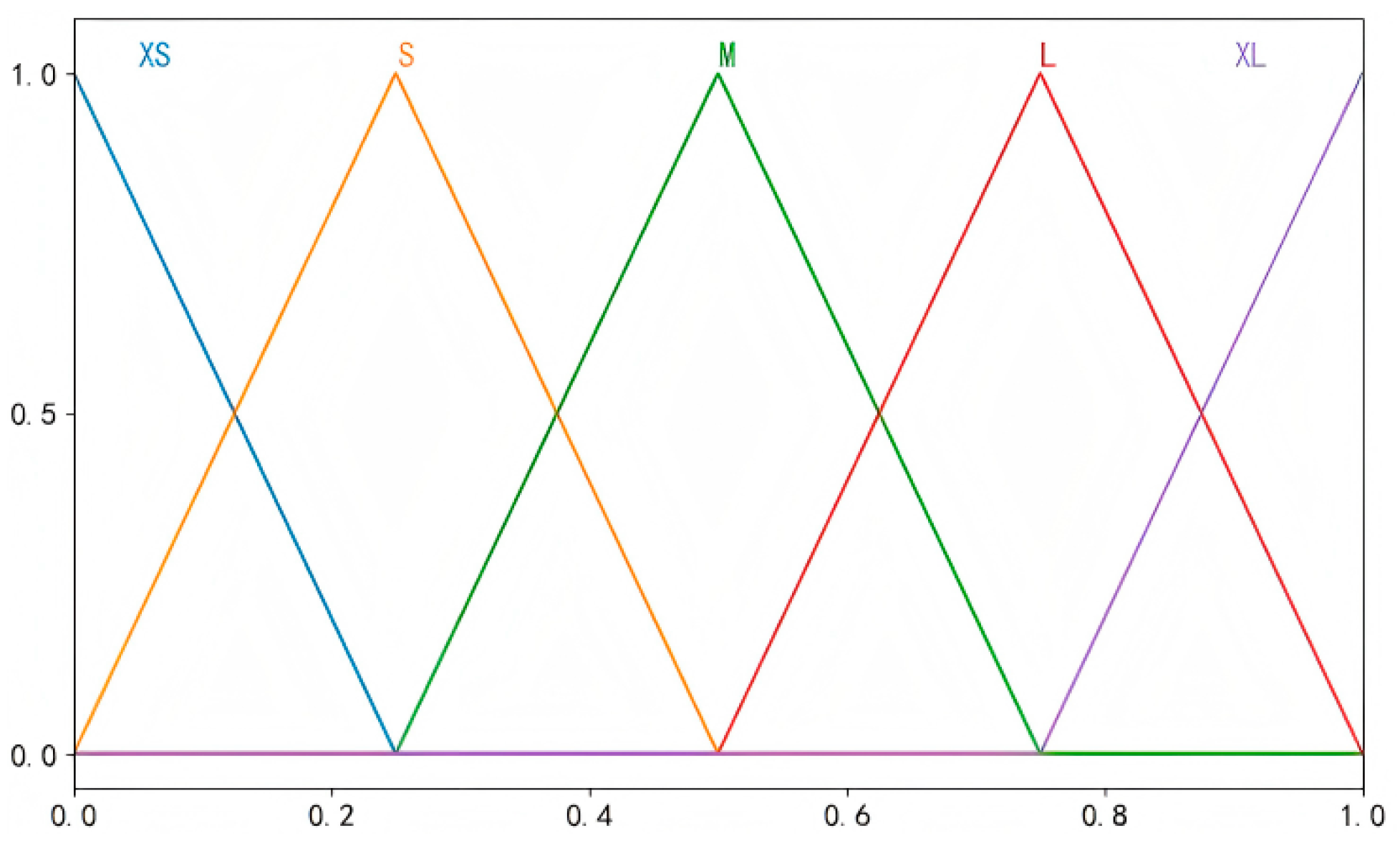
Output : universe of discourse [0, 1], linguistic terms {Extremely Small (XS), Small (S), Medium (M), Large (L), Extremely Large (XL)}.
The membership functions of the input and output variables are depicted in
Figure 12 and
Figure 13, respectively.
The guidance fuzzy rules are constructed according to a target-oriented design principle. When the USV is far from the target and already approximately aligned with the desired direction, excessive emphasis on heading correction is unnecessary and may reduce motion efficiency; therefore, a relatively small output for the heading-related weight is preferred. In contrast, when the USV is close to the target but exhibits a large heading deviation, heading correction becomes more critical for preventing target overshoot or repeated adjustment, and a larger heading-related weight is therefore assigned. Based on this principle, the complete rule base for the guidance fuzzy controller is summarized in
Table 1.
- (2)
Safety Fuzzy Controller
The safety fuzzy controller comprises three inputs and two outputs. The inputs are (i) the distance Dg from the USV’s current position to the target, the shortest distance Do to the nearest obstacle, and (iii) the obstacle density Io in the USV’s vicinity. The outputs are the weighting coefficients (for the obstacle-distance cost term) and (for the velocity cost term).
The obstacle density Io around the USV can be computed from the number of obstacles within the perception range, their individual areas, and the inter-obstacle distances:
In the equation, n denotes the number of obstacles within the perception window; d represents the minimum distance between the two closest obstacles in that window; s is the cumulative area of all obstacles; are the corresponding weighting coefficients; and a and b are the base coefficients of the exponential terms. In practice, the USV’s sensing range is significantly larger than its hull dimensions; therefore, the perception window is defined as a semicircle of radius 10r, centred at the USV’s position and oriented along its forward direction.
The universe of discourse and fuzzy sets for input Dg are identical to those in the guidance fuzzy controller.
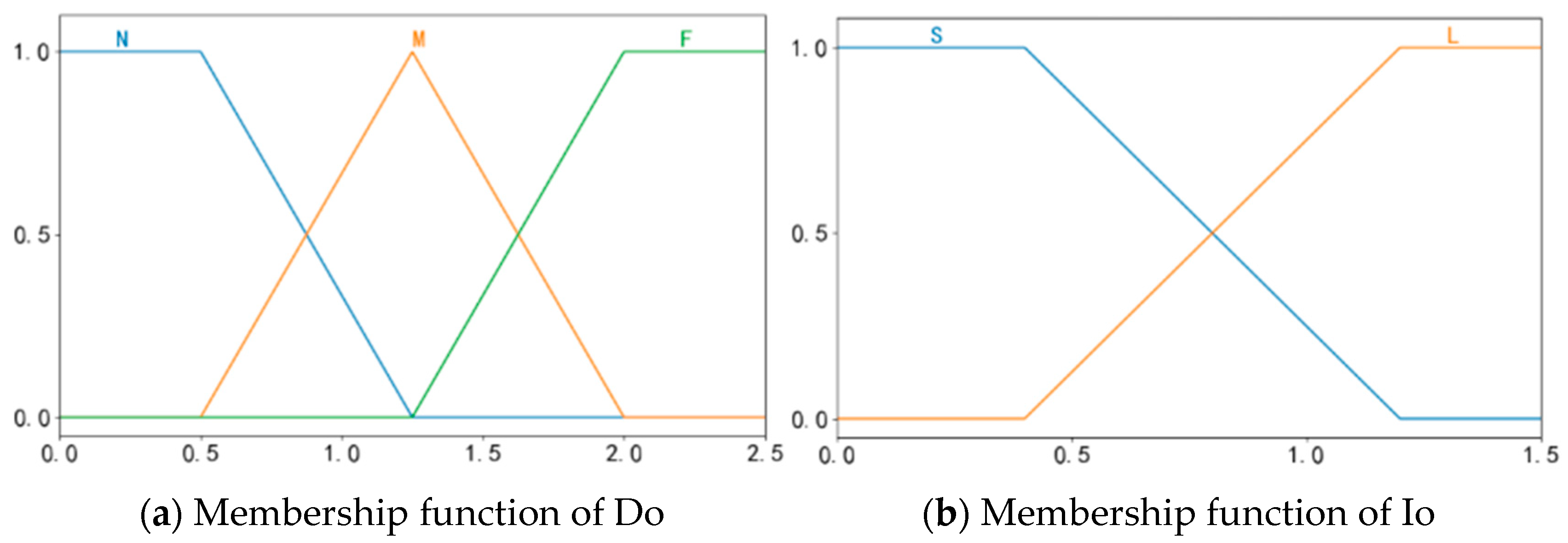
Input Do: universe [0, 2.5], linguistic terms {Near (N), Medium (M), Far (F)}.
Input Io: universe [0, 1.5], linguistic terms {Small (S), Large (L)}.
Outputs and : universe [0, 3], linguistic terms {Extremely Small (XS), Small (S), Medium (M), Large (L), Extremely Large (XL)}.
The membership functions for the inputs and outputs of the safety fuzzy controller are shown in
Figure 14 and
Figure 15 (the membership function for input Dg is identical to that depicted in
Figure 12a).
In the safety fuzzy controller, if Dg is large while both Do and Io are small—indicating the USV is far from the target and in open waters—a small
and a large
are selected to maximize speed toward the target. Conversely, if Dg is small and both Do and Io are large—signifying proximity to the target in a cluttered environment—
is increased and
is decreased to reduce speed, ensuring safety without missing the target. Based on this logic, the fuzzy rule base for the safety controller is established in
Table 2.
After fuzzy inference using the above two rule bases, the output fuzzy sets are converted into crisp numerical values by means of the centroid defuzzification method, which is one of the most commonly used defuzzification strategies in fuzzy-control systems [
29].
In the equation, denotes the defuzzified crisp output value; a and b define the universe of discourse of the membership function; y represents every possible value of the input variable over the continuous domain; and is the fuzzy membership function.
4. Dynamic Obstacle-Avoidance Algorithm via FDWA–Global Cruise Path Fusion
To enhance the path-planning performance of an unmanned surface vehicle (USV) in complex, dynamic environments—particularly for dynamic obstacle avoidance—this study proposes integrating the Fuzzy-enhanced Dynamic Window Approach (FDWA) with the global cruise route generated by the improved bidirectional A*–improved grey wolf optimizer (IBA*–IGWO). The resulting fusion algorithm leverages the global guidance of IBA*–IGWO and the local reactive-avoidance capability of FDWA: the global cruise route continuously guides FDWA while the latter performs real-time obstacle avoidance. This synergy ensures that the USV can execute multi-waypoint patrol missions efficiently and safely in highly dynamic maritime scenarios [
26,
27].
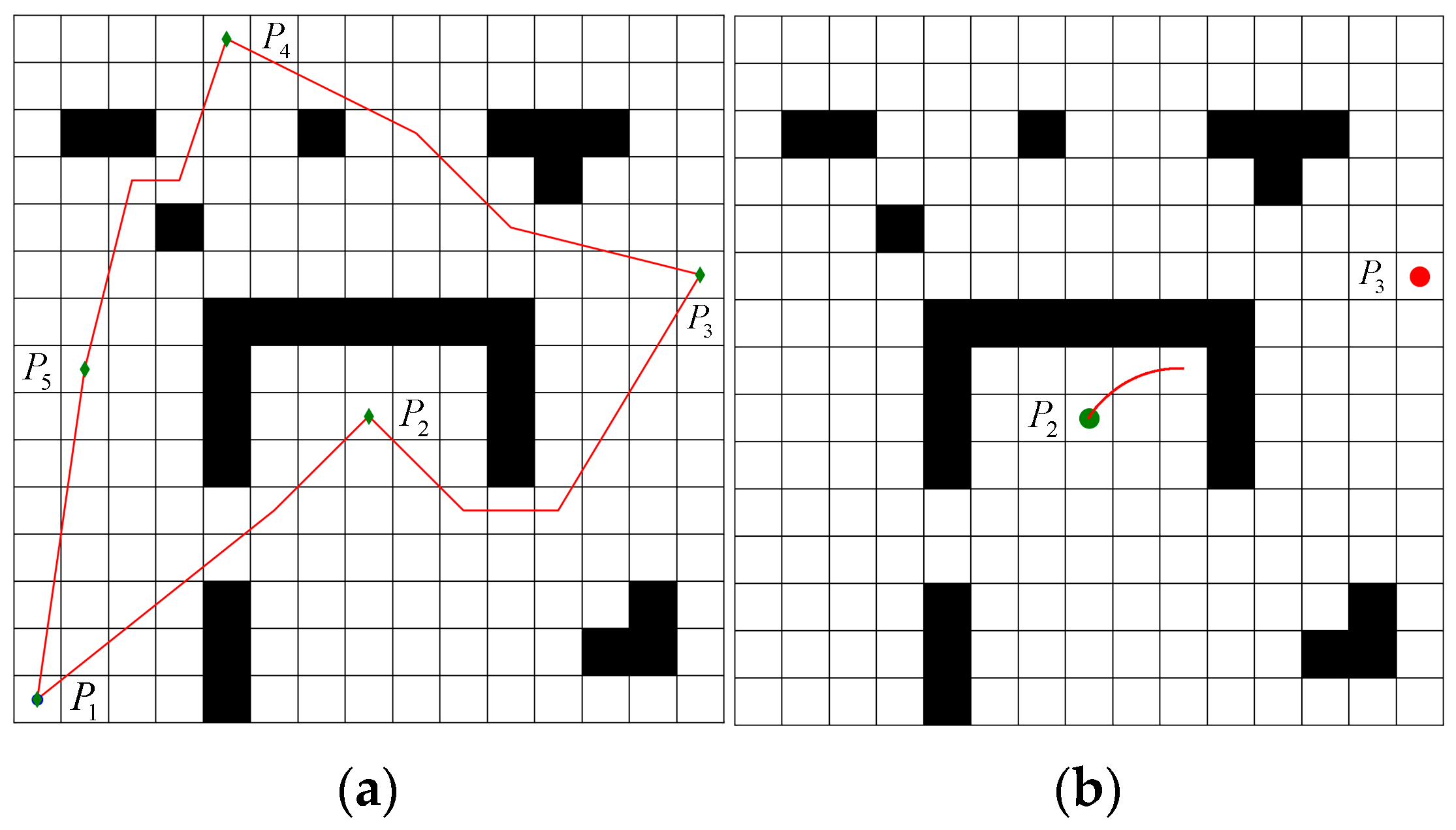
Assume a USV patrol mission with five waypoints (including the start point). The IBA*–IGWO algorithm yields the optimal waypoint sequence
and the corresponding global static cruise path
, as shown in
Figure 16a.
Two strategies are available for incorporating FDWA into the patrol mission for dynamic avoidance. Strategy 1 repeatedly invokes FDWA between successive waypoints: upon reaching each waypoint, it is treated as the new start and the next waypoint as the goal until all waypoints are visited. However, DWA-based local planners—including the improved FDWA—are susceptible to local minima when encountering certain obstacle configurations;
Figure 16b illustrates such a failure between P
2 and P
3. Therefore, Strategy 2 is adopted: key nodes along the global cruise path are designated as successive intermediate local goals for FDWA, thereby ensuring that the local planner remains consistent with the global cruising route.
In this strategy, the turning points and patrol waypoints along the global cruise path are selected as successive local goals for the FDWA algorithm. However, if the USV must fully reach each local goal before the next one is assigned, it is forced to decelerate repeatedly so as not to overshoot, degrading cruise efficiency. Therefore, when the upcoming local goal is not a designated patrol waypoint, the next target is dynamically shifted before the current local goal is reached, enabling the USV to transition smoothly without coming to a complete stop. The algorithmic procedure is outlined below.
- (1)
Acquire environmental data, construct the occupancy grid map, and define the USV’s start position and patrol waypoints.
- (2)
Invoke the IBA*–IGWO algorithm to obtain the global static cruise path that visits all waypoints.
- (3)
From , extract the waypoints and the turning points between consecutive waypoints as local goals; record their coordinates.
- (4)
Using the local goal coordinates, apply the FDWA local planner to generate motion trajectories. While sailing, on-board sensors detect obstacles absent from the original map, update the map and re-plan to circumvent these obstacles. After avoidance, the USV rejoins the global path .
- (5)
Check whether the current local goal is a waypoint; if yes, proceed to (6); otherwise, return to (4).
- (6)
Determine if the reached waypoint is the final one; if so, advance to (7); otherwise, adjust the USV’s initial heading and return to (4).
- (7)
All waypoints have been visited; terminate the algorithm.
- (8)
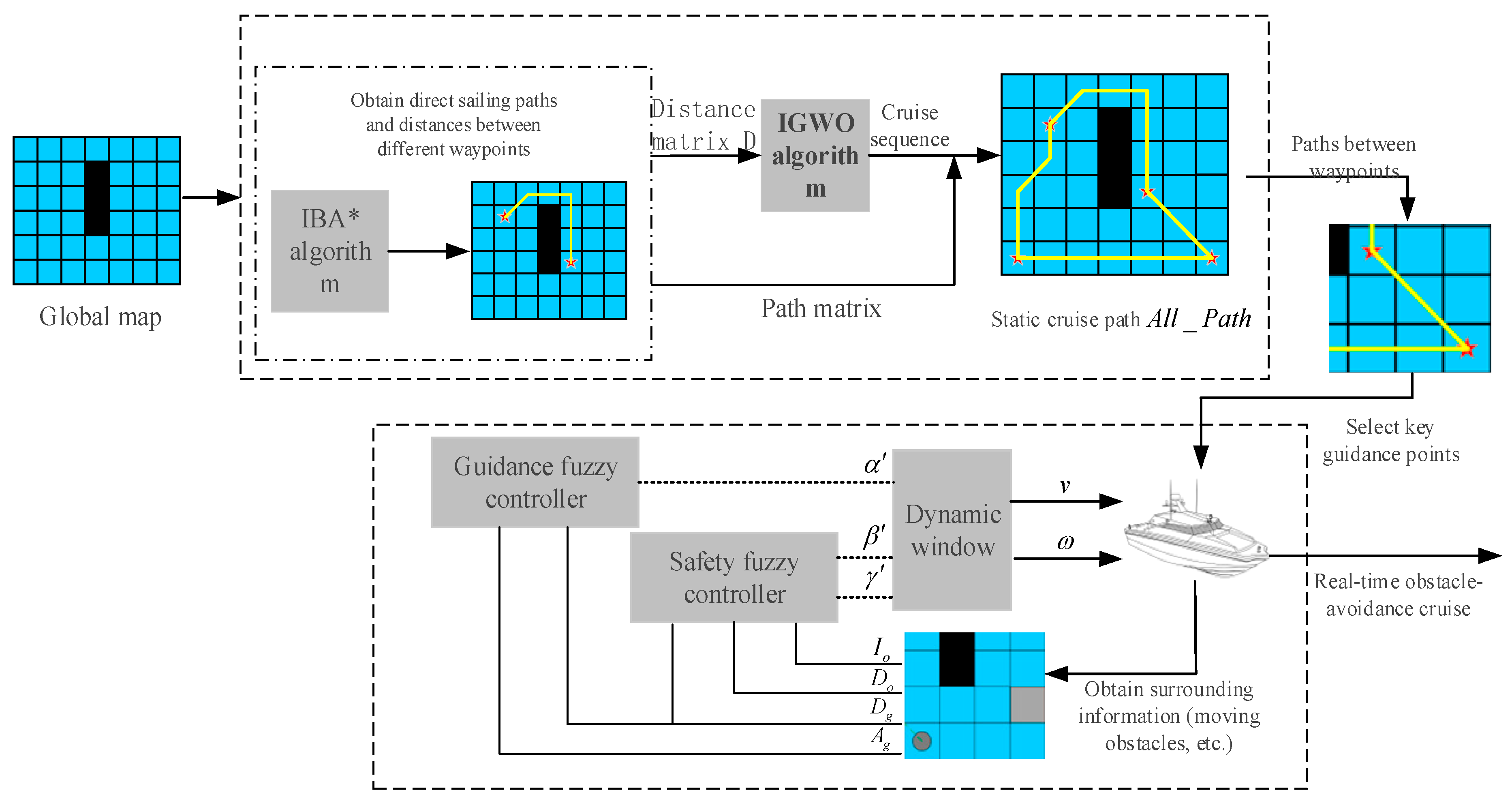
The overall framework of the FDWA–global cruise path fusion for dynamic obstacle avoidance is illustrated in
Figure 17.
In this framework, the FDWA module is primarily responsible for local trajectory generation under dynamic obstacle disturbances, while the global cruise path provides long-range mission guidance. From a system-architecture perspective, this global–local fusion pattern also offers a natural interface for further functional extension. In particular, additional decision modules may be incorporated between environmental perception and local trajectory generation, so that relative-motion assessment, encounter interpretation, and maneuver preference can be considered before evaluating candidate trajectories. Under such a hierarchical structure, the admissible action space of the local planner can be further constrained by higher-level navigation logic, enabling the generated trajectories to better satisfy not only geometric collision-avoidance requirements but also more practical maritime operating considerations. This extensibility highlights the potential of the proposed framework as a structured basis for more complete autonomous navigation systems.
5. Simulation Experiments
To validate the superiority of the proposed method, a three-stage comparative experiment is conducted. First, the effectiveness of the IBA*–IGWO fusion algorithm in generating a global cruise path is verified. Second, the performance of the FDWA algorithm is assessed against the conventional DWA algorithm. Finally, it is examined whether integrating the FDWA algorithm with the IBA*–IGWO-planned global static route enables real-time obstacle avoidance.
5.1. Simulation Validation of the IBA*–IGWO-Based Global Path-Planning Algorithm
The proposed IBA*–IGWO global path-planning algorithm is benchmarked against a state-of-the-art direct-path planner fused with the Genetic Algorithm (GA) as reported in [
25], and the multi-waypoint planners presented in [
27,
28].
Method II: Reference [
25]
Method III: Reference [
28]
Method IV: This paper
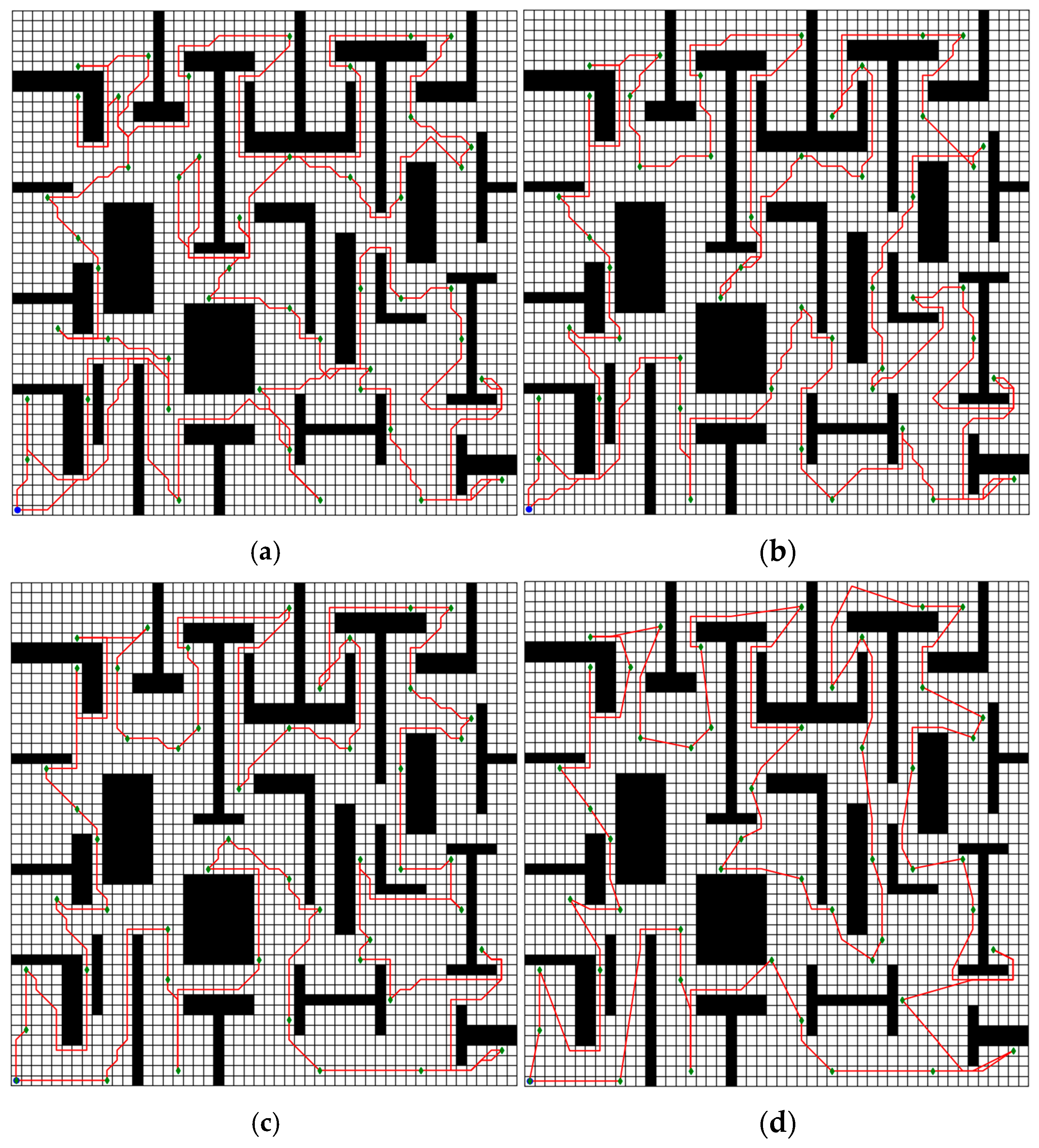
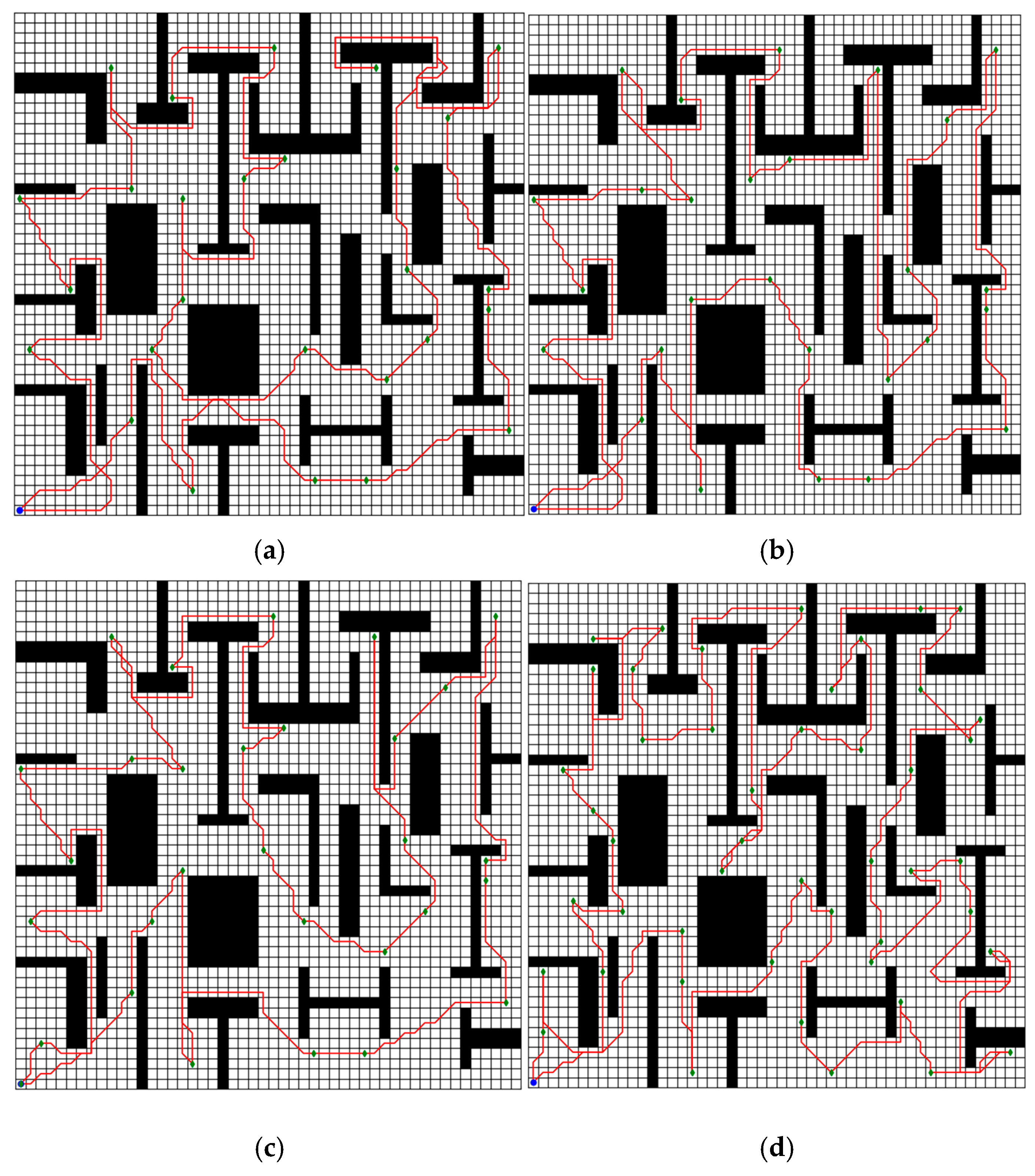
Experiments were conducted on a 50 × 50 grid map. Within the obstacle-free region, 30 and 50 waypoints were randomly generated for the two test scales. Using the four aforementioned methods, multi-waypoint USV patrol paths were planned with the start and finish both located at (1, 1). The results are illustrated in
Figure 18 and
Figure 19:
In the figures, the circle at the lower-left corner denotes the start/finish location, and the green diamonds mark the waypoints that the USV must visit. All four algorithms successfully traverse every waypoint without obstacle collision. Performance is evaluated in terms of path length, number of turns, and computational time; the results are summarized in
Table 3.
According to the results in
Table 3:
- (1)
Method I (ref. [
27]) exhibits the lowest computational cost among the four approaches. This algorithm directly employs the straight-line Euclidean distance between waypoints when constructing the distance matrix, thereby ignoring the presence of obstacles. Although this simplification reduces computation time, the resulting distances are unrealistic, preventing the determination of an optimal cruise sequence; consequently, the final path length is the longest, and the number of turns is the highest.
- (2)
Method II (ref. [
25]) reduces runtime by exploiting the bidirectional A* search mechanism when constructing the distance matrix. However, the generated cruise route still contains considerable redundancy.
- (3)
Method III (ref. [
28]) adopts the conventional unidirectional A* algorithm to construct the distance matrix while explicitly accounting for obstacle effects. Although this improves route quality, it also leads to a higher computational cost.
- (4)
Method IV (the proposed algorithm) integrates the improved bidirectional A* algorithm with the improved grey wolf optimizer, achieving a notable reduction in runtime. Simultaneously, it delivers the shortest cruise route and the fewest turns.
5.2. Simulation Verification of FDWA Effectiveness
To demonstrate the superiority of the proposed FDWA path-planning algorithm, simulations were conducted on a 20 × 20 grid map with a cell resolution of 1 m. The start point was set at (1, 1) and the goal at (20, 20). The USV dynamic parameters and sampling interval are listed in
Table 4.
- (1)
Comparative study on the efficacy of different DWA variants under static conditions
For the conventional DWA algorithm, three distinct weight combinations are employed for local path planning; the corresponding traditional DWA weight coefficients are listed in
Table 5.
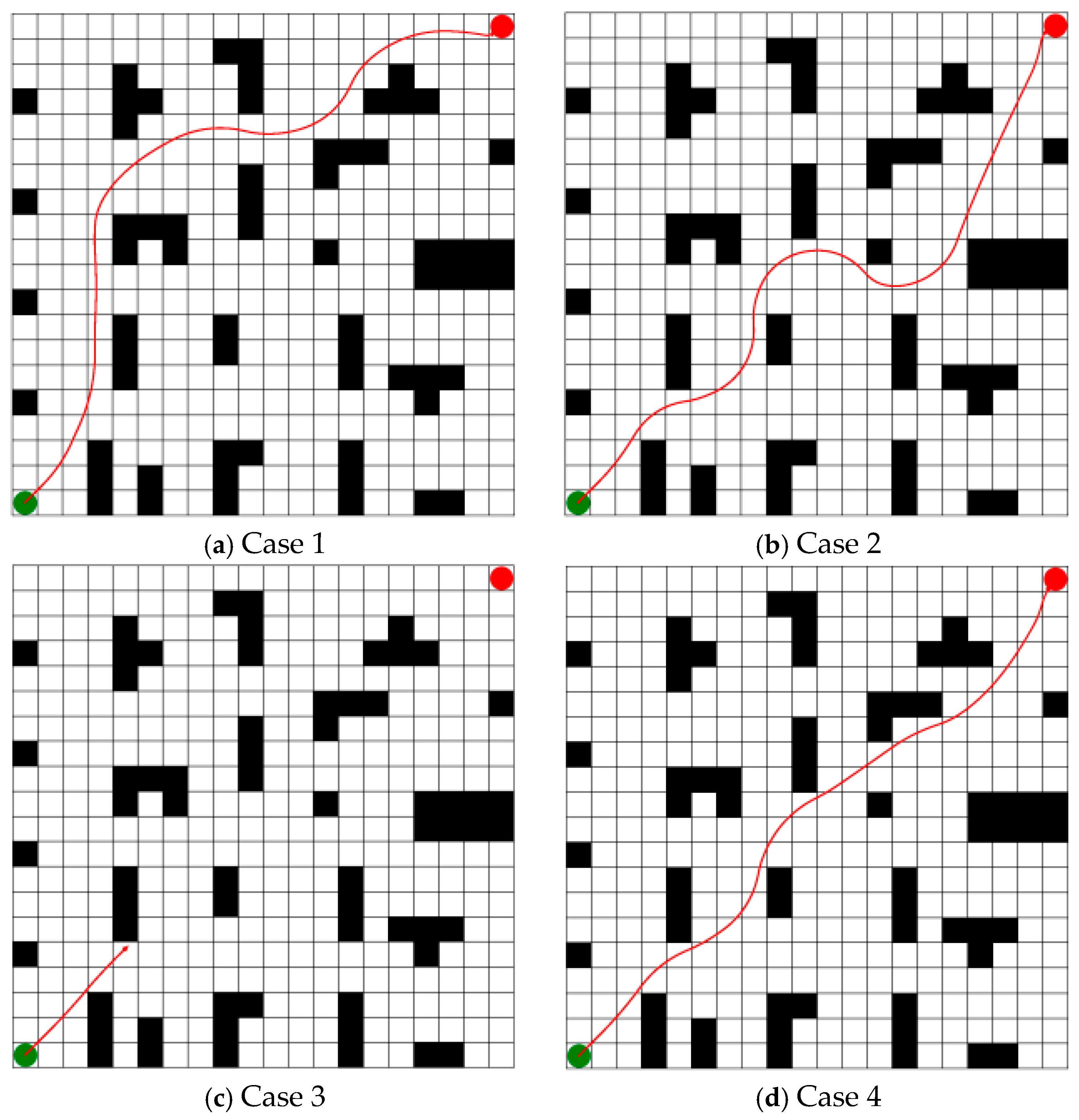
The experimental results of local path planning for the traditional DWA under the three weight combinations and for the proposed FDWA algorithm are illustrated in
Figure 20.
- (1)
Case 1 (small heading weight , large obstacle-distance weight , moderate speed weight) yields obstacle-avoidance-biassed paths with poor goal orientation, resulting in detours; this setting is suitable only for highly cluttered areas.
- (2)
Case 2 (increased and , reduced ) improves initial goal attraction, yet later obstacle complexity still forces deviation, giving only marginal reductions in path length (–1.3% vs. Case 1), iterations (–5.8%), and runtime (–9.8%); it fits moderately obstructed waters.
- (3)
Case 3 (further increased and , minimal ) minimizes heading error but offers weak avoidance; the USV tends to stall in front of obstacles, making it viable only in open areas.
- (4)
The proposed FDWA outperforms all three fixed-weight cases. Compared with Case 1, path length is reduced by 10.98%, iterations by 11.34%, and runtime by 13.7%. Compared with Case 2, the reductions are 10.2%, 5.8%, and 4.3%, respectively. The smaller runtime gain relative to iteration reduction stems from the computational cost of the two online fuzzy controllers used at every iteration.
- (2)
Feasibility of FDWA for dynamic obstacle avoidance
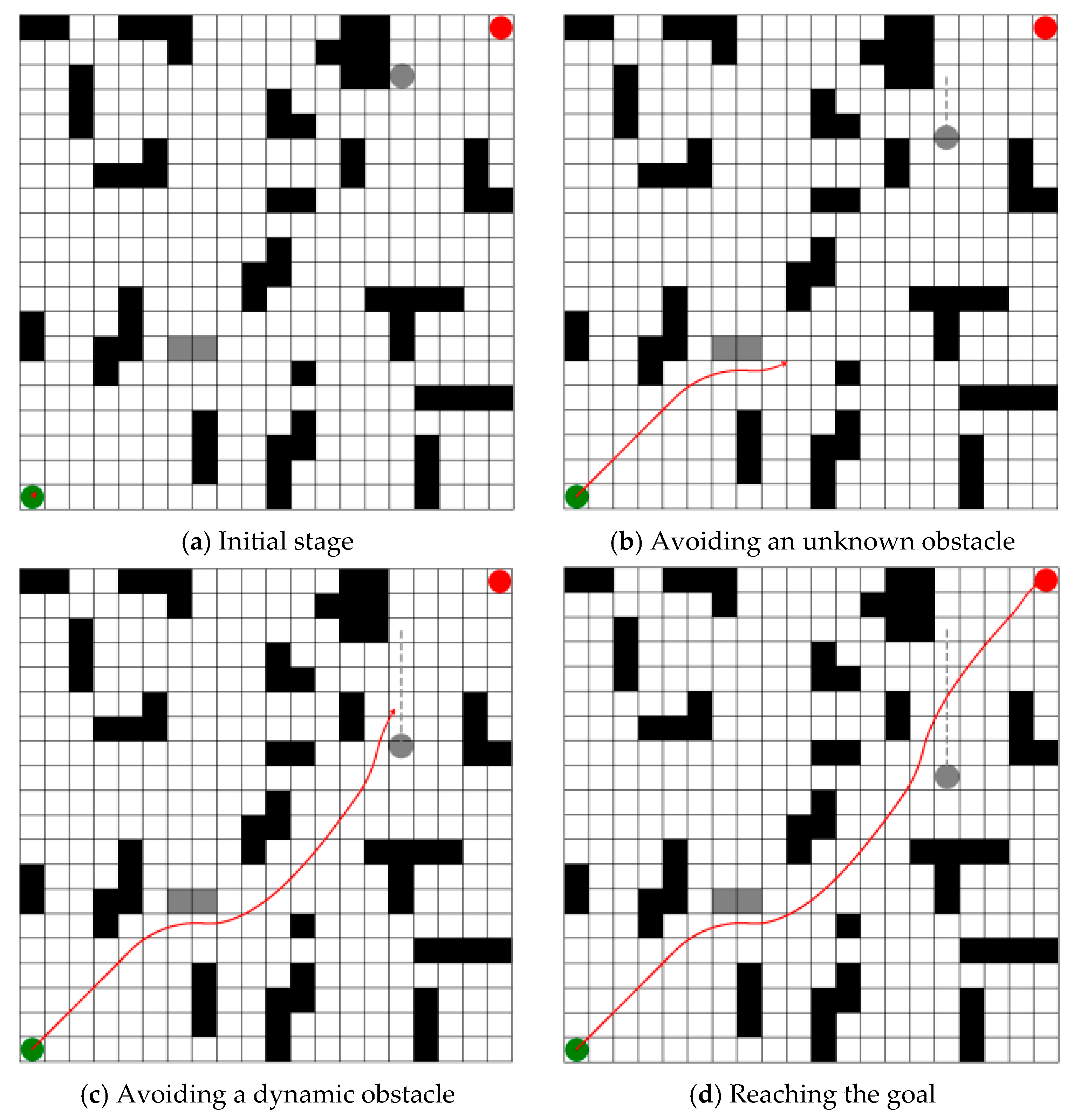
To verify the real-time avoidance capability of FDWA under complex dynamic conditions, additional unknown static obstacles and moving obstacles are introduced into the map besides the known ones. The obstacle information used in the simulations is listed in
Table 7, and the experimental results are presented in
Figure 21.
The above figures illustrate the real-time obstacle-avoidance behaviour of the USV when FDWA is employed. Grey squares denote unknown static obstacles, grey circles represent moving obstacles, the dashed grey lines trace the motion of the moving obstacles, the solid red line indicates the USV trajectory, and the arrow on the trajectory marks the USV’s instantaneous position. In
Figure 21a, the local planning phase begins while the dynamic obstacle starts moving.
Figure 21b,c show that whenever the USV encounters unknown or dynamic obstacles, the trajectory is replanned immediately to evade them, after which the vehicle continues toward the goal and eventually arrives successfully.
Collectively, these results demonstrate that the performance of the conventional DWA is highly sensitive to the fixed weight coefficients governing obstacle avoidance, goal attraction, and speed control. In contrast, the proposed FDWA exhibits strong environmental adaptability: by means of fuzzy control, it dynamically adjusts these weights according to the surrounding conditions, thereby flexibly satisfying diverse path-planning requirements.
It should also be noted that the comparisons in this section are mainly intended to evaluate the effectiveness of the proposed fuzzy adaptive weighting strategy with respect to conventional fixed-weight DWA settings under the current simulation framework. In other words, the objective of
Section 5.2 is to verify the local performance gain brought by the adaptive weighting mechanism itself, rather than to establish a comprehensive benchmark against all representative maritime local route-planning methods. In particular, the objective of the present study is different from that of COLREG-compliant local route-planning methods such as [
24]. The method in [
24] focuses on rule-compliant local maneuver generation under formally defined maritime encounter scenarios, whereas the present work focuses on integrating multi-waypoint global cruise guidance with FDWA-based reactive local obstacle avoidance. Therefore, the main contribution of this study lies in establishing a global–local fusion framework for mission continuity and local replanning adaptability, rather than in developing a fully rule-compliant local collision-avoidance strategy. At the current stage, explicit COLREG compliance is outside the scope of the present study and will be addressed in future work through the introduction of a higher-level rule-constrained decision layer above the FDWA planner.
5.3. Simulation Verification of the Dynamic Obstacle-Avoidance Algorithm Integrating FDWA with the IBA*–IGWO Global Cruise Path
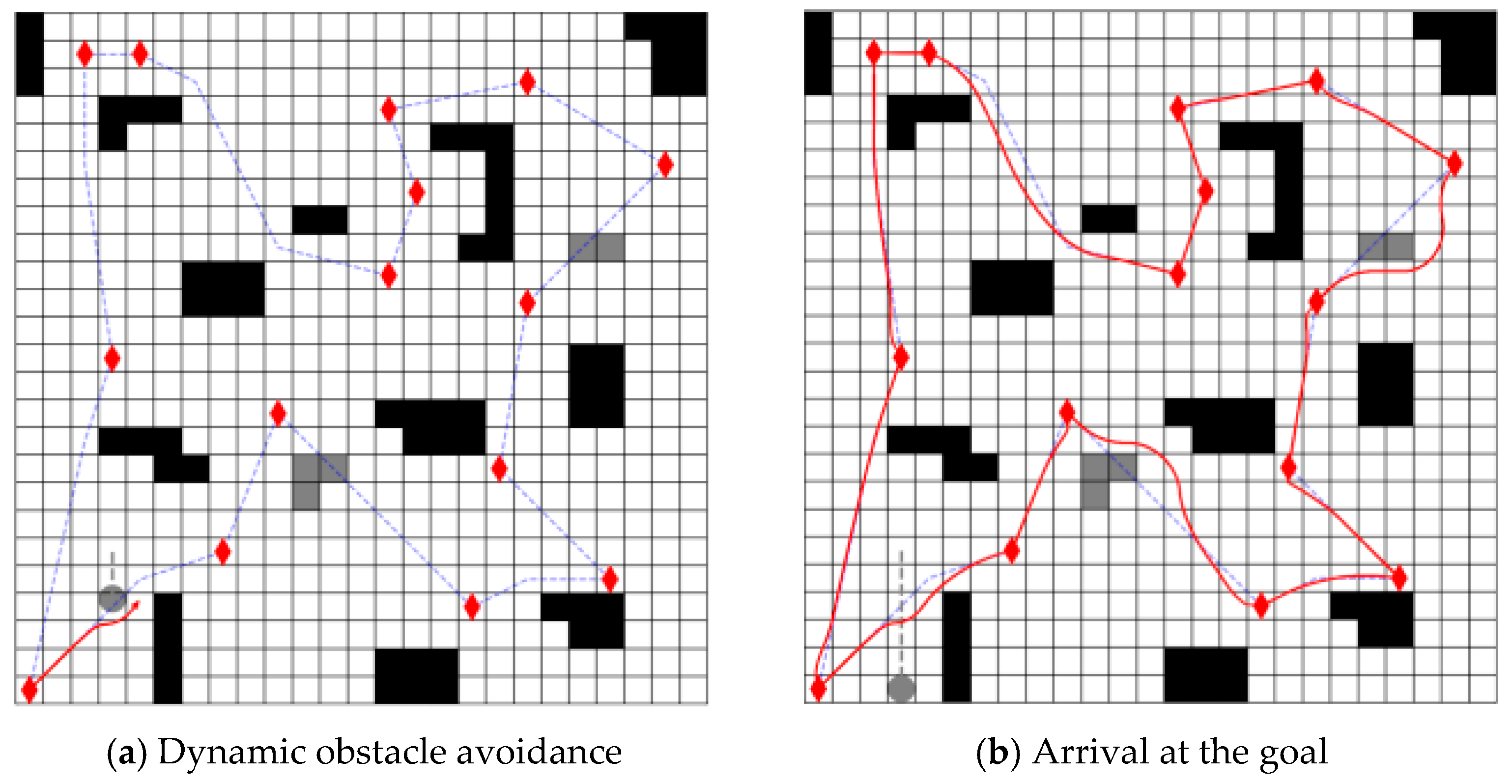
Since the superiority of the IBA*–IGWO fusion algorithm and the FDWA algorithm has already been demonstrated in previous simulations, this section focuses solely on verifying whether the dynamic obstacle-avoidance algorithm that integrates FDWA with the global cruise path can guarantee safe mission completion under complex dynamic conditions. Experiments were conducted on a 30 × 30 grid map (cell size 1 m) with 15 waypoints and unknown as well as dynamic obstacles. The obstacle information used in the simulations is listed in
Table 8, and the results are shown in
Figure 22.
In the figure, black cells indicate known obstacles, grey squares denote unknown static obstacles, grey circles represent moving obstacles, and dashed grey lines trace the trajectories of these dynamic objects. Red diamonds mark the waypoints, the dashed blue curve is the global static cruise route computed by the IBA*–IGWO algorithm, and the solid red curve is the dynamic obstacle-avoidance trajectory produced by the FDWA–global path fusion.
As shown, the global static route successfully visits every waypoint while avoiding known obstacles; however, it intersects several unknown and moving obstacles, demonstrating that offline planning cannot account for real-time environmental changes and thus poses safety risks. After fusion with FDWA, the USV follows the global path but performs local evasive maneuvers whenever dynamic or unknown obstacles appear, preventing collisions and eliminating the myopic behaviour typical of pure local planners. The resulting trajectory is smoother, kinematically feasible, and robust against dynamic disturbances, ensuring safe and reliable mission completion.
It should be noted that the dynamic obstacle scenarios considered in this study are primarily designed to examine the real-time responsiveness and local replanning capability of the proposed FDWA–global cruise path fusion framework under changing environmental conditions. In this setting, the moving obstacles are modelled as representative dynamic disturbances with explicitly defined kinematic parameters, rather than as a complete set of formally categorized encounter cases. Accordingly, the present simulations are intended to verify the feasibility of global–local path-planning coordination in dynamic environments, while more refined evaluation strategies based on structured encounter scenarios, such as head-on, crossing, and overtaking situations, can be further developed in future studies to improve the interpretability and practical relevance of the experimental analysis.
6. Conclusions and Discussion
To improve the adaptability of unmanned surface vehicles (USVs) to environmental changes during patrol missions, this study proposes a dynamic obstacle-avoidance framework that integrates the Fuzzy-enhanced Dynamic Window Approach (FDWA) with a pre-computed global cruise path generated by the IBA*–IGWO algorithm. An initial heading-angle optimization strategy is introduced to reduce heading deviation during departure and waypoint transitions, while a fuzzy-control mechanism is used to adaptively adjust the weighting coefficients of the DWA evaluation function according to the navigation state and local environment. In addition, key nodes extracted from the global cruise route are employed as successive local goals for the FDWA planner. The resulting framework combines long-range global guidance with real-time local obstacle avoidance, thereby improving the feasibility of multi-waypoint cruise navigation in dynamic environments.
Nevertheless, the present study should be regarded as a proof-of-concept validation under simplified simulation conditions. The experiments are conducted on grid-based maps with idealized kinematic settings and mainly verify the feasibility of combining global cruise-path guidance with local dynamic obstacle avoidance. Several factors that are important in realistic maritime operations have not yet been explicitly considered, including sensor uncertainty, communication and execution delays, environmental disturbances induced by wind, waves, and currents, as well as more complex multi-vessel interactions. These simplifications may influence both the robustness and the practical applicability of the proposed method. In particular, the local perception-update process, dynamic obstacle state estimation, and the trajectory-evaluation mechanism of the FDWA planner are expected to be most sensitive to real-world disturbances. Future work will therefore focus on uncertainty-aware perception and prediction, including state filtering, target motion prediction, extended USV dynamic models, and the incorporation of environmental loads and actuator constraints.
To further summarize the main strengths, limitations, and practical implications of the proposed framework,
Table 9 is provided below.
From an engineering perspective, the proposed framework is more suitable for platforms with moderate onboard computational capability than for extremely resource-limited systems, because the FDWA module performs repeated trajectory prediction, fuzzy inference, and local replanning online. Nevertheless, its modular structure remains favourable for practical implementation, since the global planner can be executed offline and the local planner can be further simplified through reduced sampling density, shorter prediction horizons, or lightweight rule bases when deployed on embedded USV platforms.
Another important limitation is that the present framework mainly addresses geometric and kinematic collision avoidance and does not yet include an explicit COLREG-compliant decision-making layer. Accordingly, it should not be interpreted as a fully rule-compliant autonomous navigation system, but rather as a lower-level framework for trajectory generation and global–local coordination. Although the generated trajectories are computationally collision-free, they are not guaranteed to satisfy maritime navigation rules in all encounter situations. In future work, a higher-level rule-constrained decision layer will be introduced above the FDWA planner to classify typical encounter situations, such as head-on, crossing, and overtaking, and to impose corresponding maneuvering constraints on the admissible trajectory space of the local planner. In this sense, the main contribution of the present study lies in establishing a global–local fusion framework that supports mission continuity and local replanning adaptability, while providing a structured basis for future extension toward more complete and practically interpretable autonomous USV navigation architectures [
22,
23,
24,
30].




 ,
,