Article

A New Probabilistic Approach to Fault Detection for Tidal Stream Turbine Blades

1
Logistics Engineering College, Shanghai Maritime University, Shanghai 201306, China
2
Logistics Research Center, Shanghai Maritime University, Shanghai 201306, China
*
Author to whom correspondence should be addressed.
J. Mar. Sci. Eng. 2026, 14(8), 721; https://doi.org/10.3390/jmse14080721
Submission received: 8 March 2026 / Revised: 8 April 2026 / Accepted: 11 April 2026 / Published: 14 April 2026
(This article belongs to the Section Marine Energy)

Abstract

To improve the safety and reliability of tidal stream turbines (TSTs) under harsh marine environments, a novel probabilistic approach is proposed for blades fault detection in TSTs subject to stochastic disturbances of unknown probability distribution. On the basis of analytically analyzing the influence of blade imbalance fault on stator current signals, stationary wavelet transform (SWT) is first performed to extract multiscale time–frequency characteristics of blade faults from stator current data corrupted by non-stationary stochastic disturbances. Then an enhanced feature space is established by further computing the energy, standard deviation and kurtosis of SWT decomposition coefficients. By introducing the mean-covariance-based ambiguity set to characterize the probability distribution of feature vector in both fault-free and faulty cases, an optimal separating hyperplane for fault detection is learned using a distributionally robust optimization technique. It can achieve an optimal trade-off between the false alarm rate and the missed detection rate in a probabilistic setting, without requiring any specific distribution assumption. In this way, the proposed fault detection system is robust not only against disturbances but also against distributional uncertainties of disturbances. Finally, an experimental study based on a 0.23 kW tidal stream turbine platform is carried out to validate the effectiveness of the proposed method.

1. Introduction

With the accelerating transition of global energy structure towards green and low-carbon, tidal current energy has become a research hotspot by virtue of its high energy density and strong predictability [1,2,3]. A tidal power generation system (TPGS) is a complex electromechanical system mainly composed of tidal stream turbine (TST), power conversion circuits, control unit, and sensors. Among them, the blades in TST, serving as the core energy-capturing component of the system, operate in harsh and complex marine environments and are inevitably affected by high salinity, turbulence and marine organisms. These adverse environmental factors tend to induce uneven biofouling (e.g., adhesion of barnacles, algae and mollusks) and long-term seawater corrosion, as well as structural damages such as blade cracks and breakage in severe cases. As a result, the symmetric mass and hydrodynamic distribution of blades would be destroyed and trigger severe blade imbalance faults or even blade fracture, thereby significantly threatening the safety and operational lifespan of TPGSs [4,5,6]. Therefore, research on the blade fault detection for TSTs is practically meaningful for improving the efficiency and stability of TPGSs.
Currently, numerous studies have been conducted to address blade fault detection issues, mainly based on signal processing and machine learning techniques [7], as seen in Table 1. For instance, considering that biofouling causes performance degradation and additional mechanical loads on TSTs, Saidi et al. [8] proposed to detect imbalance blade faults by using a higher-order spectra (HOS) analysis scheme. Towards blade fault detection under variable tidal speed, Xie et al. [9] integrated the Hilbert transform (HT) technique with principal component analysis (PCA) to monitor stator voltage signal while without equipping extra sensors. A combination of multiple envelope geometrical K-means (MEGK-means) with PCA for TST blades fault detection was successively investigated in ref. [10]. In these two methods, T 2 and SPE statistics were adopted for online testing, where the corresponding thresholds were determined to ensure an acceptable false alarm rate (FAR). However, the robustness of the proposed schemes was not discussed. By analyzing the influence of blade imbalance fault to stator voltage, a generalized likelihood ratio test (GLRT) scheme was recently developed in ref. [6] concerning constant tidal speed. Freeman et al. [11] combined continuous Morlet wavelet transform (CWT), PCA, and K-nearest neighbor (KNN) schemes for knowledge-guided feature extraction, achieving reliable detection and severity estimation of rotor imbalance fault under variable speed conditions. To enhance the robustness and detection accuracy under complex inflow conditions, Freeman et al. [12] embedded the turbulence intensity knowledge into a neural network and developed a hybrid physics-informed (HPI) fault detection method. In ref. [13], Syed et al. proposed an explainable artificial intelligence (XAI) approach to real-time tidal blade damage detection. Based on vibration data, Galloway et al. [14] investigated an autoencoder-aided deep neural network (DNN) for tidal turbine faults diagnosis using vibration data, which enables automatic feature learning and improvement of detection accuracy. By using audio data, Munko et al. [15] combined fast CWT with neural network autoencoder (NNA) to detect anomalies of TST blades. Very recently, based on video images, a soft voting ensemble aided transfer learning approach [16] and a two-dimensional variational mode decomposition (VMD)-based method [17] were developed for the detection, classification and estimation of biofouling in TST blades.
Despite the considerable progress achieved in blade fault detection in TSTs, several critical issues remain to be solved. Firstly, the existing achievements mainly focus on fault feature extraction by means of signal processing and learning schemes, so as to improve the fault detection accuracy. Nevertheless, the detection performance indices (e.g., FAR, missed detection rate (MDR) and fault detection rate (FDR)) are usually evaluated empirically in the statistic context, but cannot be predesigned in the probabilistic context. Secondly, due to the harsh marine environment (e.g., turbulence, waves, measurement noises, etc.), the source data (including stator current, voltage and electrical power) used for fault detection are generally stochastic sequences without knowing exact probability distribution. This hinders the testing schemes under the assumption of known probability distribution of disturbances. For example, in ref. [9], T 2 and SPE statistics were adopted for decision making. The FAR can be guaranteed in the probabilistic context when the noise is Gaussian distributed, but this no longer holds for non-Gaussian distributed noises. In other words, when the assumed distribution differs from the real one, the practical FAR might be larger than the predefined level or, even worse, the testing scheme does not work any more. In addition, the probability distribution of source data may vary over time due to the non-stationary turbulence and noises. Determining how to deal with blade fault detection issues under unknown exact probability distribution of disturbance and improve the robustness of fault detection system to distributional uncertainties remains an open topic. Thirdly, we cannot decrease FAR and MDR simultaneously merely by adjusting the threshold. Determining how to achieve an optimal trade-off between FAR and MDR criteria in the probabilistic context remains another challenging problem.
Regarding coping with distributional uncertainties, the technique of distributionally robust optimization (DRO) primarily developed in operational research has attracted much attention in recent years [18,19,20,21]. Its applications in energy management [19,20], control engineering [22,23] and fault diagnosis [24,25,26,27] have been also extensively reported. In this framework, instead of making specific distribution assumption on stochastic variables, a so-called ambiguity set is constructed to characterize the distribution of stochastic variables based on partial distribution knowledge (e.g., mean, covariance, second-order moments, empirical probability density function, etc.). In this way, the solution of the targeting DRO problem is applicable to any probability distribution belonging to the ambiguity set. In other words, the solution is robust against the distributional uncertainties. Concerning constructing the ambiguity set with mean and covariance matrix, a robust binary classification method named minimax probability machine (MPM) was proposed in ref. [28], which was further applied for fault detection in ref. [29] achieving satisfactory detection accuracy and good robustness to distributional uncertainties of disturbance. By specifying the ambiguity set with the Wasserstein metric, distributionally robust fault detection issues were studied in refs. [25,26,27]. Although these achievements, research on fault detection in DRO framework is at its initial stage, and distributionally robust blade fault detection for TSTs remain an open topic. On the other hand, the disturbance suffered by TSTs is usually non-stationary under time-varying tidal speed. In this situation, stationary wavelet transform (SWT) is a promising tool for fault feature extraction thanks to its shift-invariant property in comparison with discrete wavelet transform (DWT) [30]. SWT can maintain the time alignment and amplitude characteristics of non-stationary signals, enabling weak fault features extraction and the improvement in detection accuracy and robustness under time-varying tidal speed. To the best of the authors’ knowledge, combining SWT with DRO technique for blades fault detection in TSTs under variable tidal speed has not been reported up to date.
Motivated by the above observations, in this paper we combine SWT with the DRO technique and develop a new probabilistic approach to blade fault detection for TSTs. On the basis of analyzing the operating principle of TSTs and the mechanisms of blade imbalance fault under turbulence, SWT is first performed to extract time–frequency features from the stator current signal. Then the finite-time energy, standard deviation, and kurtosis are extracted from SWT decomposition coefficients to establish an enhanced feature space. Towards an optimal trade-off between FAR and MDR in the probabilistic context, an optimal hyperplane is learned in the DRO framework, in which the mean-covariance-based ambiguity set of feature vector is constructed in fault-free and faulty cases. An experimental study is demonstrated to verify the effectiveness of the proposed method. The main contributions of the paper are summarized as follows:
  • An SWT-based feature extraction enables the extraction of weak fault information under non-stationary conditions induced by turbulence, waves and measurement noises.
  • An optimal trade-off between FAR and MDR can be achieved. Meanwhile, the upper bounds of FAR and MDR can be theoretically obtained in the probabilistic context, without making specific distribution assumptions on stochastic disturbance.
  • The proposed fault detection system can achieve twofold robustness against both disturbances and distributional uncertainties of disturbances, on the basis of introducing the mean-covariance-based ambiguity set.
The rest of the paper is organized as follows. In Section 2, preliminaries, including the operating principle of tidal stream turbine, the mechanism of blade imbalance fault and problem formulation, are presented. A probabilistic approach to blades fault detection is developed in Section 3. Section 4 demonstrates the experimental study to validate the proposed method, followed by conclusions in Section 5.

2. Preliminaries and Problem Formulation

2.1. TST Equipped with Direct-Drive Permanent Magnet Synchronous Generator

As is well known, a tidal power generation system is mainly composed of the turbine, power conversion circuit, control unit, and sensors. During the operation of the system, the tidal current drives the turbine to convert kinetic energy into mechanical energy, which is further converted into electrical energy with the generator. Through the power conversion circuit (including rectifies, inverts and filters), the electrical energy meeting the grid-connection requirements is finally transmitted to the power grid. According to Betz theory, the mechanical power captured from tidal current can be expressed as [31]
P = 1 2 ρ π R p 2 C p ( λ , β c ) v 3
where P is the power extracted from tidal current, ρ is the water density, R p is the radius of blade, v is the tidal speed, and C p ( λ , β c ) is the power coefficient that depends on the pitch angle β c and tip speed ratio λ . For a fixed pitch angle β c , there exists an optimal tip speed ratio that delivers a maximal power coefficient C p [32]. Considering the TST equipped with direct-drive permanent magnet synchronous generator (PMSG), we further have [9]
P = T m ω m
where T m and ω m denote the mechanical torque and speed. The motion equation is described as
J d ω m d t = T m T e D ω m
with J being the moment of inertia, T e the electromagnetic torque and D the system damping coefficient.

2.2. Mechanism Analysis of TST Blade Imbalance Fault

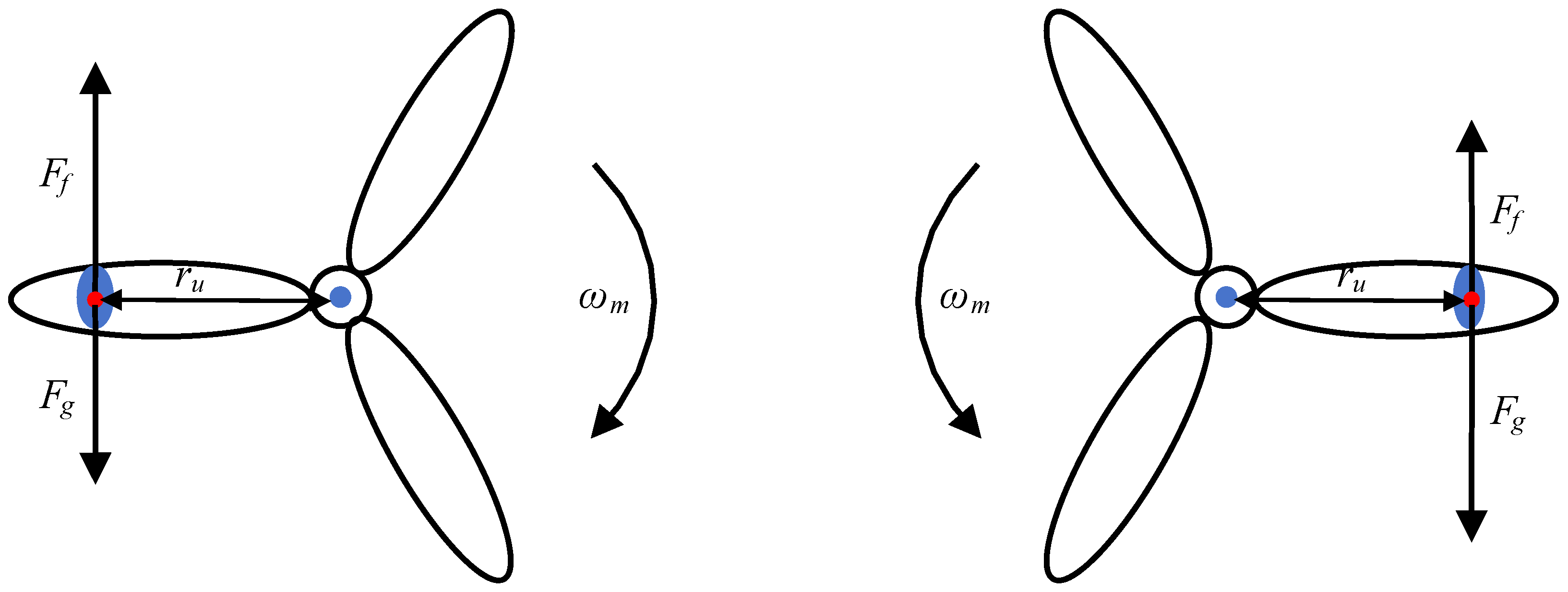
As the core component for energy conversion in TPGS, blades are highly prone to failure due to seabed entanglements and biological attachments in the harsh marine environment. As demonstrated in Figure 1, blade faults such as cracking, mass loss, biofouling, or deformation will destroy the symmetry of the rotor. As the turbine torque is generated by the hydrodynamic force on each blade, any asymmetry will lead to unbalanced thrust and torque during rotation. This causes a significant torque fluctuation [10] known as torque imbalance, denoted by T i m in this paper. Therefore, under consideration of a blade imbalance fault, the mechanical torque of TSTs can be expressed as
T n = T m + T i m
Under the action of gravitational acceleration and buoyancy, the unbalance fault causes the blade to undergo periodic acceleration and deceleration. Therefore, the additional torque can be further modeled as [6]
T i m = ( m g m ρ g m V ) r u sin ( ω m t + ϕ )
where m and V are the mass and volume of the equivalent attachment leading to torque imbalance, respectively, g m is the gravitational acceleration, r u is the distance from the center of mass of the attachment to the impeller axis, and ϕ is the initial phase angle. Thus, the motion equation of a TST becomes
J d ω n d t = T m + T i m T e D ω m
where ω n represents the mechanical speed under the blade imbalance fault.
It is observed from (5) and (6) that unbalanced mass on the blades would lead to an additional torque T i m on the system’s output mechanical torque, causing a periodic disturbance. As a result, the system’s rotational speed exhibits periodic fluctuations around its steady-state value and varies with the disturbance frequency. For ease of analysis, we assume that the TST operates in a relatively stable state under normal conditions, which leads to T m T e . Meanwhile, as the system damping coefficient D is generally small, its influence can be neglected approximately. Equation (6) is then simplified as
J d ω n d t T n T e = T i m
Substituting Equation (5) into (7) yields
d ω n d t ( m g m ρ g m V ) r u J sin ( ω m t + ϕ )
By performing integration of both sides of (8), we have
ω n ( t ) = ω m ( m g m ρ g m V ) r u J ω m cos ( ω m t + ϕ ) = ω m B cos ( ω m t + ϕ )
where B = ( m g m ρ g m V ) r u J ω m represents the amplitude of the rotational speed variation introduced by the equivalent unbalanced mass.
For a direct-drive PMSG, the relationship between the electrical angular frequency of its stator current and the mechanical angular velocity satisfies ω e = p ω n , where p is the number of pole pairs. Furthermore, the single-phase stator current can be expressed as
i s ( t ) = A cos 0 t ω e ( τ ) d τ + δ 0
where A is the amplitude of the stator current, and δ 0 is the initial phase. Substituting (9) into (10), we have
i s ( t ) = A cos p ω m t B p ω m sin ( ω m t + ϕ )
It implies that, except for the steady-state component p ω m t , a sinusoidal term is introduced in the stator current and it varies synchronously with the frequency ω m . The term B p ω m sin ( ω m t + ϕ ) is the unbalanced feature component induced by the blade unbalanced mass fault in the stator current signal. The intensity of this feature component is proportional to ( m g m ρ g m V ) r u , which means that the heavier the mass or the larger the eccentricity, the more significant the unbalanced feature. In addition, due to the influence of wave, turbulence and noises, the measured stator current suffering stochastic disturbance can be modeled as
i s ( t ) = A cos p ω m t B p ω m sin ( ω m t + ϕ ) + i d ( t )
where i d R denotes the stochastic disturbance in i s . In this paper, the exact probability distribution of i d is considered to be unknown.

2.3. Problem Formulation

As demonstrated above, the blade imbalance fault would cause the changes of the amplitude and frequency of the stator current signal. To achieve successful blades fault detection with satisfactory detection accuracy, we, without loss of generality, regard the blade fault detection issue as a binary classification problem, i.e., the fault-free class and faulty class, and the following problems should be successively addressed:
  • Problem 1: Design a feature extraction operator F to extract the blade imbalance fault information from the stator current signal concerning the non-stationarity of disturbance, i.e.,
    Z = F ( i s )
    where Z denotes the extracted feature vector.
  • Problem 2: Find an optimal separating hyperplane H ( W , b ) to separate the fault-free and faulty samples by performing the following decision logic:
    W T Z b , no fault alarm W T Z > b , fault alarm
    so as to achieve an optimal trade-off between the FAR and MDR criteria in the probabilistic context by solving the following problem:
    min W , b θ α + ( 1 θ ) β
    s . t . sup T i m = 0 Pr W T Z > b α , sup T i m 0 Pr W T Z b β
    where Pr { · } represents the probability of { · } , α , β ( 0 , 1 ) are the upper bounds of FAR and MDR, respectively, and θ ( 0 , 1 ) is the weight coefficient. It is remarkable that such a hyperplane directly accounts for the detection accuracy in the probabilistic context. However, due to the unknown exact probability distribution of disturbance, addressing such an optimization problem remains challenging.

3. Design of a Probabilistic Fault Detection System for TST Blades

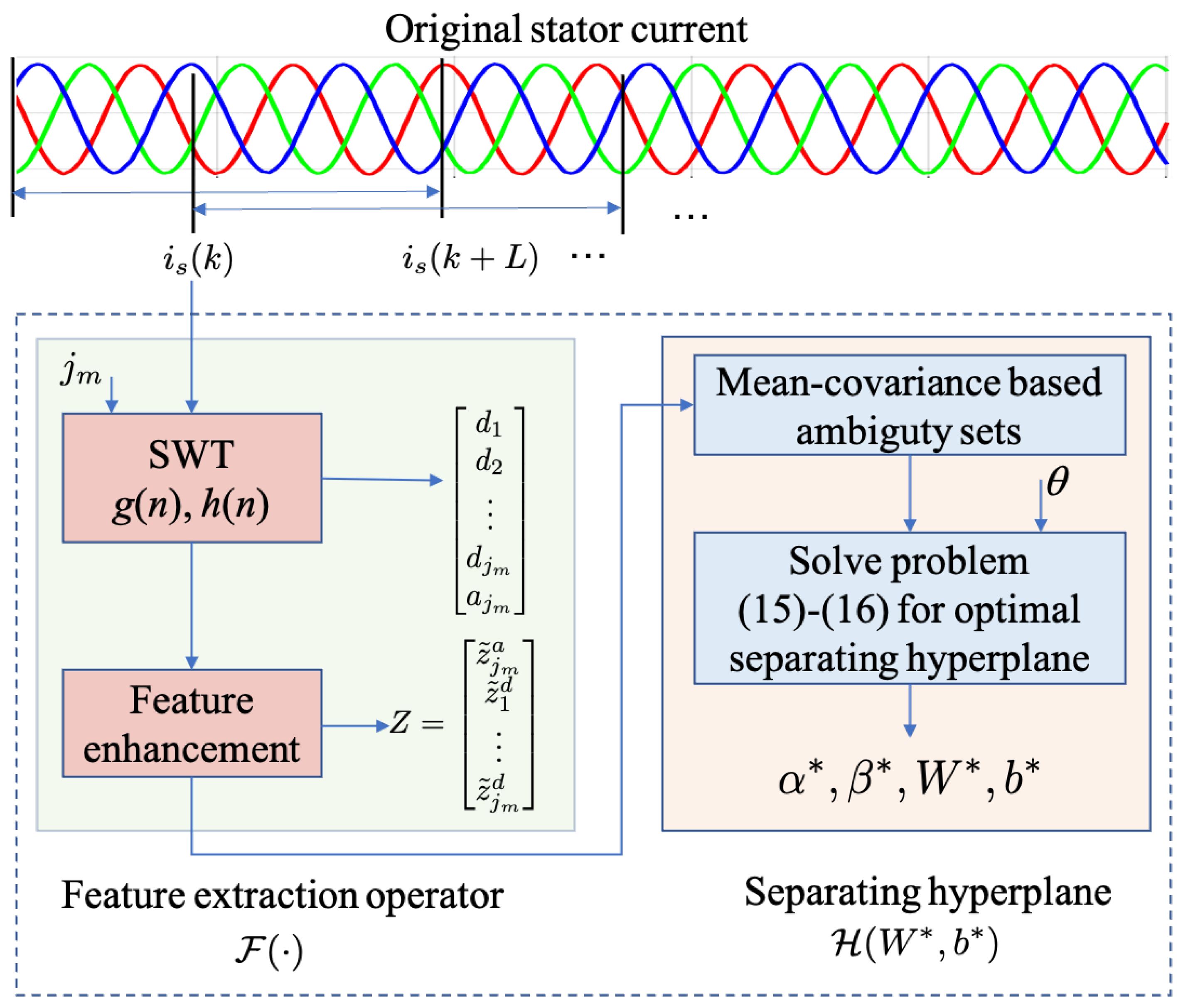
In this section, with respect to addressing Problem 1 for feature extraction operator F and Problem 2 for separating hyperplane H ( W , b ) , a probabilistic fault detector is developed by combining SWT with DRO techniques. The schematic diagram is demonstrated in Figure 2.

3.1. Stationary Wavelet Transform-Based Feature Extractor

As a non-downsampling redundant wavelet decomposition technique, SWT possesses the favorable property of shift invariance [33]. Unlike DWT, which performs twofold downsampling on the filter output at each decomposition layer, SWT maintains the same length for the multiscale decomposition coefficients as the original signal by removing downsampling and scaling the filter coefficients. This effectively alleviates the shift-variance problem inherent in DWT and improves the stability and repeatability of fault feature extraction. SWT is, therefore, particularly suitable for analyzing non-stationary signals with frequency drift and transient disturbances. Thanks to these merits, an SWT-based feature extractor is designed in this subsection.
Given the discretized stator current signal i s ( n ) , let h ( n ) and g ( n ) be the low-pass and high-pass filters corresponding to a selected wavelet basis function. By performing j m decomposition on i s ( n ) using SWT, the approximation coefficients a j ( n ) and detail coefficients d j ( n ) at j-th level can be obtained as
a j ( k ) = n h j 1 ( n k ) a j 1 ( n ) d j ( k ) = n g j 1 ( n k ) a j 1 ( n ) j = 1 , 2 , , j m
where a 0 ( n ) = i s ( n ) , h j ( n ) = h ( 2 j 1 n ) and g j ( n ) = g ( 2 j 1 n ) . Owing to the time–frequency analysis property of SWT, the approximation coefficients a j m ( n ) and the bank of detail coefficients d j ( n ) , j = 1 , 2 , , j m contain the low-frequency and higher-frequency components of signal i s ( n ) , respectively. As the blade imbalance fault of TST will cause the amplitude and frequency fluctuation of the stator current, the fault information would be contained in the SWT decomposition coefficients.
To further enhance the fault characteristics, we extract the features of energy, standard deviation and kurtosis from the approximation coefficients a j m ( n ) and detailed coefficients d j ( n ) , j = 1 , 2 , , j m , by using sliding window technique. Let N and l be the lengths of SWT coefficients and sliding window, respectively. Compute
z j , 1 p ( k ) = 1 l i = k l + 1 k ( x j p ( i ) ) 2
z j , 2 p ( k ) = 1 l i = k l + 1 k ( x j p ( i ) x ¯ j p ) 2
z j , 3 p ( k ) = 1 l i = k l + 1 k ( x j p ( i ) x ¯ j p ) 4 ( 1 l i = k l + 1 k ( x j p ( i ) x ¯ j p ) 2 ) 2
for l N , where x j p denotes a j m and d j , j = 1 , 2 , , j m , p = a when x j = a j m and p = d when x j = d j , x ¯ j p is the mean value of x j p in the interval of [ k l + 1 , k ] . Then, we can construct the following enhanced feature space:
Z ( k ) = z ˜ j m a ( k ) z ˜ 1 d ( k ) z ˜ j m d ( k ) , k = 1 , 2 , , N z
where Z ( k ) R 3 ( j m + 1 ) , z ˜ j p ( k ) = [ z j , 1 p ( k ) , z j , 2 p ( k ) , z j , 3 p ( k ) ] T with p = a for approximation coefficients and p = d for detailed coefficients.
Up to now, the feature extraction operator F in (13) has been designed, which consists of the stationary wavelet transformer (17) and the enhanced feature extractor (18)–(21).

3.2. A Distributionally Robust Optimization-Based Separating Hyperplane

Note that the blades of TST in TPGS operate in marine environments for a long time and the stator current signal is affected by random disturbances, which make it difficult to accurately depict the true probability distribution of feature samples Z ( k ) . In this context, traditional statistical testing methods that rely on specific distribution assumptions cannot be applicable. To guarantee the fault detection accuracy while improve the robustness of the fault detector to distributional uncertainties of disturbance, we develop a DRO-based separating hyperplane design method with respect to solving the problem (15) and (16).
Remarkably, the key of solving problem (15) and (16) lies in handling the probabilistic constraints in (16). Despite the unknown exact probability distribution of feature vector Z ( k ) , we can generally compute the mean and covariance matrix of Z ( k ) empirically both in fault-free and faulty cases, i.e.,
Z ¯ 0 = 1 N z k = 1 N z Z ( k ) | T i m = 0 , Σ 0 = 1 N z 1 k = 1 N z ( Z ( k ) | T i m = 0 Z ¯ 0 ) ( Z ( k ) | T i m = 0 Z ¯ 0 ) T
Z ¯ f = 1 N z k = 1 N z Z ( k ) | T i m 0 , Σ f = 1 N z 1 k = 1 N z ( Z ( k ) | T i m 0 Z ¯ f ) ( Z ( k ) | T i m 0 Z ¯ f ) T
where Z ¯ 0 , Z ¯ f R 3 ( j m + 1 ) , Σ 0 , Σ f S + 3 ( j m + 1 ) with S + n denoting a set of semipositive definite symmetric matrix in space R n . And then we construct the following mean-covariance based ambiguity sets
D 0 = P z E [ Z | T i m = 0 ] = Z ¯ 0 , V [ Z | T i m = 0 ] = Σ 0
D f = P z E [ Z | T i m 0 ] = Z ¯ f , V [ Z | T i m 0 ] = Σ f
where P z is the probability distribution of Z ( k ) , and E [ · ] and V [ · ] denote the mean and covariance of [ · ] , respectively. The constraints in (16) can be further rewritten as follows:
sup P z D 0 Pr W T Z > b α , sup P z D f Pr W T Z b β
which are the so-called distributionally robust chance constraints (DRCCs). It shows that, for any probability distribution P z delivering P z D 0 in fault-free case and P z D f in the faulty case, the FAR and MDR can be guaranteed to be no greater than the upper bounds α and β , respectively. In other words, these DRCCs ensure the robustness of the developed fault detection system against distributional uncertainties of disturbance.
To address the above DRCCs deterministically in the probabilistic context, the following theorem is referred.
Theorem 1 
([34]). Given ζ R n following probability distribution P ζ with E [ ζ ] = ζ ¯ and V [ ζ ] = Σ ζ S + n , define P = { P ζ | E P ζ [ ζ ] = ζ ¯ , V P ζ [ ζ ] = Σ ζ } . Then, for ϵ ( 0 , 1 ) , c R n and c 0 R , the condition sup P ζ P Pr c T ζ > c 0 ϵ holds if
c 0 c T ζ ¯ κ ( ϵ ) c T Σ ζ c
where κ ( ϵ ) = ( 1 ϵ ) / ϵ .
Accordingly, let κ ( α ) = ( 1 α ) / α , κ ( β ) = ( 1 β ) / β . The DRCCs in (26) can be, respectively, converted into
b W T Z ¯ 0 k ( α ) W T Σ 0 W , b + W T Z ¯ f k ( β ) W T Σ f W
which implies
W T Z ¯ f κ ( β ) W T Σ f W b κ ( α ) W T Σ 0 W + W T Z ¯ 0
And then
κ ( β ) W T Σ f W + κ ( α ) W T Σ 0 W W T ( Z ¯ f Z ¯ 0 )
Without loss of generality, we can set W T ( Z ¯ f Z ¯ 0 ) = 1 and obtain an optimal W by converting the problem (15) and (16) as
min W θ α + ( 1 θ ) β
s . t . κ ( β ) W T Σ f W + κ ( α ) W T Σ 0 W 1 , W T ( Z ¯ f Z ¯ 0 ) = 1
which is actually a minimal error MPM problem and can be solved by means of fractional programming or iterative computation [35]. An iterative computation algorithm based on the algorithm in [28] is given in Algorithm 1.
Algorithm 1 Iterative algorithm of solving (28) and (29) for optimal W * .
1: 
Given Z ¯ 0 , Z ¯ f and Σ 0 , Σ f , and parameter θ ( 0 , 1 ) , set a small regularization parameter δ > 0 , initialize β j = β 0 ( 0 , 1 ) , small enough δ β > 0 , Δ > 0 , and iteration parameters μ 1 = 1 , η 1 = 1 , iteration index i = 1 and j = 1 .
2: 
Let w 0 = Z ¯ f Z ¯ 0 Z ¯ f Z ¯ 0 2 2 and F R 3 ( j m + 1 ) × ( 3 ( j m + 1 ) 1 ) be a matrix orthogonal to Z ¯ f Z ¯ 0 . Initialize G = κ 2 ( β j ) F T Σ f F , H = F T Σ 0 F , ξ = κ 2 ( β j ) F T Σ f w 0 , and π = F T Σ 0 w 0 .
3: 
Solve M u i = x for u i , where M = 1 μ i G + 1 η i H + δ I and x = 1 μ i ξ + 1 η i π , and then set W i = w 0 + F u i .
4: 
Let μ i + 1 = κ ( β j ) W i T Σ f W i , η i + 1 = W i T Σ 0 W i , i = i + 1 and go to step 3 until μ i + η i is small enough.
5: 
Set W j * = W i 1 , α j * = κ 2 1 + κ 2 , with κ = 1 μ i + η i . Let β j + 1 = β j + δ β , j = j + 1 , and go back step 2 until θ α j * + ( 1 θ ) β j Δ .
6:
Set W * = W j * , α * = α j * and β * = β j .
By solving problems (28) and (29) for optimal solution of W, i.e., W * , it is noted that at W = W * , b achieves its optimum when the equality of both sides of b in (27) holds, i.e.,
b * = ( W * ) T Z ¯ 0 + κ ( α * ) ( W * ) T Σ 0 W * = ( W * ) T Z ¯ f κ ( β * ) ( W * ) T Σ f W *
Hence, by characterizing the probability distribution of the feature vector with mean and covariance matrix, the original design problem of separating hyperplane for fault detection has been converted into a deterministic convex problem and solved iteratively without making any probability distribution assumption. In such a way, the FAR and MDR can be guaranteed to be not greater than α * and β * , respectively. Meanwhile, the robustness of the fault detection system to the distributional uncertainties of disturbance improves, as such performance criteria can be guaranteed for any probability distribution belonging to the corresponding ambiguity sets in fault-free and faulty cases.
For online testing purposes, the stator current signal i s ( t ) is first sampled with period T s . Then, by performing SWT-based feature extraction to generate feature vector Z, the occurrence of a fault can be detected by carrying out (14). We summarize the design and online realization of the proposed fault detection system in Algorithm 2.
Algorithm 2 The design and online realization of the proposed fault detection system.
1: 
Collect stator current samples i s both in fault-free and faulty cases.
2: 
Select an appropriate wavelet basis function and the maximal decomposition level j m . Perform SWT on stator current samples to obtain approximation coefficients a j m and detailed coefficients d j , j = 1 , 2 , , j m .
3: 
Extract enhanced features z j , 1 p , z j , 2 p , z j , 3 p from a j m , d j , j = 1 , 2 , , j m and formulate feature vector Z ( k ) . Compute Z ¯ 0 , Z ¯ f and Σ 0 , Σ f using (22) and (23).
4: 
Set θ ( 0 , 1 ) . Compute W * , b * , α * and β * by using Algorithm 1 and (30).
5: 
For online testing purpose, perform Step 1∼Step 3 and then the fault occurrence information can be obtained by carrying out decision logic (14).

4. An Experimental Study

In this section, an experimental study based on a 0.23 kW TST experimental platform in Shanghai Maritime University is demonstrated to show the effectiveness of our proposed fault detection approach.

4.1. Setting of Experimental Conditions and Experimental Results

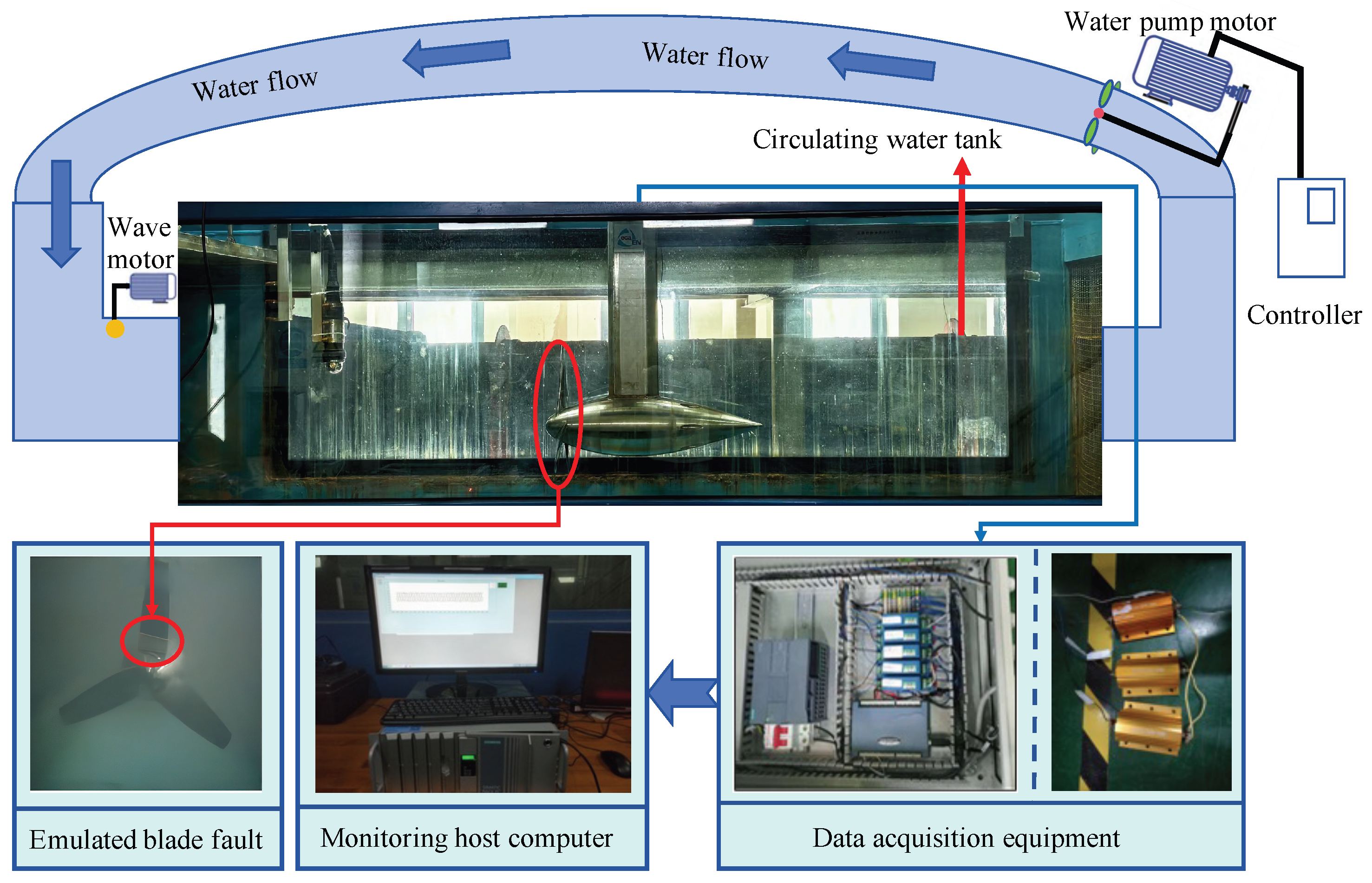
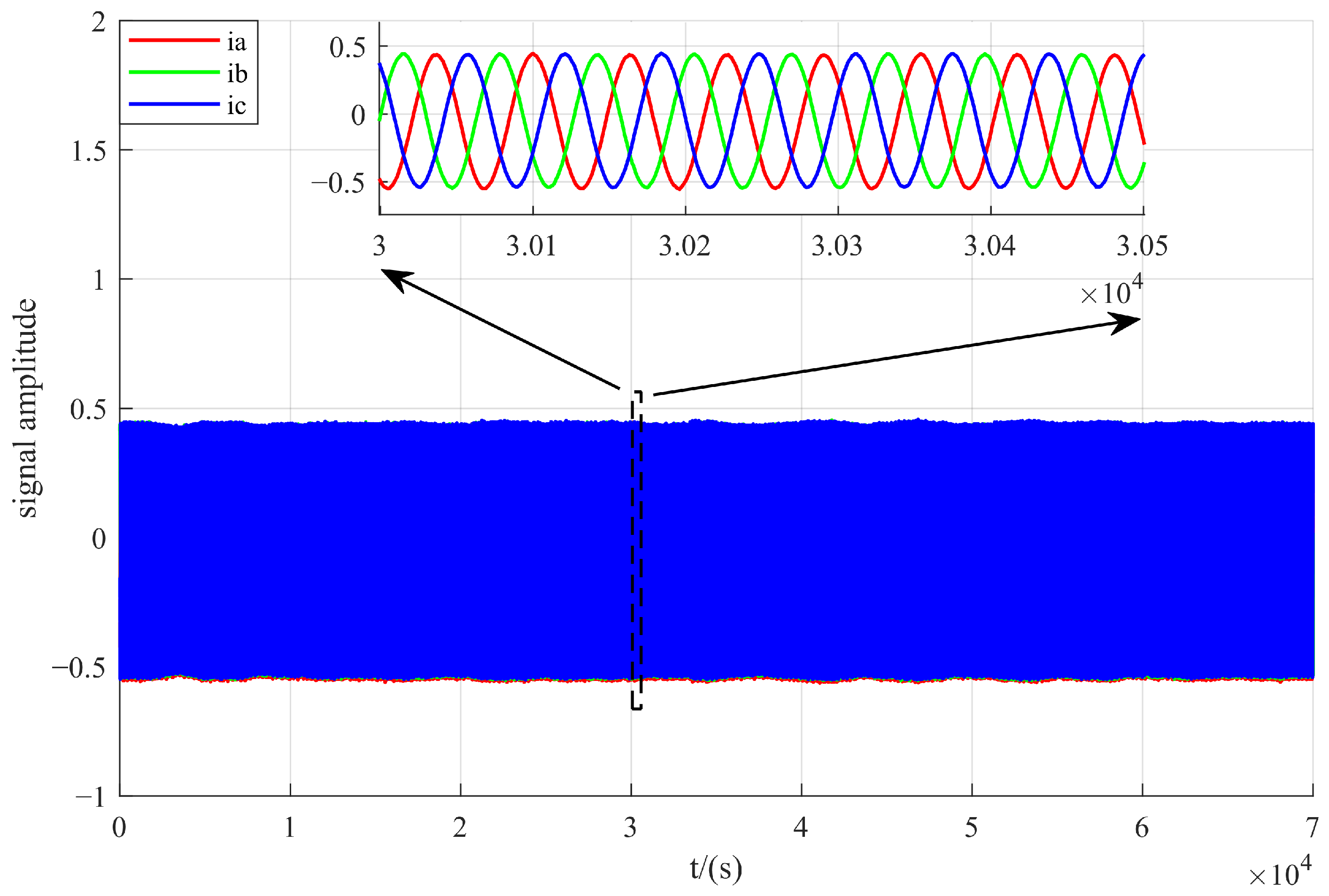
As demonstrated in Figure 3, the experimental platform is equipped with a fixed-pitch turbine, a three-phase star-connected PMSG and connected to a load circuit. The tidal speed (water flow velocity in the platform) is adjusted by regulating the frequency of the water pump. Detailed parameters of the TST are shown in Table 2. Three-phase stator current signals are collected by current sensors with a sampling frequency of 1 kHz. The three-phase stator current in the fault-free situation with average tidal current speed v a v g = 0.756 m/s is demonstrated in Figure 4, which shows that the amplitude of the stator current changes irregularly over time as the tidal speed is time-varying and non-stationary. During system operating procedure, the probability distribution of disturbance subjected by the TST is unknown.
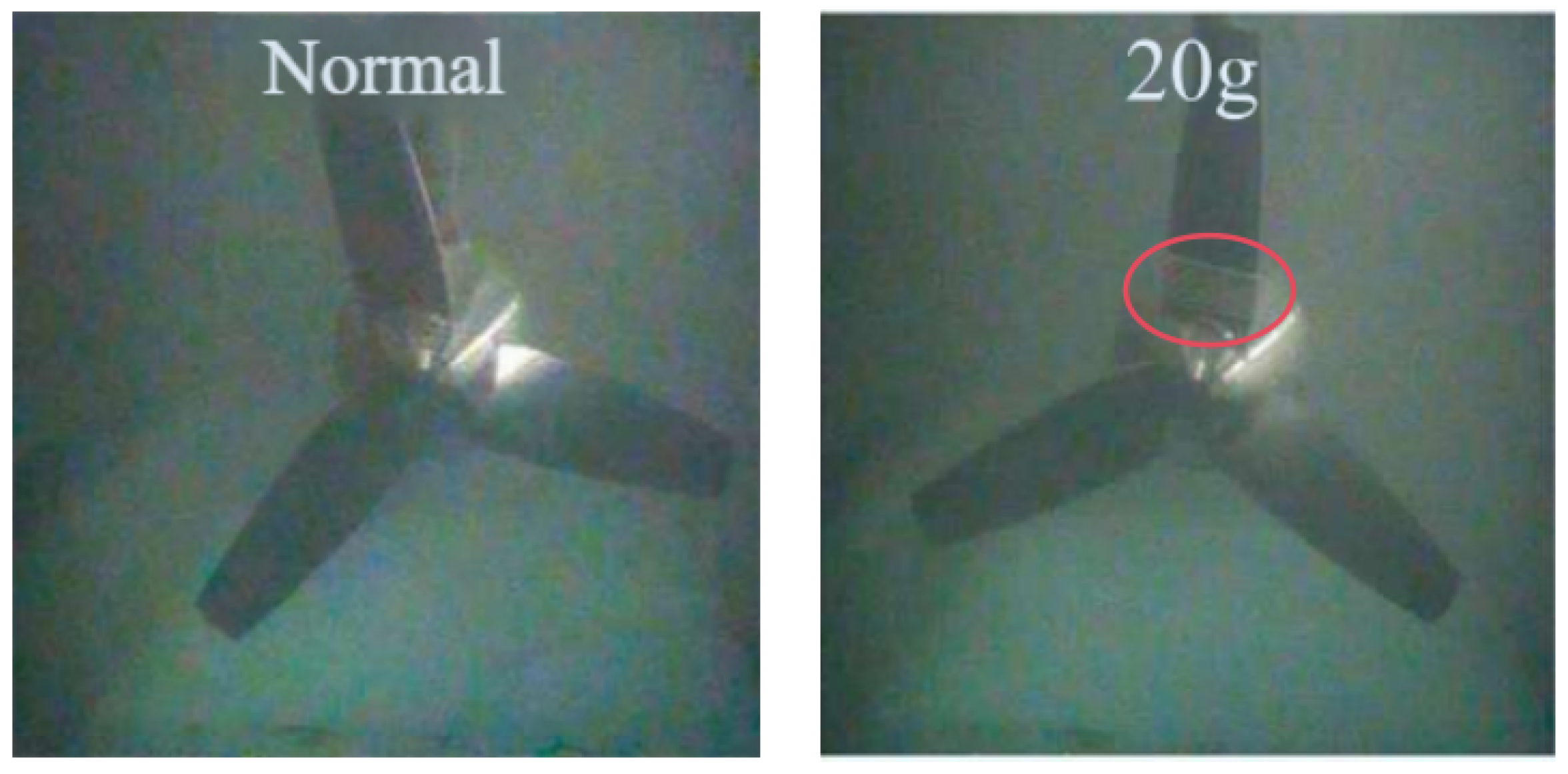
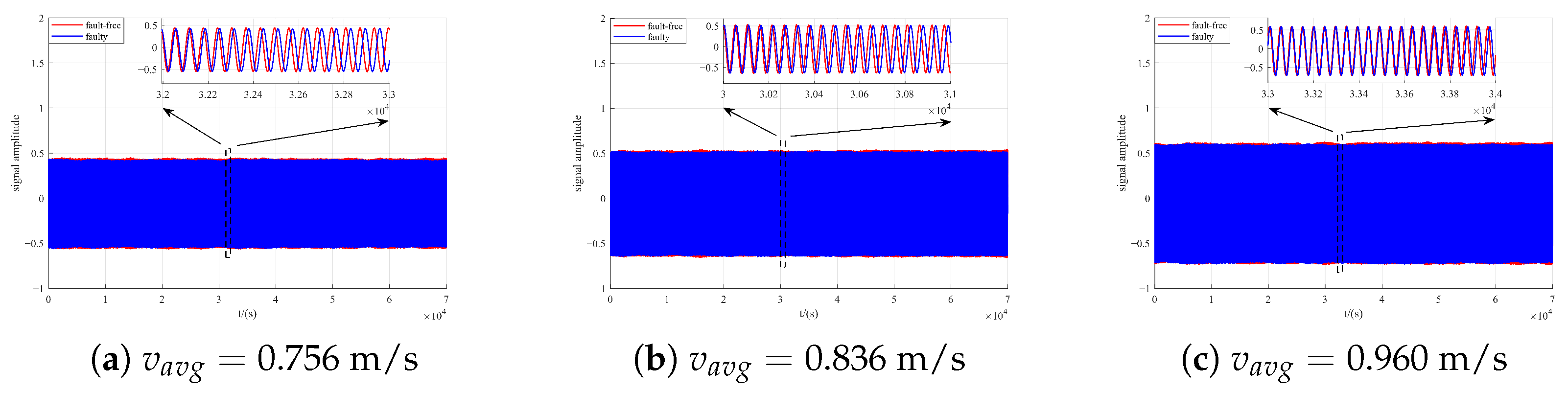
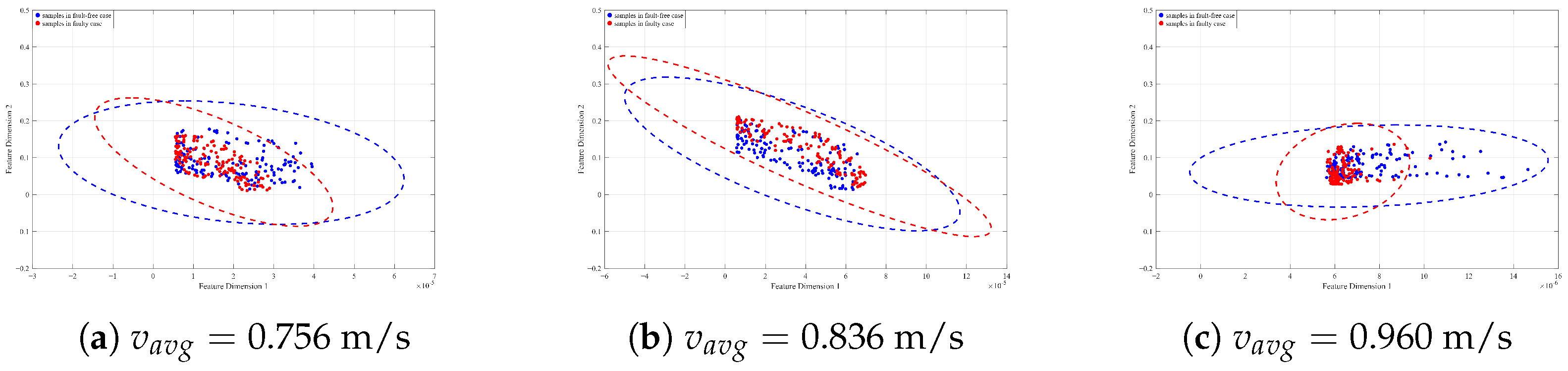
To validate the proposed fault detection method, we simulate the imbalance blade faults by winding 0.02 kg ropes in one of the blades (as shown in Figure 5) under different average tidal current speeds demonstrated in Table 3. In this study, we apply phase-a stator current signal as the original source data for fault detection. The difference of phase-a stator current in fault-free and faulty cases is illustrated clearly in Figure 6. It is obvious that the occurrence of the blade imbalance fault would cause the changes in the amplitude and frequency of the stator current, which is consistent with the theoretical analysis results in Section 2.2. In each faulty situation, we collect phase-a stator current data lasting for 70 s and obtain 70,000 samples, among which, 50,000 samples are used for offline training of the feature extractor and the optimal separating hyperplane. The remaining 20,000 samples are used for testing purposes. According to Algorithm 2, the original samples are first segmented using a sliding window of length N = 6000 with a shift interval L = 100 , obtaining 441 segments. We select db4 wavelet for SWT and set the maximal decomposition level as j m = 8 . By performing SWT on each data segment, one approximation and eight detailed coefficients (i.e., a 8 and d 1 d 8 ) are obtained. Then, three statistical features in (18)–(20) are extracted from the bank of SWT coefficients. Each data segment delivers a 27-dimensional feature vector. A demonstration of fault-free and faulty samples’ distribution in a two-dimensional feature space is given in Figure 7. It is obvious that the two classes are inseparable in such a two-dimensional feature space.
By setting θ = 0.5 and computing the means and covariance matrices of feature vector Z ( k ) with (22) and (23) in fault-free and faulty cases, the optimal separating hyperplane H ( W * , b * ) and the upper bounds of FAR and MDR, i.e., α * and β * , can be obtained using Algorithm 1 and (30). Aiming to validate the stability and reliability of the developed fault detector, we carried out fivefold cross-validation, and the average values of α * and β * for each faulty case are as listed in Table 3. By performing fault detection on the 20,000 testing samples, the average empirical FAR and MDR are given in Table 3, which are guaranteed in the probabilistic context to be smaller than their upper bounds. Onefold testing results under different tidal speed are illustrated in Figure 8, where the first 6000 samples (i.e., the first 6 s of data) are used to generate the initial detection sample, and a sliding window strategy is then adopted to produce the remaining detection samples from 6 s to 20 s. Therefore, only the detection results in the interval from 6 s to 20 s are presented.
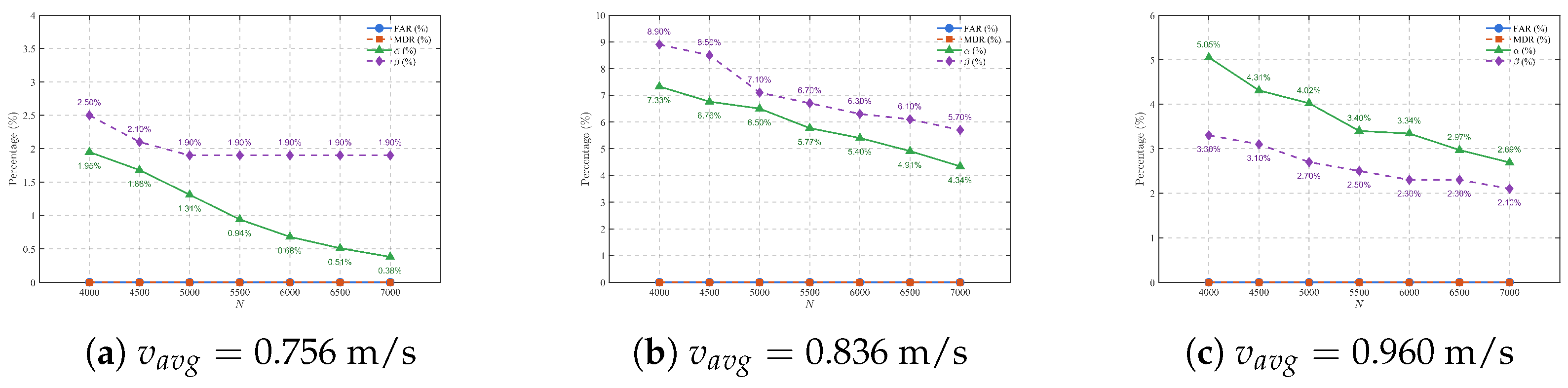
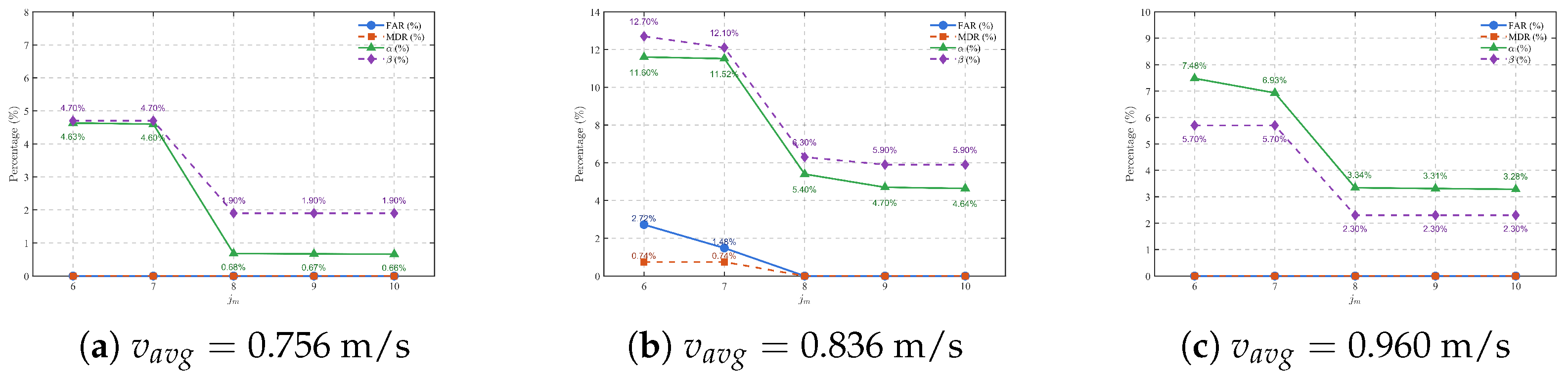
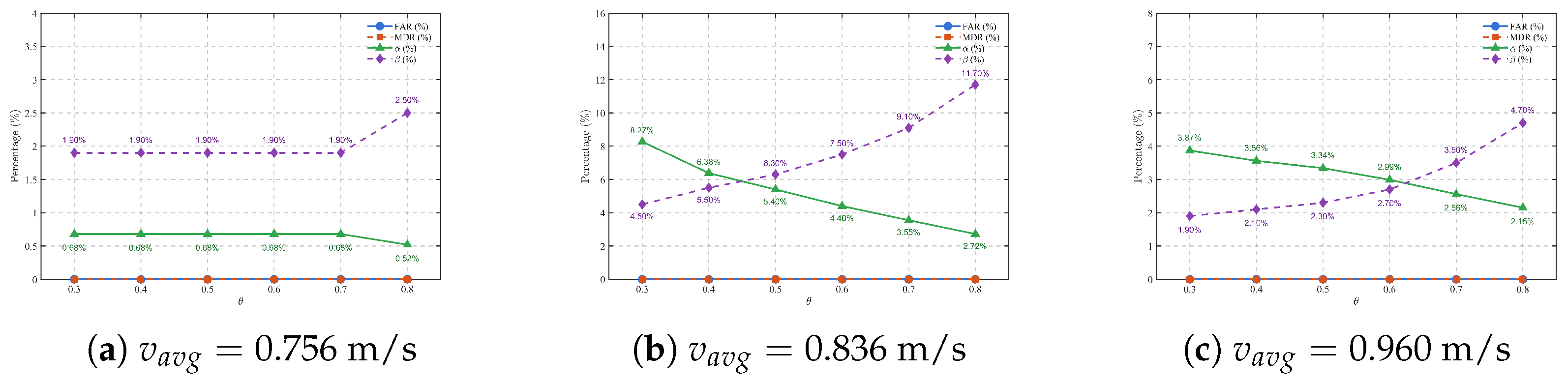
Furthermore, to investigate the sensitivity of the developed fault detection system over the segmentation window length N, the decomposition level j m in SWT, and the weighting parameter θ in hyperplane designing, we plot the evolution of α * , β * , empirical FAR and MDR over N, j m and θ in Figure 9, Figure 10 and Figure 11, respectively.
In addition, as a comparison, the traditional PCA-based fault detection for the concerned TST blade imbalance fault in Table 3 is also carried out. In the PCA-based scheme, samples Z ( k ) in feature space are projected into principal component space and the T 2 test statistic is applied for fault detection by setting the threshold as the 1 α * percentile of the T 2 values calculated from normal operation data. The derived empirical FAR and MDR under different tidal speed are demonstrated in Table 3. The testing results based on 20,000 testing samples are given in Figure 12.

4.2. Experimental Results Analysis

We can see from Table 3 and Figure 8 that, without making specific distribution assumptions on marine disturbance, the proposed method can achieve zero empirical FAR and MDR and, meanwhile, guarantee in the probabilistic context that the worst-case FAR and MDR do not exceed α * (smaller than 6 % ) and β * (smaller than 7 % ), respectively. Such excellent performance relies on two key factors. On the one hand, due to the fluctuation of tidal speed around the average value v a v g and/or the non-stationarity of measurement noises, the stator current signal, whose amplitude varies over time (as shown in Figure 4 and Figure 6), is non-stationary. This is to the detriment of accurate fault detection. To handle this difficulty, we primarily extract fault features from data using SWT, which exhibits excellent multiscale time–frequency analysis capability for non-stationary signals and lays the foundation of accurate fault detection. On the other hand, by characterizing the probability distribution of samples in feature space with the mean-covariance-based ambiguity set, the separating hyperplane is designed achieving an optimal trade-off between the FAR and MDR criteria. In such a way, the derived fault detection system is not only robust against the environmental stochastic disturbances (guaranteed by the upper bounds of FAR and MDR) but also the distributional uncertainties of disturbances (achieved by the introduction of ambiguity set). Hence, the proposed method has superior engineering applicability in complex and dynamic real marine environments.
As demonstrated in Figure 9, Figure 10 and Figure 11, the sensitivity of fault detection performance on segmentation window length N, the SWT decomposition level j m , and weighting parameter θ was investigated. Firstly, we can see from Figure 9 that the increase in window length N delivers the decrease in α * and β * and, meanwhile, unfortunately, the degradation of real-time capability for online fault detection. Therefore, in this paper we select N = 6000 to achieve a trade-off between the detection accuracy and real-time capability. Secondly, Figure 10 shows that the detection accuracy improves with the increase in SWT decomposition level j m and, when j m > 8 , such an improvement becomes negligible. Hence, j m = 8 is an appropriate choice to achieve satisfactory detection accuracy with a relatively low computational cost. Thirdly, as illustrated in Figure 11, the FAR and MDR criteria exhibit a contradictory relationship. This is, indeed, one of the important research motivations for us and many other researchers in the fault detection field, who aim to strike a balance between the FAR and MDR criteria. For a predefined θ ( 0 , 1 ) , an optimal trade-off between FAR and MDR criteria can be achieved by using our proposed method.
Moreover, it is noted from Table 3 and Figure 8 and Figure 12 that, despite the fact that the traditional PCA-based method and the proposed method can both achieve acceptable fault detection accuracy without knowing the exact probability distribution of disturbance, the proposed scheme is superior to the PCA-based method due to a smaller empirical FAR in the probabilistic context. In addition, theoretically, the proposed method would have better robustness against distributional uncertainties than the PCA-based scheme.

4.3. Additional Remarks

In the proposed fault detection method, the optimal hyperplane H ( W * , b * ) is designed based on the measured stator current signal, which is corrupted by the stochastic disturbance of unknown precise probability distribution. An optimal trade-off between the upper bounds of FAR and MDR is achieved in the probabilistic context without making a specific distribution assumption on disturbance. In the offline design stage, the optimization problem (28) and (29) reduces to a second-order cone program problem, with a worst-case solving complexity O ( n 3 ) [28]. As the separating hyperplane can be designed offline and the dimension of feature space is not that large, such a computational complexity is practically acceptable.
As the fault features are extracted from stator current samples based on SWT within a finite time interval [ k N + 1 , k ] , a detection time delay related to segmentation window length N is inevitable. As demonstrated in Figure 9, the larger the N, the smaller the upper bounds of FAR and MDR. Unfortunately, the real-time capability would degrade accordingly, and vice versa. Hence, the segmentation window length N should be appropriately selected towards a balance between the detection accuracy and the real-time capability in practical applications.
Notably, the robustness of the proposed scheme against distributional uncertainties is achieved with the introduction of the mean-covariance based ambiguity set. Yet, due to the limited distributional information, the derived upper bounds of FAR and MDR are, to some extent, conservative. This can be seen from Table 3, in which the empirical values of FAR and MDR are much smaller than their upper bounds. To address this defect, one promising direction is to deal with TST blades fault detection issues in the DRO framework with more informative ambiguity sets, such as those based on Wasserstein distance and bounded moments.
In this paper, the TST blade fault detection issue is regarded as a binary classification problem, with only one type of fault concerned. Extension of the developed method to multiple faulty scenarios remains an open topic. Moreover, for large-scale systems involving a massive data of high dimensions, solving the problems (28) and (29) for an optimal separating hyperplane would become computationally expensive. Therefore, simplifying the design procedure of the proposed scheme is another important topic.

5. Conclusions

In this paper, a novel probabilistic fault detection method was proposed by combining the SWT and DRO techniques. Firstly, by noting that the blade imbalance fault will introduce synchronous frequency fluctuation components in the stator current signal, SWT was applied for primary feature extraction from the stator current signal. On this basis, the energy, standard deviation and kurtosis of SWT decomposition coefficients were extracted to establish an enhanced feature space. By characterizing the feature vector with the mean-covariance-based ambiguity set both in fault-free and faulty cases, a separating hyperplane for fault detection was designed in the sense of optimizing a trade-off between the upper bounds of FAR and MDR in the probabilistic context. A numerical solution was derived without making specific distribution on disturbances. The robustness of the proposed method is twofold, i.e., the robustness to disturbance and the robustness against distributional uncertainties of disturbance. An experimental study was performed to validate the effectiveness of the proposed scheme. The experimental results showed that, in comparison with the traditional PCA-based method, a smaller empirical FAR (0%) for the same empirical MDR (0%) can be obtained under different tidal speeds with unknown probability distribution of disturbance. Meanwhile, the upper bounds of FAR and MDR were guaranteed to be not larger than 6 % and 7 % , respectively. The sensitivity of fault detection performance to the developed detection model parameters (including the length of data segmentation window, SWT decomposition level, and the weighting parameter for balancing FAR and MDR criteria) was also discussed. For future work, one direction is to extend the proposed method to multiple fault types of TST blades. In addition, we will also explore how to deal with TST blades fault detection issues in the DRO framework with more informative ambiguity sets, such as those based on Wasserstein distance and bounded moments.

Author Contributions

Conceptualization, T.X.; methodology, T.X.; software, D.Y.; validation, D.Y.; formal analysis, D.Y. and Q.F.; investigation, D.Y. and Q.F.; re-sources, T.W.; data curation, T.W.; writing—original draft preparation, D.Y.; writing—review and editing, T.X., D.Y. and Q.F.; visualization, Q.F.; supervision, T.X.; project administration, T.X.; funding acquisition, T.X. and T.W. All authors have read and agreed to the published version of the manuscript.

Funding

This research was funded by the National Natural Science Foundation of China under Grants 62473248, 62103247 and 62573283.

Data Availability Statement

The data presented in this study are available on request from the corresponding author. The data are not publicly available due to restriction.

Conflicts of Interest

The authors declare no conflicts of interest.

Abbreviations and Symbols List

The following abbreviations are used in this manuscript:
HOSHigher-Order Spectra
MEGKMultiple Envelope Geometrical K-mean
KNNK-nearest Neighbors
HPIHybrid Physics-informed
DNNDeep Neural Network
NNANeural Network Autoencoder
VMDVariational Mode Decomposition
SWTStationary Wavelet Transform
MPMMinimum Probability Machine
TPGSTidal Power Generation System
TSTTidal Stream Turbine
PCAPrincipal Component Analysis
GLRTGeneralized Likelihood Ratio Test
CWTContinuous Morlet Wavelet Transform
FARFalse Alarm Rate
MDRMissed Detection Rate
FDRFault Detection Rate
DRODistributionally Robust Optimization
DWTDiscrete Wavelet Transform
PMSGPermanent Magnet Synchronous Generator
DRCCsDistributionally Robust Chance Constraints

Nomenclature

PPower captured from tidal current
ρ Water density
R p Blade radius
C p Power coefficient
β c pitch angle
λ Tip speed ratio
vTidal speed
v avg Average tidal speed
T m Mechanical torque
ω m Mechanical angular velocity
JMoment of inertia
T e Electromagnetic torque
DDamping coefficient
T i m Imbalance torque due to blade fault
mMass of attached fouling
gGravitational acceleration
pNumber of pole pairs
i s Stator current
i d Stochastic disturbance
F Feature extraction operator
ZFeature vector
j m Maximum SWT decomposition level
a j , d j SWT approximation and detail coefficients
WWeight vector of separating hyperplane
bBias of separating hyperplane
α Upper bound of FAR
β Upper bound of MDR
θ Weight for FAR/MDR trade-off
E [ · ] Mathematical expectation
V [ · ] Covariance matrix
P z [ · ] Probability distribution of Z
Pr { · } The probability of { · }
S + n Set of semipositive definite symmetric matrix in space R n

References

  1. Zhang, X.; Ji, R.; Sun, K.; Zhang, J.; Zhang, X.; Yin, M.; Kong, M.; Reabroy, R. A review of ocean tidal current energy technology: Advances, trends, and challenges. Phys. Fluids 2025, 37, 071308. [Google Scholar] [CrossRef]
  2. Chen, H.; Li, Q.; Benbouzid, M.; Han, J.; AïtAhmed, N. Development and research status of tidal current power generation systems in China. J. Mar. Sci. Eng. 2021, 9, 1286. [Google Scholar] [CrossRef]
  3. Kariman, H.; Hoseinzadeh, S.; Khiadani, M.; Nazarieh, M. 3D-CFD analysing of tidal Hunter turbine to enhance the power coefficient by changing the stroke angle of blades and incorporation of winglets. Ocean Eng. 2023, 287, 115713. [Google Scholar] [CrossRef]
  4. Rashid, H.; Benbouzid, M.; Titah-Benbouzid, H.; Amirat, Y.; Mamoune, A. Tidal stream turbine biofouling detection and estimation: A review-based roadmap. J. Mar. Sci. Eng. 2023, 11, 908. [Google Scholar] [CrossRef]
  5. Song, S.; Demirel, Y.K.; Atlar, M.; Shi, W. Prediction of the fouling penalty on the tidal turbine performance and development of its mitigation measures. Appl. Energy 2020, 276, 115498. [Google Scholar] [CrossRef]
  6. Zhang, M.; Chen, J.; Yang, L.; Claramunt, C. Imbalance fault detection of marine current turbine based on GLRT detector. Sensors 2025, 25, 874. [Google Scholar] [CrossRef]
  7. Wang, T.; Zhou, F.; Xie, T.; Razik, H. Diagnosis methods on the blade of marine current turbine. In Nonstationary Systems: Theory and Applications; Chaari, F., Leskow, J., Wylomanska, A., Zimroz, R., Napolitano, A., Eds.; Springer International Publishing: Cham, Switzerland, 2022; pp. 393–426. [Google Scholar] [CrossRef]
  8. Saidi, L.; Benbouzid, M.; Diallo, D.; Amirat, Y.; Elbouchikhi, E.; Wang, T. Higher-order spectra analysis-based diagnosis method of blades biofouling in a PMSG driven tidal stream turbine. Energies 2020, 13, 2888. [Google Scholar] [CrossRef]
  9. Xie, T.; Li, Z.; Wang, T.; Shi, M.; Wang, Y. An integration fault detection method using stator voltage for marine current turbines. Ocean Eng. 2021, 226, 108808. [Google Scholar] [CrossRef]
  10. Xie, T.; Zhang, W.; Li, F.; Ahmed, Z. Impact fault detection for marine current turbines blade via MEGK-means and PCA under variable marine conditions. Meas. Sci. Technol. 2023, 34, 095906. [Google Scholar] [CrossRef]
  11. Freeman, B.; Tang, Y.; Huang, Y.; VanZwieten, J. Rotor blade imbalance fault detection for variable-speed marine current turbines via generator power signal analysis. Ocean Eng. 2021, 223, 108666. [Google Scholar] [CrossRef]
  12. Freeman, B.; Tang, Y.; Huang, Y.; VanZwieten, J. Physics-informed turbulence intensity infusion: A new hybrid approach for marine current turbine rotor blade fault detection. Ocean Eng. 2022, 254, 111299. [Google Scholar] [CrossRef]
  13. Syed, M.J.; Goggins, J. Explanation artificial intelligence-based condition monitoring for tidal energy turbines. AIP Conf. Proc. 2024, 2919, 140001. [Google Scholar] [CrossRef]
  14. Galloway, G.S.; Catterson, V.M.; Fay, T.; Robb, A.; Love, C. Diagnosis of tidal turbine vibration data through deep neural networks. PHM Soc. Eur. Conf. 2016, 3. [Google Scholar] [CrossRef]
  15. Munko, M.J.; Valdivia Camacho, M.A.; Cuthill, F.; Bradaigh, C.M.Ó.; Lopez Dubon, S. Using audio-data for anomaly detection in the fatigue test of a composite tidal turbine blade. In Proceedings of the International Conference on Condition Monitoring and Asset Management; The British Institute of Non-Destructive Testing: Northampton, UK, 2023; pp. 1–2. [Google Scholar] [CrossRef]
  16. Rashid, H.; Benbouzid, M.; Amirat, Y.; Berghout, T.; Titah-Benbouzid, H.; Mamoune, A. Biofouling detection and classification in Tidal Stream Turbines through soft voting ensemble transfer learning of video images. Eng. Appl. Artif. Intell. 2024, 138, 109316. [Google Scholar] [CrossRef]
  17. Habbouche, H.; Rashid, H.; Amirat, Y.; Banerjee, A.; Benbouzid, M. A 2D VMD video image processing-based transfer learning approach for the detection and estimation of biofouling in tidal stream turbines. Ocean Eng. 2024, 312, 119283. [Google Scholar] [CrossRef]
  18. Wang, Z.; Xuan, A.; Shen, X.; Du, Y.; Sun, H. A robust planning model for offshore microgrid considering tidal power and desalination. Appl. Energy 2023, 350, 121713. [Google Scholar] [CrossRef]
  19. Zhu, Y.; Liu, J.; Hu, Y.; Xie, Y.; Zeng, D.; Li, R. Distributionally robust optimization model considering deep peakshaving and uncertainty of renewable energy. Energy 2024, 288, 129935. [Google Scholar] [CrossRef]
  20. Fan, W.; Fan, Y.; Liu, P.; Wang, Y.; Tong, F.; Yi, B.; Yao, X. Distributionally robust optimization scheduling model for electric power and computing power coordination considering spatiotemporal response. Appl. Energy 2025, 402, 126895. [Google Scholar] [CrossRef]
  21. Brock, E.; Zhang, H.; Lavaei, J.; Sojoudi, S. Distributionally robust joint chance-constrained optimal power flow using relative entropy. IEEE Trans. Power Syst. 2025, 40, 2902–2914. [Google Scholar] [CrossRef]
  22. Hakobyan, A.; Yang, I. Wasserstein distributionally robust control of partially observable linear stochastic systems. IEEE Trans. Autom. Control 2024, 69, 6121–6136. [Google Scholar] [CrossRef]
  23. Taskesen, B.; Iancu, D.; Koçyiğit, Ç.; Kuhn, D. Distributionally robust linear quadratic control. Adv. Neural Inf. Process. Syst. 2023, 36, 18613–18632. [Google Scholar]
  24. Qi, Z.; Luo, Z.; Zhao, M.; Zhou, S. A Domain Generalization Method for Fault Diagnosis: Integrating Causal Learning and Distributionally Robust Optimization. IEEE Trans. Instrum. Meas. 2025, 74, 3522212. [Google Scholar] [CrossRef]
  25. Feng, Y.; Ye, H.; Shang, C. A Globalized Distributionally Robust Fault Detection Design with Moment Information. In Proceedings of the 2025 CAA Symposium on Fault Detection, Supervision, and Safety for Technical Processes (SAFEPROCESS), Urumqi, China, 22–24 August 2025; pp. 1–6. [Google Scholar] [CrossRef]
  26. Feng, Y.; Jin, H.; Ding, S.X.; Ye, H.; Shang, C. Distributionally robust fault detection trade-off design with prior fault information. Control Eng. Pract. 2026, 169, 106758. [Google Scholar] [CrossRef]
  27. Ma, Z.; Wang, J.; Wang, M.; Hu, W.; Peng, Y.; Xu, Y.; Zhang, Y.; Qin, H. Bearing fault diagnosis under unknown operating conditions using distribution robust optimization theory with distribution exploration strategy and Wasserstein constraints. Meas. Sci. Technol. 2025, 36, 066115. [Google Scholar] [CrossRef]
  28. Lanckriet, G.R.G.; El Ghaoui, L.; Bhattacharyya, C.; Jordan, M.I. A robust minimax approach to classification. J. Mach. Learn. Res. 2003, 3, 555–582. [Google Scholar]
  29. Xue, T.; Zhong, M.; Li, L.; Ding, S.X. An optimal data-driven approach to distribution independent fault detection. IEEE Trans. Ind. Inform. 2020, 16, 6826–6836. [Google Scholar] [CrossRef]
  30. Laha, S.K.; Swarnakar, B.; Kansabanik, S.; Ray, S. A novel signal denoising method using stationary wavelet transform and particle swarm optimization with application to rolling element bearing fault diagnosis. Mater. Today Proc. 2022, 66, 3935–3943. [Google Scholar] [CrossRef]
  31. Wang, L.; Li, C.-N. Dynamic stability analysis of a tidal power generation system connected to an onshore distribution system. IEEE Trans. Energy Convers. 2011, 26, 1191–1197. [Google Scholar] [CrossRef]
  32. Belkhier, Y.; Achour, A.; Hamoudi, F.; Ullah, N.; Mendil, B. Robust energy-based nonlinear observer and voltage control for grid-connected permanent magnet synchronous generator in the tidal energy conversion system. Int. J. Energy Res. 2021, 45, 13250–13268. [Google Scholar] [CrossRef]
  33. Percival, D.B.; Walden, A.T. Wavelet Methods for Time Series Analysis. Cambridge Series in Statistical and Probabilistic Mathematics; Cambridge University Press: Cambridge, UK, 2000. [Google Scholar] [CrossRef]
  34. El Ghaoui, L.; Oks, M.; Oustry, F. Worst-case value-at-risk and robust portfolio optimization: A conic programming approach. Oper. Res. 2003, 51, 543–556. [Google Scholar] [CrossRef]
  35. Huang, K.Z.; Yang, H.Q.; King, I.; Lyu, M.R.; Chan, L.W. The minimum error minimax probability machine. J. Mach. Learn. Res. 2004, 5, 1253–1286. [Google Scholar]
Figure 1. Mechanism diagram of blade imbalance fault in a TST. In this figure, the blue dot denotes the equivalent unbalanced mass that causes the torque imbalance, whose center of gravity is represented by the red dot. F g and F f represent the gravity and fluid buoyancy of the unbalanced mass, respectively.
Jmse 14 00721 g001
Figure 2. The schematic diagram of the proposed fault detection method for TST blades.
Jmse 14 00721 g002
Figure 3. The TST experimental prototype.
Jmse 14 00721 g003
Figure 4. Three-phase stator current signal with v a v g = 0.756 m/s.
Jmse 14 00721 g004
Figure 5. Simulation of blade imbalance fault in TSTs.
Jmse 14 00721 g005
Figure 6. Comparison of phase-a stator current in fault-free and faulty cases.
Jmse 14 00721 g006
Figure 7. Distribution of a 2-dimensional samples in feature space in fault-free and faulty cases.
Jmse 14 00721 g007
Figure 8. Testing results by using the proposed method under different average tidal speeds.
Jmse 14 00721 g008
Figure 9. Evolution of α * , β * , empirical FAR and MDR with segmentation window length N for θ = 0.5 and j m = 8 .
Jmse 14 00721 g009
Figure 10. Evolution of α * , β * , empirical FAR and MDR with decomposition level j m for θ = 0.5 and N = 6000 .
Jmse 14 00721 g010
Figure 11. Evolution of α * , β * , empirical FAR and MDR with parameter θ for j m = 8 and N = 6000 .
Jmse 14 00721 g011
Figure 12. Testing results using the PCA-based scheme.
Jmse 14 00721 g012
Table 1. The state-of-the-art of blades fault detection methods in TSTs.
Method CategorySource Data TypeTidal SpeedDisturbance/NoiseRobustnessTheoretical
Performance Assessment
GLRT [6]Stator voltageConstantGaussian noise**
HOS [8]Stator currentVariableZero-mean non-Gaussian**
HT + PCA [9]Stator voltageVariableGaussian noise*FAR (using T 2 and SPE test)
MEGK-means + PCA [10]Stator currentVariableGaussian noise*FAR (using T 2 and SPE test)
CWT + PCA + KNN [11]Electrical powerVariableRandom noise*FAR (confidence interval)
HPI [12]Electrical powerVariableRandom noiseImproved*
XAI [13]Stator current****
DNN [14]VibrationVariable***
CWT + NNA [15]AudioVariable***
Soft voting ensemble aided transfer learning [16]Video imagesVariable***
Two dimensional VMD [17]Video imagesVariable***
Note: * denotes that the item was not referred or discussed.
Table 2. Parameters of the turbine and permanent magnet synchronous motor.
Turbine ParametersValuePermanent Magnet Synchronous Motor ParametersValue
AirfoilNACA0018Number of pole pairs8
Twist angle/(°)3.4∼25.2Permanent magnet flux linkage/Wb0.1775
Chord length/m0.19∼0.32Internal resistance/ Ω 3.3
Rotor diameter/m0.6Quadrature-axis inductance/mH11.873
Water density/(kg/m3)1027Direct-axis inductance/mH11.873
Kinematic viscosity/( 10 6  m2/s)1Moment of inertia/(kg·m2)3.5
Table 3. Fault detection performance under different experimental conditions.
Proposed MethodPCA-Based Method
Tidal Speed v avg (m/s) Attached Mass m (kg) α * (%) β * (%) FAR (%) MDR (%) FAR (%) MDR (%)
Case 10.7560.020.681.900.000.005.670.00
Case 20.8360.025.406.300.000.009.930.00
Case 30.9600.023.342.300.000.003.550.00
Disclaimer/Publisher’s Note: The statements, opinions and data contained in all publications are solely those of the individual author(s) and contributor(s) and not of MDPI and/or the editor(s). MDPI and/or the editor(s) disclaim responsibility for any injury to people or property resulting from any ideas, methods, instructions or products referred to in the content.